Showing posts with label Buhisan Watershed. Show all posts

Sunday, September 18, 2016

BUSHCRAFT BUHISAN XXXVIII: In the Big League

TEACHING BUSHCRAFT AND SURVIVAL is a passion which I love to do. I found pleasure in sharing it to my fellow countrymen and to foreigners alike. Language barriers are not a problem with me and I find it entertaining to see faces of people amused at my thick Cebuano-laced tongue trying to make a conversation in Tagalog or navigating my lecture through its intended course in my coarse English, supplemented with hand gestures to cross the language barrier.

It is good that I have something to read on in almost-perfect English prepared by me, of course, which is now standard matrix to which I conduct these outdoor trainings. In the entire album of my photos, you might see me reading to the participants or discussing something to them while holding stapled sheaves of bond paper. I do not teach in helter-skelter fashion and I do these, instead, in an organized manner.

It is not often I receive foreign guests interested to learn the BASIC TROPICAL BUSHCRAFT COURSE like I did once coming from the UK and the USA. While English may be the preferred international language in business and commerce but it is still Greek to a lot of people specially from the former Eastern bloc countries. I even toyed with the idea of learning basic Russian, if ever these guys come to town. They did come, however.


What came to town instead were five guests from Poland. Surprisingly, they can speak and understand English very well and it made my day. That day is January 13, 2016 and I arrive at their hotel early in the morning to pick them up and whisk them away to the parking lot of Guadalupe church. Another client – a Filipino – arrive to take his place inside the small Suzuki Scrum mini pickup that I hired while I wait for my assistant.

After finishing with my procurement of food ingredients, Ernie Salomon arrive and take his place in the ever tightening room of the small Suzuki. We proceed to Baksan Hills while the driver shift to four-wheel drive as the road go steep. We arrive at the trailhead at around 08:00 and I do my first duty by briefing all my guests of the terrain and the camp rules. I intend to set up our campsite at the old Camp Damazo.

While I have taught outdoor seminars of this same nature many times in the past, I did it part-time since I have a day job. After I have parted with my employer on the last day of 2015, I decide to go full time. This would be my first endeavor as an unemployed. The five from Poland and one Filipino would be my first clients. I am providing them a Silangan Rev 20 tent and three hammocks (Silangan and Tingguian Tribe) for this occasion plus an Apexus fly sheet. Sef Abella, the lone Filipino, has with him a hammock-and-shelter set.

I am left with a cheap laminated-nylon sheet which I intend to use as a ground sheet to sleep upon without an overhead shelter and hope that it never rains. Ernie will not stay overnight but will prepare the meals when I start the lectures. I tied up the hammocks and the fly sheet between four trunks while two Poles set up the tent. The camp ground is dry while Creek Alpha below still has running water which vanish and appear in some places.

Our water supply are composed of bottled water and in Nalgene bottles. I may have to supplement these by sourcing water from the streambed for cooking and washing since what we have are not enough for two days. The jungle is a humid place and it is very warm, especially after a light shower had fallen down. We dug two water holes on the sandy bed and line the insides with stones and let the silt settle down. Meanwhile, I designate the latrine area sixty meters away from our camp.


When I have taken coffee, I begin by introducing myself to the participants, then the Introduction to Bushcraft. Bushcraft is very popular in the northern hemisphere, especially among countries located in temperate zones – which Poland is – and this is a serious activity for them. While bushcraft may be associated or mixed in with survival, I emphasized that bushcraft is really different from survival. While survival is immediate, bushcraft is the preparation thereof.

As they begin to understand that, I proceed to Ethical Bushcraft. When a lot of people begin to practice bushcraft as a leisure weekend activity, expect land owners and park managers to frown upon them, like those happening in the USA and the UK right now. Here in the Philippines, people have not totally grasped the idea of bushcraft yet, but, in time, they will. My introduction of Ethical Bushcraft in all my outdoor seminars is to educate people about the judicious use of forest resources.

Among the most important tools in bushcraft and, to a higher extent, survival, is the knife. Since it cuts through organic material and flesh, education about its proper use is of high importance. The topic of Knife Care and Safety precedes everything before handling a knife or any type of blade. This covers from safety carriage and rest, travelling, blade-handling efficiency, blade designs and grinds, sharpening techniques, courtesy, the Nessmuk trio, even our local knife law, if it helps them.

I would have Survival Tool-Making as the next topic like I did with my previous seminars but I proceed instead to Plant ID and Foraging. This section talks about hunting for food, collecting essential items like tinder, foraging edible plants, making traps and snares, and identifying plants, especially the toxic kind, which the tropics has a lot. Here in the Philippines, edible plants are that many since most of these are introduced from Central and South America by the Spanish and, later, by the Americans.

I will have to engage them in a Discovery Hike so they will encounter some harmful plants like the rattan vines, the stinging nettles and the Asiatic bitter yams on our way to forage a bamboo pole which can only be found at Creek Bravo. The bamboo is essential in tool-making and can be carved easily with a knife according to its use. I found no dried bamboo of the exact size for fire-making and have to make do with a smaller one. It is a thin and flimsy piece.


When I have secured a green bamboo pole and the dry bamboo, we double back to camp for our lunch, since it is almost 13:00 already. Ernie did a good job of the pork adobao and the five Poles found it excellent. We always cook our food without monosodium glutamate (MSG) and their derivatives disguised as “magic mix”. I have influenced Ernie how to cook with the right frame of the mind and, for that, he is now the best outdoors chef in Cebu, even in the entire country, hands down!

After an hour of siesta, we begin Survival Tool-Making. It is about making survival tools for just about anything from digging sticks, cordage, dining and cooking implements, hunting and fishing applications, and others as obscure as the batoning stick. I show to them the idea of a digging stick – taller than me, heavier than usual and flat-edged instead of pointed. Then we proceed with cordage using fibers of plantain. Making it strong by twining three lengths and braiding these together.

To apply what they learned in knife safety on the making of survival tools and to practice their dexterity with a knife, I suggest to them to make spoons and drinking jugs from the green bamboo pole. Before they start that, I teach them how to use a small knife to cut up bamboo with the use of a baton and how to make a cooking vessel from the same bamboo using the Trailhawk System. I choose my William Rodgers knife to do that demo.

While all are busy, I make a pressure-trigger snare from small pieces of bamboo. It may look so complex but, actually, is the most common type that most people use. When I find them in a lull, I lead them to where the snare is located and show them how it works. You may or may not place bait and it works better with heavier fowls like chicken, ducks, turkey and geese. Meanwhile, Ernie has to leave at 15:00 but he marinated the rest of the meat for our supper later.

Time ran its course and, when we sensed that it is already 16:30, we forage more firewood. Sef ably helped me with the fires and the pork barbecue. The Poles are now ready to cook rice on their bamboo pot. I teach them the Trailhawk System for cooking rice which is quite different with how you usually cook it. Dinner came at 19:00 and the rice was perfectly cooked. The bottom of the bamboo did not suffer holes and I am quite satisfied of their job.


The Campfire Yarns and Storytelling begins with knowing each country. The Poles are curious about our close attachment to the Americans and what would I feel about the idea of different price tags for tourists and another for locals? Our fond regard of the USA started when it introduced public education which a former colonizer failed; then we fought with them in Bataan and suffered the same ignominy after defeat. Many of their soldiers voluntarily stayed to resist tyranny. We fought with them again in Korea and in Vietnam even though these were not our war.

My guests have visited Loay, Bohol and Oslob, Cebu and they would proceed to El Nido, Palawan tomorrow. They do not like places which are saturated with tourists and that is why they took a chance with learning bushcraft in a jungle. Double pricing is giving tourism a bad name and I do not like this practice. In fact, a lot of Filipinos do not like it at all and the government should take steps to regulate establishments employing this bad practice. In fact, what price I gave them are similar to what I offer to Filipinos.

Now my turn. I asked them if they know Lech Waleska and St. Karol Wojtyla? All five knows the former but only one knows the latter. I have seen Karol Wojtyla when he came here in 1981 and he was carrying the more popular name of Pope John Paul II. I mentioned the places Pomerania and Gdansk and they describe to me of these places. When they will return to Poland, it would be the start of winter and they would expect below zero temperatures.

I carried a metal flask filled with a specially aged Matador brandy and I shared this to my guest which made our conversations more fluid. All turn in at 21:00 while I stay awake to stand guard and watch over the fire. I am sleeping out but I am protected by a hooded wool sweater. Fortunately, it did not rain. I enjoyed the MP3 music from Cherry Mobile U2 phone tuned low. I believe drowsiness won over me at around 02:00.


I wake up the next day – January 14 – at 05:30 and everybody are still asleep. I use a Trangia alcohol burner to boil water for coffee. After I had coffee I cook an egg omelet with that and slice it equally for 11 sandwiches – two each for the five from Poland, one for Sef and none for me. Also fry 20 pieces of small “lumpia”, grounded meat handrolled with thin flour wrappers.

Breakfast was decimated without a waste and they begin to pack their things and clean up the campsite. They have a plane to catch at 14:00 and I promised to send them off to the airport before 12:00. One guy showed me an unhusked coconut that he found at Bohol and asked me how to open it. I showed him how and I prepared a small cook pot underneath to catch the liquid when the shell is broke. All five of them took turns in sipping the coconut water.

But I have one last topic to talk, which is Firecraft and it is already 09:00. I have to make this quick. Would that be possible? I have to improvise and start off with what makes a fire. I talk about the fire triangle where three elements should be present so fire could start and, conversely, you take away any element from the three and the fire dies. There has been a revision with this and they added another element – chemical reaction – to make it a fire tetrahedron. But I liked to explain it in its old context because it is simpler.

Then I reminded them that the firewood they collected yesterday from the ground were not the best firewood because these absorb moisture from the ground and it hampers the progress of your fire. The best firewood are those that are found hanging or those that do not touch the ground and it is best that you start with pencil-lead sizes, then pencil-wood sizes and, lastly, the thumb sized.

Tinder materials are anything that is light, dry and fluffy. I prepare a tinder bundle, sometimes called a “bird's nest”, and show them how it is done. On the contrary, it is best that you collect different tinder material and store these in a fire kit else you make one yourself. I show them my fire kit and the different tinder I foraged as well as charclothe inside the can that had been used to make these. I show them the original material – pieces of cotton jeans – before these were charred and turned into charcoal clothe.


I start making fire with the easiest which is now very popular because of the advent of survival TV, and that is striking a ferro rod. Taught them two different styles in striking a ferro rod which both participants tried with success on my tinder made from a hair-like fiber of a sugar palm. Showed them also a much older contraption – the flint and steel – which should be paired with charclothe.

Then I proceed to the friction method of making a fire. I have already prepared the one with the flimsy bamboo yesterday. I show them each piece of the bamboo fire-saw and what should you do with it, including its tinder bundle, which I demonstrate in making one. I rub both pieces and it emit smoke until the bottom piece broke caused by the pressure of my weight and the process of rubbing. On the other hand, I find no success with the bowdrill method as the pressure of time is now so greatly felt. I remembered their flight schedule.

I decide to pack my things inside my two bags I used for this occasion: a Sandugo Khumbu 40L and a Lifeguard USA. We retrace the trail that we took yesterday in coming here. We arrive at the road at 10:50 and walk for about a kilometer downhill where the Suzuki Scrum is waiting. We arrive at the departure area of the Mactan-Cebu International Airport at around 12:10 despite encountering traffic caused by the festivities of the coming Sinulog Festival.

We parted and I believed I have entered the portals of the big league reserved only for those who have created their name doing what they loved best. I cannot turn back now and I am made.


Document done in LibreOffice 4.4 Writer

Sunday, November 1, 2015

BUSHCRAFT BUHISAN XXXIII: The Search is Over

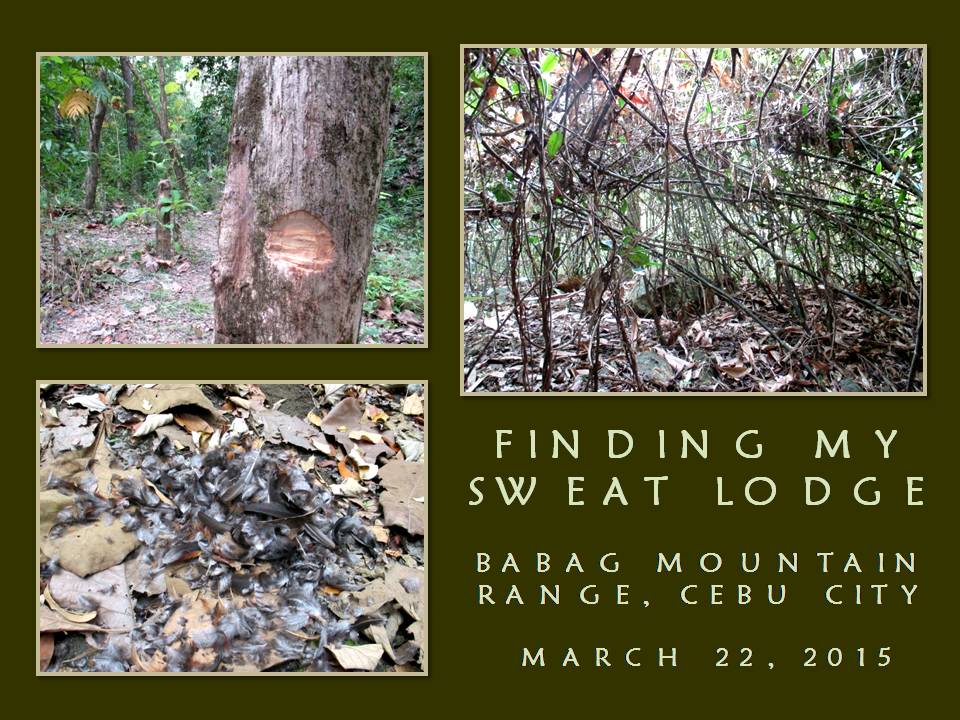
I HAVE TO FIND MY INDIAN-style camp today, March 22, 2015, which I failed to locate seven days ago. I would use the same route as was the last time but, this time, I will cross Creek Charlie and walk that steep trail that I have noticed many months ago. This time also, I have to be early so I could cover more ground and not compromise my health by eating a late lunch.

After procuring the food ingredients for my meal at Guadalupe, I proceed to the trailhead at Baksan. I go down to the reclining mango tree and prepare the Chipaway Cutlery fighting bowie knife that I aim to carry openly for today. I also brought an Albay-made native blade (Local name: ginunting) with its wooden sheath as a back-up tool should I need it for hard chopping work.


A Mora Companion knife is safely slipped inside the pivot place of the right shoulder strap of my backpack while a Victorinox SAK Trailmaster is inside the bag’s front pocket. I get ready my Canon IXUS 145 camera and my Cherry Mobile U2 phone, then I sent off text messages to Jhurds and Ernie about my solo hike. The sky is partly cloudy but it is warm. I place my meshed shawl on my neck should I use it to cover my head if I am exposed to the sun. Once again, I pick up a short stick which I could use as a tool or a weapon.

It is 08:00 when I begin my walk. I found the new route that I had chosen and explored last week very favorable compared to the old route of interconnecting ridges. My water bottle is full compared to the last time and it gave me confidence. It is getting warm as clouds begins to disperse. The teak forest does not help me a bit as it is now almost bald of leaves. The path led to a dry stream called Creek Alpha.

I stop where another dry stream join and see drops of liquid on a stone. It is sticky. It comes from a high part of a live tree. I put a finger on my tongue and it is sweet. Another overflowing honeycomb but there is no hive. This is a different colony of stingless bee (kiyot). I found one last week near Camp Damazo and I am quite surprised that nobody had harvested these.


I see a path beside the dry stream and I might as well explore this since I have the luxury of time. This path goes on a small saddle to another foothill. My right foot snagged on a root and I dive forward landing on the right side of my body. Fortunately for me, the trail is full of dry mahogany leaves and it cushioned my fall. I stood up and continue. I notice my right small finger acting queerly.

I cross a dry gully and walk among tall mahogany trees whose foliage are now enveloped by leaves of crawling bamboos (bokawe). I find this place remote with a small clearing to set up a tepee but I see a debris shelter used by a hunter and, coupled by lack of a water source, I decide that this is not the place I am looking for. This is the first of the many places I am exploring and I have a full day to find that perfect place.

I go back to Creek Alpha and walk downstream. I pass by the slow seeps occurring on the dry stream and studied it for some time and quite convinced that the source is not near here. It could be from the other side of the mountain. I walk on and visit my old campsite which I yielded to the holding of the first Philippine Independence Bushcraft Camp in 2011. People had spent a night here recently. They had a dry camp. Were they had dug a hole, they could have water.


They had used big chunks of wood for their campfire. I never taught people Western-style camping. I always taught the conscientious use of forest resources, including firewood. I do not like bonfires because it is unnecessary. I see the flattened vegetation caused by tents – which is okay - and I see a tree trunk chopped so a rope of a hammock would not slide down – not a good idea.

I leave the camp and Creek Alpha for the next destination – Camp Damazo. The dead teak leaves which had carpeted the trail last week had disintegrated, caused by several pairs of hiking shoes passing by here. I am walking comfortably now without those “popcorn” sounds. After the teak comes dry mahogany leaves. The leaves had either frayed or crumbled and I do not feel like “floating” today.

I arrive at another dry streambed called Creek Bravo. It would be good to explore the part of the creek up ahead. I notice small spurts of running water and pools of clear ones when I walked a considerable distance. I had also observed a smaller branch of a creek contain much water than the bigger one. Nevertheless, I explored the farthest reach of Creek Bravo until I could get no further. Besides that, I have no appetite to use a stream, even how dry, as a route.


Creek Bravo would have been an ideal location for a campsite since it could provide me adequate water but its banks are just too steep. I go back to where I came from and start exploring the small stream that joined Creek Bravo. Somebody had cooked something here and that somebody had dug two water holes. Aside that, this somebody had placed a zingiber leaf underneath a rock and water flowed on it like a trough. It is just less than a day old.

I walk on upstream over several clear pools of water and I discover (and assume) that this small unnamed stream is the source of those slow seeps occurring at Creek Alpha! The streambed is easy to walk although it steep gently and I begin to like it here. I could go on walking up to its source which I believe could just be up ahead. I look for level areas along its banks but all are steep.

I see something unnatural. In the middle of a dry part of the creek is a clump of feathers. That somebody had caught a live wild fowl and dressed it here. There is no sign of blood, so the fowl must had been caught with a snare or it could be brought here. What caught me by surprise is the fowl was very fat judging by the texture of its feathers. I collect nine feathers and carefully stow it.


I go back to the bigger stream and decide to prepare my lunch. It is now 10:20 and, besides that, I had not taken anything solid since the time I woke up. I will make my fire over the ones that I have found somebody cooking. I collect dry firewood. I have no problem with dry wood since it is totally very warm for the past four weeks. I choose twigs and small branches and break it into short pieces.

I brought with me my AJF Folding Trivet, place a pot above it and I start to boil water. I need to enjoy coffee first before I start my cooking. Milled corn came next and then I start to slice pork meat, onions, garlic and green pepper with my Morakniv over my extra-thin PVC chopping board. When the milled corn got cooked, I place the second pot with oil over the fire.

I scatter crushed garlic first until it begins to go brown then I drop sliced onions. Next comes the chopped green pepper. Finally, the meat. I stir it all briskly, reduce the flame, and return the lid. After about five minutes, I stir it again before I pour soy sauce. Feed the fire with more wood and start to relax. After another 10 minutes, I take a peek at my pork. It looks perfectly cooked and it smells spicy. Now, I am hungry.


At exactly 12:00, I eat lunch. In silence, I enjoyed the meal. It is very spicy without any artificial flavourings. It is cooked with the right frame of my mind. I eat all the pork adobao but I am not able to eat the rest of the milled corn. I leave the rest instead on top of a big stone which is exposed to the sun. The oil from the adobao, I pour over the milled corn. It would make a nice meal to this forest’s wildlife.

I start packing my things and continue on at 13:00, going up to Camp Damazo. The honey I discovered last week is still oozing in slow motion from its perch to the ground and nobody had disturbed it as well as the Asiatic bitter yam (kobong) that I dug also last week. Eventually, I reach Camp Damazo but I walk past it towards Creek Charlie. Plants always attract me and I take it seriously by taking pictures of that which I need to learn or to teach people.

I have always seen this strangely-shaped tree which looked like either a giraffe or a brontosaurus but have not dared to come close and shoot it. Was it fear of the unknown or is it just that I would not want people know of its existence? Both. I may be a modern savage but I believe in the spirit world that I always give it a sense of respect. Today, I felt something that this whole forest had accepted me so I go near the tree and take pictures.

Having done that, I go down the stream and study the banks for any human or animal activity. I found none so I watch the water cascade down slowly on rocks coming from upstream. I see a long pole of bamboo arching down to the other bank which I have not noticed in my previous visits. A smile crossed my face in the discovery of another rare bamboo grove. The forest is slowly revealing its secrets to me and I take it as a sign that the search for my camp would not take long.

Across me is a trail which I had noticed for sometime but lacked the time to explore it. I am not in a hurry. Perhaps, it would be wise if I lay down first on a rock big enough to fit me and close my eyes to rest for a while. The stream is very humid, the early afternoon sun drains me of my strength. I would summon my energy back first and, when I am ready, I would continue my search for that elusive camp which I plan to make as a sweat lodge. Just a little while.


By 14:00, I am up and begin engaging the path that lead up to a steep mountain. This is a seldom-used trail and I use my tracking skills to follow the scant path which goes up a ground which has a steep gully that is 20 feet deep. The path crosses to a part where it is not deep enough and continue on precipitously to the other side. It is a dangerous choice of a trail but I soon sense that there is no better way to cross over the other side except through here although walking here sends you shivers.

I climb up and the trail vanishes before a conglomeration of naturally-felled trees and debris caused by recent typhoons. I veer left over easier slopes and face another sheer slope. I catch a glimpse of level ground, which is quite rare in a place where I am now. I scan the place all around. Trees are everywhere but not on the place where I stood at a radius of five meters! A rare pocket of open ground in a forest and the only piece of level ground on a rugged mountain slope.

The forest had been kind in giving me this place as a gift for my future sweat lodge. Somehow, I cannot explain how it had known my heart, my mind and my purpose. The place is a place of power. It faces east where the sun rises. Across me is a distant mountain and, behind it, is a small mountain range. With so much dead wood near here, I could make either a teepee or a hogan. I am quite happy at this discovery.

I make more explorations and I discovered two more bamboo groves, one of which had not shown signs of human activity. There are a lot of bamboo poles that I could use in the construction of a shelter. There are also a lot of wild edible plants that I could cook but I could introduce vegetables and fruiting trees here in the future. The place is awesome but very remote and quite hidden.

After I had finished my business here, I returned to the path I took. Before leaving, I left a mark on a tree and a trailsign on another tree. It is necessary since what looks familiar today would look strange in a different season. I go down Creek Charlie then up towards Camp Damazo but veer left instead to the exit route. I reach the road but cross over to a trail that leads to Lanipao.

I will be back for sure. I believe it would be after the Philippine Independence Bushcraft Camp or later.


Document done in LibreOffice 3.3 Writer


Saturday, October 24, 2015

BUSHCRAFT BUHISAN XXXII: Sweet Time

I WILL BE EXPECTING that the Buhisan Watershed Area – my training ground – would soon be off-limits to people. While it may bring in good results for its upkeep, it denies people to make a living there. The protection of the watershed from illegal logging, charcoal gathering, wildlife poaching and, to a lesser degree, recreational activities, will make the man-made forest generate healthily and ensure a cleaner water supply for the metropolis.

The Buhisan Watershed Area, known previously as Lensa (and still do by the locals), is 5.5 hectares in size. It is mostly found in the village of Buhisan but parts of it are found or are bounded by the villages of Toong, Pamutan, Sapangdaku, Tisa and Guadalupe. It has a man-made lake that often disappears because of siltation and a 100-year old but still working dam which was constructed by the Americans when Cebu was under their administration.

As a man-made forest, early reforestation work focused more on the planting of exotic trees which modern soil scientists have found to be incompatible with local flora and fauna and causes leaching of soil which does not produce good results for a healthy and balanced ecosystem. Only the hardy rattan palm and other equally hardy weeds grow compatibly underneath mahogany trees, a South American import.


The dry water channels, where rainwater passes, and the small streams are choked with indigenous species and it is where healthy trees and shrubs are found. Likewise the catchment basin and its nearby marshland. There is life there. Birds, butterflies and all sort of wildlife abound on those narrow corridors. My activities are focused on those corridors too which a few cannot be penetrated by radio, cellphone or satellite signals. These are dead spots.

Somewhere among those hidden places where vegetation is thickest, I will find my Indian-style camp. My own “spirit lodge” where I would vanish into its solitude and do meditations to purify the spirit. Although I have found it long ago, I had ceded it to the hosting of the Philippine Independence Bushcraft Camp in 2011. It is not applicable now since it is now a known location. I will look for another and it is on this quest today, March 15, 2015, that I took to exploring the Buhisan again alone.

It is a very warm morning as I start my hike. I am late in waking up and have failed to join my brethren in the Camp Red Bushcraft and Survival Guild doing a knife safety class in the other part of the mountain range where I am at. I had bought food ingredients for my noontime meal at Guadalupe but I doubt if I could eat at exactly noon since it is now 10:30 and too few hours to prepare that given the time that I will consume most later for walking and exploring.


The underbrush had wilted and tree branches had thinned. Sunlight is now felt even under a man-made forest of Burmese teak with which branches own the widest set of leaves. The ground is parched dry due to absence of rain for a good three weeks. Branches of a star-apple tree almost kissed the ground as the fruits are now heavy and ripe for the picking. I took four ripe ones with me. I stop for a while under the shade of a mango tree to get my AJF Gahum knife from inside the Sandugo Khumbu 40L bag and open carry it.

After a small sip of water, I proceed on. Today I will try to inspect another trail that branch on the right, which is different from the route that I used to hike which led to Boy T’s Hell and then down to Creek Alpha. This new route is not going uphill but going down in a very moderate manner which I suspect would lead to the same Creek Alpha. I walk slowly trying to absorb the heart and soul of the trail, inhaling to memory its distinct aroma and listening to the sounds of the wind and the birds.

Another trail branched off the ones I am following but I shrug it off. My focus is on the main trail which now goes down into a dry streambed where there is an abandoned sack of sand. I see drops of liquid on a stone and it looks like sweat. Moisture would instantly evaporate at this very late morning but it is still recent. I look for human signs and I see grains of wet sand on a rock, the kind you see when a shoe transfer sand to a polished floor.


A smudge here and a deep footprint there. Whoever he is, he must have been in a hurry and his direction goes downstream. I do not have to follow the gait of a man on flight. His presence is enough for me to keep my eyes and ears open and sense everything unusual. Walking on the dry stream, sand gave way to granite. Depressions on the rocks hold water, colored in a transparent reddish tinge, and minutes of life swim on the surfaces.

I see a very slow seep of water coming out of a crack of granite and above it are the greenest shrubs. An unknown number of birds could be heard tweeting and chirping from that direction. So, there must be a good supply of water to make those shrubs perpetually green under the steaming heat of the day which also made the birds happy. I mark the spot in my memory and I would explore it on my next visit. Promise.

Following the stream down, I see a familiar place, only it is dyingly dry, and then a trail. The most beautiful trail on this balding forest is still beautiful as ever since it is shady and the ground is carpeted with dried leaves. Only it is too short. I stay for a while to answer the call of nature and to leave something housed in plastic and hang it from a branch. It is intended to mark the spot as a camping site for visitors who will come here in a few days.


The trail ended abruptly on the creek, as expected, and I walk the dry bed where another trail begins on a high bank. I had found one of the last missing puzzles of Lensa Trail which happened more than an hour ago. Yes, I spend more than an hour for that new route I tried which is not even a kilometer long. The sun is almost at its zenith but I do not intend to hurry. Hurrying is playing in to stupidity. A thinking man do things in a comfortable pace.

The path is littered with dried leaves of teak and mahogany. The bigger teak leaves are more noisy as it crumble in a loud crunchy sound as you step on it. I try to evade stepping on it but there are just too many and my walking sounds like a huge popcorn feast. It betrays my presence. The smaller mahogany leaves are not noisy but stepping on it is like stepping on a soapy tiled floor. The leaves slip against each other and you literally float on dry land. Whichever, I found these dry exotic leaves annoying.

I reach the very dry Creek Bravo and take rest. It is now 12:00 but I am not hungry. I open the biggest star apple fruit and munch it. I hope the seeds grow where it landed. I need to inspect the groves of water bamboo up a high bank so I climb it. I see six groves but only one is healthy enough to have recovered so well from wanton harvesting last year by locals. The other five, including the one burned down, have slowly recovered but all are not healthy yet.

I go down back to the stream and I see four boys accompanied by two adults. They are on a hunt for the edible tree snails (Local name: taklong, takdong, takyong, korakol) and they are going downstream towards the bigger Lensa Creek which, I believe, is also dry. I need to go up a ridge and prepare my meal at Camp Damazo. The camp, which hosted two more episodes of the PIBC, is on a high-ground but, the good thing is, there is a good water source near there.

I notice that the trail had not been cleared of debris that Typhoon Seniang dealt with last December and so I get to work on my AJF Gahum and start clearing. Trail maintenance is a manly labor and I love doing this. The sound of the chopping and the slashing motivates me more of the importance of my existence and purpose. It makes me think clearly aside from the opportunity that silence and solitude had already presented.


In my active pursuit I get to know of a plant which, to the rest, is just a pesky vine that hurts skin. A weed. This is the Asiatic bitter yam (kobong). I found the rootcrop as I was going up the ridge since it was exposed. I open the bulb and the flesh is colored yellow and starchy. The stem is olive green and full of thorns. At this time of year, it does not bear leaves. It adapts. I collect pieces of the rootcrop and bring it with me for propagation.

Once I am on the ridge, a whole branch that broke off from a tree block the trail. I clear the smaller branches and stack it above the other. I make it sure that good-sized wood are not touching the ground. Who knows, I may have use of it one day? Rattan palms cross the path. I did not cut it but move it sideways with the use of a forked stick. I place a few trail signs on the trunk when I think a branch of a trail might mislead people.

After I picked up a wrist-sized wood that cross the path and place it beside a trunk, I notice a glossy liquid on a stone near a tree. The liquid came from the tree and it slid down the trunk down into the ground and that stone. The source is too high to see and I notice that the tree is dead. I touch the glossy liquid. It is partly dry but sticky. I taste it and I found it sweet. Honey! No beehive. Only a stingless bee (kiyot) could produce honey without building a beehive. It bores through wood and make their honeycombs inside.

Satisfied with my discovery, I continue with trail maintenance until I arrive at Camp Damazo. Exhausted by my walk and by my work, I take two sips of my diminishing water. It is now 13:00, so I decide to stop here and make my meal. I retrieve one of my bigger pots and my cup and, along with my almost-empty water bottle, I walk a little distance to a natural spring, leaving my bag behind perfectly hidden. The spring had not diminished its flow and may need a change of its bamboo trough though.

When I came back, I look for dry wood. There are plenty but I prefer the twigs and small branches. I break it into small pieces and prepare a fireplace. I need to drink coffee so I will heat the water inside the bigger pot. I look for three sticks to make a tripod and lash it all on one end with a green vine. When it was done, I hang the pot and start making a fire with a lighter. The warm temperature made my fire easy and soon I will have my coffee.

I transfer some of the partly boiled water into the smaller pot so I could commence cooking the milled corn while providing my cup some amount of this water for instant coffee. The smaller pot does not have a handle like those of the bigger one which can be hanged. I found a flat stone and place the second pot above, one half of its bottom to the fire, the other half balancing on the stone. The good thing about milled corn is you do not have to reposition the pot to evenly cook it. You just have to stir forcibly the contents.

I grab the pork meat and slice it with my Mora Companion. Same with the onion, garlic and green pepper. I pour oil on the bigger pot and hang it back feeding the fire with small sticks. I found two more stones and confine the fire to a small space so it would not spread and, at the same time, maximizes cooking efficiency. I drop the sliced onions, garlic and green pepper into it and stir. I add the sliced meat and stir more until it is brownish. I pour soy sauce and return the lid.


The milled corn is perfectly cooked without a trace of burnt particles despite the pot exposed to the flame on one side only. About the same time, my pork adobao is ready for serving after a sprinkling of black pepper powder. At 15:15 I eat my late lunch. In the silence of the afternoon, I savor the simple meal alone and without any distractions. It is a sweet time that pure backwoodsmen of old would enjoy.

Sadly, I cannot continue with my search of my Indian-style camp for I do not have the luxury of time. Perhaps, next week. I would find it while Buhisan is still blissfully open. I was not able to eat all I cooked but I have someone who would need this. I clean the place and burn anything man-made I found at Camp Damazo. After packing my things and making sure that the fire had died, I leave at 15:45.

I arrive at the road, cross it, and give my food to the “forest keeper”, Mario. I call him that because we frequently meet each other in the most remote parts of Buhisan. He makes a living there and the fencing of the Buhisan would affect his livelihood and deny his family a chance of decent simple living. I am sad for him but, I believe, he will find ways to earn his living on the same place of which I, too, would find access to visit my soon-to-be-found “spirit lodge” in the near future.

The day is now casting long shadows but the trail is easy now. The setting sun had washed Tagaytay Ridge in a beautiful glow. The skylined towers above it are now linked to each other by cables. In a while, I will be in the community of Lanipao and then in Napo, where there would be a motorcycle-for-hire waiting for me.


Document done in LibreOffice 3.3 Writer