Showing posts with label events. Show all posts

Friday, January 22, 2021

2021-004 | THE 2ND JACOBEAN CONGRESS OF CEBU

WHEN THE MUNICIPALITY OF COMPOSTELA, Cebu, through its then mayor, Hon. Joel Quiño, accepted the invitation to host the Second National Congress of St. James the Apostle Parishes and Devotees during the first congress held in Alabang, Muntinlupa City in 2018; it was the best thing to happen because it would expose our Camino de Santiago to more pilgrims and people; and it would also place Compostela in the center of the Jacobean Pilgrimage of the country instead of just another provincial backwater. 

Our own Compostela, the namesake of that famous city in Spain, hosts another namesake of a church from its mother country, the Archdiocesan Shrine of Santiago de Compostela, established in 1866 by an Agustinian Recollect priest from Zaragoza, Spain who brought with him a statue of St. James that became a permanent fixture high above the parish door. Its parish priest then, Fr. Scipio Deligero, was all smile as his pet project would soon be demonstrated before a national congress.

The congress in Cebu was simply all about the Camino de Santiago. The devotion of St. James was and always been centered on how and why people came to know him better: the Camino. It was the Camino de Santiago that lured me closer to him for, without it, I barely knew the good saint. It was the Camino de Santiago in Spain that pushed Fr. Scipio to have one like this in Cebu, that is affordable to anybody but, at the same time, spiritually fulfilling. A poor man’s Camino. 

In the preparation leading to the event, a huge botafumeiro or censer, 11.5 feet tall and 150 kilograms in weight, was fabricated courtesy of a single donor; while a huge structure housing this botafumeiro was soon constructed infront of the parish, courtesy also of four other donors. The main thoroughfare was paved with thick earthen bricks where scallop images lined the edges. Then an FM radio station was installed to deliver the news of this event to the remotest areas. At short notice all proceeded to be available on the appointed date: February 5-6, 2019. 

Ten days before that date, I was leading ten pilgrims on January 27, 2019 from the St. James the Apostle Parish, in Poblacion, Badian to the Our Lady of Consolation Parish, in the mountains of Manlapay, Dalaguete. We were on our first day of the Camino Cebu, a 175-kilometer pilgrimage over the central backbones of Cebu that is walked for ten days. The first day is always the hardest for it is walked from near sea level to 780 meters of elevation and 18+ kilometers long.


The ten pilgrims were Fr. Wilfredo Genelazo of the Archdiocesan Shrine of Our Lady of Fatima of Basak, Mandaue City; adventure entrepreneur Randy Salazar; Big C survivor Renelyn Reynes; journalists Erl Durano and Grace Lina; ship electrician Rafael Gica; Jocelyn Baran and Jean Antipuesto of Compostela; an OFW from Abu Dhabi, Sheen Mark Deligero; and Raszil Zuasola, our photographer who has a bag that his brother had carried in the Camino Primitivo in Spain. 

The second day, January 28, was a long day, 20+ kilometers, and warm, as we trudged over the “Vegetable Highway” from Manlapay to the Our Lady of Immaculate Conception Parish in Colawin, Argao. The third day, January 29, was almost the same but longer, 26+ kilometers, warm, following the same “Vegetable Highway” from Colawin, passing by Sibonga and parts of Carcar City to the San Isidro Labrador Parish in Mantalongon, Barili. 

The fourth day, January 30, was 19+ kilometers long, also a warm day, from Mantalongon, passing by the San Isidro Labrador Parish in Calidngan, Carcar City, to the St. Augustine de Hippo Parish in Magsico, San Fernando. The fifth day, January 31, was the last of the long days, at 22+ kilometers, from Magsico, passing by the San Roque Parish in Uling, Naga City, to the San Pedro Calungsod Parish in Cantabaco, Toledo City.


This was now the turning point of the Camino Cebu when the pilgrims would experience shorter days and longer rests. The sixth day, February 1, is shorter than usual, at 14+ kilometers, from Cantabaco, passing by Minglanilla, to the St. John the Baptist Parish in Sudlon I, Cebu City. The seventh day, February 2, shortest at 8+ kilometers, starts late from Sudlon I and meander down to the Birhen sa Guadalupe Parish in Babag, Cebu City. 

Day Eight, February 3, is 16+ kilometers long, from Babag to the Sto. Niño Parish in Guba, Cebu City. It was here that we watched in Facebook Live, the arrival of relics of St. James in the Mactan Cebu International Airport from Compostela, Spain. Fr. Deligero, Fr. Gonzalo Candado and Mayor Quiño led the contingent to receive the sacred cargo brought by Msgr. Elizardo Temperan Villaverde, Chancellor of the Cathedral of Santiago de Compostela, who was with Fr. Manny Domingo SDB. 

There was a motorcade from the airport to the Archbishop’s Palace, in Cebu City, for viewing, and then to its permanent home in the Archdiocesan Shrine of Santiago de Compostela, where it will await of our arrival on February 5. That night, in our sleeping quarters of the multi-purpose hall of the Sto. Niño Parish, we celebrated the occasion with a small party, courtesy of then parish priest Fr. Peter Necesario. A pilgrim of the previous Camino of July 2017, Jonathan Apurado, joined us here to walk with us for the last two days.


On the ninth day, February 4, everybody were now excited as we were now on the threshold of Compostela. It is just 15+ kilometers away and, possibly, we would meet the first pilgrims doing another Camino de Santiago later in the day, who would be starting from the Archdiocesan Shrine of Santiago de Compostela. We left Guba and passed by Consolacion where, at 2:00 PM, we met Xenon Walde, Angie Villanueva, Cleo Villanueva and Eric Cuisia of the St. James the Greater Parish of Alabang, at Mulao, Liloan. 

There were 78 pilgrims on this shorter Camino Cebu, plus the 11 of us, converging at Basak, Compostela. Most of the pilgrims were housed in the covered court, while the rest were distributed among private homes and the Gatubod Spring Resort. We were just fortunate to be accommodated in the humble home of Bro. Frank Catampatan and family. There was a barrio fiesta atmosphere in the covered court as utan bisayà (traditional Cebuano vegetable soup), inasal (roasted pig) and pusò (rice wrapped in coconut leaves) were served as dinner.    

The last day of the Camino de Santiago for both the 2 days and the 10 days, February 5, begins from Basak, going up to the peak where the “Cross of Triumph” is located, in Bagalnga, Compostela; and then going down to the Archdiocesan Shrine of Santiago de Compostela. There, we were met by a cheerful crowd and the unceasing pealing of bells announcing our arrival. A Eucharistic Celebration was celebrated by the freshly-ordained Fr. Vhen Jesus Fernandez of Compostela.


After venerating the relics of St. James that I saw brought here two days ago in Facebook, I turned myself in to my host, Capt. Lito Ramon and family. I then proceeded to the parish where there was an evening program. Dances and songs from the best talents of Compostela were presented to the pilgrims. Amidst all that, a buffet dinner was served. Saw many familiar faces, especially of the contingent from Alabang, led by Bro. Benjie Bernardo and wife. 

Two pilgrims were selected to give their own personal testimonies of their experience of the Camino de Santiago: one was from the 2-day Camino which was beautifully expounded by Cris Evert Lato-Ruffulo and the other was from the 10-day Camino which that honor belonged to Randy Salazar, who equally dished out a good testimony. I shared a table with Fr. Deligero where a cold bottle of beer came my way. He seemed so peaceful as if a big needle was removed from his back. 

The last day of the congress, there was a separate presentation done by Bro. Benjie Bernardo of St. James Alabang and then by Msgr. Elizardo Temperan Villaverde, who was speaking in Spanish but translated by Fr. Manny Domingo SDB. Both speakers were extolling the virtues and the origins of St. James, who was also known as Jacob, Yago and Diago; with the latter explaining how the Camino de Santiago began; and how it changed the course of Spain’s history and its fortune.


Then the last program of the Jacobean Congress was the Concelebrated Eucharistic Celebration presided by His Excellency Jose Palma DD, the Archbishop of Cebu. Then the exchange of the "Spiritual Bond of Affinity" between the Cathedral of Santiago de Compostela of Galicia, Spain by Msgr. Temperan and the Archdiocesan Shrine of Santiago de Compostela, of Cebu, Philippines by Fr. Deligero were presented to all pilgrims and parishioners which elicit a loud response. The documents states "that you would receive the same spiritual rewards and plenary indulgences" in either the Camino in Spain or in Cebu. It is a good feeling to see this possibility coming through in my lifetime. GOD IS GOOD! 

I bid goodbye to Fr. Deligero, Fr. Candado, Fr. Fernandez, my fellow pilgrims and my good hosts of Compostela and settled in a Toyota Hilux, driven by Markus Immer who was with wife, Analyn, for home. The couple came just to give me support and to witness the most important program of this once-in-a-lifetime event that would soon change the way of life of Compostela. The 2nd National Congress was a success because of a very warm cooperation of government and church and the population that boasts of good charisma by its priests and local government officials. 

As I end this article, I would like to thank the following for their support of the 2nd National Congress that was jointly hosted by the Municipality of Compostela and the Archdiocesan Shrine of Santiago de Compostela; and the Camino de Santiago that progressed forth along the way on January 27 to February 5, 2019; to include me. They were: 

My understanding wife and my family.

Fr. Marlon Mejia of St. James the Apostle Parish, Badian.

Mr. Tirso Cominghod of Barangay Tigbao, Badian.

Badian Municipal Police Station.

Fr. Elegio Almazol Jr. of Our Lady of Consolation Parish, Dalaguete.

Fr. Mario Villacastin of Our Lady of Immaculate Conception Parish, Argao.

Fr. Benedict Into of Our Lady of Immaculate Conception Parish, Argao.

Argao Municipal Police Station.

SPO3 Dante Estenzo of Sibonga Municipal Police Station.

PO3 Paul Baclay of Sibonga Municipal Police Station.

Fr. Dennis James Acedo of San Isidro Labrador Parish, Barili.

Fr. Lyle Carungay of San Isidro Labrador Parish, Barili.

Fr. Benjie Contapay of San Isidro Labrador Parish, Carcar City.

SPO1 Eduardo Bagol of Carcar City Police Station.

PO1 Chuck Dayuja of Carcar City Police Station.

Fr. Murphy Sarsua of St. Augustine de Hippo Parish, San Fernando.

Fr. Armando Orehuela of San Pedro Calungsod Parish, Toledo City.

Fr. Bernardo Oyao of St. John the Baptist Parish, Cebu City.

Fr. Mark Barneso of Birhen sa Guadalupe Parish, Cebu City.

Fr. Peter Necesario of Santo Niño Parish, Cebu City.

Mr. Markus Immer and Mrs. Analyn Pocong-Immer, Cebu City.

Bro. Frank Catampatan and Family of Basak, Compostela.

Bro. Cedee Neo and Sis. Julie Neo of Doneo Host Making, Cebu City.

Bro. Mizar Bacalla of Archdiocesan Shrine of Santiago de Compostela.

Sis. Mimi Montecino of Archdiocesan Shrine of Santiago de Compostela.

Capt. Lito Ramon and Family of Poblacion, Compostela.

Mr. Jose Neo of Camp Red Bushcraft and Survival Guild, Cebu City.

Mr. Jet Manuel of Ham Radio Cebu, Consolacion.

Mr. Ed Soronio of Versa 2-Way Radio, Mandaue City. 

But, most importantly, to all the nameless parish workers and volunteers who served us our food, our beddings and who attended to our comfort as we engaged on our pilgrimage of the soul. I am most indebted to them and may St. James intercede my prayers whispered for them at the foot of the Cross of Triumph, upon his relics and the Abrazado, which is located in the chapel of Doneo Host Making in Banawa, Cebu City.


Photos courtesy of Pilgrims and the Organizing Committee.

Tuesday, December 18, 2018

THE 1ST PHILIPPINE CONGRESS OF ST. JAMES THE GREAT

THE ARCHDIOCESAN SHRINE OF SANTIAGO DE COMPOSTELA of Compostela, Cebu gets invited to the First National Congress of St. James the Great Parishes and Devotees. The date is February 6 and 7, 2018 and it would be held at the St. James the Great Parish, Alabang, Muntinlupa City. To date, the country has 46 such parishes dedicated to St. James the Apostle (the Great) spread throughout Luzon, the Visayas and Mindanao.

 
Cebu has three such parishes and the two others are in Badian and Sogod. The gathering is initiated by the Alabang-based Confraternity of St. James (CSJ) and would bring together these 46 parishes for the first time, introduce their parish priests and devotees to one another, create awareness on the life of St. James, be involved in developing local Caminos, be informed of the CSJ and its mission, and to become one evangelical community.

Fr. Scipio Deligero would lead the contingent from Compostela. Going with him are Hon. Joel Quiño – the incumbent municipal mayor of Compostela, Jem Montesclaros, Mizar Bacalla, Roger Montecino, Alvie Rey Ramirez, Jonathaniel Apurado and this blogger. We were the pilgrims that have completed Cebu’s first Camino de Santiago last July 2017. Another pilgrim – Roderick (Jem’s husband) – could not join us due to his job.

We leave Cebu early on February 6 by plane and touched down at the NAIA at 07:45. Bro. Francis Choi of the CSJ Transport Committee fetched us and we were billeted at the Bellevue Hotel in Alabang. We missed the opening Eucharistic Celebration of the Congress but timely enough to be seated on one of the tables and be recognized during the introductions. We found out that we were the only ones representing Cebu.

The Cardinal Sin Hall became the main venue for the full two days where the representatives of more than 35 parishes converged. Breakfast, lunch and dinner, along with morning and afternoon snacks, were served courtesy of the CSJ, led by its President, Bro. Benjamin Bernardo and by the event chairman, Sis. Conchita Arau. The hosts made it sure that everyone is comfortable as possible as the Congress unveiled the different programs and activities.

First to speak is Rev. Msgr. Pedro Gerardo Santos, Executive Secretary of the CBCP Episcopal Commission and concurrent Parish Priest of the St. Peter and St. Paul Parish of Makati City. Msgr. Santos talked about “St. James as Apostle, Pilgrim and Caballero”. Next to speak is Rev. Fr. Francis Eugene Fadul, Chancellor of the Diocese of San Pablo. Fr. Fadul talked about “Promoting Devotion of St. James and Making Him Known”.

Main speaker is Orlando Cardinal Quevedo. Cardinal Quevedo is the current Archbishop of Cotabato and he talked about “St. James and the New Evangelization”. Since there was still a surplus of time before the next program, I volunteered to do a presentation of Cebu’s own Camino de Santiago which the Cebuano contingent had walked for 10 days across 175 kilometers of rugged mountains from Badian to Compostela.

After noonbreak, the delegates were grouped by regions and each was given a checklist of fourteen activities that each believed should be most acceptable and worthy to be held in their own parishes. In this workshop, the majority opt to have a Pilgrim Walk, a Novena to St. James, and a Fiesta Translacion – all tied for number 1 – as their choice. Next came the (2) St. James Prayer and (3) the St. James Hymn.

When the workshop was finished, everyone settled down and the whole congress would have to choose from among them of who would host the next edition for next year. Cebu was chosen and Fr. Scipio accepted the challenge after conferring with Mayor Joel. Alabang has set a high standard when it came to organizing and hosting the 1st National Congress and we have to do our very best to, at least, replicate this.      

Everyone prepared for a Eucharistic Celebration at 17:00 which will be concelebrated by Bishop Jesse Mercado of the Diocese of Parañaque; Rev. Fr. Rolando Agustin, Parish Priest of St. James the Great Parish of Alabang; and the delegate priests of the other St. James the Apostle parishes of the Philippines. Homily was given by Bishop Mercado. All the priests were provided brand-new vestment with the red Cross of St. James embroidered on the back. Each parish received a third-class relic of St. James the Great, sent from Compostela, Spain for this occasion.

The hosts of this national congress – the Confraternity of St. James – treated the delegates to an evening of songs and dances, good dining and red wine. The hosts have successfully welded a community dedicated for St. James the Great (or the Greater and the Apostle) and their preparations and hard work turned out so well. We shall be bringing the goodwill of St. James the Great and the CSJ to the far provinces where we will focus from now on. The night ended on a high note but we will have to rise early the next day.

Scheduled for the second day – February 7 – is the Camino Walk in and around Ayala Alabang Village. Our delegation came late but it does not matter. We only have to quicken our pace to catch up. We finished all the ten stations designated by our hosts but we did not catch any early bird. We were that late and we suffered for that with more sun on our crowns. We all got our passports stamped and earned our scallops.

We were the last to arrive and some of the delegates were having a grand day on the facade of the St. James the Great Parish taking group pictures and individual selfies, both handsome and beautiful wearing the blue Camino t-shirts with a bold golden-yellow arrow print that forever point left. The Camino was the highlight of the first congress and it is this particular activity that the deeds and sacrifices of St. James are fully appreciated.

Gaining from the experience, appreciation, humility and the wisdom, we returned to our hotel knowing fully well that we would not be seeing again our new-found brethren until after another year. A community has been born from this congress and friendship and network has just been cemented. We are all pilgrims of life and we followed the Light that had been wrought for us by His Blood and St. James holding high the banner that we are in the right direction.

See you in the 2nd National Congress! ¡Buen Camino!  

Document done in LibreOffice 5.3 Writer

Friday, July 20, 2018

THE TRAILHAWK JOURNEYS: AkyatCon 2.0

UNIVERSITY OF THE PHILIPPINES MOUNTAINEERS, Inc. introduced AkyatCon in 2016 to the outdoors community. This was a national convention for responsible mountaineering and for the conservation of mountain environments. It is where professional and leisure hikers, local communities, conservation workers, students and academics, national and local government agencies, and other stakeholders share their accomplishments, projects, technology, information, knowledge, and experiences.

The following year – 2017 – the UP Mountaineers celebrated their 40 years as a school-based mountaineering organization, and as an advocate of responsible mountaineering and environmental protection. Running parallel to that was their hosting the second sequel and highly successful AkyatCon, in cooperation with the UP-Diliman Institute of Biology, on the dates of July 28 and 29, 2017, at the Institute of Biology Auditorium, Diliman, Quezon City.

AkyatCon 2.0 featured discussions on mountain biodiversity and conservation, outdoor ethics, mountain-related policies and implementing issues, cultural and gender aspects of mountaineering, explorations and expeditions, emerging/current mountaineering techniques, technologies, issues and trends in mountain sports. UPM aimed in enlightening participants of such topics especially with the growing popularity of mountaineering as a sport and as leisure activity available for everyone who wishes to experience the outdoors.

From out of the blue, I was invited to give a talk about the Cebu Highlands Trail for AkyatCon 2.0, which I accepted. I could not believe it then. No less than the UP Mountaineers extending that invitation to me even when I have not submitted any abstract nor an application. It was beyond my expectations yet I had to honor that and prepared my presentation and sourced funds for my travel to UP-Diliman in the National Capital Region. This was something big which I did not let pass away.

I did not know that the AkyatCon 2.0 organizers have taken an interest in my Thruhike of the CHT – all 400 kilometers and 27 days of that – and it took place on center stage, which is one of several plenary talks scheduled for two days inside the 150-seat auditorium. I added more spice to that by mentioning the explorations of the eight different segments for almost six years and the difficulties of engaging an expedition without support from big corporate names. These were the very ingredients that the CHT came to be.

I forgot to tell you that I am not a mountaineer. I am just an ordinary outdoorsman who walked and ranged mountains as a form of exercise, as recreation and where I earn my keeps. I am a bushcraft enthusiast, a wilderness guide and an experiential educator specializing in the outdoors. The CHT is just a by-product of my creative mind. I just want to inspire people that you can make your dreams come true with hard work, patience, persistence and a dash of audacity.

I arrived at NCR by plane on July 26 in a very dour morning. There was a tropical depression and it was raining hard. I need not worry about AkyatCon 2.0 since it is mostly indoors. I availed of the offer of a mining executive and friend to enjoy the privilege of staying at the Holiday Inn Manila for a day. Yes, for a day, this lowly bushman lived like a king and I took advantage of the uncooperative weather by exploring every nook and cranny of my comfortable kingly chamber.

 
On July 27, I transferred residence to Navotas City. The couple Jay Z and Carla Jorge have hosted me several times when I visit Luzon for my training sorties and I took this opportunity again. Carla is a public teacher while Jay Z takes care of their startup business – Pacing’s House of Barbecue. They are very generous when it came to sampling their menu to me. I could never say no for theirs is the most delicious fare on this side of town. This time, I dined like a king.

Then came the BIG day, July 28. That was my schedule and I was the second speaker. The AkyatCon 2.0 have already started when I arrived and the first of three plenary talks for this day – Eco-Climbing in the Philippines by Anthony Arbias – was now in its infant stage as I settled in one of the cozy seats of the auditorium. Listening to Mr. Arbias, I began to learn many things. AkyatCon 2.0 was a very good event for improving your stock knowledge and I commend UPM for this idea.

My turn came and I talked casually about the CHT without any script. The slides lets you in on the groove naturally. Did you not know that long ago I have this fear of speaking before a crowd? I do not know what happened in between but I found out that I have this natural gift later in life like wine when it goes through its aging process. Yes I was quite aware that I was in a bigger stage. I was in UP-Diliman! Right before me were authorities in their own right, academics and idealistic thinkers. The best in the land.

 
I was given an hour for my discourse and that was fair. I just add incongruencies to elicit laughter so I could steer my presentation back and forth without interrupting the natural rhythm of the slide sequence. Adding icing on the cake, I talked about my recent Camino de Santiago, which overlapped some of the routes of the CHT. Questions came my way but they were the merciful kind and I was able to satisfy people. A token of appreciation, a terracotta plaque designed by Roberto Acosta, was presented to me after my talk.

With my talk over, I went back to the lobby area so I would meet the very people who made possible my participation in AkyatCon 2.0 and they were Leonard “Bunny” Soriano and Jom Daclan, the UPM President. Tope Ordoñez, also of UPM, informed me of a room reserved for me. I returned to the auditorium to listen to the last plenary talk – An Everest Base Camp (EBC) Backpacking Experience by Ed Magdaluyo and Doreen Candelaria.

Lunch got served in the canteen of the Institute of Biology Building for the registrants, organizers and guests. Bottomless coffee was available provided you brought your own cup, this is in line of UPM’s pro-environment advocacy: Green Is Good. UPM was generous of my participation that they had provided me free stay for one night at the UP NISMED Hotel, where I headed that way on foot. The weather was still gloomy and the star gazing session at nighttime was now in peril.

 
In the afternoon, breakout sessions were held. There were three topics each hour and you have to choose one and you have all the four hours of the afternoon to navigate your way from one topic to another. For the first hour alone you have the following subjects to choose: 1) Down-to-Earth Approaches to Light Backpacking; 2) Speed Ascents; and 3) Top of the World: Identifying Factors that Influence a Person to Become a Mountaineer.

For the second hour: 1) Mt. Maranat, Mt. Balagbag, and Oriod: Forest Protection Activities and Rules and Regulations for Hikers; 2) Wildlife Act: Reporting Protocols and Do’s and Dont’s; and 3) Mountains on Hiatus. The third hour was this: 1) On Philippine Caves; 2) Open Source Mapping, GPS and the Mountaineering Community; and 3) Friend or Foe: Introduction to Philippine Snakes for Mountaineers.

For the last hour of the day the talks were: 1) Experiences of a Woman Backpacker Traveling Solo; 2) Bikepacking 101; and 3) Trail Running 101. After the first-day sessions, I walked back to the university hotel in a slight downpour, following a path that passed through their famous botanical garden. Rare trees that I often saw on my ranging were all here and, where a few that I know not its name, it was here with labels. I wished I had more time and better weather to be with these native trees.

Second day, July 29, I checked out of the hotel and went back to the event site. The plenary talks started as scheduled and these were: 1) Accessing the New Adventure Economy as a Tool for Landscape Conservation by JP Alipio; 2) Carrying Capacity and Beyond by Caloy Libosada Jr.; and 3) Best Practices in Mountain Management by Philip Bartilet. When the talks were finished, everyone went out of the auditorium and into an indoor market.

 
The lobby was dedicated for booths and tables displaying branded outdoor bags, apparel, shoes and other items, sold at slashed-down prices, and I took advantage of that by acquiring a pair of Hi-Tec shoes. The crowd had doubled and I began to see familiar faces like Adonis Lloren of Lagataw, who would be giving a talk later in a breakout session; Jay Servano of Silangan Outdoor Equipment, my CHT sponsor; and Marc Gana, whom I mentored in a bushcraft camp at Mt. Balagbag in 2012. Or virtual FB friends like Fred Ochavo, Vernie Villarosa and Jay Plantinos

After lunchbreak, the breakout sessions began where you would have to choose one topic again from among three on the first hour: 1) Useful Plants in the Wild; 2) Impact of Social Media in Mountaineering; and 3) On Biodiversity. The second hour came: 1) From Capitalist to Naturalist; 2) The Tungtong River Conservation Project; and 3) Project AlaGALAan: Proper Etiquettes in the Outdoors.

The last breakout hour sessions were like these: 1) The Sicapoo Exploration; 2) The True Story of Rene, Abel, Kit and Lorna; and 3) The Palanan Co Sierra Madre Trek. Then all the audience returned to the auditorium once again to listen to Carina Dayondon talk about her topic – First Filipina Attempt on the Seven Summits. There was a raffle session after this where the top prize was an Insta360 camera.

It was just unfortunate that the outdoor activities of bird watching and the native tree tour got aborted due to unfavorable weather, along with last night’s star gazing session. On the whole, AkyatCon 2.0 was another success, maybe better than the first, and I wished there would be many sequels to come or maybe they would bring AkyatCon to the rest of the country. In my own little way, I would endorse AkyatCon anytime to as many people as possible. It is a treasure trove of knowledge and a bridge to start new friendships.

Document done LibreOffice 5.3 Writer
Photos 1, 3, 4, 6, 11, 12 & 13 grabbed from AkyatCon 2.0
Photo 5 & 9 courtesy of Jay Plantinos
Photo 8 courtesy of Vernie Villarosa
Photo 10 courtesy of Fred Ochavo

Tuesday, May 29, 2018

TACS EXPO CEBU: Defense, Security and Survival Show for Sustainable Living

CALAMITIES, ACCIDENTS, CRIMINALITY, CIVIL disturbances and simple personal problems should not get above the best of you and your loved ones. You can overcome these if you have the proper mindset, a few important tools and the knowledge. How do you learn and acquire these? Simply attend the TACTICAL SURVIVAL AND ARMS EXPO 2018, which will be held at the Cebu Trade Hall, SM City Cebu on the dates of June 15 to 18, 2018. (See poster for more details.) Admission is FREE for you so you could have that opportunity.

This would be the very first time that TACS EXPO would be held in Cebu. It was first held in the National Capital Region in 2017 under the original event name of “Tactical and Survival Expo” and it was a very successful affair which brought together from their hideouts and cells, also for the first time, several Filipino prepping communities. This time TACS EXPO 2018 have programmed a more comprehensive exhibition of survival gear, useful blades and instruments, security equipment and software, and self-defense tools, to include firearms and accessories.

Not only that, relevant topics and interactive workshops based on experiential education and against the prevailing scenarios and real threats of global warming, scarcity of food and water, overpopulation, home invasions, disasters and terrorism, would be discussed before the audience by resource persons who are the best in their specialized fields. TACS EXPO 2018 is an informative and educational event which is best appreciated by the most basic of communities: the family.


TACS EXPO is a groundbreaking concept by ARMSCOR Global Defense, Inc. organized and presented to the public to increase awareness on self-defense, self-reliance and preparedness. This event caters to all ages and gender and across all religious and political lines. For this year, it is calendared in three installments: NCR in February, Cebu in June and NCR again in November. The first one, held at SMX Aura, Taguig City last February 22-25, was a success, that a mini TACS EXPO was hastily organized last April 15-17 at Camp Crame.

Meanwhile, TACS EXPO CEBU 2018 is a very good opportunity for LGUs, state security units, private security companies, safety organizations, volunteer groups, prepping communities and individuals based in Cebu or scattered around the rest of the Visayas or down south in Mindanao to witness and attend this at a place convenient for all. Cebu is the center of maritime traffic in the Philippines and is bushcraft country where a lot of individuals are practicing bushcrafters as a leisure outdoors activity.

This author, the engine behind the resurgence and popularity of modern bushcraft in this country through the introduction of the Philippine Independence Bushcraft Camp in 2011, which became an annual affair, will be officially participating as an event blogger. TACS EXPO CEBU 2018, thus, fulfills the aspirations and hopes of the author to disseminate the idea of self-sufficiency, preparedness and self-protection to a wider sphere of audience.

Just a few more days and the TACS EXPO CEBU 2018 will open its doors to the general public. Door prizes awaits to the most fortunate as well as to those who came prepared. Your most desired gear and equipment, given at the most generous of rates, will be waiting for you displayed on the exhibition booths. For four days, come early and choose your favorite spot, then listen to the different speakers talk about different topics. Expand your mindscape. Learn new things and ideas.

Registration is already available online through the convenience of your smartphones. You may also register on site anyday during June 15 to 18 but, to avoid the rush and the long queue, online registration is best. Just click on the link below and fill in the blank spaces.


Document done in LibreOffice 5.3 Writer

Monday, January 1, 2018

BUSHCRAFT WITH DOLPO KIDS IN BLUEWATER MARIBAGO

SURVIVAL, TO A CHILD’S EYE, IS A WORLD that is associated with home entertainment. This genre is the most popular staple in reality TV shows. It is remote and the audience does not really experience the austere conditions and hardships that the show would like to impart, never mind that it is scripted and in a controlled environment, complete with support crews, like a medical team and a safety staff.


But the real world of survival is not even that close as those shown on TV. There are no drama. No dialogues. There is only torment. Anger. Uncertainty. Silence amid the turmoil of the world and the inner you. Perhaps, tinkering with an acceptance of an unacceptable fate. Survivors go past those stage and they live. Some live but their souls got lost along the way.

On a lesser note, BUSHCRAFT, an old-world way of adapting into the wilderness to carve out a livelihood or a calling, is fast becoming a recreational outdoors activity. Although a close cousin to survival, the term is still alien to the majority of the population in the Philippines, much more so with the young generation. It uses more brains than brawn, and a tool which, in this case, is the knife.

Bushcraft and Survival are my expertise and I am usually called on to teach these things to individuals or by organizations. It is not unusual for me to find minors in my trainings. In fact, I encourage parents to expose their children to be out of doors all the time and make themselves more useful and productive, instead of being wired to electronic gadgets and the power cable. Would handling a knife be a part of that? A parent may ask. 

 
You know, it would be absurd to expose a child near a knife, much more so encourage them to touch it. You are right. No sane and responsible parent would allow their son or daughter tinker with any sharp-edged instrument and, in most homes, it is tucked away from their reach. But I have seen sheltered kids feeling lost or scared or outright careless when they happen to come into possession of a knife. It is scary indeed if they hurt themselves or their playmates.

Could we do something about that knife thing? No. I cannot teach bushcraft with plastic knives and a make-believe world. I love to train them the real thing. Develop their confidence and make them responsible adults someday; expose them to the joys of the real outdoors; stimulate their senses; and work their creativity juices to a high gear. They do not stare at a knife. They use it with their hands with adult supervision, of course.

There was a time when a knife was given as a gift. It was the happiest moment in a boy’s life, for, in his eyes, he is accepted as an adult. It happened because the giver knows the recipient is ripe enough how to use, keep and care of the knife. It is a rite of passage. It is not anymore. We live in a different world with changing values. The old ways are discarded for something politically correct, metrosexual and superficial

You simply cannot earn your first knife if your hands are soft and lazy. A child must be taught how to use the knife as a tool and he practices it on his spare time until such time his confidence would increase his level of skill. In much the same way, a child skilled in making a fire prepares himself or herself to the business of simple life skills of cooking and eating. The child becomes self-reliant and how self-reliance is now a rare commodity, is it not? 

 
In the backcountry, kids use bigger blades as if these were light and small and carve things from nature. They have developed great dexterity through constant use and they have formed their own values with these tools. I had been exposed myself to working with bigger blades when I was young because there is work to be done and, ironically, I grew up in a big city. Adults would guide me and encourage me as painful blisters marked my palms.

You might wonder why I and those mountain kids still have complete digits after using much more formidable blades, almost all of the time unsupervised by adults? The secret to that is education. I would not allow a minor, not even an adult, to touch a knife without being educated in knife safety. They cannot proceed on the next instructions without that. For this particular education, I have raised it into an art, as a necessity, to remove accidents. 

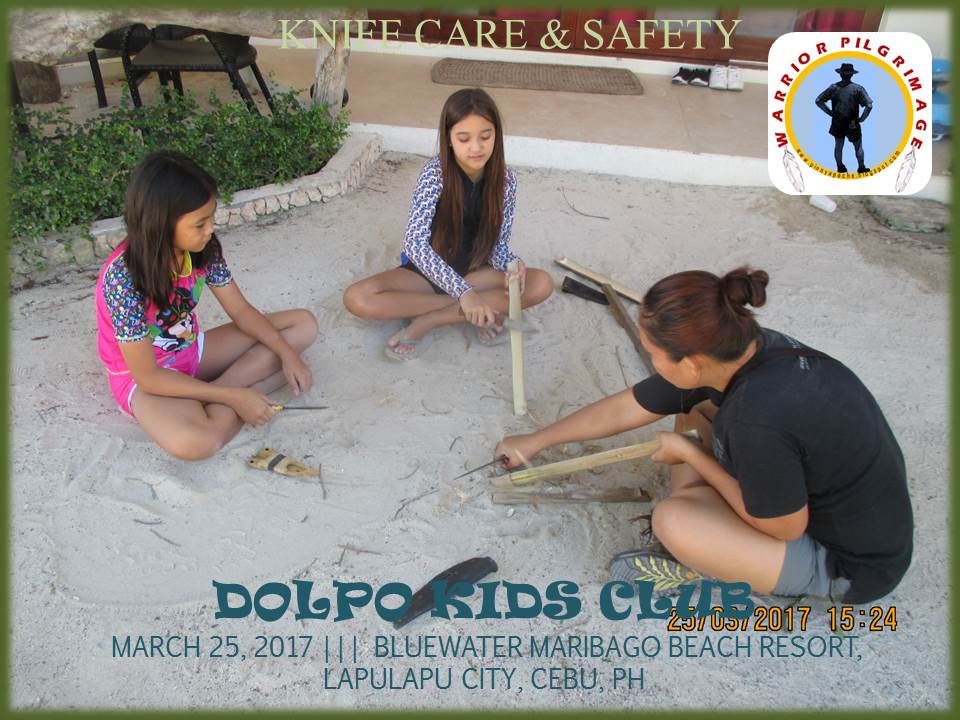
One day I was called by the staff of Bluewater Maribago Beach Resort, located in Lapulapu City, Cebu, to introduce kids to a day of bushcraft and survival. These kids belonged to the Dolpo Kids Club and their age range are from 7 to 14. Fourteen girls and boys showed up on March 25, 2017, and all were accompanied by either parents or minders. I have worked before with kids in a corporate setting like the City Sports Club Cebu last November 2016 and I know how to proceed with my program.

Since I would be working with kids, I brought my protegees, the couple Mark and Mirasol Lepon of the Camp Red Bushcraft and Survival Guild. Both had taken the Philippine Independence Bushcraft Camp in 2015 that I organize annually and are active bushcraft practitioners. Both are working full time in health lifestyle counselling under Herbalife. They are some of my best people and I am confident they could fulfill their tasks easily. 

 
I brought only a cache of small knives, purposely unsharpened, as a safety measure. They are a William Rodgers, a Fame Kitchener, a Condor Bushlore, a Mora Companion, a Knifemaker Camper, two Seseblade Sinalung, a Seseblade Matavia, a Victorinox SAK Ranger, a Victorinox SAK Trailmaster and a Browning linerlock. Since this is not an all-knife show, I pitched in my Fire Kit and my spools of cords for the different aspects of a bushcraft activity.

It was my first time to visit Bluewater Maribago Beach Resort and I was impressed by the staff, the service, the food and the neat paths to the beachfront. It is in a hidden cove among many resorts that line the Hilutungan Channel. What caught my attention is a huge strangling fig that seem to be the center that held together all what is aesthetic of this prestigious resort. I was amazed that it was preserved by management inspite that it is on prime space good for more expansion.

Kids, when they get bored, do not have a flexible attention span. You have to engage them where they are most interested. Making fire would be a good start. These kids do not have the opportunity to experience making a fire. They have adults to do that for them. It is much safe for a home that kids are kept away from safety matches, butane lighters, electric and LPG stoves. However, curiosity would kill the cat.

Kids, being kids, are bound to be tempted to touch these things that are off limits for them and that is when things go wrong. Teach them why is that and expose them how to make one. With a ferrocerium rod. They see these things on TV and probably got amazed why a mere spark from those produce fires? After a short but practical lecture on fire safety, the kids got their wish producing tiny meteor showers on soft downy material and small wood shavings.

 
After an hour of smoke and heat and slaked wonder, we observed an hour of noonbreak but, once it was over, the fire sessions continue on their own instance. I would rather have the course of their learning dictated by their own unhindered progress. When they reached a point that they have had enough, I turned their attention to MarK and Mirasol. Right then and there, they witnessed how a fire is made by rubbing two pieces of bamboo. It raised their astonishment a higher notch.

From there, I produced a short piece of bamboo pole, opened it with a knife and place it above the fire made by friction method. I poured water into the hole and then rice. They were amazed to see these novel sights. How in the world could people cook rice in bamboos? They know only that metal pots and earthenware do that function. I assured them that it is for real but we all would have to wait for the result.

While the waiting would have a big effect on their attention span, I showed them three bamboo poles, bound a cord on one end and spread the poles on the sandy ground. I placed a cheap laminated nylon sheet over it and it becomes an instant shelter. Their satisfaction rose higher now and I directed them to a row of hedge where Mark have set up a couple of different snares.

To entertain them, I imitated a monkey and a hen, activating the two crude machines as my hand got caught on each of the looped cords, eliciting laughter. Catching better their attention now, I proceed to the serious business of survival tool making. There are no short cuts to there as a knife would have to be used. That is where my knife safety session is introduced. Repeating where it is most crucial and visually showing how a knife should be held and the proper execution of knife functions. Safety first.

Grouping them according to age, they formed a circle sitting on the ground, hand them the materials and a knife each. They baton, chop, shave and whittle bamboos to their desired shapes. Mark and Mirasol helped me supervise their progress. The kids were having fun and their parents joined and helped their kids. They saw their kids developed confidence with handling and working with a knife as minutes wore on.

You do not learn these things inside a classroom nor appreciate it much from watching online videos and survival TV. The real stuff is better, right where the action is. It was a beautiful scene, child and parent working to produce their best hand-made spoons. The kids showed off their creations proudly and nobody got nicked by a knife. Education is the key. The day’s session ended after that and they get to taste the rice perfectly cooked in bamboo.

My appearance to teach Introduction to Bushcraft and Survival to the Dolpo Kids Club in Bluewater Maribago Beach Resort would not have been possible without the participation and cooperation of Bluewater Resorts, thru Mr. Erik Monsanto and his assistant, Ms. Fresha Endico; the recommendation of Mr. Gian Carlo of Adrenaline Romance; and the support of Mark and Mirasol Lepon of the Camp Red Bushcraft and Survival Guild.

Likewise, to my sponsors who provided me the wares to share my skills and knowledge and  in my adventures like AJF Knives of Liloan, Seseblades of Pangasinan, the Knifemaker of Mandaue City, Pacing’s House of Barbecue of Navotas City, Alan Poole of the United Kingdom, Markus Immer of Switzerland, Derek’s Classic Blade Exchange of Iloilo City, and Jerome Tibon of Lapulapu City. Thank you all.

The significance of the ancient strangling fig only tells me that Bluewater Maribago Beach Resort is a green resort. They saw the connection between the environment and their business better than the rest crowding every inch of coastal beaches in Lapulapu City. They do not have to modify the skyline and the land features and create a make-believe environment. They work around it and blend with the surroundings.

They have my greatest respect and I highly recommend Bluewater Maribago Beach Resort or any of their facilities to friends and strangers. It is good to know that we have a green resort in Mactan Island.

Document done in LibreOffice 5.3 Writer