Showing posts with label survival. Show all posts

Saturday, June 16, 2018

TACS EXPO CEBU 2018 IS NOW OPEN

THE BEST TACTICAL, SURVIVAL AND ARMS EXPO in the country opened its doors to the public, here in Cebu, and to the rest of the Visayas and Southern Philippines as well, on June 15, 2018 at the Cebu Trade Hall, SM City Cebu. Despite an online registration arrangement that was instantly filled in by a lot of people, yet there still was a long line of people who registered on the actual site.

 
Of course, most people came to process or renew their firearms registration and individual licenses to own and operate a firearm and, to some extent, their license to carry outside of their residence, which the Philippine National Police (PNP), through the Firearms Explosives Office (FEO), is accepting for processing at the TACS EXPO CEBU. It is a One-Stop Shop for present gun owners and for future ones. You do not need to travel from one office to another as it is all there.

You can take the drug test, neuro-psychiatric examination, notarial services, copier services, photo booth, NBI clearance, Director for Intelligence clearance, gun safety seminar and everything relating to documentation about firearm ownership. It is all there except gun proficiency, which is held at the indoor firing range of ARMSCOR Global Defense Inc. in D. Jakosalem Street, a distance of about 10 minutes on a fine day. Coaster vehicles are made available for free for such contingency to ferry all gun ownership applicants.


TACS EXPO is an original concept of ARMSCOR Global Defense which they started last year in the National Capital Region to increase awareness on self-defense, self-reliance and preparedness. This year, they have calendared it in three installments: twice at NCR in February and November and, for the first time, in Cebu on this month. Actually, the February episode was a success that a mini TACS EXPO was immediately organized in April which was held at Camp Crame. Certainly, for TACS EXPO, Cebu was a good choice.  

On the first day of TACS EXPO CEBU, no other than the Chief of the PNP, Director General Oscar Albayalde, came to grace the opening. He was assisted by ARMSCOR chief executives led by its President, Martin Tuason. Rock Island Armory, the main product line of ARMSCOR Global Defense, took up the center booth along with its subsidiary, Squires Bingham International Inc.

 
Other exhibitors came to put up their products on display either as profit-oriented establishments or as partners of TACS EXPO 2018:

         Thiago Military Supply
         Forge Philippines
         Alpha Zero
         QBC Sporting Supplies
         True Weight Inc.
         Gibrosen General Merchandise
         Mamot
         Preppers Point Cebu
         Makati Medical Foundation/Steramist
         Bul Ltd.

  • HL Health Center Inc.
  • Sightron
         Philippine Air Force
         Philippine Army
         Philippine Navy
         Philippine Coast Guard
         Cebu City Police Office
         Office of the Civil Defense Central Visayas
         Philippine Red Cross Cebu Chapter
         Disaster and Emergency Responders International
         Camp Red Bushcraft and Survival Guild

There were also resource speakers touching on relevant topics and interactive workshops starting early afternoon. The first topic was about “Improvised Rescue Techniques Using Common Household Materials” by Joebert Tolentino of DERIN-CERT; Following that is the “FAQs on Firearms Ownership” by the PNP-FEO. This author came next with “Adventure Travel: The Lure of the Long Trails”; and then “Urban Survival After a Disaster” by Per Christian Thrane Neis of FAMC Motorcycle Rescue Foundation.

 
After a short break, “READY 101: Family Preparedness” gets discussed by an emergency management consultant, Martin Aguda; before the day ends, it gets capped by this blogger with his favorite topic of “Knife Carry Rights and Ethics”. For the first time, the general public gets to learn about knife ethics and the many influences of their right of ownership and to carry are subjected to which may turn out good or bad for them.

This author is officially participating in the TACS EXPO CEBU 2018 as an event blogger and as resource speaker. That participation extends to my organization – the Camp Red Bushcraft and Survival Guild – wherein the organizers provided us the free use of a booth to display our love of our craft and our love of bladed tools with which privilege is not given en gratis to any Cebu-based outdoors leisure and hobby group.

 
The TACS EXPO CEBU will stay up to June 18, 2018. Please visit the Cebu Trade Hall of SM City Cebu and register on site. Avail of the PNP-FEO One-Stop Shop for firearms ownership offered by the TACS EXPO CEBU on spaces provided for that. While waiting for approval of your LTOP or your PTCFOR, explore the booths for everyday carry items and gun accessories or you may sit in a good spot and listen to topics discussed by people who are the best in their fields. What are you waiting for?     

Document done in LibreOffice 5.3 Writer
Photo number 10 by Silverio Tolitol Jr
Photo number 11 by Dennis Chiong

Tuesday, May 29, 2018

TACS EXPO CEBU: Defense, Security and Survival Show for Sustainable Living

CALAMITIES, ACCIDENTS, CRIMINALITY, CIVIL disturbances and simple personal problems should not get above the best of you and your loved ones. You can overcome these if you have the proper mindset, a few important tools and the knowledge. How do you learn and acquire these? Simply attend the TACTICAL SURVIVAL AND ARMS EXPO 2018, which will be held at the Cebu Trade Hall, SM City Cebu on the dates of June 15 to 18, 2018. (See poster for more details.) Admission is FREE for you so you could have that opportunity.

This would be the very first time that TACS EXPO would be held in Cebu. It was first held in the National Capital Region in 2017 under the original event name of “Tactical and Survival Expo” and it was a very successful affair which brought together from their hideouts and cells, also for the first time, several Filipino prepping communities. This time TACS EXPO 2018 have programmed a more comprehensive exhibition of survival gear, useful blades and instruments, security equipment and software, and self-defense tools, to include firearms and accessories.

Not only that, relevant topics and interactive workshops based on experiential education and against the prevailing scenarios and real threats of global warming, scarcity of food and water, overpopulation, home invasions, disasters and terrorism, would be discussed before the audience by resource persons who are the best in their specialized fields. TACS EXPO 2018 is an informative and educational event which is best appreciated by the most basic of communities: the family.


TACS EXPO is a groundbreaking concept by ARMSCOR Global Defense, Inc. organized and presented to the public to increase awareness on self-defense, self-reliance and preparedness. This event caters to all ages and gender and across all religious and political lines. For this year, it is calendared in three installments: NCR in February, Cebu in June and NCR again in November. The first one, held at SMX Aura, Taguig City last February 22-25, was a success, that a mini TACS EXPO was hastily organized last April 15-17 at Camp Crame.

Meanwhile, TACS EXPO CEBU 2018 is a very good opportunity for LGUs, state security units, private security companies, safety organizations, volunteer groups, prepping communities and individuals based in Cebu or scattered around the rest of the Visayas or down south in Mindanao to witness and attend this at a place convenient for all. Cebu is the center of maritime traffic in the Philippines and is bushcraft country where a lot of individuals are practicing bushcrafters as a leisure outdoors activity.

This author, the engine behind the resurgence and popularity of modern bushcraft in this country through the introduction of the Philippine Independence Bushcraft Camp in 2011, which became an annual affair, will be officially participating as an event blogger. TACS EXPO CEBU 2018, thus, fulfills the aspirations and hopes of the author to disseminate the idea of self-sufficiency, preparedness and self-protection to a wider sphere of audience.

Just a few more days and the TACS EXPO CEBU 2018 will open its doors to the general public. Door prizes awaits to the most fortunate as well as to those who came prepared. Your most desired gear and equipment, given at the most generous of rates, will be waiting for you displayed on the exhibition booths. For four days, come early and choose your favorite spot, then listen to the different speakers talk about different topics. Expand your mindscape. Learn new things and ideas.

Registration is already available online through the convenience of your smartphones. You may also register on site anyday during June 15 to 18 but, to avoid the rush and the long queue, online registration is best. Just click on the link below and fill in the blank spaces.


Document done in LibreOffice 5.3 Writer

Sunday, April 15, 2018

THE TRAILHAWK JOURNEYS: Sumilon Island Survival Training

MY COUNTRY, THE PHILIPPINES, is composed of many islands and it is in both the “ring of fire” and the “typhoon belt”. Our own eastern seaboard is facing the Pacific Ocean and is susceptible to rising sea water during climatic changes and during catastrophes, which could induce tidal waves and storm surges. The same with our western, southern and northern coastlines.

A strong earthquake from across the Pacific and from any direction would generate a tsunami, like in Southern Mindanao in 1977. A Category 5 cyclone, meanwhile, could overwhelm large coastal cities and communities typified by Typhoon Mike (Ruping) in 1990 and by Typhoon Haiyan (Yolanda) in 2013. In fact, these same calamities have struck many years ago and memories of its magnitude cannot be appreciated anymore by this present generation.

Coastal and island communities found in between inland seas, bays and straits are also not safe anymore. Islands are now experiencing unprecedented great floods, frequent landslides and massive erosion which we could very well attribute to large-scale deforestation, unabated quarrying and strip mining. We also have a long history of man-made disasters, ship collisions and faulty maritime navigation and a world war which is still in our memories.

Let us talk about the aftermath of Typhoon Haiyan. Communities living along foreshore areas and to as far as 1,200 meters inland were swept away by gigantic storm surges with an untold destruction, the likes of which was never before seen nor felt in our lifetime.  Unbelief and shock were written on the faces of every survivor. For the first few days, there was no outside help nor contact. Communications and transportation infrastructures were severely damaged, further isolating surviving communities.

 
Food and water ran low after two days and survivors resort to pillaging stores and those they thought were stocking vital supplies to feed for their survival. Law and order broke down as the stench of the dead began to add to the desperate situation. Government control was totally absent and everyone, including the dead, were left to fend for themselves on the streets. Anarchy ruled as armed mobs appeared everywhere even infringing inside the sanctity of private homes.

It was a hopeless situation for all other survivors who lived in desperate moments day by day. Slowly, the national government with its limited resources brought stability to some of the affected areas. The situation became normal only after six months as international humanitarian organizations poured in billions of dollars worth of aid, food and housing to give solace and normalcy to the lives of the affected communities.

The post-typhoon mayhem on the eastern coasts of Leyte was unexpected. Filipinos are known for their tenacity and resiliency when it comes to coping with disasters and other life-threatening moments. In such situations, they would retrieve and utilize their primitive-living skills which they learned from the older generations. During those desperate moments, everyone acted like feral animals. Human decency and respect broke down.

People seemed to have lost their will to think and resorted on primeval instinct. This could have been avoided if they have listened to government exhortations to abandon their homes before the storm came. Casualties would have been mitigated or avoided. Productive skills like people relations, community mobilization and communal survival would have lurched positively from the aftermath of the deadliest storm of the century.

 
It is situations like these that spurred me to give up the privilege of owning a knowledge that had been bequeathed me by my first teacher – my grandfather – and share it to people, communities, organizations, government agencies and corporations. Even before these calamities came, I was already teaching people bushcraft and survival. I have taught just enough and then people realized that they have to go back to the basics.

This survival training is prepared and designed for use in a post-disaster scenario like storm surges and tsunamis, even consequences from a maritime accident. This course aims to develop the participants of the basics of survival in island and foreshore setting of sandy beaches, rocky shorelines, limited water resources and sparse vegetation, without disregarding the proper procedures that would ensure the chances of survival of an individual.

Preparation for any survival situation should be given premium by anybody, regardless if the individual is an experienced one or not. As much as we would like the serenity and aesthetic joy and the privacy of an island surrounded by an emerald sea, the fact is that islands present its own hazards coupled by unpredictable weather conditions which could spawn a calm sea into a roaring monster in just a few minutes.

I always emphasized that a person can be an island on his own contrary to the general idea. I would always encourage that every individual should be self-sufficient and could sustain his ability to survive alone when facing real survival situations. He should be able to fend for himself during the most trying times and, in the absence of equipment, compensate this with knowledge. Knowledge of survival skills enhances one’s standing in a group of survivors and, through his guidance, a community could arise from despair.

My training is designed for island visitors, backpackers, tourists, resort workers, residents and water sport enthusiasts and would complement experience, skill, safety and good common sense. Its main purpose is to educate and to give an idea about what to expect when faced with a situation of survival on an island and foreshore environment and, consequently, prepare a person for the worst conditions.

Bluewater Resorts, a Filipino company operating the world-renowned Bluewater Maribago Beach Resort in Lapulapu City, the Bluewater Panglao Beach Resort in Bohol and the Bluewater Sumilon Island Resort in Oslob, Cebu – all “green” resorts – took a good step forward by encouraging their resort officers and staff to actively participate in a three-day BASIC ISLAND SURVIVAL COURSE this writer had offered for May 23, 24 and 25, 2017 at Camp Bermejo of the Bluewater Sumilon Island Resort.

Camp Bermejo is named after Fr. Julian Bermejo, a Spanish priest who was the architect of the construction of a series of watchtowers in Southern Cebu that fended off Moro raids early in the 19th Century. One of these surviving towers is found on the eastern part of Sumilon Island. Its stone masonry withstood the test of time as well as a few hardwood buttresses. Gone is the wooden platform that would have supported the defenders and their instruments of warfare.

Beside the old Spanish structure is a round concrete tower that supported a navigation light. It is about 75 feet tall. It is not a lighthouse. Vegetation dominating the interior of the island is a forest of white leadtree (Local name: ipil-ipil), introduced many years ago as sanctuary for birds and to prevent erosion. Along the edges of the island are bare rocks and pocket forests of indigenous coastal hardwood varieties and mangroves.

A network of paths was established by Bluewater management to access the interior and Camp Bermejo and along the fringes to approach isolated beaches and hidden nooks. The campsite, the lecture area and the kitchen are located near the man-made structures of Camp Bermejo. Seven Bluewater staff attended this training, which is geared for traditional outdoor and casual setting.

Introduction to Survival was the first chapter of the first day, May 23, and it is where the survivor’s mindset were explained thoroughly, along with the hierarchy of needs and of survival nutrition. Next was Water Sanitation and Hydration which is very important since islands and foreshore areas always bore the brunt of abrupt changes of weather from uncomfortable warmth to lashing sea sprays and wind chills. These places rarely host natural springs and fresh water sources.

Knife Care and Safety came next after lunch and siesta; and the participants learned our country’s knife law, ethics, safety carry and use, sharpening and proper storage. Then they get to test their dexterity with a knife through the practical chapter of Survival Tool Making where they carved spoons and drinking jugs from bamboo. Lectures ended at dusk. Participants helped each other out to cook their dinner. The campfire became the social hub of the yarns and storytelling episode which ended at around nine.

Second day, May 24, was a test for the participants and also was the most exciting. They fasted that day. Their concentration were challenged by hunger, thirst, humidity, drowsiness, annoying insects and the warm sun. First part of the morning was the chapter on Notches. It was another practical session with a knife but aided this time by a batoning stick. Five different notches had to be carved from a stick with the last one needed to hold another object like a rock or metal.

After that, everybody relaxed to listen to the section on Foraging and Plant Identification. They were shown photos of harmful plants and samples of simple traps and snares. Then we proceed to Fire, Tinder and Campfire Safety. On this episode, the participants were taught how to identify and chose the best firewood and kindling, manufacture tinder and test their skills on the ferro rod and the flint and steel. Later, they witnessed how fire is made through the bow drill.

Last lecture for the day is Food Preservation and Cooking. Their appetite for food which were denied them became possible by cooking rice in improvised bamboo pots. When that done, they proceed with Nocturnal Hunting. They caught five big land crabs with bare hands and sticks. They now have food to pair with their rice. However, we decide to release the crabs and eat food provided by Bluewater Sumilon. They had proven their worth and the campfire was now more lively.

Third day, May 25, the participants packed their things and, once finished, they sat around and listened to the lecture on Customizing the 72-Hour Bag. Different kits and items are shown to them of what it looked like and how does one design it to the type of environment and activity one is engaged in. Then came Traditional Navigation. Floating on seas, constellations, the sun and moon matter very much. Last one for the day was Outdoors Common Sense. It talked about protection, safety, wildlife encounters and well-planned travels.

The day wrapped up with giveaways courtesy of Mr. Jose Neo of the Camp Red Bushcraft and Survival Guild. A Seseblade Sinalung was raffled out and it went to a lucky Bluewater staff. This blogger is thankful for Mr. Erik Monsanto of Bluewater Resorts for making possible this training in a protected marine sanctuary of Sumilon. My thanks also goes out to Mr. Neo and Camp Red; and to my patrons whose names I carried and endorsed: Seseblades, Silangan Outdoor Equipment, KnifeMaker, Derek’s Classic Blade Exchange, Titay’s Liloan Rosquillos, Pacing’s House of Barbecue and Tingguian Tribe.


Document done in LibreOffice 5.3 Writer

Saturday, March 17, 2018

NAPO TO BABAG TALES CXXIII: Bukal Outdoor Club Goes Survival


IT IS ALWAYS A GOOD INVESTMENT for an individual to sit, listen, watch and participate actively in outdoors training. Much more so if it is a survival class. That individual would know exactly what to do in an ugly situation. With people around him, his presence would be McGyver-like. Perhaps not. Unlike others who prioritized equipment and gear over training, knowledge does not get stolen nor get damaged. Its value does not depreciate because it is priceless. It becomes part of you.

A group investing in survival training is much better. Everybody knows what to do when SHTF comes. We know that no activity is perfect. No trip is seamless even if it is well planned. A number of trained people caught in dire straits would weather that out much better than on another group who have none or even with one. I would cast my fortunes on the former any time, any day and on any place. With a group, a member would complement another in clockwork precision.

MCAP and CLIMBER, legitimate outdoor organizations based in Luzon, had previously harnessed my know-how in preparing their members or participants in survival education. It improved the participants’ stock knowledge and raised their confidence and understanding a few notches higher. Same with PECOJON, an NGO composed of journalists I trained in bushcraft; emergency response units like the ones maintained by the Archdiocese of Capiz and the Municipality of Liloan, Cebu; and an Army reserve unit.

Here in Cebu, BUKAL OUTDOOR CLUB is the first outdoor recreations group to cross over that line which separates a club that values their members’ well-being and those that do so only during Christmas Day. It is a collective sacrifice. A group investment. But it shall reap dividends, not only for themselves, but also covers to those who are with them. They shall become more responsible campers, they would have more time to think and would appreciate better the dangers nature present.

BUKAL OUTDOOR CLUB have undergone my standard three-day Basic Wilderness Survival Course on the dates May 13, 14 and 15, 2017. I held it at Camp Xi, another mythical nook found within the foothills of the Babag Mountain Range, Cebu City. They brought their usual camping gear and were just by their normal selves. No fanfare like subjecting them to cosplay and act naked and unafraid. Nor did I let them crawl on dirt to eat raw bulbs dug from the earth.

The camp we used was the ones that I used for the Bushmasters’ Camp last April 28 and 29. The campsite is accessible but is not along a route frequently used by mainstream activities. A path less taken. The campsite is on a high ground, wide and grassy, below the tree line, near a small stream, a small waterfall, a small pond and a natural spring. It has bamboos and dry firewood. Perfect requirements of a bushcraft camp.

There were fourteen excited participants sitting before me on that first day (May 13). Joining me as my assistants are Dominic Sepe, Leomel Pino, Jonathaniel Apurado, Denzen Delima and Jenmar de Leon. They are all with the Camp Red Bushcraft and Survival Guild and have taken the Philippine Independence Bushcraft Camp on different occasions between 2011 and 2017, except for Denzen who is a product of the Bonifacio Day Bushcraft Camp of 2015.

As usual, I always start the day on a light mood with my patented selfie with participants. In a few minutes, I got serious. Really serious. I explained the purpose of this basic seminar and how it will change their paradigms. It is meant to open the eyes of the participants on the real possibilities of these chain of events that would go beyond anybody’s control since the outdoors, the mountains, the weather and everything that is in nature, can never be controlled when things go wrong.

The first topic is about Introduction to Survival. During times of accidents and calamities, nobody has that ultimate answer when to survive such. A prepared mind would, at least, be blessed by chance. Surviving the initial impact is one half of it while ensuring your survival until help comes in is the other half of that. In between, the mind controls everything from the way you think and even to the release of adrenaline. Your brain is a supercomputer but, unfortunately, it could only process one thought at a time. 

When in a survival situation, your brain works double time and, in the process, use up huge amounts of body heat, water and oxygen and inadvertently release adrenaline for no apparent reason just like you would experience when getting lost or just plain hiking in darkness. It is best that you stop and sit still, relax and breathe deeply, then gather all your thoughts and rehydrate. You would need water and it is your first priority to keep your blood flowing so your brain would work properly.

In the Hierarchy of Needs and of Nutrition in a Survival Situation, water is tops on both. Why? Because we are in the tropics and the body is surrendering perspiration due to humidity and by your exertions. Along with that, goes our body heat also which you do not know. To sit still would minimize losing body fluids and keep it confined by setting up a shelter – if you still have one, or make one from scratch. This is the second need. The third would be food then warmth. Last is security which would complement well with all.

Our body has four hypothetical tanks that needs to be replenished during survival. First you have to rehydrate often so you could offset dehydration. Second is food that would give you nutrients, carbohydrates and proteins. Third is sugar converted by enzymes for your adrenaline rush. Fourth is fat, hardest to find in the tropics yet are wrapped as tissues in our body. Then you make sure your body is supplied with adequate oxygen. Keep those air passages free of obstacles. Then, by all means, you should practice personal hygiene during survival. It helps to have a healthy body and a healthy mind.

Topic for the next chapter is about Water Sanitation and Hydration. The first chapter had mentioned the importance of water during survival. Water could be sourced from natural springs, water seeps, man-made water holes, flowing streams, the atmosphere and from plants. It could be sanitized through boiling, by chemicals, exposure to heat, through filtration and by desalination. It is wise to cache water in your survival camp or just travel early and take advantage of shady places and breeze if you happen to have less.

The last topic for the day is Knife Care and Safety. I would like to change the perception about the knife and it is important that people relearn why our ancestors invented it, generally, to aid them in their daily activities and made their living better. The knife is a tool and should not be used to what it was not designed for like digging latrine holes and as pry bars. It is a vital piece of equipment that should be properly handled and cared for because it is your link to your surviving. In all the training I conducted, knife etiquette is learned first before people touch a knife.

Besides my rules, there is a knife law that forbids the display, even of concealed carrying, in public places unless you are in a lawful activity, which camping and hiking are. A knife should be in a sturdy sheath when travelling - for safety - and should be unsheathed when at home to keep it from rust. There are many kinds of knives and it is important that people know the parts, blade shapes, grind styles and the tang designs because, from those qualities, you would know how to achieve maximum work. People must also learn how to field sharpen a knife.

The participants troop to their shelters at 17:00 to proceed with their food preparations and to answer the call of nature. The campsite is located on a wide meadow and shielded by mango trees. Above us is the ridge and the trail. Over on the other side is the latrine facing another valley. Walking uphill a trail would lead you to a small stream where there is a natural spring. Most of the people visit this other side while I spent my free time, splitting firewood for tonight’s campfire. After dinner, everyone sit around the fire and the Campfire Yarns and Storytelling proceed as planned until 24:00.

The second day (May 14), the participants eat a full breakfast. After this they fast and are obligated to use all their attention and concentration listening and understanding the lectures. Denying them a meal for the rest of the day would, at least, make them feel of what is it like to be in a survival situation outdoors. They would feel the pangs of hunger but they could rehydrate as they wished. Humidity, drowsiness and crawling insects would torment them as they use all their power to remain alert.

First lecture is Customizing the Survival Kit. It is better that your survival kit should be made from scratch than bought commercially because a survival kit’s size and its components depends upon the type of the activity you are in to and the kind of environment you are going on to. Your personal touch on certain items are very important to you should it be needed. Redundancy is its best attribute especially fire-making tools, lighting gadgets, water-purification methods and cutting tools.

The components are the medical kit, the replenishment pouch, the repair kit and a back-up knife. It could all be integrated in one container or it could be separated from one another in their own containers. As much as possible, avoid clutter. In a survival situation, you could misp second lace things. Make it waterproofed, dust-proofed, insect-proofed and keep it away from direct heat.

Next is Cold Weather Survival. Since the outdoors is about mountains and high elevations, exposure to the elements are expected. There are five physical mechanisms that steal away body heat and there are ways to keep us constantly warm. Then comes Survival Tool Making and, after the lecture, they can use their knives. Tool making is essential in survival or even when not in that situation like a missing utensil or tent peg.

I showed them the most basic of tools like the digging stick, cordage from bamboo skin and coconut midribs, traps and snares from bamboo, and the batoning stick, which they would need when cutting up bamboos for their cooking pots and for their spoons and drinking jugs. I assign 4-5 participants each to three groups for this knife-dexterity exercise for better supervision.                                     
                      
This activity would run through the early afternoon, crossing over a one-hour siesta break, where another topic, Traditional Navigation, begins. This technique was perfected by our ancestors and uses the natural terrain, shadows and the sky fixtures for travel; avoiding obstacles and highly-exposed areas that cause possible hypothermia; and knowing signs on trails made by animals and by humans. This chapter also talks about how to effectively use visual and audio signals.

Last for the day is Foraging and Plant Identification. During survival, you would need to gather food and non-food items. Food could be meat and proteins which would only be sourced from animals and insects. Catching animals would be very tricky and you would have to make use of traps and snares. Food can also be sourced from edible plants. It is fundamental that you know these because it is everywhere. It is also important that you know the harmful ones. Showed them photos of stingy, thorny and poisonous plants.

The participants, exhausted by hunger and by the long and warm day, are released from sitting for long hours and proceed to the business of cooking rice in the improvised bamboo pots they made during the tool making session which employ the Trailhawk System of cooking. Their dinner would materialize after the fruits of their Nocturnal Hunting which would be done on the small stream I mentioned ago.

All the participants and camp staff, including me, use this moment to tidy up at the small stream where there is a small waterfall and a pond upstream after two days without bath. They were able to forage fresh-water crabs and a few tree snails and it becomes their dinner. They also cook food from their supply and add it to the late feast. The campfire becomes alive again and another session of Campfire Yarns and Storytelling which goes past midnight.

The last day (May 15) start early. The discussion also start ahead of time and it is about Firecraft. This is the most expected part. You cannot make a fire if one or all elements are not present, namely: fuel, heat and air. Lately, they added a fourth element – chemical reaction. Fire-making is 80% common sense, 10% skill and 10% perspiration. We are talking about the friction methods. Your fire, done with any method, can start if you can acquire and identify the right tinder, if you are in a dry place, and if you have the patience.

Aside from friction, there is the conventional or modern method which are matchsticks, lighters, ferro rods and the flint and steel. Then there is solar magnification which can be done with any magnifying lens, reading glasses, water and even ice. Then you have pressurized air, exemplified by the fire piston. I proceed in demonstrating the flint and steel, which I paired with charclothe, and the ferro rod, which the participants tried and successfully produced ember and flame. 

I showed them how to make charclothe and how to make a tinder bundle, popularly known as the “bird’s nest”. Then I demoed how the bow drill method is made and spun.  Unfortunately, I could only make thick smoke as sawdust embers refused to light up my tinder. I let others try the bowdrill. I showed them another friction method using bamboos.  Just like my bowdrill, only burnt smoke emitted. The humid conditions might have something to do with that. Staff and participants tried their hands on these primitive gadgets but all to no avail but they now gained an idea how it is made and worked.

The last discussion topic is Outdoors Common Sense.  This is the latest topic that I added and it is but excerpts from my yet unpublished book, ETHICAL BUSHCRAFT. It covers trail ethics, travel and campsite, using the time-tested principles of Blend, Adapt and Improvise. It also talks about wildlife and farm animal encounters and how to react in such situations. That sums up this three-day outdoors course which I first introduced in Luzon last 2013 and is now one of the cornerstones of my training programs.

Giving of certificates follow and the imparting of giveaway items courtesy of Seseblades and Jhurds Neo of Camp Red Bushcraft and Survival Guild. Brunch gets served at 10:00 and after breaking up of shelters, it is time to leave the campsite. We will take another route, crossing Sarapia Creek and following a less-trodden trail to Mapawon Peak and Katugasan Peak and going down to a road where a signboard says we are now in Kalunasan. A wait of an hour for motorcycles brought us all to Guadalupe.

Done in LibreOffice 5.1 Writer

Thursday, January 1, 2015

BADJAO SAFE DIVING

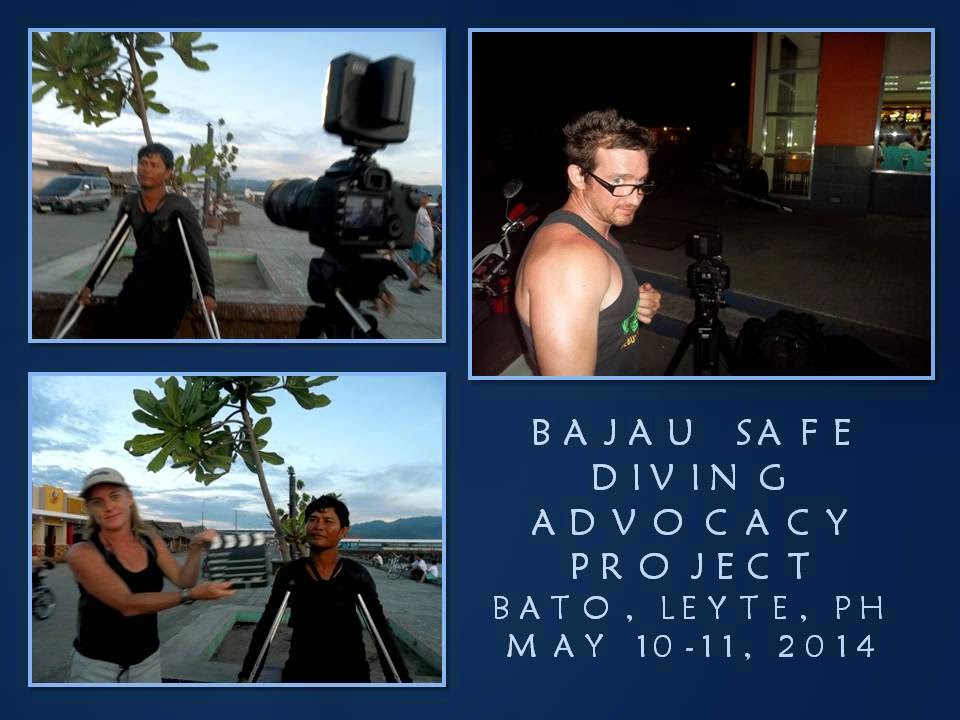
THE BAJAU PEOPLE HAS created a deep impression on Silke de Vos during the time when she was part of a production outfit doing a documentary story about the indigenous fishing methods of these sea-faring people who, sometimes, are known as the Philippine Sea Gypsies.  I was also with her for four days, being part of the team organized by film maker Matt Everett from April 28 to May 1, 2014 in Bato, Leyte.  (Read my article Conversations with the Bajaus.)


Silke decided to organize a team of her own to document the Bajaus again.  I am again part of this and there is a reversal of roles:  Matt will be her cameraman.  She has commissioned her diver friend, Lisa English, to help her on this project titled BADJAO SAFE DIVING, which really is a brainchild of Silke and her husband, Peter de Vos.  Silke and Peter owns Amontillado Beach and Diving Resort, located in Dauin, Negros Oriental.   


Badjao Safe Diving aims to improve the survivability of the Bajaus through education and actual training on the proper procedures of safe diving standards which are respected by all professional scuba divers around the world although it does not recommend or support the use of air compressors in diving.  Through this direction, the hazards of unsafe diving practices among the Bajaus would be minimized.  In the end, it will provide the Bajaus more years to enjoy their main livelihood and more years to bring food on their tables.  

To recall, the Bajaus catch their fish through diving, breathing air supplied by air compressors.  These air compressors are either the commercial kind bought from hardware stores or those that are improvised.  Improper diving causes decompression sickness which leads to coma, paralysis or death.  A lot of local government units have good reasons why it prohibits fishermen from engaging in compressor diving because of health concerns.

We start at 07:30 of May 10, 2014 from Kon Tiki Diving Resort in Lapulapu City, Cebu where Lisa and Silke were staying the previous night.  Silke rented a good-sized boat for this project.  Very spacious unlike the last time.  The plan is to cross the Camotes Sea into Isabel, Leyte and find the crippled Bajau man that another Bajau, Jerry Balansi, had mentioned last April 28 and interview him.  We do not know the exact place where he lived, much more so, the name of the man.


We took the chance even though it begins to look like finding a needle in a haystack.  But it is a better option than going to Bato first to look for Jerry then go up to Isabel and back to Bato.  That way, we can save on fuel and time.  We only have two days to do this project.  The problem is, the boat crew have no idea where Isabel is and they have to fetch another guy who does.  I had traveled to Isabel as a boat crew but it was night time and that was 28 years ago!

Anyway, the EZ Map that Silke bought was a big help.  Fishermen off the coast were also a big help, giving us information.  We dock at the Port of Isabel at exactly 12:00 and walk to the village of the Bajaus in a place called Marvel.  We introduce ourselves to the village chieftain and tell him our story.  It helped to mention the name of Jerry and they were very accommodating.  It would have been easy to locate our man but he was not in the village.  He left three days ago for Baybay City.

Challenged by this situation, the trip altered into something adventurous but, at least, we now have a name.  The quest continues back to the Camotes Sea, passing by Ponson Island, where a lone fisherman gave us directions to Baybay like someone would on a street.  We reach the Port of Baybay at 16:00 and see a man with crutches.  He is with several Bajau women and children and I am sure he is the one whom we seek and interview.  


He is Matlan “Sonny Boy” Kalingkopan, a former compressor diver.  Incapacitated by his injury caused by decompression sickness, he now make his living begging on the streets to feed his family.  He is 48 years old, married and a father to a 6-year old girl and a 2-year old boy.  He is an expectant father to a third child five months on the way.  He converted to Roman Catholic years ago and christened as Sonny Boy.  His is a sad story.

He was born in Basilan and started diving at a young age.  He met his accident some thirty years ago while in Zamboanga.  He narrated that he stayed below at about 30 arm lengths for a duration of the time you finish two cigarettes.  He remembered he floated to the surface fast and stayed on the boat to enjoy a cigarette when he began to feel numbness on his legs, tingling of the skin, headache and difficulty of breathing.  He lost consciousness and, when he regained that, three days had passed.  

He never was able to recover his full health despite being subjected to home and traditional remedies.  He left his place of origin when his father was murdered by pirates and their boat stolen away and he journeyed with his wife into the cities of Pagadian, Dipolog, Iligan, Surigao and Cebu to try their luck but he was disappointed.  He settled in Isabel for good and begged on the streets of Ormoc City for many years but he was apprehended recently and dumped in Baybay, where he goes back from time to time.


He says, a lot of good people in Ormoc knows him and he was able to give his family a decent meal.  The aluminum crutches he uses now were given to him by a kind doctor from an Ormoc hospital.  In Baybay, he is still feeling his way and he do not earn much unlike what he used to in Ormoc or when he used to dive for fish long ago.  He cried when he talked about his predicament and placed his faith in God that He will not abandon him.  

He is happy to learn that we are doing something for the Bajaus and he would have joined our tomorrow’s workshop should he be in good health.  The interview on Sonny Boy was done on camera at Baybay’s waterfront.  Later, we film him begging at a street corner where there is a popular fastfood chain.  The shooting wrapped up at 20:00 and we facilitate for his transfer to his temporary address here but not after we parted some cash for his upkeep.  After we had taken supper, we stayed at the GV Tower Hotel.

The following day, May 11, we left Baybay at 05:10 for Bato.  We were there last week, except for Lisa.  The boat reach the Port of Bato at 07:40 and, immediately, we proceed to the Bajau village of Dolho, crossing an estuary by a raft made of Styrofoam scraps.  We carry equipment, cameras, visual aids and literature for an impromptu workshop on a beach.  We meet Jerry, his brother Kapolisan Balansi, and Dulhussein Jumaldi and all agreed to attend and to learn the basics of safe diving procedures.

Lisa is the main instructor of the workshop while I interpret for her and for the Bajau should they comment or ask questions.  The simple illustrations provided quick learning and, sometimes, I need to be very creative when explaining very technical terms like “oxygen”, “nitrogen” and “decompression sickness”, which does not have an equivalent in the Cebuano dialect.  A shaken softdrink bottle, with its bubbly contents, provides them understanding why gases expand in the human body if under pressure.


When the theoretical part of the instructions had been finished, Silke decide to rent a boat owned by a Bajau complete with a compressor machine.  Silke needs to apply the theories to an actual situation and we all get ready to move offshore.  Our destination is one of the lighthouses of Dawahon Reef.  We drop anchor there while Silke and Lisa prepare their scuba diving gears.  Dulhussein, together with two others, transfer to our boat to get a last-minute review of the lectures from Lisa which I interpret for them.

Dulhussein and another will dive.  Lisa will dive with them and will give signal communications underwater.  Silke will also dive with them but she will take footage of the training.  The third Bajau will stay on their boat and will act as watchman.  He will see to it that his companions will be supplied with air and will signal same when their time under the water is about to approach the allowed time.  He will jerk at their compressor hoses and he will rap the side of the boat.

Matt stayed on our boat and shoot footage on the Bajaus’ boat and the surface where the ongoing training is being done below.  I keep reminding the Bajau watchman, above the din of the compressor, to be attentive of the time.  The current is swift, the compressor hoses are stretched almost horizontally.  We wait for the tell-tale signs of bubbles.  It came, but,  whoever is below the surface, especially at the five meter level, stayed according to the length of time allowed.  


Dulhussein surfaced first then the other Bajau.  They were trained to ascend slow – to never overtake their air bubbles - and to stay five meters below the surface at three minutes before surfacing.  Since both do not have waterproofed watches, they were instructed to count slowly from 1 to 180.  When Lisa and Silke, likewise, surfaced, all gathered on our boat for their final evaluation.  

Lisa and Silke observed that the swift current caused the air hoses to wrap tight on the Bajau divers.  Should those conditions arise, the boat should flow with the current.  It was a difficult situation for the Bajaus yet they followed the instructions to the letter.  Asked of his opinions regarding the different dive routines that he was undergoing, Dulhussein narrated that he felt good.  He did not feel the usual uneasiness that came to him after every dive using the old unscientific way.  “Mas maayo ni (This is better)”, he says. 

Happy on the progress of the workshop and training, Silke gave Dulhussein and his companions, all representing the Bajau community of Bato, a set of waterproofed instructional illustrations.  These illustrated cards would now be the cornerstone of safety whenever the Bajaus go diving.  Aside this, a quartz wristwatch with bezel ring is donated to the Bajaus so somebody on the boat would keep track of time in their underwater search for fish.

We officially terminated our business with the Bajaus and part ways from them at 17:00 for Cebu.  The team reach Lapulapu City at 22:30 and enjoy a very filling late supper at the Kon Tiki Diving Resort.  It was a memorable experience for me to work with professionals who know their line of work and exposed me further on the intricacies of the rules of proper underwater diving, which is very educational.

I am hoping that this advocacy of the de Vos couple would be made into a documentary and generate interest among well-meaning organizations and individuals on the plight of the Bajau people.  The sea is their only source of income and they have to adapt to dangerous fishing methods so their children could live.  Teaching them the right way like Badjao Safe Diving would improve their lot.      


Document done in LibreOffice 3.3 Writer