Showing posts with label traps and snares. Show all posts

Saturday, September 22, 2018

THE TRAILHAWK JOURNEYS: Bukidnon Bushcraft Training

MINDANAO IS UNDER MARTIAL LAW and I do not forget that. There was an urban war in Marawi City fought by the government forces against ISIS which had ended more than a month ago. I travelled a month earlier to Davao City to test the climate of uncertainty painted by media. There was indeed a military presence there, which is fair enough. Would it be okay to travel there again with bladed tools? I have to find that out myself.

You know, I have never taught bushcraft and wilderness survival in Mindanao and I waited for many years for that opportunity until Earl Ryan Janubas and JP Echavez, both of Cagayan de Oro City, organized one for me. Martial Law have curtailed travel of Mindanaoans to their most famous mountain destinations and they needed an alternative outlet for their thirst of adventure. That is when they contacted me.

Going by plane to Mindanao is out of the question for me, although travelling in it with blades is the most convenient. The transfer of the airport location of Cagayan de Oro, in Lumbia, to the Municipality of Laguindingan a few years ago is too far for my own comfort. The boat is my best option even if I have to unload my bladed tools to security for safekeeping while I am in the boat and it would travel with me anyway.

As an outdoors educator and survival instructor, blades play a very important role in all my classes and training instructions. Blades make easy work and these are educational aids and tools. Trusting to my good judgment, I carried some of my best blades with me like the AJF Gahum, Pandoy Pulido Pinahig, Condor Bushlore, Mora Companion, Knifemaker Camp, Seseblade Sinalung, Seseblade Matavia, a Browning and a Victorinox Trailmaster. Coming also is my veteran tomahawk.    

I travelled by boat in the evening of October 29, 2017 bound for Cagayan de Oro. Earl and JP would be expecting my arrival the following day. I arrived in the morning of October 30 and JP came to fetch me and whisked me to Focal Matters, a photography studio located at Capistrano and Yacapin streets where Earl is the resident photographer. After lunch, Earl and I travelled to Libona, Bukidnon on his Honda CG125, along with JP with his motorcycle.

We followed a newly-opened road that go through the backcountry of Indahag and Gango and arrive at Libona at around 15:00. We made a courtesy call to the village head of Poblacion and then to the community leader where we would make our camp for three days. It is in the property of Earl’s brother. We visit it for a brief inspection. It passes by a big pineapple farm and a trail lead to a stream.

Beside the stream is a narrow piece of ground good for eleven tents and some trees could host a few hammock pieces. It had been raining here for the most part of the week and the stream is deep with color associated with floods. I have my concerns but I am hoping that weather will get better. It is sunny and warm but the highlands has a weather of its own. I cannot rely on a weather forecast from a mere phone application.   

Earl and I returned to the town and made it to the house of his brother. We will both sleep there so we could be early to the campsite while JP need to go back to CDO. Bukidnon, by its location in the highlands of Mindanao, always has cold nights. It was colder still when there was a heavy downpour in the middle of the night which did not stop until the earliest hours of dawn. That got me worried about the stream and the campsite.

After breakfast of October 31, Earl and I went back to the campsite at 07:00. The stream have not risen that much. Only the color became more brown and the current more brisk than yesterday. I am assured of a very sunny morning and I hoped that the weather will turn out the better for the rest of the day. We choose this site because of its proximity to a natural spring located across.

I looked for a couple of trees, not far enough from each other and not near enough, and finding one such place, I left my bag. I choose the best location where I would be safe if the stream overflow but near enough to the rest. Open carrying my AJF Gahum, I go back up the slope and looked for a good place to make a latrine. Found one under a copse of cassia trees and dug a hole with a digging stick sharpened by my knife.

Then I foraged materials as educational aid for the outdoors seminar like dry and green bamboos, firewood and dry leaves. After an hour, JP and eleven participants arrived, including two high school students from Xavier University. One participant even brought his two dogs. All set up tents on the grassy ground while two of them found a place for a hammock.

Part of the morning was spent setting up shelters and diverting the flow of the natural spring by a bamboo viaduct, crossing over the stream into our campsite. Dry bamboos are abundant and I do not have to cut poles since there are many left rotting on the ground and a few are left hanging. I choose the clean ones for our improvised water span, propping it high enough from even an increase of a meter of flood.

The BASIC TROPICAL BUSHCRAFT COURSE is almost the same as that of the ones I do and organize in the Philippine Independence Bushcraft Camp, held in Cebu annually. It always start with Introduction to Bushcraft. The participants learned the terminologies and jargon used in bushcraft; its preferred environment; its own psychology; its methodologies; and its difference from survival and from mainstream activities.

 
Then next is Ethical Bushcraft. The best practices of leisure bushcraft, using its own principles of Blend, Adapt and Improvise, to lower your obtrusive presence among forests and jungles and increases an individual’s safety and security. It covers trail travel, courtesy to locals, campsite location, fire management and camp hygiene. Ethical Bushcraft is taken from this author’s unfinished book of the same title.

After lunch and siesta, it is the turn for Knife Care and Safety to be discussed. This chapter changes the perspective of the knife into a useful tool instead. The Philippine law on the regulations of carrying a knife – Batas Pambansa Bilang 6 – are explained thoroughly and clearly as well as ethics and safety, care and sharpening, blade shapes, parts and grinds, and the Nessmuk Trio.

At 14:30, this author demonstrate Survival Tool-Making to the participants. This chapter is a practical exercise in knife dexterity and safety; taught them how to carve spoons, jugs and an improvised cooking vessel from a green bamboo pole; and create a digging stick from a thick straight branch. Aside that, this blogger gave them the idea how and where to source cords from nature. Next is Notches. Another knife dexterity session aided, this time, by a baton.

When dusk came, all activities ceased and the participants focused on the preparation of their meals under a slight shower. By 19:30, the campfire is lit and becomes the social center for the Campfire Yarns and Storytelling. This camp tradition does not need great company as long as the train of tales and laughter begins. Sometimes, a moderate round of alcoholic drinks move that into more tales and laughter. Rains came and ended abruptly the night socials.
  
The second day (November 1) starts with breakfast but after that, all will deny food the rest of the day, not until they have accomplished foraging their own food which comes later in the night. This is to simulate the hunger pangs associated when you are stressed in a survival situation. Everyone steeled themselves for this occasion. The day is warmer than yesterday but the ground is muddy.

The first chapter for this long day is Customizing the Survival Kit. It is better that survival kits are made from scratch than bought commercially because its size and components depend upon the type of the activity you are indulging in and the kind of environment you are going to visit. Your personal preference still matters although redundancy of some functions, like fire tools, luminosity, water collection and cutting devices increases security.

Then I proceed to Foraging and Plant Identification. This author discusses about traps and snares and what are the difference between the two; luring methods and trap lines; and foraging food and non-food. It also identifies which plants are edible, harmful and poisonous. The participants are then shown the different traps and snares that are set up in camp before touring the area around the camp for the common plants growing here.

Hearing distant thunder, I decide to proceed to Fire, Fuel and Campfire Safety. Understanding first how a fire is made is very important. You have to know the three elements of the fire triangle: fuel, heat and air. You cannot produce fire if lacking one element. Conversely, you can put out a fire by removing one. Lately, they added a fourth element – chemical reaction.

Making fire by friction is 80% common sense, 10% skill and 10% perspiration. Your fire can start if you can acquire and identify the right tinder, if you are in a dry place, and if you have the patience. In a very humid location, the presence of moisture in the atmosphere almost always hinder the production of ember needed to start a fire. Most of the time heat is stolen by the cooling effect of watery air.

Aside from friction, there is the conventional method which are matchsticks, lighters, ferro rods, and the flint and steel. Then there is solar magnification which can be done with magnifying lens in a cloudless day. Then you have pressurized air, exemplified by the fire piston. Since I do not have the luxury of time, I limit my demonstrations to the flint and steel, and the ferro rod. I also showed them how to make a tinder bundle. 

Demonstrated how the bow drill method is made and spun. Unfortunately, I could only make thick smoke as sawdust embers refused to light up my tinder due to humid conditions. Dark clouds are now overhead as the thunder gets nearer and nearer. I let others try the bowdrill, the ferro rod, and the flint and steel. The participants properly learned how to use the ferro rods. It ignites easily natural tinder.

By now, wisps of moisture started to drop. I demonstrated how the bamboo-saw method is made and scratched. As with the bow drill, I could only produce smoke. Moisture have penetrated the grains of bamboo. Racing against the rain, I tried again and failed. Four participants tried but in vain. I made another derivative of the bamboo-saw that could be done with two people. Smoke is thick and there is a promise of ember but it lived shortly. Then a strong downpour fell.

For the rest of the afternoon, we could do nothing but stay in our shelters. I could not discuss the rest of the topics and our Nocturnal Hunting is even jeopardized. Owing to circumstances beyond our control, I aborted it and gave a go signal to prepare their food for dinner. In wet conditions, I am able to make fire in my Swiss Army wood burner to boil water first for coffee and then for Japanese seaweed soup.

The heavy downpour caused the stream to overflow on the lowest places of the campsite but it necessitated the transfer of three tents nevertheless to better locations. The water current increased and became very noisy, alarming everybody. For a couple of hours we were awake, watching the stream, until the rains began to slow down. I relax with my watch and half-chased sleep.

In my comfortable hammock, rainwater found its way to my chest. I shifted my body so the drips would not fall on me but a cotton rope I used to tie the hammock with snapped and I fell hard with my hammock on the ground. I re-strung my hammock and my shelter setup hoping to stop the drips. I placed drip cords on the ridgeline of my shelter just like I did before on the ends of my hammock. After I have done so, the drips have stopped.

The last day (November 2), I was surprised to see that the bamboo viaduct have withstood the stream’s rising water last night and still supplied us with an uninterrupted clean water. The water is not cloudy. We prepared breakfast early for I have four more topics to discuss. Yesterday’s muddy ground are smoothed out by water but it is wise not step on the same surfaces.

After breakfast, we break camp and transferred uphill to be away from the din created by chainsaws used by locals who took advantage of a holiday to cut trees. The first one is Understanding Cold Weather. During mountain climbing, exposure to the elements is expected. There are five physical mechanisms that steal away body heat and the things that we should do to keep us constantly warm.

Next is Outdoors Common Sense. This is the subject matter that I based from my yet unpublished book, ETHICAL BUSHCRAFT. It is about trail courtesy and behavior while on the trail; choosing the best campsites; practicing stealth camping; increasing individual safety and security; wildlife encounters; and introduce people the idea of Blend, Adapt and Improvise.

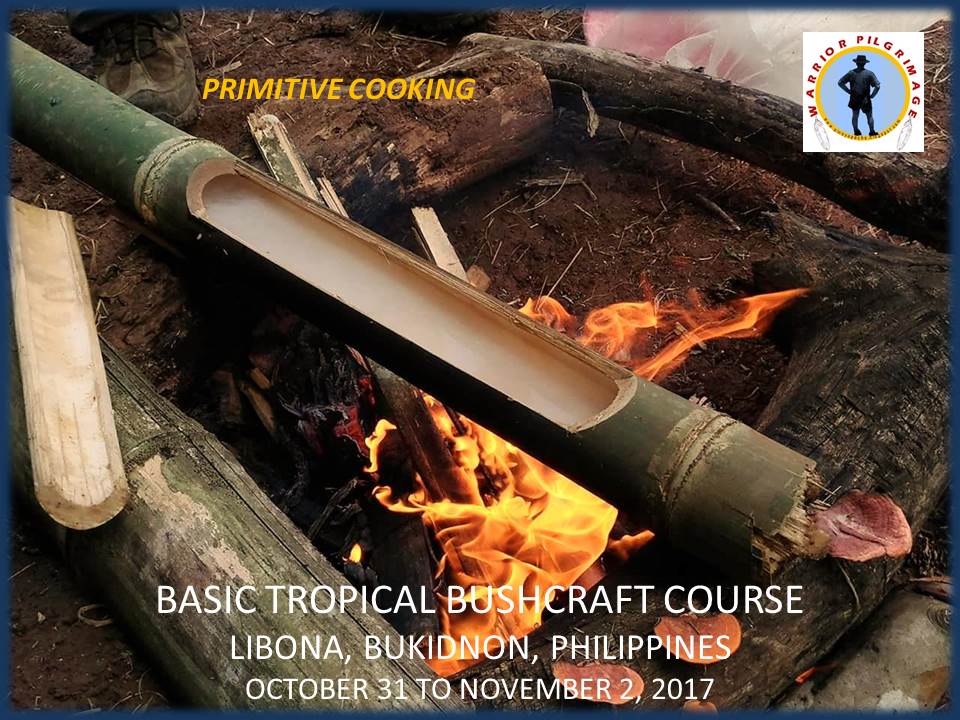
Finally, the topic of Outdoor Cooking and Food Preservation gets its slot. Different ways of preserving meat, fish, vegetable and fruits. Getting equal discussion are the different kinds of fireplaces. After the lectures, author shows how the Trailhawk System of cooking rice in bamboo is done. The participants prepared their meal for lunch and when all got cooked, to include the rice inside the bamboo, we had our meal.

We packed up everything and hiked the three kilometers back to Libona and then to the terminal. From Libona, we rode on tricycles to Manolo Fortich and transferred to a van-for-hire. Destination is Cagayan de Oro City, which we reached at 18:00. We stayed for a while at a local restaurant for dinner and the post-event discussion and socials. I was tired but I was not sleepy. I noticed there was no curfew here but we have to end after midnight.
 
I found a vacant room at Rosario’s Place for I have a speaking engagement tomorrow evening (November 3) at Viajero Outdoor Centre. Coming here to Cagayan de Oro with a cargo of blades gave me fears of travel restrictions brought about by Martial Law. It turned out well but, going back to Cebu, a security guard made it a little hard for me with his wrong presumptions. Or was he just interested with my properties? My spring-bound lecture handbook made all the explaining for him.

The unpredictable weather of the highlands of Bukidnon is something that I have to give an extra consideration next time. I expected it to behave like all highlands do but I failed to give a thought that Bukidnon is a plateau where rainwater would be collected on a wide area instead of travelling fast and quick to the sea. Here, it accumulates slow and long before going down the different drainage systems.    

It was a productive moment not just for me, but also for my newly-found friends of Mindanao. At last, I was able to introduce bushcraft there and helped them become better outdoorsmen. My trip there would not have been possible without the sudden sparks of creativity by Earl and JP. For their efforts, I part my couple of Seseblades to them, courtesy of Dr. Arvin Sese, whose quality but affordable blades I had endorsed everytime I have training sessions.  

Document done in LibreOffice 5.3 Writer

Saturday, March 17, 2018

NAPO TO BABAG TALES CXXIII: Bukal Outdoor Club Goes Survival


IT IS ALWAYS A GOOD INVESTMENT for an individual to sit, listen, watch and participate actively in outdoors training. Much more so if it is a survival class. That individual would know exactly what to do in an ugly situation. With people around him, his presence would be McGyver-like. Perhaps not. Unlike others who prioritized equipment and gear over training, knowledge does not get stolen nor get damaged. Its value does not depreciate because it is priceless. It becomes part of you.

A group investing in survival training is much better. Everybody knows what to do when SHTF comes. We know that no activity is perfect. No trip is seamless even if it is well planned. A number of trained people caught in dire straits would weather that out much better than on another group who have none or even with one. I would cast my fortunes on the former any time, any day and on any place. With a group, a member would complement another in clockwork precision.

MCAP and CLIMBER, legitimate outdoor organizations based in Luzon, had previously harnessed my know-how in preparing their members or participants in survival education. It improved the participants’ stock knowledge and raised their confidence and understanding a few notches higher. Same with PECOJON, an NGO composed of journalists I trained in bushcraft; emergency response units like the ones maintained by the Archdiocese of Capiz and the Municipality of Liloan, Cebu; and an Army reserve unit.

Here in Cebu, BUKAL OUTDOOR CLUB is the first outdoor recreations group to cross over that line which separates a club that values their members’ well-being and those that do so only during Christmas Day. It is a collective sacrifice. A group investment. But it shall reap dividends, not only for themselves, but also covers to those who are with them. They shall become more responsible campers, they would have more time to think and would appreciate better the dangers nature present.

BUKAL OUTDOOR CLUB have undergone my standard three-day Basic Wilderness Survival Course on the dates May 13, 14 and 15, 2017. I held it at Camp Xi, another mythical nook found within the foothills of the Babag Mountain Range, Cebu City. They brought their usual camping gear and were just by their normal selves. No fanfare like subjecting them to cosplay and act naked and unafraid. Nor did I let them crawl on dirt to eat raw bulbs dug from the earth.

The camp we used was the ones that I used for the Bushmasters’ Camp last April 28 and 29. The campsite is accessible but is not along a route frequently used by mainstream activities. A path less taken. The campsite is on a high ground, wide and grassy, below the tree line, near a small stream, a small waterfall, a small pond and a natural spring. It has bamboos and dry firewood. Perfect requirements of a bushcraft camp.

There were fourteen excited participants sitting before me on that first day (May 13). Joining me as my assistants are Dominic Sepe, Leomel Pino, Jonathaniel Apurado, Denzen Delima and Jenmar de Leon. They are all with the Camp Red Bushcraft and Survival Guild and have taken the Philippine Independence Bushcraft Camp on different occasions between 2011 and 2017, except for Denzen who is a product of the Bonifacio Day Bushcraft Camp of 2015.

As usual, I always start the day on a light mood with my patented selfie with participants. In a few minutes, I got serious. Really serious. I explained the purpose of this basic seminar and how it will change their paradigms. It is meant to open the eyes of the participants on the real possibilities of these chain of events that would go beyond anybody’s control since the outdoors, the mountains, the weather and everything that is in nature, can never be controlled when things go wrong.

The first topic is about Introduction to Survival. During times of accidents and calamities, nobody has that ultimate answer when to survive such. A prepared mind would, at least, be blessed by chance. Surviving the initial impact is one half of it while ensuring your survival until help comes in is the other half of that. In between, the mind controls everything from the way you think and even to the release of adrenaline. Your brain is a supercomputer but, unfortunately, it could only process one thought at a time. 

When in a survival situation, your brain works double time and, in the process, use up huge amounts of body heat, water and oxygen and inadvertently release adrenaline for no apparent reason just like you would experience when getting lost or just plain hiking in darkness. It is best that you stop and sit still, relax and breathe deeply, then gather all your thoughts and rehydrate. You would need water and it is your first priority to keep your blood flowing so your brain would work properly.

In the Hierarchy of Needs and of Nutrition in a Survival Situation, water is tops on both. Why? Because we are in the tropics and the body is surrendering perspiration due to humidity and by your exertions. Along with that, goes our body heat also which you do not know. To sit still would minimize losing body fluids and keep it confined by setting up a shelter – if you still have one, or make one from scratch. This is the second need. The third would be food then warmth. Last is security which would complement well with all.

Our body has four hypothetical tanks that needs to be replenished during survival. First you have to rehydrate often so you could offset dehydration. Second is food that would give you nutrients, carbohydrates and proteins. Third is sugar converted by enzymes for your adrenaline rush. Fourth is fat, hardest to find in the tropics yet are wrapped as tissues in our body. Then you make sure your body is supplied with adequate oxygen. Keep those air passages free of obstacles. Then, by all means, you should practice personal hygiene during survival. It helps to have a healthy body and a healthy mind.

Topic for the next chapter is about Water Sanitation and Hydration. The first chapter had mentioned the importance of water during survival. Water could be sourced from natural springs, water seeps, man-made water holes, flowing streams, the atmosphere and from plants. It could be sanitized through boiling, by chemicals, exposure to heat, through filtration and by desalination. It is wise to cache water in your survival camp or just travel early and take advantage of shady places and breeze if you happen to have less.

The last topic for the day is Knife Care and Safety. I would like to change the perception about the knife and it is important that people relearn why our ancestors invented it, generally, to aid them in their daily activities and made their living better. The knife is a tool and should not be used to what it was not designed for like digging latrine holes and as pry bars. It is a vital piece of equipment that should be properly handled and cared for because it is your link to your surviving. In all the training I conducted, knife etiquette is learned first before people touch a knife.

Besides my rules, there is a knife law that forbids the display, even of concealed carrying, in public places unless you are in a lawful activity, which camping and hiking are. A knife should be in a sturdy sheath when travelling - for safety - and should be unsheathed when at home to keep it from rust. There are many kinds of knives and it is important that people know the parts, blade shapes, grind styles and the tang designs because, from those qualities, you would know how to achieve maximum work. People must also learn how to field sharpen a knife.

The participants troop to their shelters at 17:00 to proceed with their food preparations and to answer the call of nature. The campsite is located on a wide meadow and shielded by mango trees. Above us is the ridge and the trail. Over on the other side is the latrine facing another valley. Walking uphill a trail would lead you to a small stream where there is a natural spring. Most of the people visit this other side while I spent my free time, splitting firewood for tonight’s campfire. After dinner, everyone sit around the fire and the Campfire Yarns and Storytelling proceed as planned until 24:00.

The second day (May 14), the participants eat a full breakfast. After this they fast and are obligated to use all their attention and concentration listening and understanding the lectures. Denying them a meal for the rest of the day would, at least, make them feel of what is it like to be in a survival situation outdoors. They would feel the pangs of hunger but they could rehydrate as they wished. Humidity, drowsiness and crawling insects would torment them as they use all their power to remain alert.

First lecture is Customizing the Survival Kit. It is better that your survival kit should be made from scratch than bought commercially because a survival kit’s size and its components depends upon the type of the activity you are in to and the kind of environment you are going on to. Your personal touch on certain items are very important to you should it be needed. Redundancy is its best attribute especially fire-making tools, lighting gadgets, water-purification methods and cutting tools.

The components are the medical kit, the replenishment pouch, the repair kit and a back-up knife. It could all be integrated in one container or it could be separated from one another in their own containers. As much as possible, avoid clutter. In a survival situation, you could misp second lace things. Make it waterproofed, dust-proofed, insect-proofed and keep it away from direct heat.

Next is Cold Weather Survival. Since the outdoors is about mountains and high elevations, exposure to the elements are expected. There are five physical mechanisms that steal away body heat and there are ways to keep us constantly warm. Then comes Survival Tool Making and, after the lecture, they can use their knives. Tool making is essential in survival or even when not in that situation like a missing utensil or tent peg.

I showed them the most basic of tools like the digging stick, cordage from bamboo skin and coconut midribs, traps and snares from bamboo, and the batoning stick, which they would need when cutting up bamboos for their cooking pots and for their spoons and drinking jugs. I assign 4-5 participants each to three groups for this knife-dexterity exercise for better supervision.                                     
                      
This activity would run through the early afternoon, crossing over a one-hour siesta break, where another topic, Traditional Navigation, begins. This technique was perfected by our ancestors and uses the natural terrain, shadows and the sky fixtures for travel; avoiding obstacles and highly-exposed areas that cause possible hypothermia; and knowing signs on trails made by animals and by humans. This chapter also talks about how to effectively use visual and audio signals.

Last for the day is Foraging and Plant Identification. During survival, you would need to gather food and non-food items. Food could be meat and proteins which would only be sourced from animals and insects. Catching animals would be very tricky and you would have to make use of traps and snares. Food can also be sourced from edible plants. It is fundamental that you know these because it is everywhere. It is also important that you know the harmful ones. Showed them photos of stingy, thorny and poisonous plants.

The participants, exhausted by hunger and by the long and warm day, are released from sitting for long hours and proceed to the business of cooking rice in the improvised bamboo pots they made during the tool making session which employ the Trailhawk System of cooking. Their dinner would materialize after the fruits of their Nocturnal Hunting which would be done on the small stream I mentioned ago.

All the participants and camp staff, including me, use this moment to tidy up at the small stream where there is a small waterfall and a pond upstream after two days without bath. They were able to forage fresh-water crabs and a few tree snails and it becomes their dinner. They also cook food from their supply and add it to the late feast. The campfire becomes alive again and another session of Campfire Yarns and Storytelling which goes past midnight.

The last day (May 15) start early. The discussion also start ahead of time and it is about Firecraft. This is the most expected part. You cannot make a fire if one or all elements are not present, namely: fuel, heat and air. Lately, they added a fourth element – chemical reaction. Fire-making is 80% common sense, 10% skill and 10% perspiration. We are talking about the friction methods. Your fire, done with any method, can start if you can acquire and identify the right tinder, if you are in a dry place, and if you have the patience.

Aside from friction, there is the conventional or modern method which are matchsticks, lighters, ferro rods and the flint and steel. Then there is solar magnification which can be done with any magnifying lens, reading glasses, water and even ice. Then you have pressurized air, exemplified by the fire piston. I proceed in demonstrating the flint and steel, which I paired with charclothe, and the ferro rod, which the participants tried and successfully produced ember and flame. 

I showed them how to make charclothe and how to make a tinder bundle, popularly known as the “bird’s nest”. Then I demoed how the bow drill method is made and spun.  Unfortunately, I could only make thick smoke as sawdust embers refused to light up my tinder. I let others try the bowdrill. I showed them another friction method using bamboos.  Just like my bowdrill, only burnt smoke emitted. The humid conditions might have something to do with that. Staff and participants tried their hands on these primitive gadgets but all to no avail but they now gained an idea how it is made and worked.

The last discussion topic is Outdoors Common Sense.  This is the latest topic that I added and it is but excerpts from my yet unpublished book, ETHICAL BUSHCRAFT. It covers trail ethics, travel and campsite, using the time-tested principles of Blend, Adapt and Improvise. It also talks about wildlife and farm animal encounters and how to react in such situations. That sums up this three-day outdoors course which I first introduced in Luzon last 2013 and is now one of the cornerstones of my training programs.

Giving of certificates follow and the imparting of giveaway items courtesy of Seseblades and Jhurds Neo of Camp Red Bushcraft and Survival Guild. Brunch gets served at 10:00 and after breaking up of shelters, it is time to leave the campsite. We will take another route, crossing Sarapia Creek and following a less-trodden trail to Mapawon Peak and Katugasan Peak and going down to a road where a signboard says we are now in Kalunasan. A wait of an hour for motorcycles brought us all to Guadalupe.

Done in LibreOffice 5.1 Writer

Saturday, October 1, 2016

THE TRAILHAWK JOURNEYS: Antipolo Wilderness Survival Class

I AM ON BOARD an Air Asia airplane that had already been delayed by two hours for Manila.  The flurry of announcements and non-announcements about the prohibition of the carrying of guns and deadly weapons during travel in an election period have left me fang-less.  It is strange to travel without my blades considering that I need these in the course of my work.  I am now a full-time survival instructor and I am coming over to teach people wilderness survival.  For that matter, my bag even if it is the bigger Habagat Viajero is strangely light.

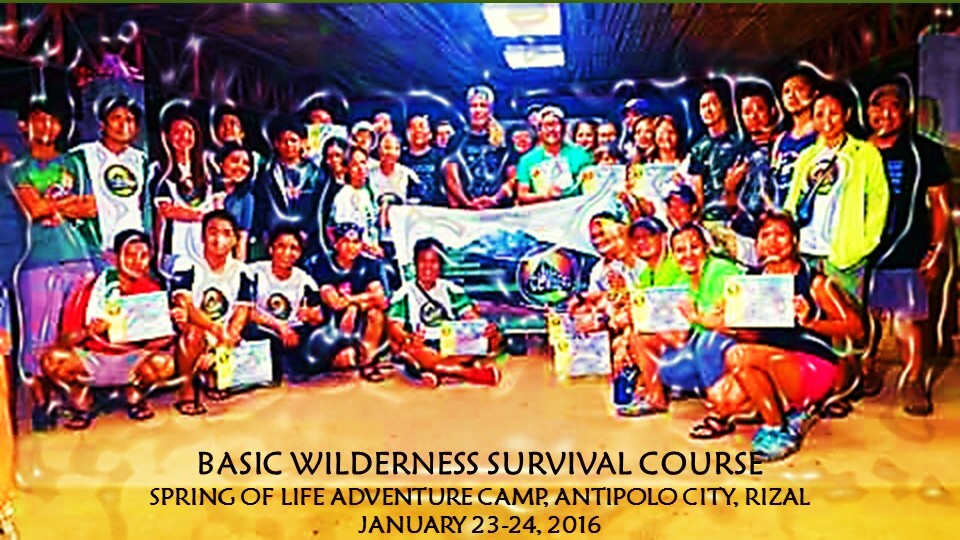
The Climbers League for Ideal Mountaineering and Balanced Environmental Responsiveness (CLIMBER) had contracted me to have 34 of their graduates of previous outdoor trainings take the BASIC WILDERNESS SURVIVAL COURSE for two days.  CLIMBER is a non-stock non-profit organization registered with the Securities and Exchange Commission that is dedicated primarily for outdoors education with the 7 Principles of the Leave No Trace as its bedrock.  Contrary to common perception, it is not a mountaineering club.


It is composed of responsible outdoorsmen whose skills and experience are varied and wide and pooled these together to create the best Basic Mountaineering Course syllabus in this country which, as of this writing, is now on its twelfth class.  They have some of the best instructors which are the best in their fields like Reggie Pablo (high-altitude mountaineering), Lester Susi (land navigation), Billy Morales (ropesmanship) and master educator Erick Suliguin (LNT).  CLIMBER is ably lead by Bong Magana, Jay Z Jorge and Sidney Orendain.

The plane touched down at the Ninoy Aquino International Airport Tarmac 4 on the evening of January 22, 2016 and I was whisked by Sidney and companion to the Mall of Asia’s Bayfront area where I was treated to an al fresco dinner and cold beer.  In a little while, Jay Z and wife Carla fetch me from there and we proceed to their home in Navotas which, perchance has it, becomes my home away from home.  I am not tired from the travel but overly excited for tomorrow’s activity.

In the early morning of January 23, Jay Z, Carla and I travel from Navotas to Antipolo City in their old but very reliable Toyota.  I learned that most of the participants for my training are already at the Spring of Life Adventure Camp.  This is the same place that I have taught members of the Mountain Climbers Alliance of the Philippines (MCAP) in October 2013 where both Jay Z and Carla attended.  Basically, this is the same course that I am teaching today except that I have added a single new chapter.

Setting up of shelters are ongoing and I choose my spot to secure my rust-colored Tingguian Tribe Sierra hammock underneath a silvery white Apexus canopy between two trunks.  The weather is perfect and I do not expect rain today although it would be cooler than usual at this latitude which is four degrees north above my dearly warm Cebu.  Over my shoulders, I expect the swarm of mites that originate from a nearby stag farm which have tormented me the last time but it never came. 

After the opening ceremonies, I got my chance to be introduced to the 34 individuals sitting inside the main hall facing me which I locked in memory with selfie shots.  Speaking about myself would have to be minimized because, from this moment onward, there will be eleven chapters which would need to be discussed within a span of two days.  I feel the pressure but I am used to it and I would have to improvise later on if it fits to be so.  All are excited at the prospect of learning survival and bushcraft.

While I would love to teach bushcraft, it might go against the grain of each individual’s belief in and interpretation of Leave No Trace.  LNT, to the most cerebral amongst us, is but a guide and an idea by which self is bound to live by, whereas, to those who cannot see beyond the true spirit by which LNT was established, it is used as a rule instead and imposed upon on other individuals.  That said, I rather not antagonize the latter by taking the middle ground teaching Basic Wilderness Survival Course to the mountaineering community.


Survival is different from bushcraft.  It is immediate and would bend rules and morality in the pursuit of life – of surviving.  That is a hard reality which all survivors must live with while in the course of their dire consequences and the thereafter.  On the other hand, the mountains consists of harsh environments, steep inclines, high elevations and unpredictable weather patterns.  It is remote yet people visit these places to chase passions and desires.  Accidents are most likely to happen there in a flash.

Chapter 1 is Introduction to Survival.  While nobody has that ultimate technique and answer to survive accidents and calamities, a prepared mind would, at least, be blest by chance.  Surviving the initial impact is one half of it while ensuring your survival until help comes in is the other half of that.  In between, the mind controls everything from the way you think and even to the release of adrenaline.  Your brain is a supercomputer but, unfortunately, it could only process one thought at a time.  

When in a survival situation, your brain works double time and, in the process, use up huge amounts of body heat, water and oxygene and inadvertently releases adrenaline for no apparent reason just like you would experience when getting lost or just plain hiking in darkness.  It is best that you stop and sit still like a rock, close eyes and breathe deeply, gather all your senses and rehydrate.  You would need water and it is your first priority to keep your blood flowing so your brain would work properly.

In the hierarchy of needs and of nutrition in a survival situation, water is tops on both.  Why?  Because we are in the tropics and the body is surrendering perspiration due to humidity and by your exertions.  Along with that, goes our body heat also which you do not know.  To sit still would minimize these wastage and keep these confined by setting up a shelter – if you still have one, or make one from scratch.  This is the second need.  The third would be food then warmth.  Last is security which would complement well with the rest.

Our body has four hypothetical tanks that needs to be replenished during survival.  First is constant rehydration that would offset dehydration.  Second is food that would give you nutrients, carbohydrates and proteins.  Third - sugar converted by enzymes for your adrenaline rush. Fourth is fat, hardest to find in the tropics yet are wrapped as tissues in our body.  Then, lastly, make sure your body is supplied with adequate oxygene.  Keep those air passages free of obstacles.  Might as well practice personal hygiene during survival.  It helps to have both a healthy body and a healthy mind.

Chapter 2 is about the Survival Kit.  It is better that survival kits are made from scratch than bought commercially because a survival kit’s size and its components depends upon the type of the activity you are in to and the kind of environment you are going on to.  Your personal touch on a vital equipment is very important to you should it be needed.  Its components are the medical kit, the replenishment pouch, the repair kit and the survival knife.  It could all be integrated in one container and should be waterproofed.


I came without my knives because I am beholden to CLIMBER to come here without a snag and make their event successful.  If I had insisted to, it could go either ways.  Anyway, Dr. Arvin Sese of Seseblade had provided me the free use (and its ownership later on) of a Seseblade Nessmuk.  Aside that, Jay Z brought his Seseblade Tabak which I also have the good liberty of using later on.  The participants will have their hands full with eighteen Seseblade knives available for sale like the Mountaineer, the NCO, the Pinahig and the popular Sinalung only after I have discussed Chapter 3, Knife Care and Safety.

The knife is a tool and should not be used to what it was not designed for like digging latrine holes and as pry bars.  It is a vital piece of equipment that should be properly handled and cared for because it is your link to your surviving.  Carrying and using it demands good knife etiquette which you can only learn in this type of trainings.  Besides that, there is a knife law that forbids the display and concealed carrying in public places unless you are in a lawful activity, which we are right now.  A knife should be in a sturdy sheath when travelling - for safety - and should be unsheathed when at home to keep it from rust.

I jump to Chapter 5, which is about Water.  The first chapter had mentioned the importance of water during survival.  Water could be sourced from natural springs, water seeps, man-made water holes, flowing streams, the atmosphere and from plants.  It could be cleansed by boiling, by chlorine tablets, betadine drops, exposure to heat, through filtration and by desalination.  It is wise to cache water in your survival camp or travel early and take advantage of shady places and breeze if you happen to have less.

We take a lunch break 30 minutes before 12:00.  Everybody proceed to their tents and group campsites to prepare their food.  I see fire being made to work up embers on charcoal.  There will be meat grilled above it soon.  While it had not started yet, I secretly place a small can filled with cuts of denim on the fire.  I will make charclothe for tomorrow’s fire-making activity.  I believe my meal is taken cared of by the organizers and I will be joining them.  After lunch, I foraged used bamboos for a class activity and other materials for my next lessons. 

By early afternoon, all assembled back at the main hall.  I need to jump further to Chapter 7 and discuss Foraging and Plant Identification.  During survival, you would need to gather food and non-food items.  Food could be meat and proteins which would only be sourced from animals and insects.  Catching animals would be very tricky and you would have to make use of traps and snares.  Food can also be sourced from edible plants.  It is fundamental that you know these because it is everywhere.  It is also important that you know the harmful ones.  Showed them photos of stingy, thorny and poisonous plants.

We go back to Chapter 4.  This is Survival Tool Making and, after this, they can use their knives.  Tool making is essential in survival or even when not in that situation.  I showed them the most basic of tools like the digging stick, cordage from a banana trunk, traps and snares from bamboo, and the batoning stick, which they would need when cutting up bamboos for their cooking pots and for their spoons and drinking jugs.  I assign 5-6 participants each to six groups for the conjoined pots employing each the Trailhawk System of cooking. 

The cooling temperature of a late afternoon coupled with rest have soothed the nerves caused by pressures to which I exposed myself teaching, talking and making my mind work a notch higher than was expected to deliver the lessons coherently and consistently.  The chance to take a bath made half of this outdoors seminar a history.  Now I am joining the organizers in their long table for a fine supper of medium rare liver, mung bean soup and a huge tuna jaw.  Cold beer flowed thereafter and it becomes a long night.  By 01:30, I checked into my inviting hammock. 


The second and final day – January 24 – started with Chapter 6.  This is about Shelters.  Before setting up one, it must be noted that you are in the safest of places.  It should not be near streams, dead trees, trails, water sources and underneath a forest of pines, cedars, pulpwood, eucalyptus and rubber trees.  You should take advantage too of early evening thermals.  Then the lecture proceed to Chapter 10, which is Traditional Navigation.  It uses the natural terrain, shadows and the sky fixtures for travel; avoiding obstacles and exposed areas; and knowing signs on trails made by animals and by humans.

After a short break, we go to Chapter 9 and discuss about Cold Weather Survival.  Since mountaineering is about high elevations, exposure to the elements is expected.  There are five physical mechanisms that steal away body heat and the things that we should do to keep us constantly warm.  The morning’s last discussion is Chapter 11 – Outdoors Safety.  This is the new chapter that I added and it is but excerpts from my yet unpublished book, ETHICAL BUSHCRAFT.

After a lunch break of two hours, I begin the last one – Chapter 8 – that discusses on the most exciting aspect of the training course, Firecraft.  You cannot make a fire if one or all elements are not present, namely: fuel, heat and air.  Lately, they added a fourth element – chemical reaction.  Fire-making is 80% common sense, 10% skill and 10% perspiration.  We are talking about the friction methods.  Your fire can start if you can acquire and identify the right tinder, if you are in a dry place, and if you have the patience.

Aside from friction, there is the conventional or modern method which are matchsticks, lighters, ferro rods and the flint and steel.  Then there is solar magnification which can be done with any lens, reading glasses, water and even ice.   Then you have pressurized air, exemplified by the fire piston.  Since I do not have the luxury of time, I limit my demonstrations to the flint and steel, which I paired with charclothe, and the ferro rod.  I showed them how to make charclothe and how to make a tinder bundle, popularly known as the “bird’s nest”.  


Then I demoed how the bow drill method is made and spun.  Unfortunately, I could only make thick smoke as sawdust embers refused to light up my tinder.  I let others try the bowdrill, the ferro rod, and the flint and steel.  All my charclothe are exhausted to an afternoon of smoke and flames.  A participant, Khai Fredeluces, does the bamboo-saw method.  Just like my bowdrill, only burnt smoke emitted.  The humid conditions might have something to do with that.

Anyway, that sums up the two days allotted by CLIMBER for the 34 participants of the BASIC WILDERNESS SURVIVAL COURSE.  Before closing the activity, Melo Sanchez of Tingguian Tribe Outdoor Equipment gave out some freebies.  Likewise, I have a surprise for all with dry-fit jerseys, dry bags, cellphone pouches and coin purses courtesy of my outfitter – Silangan Outdoor Equipment; and stickers of the Warrior Pilgrimage Blog and of Camp Red Bushcraft and Survival Guild. 

I leave Metro Manila on January 27 for Cebu on another Air Asia flight that had been delayed also, this time, for more than two hours.  I unpacked my bag once I reached home and surprised to find a Seseblade Nessmuk inside.  I completely forgot about it.  I never knew I have it all the time starting from the campsite to Navotas to NAIA and to home and I could not hide my delight with what all those noise created by COMELEC.  Well, it is mine anyway and I will have it for keeps.  Thank you Doc Arvin.

Thank you to Bong and the rest of the CLIMBER community for bringing me back to Luzon; to Melo of Tingguian Tribe for the Sierra hammock; to the Servano couple of Silangan Outdoor Equipment, who always supported me in all my outdoor endeavours; to Mr. Victor Francisco, for the treat of fine dining at the five-star Crowne Plaza Hotel; and to the couple Jay Z and Carla, for hosting me in their home and for sponsoring my tour of Corregidor Island.  Your kindness are all very much appreciated.  God bless you all.


Done in LibreOffice 5.1 Writer

Monday, August 1, 2016

BONIFACIO DAY SPECIAL BUSHCRAFT CAMP 2015

THE BUSHCRAFT CAMP that had made Cebu and its home-grown Camp Red Bushcraft and Survival Guild notable in outdoors circle, especially on occasions marking Independence Day, is returning to its old haunt at Camp Damazo. This time, it will mark November 30, 2015 as the culmination of its three-day activity, with which date commemorate the death of our national hero, Andres Bonifacio, for which activity is named after him: the BONIFACIO DAY SPECIAL BUSHCRAFT CAMP.

Camp Damazo have molded the first local bushcrafters from 2011 to 2013 after participating in the Philippine Independence Bushcraft Camp. It is a special place for these enthusiasts of primitive-living skills belonging to the Camp Red Bushcraft and Survival Guild. It is located somewhere among the small pockets of forest and jungles of the Babag Mountain Range in Cebu City. It is an hour's walk from the nearest trailhead but finding the route to there is knowledge confined only among our circle.

Fortunately, this would be the route that seventeen participants would discover today (November 28) when they would immerse themselves in the world of bushcraft. I walk the lead starting from the Our Lady of Guadalupe Parish to our first rest at the dreaded “Heartbreak Ridge” in a very warm morning. I am carrying a South Korean military duffel bag that is filled full of the things I and the rest need for this bushcraft camp, including 28 event t-shirts. Of the seventeen, five are minors.


Coming along are six individuals, personally handpicked as camp staff. Jhurds Neo, president of Camp Red and alumni of the 2012 edition of the PIBC, would sit as the camp ramrod – the administrator. Aljew Frasco (2013), the vice president, would assist as instructor, together with Mark Lepon (2015). Eli Bryn Tambiga (2012), the club secretary, would serve as camp hawkeye – photographer - and would share the task of camp medic with Christopher Ngosiok (2015). Ernie Salomon (2011) would take charge of the kitchen as the camp fixer.

The ridge almost took the fight off of me as I am forced to halt on places where I have not known to do in previous trips. In my struggle to carry the heavy duffel, I have to make a lot of stops and I had wasted time. The heat was unwavering and it added to my miseries. I was able to recover slightly on the shady areas going to the Portal, which was rolling terrain. I had been carrying a plastic bag full of the robust bread that is a specialty of Titay’s Liloan Rosquillos and Native Delicacy but I am forced to pass it to Christopher after the Portal.

Once I am out of the shade, the struggle returned on the concrete road yet, I know, up ahead would be shady Lensa Trail and all downhill until Creek Alpha. We take a trail that wind around a mountain and stop by Creek Bravo to harvest a green pole of water bamboo before proceeding to Camp Damazo which is uphill. I stop at the top where the ridge starts ascending higher and higher to Camp Damazo. This time, I surrender my task to leading the party to Ernie.

I idled on my uncomfortable seat and rose only when I found the last man coming. Camp Damazo have recovered well from its usage in 2012 and 2013. The main campground will not be used by the participants. They will, instead, camp on a recently-discovered flat terrain just below the trail and is suited best for tents. The old camp, however, will be allocated to the camp staff who, I believe, would most be setting up simple shelters and hammocks.

As I arrive, everybody are busy setting up their shelters; the participants on the lower campground while the camp staff are on the upper part. Ernie had already started the cooking fire and is ably assisted by volunteers Mirasol Lepon (2015), Jonathan Apurado (2015) and Jingaling Campomanes (2015). Jhurds, meanwhile, are bringing Mark and more volunteers – Nyor Pino (2015), Fritz Bustamante (2015) and Nelson Tan (2015), downhill towards the designated latrine areas, to cover it with laminated nylon sheets.


All the camp staff availed of a late lunch – typically an Iberian habit – at 15:30. At 16:00, I immediately opened the lectures with Introduction to Bushcraft, which I intentionally made short owing for the time lost hiking to here which, unfortunately, I was responsible for. After 15 minutes, I proceed to the longer chapter on Ethical Bushcraft. Since bushcraft is beginning to get noticed by many people as a better leisure weekend activity, it would be good to teach them better outdoor ethics and being discrete on their choice of campsites.

Not all could understand what bushcraft really is, especially if you are just imitating survival reality TV shows without knowing its full wisdom, while some cannot appreciate its methods borne out by their prejudiced view of what they perceive on survival TV. Bushcraft can be very destructive if you do not have the privilege of someone teaching you its proper ways. As a parting shot for the first day lectures, it is very important that they know this: that “bushcraft can never mix with mainstream outdoor activities”.

Ernie immediately started the preparation for supper. All the participants likewise prepared theirs on the same cooking fire under the watch of Ernie and his small crew. Dinner came at at 19:00 amid a sky threatening to burst into a storm. The Campfire Yarns and Storytelling has its fine moment until the skies cannot hold it anymore and hurled thunder and lightning and rain. Lots and lots of rain but a hardy few endured under a narrow flysheet canopy. Some continue on their duty as Nightwatch.

I work my way in the rainy darkness among a cobweb of guylines to my dry Silangan hammock protected by an Apexus canopy sheet. I slept well until Eli woke me up at 04:00 to start my watch duty. Coffee is bottomless as I feed the fire with wood. After an hour of composing my thoughts in silence, Camp Damazo begins to come alive from the grips of its cold stupor. There will only be a light breakfast for this second day – November 29 – and I see to it that all will fast for the rest of the day. This is done so the participants could relate what it would be like during survival in a wilderness setting.

There had been sightings of a palm civet (Local name: melu) in the early hours of morning and it is good that it had showed nerve despite our presence. I am quite glad that it thrived even though it is hunted by unscrupulous poachers. As long as I am here, it can never be threatened. At 08:00, the chapter on Knife Care and Safety is being discussed by Aljew. He showed all how a knife, if improperly handled, would cause harm and he gave a bonus by demonstrating different notching techniques.

The next lecture is Firecraft and Aljew still held the reins. The discussion steered from tinder selection to firewood to the different methods of starting a fire. The boredom that grasped the participants is now replaced by avid interest to witness the real thing, perhaps the opportunity to produce a fire by themselves. True to form, Aljew performed the bowdrill, spinning smoke and heat until dust embers spurred a flame on a nest of dry tinder. The participants tried their luck but spindles broke free from its cord.


Another friction method – the bamboo fire-saw, is provided by the tandem of Mark and Fritz, which both achieved in an effortless and fast-paced manner. A lone participant overcame awkwardness and, after pairing with Mark, produced fire. Then everyone tried their hand on every dry bamboo ready for the scorching and satisfaction are written in each of their grinning faces. That goes also to the ladies and the kids!

Excitement had drowned out their starvation as noontime passed without being noticed. Fire-making ate too much of time and I am again in the circle of a natural amphitheater discussing about Shelters starting at 14:00, and continue on to another topic about Foraging and Plant ID. For the satisfaction of the participants, different snares and traps are already set by the camp staff so they may understand the complexities of catching food in the wilderness. Plant ID focused more on the harmful ones which all learn from pictures and from actual plants.

I am also now on the throes of hunger but there are now but a few more hours only before we feast during dinner. Going there, I have to talk about Survival Tool Making and proceed to give some practical exercises that the participants would fulfill and, consequently, create a bond with the knife to improve their dexterity. Their creativity on the bamboo begets a spoon, sometimes with a fork, a chopstick when it gets too complicated, a drinking jug and, finally, a cook pot.

The pot cannot be used if you have nothing to cook inside. Last topic is Outdoor Cooking. This is where you are taught how to preserve meat and your other food. This is also a time to understand the different methods of the fireplace where you will cook your food. Ultimately, rice will be cooked inside the bamboo pot but it is cooked differently from the standard fare.

The participants are grouped in fives and the first to accomplish the task of cooking the rice, gets the first chance to engage in Nocturnal Hunting. Since it had rained last night, Creek Charlie nearby will be brisk and it would be a sociable place among fresh-water crabs. Then edible tree snails will come from their hiding places to feed on moss among tree trunks and branches. Both creatures will be ripe for the picking and you end the imposed fasting by cooking these as your dinner.


The children and the teens among them, probed the darkness of the forest with LED lights, without fear, accompanied by their adult companions. I stationed myself as a safety marshal at the farthest end of the forest while others posted themselves on the creeks and along the peripheries of the hunting ground. It was the best time to hunt the tree snails and they expertly left alone the exotic African variety. Likewise, they deftly catch river crabs beyond the reach of claws.

The snails and the crabs are then dumped infront of Ernie. He knows how to make these fresh catch and obscure gastronomic fantasy into a delightful reality. By 20:00, the participants and the camp staff proceed to consume their only real meal of the day. Strong spirits help conversations and laughter crackled in the night. The place becomes alive again and the Campfire Yarns and Storytelling is doing an encore but this time it is more lively. It is a strange celebration set amidst a remote forest of a mountain.

I am spent and I report to my sleeping quarter so early at 22:00 and I never fully witnessed the bond that kept these kindred spirits awake until the coming of the first shafts of light. I am glad that I am not doing night duty. Perhaps my spot had been taken by the arrival of volunteers Justin Apurado (2014) and Locel Navarro (2015) yesterday. Today marks the appearance of another PIBC alumni Fulbert Navarro (2012) to give support and morale.

This is the final day and today (November 30) is the main reason why the Bonifacio Day Special Bushcraft Camp is being held. This is the day of remembrance of Andres Bonifacio, one of the country’s greatest heroes, who died 118 years ago today at the hands of a rival faction. I will honor him today by extolling his virtues, then raising the Philippine colors high on a pole and sing the national anthem - Lupang Hinirang. Afterwards, we renew our patriotic vow by reciting the Panunumpa sa Watawat.

Then the most awaited sideshow of this bushcraft camp which is now a tradition – the Knife Porn – is unleashed. Balanced above pieces of bamboo are the prized blades that the participants, camp staff and volunteers have used for three days. High-end brands lay alongside local ones, carbon steel knives with stainless-steel ones, fixed blades with folding knives, and multi-tool sets snatch their own spots. Perfect time to catch this with pictures.


That was the last program and, slowly, everybody break camp. It has been a pleasure for me to camp and sleep again at Camp Damazo after more than two years. The fireplace is now a permanent landmark and it shall stay as it is to remind people that it is the only place to introduce fire here, even with those having stoves. A cairn marks its place and it adds character to Camp Damazo, truly a place for rugged outdoorsmen who would appreciate its presence.

We leave our camp of three days at 11:00 and pass by the camp’s very reliable water source. After crossing two streams the ascent to the road starts. We cross that when we arrive at the rim and begin hiking the last stretch to Lanipao. By 13:00, we were now splashing in the spring-fed pools of the Lanipao Rainforest Spring Resort. This is the same place that the participants of PIBC MMXII and PIBC MMXIII bathed in after three days in a very humid Camp Damazo.

A meal of hot free-rein chicken soup and grilled pork, courtesy of the camp staff, gets everyone filled up. Training certificates are being distributed along with the raffling of giveaway items. VGOOD moringa juice were provided free to every participant, camp staff and volunteers, courtesy of fellow participant Ed Eduria. After getting refreshed, we leave at 15:30 bound for Napo on foot to catch motorcycles-for-hire Guadalupe.

The Bonifacio Day Special Bushcraft Camp officially ended at 17:00 of November 30, 2016. All able staff and volunteers and alumni of previous PIBCs like Glenn Pestaño (2011) and Boy Toledo (2011) proceed to Cafe Angelica, another of my refreshment area, located at the back of KIA Motors, in Gorordo Avenue, to savor sub-zero beer. The Bonifacio Day event was the first of its kind and the first to accept minors (Jacob – 14, Cleos – 14, Shawn – 14, Michaela – 11 and Maverick – 9), and I will study it if it would be feasible to hold it yearly.

Keep those fingers crossed. XO


Document done in LibreOffice 5.1 Writer