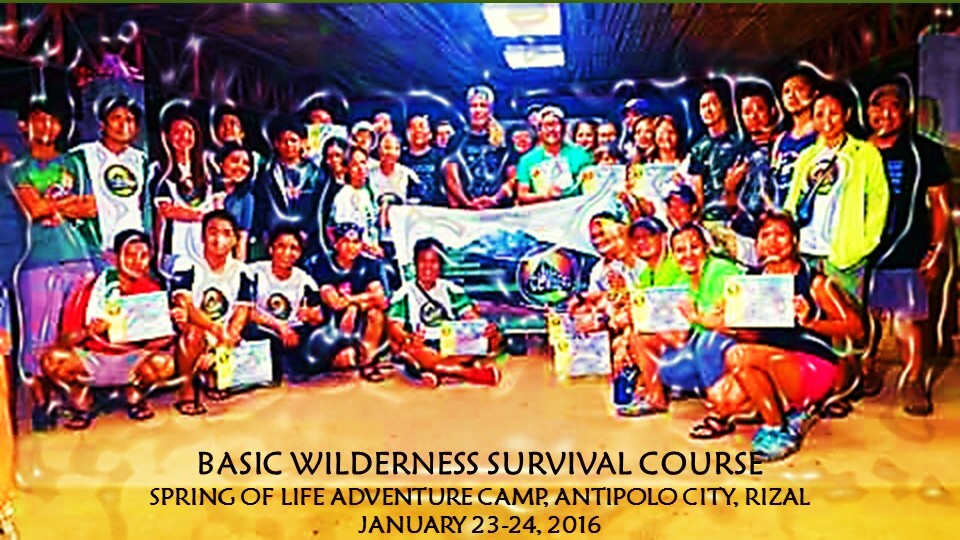
Some photos by Vernie Tuason and Franz Tiu
Showing posts with label Rizal. Show all posts
Sunday, October 21, 2018
THE TRAILHAWK JOURNEYS: Rodriguez Rizal Wilderness Survival Class
LAST FEBRUARY 2016, an independent
event organizer contacted me for a survival training, far inland beyond the
Wawa Dam, in Rodriguez, Rizal. This particular organizer became one of the
participants along with twenty others. I could not forget the two days I spent
with them and the hosting family who originally were from Aklan. That training,
came days after I had also done one with 34 individuals organized by CLIMBER.
The organizer, now my former
student, arranged again another training for another set of participants, this
time on the approach to the Binicayan-Pamitinan Protected Landscape, in
Rodriguez, Rizal, near the DENR office. I am again obliged to travel to Luzon
with my tools, educational aids and instruction manual. It is another
compressed training which would run for two days on December 9 and 10, 2017.
Although I do not mind doing a
training for two days, as I receive the same compensation package that I do for
three days, but three days is best for both the participants and me. I only
give the best instructions and the extra day would have given justice to what
you spend for. An extra day would have been relaxing on my part also and, in
the process, participants would not be forced to receive an overload of
information.
This training is called the BASIC
WILDERNESS SURVIVAL COURSE. It is designed for tropical wilderness settings of
dense jungles and rugged highlands, which I first offered to the mountaineering
community in October 2013. It is open to all individuals or groups of any
interests and purpose. Attending now are fifteen people, to include two minors.
The training is done inside a local resort.
The first chapter is Introduction
to Survival. Survival situations demand that you stay tough after the initial impact. Mental stability
and toughness are very important characteristics of a survivor. You must
develop a survival mindset. Do not engage in prolonged mind games of fantasy
and false hopes. You should rein in your mind so you would not release excess
adrenaline and cause you more confusions in a very stringent moment.
The best thing to do is stay still
and fill up your lungs with oxygene. Your brain needs it most to help you
process thoughts. You are now in a high state of agitation and so does your
brain. Your brain will be in hyper mode, collating and processing many thoughts
all at the same time which is beyond human capacity. We can do so one thought
at a time. Just stay still and breathe regularly, supplying your blood system
with oxygene.
In the hierarchy of needs and of
nutrition in a survival situation, water is always on the top of the scales of
both. Rightly so, for we are in the tropics and humidity plays a big role. With
that, we surrender perspiration by the acts of our exertions and by what the
climatic conditions imposed on us. Along with the lost moisture, is our body
heat which we let go without our knowing.
When you stay still in one place,
you lessen wastage of moisture and body heat. Then you confine the latter by
setting up a shelter (if you still have one) or make one from scratch. That is
the second need. The third would be food then warmth. Although food, and even
water, would give you warmth, but heat from a naked flame or from the rays of
the sun or from a person’s body is solace. Last is security which would
complement well with the rest.
Our body has four hypothetical
storage tanks that needs to be replenished from time to time during survival.
First is constant rehydration that would offset dehydration. Second is food
that would give you nutrients, carbohydrates and proteins. Third is sugar which
is converted by enzymes for your adrenaline rush. Fourth is fat, hardest to find
in the tropics yet are wrapped as tissues in our body.
The topic for the next chapter is
about Water Sanitation and Hydration. The first chapter had mentioned
the importance of water during survival. Water could be sourced from natural
springs, water seeps, man-made water holes, flowing streams, the atmosphere and
from plants. It could be refined through boiling, by chemicals, exposure to
heat, through filtration and by desalination. It is wise to cache water in your
survival camp or just travel early and take advantage of shady places and
breeze if you happen to have less.
We move fast to the third chapter
which is about Knife Care and Safety. The knife is a tool and should not
be used to what it was not designed for like digging holes and as pry bars. It
is a vital piece of equipment that should be properly handled and cared for
because it is your link to your surviving. In all my training, knife etiquette
is learned first before you touch a knife, so as to lessen accidents.
Besides that, there is a knife law
that forbids the display, even of concealed carrying, in public places unless
you are in a lawful activity, which we are in right now. A knife should be in a
sturdy sheath when travelling and should be unsheathed when at home to keep it
from rust. There are many kinds of knives and it is important that you know the
parts, blade shapes, grind styles and the tang designs. You must also learn how
to field sharpen a knife.
I was able to finish three chapters
in the morning and noonbreak is mandatory when the clock struck twelve. There
is no cooking as food is prepared by the family-run resort. After lunch, the
hammock is an inviting proposition and I sneaked into its comfortable grip for
a quick nap. I needed the rest to keep my mind sharp since the participants
would be handling knives later. Refreshed after 90 minutes of siesta, I
continued with the activity.
After the much appreciated
instructions about the knife in the morning, we moved on to Survival Tool
Making. Using a tool is essential in survival or even when not in that
situation. I showed them the most basic of tools like the digging stick, traps
and snares from pieces bamboo that I prepared, and the batoning stick. I let
each carve a spoon on bamboo to practice their dexterity with a knife while
supervising the practical exercise.
Following this is the chapter on Notches.
There are five basic notches that are used regularly in bushcraft. These are
applicable in shelters, furniture and tools. Again, this is another exercise in
knife dexterity but it can only be achieved with the use of another tool, the
baton stick. On a single stick that served as an art canvas, each participant
carved their five different notches, starting with the easiest up to the most
complicated.
Next is Fire, Fuel and Campfire
Safety. You cannot make a fire if one or all elements are not present,
namely: fuel, heat and air. Lately, they added a fourth element – chemical
reaction. Fire-making is 80% common sense, 10% skill and 10% perspiration. We
are talking about the friction methods. Your fire can start if you can acquire
and identify the right tinder, if you are in a dry place, and if you have the
patience.
Aside from friction, there is the
conventional method which are matchsticks, lighters, ferro rods and the flint
and steel. Then there is solar magnification which can be done with any lens,
reading glasses, water and even ice. Then you have pressurized air, exemplified
by the fire piston. Since I do not have the luxury of time, I limit my
demonstrations to the flint and steel, which I paired with charclothe, and the
ferro rod. I showed them how to make a tinder bundle.
Showed them how the bow drill
method is made and spun. Unfortunately, I could only make thick smoke as
sawdust embers refused to light up my tinder. Humidity is very high since we
are beside a big river and there is a promise of a downpour. I let others try
the bowdrill, the ferro rod, and the flint and steel. The teenagers among them
were able to light the charclothe. Unfortunately, we cannot do with the bamboos
because the dry ones have not been stored properly and are all wet.
A strong downpour came as expected
and we have to end the first day. The activity on primitive cooking using
bamboo could not proceed. The storage of firewood, along with dry bamboo had
been left to neglect. I have to dry just a few after I have set my shelter in
the morning and left the rest to the onslaught of rain when the rush for the
safe shelter commenced.
Likewise, the activity on Nocturnal
Hunting has to be shelved. The Marikina River has risen and very turbulent and
is not safe for people. The good thing about catered food is you appreciate it
in times of rain but I have seen a lot of cooking in the worst of times and
today is no exception. Should have but the organizer designed this as it is and
it is beyond my control.
When the rain stopped, the Campfire
Yarns and Storytelling pushed through naturally. A small fire gave the
participants a reason to gather around in a circle. I have to gather the
drenched firewood nearer the fire to wick it away of moisture so it would be
fed next as campfire fuel. A bottle of brandy appeared and the glass made its
way among the adults animating more of the stories. The evening program ended
at 23:00 and the hammock is most appreciated.
The second day (December 10) start
with Customizing the Survival Kit. It is better that survival kits are
made from scratch than bought commercially because a survival kit’s size and
its components depends upon the type of the activity you are indulging in and
the kind of environment you are going to visit. Your personal preference still
matters. The components should include the medical kit, the replenishment
pouch, the repair kit and a small knife. It could all be integrated in one
container and should be waterproofed.
Next is Foraging and Plant
Identification. Foraging food in the wilderness or on unfamiliar terrain
can be very taxing to the mind. When you are stressed and hungry, you tend to
remove all caution. Looks can be very deceiving in the tropics like fruits,
leaves, nuts, roots, flowers and mushrooms. Likewise, you need to evade harmful
plants while travelling your way in a jungle.
Short term food would be grub, tree
snails, fresh-water shrimps and crabs and frogs. These can be picked by hand.
Cook it if you must to remove parasites and bacteria. Long term food are meat
from mammals, fish, birds and reptiles. For that, you must use a weapon or
traps and snares. Traps could be anything designed to lure prey into a simple
contraption of a hollow bamboo or a dam of rocks. It must work with the
terrain, with gravity and the habits of creatures, including its anatomy
design.
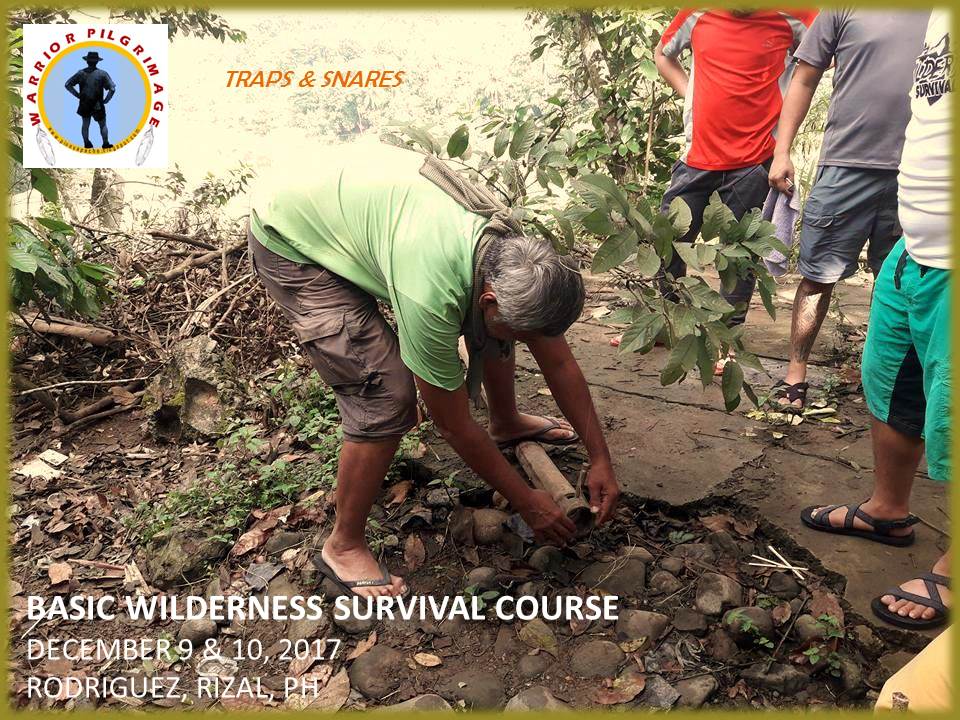
Snares are more complex. It has a
spring mechanism and a trigger mechanism which would be initiated by the prey. Showed
the students a very common snare employing a pressure-trigger mechanism. It
could catch anything from birds to goats. Another is a tube snare popularized
by the Aeta. You must use bait so prey would be lured to set it off. A single
trap or a single snare would not yield you a catch but a trap line of 20 to 30
of these, after ascertaining where prey would most likely pass or visit.
Related to these is the chapter on Food
Preservation and Cooking. If you can eat a deer all in one setting, well
and good. You are very fortunate to still possess a healthy appetite. Meat rot
in a short span of time. During survival, meat can be preserved and its
edibility can be extended for a few more hours to several months. You can boil
it. You can dry it. You can smoke it. Or you can cook it with its own oil from
its fat.
Fish can be preserved by drying and
by smoking. Fruits can be digested after a drying session and provide you
natural sugar. Common rootcrops, has high starch value, and should be cooked,
by all means possible, to remove toxins and poison. Famine crops need to be
immersed in running water for five days before cooking. Salt and vinegar are
good food preservatives. Vinegar can be sourced from any palm.
Next is Navigation and
Understanding Trails. This is more on traditional navigation which use the
natural terrain, shadows and the sky fixtures for travel; avoiding obstacles
and exposed areas; and knowing how to identify signs on trails made by both
animals and humans. Following that is Understanding Cold Weather. During
survival, exposure to the elements is expected. There are five physical
mechanisms that steal away body heat and the things that we should do to keep
us constantly warm.
Dusk would soon come and we have to
break camp, intending to finish the last chapter which is Outdoors Common
Sense. This is based from my yet unpublished book, ETHICAL BUSHCRAFT.
It is about trail courtesy and behavior while on the trail; choosing the best
campsites; practicing stealth camping; increasing individual safety and
security; wildlife encounters; and introduce people the idea of Blend, Adapt
and Improvise.
We finished the training with a
blade porn. It is a traditional bushcraft activity where all edged tools are
laid together in one place to inject another round of useful conversations and
to encourage closer camaraderie among the participants. What resulted was the
presence a considerable number of high-quality imported blades and rare local
blades. It is now almost evening and we took dinner.
The van-for-hire that took me here
two days ago from Cubao, came back to bring me back there. The organizer made
sure of that. From Cubao, I took a bus bound for Navotas where an invitation for
a second dinner awaits me and, of course, a refuge to rest a few days before my
departure back to Cebu. I am tired, not of the training compressed in two days,
but from a trusted person who failed to keep his end of the bargain. It is one of the hazards of a journeyman and it is sad.
Document done in LibreOffice 5.3
Writer
Some photos by Vernie Tuason and Franz Tiu
Posted by
PinoyApache
at
09:00
0
comments
Labels: bushcraft camp, Rizal, Rodriguez, training, travel, wilderness survival
Thursday, December 7, 2017
PINOYAPACHE MEETS THE GREATEST PINOY MOUNTAINEER
REGIE PABLO JOINED ME today, March
18, 2017, inside a Toyota Corolla driven by Jay Z Jorge. We would all be going
to Antipolo City. The Climbers League for Ideal Mountaineering and Balanced
Environmental Responsiveness, or simply known as CLIMBER, will be opening the
18th Batch of their Basic Mountaineering Course in Basekamp, a private camping
facility.
I stayed the whole day yesterday in
the residence of Jay Z in Navotas City and I am fully rested after a week of
travel, work and outdoors recreation. A wholesome dinner at Pacing’s House of
Barbecue settled my equilibrium to near normal levels. My participation in the
CLIMBER BMC would just be in a cameo role of bed spacer and freeloader. Jay Z
must have erred in inviting me.
Sitting all to himself at the back
is Regie, the renowned Filipino mountaineer and Mt. Everest summitter. It is
indeed an honor to meet and share a ride with him inside the Toyota. This
unassuming man made possible the Philippine dream of putting the first Filipino
on Everest, with which honor belonged to Leo Oracion, who planted the national
colors at 8848 meters in May 2006. It could have been him, though.
Unknown to many, he was the
wellspring of that idea when he made known his intention of climbing Everest in
2001, after acquiring the funds, the equipment and the sponsors through his own
industry and connections to sustain his expedition. He was set to claiming that
honor when he was talked and prevailed upon by the local mountaineering
community to involve the whole nation. So it became known as the Philippine
Everest Expedition Team.
On that year in 2006, the country
achieved an unprecedented feat by placing two team members on top of the peak.
He did not get that chance. He sacrificed everything for that moment but his
never came. Worse, he was sent packing days before caused by internal politics
of the expedition team. He nursed bitterness for relinquishing his opportunity
in 2001 but he will prove one day that he can climb without a team with useless
people and their personal motives.
His day came on May 16, 2007. He
did the impossible. He climbed Qomulongma all by himself, by his own wits and,
in the process, losing the endmost joint of a thumb to frostbite. But he
survived the greatest ascent of his life and lived to tell his solo adventure.
Quite a feat for someone who defied age and his critics. It was the greatest
insult he could flaunt in their faces! I loved individuals who thrived in
obscurity. Regie is a certified Badass!
I remembered featuring Regie Pablo
and his Everest climb in my Multiply account back in 2007. I know only that his
expedition was done on his own power, bequeathing his corporate job for that
one chance which elicit my appreciation. I know now that he took the longer
route, after a brush of betrayal and rejection. His ascent has more substance,
more drama and more sacrifice than any other Filipino before him and he
deserves that honor, in bold letters, as the Greatest Filipino Mountaineer.
We arrive at Basekamp and some of
the CLIMBER training staff are already there. The participants are excited to be
in a seminar that would educate them into responsible individuals. They would
learn a lot, considering that CLIMBER is an advocate of excellent outdoors
education anchored on the seven principles of the Leave No Trace. In fact,
CLIMBER is one of only a very few local partners of LNT Center of Outdoor
Education.
Jay Z introduced me to the
participants as an “inspirational” speaker. I was caught unprepared for I was
informed at the last minute. Maintaining my composure, I tried to be esteemed
as possible infront of them. I appealed to the participants to be discerning
and objective of joining in mass climbs and cheap bandwagon tours which tend to
drain them physically and emotionally instead of gaining good impressions and
memorable experiences.
However, DIY trips and organized
tours by more responsible tour agencies are much better and yields you higher
sense of adventures and better memories, provided you follow protocol, which
you can only learn in seminars like the BMC. As my parting message, it would be
nice to the environment and to the indigenous communities to keep these
unvisited places all to yourselves and it would be better, as well, not to
share it in social media sites.
Regie would talk about Introduction
to High Altitude Mountaineering during the first part of the BMC. For that
matter, he brought a big bag containing the learning aids vital to imparting
his lecture to the participants. Real mountaineering starts at 4000 meters
because air begins to thin and low temperatures starts to be a hindrance. These
two, together with ice, avalanche and crevasse, would make progress painful and
dangerous.
Altitude sickness, frostbite,
exposure, pulmonary and cranial edema are the main illnesses that slows down
expeditions and, almost always, it claim lives. Another difficulty in higher
altitudes is the difficulty of doing body functions deemed normal at sea level
like breathing, eating, drinking, sleeping, defecating and urinating. Because
of that, the sport of mountaineering needs special clothing, safety equipment
and high-end gear and a very complicated acclimatization process.
The bag is a treasure trove of
items that have seen better days when Regie brought it in many of his
mountaineering expeditions in New Zealand, China, Argentina, Kyrgyzstan, Alaska,
India and Nepal, but his crowning glory in Mt. Everest made these items more
valuable than ever. Each has its own story to unravel and are now collectible
items. These items are a decade old now and still served its purpose as
valuable aids in BMC education.
I was amazed at the number of tools
and thought processes to accomplish an expedition in arctic and thin-air
conditions. In cold weather, deprived of oxygene, your blood circulation
becomes sluggish affecting your thoughts. Simple body movement takes an
eternity to accomplish. It takes years of experience to get used to these harsh
conditions and an equally harsh environment. It takes also a deep pocket to
make a summit timed on the most favorable time of the year.
It is cheap if you were born and
have lived there all your life like the Sherpas but astronomically expensive
when you are organizing an independent expedition on your own. Lately,
commercial adventure tour agencies organize climbs in the Himalayas region and
the price has diminished so much by leaps and bounds and, because of that,
summitting Everest or any of the fourteen 8000-meter peaks are now possible for
everyone.
The Philippine Everest Expedition
Team took this very economical course and their contracted tour agency took
care of everything from climb permits, lodging houses, additional equipment,
oxygen, food, transportation, yaks and a small army of Sherpas to pave the way
for them. It would have been much cheaper still if they start from the Buddhist
Kingdom of Free Tibet but it is much safe in Nepal with all these
professionals.
Regie successfully climbed Mt.
Everest after cultivating friendships and connections with Nepalese tour
operators and guides. He is a likeable fellow, humble and simple, but he has
drive which could move mountains like his plans in 2001 where a number of
people woke up from their stupors and inspired a nation. Denied his chance in
2006, which was originally his expedition, he came back and proved his
detractors wrong. He won the last battle after a painful retreat.
His name in Philippine
mountaineering history is already ensured and his way was the stuff of legends.
Regie is an asset to any organization which could positively harness his
intellect, skills, experiences and insights and CLIMBER is just fortunate to
have worked together with him in educating people. CLIMBER guarantees the
education of BMC participants only from the people who are the best in their
fields, which followed thereafter.
The afternoon of the first day is
dedicated to Land Navigation which is handled by Ronald Fabon and, after
dinner, Basic Life Support by Christopher Jazmin. During the breaks, I set up
my Silangan 2nd-Gen Hammock and an Apexus sheet at the back of the lecture hall
and chased short naps. While witnessing the BMC, I get to meet again Ven Ap of
Ven Going Places’ Stories Blog who had featured me many times and who have
helped me with sponsorship for my Thruhike last January.
The next day, March 19, is a whole
morning of Ropesmanship and Knot Tying by Marc Gana. The afternoon is dedicated
for Wilderness First Aid by Chad Angelo Torres and Leave No Trace Principles by
LNT Master Educator Erick Suliguin. After dinner, guest resource speaker
Jeremiah Dayto talked about Prepping. Jay Z capped the final day with Introduction
to Wilderness Survival and Khai Fredeluces explaining the appearance and
contents of a survival kit.
It was another worthwhile weekend
that I spent, this time, with my friends in CLIMBER. Some of these guys have
even sat in my different bushcraft and survival classes like Jay Z (PIBC 2012,
BWSC 2013), Marc (MCAPBC 2012), Jeremiah (PIBC 2016), Chad (BWSC 2016), Khai
(BWSC 2016) and CLIMBER top honcho Bong Magana (MCAPBC 2012). These guys know
what they are doing and, as I have mentioned earlier, they are the best in
their fields.
Notable mentioning is Erick, a
product of CLIMBER’s earliest BMC batch, who went on to pursue advanced
learning in LNT at its US headquarters and came back to inject CLIMBER into a
very credible outdoors learning institution. From him, I now own a Condor
Bushlore, a Browning folding knife and a NOLS patch. It was a very fruitful
weekend and my overall 14-day in visit in Luzon, which brought me to Baguio and
Zambales, culminated in meeting Regie Pablo, a Filipino mountaineer nonpareil.
Document done in LibreOffice 5.3
Writer
Posted by
PinoyApache
at
09:00
1 comments
Labels: Antipolo City, CLIMBER, knot-tying, land navigation, LNT, mountaineering, Regie Pablo, Rizal, training, wilderness first aid
Saturday, October 1, 2016
THE TRAILHAWK JOURNEYS: Antipolo Wilderness Survival Class
I AM ON BOARD an Air Asia airplane that had already been delayed by two hours for Manila. The flurry of announcements and non-announcements about the prohibition of the carrying of guns and deadly weapons during travel in an election period have left me fang-less. It is strange to travel without my blades considering that I need these in the course of my work. I am now a full-time survival instructor and I am coming over to teach people wilderness survival. For that matter, my bag even if it is the bigger Habagat Viajero is strangely light.
The Climbers League for Ideal Mountaineering and Balanced Environmental Responsiveness (CLIMBER) had contracted me to have 34 of their graduates of previous outdoor trainings take the BASIC WILDERNESS SURVIVAL COURSE for two days. CLIMBER is a non-stock non-profit organization registered with the Securities and Exchange Commission that is dedicated primarily for outdoors education with the 7 Principles of the Leave No Trace as its bedrock. Contrary to common perception, it is not a mountaineering club.
It is composed of responsible outdoorsmen whose skills and experience are varied and wide and pooled these together to create the best Basic Mountaineering Course syllabus in this country which, as of this writing, is now on its twelfth class. They have some of the best instructors which are the best in their fields like Reggie Pablo (high-altitude mountaineering), Lester Susi (land navigation), Billy Morales (ropesmanship) and master educator Erick Suliguin (LNT). CLIMBER is ably lead by Bong Magana, Jay Z Jorge and Sidney Orendain.
The plane touched down at the Ninoy Aquino International Airport Tarmac 4 on the evening of January 22, 2016 and I was whisked by Sidney and companion to the Mall of Asia’s Bayfront area where I was treated to an al fresco dinner and cold beer. In a little while, Jay Z and wife Carla fetch me from there and we proceed to their home in Navotas which, perchance has it, becomes my home away from home. I am not tired from the travel but overly excited for tomorrow’s activity.
In the early morning of January 23, Jay Z, Carla and I travel from Navotas to Antipolo City in their old but very reliable Toyota. I learned that most of the participants for my training are already at the Spring of Life Adventure Camp. This is the same place that I have taught members of the Mountain Climbers Alliance of the Philippines (MCAP) in October 2013 where both Jay Z and Carla attended. Basically, this is the same course that I am teaching today except that I have added a single new chapter.
Setting up of shelters are ongoing and I choose my spot to secure my rust-colored Tingguian Tribe Sierra hammock underneath a silvery white Apexus canopy between two trunks. The weather is perfect and I do not expect rain today although it would be cooler than usual at this latitude which is four degrees north above my dearly warm Cebu. Over my shoulders, I expect the swarm of mites that originate from a nearby stag farm which have tormented me the last time but it never came.
After the opening ceremonies, I got my chance to be introduced to the 34 individuals sitting inside the main hall facing me which I locked in memory with selfie shots. Speaking about myself would have to be minimized because, from this moment onward, there will be eleven chapters which would need to be discussed within a span of two days. I feel the pressure but I am used to it and I would have to improvise later on if it fits to be so. All are excited at the prospect of learning survival and bushcraft.
While I would love to teach bushcraft, it might go against the grain of each individual’s belief in and interpretation of Leave No Trace. LNT, to the most cerebral amongst us, is but a guide and an idea by which self is bound to live by, whereas, to those who cannot see beyond the true spirit by which LNT was established, it is used as a rule instead and imposed upon on other individuals. That said, I rather not antagonize the latter by taking the middle ground teaching Basic Wilderness Survival Course to the mountaineering community.
Survival is different from bushcraft. It is immediate and would bend rules and morality in the pursuit of life – of surviving. That is a hard reality which all survivors must live with while in the course of their dire consequences and the thereafter. On the other hand, the mountains consists of harsh environments, steep inclines, high elevations and unpredictable weather patterns. It is remote yet people visit these places to chase passions and desires. Accidents are most likely to happen there in a flash.
Chapter 1 is Introduction to Survival. While nobody has that ultimate technique and answer to survive accidents and calamities, a prepared mind would, at least, be blest by chance. Surviving the initial impact is one half of it while ensuring your survival until help comes in is the other half of that. In between, the mind controls everything from the way you think and even to the release of adrenaline. Your brain is a supercomputer but, unfortunately, it could only process one thought at a time.
When in a survival situation, your brain works double time and, in the process, use up huge amounts of body heat, water and oxygene and inadvertently releases adrenaline for no apparent reason just like you would experience when getting lost or just plain hiking in darkness. It is best that you stop and sit still like a rock, close eyes and breathe deeply, gather all your senses and rehydrate. You would need water and it is your first priority to keep your blood flowing so your brain would work properly.
In the hierarchy of needs and of nutrition in a survival situation, water is tops on both. Why? Because we are in the tropics and the body is surrendering perspiration due to humidity and by your exertions. Along with that, goes our body heat also which you do not know. To sit still would minimize these wastage and keep these confined by setting up a shelter – if you still have one, or make one from scratch. This is the second need. The third would be food then warmth. Last is security which would complement well with the rest.
Our body has four hypothetical tanks that needs to be replenished during survival. First is constant rehydration that would offset dehydration. Second is food that would give you nutrients, carbohydrates and proteins. Third - sugar converted by enzymes for your adrenaline rush. Fourth is fat, hardest to find in the tropics yet are wrapped as tissues in our body. Then, lastly, make sure your body is supplied with adequate oxygene. Keep those air passages free of obstacles. Might as well practice personal hygiene during survival. It helps to have both a healthy body and a healthy mind.
Chapter 2 is about the Survival Kit. It is better that survival kits are made from scratch than bought commercially because a survival kit’s size and its components depends upon the type of the activity you are in to and the kind of environment you are going on to. Your personal touch on a vital equipment is very important to you should it be needed. Its components are the medical kit, the replenishment pouch, the repair kit and the survival knife. It could all be integrated in one container and should be waterproofed.
I came without my knives because I am beholden to CLIMBER to come here without a snag and make their event successful. If I had insisted to, it could go either ways. Anyway, Dr. Arvin Sese of Seseblade had provided me the free use (and its ownership later on) of a Seseblade Nessmuk. Aside that, Jay Z brought his Seseblade Tabak which I also have the good liberty of using later on. The participants will have their hands full with eighteen Seseblade knives available for sale like the Mountaineer, the NCO, the Pinahig and the popular Sinalung only after I have discussed Chapter 3, Knife Care and Safety.
The knife is a tool and should not be used to what it was not designed for like digging latrine holes and as pry bars. It is a vital piece of equipment that should be properly handled and cared for because it is your link to your surviving. Carrying and using it demands good knife etiquette which you can only learn in this type of trainings. Besides that, there is a knife law that forbids the display and concealed carrying in public places unless you are in a lawful activity, which we are right now. A knife should be in a sturdy sheath when travelling - for safety - and should be unsheathed when at home to keep it from rust.
I jump to Chapter 5, which is about Water. The first chapter had mentioned the importance of water during survival. Water could be sourced from natural springs, water seeps, man-made water holes, flowing streams, the atmosphere and from plants. It could be cleansed by boiling, by chlorine tablets, betadine drops, exposure to heat, through filtration and by desalination. It is wise to cache water in your survival camp or travel early and take advantage of shady places and breeze if you happen to have less.
We take a lunch break 30 minutes before 12:00. Everybody proceed to their tents and group campsites to prepare their food. I see fire being made to work up embers on charcoal. There will be meat grilled above it soon. While it had not started yet, I secretly place a small can filled with cuts of denim on the fire. I will make charclothe for tomorrow’s fire-making activity. I believe my meal is taken cared of by the organizers and I will be joining them. After lunch, I foraged used bamboos for a class activity and other materials for my next lessons.
By early afternoon, all assembled back at the main hall. I need to jump further to Chapter 7 and discuss Foraging and Plant Identification. During survival, you would need to gather food and non-food items. Food could be meat and proteins which would only be sourced from animals and insects. Catching animals would be very tricky and you would have to make use of traps and snares. Food can also be sourced from edible plants. It is fundamental that you know these because it is everywhere. It is also important that you know the harmful ones. Showed them photos of stingy, thorny and poisonous plants.
We go back to Chapter 4. This is Survival Tool Making and, after this, they can use their knives. Tool making is essential in survival or even when not in that situation. I showed them the most basic of tools like the digging stick, cordage from a banana trunk, traps and snares from bamboo, and the batoning stick, which they would need when cutting up bamboos for their cooking pots and for their spoons and drinking jugs. I assign 5-6 participants each to six groups for the conjoined pots employing each the Trailhawk System of cooking.
The cooling temperature of a late afternoon coupled with rest have soothed the nerves caused by pressures to which I exposed myself teaching, talking and making my mind work a notch higher than was expected to deliver the lessons coherently and consistently. The chance to take a bath made half of this outdoors seminar a history. Now I am joining the organizers in their long table for a fine supper of medium rare liver, mung bean soup and a huge tuna jaw. Cold beer flowed thereafter and it becomes a long night. By 01:30, I checked into my inviting hammock.
The second and final day – January 24 – started with Chapter 6. This is about Shelters. Before setting up one, it must be noted that you are in the safest of places. It should not be near streams, dead trees, trails, water sources and underneath a forest of pines, cedars, pulpwood, eucalyptus and rubber trees. You should take advantage too of early evening thermals. Then the lecture proceed to Chapter 10, which is Traditional Navigation. It uses the natural terrain, shadows and the sky fixtures for travel; avoiding obstacles and exposed areas; and knowing signs on trails made by animals and by humans.
After a short break, we go to Chapter 9 and discuss about Cold Weather Survival. Since mountaineering is about high elevations, exposure to the elements is expected. There are five physical mechanisms that steal away body heat and the things that we should do to keep us constantly warm. The morning’s last discussion is Chapter 11 – Outdoors Safety. This is the new chapter that I added and it is but excerpts from my yet unpublished book, ETHICAL BUSHCRAFT.
After a lunch break of two hours, I begin the last one – Chapter 8 – that discusses on the most exciting aspect of the training course, Firecraft. You cannot make a fire if one or all elements are not present, namely: fuel, heat and air. Lately, they added a fourth element – chemical reaction. Fire-making is 80% common sense, 10% skill and 10% perspiration. We are talking about the friction methods. Your fire can start if you can acquire and identify the right tinder, if you are in a dry place, and if you have the patience.
Aside from friction, there is the conventional or modern method which are matchsticks, lighters, ferro rods and the flint and steel. Then there is solar magnification which can be done with any lens, reading glasses, water and even ice. Then you have pressurized air, exemplified by the fire piston. Since I do not have the luxury of time, I limit my demonstrations to the flint and steel, which I paired with charclothe, and the ferro rod. I showed them how to make charclothe and how to make a tinder bundle, popularly known as the “bird’s nest”.
Then I demoed how the bow drill method is made and spun. Unfortunately, I could only make thick smoke as sawdust embers refused to light up my tinder. I let others try the bowdrill, the ferro rod, and the flint and steel. All my charclothe are exhausted to an afternoon of smoke and flames. A participant, Khai Fredeluces, does the bamboo-saw method. Just like my bowdrill, only burnt smoke emitted. The humid conditions might have something to do with that.
Anyway, that sums up the two days allotted by CLIMBER for the 34 participants of the BASIC WILDERNESS SURVIVAL COURSE. Before closing the activity, Melo Sanchez of Tingguian Tribe Outdoor Equipment gave out some freebies. Likewise, I have a surprise for all with dry-fit jerseys, dry bags, cellphone pouches and coin purses courtesy of my outfitter – Silangan Outdoor Equipment; and stickers of the Warrior Pilgrimage Blog and of Camp Red Bushcraft and Survival Guild.
I leave Metro Manila on January 27 for Cebu on another Air Asia flight that had been delayed also, this time, for more than two hours. I unpacked my bag once I reached home and surprised to find a Seseblade Nessmuk inside. I completely forgot about it. I never knew I have it all the time starting from the campsite to Navotas to NAIA and to home and I could not hide my delight with what all those noise created by COMELEC. Well, it is mine anyway and I will have it for keeps. Thank you Doc Arvin.
Thank you to Bong and the rest of the CLIMBER community for bringing me back to Luzon; to Melo of Tingguian Tribe for the Sierra hammock; to the Servano couple of Silangan Outdoor Equipment, who always supported me in all my outdoor endeavours; to Mr. Victor Francisco, for the treat of fine dining at the five-star Crowne Plaza Hotel; and to the couple Jay Z and Carla, for hosting me in their home and for sponsoring my tour of Corregidor Island. Your kindness are all very much appreciated. God bless you all.
Done in LibreOffice 5.1 Writer
Posted by
PinoyApache
at
08:30
0
comments
Labels: Antipolo City, bushcraft, CLIMBER, firecraft, knives, plant ID, Rizal, survivalcraft, tool making, training, traps and snares, wilderness survival
Friday, May 16, 2014
ALLIANCE MATTERS III: Basic Wilderness Survival Course 2013
I
LEAVE HOME AT 2:15 AM. Three hours from now, I will be in Metro
Manila, October 18, 2013. I have to honor a commitment with the
Mountain Climbers Alliance of the Philippines, Inc. and, that is, to
conduct training about survival among its members. I have done so
last year on a program borrowed from the Philippine Independence
Bushcraft Camp. It was held then at the slopes of Mount Balagbag,
Rizal.
This
time, I have designed a training program for mountaineers. It is
called the BASIC WILDERNESS SURVIVAL COURSE and it will run for three
days. My Sandugo Khumbu 40 Liter backpack is heavy as
I follow the line to check in at the airport. I had already
separated my EDC Kit from the bag and, when my turn came, the bag
weigh in at 13.9 kilos. I have a 15 kilogram limit and good thing
that I had handcarried my EDC Kit (minus the sharp ones) else I would
have shelled some extra peso.
The
plane left as scheduled but it arrive a bit early. I inform Pastor
Reynold Boringot that I am at Gate 4 of NAIA 3. I place my EDC back
into my bag and waited. When we meet we transfer to an MRT station
and I begin to worry if my bag would have to be searched thoroughly.
I have known that a lot of commuters had been denied entry carrying
knives during inspections at the MRT and confiscation if they insist
so and I carry a lot of blades!
In
my arsenal is an AJF Gahum knife, a Victorinox SAK
Trailmaster, a William Rodgers, a Case XX folder, a
Greenfield pocket knife, a tomahawk and a couple of small
pointed metal files. A lady guard checked my bag as I opened it.
She paused and put on rubber gloves and continue searching. I
noticed something sticky when I remove some items so she could search
thoroughly. But at the last second, she stopped and I gladly
returned the items. I am quite confused about that sticky substance
though and where it came from?
I
follow a stream of commuters into the loading bays and when a train
made itself available for loading, I chose a seat while it is still
blissfully empty. Reynold did, likewise, and the MRT move on north
for East Avenue were we disembark and walk towards the meeting place
right across the Land Registration Authority. We take breakfast at a
Jollibee outlet and I meet MCAP members, Aleks Ibo and RV Abiad.
From there, we proceed to the second meeting place at Cogeo Market
where Jay Z Jorge and Carla Tipon are waiting.
When
we think that nobody had arrived after us, we proceed for Antipolo
and then to the Nuestra Señora de Buenviaje Parish of Old Bosoboso.
From there, we walk the route to the Spring of Life Adventure Camp.
The resort is empty of people and had been left idle by the owners
but it is still functional. I choose the highest ground where there
is a kiosk. The structure has a space above it that could be used as
a sleeping quarter while all around the campsite are verdant
vegetation where a lot of bamboos grow.
Everybody
opt to stay upstairs and set up their hammocks and a free-standing
tent while I choose to set up my shelter outside. It is an Apexus
taffeta sheet rigged with a flat rope as ridge and secured by bamboo
stakes to stretch it wide. A discarded advertisement tarp becomes my
ground sheet. There are officially five participants as of yet but
it does not matter. The smaller the group, the more compact will the
instructions be.
Jay
Z handed me a package wrapped in cardboard. Dr. Arvin Sese, owner of
Seseblades, had provided me, for free, of several knives for
use on this occasion and to handcarry the rest to Cebu. Inside were
a JEST bolo, a Hudson Bay knife, six Sinalung knives and two
NCO knives. The bolo and the sinalung had the trademarked
Igorot-inspired wooden sheaths. I know all the blades are made from
the leaf-spring steel of a Willys Jeep. Aside mine, Jay Z was
given a parang, a sinalung and an NCO knife by Doc Sese.
I
start a small fire and show them how to process charclothe. After
lunch, I begin the lectures. It is the Introduction. Once I have
explained to all about the survival mindset and psychology, the
hierarchy of needs, nutrition and hygiene, I proceed to the Survival
Kit. The survival kit should include the first aid component, the
replenishment pouch, the repair pack and the survival knife. Closing
the day’s instructions is Knife Care and Safety. I talk about
Batas Pambansa Bilang 6, knife etiquette, safety carriage,
honing techniques and the Nessmuk system.
Ryan
Dizon arrive in the middle of my discussion but I do a recap of the
earlier chapters which he had missed and it goes all well. We
prepare our dinner and it is a sumptuous meal under the bright light
of a full moon. I noticed that Manila-based mountaineers prepare
their meals exquisitely compared to those from Cebu. I get to taste
good food which comes in three different courses which is rather rare
in an outdoors setting.
When
I thought that the rest of the day would turn out right, I was wrong.
After I have prepared myself against mosquitoes, covering myself
from head to toes and spraying myself with citronella, they came with
their ubiquitous noise. Why, of all places, they prefer to hover
near the ears? I tossed and turned on my search for sleep only to be
struck by a much more sinister creature: fleas. I did not know that
grass harbor fleas but, here they are, biting me everywhere.
I
tried to ignore the flea bites and them mosquitoes but these are very
insistent. The hours drag by slowly as I waited for daylight and
when it did, I found the lower half of my ground sheet already out of
the shelter due to my frequent movements. Sunrise arrive at the
campsite and it is better without sleep than to go through another
night and tormented. I talked about this predicament and the rest
suffered too from flea bites even from the relative safety high on
the kiosk.
Anyway,
breakfast is superb including a camp-baked bread done by Ryan while
another participant, Paul Malla, arrive. So that makes them seven in
all. The second day of the training start thereafter and the chapter
on Survival Tool Making is discussed. The proper way to make a
digging stick is shown to all as well as making cordage from natural
fibers. The rest of the time is allotted to making implements from a
bamboo. It also taught the participants how to properly use a knife.
The Seseblade knives were used to do this task and it
performed well.
When
all have made their bamboo spoons and drinking jugs, the chapter
about Water comes next. I talked about the places where drinking
water could be sourced and what methods are used to cure it before
drinking. We take a break and prepare our meal for lunch. I show
them how to cook rice and vegetable soup inside of a bamboo pole
using my style – the Trailhawk system of cooking.
After
another very filling meal, we proceed to the chapter about Shelters
which consist of man-made and the natural. I also talked about
campsite location, safety and how to utilize thermals during night.
Next is the chapter on Foraging and Plant ID. This is about hunting
food, collecting non-food items, traps/snares and edible plants.
Showed them photos of toxic plants and taught them how to make simple
traps from bamboos as well as making a snare. Later on, I engage
them to a hike all around the property for plant ID and I found out
that there is a gamecock farm adjacent to us and that is why there
are a lot of fleas!
When
it is dusk, we make coffee before preparing our dinner. Carla loved
her coffee inside a bamboo jug. I cook rice again inside the bamboo
pole and they love the sweet aroma when it is offered on the table.
It was another sumptuous dinner. It is full moon and we while away
the night on good conversations. Reynold offered his anti-insect
lotion and I gladly smeared myself along the exposed skins and where
skin and cloth edge meet. It has been 20 years now since I last used
this cream and I discard, for this occasion, my disdain about
anything chemical.
Morning’s
promise came and I revel at having a good night’s sleep. The
anti-insect did its magic and protected me from my tormentors. Today
is the third and last day of this outdoors activity. Everyone
combined all their efforts to prepare breakfast with few ingredients
and a “tactical soup” was produced. It is a good breakfast and I
salute all the participants for their ingenuity at cooking such
tasteful meal.
At
9:00 AM, I begin the chapter on Firecraft. This is all about the
fire triangle, selection and collection of tinder and firewood,
friction tools and methods, and safety. I gave a demonstration of
the bow-drill method and the bamboo-saw method then the participants
tried their hands on the primitive contraptions. It is a good hour
of producing smoke, embers and sweat. The charclothe made two days
ago is used and the participants learned of its efficiency,
especially when paired with a ferro rod.
Next
comes Cold Weather Survival and this is a chapter which I have
borrowed from GreyOne of Bushcraft USA which he titled as Heat
Loss: Cause and Prevention. There are five physical mechanisms
that steal away body heat and it is enumerated as follows: (1)
Respiration; (2) Conduction; (3) Convection; (4) Evaporation; and (5)
Radiation of which the author provided solutions.
Last
is the chapter about Traditional Navigation. It gives importance on
terrain and shadow analysis, obstacles and passages, night travel,
trail signs and signalling. Before I ended the seminar, I make them
know the important significance of the following phrases:
When
it goes wrong, it will always go wrong.
Chance
favors the prepared mind.
Before
we pack our things back to our respective backpacks, I gave them a
surprise. These are product giveaways courtesy of Silangan
Outdoor Equipment, which I am a proud endorser. These were coin
purses, side pouches and dry bags. Also raffled off are paracord
bracelets made by Guns Pestaño; a ferro rod set and a t-shirt by
Warrior Pilgrimage.
We
break camp and leave our campsite of three days at 12:00 noon and
walk down to where the cars are parked near the church. Before
parting, we all take lunch at a small roadside eatery where swamp
buffalo meat is a menu. Jay Z and Carla offered to bring me to NAIA
3 for my departure at 10:35 PM back to Cebu. Since it is still
early, we spend time at the Mall of Asia and ended it with a dinner.
By
8:00 PM, I am at the NAIA 3 and work my way past the x-ray guard with
all my blades, including the package I carried. Although I get
questioned why I carried so much, they let me go after I introduced
myself as a survival instructor and they were just being strict since
the elections forbid carrying of firearms and some items which can be
used as a weapon. Just about right and I agree but I am on a lawful
calling myself and the travelling with it is part and parcel of a
survival instructor.
The
plane touch down safely at the Mactan-Cebu International Airport at
11:40 PM and it is good to be back home. It was a very rewarding
experience for me to be at the Spring of Life Adventure Camp to teach
survival techniques to mountaineers and to get to know them closely.
I am most gracious to Dr. Arvin Sese for providing me blades, quite
unexpected and at no cost at all, for use during the outdoors
seminar. A big thank you and more power to Seseblades!
Many
thanks to couple JR and Cheryl Serviano of Silangan Outdoor
Equipment, for the giveaways. I believe your products are worth
endorsing and people in Metro Manila are beginning to take an
interest. A thank you to Mr. Aljew Frasco, for the prototype AJF
Gahum Heavy Duty Knife he designed for my use. To Pastor
Reynold, who read verses from the bible before starting each day’s
activity and for leading the grace before and after meals, thank you.
To
Jay Z and Carla, for offering me the front seat of their car, for the
delicious meals they prepared or paid for and for accommodating to
carry the package of Seseblades, a big thank you. To all the
participants, remember what you learned and polish it some more by
learning from the other masters. TO GOD BE THE GLORY!
Document
done in LibreOffice 3.3 Writer
Posted by
PinoyApache
at
10:00
2
comments
Labels: Antipolo, bushcraft camp, MCAP, Rizal, survival, training
Subscribe to:
Posts (Atom)