Showing posts with label wilderness survival. Show all posts

Wednesday, March 6, 2019

THE TRAILHAWK JOURNEYS: Iloilo Wilderness Survival Class

THIS IS NO ORDINARY CROWD that I am facing today, April 7, 2018. This is the cream of the crop of Philippine mountaineering and the legends of the Philippine underworld. I should be intimidated, shaking with stage fright, but I feel nothing. Instead, I sense kinship with these guys as if I am on home ground.

The Iloilo Mountaineering Club (IMC) is one of the oldest mountaineering organizations in the Philippines. It was established in 1970 and became one of the original founding clubs that signed the charter of the National Mountaineering Federation of the Philippines, now known as the Mountaineering Federation of the Philippines, Inc. (MFPI).

IMC is quite active despite their preference to be in an inactive status, for the time being, from the MFPI. In fact, they are in the midst of euphoria after they have finally completed the Panay Trilogy, a project that took them many decades to accomplish. This is their banner year and I could feel the energy of everyone flowing.

The Panay Trilogy is the crowning glory of IMC. It comprises Mount Madia-as, Mount Nangtud and Mount Baloi Daku, spanning all the four provinces of Panay Island. The final and successful expedition lasted 18 days and involved the entire club either as the exploration team, the four supply teams or the standby reserve team.

The Western Visayas Caving Association (WVCA) covers both Iloilo and Negros and was established in 1995. WVCA is one of the founding clubs of the Philippine Speleological Society (PSS). WVCA is very active in explorations, trainings, assessments and participation in the annual PSS Congress. Their strict adherence to caving safety, ethics and ecology protection created the benchmarks on how caves ought to be managed.

IMC and WVCA are feathers from the same parents. Their members could do both mountaineering and caving with ease. Credit that to the founding fathers who are all close friends like Vic Pison, Dodot Pison and Fred Tayo Jr. for IMC and Fred Jamili for WVCA. This is a great community of passionate people who love the outdoors.

Today is the first day of the Araw ng Kagitingan Wilderness Survival Camp which would end on April 9. All would sit and listen to me talk and discuss the BASIC WILDERNESS SURVIVAL COURSE. Most of these guys had been to the mountains for a long time and each could have personally collected their own knowledge about survival. This training would refine that and guide them to the best practices of survival.

I would be assisted by Ernie Salomon and Jonathaniel Apurado who both came all the way from Cebu with me. Carrying us here last night is Randy Salazar of IMC and WVCA, driving his Nissan Strada, and would probably also help me if I need his expertise. Then Derek Manuel of Derek’s Classic Blade Exchange would also have a part during the training. Together we represent the Camp Red Bushcraft and Survival Guild.

After an opening address by Sir Vic, this blogger proceed to explain the purpose of the training. It is designed for tropical wilderness settings of dense jungles and rugged highlands, which I first offered to the mountaineering community in October 2013. It is open to all individuals or groups of any interests and purpose. The training is done inside a local resort of Alimodian, Iloilo.

The first chapter is Introduction to Survival. Survival situations demand that you stay tough after the initial impact. Mental stability and toughness are very important characteristics of a survivor. You must develop a survival mindset. Do not engage in prolonged mind games of fantasy and false hopes. You should rein in your mind so you would not release excess adrenaline and cause you more confusion in a very stringent moment.

The best thing to do is stay still and fill up your lungs with oxygene. Your brain needs it most to help you process thoughts. You are now in a high state of agitation and so does your brain. Your brain will be in hyper mode, collating and processing many thoughts all at the same time which is beyond human capacity. We can do so one thought at a time. Just stay still and breathe regularly, supplying your blood system with oxygene.

In the hierarchy of needs and of nutrition in a survival situation, water is always on the top of the scales of both. Rightly so, for we are in the tropics and humidity plays a big role. With that, we surrender perspiration by the acts of our exertions and by what the climatic conditions imposed on us. Along with the lost moisture, is our body heat which we let go without our knowing.

When you stay still in one place, you lessen wastage of moisture and body heat. Then you confine the latter by setting up a shelter (if you still have one) or make one from scratch. That is the second need. The third would be food then warmth. Although food, and even water, would give you warmth, but heat from a naked flame or from the rays of the sun or from a person’s body is solace. Last is security which would complement well with the rest.

Our body has four hypothetical storage tanks that need to be replenished from time to time during survival. First is constant rehydration that would offset dehydration. Second is food that would give you nutrients, carbohydrates and proteins. Third is sugar which is converted by enzymes for your adrenaline rush. Fourth is fat, hardest to find in the tropics yet are wrapped as tissues in our body.

The topic for the next chapter is about Water Sanitation and Hydration. The first chapter had mentioned the importance of water during survival. Water could be sourced from natural springs, water seeps, man-made water holes, flowing streams, the atmosphere and from plants. It could be refined through boiling, by chemicals, exposure to heat, through filtration and by desalination. It is wise to cache water in your survival camp or just travel early and take advantage of shady places and breeze if you happen to have less.

We move on to the third chapter which is about Knife Care and Safety. The knife is a tool and should not be used to what it was not designed for like digging holes and as pry bars. It is a vital piece of equipment that should be properly handled and cared for because it is your link to your surviving. In all my training, knife etiquette is learned first before you touch a knife, so as to lessen accidents.

Besides that, there is a knife law that forbids the display, even of concealed carrying, in public places unless you are in a lawful activity, which we are in right now. A knife should be in a sturdy sheath when travelling and should be unsheathed when at home to keep it from rust. There are many kinds of knives and it is important that you know the parts, blade shapes, grind styles and the tang designs. You must also learn how to field sharpen a knife.

During this moment, Derek added his specialty to the lecture by showing the participants the different shapes and the different grinds. Derek further illustrate with a graph what are the most popular and the best grinds and what are the tools to grind or hone an edge. He also discuss how a knife edge behave when being grounded and the best way to remove burrs.

I was able to finish three chapters in the morning and noonbreak is mandatory when the clock struck twelve. There is no cooking as food is prepared by the family-run resort. After lunch, the hammock is an inviting proposition and I sneaked into its comfortable grip for a quick nap. I needed the rest since I did not feel well and the participants would be handling knives later. Refreshed after 45 minutes of siesta, I continued with the activity.

After the much appreciated instructions about the knife in the morning, we moved on to Survival Tool Making. Using a tool is essential in survival or even when not in that situation. I showed them the most basic of tools like the digging stick, traps and snares from pieces bamboo that I prepared, and the batoning stick. I let each carve a spoon on bamboo to practice their dexterity with a knife while supervising the practical exercise.

Following this is the chapter on Notches. There are five basic notches that are used regularly in bushcraft. These are applicable in shelters, furniture and tools. Again, this is another exercise in knife dexterity but it can only be achieved with the use of another tool, the baton stick. On a single stick that served as an art canvas, each participant carved their five different notches, starting with the easiest up to the most complicated.

At the last hours of daylight, the first day lecture ends. We have accomplished much for the day, simply because we started at 09:00. After supper, the socials on Campfire Yarns and Storytelling proceed. The evening start with individual introductions and, fueled by moderate supply of alcoholic drinks, it metamorphosed into funny tales which progressed towards the scary ones as the night approach midnight.

The second day, April 8, start with Customizing the Survival Kit. It is better that survival kits are made from scratch than bought commercially because a survival kit’s size and its components depends upon the type of the activity you are indulging in and the kind of environment you are going to visit. Your personal preference still matters. The components should include the medical kit, the replenishment pouch, the repair kit and a small knife. It could all be integrated in one container and should be waterproofed.

At this juncture, Jonathan, Ernie, Randy and Derek lent their survival kits to the lecture. Each one describe the items and how it could complement with the other items with little ingenious hacks. The individual survival kits came in different sizes, which ranged from a kit which focused more on first aid and to another which is for everyday carry (EDC).

Next is Fire, Fuel and Campfire Safety. You cannot make a fire if one or all elements are not present, namely: fuel, heat and air. Lately, they added a fourth element – chemical reaction. Fire-making is 80% common sense, 10% skill and 10% perspiration. We are talking about the friction methods. Your fire can start if you can acquire and identify the right tinder, if you are in a dry place, and if you have the patience.

Aside from friction, there are the conventional methods which are matchsticks, lighters, ferro rods and the flint and steel. Then there is solar magnification which can be done with any lens, reading glasses, water and even ice. Then you have pressurized air, exemplified by the fire piston. I first give a demonstration of the flint and steel, which I paired with charclothe, and then with the ferro rod.

Everyone tried the flint-and-steel and the ferro rod but they were much successful with the latter, simply because it is much easy to achieve. Embers caught on soft fuel became instant flames and it was a smoke-filled mid-morning affair. Then I showed them how a tinder bundle is made. Popularly called as a “bird’s nest”, it is the material by which you transfer ember or a small flame so it would progress into a useful flame.. 

I start with the bow drill method and showed them how it is made and spun. Unfortunately, I could only make thick smoke as sawdust embers refused to light up my tinder. Humidity plays a big role here since it rained many minutes ago. I let others try the bowdrill. Three teams tried their best coaxed by morale-boosting chants but all to no avail. I tried with the bamboo method but I also failed until Randy came at the right moment and saved the day.

Noonbreak came but there is no meal prepared. Everyone is on fasting. It is part of the training. Everyone will have to experience the pangs of hunger during survival situations. When you are hungry, you get irritated by the humidity, the warmth, the uncomfortable position, crawling insects and you tend to be sleepy. Fighting off that demands great concentration and will power. All will avail of food right after the fruits of their night foraging later.

After a one-hour siesta, the participants go back to listen to the next topic which is about Foraging and Plant Identification. Foraging food in the wilderness or on unfamiliar terrain can be very taxing to the mind. When you are stressed and hungry, you tend to remove all caution. Looks can be very deceiving in the tropics like fruits, leaves, nuts, roots, flowers and mushrooms. Likewise, you need to evade harmful plants while travelling your way in a jungle.

Short term food would be grub, tree snails, fresh-water shrimps and crabs and frogs. These can be picked by hand. Cook it if you must to remove parasites and bacteria. Long term foods are meat from mammals, fish, birds and reptiles. For that, you must use a weapon or traps and snares. Traps could be anything designed to lure prey into a simple contraption of a hollow bamboo or a dam of rocks. It must work with the terrain, with gravity and the habits of creatures, including its anatomy design.

Snares are more complex. It has a spring-and-trigger mechanism which would be initiated by the prey. Showed the students a very common snare employing a pressure-trigger mechanism. It could catch anything from birds to goats. Another is a tube snare. You must use bait so prey would be lured to set it off. A single trap or a single snare would not yield you a catch but a trap line of 20 to 30 of these, after ascertaining where prey would most likely pass or visit.

Related to these is the chapter on Food Preservation and Cooking. If you can eat a deer all in one setting, well and good. You are very fortunate to still possess a healthy appetite. Meat rots in a short span of time. During survival, meat can be preserved and its edibility can be extended for a few more hours to several months. You can boil it. You can dry it. You can smoke it. Or you can cook it with its own oil from its fat.

Fish can be preserved by drying and by smoking. Fruits can be digested after a drying session and provide you natural sugar. Common rootcrops has high starch value and should be cooked, by all means possible, to remove toxins. Famine crops need to be immersed in running water for five days before cooking. Salt and vinegar are good food preservatives. Vinegar can be sourced from any palm.

Since there is still a few hours of daylight, I collected bamboo poles and teach them how to create an improvised cooking vessel, specifically designed to cook anything save frying with oil. I employ my Trailhawk System for this which also includes how rice is cooked, which is so different from the rest of the country. It is a Visayan technique which finds its origin in cooking milled corn.

 
After assigning them into seven groups of six persons each, the participants begin the process of making bamboo cooking vessels and, as a community; they use one firepit to cook all seven bamboos in a line. Everyone lend their hands for their group by feeding more firewood or peering into the chamber to observe the tell-tale bubbles. I leave them to their devices and seek out the comfort of my hammock. I am so tired. 

When I receive news that the rice is all cooked, we proceed with Nocturnal Hunting. There is an assigned area for this and all would hike in darkness with headlights and hand torch looking for edible tree snails. After an hour, each group returned empty-handed. There is not much left. I was hoping even though our camp is near human habitations. I later found out that the area is a man-made forest of introduced trees which no indigenous fauna would make home.

Anyway, the catering service provided Plan B and everybody made amends with their hungry stomachs while half of them made many trips to the buffet table. A campfire is lighted up early by the youngsters when we went foraging leaving us with just a few firewood to start another Campfire Yarns and Storytelling. We decide to ditch this night activity so all could sleep early and recover from the torture of a hungry day.

The final day, April 9, is the one marked as an official holiday. Before, it commemorates the Fall of Bataan, and was named as Bataan Day. Then they changed that to Araw ng Kagitingan, which is “Day of Courage” if you translate it into English. To honor our fallen heroes, we raise the Philippine Flag and sing the National Hymn. We follow it up with the Oath to Flag and Country.

After the formalities, the Blade Porn begins. I have never seen so many blades before when I started my bushcraft camps eight years ago. The whole of Panay, comprising the provinces of Iloilo, Capiz, Aklan and Antique produce their own distinctive battle and utility blades which are laid before me side-by-side with branded blades and those from other regions. It filled to the brim one 8-ft. by 8-ft. laminated nylon sheet and needed another sheet to accommodate more. It is a collector’s delight.

I have to finish the rest of the topics and proceed with Navigation and Understanding Trails. This is more on traditional navigation which use the natural terrain, shadows and the sky fixtures for travel; avoiding obstacles and exposed areas; and knowing how to identify signs on trails made by both animals and humans.

Following that is Understanding Cold Weather. During survival, exposure to the elements is expected. There are five physical mechanisms that steal away body heat and the things that we should do to keep us constantly warm.

Last topic is Outdoors Common Sense. This is based from my yet unpublished book, ETHICAL BUSHCRAFT. It is about trail courtesy and behavior while on the trail; choosing the best campsites; practicing stealth camping; increasing individual safety and security; wildlife encounters; and introduce people to the idea of Blend, Adapt and Improvise.

After the training, there is the giving of training certificates for the participants and the certificate of appreciation for me, Randy, Derek, Jonathan and Ernie. Then the most awaited part, the giveaways, is raffled off to the participants. At the top of the ladder is a beautiful Schrade knife, courtesy of Classic Blade Exchange. Then you have more ESEE knives, Marbles Arkansas stones, survival items by SOL and UST from CBX.

More blade giveaways came from the Knifemaker of Mandaue City and locally-made blades courtesy of Filipino Traditional Blades begun to find new owners, as well as camping and hiking accessories from Silangan Outdoor Equipment and from PAC Gear. This is the highlight of the day and, after lunch, everyone break camp and made it to their cars and pickups. 

I have a long day ahead tomorrow with Randy, Ernie and Jonathan but it would be another adventure and another article, perhaps. My grandfather’s journey came full circle as I delivered the survival instructions for IMC and WVCA, which I came to understand was the most I handled in my many years teaching this. I counted and signed 49 certificates.

Oh, I almost forgot. My grandfather taught me these skills when I was 6 years old until I was 8. He was from Lambunao, Iloilo. He left his hometown when he was 12 on a one-way trip to Cebu. He lived by his own wits there and almost fought in Europe during World War I as a Philippine Scout; he became a three-term municipal councilor, a lawyer, started a family, a professor and survived World War II as a most-wanted guerrilla officer in Bohol.

I cut my teeth under him. He is no other than the late Gervasio Lavilles, the wellspring that made Cebu a Chartered City. It is an honor to impart what I learned from him back to his native soil. It came at a most appropriate time, Araw ng Kagitingan. He was an unsung hero. 
Document done in LibreOffice 5.3 Writer
Photos courtesy of JM Alabe Mejorada of IMC/WVCA

Sunday, October 21, 2018

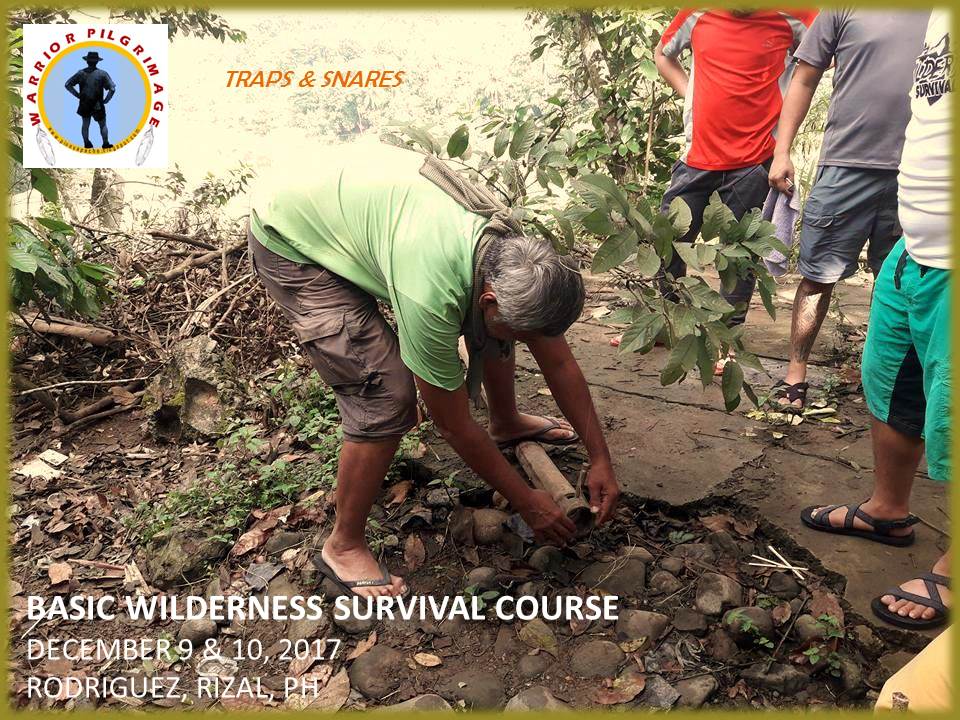
THE TRAILHAWK JOURNEYS: Rodriguez Rizal Wilderness Survival Class

LAST FEBRUARY 2016, an independent event organizer contacted me for a survival training, far inland beyond the Wawa Dam, in Rodriguez, Rizal. This particular organizer became one of the participants along with twenty others. I could not forget the two days I spent with them and the hosting family who originally were from Aklan. That training, came days after I had also done one with 34 individuals organized by CLIMBER.

The organizer, now my former student, arranged again another training for another set of participants, this time on the approach to the Binicayan-Pamitinan Protected Landscape, in Rodriguez, Rizal, near the DENR office. I am again obliged to travel to Luzon with my tools, educational aids and instruction manual. It is another compressed training which would run for two days on December 9 and 10, 2017.

Although I do not mind doing a training for two days, as I receive the same compensation package that I do for three days, but three days is best for both the participants and me. I only give the best instructions and the extra day would have given justice to what you spend for. An extra day would have been relaxing on my part also and, in the process, participants would not be forced to receive an overload of information. 

This training is called the BASIC WILDERNESS SURVIVAL COURSE. It is designed for tropical wilderness settings of dense jungles and rugged highlands, which I first offered to the mountaineering community in October 2013. It is open to all individuals or groups of any interests and purpose. Attending now are fifteen people, to include two minors. The training is done inside a local resort.

The first chapter is Introduction to Survival. Survival situations demand that you stay tough after the initial impact. Mental stability and toughness are very important characteristics of a survivor. You must develop a survival mindset. Do not engage in prolonged mind games of fantasy and false hopes. You should rein in your mind so you would not release excess adrenaline and cause you more confusions in a very stringent moment.

The best thing to do is stay still and fill up your lungs with oxygene. Your brain needs it most to help you process thoughts. You are now in a high state of agitation and so does your brain. Your brain will be in hyper mode, collating and processing many thoughts all at the same time which is beyond human capacity. We can do so one thought at a time. Just stay still and breathe regularly, supplying your blood system with oxygene.

In the hierarchy of needs and of nutrition in a survival situation, water is always on the top of the scales of both. Rightly so, for we are in the tropics and humidity plays a big role. With that, we surrender perspiration by the acts of our exertions and by what the climatic conditions imposed on us. Along with the lost moisture, is our body heat which we let go without our knowing.

When you stay still in one place, you lessen wastage of moisture and body heat. Then you confine the latter by setting up a shelter (if you still have one) or make one from scratch. That is the second need. The third would be food then warmth. Although food, and even water, would give you warmth, but heat from a naked flame or from the rays of the sun or from a person’s body is solace. Last is security which would complement well with the rest.

Our body has four hypothetical storage tanks that needs to be replenished from time to time during survival. First is constant rehydration that would offset dehydration. Second is food that would give you nutrients, carbohydrates and proteins. Third is sugar which is converted by enzymes for your adrenaline rush. Fourth is fat, hardest to find in the tropics yet are wrapped as tissues in our body.

The topic for the next chapter is about Water Sanitation and Hydration. The first chapter had mentioned the importance of water during survival. Water could be sourced from natural springs, water seeps, man-made water holes, flowing streams, the atmosphere and from plants. It could be refined through boiling, by chemicals, exposure to heat, through filtration and by desalination. It is wise to cache water in your survival camp or just travel early and take advantage of shady places and breeze if you happen to have less.

We move fast to the third chapter which is about Knife Care and Safety. The knife is a tool and should not be used to what it was not designed for like digging holes and as pry bars. It is a vital piece of equipment that should be properly handled and cared for because it is your link to your surviving. In all my training, knife etiquette is learned first before you touch a knife, so as to lessen accidents.

Besides that, there is a knife law that forbids the display, even of concealed carrying, in public places unless you are in a lawful activity, which we are in right now. A knife should be in a sturdy sheath when travelling and should be unsheathed when at home to keep it from rust. There are many kinds of knives and it is important that you know the parts, blade shapes, grind styles and the tang designs. You must also learn how to field sharpen a knife.

I was able to finish three chapters in the morning and noonbreak is mandatory when the clock struck twelve. There is no cooking as food is prepared by the family-run resort. After lunch, the hammock is an inviting proposition and I sneaked into its comfortable grip for a quick nap. I needed the rest to keep my mind sharp since the participants would be handling knives later. Refreshed after 90 minutes of siesta, I continued with the activity.

After the much appreciated instructions about the knife in the morning, we moved on to Survival Tool Making. Using a tool is essential in survival or even when not in that situation. I showed them the most basic of tools like the digging stick, traps and snares from pieces bamboo that I prepared, and the batoning stick. I let each carve a spoon on bamboo to practice their dexterity with a knife while supervising the practical exercise.

Following this is the chapter on Notches. There are five basic notches that are used regularly in bushcraft. These are applicable in shelters, furniture and tools. Again, this is another exercise in knife dexterity but it can only be achieved with the use of another tool, the baton stick. On a single stick that served as an art canvas, each participant carved their five different notches, starting with the easiest up to the most complicated.

Next is Fire, Fuel and Campfire Safety. You cannot make a fire if one or all elements are not present, namely: fuel, heat and air. Lately, they added a fourth element – chemical reaction. Fire-making is 80% common sense, 10% skill and 10% perspiration. We are talking about the friction methods. Your fire can start if you can acquire and identify the right tinder, if you are in a dry place, and if you have the patience.

Aside from friction, there is the conventional method which are matchsticks, lighters, ferro rods and the flint and steel. Then there is solar magnification which can be done with any lens, reading glasses, water and even ice. Then you have pressurized air, exemplified by the fire piston. Since I do not have the luxury of time, I limit my demonstrations to the flint and steel, which I paired with charclothe, and the ferro rod. I showed them how to make a tinder bundle. 

Showed them how the bow drill method is made and spun. Unfortunately, I could only make thick smoke as sawdust embers refused to light up my tinder. Humidity is very high since we are beside a big river and there is a promise of a downpour. I let others try the bowdrill, the ferro rod, and the flint and steel. The teenagers among them were able to light the charclothe. Unfortunately, we cannot do with the bamboos because the dry ones have not been stored properly and are all wet.

A strong downpour came as expected and we have to end the first day. The activity on primitive cooking using bamboo could not proceed. The storage of firewood, along with dry bamboo had been left to neglect. I have to dry just a few after I have set my shelter in the morning and left the rest to the onslaught of rain when the rush for the safe shelter commenced.

Likewise, the activity on Nocturnal Hunting has to be shelved. The Marikina River has risen and very turbulent and is not safe for people. The good thing about catered food is you appreciate it in times of rain but I have seen a lot of cooking in the worst of times and today is no exception. Should have but the organizer designed this as it is and it is beyond my control.

When the rain stopped, the Campfire Yarns and Storytelling pushed through naturally. A small fire gave the participants a reason to gather around in a circle. I have to gather the drenched firewood nearer the fire to wick it away of moisture so it would be fed next as campfire fuel. A bottle of brandy appeared and the glass made its way among the adults animating more of the stories. The evening program ended at 23:00 and the hammock is most appreciated.
 
The second day (December 10) start with Customizing the Survival Kit. It is better that survival kits are made from scratch than bought commercially because a survival kit’s size and its components depends upon the type of the activity you are indulging in and the kind of environment you are going to visit. Your personal preference still matters. The components should include the medical kit, the replenishment pouch, the repair kit and a small knife. It could all be integrated in one container and should be waterproofed.

Next is Foraging and Plant Identification. Foraging food in the wilderness or on unfamiliar terrain can be very taxing to the mind. When you are stressed and hungry, you tend to remove all caution. Looks can be very deceiving in the tropics like fruits, leaves, nuts, roots, flowers and mushrooms. Likewise, you need to evade harmful plants while travelling your way in a jungle.

Short term food would be grub, tree snails, fresh-water shrimps and crabs and frogs. These can be picked by hand. Cook it if you must to remove parasites and bacteria. Long term food are meat from mammals, fish, birds and reptiles. For that, you must use a weapon or traps and snares. Traps could be anything designed to lure prey into a simple contraption of a hollow bamboo or a dam of rocks. It must work with the terrain, with gravity and the habits of creatures, including its anatomy design.

Snares are more complex. It has a spring mechanism and a trigger mechanism which would be initiated by the prey. Showed the students a very common snare employing a pressure-trigger mechanism. It could catch anything from birds to goats. Another is a tube snare popularized by the Aeta. You must use bait so prey would be lured to set it off. A single trap or a single snare would not yield you a catch but a trap line of 20 to 30 of these, after ascertaining where prey would most likely pass or visit.

 
Related to these is the chapter on Food Preservation and Cooking. If you can eat a deer all in one setting, well and good. You are very fortunate to still possess a healthy appetite. Meat rot in a short span of time. During survival, meat can be preserved and its edibility can be extended for a few more hours to several months. You can boil it. You can dry it. You can smoke it. Or you can cook it with its own oil from its fat.

Fish can be preserved by drying and by smoking. Fruits can be digested after a drying session and provide you natural sugar. Common rootcrops, has high starch value, and should be cooked, by all means possible, to remove toxins and poison. Famine crops need to be immersed in running water for five days before cooking. Salt and vinegar are good food preservatives. Vinegar can be sourced from any palm.

Next is Navigation and Understanding Trails. This is more on traditional navigation which use the natural terrain, shadows and the sky fixtures for travel; avoiding obstacles and exposed areas; and knowing how to identify signs on trails made by both animals and humans. Following that is Understanding Cold Weather. During survival, exposure to the elements is expected. There are five physical mechanisms that steal away body heat and the things that we should do to keep us constantly warm.

Dusk would soon come and we have to break camp, intending to finish the last chapter which is Outdoors Common Sense. This is based from my yet unpublished book, ETHICAL BUSHCRAFT. It is about trail courtesy and behavior while on the trail; choosing the best campsites; practicing stealth camping; increasing individual safety and security; wildlife encounters; and introduce people the idea of Blend, Adapt and Improvise.

We finished the training with a blade porn. It is a traditional bushcraft activity where all edged tools are laid together in one place to inject another round of useful conversations and to encourage closer camaraderie among the participants. What resulted was the presence a considerable number of high-quality imported blades and rare local blades. It is now almost evening and we took dinner.

The van-for-hire that took me here two days ago from Cubao, came back to bring me back there. The organizer made sure of that. From Cubao, I took a bus bound for Navotas where an invitation for a second dinner awaits me and, of course, a refuge to rest a few days before my departure back to Cebu. I am tired, not of the training compressed in two days, but from a trusted person who failed to keep his end of the bargain. It is one of the hazards of a journeyman and it is sad.

Document done in LibreOffice 5.3 Writer
Some photos by Vernie Tuason and Franz Tiu

Tuesday, November 14, 2017

THE TRAILHAWK JOURNEYS: Baguio Wilderness Survival Class

I HAVE NEVER THOUGHT OF giving a survival training someday for outdoor guys based in Baguio City. Must be because Baguio is the center of the tribal peoples of the Luzon Highlands. I believed that their heritage and culture are still strong that primitive living skills are just second nature for them. Never in my dreams until, one day, a guy named Gary contacted me and we set a schedule of March 11 and 12, 2017 for that.

Going up to Baguio would be a long bus ride from Manila and to Manila – from Cebu – would be 90 minutes by plane or 24 hours by boat. (In the old days and where competition was stiff, it took just 18 hours!) I opt for sea travel to remove the stress of quick transfers that are inherent in airplane travel. I choose March 8 as my departure so I would have enough time to move comfortably about in my journey to Baguio. It was not to be. When passenger sea travel to Manila is a monopoly, it happens. No options.

In the process, my departure for Manila got moved several times and my temper came to its last straw as the frequent rescheduling threatened to jeopardize my training class schedule in Baguio. At the last hour of 21:00 of March 9, the slow boat detached itself from the Port of Cebu and sailed north. The boat arrive the following night (March 10) and it left me the quick transfers that I disdained to happen and the long queue for the ticket and for the bus.

The bus did leave as scheduled at 23:30 of March 10 and I catch sleep as much as I could as it went its way up to Baguio. I arrive at 04:00 of March 11 in Baguio City and it is very cold. I was just wearing a t-shirt and a flimsy long hiking pants. Some passengers went on their way while some opt to stay inside the heated terminal but I just want to stay near a bonfire at the back of the city tourism outpost to wait for Gary.

From the bus terminal I was whisked by Gary, Pandoy and Quintin to Crosby Park in Itogon, Benguet. The facility is owned by Benguet Mining Corporation and it had seen better days. It is located on top of a hill where some of the participants had already set up their shelters since yesterday like Doc Mike, Vera and Loco. As with most of the highlands landscape here, Benguet pine trees dominate the scene.

Still groggy from a lack of sleep and a still missing breakfast, I set up my Silangan Outdoor hammock and an Apexus sheet between two stout pine trees. The Benguet Highlands is perfect hammock country, that is if you can prevent the shivering cold winds crawling on your back. It is still the season of northeast monsoons and the amihan would be carrying the cold winters of Siberia, Japan, Manchuria and the Korean Peninsula to the tropics.

The guys are preparing breakfast. Gary is baking a bread that he would cook Bannock style while Loco has his own idea of bread on a frypan. Any of those are perfect for any empty stomach like mine. I get to eat their unusual but warm bread and it is just as filling as if I am eating traditional Filipino food. Some of the participants arrive with Quintin like Johnson and Kerubin. Another participant, Charleston, arrived later.

I have two previous students present: Pandoy who attended one organized in Montalban last February 2016 and Michael in Cebu on November 2016. The duo are serious blade enthusiasts but have different philosophies with how they treat and use their knives. I would ask them to assist me instead although the number of participants can be managed comfortably by my lone self.

At 09:00 I start the training for the BASIC WILDERNESS SURVIVAL COURSE, an outdoors educational activity designed for tropical wilderness settings of jungles and rugged highlands, which I first offered to the mountaineering community and to emergency responders in October 2013. It is intended as a three-day training but, when clients insist for two days only, I can only yield. Definitely, I would not accept doing it in one day.

The first chapter is Introduction to Survival. Survival situations demand that you stay tough  after the initial impact. Mental stability and toughness are very important characteristics of a survivor. You must develop a survival mindset. Do not engage in prolonged mind games of fantasy and false hopes. You should rein in your mind so you would not release excess adrenaline and cause you more confusions in a very stringent moment.

The best thing to do is stay still and fill up your lungs with oxygene. Your brain needs it most to help you process thoughts. You are now in a high state of agitation and so does your brain. Your brain will be in hyper mode, collating and processing many thoughts all at the same time which is beyond human capacity. We can do so one thought at a time. Just stay still and breathe regularly, supplying your blood system with oxygene.

In the hierarchy of needs and of nutrition in a survival situation, water is always on the top of the scales of both. Rightly so, for we are in the tropics and humidity plays a big role. With that, we surrender perspiration by the acts of our exertions and by what the climatic conditions imposed on us. Along with the lost moisture, is our body heat which we let go without our knowing.

When you stay still in one place, you lessen wastage of moisture and body heat. Then you confine the latter by setting up a shelter (if you still have one) or make one from scratch. That is the second need. The third would be food then warmth. Although food, and even water, would give you warmth, but heat from a naked flame or from the rays of the sun or from a person’s body is solace. Last is security which would complement well with the rest.

Our body has four hypothetical storage tanks that needs to be replenished from time to time during survival. First is constant rehydration that would offset dehydration. Second is food that would give you nutrients, carbohydrates and proteins. Third is sugar which is converted by enzymes for your adrenaline rush. Fourth is fat, hardest to find in the tropics yet are wrapped as tissues in our body.

The topic for the next chapter is about Water Sanitation and Hydration. The first chapter had mentioned the importance of water during survival. Water could be sourced from natural springs, water seeps, man-made water holes, flowing streams, the atmosphere and from plants. It could be refined through boiling, by chemicals, exposure to heat, through filtration and by desalination. It is wise to cache water in your survival camp or just travel early and take advantage of shady places and breeze if you happen to have less.

We move fast to the third chapter which is about Knife Care and Safety. The knife is a tool and should not be used to what it was not designed for like digging latrine holes and as pry bars. It is a vital piece of equipment that should be properly handled and cared for because it is your link to your surviving. In all my trainings, knife etiquette is learned first before you touch a knife.

Besides my rules, there is a knife law that forbids the display, even of concealed carrying, in public places unless you are in a lawful activity, which we are in right now. A knife should be in a sturdy sheath when travelling - for safety - and should be unsheathed when at home to keep it from rust. There are many kinds of knives and it is important that you know the parts, blade shapes, grind styles and the tang designs. You must also learn how to field sharpen a knife.

After the much appreciated instructions about the knife, we move on to Survival Tool Making. Making a tool is essential in survival or even when not in that situation. I showed them the most basic of tools like the digging stick, traps and snares from pieces bamboo that I was able to obtain, and the batoning stick. Since bamboos are rare in the higher elevations, I let each carve a spoon instead from pine wood to practice their dexterity with the knife. I settled for a cup of brewed coffee while supervising their practical exercise.

I was able to finish four chapters in the morning and we have to observe noonbreak. I noticed that it is not that cold today. It is in a warm 24ºC. I boiled water using my Swiss Army Emergency Burner for my Japanese miso soup which would be my simple meal. I am tired and I lacked sleep but this is not the time to show weakness, not while you are working. Outdoors education vis-a-vis survival instructor is now my bread and butter.

Aggravating my physical drain is doing this training for two days instead of the desired three days. You feel the pressure and the instructions are very much compressed, leaving almost out the finer details which could have made the lectures most appetizing, most interesting, as I could insert situations and experiences to the students. Anyway, the hammock is an inviting proposition and I sneaked into its comfortable clasp for a nap.

Refreshed after 90 minutes of siesta, I continued with Notches and Lashes. There are five basic notches that are used regularly in bushcraft. These are applied in shelters and tool making. Again this is an exercise of knife dexterity together with the baton stick which lets me rest for a short while. Lashing a cord to join two sticks or a different object are very important with this process. For this part, I showed them three basic lashes.

We go next to Simple Shelters. Before setting up one, it must be noted that you should be in the safest of places. It should not be near streams, dead trees, trails, water sources and underneath a forest of combustible trees. As you can see, we are in a forest of pines which is a very combustible one but the trees are not so close to each other and allows breeze to move in between. You should take advantage too of early evening thermals.

Simple shelters are essentially man-made or natural. Natural are caves, rock overhangs, tree cavities and underneath fallen trees. Simple shelters could be synthetic ones or made from natural materials or a combination of both. As it is a simple shelter, you could only enjoy it in a very short span of time since your purpose is just to survive from the elements until such time you are rescued or walked your way to civilization.

When you have a shelter, your next step is to find food. The next chapter is Foraging and Plant Identification. Foraging food in the wilderness or on unfamiliar terrain can be very taxing to the mind. When you are stressed and hungry, you tend to remove all caution. Looks can be very deceiving in the tropics like fruits, leaves, nuts, roots, flowers and mushrooms. Likewise, you need to evade harmful plants while travelling your way in a jungle.

Short term food would be grub, tree snails, fresh-water shrimps and crabs and frogs. These can be picked by hand. Cook it if you must to remove parasites and bacteria. Long term food are meat from mammals, fish, birds and reptiles. For that, you must use a weapon, traps and snares. Traps could be anything designed to lure prey into a simple contraption of a hollow bamboo or a dam of rocks. It must work with the terrain, with gravity and the habits of creatures.

Snares are more complex. It has a spring mechanism and a trigger mechanism which would be initiated by the prey. Showed the students a very common snare employing a pressure-trigger mechanism. It could catch anything from birds to goats. Then again, you must use bait so prey would be lured to step on it. A single trap or a single snare would not yield you a catch but a trap line of 20 to 30 snares or traps would after ascertaining where would the prey would most likely pass or visit.

Related to these is the chapter on Food Preservation and Cooking. If you can eat a deer all in one setting, well and good. You are very fortunate to still possess a healthy appetite. Meat rot in a short span of time. During survival, meat can be preserved and its edibility can be extended for a few more hours to several months. You can boil it. You can dry it. You can smoke it. Or you can cook it with its own oil from its fat.

Fish can be preserved by drying and by smoking. Fruits can be digested after a drying session and provide you natural sugar. Common rootcrops, has high starch value, and should be cooked, by all means possible, to remove toxins and poison. Famine rootcrops need to be immersed in running water for five days before cooking. Salt and vinegar are good food preservatives. Vinegar can be sourced from any palm.

Last chapter for the day is Fire, Fuel and Campfire Safety. You cannot make a fire if one or all elements are not present, namely: fuel, heat and air. Lately, they added a fourth element – chemical reaction. Fire-making is 80% common sense, 10% skill and 10% perspiration. We are talking about the friction methods. Your fire can start if you can acquire and identify the right tinder, if you are in a dry place, and if you have the patience.

Aside from friction, there is the conventional method which are matchsticks, lighters, ferro rods and the flint and steel. Then there is solar magnification which can be done with any lens, reading glasses, water and even ice. Then you have pressurized air, exemplified by the fire piston. Since I do not have the luxury of time, I limit my demonstrations to the flint and steel, which I paired with charclothe, and the ferro rod. I showed them how to make a tinder bundle. 

Showed them how the bow drill method is made and spun. Unfortunately, I could only make thick smoke as sawdust embers refused to light up my tinder. It is now late afternoon and dusk is just around the corner. I let others try the bowdrill, the ferro rod, and the flint and steel. All my charclothe are exhausted to smoke and flames. Unfortunately, we cannot do with the bamboos because there are none in our location.

The day ends and the promise of dinner is up in the air. I decide to transfer my hammock to another part as the ones I placed earlier is now exposed to strong winds which I have not felt before. After hitching it up, I turn to cooking milled corn which I brought from Cebu. I was expecting a very cold evening and milled corn would have helped me in staving off cold. The Swiss Army Emergency Burner is very efficient and I just used broken up twigs.

Johnson and Kerubin cooked rice and sardine-laced corned beef on big pots employing a tripod system of cooking they learned from my lectures. The cooking fire simply became a campfire after dinner and is now the center of evening socials. Strong spirits supply the yarns and storytelling into a more animated evening which crept into the early minutes of the second day. By then, my long awaited sleep is now a possibility.

Woke up at 07:30 of March 12, the camp seems deserted. Everyone are still asleep or just remained invisible. As my steps shuffled the soft pine needles, I could hear somebody stirring inside a tent and another a yawn. Slowly, people appear and the bench where the food are placed are now ringed by them. A firebox becomes alive and a kettle is settled over it. A good strong coffee starts the day and soon I get to taste the vegetarian fare made by Vera and Doc Mike as my light breakfast.

The second day start with Customizing the Survival Kit. It is better that survival kits are made from scratch than bought commercially because a survival kit’s size and its components depends upon the type of the activity you are indulging in and the kind of environment you are going to visit. Your personal preference still matters. The components should include the medical kit, the replenishment pouch, the repair kit and a small knife. It could all be integrated in one container and should be waterproofed. 

Next comes Navigation and Understanding Trails. It is more on traditional navigation which use the natural terrain, shadows and the sky fixtures for travel; avoiding obstacles and exposed areas; and knowing how to identify signs on trails made by both animals and humans. Following that is Understanding Cold Weather. During survival, exposure to the elements is expected. There are five physical mechanisms that steal away body heat and the things that we should do to keep us constantly warm.

The last chapter is Outdoors Common Sense. This is the subject matter that I based from my yet unpublished book, ETHICAL BUSHCRAFT. It is about trail courtesy and behavior while on the trail; choosing the best campsites; practicing stealth camping; increasing individual safety and security; wildlife encounters; and introduce people the idea of Blend, Adapt and Improvise.

We finished the training with a blade porn. It is a traditional bushcraft activity where all edged tools are laid on a ground sheet to inject another round of useful conversations and to encourage closer camaraderie among the participants. Gary then presented me a framed certificate of appreciation signed by, no less, than the Mayor of Baguio City, the Hon. Mauricio G. Domongan. Along with that is a small stainless steel pot, a stainless cup and a small lantern.

From Crosby Park, we went on our separate ways. I am with Gary, Pandoy, Loco and Michael in a car driven by Quintin. We stayed for a while in a bus terminal to send off Pandoy and Loco. Gary invited me and Michael to his home to tidy up. My first bath after three days! We treat ourselves later to a superb dinner of pork ribs in one of Baguio’s more popular diners. We walk back to Gary’s home and spent the rest of the hours on the front steps of the condo talking and devising ways to empty four big bottles of Red Horse Beer.


Document done in LibreOffice 5.3 Writer