Showing posts with label Iloilo. Show all posts

Wednesday, March 6, 2019

THE TRAILHAWK JOURNEYS: Iloilo Wilderness Survival Class

THIS IS NO ORDINARY CROWD that I am facing today, April 7, 2018. This is the cream of the crop of Philippine mountaineering and the legends of the Philippine underworld. I should be intimidated, shaking with stage fright, but I feel nothing. Instead, I sense kinship with these guys as if I am on home ground.

The Iloilo Mountaineering Club (IMC) is one of the oldest mountaineering organizations in the Philippines. It was established in 1970 and became one of the original founding clubs that signed the charter of the National Mountaineering Federation of the Philippines, now known as the Mountaineering Federation of the Philippines, Inc. (MFPI).

IMC is quite active despite their preference to be in an inactive status, for the time being, from the MFPI. In fact, they are in the midst of euphoria after they have finally completed the Panay Trilogy, a project that took them many decades to accomplish. This is their banner year and I could feel the energy of everyone flowing.

The Panay Trilogy is the crowning glory of IMC. It comprises Mount Madia-as, Mount Nangtud and Mount Baloi Daku, spanning all the four provinces of Panay Island. The final and successful expedition lasted 18 days and involved the entire club either as the exploration team, the four supply teams or the standby reserve team.

The Western Visayas Caving Association (WVCA) covers both Iloilo and Negros and was established in 1995. WVCA is one of the founding clubs of the Philippine Speleological Society (PSS). WVCA is very active in explorations, trainings, assessments and participation in the annual PSS Congress. Their strict adherence to caving safety, ethics and ecology protection created the benchmarks on how caves ought to be managed.

IMC and WVCA are feathers from the same parents. Their members could do both mountaineering and caving with ease. Credit that to the founding fathers who are all close friends like Vic Pison, Dodot Pison and Fred Tayo Jr. for IMC and Fred Jamili for WVCA. This is a great community of passionate people who love the outdoors.

Today is the first day of the Araw ng Kagitingan Wilderness Survival Camp which would end on April 9. All would sit and listen to me talk and discuss the BASIC WILDERNESS SURVIVAL COURSE. Most of these guys had been to the mountains for a long time and each could have personally collected their own knowledge about survival. This training would refine that and guide them to the best practices of survival.

I would be assisted by Ernie Salomon and Jonathaniel Apurado who both came all the way from Cebu with me. Carrying us here last night is Randy Salazar of IMC and WVCA, driving his Nissan Strada, and would probably also help me if I need his expertise. Then Derek Manuel of Derek’s Classic Blade Exchange would also have a part during the training. Together we represent the Camp Red Bushcraft and Survival Guild.

After an opening address by Sir Vic, this blogger proceed to explain the purpose of the training. It is designed for tropical wilderness settings of dense jungles and rugged highlands, which I first offered to the mountaineering community in October 2013. It is open to all individuals or groups of any interests and purpose. The training is done inside a local resort of Alimodian, Iloilo.

The first chapter is Introduction to Survival. Survival situations demand that you stay tough after the initial impact. Mental stability and toughness are very important characteristics of a survivor. You must develop a survival mindset. Do not engage in prolonged mind games of fantasy and false hopes. You should rein in your mind so you would not release excess adrenaline and cause you more confusion in a very stringent moment.

The best thing to do is stay still and fill up your lungs with oxygene. Your brain needs it most to help you process thoughts. You are now in a high state of agitation and so does your brain. Your brain will be in hyper mode, collating and processing many thoughts all at the same time which is beyond human capacity. We can do so one thought at a time. Just stay still and breathe regularly, supplying your blood system with oxygene.

In the hierarchy of needs and of nutrition in a survival situation, water is always on the top of the scales of both. Rightly so, for we are in the tropics and humidity plays a big role. With that, we surrender perspiration by the acts of our exertions and by what the climatic conditions imposed on us. Along with the lost moisture, is our body heat which we let go without our knowing.

When you stay still in one place, you lessen wastage of moisture and body heat. Then you confine the latter by setting up a shelter (if you still have one) or make one from scratch. That is the second need. The third would be food then warmth. Although food, and even water, would give you warmth, but heat from a naked flame or from the rays of the sun or from a person’s body is solace. Last is security which would complement well with the rest.

Our body has four hypothetical storage tanks that need to be replenished from time to time during survival. First is constant rehydration that would offset dehydration. Second is food that would give you nutrients, carbohydrates and proteins. Third is sugar which is converted by enzymes for your adrenaline rush. Fourth is fat, hardest to find in the tropics yet are wrapped as tissues in our body.

The topic for the next chapter is about Water Sanitation and Hydration. The first chapter had mentioned the importance of water during survival. Water could be sourced from natural springs, water seeps, man-made water holes, flowing streams, the atmosphere and from plants. It could be refined through boiling, by chemicals, exposure to heat, through filtration and by desalination. It is wise to cache water in your survival camp or just travel early and take advantage of shady places and breeze if you happen to have less.

We move on to the third chapter which is about Knife Care and Safety. The knife is a tool and should not be used to what it was not designed for like digging holes and as pry bars. It is a vital piece of equipment that should be properly handled and cared for because it is your link to your surviving. In all my training, knife etiquette is learned first before you touch a knife, so as to lessen accidents.

Besides that, there is a knife law that forbids the display, even of concealed carrying, in public places unless you are in a lawful activity, which we are in right now. A knife should be in a sturdy sheath when travelling and should be unsheathed when at home to keep it from rust. There are many kinds of knives and it is important that you know the parts, blade shapes, grind styles and the tang designs. You must also learn how to field sharpen a knife.

During this moment, Derek added his specialty to the lecture by showing the participants the different shapes and the different grinds. Derek further illustrate with a graph what are the most popular and the best grinds and what are the tools to grind or hone an edge. He also discuss how a knife edge behave when being grounded and the best way to remove burrs.

I was able to finish three chapters in the morning and noonbreak is mandatory when the clock struck twelve. There is no cooking as food is prepared by the family-run resort. After lunch, the hammock is an inviting proposition and I sneaked into its comfortable grip for a quick nap. I needed the rest since I did not feel well and the participants would be handling knives later. Refreshed after 45 minutes of siesta, I continued with the activity.

After the much appreciated instructions about the knife in the morning, we moved on to Survival Tool Making. Using a tool is essential in survival or even when not in that situation. I showed them the most basic of tools like the digging stick, traps and snares from pieces bamboo that I prepared, and the batoning stick. I let each carve a spoon on bamboo to practice their dexterity with a knife while supervising the practical exercise.

Following this is the chapter on Notches. There are five basic notches that are used regularly in bushcraft. These are applicable in shelters, furniture and tools. Again, this is another exercise in knife dexterity but it can only be achieved with the use of another tool, the baton stick. On a single stick that served as an art canvas, each participant carved their five different notches, starting with the easiest up to the most complicated.

At the last hours of daylight, the first day lecture ends. We have accomplished much for the day, simply because we started at 09:00. After supper, the socials on Campfire Yarns and Storytelling proceed. The evening start with individual introductions and, fueled by moderate supply of alcoholic drinks, it metamorphosed into funny tales which progressed towards the scary ones as the night approach midnight.

The second day, April 8, start with Customizing the Survival Kit. It is better that survival kits are made from scratch than bought commercially because a survival kit’s size and its components depends upon the type of the activity you are indulging in and the kind of environment you are going to visit. Your personal preference still matters. The components should include the medical kit, the replenishment pouch, the repair kit and a small knife. It could all be integrated in one container and should be waterproofed.

At this juncture, Jonathan, Ernie, Randy and Derek lent their survival kits to the lecture. Each one describe the items and how it could complement with the other items with little ingenious hacks. The individual survival kits came in different sizes, which ranged from a kit which focused more on first aid and to another which is for everyday carry (EDC).

Next is Fire, Fuel and Campfire Safety. You cannot make a fire if one or all elements are not present, namely: fuel, heat and air. Lately, they added a fourth element – chemical reaction. Fire-making is 80% common sense, 10% skill and 10% perspiration. We are talking about the friction methods. Your fire can start if you can acquire and identify the right tinder, if you are in a dry place, and if you have the patience.

Aside from friction, there are the conventional methods which are matchsticks, lighters, ferro rods and the flint and steel. Then there is solar magnification which can be done with any lens, reading glasses, water and even ice. Then you have pressurized air, exemplified by the fire piston. I first give a demonstration of the flint and steel, which I paired with charclothe, and then with the ferro rod.

Everyone tried the flint-and-steel and the ferro rod but they were much successful with the latter, simply because it is much easy to achieve. Embers caught on soft fuel became instant flames and it was a smoke-filled mid-morning affair. Then I showed them how a tinder bundle is made. Popularly called as a “bird’s nest”, it is the material by which you transfer ember or a small flame so it would progress into a useful flame.. 

I start with the bow drill method and showed them how it is made and spun. Unfortunately, I could only make thick smoke as sawdust embers refused to light up my tinder. Humidity plays a big role here since it rained many minutes ago. I let others try the bowdrill. Three teams tried their best coaxed by morale-boosting chants but all to no avail. I tried with the bamboo method but I also failed until Randy came at the right moment and saved the day.

Noonbreak came but there is no meal prepared. Everyone is on fasting. It is part of the training. Everyone will have to experience the pangs of hunger during survival situations. When you are hungry, you get irritated by the humidity, the warmth, the uncomfortable position, crawling insects and you tend to be sleepy. Fighting off that demands great concentration and will power. All will avail of food right after the fruits of their night foraging later.

After a one-hour siesta, the participants go back to listen to the next topic which is about Foraging and Plant Identification. Foraging food in the wilderness or on unfamiliar terrain can be very taxing to the mind. When you are stressed and hungry, you tend to remove all caution. Looks can be very deceiving in the tropics like fruits, leaves, nuts, roots, flowers and mushrooms. Likewise, you need to evade harmful plants while travelling your way in a jungle.

Short term food would be grub, tree snails, fresh-water shrimps and crabs and frogs. These can be picked by hand. Cook it if you must to remove parasites and bacteria. Long term foods are meat from mammals, fish, birds and reptiles. For that, you must use a weapon or traps and snares. Traps could be anything designed to lure prey into a simple contraption of a hollow bamboo or a dam of rocks. It must work with the terrain, with gravity and the habits of creatures, including its anatomy design.

Snares are more complex. It has a spring-and-trigger mechanism which would be initiated by the prey. Showed the students a very common snare employing a pressure-trigger mechanism. It could catch anything from birds to goats. Another is a tube snare. You must use bait so prey would be lured to set it off. A single trap or a single snare would not yield you a catch but a trap line of 20 to 30 of these, after ascertaining where prey would most likely pass or visit.

Related to these is the chapter on Food Preservation and Cooking. If you can eat a deer all in one setting, well and good. You are very fortunate to still possess a healthy appetite. Meat rots in a short span of time. During survival, meat can be preserved and its edibility can be extended for a few more hours to several months. You can boil it. You can dry it. You can smoke it. Or you can cook it with its own oil from its fat.

Fish can be preserved by drying and by smoking. Fruits can be digested after a drying session and provide you natural sugar. Common rootcrops has high starch value and should be cooked, by all means possible, to remove toxins. Famine crops need to be immersed in running water for five days before cooking. Salt and vinegar are good food preservatives. Vinegar can be sourced from any palm.

Since there is still a few hours of daylight, I collected bamboo poles and teach them how to create an improvised cooking vessel, specifically designed to cook anything save frying with oil. I employ my Trailhawk System for this which also includes how rice is cooked, which is so different from the rest of the country. It is a Visayan technique which finds its origin in cooking milled corn.

 
After assigning them into seven groups of six persons each, the participants begin the process of making bamboo cooking vessels and, as a community; they use one firepit to cook all seven bamboos in a line. Everyone lend their hands for their group by feeding more firewood or peering into the chamber to observe the tell-tale bubbles. I leave them to their devices and seek out the comfort of my hammock. I am so tired. 

When I receive news that the rice is all cooked, we proceed with Nocturnal Hunting. There is an assigned area for this and all would hike in darkness with headlights and hand torch looking for edible tree snails. After an hour, each group returned empty-handed. There is not much left. I was hoping even though our camp is near human habitations. I later found out that the area is a man-made forest of introduced trees which no indigenous fauna would make home.

Anyway, the catering service provided Plan B and everybody made amends with their hungry stomachs while half of them made many trips to the buffet table. A campfire is lighted up early by the youngsters when we went foraging leaving us with just a few firewood to start another Campfire Yarns and Storytelling. We decide to ditch this night activity so all could sleep early and recover from the torture of a hungry day.

The final day, April 9, is the one marked as an official holiday. Before, it commemorates the Fall of Bataan, and was named as Bataan Day. Then they changed that to Araw ng Kagitingan, which is “Day of Courage” if you translate it into English. To honor our fallen heroes, we raise the Philippine Flag and sing the National Hymn. We follow it up with the Oath to Flag and Country.

After the formalities, the Blade Porn begins. I have never seen so many blades before when I started my bushcraft camps eight years ago. The whole of Panay, comprising the provinces of Iloilo, Capiz, Aklan and Antique produce their own distinctive battle and utility blades which are laid before me side-by-side with branded blades and those from other regions. It filled to the brim one 8-ft. by 8-ft. laminated nylon sheet and needed another sheet to accommodate more. It is a collector’s delight.

I have to finish the rest of the topics and proceed with Navigation and Understanding Trails. This is more on traditional navigation which use the natural terrain, shadows and the sky fixtures for travel; avoiding obstacles and exposed areas; and knowing how to identify signs on trails made by both animals and humans.

Following that is Understanding Cold Weather. During survival, exposure to the elements is expected. There are five physical mechanisms that steal away body heat and the things that we should do to keep us constantly warm.

Last topic is Outdoors Common Sense. This is based from my yet unpublished book, ETHICAL BUSHCRAFT. It is about trail courtesy and behavior while on the trail; choosing the best campsites; practicing stealth camping; increasing individual safety and security; wildlife encounters; and introduce people to the idea of Blend, Adapt and Improvise.

After the training, there is the giving of training certificates for the participants and the certificate of appreciation for me, Randy, Derek, Jonathan and Ernie. Then the most awaited part, the giveaways, is raffled off to the participants. At the top of the ladder is a beautiful Schrade knife, courtesy of Classic Blade Exchange. Then you have more ESEE knives, Marbles Arkansas stones, survival items by SOL and UST from CBX.

More blade giveaways came from the Knifemaker of Mandaue City and locally-made blades courtesy of Filipino Traditional Blades begun to find new owners, as well as camping and hiking accessories from Silangan Outdoor Equipment and from PAC Gear. This is the highlight of the day and, after lunch, everyone break camp and made it to their cars and pickups. 

I have a long day ahead tomorrow with Randy, Ernie and Jonathan but it would be another adventure and another article, perhaps. My grandfather’s journey came full circle as I delivered the survival instructions for IMC and WVCA, which I came to understand was the most I handled in my many years teaching this. I counted and signed 49 certificates.

Oh, I almost forgot. My grandfather taught me these skills when I was 6 years old until I was 8. He was from Lambunao, Iloilo. He left his hometown when he was 12 on a one-way trip to Cebu. He lived by his own wits there and almost fought in Europe during World War I as a Philippine Scout; he became a three-term municipal councilor, a lawyer, started a family, a professor and survived World War II as a most-wanted guerrilla officer in Bohol.

I cut my teeth under him. He is no other than the late Gervasio Lavilles, the wellspring that made Cebu a Chartered City. It is an honor to impart what I learned from him back to his native soil. It came at a most appropriate time, Araw ng Kagitingan. He was an unsung hero. 
Document done in LibreOffice 5.3 Writer
Photos courtesy of JM Alabe Mejorada of IMC/WVCA

Friday, March 1, 2019

PINOYAPACHE CELEBRATES SECRET BIRTHDAY IN PANAY

IN JUST A FEW MINUTES, it would be my birthday. The Mitsubishi Strada came in at 23:50 of April 5, 2018 at MJ Cuenco Avenue, Cebu City as agreed. Driving is Randy Salazar of Philippine Adventure Consultants and one of the driving force behind Filipino Traditional Blades. His passengers are Ernie Salomon and Jonathaniel Apurado and all of them are with the Camp Red Bushcraft and Survival Guild.

The Strada is loaded and my High Sierra Titan is added to the cargo at the back. We are travelling tonight, or to put in a better perspective, most of tomorrow, April 6, overland from Cebu City to Toledo City, cross Tañon Strait, drive from San Carlos City over the hump of the Negros Cordillera to Bacolod City, cross Guimaras Strait, and drive a few kilometers from Port Dumangas to Iloilo City. Impressive!

Tomorrow would be my birthday. I prefer that people not know about it but who keeps secret these days, especially if you are honest enough to add it in Facebook. At that early hour there were no birthday greetings from the three guys. I suspect they may have devious plans among themselves. I have been ambushed many times and I know the drill.

Everyone are in high adrenaline mode as we travel south to Toledo City. The Strada is very noisy inside. There is no traffic and we reach the Port of Toledo at 02:00 and we have a cup of coffee to kill the time as our ship steadily docked to the wharf. The crossing of Tañon Strait took just 90 minutes and we are now at the Port of San Carlos. My birthday starts today.

In semi-darkness, Randy steered the pickup to the highway of the skies. There was not much to see and it was eerily silent at the back of me and both Ernie and Jon pursued the last hours of sleep before daylight overtakes them. I tried my best to keep Randy in company but found myself struggling with my consciousness. The sudden changes of  engine sound would wake me up from time to time.

I felt a strange silence as the Strada screeched to a halt then a noise of the pickup door is slammed shut. Where are we? Time to take a nature leak. The first lights of dawn painted the Negros sky and dark shadowy mass begun to slowly show details. A waterfall! Where is this place? I know we are now in the highlands of Don Salvador Benedicto but I did not notice this scenery before.

By now, the day begins to expose everything along this highway of the Negros Cordillera. I am beginning to get oriented once I spot Canlaon Volcano on one side and the Mandalagan Mountain Range on the other side. The fertile valleys hosted the plains dedicated to sugar canes that made barons out of farmers in the heady days when sugar was gold.

It took us another hour of travel before Randy decides to stop at Murcia. It takes great concentration and control to drive over in darkness to here from Cebu City. Our company would have helped but we unashamedly gave in to drowsiness. He needs a break. Time to enjoy another cup of coffee. Where is that coffee please?

We stay for a moment as Randy’s favorite breakfast joint begins to muster the last phase of chicken soup. The coffee came at the most perfect time and the blade talks make us forget food for a while. I remembered the blades that were placed below the shift stick. Randy owns a lot of beautiful blades. He is a blade connoisseur in his own right.

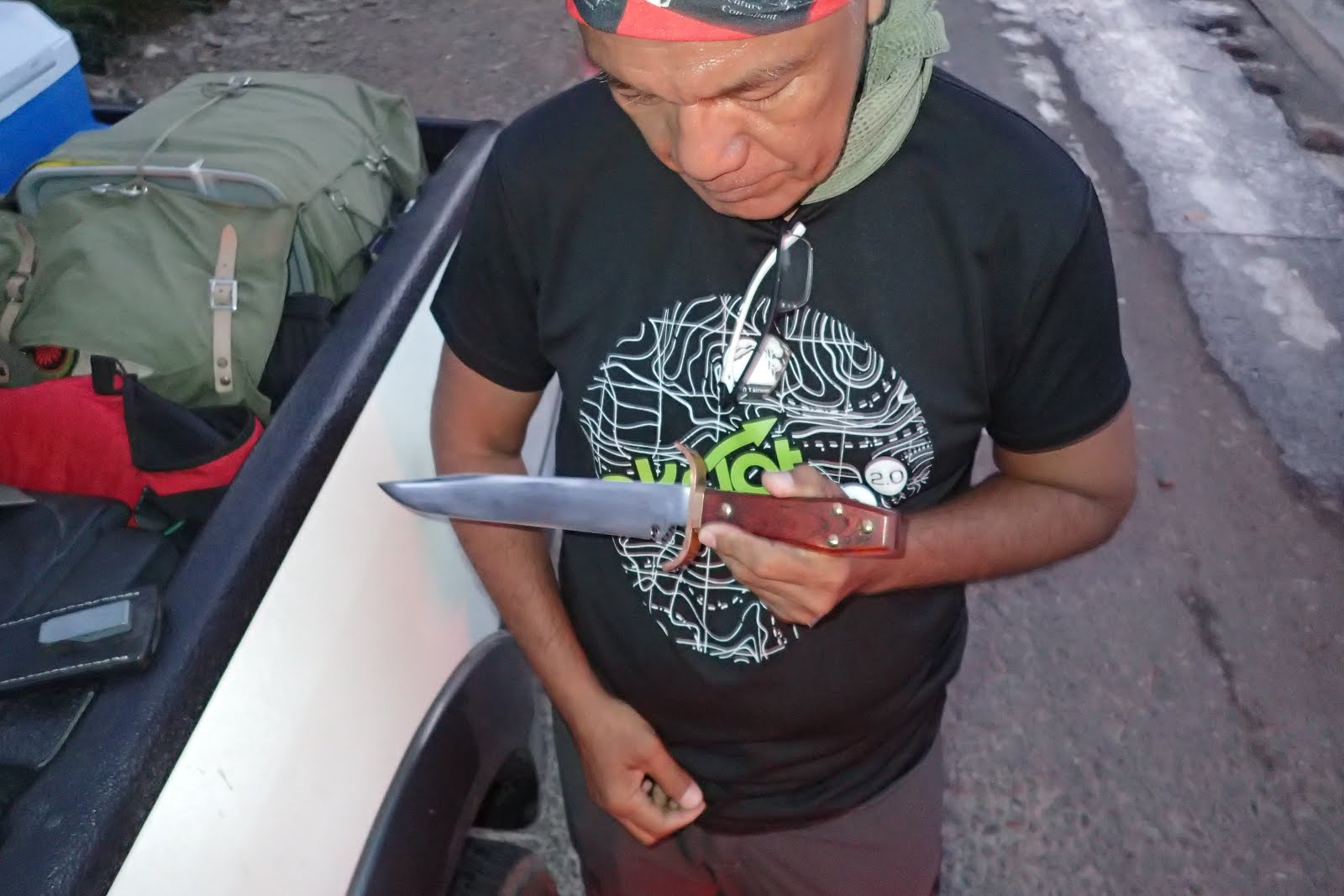
I was talking about a Bowie with a coffin-shaped handle and that sweet-looking Nessmuk. The Bowie is made by Freddie Angeles in 1987. He do not make blades anymore since he is now 80 years old and, for that matter, the Bowie becomes a collector’s item. The Nessmuk is made by Dondon Dimpas under the Ursulo line. It is stamped as 002 and, therefore, also another collector’s item since it is the most popular of his early make which elicit profound attention from blade enthusiasts.

I am flushed with envy and I am so happy it fell to the right hands. If it cannot be mine, at least, for the moment, I will have that privilege to hold and feel its balance and be photographed with it for posterity. Oh, real coffee, raw and strong, provoked an inner ecstasy within me as I held those blades in my hand. 

Come to think of it, I started all this thing about blades. I taught people the value of a blade in my bushcraft camps. I now have many converts and, I admit, I am but a pygmy when you talk about their dedication and passion about blades. They know so much and everything about it and are now on the verge of becoming bladesmiths themselves. 

After breakfast, we drive around the market and Randy surprised us with a kilo each of grounded Negros coffee, the same coffee that perked me up a half-hour ago. Then we proceed to the last stretch of road to Bacolod City to catch the first trip for Iloilo. Unfortunately, we did not make it and have to wait for the second trip.

For a full 45 minutes we waited until the time when the Nissan Strada got the go signal to crawl over the ramp into the ship’s deck. Jon, Ernie and I make it to the gangplank and up a series of stairs and find the best location. Crossing the Guimaras Strait took a longer time as tide and current clash midstream. The skipper has to make the necessary adjustments until we reach the Port of Dumangas.

It is 20 kilometers to Iloilo City and we have lots of time. Randy would have to make a stop on his old residence in the city. This was where he started before making Cebu as his base. We unload the things found on the back of the Strada and secured it inside the house. It seems Randy would like to make a little tour for us around the city.

 
The first stop is the old market where they sell the original versions of the different La Paz batchoy, an Ilonggo version of noodles which has very generous shredded meat, liver, egg and vegetable garnishments. You are provided condiments to suit your taste. I have never tried an original batchoy before and I would not let this pass.

Second stop is at Derek’s Classic Blade Exchange. I know the guy who runs this place: Derek Manuel. Setting up a knife store in Iloilo City and making it run for more than two years is an accomplishment in itself. You got to hand it to the man. Part of his business is online and people from faraway as Metro Manila and Metro Cebu source their blades here.

He sells good quality blades, knife accessories and other stuff relating to the outdoors sub-culture of bushcraft and survival. It is located across the La Paz Plaza. However, we could not resume our private tour since Derek wanted to treat us to a real Iloilo lunch, which is a good thing. We proceed to Breakthrough Restaurant, located in a beach of Molo district.

Arriving to join us is Derek’s wife, Ana. We ordered seafood and it is laid before us, rich savory and succulent. We finished almost at 15:00 and we were really full of that grand Iloilo lunch that Derek provided for our lot. Randy took a long drive back to our place. There, we returned the things to the back of the Strada.

We are going to Alimodian but we have to pass by first at Adventure Central, the home of Iloilo’s best sports climbing wall and it was here that the drawing board of the successful completion of the Panay Trilogy is headquartered. I get to meet the staff and it feels good to just sit, suckle a cold bottle of Red Horse and watch future rock jocks solve problems above.

We leave Adventure Central in a convoy of three pickups. It is now in the middle of the afternoon. We reach Alimodian with plenty of daylight to spare. I chose a spot for my hammock-and-shelter setup and I am home. A bottle of local brandy appears and my cup is empty. I am thirsty.

Randy gave me a hatchet. The axehead is acquired from the traditional blacksmiths of Sibalom, Antique, while the haft is carved by his own hands. Picked on one side are the words “Camp Red” painted in bold red while on the other side is the emblem of the Guild: a modern interpretation of a noble Native American warrior in bold red.


Could they have known my birthday and kept it hush-hush? I am not surprised there. I know that game. Okay, THEY do know. They just gave me a small lighted candle. They sang the birthday song. I blew the candle and clapping of hands and laughter echo in the evening. I open my Lenovo A7000 and a flood of greetings swamp my Facebook newsfeed.

Document done in LibreOffice 5.3 Writer
Photos by Jonathaniel Apurado

Wednesday, April 6, 2016

CAPIZ RESPONDERS GOES BUSHCRAFT

I HAVE NEVER BEEN TO the Province of Capiz. That would be my destination, however, as I sat inside a Cebu Pacific plane bound for Iloilo from Cebu on the early morning of July 23, 2015. Coming with me is Joy Quito, whose organization, the Peace and Conflict Journalism Network (PECOJON), made possible my appearance there soon as a resource person for the training of 32 individuals in Basic Tropical Bushcraft Course.

These 32 individuals belong to the Capiz Archdiocese Disaster Emergency Responders (CADER), which is a pet project of the director of the Capiz Archdiocese Social Action Center, Rev. Fr. Mark Q. Granflor. A private passenger van from the Archdiocese of Capiz whisk me and Joy from the airport in Cabatuan, then rendezvous with Len Manriquez and Charlie Saceda of PECOJON, and travel overland to Roxas City over a scenery of healthy rice fields and friendly people, whose tone of Hiligaynon are pleasantly sweet to my ears.


Would I present my lecture in Hiligaynon to these 32 individuals of CADER or would I prefer to use Cebuano and English? Or in Tagalog, perhaps? I had been a basic speaker of Hiligaynon as I learned it in my journeys in the Visayan Sea in 1986-87 but it had eroded through the years without practice although I could plainly understand what the Ilonggos would say amongst themselves. Nevertheless, I have to try. It would be stiff on my part but it is part of the challenge as a bushcraft instructor.

We arrive at the place where the Archdiocese of Capiz is founded and the bronze statue of the late Cardinal Jaime Sin stood prominently as we proceed to the office of Fr. Mark. After a few minutes, Fr. Mark invited me and the PECOJON officers – Len, Charlie and Joy – to a lunch at his grandmother's house in Ivisan, Capiz. Seafoods galore: steamed mud crabs (Local: alimango), shrimps, mantis shrimps (hanlilitik) and mussels; blanched seaweeds (lato); and crabs in thick coconut-milk soup.

The place where the bushcraft camp would be held is just in the vicinity yet we have to take the same vehicle in going there. It is now almost two in the afternoon and the opening of the seminar is a bit delayed. I found myself inside a local haunt, the Spring Hills Resort, as the site where I and the participants would spend the next three days. It is in the village of Malocloc Norte and has two pools, several cottages and a main hall. It has a small stream running beside it and verdant vegetation everywhere.

I found no other place to set up a campsite except at a grassy volleyball court and a vegetated knoll above it. The participants are now all accounted for and I introduce myself after opening the seminar. The heavens begin to growl and I instructed the participants – to include the PECOJON officers - to set up their simple shelters under the onslaught of rain, because that would be the same conditions when you are responding to places hit by disasters. A few seconds later, it rained hard. All were unprepared and some were in a state of mild shock at this reality.

As I have stated to them earlier about this strange sounding activity called bushcraft, that it is just all about the mind, adaptation and improvisation; and gears have nothing to do with surviving. The archdiocese had provided the CADER volunteers several pieces of cheap 3-meter by 3-meter laminated nylon sheets that I have specified for use in this training. I watched and documented them as they started to set up their shelters using pieces of rope, foraged wood and improvised cordage. All sorts of knife lay on the ground everywhere.


I have done this on purpose to test their levels of individuality and their teamwork and to make as basis for a critique later on. Each tarpaulin are assigned to a team of two people and I saw two teams merge to create a better and bigger shelter while another team help set up another theirs. Later on, another three teams merged and a crude mansion emerged. Then all improved the comfortability of their living quarters by placing cushions of grass and coconut palms under their ground sheets and leaves of banana and anahaw (English: foot-stool palm) are propped at the exposed sides to break the entry of drafts.

I too set up my own shelter in the pouring rain. My T-shirt is wet as well as my thick Blackhawk pants and 5.11 shoes. I do not mind it and even used my Canon IXUS 145 camera to take pictures, knowing well that water would incapacitate it. I really do not mind it at all for I know the participants are also watching me of how I conducted myself in a difficult situation. Inspired by my example, the CADER volunteers began to show tenacity and perseverance and a sense of community evolved.

Satisfied with their grit and their resourcefulness, I reminded them that the brain would adapt to pressure and stress in any given situation. All you have to do is act accordingly and smartly to what you will perceive. I proceed to the first chapter which is Introduction to Bushcraft. In this chapter, bushcraft is described to them in the most simple terms as possible. I even provide the nearest equivalent to my own dialect in Cebuano about bushcraft as “panikaysikay”. Cool.

The participants are a mixed group of young college students and mature family men, the oldest of which is 64 years old. Joining them is Mai Durias, the project manager of CADER and the guys from PECOJON. Discussions in English taken from the lecture sheets would have been alright to a set of sophisticated assortment of individuals like weekend hikers, mountain climbers, would-be survivalists and yuppies but this group is different. They do not even know who Bear Grylls is. Got my point?

The lecture ended as it starts to get dark. Quickly, the participants help each other in grilling the pork chops and cooking the rice. I squeeze in between glowing charcoals a small can containing tiny squares of denim to make charclothe. They asked what is it but I kept my lips tight. Upon my suggestion, banana leaves are gathered to line the tops of four long tables in the main hall right after fraying it with fire. We will have a grand “boodle fight” tonight. Dinner started right after a prayer. It is a silent group but it will be a noisy lot after this night.


We transfer to the volleyball court and a huge bonfire erupt in the middle. Dry firewood are rare after that heavy downpour earlier. Inspite of that, we were able to start a flame using diesel fuel. Activity is the Campfire Yarns and Storytelling. In the Philippine Independence Bushcraft Camp, this activity is fueled by alcoholic drinks making it very animated and entertaining. Fr. Mark's presence made me formal stiff and I have to wrack my brains to achieve a string of conversations for this gathering. Good thing, I got help from Len.

For a good two hours, each participant tell everyone in the circle candidly about his or her expectations of the seminar and narrate about his or her reaction when building a simple shelter with just a few resources at hand and no clear-cut instructions under the onslaughts of a heavy downpour. On this occasion, natural leaders emerged from the group. After the activity, I burrow into my Silangan hammock in a cold rainy night.

The second day – July 24 – is sunny. After breakfast, I begin the next chapter of Ethical Bushcraft. There is always the danger of overdoing things in the course of a bushcraft activity and might not be conformable to the environment and to certain individuals or organizations. Ethical Bushcraft guides you the proper way to use forest resources in the best way possible, taking advantage of knowing the plants and animals, choosing a campsite well, fire safety, disposal of garbage the bushcraft way and be stewards of the forest.

This chapter is very long and is very important as well that people know this. I know a lot of very entertaining survival TV shows that sends the wrong messages to its audiences and I read in websites that a lot of park managers and private land owners are beginning to complain about destruction of plants and the aesthetics of their lands by these weekend survivalists in the US and UK. Proper education is the key here and this is where it starts.

As I prepare for the next lecture, I place all my unsheathed blades on the table before me: the AJF Gahum, the William Rodgers, the tomahawk, the Victorinox Trailmaster, the Leatherman Juice S2, the Mora Companion, two Seseblades sinalung and a ginunting. Because, in a moment, the chapter on Knife Care and Safety will start. A knife is a tool, first and foremost, and, like any other tool, it must be maintained sharp and free of rust. You must learn how to sharpen and must know what are the parts of a knife as well as the kinds of designs and edge.

It hurts also – and, sometimes, very expensive - if you do not know the only law (Batas Pambansa Bilang 6) governing the use and carry of a knife here in the Philippines. It is very important that those who participated in all my bushcraft camps know this by heart and the procedures (and proper gestures, as well) in declaring and surrendering your carried blades to security checks when entering ports of entry, airports, malls and, even road checkpoints.

Knife safety is very important in bushcraft because, if you do not practice that, you are bound to hurt yourself or others with you since bushcraft is a labor-intensive activity and directing a lot of work with a knife or knives. As our next chapter would be labor-intensive, it is important that safety should be observed. Meanwhile, people are going to fast today, including me. There would be no noon meal. It is part of the learning process.


Survival Tool-Making is next and I assigned people to six groups. There are mature bamboo poles provided for use in this class and soon it would be dismembered. Mature bamboos are hard but with a sharp knife, even if it is a small one, you can cut it as it pleases you as long as you pay attention to my instructions and my demo. They have to make for themselves individually bamboo spoons and jugs. As a group, they would have to make bamboo cooking pots with conjoined segments – the Trailhawk System way.

The six groups began cutting the poles even as a deluge of rain begins to fall from the skies. I leave them be and they brought the bamboos underneath the roof of the main hall. They only stop when I think it is time to continue with another lecture about Outdoor Cooking. On this chapter, I discussed the different ways to preserve the edibility of vegetables, fruits, meat and fish. They also learned the methods of cooking as in an open fireplace, semi-closed pit and the closed way of cooking which is done under the ground. In time, they will understand these later in the night.

After all had happily showed me their crafted tools - bamboo cooking pots, spoons and drinking jugs – I begin the process of teaching them how to cook rice in bamboo, especially mature bamboos. Unknown to most, mature bamboos can be used to cook something as much as you would use one with green bamboos and it is no different when you integrate it with my Trailhawk System from opening up the segments down to the cooking itself.

So, while some attend to the cooking, the rest forage around for food. Some guys have foraged along the river for snails which only a few were found which are the neritidae and the thiaridae species. Others opt to scrounge edible plants like horseradish, swamp cabbage and banana trunks while a handful borrowed my two catapults and used these to ping two free-rein chicken senseless.

Slowly the rice from the bamboos are being transferred to frayed banana leaves. Ah, I see another grand “boodle fight” feast in the making. Each group occupy one table and I make the round among the tables inspecting what viands are they going to eat? One table has swamp cabbage adobo. Another has the core of banana trunks cooked and set as extender for canned sardines. Then four tables shared the native chicken estofado among them. Dinner commence at 19:45 after a short prayer.


Since it is raining and a campfire is not feasible, I rather have the participants gather in the social hall of the resort for some team-building activity initiated by the students among them and videos of some of the things I discussed for the past two days. Two episodes of Ray Mears are shown to the participants – the ones done between Thailand and Vietnam (POW Survival Stories) and the other one shot in Palawan (Desert Island Survival). Then they begin to understand what I was talking about.

It is another cold night, wet and omnipresent rain, as I seek the comfort of my shelter in the darkness. My place is located at the farthest and the highest part of the campsite where there are Mexican lilac trees (kakawate) to fasten my hammock and canopy sheet. The call of a night heron pierce the silence of dawn and it is just near. Meanwhile, drops of moisture found its way into me as my sheet begins to show signs of aging and from abuse.

The third day – July 25 – also shows a promise of a sunny and warm morning. I begin to discern that rain always come knocking at or near noon here in this part of the Visayas. While everyone are still recovering from their sleep, I devise an Aeta-style bamboo snare that is designed to catch a monkey or a monitor lizard and a trap that is good for snakes, fish and lizards. Three participants caught me doing this and made themselves two pressure-trigger snares for fowls while another made a loop snare designed to catch small mammals.

I took advantage of the good window of sunny weather and proceed on with the lecture about Firecraft. As always, the importance of this skill rely mostly on dry things and less humidity. Since it rained the whole night and the ground is wet, I doubt if we could make fire by friction but I could try and dry the bamboos. But first, I have to discuss the solar magnification method which would utilize the rays of the sun to be increased in intensity by placing a magnifying lens between it and a tinder.

I showed them the small blackened can which I placed on a fire on the first night as if I am cooking it. I opened it and showed the contents: charred cloth or charcloth. They place a magnifying lens over it and it begins to produce smoke and ember faster than they have known of doing it with paper. They are amazed and they begin to ask how did I “cook” it? I showed them how with the same air-tight can with a small hole where “fresh” denim cloth are placed inside. It helped when I mentioned the process of making charcoal and they can relate better the idea of the charclothe.


By now, the sky begins to go cloudy. Solar magnification by use of a bottled water did not have a good result so I proceed to fire-making by friction else it rain again. There are many ways in doing that but I start with the unfamiliar: the bow-drill method. I have pieces of dry wood that I have brought from Cebu and I begin unravelling the intricacies of making and performing the bow drill to the eager participants who are now mesmerized by the simple wonders of bushcraft.

My several efforts only produce a smoke. I do not have the good timing and it might be good if I let the participants try this on themselves. Two sets of bow drills are now at work and the odor of smoke pervade the air but no ember too. Too humid. The ground is wet and moisture, invisible to the naked eye, easily transfers to a porous material like dry soft wood for it acts like sponge. Worse, I can smell the ominous coming of rain. Time to hurry this lecture and proceed to the bamboo-saw method.

Very popular but very effective, the bamboo saw is taught to the Boy Scout here, which some of the participants were once had been. Similarly, as in the bow drill, it only emitted the pungent odor of burnt wood and the tell-tale smoke, but no ember. To prop back their sagging confidence, I introduce them to the novel idea of lighting a fire with a ferro rod. They could not contain their smile and their amazement at the wonders of this inextinguishable source of fire that worked even when wet.

My last lecture for the day is about a kit that is very relevant to any would-be responder: the Everyday Carry or EDC. They were a bit confused about this term but they were able to relate again with a smile when I asked them of the usual things that a carpenter would bring to his work. All my EDC items get a scrutiny from sugar sachets to a power bank to a coin purse containing loose change and a USB memory. Some of them carried micro-EDCs but they just did not know that. Now they are educated on the twerks of urban survival.

The course finished before 17:00 and everybody happily heaved a sigh of relief. I did likewise. This was a different crowd but I am able to adjust and improvise a bit. Just some little tweaks and a good dose of creativity. I am optimistic that I would meet this same kind of participants and I could apply the same tricks. Anyway, all gathered for a group picture with their certificates of training before everyone went to their assigned tasks. Some prepared something for dinner while four guys left the resort on board the CADER vehicle.

I visit the room reserved and paid for my keep which I did not use for two nights when I was with the participants. The soft bed is inviting but it is best that I take a bath first which I have not had the opportunity to do so for the past three days. I take a nap after that and woke up. It is already dark but I feel refreshed. Fr. Mark is here and I greet him a good evening. I notice a sack filled with fresh oysters which majority of these are already in the process of being cooked on raw embers and in boiling water.


I sit on the long table with Fr. Mark, Len, Charlie, Joy and Mai for dinner. I notice something familiar – a perfectly-cold bottle of Gold Eagle Beer. It has been eons since I last drank this. That was in the late '80s. Then I notice something new – a dish of immaculately white elongated clams. I learned that this is called “diwal” (English: angel-wing clam) and it is highly-valued in Capiz as their own. Rightly so. The meat is succulently delicious and strangely sweet. I believed I had eaten twenty pieces during dinner plus the oysters and emptied three bottles of beer.

When Fr. Mark left, I proceed to my room. I wake up at 07:00 on the fourth day – July 26. My Blackhawk pants and my 5.11 shoes are already dry. Today I would travel back to Iloilo then to Cebu but, first, we have to be at Roxas City. I receive tokens of appreciation from the Archdiocese of Capiz then the same vehicle that brought me and PECOJON people here in July 23 came and whisked us back to Iloilo with a stopover at Midway, a good restaurant located on the middle of nowhere. Joy and I catch plane back to Cebu but Len and Charlie took on separate destinations. Arrive home at 15:00.

The opportunity to expand my realm of teaching bushcraft to the Province of Capiz, especially to the volunteer emergency responders belonging to CADER, had been made possible thru the instance of PECOJON. PECOJON, together with partner NGOs and LGUs, are engaged in the advocacy of developing emergency preparedness capability for the local communities which had been hit hardest by Tropical Cyclone Haiyan. Self-reliance skills which I have taught is just one of their objectives to reduce the impacts of catastrophes.

Going back to this window of opportunity, I somehow placed myself at the edge of my wildest dreams: that of actively pursuing my passion into something tangible, worthwhile and enjoyable. I have studied this for a very long time considering that I have a day job which might be affected by the conflict of how I divide my time. Sooner or later, I will choose which would be best for me and my family's upkeep. For now, I get to have a foretaste of the labors of this novel interest which I am sharing to Filipinos and it is very tempting.


Document done in LibreOffice 4.3 Writer

Tuesday, December 1, 2009

A QUICK VISIT TO LAMBUNAO

I HAD TO BE THERE. A mobile phone call from Lambunao in Iloilo goaded the Cebu clan to have me represent them for the last burial rites of the late Enriqueta “Endring” Lavilles-Legayada on the morning of September 4, 2009. And so I took a Philippine Air Lines PR 380 Express Flight at 9:15 AM for Iloilo. I buckled my seat inside a Bombardier Q400 turboprop plane and waited for the plane to depart the Mactan-Cebu International Airport.


I seated myself nearest to the window and saw the power of the big propellers came to life and the plane roared on the tarmac at a speed and intensity much lesser than that of jets. As it became airborne, it made a clockwise turn passing over the fishponds of Kalawisan in Mactan Island then crossing the Mactan Channel and into the airspace above Metro Cebu. Underneath me, I spotted the little red square of a roof of my home and I smiled to myself elated, at last, to see my home from above aside from Google Earth.

As the plane climbed, clouds covered what's left of Cebu and I couldn't see the landmarks until it crossed a body of water which, I knew, is the Tañon Strait. Over the island of Negros, these same clouds trapped my vision and I saw two Cebu Pacific jets from Iloilo, one after the other, shot by us in the opposite direction. Then another body of water – the Guimaras Strait – appeared below me. As it progressed over the island of Panay, the Q400 dipped in altitude and I could see clearly now the topography of the province of Iloilo.


Iloilo, viewed from above, is an immense plain dotted here and there with farms and rice fields. Agriculturally, it is highly developed. It is of no wonder why it is called as the “rice granary of the Visayas”. Aside that, I appreciate at how the Ilonggos managed their lands. From the air, I could see no encroachments of housing and industrial developments upon their agricultural lands that are so common in the CALABARZON area and in other provinces.

Moreover, Ilonggos are environmentalists of their own right. The rice farms, for example, follow the lay-out of the land along cleavages and small valleys. It used the contours to a maximum so as to collect rain efficiently to water their rice paddies like mini rice terraces. Amidst that, trees and woody plants grew with wild abandon along the meandering rivers, creeks and waterways; atop ridges; beside roads and among communities. The plane circled among all these sights until it touched down in slow motion on the New Iloilo Airport in Santa Barbara.


From the airport I rode in a multicab for the highway and from there I caught a bus bound for Lambunao. It would be my second time there. I was with my mother, Marietta, when I went there the first time eight years ago today. We were there to celebrate the town fiesta in honor of its patron, San Nicolas de Tolentino. Now I am alone and I carried with me a mixed optimism and doubt and I just wished they would still remember me and I also hoped I could communicate with them thoroughly. I am Cebuano. What Ilonggo I learned during my sea-faring days many years ago have been eroded through non-practice.


Basically, the Ilonggos are people more akin to me, much more so in Lambunao, where my grandfather, the late Gervasio Lira Lavilles was born. Gervasio, during his one-way trip to Cebu in his youth in search of his older brother whom he had not found, decided to stay in Cebu for good and worked his way to finish elementary, high school and Bachelor of Laws. After a stint with the Philippine Scouts as World War 1 ended, he became a newspaper reporter and editor, lawyer, professor and a three-term councilor of Cebu when it was not yet a chartered city. He married and remarried and unknowingly became a patriarch of the Lavilles clan in Cebu.

I came, hoping to see a landscape what my late grandfather used to see, but I saw a tamer place. But the smell of the soil after an early morning shower lingered long enough to remind me that I am in the land of his birth; the playful sounds of their dialect rhymed and sang in my ears save, perhaps, for a few words that evolved in that long stretch of time were also the sounds that grandpa used to converse and listen with.


I arrived at the Lambunao Municipal Cemetery at 11:24 AM, way too late for the burial rite, and I decided to follow, on board a motorcycle-for-hire, the throng of vehicles filled with mourners to the dear departed's home. Feeling awkward, I decided to stand at the periphery until Amil Pabon, my second cousin Ligaya's husband, spotted me and dragged me, bag and all, inside where I was re-introduced to my kinfolks. The last of the Lavilles siblings sired by Gervasio's only brother Camilo, Rebecca “Ebeng” Lavilles-Lavilla, was there. The house was filled with grieving relatives and visitors and I became one of their numbers.


When the last of the mourners left, I had the chance to get to know of another second cousin based in Metro Manila working with the Bureau of Customs, Nelson Lavilles; and third cousin, Ephraim Leal, (technically my nephew) over glasses of Fundador Brandy. After the two bottles of brandy ran at the end of its course, Nelson opted to visit more of his relatives in Dingle and left early while I accompanied Ephraim to see the book – Bridging the Gap by Mercedita Lometillos – and explained to me why I am his uncle! On Page 108 of the book, I found my family line quite updated with my wife's name printed upon it as well as the names of my sons.


One thing I noticed in Lambunao is that all the big families and clans start with the letter “L” like Lira, Lavilles, Legayada, Latorre, Launio, Leal, Lavilla, etc. You could see some of those names in the street signs of Lambunao except for the name Lavilles which is a street sign in Cebu. Ephraim proudly declared to me that Lambunao produced the most number of generals second only to Batac in Ilocos Norte. Batac, of course, was the hometown of a former dictator.


I went around the poblacion after that and I saw the face and name of the present town mayor – a former police general - all over the place. Well, the last time I was around here, the streets were not paved. Now it is concreted. I assumed he did his mandate quite well. I went to the town plaza and I took pictures of the San Nicolas de Tolentino Parish. The run-off to the incoming fiesta can be felt in the air with all those piryahans in the plaza. I just learned that Lambunao hosted twenty-five major waterfalls which I am ignorant of until I saw a tarpaulin sheet announcing Lambunao as “The Land of Waterfalls”. So, I will see more of Lambunao in the near future.


Going back to the Legayada home, now the permanent resident of Amel and Ligaya, I sipped coffee with them after a novena. Later, we were invited to partake of a dinner hosted by sisters Soledad Latorre-Mendoza and Sonia Latorre-Ebuna, both my second cousins. Soledad, is the better half of the present DOTC Secretary, Leandro Mendoza. The Latorre house had evolved into a big edifice with several rooms and a large dining area. After that, I slept early in the house of the Legayadas.

I woke up at dawn preparing my things to leave Lambunao once more. I bade them goodbye again after a hearty breakfast. I rode down the great Panay Plateau in a vehicle-for-hire together with two other guests for Metro Iloilo. We rode a fastcraft at 10:15 AM for the port of Bacolod and arrived there an hour and fifty minutes later inspite of the huge waves battering the craft's starboard side. I caught up with a Cebu-bound Ceres Bus with minutes to spare. It's my first time to set foot in Bacolod City yet, again, I only saw it in a minute's passing.


The bus steadily climbed the national highway and traversed the Negros central highlands where I was afforded some new scenes and sights that awoken my explorer spirit. The Mandalagan Mountain Range and Mount Silay were off to the north of me while Canlaon Volcano towered in the east. Amidst those, were deep rivers that cut deep into the high plains; rushing rivers whose laughter echoed in the distance. A camera would have been useful here, sorely, I lacked one.

The bus steadily cut the distance away to Cebu and we passed by remote Don Santiago Benedicto town with its neat little rice paddies that gave the place an allure all its own. It was raining and the fields around us were amazingly green and so clear nary a mirage of smoky haze normally caused by pollutants. Ridges were topped off with pine trees and people were so laid back in their movements, uncaring of the world outside them. This is another paradise that I hoped won't be raped by greedy capitalists and landowners.


Finally, I arrived at the port of San Carlos City. Been to this place many times in my youth and it is, as it had been in the past, the gateway to Central Cebu from Negros Island. Endless armies of battering waves shelled the wharf caused by the strong gusts of wind from the southeast. My clothes ruffled and reverberated on my skin and I hid back to the comfort of the parked bus as we wait for the ferry that would take the bus and me and the rest of the passengers to Cebu.


The unwieldy seacraft unmoored from the Port of San Carlos the moment we settled in and crossed the wide Tañon Strait for the Port of Toledo. As I sat on the lee of the craft, I noticed solitary little brown birds, locally known as gorion, crossing the strait in the other direction. They crossed over the wide distance singly in intervals of between five to fifteen minutes. They rode the wind current and flew effortlessly towards Negros. Finally, we arrived in Toledo City and the bus went on its way towards the Naga-Uling Road.


I arrived at the Cebu South Bus Terminal at 7:15 PM on September 5, 2009. It was a memorable trip for me the moment I rode that turboprop plane yesterday for Iloilo until the moment I arrived at San Carlos. Most of those circumstances, I have done for the very first time and it got itself etched forever in my memory. Meantime, all is well in my home from the time of my absence until my arrival and a hearty hug to my grandson assures him that all is alright, after all.


Document done in OpenOffice 2.1 Writer.