Showing posts with label Negros Occidental. Show all posts

Friday, March 1, 2019

PINOYAPACHE CELEBRATES SECRET BIRTHDAY IN PANAY

IN JUST A FEW MINUTES, it would be my birthday. The Mitsubishi Strada came in at 23:50 of April 5, 2018 at MJ Cuenco Avenue, Cebu City as agreed. Driving is Randy Salazar of Philippine Adventure Consultants and one of the driving force behind Filipino Traditional Blades. His passengers are Ernie Salomon and Jonathaniel Apurado and all of them are with the Camp Red Bushcraft and Survival Guild.

The Strada is loaded and my High Sierra Titan is added to the cargo at the back. We are travelling tonight, or to put in a better perspective, most of tomorrow, April 6, overland from Cebu City to Toledo City, cross Tañon Strait, drive from San Carlos City over the hump of the Negros Cordillera to Bacolod City, cross Guimaras Strait, and drive a few kilometers from Port Dumangas to Iloilo City. Impressive!

Tomorrow would be my birthday. I prefer that people not know about it but who keeps secret these days, especially if you are honest enough to add it in Facebook. At that early hour there were no birthday greetings from the three guys. I suspect they may have devious plans among themselves. I have been ambushed many times and I know the drill.

Everyone are in high adrenaline mode as we travel south to Toledo City. The Strada is very noisy inside. There is no traffic and we reach the Port of Toledo at 02:00 and we have a cup of coffee to kill the time as our ship steadily docked to the wharf. The crossing of Tañon Strait took just 90 minutes and we are now at the Port of San Carlos. My birthday starts today.

In semi-darkness, Randy steered the pickup to the highway of the skies. There was not much to see and it was eerily silent at the back of me and both Ernie and Jon pursued the last hours of sleep before daylight overtakes them. I tried my best to keep Randy in company but found myself struggling with my consciousness. The sudden changes of  engine sound would wake me up from time to time.

I felt a strange silence as the Strada screeched to a halt then a noise of the pickup door is slammed shut. Where are we? Time to take a nature leak. The first lights of dawn painted the Negros sky and dark shadowy mass begun to slowly show details. A waterfall! Where is this place? I know we are now in the highlands of Don Salvador Benedicto but I did not notice this scenery before.

By now, the day begins to expose everything along this highway of the Negros Cordillera. I am beginning to get oriented once I spot Canlaon Volcano on one side and the Mandalagan Mountain Range on the other side. The fertile valleys hosted the plains dedicated to sugar canes that made barons out of farmers in the heady days when sugar was gold.

It took us another hour of travel before Randy decides to stop at Murcia. It takes great concentration and control to drive over in darkness to here from Cebu City. Our company would have helped but we unashamedly gave in to drowsiness. He needs a break. Time to enjoy another cup of coffee. Where is that coffee please?
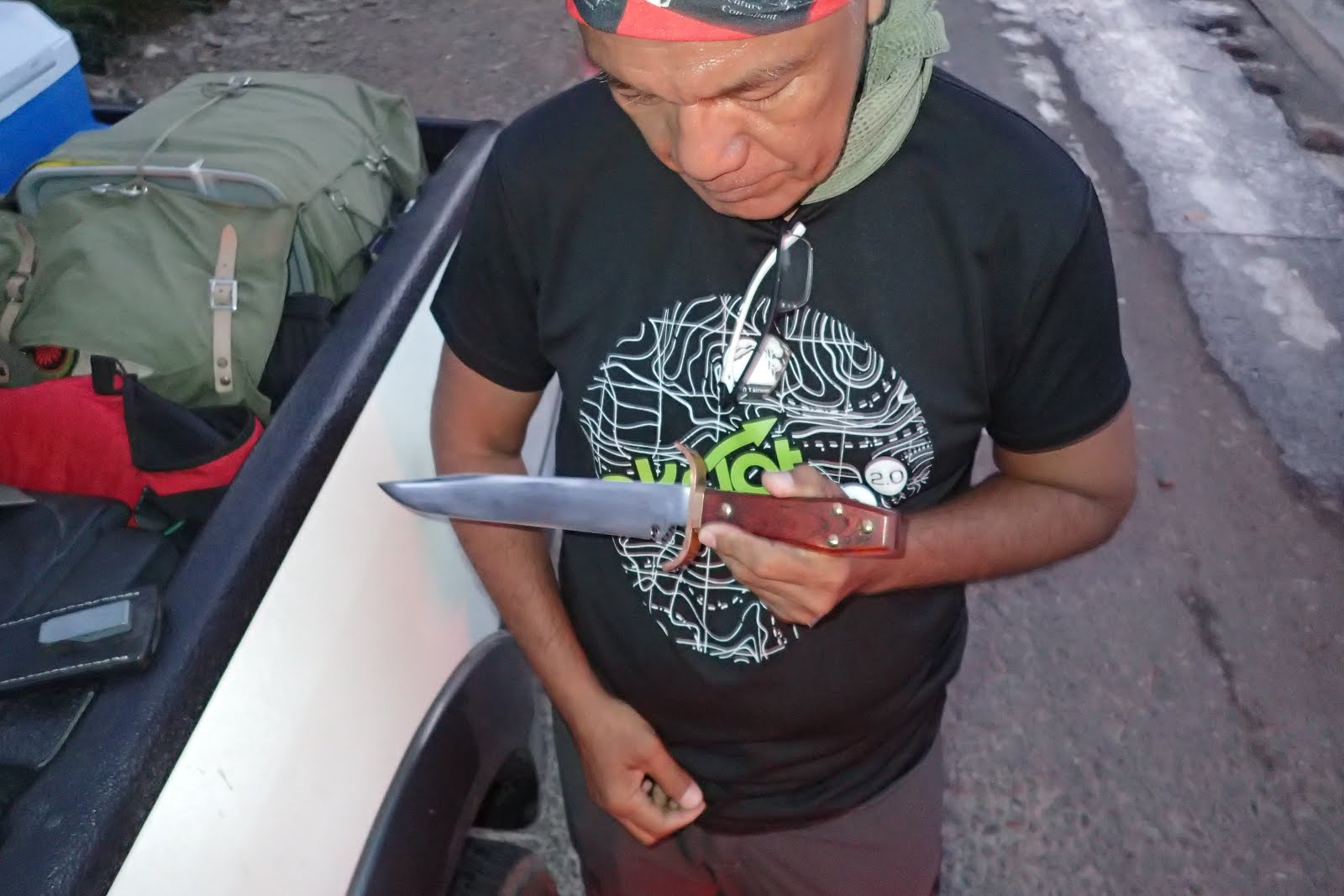
We stay for a moment as Randy’s favorite breakfast joint begins to muster the last phase of chicken soup. The coffee came at the most perfect time and the blade talks make us forget food for a while. I remembered the blades that were placed below the shift stick. Randy owns a lot of beautiful blades. He is a blade connoisseur in his own right.

I was talking about a Bowie with a coffin-shaped handle and that sweet-looking Nessmuk. The Bowie is made by Freddie Angeles in 1987. He do not make blades anymore since he is now 80 years old and, for that matter, the Bowie becomes a collector’s item. The Nessmuk is made by Dondon Dimpas under the Ursulo line. It is stamped as 002 and, therefore, also another collector’s item since it is the most popular of his early make which elicit profound attention from blade enthusiasts.

I am flushed with envy and I am so happy it fell to the right hands. If it cannot be mine, at least, for the moment, I will have that privilege to hold and feel its balance and be photographed with it for posterity. Oh, real coffee, raw and strong, provoked an inner ecstasy within me as I held those blades in my hand. 

Come to think of it, I started all this thing about blades. I taught people the value of a blade in my bushcraft camps. I now have many converts and, I admit, I am but a pygmy when you talk about their dedication and passion about blades. They know so much and everything about it and are now on the verge of becoming bladesmiths themselves. 

After breakfast, we drive around the market and Randy surprised us with a kilo each of grounded Negros coffee, the same coffee that perked me up a half-hour ago. Then we proceed to the last stretch of road to Bacolod City to catch the first trip for Iloilo. Unfortunately, we did not make it and have to wait for the second trip.

For a full 45 minutes we waited until the time when the Nissan Strada got the go signal to crawl over the ramp into the ship’s deck. Jon, Ernie and I make it to the gangplank and up a series of stairs and find the best location. Crossing the Guimaras Strait took a longer time as tide and current clash midstream. The skipper has to make the necessary adjustments until we reach the Port of Dumangas.

It is 20 kilometers to Iloilo City and we have lots of time. Randy would have to make a stop on his old residence in the city. This was where he started before making Cebu as his base. We unload the things found on the back of the Strada and secured it inside the house. It seems Randy would like to make a little tour for us around the city.

 
The first stop is the old market where they sell the original versions of the different La Paz batchoy, an Ilonggo version of noodles which has very generous shredded meat, liver, egg and vegetable garnishments. You are provided condiments to suit your taste. I have never tried an original batchoy before and I would not let this pass.

Second stop is at Derek’s Classic Blade Exchange. I know the guy who runs this place: Derek Manuel. Setting up a knife store in Iloilo City and making it run for more than two years is an accomplishment in itself. You got to hand it to the man. Part of his business is online and people from faraway as Metro Manila and Metro Cebu source their blades here.

He sells good quality blades, knife accessories and other stuff relating to the outdoors sub-culture of bushcraft and survival. It is located across the La Paz Plaza. However, we could not resume our private tour since Derek wanted to treat us to a real Iloilo lunch, which is a good thing. We proceed to Breakthrough Restaurant, located in a beach of Molo district.

Arriving to join us is Derek’s wife, Ana. We ordered seafood and it is laid before us, rich savory and succulent. We finished almost at 15:00 and we were really full of that grand Iloilo lunch that Derek provided for our lot. Randy took a long drive back to our place. There, we returned the things to the back of the Strada.

We are going to Alimodian but we have to pass by first at Adventure Central, the home of Iloilo’s best sports climbing wall and it was here that the drawing board of the successful completion of the Panay Trilogy is headquartered. I get to meet the staff and it feels good to just sit, suckle a cold bottle of Red Horse and watch future rock jocks solve problems above.

We leave Adventure Central in a convoy of three pickups. It is now in the middle of the afternoon. We reach Alimodian with plenty of daylight to spare. I chose a spot for my hammock-and-shelter setup and I am home. A bottle of local brandy appears and my cup is empty. I am thirsty.

Randy gave me a hatchet. The axehead is acquired from the traditional blacksmiths of Sibalom, Antique, while the haft is carved by his own hands. Picked on one side are the words “Camp Red” painted in bold red while on the other side is the emblem of the Guild: a modern interpretation of a noble Native American warrior in bold red.


Could they have known my birthday and kept it hush-hush? I am not surprised there. I know that game. Okay, THEY do know. They just gave me a small lighted candle. They sang the birthday song. I blew the candle and clapping of hands and laughter echo in the evening. I open my Lenovo A7000 and a flood of greetings swamp my Facebook newsfeed.

Document done in LibreOffice 5.3 Writer
Photos by Jonathaniel Apurado

Tuesday, December 1, 2009

A QUICK VISIT TO LAMBUNAO

I HAD TO BE THERE. A mobile phone call from Lambunao in Iloilo goaded the Cebu clan to have me represent them for the last burial rites of the late Enriqueta “Endring” Lavilles-Legayada on the morning of September 4, 2009. And so I took a Philippine Air Lines PR 380 Express Flight at 9:15 AM for Iloilo. I buckled my seat inside a Bombardier Q400 turboprop plane and waited for the plane to depart the Mactan-Cebu International Airport.


I seated myself nearest to the window and saw the power of the big propellers came to life and the plane roared on the tarmac at a speed and intensity much lesser than that of jets. As it became airborne, it made a clockwise turn passing over the fishponds of Kalawisan in Mactan Island then crossing the Mactan Channel and into the airspace above Metro Cebu. Underneath me, I spotted the little red square of a roof of my home and I smiled to myself elated, at last, to see my home from above aside from Google Earth.

As the plane climbed, clouds covered what's left of Cebu and I couldn't see the landmarks until it crossed a body of water which, I knew, is the Tañon Strait. Over the island of Negros, these same clouds trapped my vision and I saw two Cebu Pacific jets from Iloilo, one after the other, shot by us in the opposite direction. Then another body of water – the Guimaras Strait – appeared below me. As it progressed over the island of Panay, the Q400 dipped in altitude and I could see clearly now the topography of the province of Iloilo.


Iloilo, viewed from above, is an immense plain dotted here and there with farms and rice fields. Agriculturally, it is highly developed. It is of no wonder why it is called as the “rice granary of the Visayas”. Aside that, I appreciate at how the Ilonggos managed their lands. From the air, I could see no encroachments of housing and industrial developments upon their agricultural lands that are so common in the CALABARZON area and in other provinces.

Moreover, Ilonggos are environmentalists of their own right. The rice farms, for example, follow the lay-out of the land along cleavages and small valleys. It used the contours to a maximum so as to collect rain efficiently to water their rice paddies like mini rice terraces. Amidst that, trees and woody plants grew with wild abandon along the meandering rivers, creeks and waterways; atop ridges; beside roads and among communities. The plane circled among all these sights until it touched down in slow motion on the New Iloilo Airport in Santa Barbara.


From the airport I rode in a multicab for the highway and from there I caught a bus bound for Lambunao. It would be my second time there. I was with my mother, Marietta, when I went there the first time eight years ago today. We were there to celebrate the town fiesta in honor of its patron, San Nicolas de Tolentino. Now I am alone and I carried with me a mixed optimism and doubt and I just wished they would still remember me and I also hoped I could communicate with them thoroughly. I am Cebuano. What Ilonggo I learned during my sea-faring days many years ago have been eroded through non-practice.


Basically, the Ilonggos are people more akin to me, much more so in Lambunao, where my grandfather, the late Gervasio Lira Lavilles was born. Gervasio, during his one-way trip to Cebu in his youth in search of his older brother whom he had not found, decided to stay in Cebu for good and worked his way to finish elementary, high school and Bachelor of Laws. After a stint with the Philippine Scouts as World War 1 ended, he became a newspaper reporter and editor, lawyer, professor and a three-term councilor of Cebu when it was not yet a chartered city. He married and remarried and unknowingly became a patriarch of the Lavilles clan in Cebu.

I came, hoping to see a landscape what my late grandfather used to see, but I saw a tamer place. But the smell of the soil after an early morning shower lingered long enough to remind me that I am in the land of his birth; the playful sounds of their dialect rhymed and sang in my ears save, perhaps, for a few words that evolved in that long stretch of time were also the sounds that grandpa used to converse and listen with.


I arrived at the Lambunao Municipal Cemetery at 11:24 AM, way too late for the burial rite, and I decided to follow, on board a motorcycle-for-hire, the throng of vehicles filled with mourners to the dear departed's home. Feeling awkward, I decided to stand at the periphery until Amil Pabon, my second cousin Ligaya's husband, spotted me and dragged me, bag and all, inside where I was re-introduced to my kinfolks. The last of the Lavilles siblings sired by Gervasio's only brother Camilo, Rebecca “Ebeng” Lavilles-Lavilla, was there. The house was filled with grieving relatives and visitors and I became one of their numbers.


When the last of the mourners left, I had the chance to get to know of another second cousin based in Metro Manila working with the Bureau of Customs, Nelson Lavilles; and third cousin, Ephraim Leal, (technically my nephew) over glasses of Fundador Brandy. After the two bottles of brandy ran at the end of its course, Nelson opted to visit more of his relatives in Dingle and left early while I accompanied Ephraim to see the book – Bridging the Gap by Mercedita Lometillos – and explained to me why I am his uncle! On Page 108 of the book, I found my family line quite updated with my wife's name printed upon it as well as the names of my sons.


One thing I noticed in Lambunao is that all the big families and clans start with the letter “L” like Lira, Lavilles, Legayada, Latorre, Launio, Leal, Lavilla, etc. You could see some of those names in the street signs of Lambunao except for the name Lavilles which is a street sign in Cebu. Ephraim proudly declared to me that Lambunao produced the most number of generals second only to Batac in Ilocos Norte. Batac, of course, was the hometown of a former dictator.


I went around the poblacion after that and I saw the face and name of the present town mayor – a former police general - all over the place. Well, the last time I was around here, the streets were not paved. Now it is concreted. I assumed he did his mandate quite well. I went to the town plaza and I took pictures of the San Nicolas de Tolentino Parish. The run-off to the incoming fiesta can be felt in the air with all those piryahans in the plaza. I just learned that Lambunao hosted twenty-five major waterfalls which I am ignorant of until I saw a tarpaulin sheet announcing Lambunao as “The Land of Waterfalls”. So, I will see more of Lambunao in the near future.


Going back to the Legayada home, now the permanent resident of Amel and Ligaya, I sipped coffee with them after a novena. Later, we were invited to partake of a dinner hosted by sisters Soledad Latorre-Mendoza and Sonia Latorre-Ebuna, both my second cousins. Soledad, is the better half of the present DOTC Secretary, Leandro Mendoza. The Latorre house had evolved into a big edifice with several rooms and a large dining area. After that, I slept early in the house of the Legayadas.

I woke up at dawn preparing my things to leave Lambunao once more. I bade them goodbye again after a hearty breakfast. I rode down the great Panay Plateau in a vehicle-for-hire together with two other guests for Metro Iloilo. We rode a fastcraft at 10:15 AM for the port of Bacolod and arrived there an hour and fifty minutes later inspite of the huge waves battering the craft's starboard side. I caught up with a Cebu-bound Ceres Bus with minutes to spare. It's my first time to set foot in Bacolod City yet, again, I only saw it in a minute's passing.


The bus steadily climbed the national highway and traversed the Negros central highlands where I was afforded some new scenes and sights that awoken my explorer spirit. The Mandalagan Mountain Range and Mount Silay were off to the north of me while Canlaon Volcano towered in the east. Amidst those, were deep rivers that cut deep into the high plains; rushing rivers whose laughter echoed in the distance. A camera would have been useful here, sorely, I lacked one.

The bus steadily cut the distance away to Cebu and we passed by remote Don Santiago Benedicto town with its neat little rice paddies that gave the place an allure all its own. It was raining and the fields around us were amazingly green and so clear nary a mirage of smoky haze normally caused by pollutants. Ridges were topped off with pine trees and people were so laid back in their movements, uncaring of the world outside them. This is another paradise that I hoped won't be raped by greedy capitalists and landowners.


Finally, I arrived at the port of San Carlos City. Been to this place many times in my youth and it is, as it had been in the past, the gateway to Central Cebu from Negros Island. Endless armies of battering waves shelled the wharf caused by the strong gusts of wind from the southeast. My clothes ruffled and reverberated on my skin and I hid back to the comfort of the parked bus as we wait for the ferry that would take the bus and me and the rest of the passengers to Cebu.


The unwieldy seacraft unmoored from the Port of San Carlos the moment we settled in and crossed the wide Tañon Strait for the Port of Toledo. As I sat on the lee of the craft, I noticed solitary little brown birds, locally known as gorion, crossing the strait in the other direction. They crossed over the wide distance singly in intervals of between five to fifteen minutes. They rode the wind current and flew effortlessly towards Negros. Finally, we arrived in Toledo City and the bus went on its way towards the Naga-Uling Road.


I arrived at the Cebu South Bus Terminal at 7:15 PM on September 5, 2009. It was a memorable trip for me the moment I rode that turboprop plane yesterday for Iloilo until the moment I arrived at San Carlos. Most of those circumstances, I have done for the very first time and it got itself etched forever in my memory. Meantime, all is well in my home from the time of my absence until my arrival and a hearty hug to my grandson assures him that all is alright, after all.


Document done in OpenOffice 2.1 Writer.