Showing posts with label notches. Show all posts

Wednesday, March 6, 2019

THE TRAILHAWK JOURNEYS: Iloilo Wilderness Survival Class

THIS IS NO ORDINARY CROWD that I am facing today, April 7, 2018. This is the cream of the crop of Philippine mountaineering and the legends of the Philippine underworld. I should be intimidated, shaking with stage fright, but I feel nothing. Instead, I sense kinship with these guys as if I am on home ground.

The Iloilo Mountaineering Club (IMC) is one of the oldest mountaineering organizations in the Philippines. It was established in 1970 and became one of the original founding clubs that signed the charter of the National Mountaineering Federation of the Philippines, now known as the Mountaineering Federation of the Philippines, Inc. (MFPI).

IMC is quite active despite their preference to be in an inactive status, for the time being, from the MFPI. In fact, they are in the midst of euphoria after they have finally completed the Panay Trilogy, a project that took them many decades to accomplish. This is their banner year and I could feel the energy of everyone flowing.

The Panay Trilogy is the crowning glory of IMC. It comprises Mount Madia-as, Mount Nangtud and Mount Baloi Daku, spanning all the four provinces of Panay Island. The final and successful expedition lasted 18 days and involved the entire club either as the exploration team, the four supply teams or the standby reserve team.

The Western Visayas Caving Association (WVCA) covers both Iloilo and Negros and was established in 1995. WVCA is one of the founding clubs of the Philippine Speleological Society (PSS). WVCA is very active in explorations, trainings, assessments and participation in the annual PSS Congress. Their strict adherence to caving safety, ethics and ecology protection created the benchmarks on how caves ought to be managed.

IMC and WVCA are feathers from the same parents. Their members could do both mountaineering and caving with ease. Credit that to the founding fathers who are all close friends like Vic Pison, Dodot Pison and Fred Tayo Jr. for IMC and Fred Jamili for WVCA. This is a great community of passionate people who love the outdoors.

Today is the first day of the Araw ng Kagitingan Wilderness Survival Camp which would end on April 9. All would sit and listen to me talk and discuss the BASIC WILDERNESS SURVIVAL COURSE. Most of these guys had been to the mountains for a long time and each could have personally collected their own knowledge about survival. This training would refine that and guide them to the best practices of survival.

I would be assisted by Ernie Salomon and Jonathaniel Apurado who both came all the way from Cebu with me. Carrying us here last night is Randy Salazar of IMC and WVCA, driving his Nissan Strada, and would probably also help me if I need his expertise. Then Derek Manuel of Derek’s Classic Blade Exchange would also have a part during the training. Together we represent the Camp Red Bushcraft and Survival Guild.

After an opening address by Sir Vic, this blogger proceed to explain the purpose of the training. It is designed for tropical wilderness settings of dense jungles and rugged highlands, which I first offered to the mountaineering community in October 2013. It is open to all individuals or groups of any interests and purpose. The training is done inside a local resort of Alimodian, Iloilo.

The first chapter is Introduction to Survival. Survival situations demand that you stay tough after the initial impact. Mental stability and toughness are very important characteristics of a survivor. You must develop a survival mindset. Do not engage in prolonged mind games of fantasy and false hopes. You should rein in your mind so you would not release excess adrenaline and cause you more confusion in a very stringent moment.

The best thing to do is stay still and fill up your lungs with oxygene. Your brain needs it most to help you process thoughts. You are now in a high state of agitation and so does your brain. Your brain will be in hyper mode, collating and processing many thoughts all at the same time which is beyond human capacity. We can do so one thought at a time. Just stay still and breathe regularly, supplying your blood system with oxygene.

In the hierarchy of needs and of nutrition in a survival situation, water is always on the top of the scales of both. Rightly so, for we are in the tropics and humidity plays a big role. With that, we surrender perspiration by the acts of our exertions and by what the climatic conditions imposed on us. Along with the lost moisture, is our body heat which we let go without our knowing.

When you stay still in one place, you lessen wastage of moisture and body heat. Then you confine the latter by setting up a shelter (if you still have one) or make one from scratch. That is the second need. The third would be food then warmth. Although food, and even water, would give you warmth, but heat from a naked flame or from the rays of the sun or from a person’s body is solace. Last is security which would complement well with the rest.

Our body has four hypothetical storage tanks that need to be replenished from time to time during survival. First is constant rehydration that would offset dehydration. Second is food that would give you nutrients, carbohydrates and proteins. Third is sugar which is converted by enzymes for your adrenaline rush. Fourth is fat, hardest to find in the tropics yet are wrapped as tissues in our body.

The topic for the next chapter is about Water Sanitation and Hydration. The first chapter had mentioned the importance of water during survival. Water could be sourced from natural springs, water seeps, man-made water holes, flowing streams, the atmosphere and from plants. It could be refined through boiling, by chemicals, exposure to heat, through filtration and by desalination. It is wise to cache water in your survival camp or just travel early and take advantage of shady places and breeze if you happen to have less.

We move on to the third chapter which is about Knife Care and Safety. The knife is a tool and should not be used to what it was not designed for like digging holes and as pry bars. It is a vital piece of equipment that should be properly handled and cared for because it is your link to your surviving. In all my training, knife etiquette is learned first before you touch a knife, so as to lessen accidents.

Besides that, there is a knife law that forbids the display, even of concealed carrying, in public places unless you are in a lawful activity, which we are in right now. A knife should be in a sturdy sheath when travelling and should be unsheathed when at home to keep it from rust. There are many kinds of knives and it is important that you know the parts, blade shapes, grind styles and the tang designs. You must also learn how to field sharpen a knife.

During this moment, Derek added his specialty to the lecture by showing the participants the different shapes and the different grinds. Derek further illustrate with a graph what are the most popular and the best grinds and what are the tools to grind or hone an edge. He also discuss how a knife edge behave when being grounded and the best way to remove burrs.

I was able to finish three chapters in the morning and noonbreak is mandatory when the clock struck twelve. There is no cooking as food is prepared by the family-run resort. After lunch, the hammock is an inviting proposition and I sneaked into its comfortable grip for a quick nap. I needed the rest since I did not feel well and the participants would be handling knives later. Refreshed after 45 minutes of siesta, I continued with the activity.

After the much appreciated instructions about the knife in the morning, we moved on to Survival Tool Making. Using a tool is essential in survival or even when not in that situation. I showed them the most basic of tools like the digging stick, traps and snares from pieces bamboo that I prepared, and the batoning stick. I let each carve a spoon on bamboo to practice their dexterity with a knife while supervising the practical exercise.

Following this is the chapter on Notches. There are five basic notches that are used regularly in bushcraft. These are applicable in shelters, furniture and tools. Again, this is another exercise in knife dexterity but it can only be achieved with the use of another tool, the baton stick. On a single stick that served as an art canvas, each participant carved their five different notches, starting with the easiest up to the most complicated.

At the last hours of daylight, the first day lecture ends. We have accomplished much for the day, simply because we started at 09:00. After supper, the socials on Campfire Yarns and Storytelling proceed. The evening start with individual introductions and, fueled by moderate supply of alcoholic drinks, it metamorphosed into funny tales which progressed towards the scary ones as the night approach midnight.

The second day, April 8, start with Customizing the Survival Kit. It is better that survival kits are made from scratch than bought commercially because a survival kit’s size and its components depends upon the type of the activity you are indulging in and the kind of environment you are going to visit. Your personal preference still matters. The components should include the medical kit, the replenishment pouch, the repair kit and a small knife. It could all be integrated in one container and should be waterproofed.

At this juncture, Jonathan, Ernie, Randy and Derek lent their survival kits to the lecture. Each one describe the items and how it could complement with the other items with little ingenious hacks. The individual survival kits came in different sizes, which ranged from a kit which focused more on first aid and to another which is for everyday carry (EDC).

Next is Fire, Fuel and Campfire Safety. You cannot make a fire if one or all elements are not present, namely: fuel, heat and air. Lately, they added a fourth element – chemical reaction. Fire-making is 80% common sense, 10% skill and 10% perspiration. We are talking about the friction methods. Your fire can start if you can acquire and identify the right tinder, if you are in a dry place, and if you have the patience.

Aside from friction, there are the conventional methods which are matchsticks, lighters, ferro rods and the flint and steel. Then there is solar magnification which can be done with any lens, reading glasses, water and even ice. Then you have pressurized air, exemplified by the fire piston. I first give a demonstration of the flint and steel, which I paired with charclothe, and then with the ferro rod.

Everyone tried the flint-and-steel and the ferro rod but they were much successful with the latter, simply because it is much easy to achieve. Embers caught on soft fuel became instant flames and it was a smoke-filled mid-morning affair. Then I showed them how a tinder bundle is made. Popularly called as a “bird’s nest”, it is the material by which you transfer ember or a small flame so it would progress into a useful flame.. 

I start with the bow drill method and showed them how it is made and spun. Unfortunately, I could only make thick smoke as sawdust embers refused to light up my tinder. Humidity plays a big role here since it rained many minutes ago. I let others try the bowdrill. Three teams tried their best coaxed by morale-boosting chants but all to no avail. I tried with the bamboo method but I also failed until Randy came at the right moment and saved the day.

Noonbreak came but there is no meal prepared. Everyone is on fasting. It is part of the training. Everyone will have to experience the pangs of hunger during survival situations. When you are hungry, you get irritated by the humidity, the warmth, the uncomfortable position, crawling insects and you tend to be sleepy. Fighting off that demands great concentration and will power. All will avail of food right after the fruits of their night foraging later.

After a one-hour siesta, the participants go back to listen to the next topic which is about Foraging and Plant Identification. Foraging food in the wilderness or on unfamiliar terrain can be very taxing to the mind. When you are stressed and hungry, you tend to remove all caution. Looks can be very deceiving in the tropics like fruits, leaves, nuts, roots, flowers and mushrooms. Likewise, you need to evade harmful plants while travelling your way in a jungle.

Short term food would be grub, tree snails, fresh-water shrimps and crabs and frogs. These can be picked by hand. Cook it if you must to remove parasites and bacteria. Long term foods are meat from mammals, fish, birds and reptiles. For that, you must use a weapon or traps and snares. Traps could be anything designed to lure prey into a simple contraption of a hollow bamboo or a dam of rocks. It must work with the terrain, with gravity and the habits of creatures, including its anatomy design.

Snares are more complex. It has a spring-and-trigger mechanism which would be initiated by the prey. Showed the students a very common snare employing a pressure-trigger mechanism. It could catch anything from birds to goats. Another is a tube snare. You must use bait so prey would be lured to set it off. A single trap or a single snare would not yield you a catch but a trap line of 20 to 30 of these, after ascertaining where prey would most likely pass or visit.

Related to these is the chapter on Food Preservation and Cooking. If you can eat a deer all in one setting, well and good. You are very fortunate to still possess a healthy appetite. Meat rots in a short span of time. During survival, meat can be preserved and its edibility can be extended for a few more hours to several months. You can boil it. You can dry it. You can smoke it. Or you can cook it with its own oil from its fat.

Fish can be preserved by drying and by smoking. Fruits can be digested after a drying session and provide you natural sugar. Common rootcrops has high starch value and should be cooked, by all means possible, to remove toxins. Famine crops need to be immersed in running water for five days before cooking. Salt and vinegar are good food preservatives. Vinegar can be sourced from any palm.

Since there is still a few hours of daylight, I collected bamboo poles and teach them how to create an improvised cooking vessel, specifically designed to cook anything save frying with oil. I employ my Trailhawk System for this which also includes how rice is cooked, which is so different from the rest of the country. It is a Visayan technique which finds its origin in cooking milled corn.

 
After assigning them into seven groups of six persons each, the participants begin the process of making bamboo cooking vessels and, as a community; they use one firepit to cook all seven bamboos in a line. Everyone lend their hands for their group by feeding more firewood or peering into the chamber to observe the tell-tale bubbles. I leave them to their devices and seek out the comfort of my hammock. I am so tired. 

When I receive news that the rice is all cooked, we proceed with Nocturnal Hunting. There is an assigned area for this and all would hike in darkness with headlights and hand torch looking for edible tree snails. After an hour, each group returned empty-handed. There is not much left. I was hoping even though our camp is near human habitations. I later found out that the area is a man-made forest of introduced trees which no indigenous fauna would make home.

Anyway, the catering service provided Plan B and everybody made amends with their hungry stomachs while half of them made many trips to the buffet table. A campfire is lighted up early by the youngsters when we went foraging leaving us with just a few firewood to start another Campfire Yarns and Storytelling. We decide to ditch this night activity so all could sleep early and recover from the torture of a hungry day.

The final day, April 9, is the one marked as an official holiday. Before, it commemorates the Fall of Bataan, and was named as Bataan Day. Then they changed that to Araw ng Kagitingan, which is “Day of Courage” if you translate it into English. To honor our fallen heroes, we raise the Philippine Flag and sing the National Hymn. We follow it up with the Oath to Flag and Country.

After the formalities, the Blade Porn begins. I have never seen so many blades before when I started my bushcraft camps eight years ago. The whole of Panay, comprising the provinces of Iloilo, Capiz, Aklan and Antique produce their own distinctive battle and utility blades which are laid before me side-by-side with branded blades and those from other regions. It filled to the brim one 8-ft. by 8-ft. laminated nylon sheet and needed another sheet to accommodate more. It is a collector’s delight.

I have to finish the rest of the topics and proceed with Navigation and Understanding Trails. This is more on traditional navigation which use the natural terrain, shadows and the sky fixtures for travel; avoiding obstacles and exposed areas; and knowing how to identify signs on trails made by both animals and humans.

Following that is Understanding Cold Weather. During survival, exposure to the elements is expected. There are five physical mechanisms that steal away body heat and the things that we should do to keep us constantly warm.

Last topic is Outdoors Common Sense. This is based from my yet unpublished book, ETHICAL BUSHCRAFT. It is about trail courtesy and behavior while on the trail; choosing the best campsites; practicing stealth camping; increasing individual safety and security; wildlife encounters; and introduce people to the idea of Blend, Adapt and Improvise.

After the training, there is the giving of training certificates for the participants and the certificate of appreciation for me, Randy, Derek, Jonathan and Ernie. Then the most awaited part, the giveaways, is raffled off to the participants. At the top of the ladder is a beautiful Schrade knife, courtesy of Classic Blade Exchange. Then you have more ESEE knives, Marbles Arkansas stones, survival items by SOL and UST from CBX.

More blade giveaways came from the Knifemaker of Mandaue City and locally-made blades courtesy of Filipino Traditional Blades begun to find new owners, as well as camping and hiking accessories from Silangan Outdoor Equipment and from PAC Gear. This is the highlight of the day and, after lunch, everyone break camp and made it to their cars and pickups. 

I have a long day ahead tomorrow with Randy, Ernie and Jonathan but it would be another adventure and another article, perhaps. My grandfather’s journey came full circle as I delivered the survival instructions for IMC and WVCA, which I came to understand was the most I handled in my many years teaching this. I counted and signed 49 certificates.

Oh, I almost forgot. My grandfather taught me these skills when I was 6 years old until I was 8. He was from Lambunao, Iloilo. He left his hometown when he was 12 on a one-way trip to Cebu. He lived by his own wits there and almost fought in Europe during World War I as a Philippine Scout; he became a three-term municipal councilor, a lawyer, started a family, a professor and survived World War II as a most-wanted guerrilla officer in Bohol.

I cut my teeth under him. He is no other than the late Gervasio Lavilles, the wellspring that made Cebu a Chartered City. It is an honor to impart what I learned from him back to his native soil. It came at a most appropriate time, Araw ng Kagitingan. He was an unsung hero. 
Document done in LibreOffice 5.3 Writer
Photos courtesy of JM Alabe Mejorada of IMC/WVCA

Monday, February 18, 2019

NAPO TO BABAG TALES CXXX: A Different Kind of Wilderness Survival Camp

THIS IS A STRANGE CROWD that I am facing today, March 23, 2018. Ricky Petiluna, the event organizer had assembled one which looked like it came straight out of Bohemia. Ricky himself is a front act of a local death metal band, the Kryptic Skulls. I assume the rest of the band are here and the rest are its fan base.

This band has a different philosophy. They are enchanted with nature and the outdoors. Everytime they have out-of-town gigs, they make it sure that, after the klieg lights, after the ear-splitting music, after the exhausting performance, after the shrieking crowds, they go straight to the hills of their hosts and launch their own nature appreciation therapy.

It has a different energy and it travels through their soundbytes. This event and the participation is testament to that. A couple of Boy Scouts took the opportunity when it was posted in Facebook and hanged on to the call of the wild. The venue would be at a place I designate as Camp Xi, easy to access but tricky to find.

 
All the participants are accounted for at the parking lot of the Our Lady of Guadalupe Parish. We all proceed to the trailhead of Napo, the gateway to the Babag Mountain Range, Cebu City, Philippines. Going to assist me are Ernie Salomon, Jonathaniel Apurado and Randy Salazar. Their mere presence already elicits awe among participants as they have created names for themselves in our small outdoors sub-culture of bushcraft.

After a hike of an hour through the beautiful trails of Sapangdaku Valley, we cross a stream and ascend a ridge leading to Camp Xi. The campsite is ready with a good water source 150 meters away – spring, waterfall and stream; separate latrines for men and women; a firepit with adequate firewood; and a grassy meadow to welcome individual shelters.

The participants set up their tents and simple shelters. Some opt to find places to hang a hammock. After claiming their spots, I let them prepare their meals for lunch. Ernie and Jon cook the food for the four of us camp staff. I would start the training after siesta and that would be at 13:00. The weather is warm and humid assuring us sunshine all the way.

Before proceeding to the first topic, I talk about the purpose and the design of the BASIC WILDERNESS SURVIVAL COURSE. You see, the mountains consist of harsh environments, steep inclines, high elevations and unpredictable weather patterns. It is remote yet people visit these places to chase passions and desires. Accidents are most likely to happen there in a flash.

After that, I proceed to the Introduction to Survival. Survival is different from bushcraft. It is immediate and would bend rules and morality in the pursuit of life – of surviving. That is a hard reality which all survivors must live with while in the course of their dire consequences and the thereafter.

While nobody has that ultimate technique to survive accidents and calamities, a prepared mind would, at least, be blest by chance. Surviving the initial impact is one half of it while ensuring your survival until help comes in is the other half of that. In between, the mind controls everything from the way you think and even to the release of adrenaline. Your brain is a supercomputer but, unfortunately, it could only process one thought at a time.

Survival situations demand that you stay tough after the initial impact. Mental stability and toughness are very important characteristics of a survivor. You must develop a survival mindset. Do not engage in prolonged mind games of fantasy and false hopes. You should rein in your mind so you would not release excess adrenaline and cause you more confusions in a very stringent moment.

The best thing to do is stay still and fill up your lungs with oxygen. Your brain need it most to help you process thoughts. You are now in a high state of agitation and so does your brain. Your brain will be in hyper mode, collating and processing many thoughts all at the same time which is beyond human capacity. We can do so one thought at a time only. Just stay still and breathe regularly, supplying your blood system with oxygen.

In the hierarchy of needs and of nutrition in a survival situation, water is always on the top of the scales of both. Rightly so, for we are in the tropics and humidity plays a big role. With that, we surrender perspiration by the acts of our exertions and by what the climatic conditions imposed on us. Along with the lost moisture, is our body heat which we let go without our knowing.

When you stay still in one place, you lessen wastage of moisture and body heat. Then you confine the latter by setting up a shelter (if you still have one) or make one from scratch. That is the second need. The third would be food then warmth. Although food, and even water, would give you warmth, but heat from a naked flame or from the rays of the sun or from a person’s body is solace. Last is security which would complement well with the rest.

Our body has four hypothetical storage tanks that need to be replenished from time to time during survival. First is constant rehydration that would offset dehydration. Second is food that would give you nutrients, carbohydrates and proteins. Third is sugar which is converted by enzymes for your adrenaline rush. Fourth is fat, hardest to find in the tropics yet are wrapped as tissues in our body.

The next topic is about Water Sanitation and Hydration. The first chapter had mentioned the importance of water during survival. Water could be sourced from natural springs, water seeps, water holes, flowing streams, the atmosphere and from plants. It could be sanitized through boiling, through filtration and by desalination. It is wise to cache water  or travel early and take advantage of shady places and breeze if you happen to have less.

We move fast to the third topic of the day which is Knife Care and Safety. The knife is a tool and should not be used to what it was not designed for like digging latrine holes and as pry bars. It is a vital piece of equipment that should be properly handled and cared for because it is your link to your surviving. In all training I conducted, knife etiquette is learned first before you touch a knife.

Besides my rules, there is a knife law that forbids the display, even of concealed carrying, in public places unless you are in a lawful activity, which we are in right now. A knife should be in a sturdy sheath when travelling and should be unsheathed when at home to keep it from rust. There are many kinds of knives and it is important that you know the parts, blade shapes, grind styles and the tang designs. You must also learn how to field sharpen a knife.

After the much appreciated instructions about the knife, we move on to Survival Tool Making. Making a tool is essential in survival or even when not in that situation. I showed them the most basic of tools like the digging stick, traps and snares from pieces of bamboo that I was able to obtain, and the batoning stick.

I let the participants practice their knife dexterity by making their own spoons, jugs and cooking pots from poles of bamboo. They work in groups of five and closely supervised. Before 17:00, the groups managed to finish their tools. The first day lecture just end and everyone goes to prepare their dinner.

The first evening of the day is reserved for the Campfire Yarns and Storytelling. This had become tradition after it had its first introduction in 2011 during the first Philippine Independence Bushcraft Camp. With the campfire as the center of social life, participants sit in a wide circle listening to funny tales and anecdotes, usually fueled by a moderate dose of alcohol. This last activity for the day ended at 23:00.

The second day, March 24, begin with Notches. There are five basic notches that are used regularly in bushcraft. These are commonly used in building shelters and creating tools. Again this is another exercise of knife dexterity together with the baton stick. Another stick is supplied each participant and they proceed to carve the five notches there.

The next chapter is Foraging and Plant Identification. Foraging food in the wilderness or on unfamiliar terrain can be very taxing to the mind. When you are stressed and hungry, you tend to remove all caution. Looks can be very deceiving in the tropics like fruits, leaves, nuts, roots, flowers and mushrooms. Likewise, you need to evade harmful plants while travelling your way in a jungle.

Short term food would be grub, tree snails, fresh-water shrimps and crabs and frogs. These can be picked by hand. Cook it if you must to remove parasites and bacteria. Long term food are meat from mammals, fish, birds and reptiles. For that, you must use a weapon, traps and snares. Traps could be anything designed to lure prey into a simple contraption of a hollow bamboo or a dam of rocks. It must work with the terrain, with gravity and the habits of creatures.

Snares are more complex. It has a spring mechanism and a trigger mechanism which would be initiated by the prey. Showed the students a very common snare employing a pressure-trigger mechanism. It could catch anything from birds to goats. Then again, you must use bait so prey would be lured to step on it. A single trap or a single snare would not yield you a catch but a trap line of 20 to 30 snares or traps would after ascertaining where would the prey would most likely pass or visit.

Related to these is the chapter on Food Preservation and Cooking. If you can eat a deer all in one setting, well and good. You are very fortunate to still possess a healthy appetite. Meat rot in a short span of time. During survival, meat can be preserved and its edibility can be extended for a few more hours to several months. You can boil it. You can dry it. You can smoke it. Or you can cook it with its own oil from its fat.

Fish can be preserved by drying and by smoking. Fruits can be digested after a drying session and provide you natural sugar. Common rootcrops, has high starch value, and should be cooked, by all means possible, to remove toxins and poison. Famine rootcrops need to be immersed in running water for five days before cooking. Salt and vinegar are good food preservatives. Vinegar can be sourced from any palm.

Last chapter for the day is Fire, Fuel and Campfire Safety. You cannot make a fire if one or all elements are not present, namely: fuel, heat and air. Lately, they added a fourth element – chemical reaction. Fire-making is 80% common sense, 10% skill and 10% perspiration. We are talking about the friction methods. Your fire can start if you can acquire and identify the right tinder, if you are in a dry place, and if you have the patience.

Aside from friction, there is the conventional method which are exemplified by the use of matchsticks, lighters, ferro rods and the flint and steel. Then there is solar magnification which can be done with magnifying glass. Then you have pressurized air, exemplified by the fire piston. Showed them how to use the flint and steel, which I paired with charclothe, and the ferro rod. I also showed them how to make a tinder bundle. 

Showed them how the bow drill method is made and spun. Unfortunately, I could only make thick smoke as sawdust embers refused to light up my tinder. Too humid. Likewise, for the bamboo method. It is now late afternoon and dusk is just around the corner. I let others try the bowdrill, the bamboo, the ferro rod, and the flint and steel.

In this second day, all the participants are exposed to a whole day of fasting. They have to experience the pangs of hunger. The stomach would crave for food and would challenge their concentration. It would increase drowsiness, decrease attention span as the humidity, the uncomfortable situation, even the crawling insects place them in an irritating mood.

After securing the fire, the four groups consisting of 5-6 participants each, begin their quest for dinner. Rice is cooked inside bamboo poles and when it is done, they go to the next phase, which is Nocturnal Hunting. No food, no dinner. All looked for edible snails on trees and fresh-water crabs on the stream. There was good foraging and Ernie cooked it for them, gourmet style. 

The second edition of the Campfire Yarns and Storytelling starts and wonderful tales begun to unravel, much more so when bottles of local brandy mysteriously appeared from out of nowhere, courtesy of two very resourceful participants, who hunted something different other than snails and crabs. The night extended well beyond midnight until the last drops have been consumed.

The third and last day, March 25, start with Customizing the Survival Kit. It is better that survival kits are made from scratch than bought commercially because a survival kit’s size and its components depends upon the type of the activity you are indulging in and the kind of environment you are going to visit. Your personal preference still matters.

Next comes Navigation and Understanding Trails. It is more on traditional navigation which use the natural terrain, shadows and the sky fixtures for travel; avoiding obstacles and exposed areas; and knowing how to identify signs on trails made by both animals and humans. Following that is Understanding Cold Weather. During survival, exposure to the elements is expected. There are five physical mechanisms that steal away body heat and the things that we should do to keep us constantly warm.

The last chapter is Outdoors Common Sense. This is the subject matter that I based from my yet unpublished book, ETHICAL BUSHCRAFT. It is about trail courtesy and behavior while on the trail; choosing the best campsites; practicing stealth camping; increasing individual safety and security; wildlife encounters; and introduce people the idea of Blend, Adapt and Improvise.

After I have closed the training camp, I let them witness how the Blade Porn looks like. This is another bushcraft tradition which is unique in itself and is not found in any outdoor disciplines. This is a staple of good conversations and Randy explained to the crowd the innate qualities of each blade. A few of the participants place their blades to the collection and they begin to understand the purpose of this.

After an early lunch, we break camp and walk down the ridge to another different ridge, crossing a bit into Kalunasan. We finally reach the road at 14:00 and a transport begins to transfer the participants back to Guadalupe. This was one of the best survival training camp put together by an independent organizer. The participants are provided an event t-shirt and a badge plus a giveaway. Congratulations Ricky, I see one future bushmaster in you. Some day.

Document in LibreOffice 5.3 Writer

Saturday, September 22, 2018

THE TRAILHAWK JOURNEYS: Bukidnon Bushcraft Training

MINDANAO IS UNDER MARTIAL LAW and I do not forget that. There was an urban war in Marawi City fought by the government forces against ISIS which had ended more than a month ago. I travelled a month earlier to Davao City to test the climate of uncertainty painted by media. There was indeed a military presence there, which is fair enough. Would it be okay to travel there again with bladed tools? I have to find that out myself.

You know, I have never taught bushcraft and wilderness survival in Mindanao and I waited for many years for that opportunity until Earl Ryan Janubas and JP Echavez, both of Cagayan de Oro City, organized one for me. Martial Law have curtailed travel of Mindanaoans to their most famous mountain destinations and they needed an alternative outlet for their thirst of adventure. That is when they contacted me.

Going by plane to Mindanao is out of the question for me, although travelling in it with blades is the most convenient. The transfer of the airport location of Cagayan de Oro, in Lumbia, to the Municipality of Laguindingan a few years ago is too far for my own comfort. The boat is my best option even if I have to unload my bladed tools to security for safekeeping while I am in the boat and it would travel with me anyway.

As an outdoors educator and survival instructor, blades play a very important role in all my classes and training instructions. Blades make easy work and these are educational aids and tools. Trusting to my good judgment, I carried some of my best blades with me like the AJF Gahum, Pandoy Pulido Pinahig, Condor Bushlore, Mora Companion, Knifemaker Camp, Seseblade Sinalung, Seseblade Matavia, a Browning and a Victorinox Trailmaster. Coming also is my veteran tomahawk.    

I travelled by boat in the evening of October 29, 2017 bound for Cagayan de Oro. Earl and JP would be expecting my arrival the following day. I arrived in the morning of October 30 and JP came to fetch me and whisked me to Focal Matters, a photography studio located at Capistrano and Yacapin streets where Earl is the resident photographer. After lunch, Earl and I travelled to Libona, Bukidnon on his Honda CG125, along with JP with his motorcycle.

We followed a newly-opened road that go through the backcountry of Indahag and Gango and arrive at Libona at around 15:00. We made a courtesy call to the village head of Poblacion and then to the community leader where we would make our camp for three days. It is in the property of Earl’s brother. We visit it for a brief inspection. It passes by a big pineapple farm and a trail lead to a stream.

Beside the stream is a narrow piece of ground good for eleven tents and some trees could host a few hammock pieces. It had been raining here for the most part of the week and the stream is deep with color associated with floods. I have my concerns but I am hoping that weather will get better. It is sunny and warm but the highlands has a weather of its own. I cannot rely on a weather forecast from a mere phone application.   

Earl and I returned to the town and made it to the house of his brother. We will both sleep there so we could be early to the campsite while JP need to go back to CDO. Bukidnon, by its location in the highlands of Mindanao, always has cold nights. It was colder still when there was a heavy downpour in the middle of the night which did not stop until the earliest hours of dawn. That got me worried about the stream and the campsite.

After breakfast of October 31, Earl and I went back to the campsite at 07:00. The stream have not risen that much. Only the color became more brown and the current more brisk than yesterday. I am assured of a very sunny morning and I hoped that the weather will turn out the better for the rest of the day. We choose this site because of its proximity to a natural spring located across.

I looked for a couple of trees, not far enough from each other and not near enough, and finding one such place, I left my bag. I choose the best location where I would be safe if the stream overflow but near enough to the rest. Open carrying my AJF Gahum, I go back up the slope and looked for a good place to make a latrine. Found one under a copse of cassia trees and dug a hole with a digging stick sharpened by my knife.

Then I foraged materials as educational aid for the outdoors seminar like dry and green bamboos, firewood and dry leaves. After an hour, JP and eleven participants arrived, including two high school students from Xavier University. One participant even brought his two dogs. All set up tents on the grassy ground while two of them found a place for a hammock.

Part of the morning was spent setting up shelters and diverting the flow of the natural spring by a bamboo viaduct, crossing over the stream into our campsite. Dry bamboos are abundant and I do not have to cut poles since there are many left rotting on the ground and a few are left hanging. I choose the clean ones for our improvised water span, propping it high enough from even an increase of a meter of flood.

The BASIC TROPICAL BUSHCRAFT COURSE is almost the same as that of the ones I do and organize in the Philippine Independence Bushcraft Camp, held in Cebu annually. It always start with Introduction to Bushcraft. The participants learned the terminologies and jargon used in bushcraft; its preferred environment; its own psychology; its methodologies; and its difference from survival and from mainstream activities.

 
Then next is Ethical Bushcraft. The best practices of leisure bushcraft, using its own principles of Blend, Adapt and Improvise, to lower your obtrusive presence among forests and jungles and increases an individual’s safety and security. It covers trail travel, courtesy to locals, campsite location, fire management and camp hygiene. Ethical Bushcraft is taken from this author’s unfinished book of the same title.

After lunch and siesta, it is the turn for Knife Care and Safety to be discussed. This chapter changes the perspective of the knife into a useful tool instead. The Philippine law on the regulations of carrying a knife – Batas Pambansa Bilang 6 – are explained thoroughly and clearly as well as ethics and safety, care and sharpening, blade shapes, parts and grinds, and the Nessmuk Trio.

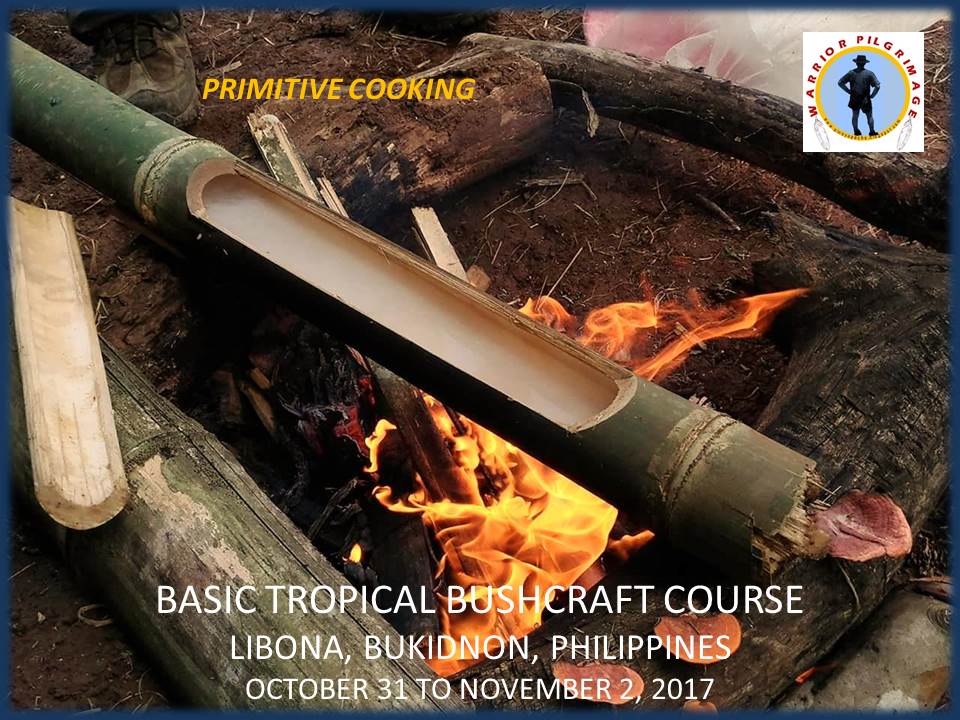
At 14:30, this author demonstrate Survival Tool-Making to the participants. This chapter is a practical exercise in knife dexterity and safety; taught them how to carve spoons, jugs and an improvised cooking vessel from a green bamboo pole; and create a digging stick from a thick straight branch. Aside that, this blogger gave them the idea how and where to source cords from nature. Next is Notches. Another knife dexterity session aided, this time, by a baton.

When dusk came, all activities ceased and the participants focused on the preparation of their meals under a slight shower. By 19:30, the campfire is lit and becomes the social center for the Campfire Yarns and Storytelling. This camp tradition does not need great company as long as the train of tales and laughter begins. Sometimes, a moderate round of alcoholic drinks move that into more tales and laughter. Rains came and ended abruptly the night socials.
  
The second day (November 1) starts with breakfast but after that, all will deny food the rest of the day, not until they have accomplished foraging their own food which comes later in the night. This is to simulate the hunger pangs associated when you are stressed in a survival situation. Everyone steeled themselves for this occasion. The day is warmer than yesterday but the ground is muddy.

The first chapter for this long day is Customizing the Survival Kit. It is better that survival kits are made from scratch than bought commercially because its size and components depend upon the type of the activity you are indulging in and the kind of environment you are going to visit. Your personal preference still matters although redundancy of some functions, like fire tools, luminosity, water collection and cutting devices increases security.

Then I proceed to Foraging and Plant Identification. This author discusses about traps and snares and what are the difference between the two; luring methods and trap lines; and foraging food and non-food. It also identifies which plants are edible, harmful and poisonous. The participants are then shown the different traps and snares that are set up in camp before touring the area around the camp for the common plants growing here.

Hearing distant thunder, I decide to proceed to Fire, Fuel and Campfire Safety. Understanding first how a fire is made is very important. You have to know the three elements of the fire triangle: fuel, heat and air. You cannot produce fire if lacking one element. Conversely, you can put out a fire by removing one. Lately, they added a fourth element – chemical reaction.

Making fire by friction is 80% common sense, 10% skill and 10% perspiration. Your fire can start if you can acquire and identify the right tinder, if you are in a dry place, and if you have the patience. In a very humid location, the presence of moisture in the atmosphere almost always hinder the production of ember needed to start a fire. Most of the time heat is stolen by the cooling effect of watery air.

Aside from friction, there is the conventional method which are matchsticks, lighters, ferro rods, and the flint and steel. Then there is solar magnification which can be done with magnifying lens in a cloudless day. Then you have pressurized air, exemplified by the fire piston. Since I do not have the luxury of time, I limit my demonstrations to the flint and steel, and the ferro rod. I also showed them how to make a tinder bundle. 

Demonstrated how the bow drill method is made and spun. Unfortunately, I could only make thick smoke as sawdust embers refused to light up my tinder due to humid conditions. Dark clouds are now overhead as the thunder gets nearer and nearer. I let others try the bowdrill, the ferro rod, and the flint and steel. The participants properly learned how to use the ferro rods. It ignites easily natural tinder.

By now, wisps of moisture started to drop. I demonstrated how the bamboo-saw method is made and scratched. As with the bow drill, I could only produce smoke. Moisture have penetrated the grains of bamboo. Racing against the rain, I tried again and failed. Four participants tried but in vain. I made another derivative of the bamboo-saw that could be done with two people. Smoke is thick and there is a promise of ember but it lived shortly. Then a strong downpour fell.

For the rest of the afternoon, we could do nothing but stay in our shelters. I could not discuss the rest of the topics and our Nocturnal Hunting is even jeopardized. Owing to circumstances beyond our control, I aborted it and gave a go signal to prepare their food for dinner. In wet conditions, I am able to make fire in my Swiss Army wood burner to boil water first for coffee and then for Japanese seaweed soup.

The heavy downpour caused the stream to overflow on the lowest places of the campsite but it necessitated the transfer of three tents nevertheless to better locations. The water current increased and became very noisy, alarming everybody. For a couple of hours we were awake, watching the stream, until the rains began to slow down. I relax with my watch and half-chased sleep.

In my comfortable hammock, rainwater found its way to my chest. I shifted my body so the drips would not fall on me but a cotton rope I used to tie the hammock with snapped and I fell hard with my hammock on the ground. I re-strung my hammock and my shelter setup hoping to stop the drips. I placed drip cords on the ridgeline of my shelter just like I did before on the ends of my hammock. After I have done so, the drips have stopped.

The last day (November 2), I was surprised to see that the bamboo viaduct have withstood the stream’s rising water last night and still supplied us with an uninterrupted clean water. The water is not cloudy. We prepared breakfast early for I have four more topics to discuss. Yesterday’s muddy ground are smoothed out by water but it is wise not step on the same surfaces.

After breakfast, we break camp and transferred uphill to be away from the din created by chainsaws used by locals who took advantage of a holiday to cut trees. The first one is Understanding Cold Weather. During mountain climbing, exposure to the elements is expected. There are five physical mechanisms that steal away body heat and the things that we should do to keep us constantly warm.

Next is Outdoors Common Sense. This is the subject matter that I based from my yet unpublished book, ETHICAL BUSHCRAFT. It is about trail courtesy and behavior while on the trail; choosing the best campsites; practicing stealth camping; increasing individual safety and security; wildlife encounters; and introduce people the idea of Blend, Adapt and Improvise.

Finally, the topic of Outdoor Cooking and Food Preservation gets its slot. Different ways of preserving meat, fish, vegetable and fruits. Getting equal discussion are the different kinds of fireplaces. After the lectures, author shows how the Trailhawk System of cooking rice in bamboo is done. The participants prepared their meal for lunch and when all got cooked, to include the rice inside the bamboo, we had our meal.

We packed up everything and hiked the three kilometers back to Libona and then to the terminal. From Libona, we rode on tricycles to Manolo Fortich and transferred to a van-for-hire. Destination is Cagayan de Oro City, which we reached at 18:00. We stayed for a while at a local restaurant for dinner and the post-event discussion and socials. I was tired but I was not sleepy. I noticed there was no curfew here but we have to end after midnight.

 
I found a vacant room at Rosario’s Place for I have a speaking engagement tomorrow evening (November 3) at Viajero Outdoor Centre. Coming here to Cagayan de Oro with a cargo of blades gave me fears of travel restrictions brought about by Martial Law. It turned out well but, going back to Cebu, a security guard made it a little hard for me with his wrong presumptions. Or was he just interested with my properties? My spring-bound lecture handbook made all the explaining for him.

The unpredictable weather of the highlands of Bukidnon is something that I have to give an extra consideration next time. I expected it to behave like all highlands do but I failed to give a thought that Bukidnon is a plateau where rainwater would be collected on a wide area instead of travelling fast and quick to the sea. Here, it accumulates slow and long before going down the different drainage systems.    

It was a productive moment not just for me, but also for my newly-found friends of Mindanao. At last, I was able to introduce bushcraft there and helped them become better outdoorsmen. My trip there would not have been possible without the sudden sparks of creativity by Earl and JP. For their efforts, I part my couple of Seseblades to them, courtesy of Dr. Arvin Sese, whose quality but affordable blades I had endorsed everytime I have training sessions.  

Document done in LibreOffice 5.3 Writer