Showing posts with label plant identification. Show all posts

Wednesday, November 18, 2020

2020-005 | OUTDOORS SAFETY & THE PLANT KINGDOM

OUTDOOR COMMON SENSE TIPS: Treat all vegetation as harmful. Looks could be deceiving. Do not take chances in touching it, much less ingest it, unless you KNOW the plant personally.

Never ever touch and cook wild mushrooms. They look almost the same found in grocery stores and supermarkets yet exhibit different characteristics.

First seen on Facebook

December 14, 2017

=> => => o0o <= <= <=


MAN MAY HAVE DOMINION over the animals and plants of this planet but he has no complete control of all the plants that grew in his realm. What could be toxic here could be a delicacy in another part of the world. He might be a walking encyclopedia in a semi-arctic region but he would be a complete idiot in the tropics.

Science, however, have resolved that large gap but, scientific research and volumes of books related to the plant kingdom are confined only to the few and, mostly, within walls; and what information that may be shared to the public, comes out after the fact, when a person or a family succumb to the fatal ingestion of harmful plants.

Fortunately for us we now have the Internet. We could learn plants from the tips of our fingers and the information are almost endless. Would that make you an instant expert? Your guess is as good as mine. On the other hand, what little knowledge you got would be dangerous. Me, I just give plants a wide berth when walking on a trail, making sure I do not touch the one that have caused so much grief to people.     

The one I am talking here is the stinging tree (first photo) or what we know locally as "alingatong" or “lipa”. As long as the leaves are found as high as your head, you are safe. Watch out instead for the younger trees which grow level to your face, arms and legs. They sting when brushed and the more you rub the more torment you would receive. This last for 3 to 4 days without medical intervention.

During the flowering season, pollen and tiny fibers float from the treetops and branches down to the ground in slow motion. Zillions of these stay almost suspended in the air and carried off by wind higher or lower or sideways. These tiny particles causes allergenic reaction to one who has asthmatic spells and, sometimes, causes irritation to the skin which ran for days.

One of the most notorious plants to have this characteristic is the cowhage (second photo), or more locally known as “aninipay” or “nipay”. Its tiny fibers adhering to the flowers and fruit causes so much irritation. Folk tales suggest that because it is so light you could spot a beam of light over the “nipay” towards a person and it would ride that beam of light and inflict harm. Of course, it is unverified tale and made for entertainment only.

We may have other plants that are so toxic but it would not harm you for as long as you do not break a leaf or branch and smear your skin with its sap or ingest a part of it. We also do not know some plants are toxic and that is why we treat everyone as harmful. We do not experiment just because it looked like the ones demonstrated in YouTube or you saw a picture printed in a book.

Although not a plant, but still a member of the plant kingdom, mushrooms ARE to be left alone. They almost looked the same with just a little difference in their parts or color pigments. The safest mushrooms are still those found in supermarkets and groceries. Let a real living person, especially a grower, show you how. As much as possible, never discuss mushrooms if you are not an expert.

Learning how edible plants looked like is best learned from a garden and on the public markets. Bring these to the kitchen and learn how to process and cook these in many ways. Seasonal edibles are always found in markets. If you visit a place, look for this kind and you would learn something; much better than those online instructional.     

Skin irritations are best treated by washing the affected part and apply Caladryl© or calamine ointment. Do not apply alcohol, oil or skin lotion! If you do not have an ointment, alternative treatment but not a treatment actually, is smearing it with petroleum jelly. It helps to cool the affected skin and lessen the swelling.


=> => => o0o <= <= <=

WARRIOR PILGRIMAGE BLOG, personified by this writer, is synonymous with the Outdoors, since Bushcraft and Survival is its niche. Safety and Security are its bedrock when it ventured into organizing outdoor events that involved people as in adventure/pilgrimage guideships and seminars; and explorations and expeditions.


Through tutorship, experience, folk knowledge and good old common sense, this writer were able to collect useful information which he is currently documenting in a book titled, ETHICAL BUSHCRAFT. He shares some of this information and knowledge in his training sessions; in his social-media account; and in this blog.


Photo Nr 3 from Mushroon Info
Photo Nr 4 from Adrenaline Romance

Saturday, September 22, 2018

THE TRAILHAWK JOURNEYS: Bukidnon Bushcraft Training

MINDANAO IS UNDER MARTIAL LAW and I do not forget that. There was an urban war in Marawi City fought by the government forces against ISIS which had ended more than a month ago. I travelled a month earlier to Davao City to test the climate of uncertainty painted by media. There was indeed a military presence there, which is fair enough. Would it be okay to travel there again with bladed tools? I have to find that out myself.

You know, I have never taught bushcraft and wilderness survival in Mindanao and I waited for many years for that opportunity until Earl Ryan Janubas and JP Echavez, both of Cagayan de Oro City, organized one for me. Martial Law have curtailed travel of Mindanaoans to their most famous mountain destinations and they needed an alternative outlet for their thirst of adventure. That is when they contacted me.

Going by plane to Mindanao is out of the question for me, although travelling in it with blades is the most convenient. The transfer of the airport location of Cagayan de Oro, in Lumbia, to the Municipality of Laguindingan a few years ago is too far for my own comfort. The boat is my best option even if I have to unload my bladed tools to security for safekeeping while I am in the boat and it would travel with me anyway.

As an outdoors educator and survival instructor, blades play a very important role in all my classes and training instructions. Blades make easy work and these are educational aids and tools. Trusting to my good judgment, I carried some of my best blades with me like the AJF Gahum, Pandoy Pulido Pinahig, Condor Bushlore, Mora Companion, Knifemaker Camp, Seseblade Sinalung, Seseblade Matavia, a Browning and a Victorinox Trailmaster. Coming also is my veteran tomahawk.    

I travelled by boat in the evening of October 29, 2017 bound for Cagayan de Oro. Earl and JP would be expecting my arrival the following day. I arrived in the morning of October 30 and JP came to fetch me and whisked me to Focal Matters, a photography studio located at Capistrano and Yacapin streets where Earl is the resident photographer. After lunch, Earl and I travelled to Libona, Bukidnon on his Honda CG125, along with JP with his motorcycle.

We followed a newly-opened road that go through the backcountry of Indahag and Gango and arrive at Libona at around 15:00. We made a courtesy call to the village head of Poblacion and then to the community leader where we would make our camp for three days. It is in the property of Earl’s brother. We visit it for a brief inspection. It passes by a big pineapple farm and a trail lead to a stream.

Beside the stream is a narrow piece of ground good for eleven tents and some trees could host a few hammock pieces. It had been raining here for the most part of the week and the stream is deep with color associated with floods. I have my concerns but I am hoping that weather will get better. It is sunny and warm but the highlands has a weather of its own. I cannot rely on a weather forecast from a mere phone application.   

Earl and I returned to the town and made it to the house of his brother. We will both sleep there so we could be early to the campsite while JP need to go back to CDO. Bukidnon, by its location in the highlands of Mindanao, always has cold nights. It was colder still when there was a heavy downpour in the middle of the night which did not stop until the earliest hours of dawn. That got me worried about the stream and the campsite.

After breakfast of October 31, Earl and I went back to the campsite at 07:00. The stream have not risen that much. Only the color became more brown and the current more brisk than yesterday. I am assured of a very sunny morning and I hoped that the weather will turn out the better for the rest of the day. We choose this site because of its proximity to a natural spring located across.

I looked for a couple of trees, not far enough from each other and not near enough, and finding one such place, I left my bag. I choose the best location where I would be safe if the stream overflow but near enough to the rest. Open carrying my AJF Gahum, I go back up the slope and looked for a good place to make a latrine. Found one under a copse of cassia trees and dug a hole with a digging stick sharpened by my knife.

Then I foraged materials as educational aid for the outdoors seminar like dry and green bamboos, firewood and dry leaves. After an hour, JP and eleven participants arrived, including two high school students from Xavier University. One participant even brought his two dogs. All set up tents on the grassy ground while two of them found a place for a hammock.

Part of the morning was spent setting up shelters and diverting the flow of the natural spring by a bamboo viaduct, crossing over the stream into our campsite. Dry bamboos are abundant and I do not have to cut poles since there are many left rotting on the ground and a few are left hanging. I choose the clean ones for our improvised water span, propping it high enough from even an increase of a meter of flood.

The BASIC TROPICAL BUSHCRAFT COURSE is almost the same as that of the ones I do and organize in the Philippine Independence Bushcraft Camp, held in Cebu annually. It always start with Introduction to Bushcraft. The participants learned the terminologies and jargon used in bushcraft; its preferred environment; its own psychology; its methodologies; and its difference from survival and from mainstream activities.

 
Then next is Ethical Bushcraft. The best practices of leisure bushcraft, using its own principles of Blend, Adapt and Improvise, to lower your obtrusive presence among forests and jungles and increases an individual’s safety and security. It covers trail travel, courtesy to locals, campsite location, fire management and camp hygiene. Ethical Bushcraft is taken from this author’s unfinished book of the same title.

After lunch and siesta, it is the turn for Knife Care and Safety to be discussed. This chapter changes the perspective of the knife into a useful tool instead. The Philippine law on the regulations of carrying a knife – Batas Pambansa Bilang 6 – are explained thoroughly and clearly as well as ethics and safety, care and sharpening, blade shapes, parts and grinds, and the Nessmuk Trio.

At 14:30, this author demonstrate Survival Tool-Making to the participants. This chapter is a practical exercise in knife dexterity and safety; taught them how to carve spoons, jugs and an improvised cooking vessel from a green bamboo pole; and create a digging stick from a thick straight branch. Aside that, this blogger gave them the idea how and where to source cords from nature. Next is Notches. Another knife dexterity session aided, this time, by a baton.

When dusk came, all activities ceased and the participants focused on the preparation of their meals under a slight shower. By 19:30, the campfire is lit and becomes the social center for the Campfire Yarns and Storytelling. This camp tradition does not need great company as long as the train of tales and laughter begins. Sometimes, a moderate round of alcoholic drinks move that into more tales and laughter. Rains came and ended abruptly the night socials.
  
The second day (November 1) starts with breakfast but after that, all will deny food the rest of the day, not until they have accomplished foraging their own food which comes later in the night. This is to simulate the hunger pangs associated when you are stressed in a survival situation. Everyone steeled themselves for this occasion. The day is warmer than yesterday but the ground is muddy.

The first chapter for this long day is Customizing the Survival Kit. It is better that survival kits are made from scratch than bought commercially because its size and components depend upon the type of the activity you are indulging in and the kind of environment you are going to visit. Your personal preference still matters although redundancy of some functions, like fire tools, luminosity, water collection and cutting devices increases security.

Then I proceed to Foraging and Plant Identification. This author discusses about traps and snares and what are the difference between the two; luring methods and trap lines; and foraging food and non-food. It also identifies which plants are edible, harmful and poisonous. The participants are then shown the different traps and snares that are set up in camp before touring the area around the camp for the common plants growing here.

Hearing distant thunder, I decide to proceed to Fire, Fuel and Campfire Safety. Understanding first how a fire is made is very important. You have to know the three elements of the fire triangle: fuel, heat and air. You cannot produce fire if lacking one element. Conversely, you can put out a fire by removing one. Lately, they added a fourth element – chemical reaction.

Making fire by friction is 80% common sense, 10% skill and 10% perspiration. Your fire can start if you can acquire and identify the right tinder, if you are in a dry place, and if you have the patience. In a very humid location, the presence of moisture in the atmosphere almost always hinder the production of ember needed to start a fire. Most of the time heat is stolen by the cooling effect of watery air.

Aside from friction, there is the conventional method which are matchsticks, lighters, ferro rods, and the flint and steel. Then there is solar magnification which can be done with magnifying lens in a cloudless day. Then you have pressurized air, exemplified by the fire piston. Since I do not have the luxury of time, I limit my demonstrations to the flint and steel, and the ferro rod. I also showed them how to make a tinder bundle. 

Demonstrated how the bow drill method is made and spun. Unfortunately, I could only make thick smoke as sawdust embers refused to light up my tinder due to humid conditions. Dark clouds are now overhead as the thunder gets nearer and nearer. I let others try the bowdrill, the ferro rod, and the flint and steel. The participants properly learned how to use the ferro rods. It ignites easily natural tinder.

By now, wisps of moisture started to drop. I demonstrated how the bamboo-saw method is made and scratched. As with the bow drill, I could only produce smoke. Moisture have penetrated the grains of bamboo. Racing against the rain, I tried again and failed. Four participants tried but in vain. I made another derivative of the bamboo-saw that could be done with two people. Smoke is thick and there is a promise of ember but it lived shortly. Then a strong downpour fell.

For the rest of the afternoon, we could do nothing but stay in our shelters. I could not discuss the rest of the topics and our Nocturnal Hunting is even jeopardized. Owing to circumstances beyond our control, I aborted it and gave a go signal to prepare their food for dinner. In wet conditions, I am able to make fire in my Swiss Army wood burner to boil water first for coffee and then for Japanese seaweed soup.

The heavy downpour caused the stream to overflow on the lowest places of the campsite but it necessitated the transfer of three tents nevertheless to better locations. The water current increased and became very noisy, alarming everybody. For a couple of hours we were awake, watching the stream, until the rains began to slow down. I relax with my watch and half-chased sleep.

In my comfortable hammock, rainwater found its way to my chest. I shifted my body so the drips would not fall on me but a cotton rope I used to tie the hammock with snapped and I fell hard with my hammock on the ground. I re-strung my hammock and my shelter setup hoping to stop the drips. I placed drip cords on the ridgeline of my shelter just like I did before on the ends of my hammock. After I have done so, the drips have stopped.

The last day (November 2), I was surprised to see that the bamboo viaduct have withstood the stream’s rising water last night and still supplied us with an uninterrupted clean water. The water is not cloudy. We prepared breakfast early for I have four more topics to discuss. Yesterday’s muddy ground are smoothed out by water but it is wise not step on the same surfaces.

After breakfast, we break camp and transferred uphill to be away from the din created by chainsaws used by locals who took advantage of a holiday to cut trees. The first one is Understanding Cold Weather. During mountain climbing, exposure to the elements is expected. There are five physical mechanisms that steal away body heat and the things that we should do to keep us constantly warm.

Next is Outdoors Common Sense. This is the subject matter that I based from my yet unpublished book, ETHICAL BUSHCRAFT. It is about trail courtesy and behavior while on the trail; choosing the best campsites; practicing stealth camping; increasing individual safety and security; wildlife encounters; and introduce people the idea of Blend, Adapt and Improvise.

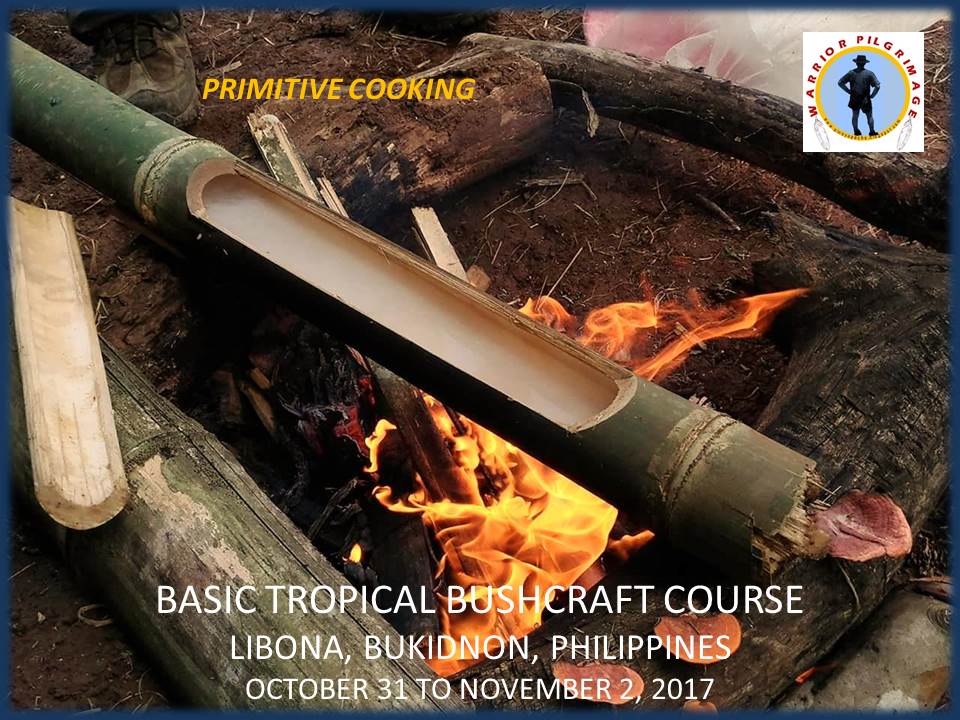
Finally, the topic of Outdoor Cooking and Food Preservation gets its slot. Different ways of preserving meat, fish, vegetable and fruits. Getting equal discussion are the different kinds of fireplaces. After the lectures, author shows how the Trailhawk System of cooking rice in bamboo is done. The participants prepared their meal for lunch and when all got cooked, to include the rice inside the bamboo, we had our meal.

We packed up everything and hiked the three kilometers back to Libona and then to the terminal. From Libona, we rode on tricycles to Manolo Fortich and transferred to a van-for-hire. Destination is Cagayan de Oro City, which we reached at 18:00. We stayed for a while at a local restaurant for dinner and the post-event discussion and socials. I was tired but I was not sleepy. I noticed there was no curfew here but we have to end after midnight.

 
I found a vacant room at Rosario’s Place for I have a speaking engagement tomorrow evening (November 3) at Viajero Outdoor Centre. Coming here to Cagayan de Oro with a cargo of blades gave me fears of travel restrictions brought about by Martial Law. It turned out well but, going back to Cebu, a security guard made it a little hard for me with his wrong presumptions. Or was he just interested with my properties? My spring-bound lecture handbook made all the explaining for him.

The unpredictable weather of the highlands of Bukidnon is something that I have to give an extra consideration next time. I expected it to behave like all highlands do but I failed to give a thought that Bukidnon is a plateau where rainwater would be collected on a wide area instead of travelling fast and quick to the sea. Here, it accumulates slow and long before going down the different drainage systems.    

It was a productive moment not just for me, but also for my newly-found friends of Mindanao. At last, I was able to introduce bushcraft there and helped them become better outdoorsmen. My trip there would not have been possible without the sudden sparks of creativity by Earl and JP. For their efforts, I part my couple of Seseblades to them, courtesy of Dr. Arvin Sese, whose quality but affordable blades I had endorsed everytime I have training sessions.  

Document done in LibreOffice 5.3 Writer

Sunday, May 6, 2018

PHILIPPINE INDEPENDENCE BUSHCRAFT CAMP 2017


AFTER THREE YEARS, the PIBC returned to the place of its birth: Camp Damazo. It started there in 2011 until it experimented in holding it at Sibonga in 2014. In 2015 and 2016, it was held in Liloan. During that period of six years, it had hosted 97 participants who learned basic tropical bushcraft skills. This year, another set of 26 registrants would flock to the jungles and enhance their knowledge about the outdoors.


The PIBC had become an institution in itself, exceeding its expectations when it was held for the very first time in 2011. By 2012, it had accepted the first participants from outside Cebu and by 2015, the first foreigner. The format used had changed and improved through the years and used as basis for trainings that this writer conduct in other places and for organizations like MCAP, CLIMBER, Archdiocese of Capiz, PECOJON, Liloan DRRMO, 5th CMAG, Bukal Outdoor Club and Bluewater Resorts.

The PIBC officially starts every June 10th and culminates on June 12th, which happen to be, you guessed it, Philippine Independence Day. It follows the dates faithfully, whether it fall on weekends or weekdays. PIBC is a patriotic activity which rekindle each Filipino’s love of flag, country and freedom. It also is a venue for outdoors learning and education, as well as a campsite for camaraderie, kindred and friendship.

Warrior Pilgrimage and the Camp Red Bushcraft and Survival Guild collaborated through hard work and dedication for many years to bring again this seventh episode. Assembly area is the parking lot of the Our Lady of Guadalupe Parish on the first day (June 10). Participants, instruction presentors, camp staff and volunteers start to arrive. Among them were four from Luzon, one from Leyte, one from Palawan, one based in the USA, one from Switzerland and three minors.

The famous Duke Bus of the Municipality of Liloan, our main transport for the last three episodes, came again to ferry all to the trailhead in Baksan. From there, the participants are engaged to walk in a Discovery Hike to introduce them and increase their outdoors awareness. It follow Lensa Trail, crossing streams, following a ridge on a combination of forest and jungle, and finally arriving at Camp Damazo at 10:00.

After a short briefing about camp rules, locations of latrines and campfire and the camp staff, the participants proceed to erect their shelters. Most have tents but some have hammocks. Jhurds Neo (PIBC 2012), camp ramrod, assigned an area for participants and another one for volunteers. Humidity is high and, as with previous experience, rain is expected to fall. Meals for lunch are prepared and eaten as the minutes ticked to officially start the activities. After forsaking siesta, all gathered under a wide tarp canopy at 13:00, and all ears now for the lectures at hand.

This author, discusses the first chapter: Introduction to Bushcraft. It tackles the meanings and the jargons used in bushcraft, its environment, the psychology of an enthusiast, its methodologies and its difference from survival and from mainstream activities. Comes next is Ethical Bushcraft. The best practices of leisure bushcraft, using its own principles of Blend, Adapt and Improvise. It covers trail travel, campsite location and safety, fire management and camp hygiene.

At 15:00, Knife Care and Safety gets discussed by Aljew Frasco (PIBC 2013). This chapter changes back the perspective of the knife into a useful tool. The Philippine law on the knife – Batas Pambansa Bilang 6 – are explained thoroughly and clearly as well as ethics and safety, care and sharpening, blade shapes, parts and grinds, and the Nessmuk Trio. At 16:30, this author take over once more to demonstrate Survival Tool-Making. This chapter is a practical exercise in knife dexterity and safety. Dr. Guille Zialcita (PIBC 2016) discussed the part that touched on fishing applications.

When dusk came, all activities ceased and the participants focused on the preparation of their meals. By 19:30, the campfire is lit and the place begun to be populated by participants and camp staff and volunteers. A social event, Campfire Yarns and Storytelling, is an integral component in camp life. Tales and stories caught everyone’s attention and their humor as the small company gets fueled by a moderate round of alcoholic drinks. The social activity ended at 23:30 but a set of night watch starts their task until such time they are relieved after one hour and so on until daybreak.
  
The second day (June 11) starts with breakfast but after that, all will deny food the rest of the day, not until they have accomplished foraging their own food which comes later in the night. The first chapter is Foraging and Plant Identification. This author discusses about traps and snares, luring methods and trap lines, and foraging food and non-food. It also identifies which plants are edible, harmful and poisonous. The participants are then shown the different traps and snares that are set up in camp.

Next at 10:00, is Common Wilderness Treatments, discussed by Eli Bryn Tambiga (PIBC 2013). It tackles common injuries in the woods like open wounds and bleeding, fractures, hypothermia, heat strokes, hypoglycemia and the methods to contain it as well as a practical in using a triangular clothe as bandage and sling. At 13:00, Dominik Sepe (PIBC 2012) discusses about Notches and Lashings. After a half hour of demonstration, the participants proceeded with the business of working with knife and baton on a stick and produce five different notches.

When everybody is about to settle down at 15:00, Outdoor Cooking and Food Preservation came next. This author talked about the ways how meat, fish, vegetable and fruits are preserved. Getting equal discussion are the different kinds of fireplaces. After the lectures, author shows how the Trailhawk System of cooking rice in bamboo is done. Five groups came to possess five different bamboo poles to process into cooking vessels. A fire is prepared and rice are cooked inside it.

After the first group have cooked their rice, they commenced to Nocturnal Hunting. The jungle and streams of Camp Damazo host small edible creatures and have sustained participants of the PIBC during the early years and now, after an absence of three years, these creatures are good enough in numbers for the taking. Ernie Salomon (PIBC 2011), the camp fixer, would ensure that the foraged creatures become a gastronomic treat for the participants and volunteers alike.

For one-and-a-half hours, the five groups filled their respective catch bins and ensured their meal, ending a day-long fast. Dinner is most sweet when you personally toiled and foraged your own food, offering an empty stomach a way out of its hunger pains. All dined together, the rice inside the bamboo pots exude a sweet aroma which made the food more desired. Everyone were happy and exchanged jolly conversations in between swallows.

The second Campfire Yarns and Storytelling started at 20:30 and almost everyone felt relaxed that all had already overcame their ordeals of drowsiness, hunger, thirst, humidity and other stress-causing conditions and it becomes second nature for all to gift self with toasts of success. A few took the pleasure of an early rest, easing on the thought that tomorrow would be the last day and they had proven themselves for the last two days. Alcoholic drinks, cached underneath the ground for a week made its regular rounds again to stoke interesting conversations until midnight.

Last day (June 12), the Blade Porn, a traditional bushcraft camp activity wherein knives and hatchets are laid on a blanket to elicit good conversations, began. The number of blades far outnumber the owners three to one but this author believed most of the campers carried more than six with them. Then came the Patriotic Time. Jingaling Campomanes (PIBC 2015) led the singing of the Lupang Hinirang and the reciting of the Panatang Makabayan.

After a late breakfast, we broke camp and cleaned up Camp Damazo. To see to it that we do not leave trace, a task group led by Jonathaniel Apurado (PIBC 2015), left behind to pick up rubbish that may have been missed out, dismantle camp furnitures and snares, and see to it that the campfire and firepit embers are completely extinguished. Because of the unexpected late participation of additional volunteers, a lot of ground had to be cleared. As per assessment, it is recommended that the PIBC would have to be held somewhere other than here for the next two years.

The exit route is shorter than the ones we took two days ago but it is steep on the last part. It goes out to the Baksan-Pamutan Road. A trail across goes down to Lanipao Rainforest Natural Spring Park and it is there where we would go. The fresh-water pools are perfect for bathing and to cool our bodies down. Aside that, cool refreshments would be provided; raffles and giveaways, blanket trading, and the distribution of training certificates would also be done there. 

The following participants finished the 3-day Basic Tropical Bushcraft Course:

      Ronilyn Ambal                 Frederick Ygnacio III
      Eulalio Conrado Salazar        Raul Andre Jose Ben
      Ronniel Abellar                Vladimir Lumbab
      Mark Brylle Moniva             Aileen Estoquia
      Katrina Mie Javier              Jayson Binamira
      Buen Josef Andrade           Joan Binamira
      Rodillo Arnejo                 Sweet Honey Acenas
      Martin Ibañez II                Bonabella Canga
      Honey Vina Alquizola           April Joy Delantar
      Shelley Kim Binghay            Floramae Dellosa
      Luzviminda Viray              Felipe Arturo Enriquez
      Dave Judson Sy               Alvin John Osmeña
      Frederick Ygnacio Jr           Markus Immer

The giveaways were provided by Derek Manuel (PIBC 2016) of Derek’s Classic Blade Exchange; John Robert (PIBC 2016) of the KnifeMaker; Paracord Manila; Silangan Outdoor Equipment; Titay’s Liloan Rosquillos and Native Delicacies; Tingguian Tribe Outdoors; Zue Fashion; and the Camp Red Buscraft and Survival Guild. Transportation provided free by the Municipality of Liloan. Warrior Pilgrimage is the media partner for PIBC MMXVII.


Document done in LibreOffice 5.3 Writer

Saturday, March 17, 2018

NAPO TO BABAG TALES CXXIII: Bukal Outdoor Club Goes Survival


IT IS ALWAYS A GOOD INVESTMENT for an individual to sit, listen, watch and participate actively in outdoors training. Much more so if it is a survival class. That individual would know exactly what to do in an ugly situation. With people around him, his presence would be McGyver-like. Perhaps not. Unlike others who prioritized equipment and gear over training, knowledge does not get stolen nor get damaged. Its value does not depreciate because it is priceless. It becomes part of you.

A group investing in survival training is much better. Everybody knows what to do when SHTF comes. We know that no activity is perfect. No trip is seamless even if it is well planned. A number of trained people caught in dire straits would weather that out much better than on another group who have none or even with one. I would cast my fortunes on the former any time, any day and on any place. With a group, a member would complement another in clockwork precision.

MCAP and CLIMBER, legitimate outdoor organizations based in Luzon, had previously harnessed my know-how in preparing their members or participants in survival education. It improved the participants’ stock knowledge and raised their confidence and understanding a few notches higher. Same with PECOJON, an NGO composed of journalists I trained in bushcraft; emergency response units like the ones maintained by the Archdiocese of Capiz and the Municipality of Liloan, Cebu; and an Army reserve unit.

Here in Cebu, BUKAL OUTDOOR CLUB is the first outdoor recreations group to cross over that line which separates a club that values their members’ well-being and those that do so only during Christmas Day. It is a collective sacrifice. A group investment. But it shall reap dividends, not only for themselves, but also covers to those who are with them. They shall become more responsible campers, they would have more time to think and would appreciate better the dangers nature present.

BUKAL OUTDOOR CLUB have undergone my standard three-day Basic Wilderness Survival Course on the dates May 13, 14 and 15, 2017. I held it at Camp Xi, another mythical nook found within the foothills of the Babag Mountain Range, Cebu City. They brought their usual camping gear and were just by their normal selves. No fanfare like subjecting them to cosplay and act naked and unafraid. Nor did I let them crawl on dirt to eat raw bulbs dug from the earth.

The camp we used was the ones that I used for the Bushmasters’ Camp last April 28 and 29. The campsite is accessible but is not along a route frequently used by mainstream activities. A path less taken. The campsite is on a high ground, wide and grassy, below the tree line, near a small stream, a small waterfall, a small pond and a natural spring. It has bamboos and dry firewood. Perfect requirements of a bushcraft camp.

There were fourteen excited participants sitting before me on that first day (May 13). Joining me as my assistants are Dominic Sepe, Leomel Pino, Jonathaniel Apurado, Denzen Delima and Jenmar de Leon. They are all with the Camp Red Bushcraft and Survival Guild and have taken the Philippine Independence Bushcraft Camp on different occasions between 2011 and 2017, except for Denzen who is a product of the Bonifacio Day Bushcraft Camp of 2015.

As usual, I always start the day on a light mood with my patented selfie with participants. In a few minutes, I got serious. Really serious. I explained the purpose of this basic seminar and how it will change their paradigms. It is meant to open the eyes of the participants on the real possibilities of these chain of events that would go beyond anybody’s control since the outdoors, the mountains, the weather and everything that is in nature, can never be controlled when things go wrong.

The first topic is about Introduction to Survival. During times of accidents and calamities, nobody has that ultimate answer when to survive such. A prepared mind would, at least, be blessed by chance. Surviving the initial impact is one half of it while ensuring your survival until help comes in is the other half of that. In between, the mind controls everything from the way you think and even to the release of adrenaline. Your brain is a supercomputer but, unfortunately, it could only process one thought at a time. 

When in a survival situation, your brain works double time and, in the process, use up huge amounts of body heat, water and oxygen and inadvertently release adrenaline for no apparent reason just like you would experience when getting lost or just plain hiking in darkness. It is best that you stop and sit still, relax and breathe deeply, then gather all your thoughts and rehydrate. You would need water and it is your first priority to keep your blood flowing so your brain would work properly.

In the Hierarchy of Needs and of Nutrition in a Survival Situation, water is tops on both. Why? Because we are in the tropics and the body is surrendering perspiration due to humidity and by your exertions. Along with that, goes our body heat also which you do not know. To sit still would minimize losing body fluids and keep it confined by setting up a shelter – if you still have one, or make one from scratch. This is the second need. The third would be food then warmth. Last is security which would complement well with all.

Our body has four hypothetical tanks that needs to be replenished during survival. First you have to rehydrate often so you could offset dehydration. Second is food that would give you nutrients, carbohydrates and proteins. Third is sugar converted by enzymes for your adrenaline rush. Fourth is fat, hardest to find in the tropics yet are wrapped as tissues in our body. Then you make sure your body is supplied with adequate oxygen. Keep those air passages free of obstacles. Then, by all means, you should practice personal hygiene during survival. It helps to have a healthy body and a healthy mind.

Topic for the next chapter is about Water Sanitation and Hydration. The first chapter had mentioned the importance of water during survival. Water could be sourced from natural springs, water seeps, man-made water holes, flowing streams, the atmosphere and from plants. It could be sanitized through boiling, by chemicals, exposure to heat, through filtration and by desalination. It is wise to cache water in your survival camp or just travel early and take advantage of shady places and breeze if you happen to have less.

The last topic for the day is Knife Care and Safety. I would like to change the perception about the knife and it is important that people relearn why our ancestors invented it, generally, to aid them in their daily activities and made their living better. The knife is a tool and should not be used to what it was not designed for like digging latrine holes and as pry bars. It is a vital piece of equipment that should be properly handled and cared for because it is your link to your surviving. In all the training I conducted, knife etiquette is learned first before people touch a knife.

Besides my rules, there is a knife law that forbids the display, even of concealed carrying, in public places unless you are in a lawful activity, which camping and hiking are. A knife should be in a sturdy sheath when travelling - for safety - and should be unsheathed when at home to keep it from rust. There are many kinds of knives and it is important that people know the parts, blade shapes, grind styles and the tang designs because, from those qualities, you would know how to achieve maximum work. People must also learn how to field sharpen a knife.

The participants troop to their shelters at 17:00 to proceed with their food preparations and to answer the call of nature. The campsite is located on a wide meadow and shielded by mango trees. Above us is the ridge and the trail. Over on the other side is the latrine facing another valley. Walking uphill a trail would lead you to a small stream where there is a natural spring. Most of the people visit this other side while I spent my free time, splitting firewood for tonight’s campfire. After dinner, everyone sit around the fire and the Campfire Yarns and Storytelling proceed as planned until 24:00.

The second day (May 14), the participants eat a full breakfast. After this they fast and are obligated to use all their attention and concentration listening and understanding the lectures. Denying them a meal for the rest of the day would, at least, make them feel of what is it like to be in a survival situation outdoors. They would feel the pangs of hunger but they could rehydrate as they wished. Humidity, drowsiness and crawling insects would torment them as they use all their power to remain alert.

First lecture is Customizing the Survival Kit. It is better that your survival kit should be made from scratch than bought commercially because a survival kit’s size and its components depends upon the type of the activity you are in to and the kind of environment you are going on to. Your personal touch on certain items are very important to you should it be needed. Redundancy is its best attribute especially fire-making tools, lighting gadgets, water-purification methods and cutting tools.

The components are the medical kit, the replenishment pouch, the repair kit and a back-up knife. It could all be integrated in one container or it could be separated from one another in their own containers. As much as possible, avoid clutter. In a survival situation, you could misp second lace things. Make it waterproofed, dust-proofed, insect-proofed and keep it away from direct heat.

Next is Cold Weather Survival. Since the outdoors is about mountains and high elevations, exposure to the elements are expected. There are five physical mechanisms that steal away body heat and there are ways to keep us constantly warm. Then comes Survival Tool Making and, after the lecture, they can use their knives. Tool making is essential in survival or even when not in that situation like a missing utensil or tent peg.

I showed them the most basic of tools like the digging stick, cordage from bamboo skin and coconut midribs, traps and snares from bamboo, and the batoning stick, which they would need when cutting up bamboos for their cooking pots and for their spoons and drinking jugs. I assign 4-5 participants each to three groups for this knife-dexterity exercise for better supervision.                                     
                      
This activity would run through the early afternoon, crossing over a one-hour siesta break, where another topic, Traditional Navigation, begins. This technique was perfected by our ancestors and uses the natural terrain, shadows and the sky fixtures for travel; avoiding obstacles and highly-exposed areas that cause possible hypothermia; and knowing signs on trails made by animals and by humans. This chapter also talks about how to effectively use visual and audio signals.

Last for the day is Foraging and Plant Identification. During survival, you would need to gather food and non-food items. Food could be meat and proteins which would only be sourced from animals and insects. Catching animals would be very tricky and you would have to make use of traps and snares. Food can also be sourced from edible plants. It is fundamental that you know these because it is everywhere. It is also important that you know the harmful ones. Showed them photos of stingy, thorny and poisonous plants.

The participants, exhausted by hunger and by the long and warm day, are released from sitting for long hours and proceed to the business of cooking rice in the improvised bamboo pots they made during the tool making session which employ the Trailhawk System of cooking. Their dinner would materialize after the fruits of their Nocturnal Hunting which would be done on the small stream I mentioned ago.

All the participants and camp staff, including me, use this moment to tidy up at the small stream where there is a small waterfall and a pond upstream after two days without bath. They were able to forage fresh-water crabs and a few tree snails and it becomes their dinner. They also cook food from their supply and add it to the late feast. The campfire becomes alive again and another session of Campfire Yarns and Storytelling which goes past midnight.

The last day (May 15) start early. The discussion also start ahead of time and it is about Firecraft. This is the most expected part. You cannot make a fire if one or all elements are not present, namely: fuel, heat and air. Lately, they added a fourth element – chemical reaction. Fire-making is 80% common sense, 10% skill and 10% perspiration. We are talking about the friction methods. Your fire, done with any method, can start if you can acquire and identify the right tinder, if you are in a dry place, and if you have the patience.

Aside from friction, there is the conventional or modern method which are matchsticks, lighters, ferro rods and the flint and steel. Then there is solar magnification which can be done with any magnifying lens, reading glasses, water and even ice. Then you have pressurized air, exemplified by the fire piston. I proceed in demonstrating the flint and steel, which I paired with charclothe, and the ferro rod, which the participants tried and successfully produced ember and flame. 

I showed them how to make charclothe and how to make a tinder bundle, popularly known as the “bird’s nest”. Then I demoed how the bow drill method is made and spun.  Unfortunately, I could only make thick smoke as sawdust embers refused to light up my tinder. I let others try the bowdrill. I showed them another friction method using bamboos.  Just like my bowdrill, only burnt smoke emitted. The humid conditions might have something to do with that. Staff and participants tried their hands on these primitive gadgets but all to no avail but they now gained an idea how it is made and worked.

The last discussion topic is Outdoors Common Sense.  This is the latest topic that I added and it is but excerpts from my yet unpublished book, ETHICAL BUSHCRAFT. It covers trail ethics, travel and campsite, using the time-tested principles of Blend, Adapt and Improvise. It also talks about wildlife and farm animal encounters and how to react in such situations. That sums up this three-day outdoors course which I first introduced in Luzon last 2013 and is now one of the cornerstones of my training programs.

Giving of certificates follow and the imparting of giveaway items courtesy of Seseblades and Jhurds Neo of Camp Red Bushcraft and Survival Guild. Brunch gets served at 10:00 and after breaking up of shelters, it is time to leave the campsite. We will take another route, crossing Sarapia Creek and following a less-trodden trail to Mapawon Peak and Katugasan Peak and going down to a road where a signboard says we are now in Kalunasan. A wait of an hour for motorcycles brought us all to Guadalupe.

Done in LibreOffice 5.1 Writer