Showing posts with label outdoor cooking. Show all posts

Saturday, October 6, 2018

BUSHCRAFT BUHISAN XLVI: Jungle Steam

IT IS A SPECIAL DAY today, November 26, 2017, for the Camp Red Bushcraft and Survival Guild. We have a special guest whose blades provided the tools for our dirt-times and became synonymous with Philippine bushcraft. Dr. Arvin Sese is in town. Taking timeout from his busy schedule, Doc Arvin happily joined the bunch in our hallowed playground at the old Camp Damazo, the site of the first Philippine Independence Bushcraft Camp in 2011.

While the weather was very depressing the days before, today promises a very warm day. The sun shone gloriously on the parking lot infront of the Our Lady of Guadalupe Parish, Guadalupe, Cebu City. When I arrived, Ernie Salomon, Richie Quijano, Vlad Lumbab, Glyn Formentera, Nelson Tan and Jenmar de Leon were already there. Then came Aljew Frasco, Eman Apuya and Boblyle Balverde. Arriving last in an Isuzu passenger van are Jhurds Neo and Doc Arvin.

After securing the food ingredients from the roadside market of Guadalupe, we leave as one on board the Isuzu at 08:15. We arrived twenty minutes later at Baksan and proceed to the trailhead. The path led to a man-made exotic forest of Burma teak. The ground is wet but not muddy. Going downhill, we follow the same serpentine path to the Banauan Creek. The stream is brisk but clear, its ripples sweet music to the ears.

I am leading the pack and I made it sure that the pace is favorable for Jhurds, Vlad and Doc Arvin, especially now that we are following the stream down to its intended union with the bigger Lensa Creek. We would not be going to the catchment basin of the Buhisan but we would be on higher ground instead where it is much safe. We reach the old site of Camp Damazo at 09:30 and staked our dirt time here.

 
The heat of the day made the jungle very humid as steam rose to the canopies. While the rains may have left a wet surrounding, we at the Camp Red Bushcraft and Survival Guild know where to source dry kindling, tinder and firewood. I taught these guys and I am mighty proud of them. If we do not find them, we have these in our fire kits. The guys automatically spread out to look for dry fuel.

An uneasy flame appeared underneath a wooden tripod standing high and a little gentle coaxing from Aljew, this flame begins to gain warmed up spaces around its small circle of half-moist tinder and kindling until it became confident to burn bigger fuel. Thick smoke rise and a crackle of fire announced to all that it is ready for the pyromaniacs. A pot hanged from the tripod and coffee is in the first order of things.

   
Doc Arvin, tired from his travel from Carcar City, 41 kilometers away, set up a hammock in between two trunks and, in an instant, a blissful snore sounded off. He says he stayed a full vigil the whole night at the Carcar District Hospital treating and caring patients. He is a government doctor who is on loan from a government hospital in Pangasinan. He would be going back to his home province after a few days.

Dr. Arvin Sese, together with his brothers, owned and sold knives under the SESEBLADE brand. I first saw a Seseblade, an NCO, during the 2012 PIBC. Since then I have used their blades in all my bushcraft and survival classes everywhere in the country and endorsed the Seseblade before participants. Aside from the NCO, Seseblade also has the Mountaineer, Sinalung, Nessmuk, Matavia, the JEST Bolo, Parang and the Tomahawk.

It is known that I just used a 9-inch Seseblade Straight NCO over another bigger blade to work my way through the forbidding wilderness of the Doce Cuartos Mountain Range in Tabogon during Day 22 of my Thruhike of the Cebu Highlands Trail. Even though small, the local blade performed well in a tropical jungle environment with just a flick of a wrist, a method that shies away from those cinema-type hacking which is tiring and less effective.

After drinking coffee, I found the rest of the gathered firewood partly moist so I decided to augment theirs with dry ones. I see a waist-high stump and started chopping on one side with my AJF Gahum. Although the outermost part is moist, the next layers were completely dry. Storms and downpours could not penetrate the grains and it shall remain dry although it looked wet on the outside. The wood from the dead trunk provided good fuel for the cooking.

The guys were busy with the cooking and they were deeply buried in their conversations. I need not disturb that equilibrium so I dragged a cheap laminated nylon sheet from my Lifeguard USA rucksack to a place where there is shade. Unmindful of the dear doctor’s snoring and the roars of laughter from the river bank, I tried to squeeze a few minutes of sleep, which I did, until my Yaesu FT270R picked up a wayward signal.

I do not know how many minutes did I sleep but I felt I was cheated. It felt that I enjoyed it in a few seconds only. I did not feel revived nor was I short of being tired. The struggles of the camp fixers of their food have not yet seen its finale but there is still brewed coffee in a billy can. I could try another cup. The snores are still there and I envy Doc Arvin. More jungle steam rising to the branches and humidity is high.

The last of the meat is almost done on open ember. The aroma is overpoweringly sweet, teasing my hunger to its ultimate borderline of instability. Doc Arvin could have felt it too as the snores have stopped and the hammock moved to reveal a couple of lower legs dangling and reaching for the ground. I see a smiling Doc Arvin, quite refreshed from his half-hour of sleep. Ernie removed the last one and Vlad sliced that with his scary-sharp blade.

Lunch begin at 12:30, fair enough to feed a mad and famished man. Aside from grilled pork, liver estofado and raw cucumber in vinegar got served with unlimited rice. The pot bottoms are scraped clean leaving less for the ants. Conversations regained its momentum with the clank and clink of metal competing for earspace as it gets a scrubbing from sand near a water hole.

By 13:30, it was time to move off. Doc Arvin has to leave Cebu City for Carcar City at 17:00. After cleaning up Camp Damazo, leaving as little traces of our time here, I led them to another trail. I would have loved to go the way we went in but it is longer. The trail I am following now is steep but we would be at the trailhead in shorter time possible even if we tarry a lot for rests which is natural.

We are climbing a peak which I jestingly call as “Boy T’s Hell” and it is steep. We overcome two false peaks before arriving there. This peak, I first climbed in 2010 with Boy Toledo and Ernie during an earlier exploration of the extremities of the Buhisan. It was here that Boy almost collapsed of dehydration, fatigue and disorientation. I gave him all my water and it revived him but the peak was hell for him.

We arrived at Boy T’s Hell at 14:30 and before us is a long ridge that connect to another ridge and, on that day, it was beautiful to gaze at, unlike the last time I was there. Across us is the pyramidal shape of Bokatol. We arrived at Baksan at 15:30, time good enough for Doc Arvin to be at the Cebu South Bus Terminal before 17:00. We immediately leave as one on board the Isuzu and reached Guadalupe.

We say goodbye and thanks to Doc Arvin as Jhurds drove the Isuzu to the bus terminal. It was my first time to see and talk to Doc Arvin in person yet it seemed we knew each other for a longer time. In this strange interest of bushcraft, I have encouraged my adherents and students to patronize local products, most particularly, local blades. Doc Arvin has been most generous to provide me his designs and prototypes and I was a willing ambassador.

Document done in LibreOffice 5.4 Writer

Sunday, April 15, 2018

THE TRAILHAWK JOURNEYS: Sumilon Island Survival Training

MY COUNTRY, THE PHILIPPINES, is composed of many islands and it is in both the “ring of fire” and the “typhoon belt”. Our own eastern seaboard is facing the Pacific Ocean and is susceptible to rising sea water during climatic changes and during catastrophes, which could induce tidal waves and storm surges. The same with our western, southern and northern coastlines.

A strong earthquake from across the Pacific and from any direction would generate a tsunami, like in Southern Mindanao in 1977. A Category 5 cyclone, meanwhile, could overwhelm large coastal cities and communities typified by Typhoon Mike (Ruping) in 1990 and by Typhoon Haiyan (Yolanda) in 2013. In fact, these same calamities have struck many years ago and memories of its magnitude cannot be appreciated anymore by this present generation.

Coastal and island communities found in between inland seas, bays and straits are also not safe anymore. Islands are now experiencing unprecedented great floods, frequent landslides and massive erosion which we could very well attribute to large-scale deforestation, unabated quarrying and strip mining. We also have a long history of man-made disasters, ship collisions and faulty maritime navigation and a world war which is still in our memories.

Let us talk about the aftermath of Typhoon Haiyan. Communities living along foreshore areas and to as far as 1,200 meters inland were swept away by gigantic storm surges with an untold destruction, the likes of which was never before seen nor felt in our lifetime.  Unbelief and shock were written on the faces of every survivor. For the first few days, there was no outside help nor contact. Communications and transportation infrastructures were severely damaged, further isolating surviving communities.

 
Food and water ran low after two days and survivors resort to pillaging stores and those they thought were stocking vital supplies to feed for their survival. Law and order broke down as the stench of the dead began to add to the desperate situation. Government control was totally absent and everyone, including the dead, were left to fend for themselves on the streets. Anarchy ruled as armed mobs appeared everywhere even infringing inside the sanctity of private homes.

It was a hopeless situation for all other survivors who lived in desperate moments day by day. Slowly, the national government with its limited resources brought stability to some of the affected areas. The situation became normal only after six months as international humanitarian organizations poured in billions of dollars worth of aid, food and housing to give solace and normalcy to the lives of the affected communities.

The post-typhoon mayhem on the eastern coasts of Leyte was unexpected. Filipinos are known for their tenacity and resiliency when it comes to coping with disasters and other life-threatening moments. In such situations, they would retrieve and utilize their primitive-living skills which they learned from the older generations. During those desperate moments, everyone acted like feral animals. Human decency and respect broke down.

People seemed to have lost their will to think and resorted on primeval instinct. This could have been avoided if they have listened to government exhortations to abandon their homes before the storm came. Casualties would have been mitigated or avoided. Productive skills like people relations, community mobilization and communal survival would have lurched positively from the aftermath of the deadliest storm of the century.

 
It is situations like these that spurred me to give up the privilege of owning a knowledge that had been bequeathed me by my first teacher – my grandfather – and share it to people, communities, organizations, government agencies and corporations. Even before these calamities came, I was already teaching people bushcraft and survival. I have taught just enough and then people realized that they have to go back to the basics.

This survival training is prepared and designed for use in a post-disaster scenario like storm surges and tsunamis, even consequences from a maritime accident. This course aims to develop the participants of the basics of survival in island and foreshore setting of sandy beaches, rocky shorelines, limited water resources and sparse vegetation, without disregarding the proper procedures that would ensure the chances of survival of an individual.

Preparation for any survival situation should be given premium by anybody, regardless if the individual is an experienced one or not. As much as we would like the serenity and aesthetic joy and the privacy of an island surrounded by an emerald sea, the fact is that islands present its own hazards coupled by unpredictable weather conditions which could spawn a calm sea into a roaring monster in just a few minutes.

I always emphasized that a person can be an island on his own contrary to the general idea. I would always encourage that every individual should be self-sufficient and could sustain his ability to survive alone when facing real survival situations. He should be able to fend for himself during the most trying times and, in the absence of equipment, compensate this with knowledge. Knowledge of survival skills enhances one’s standing in a group of survivors and, through his guidance, a community could arise from despair.

My training is designed for island visitors, backpackers, tourists, resort workers, residents and water sport enthusiasts and would complement experience, skill, safety and good common sense. Its main purpose is to educate and to give an idea about what to expect when faced with a situation of survival on an island and foreshore environment and, consequently, prepare a person for the worst conditions.

Bluewater Resorts, a Filipino company operating the world-renowned Bluewater Maribago Beach Resort in Lapulapu City, the Bluewater Panglao Beach Resort in Bohol and the Bluewater Sumilon Island Resort in Oslob, Cebu – all “green” resorts – took a good step forward by encouraging their resort officers and staff to actively participate in a three-day BASIC ISLAND SURVIVAL COURSE this writer had offered for May 23, 24 and 25, 2017 at Camp Bermejo of the Bluewater Sumilon Island Resort.

Camp Bermejo is named after Fr. Julian Bermejo, a Spanish priest who was the architect of the construction of a series of watchtowers in Southern Cebu that fended off Moro raids early in the 19th Century. One of these surviving towers is found on the eastern part of Sumilon Island. Its stone masonry withstood the test of time as well as a few hardwood buttresses. Gone is the wooden platform that would have supported the defenders and their instruments of warfare.

Beside the old Spanish structure is a round concrete tower that supported a navigation light. It is about 75 feet tall. It is not a lighthouse. Vegetation dominating the interior of the island is a forest of white leadtree (Local name: ipil-ipil), introduced many years ago as sanctuary for birds and to prevent erosion. Along the edges of the island are bare rocks and pocket forests of indigenous coastal hardwood varieties and mangroves.

A network of paths was established by Bluewater management to access the interior and Camp Bermejo and along the fringes to approach isolated beaches and hidden nooks. The campsite, the lecture area and the kitchen are located near the man-made structures of Camp Bermejo. Seven Bluewater staff attended this training, which is geared for traditional outdoor and casual setting.

Introduction to Survival was the first chapter of the first day, May 23, and it is where the survivor’s mindset were explained thoroughly, along with the hierarchy of needs and of survival nutrition. Next was Water Sanitation and Hydration which is very important since islands and foreshore areas always bore the brunt of abrupt changes of weather from uncomfortable warmth to lashing sea sprays and wind chills. These places rarely host natural springs and fresh water sources.

Knife Care and Safety came next after lunch and siesta; and the participants learned our country’s knife law, ethics, safety carry and use, sharpening and proper storage. Then they get to test their dexterity with a knife through the practical chapter of Survival Tool Making where they carved spoons and drinking jugs from bamboo. Lectures ended at dusk. Participants helped each other out to cook their dinner. The campfire became the social hub of the yarns and storytelling episode which ended at around nine.

Second day, May 24, was a test for the participants and also was the most exciting. They fasted that day. Their concentration were challenged by hunger, thirst, humidity, drowsiness, annoying insects and the warm sun. First part of the morning was the chapter on Notches. It was another practical session with a knife but aided this time by a batoning stick. Five different notches had to be carved from a stick with the last one needed to hold another object like a rock or metal.

After that, everybody relaxed to listen to the section on Foraging and Plant Identification. They were shown photos of harmful plants and samples of simple traps and snares. Then we proceed to Fire, Tinder and Campfire Safety. On this episode, the participants were taught how to identify and chose the best firewood and kindling, manufacture tinder and test their skills on the ferro rod and the flint and steel. Later, they witnessed how fire is made through the bow drill.

Last lecture for the day is Food Preservation and Cooking. Their appetite for food which were denied them became possible by cooking rice in improvised bamboo pots. When that done, they proceed with Nocturnal Hunting. They caught five big land crabs with bare hands and sticks. They now have food to pair with their rice. However, we decide to release the crabs and eat food provided by Bluewater Sumilon. They had proven their worth and the campfire was now more lively.

Third day, May 25, the participants packed their things and, once finished, they sat around and listened to the lecture on Customizing the 72-Hour Bag. Different kits and items are shown to them of what it looked like and how does one design it to the type of environment and activity one is engaged in. Then came Traditional Navigation. Floating on seas, constellations, the sun and moon matter very much. Last one for the day was Outdoors Common Sense. It talked about protection, safety, wildlife encounters and well-planned travels.

The day wrapped up with giveaways courtesy of Mr. Jose Neo of the Camp Red Bushcraft and Survival Guild. A Seseblade Sinalung was raffled out and it went to a lucky Bluewater staff. This blogger is thankful for Mr. Erik Monsanto of Bluewater Resorts for making possible this training in a protected marine sanctuary of Sumilon. My thanks also goes out to Mr. Neo and Camp Red; and to my patrons whose names I carried and endorsed: Seseblades, Silangan Outdoor Equipment, KnifeMaker, Derek’s Classic Blade Exchange, Titay’s Liloan Rosquillos, Pacing’s House of Barbecue and Tingguian Tribe.


Document done in LibreOffice 5.3 Writer

Saturday, March 17, 2018

NAPO TO BABAG TALES CXXIII: Bukal Outdoor Club Goes Survival


IT IS ALWAYS A GOOD INVESTMENT for an individual to sit, listen, watch and participate actively in outdoors training. Much more so if it is a survival class. That individual would know exactly what to do in an ugly situation. With people around him, his presence would be McGyver-like. Perhaps not. Unlike others who prioritized equipment and gear over training, knowledge does not get stolen nor get damaged. Its value does not depreciate because it is priceless. It becomes part of you.

A group investing in survival training is much better. Everybody knows what to do when SHTF comes. We know that no activity is perfect. No trip is seamless even if it is well planned. A number of trained people caught in dire straits would weather that out much better than on another group who have none or even with one. I would cast my fortunes on the former any time, any day and on any place. With a group, a member would complement another in clockwork precision.

MCAP and CLIMBER, legitimate outdoor organizations based in Luzon, had previously harnessed my know-how in preparing their members or participants in survival education. It improved the participants’ stock knowledge and raised their confidence and understanding a few notches higher. Same with PECOJON, an NGO composed of journalists I trained in bushcraft; emergency response units like the ones maintained by the Archdiocese of Capiz and the Municipality of Liloan, Cebu; and an Army reserve unit.

Here in Cebu, BUKAL OUTDOOR CLUB is the first outdoor recreations group to cross over that line which separates a club that values their members’ well-being and those that do so only during Christmas Day. It is a collective sacrifice. A group investment. But it shall reap dividends, not only for themselves, but also covers to those who are with them. They shall become more responsible campers, they would have more time to think and would appreciate better the dangers nature present.

BUKAL OUTDOOR CLUB have undergone my standard three-day Basic Wilderness Survival Course on the dates May 13, 14 and 15, 2017. I held it at Camp Xi, another mythical nook found within the foothills of the Babag Mountain Range, Cebu City. They brought their usual camping gear and were just by their normal selves. No fanfare like subjecting them to cosplay and act naked and unafraid. Nor did I let them crawl on dirt to eat raw bulbs dug from the earth.

The camp we used was the ones that I used for the Bushmasters’ Camp last April 28 and 29. The campsite is accessible but is not along a route frequently used by mainstream activities. A path less taken. The campsite is on a high ground, wide and grassy, below the tree line, near a small stream, a small waterfall, a small pond and a natural spring. It has bamboos and dry firewood. Perfect requirements of a bushcraft camp.

There were fourteen excited participants sitting before me on that first day (May 13). Joining me as my assistants are Dominic Sepe, Leomel Pino, Jonathaniel Apurado, Denzen Delima and Jenmar de Leon. They are all with the Camp Red Bushcraft and Survival Guild and have taken the Philippine Independence Bushcraft Camp on different occasions between 2011 and 2017, except for Denzen who is a product of the Bonifacio Day Bushcraft Camp of 2015.

As usual, I always start the day on a light mood with my patented selfie with participants. In a few minutes, I got serious. Really serious. I explained the purpose of this basic seminar and how it will change their paradigms. It is meant to open the eyes of the participants on the real possibilities of these chain of events that would go beyond anybody’s control since the outdoors, the mountains, the weather and everything that is in nature, can never be controlled when things go wrong.

The first topic is about Introduction to Survival. During times of accidents and calamities, nobody has that ultimate answer when to survive such. A prepared mind would, at least, be blessed by chance. Surviving the initial impact is one half of it while ensuring your survival until help comes in is the other half of that. In between, the mind controls everything from the way you think and even to the release of adrenaline. Your brain is a supercomputer but, unfortunately, it could only process one thought at a time. 

When in a survival situation, your brain works double time and, in the process, use up huge amounts of body heat, water and oxygen and inadvertently release adrenaline for no apparent reason just like you would experience when getting lost or just plain hiking in darkness. It is best that you stop and sit still, relax and breathe deeply, then gather all your thoughts and rehydrate. You would need water and it is your first priority to keep your blood flowing so your brain would work properly.

In the Hierarchy of Needs and of Nutrition in a Survival Situation, water is tops on both. Why? Because we are in the tropics and the body is surrendering perspiration due to humidity and by your exertions. Along with that, goes our body heat also which you do not know. To sit still would minimize losing body fluids and keep it confined by setting up a shelter – if you still have one, or make one from scratch. This is the second need. The third would be food then warmth. Last is security which would complement well with all.

Our body has four hypothetical tanks that needs to be replenished during survival. First you have to rehydrate often so you could offset dehydration. Second is food that would give you nutrients, carbohydrates and proteins. Third is sugar converted by enzymes for your adrenaline rush. Fourth is fat, hardest to find in the tropics yet are wrapped as tissues in our body. Then you make sure your body is supplied with adequate oxygen. Keep those air passages free of obstacles. Then, by all means, you should practice personal hygiene during survival. It helps to have a healthy body and a healthy mind.

Topic for the next chapter is about Water Sanitation and Hydration. The first chapter had mentioned the importance of water during survival. Water could be sourced from natural springs, water seeps, man-made water holes, flowing streams, the atmosphere and from plants. It could be sanitized through boiling, by chemicals, exposure to heat, through filtration and by desalination. It is wise to cache water in your survival camp or just travel early and take advantage of shady places and breeze if you happen to have less.

The last topic for the day is Knife Care and Safety. I would like to change the perception about the knife and it is important that people relearn why our ancestors invented it, generally, to aid them in their daily activities and made their living better. The knife is a tool and should not be used to what it was not designed for like digging latrine holes and as pry bars. It is a vital piece of equipment that should be properly handled and cared for because it is your link to your surviving. In all the training I conducted, knife etiquette is learned first before people touch a knife.

Besides my rules, there is a knife law that forbids the display, even of concealed carrying, in public places unless you are in a lawful activity, which camping and hiking are. A knife should be in a sturdy sheath when travelling - for safety - and should be unsheathed when at home to keep it from rust. There are many kinds of knives and it is important that people know the parts, blade shapes, grind styles and the tang designs because, from those qualities, you would know how to achieve maximum work. People must also learn how to field sharpen a knife.

The participants troop to their shelters at 17:00 to proceed with their food preparations and to answer the call of nature. The campsite is located on a wide meadow and shielded by mango trees. Above us is the ridge and the trail. Over on the other side is the latrine facing another valley. Walking uphill a trail would lead you to a small stream where there is a natural spring. Most of the people visit this other side while I spent my free time, splitting firewood for tonight’s campfire. After dinner, everyone sit around the fire and the Campfire Yarns and Storytelling proceed as planned until 24:00.

The second day (May 14), the participants eat a full breakfast. After this they fast and are obligated to use all their attention and concentration listening and understanding the lectures. Denying them a meal for the rest of the day would, at least, make them feel of what is it like to be in a survival situation outdoors. They would feel the pangs of hunger but they could rehydrate as they wished. Humidity, drowsiness and crawling insects would torment them as they use all their power to remain alert.

First lecture is Customizing the Survival Kit. It is better that your survival kit should be made from scratch than bought commercially because a survival kit’s size and its components depends upon the type of the activity you are in to and the kind of environment you are going on to. Your personal touch on certain items are very important to you should it be needed. Redundancy is its best attribute especially fire-making tools, lighting gadgets, water-purification methods and cutting tools.

The components are the medical kit, the replenishment pouch, the repair kit and a back-up knife. It could all be integrated in one container or it could be separated from one another in their own containers. As much as possible, avoid clutter. In a survival situation, you could misp second lace things. Make it waterproofed, dust-proofed, insect-proofed and keep it away from direct heat.

Next is Cold Weather Survival. Since the outdoors is about mountains and high elevations, exposure to the elements are expected. There are five physical mechanisms that steal away body heat and there are ways to keep us constantly warm. Then comes Survival Tool Making and, after the lecture, they can use their knives. Tool making is essential in survival or even when not in that situation like a missing utensil or tent peg.

I showed them the most basic of tools like the digging stick, cordage from bamboo skin and coconut midribs, traps and snares from bamboo, and the batoning stick, which they would need when cutting up bamboos for their cooking pots and for their spoons and drinking jugs. I assign 4-5 participants each to three groups for this knife-dexterity exercise for better supervision.                                     
                      
This activity would run through the early afternoon, crossing over a one-hour siesta break, where another topic, Traditional Navigation, begins. This technique was perfected by our ancestors and uses the natural terrain, shadows and the sky fixtures for travel; avoiding obstacles and highly-exposed areas that cause possible hypothermia; and knowing signs on trails made by animals and by humans. This chapter also talks about how to effectively use visual and audio signals.

Last for the day is Foraging and Plant Identification. During survival, you would need to gather food and non-food items. Food could be meat and proteins which would only be sourced from animals and insects. Catching animals would be very tricky and you would have to make use of traps and snares. Food can also be sourced from edible plants. It is fundamental that you know these because it is everywhere. It is also important that you know the harmful ones. Showed them photos of stingy, thorny and poisonous plants.

The participants, exhausted by hunger and by the long and warm day, are released from sitting for long hours and proceed to the business of cooking rice in the improvised bamboo pots they made during the tool making session which employ the Trailhawk System of cooking. Their dinner would materialize after the fruits of their Nocturnal Hunting which would be done on the small stream I mentioned ago.

All the participants and camp staff, including me, use this moment to tidy up at the small stream where there is a small waterfall and a pond upstream after two days without bath. They were able to forage fresh-water crabs and a few tree snails and it becomes their dinner. They also cook food from their supply and add it to the late feast. The campfire becomes alive again and another session of Campfire Yarns and Storytelling which goes past midnight.

The last day (May 15) start early. The discussion also start ahead of time and it is about Firecraft. This is the most expected part. You cannot make a fire if one or all elements are not present, namely: fuel, heat and air. Lately, they added a fourth element – chemical reaction. Fire-making is 80% common sense, 10% skill and 10% perspiration. We are talking about the friction methods. Your fire, done with any method, can start if you can acquire and identify the right tinder, if you are in a dry place, and if you have the patience.

Aside from friction, there is the conventional or modern method which are matchsticks, lighters, ferro rods and the flint and steel. Then there is solar magnification which can be done with any magnifying lens, reading glasses, water and even ice. Then you have pressurized air, exemplified by the fire piston. I proceed in demonstrating the flint and steel, which I paired with charclothe, and the ferro rod, which the participants tried and successfully produced ember and flame. 

I showed them how to make charclothe and how to make a tinder bundle, popularly known as the “bird’s nest”. Then I demoed how the bow drill method is made and spun.  Unfortunately, I could only make thick smoke as sawdust embers refused to light up my tinder. I let others try the bowdrill. I showed them another friction method using bamboos.  Just like my bowdrill, only burnt smoke emitted. The humid conditions might have something to do with that. Staff and participants tried their hands on these primitive gadgets but all to no avail but they now gained an idea how it is made and worked.

The last discussion topic is Outdoors Common Sense.  This is the latest topic that I added and it is but excerpts from my yet unpublished book, ETHICAL BUSHCRAFT. It covers trail ethics, travel and campsite, using the time-tested principles of Blend, Adapt and Improvise. It also talks about wildlife and farm animal encounters and how to react in such situations. That sums up this three-day outdoors course which I first introduced in Luzon last 2013 and is now one of the cornerstones of my training programs.

Giving of certificates follow and the imparting of giveaway items courtesy of Seseblades and Jhurds Neo of Camp Red Bushcraft and Survival Guild. Brunch gets served at 10:00 and after breaking up of shelters, it is time to leave the campsite. We will take another route, crossing Sarapia Creek and following a less-trodden trail to Mapawon Peak and Katugasan Peak and going down to a road where a signboard says we are now in Kalunasan. A wait of an hour for motorcycles brought us all to Guadalupe.

Done in LibreOffice 5.1 Writer

Monday, January 1, 2018

BUSHCRAFT WITH DOLPO KIDS IN BLUEWATER MARIBAGO

SURVIVAL, TO A CHILD’S EYE, IS A WORLD that is associated with home entertainment. This genre is the most popular staple in reality TV shows. It is remote and the audience does not really experience the austere conditions and hardships that the show would like to impart, never mind that it is scripted and in a controlled environment, complete with support crews, like a medical team and a safety staff.


But the real world of survival is not even that close as those shown on TV. There are no drama. No dialogues. There is only torment. Anger. Uncertainty. Silence amid the turmoil of the world and the inner you. Perhaps, tinkering with an acceptance of an unacceptable fate. Survivors go past those stage and they live. Some live but their souls got lost along the way.

On a lesser note, BUSHCRAFT, an old-world way of adapting into the wilderness to carve out a livelihood or a calling, is fast becoming a recreational outdoors activity. Although a close cousin to survival, the term is still alien to the majority of the population in the Philippines, much more so with the young generation. It uses more brains than brawn, and a tool which, in this case, is the knife.

Bushcraft and Survival are my expertise and I am usually called on to teach these things to individuals or by organizations. It is not unusual for me to find minors in my trainings. In fact, I encourage parents to expose their children to be out of doors all the time and make themselves more useful and productive, instead of being wired to electronic gadgets and the power cable. Would handling a knife be a part of that? A parent may ask. 

 
You know, it would be absurd to expose a child near a knife, much more so encourage them to touch it. You are right. No sane and responsible parent would allow their son or daughter tinker with any sharp-edged instrument and, in most homes, it is tucked away from their reach. But I have seen sheltered kids feeling lost or scared or outright careless when they happen to come into possession of a knife. It is scary indeed if they hurt themselves or their playmates.

Could we do something about that knife thing? No. I cannot teach bushcraft with plastic knives and a make-believe world. I love to train them the real thing. Develop their confidence and make them responsible adults someday; expose them to the joys of the real outdoors; stimulate their senses; and work their creativity juices to a high gear. They do not stare at a knife. They use it with their hands with adult supervision, of course.

There was a time when a knife was given as a gift. It was the happiest moment in a boy’s life, for, in his eyes, he is accepted as an adult. It happened because the giver knows the recipient is ripe enough how to use, keep and care of the knife. It is a rite of passage. It is not anymore. We live in a different world with changing values. The old ways are discarded for something politically correct, metrosexual and superficial

You simply cannot earn your first knife if your hands are soft and lazy. A child must be taught how to use the knife as a tool and he practices it on his spare time until such time his confidence would increase his level of skill. In much the same way, a child skilled in making a fire prepares himself or herself to the business of simple life skills of cooking and eating. The child becomes self-reliant and how self-reliance is now a rare commodity, is it not? 

 
In the backcountry, kids use bigger blades as if these were light and small and carve things from nature. They have developed great dexterity through constant use and they have formed their own values with these tools. I had been exposed myself to working with bigger blades when I was young because there is work to be done and, ironically, I grew up in a big city. Adults would guide me and encourage me as painful blisters marked my palms.

You might wonder why I and those mountain kids still have complete digits after using much more formidable blades, almost all of the time unsupervised by adults? The secret to that is education. I would not allow a minor, not even an adult, to touch a knife without being educated in knife safety. They cannot proceed on the next instructions without that. For this particular education, I have raised it into an art, as a necessity, to remove accidents. 

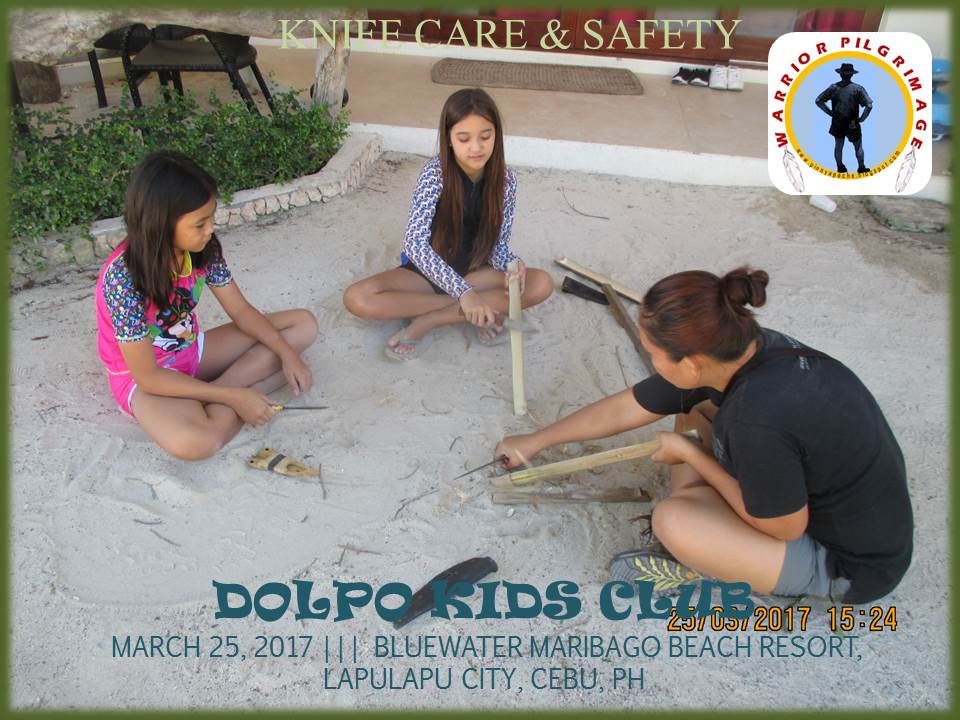
One day I was called by the staff of Bluewater Maribago Beach Resort, located in Lapulapu City, Cebu, to introduce kids to a day of bushcraft and survival. These kids belonged to the Dolpo Kids Club and their age range are from 7 to 14. Fourteen girls and boys showed up on March 25, 2017, and all were accompanied by either parents or minders. I have worked before with kids in a corporate setting like the City Sports Club Cebu last November 2016 and I know how to proceed with my program.

Since I would be working with kids, I brought my protegees, the couple Mark and Mirasol Lepon of the Camp Red Bushcraft and Survival Guild. Both had taken the Philippine Independence Bushcraft Camp in 2015 that I organize annually and are active bushcraft practitioners. Both are working full time in health lifestyle counselling under Herbalife. They are some of my best people and I am confident they could fulfill their tasks easily. 

 
I brought only a cache of small knives, purposely unsharpened, as a safety measure. They are a William Rodgers, a Fame Kitchener, a Condor Bushlore, a Mora Companion, a Knifemaker Camper, two Seseblade Sinalung, a Seseblade Matavia, a Victorinox SAK Ranger, a Victorinox SAK Trailmaster and a Browning linerlock. Since this is not an all-knife show, I pitched in my Fire Kit and my spools of cords for the different aspects of a bushcraft activity.

It was my first time to visit Bluewater Maribago Beach Resort and I was impressed by the staff, the service, the food and the neat paths to the beachfront. It is in a hidden cove among many resorts that line the Hilutungan Channel. What caught my attention is a huge strangling fig that seem to be the center that held together all what is aesthetic of this prestigious resort. I was amazed that it was preserved by management inspite that it is on prime space good for more expansion.

Kids, when they get bored, do not have a flexible attention span. You have to engage them where they are most interested. Making fire would be a good start. These kids do not have the opportunity to experience making a fire. They have adults to do that for them. It is much safe for a home that kids are kept away from safety matches, butane lighters, electric and LPG stoves. However, curiosity would kill the cat.

Kids, being kids, are bound to be tempted to touch these things that are off limits for them and that is when things go wrong. Teach them why is that and expose them how to make one. With a ferrocerium rod. They see these things on TV and probably got amazed why a mere spark from those produce fires? After a short but practical lecture on fire safety, the kids got their wish producing tiny meteor showers on soft downy material and small wood shavings.

 
After an hour of smoke and heat and slaked wonder, we observed an hour of noonbreak but, once it was over, the fire sessions continue on their own instance. I would rather have the course of their learning dictated by their own unhindered progress. When they reached a point that they have had enough, I turned their attention to MarK and Mirasol. Right then and there, they witnessed how a fire is made by rubbing two pieces of bamboo. It raised their astonishment a higher notch.

From there, I produced a short piece of bamboo pole, opened it with a knife and place it above the fire made by friction method. I poured water into the hole and then rice. They were amazed to see these novel sights. How in the world could people cook rice in bamboos? They know only that metal pots and earthenware do that function. I assured them that it is for real but we all would have to wait for the result.

While the waiting would have a big effect on their attention span, I showed them three bamboo poles, bound a cord on one end and spread the poles on the sandy ground. I placed a cheap laminated nylon sheet over it and it becomes an instant shelter. Their satisfaction rose higher now and I directed them to a row of hedge where Mark have set up a couple of different snares.

To entertain them, I imitated a monkey and a hen, activating the two crude machines as my hand got caught on each of the looped cords, eliciting laughter. Catching better their attention now, I proceed to the serious business of survival tool making. There are no short cuts to there as a knife would have to be used. That is where my knife safety session is introduced. Repeating where it is most crucial and visually showing how a knife should be held and the proper execution of knife functions. Safety first.

Grouping them according to age, they formed a circle sitting on the ground, hand them the materials and a knife each. They baton, chop, shave and whittle bamboos to their desired shapes. Mark and Mirasol helped me supervise their progress. The kids were having fun and their parents joined and helped their kids. They saw their kids developed confidence with handling and working with a knife as minutes wore on.

You do not learn these things inside a classroom nor appreciate it much from watching online videos and survival TV. The real stuff is better, right where the action is. It was a beautiful scene, child and parent working to produce their best hand-made spoons. The kids showed off their creations proudly and nobody got nicked by a knife. Education is the key. The day’s session ended after that and they get to taste the rice perfectly cooked in bamboo.

My appearance to teach Introduction to Bushcraft and Survival to the Dolpo Kids Club in Bluewater Maribago Beach Resort would not have been possible without the participation and cooperation of Bluewater Resorts, thru Mr. Erik Monsanto and his assistant, Ms. Fresha Endico; the recommendation of Mr. Gian Carlo of Adrenaline Romance; and the support of Mark and Mirasol Lepon of the Camp Red Bushcraft and Survival Guild.

Likewise, to my sponsors who provided me the wares to share my skills and knowledge and  in my adventures like AJF Knives of Liloan, Seseblades of Pangasinan, the Knifemaker of Mandaue City, Pacing’s House of Barbecue of Navotas City, Alan Poole of the United Kingdom, Markus Immer of Switzerland, Derek’s Classic Blade Exchange of Iloilo City, and Jerome Tibon of Lapulapu City. Thank you all.

The significance of the ancient strangling fig only tells me that Bluewater Maribago Beach Resort is a green resort. They saw the connection between the environment and their business better than the rest crowding every inch of coastal beaches in Lapulapu City. They do not have to modify the skyline and the land features and create a make-believe environment. They work around it and blend with the surroundings.

They have my greatest respect and I highly recommend Bluewater Maribago Beach Resort or any of their facilities to friends and strangers. It is good to know that we have a green resort in Mactan Island.

Document done in LibreOffice 5.3 Writer

Thursday, November 23, 2017

PINOYAPACHE GOES TO MASINLOC

I FOUND MYSELF STILL awake at midnight in Baguio City. After emptying the last ounces of the last big bottle of Red Horse Extra Strong Beer, me and Michael Schwarz decide to say goodbye to Gary, our host here in the City of Pines. I am tired and sleepy but tried not to think about it. In a little while, we would be in the bus terminal hoping to find brief solace on a trip for Olongapo City.

It is now March 13, 2017 and Micheal has plans for this day and the next few days after that and I will be his guest in his playground somewhere in Zambales. We found a 01:45 bus and, immediately, the soft-cushioned seat of the Victory Liner gave me an idea of what will be my Dreamland Ride hereon. Sleeping while sitting jolt you a few times to consciousness and mild confusion. Curtained windows gave you imaginary privacy.

The bus arrive at 05:45 in Olongapo. We took a hasty breakfast in a fastfood chain and returned to the same bus, which would go north to Pangasinan. By 06:30, we are on the road again. We passed by the last town of Bataan and we are now in Zambales. Never been here before but, new places to see and experience, somehow remove the cobwebs of dull attention that sleepiness impose.

Tired as I was, I could feel the adrenaline rising as sure as the heat rises in rhythm with the orbit of the sun. Outside glare from gaps between curtains began to harass my droopy eyes trying to retrieve what was once known as sleep, even in its imaginary state. After about two hours we stop at a terminal in Botolan and transfer to another bus bound for Masinloc. After a short wait, we left and there is no turning back to sleep.

At Masinloc, we set foot on the town square. It is 10:30. We waited for Jed, an outdoor accomplice of Michael, who arrived a few minutes later. Across us is the Masinloc Mall and the police station and a street going to the public market. We need to buy food ingredients for our meals that would nourish us in the mountains. We will navigate the tight spaces and lanes with our big bags. It becomes an acquired skill when our police deny safekeeping bags while doing our marketing.

From the market, we transferred to the village of Sta. Rita by tricycle. Waiting there is Pips, the last member of Michael’s triumvirate of “lazy campers”. Yes, Pedro, they have a Facebook group called Lazy Campers Bushcraft. They are serious outdoorsmen and they are equally serious in introducing dirt time in Luzon. Recreational bushcraft is more enjoyable than racing with the sun and counting peaks. Like me, these guys practice Zen regularly in the outdoors.

Michael the Prussian Drillmaster is the ringleader. He is a free spirit of the woods and had found his specialty: sharpening edges. He cannot imagine hiking the mountains without his Granfors and his cache of sharp tools. His passion always clashed with the mainstream and he hates sheep. His radical ideas and the dose of temper he dealt with those that do not agree with him somehow got tamed by his girlfriend and a little bit with my guidance.

Jed is a natural bushman. Originally from Cebu, he adapted well with his new home in Zambales. Shy, silent and strong, he could do things on his own and has enough imagination to turn a bland day into an exciting one. Pips is another natural bushman. He is a pure Zambaleño and is a volunteer ecoguide and responder when requested. Influenced by Michael, Pips developed a skill in making bolos on his DIY forge.

I am the pampered guest who is about to witness their playground in the coming days. I need to stretch my time so I could be in another outdoor activity in Antipolo City on March 17 and the trip to Zambales is most welcome. After securing our food good for “one month”, we rode another tricycle and arrive in another village of Bunga. From the community, we hiked for about two kilometers to a campsite in Bunga Creek.

I analyzed the stream’s highest waterline and we choose a campsite on a higher ground. We placed our campfire instead among the rocks near the water’s edge. Under the shade from the fiery sun, the best thing to do is boil water for coffee and talk about things to do for the rest of the day. While the residents of Luzon cooked rice, I, the Visayan, cooked milled corn. Jed almost cried seeing my milled corn since he had not eaten that for ten years! I gave him the ones I cooked and more of that good for ten meals.

Pips and Michael cooked our main fare, a native chicken adobo. Yes, we dined like royalty. After dinner, Michael, Jed and Pips scoured the stream for something edible. I joined them with my generic LED headlamp sputtering to stay bright. I was not successful but the trio got two small shrimps the size of a small finger and promptly dispatch it on an ember. The humidity was so pressing hours before, so I decide to cool down and bathe on a chute of rock where water runs swift and massage your flesh vigorously. 

I slept and shared space under a Deer Creek canvass shelter with Michael. I brought my Therm-a-Rest sleeping pad for this occasion. It was a gift by Michael so it would give me comfort and blissful sleep during my 27-day Thruhike of Cebu early this year which it did. He is happy to know that and I laid it side by side with his own but differently designed Therm-a-Rest. Michael lent me his power storage battery so I could pump direct current into my Cherry Mobile U2. The night was cool and it aided a good night’s sleep.

The second day, March 14, saw Jed cooking his milled corn breakfast paired with egg omelet. Yes we have ours too but with rice. I ran out of water and I used my Lifestraw to suck water from the stream. We start breaking camp. Michael has other plans. When we were all packed, we collect litters left by picnicking locals into our garbage bag. It is Michael’s gesture in paying back a nearby community which uses this stream as their water and food source.

We returned to Sta. Rita riding on an empty three-wheeled hog carrier and crossed a bigger river. After a very soothing cold Red Horse, we proceed to the town center to eat lunch in one of its food stands while waiting for a public jitney that would take us to another location. You get to know the place, they say, when you visit the market or eat their food. I have seen the market yesterday and it is more of the same with other places. One food gets my interest. It has an ingredient from a tree. Perfect!

At 14:00, we leave Masinloc for the hills where I know not. The old jitney brought my eyes to view a beautiful meandering river filled with emerald water and dotted with rocky and sandy beds and embankments. It has beautiful forests all over the river dominated by casuarina trees (Local name: agoho, maribuhok). The tree sometimes get mistaken as a pine tree since it has needles instead of broad leaves and has small pine cones for fruit. It is a hardwood variety though.

After an hour, we arrive at an abandoned mining complex. Used to be operated by Benguet Consolidated Mining Corp., it had seen better days. It even has a small airstrip. Along one side are heavy equipment and machinery parked and stacked neatly. Dilapidated buildings that used to energize this big mine loomed from afar with their smokestacks. A detachment of security guards still manned the facility. A gate ushers us inside and we were required to register our names and purpose. Then the jitney proceed to the township.

Rows of well-kept staff houses are still used as homes by former employees and their families. There are two public schools – one for elementary and one for secondary, a basketball court, a huge Catholic chapel, a couple of convenience stores, a refreshment parlor and an empty community center which may have hosted noisy parties and discos when the mine was at its peak and very profitable. Now, it is almost a ghost town save for the schools which still accept students.

The jitney brought us to an explosives dump. We are on our own now, Michael, Jed, Pips and me. We walk towards that beautiful river in the waning afternoon light. Greeting me is a silent amusement park and empty resort cottages which could have been full during the height of the mine’s productivity. Upstream of me is a span that used to be a low hanging bridge. Steel and cables are twisted beyond repair. A great flood could only cause that and we are just in a tributary.

We cross this stream along a causeway to another bank where the bigger Lawis River is found. We settled on a point where the two streams meet. The river is free flowing and the water is crystal clear that I could see pebbles on its bottom. Sometimes, I could see flashes of silver indicating fish. The beach is sandy and clean and strewn with pebbles. I could just lay flat a ground tarp and Therm-a-Rest and slept under the stars but the sight of that hanging bridge gave me a cold sweat.

I choose a high deck with a roof. The floor is wood and it is empty save for two sets of bench and seats. I would settle here for the night. Brought out my tools, a headlamp, pots, instant coffee and the Swiss Army emergency burner after I had placed the ground tarp and the Therm-a-Rest over it. Prepared also a small lantern and place it for easy access when darkness comes. I go down to the campsite, foraged dry grass and twigs, and started a fire inside my burner. Coffee first for me.

Tempted by the cool water of the river as against the humid air that begins to be felt in the low afternoon, I swam into its depths. I stayed long enough until I felt my body in a shivering stage. Going back to the fireplace, Pips had started a fire on wood supplied by Michael the Prussian. These are dry casuarina wood cut neatly by Michael’s shark-toothed camp saw. Meanwhile, Jed had just butchered two live fowls and start dressing it.

I cooked the rest of our day’s rice in my pot. We have clean piped water provided free from the resort’s reservoir. I believe we will enjoy another feast fit for the royalty in a short while. One free-rein chicken is cooked as soup which we will dine on tonight while the other one is preserved for tomorrow’s meal. The place is deserted and very silent. I just love the ambiance. In the waning light, our campfire emerged as a source for company. 

I woke up very early on the third day, March 15, and it is silent. No voices from the trio. I went down the stairs to and investigate last night’s campfire. The ground is cold. A snore emanated from one of the tents. Bored, I go back to my Therm-a-Rest and chase more sleep. I woke up again just when sunrise had crested over the mountain across me and flood my eyes with golden sunshine. Made some noise chopping wood with my small Knifemaker Camp Knife.

Made another small fire inside the burner for another day of coffee. The camp starts to stir. Two zippers made their long arching runs and out came Pips and then Jed. Michael do not need any. He loves old camp setups like the heavy Deer Creek canvass sheet. All the air in the world. Varmints too. A good fire emerged spurred on by the heat-efficient casuarina. Rice, coffee, sliced gumbo adobo and leftover chicken from last night.

We break camp and followed a path up a slope. It used to be a road but nature reclaimed it. Vegetation is different here. There are fruit-bearing trees, stringy bamboos, grass and more indigenous vegetation. Beside this old road is a raised concrete trough that transfers running water down to the old township. A juvenile monitor lizard escaped as potential food using the trough, nimbly flowing with the swift current.

Rusting sluice valves are placed along the paths of small streams that run down the mountain, crossing the road, and into the main river. These may have been part of a flood control system used by the mine company, diverting excess water to where it is most needed. Michael wanted Jed to cook the preserved chicken wrapped in leaves so I foraged the broad leaves of a parasol-leaf tree (binunga).

I see traces of a horse leaving a shod hoof print on mud that hardened with its signatory droppings. Walking on a warm morning is eased by shady areas and a constant flow of breeze. We may have walked four kilometers and we stopped beside a cashew tree. Not that it is shady, but because it had dropped plenty of ripened fruits on the ground. Jed collect the fruits on the ground and removed the exposed seed from the yellow flesh. He crushed the flesh and a fluid is directed into his mouth. I did the same.

I see recent animal traces which could only be made by a wild boar. The cashew had been its food source. Nice to learn more wildlife habits. Michael saw a good campground across us on a distant riverbank shore and how he wished to be there if only there is a path. It is indeed a perfect place to camp. It is just a matter of finding a path down to the stream from where we stood which is just too steep. I analyzed the terrain and it is an obstacle.

It did not turn out difficult for me though. I did not even exert enough effort. When I saw a bare patch of ground under thick vegetation, I followed it and discovered a staircase hewn out from the bare face of solid rock. When presence of people began to disappear, wildlife used the path down frequently to the stream else vegetation would have been parted. You would not know the presence of this staircase if you do not know traditional navigation.

I went back up and called the trio. Excitement are written all over their faces. There is a wide ledge of solid rock and it have not had a visit of man for so many years. What I found are recent droppings of a happy leopard cat (melò) which may have all this territory to himself and a shrub which bore black berry-like fruit. I followed the invisible paw prints on rock, mere scratches that you can see in a different angle, and it went into a small hole among a jumble of rocks. The awful smell defines its lair.

As I was doing my small discoveries of wildlife, the three found a good place to cross across the wide stream. They were now considering making a camp underneath a copse of casuarinas but I found the ground too soggy. They are on the path of a small stream! I passed by them and drop my bag on the actual place from where I first saw it from across the stream, before I discovered that stairway. It is a raised sandy area and shaded by broad-leafed trees.

The river is so beautiful and clean. Rocks are sun bleached and plenty. Wherever you view it, downstream or upstream, you cannot believe that this is in the Philippines. The former mine administrators rehabilitated and designed a first-world country landscape when they started to stop operations. Casuarina trees project a false pine forest to a naive visitor and it is nice to gaze at. In between these are other trees native to Luzon. I wished they had also planted bamboos.

There is a natural hedge of katmon aso on one side of our camp while a fallen log protected us on the other side. There is a lone tree growing at the edge where sand meets slope and supplied us the shade. Near the log is a ditch that had been carved by running water as it made its way down to the river’s edge. Michael pitched his canvass shelter on the raised sand and I assisted him. The canvass shelter, even if it is dark blue, is a natural.

Jed retrieved yesterday’s dressed chicken and prepared it for cooking. He wrapped it with several layers of binunga leaves and tied it with natural fibers. Then he dug a hole on the ground, placed the wrapped chicken inside and covered the hole with sand. Jed and Pips made a fire over it after we found enough dry firewood. With the same fire, we cooked rice and part of the marinated pork which Pips cooked in oil and will become our spartan meal.

Michael, meanwhile, prepared a tripod. He would use it as a platform to dry the rest of the marinated pork by exposure to the sun and by radiated heat from the campfire. I watched the trio and, at the same time, suggest them with wrong ideas to mislead them. It is cool under the shade while a few meters away, on the bare sand, it is very warm. Over that bare stretch is emerald water, as inviting as ever. I will have that after my tummy gets filled.   

The log, with its dead branches pointing to the skies, are full of cicadas. The same with the green branches drooping to the ground from live trees. These underground residents have reached the end of their 17-year cycle and would soon be mummified to where they were last found. Michael claimed the coolness of the water while Jed and Pips focused their attention on their own shelters. We let the embers burn and fed with a few firewood.

I did a little exploration upstream and found a lot of wildlife activity. Plenty of paw prints on the sand, from a gang of monkeys and individual leopard cats. One even left urine and stained a rock. My tracking skills followed an invisible path which bound from stone to stone and clung on to a low branch which it used to go over thick grass to a rock on a slope. The branch is smoothed by many claws and the debris fell to a bleached rock. 
  
I went back to the camp fully satisfied with my discoveries but a small stream nearby snared my attention. I go up several small levels of rocks and discovered boar droppings, a week old. I go back when the stream becomes difficult to navigate but the stream would satisfy our water needs should we run out of our supply. Jed and Pips had already joined Michael in the water and are frolicking like children. I took a bathe after they were done.

The disappearing light of the day turned our attention to the campfire. We fed it with more wood and cooked rice and milled corn. We retrieved the dried meat and cooked it in saucy adobo. A full bottle of local brandy fueled the campfire stories. The full moon shone at its brightest and the riverscape is a beautiful sight to behold. On the river’s edge, I expected nocturnal creatures to thrive but I was disappointed. There is something wrong.

 
On our last day, March 16, I would find out why the river is devoid of other life except a few fish. I saw a school of six fish the size of a child’s palm on the stream’s transparently clear water. Why only fish and just a few? I go back upstream carrying both my AJF Gahum and Mora Companion on my belt. I need to explore more. I got past the stained rock and I am now scrambling over obstacles, stepping over gaps and cross dry watercourses choked with rocks.

Squeezing past a notch, I saw a fruit bat clinging to a wall of rock, its back facing the early sunrise. It had not noticed me and that is strange. It should have flown away but it had not. I looked closely and it is emaciated. Blood dripped from its snout. It is dead. What caused it? Disease? Perhaps. Some parts of the stream, where it is deeper and still, there is presence of algae. The river is healthy and free-flowing yet it had lacked something that may contribute to a healthy ecosystem.

Or there is something that hindered it. Heavy metal? The upper slopes were mined years ago. Who knows what did the miners used to separate the minerals from the rest of the ores. This place is rich in chrome, copper, nickel and gold. It had been extensively mined until such time all the rich veins had been exhausted or that the drop in prices does not justify anymore the expensive maintenance and operation of the mining complex. But they left the land recovering.

I retraced my path and stumbled and fell. Just a split second before I hit ground, I maneuvered my body so my back would take the impact. I fell on a rock and it did not hurt. I listened to my body for a full thirty seconds and I noticed pain on both my shins. Of course, I snagged on a rock and it scratched my shins. Feeling a bit dazed, I stood up and started. Suddenly a snake that I had not noticed came alive just a meter away from me and made its escape. I gave chase with camera but lost it when it swam effortlessly in the stream, crossing on the other side.

When I returned I had a cup of coffee and talked about my encounter with a dead bat and a strange snake. Rice is halfway through its course and everyone waited when it would be cooked. Remember, we buried a full chicken underneath the fireplace. How does it appear and taste takes up space in our thoughts. Finally, the embers are cleared and the chicken wrapped in leaves is retrieved. Who wants sandy chicken?


Document done in LibreOffice 5.3 Writer