Showing posts with label knives. Show all posts

Monday, February 14, 2022

2022-007 | MORA COMPANION

IT WAS IN EARLY 2015, THAT I get to own a MORA Companion. My first and only knife from MORAKNIV of Sweden. It was a gift from my student who took the 2014 edition of the Philippine Independence Bushcraft Camp. It is made of carbon steel with a plastic sheath. The handle is made from a combination of different synthetic material which, surprisingly, produce a good grip. 

The MORA Companion then became part of my array of blades that I used for a living here in the Philippines. I am an outdoors educator, bushcraft and survival instructor, adventure guide, blogger and explorer. I travel with my blades when I do survival trainings in other parts of the country. I am also a knife-carry rights advocate, educating people about knife safety and carry ethics.

My MORA Companion, like all my other blades, are extensively used during my training sessions. However, no student would touch a blade until they listen and understand first about knife care and safety. Then I let them engage in knife-dexterity exercises during survival-tool making and when batoning notches. Although supervised, I would never know how they would use the blades when left alone for a while. 

When I examined the blades afterwards, some, if not, most, has edges suffering traumatic results. But one of the very few blades that had not been affected by that undetected and unseemly use is the MORA Companion. The result led me to believe that MORAKNIV has superior heat treatment which made their blades impervious to the wear and tear of use in the outdoors. 

Even when I know that the MORA Companion has three-fourths tang, I subjected it to rough handling as if it was a full-tanged knife by carving it on hardwood or of batoning with a heavy stick. The blade had not chipped nor bent nor it showed signs of separating itself from the handle. The hardness of the blade could be attributed to the preference of MORAKNIV to design their blades with industrial standards in mind. 

I have exposed my MORA Companion to salty air when I did an exploration of the Dayhagon Canal, an expanse of chest-high mangrove forest, mud flats and fish ponds in Northern Cebu, on April 2015. I slipped it in the chest strap of my backpack and inside a float vest. On other times, I used this on sponsored corporate bushcraft sessions with kids on beach and island resorts.

Then I did the unthinkable. I slipped my MORA Companion into the sleeve of my dive suit as if it was a diving knife when I participated in an international coastal garbage cleanup at Mactan Island in September 2017. Rust was never an issue for the metal responded well to my care. Immersing the whole knife in fresh water overnight and coating it with oil the next day solved that problem. 

The MORA Companion weighs just 110 grams, to include the sheath, and I brought it in my route explorations of the last six segments of the Cebu Highlands Trail Project, a long trail I established in between February 2011 and November 2016.  I brought it again when I hiked through my finished project, across the central cordilleras of Cebu, of a south-north axis, 408+ kilometers long in 29 days. I even carried this in our local Camino de Santiago, 10 days and 175 kms. Long. 

What I liked about the sheath system employed on the MORA Companion is that it is very safe to carry and remove blade. The hard plastic sheath kept the blade from cutting through to you when you take a hard fall. If you want to remove the blade safely from the sheath, you just hold the handle and, with the thumb, push the sheath away. Very child-friendly and a very convenient way to teach knife safety. 

The hole on the tip of the sheath drains water away when you are immersed in chest deep of water or drenched by rain. Because it is plastic, it discourages moisture to accumulate inside which causes rust to form on your blade and it is safe to store your MORA Companion inside its sheath although it is advised to separate both. 

The only downside of the sheath design is its belt clip. I already experienced two cases of missing MORAKNIV blades from two different individuals: one had a Companion and the other had a Basic. Both were used in jungle environment where wiry vegetation would snag on anything. It is best clipped facing inward instead of outward and hanging loose. 

I rarely open carry the MORA Companion on my belt except when I am within the comforts of a camp. I preferred its sheath clipped and tucked in a series of MOLLE webbings of a tactical backpack or just clipped inside of a side pouch of a bag when I walk the trails. Both ways, I could retrieve the blade quickly if I need it. My Companion is indeed a companion and I share my joys to you by acquiring yourself one. 

MORA Companion comes in military green, black, beige and pastel colors of blue, pink, green, and orange. Aside from carbon steel, a Companion is also made in stainless steel and is thicker by 0.5 millimeter. The carbon steel is 2.0 mm thick. There are other Companion variants like the Serrated, the Expert, the Heavy-duty and Heavy-duty Serrated, the Spark, the SRT and the Rescue SRT Safe, the Service Knife, the Electrician and the Fishing Fillet.

The MORA Companion and other MORAKNIV products are available online from their own website. These are also available online at Amazon and all outdoors-and-sports-oriented online stores. Here in the Philippines, it can be bought from real stores like Forged Philippines, Derek’s Classic Blade Exchange and Tactical Asia or online from them.

Wednesday, November 14, 2018

WARRIOR REVIEW: AJF Gahum Knife

I HAVE BEEN A LONELY VOICE in the outdoors, propagating a strange interest here in Cebu, the Philippines, called BUSHCRAFT. In the middle of 2009, only two people, apart from me, could comprehend its idea and how it is done or enjoyed of as a leisure activity. I was then in the process of distancing myself from mainstream outdoors. I love camping with a real fire and using a knife. Uh. Sorry. Knives.

Backpacking, sometimes mistaken here as mountaineering, is very popular. Urbanites regularly trekked to the mountains carrying heavy loads to spend overnight or a few days on those barren and exposed places. They looked cool carrying branded bags with matching shoes and brightly-colored clothes. If you look closer on their activities, you would notice the absence of a respectable knife.

I could not comprehend why people replaced a real knife with ceramic or plastic ones, and sometimes by nail files? Is it because of weight? Regulations? Fear? Whatever it was, the lack of that was influenced by no other than by ignorance. Then it became an advocacy for me to re-introduce the knife back to camping life, the knife-carry rights, and to educate more people about knife law, ethics, care and safety.

When I organized the first Philippine Independence Bushcraft Camp in 2011, the topic about the knife was given paramount importance. It was here that the participants began to understand the knife and it was also here that the knife culture began to slowly reclaim its spot in Philippine outdoors, thanks to my new converts (to include the next PIBC batches), which became the tiny sparks that started the organization of the Camp Red Bushcraft and Survival Guild.

Recreational bushcraft activities every weekend fascinated the outdoors community in social media. My activities always placed the knives at stellar attraction with the introduction of the first (and succeeding) “blade porn”, a traditional bushcraft showcase. An online prepping community began to appear and their members start to feature knives regularly. So were an online survivalist community and another online group that specialized more on blades.

One of those who participated in PIBC 2013 is a collector of expensive knives. He had been searching in the internet for any bushcraft activity in the Philippines so he could use his blades and it surprised him that his search brought him back to Cebu, of all places, his home province. He is Aljew Frasco, a gentleman from Liloan and a baker by profession. After the PIBC, he toyed on the idea of making knives from his DIY shop.

He just wanted to develop that skill as a hobby. That is all. Profiting from that was out of his thoughts. He had been searching long and wide for a perfect knife – a knife that could do all things. He found out later that he had been looking for the wrong places and it was with him all the time and they were a combination of threes or twos. What he lacked was time in the outdoors. The best place to test a knife. The PIBC gave him a different perspective this time.

One day after PIBC 2013, I got a call from him. He wanted me to test a knife. He made it himself. His first. A set of three letters were etched near the spine – AJF. His initials. With a sheepish smile, he named the knife as the AJF Gahum. Gahum is the literal Cebuano for “power”. Well, I thought to myself, I really need all the power in my arm to wield this steel blade. It was heavy but it suits me anyway and my outdoors lifestyle. I am used to hard work.

A few months later, he asked me of my opinion of the AJF Gahum. I gave him my honest observations; and the knife back to him. A few weeks passed and I got a call from him again. This time, the AJF Gahum sported a new set of wooden scales made of Philippine rosewood (Local name: narra) and Leichardt pine (hambabalod). Heavy mechanical work on the blade surface and the tapered distal made it lighter. It now has a convex grind and, likewise, thinner by a few micrometers. It is now sleek, vicious and hungry. There is only one thing to do: TEST IT OUTDOORS!

The AJF Gahum is a straight-backed knife. A very simple one. Of a very basic design, it is 235 millimeters long from tip to hilt. The full tang that held the scales is 130 mm from ricasso to end.  It is 47 mm from its widest measure and 6 mm at its thickest. It weighed 610 grams. With its new scales, it looked very handsome and caused a stir of interest, desires and more stares. It had lived up to its name. But appearances are different from performances. It had to be worn out and break something or be broken.

And so it became a regular customer on my side during dirt times and it made my work on the fields much easy, easing out my beloved tomahawk. The longer edge made cutting seamless and it never missed wood or bamboo. The extra, yet very manageable, weight made chopping effortless. I only have to raise it up and let gravity do its work. The weight assures me that it is there inside its sheath all the time and it erased my fear of it getting lost.

Weekends are my favorite days with the AJF Gahum. I test it on hardy bamboos, whose denseness in grain and skin could undo the superiority of branded knives into so-so ones. The Gahum, could cut it all seamlessly whether it be on the woody part or on wiry types whose thin tubes crack to splinters with a wrong swing. It does not matter if it is green or matured. This big knife is native born and is made to cut bamboo and wood, cane grass and shrubs.

The spine is friendly to batoning sticks which guide the strong-willed Gahum to a finer cutting tool. The same spine flaked off quartzites and iron pyrites from its mother stones, creating sparks from the clash of 5160 carbon steel and raw, but harder, material. As it is subjected to heavy usage, one of the rosewood scales went missing. The other half splintered into two pieces during a knife-throwing session. But the Leichardt wood scales remained.

For want of a hammer, a heavy stick, or a stone, the AJF Gahum drove sharpened sticks into the ground when I set up fly sheets for shelters. Some grounds are soft and some need power to penetrate. It happens all the time when I carried a hammock and where anchoring needed wooden pegs. I usually hit the top of the pegs right on the face of the blade. The same spot over and over again and the blade had not warped nor bent a slight angle. It is straight as ever.

I carried openly the Gahum at my belt during the exploration phase of the Cebu Highlands Trail, starting January 2015. The project is divided into eight segments, north to south, and this knife had been brought and toured on the six segments. I expected heavy knife work but I was glad it did not come to that. The opportunity to show off the AJF Gahum in open carry was just to familiarize locals, instead, about knife-carry rights for outdoorsmen.

The AJF Gahum, with its bulk and appearance, travelled with me, along with six to nine of my other knives, to Luzon, Visayas and, later, Mindanao. I did part-time classes in bushcraft and survival when I had a day job. When I pursued full time this journeyman occupation in 2016, I already knew how to bring my entire sharp tools through security, legally, for just as long as you follow regulations and protocols. Just do not carry the wrong item. Nor give a joke about bombs.

I let my students handle the Gahum during knife dexterity sessions. After each activity, I always examine the edge if it had dents and cracks. You would never know how people do to other people’s knives. Especially the “uneducated” ones who see knife as nothing but pry bars or digging tools. As a knife-carry rights advocate and teacher, your satisfaction goes ten-fold when you see no such marks. It is not a question of how perfect the temper of your knife is but of how your students fully absorbed the lectures well.

If you are skilled with a knife, you can use an AJF Gahum with a deficiency to its handle. I did that for more than a year. The missing rosewood scales allowed me to move back an inch to grip on the remaining scales. I used the baton stick instead to do the work for me. I cannot tolerate an absent AJF Gahum in my activity so the missing scales could be replaced. Despite the insistence of the maker to do that task for free.

However, I did acquiesce to the wishes of the maker at last. He asked me what material would I want to replace the scales. I provided him industrial micarta, a hardy material which were shaped to hold superheated shaft bearings of mining machinery that I found in an abandoned mine in Misamis Oriental in 2012. The mere fact that it is for industrial use and bear the Hitachi logo, makes it indestructible and would stay for keeps.

Just in time before the start of the PIBC 2017, I held the AJF Gahum once again. This time, it sported a different look and character: dark, brooding, unpredictable and incorruptible. From a blade with flamboyant two-toned scales, it now sports gloomy black scales. More like the Dark Knight. I like it that way. Very proletarian. Knives are just tools and should be used according to what it was intended for when early man invented it.

The AJF Gahum, however, is not a perfect knife. It has to be paired with a smaller one so I could accomplish my tasks outdoors. The built, temper and design are perfect in tropical settings. The edge has dulled just a bit and I liked it that way for my classes. I could not remember the time I sharpened it myself. It never came to that. I am a satisfied recipient of an excellent knife and it is a privilege to own the first of just a few blades made by AJF.

Document done in LibreOffice 5.3 Writer

Monday, January 1, 2018

BUSHCRAFT WITH DOLPO KIDS IN BLUEWATER MARIBAGO

SURVIVAL, TO A CHILD’S EYE, IS A WORLD that is associated with home entertainment. This genre is the most popular staple in reality TV shows. It is remote and the audience does not really experience the austere conditions and hardships that the show would like to impart, never mind that it is scripted and in a controlled environment, complete with support crews, like a medical team and a safety staff.


But the real world of survival is not even that close as those shown on TV. There are no drama. No dialogues. There is only torment. Anger. Uncertainty. Silence amid the turmoil of the world and the inner you. Perhaps, tinkering with an acceptance of an unacceptable fate. Survivors go past those stage and they live. Some live but their souls got lost along the way.

On a lesser note, BUSHCRAFT, an old-world way of adapting into the wilderness to carve out a livelihood or a calling, is fast becoming a recreational outdoors activity. Although a close cousin to survival, the term is still alien to the majority of the population in the Philippines, much more so with the young generation. It uses more brains than brawn, and a tool which, in this case, is the knife.

Bushcraft and Survival are my expertise and I am usually called on to teach these things to individuals or by organizations. It is not unusual for me to find minors in my trainings. In fact, I encourage parents to expose their children to be out of doors all the time and make themselves more useful and productive, instead of being wired to electronic gadgets and the power cable. Would handling a knife be a part of that? A parent may ask. 

 
You know, it would be absurd to expose a child near a knife, much more so encourage them to touch it. You are right. No sane and responsible parent would allow their son or daughter tinker with any sharp-edged instrument and, in most homes, it is tucked away from their reach. But I have seen sheltered kids feeling lost or scared or outright careless when they happen to come into possession of a knife. It is scary indeed if they hurt themselves or their playmates.

Could we do something about that knife thing? No. I cannot teach bushcraft with plastic knives and a make-believe world. I love to train them the real thing. Develop their confidence and make them responsible adults someday; expose them to the joys of the real outdoors; stimulate their senses; and work their creativity juices to a high gear. They do not stare at a knife. They use it with their hands with adult supervision, of course.

There was a time when a knife was given as a gift. It was the happiest moment in a boy’s life, for, in his eyes, he is accepted as an adult. It happened because the giver knows the recipient is ripe enough how to use, keep and care of the knife. It is a rite of passage. It is not anymore. We live in a different world with changing values. The old ways are discarded for something politically correct, metrosexual and superficial

You simply cannot earn your first knife if your hands are soft and lazy. A child must be taught how to use the knife as a tool and he practices it on his spare time until such time his confidence would increase his level of skill. In much the same way, a child skilled in making a fire prepares himself or herself to the business of simple life skills of cooking and eating. The child becomes self-reliant and how self-reliance is now a rare commodity, is it not? 

 
In the backcountry, kids use bigger blades as if these were light and small and carve things from nature. They have developed great dexterity through constant use and they have formed their own values with these tools. I had been exposed myself to working with bigger blades when I was young because there is work to be done and, ironically, I grew up in a big city. Adults would guide me and encourage me as painful blisters marked my palms.

You might wonder why I and those mountain kids still have complete digits after using much more formidable blades, almost all of the time unsupervised by adults? The secret to that is education. I would not allow a minor, not even an adult, to touch a knife without being educated in knife safety. They cannot proceed on the next instructions without that. For this particular education, I have raised it into an art, as a necessity, to remove accidents. 

One day I was called by the staff of Bluewater Maribago Beach Resort, located in Lapulapu City, Cebu, to introduce kids to a day of bushcraft and survival. These kids belonged to the Dolpo Kids Club and their age range are from 7 to 14. Fourteen girls and boys showed up on March 25, 2017, and all were accompanied by either parents or minders. I have worked before with kids in a corporate setting like the City Sports Club Cebu last November 2016 and I know how to proceed with my program.

Since I would be working with kids, I brought my protegees, the couple Mark and Mirasol Lepon of the Camp Red Bushcraft and Survival Guild. Both had taken the Philippine Independence Bushcraft Camp in 2015 that I organize annually and are active bushcraft practitioners. Both are working full time in health lifestyle counselling under Herbalife. They are some of my best people and I am confident they could fulfill their tasks easily. 

 
I brought only a cache of small knives, purposely unsharpened, as a safety measure. They are a William Rodgers, a Fame Kitchener, a Condor Bushlore, a Mora Companion, a Knifemaker Camper, two Seseblade Sinalung, a Seseblade Matavia, a Victorinox SAK Ranger, a Victorinox SAK Trailmaster and a Browning linerlock. Since this is not an all-knife show, I pitched in my Fire Kit and my spools of cords for the different aspects of a bushcraft activity.

It was my first time to visit Bluewater Maribago Beach Resort and I was impressed by the staff, the service, the food and the neat paths to the beachfront. It is in a hidden cove among many resorts that line the Hilutungan Channel. What caught my attention is a huge strangling fig that seem to be the center that held together all what is aesthetic of this prestigious resort. I was amazed that it was preserved by management inspite that it is on prime space good for more expansion.

Kids, when they get bored, do not have a flexible attention span. You have to engage them where they are most interested. Making fire would be a good start. These kids do not have the opportunity to experience making a fire. They have adults to do that for them. It is much safe for a home that kids are kept away from safety matches, butane lighters, electric and LPG stoves. However, curiosity would kill the cat.

Kids, being kids, are bound to be tempted to touch these things that are off limits for them and that is when things go wrong. Teach them why is that and expose them how to make one. With a ferrocerium rod. They see these things on TV and probably got amazed why a mere spark from those produce fires? After a short but practical lecture on fire safety, the kids got their wish producing tiny meteor showers on soft downy material and small wood shavings.

 
After an hour of smoke and heat and slaked wonder, we observed an hour of noonbreak but, once it was over, the fire sessions continue on their own instance. I would rather have the course of their learning dictated by their own unhindered progress. When they reached a point that they have had enough, I turned their attention to MarK and Mirasol. Right then and there, they witnessed how a fire is made by rubbing two pieces of bamboo. It raised their astonishment a higher notch.

From there, I produced a short piece of bamboo pole, opened it with a knife and place it above the fire made by friction method. I poured water into the hole and then rice. They were amazed to see these novel sights. How in the world could people cook rice in bamboos? They know only that metal pots and earthenware do that function. I assured them that it is for real but we all would have to wait for the result.

While the waiting would have a big effect on their attention span, I showed them three bamboo poles, bound a cord on one end and spread the poles on the sandy ground. I placed a cheap laminated nylon sheet over it and it becomes an instant shelter. Their satisfaction rose higher now and I directed them to a row of hedge where Mark have set up a couple of different snares.

To entertain them, I imitated a monkey and a hen, activating the two crude machines as my hand got caught on each of the looped cords, eliciting laughter. Catching better their attention now, I proceed to the serious business of survival tool making. There are no short cuts to there as a knife would have to be used. That is where my knife safety session is introduced. Repeating where it is most crucial and visually showing how a knife should be held and the proper execution of knife functions. Safety first.

Grouping them according to age, they formed a circle sitting on the ground, hand them the materials and a knife each. They baton, chop, shave and whittle bamboos to their desired shapes. Mark and Mirasol helped me supervise their progress. The kids were having fun and their parents joined and helped their kids. They saw their kids developed confidence with handling and working with a knife as minutes wore on.

You do not learn these things inside a classroom nor appreciate it much from watching online videos and survival TV. The real stuff is better, right where the action is. It was a beautiful scene, child and parent working to produce their best hand-made spoons. The kids showed off their creations proudly and nobody got nicked by a knife. Education is the key. The day’s session ended after that and they get to taste the rice perfectly cooked in bamboo.

My appearance to teach Introduction to Bushcraft and Survival to the Dolpo Kids Club in Bluewater Maribago Beach Resort would not have been possible without the participation and cooperation of Bluewater Resorts, thru Mr. Erik Monsanto and his assistant, Ms. Fresha Endico; the recommendation of Mr. Gian Carlo of Adrenaline Romance; and the support of Mark and Mirasol Lepon of the Camp Red Bushcraft and Survival Guild.

Likewise, to my sponsors who provided me the wares to share my skills and knowledge and  in my adventures like AJF Knives of Liloan, Seseblades of Pangasinan, the Knifemaker of Mandaue City, Pacing’s House of Barbecue of Navotas City, Alan Poole of the United Kingdom, Markus Immer of Switzerland, Derek’s Classic Blade Exchange of Iloilo City, and Jerome Tibon of Lapulapu City. Thank you all.

The significance of the ancient strangling fig only tells me that Bluewater Maribago Beach Resort is a green resort. They saw the connection between the environment and their business better than the rest crowding every inch of coastal beaches in Lapulapu City. They do not have to modify the skyline and the land features and create a make-believe environment. They work around it and blend with the surroundings.

They have my greatest respect and I highly recommend Bluewater Maribago Beach Resort or any of their facilities to friends and strangers. It is good to know that we have a green resort in Mactan Island.

Document done in LibreOffice 5.3 Writer

Sunday, December 11, 2016

NAPO TO BABAG TALES CXIV: Country Good for Old Men

IT IS MILDLY WARM TODAY AND I HAVE so much time in my hands. Today is Friday, September 2, 2016, and I have a guest from Switzerland. We knew each other before when he dropped by last December 2015 to place a donation for a fund-raising gig of Christmas United IV held at The HeadquarterZ. He stayed for a few hours to know the wonderful guys running this outreach event and of the crazy people of this Camp Red Bushcraft and Survival Guild.

The Swiss is also my benefactor and friend. He is married to a Cebuana and he lives here in Cebu City. He lets me know of his plans and, one time, he invited me and my wife for an overnight trip in Dumaguete City to have a look over of the property he had bought. Not only that, he gifted me a beautiful Victorinox Ranger Swiss Army Knife when he came back last July. Believe me, big SAKs do not just drop from the skies in this country and I am quite indebted to him.

He wanted to the see the backcountry of Metro Cebu and he wanted to test his own Ranger and a small Gerber fixed-blade knife. He wanted also to improve his stamina after recovering from a minor operation and he wanted to have a dirt-time of his own. We arrived at the same time at the parking lot of the Our Lady of Guadalupe Parish at 07:00 and proceed immediately to the back of the church where all journeys to the Babag Mountain Range began, begun and begin.


I am carrying light. A tan Lifeguard USA rucksack is all I need to bring to what few things I have like a spare t-shirt, a few bread, my Ranger, another Victorinox Trailmaster Swiss Army Knife, a William Rodgers bushcraft knife, a Mora Companion knife, a Cignus V85 radio, a Magellan GPS, a laminated nylon sheet, a Tingguian Tribe Sierra hammock and a full Nalgene bottle. My Swiss friend carried a sling bag with two liters of water, his own Ranger, the Gerber, his sandwich and more bread.

I am testing, for the first time, an old Magellan Blazer12 GPS unit. It had been donated to me by an outdoor friend along with a thick manual, sometime in late 2014, when I pleaded for sponsorship of any kind and form to equip an Exploration Team that I was planning to organize for the Cebu Highlands Trail Project which, at that time, was woefully lingering at Segment II. It had never been used and never would be in the exploration phase.

I tinkered with it last night, reading the manual, cleaning well the terminals, and made it work with new AA batteries. A date appeared on its screen: April 4, 1998. Wow! It had been that long since its last use. I cannot download nor upload its data. It is a second-generation GPS system. Even so, I set the Navigation mode for today’s test. I might use this when the Cebu Highlands Trail Project is done.


We arrive at Napo and follow the trail meandering above the now-brisk Sapangdaku Creek. I walk easy and slow and, as usual, do my own usual stuff talking about plants, recent occurrences and what to expect beyond. I am conditioning his mind so he could devise his own strategies to adapt to the situation at hand, the ones we called as the “economy of movement”, which the Swiss are good at.

We stop often under the shades when the sun is overbearing and walk the walk – the old men’s way – when we continue. We meet locals along the way and children going to school late, or early, depending on which subject. I am taking my friend to Camp Xi, which part I do not know yet. There are four campsites there, each different and isolated from each other by a stream or by a ridge.

I noticed something wrong. Weeds are hanging from a power cable line. Workers are re-attaching a cable today that had been deliberately cut by thieves early last year in the hope of stealing it. The cable lay in the ground for many months and are overgrown with weeds. When they brought it up, so were the weeds. That is the quality of work when no engineer is supervising and my Filipino brothers are good at it. Not our finest moment especially when the very efficient Swiss are around.


We arrive at Camp Xi at 09:45. My friend loved the place. It is an ideal campsite. Not here, my friend. Too open. We cross the stream and found a path going up on another campsite. It is hidden but the ground was used for farming. I checked an old lanzones tree if it is bearing fruit. It was but it is still green. We go down the stream and walk a few meters upstream then climb another path. Perfect.

The third campsite is good for activities not requiring observers. It is farther from the trail and covered by trees and bamboos growing beside the stream. I once conducted a wilderness survival training here for Army reservists last May. There are large mango trees that would gave shade and we found a spot to test the knives. I drag a dry bamboo pole that was left hanging on thorns after it was cut by a local many days ago.

I splay my laminated nylon sheet on the ground to place things and to sit on. I check the data of the GPS. Power went off. I tried to switch it on but it went blank after a few seconds. Batteries merrily drained away by the greedy unit. I was using the red-colored Eveready batteries and maybe it needs alkaline ones. I guess it has to sit long enough to gather dust before I could afford a set of rechargeable alkaline batteries.

My friend happily used his Ranger and his Gerber alternately on the bamboo pole. The tiny folding saw of the Ranger, which is by far longer than a Trailmaster, make cutting work fast. I tried mine and timed it on the endmost part of the pole where it is around 2-7/8 inches in diameter and about 5/16th of an inch thick. I was able to cut it three seconds less than the one I did with my Trailmaster. Without a doubt, SAK saw design and efficiency are the best when you talk of multi-tool set saws.

I leave him alone while he is toying with the Gerber. I set up the hammock on a nearby tree. After that, I go back to check on his current progress. It seems the Gerber is small enough to do a man’s work yet I believe it could handle well a kitchen job. The humidity is almost unbearable. I do not know my Swiss friend of how he is feeling now. I eat the first of my bread and paired it with water.


Turned the power knob of my Cignus V85 portable radio to monitor stations in the frequency of Ham Radio Cebu. I get lots of splats instead from another frequency used by a taxi company which enters accidentally all the time when you are communicating with another. I waited for it to die down before I press the PTT to check on stations. I do not get a reply. I just let the radio on, hopefully, a message might find my way.

It is now 11:30. I ask my friend how he is doing. He says he is fine. He was waiting for me of what my next plan is. It is too early to call it a day. I ask him again if he is okay for another short hike. A bit steep than before. No problem he says. So be it. I pack all my things back to my rucksack and keep the place tidy as if we were not here. We go down and cross the stream and climb up the main trail.

We arrive at Lower Kahugan Spring and I have to stop to refill my bottle. It is shady but it is empty of people. We resume our walk. I am planning of taking him to the Busay Lut-od Waterfalls. We meet people and children going to school along the trail, this time the children are early for their afternoon class. We rest when we could find shade and we do that many times because the trail is steep. It is necessary.

After about an hour or more of walking, I show him the first of the waterfalls in its grand splendor under a noon sun. I pause for a while to catch a glimpse of two big catfish I saw last March turning up its head at this same hour. They are probably washed downstream during heavy rains. “Can I swim?”, he asks. No problem. Taking off his bag, his shoes and his socks, he immerse himself in the cool water with his clothes on. He needs it badly. The heat stinks.

My friend seems to have recovered by the cool-down in the pool and he is smiling. We go up the path to the trail and go back to the Lower Kahugan Spring to rest for a short time. It is still 12:45 but we meet people and children coming from school. Big smiles for the little ones when my friend parted his untouched bread. In a matter of a half hour, we are now at Napo. A few seconds later, we were on motorcycles back to Guadalupe.

What better way to cool much further for the rest of the day are mugs of the coldest beer at my favorite watering hole. Ciao!


Document done LibreOffice 5.2 Writer

Sunday, November 6, 2016

BEBUT’S TRAIL XIII: Legends of Baksan

IT IS A PARADISE FOR BUSHCRAFT. Nobody knows where Baksan is and nobody is interested. I do. Jhurds Neo, the head shed of the Camp Red Bushcraft and Survival Guild does. It is just walking distance from Guadalupe. If you prefer to be lazy, you just drop at Sector 8 and you would be on your way on foot the rest of the way.

Where really is this place called Baksan? Honestly, I cannot tell you. Just use your Android phones and your Google Map. It is right there complete with longitudes and latitudes. But could it really tell you the whole she-bang? Uh-uh. GPS technology is only good when you are driving a company car. Ask your HR department. It is also only good on straight lines and wide open spaces and catching Pokemons.


I am choosy now of who I bring with me. I do not want it saturated by people who cannot fit in to the places they visit. These people are careless creatures who do not know common sense, trying to adapt themselves into something else which they themselves have no idea about. The absolute posers and pretenders. They come from both extremes and both kinds are amusements in Facebook. Then there are the stupid.

A year ago, I thought I know a lot about Baksan. I was just learning it right along the fringes until a local led me into its bosom some months ago. I have written an article about this, ready for posting in Warrior Pilgrimage but, unfortunately, this and the rest of my valuable files got lost after my hard disk drive got corrupted. I have to start writing this again, this time, for today’s activity.

Well, today is July 31, 2016. I am guiding Jhurds and the rest of the badasses of the Camp Red Bushcraft and Survival Guild and a female guest who seems to like our brand of outdoor activity. Tell you frankly, I have always observed that women are more inclined to challenge themselves to worm their way in to this man’s world called bushcraft. Must be that they are right-brained and can understand better the creativity that bushcraft provided.

From Guadalupe, the forest swallowed us by the time we hiked a trail that is the flank of a low mountain range which is now developed into an abomination called the Monterazzas de Cebu. This unfinished and hard to sell high-end subdivision which tried to sound Italian, claims the whole of Banawa Hills and is just a few steps into the Buhisan Watershed Area. How could the DENR approved an Environment Compliance Certificate for this? Why cannot the Metro Cebu Water District question this development? Is it money talking?


The trail wove around places where there used to be communities. Hedges of ornamental plants that line the front of what used to be houses are now thick and wild. A part of a post protrude from the vegetation that is now claiming the old habitations. A part of a concrete floor is now crumbling and begins the process of turning into dirt. Hibiscus and franciscos indicates an absent family that used to claim their side of paradise here.

We pass by an even ground where there used to be a basketball court and, beside it, a place where there used to be a chapel. It was abandoned by the former inhabitants when this became the battleground in the ‘80s between the military and an ideology that promised a painful change. There were no victors but there were shattered dreams and blistered hopes as the conflict stunted the growth of progress here. It is a cursed place.

I led them into a place the locals called as Enas. There is a natural spring that bleed water into a very small pool tainted with sulfur. It is not potable. The overflow trickled slowly down the hillside and joins Baksan Creek below. The ground has thick sulfur deposits and is bare of vegetation except of sparse ankle-high ferns. Dead trunks appear as burnt and black. This place reminds me of Kaipuhan, in the Cuernos de Negros Mountain Range, but smaller in scale.

It is my first time to see something like this in Cebu. The place is just queer. I see a lot of Indian rhododendron (Local name: yagumyum) growing around the fringes of Enas, with which shrubs are found only in highly elevated places where the clime is colder. Its presence only indicates of a micro climate happening here, perhaps, spurred by the location of the sulfur spring.


The sulfur spring could only mean that there is an underground volcanic activity or there is a fault line somewhere near which necessitates the seepage of sulfurous water. There is a fault line though, discovered recently running across the Buhisan Watershed Area. Bad news for that greedy high-end Italian-sounding abomination. It is just less than a kilometer away. Good luck!

We followed a trail and I took chance to look over a rare homestead where there are three boys playing. It would be a big help if I could ask them of the way to Sibalas and they pointed to a very narrow trail. I see a lot of marang trees (English: Johey oak) and these are bearing fruits, just a few more days and it will be ripe. The trail is quite steep, without any shrub for a handhold, and it led to a stream below.

The stream is familiar. I have passed by here in December last year, right after a Christmas outreach for children located in Upper Baksan and on two different occasions after that. There is a crumbling structure of what used to be a house. A standing concrete wall bear bullet holes, concrete testament of the intensity of conflict that befell on this place. Walking upstream, we came upon a small community, remnants of a once big community.

A path leads to a ridgeline above. Locals are harvesting star apple fruits (kaimito) on a saddle and, some of them, we meet along the trail carrying it downhill in big baskets on their backs held by tumplines supported by their foreheads. We found several paths but I chose the most beaten trail. It followed a low ridge and, after crossing a gully full of accumulated cottonfruits (santol), I saw a roof of a small house.

We are now in the “Navel of Baksan”, a correct translation to a description given by my local guide during a hike here in March as “ang kinapusuran sa Baksan”. There is now a community here, another remnant, led by an original resident Luceno Laborte. Nearby is a natural spring contained in a concrete box which my guide have suggested to as the center of it all. The water source attracts nearby communities to as far as Gethsemane in Banawa during extreme drought.

Luceno or Noy Ceno is present and he welcomed us all. We all remove backpacks and begun the process of our patented “dirt time”. The guys immediately forage dry firewood while Ernie Salomon, the camp fixer, receives all the raw food ingredients into his airy kitchen and tame the edible assortments into one fine meal which will soon emerge. Fire appears, not from bottled fuel but by real source, and water is boiled first for coffee. Coffee, campfire and the outdoors is a good combination, is it not?

I looked at some of my blades when I am alone. There is a 10-inch vintage 1943 knife made by Fame E&J Kitchening Ltd. of Sheffield, England, with a deer antler handle and can be carried on the side in a black leather sheath personally made and owned previously by my generous benefactor and a fine gentleman from the UK – Alan Poole, also known as the Ghost of the Woods in the international bushcraft community.


Second is a classic bushcraft knife made by William Rodgers, also of England. A phrase of “I Cut My Way” is engraved, along with the manufacturer, on the blade. It is 9 inches long and 5/32” thick with beech scales. It is impervious to abuse and was also given to me by a gentleman from Liloan, Cebu – Aljew Frasco. The present leather sheath, untreated yet, is designed to be worn frontiersman style and is made by Jonathaniel Apurado.

Another is a custom bushcraft knife made by The Knifemaker of Mandaue City, Cebu. It is small, 8-inch and 3/16” thick with hardwood scales. Sheath is riveted kydex and can be worn hanging from the neck, over the shoulder or could be slipped into the waistline. The manufacturer wanted it tested in real live action accompanied with a product review. So far, I had felt its weight in my bag and in my person and it is barely negligible.

What about balance? There is no such thing as balance. Balance can be interpreted differently. For an experienced knife thrower, balance is immaterial. Distance does and dynamics. Choosing a cottonfruit tree, I aimed the Knifemaker custom knife onto its trunk from an estimated distance where I believed it ought to be thrown. The blade spun in blinding speed and found the target true.

Blades, the main tool of all crazy bushmen, are used without limits and does all the work of splitting firewood to slicing meat and vegetables. Noy Ceno shows off a few of his prized blades: a 36-inch long tenegre blade and an 8-inch knife. The knife is a World War II survival knife issued to US pilots which is now sporting a different handle. The tenegre is badass. It belonged to his great grandfather and it has a tale to unwind.

Ears pricked up, Noy Ceno tells me that the blade was used by the original owner during the days after the Tres de Abril uprising of 1898 against Spanish domination in Cebu. Then it had seen action during the Philippine-American War after that. Both historical events told of many brutal close quarter encounters where the blade has advantage, whose Cebuano hands wielding it have grown up with the indigenous art of stick fighting.

This old tenegre blade is not that thick and it is very light. I could hear the metal sing faintly as I slashed the empty air. My hair stood up at the very act of it. The present wooden handle and sheath are replacements of the older ones and is made by a local artisan, whose designs are prevalent among all working blades owned by farmers in Baksan and among nearby communities here.

The name Baksan, from what I understood and came to believed in for so many years, comes from a local snake – a python, as it would be to a lot of places bearing the names of Lawaan and Buhisan, even a spitting cobra, Banakon. But Noy Ceno begged to disagree. “Baksan” is termed to this place by other locals because of the habit of its inhabitants who secured the intestines of their opened stomachs as if it is a belt while retreating from a battle.

It was kind of strange hearing it but I have known of some hardy characters who survived knife fights with their opened entrails pushed back inside slashed stomachs as if nothing happened. These guys surely have grit. I look at my pot belly. Could I do the same? I would faint, perhaps, but I would have to bite the bullet if ever I would have to choose between one who sports an ugly scar or as a cadaver.

Lunch came. One is a soupy local pasta called pansit; another is a dish of scrambled salty eggs mixed with sliced tomatoes and onions; and a dessert of sliced cucumbers, tomatoes and onions in vinegar. Rice and milled corn are mixed in to the fray. It is a small feast which are rare in dayhikes but is held regularly by the Camp Red Bushcraft and Survival Guild as a sort of tradition. Here, everybody learn outdoors culinary, enjoy a warm meal and a good dose of bush lore.


On the other hand, all mainstream hikers subsist on cold meals or snacks because they are concerned of their time. Their watch, always telling them the Western idea of time, kept them away from enjoying the mountains in such a close and sacred interaction and the opportunity of maintaining friendships with locals are almost nil. They are always in a hurry and they are just passing all the time. They can never be part of a landscape.

I am proud with the guys at Camp Red Bushcraft and Survival Guild for they have understood the ways of nature and are far better outdoorsmen than their corporate peers. By leagues. They move with an easy stride and demeanor and time is of no essence to them. They can lose among vegetation if they wished it and appear in another place some distance away.

When the sun seems to have started losing its intensity, we begin packing our things. We had spared food for Noy Ceno and his family as well as unused coffee, sugar and some items. We will take another route that will pass behind that greedy high-end Italian-sounding abomination. It goes down a long ridge which would be heartbreaking if taken uphill in the morning. We reach Guadalupe in good daylight and spend the rest of the hours in a friendly watering hole.

Document done in LibreOffice 5.2 Writer

Saturday, October 1, 2016

THE TRAILHAWK JOURNEYS: Antipolo Wilderness Survival Class

I AM ON BOARD an Air Asia airplane that had already been delayed by two hours for Manila.  The flurry of announcements and non-announcements about the prohibition of the carrying of guns and deadly weapons during travel in an election period have left me fang-less.  It is strange to travel without my blades considering that I need these in the course of my work.  I am now a full-time survival instructor and I am coming over to teach people wilderness survival.  For that matter, my bag even if it is the bigger Habagat Viajero is strangely light.

The Climbers League for Ideal Mountaineering and Balanced Environmental Responsiveness (CLIMBER) had contracted me to have 34 of their graduates of previous outdoor trainings take the BASIC WILDERNESS SURVIVAL COURSE for two days.  CLIMBER is a non-stock non-profit organization registered with the Securities and Exchange Commission that is dedicated primarily for outdoors education with the 7 Principles of the Leave No Trace as its bedrock.  Contrary to common perception, it is not a mountaineering club.


It is composed of responsible outdoorsmen whose skills and experience are varied and wide and pooled these together to create the best Basic Mountaineering Course syllabus in this country which, as of this writing, is now on its twelfth class.  They have some of the best instructors which are the best in their fields like Reggie Pablo (high-altitude mountaineering), Lester Susi (land navigation), Billy Morales (ropesmanship) and master educator Erick Suliguin (LNT).  CLIMBER is ably lead by Bong Magana, Jay Z Jorge and Sidney Orendain.

The plane touched down at the Ninoy Aquino International Airport Tarmac 4 on the evening of January 22, 2016 and I was whisked by Sidney and companion to the Mall of Asia’s Bayfront area where I was treated to an al fresco dinner and cold beer.  In a little while, Jay Z and wife Carla fetch me from there and we proceed to their home in Navotas which, perchance has it, becomes my home away from home.  I am not tired from the travel but overly excited for tomorrow’s activity.

In the early morning of January 23, Jay Z, Carla and I travel from Navotas to Antipolo City in their old but very reliable Toyota.  I learned that most of the participants for my training are already at the Spring of Life Adventure Camp.  This is the same place that I have taught members of the Mountain Climbers Alliance of the Philippines (MCAP) in October 2013 where both Jay Z and Carla attended.  Basically, this is the same course that I am teaching today except that I have added a single new chapter.

Setting up of shelters are ongoing and I choose my spot to secure my rust-colored Tingguian Tribe Sierra hammock underneath a silvery white Apexus canopy between two trunks.  The weather is perfect and I do not expect rain today although it would be cooler than usual at this latitude which is four degrees north above my dearly warm Cebu.  Over my shoulders, I expect the swarm of mites that originate from a nearby stag farm which have tormented me the last time but it never came. 

After the opening ceremonies, I got my chance to be introduced to the 34 individuals sitting inside the main hall facing me which I locked in memory with selfie shots.  Speaking about myself would have to be minimized because, from this moment onward, there will be eleven chapters which would need to be discussed within a span of two days.  I feel the pressure but I am used to it and I would have to improvise later on if it fits to be so.  All are excited at the prospect of learning survival and bushcraft.

While I would love to teach bushcraft, it might go against the grain of each individual’s belief in and interpretation of Leave No Trace.  LNT, to the most cerebral amongst us, is but a guide and an idea by which self is bound to live by, whereas, to those who cannot see beyond the true spirit by which LNT was established, it is used as a rule instead and imposed upon on other individuals.  That said, I rather not antagonize the latter by taking the middle ground teaching Basic Wilderness Survival Course to the mountaineering community.


Survival is different from bushcraft.  It is immediate and would bend rules and morality in the pursuit of life – of surviving.  That is a hard reality which all survivors must live with while in the course of their dire consequences and the thereafter.  On the other hand, the mountains consists of harsh environments, steep inclines, high elevations and unpredictable weather patterns.  It is remote yet people visit these places to chase passions and desires.  Accidents are most likely to happen there in a flash.

Chapter 1 is Introduction to Survival.  While nobody has that ultimate technique and answer to survive accidents and calamities, a prepared mind would, at least, be blest by chance.  Surviving the initial impact is one half of it while ensuring your survival until help comes in is the other half of that.  In between, the mind controls everything from the way you think and even to the release of adrenaline.  Your brain is a supercomputer but, unfortunately, it could only process one thought at a time.  

When in a survival situation, your brain works double time and, in the process, use up huge amounts of body heat, water and oxygene and inadvertently releases adrenaline for no apparent reason just like you would experience when getting lost or just plain hiking in darkness.  It is best that you stop and sit still like a rock, close eyes and breathe deeply, gather all your senses and rehydrate.  You would need water and it is your first priority to keep your blood flowing so your brain would work properly.

In the hierarchy of needs and of nutrition in a survival situation, water is tops on both.  Why?  Because we are in the tropics and the body is surrendering perspiration due to humidity and by your exertions.  Along with that, goes our body heat also which you do not know.  To sit still would minimize these wastage and keep these confined by setting up a shelter – if you still have one, or make one from scratch.  This is the second need.  The third would be food then warmth.  Last is security which would complement well with the rest.

Our body has four hypothetical tanks that needs to be replenished during survival.  First is constant rehydration that would offset dehydration.  Second is food that would give you nutrients, carbohydrates and proteins.  Third - sugar converted by enzymes for your adrenaline rush. Fourth is fat, hardest to find in the tropics yet are wrapped as tissues in our body.  Then, lastly, make sure your body is supplied with adequate oxygene.  Keep those air passages free of obstacles.  Might as well practice personal hygiene during survival.  It helps to have both a healthy body and a healthy mind.

Chapter 2 is about the Survival Kit.  It is better that survival kits are made from scratch than bought commercially because a survival kit’s size and its components depends upon the type of the activity you are in to and the kind of environment you are going on to.  Your personal touch on a vital equipment is very important to you should it be needed.  Its components are the medical kit, the replenishment pouch, the repair kit and the survival knife.  It could all be integrated in one container and should be waterproofed.


I came without my knives because I am beholden to CLIMBER to come here without a snag and make their event successful.  If I had insisted to, it could go either ways.  Anyway, Dr. Arvin Sese of Seseblade had provided me the free use (and its ownership later on) of a Seseblade Nessmuk.  Aside that, Jay Z brought his Seseblade Tabak which I also have the good liberty of using later on.  The participants will have their hands full with eighteen Seseblade knives available for sale like the Mountaineer, the NCO, the Pinahig and the popular Sinalung only after I have discussed Chapter 3, Knife Care and Safety.

The knife is a tool and should not be used to what it was not designed for like digging latrine holes and as pry bars.  It is a vital piece of equipment that should be properly handled and cared for because it is your link to your surviving.  Carrying and using it demands good knife etiquette which you can only learn in this type of trainings.  Besides that, there is a knife law that forbids the display and concealed carrying in public places unless you are in a lawful activity, which we are right now.  A knife should be in a sturdy sheath when travelling - for safety - and should be unsheathed when at home to keep it from rust.

I jump to Chapter 5, which is about Water.  The first chapter had mentioned the importance of water during survival.  Water could be sourced from natural springs, water seeps, man-made water holes, flowing streams, the atmosphere and from plants.  It could be cleansed by boiling, by chlorine tablets, betadine drops, exposure to heat, through filtration and by desalination.  It is wise to cache water in your survival camp or travel early and take advantage of shady places and breeze if you happen to have less.

We take a lunch break 30 minutes before 12:00.  Everybody proceed to their tents and group campsites to prepare their food.  I see fire being made to work up embers on charcoal.  There will be meat grilled above it soon.  While it had not started yet, I secretly place a small can filled with cuts of denim on the fire.  I will make charclothe for tomorrow’s fire-making activity.  I believe my meal is taken cared of by the organizers and I will be joining them.  After lunch, I foraged used bamboos for a class activity and other materials for my next lessons. 

By early afternoon, all assembled back at the main hall.  I need to jump further to Chapter 7 and discuss Foraging and Plant Identification.  During survival, you would need to gather food and non-food items.  Food could be meat and proteins which would only be sourced from animals and insects.  Catching animals would be very tricky and you would have to make use of traps and snares.  Food can also be sourced from edible plants.  It is fundamental that you know these because it is everywhere.  It is also important that you know the harmful ones.  Showed them photos of stingy, thorny and poisonous plants.

We go back to Chapter 4.  This is Survival Tool Making and, after this, they can use their knives.  Tool making is essential in survival or even when not in that situation.  I showed them the most basic of tools like the digging stick, cordage from a banana trunk, traps and snares from bamboo, and the batoning stick, which they would need when cutting up bamboos for their cooking pots and for their spoons and drinking jugs.  I assign 5-6 participants each to six groups for the conjoined pots employing each the Trailhawk System of cooking. 

The cooling temperature of a late afternoon coupled with rest have soothed the nerves caused by pressures to which I exposed myself teaching, talking and making my mind work a notch higher than was expected to deliver the lessons coherently and consistently.  The chance to take a bath made half of this outdoors seminar a history.  Now I am joining the organizers in their long table for a fine supper of medium rare liver, mung bean soup and a huge tuna jaw.  Cold beer flowed thereafter and it becomes a long night.  By 01:30, I checked into my inviting hammock. 


The second and final day – January 24 – started with Chapter 6.  This is about Shelters.  Before setting up one, it must be noted that you are in the safest of places.  It should not be near streams, dead trees, trails, water sources and underneath a forest of pines, cedars, pulpwood, eucalyptus and rubber trees.  You should take advantage too of early evening thermals.  Then the lecture proceed to Chapter 10, which is Traditional Navigation.  It uses the natural terrain, shadows and the sky fixtures for travel; avoiding obstacles and exposed areas; and knowing signs on trails made by animals and by humans.

After a short break, we go to Chapter 9 and discuss about Cold Weather Survival.  Since mountaineering is about high elevations, exposure to the elements is expected.  There are five physical mechanisms that steal away body heat and the things that we should do to keep us constantly warm.  The morning’s last discussion is Chapter 11 – Outdoors Safety.  This is the new chapter that I added and it is but excerpts from my yet unpublished book, ETHICAL BUSHCRAFT.

After a lunch break of two hours, I begin the last one – Chapter 8 – that discusses on the most exciting aspect of the training course, Firecraft.  You cannot make a fire if one or all elements are not present, namely: fuel, heat and air.  Lately, they added a fourth element – chemical reaction.  Fire-making is 80% common sense, 10% skill and 10% perspiration.  We are talking about the friction methods.  Your fire can start if you can acquire and identify the right tinder, if you are in a dry place, and if you have the patience.

Aside from friction, there is the conventional or modern method which are matchsticks, lighters, ferro rods and the flint and steel.  Then there is solar magnification which can be done with any lens, reading glasses, water and even ice.   Then you have pressurized air, exemplified by the fire piston.  Since I do not have the luxury of time, I limit my demonstrations to the flint and steel, which I paired with charclothe, and the ferro rod.  I showed them how to make charclothe and how to make a tinder bundle, popularly known as the “bird’s nest”.  


Then I demoed how the bow drill method is made and spun.  Unfortunately, I could only make thick smoke as sawdust embers refused to light up my tinder.  I let others try the bowdrill, the ferro rod, and the flint and steel.  All my charclothe are exhausted to an afternoon of smoke and flames.  A participant, Khai Fredeluces, does the bamboo-saw method.  Just like my bowdrill, only burnt smoke emitted.  The humid conditions might have something to do with that.

Anyway, that sums up the two days allotted by CLIMBER for the 34 participants of the BASIC WILDERNESS SURVIVAL COURSE.  Before closing the activity, Melo Sanchez of Tingguian Tribe Outdoor Equipment gave out some freebies.  Likewise, I have a surprise for all with dry-fit jerseys, dry bags, cellphone pouches and coin purses courtesy of my outfitter – Silangan Outdoor Equipment; and stickers of the Warrior Pilgrimage Blog and of Camp Red Bushcraft and Survival Guild. 

I leave Metro Manila on January 27 for Cebu on another Air Asia flight that had been delayed also, this time, for more than two hours.  I unpacked my bag once I reached home and surprised to find a Seseblade Nessmuk inside.  I completely forgot about it.  I never knew I have it all the time starting from the campsite to Navotas to NAIA and to home and I could not hide my delight with what all those noise created by COMELEC.  Well, it is mine anyway and I will have it for keeps.  Thank you Doc Arvin.
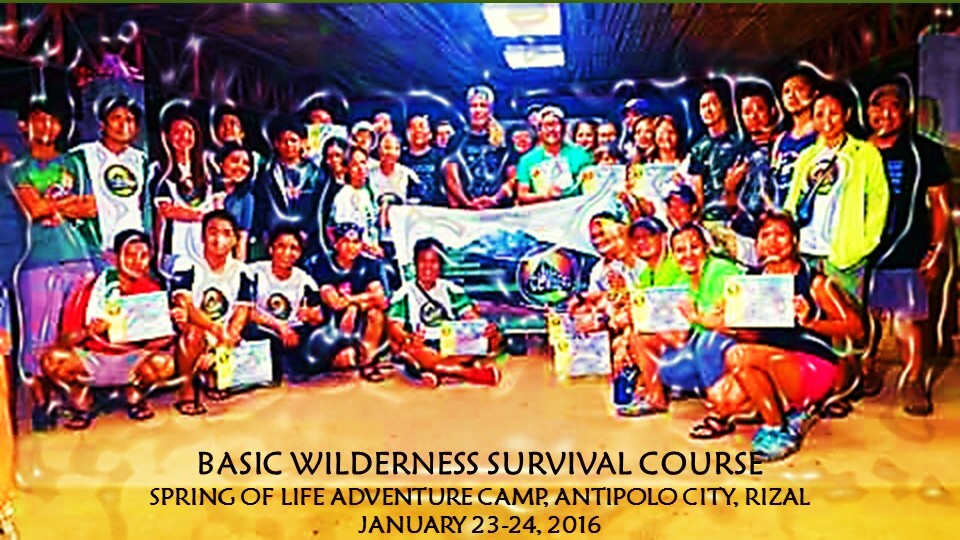
Thank you to Bong and the rest of the CLIMBER community for bringing me back to Luzon; to Melo of Tingguian Tribe for the Sierra hammock; to the Servano couple of Silangan Outdoor Equipment, who always supported me in all my outdoor endeavours; to Mr. Victor Francisco, for the treat of fine dining at the five-star Crowne Plaza Hotel; and to the couple Jay Z and Carla, for hosting me in their home and for sponsoring my tour of Corregidor Island.  Your kindness are all very much appreciated.  God bless you all.


Done in LibreOffice 5.1 Writer