Showing posts with label Bebut’s Trail. Show all posts

Friday, February 1, 2019

BEBUT’S TRAIL XX: Foraging in the Rain

I GOT KIDS TO TEACH spoon carving on Saturday, March 17, 2018. I need them to carve the softest bamboo that is still green and thin. Kids have little hands and do not have the strength to slice and whittle bigger and harder bamboos. They will be using blades, you know, and that makes it very dangerous. Self-inflicted injuries cannot be discounted.

Why am I teaching children to use knives when parents forbid it? In my generation, we were also forbidden but we were taught by the elders how to use blades safely and properly. Growing up with blades taught us responsibility and we earned our first blades when it was observed that we have grown to appreciate the value of a knife in our everyday lives.

In a society that is too politically-correct, old values which tend to aid children into better adults are discarded because of unfounded fear brought on by sensationalism and by reckless movies which depict glory in blood and gory. Too bad, nobody teaches blade safety and dexterity to kids anymore except from a lone voice in the wilderness.

This is now my advocacy. In my bushcraft camps, there are no shortcuts to handling a knife without sitting all ears first to the topic about knife care and safety. But those were mostly adults and, despite that, it is still strictly supervised. How much more for children? The best age to introduce the knife to children is 7 years old and above.

Because I place good premium on safety, I would forage these green and soft bamboo poles myself. Although I have requested the host of the event to produce green bamboo poles, it might not be the kind of bamboo I meant. I have to be sure because I also put good premium on quality of instruction. These kids should be taught only the best.

On an unusually cloudy morning of March 13th, I left the comforts of home for Guadalupe. It is a Wednesday. I would just be on a very short hike on the hills where I thought I found a lot of healthy groves of bamboo. There are many species of bamboo that I have come to know of but I am only after one kind that is known by its local name: “buho”. 

When I arrive in Guadalupe, I buy a sachet of instant coffee and five bread. This would be my breakfast which I intend to enjoy somewhere over that hump that I love to call as “heartbreak ridge”. It is actually called Guadalupe Hills and there is a trail that goes over its bare back which ultimately goes into a thick forest of Banika and Baksan.

I am carrying my canvass Lifeguard USA rucksack and inside it is an aluminum Swiss Army wood burner, water in a Nalgene bottle and a repurposed Gatorade bottle, a cup, cords, a cheap laminated plaid-nylon sheet, a Cold Steel Bushman, a William Rodgers Bushlore, a Victorinox Trailmaster, my fire kit, extra t-shirt, my “wildlife kit” and a folding “SOP”.

 
The SOP means “seat of power” and is nothing more than a folding seat. When you are now in your middle ages, seating is way comfortable than squatting on the ground. I found it very comfortable when I am working with a fire to cook food or boil water for coffee. I just bring this in short hikes because it is heavy but I have done it lately on extended hikes.

The wildlife kit is a new addition to my usual dayhike load. It is composed of a journal, a waterproof notebook, a ballpen, a pencil, magnifying glass, a ruler and a tape measure, all placed inside a handbag. This is my tool to find and document animal trails in Cebu, whether it is about farm animals, pets or wildlife. Another project in the making.

The weather is very mild today yet two days before I was complaining to myself that it was unusually warm. It was that time I was guiding people on the Babag Mountain Range which is visible from where I stand now on “heartbreak ridge”. The ground is partially wet since it rained lightly here hours before.

Arriving on the outskirts of the forest, precipitation materializes, dampening the mood of the day. Drops of rain fall on my clothes and shoes, totally getting me wet. I cannot stop just because it is raining. Until I found a good and healthy grove of bamboo. There are many visible from the trail but it is not what I desire.

I transfer to another path which I seldom take and found one in the innermost part of the forest. The rain does not bother too much now under thick foliage and so I set up camp near the bamboo. From my bag, I splay on the ground the cheap sheet and place all my things over it. The SOP is the last item I remove and I sit for a while to stare at the bamboos.

As an advocate of ethical bushcraft, you do not cut wantonly any member of a plant you desire. In this case, a bamboo. I study the poles. There are straight ones that reach to the top of the forest cover and there are a few who bow to the will of gravity. I do not need a thick pole, long and full of strength. What I need is a tender one that is thin and soft.

I found what I was looking for and marked it. Then I turn to the business of boiling water for coffee. Light breakfast first. Although it is raining, we in bushcraft (I taught a lot of people), could make fire under any circumstances. We could find dry firewood and tinder in wet conditions and light it up with a single matchstick or with a gas lighter.

With dry twigs and a sliver of paper, a fire came alive within the confines of the Swiss Army burner. I place the stainless-steel cup with water over the rim of the blazing burner and wait for the tell-tale bubbles on the bottom of the cup to appear. If you want it quick, do away the roiling bubbling moment and save time and fuel. In five minutes I have my coffee.

After finishing the five bread and coffee, I pick up a tool most suited for this kind of work: the saw. The bamboo pole I choose is not thick and it does not need brute force to remove it from the rest. The saw-teeth design of the Victorinox Trailmaster, or any Swiss Army Knife for that matter, is a very efficient cutting tool, better than other makes.

I cut an inch above the culm on the lowest part of the pole I choose and the rest of the pole come crashing down to earth. With the Cold Steel Bushmaster, I cut away the branches, the thick bottom and the topmost part where it is most narrow. Dividing the pole into five parts, I let the Trailmaster do its efficient and neat cutting work.

I now got my five poles at about 2 meters each and I believe it would be enough for my class four days from now. I secured all together with timber hitches on both ends for easy carrying. This bamboo variety is very light and hefting on one shoulder is no big deal, especially on a very slippery downhill trail.

I am much satisfied with my foraging work and, slowly, I stow all my things back to my bag. Thanking the place for accepting my intrusion, to include the disturbance. I keep it tidy as possible. I keep the cut branches mixed in with the foliage above while the rest of the unneeded parts, I place it inside a hollow trunk of a tree.

As expected, the path is slippery for it is smooth limestone. My Jack Wolfskin pair tried its best to grip the ground and it had succeeded because I deem to walk slow. It is still raining and a spray of water just slapped my face after I had taken a selfie. Nevertheless, this foraging work is not finished, not until I reach home.

I always give my best when I am teaching people. That means I make things happen that is beyond the scope of my work. That extra mile, that extra effort, is what people want although they do not know it and, likewise, do justice to the bread that they pay you for a glimpse of unconventional education that they yearn from you.

Document done in LibreOffice 5.3 Writer

Sunday, January 1, 2017

BEBUT’S TRAIL XV: The Little Boss

THE GATE IS NOW OPEN FOR LITTLE JACOB to mountain adventures and into the world of the Camp Red Bushcraft and Survival Guild. He is the seven-year old son of Jhurds Neo, head shed of the Camp Red guild. Jacob has a “cult following” of his own of boys his age and above. His skill with the knife and with firecraft are “legendary” and would finally be tested on playgrounds which were denied skilfully by his father to him for sometime.

He is appropriately dressed for the outdoors today (September 12, 2016) and carries a sling bag which, I believe, contained his prized possessions: a knife, a ferro rod set and his jellied cottons. I am following him on the trail. He walked in swagger fashion at first but when he noticed that the ground is a bit slippery for his comfort, he walked cautiously and slowly this time. Hearing the word “snake”, he stopped and signaled me to go first. Smart fellow.


Behind him is his concerned dad, our Swiss friend and benefactor, Ernie the Fixer, Boy O, Jonathan and SeƱor Nyor. The greens are all in bloom and a good time to do a little Plant ID for the benefit of the Little Boss and our Swiss guest. I start with the most basic and most common of the lot like jackfruit, breadfruit, cottonfruit, star apple, sour sop, sweet potato, spinach vine, horseradish, taro, cassava, papaya and, of course, the bamboo.

Jhurds wanted to introduce Jacob to the almost-forgotten art of making pop guns from bamboo. Too much Internet for the kids today have eroded many of the ideas and the skills of much of the boyhood games and contraptions we learned long ago. We, the older generation, have adapted with technology well and became knowledgeable of the best of both worlds but the present generation do not. Jhurds has to open the gate wide this time for Jacob to explore the ancient world of his dad and that of his grandpop.


I wished I have started my kids when they were young like my late grandfather did for me. I was too engrossed with my government work then, benefiting me nothing but a life devoid of a soul, serving an ingrate master begetting me disappointments. Fortunately, I was able to recover my respect and my reputation after realizing the futility of remaining there and escaping at the right time to the folds of a new-found spirituality and private employment. I am not employed now and have too much time but, still, I wished I had time with my kids then.

We reach the homestead of Luceno Laborte in Sibalas, the navel of Baksan. After rehydrating, we settled down and begun the process of our dirt-time. My Swiss friend unpacked his toys: a Militec folding saw, a Cold Steel Bushman and a strangely camouflaged Swiss army-issue poncho. I instantly fell in love with the poncho but it petered out when he presented to me a Swiss Army emergency stove for testing. It consists of a hobo can, a bottle and a cup and it is all aluminum, except for the steel bail and a cork cap.


Ernie start his business of collecting the food ingredients into his airy kitchen while Nyor has just placed a bird’s nest above dry firewood to be given a baptism of meteor showers from his ferro rod. The sparks came streaming down but the tinder barely caught it. Our Swiss friend tried his own into the nest and, slowly, a tiny flame sprouted from a cotton-silk tree down. Meanwhile, Jacob found new friends and disappeared from view. Only his high-pitched voice could be heard that he is somewhere near. Boys.

Luceno arrived with a half liter of unadulterated coconut wine, still in its white state and sweetness. This cannot be? The hell with coffee. It is a great privilege to be offered coconut wine, of all places, in Cebu City, at its purest form yet. How often do you know of native wine produced in the city’s mountain communities being made available to other people. This liquid is worth its weight in gold if I were to analyze its rarity. Most of the coconut wine came from the far towns north, west and south, already questionable, and from Leyte, which is already aged.


Spurred on by this good fortune, I begun to dissect the Swiss emergency stove and document each part and the different possibilities of being tweaked to serve current conditions. This contraption can be used with solid fuel like twigs, dry organic material, sawdust, paper, cardboard or even charcoal. I boiled water in its cup component using heat from burned twigs. Or you could use it in combo with an alcohol burner like I did later with water in its bottle component. There is one problem though: How would you hold the bottle when it is hot? Even so, I can tweak that.

Now, where would Jacob be? I saw a glimpse of him trying to catch pace with a local boy and he has a slender bamboo with him. I thought I heard the unmistakable “pop” sound of an improvised bamboo pop gun. There goes another “pop” and another. They are in the midst of an ongoing battle, I think? Pop! Pop! Pop! A small balled paper landed inches away from me. I am almost grazed by their intense warfare, most likely, almost a casualty of friendly fire.


This Filipino childhood past time is made from a slender bamboo tube about 8 to 10 inches long. A bamboo stick, a half-inch shorter than the tube and which fits snugly inside the tube’s bore, is used to push projectiles out of the tube and is connected to another short tube, about 4 to 5 inches long, which acts as a handle for the rod. The projectile is wet paper balled to be force-fed into the tube by the rod. The water acts as a sealant. When another balled paper is pushed hard into the tube, air pressure increase and forces the paper on the other end to “fire”.

Jhurds seems ecstatic at the outcome of his experiment and relaxed slightly his watch over Jacob. Now he is talking with our Swiss guest and Boy O. Jonathan and Nyor are helping Ernie with the cooking and I bet it would be another feast fit for princes and dukes. Just a half hour from now we would indulge on that. Luceno brought marang (English: Johey oak) and avocados from his orchards. Our Swiss friend added some fruits he bought from the market like mangoes, lanzones, rambutan and mangosteens.


Jacob, probably tired of his little skirmishes, turned up with thirteen sets of bamboo pop guns. Three local boys foraged these bamboos and made all of these for him. I can imagine Jacob’s joy at owning that many in his armory. He may well start an arms trading business in the school where he is studying. Just in time for the meal that is now being served. Everybody, to include Luceno and wife and Jacob’s playmates partake of a local pasta called pancit, mixed vegetable soup, sliced cucumber in vinegar and milled corn.

Getting his energy back, Jacob goes back to play mode. This time he witnessed two boys doing a rap duel, fast-faced sing-song-talk in Tagalog which could easily twist and tangle my thick Visayan tongue in spasmodic delirium if I were to try it. I would not dare but it is a sight to behold to see these mountain-bred children performing something which I thought popular only in highly-urbanized areas, streets, TV shows and in the Internet. These children in the highlands have the best of both worlds too and they are adept to embrace pop culture and technology as if it is just a change of clothes.


Then I came to realize how Jacob would learn so much in the use of the knife when he sees his playmates using bigger work blades with such dexterity as if they were working with a small knife. On the other end, the boys would be amazed to see Jacob’s Condor Bushlore as they are not used to seeing smaller blades. Then their amazement would go double when Jacob would show them how to make fire from jellied cottons after a spark from the ferro rod. The masters of firecraft being taught new tricks by a novice and so thirteen bamboo pop guns were happily given.

It was dream time for Jacob and for his playmates. Dream time also for me for soon I will own that Swiss Army emergency stove. The kick from the native wine made today’s activity very worthwhile and unforgettable. When it is in the middle of the afternoon, we start packing our things. Jacob is reluctant to part with his playmates but he is tired and he has to go with his dad on the route we took in the morning. Me and the rest would go down direct to Guadalupe by way of Bebut’s Trail and the not-so-dreaded-anymore “Heartbreak Ridge”.

Document done LibreOffice 5.2 Writer

Saturday, November 26, 2016

BEBUT’S TRAIL XIV: The Italian-Sounding Abomination

WE AT THE CAMP RED BUSHCRAFT and Survival Guild begun to love Baksan when we discovered its secrets that we decide to transfer our “dirt times” there. At Baksan, we do not meet anymore colorful corporate hikers. Of course, they know where it is because it can be searched in Google Earth but going there is still a puzzle for them. Even if they will accidentally find it, they cannot fit in because there is nothing spectacular to talk about.

In the old Roble Homestead, we frequently meet them there. Meetings are mutual and friendly but we know that they talk behind us because we are different. We do not worship Leave No Trace, like they do in such vociferous manners on other people, yet they cannot impose it on us. We have our own set of values when it comes to enjoying the outdoors and LNT is not one of those.

We carry knives and we know most of them cringe at the sight of even the smallest Swiss Army Knife. We regard our knives as mere tools and we know the value of this simple tool in simple outdoor functions or, worse, during SHTF. Our difference from them stood out glaringly with our joyous attachment to our unique tradition of the blade porn. We delight at our “wrong turns” and it is the best thing in the world.


We blend well with the landscape by just being there and not mere passersby. We can sit idly by a campfire and enjoy its companionship of warm food and steaming coffee while some of these colorful hikers would be busy spying on other campers of their misplaced garbage. While some of them pounce people in Facebook by posting pictures that hurt their make-believe LNT sensibilities, we dare them with ours that totally ground against their beliefs.

We are now at Baksan always to save them of their frustrations of seeing us doing many things that ran contrary to their Western-inspired outdoor principles. We regret to inform them that we never camp on bald peaks nor make campfires there. These are the very places we evade for it ran counter to our adherence of Blend, Adapt and Improvise. On the other hand, we do not stay a minute and we had rather be on our way quick.

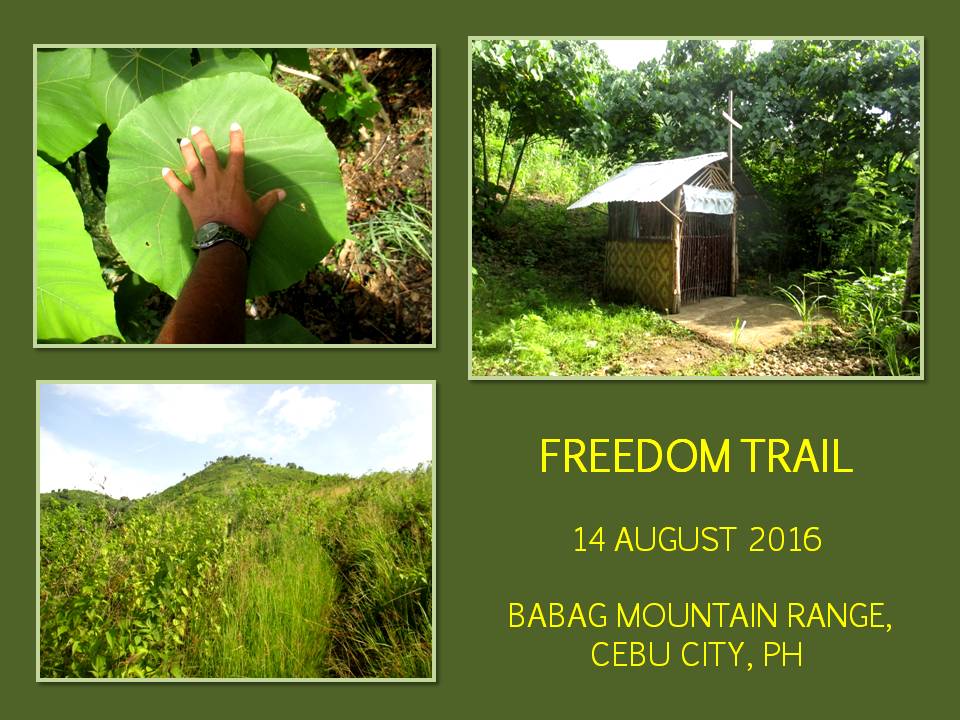
This day – August 14, 2016 – I am with these crazy bushcrafters. Two male guests came along upon the invite of one. Our plan would be to test the route between Tisa and Kilat Spring for we heard rumors of this greedy Italian-sounding abomination called the Monterazzas de Cebu trying to gobble up the whole of Banawa Hills and part of Tisa Hills, thereby, close access to a valuable water source at Kilat forever.


Although it is still 07:30, by my own experience walking both Tisa and Banawa Hills at this hour, it should already be warm. The hills are grassy but devoid of trees. It is rare to find a copse of different trees, most of it among deeper cleaves and on a few ridge tops. A power pylon stood guard on the trail. Its presence a hint that a corridor underneath it and its cables are government property. Why would this Italian-sounding housing development pursue its project?

Behind this low mountain range facing Cebu City is a watershed where Kilat Spring is found and the imaginary boundary is just a couple of steps away. Do not the Metro Cebu Water District find this position irregular? Is it okay to supply water to the metropolitan area whose source partly comes from the Buhisan Watershed Area which is now a close-door neighbor of this Italian-sounding residential area?

Did they check where their drainage flowed this time because there had been silence lately of places which had been inundated with water and mud coming from them in the past? I am just curious because one small stream in the Buhisan showed brown and silty effluents during a downpour. I understand it has been issued an Environment Compliance Certificate by the DENR because you cannot proceed with earth-moving activities without one? Is this ECC acquired with all the proper requirements? Is it above board?


Is it not a part of this Italian-sounding residential area transgressed by a corridor of high-voltage power lines supported by two steel towers on two separate points can be a risk to life and property? Can City Hall just allow and provide them building and land development permits without closely scrutinizing its close location to a watershed and a power corridor? Would City Hall not consider preserving a historical landmark that is now being trampled underneath this Italian-sounding abomination? It is a kilometer-long Japanese tunnel.

I waited for the others as they slowly negotiate the trail. I found a branch of a trail that would lead us to Kilat Spring. I know most of them have exhausted their water bottles but, over that ridge where there is an old mango tree, a path goes down into the Buhisan Watershed Area and abundant water. It did not take long and we reach Kilat Spring. We have all the water in the world. We celebrate by boiling water for coffee.

Water from Kilat Spring, according to an old-timer that I met some years back, burst forth after the ground was hit by lightning. A stump of a burnt tipolo tree is a testament to this incident which happened many many years ago. The water is now caught inside a concrete box and is diverted to the dam structure to serve as water supply for the MCWD engineers while the rest just flows freely thru a tap. Above the spring is a talo-ot tree, which nurtures the fine quality of the spring.

After 45 minutes we proceed to the Portal. We are now traversing thick jungle on a path that had not been used frequently by many people as before. Some parts of the trail are beginning to be overrun by weeds and it came at a point where there is a spot that had, so many times, led me to walk in circles and I am doing it again. I finally caught the true path and it relieved all the stress that I am now beginning to accumulate.


We pass by a forest of mixed sugar palms (Local name: idyok) and upland marsh palms (saksak). There has been an attempt to burn down these and a few of the palms are molested and cut without meaning. How could anyone be so vicious on these palms? I carefully pull the hair-like fibers of a sugar palm and the others did so. We collect this for our fire-making needs as it is a good tinder. I stuffed mine inside a small plastic bag where it will be transferred to my fire kit soon.

We reach the Portal but we continue until we reach Sibalas, the “Navel of Baksan”. There is also a natural spring here which is now housed inside a concrete box. Nearby, is the resting hut of the old steward of the water source and of the big swath of the place itself – Luceno Laborte or Noy Ceno. He is around and Jhurds Neo, the head shed of the Camp Red Bushcraft and Survival Guild, gave him two brand-new stainless-steel cups which elicit a very happy smile from him.

Everybody settled down and proceed to the foraging of dry firewood, which are few. Nevertheless, we have ways to make it fire-ready. The sound of wood being split by knives echoes down to where I sat talking to Noy Ceno and Jhurds. I watch the two guests, both wearing red t-shirts, watching silently the show the guys are now running. It would be their first time to see “dirt time” and they are glued to the spot where they are crouched.


Ernie Salomon, the camp fixer, is busy preparing the food while the rest are keeping him company in the slicing business. Fires are lit on two hearths. A pot for coffee is now above one while another pot of rice claims the other. Ernie’s home-made hobo stove spews out a smoke and a tin cup for coffee is placed over it. I was tired of the hike. Maybe I am just too busy. I was guiding people yesterday. Or maybe I am getting old.

I drank coffee again and I tinker with my Cignus V85 VHF radio. I am able to contact amateur station DV7FAL of Linao, Talisay City from my hidden location in Baksan, bouncing my signal to a steep flank of Banawa Hills which then makes a ping-pong to a repeater in Busay. Ingenious maneuver. When you are into ham radio, you tend to experiment and that is what I just did with an inferior made-in-China equipment. Think of what I could do with a Japan-branded radio?

Immediately after that, I caught the attention and interest of Christopher Ngosiok, Nelson Tan and the two guests about ham radio. We talked about licensing, acquisition of radios, review classes and preparing for that written examination administered by the National Telecommunications Commission. I am a licensed ham operator for three years now and I carry a callsign of DW7EUV. Many of the guys from the Camp Red Bushcraft and Survival Guild are licensed hams.

Radio equipment is always part of mine and someone else’s gear. Radio communications is essential when SHTF sets in. I have personally witnessed cellular signals fail in the aftermath of a 7.2 earthquake in Bohol and in places in the path of Typhoon Haiyan. Only radio signals were able to provide a link between the distressed communities and relief agencies. It happened in 2013 in many places of Bohol, Leyte, Samar and Northern Cebu.


Spoon is rapped on a pot lid, signalling the start of our late lunch. Ernie did wonders with chicken meat with an estofado dish. For a dayhike, we at the Camp Red Bushcraft and Survival Guild are pampered to feast like kings! How could we reduce our weight with food like that? More servings please! We gave a share of the meal to Noy Ceno and his family and our bellies bloat like that of Jhurds’. Hahaha…

When dark clouds begun to appear in the middle of the afternoon, we decide to pack our things back into our bags, including the blackened pots. We will be exiting to Guadalupe this time but, first, we will have to pass Enas. I lost the trail to there and I decide to explore the many strange trails that crisscross Lower Baksan until I call it quits and followed a trail that led to high ground. So familiar. So, Bebut’s Trail it is.

We go down that dreaded place called “Heartbreak Ridge”. We walk on the fringes of that Italian-sounding abomination and I see they are now starting to fence off the poorer quarters. How can you fence off a fault line? It is recently discovered in Buhisan, just at their back. I wished the new homeowners well.


Document done in LibreOffice 5.2 Writer

Sunday, November 6, 2016

BEBUT’S TRAIL XIII: Legends of Baksan

IT IS A PARADISE FOR BUSHCRAFT. Nobody knows where Baksan is and nobody is interested. I do. Jhurds Neo, the head shed of the Camp Red Bushcraft and Survival Guild does. It is just walking distance from Guadalupe. If you prefer to be lazy, you just drop at Sector 8 and you would be on your way on foot the rest of the way.

Where really is this place called Baksan? Honestly, I cannot tell you. Just use your Android phones and your Google Map. It is right there complete with longitudes and latitudes. But could it really tell you the whole she-bang? Uh-uh. GPS technology is only good when you are driving a company car. Ask your HR department. It is also only good on straight lines and wide open spaces and catching Pokemons.


I am choosy now of who I bring with me. I do not want it saturated by people who cannot fit in to the places they visit. These people are careless creatures who do not know common sense, trying to adapt themselves into something else which they themselves have no idea about. The absolute posers and pretenders. They come from both extremes and both kinds are amusements in Facebook. Then there are the stupid.

A year ago, I thought I know a lot about Baksan. I was just learning it right along the fringes until a local led me into its bosom some months ago. I have written an article about this, ready for posting in Warrior Pilgrimage but, unfortunately, this and the rest of my valuable files got lost after my hard disk drive got corrupted. I have to start writing this again, this time, for today’s activity.

Well, today is July 31, 2016. I am guiding Jhurds and the rest of the badasses of the Camp Red Bushcraft and Survival Guild and a female guest who seems to like our brand of outdoor activity. Tell you frankly, I have always observed that women are more inclined to challenge themselves to worm their way in to this man’s world called bushcraft. Must be that they are right-brained and can understand better the creativity that bushcraft provided.

From Guadalupe, the forest swallowed us by the time we hiked a trail that is the flank of a low mountain range which is now developed into an abomination called the Monterazzas de Cebu. This unfinished and hard to sell high-end subdivision which tried to sound Italian, claims the whole of Banawa Hills and is just a few steps into the Buhisan Watershed Area. How could the DENR approved an Environment Compliance Certificate for this? Why cannot the Metro Cebu Water District question this development? Is it money talking?


The trail wove around places where there used to be communities. Hedges of ornamental plants that line the front of what used to be houses are now thick and wild. A part of a post protrude from the vegetation that is now claiming the old habitations. A part of a concrete floor is now crumbling and begins the process of turning into dirt. Hibiscus and franciscos indicates an absent family that used to claim their side of paradise here.

We pass by an even ground where there used to be a basketball court and, beside it, a place where there used to be a chapel. It was abandoned by the former inhabitants when this became the battleground in the ‘80s between the military and an ideology that promised a painful change. There were no victors but there were shattered dreams and blistered hopes as the conflict stunted the growth of progress here. It is a cursed place.

I led them into a place the locals called as Enas. There is a natural spring that bleed water into a very small pool tainted with sulfur. It is not potable. The overflow trickled slowly down the hillside and joins Baksan Creek below. The ground has thick sulfur deposits and is bare of vegetation except of sparse ankle-high ferns. Dead trunks appear as burnt and black. This place reminds me of Kaipuhan, in the Cuernos de Negros Mountain Range, but smaller in scale.

It is my first time to see something like this in Cebu. The place is just queer. I see a lot of Indian rhododendron (Local name: yagumyum) growing around the fringes of Enas, with which shrubs are found only in highly elevated places where the clime is colder. Its presence only indicates of a micro climate happening here, perhaps, spurred by the location of the sulfur spring.


The sulfur spring could only mean that there is an underground volcanic activity or there is a fault line somewhere near which necessitates the seepage of sulfurous water. There is a fault line though, discovered recently running across the Buhisan Watershed Area. Bad news for that greedy high-end Italian-sounding abomination. It is just less than a kilometer away. Good luck!

We followed a trail and I took chance to look over a rare homestead where there are three boys playing. It would be a big help if I could ask them of the way to Sibalas and they pointed to a very narrow trail. I see a lot of marang trees (English: Johey oak) and these are bearing fruits, just a few more days and it will be ripe. The trail is quite steep, without any shrub for a handhold, and it led to a stream below.

The stream is familiar. I have passed by here in December last year, right after a Christmas outreach for children located in Upper Baksan and on two different occasions after that. There is a crumbling structure of what used to be a house. A standing concrete wall bear bullet holes, concrete testament of the intensity of conflict that befell on this place. Walking upstream, we came upon a small community, remnants of a once big community.

A path leads to a ridgeline above. Locals are harvesting star apple fruits (kaimito) on a saddle and, some of them, we meet along the trail carrying it downhill in big baskets on their backs held by tumplines supported by their foreheads. We found several paths but I chose the most beaten trail. It followed a low ridge and, after crossing a gully full of accumulated cottonfruits (santol), I saw a roof of a small house.

We are now in the “Navel of Baksan”, a correct translation to a description given by my local guide during a hike here in March as “ang kinapusuran sa Baksan”. There is now a community here, another remnant, led by an original resident Luceno Laborte. Nearby is a natural spring contained in a concrete box which my guide have suggested to as the center of it all. The water source attracts nearby communities to as far as Gethsemane in Banawa during extreme drought.

Luceno or Noy Ceno is present and he welcomed us all. We all remove backpacks and begun the process of our patented “dirt time”. The guys immediately forage dry firewood while Ernie Salomon, the camp fixer, receives all the raw food ingredients into his airy kitchen and tame the edible assortments into one fine meal which will soon emerge. Fire appears, not from bottled fuel but by real source, and water is boiled first for coffee. Coffee, campfire and the outdoors is a good combination, is it not?

I looked at some of my blades when I am alone. There is a 10-inch vintage 1943 knife made by Fame E&J Kitchening Ltd. of Sheffield, England, with a deer antler handle and can be carried on the side in a black leather sheath personally made and owned previously by my generous benefactor and a fine gentleman from the UK – Alan Poole, also known as the Ghost of the Woods in the international bushcraft community.


Second is a classic bushcraft knife made by William Rodgers, also of England. A phrase of “I Cut My Way” is engraved, along with the manufacturer, on the blade. It is 9 inches long and 5/32” thick with beech scales. It is impervious to abuse and was also given to me by a gentleman from Liloan, Cebu – Aljew Frasco. The present leather sheath, untreated yet, is designed to be worn frontiersman style and is made by Jonathaniel Apurado.

Another is a custom bushcraft knife made by The Knifemaker of Mandaue City, Cebu. It is small, 8-inch and 3/16” thick with hardwood scales. Sheath is riveted kydex and can be worn hanging from the neck, over the shoulder or could be slipped into the waistline. The manufacturer wanted it tested in real live action accompanied with a product review. So far, I had felt its weight in my bag and in my person and it is barely negligible.

What about balance? There is no such thing as balance. Balance can be interpreted differently. For an experienced knife thrower, balance is immaterial. Distance does and dynamics. Choosing a cottonfruit tree, I aimed the Knifemaker custom knife onto its trunk from an estimated distance where I believed it ought to be thrown. The blade spun in blinding speed and found the target true.

Blades, the main tool of all crazy bushmen, are used without limits and does all the work of splitting firewood to slicing meat and vegetables. Noy Ceno shows off a few of his prized blades: a 36-inch long tenegre blade and an 8-inch knife. The knife is a World War II survival knife issued to US pilots which is now sporting a different handle. The tenegre is badass. It belonged to his great grandfather and it has a tale to unwind.

Ears pricked up, Noy Ceno tells me that the blade was used by the original owner during the days after the Tres de Abril uprising of 1898 against Spanish domination in Cebu. Then it had seen action during the Philippine-American War after that. Both historical events told of many brutal close quarter encounters where the blade has advantage, whose Cebuano hands wielding it have grown up with the indigenous art of stick fighting.

This old tenegre blade is not that thick and it is very light. I could hear the metal sing faintly as I slashed the empty air. My hair stood up at the very act of it. The present wooden handle and sheath are replacements of the older ones and is made by a local artisan, whose designs are prevalent among all working blades owned by farmers in Baksan and among nearby communities here.

The name Baksan, from what I understood and came to believed in for so many years, comes from a local snake – a python, as it would be to a lot of places bearing the names of Lawaan and Buhisan, even a spitting cobra, Banakon. But Noy Ceno begged to disagree. “Baksan” is termed to this place by other locals because of the habit of its inhabitants who secured the intestines of their opened stomachs as if it is a belt while retreating from a battle.

It was kind of strange hearing it but I have known of some hardy characters who survived knife fights with their opened entrails pushed back inside slashed stomachs as if nothing happened. These guys surely have grit. I look at my pot belly. Could I do the same? I would faint, perhaps, but I would have to bite the bullet if ever I would have to choose between one who sports an ugly scar or as a cadaver.

Lunch came. One is a soupy local pasta called pansit; another is a dish of scrambled salty eggs mixed with sliced tomatoes and onions; and a dessert of sliced cucumbers, tomatoes and onions in vinegar. Rice and milled corn are mixed in to the fray. It is a small feast which are rare in dayhikes but is held regularly by the Camp Red Bushcraft and Survival Guild as a sort of tradition. Here, everybody learn outdoors culinary, enjoy a warm meal and a good dose of bush lore.


On the other hand, all mainstream hikers subsist on cold meals or snacks because they are concerned of their time. Their watch, always telling them the Western idea of time, kept them away from enjoying the mountains in such a close and sacred interaction and the opportunity of maintaining friendships with locals are almost nil. They are always in a hurry and they are just passing all the time. They can never be part of a landscape.

I am proud with the guys at Camp Red Bushcraft and Survival Guild for they have understood the ways of nature and are far better outdoorsmen than their corporate peers. By leagues. They move with an easy stride and demeanor and time is of no essence to them. They can lose among vegetation if they wished it and appear in another place some distance away.

When the sun seems to have started losing its intensity, we begin packing our things. We had spared food for Noy Ceno and his family as well as unused coffee, sugar and some items. We will take another route that will pass behind that greedy high-end Italian-sounding abomination. It goes down a long ridge which would be heartbreaking if taken uphill in the morning. We reach Guadalupe in good daylight and spend the rest of the hours in a friendly watering hole.

Document done in LibreOffice 5.2 Writer

Thursday, August 11, 2016

BEBUT’S TRAIL IX: Christmas United Year 4

THIS IS A VERY DIFFERENT morning. I can feel it in my nose. Aha! Yes! It is December 13, 2015 and it is the season of giving. I am the first in the parking lot of the Our Lady of Guadalupe Parish. Then comes the people who lived from faraway Lapulapu City, one after the other. They never failed to amaze me. Richie Quijano, Nyor Pino and Locel Navarro.

As I sat on the front stairs of an unfinished building, the rest came in trickles. Across me, is another group who are on a mission today to Kahugan. They are kindred spirits. In a half hour we will have ours at Baksan. Fritz Jay Hortelano arrive with a plastic bag full of face towels while Justin Abella and Faith Gomez have two big vacuum-packed plastic filled with stuffed toys.

Aljew Frasco and Bonna Canga parked a maroon Toyota pick-up which will be useful transport soon for the volunteers among us. Jhurds Neo also with a Toyota Fortuner that has wife Zette, son Jacob and niece among the passengers and our guest Derek Manuel with wife and daughter. Also arriving is the Neo family's other transport – a Suzuki Every 660 – to be used for this event called Christmas United, which is in its fourth year.

We have held Christmas United in Kahugan for three straight years until we decide to transfer it to Baksan this year. An incident in July had caused our perennial hosts, the Roble Family, to transfer elsewhere. Their place was perfect for our outreach events like Christmas United and another one called Who Put the “N” in Nature, which we hold every May of each year before the opening of classes.

It is really sad on our part because a lot of children there will be deprived of the gifts we bring this December because of the deeds of one resident named Timoteo “Nonoy” Gabasan. He has been responsible in the attempt on the life of Fele Roble and the burning of their house after that. To show our sympathy to the Roble family, we decide to transfer to Baksan, with a heavy heart, until justice will be served on the suspect.

Already at Baksan as our advance party of yesterday are Mark and Mirasol Lepon, Nelson Orozco, Jonathan Apurado, Fritz Bustamante and Nelson Tan. They have stayed at the Ragasajo Homestead where it may well be being prepared for use today. They have carried the bulk of the gifts and some of the food stuffs which we will prepare for the children and, possibly, for their parents too.

The convoy of three vehicles with all volunteers and items aboard leave Guadalupe at almost nine. We reach the trailhead by the road at 09:10 and, slowly, we grab what we can carry with our hands towards the Ragasajo homestead. It is a short walk of undulating terrain but quite shady. An approaching tropical storm called “Nono” is threatening us with a light shower but we remain optimistic that it does not ruin our day.

I believe the children and their supportive parents are waiting for us now. Some of these children, walked with us, expectant of something on this beautiful morning. Two vats of street ice cream are being transferred from the vehicles to the outreach area as well as some of the gifts and the food ingredients that we will prepare and cook today for the children.

Supporting us and relishing to volunteer their time is Atty. Jose Mari Gochangco and his very modest wife-to-be. The guys from the Camp Red Bushcraft and Survival Guild are very honored by the presence the Gochangco couple and the Manuels. We behaved and watched our language and put our best foot forward. All hands took to their assigned tasks to the letter and most put on an extra effort.

Baby Quia, daughter of Aaron and Ann Jillian Binoya, exercised her social skills as well as her hiking legs as she is totally awestruck in this Christmas affair with so many children around her. Not to be outdone, 7-year old Jacob snared a lot of new friends – young and older – and became part of his fledgling pack. The Ragasajo homestead is a beehive of activities which the following montage shows:


When all the gifts are now in every kid’s safe clutch, when every morsel of food is wiped clean from the plates and the place is swept up of clutter and litter, it is time for us to go. A grateful local, Alex, showed and led us to a route down which would exit nearest to Guadalupe. We follow down a creek and walk the boulder-strewn streambed and its creekside trail.

I say this again: that if you show goodwill, routes which lay unknown will be opened up for you. The route is a lonely one since nobody – not even locals – go there anymore. They opt for the easier Baksan Road and hire a motorcycle when they go to the city center or, if they may have to walk, they go by way of Banika. It is really lonely. Something in the air imply that it is a cursed one.

Alex told tales of how this place became a stronghold of armed radicals in the ‘80s and it had been a battleground as well. There used to be a thriving community here but the residents abandoned their homes to seek peaceful and safer places. We passed by a crumbling hulk of concrete of what used to be a house. On its walls were bullet holes.


We found habitated houses but it is used only as resting places by locals who worked on small farmplots. By late afternoons, it is abandoned for their more secure abodes downstream like a woman with her infant who joined us. But what astonishes me is a good-looking couple who made this cursed place their home and they were not even locals.

We reach Guadalupe at 18:00 and proceed to my new water hole that would ensure me endless ice-cold bottles of beer – Cafe Angelica – which is located at the back of KIA Motors in Gorordo Avenue. There, we celebrate our success with the fourth edition of Christmas United. Despite that, I could not erase the faces of children of Kahugan whom I have known so well and who were deprived of another joyful and unforgettable Christmas because of this rogue named Timoteo “Nonoy” Gabasan.

It breaks my heart. Merry Christmas anyway to you all in Kahugan.

Document done LibreOffice 5.1 Writer

Monday, June 1, 2015

BUSHCRAFT BUHISAN XXX: Dog-Weary

I NEVER LIKED TO ORGANIZE anymore and involve a lot of people in any outdoors activity, except when it is the Philippine Independence Bushcraft Camp, an outreach event or an outdoors seminar which would increase the knowledge of people about outdoors safety. I do not want to put a strain on myself in managing a big group of people without any tangible benefit for them except the opportunity to enjoy the outdoors. They could do that for themselves and they have the cash to do it anywhere.

Neither would I liked to bring a lot of people again into the Buhisan Watershed Area for the simple reason that it is a protected area. The Buhisan is the source of drinking water for Metro Cebu residents and I do not want to despoil their water source because I insist to do my dirt time at the streams and on the catchment basin. Nowadays, I just bring only a handful of people and I feel comfortable with that even if we are walking on the streams.


Today, October 12, 2014, I am organizing an activity for the Camp Red Bushcraft and Survival Guild. My route would just be short and it will intrude into the seams of the Buhisan with a planned short lecture at Camp Damazo. I believe, some members of the Cebu Mountaineering Society would be joining us. I am worried because the number of people coming would not be appealing on my part and that they might also find our methods displeasing.

I am at the parking lot of the Our Lady of Guadalupe Parish waiting. One by one, they came. From Camp Red: Jhurds, Jerome, Nelson, Ernie, Glenn, Dominik and Justin. Jonathan, Justin’s father, tagged along. A rough cut, Mark, came with wife, Marisol. We are eleven. From CeMS: Boy T, Boy O, Mon and Aldrich. Apart from them, they have two lady guests from Bacolod – Jo and Ping. Six people are with CeMS and we are seventeen in all. Good God, too many!

I may have to accommodate the presence of people from CeMS since they are already here and that means I have to tone down a bit our dirt time. Aldrich, whom I had not seen for some time, is now based in Papua New Guinea. He had been with me during that great traverse hike in Bukidnon, from Lantapan to Impasud-ong, which scaled both Mount Dulangdulang and Mount Kitanglad, the country’s second and fourth highest peaks, in three days of 2008. He is on vacation together with Jo and Ping, who both are nurses working in Saudi Arabia.

Boy T, Boy O and Mon are quite familiar with Camp Red activities since they had joined us many times. Anyway, when all had arrived at the parish grounds, I gave all a briefing. It is about the special concerns of a watershed area which an individual may have to observe and respect. I state out the rules and I am very strict about this. I also apprised Aldrich, Jo and Ping about the way Camp Red people conduct their activities that might ran contrary to their belief of the Leave No Trace, granting that they are aware of it. All understood very well why we open-carry our knives. Good!

Having resolved the foregoing issues, I decide to lengthen the route and walk on high ground. We would tackle “Heartbreak Ridge” first before proceeding to Baksan. I would ensure that Aldrich and friends will be satisfied of the exertions for this activity and will have a memorable weekend. We start our hike at 07:30 right after procuring the ingredients for our meal which we will enjoy later at Camp Damazo. The weather at this early stage of morning is very mild and would greatly help the participants overcome this ridge, which had been notorious to many.


The ridge is now home to many dumps of garbage since the time informal settlers claimed the lower part. There is now a community where, before, there was just a plot of corn and a cairn. I see an empty bottle and I pick it up. Walking on, I see a lot of broken glass. I collect this and placed it inside empty foil-like junk food pouches. I cannot imagine a boy getting lacerated on the foot while flying a kite like I did in my early teens while pursuing a basketball on thick grass. Picking up broken glass and whole bottles is now my advocacy so our world would be a little safer.

Meanwhile, two of my guys bogged down in the middle with one raising the white flag. We have one guy less but sixteen people to look after is still a lot. Mon, Aldrich, Jo and Ping, whom I thought would suffer from the initial ascent, made it. I wait for the rest at the top where forest cover are a few meters away. It is now 09:30 and a lot of time are wasted where, at this hour, we would have been at Baksan. The sun exact its revenge after an hour of being covered by clouds. It will be very hot soon.

The shades afforded by forest cover have soothed the frayed nerves caused by that hike on heartbreak ridge. The air is cooler, the leaves are wet, the ground soft with a lot of bird activity. I see, on three different occasions, hunters with rifles. They are on the prowl today but I am worried of those that I have not seen yet because they would also never know our presence. I scan people’s clothes and bag. All Camp Red people wear clothes and carry bags with earth tones and they blend perfectly well. What I want is someone who would stand out. Aldrich’s backpack cover fits that. It is neon green!

We reach the Portal but we just pass by it. We proceed instead to a house where we used to fill up our water bottles. The minutes are ticking. Temperature slowly rising. We will feel the heat once we reach the road. We work our way among the small community of Baksan into the road. The school that had been burned in 1984 by the New People’s Army gets the attention of Jonathan. He used to ride a mountain bike on this very road and he always sees the skeleton of the school when the place was yet bare of trees. The road is now concrete and heat bounced off the surface adding to the discomfort of glare.

After an uphill walk on the road, we go down a path towards a shady clearing underneath a mango tree. Here, I briefed again the mixed group. Wooden sticks becomes relevant. It is now 10:15 and we still have a long way to go. We climb up a ridge and switch to another ridge. The grasses are tall and healthy. Birds are always absent inside a teak forest. Their wide leaves kill neighboring trees and the heat under their shades are oppressive. We walk past a saddle and into a low hill. This hill used to be Boy T’s nightmare and the name stuck. It became the name of the hill and it is now tabbed in my map as Boy T’s Hell. Mon provided me the altitude at 275 meters.

When we got past the hill, the route goes down steep into a stream. I saw my trailsign and we go down a path that had been first created during the PIBC 2013. The ground is soft but the vegetation had not claimed back the ground made bare by the passing of several feet. We reach the creek and I immediately immerse my meshed shawl with water and wipe it on my face and nape. The coolness of water from the stream brought some comfort. Everyone converge on the stream that I designate as Creek Alpha. I think this is the best time to drink coffee.

I retrieve my set of blackened pots, fill it with water from the stream. We use a butane stove to boil water quick. Those whose drinking water getting low availed of the portable filters provided by Jerome and Jhurds. You just sip from the running stream with the straw and it saves your water inside the bottle from being used. When coffee was available, everyone gets a serving. Although hot, it soothes out thirst and it peps up your strength and your sagging determination. I took a second steaming cup for good measure. We boiled the pork meat so it would not spoil. We leave Creek Alpha at 11:00 for Creek Bravo.


I hasten the pace but I warned the rest of the presence of rattan palms. Stones and tree roots are slippery and I begin to feel fatigue. I just ate three small bread as breakfast at Guadalupe many hours ago and now it is almost noon. My gut needs nourishment although the two cups of coffee I enjoyed at the stream had given me a brief respite. I reach Creek Bravo and rest for a while to wait on the rest then we go uphill. My pace is fast as I stepped on stones and tree roots intending not to leave my mark on the wet yet still scratchless ground. Once in a while, I look back to take note of the weak link.

It is 12:45 when I finally reach Camp Damazo. Oh God, I am tired. Despite it, I begin to collect the wooden staffs and make a tripod. I lashed the sticks with vine over a pile of tinder, kindling and twigs that the father-and-son tandem of Jonathan and Justin prepared for a fireplace. Quickly, I retrieved my blackened pots with its contents of boiled pork meat and disposed it under Ernie’s care and parted some of my foraged tinder to make fire-making easier. Jerome erected another tripod tied with paracord above another fireplace which Jonathan and Justin also gave life.

Dominik and Mark teased another fireplace to life for cooking pork barbecue. Everyone are exhausted by the ascent, by force of a pace imposed by me and by the tantrums of the gut. What better way to feel relaxed is to just sit still and recover your wind, then change into dry clothes. Most just go on with life, help in the cooking, collect firewood or talk about knives. Jhurds arrived with an armful of dry twigs while Nelson walked behind him with another armful of dry wood. Mon lent his butane stove to provide more option to the cooking. Jo and Ping engage in a conversation with Marisol when not taking photos. Mark and Aldrich collect all empty bottles and refilled it at a natural spring.

Jhurds set up his Silangan “stealth hammock” complete with an overhead taffeta shelter inside the forest. I lay on a stone underneath the hammock and try to sleep but mosquitoes hovering near your ears became unbearable and I transferred near the fire but away from direct heat. I splay a matted nylon sheet and pretend to sleep. A dog sat beside me but I ignored it. Aldrich joined me on the sheet. Later, snores from my neighbor woke me up. I gaze at the treetops and see a native pigeon attracted by the smell of our cooking. Something big moved beyond the tops. A serpent hawk. It floated in circles.

My vision is blurry yet I could still mark fine details if I had to and that means I have to strain my eyes hard. Blurry vision is a sign of fatigue. It is like someone placing fine sand in your eyes. I blink many times to adjust focus. As time goes by, my vision cleared, but it is not a good time to read something on paper. I am supposed to do a lecture here but my eyes are uncooperative. The discussion is about “Blend, Adapt and Improvise”. I am discussing this subject matter for Camp Red and is taken from my e-Book project titled ETHICAL BUSHCRAFT. Somehow, I have to postpone this. It is good to be sensitive.

By now, cooking is almost over and food will be served in a little while. Fresh banana leaves are frayed over the fire and it will soon host the food. The grilled pork are already sliced and are now placed over both cooked rice and milled corn. The salmon belly soup (Local: tinola, tuwa) elicit a lot of stares from all. Who would have thought that Northwest Pacific salmon could be cooked in soup, Filipino style! Give credit to the camp fixer, Maestro Ernie. After the mixed-vegetable soup and fried anchovies got cooked, our delayed lunch began at 14:00.


I pounced immediately on the salmon soup and slurp its life-sustaining taste. Bon appetit, mon amie! I was starving but I am feeling better now. Took another serving of the same soup mixed with milled corn and now my stomach felt something tangible inside. I took a third serving of the soup mixed with milled corn again. The rest picked on any viand they choose to eat and they all milled around the banana leaves on the ground. Everything was consumed except the banana leaves. When the meal is over, I collect my pots from “no man’s land” and I proceed to Creek Charlie to wash it there. Justin came along, then Nelson.

My wife kept complaining why my pots are dirty and why does she has to clean it all the time? I do not wish to bother her tonight when I go home. I line the three pots on the stream bed and place water in it to soften the food morsels adhering inside. When the food got removed, I throw the waste water far away from the stream. With sand, I rubbed the blackened surface until the sane appearance is almost restored. Justin and Nelson did, likewise, on theirs and we go back to Camp Damazo. Along the way, I showed both to a tree that looked like a giraffe. Justin took a photo for souvenir.

The rest are already packed and raring to go. We leave at 16:00 back to another point of the Baksan-Pamutan Road. I led, passing by the natural spring, crossing the upper part of Creek Bravo, climbing up a steep hillside for about 200 meters, going down and cross another stream, which is the upper part of Creek Alpha. From there it is easy rolling terrain and I reach the road at 16:40. The waiting for the rest almost took forever and so we decide to proceed to Lanipao instead. It is downhill walk now and quite easy.

A small store sells cold drinks at Lanipao. I had a bottle of Sparkle while the rest prefer Coke. It is already dark at 17:30 and we continue with our hike to Napo. At Napo, I let those who were with me proceed to Guadalupe on motorcycles. I wait for the rest and let them go ahead. Once it is dark, motorcycles are scarce at Napo. I walk the road instead, going to Guadalupe with Dom, Mark and Marisol. A motorcycle pass by and I ensure Mark and Marisol hop on to it. Likewise to Dom. I am the last to leave the road.


Document done in LibreOffice 3.3 Writer