Showing posts with label Buhisan. Show all posts

Saturday, September 15, 2018

BUSHCRAFT BUHISAN XLV: Rewilding

REWILDING IS THE RETURN of habitats to its original state, to include the re-introduction of wild animals that were once native there before its disappearance. My version of rewilding is the return of the wilderness into my system. Immersion in a jungle environment, on a place or a camp all to myself, far away from any human company, is my idea of rewilding and I have the perfect place for it – Creek Charlie.

I need to return to the wild alone today, October 27, 2017, and there is no other day. In a few days, I will be sailing to Mindanao so I could teach and share bushcraft skills for the very first time there. Whenever I do that, I always retrieve the essence of the forests, the jungles, the mountains, the streams and all that is in the outdoors for connection, inner strength and a renewed knowledge in woodlore.

I cannot explain that to someone who has a mindset that is so different from mine. I may dress and behave like anyone else but I am not what you think. I am now carrying thoughts borne out of my native origins which I have rediscovered and embraced long ago yet modern enough to write something complex as this article. Yes, Virginia, my philosophy of the world around me is in all my writings.

You know, I have been assimilated unawares to conventional ways but I cannot undo it. I do not hate myself for that nor feel uneasy of all these people around me whose mindsets are mechanically trained since childhood to think and act in a manner and behavior tailored-fit for Western culture. I could do nothing about it and I can live with that but it does not carry an obligation to explain everything to someone who is of not my kind.

However, you may understand me if you follow the gist of this article. So, rewilding is a sort of ritual that I have done countless times, before I proceed to do big tasks ahead. It had helped me release stress while I was in a corporate prison, working my ass off for my masters. Rewilding had enriched my spirit and my life, and lets me retrieve wisdom that are not available in conventional channels. 

Personally, I love solo walks into the mountains. The silence is something that I would not trade for a lively company or the spattering of friendly conversations. My kind of silence is the whisper of wind among leaves, bird songs, the frolic of water in a stream, the buzz of a fleeting bee, even the crackling of dry tinder before a robust flame. I longed for these kind of sounds. Primeval and distant. In silence, these are so sweet to the soul.
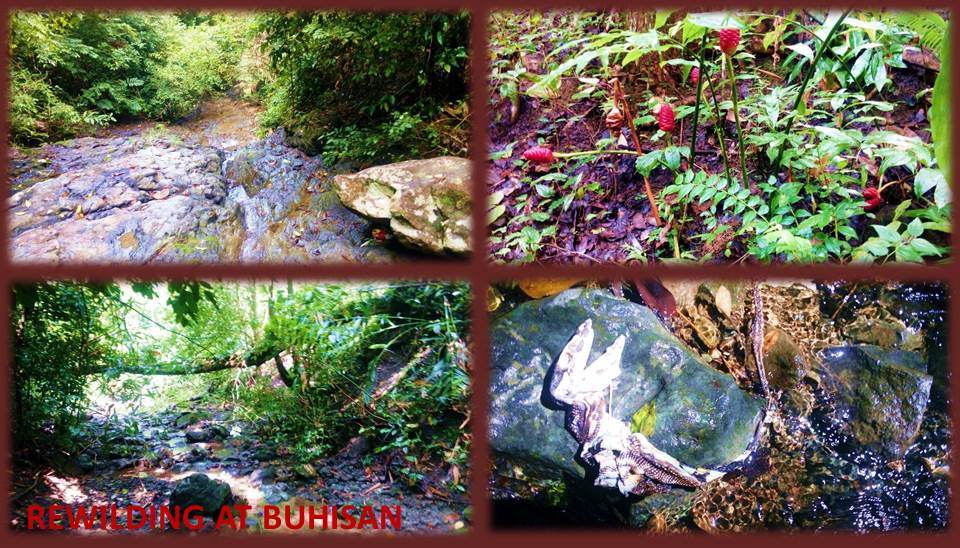
I followed a path that I know very well and the chance to tread on bare ground immediately connects me to sacred grounds. I became one with the forest. Unobtrusive in movement and clothes. Silent like a cat. No hurried steps, no pressure of time. Not even the presence of dark clouds overhead could alter my pace. I am that rare someone who found enjoyment in what I do – alone – even walking on the same trails and places.

My Silangan Predator bag swayed as I struggled for balance when a shoe failed to grip softer ground downhill, exposing my presence to whoever may walk this path. But I doubt that. I have still to meet someone who is brave enough to walk trails on a weekday. Alone. Too bad, everyone is a slave to the system and their time is programmed on weekends only. Cannot blame them. Better that way. I can have all the spaces without them. 

The sun warmed up the forest and steam begins to rise. I am sweating even when I am under shady trees. Wild gingers are flowering everywhere, even within the unwelcoming presence of a Burma teak forest. Long ago, our forest managers eat anything fed to them, planting exotic species, never knowing the troubles it brought to native species, insects, birds and soil. This man-made forest is a failed experiment even if the trees grew healthy. 

Creek Alpha is before me and the stream is full and merry. I followed it downstream, careful this time not to leave any trace. Common sense tells me to evade streams but I find good sense of forest people using part of the stream as a route. They know their own places and I am learning from them. I see where they placed foot on rocks and know what are they wearing for their feet. Because of them, Creek Alpha now has a name: Banauan.

I am leaving Banauan Creek and the phony forest and I am now on a trail in an environment that is much wilder. Presence of spiny rattan competes for your special attention apart from the softened trail. This path is one of the wonders of local knowledge. It simply followed a certain contour instead of cutting across a mountain. It benefits well my walk, rising gently to cross a saddle and going down gently to Creek Bravo.

Just like the first stream, Creek Bravo is also energetic and loaded. On a rock is a carcass of a juvenile monitor lizard which died several weeks ago. This particular stream is teeming with rocks of all ages and sizes, broken up by the force of water. Across me are the groves of water bamboos, fully recovering from wanton destruction five years ago. I have planned of reintroducing fresh-water shrimps here but I just could not source live specimen.

After that brief rest, I passed through an alley where “skin snatchers” abound. This trail is thick with rattan palms and their spiny tendrils, slender and barely noticeable, suddenly catches skin or fabric and you have to respect that. You take a few steps back and slowly remove the spiny whip. My copy of the Puffin Magnum knife becomes useful as it cleared a safe path for me.

The trail climbs up towards a ridge, leaving the marshy areas behind for stable ground. The ridge goes up gently but it is blocked by more rattan palms and by the equally thorny vines of the Asiatic bitter yam (kobong), which got cleared by my open-carried knife. At this instance, I carved a digging stick to extract from the ground a rootcrop from the wild yam which I intend to bring home. The thorny vines make a good hedge against intruders.

The trail led to a very beautiful forest. Both sides are steep but it is much vegetated. It goes up and up, but gently. I arrive a small clearing which I know as my dear Camp Damazo. It hosted recently the 7th edition of the Philippine Independence Bushcraft Camp last June. Twenty-six participants came to learn basic bushcraft here which I first organized in 2011. The PIBC returned here after three years in Sibonga and Liloan.

Settling myself on a cheap laminated nylon sheet, I prepared my Swiss Army wood burner. I intend to boil water for coffee for it is 10:45 anyway. Found dry twigs which I break into short lengths and started a fire by a gas lighter. Placed a cup of water over the rim of the burner and feed more fuel into the burner. Water finally boiled after five minutes and I poured instant coffee. Paired the coffee with bread and enjoyed the moment of silence.   

Camp Damazo has recovered in so short a time, thanks to the rainy season. The campfire area marked by a cairn has settled well and new growths of vegetation begin to reclaim around it. A remnant of a bamboo pot with its lid lies nearby a Moluccan ironwood (ipil) and the stinging tree (alingatong) where a mass of dirt are left by the now missing army of ants after gnawing off clean the leftover rice many months ago.

I looked around the camp area. Madras ginger (galangal) bears little round fruits at the tips of its stems, ripe and drooping to the ground. The yellowish-green fruit became a diet of a passing palm civet (singalong) and left black round scats over a tree root. Tall arbor trees provide second-tier shade and jungle fowls loved to forage there when caterpillars infest the leaves. Much more so with raptors and lesser avian.  

I rest for more than an hour at Camp Damazo. I would have loved to stay here but there is something wilder somewhere over there. I pack my things back inside my bag and proceed to Creek Charlie. It is now 13:00 and, to my estimates, too late to explore more places. But there is a place that I once visited four years ago. I marked that trail but I was wondering what happened of that?

I followed the trail going to Creek Charlie, passing by where an unusually-shaped tree that looked like a brontosaurus, complete with feet, a tail and a long neck. This tree I also discovered four years ago but did not have the courage to approach and take a photo of it. I respect the presence of something other than it. Through the years, I was able to take photos from afar, then point-blank, when I think it is now used to my presence.

I am not superstitious and do not believe in those “third eye” tales, but I am convinced of the presence of these rarely-seen elements. I have seen and encountered many of these kind, even at closer range possible, yet I do not show fear and I let them be as they are. When you are a renewed Roman Catholic you would understand and be aware of their presence but it does not mean that you are impervious from harm.

Vegetation near it was being cleared and a hunter’s shed is being built near the trail, already shriveled, exposing horizontal wood beams that had once supported a roof of abaca leaves and walls of galangal leaves. I looked around where the hunter might have set his sights and I settled on thick debris that was supported by tree branches of the brontosaur tree and its neighbors. It could host a nest, an arboreal hiding place of wildlife.

I could only shake my head. Why would I trouble myself waiting for a prey in an uncomfortable location so I could get off a shot when I could do better with indigenous methods, with myself comfortably waiting in the confines of my home? I would not have to alter the surroundings. The only alteration I make is introducing a cord and using a young sprout to bend to my whim. 

Creek Charlie, I discovered, is part of the right fork of the bigger Lensa Creek that supplied water to the catchment basins, marshes, the man-made lake and, ultimately, to the MCWD consumers. This is a stream of primeval proportions. The rocks are bigger, water fall in cascades. You get caught in a flashflood here and you are dead. It is never a good idea to use this as a route but I know of a trail across me.

It is steep and follow a very narrow ridge, steep on both sides with one side on a deep ravine. The soil on this ridge is soft and it is not good to bring a lot of people here, especially people who do not carry the same mindset as mine. I crossed over another ridge, which can be reached by a short leap. The trail suddenly dies out and I am facing three possibilities, once upon a time paths before these were choked by vegetation.

I choose the marked trail and passed by a hole filled with very clear water coming from a spring. I did not see this before. The jungle is unfolding and showing me things that were denied to me last time. Must be because I am very patient or was it my awe and reverence for this place? I passed by the first of two bamboo groves. Poles are left by a forest dweller on the ground but I place it standing up beside a trunk. I might use this someday.

I am going to my sacred place in a jungle where it faced a distant lone mountain and the rising of the sun. I have bamboos to make a shelter – a sweat lodge – where I can do meditations in the future and be away from the complexities of urban living. It is there among giant figs (tibig and talo-ot) with buttress roots as tall as a man. Then I saw movement. Timid, confident and unafraid. Brown fur and a thick tail. Squirrel?

The Philippine squirrel (kangsi) is a very elusive rodent that is common in Palawan. But on my visit to Mount Pangasugan in Leyte last March 2014, my guide showed me a live one staying inert on a branch from a distance of about 50 meters. I could only see a brown smudge among the greens but its shrill whistle pierced the early morning air. You would think that the noise they made were done by birds.

I believed Cebu was part of its habitat when it was still all forest and too few people claiming farm patches. In case you do not know, there is a place in Sapangdaku Creek and everywhere in Cebu that are called Kangsi or Kansi. Nobody remembers why it is called that but I know why? The creature I saw disappeared among the roots and I found holes underneath it, the entrances are well used, indicating a healthy family.

Yes the forest is unfolding and showing me its hidden features. I am quite satisfied of my finds that I did not tarry long. I found my sacred place and the second bamboo is still untouched by humans. I go back to where I came from and crossed Creek Charlie once more. I take another trail to drink from a natural spring called Karamon. I crossed the headwaters of Creek Bravo and Banauan Creek towards a mountain road.

Across me is a trail that goes to Lanipao. It goes lazily downhill to the Lanipao Rainforest Spring Resort, Cabins Resort and a store that sells cold soft drinks. Walking on, I found another recreation center – Motmot Spring Resort – that was not here last June. Not only was the forest unfolding its secrets to me, it also include this road to Napo. So much for mysteries. Ha!

Document done in LibreOffice 5.3 Writer

Tuesday, April 26, 2016

BUSHCRAFT BUHISAN XXXV: A Family Affair

I RARELY HIKE ON a weekday for I have a day job, unless, of course, if a guest requests me. I have done that on a few occasions and today, August 4, 2015, is one of those days. I would never say no on a good offer and never says no as well if it interests me at all even without getting paid for services rendered. I do part-time wilderness guiding – not mountain guiding.

However, neither of those conditions have forced me to be absent from my workstation today. It is for a different reason and I considered it as urgent. Relatives from Guam whom I have not known or seen in person since existing in this world came to visit their Cebu connection. My family put on their best foot forward and accommodated our visiting relatives.


With me is my second cousin, Neil, and his eldest daughter, Cami – my niece. They carried the same surname as I have and it is a good moment to establish good bonding time. I would never say no to them and never would say no to occasions such as this. Not even Super Typhoon Hanna, which just entered the Philippines, because I have committed this day for a hike in the woods.

We used my brother's red Suzuki Scrum to transport us to Guadalupe so I could buy food ingredients for our meal later on and then going to the trailhead in Baksan. The ground is wet since it rained early dawn precipitated by the coming of the storm. Surely, there would be a lot of slippery spots. Times like these make me very careful, not for myself but for those coming with me. The tempo of the walk is deliberate and slow.

When in that pace, I could see everything and I could talk a lot to my guests. I always talk about the plants because those are the very first things you will always notice and then the insects and animals. Next would be the names of places and the woodlores. Keeping guests entertained and informed is what distinguishes true outdoorsmen from another set of “outdoorsmen”.

The stream is clear and swiftly weaves among its chosen channels where it had carved for many years. The sky is cloudy with wefts of sunlight escaping from among its most porous parts. There is an ominous silence save for the cicadas (Local name: gangis). Old folks say that when these are noisy, expect no rain to fall. I half-believe that but, just the same, it is entertaining to the ears of guests if you tell these half-beliefs to them. Now that is woodlore.


Underneath the tall canopies of trees, the jungle is very dim. I follow the trail as we ascend the stream bank. We would be walking now on higher ground. The path is not ascending but it follow the contours of a mountain and Neil begins to ask how do I keep myself from straying. I do not in my turf. I mark a few trailsigns though where there are crossroads. I point to one and he understands.

The richness of the vegetation enlivens father and daughter as I name each plant which have uses and each plant which they would have to give a wide berth. Rattan is one and a stinging nettle (daw-daw) another one. Both grow low to people's height and touching each would cause you either cuts or skin irritations. Pace is controlled. I picked up a straight stick on the ground and passed it to Cami as a walking staff. I can see she walks better with it.

We go down another stream and we rest here. However, I have to do something. I have to climb a high bank where groves of water bamboo grow. I have to find a dry piece of bamboo pole. There were a lot of discarded poles left by forest gatherers a year ago which I kept off the ground hoping it would be useful someday. I found one and carry it down. I would use this later for an impromptu firecraft session.

We now ascend a trail to the ridge. I show them another plant that is harmful to a touch if you go careless and this is the Asiatic bitter yam (kobong). The path is lined with rattan but my eyes also scanned what is above us. Dead branches are also my concern. You would not know when it would fall down, would we? I take time with my pace so as not to overwork Cami and Neil.


I arrive at Camp Damazo and inform both father and daughter that we will stay here for a while. I need to boil water for coffee but I have to leave them so I would get water from a natural spring which would not be far. There would be mosquitoes and ants when they sense our presence. It would go away when you have a fire but we have no fire yet. I have an alternative though so I pluck leaves from a common floss plant (hagonoy) and teach how it is used.

I rigged my Silangan hammock – the ones with a mosquito net – should mosquitoes becomes unruly. I laid a laminated nylon sheet on the ground for Cami and Neil to sit on and got all the pots and bottles out. I prepare a tripod of sticks that I will later use in cooking our meal. It is 09:15 and we are early. The cicadas are noisy as ever. I left them bringing along two empty water bottles and my empty Zebra pot.

I go back to the camp and produce a Trangia alcohol stove and start heating another pot after I transfer contents from the Zebra. Then I get my fire kit. It is just an assortment of “garbage” that ordinary people stepped over or walked past without any idea what it is and are its uses. When you are into bushcraft, these things matter.

I show Cami how to work out a spark from a ferro rod. She tried once, again and again and it did not spark. She tried it forcefully and small sparks came. I show how it is properly done then Cami worked it like magic. Now time to choose firewood. I tell here that the best firewood are not picked up from the ground but those that are above the ground and these are small. I told her a story about fire made by a Native American and the ones by a white American and she chuckled.

The process of obtaining dry twigs and small branches begins and then converting it into pieces which are very easy for a nascent flame to feed on. Neil produce some tinder by scraping knife on a mature bamboo surface and form it into a loose ball where Cami directed the sparks of the ferro. Meanwhile, the water boiled above the Trangia and I mix instant coffee on a metal cup for Neil and Cami to savor on. I pour mine on a metal dish and enjoyed coffee that way.


Showed my best tinders for Neil and Cami to ogle upon: a tuft of kapok, shrivelled Spanish moss, coconut husk fibers and hair-like sugar-palm fibers. For me, they are my time-tested tinders that could catch sparks. And then there is the charclothe. Stored it all dry to through many layers of plastic aside from the green Triton dry bag.

I left Cami to practice with the ferro rod while Neil coached her. I prepare the rice inside the Zebra, for any moment we will start the cooking. A smile crossed Cami's face as she worked an ember on a charclothe and blow it on a nest of mixed tinder. There goes a thick smoke and a small flame. Quickly, it is placed underneath a teepee of twigs. The Zebra with the rice is now hanged from the tripod with a special hook.

I could now start slicing the pork meat, onions, garlic and those long green peppers. I show them the trees around Camp Damazo while waiting for the rice to get thoroughly cooked. I have trust on the Zebra as it is really an efficient pot. Neil looked up at a huge tree and asked for its name. Moluccan ironwood (ipil). Beside it is a small tree but you better keep a wary eye on it because it is the stinging tree (alingatong). It is harmless since the foliage are now a bit high.

I replace the Zebra with the already cooked rice with a battered pot with cooking oil in it. The fire is fed with more wood as the tell-tale pops of the cooking oil approaching boiling point is heard. I pour the sliced garlic, then all the sliced onions. Stirred it until onion gets soft. Two-thirds of the sliced green pepper are mixed to the aromatic concoction. A few minutes after, the sliced meat are dropped and stirred. Then I add soy sauce.

Neil and I talked about knives and he brought along the ones I have given him – a prized ginunting from Albay and a small Seseblades sinalung. He collects knives and he preferred Philippine traditional blades. He is with the US Air Force and travels with his unit anywhere. On the other hand, Cami is an accomplished sport dancer. She had snared top honors in international dance competitions in Barcelona, Rome and Las Vegas.

I go back to my cooking and poked the meat texture. A few more minutes and it should be done. Now the meat is tender, I pour the last of the green pepper as garnish and drop a few black pepper powder into it and left it to the fire for a full minute. The pork adobao is now ready for eating along with the rice and we eat in silence which is broken, time and time again, by conversations. I make a pair of bamboo chopsticks each for father and daughter while I settle for a fork when I notice I failed to bring a spoon.

The pots were literally cleaned off of their contents. It was a good meal considering we have limited comfort and too few hours to get a good opportunity of cooking from a very threatening sky. The slightly-spicy pork adobao was appreciated very much by Neil and Cami. It was cooked with the right frame of the mind. I place water on the pots, cups, metal dishes and, for a purpose, leave it be for a while.

From a piece of mature bamboo that I foraged earlier, I split it into two parts. I will show Cami how to make fire by rubbing two pieces of bamboo together. Although air is humid and misty and the bamboo is partly wet, I will try to show to Cami how this works. The most important thing is teaching Cami the process of making the bamboo into a fire tool. First, make a notch on one piece then scrape its hard skin back and forth for tinder.

The other piece would be the “saw”. I smoothed one edge so it would fit on the notch of the other. Place the tinder bundle on the inside of the notched piece and keep it in place with a thin bamboo strip. Either you place the notched piece on the ground where it gets rubbed by the other or you place edged piece below the notched piece where it gets rubbed. Showed her how it is done. After several drops of sweat rolled from my forehead, I got smoke. Then thick smoke. And that is all. No fire. I am exhausted. Skin of one finger brushed against ground. Pain!

It was a nice try despite drops of sweat and dew over the primitive fire tool and Cami is delighted at the sight of the real thing which she probably had seen many times in the Internet. She tried the native contraption but one bamboo piece broke in two. I would have made another piece and try it one more time but the sky says no. Drops of light rain are beginning to fall over the forest canopies. I pack the things into my Lifeguard USA rucksack and take the exit route.

The rain is for real now and no half-beliefs about cicadas could stop it. It made the ground more dangerous but, as always, I take charge of the pace. The route climb up a steep stretch and I have to wait for father and daughter to catch up and let them take rest. We have a luxury of time. Cloudy skies made the lighting dim as if to give impression that it is late and would have made another impression on the brain to dictate the body to release adrenaline so we would increase our pace.

We reach the road at 14:15 but across us is a trail to Lanipao and it is all downhill and easy. This time the rain fell at a greater intensity. The trail became a small stream and I have to check always my back trail for telltale signs of rushing water which are most probable in mountainous areas especially if there is an occurrence of a landslide. We trod on the side of the path instead where there are grasses.

We stop for a while at a place where there are midget coconut trees. Neil needs a coconut palm. He is onto something. I choose a healthy frond. Neil split the palm into two and counted something like fourteen midribs each piece. We carried the leaves to Lanipao then to Napo. The rain had not abated and the Sapangdaku Creek had risen a little and can still be forded by using a technique which I learned and developed on my own.

We walk on the asphalt road to where the Suzuki Scrum would rendezvous us. It arrived at the right time on the road corner leading to Baksan but we are now going to Guadalupe this time. We are all wet to the skin but it does not matter. The Suzuki proceed to Mandaue City to drop both Neil and Cami at their hotel. Neil talked of giving me a surprise with the coconut fronds when we meet again in a few days. Cami is elated at the chance to hike in my hidden jungle which she captured all with her camera.

It was a good time to know my relatives from Guam and them about me. Even more than what they knew me doing all these things in Facebook. I am what I am and I am proud to be a relative.


Document done LibreOffice 4.3 Writer

Wednesday, March 16, 2016

BUSHCRAFT BUHISAN XXXIV: Jungle Kids

MY BODY IS NOT working at its best, yet I have given my word. Regardless, I have to honor a walk in the woods today, June 28, 2015. This is the first hike that I would take after two Sundays where I gave myself a break. I needed to be back to the mountains right after convening the fifth edition of the Philippine Independence Bushcraft Camp that was hosted by the Municipality of Lilo-an, Cebu.

I wake up at exactly 05:00 and begin the process of transferring the things that I had arranged so well inside the Lifeguard USA rucksack into the bigger Silangan Predator Z tactical bag. I start to sweat as I was doing this although the morning is cooler than I had expected because of the early rain. Having settled that after almost an hour, I switch to the bathroom.


It was a quick shower and, I noticed, I am still sweating. Nevertheless, I change to my outdoor apparels and off I go into the street. I arrive at Guadalupe and I am glad to see familiar faces. They are all from the Camp Red Bushcraft and Survival Guild and four of them had just finished the PIBC. It is a good opportunity for the two of the four to see the environment reserved for bushcraft. The real world, I mean.

I also happen to see two new faces and three minors. My mind begins to calculate the risks of the route in relation to a child's view. It would be a long walk though but warmth would be out of the equation. I may have to slow my pace then and talk a lot of things that may catch interest to a child. It is a good idea to expose children more often in the woodlands instead of being wired to an electrical outlet.

The first route will be Bebut's Trail. We climb up a series of high steps to get there until we are onto a ridge that cant upwards towards Banawa Hills. This meant we have to pass by that dreadful “Heartbreak Ridge”, which is not dreadful at this moment since it is going to rain. I hear whispers of thunder from somewhere beyond the horizon and I see rain falling hard on Bohol Strait. It is very far but the southwest winds (Local name: habagat) is pushing it nearer to where I stood.

We walk past the power pylon and take a rest at the tunnel vent constructed by the Japanese during World War II. Those that visit here the first time wondered at the tunnel's presence and asked about its length. It is a piece of history and I hope that this abomination called Monterazzas de Cebu would not touch this place like those they recently done on the adjoining hills.


The steady climbing towards the crest of the hill gave in to the steady downhill into woodland which the first-timers have not thought of as existing. Everybody, especially the kids, are sweating hard. Along the way, I show different plants that are edible and those that are harmful and gave meaning of why they joined. The density of greens and the number of trees overwhelmed the young ones.

We stop by a small community to study the hosting of an outreach event. After ten minutes of talking with the locals, we proceed on to the road at Baksan. The road, which links the village of Sapangdaku to the villages of Pamutan, To-ong and Buhisan, is now concrete. We go up the road and somewhere up ahead we will bury into the forest again. The second route would be Lensa Trail.

The trail is good and a better improvement than the last time I was here, which was last March. That time, it was very warm and the vegetation had wilted but I did it twice. We follow a small stream, which turn out to be Creek Alpha. It now has running water and it leads to the old Camp Damazo, the site of the first PIBC. It starts to rain but not that strong. I guess the kids needs to rest and we stop to prepare our meal.

Rain had soaked dry wood and tinder. Finding dry ones under this condition is quite tricky but the guys know where to find dry ones. They learned that by joining the PIBC. Ernie Salomon, the veteran camp cook, takes charge of the cooking. He asks people help and, instantly, all lend their hands to assist him. A smoky fire begins to appear while the food ingredients are getting processed for cooking.


Another set of guys begin digging a waterhole. It is dug on the stream bed. The water go foggy but, in a little while, it will go clear. I line the insides with pebbles. We will use the water later on for washing. Meanwhile, boiled water is now ready for coffee. I get my cup and proceed on to enjoy my coffee. Coffee never tastes better to a man deprived of the urban comforts than in the outdoors. I wonder why coffee companies do not exploit outdoor conditions in their commercials? I am willing to model for them. Ha!

A tripod is raised and a pot is hanged over the fire. Rice. Conversations echo along the small stream as Ernie begins the preparations of making spring rolls. Cooking oil are extensively used to cook the rolls. Rain continues and people shield the cooking and the fire with banana leaves. Jhurds Neo, forage small stems of crawling bamboos (bokawe) and used these as skewers for sliced pork. I believe there will be pork barbecue. The sweet aroma of fatty oil teased my nostrils as it touched ember.

The light rain causes much difficulty on the cooking. A tarpaulin shelter is rigged to keep the young ones from the rain. By 14:00, lunch is now ready. Fried spring rolls and pork barbecue are doubly tasty when you eat it two hours after twelve noon. All partake of the meal evenly. The children eat silently as the light rain numbed the conversations to the background. It is typical jungle condition made bearable by a good hot meal.

Slowly, we clean up the place after packing all the gears that had been used. We left the water hole as it is. I pick up my water bottle half immersed in the stream. Water inside gets cooled and I drink some of it before stowing it back to my rucksack. We will take the rest of Lensa Trail and leave the old Camp Damazo. I lead them to this nice path that had not been seen by people outside of my sphere. But I doubt that.


A lot of people read this blog. They would love to be in my shoes. Who would not? I gave people inspiration by writing many articles where the readers felt as if they were the ones engaging on these activities themselves that I regularly wrote about. It wakes up the adventurers and the explorers in them that they have thought long ago that they are not capable of. I use my blog to compel people to visit the mountains, make children happy, initiate charity and incite locals to protect their environment.

However, as much as I would like people to engage in the trails and places that I always talked about, there are a few places that I wished they would not try to visit. One such place is the one I called as “the last wild place”. It has a name but I rather not mention it so people would not go in there and hurt themselves or despoil its environment, whichever. It does not mean that I do not trust your education and your morals. It is just not meant for recreation and I rather it stays that way.

We reach Creek Bravo and we rest. The boy and the two girls are affected by the rain and the humidity. The trail would be ascending after here. I will have to go slow and engage them in conversations to distract their feeling of discomforts. My conversations would always touch on the plants and the most common birdcalls. When we reach the top of a ridge, we rest. The kids are winded, tired and seemed to want this activity over quickly.


We follow the thickly-forested ridge to a hill and then another ridge to a much-wider hill. Camp Damazo at last! Of course, I did not tell the guests that it is. To those who started their love for bushcraft, like Jhurds and Dominik Sepe in 2012, it is always a sweet homecoming. Found this place in 2010, on the heels of a forced march to civilization after a day of exploration where I was to choose four trails running on four directions. I choose east...and here.

We rest here, sitting where it is inviting to our flesh. Someone brings out his alcohol stove and paired it with a pot of water. Aha...coffee break! The magnet of interest has overtaken me and I make ready my stainless-steel cup. The rain had ceased but it invites live mosquitoes in its wake. One guy burns dry twigs and smoke begins to chase mosquitoes away. For a good thirty minutes, we just sat and talked and enjoyed our coffee.

Then it is time to move. The kids had recovered slightly but there is still a steep route that we need to climb at after crossing a small stream. It is not that hard anymore for the kids for others carried their things. All they do is to make sure that they do not slip. I did. My 5.11 Tactical shoes had already seen the start of its ending in a near future. I try to make do by timing my steps slowly on surfaces which I think are slippery.

We reach the road and the kids heave a sigh of relief. So it may be for others that I have not had the opportunity to observe. Well, the path across me is all downhill and so easy. Just make sure you do not get chased by dogs since there are settlements along the way. It is now 17:30 and Lanipao is just beyond.


Document done in LibreOffice 4.3 Writer

Saturday, August 1, 2015

BUSHCRAFT BUHISAN XXXI: Baptism by Water

TROPICAL STORM SENIANG IS approaching but I liked the way it is behaving.  It is moving too slow.  I can go on among the mountains unperturbed today, December 30, 2014.  In fact, my enthusiasm led me to rise up early and be the first at the assembly area, as it had always been, on the parking lot of the Our Lady of Guadalupe Parish.  The sky is still in semi-darkness at 05:47 and the cold wind stung as I sat alone on the makeshift bleacher.

The activity is a Year-Ender Hike, the last activity of the Camp Red Bushcraft and Survival Guild for 2014.  It is just a dayhike but it demands stamina and patience owing to the challenge brought on by a wet ground caused by rains for the last two days.  This morning, the sky is dark and cloudy and rain is ominous.  It is windy.  A good sign that the weather will be fair.  There are two options for the route depending on the number of people.


By and by, Nyor Pino – a resident of the island city of Lapulapu - arrive after ten minutes.  He has discipline and commitment and arrived almost an hour before the next person – Jhurds Neo – a Cebu City resident.  Then all came, just a few minutes of each other:  Jonathan, Justin and and Jon Daniel Apurado; Boy Olmedo; Aljew Frasco and Christopher Maru with guest Bona Canga; Mark Lepon with guests Rommel and Nelson.  Last to come is Dominic Sepe.  We are fourteen in all and I will choose Option B of the route. 

We left Guadalupe at 07:30 after procuring ingredients for our noontime meal.  We will tackle first Heartbreak Ridge but there will be no heartbreak tales today since the weather played into our wishes.  I take the lead and deliberately make my pace slow to accommodate the newcomers and the slow starters.  For the same reason, it is best to take it slow since there will be slippery parts.  

This activity is a preparation of sort for my scheduled training which I imposed upon myself starting next week next year (January 4, 2015), which is also in preparation for the Segment 3 of the Cebu Highlands Trail Project.  Part of my preparations today is to test my newly-purchased 5.11 Tactical Series Shoes.  The wet ground with its slippery spots would be an interesting challenge for the new pair, which actually were provided for by a sponsor.

Anyway, I also see Bona wearing a new pair of purple Merrell hiking shoes.  She would also get to test it on the proving grounds of the Buhisan Watershed Area.  Yes, the Buhisan is a good training ground, especially at its wildest parts and along its many small streams.  It is there where shoes gets its real baptism by water.  The stream banks also make you think where to place a foot and then use another muscle group that you would not do while walking on plain terrain. 

I keep looking back to Bona since the time I started to ascend the terrible heartbreaking piece of hill as it would be her first real hike.  Although she had one last week during a charity event on the other side of the Babag Mountain Range, it was nothing compared to this.  When we got past the tower and resting above a tunnel vent, I am quietly relieved that she had hurdled the first step.  Uphills are hard but going down a trail on wet ground is different.  That would be her second test.


After we had overcome the hill, the trail goes gently downhill.  Polished limestones are, by my previous experience, do not work well on some type of rubber.  I found the 5.11 shoes doing very good here.  I even deliberately stepped on exposed coconut roots which had previously left me staggering on another pair.  I could not hide my amusement but, altogether, kept it to myself.  I hide the smile when I look back to see how the good lady is doing with her Merrell.

The terrain goes into a man-made forest of fruit trees with wild shrubs growing in between.  I reach the Portal and I wait of the others.  Ringing around me like wheel spokes are seven trails, three of these are getting wilder and wilder as the uninterrupted rains after a 2010 drought had given the vegetation some good reason to live on.  Aside that, my visits to these trails are now few and far between.  

Since we are more than ten, 14 to be exact, I will take Option B.  That is Lensa Trail and it cuts around higher ground so the chances of walking on the streams of the watershed is out of the question.  However, there is a hindrance to that.  I have to make sure that I will not overlook the marker – a young fish-tail palm.  Failing that, it would lead me to a false trail going down to Banica Creek which I am doing now.  Option A wins!

I had created a path through this thick jungle last March but it got overwhelmed by the same jungle.  As I had done the last time, I begin slashing the spiny plants that are blocking the path with the AJF Gahum heavy-duty knife.  Behind me is the creator of the knife and I could feel his satisfaction and approval.  He had loaned me this knife for testing in the real world and it is with me ever since.  The Gahum is the prototype of his succeeding creations but it is the only one of its kind.

There is no landmark to keep track of but there is an unseen stream beyond.  The arc of my slashes are short confined only to the harmful ones and, even as I am doing these, I get snagged by those that I had overlooked.  The ground is soft and steep but we hold on to trunks or branches and, sometimes, rattan vines if we have no other options.  I get some scratches on my arms and my t-shirt begins to look like a miniature battlefield.

The sound of the stream is getting nearer and nearer and my frown begins to lose its intensity.  I touched base at Banica Creek and come to gaze at a big rock which I had seen during my first visit here in 2009 and which appearance gave me an inspiration to seriously shift to bushcraft.  It is on a confluence of two small streams and still retained that primeval look, the only difference this time, is the streams are now full of water.


We walk carefully downstream.  Our eyes cast on the polished stones and mossy rocks.  We left a lot of shoe prints on the sand and on moss.  That is why I do not want to bring a lot of people on the streams for this reason but, what can I do, I missed the trail sign!  And there are many other reasons aside that like wayward bullets from hunters, sudden floods, accidents and personal necessities.  

It is gloomy walking on small streams since the banks are narrow and covered by trees and gloomier still when when you pass by a marshy area with trees reaching high at two different tiers.  Once everyone sees that wide-open catchment basin, they let sighs of relief.  Some are tired now and craving for something hot like coffee.  Not here but upstream.  At a place where two streams meet.

We set up our AJF Folding Trivets and prepared our cooking fires on a flat rock located just a little downstream of the merging of the two streams.  Just perfect.  We have brought two kilos of pork meat and we intend to grill it over coals.  The trivets would support the pots for coffee and rice.  The coffee came first and we savored the liquid. 

I take time to explore a trail that I have eyed for some time.  Vegetation is thick and the trail begins to disappear but I follow the gist of the terrain and come upon an abandoned camp used by poachers.  It is small but it is flat and could accommodate a single tent and four hammock shelters.  The faint trail move up to higher ground and I see an even better campsite.  I noted these places for it is perfect for a “Survival Day” activity.


When I returned, two pots of rice were ultimately cooked and fresh fern tops were blanched and mixed in to a spiced vinegar concoction and becomes the grilled pork’s companion in a late lunch by the riverside.  Everybody enjoyed a full-sized slice each of grilled pork and an almost bottomless serving of rice.  Finally, the food gets decimated without a whimper. 

I washed my black-bottomed pots the traditional way with rough sand and free-running water on the stream.  We clean the place but we leave the ashes.  Believe it or not, there are birds who find ashes a very favorite ingredient for their grooming.  Drops of rain begins to fall now, turning what had been a gregarious setting into a gloomy state again.

I take a trail found on a headland and the rest followed.  We weave among mahogany trees and pesky rattan palms.  The path near the waterfall is deteriorating and it is not a good path right now since the side facing the waterfall is very steep.  Everyone walk very carefully until we reach the stream bed.  I look back how Bonna fared and she managed it without difficulty.  Good God, she is a gutsy lady!

We follow Lensa Creek and I see the twin logs which marks Creek Alpha.  We walk past it and proceed upstream and reach Creek Bravo.  Sunlight peep from the clouds and it restored my confidence.  Probably, it would have the same effect on the rest.  I follow Creek Bravo and switch to a trail that ascend to Camp Damazo.  It is a moderate ascent but it is a good path.  We rest when we arrive at the old camp.

After a group pose before cameras, we resume our homeward trek.  After crossing a small creek, the route gets a bit steeper and longer.  When we got past that we cross another small creek and the path winds up to a road.  We cross the road and walk down a path going to the community of Lanipao and gets our thirst quenched with cold soda drinks.  The remaining kilometers can now be walked on a paved road and it goes to Napo where we found motorcycles to ride.


I had assessed that the 5.11 shoes I acquired are good enough on terrain I choose which posed a difficulty provided by jungle and streams.  It is kind of easy on wet limestone but some polished stones and moss-coated boulders are places which need to be stepped less.  It is ready for the big adventures ahead.  The Merrell which Bona recently bought is, according to her, are comfortable and had given her good footing on the same places where I had walked.  


Photos courtesy of Mark Lepon
Document done in LibreOffice 3.3 Writer

Monday, June 1, 2015

BUSHCRAFT BUHISAN XXX: Dog-Weary

I NEVER LIKED TO ORGANIZE anymore and involve a lot of people in any outdoors activity, except when it is the Philippine Independence Bushcraft Camp, an outreach event or an outdoors seminar which would increase the knowledge of people about outdoors safety. I do not want to put a strain on myself in managing a big group of people without any tangible benefit for them except the opportunity to enjoy the outdoors. They could do that for themselves and they have the cash to do it anywhere.

Neither would I liked to bring a lot of people again into the Buhisan Watershed Area for the simple reason that it is a protected area. The Buhisan is the source of drinking water for Metro Cebu residents and I do not want to despoil their water source because I insist to do my dirt time at the streams and on the catchment basin. Nowadays, I just bring only a handful of people and I feel comfortable with that even if we are walking on the streams.


Today, October 12, 2014, I am organizing an activity for the Camp Red Bushcraft and Survival Guild. My route would just be short and it will intrude into the seams of the Buhisan with a planned short lecture at Camp Damazo. I believe, some members of the Cebu Mountaineering Society would be joining us. I am worried because the number of people coming would not be appealing on my part and that they might also find our methods displeasing.

I am at the parking lot of the Our Lady of Guadalupe Parish waiting. One by one, they came. From Camp Red: Jhurds, Jerome, Nelson, Ernie, Glenn, Dominik and Justin. Jonathan, Justin’s father, tagged along. A rough cut, Mark, came with wife, Marisol. We are eleven. From CeMS: Boy T, Boy O, Mon and Aldrich. Apart from them, they have two lady guests from Bacolod – Jo and Ping. Six people are with CeMS and we are seventeen in all. Good God, too many!

I may have to accommodate the presence of people from CeMS since they are already here and that means I have to tone down a bit our dirt time. Aldrich, whom I had not seen for some time, is now based in Papua New Guinea. He had been with me during that great traverse hike in Bukidnon, from Lantapan to Impasud-ong, which scaled both Mount Dulangdulang and Mount Kitanglad, the country’s second and fourth highest peaks, in three days of 2008. He is on vacation together with Jo and Ping, who both are nurses working in Saudi Arabia.

Boy T, Boy O and Mon are quite familiar with Camp Red activities since they had joined us many times. Anyway, when all had arrived at the parish grounds, I gave all a briefing. It is about the special concerns of a watershed area which an individual may have to observe and respect. I state out the rules and I am very strict about this. I also apprised Aldrich, Jo and Ping about the way Camp Red people conduct their activities that might ran contrary to their belief of the Leave No Trace, granting that they are aware of it. All understood very well why we open-carry our knives. Good!

Having resolved the foregoing issues, I decide to lengthen the route and walk on high ground. We would tackle “Heartbreak Ridge” first before proceeding to Baksan. I would ensure that Aldrich and friends will be satisfied of the exertions for this activity and will have a memorable weekend. We start our hike at 07:30 right after procuring the ingredients for our meal which we will enjoy later at Camp Damazo. The weather at this early stage of morning is very mild and would greatly help the participants overcome this ridge, which had been notorious to many.


The ridge is now home to many dumps of garbage since the time informal settlers claimed the lower part. There is now a community where, before, there was just a plot of corn and a cairn. I see an empty bottle and I pick it up. Walking on, I see a lot of broken glass. I collect this and placed it inside empty foil-like junk food pouches. I cannot imagine a boy getting lacerated on the foot while flying a kite like I did in my early teens while pursuing a basketball on thick grass. Picking up broken glass and whole bottles is now my advocacy so our world would be a little safer.

Meanwhile, two of my guys bogged down in the middle with one raising the white flag. We have one guy less but sixteen people to look after is still a lot. Mon, Aldrich, Jo and Ping, whom I thought would suffer from the initial ascent, made it. I wait for the rest at the top where forest cover are a few meters away. It is now 09:30 and a lot of time are wasted where, at this hour, we would have been at Baksan. The sun exact its revenge after an hour of being covered by clouds. It will be very hot soon.

The shades afforded by forest cover have soothed the frayed nerves caused by that hike on heartbreak ridge. The air is cooler, the leaves are wet, the ground soft with a lot of bird activity. I see, on three different occasions, hunters with rifles. They are on the prowl today but I am worried of those that I have not seen yet because they would also never know our presence. I scan people’s clothes and bag. All Camp Red people wear clothes and carry bags with earth tones and they blend perfectly well. What I want is someone who would stand out. Aldrich’s backpack cover fits that. It is neon green!

We reach the Portal but we just pass by it. We proceed instead to a house where we used to fill up our water bottles. The minutes are ticking. Temperature slowly rising. We will feel the heat once we reach the road. We work our way among the small community of Baksan into the road. The school that had been burned in 1984 by the New People’s Army gets the attention of Jonathan. He used to ride a mountain bike on this very road and he always sees the skeleton of the school when the place was yet bare of trees. The road is now concrete and heat bounced off the surface adding to the discomfort of glare.

After an uphill walk on the road, we go down a path towards a shady clearing underneath a mango tree. Here, I briefed again the mixed group. Wooden sticks becomes relevant. It is now 10:15 and we still have a long way to go. We climb up a ridge and switch to another ridge. The grasses are tall and healthy. Birds are always absent inside a teak forest. Their wide leaves kill neighboring trees and the heat under their shades are oppressive. We walk past a saddle and into a low hill. This hill used to be Boy T’s nightmare and the name stuck. It became the name of the hill and it is now tabbed in my map as Boy T’s Hell. Mon provided me the altitude at 275 meters.

When we got past the hill, the route goes down steep into a stream. I saw my trailsign and we go down a path that had been first created during the PIBC 2013. The ground is soft but the vegetation had not claimed back the ground made bare by the passing of several feet. We reach the creek and I immediately immerse my meshed shawl with water and wipe it on my face and nape. The coolness of water from the stream brought some comfort. Everyone converge on the stream that I designate as Creek Alpha. I think this is the best time to drink coffee.

I retrieve my set of blackened pots, fill it with water from the stream. We use a butane stove to boil water quick. Those whose drinking water getting low availed of the portable filters provided by Jerome and Jhurds. You just sip from the running stream with the straw and it saves your water inside the bottle from being used. When coffee was available, everyone gets a serving. Although hot, it soothes out thirst and it peps up your strength and your sagging determination. I took a second steaming cup for good measure. We boiled the pork meat so it would not spoil. We leave Creek Alpha at 11:00 for Creek Bravo.


I hasten the pace but I warned the rest of the presence of rattan palms. Stones and tree roots are slippery and I begin to feel fatigue. I just ate three small bread as breakfast at Guadalupe many hours ago and now it is almost noon. My gut needs nourishment although the two cups of coffee I enjoyed at the stream had given me a brief respite. I reach Creek Bravo and rest for a while to wait on the rest then we go uphill. My pace is fast as I stepped on stones and tree roots intending not to leave my mark on the wet yet still scratchless ground. Once in a while, I look back to take note of the weak link.

It is 12:45 when I finally reach Camp Damazo. Oh God, I am tired. Despite it, I begin to collect the wooden staffs and make a tripod. I lashed the sticks with vine over a pile of tinder, kindling and twigs that the father-and-son tandem of Jonathan and Justin prepared for a fireplace. Quickly, I retrieved my blackened pots with its contents of boiled pork meat and disposed it under Ernie’s care and parted some of my foraged tinder to make fire-making easier. Jerome erected another tripod tied with paracord above another fireplace which Jonathan and Justin also gave life.

Dominik and Mark teased another fireplace to life for cooking pork barbecue. Everyone are exhausted by the ascent, by force of a pace imposed by me and by the tantrums of the gut. What better way to feel relaxed is to just sit still and recover your wind, then change into dry clothes. Most just go on with life, help in the cooking, collect firewood or talk about knives. Jhurds arrived with an armful of dry twigs while Nelson walked behind him with another armful of dry wood. Mon lent his butane stove to provide more option to the cooking. Jo and Ping engage in a conversation with Marisol when not taking photos. Mark and Aldrich collect all empty bottles and refilled it at a natural spring.

Jhurds set up his Silangan “stealth hammock” complete with an overhead taffeta shelter inside the forest. I lay on a stone underneath the hammock and try to sleep but mosquitoes hovering near your ears became unbearable and I transferred near the fire but away from direct heat. I splay a matted nylon sheet and pretend to sleep. A dog sat beside me but I ignored it. Aldrich joined me on the sheet. Later, snores from my neighbor woke me up. I gaze at the treetops and see a native pigeon attracted by the smell of our cooking. Something big moved beyond the tops. A serpent hawk. It floated in circles.

My vision is blurry yet I could still mark fine details if I had to and that means I have to strain my eyes hard. Blurry vision is a sign of fatigue. It is like someone placing fine sand in your eyes. I blink many times to adjust focus. As time goes by, my vision cleared, but it is not a good time to read something on paper. I am supposed to do a lecture here but my eyes are uncooperative. The discussion is about “Blend, Adapt and Improvise”. I am discussing this subject matter for Camp Red and is taken from my e-Book project titled ETHICAL BUSHCRAFT. Somehow, I have to postpone this. It is good to be sensitive.

By now, cooking is almost over and food will be served in a little while. Fresh banana leaves are frayed over the fire and it will soon host the food. The grilled pork are already sliced and are now placed over both cooked rice and milled corn. The salmon belly soup (Local: tinola, tuwa) elicit a lot of stares from all. Who would have thought that Northwest Pacific salmon could be cooked in soup, Filipino style! Give credit to the camp fixer, Maestro Ernie. After the mixed-vegetable soup and fried anchovies got cooked, our delayed lunch began at 14:00.


I pounced immediately on the salmon soup and slurp its life-sustaining taste. Bon appetit, mon amie! I was starving but I am feeling better now. Took another serving of the same soup mixed with milled corn and now my stomach felt something tangible inside. I took a third serving of the soup mixed with milled corn again. The rest picked on any viand they choose to eat and they all milled around the banana leaves on the ground. Everything was consumed except the banana leaves. When the meal is over, I collect my pots from “no man’s land” and I proceed to Creek Charlie to wash it there. Justin came along, then Nelson.

My wife kept complaining why my pots are dirty and why does she has to clean it all the time? I do not wish to bother her tonight when I go home. I line the three pots on the stream bed and place water in it to soften the food morsels adhering inside. When the food got removed, I throw the waste water far away from the stream. With sand, I rubbed the blackened surface until the sane appearance is almost restored. Justin and Nelson did, likewise, on theirs and we go back to Camp Damazo. Along the way, I showed both to a tree that looked like a giraffe. Justin took a photo for souvenir.

The rest are already packed and raring to go. We leave at 16:00 back to another point of the Baksan-Pamutan Road. I led, passing by the natural spring, crossing the upper part of Creek Bravo, climbing up a steep hillside for about 200 meters, going down and cross another stream, which is the upper part of Creek Alpha. From there it is easy rolling terrain and I reach the road at 16:40. The waiting for the rest almost took forever and so we decide to proceed to Lanipao instead. It is downhill walk now and quite easy.

A small store sells cold drinks at Lanipao. I had a bottle of Sparkle while the rest prefer Coke. It is already dark at 17:30 and we continue with our hike to Napo. At Napo, I let those who were with me proceed to Guadalupe on motorcycles. I wait for the rest and let them go ahead. Once it is dark, motorcycles are scarce at Napo. I walk the road instead, going to Guadalupe with Dom, Mark and Marisol. A motorcycle pass by and I ensure Mark and Marisol hop on to it. Likewise to Dom. I am the last to leave the road.


Document done in LibreOffice 3.3 Writer