Showing posts with label Lensa Trail. Show all posts

Saturday, December 1, 2018

NAPO TO BABAG TALES CXXVII: Three Raptors

FOR OLD TIME’S SAKE, I accommodated a request from my friends belonging to my former club, the Cebu Mountaineering Society. Actually, I had done so for them in July on a climb to Mount Babag from Napo and, again, just last December 28, on a hike through the Buhisan Watershed Area to Napo. This time, I would do so again for them from Napo to Bokawe to Guadalupe. Today is another brand-new year, January 2, 2018. Happy New Year!

The opportunity to go out again to the mountains instead of snoring through the party fats of the past few days brought about by holiday goodwill is most cherished. Without any second thoughts, I came first at the parking lot of the Our Lady of Guadalupe Parish and waited for my friends. They came and they were Lilibeth Initan, Mon Corro, Paul Morgia and two ladies who, I think, are new members, since it is the first time I saw of them.

It was already 08:30 when we start from Napo. I would surprise them today by bringing them to my playground. They were indeed surprised when I brought them to a different trail right after crossing the foot bridge. The Manggapares Trail, from its very trailhead, is known by the locals only and my people from the Camp Red Bushcraft and Survival Guild. It goes up upon the very moment you step on its path.

There are a few houses here and a flower farm at the beginning but, once you get past it, it is a very lonely trail. It is very shady. Mexican lilac (Local: kakawate), cassia (bistula), alom, beach hibiscus (malibago), Java plum (lomboy), mango, tamarind and bauhinia trees abound here. The ground is hard and rocky. Shrubs, herbs and grass line the path and elevation is forever rising.

Tagaytay Ridge is just one of the many ridges of the Babag Mountain Range that extend far to the east and it had been used for many years by the older generations when travelling to Mount Babag and beyond. Manggapares Trail is really an old trail that I once trod in the early ‘90s and have been forgotten when I laid low from the outdoors scene for years. I only rediscovered it in 2011 but, by that time, there was an earth-moving activity on the ridge. 

Yes, there was a crude road made so that heavy equipment and trucks could be brought up. Big holes were dug from the ground and a lot of cement were poured on it. These were the anchors for a series of steel towers that would soon be erected. My heart ached at the sight of these but, after many years, when the ground settled down and nature reclaimed what was theirs, I accepted the presence of the steel behemoths.

We reach the first of these towers. It now has high-tension cables over it, relaying electricity from a power plant in Naga City over the mountains and down the line from here across to Mapawon Peak in Kalunasan and beyond to the distribution facility in Cabancalan, Mandaue City. The second tower is on a higher elevation and is 200 meters uphill. We follow a path between a field of wild-growing sweet potatoes and yams, hoping not to disturb any reptiles snoozing among it.

The third tower is a bit of difficult to reach since a path to it is steep. Once you are below it, a row of Mexican lilac trees provide you shade from the sun. However, at this time of the year, there is no need for that. Northeast monsoon winds carrying the winter cold of Siberia, Manchuria and Japan reach the tropics making the weather very mild. The cooler wind is most welcome.

The path is now rolling terrain and we stop to rest at an abandoned backhoe. Why it had been left there to rust against the elements is a question which I have not had a credible answer as of this time. According to my local friends, it had fell twice on the side of the mountain but was salvaged each time. They were even more mystified than I am when the workers left it even if it was not broke.

It became part of the landscape and a landmark of sort. It is a natural magnet of conversations and people naturally rest here like we are doing now. We have just overcome the hardest part and it would be easy walk from hereon. Yonder is the fourth and fifth tower and a sixth on top of a hill. As we were going to the next tower, I happen to scan the sky and, above me, is the unmistakable silhouette of a rare Philippine falconet.

Tried to take a photo of the small raptor but the distance was just too great. My being close to nature all the time, have developed my observation skills to a finer edge. I can see many things that most people do not see, the finest details, and I am awed at such spectacles. The spectacles I yearned are not the landscapes and scenery but the ordinary ones which do not elicit a second look from a mainstream hiker.

Everything on my path is interesting and each rock, plant, footprint, soil, stream, insect, bird, or creature tells a story. It gives me joy to see all these in their proper order of things and that joy increases if you could see something beyond the ordinary. The outdoors is better appreciated if you would only relegate your ego to the background and put yourself into your most humble form.  

I am now approaching the fifth tower and, in a few seconds, would walk past it to the next one. If I was with my Camp Red Bushcraft and Survival Guild, we do not walk past the fifth tower. There are trails here which we use just for ourselves. I do not often share these secret places to the mainstream, although sharing now the Manggapares Trail is already a favor. Must be their lucky day.

I walk to a high saddle where one of the peak hosts the sixth tower. It is a cloudy day and the lower hills and the metropolis are covered by fogs. The wind roared, bringing with it the cold winters of the temperate zone. Mon and the rest are trudging up the trail towards me. A familiar cry overhead changed my attention to the sky. Another raptor. It is not a Brahminy kite. Then it must be a serpent hawk! It is!

I am quite elated to see two different kinds of birds-of-prey today which are not so common in Cebu. Both were wedge-tailed and flew effortlessly! I developed a keen sense of amity for raptors after I had encountered a great Philippine eagle in the wilderness of Pangasugan in ‘92. It glided in my direction then under the forest cover and dropped a lone feather which fell on my opened palm. The ground around me dimmed when it passed by.

A path lay before me as I studied the landscape on the other side of the saddle. Bokawe. It is a big mountain district yet it is not a village. In fact, one huge part belonged to Pamutan and another smaller part to Sapangdaku. I could be wrong but the absence of boundary markers could be the reason. A road that I dread lay in wait for me below the mountain and I believe this path would lead me there.

We reach the road and, good thing, we walked just a couple of kilometers of paved concrete to the junction in Pamutan. Locals called this particular place as “bagsakan” - a term which meant as a place where the farm produce are collected, before being brought to the market. This is now a very popular place for hikers where they take rest and eat meals. There were five when we arrived and we took a table to feast on cold soda drinks.

More hikers arrived. A few recognized me. The shorts-and-black-leggings crowd. That is how they look now. Appropriate for a girl though, but… Only Paul and me are wearing long hiking pants. Mine is made in Cebu by Silangan Outdoor Equipment. Thin, stretchy and quick-drying, my pair of Silangan pants have proven its worth during my 27-day Thruhike of Cebu last year and to so many dirt times with the Camp Red Bushcraft and Survival Guild.

On this junction, four roads crossed each other. From the north is the road that we just walked in from Bocawe. From the south is the ones coming from Buhisan and To-ong. From the west – Pamutan; and from the northeast – Baksan, Sapangdaku and Guadalupe. We will go to Guadalupe and so we will take the last road. It goes downhill between a man-made forest of Burma teak.


The afternoon sun appeared faintly but we are now in a shaded road and would soon disappear into jungle. We reach Managobtob and transfer to a trail into the Buhisan Watershed Area. This is another of my well-kept secret paths which I am sharing to this group. I do not have to worry of their second coming, They cannot remember a thing nor any landmark anyway. This is the famed Lensa Trail which passes Camp Damazo.

Camp Damazo is holy ground to the Camp Red Bushcraft and Survival Guild and I have just committed sacrilege by introducing non-guild people here. It is okay as long as you do not tell them that. The path goes downhill and we take it very slow, warning them of the slippery surfaces. We cross a small stream and another before I let them rest near a water source to rehydrate.

Jungle travel is different from a normal mountain hike underneath a forest. In jungles, the air is stuffy, the heat so humid and your thirst doubled. Once we resumed our hike, I warned them again of harmful plants. There are so many on Lensa Trail and there are also many plants that they are not aware of but actually are growing here like the stinging tree (alingatong), Moluccan ironwood (ipil) and the Madras ginger (galangal).

The trail took us to a stream – Creek Bravo, and follow another trail that goes around a mountain until we come upon another stream – Banauan Creek. We take a rest here and showed them a small cascade, never knowing that this was the first site of the first Philippine Independence Bushcraft Camp held in 2011. I tell them tales to distract and to refresh them since a jungle environment can be so demanding on your stamina.

Tales should be craftily woven to suit to a certain mountain and a person’s experience and when that person is an acquaintance, the moment, or should I say a forbidding peak, then becomes light to surmount. The humour to the story is what goads a tired hiker to discover for himself or herself the actual physical attribute that have almost waylaid that certain individual. The interest offsets the fatigue. I am talking about “Boy T’s Hell”.

This is a low peak but steep and this is the best exit to take in the hours when the shadows are now longer. Inside jungles, 2 o’clock looked like four. I follow a path where I can only see and the rest followed me. The good thing about a high ground is that you get all the light you need. The shadows disperse and you can see the skies clearly, almost without obstacles. We reach the peak after two false ones and take a deep breather.

We must follow a trail east of us that has long grasses to reach another mountain. The trail follow a long ridge, steep on one side, and goes up to link to another ridge. The northern branch goes down to a phoney forest of Burma teak and then a road. We are now at Baksan and we have to walk a paved road for a few meters before electing to transfer yet into another trail.

Again, they do not know this trail existed and it would take them all the way to Guadalupe. The path goes to a mixed forest of native and fruit-bearing trees like mango, Johey oak (marang), cottonfruit (santol), Java plum, breadfruit (kulo), currants (bugnay), star apple, tamarind and coconuts. The forest becomes a stunted limestone forest. This time, vegetation are cleared and fields of corn, cassava, lime grass and horseradish tree are planted.

Then we come upon the bare slopes of Guadalupe Hills – the one I loved to call as “Heartbreak Ridge”. Another raptor appeared from out of nowhere and, this time, it is a Brahminy kite. This would be the third one and it is the least kind of raptor that I would want observed. This is also the most common and it does not instill a sense of awe that I would have given to other kinds.

We pass by a hole in the ground. I explained to them that this whole range we are on was a battlefield during World War II and the hole was a vent from a tunnel made by the Japanese. The dome of the Our Lady of Guadalupe Parish is clearly visible and anytime from now we would be back to the parking area where we met in the morning. We did reach that at 16:30 and everyone were very happy of the long walk. I am too.
  
The best thing is to reconnect with them for we are not getting younger. The more time we have for times like this, the better. Maybe in the next episode, I would tell them all the secrets I kept. But, for now, it is best that we toast this New Year as a Good and Happy Year.

Document done in LibreOffice 5.3 Writer

Thursday, November 8, 2018

BUSHCRAFT BUHISAN XLVII: Mending Fences

THIS IS A NON-BUSHCRAFT article or entry. I just placed this activity under the “Bushcraft Buhisan” series. This is a guided hike which I am doing for my friends from my former club, the Cebu Mountaineering Society, on December 28, 2017. Yes, it comes at an inopportune time after Christmas Day and before New Year’s Eve. I may want to spend this day like other normal person would but I have my own reasons to go out of the lazy zone.

We met at McDonald in Mambaling, Cebu City in the early morning. Boy Olmedo, Lilibeth Initan, Mon Corro and their three new members were there and we walked to Punta Princesa to ride a tricycle to Buhisan. It turned out the tricycle was only good on level ground and refused to accelerate on steep roads toward the Buhisan Dam. We were walking towards the watershed area when a government vehicle stopped to accommodate us after trying to hitch a ride.

After thanking the people who rode on the vehicle, we start to follow a path among a man-made forest of mahogany trees. This used to be my playground more than 25 years ago but I did not find it suitable as good for outdoor activities, for the very reason that it was dangerous here due to rampant hunting of birds which could easily injure you from a wayward bullet. This is also used as a refuge of people running from the law and becoming a convenient garbage dump from a nearby community. Lastly, the forest itself is fake. 

I was just here for this day upon the request from my friends. They are preparing for a climb to Mount Kinabalu and this is the first day of their training and wanted to take it slow on the first time and gradually become harder on the next few weeks. Yes, they would also avail of my terrain knowledge for another session next year, that would be just a few days from today. Anyway, I just follow an unfamiliar route and I believe it would connect to another bigger trail, which it does.

We crossed a small stream and came upon a wide level area which, I also believed were used as a picnic area for locals. Upon a small ravine, I saw a tiny waterfall and it has a lot of empty shampoo sachets and stones which has bits of soap that had adhered to the irregular surfaces. Come to think of it: the Buhisan Watershed Area is the source of potable water for 15 percent of Metro Cebu’s total household consumers.

The Metropolitan Cebu Water District neglected to protect it from vandals and pollutants and this is criminal. Or is this the mandate of the Department of Environment and Natural Resources? Whichever, this has happened for as long as I could remember and both entities has people that are all suffering from an extreme case of bad eyesight, close to blindness. If these were a forest that bear money, I am sure they would have built a high concrete fence complete with machine gun posts.

By this time the stream joined another stream and the trail forked out into two. In the denseness of undergrowth, I could not assess of what is beyond on one easy trail but the higher of the two would make it possible. I followed that and it goes on higher ground and I could see the man-made lake of Buhisan full of water. At other times of the year this is bare. It is so strange seeing the Buhisan so watery today. Its edges are marshy and this is referred to by locals as Pagatpatan. This is where hunting is rampant.

Most common tree that could survive and thrive in watery ground is the Leichardt pine (Local name: bangkal), whose flowers resembled that of pin cushions. I saw this same trees growing in the same conditions in Lake Lanao, Daanbantayan. Just the same, it resembled that of another hardy tree called the hambabalud (Sp. Neonauclea formicaria), which grew in rocky hillsides and bare soil. Far from the water’s edge are many young Philippine ebony trees (kamagong, mabolo) planted in between other common species.

We were now on drier ground now and more trails forked but I always took the leftmost, to be away from the lakeshore. I was rewarded of a familiar view of the catchment basin and we are out in more open terrain and sunshine. We followed a dried-up stream but I know there is another stream underneath us. We followed upstream and came upon three smaller rocks stacked above a bigger one. People do not really know the purpose and meanings of leaving trail signs.

Using the rock as a trailsign is adopted in the Boy Scout and leisure hiking. It is borrowed from the “talking rocks” used by Southwest Desert Native Americans when communicating with each other. It is left alone until such time when the recipient received the message. What the Boy Scout failed to appreciate was how to dispose the rocks after the recipient of the message – the last person – received the instructions. It is not left in eternal splendor. I threw the rocks aside because it is the most proper.

Right on the sandy ground are vandal lines which formed into a word, to which I do not like to perpetuate here in this article because I have better breeding, unlike that embarrassing cockroach that ruled this country like a madman. Two canines “ambushed” us for company and scouted the yards ahead of us. They really thought we would reward them with food with their unsolicited “help”. Sorry doggies. Thank you, but, no thanks.

Water appeared suddenly and it became a real stream finally. Why is this place called Buhisan? There are many versions actually and one version came from the word “buhis” (tax or tribute in Tagalog) which is very absurd. Buhisan actually refers to an old and large python that rarely moved because of its size. Because of its age and sedentary nature, moss and fungi grew on its scales and created a camouflage effect. It hunts by simply waiting for a prey to pass by. It lies itself like a log or hanging like a vine.

But the old folks called this place as Lensa instead, which in Cebuano is referred to as the rainforest. By this knowledge learned from the locals, I named the stream from its original name of Lensa Creek and the circuit of trails found here as Lensa Trail, instead of something Greek. There are many secret places in Lensa and they are given names by the locals who made their living here and I know some because bushcraft is not just a skill but also a repository of wood lore and history.

Upstream are many boulders and a big pool, made deeper by damming with stones. This is also a popular picnic area by locals but, today, they are absent. I looked up at the sky and I frowned at the sight of dark clouds passing. Droplets of moisture drop on you but it is not rain. It is just the behaviour of a rainforest. We move on and arrive at place where Lensa Creek divides into two. A headland between two forks, there is a trail and we would be in safer ground. For a while.

We may have to pass through another mahogany forest, this time with those treacherous rattan palm tendrils which could freeze you on your tracks. The barbs are very painful if it is caught on your skin and disastrous for a branded dry-fit top. It passes on a narrow path with nothing on one side but space and rocks below. Slowly we reach the same stream and walked back a little downstream to gawk at the bottom of the Buhisan Waterfall from its headrock. That legendary snake was found somewhere near here long ago.

This is now the limits of my new playground. I do not do anymore a walk on lower ground and among streams here and today is but an exception. We walk upstream and a smaller tributary joined the bigger Lensa Creek but it is not yet the one. Trekking on we reach the fork of the Banauan Creek but it is difficult terrain. The next stream – Creek Bravo – would be better. We took it and walked a little upstream and took a rest.

I just test their local knowledge here and one of their member could not retrace or remember the route and it made them disoriented. I took over again and led them to higher ground and better trails. Although I am very protective of my camping grounds but, this is one of those times where mending a fence with my former club takes importance. I usually do not take people here outside of my circle in bushcraft. But not so today.

 
We climb up a ridge and once there we follow the back of the mountain gently and easily  in a forest of mixed exotic and native trees and shrubs. Birds flew in and out and sang of their presence. The trail climb up more gently and gently until we came upon a rare open space. We are now on the sacred ground of the Camp Red Bushcaft and Survival Guild; the fabled place called Camp Damazo. They saw for themselves how a Moluccan ironwood tree (ipil) looked like and what distance you would give to a stinging tree (alingatong).

From Camp Damazo, we go straight ahead and took a trail on the right that goes into thick jungle vegetation. I showed them Caramon Spring, a good drinking water source which had provided my bushcraft camps water for more than five years and it had not changed in volume since I found it in 2012. We crossed a stream, climbed up a steep trail slowly and safely, crossed another stream and followed the rolling terrain until we reach a road: the Baksan-Pamutan Road.

I showed them another trail across and it goes downhill among farms and orchards and quite tame from the ones we walked before in the morning. The dirt path goes down to Lanipao and then a road that goes to Napo. The day ended at 12:00 noon which was a good workout, inhaling good rainforest air. From here we transferred to Guadalupe on motorcycles. I promised my friends to bring them to another playground of mine next year.

Document done in LibreOffice 5.3 Writer

Tuesday, May 1, 2018

BUSHCRAFT BUHISAN XLIV: Return to Camp Damazo


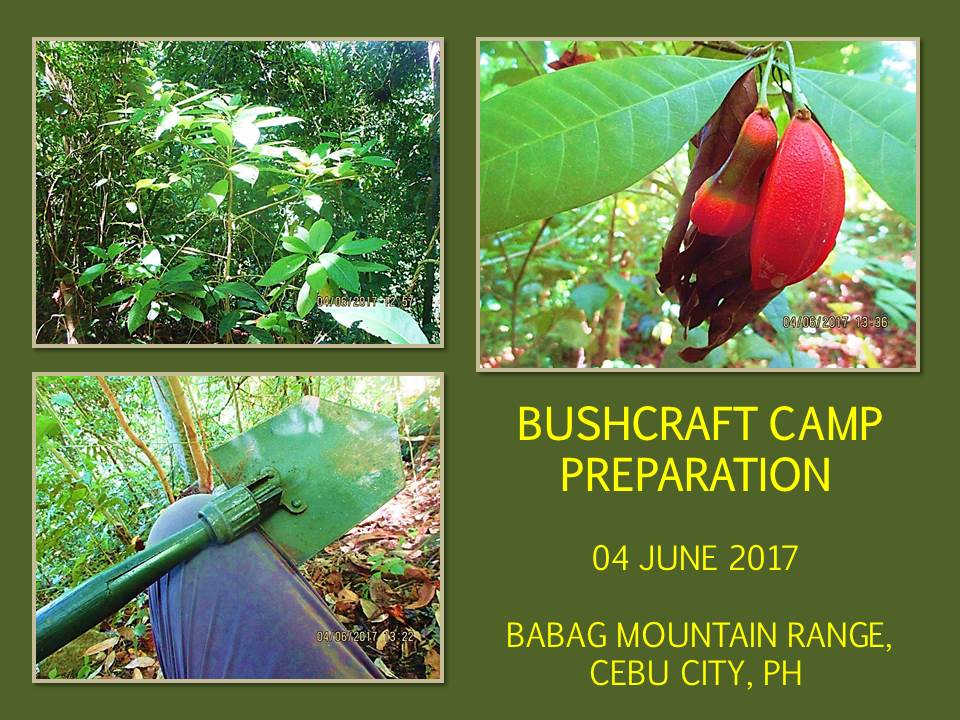
THE PHILIPPINE INDEPENDENCE BUSHCRAFT CAMP is less than a week away. Today, June 4, 2017, is a day reserved for preparing the campsite. The last time I visited Camp Damazo was five months ago during my psyching up for the Thruhike. It had been jungle when I discovered it many years ago and still was jungle when I last saw it. I believed it would stay that way for as long as you kept it a secret to the mainstream crowd.

I come today with the right people. My kind of people and all belonged to the Camp Red Bushcraft and Survival Guild. Most of these guys who are present today cut their teeth here like Ernie Salomon in PIBC 2011, Jhurds Neo in PIBC 2012 and Richie Quijano during the Bonifacio Day Bushcraft Camp in 2015. The rest like Jingaling Campomanes, Mirasol Lepon, Jonathaniel Apurado, Glyn Formentera and Jhops Burbe either took the PIBC 2015 or in 2016 at Liloan.

 
These guys can work on their own without so much supervision. Before we left Guadalupe, each guy had been briefed of what we will all do and all are prepared for the tasks at hand. We all have some of our blades with us and the opportunity for another dirt time in a jungle is sheer joy. Nobody could beat that anytime. I am doing the point and my outdoor awareness level are again at its max. I expect reptiles lurking, especially that it rained hard last night and in the early morning.

The ground is wet, leaves dripping with dew. We move slowly among this man-made forest of Burma teak, its wide leaves that fell to the ground do not make pop-corn sounds anymore like it used to during the warm summer days. The trail follow a low ridge which is sandwiched between two small streams. We follow the bigger one (Creek Alpha) downstream. The water is clear and flowing, the stones among them glossy and shiny. Rubber works on most wet rocks but it is much safer if you go it slow.

The vegetation changed from a single species into a diverse chain of indigenous shrubs and vines that line the stream banks. Here, the birds and insects are much alive. The cacophony of sounds are just amazing. That is what rain can do to a parched land in so short a time. The stream is tricky on some point but I know these parts very well. I caught sight of the trail and we are walking on ground once more. This is a mixed forest of teak, mahogany, gmelina and thick undergrowth dominated by rattan, rhododendron, wild ginger and wild yams.

 
This is part of Lensa Trail which actually crisscross each other through the vast Buhisan Watershed Area. We keep to the high ground from then on until we cross another small stream (Creek Bravo) to proceed to another trail across. The path led me to a ridge which transforms into a beautiful forest of mixed indigenous and exotic species. For a moment, I seem to be in another world but it ended as wild vegetation claimed ground what was once theirs.

We are now at Camp Damazo, pure jungle environment and, soon, home-to-be to the PIBC once more. As we were approaching it, I did my usual trail maintenance work, clearing the path of obstacles and debris, bringing dry twigs and branches with me. The rest of the guys carry dry bundles of twigs collected along the way. We would need dry firewood for our cooking later on and these are few after a downpour. There would be a lot of work but the promise of a good meal would put more heart to our combined effort.

 
First things first, is to make fire and keep the smoke thick to keep daytime mosquitoes, hornets, ants and creepy crawlies away. In jungle environments, these insects are pesky and thick and they are attracted to human presence. It could be your carbon dioxide exhausts from your breath and perspiration or it could be your artificial odor on your clothes. Sometimes, it is just the wrong kind of shirt and bag color but we keep that annoyance to a minimum by using fabric with natural-toned colors.

Ernie will do the cooking and he is supplied with a generous amount of dry firewood that we collected along the way. Jingaling and Mirasol will assist him in his airy kitchen. Jhurds, Jon, Jhops and Glyn will work on a firepit and the kitchen furniture and stock it with more firewood. Me and Richie will dig a latrine for male and female. We just have to retrace our route and look for those perfect spots to commune with nature. Richie has his small pick-axe while I have with me a US-surplus folding shovel, given by Hawaii resident Remy Ababa a few months ago.

The work on the latrines were easy due to modern tools and we were able to finish it earlier than we expected it to be. We go back to the camp and Ernie and girls are in the middle of preparing the food while a cooking fire is doing its work on two blackened pots which, most likely, contain rice. Jhurds and his crew are busy with their blades splitting firewood picked up from the ground. Richie joined them while I go check the water source. It is located 150 meters away. The bamboo trough is now missing and it needs replacement with a new one. Time to look for bamboo poles.

 
In this jungle, only a few groves of bamboo grow. Most of those that grew are the hardy type which are protected by a screen of thorns. I saw one in a nearby stream (Creek Charlie) and I unleashed my big AJF Gahum knife to forage one pole. I am able to clear the thorns away, work which is quite painstaking and time-consuming, so I could have access to a pole. The sound of chopping reverberated in the silence of the place, disturbing the bird calls and the chirp of cicadas and other insects. All sorts of ants fell from the foliage and dropped on my person and it made this work more difficult. I should have smoked it before I commenced.

I cut the pole but it hanged forever above me, its foliage and branches completely intertwined with its own kind. Forcing it with all my strength only budged it just a few inches down. My footing is only limited to two narrow boulders and there is not much I can do except pulling it with a rope from the streambed which is eight feet below. The more I pulled, the more ants falling over me. Some bit and some leave substance that stung. It crawled over my hair to my face and it caused me eye irritations. The pole moved just a foot. I tried to force the pole down by grabbing it and jumping down to the stream like Tarzan which is very dangerous and it budged just a little.

 
Leaving it hanging, I go back to Camp Damazo. I would just hire a local to bring it down to earth in time for the PIBC. I need two green bamboo poles though for survival tool-making and for knife dexterity exercises for the participants and another short piece of dry bamboo for friction fire-making. Anyway, I got a piece of the green bamboo and go first to the water source and insert this to replace the missing trough. The kitchen fire pit is already done when I returned and two iron bars are placed over it. These will hold the pots and pans when it is operational during the PIBC.

I sipped my cup of coffee and enjoyed the sight of the kitchen furniture frame already standing. Soon a platform of round sticks will be laid across the two wooden beams. Meantime, I have to help in collecting firewood and identify more ground for tents and ground sheets. I brought two 4 feet x 10 feet laminated nylon sheets for the latrines but it would be best if this is installed on the day of the event and so I have to cache it securely where its unnatural color of blue and orange would be an obvious sight in a jungle environment.

I looked around the hidden beauty of the jungle even the sinister presence of stinging plants gave off its enchanting allure to butterflies and bees. The “giraffe tree” is now threatened by man. Its surroundings gets cleared as a hunter’s blind is erected near it. Hunting of jungle fowls, ground pigeons, palm civets, leopard cats, monitor lizards and pythons are frequent here and the government do not have the manpower nor the resources to enforce laws in this protected area.

 
The camp preparation work and the walk in a humid environment left me sweaty, thirsty and hungry and a shout from Ernie says that food is now ready along with a rapping of spoon on metal cup. Food are fried mixed vegetables, lo-me (local noodles), seaweeds in vinegar, grilled pork and cupcakes baked in Dutch oven. Truly, this meal is a meal fit for kings considering it is just a day activity. In the Camp Red Bushcraft and Survival Guild, this is regular. Someday, I might entertain of elevating it into bushcraft glamping.

Well fed and invigorated by coffee, camp prep work continue to the rest of the day until we have what we need: firewood placed on a platform above ground, latrines, fire pit for the kitchen, kitchen furniture and trough for the natural spring. The bamboo poles could contracted to locals which I would do when we get out of the jungle on the way to Lanipao. The return of the PIBC to Camp Damazo is very well-considered as participation increased from last time and so are volunteers. But I trust in my people to practice Ethical Bushcraft when they are in pristine environment. I taught them how.

Document done LibreOffice 5.3 Writer

Tuesday, April 26, 2016

BUSHCRAFT BUHISAN XXXV: A Family Affair

I RARELY HIKE ON a weekday for I have a day job, unless, of course, if a guest requests me. I have done that on a few occasions and today, August 4, 2015, is one of those days. I would never say no on a good offer and never says no as well if it interests me at all even without getting paid for services rendered. I do part-time wilderness guiding – not mountain guiding.

However, neither of those conditions have forced me to be absent from my workstation today. It is for a different reason and I considered it as urgent. Relatives from Guam whom I have not known or seen in person since existing in this world came to visit their Cebu connection. My family put on their best foot forward and accommodated our visiting relatives.


With me is my second cousin, Neil, and his eldest daughter, Cami – my niece. They carried the same surname as I have and it is a good moment to establish good bonding time. I would never say no to them and never would say no to occasions such as this. Not even Super Typhoon Hanna, which just entered the Philippines, because I have committed this day for a hike in the woods.

We used my brother's red Suzuki Scrum to transport us to Guadalupe so I could buy food ingredients for our meal later on and then going to the trailhead in Baksan. The ground is wet since it rained early dawn precipitated by the coming of the storm. Surely, there would be a lot of slippery spots. Times like these make me very careful, not for myself but for those coming with me. The tempo of the walk is deliberate and slow.

When in that pace, I could see everything and I could talk a lot to my guests. I always talk about the plants because those are the very first things you will always notice and then the insects and animals. Next would be the names of places and the woodlores. Keeping guests entertained and informed is what distinguishes true outdoorsmen from another set of “outdoorsmen”.

The stream is clear and swiftly weaves among its chosen channels where it had carved for many years. The sky is cloudy with wefts of sunlight escaping from among its most porous parts. There is an ominous silence save for the cicadas (Local name: gangis). Old folks say that when these are noisy, expect no rain to fall. I half-believe that but, just the same, it is entertaining to the ears of guests if you tell these half-beliefs to them. Now that is woodlore.


Underneath the tall canopies of trees, the jungle is very dim. I follow the trail as we ascend the stream bank. We would be walking now on higher ground. The path is not ascending but it follow the contours of a mountain and Neil begins to ask how do I keep myself from straying. I do not in my turf. I mark a few trailsigns though where there are crossroads. I point to one and he understands.

The richness of the vegetation enlivens father and daughter as I name each plant which have uses and each plant which they would have to give a wide berth. Rattan is one and a stinging nettle (daw-daw) another one. Both grow low to people's height and touching each would cause you either cuts or skin irritations. Pace is controlled. I picked up a straight stick on the ground and passed it to Cami as a walking staff. I can see she walks better with it.

We go down another stream and we rest here. However, I have to do something. I have to climb a high bank where groves of water bamboo grow. I have to find a dry piece of bamboo pole. There were a lot of discarded poles left by forest gatherers a year ago which I kept off the ground hoping it would be useful someday. I found one and carry it down. I would use this later for an impromptu firecraft session.

We now ascend a trail to the ridge. I show them another plant that is harmful to a touch if you go careless and this is the Asiatic bitter yam (kobong). The path is lined with rattan but my eyes also scanned what is above us. Dead branches are also my concern. You would not know when it would fall down, would we? I take time with my pace so as not to overwork Cami and Neil.


I arrive at Camp Damazo and inform both father and daughter that we will stay here for a while. I need to boil water for coffee but I have to leave them so I would get water from a natural spring which would not be far. There would be mosquitoes and ants when they sense our presence. It would go away when you have a fire but we have no fire yet. I have an alternative though so I pluck leaves from a common floss plant (hagonoy) and teach how it is used.

I rigged my Silangan hammock – the ones with a mosquito net – should mosquitoes becomes unruly. I laid a laminated nylon sheet on the ground for Cami and Neil to sit on and got all the pots and bottles out. I prepare a tripod of sticks that I will later use in cooking our meal. It is 09:15 and we are early. The cicadas are noisy as ever. I left them bringing along two empty water bottles and my empty Zebra pot.

I go back to the camp and produce a Trangia alcohol stove and start heating another pot after I transfer contents from the Zebra. Then I get my fire kit. It is just an assortment of “garbage” that ordinary people stepped over or walked past without any idea what it is and are its uses. When you are into bushcraft, these things matter.

I show Cami how to work out a spark from a ferro rod. She tried once, again and again and it did not spark. She tried it forcefully and small sparks came. I show how it is properly done then Cami worked it like magic. Now time to choose firewood. I tell here that the best firewood are not picked up from the ground but those that are above the ground and these are small. I told her a story about fire made by a Native American and the ones by a white American and she chuckled.

The process of obtaining dry twigs and small branches begins and then converting it into pieces which are very easy for a nascent flame to feed on. Neil produce some tinder by scraping knife on a mature bamboo surface and form it into a loose ball where Cami directed the sparks of the ferro. Meanwhile, the water boiled above the Trangia and I mix instant coffee on a metal cup for Neil and Cami to savor on. I pour mine on a metal dish and enjoyed coffee that way.


Showed my best tinders for Neil and Cami to ogle upon: a tuft of kapok, shrivelled Spanish moss, coconut husk fibers and hair-like sugar-palm fibers. For me, they are my time-tested tinders that could catch sparks. And then there is the charclothe. Stored it all dry to through many layers of plastic aside from the green Triton dry bag.

I left Cami to practice with the ferro rod while Neil coached her. I prepare the rice inside the Zebra, for any moment we will start the cooking. A smile crossed Cami's face as she worked an ember on a charclothe and blow it on a nest of mixed tinder. There goes a thick smoke and a small flame. Quickly, it is placed underneath a teepee of twigs. The Zebra with the rice is now hanged from the tripod with a special hook.

I could now start slicing the pork meat, onions, garlic and those long green peppers. I show them the trees around Camp Damazo while waiting for the rice to get thoroughly cooked. I have trust on the Zebra as it is really an efficient pot. Neil looked up at a huge tree and asked for its name. Moluccan ironwood (ipil). Beside it is a small tree but you better keep a wary eye on it because it is the stinging tree (alingatong). It is harmless since the foliage are now a bit high.

I replace the Zebra with the already cooked rice with a battered pot with cooking oil in it. The fire is fed with more wood as the tell-tale pops of the cooking oil approaching boiling point is heard. I pour the sliced garlic, then all the sliced onions. Stirred it until onion gets soft. Two-thirds of the sliced green pepper are mixed to the aromatic concoction. A few minutes after, the sliced meat are dropped and stirred. Then I add soy sauce.

Neil and I talked about knives and he brought along the ones I have given him – a prized ginunting from Albay and a small Seseblades sinalung. He collects knives and he preferred Philippine traditional blades. He is with the US Air Force and travels with his unit anywhere. On the other hand, Cami is an accomplished sport dancer. She had snared top honors in international dance competitions in Barcelona, Rome and Las Vegas.

I go back to my cooking and poked the meat texture. A few more minutes and it should be done. Now the meat is tender, I pour the last of the green pepper as garnish and drop a few black pepper powder into it and left it to the fire for a full minute. The pork adobao is now ready for eating along with the rice and we eat in silence which is broken, time and time again, by conversations. I make a pair of bamboo chopsticks each for father and daughter while I settle for a fork when I notice I failed to bring a spoon.

The pots were literally cleaned off of their contents. It was a good meal considering we have limited comfort and too few hours to get a good opportunity of cooking from a very threatening sky. The slightly-spicy pork adobao was appreciated very much by Neil and Cami. It was cooked with the right frame of the mind. I place water on the pots, cups, metal dishes and, for a purpose, leave it be for a while.

From a piece of mature bamboo that I foraged earlier, I split it into two parts. I will show Cami how to make fire by rubbing two pieces of bamboo together. Although air is humid and misty and the bamboo is partly wet, I will try to show to Cami how this works. The most important thing is teaching Cami the process of making the bamboo into a fire tool. First, make a notch on one piece then scrape its hard skin back and forth for tinder.

The other piece would be the “saw”. I smoothed one edge so it would fit on the notch of the other. Place the tinder bundle on the inside of the notched piece and keep it in place with a thin bamboo strip. Either you place the notched piece on the ground where it gets rubbed by the other or you place edged piece below the notched piece where it gets rubbed. Showed her how it is done. After several drops of sweat rolled from my forehead, I got smoke. Then thick smoke. And that is all. No fire. I am exhausted. Skin of one finger brushed against ground. Pain!

It was a nice try despite drops of sweat and dew over the primitive fire tool and Cami is delighted at the sight of the real thing which she probably had seen many times in the Internet. She tried the native contraption but one bamboo piece broke in two. I would have made another piece and try it one more time but the sky says no. Drops of light rain are beginning to fall over the forest canopies. I pack the things into my Lifeguard USA rucksack and take the exit route.

The rain is for real now and no half-beliefs about cicadas could stop it. It made the ground more dangerous but, as always, I take charge of the pace. The route climb up a steep stretch and I have to wait for father and daughter to catch up and let them take rest. We have a luxury of time. Cloudy skies made the lighting dim as if to give impression that it is late and would have made another impression on the brain to dictate the body to release adrenaline so we would increase our pace.

We reach the road at 14:15 but across us is a trail to Lanipao and it is all downhill and easy. This time the rain fell at a greater intensity. The trail became a small stream and I have to check always my back trail for telltale signs of rushing water which are most probable in mountainous areas especially if there is an occurrence of a landslide. We trod on the side of the path instead where there are grasses.

We stop for a while at a place where there are midget coconut trees. Neil needs a coconut palm. He is onto something. I choose a healthy frond. Neil split the palm into two and counted something like fourteen midribs each piece. We carried the leaves to Lanipao then to Napo. The rain had not abated and the Sapangdaku Creek had risen a little and can still be forded by using a technique which I learned and developed on my own.

We walk on the asphalt road to where the Suzuki Scrum would rendezvous us. It arrived at the right time on the road corner leading to Baksan but we are now going to Guadalupe this time. We are all wet to the skin but it does not matter. The Suzuki proceed to Mandaue City to drop both Neil and Cami at their hotel. Neil talked of giving me a surprise with the coconut fronds when we meet again in a few days. Cami is elated at the chance to hike in my hidden jungle which she captured all with her camera.

It was a good time to know my relatives from Guam and them about me. Even more than what they knew me doing all these things in Facebook. I am what I am and I am proud to be a relative.


Document done LibreOffice 4.3 Writer