Showing posts with label camp management. Show all posts
Tuesday, May 1, 2018
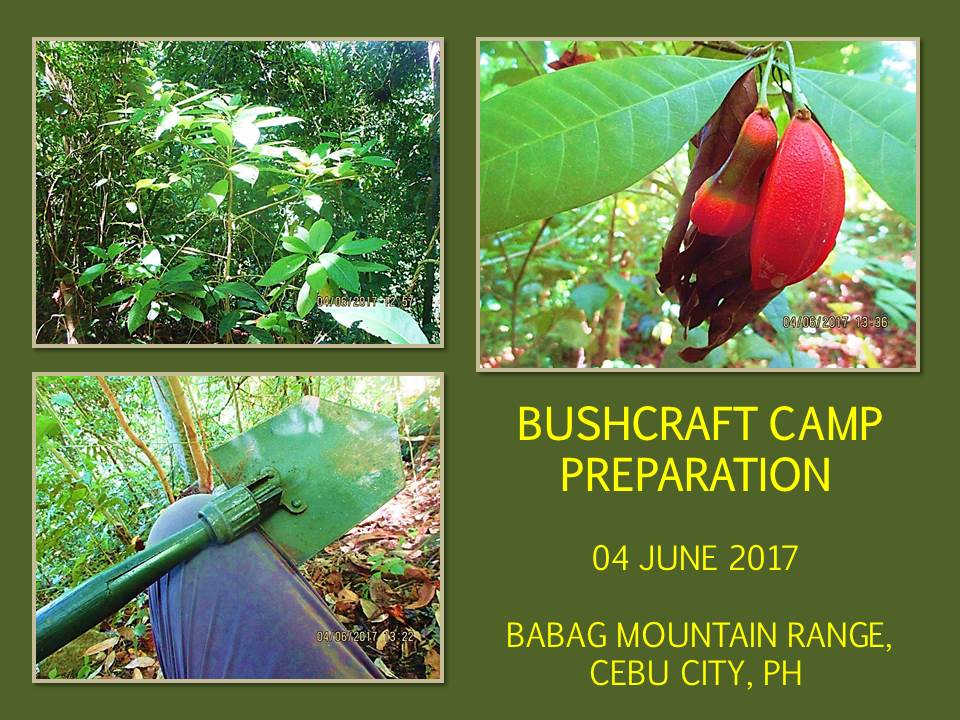
BUSHCRAFT BUHISAN XLIV: Return to Camp Damazo
THE PHILIPPINE INDEPENDENCE BUSHCRAFT CAMP is less
than a week away. Today, June 4, 2017, is a day reserved for preparing the
campsite. The last time I visited Camp Damazo was five months ago during my
psyching up for the Thruhike. It had been jungle when I discovered it many
years ago and still was jungle when I last saw it. I believed it would stay
that way for as long as you kept it a secret to the mainstream crowd.
I come today with the right people. My kind of people
and all belonged to the Camp Red Bushcraft and Survival Guild. Most of these
guys who are present today cut their teeth here like Ernie Salomon in PIBC
2011, Jhurds Neo in PIBC 2012 and Richie Quijano during the Bonifacio Day
Bushcraft Camp in 2015. The rest like Jingaling Campomanes, Mirasol Lepon,
Jonathaniel Apurado, Glyn Formentera and Jhops Burbe either took the PIBC 2015
or in 2016 at Liloan.
These guys can work on their own without so much
supervision. Before we left Guadalupe, each guy had been briefed of what we
will all do and all are prepared for the tasks at hand. We all have some of our
blades with us and the opportunity for another dirt time in a jungle is sheer
joy. Nobody could beat that anytime. I am doing the point and my outdoor
awareness level are again at its max. I expect reptiles lurking, especially
that it rained hard last night and in the early morning.
The ground is wet, leaves dripping with dew. We move
slowly among this man-made forest of Burma teak, its wide leaves that fell to
the ground do not make pop-corn sounds anymore like it used to during the warm
summer days. The trail follow a low ridge which is sandwiched between two small
streams. We follow the bigger one (Creek Alpha) downstream. The water is clear
and flowing, the stones among them glossy and shiny. Rubber works on most wet
rocks but it is much safer if you go it slow.
The vegetation changed from a single species into a
diverse chain of indigenous shrubs and vines that line the stream banks. Here,
the birds and insects are much alive. The cacophony of sounds are just amazing.
That is what rain can do to a parched land in so short a time. The stream is
tricky on some point but I know these parts very well. I caught sight of the
trail and we are walking on ground once more. This is a mixed forest of teak,
mahogany, gmelina and thick undergrowth dominated by rattan, rhododendron, wild
ginger and wild yams.
This is part of Lensa Trail which actually crisscross
each other through the vast Buhisan Watershed Area. We keep to the high ground
from then on until we cross another small stream (Creek Bravo) to proceed to
another trail across. The path led me to a ridge which transforms into a
beautiful forest of mixed indigenous and exotic species. For a moment, I seem
to be in another world but it ended as wild vegetation claimed ground what was
once theirs.
We are now at Camp Damazo, pure jungle environment
and, soon, home-to-be to the PIBC once more. As we were approaching it, I did
my usual trail maintenance work, clearing the path of obstacles and debris,
bringing dry twigs and branches with me. The rest of the guys carry dry bundles
of twigs collected along the way. We would need dry firewood for our cooking
later on and these are few after a downpour. There would be a lot of work but
the promise of a good meal would put more heart to our combined effort.
First things first, is to make fire and keep the smoke
thick to keep daytime mosquitoes, hornets, ants and creepy crawlies away. In
jungle environments, these insects are pesky and thick and they are attracted
to human presence. It could be your carbon dioxide exhausts from your breath
and perspiration or it could be your artificial odor on your clothes.
Sometimes, it is just the wrong kind of shirt and bag color but we keep that
annoyance to a minimum by using fabric with natural-toned colors.
Ernie will do the cooking and he is supplied with a
generous amount of dry firewood that we collected along the way. Jingaling and
Mirasol will assist him in his airy kitchen. Jhurds, Jon, Jhops and Glyn will
work on a firepit and the kitchen furniture and stock it with more firewood. Me
and Richie will dig a latrine for male and female. We just have to retrace our
route and look for those perfect spots to commune with nature. Richie has his
small pick-axe while I have with me a US-surplus folding shovel, given by Hawaii
resident Remy Ababa a few months ago.
The work on the latrines were easy due to modern tools
and we were able to finish it earlier than we expected it to be. We go back to
the camp and Ernie and girls are in the middle of preparing the food while a cooking
fire is doing its work on two blackened pots which, most likely, contain rice.
Jhurds and his crew are busy with their blades splitting firewood picked up
from the ground. Richie joined them while I go check the water source. It is
located 150 meters away. The bamboo trough is now missing and it needs
replacement with a new one. Time to look for bamboo poles.
In this jungle, only a few groves of bamboo grow. Most
of those that grew are the hardy type which are protected by a screen of
thorns. I saw one in a nearby stream (Creek Charlie) and I unleashed my big AJF
Gahum knife to forage one pole. I am able to clear the thorns away, work which
is quite painstaking and time-consuming, so I could have access to a pole. The
sound of chopping reverberated in the silence of the place, disturbing the bird
calls and the chirp of cicadas and other insects. All sorts of ants fell from
the foliage and dropped on my person and it made this work more difficult. I
should have smoked it before I commenced.
I cut the pole but it hanged forever above me, its
foliage and branches completely intertwined with its own kind. Forcing it with
all my strength only budged it just a few inches down. My footing is only
limited to two narrow boulders and there is not much I can do except pulling it
with a rope from the streambed which is eight feet below. The more I pulled,
the more ants falling over me. Some bit and some leave substance that stung. It
crawled over my hair to my face and it caused me eye irritations. The pole moved
just a foot. I tried to force the pole down by grabbing it and jumping down to
the stream like Tarzan which is very dangerous and it budged just a little.
Leaving it hanging, I go back to Camp Damazo. I would
just hire a local to bring it down to earth in time for the PIBC. I need two
green bamboo poles though for survival tool-making and for knife dexterity
exercises for the participants and another short piece of dry bamboo for
friction fire-making. Anyway, I got a piece of the green bamboo and go first to
the water source and insert this to replace the missing trough. The kitchen
fire pit is already done when I returned and two iron bars are placed over it.
These will hold the pots and pans when it is operational during the PIBC.
I sipped my cup of coffee and enjoyed the sight of the
kitchen furniture frame already standing. Soon a platform of round sticks will
be laid across the two wooden beams. Meantime, I have to help in collecting
firewood and identify more ground for tents and ground sheets. I brought two 4
feet x 10 feet laminated nylon sheets for the latrines but it would be best if
this is installed on the day of the event and so I have to cache it securely
where its unnatural color of blue and orange would be an obvious sight in a
jungle environment.
I looked around the hidden beauty of the jungle even
the sinister presence of stinging plants gave off its enchanting allure to
butterflies and bees. The “giraffe tree” is now threatened by man. Its
surroundings gets cleared as a hunter’s blind is erected near it. Hunting of
jungle fowls, ground pigeons, palm civets, leopard cats, monitor lizards and
pythons are frequent here and the government do not have the manpower nor the
resources to enforce laws in this protected area.
The camp preparation work and the walk in a humid
environment left me sweaty, thirsty and hungry and a shout from Ernie says that
food is now ready along with a rapping of spoon on metal cup. Food are fried
mixed vegetables, lo-me (local noodles), seaweeds in vinegar, grilled pork
and cupcakes baked in Dutch oven. Truly, this meal is a meal fit for kings
considering it is just a day activity. In the Camp Red Bushcraft and Survival
Guild, this is regular. Someday, I might entertain of elevating it into
bushcraft glamping.
Well fed and invigorated by coffee, camp prep work
continue to the rest of the day until we have what we need: firewood placed on
a platform above ground, latrines, fire pit for the kitchen, kitchen furniture
and trough for the natural spring. The bamboo poles could contracted to locals
which I would do when we get out of the jungle on the way to Lanipao. The
return of the PIBC to Camp Damazo is very well-considered as participation
increased from last time and so are volunteers. But I trust in my people to practice
Ethical Bushcraft when they are in pristine environment. I taught them how.
Posted by
PinoyApache
at
09:30
2
comments
Labels: Camp Damazo, camp management, camp preparation, Camp Red, Lensa Trail, PIBC
Thursday, March 1, 2018
NAPO TO BABAG TALES CXXII: Outdoors Leadership
THE
PASSION OF SHARING MY IDEAS to people is a very intoxicating feeling just as I
had experienced it when I initially introduced the Philippine Independence
Bushcraft Camp in Cebu in 2011. The outdoors then were all about mainstream
activities with people doing the same things over and over again for more than
25 years. It had reached its summit a long time ago and it overflowed to
dangerous proportions despite its monotony.
I
have seen that and I do not want to be part of the problem. Shifting to leisure
bushcraft was the best decision that I made because the outdoors landscape was
virgin ground and it is an interest that is closest to my heart. I learned it
young from the greatest teachers of all time: self-reliance, endurance,
kindness, audacity, wisdom and humility. It was a long process and it came to a
point in time where it has to be served on a silver platter.
Getting
a share of people’s attention was not difficult. I found many unenlightened
ones. These were the ones who watched too much survival reality TV shows and
stereotyped bushcraft with it even though it is a completely different animal.
Those who embraced my brand of bushcraft with an opened mind came to love it
and understood the idea very well. They became the Camp Red Bushcraft and
Survival Guild.
The
PIBC became an annual affair and institutionalized as a membership requisite
for the Guild. I journeyed far and wide to share my knowledge to more people
who cannot come to Cebu. I have succeeded in educating people about the correct
practice of bushcraft and ignorance declined. It would not have been possible
were I would not have composed the raw manuscripts for a future book which
would soon become known as Ethical Bushcraft.
I
envisioned Ethical Bushcraft as a guiding literature for those who would like
to indulge or enjoy leisure bushcraft in the Philippines. It is still under
improvement and more pages have to be added. It is indigenous, it is modern, it
is for the environment, it is practical, and it is common sense. Its heart and
philosophy are anchored on the very simple and time-worn principles of Blend,
Adapt and Improvise.
This
is the same material where I based a new outdoors seminar that I organized as
the Bushmasters’ Camp. This is an overnight camping activity which answers
people’s thirst for more knowledge about bushcraft and its best practices. It
refines an individual into someone who could blend instead of standing out, to
adapt instead of giving up, and to improvise instead of complaining. This is
outdoors leadership training and a prerequisite for camp volunteers in PIBC
MMXVII, therefore, an advanced subject matter.
On
April 28, 2017, seventeen people who have taken the PIBC and related training
done by me arrive at the Our Lady of Guadalupe Parish in Guadalupe, Cebu City.
We proceed to a new campsite that I had located five days ago. They are Jhurds
Neo, Rany San Juan, Marc Lim, Jingaling Campomanes, Mirasol Lepon, Mark Lepon,
Jon Apurado, Justin Apurado, Locel Navarro, Maria Theresa Lanit, Jamer
Maestrado, Justin Abella, Nelson Tan, Nyor Pino, Ariel Lim, Glyn Formentera and
Jenmar de Leon.
The
first part of the seminar is about Campsite Management. Before we proceed to
the choice of a campsite, it is important that you know the different outdoor
activities here. It could be Mainstream which is purely recreational on popular
destinations; Adventure Tourism which is regulated and also on popular
destinations; Outdoor Sports which is a race; and Unconventional are activities
on unpopular destinations.
Adventure
Tourism and Outdoor Sports may well be part of Mainstream for it is well
organized with participation and support of local government units, business,
NGOs and community organizations. Bushcraft, even if it is recreational, comes
under Unconventional along with exploration and hunting. Bushcraft is not that
popular here and it is held without too much fanfare. Our camp selection would
concentrate here.
First
thing to look for is accessibility. It does not have to be difficult and far.
It shies away from the high and exposed places. What it desire are places below
treeline. It is a small activity if you compare it with mainstream camping. It
strictly consider hazards that might threaten people like running water,
unsteady trees and branches, rockfalls and landslides. It has to have a water
source and it makes sure that it will not threaten or disturb wildlife.
Going
to a campsite requires good travel management. Bushcraft is found in wilderness
areas and it may well pass mountainous and difficult terrain which route you
must identify. You must have a good knowledge of the places you are passing for
your security. Walking composition are the same as that of mainstream. Pace
depends on the slowest member. Distance between members are 2 meters on normal
terrain and 4 meters going downhill.
Trail
ethics puts more emphasis on the right of locals on the use of trails. We are just
visitors, we see to it that we give them right of first passage and we make
sure that the trails are in good condition after walking through it. Leave less
footprints and walk elsewhere when trails are muddy. Of course, do not forget
to show respect. Use your people skills. The principles of Blend, Adapt and
Improvise are very useful here.
When
camp is found, it is always a good practice to give importance to hygiene. Size
of camp affects health and hygiene of people. Small-sized camps are manageable
and, where latrines are made, catholes may well do. Personal hygiene should
also be practiced especially when touching food and, if possible, purify water
sourced locally. Assign a compost pit for biodegradable wastes while separating
non-bio ones inside garbage bags.
It
may also be important that when you are a responsible outdoorsman, you must
also be an advocate for the environment. You do not confront locals making
their livelihood cutting trees, burning grasslands, hunting wildlife and making
charcoals. Use your cameras secretly and upload images in social media with
date, place and caption. Be responsible with your posts. Do not mention people
who had nothing to do with that. While you are at that, you must also think of
what you will bring outdoors: garbage.
Garbage
issues needs a good understanding of wastes. There is the biodegradable, the
non-bio and the recyclable. Campers pack opened cans and mix it with the rest
of the undesirable ones inside a thin black bag. Because of hygiene issues,
they tie the garbage bag on the back of their bags or carry it by hand. Note
that the opened cans will severe easily the thin bag and disembowel your
garbage on the trail without you knowing. Razor-sharp blades of grass will also
tear away the bags to shreds even if you pack it double.
The
best practice is to segregate your garbage. You place food scraps, fruit
peelings and unused ingredients in a compost pit. Top it with ash from the fire
before covering with soil so it would not be smelled by wildlife. You just rid
the most unpleasant pieces. What about plastic? You just let them dry and let
the ants sort them out. By the morrow it would be clean and light and ready to
pack. What to do about the cans?
After
opening, you turn it upside down so the juices would flow out and let the ants
do their thing. In hours it will be completely cleaned off then you fold the
opened serrated top back inside and step on the opened part. Once it is partly
sealed, step on the bottom towards the rim so it would lay flat. It would not
be bulky anymore once you place it inside your garbage bag and you can pack
that inside your backpack with peace of mind.
In
a bushcraft camp, there will always be cooking with real fire. It becomes the
center of social activity and becomes a campfire. A campfire could be placed
down a pit or it could be encircled by stones. Whether it is a big camp or a
small one, the fire should be small. Just enough to boil water, cook food and
provide heat and light. Do not make bonfires. It is a waste of firewood.
Use the ash to neutralize the odor of your biodegradable pit.
Never
use a live tree as your heat reflector. Do not set-up shelter near designated
fire pit. Clear dry debris around your fire and protect it from gusts of wind.
Do not make fire inside a tight forest of pine, cedar, pulpwood and eucalyptus
and within a rubber tree plantation. Assign a night watch to protect and feed
the fire throughout the night. If that cannot be possible, put it out
thoroughly. Spread the ashes when you leave. Cover pit with stones.
Water
source management is making sure that you do not contaminate this with your
presence. Keep your camp and latrines a hundred feet away. The same with
urinating. Do not wash your pots and plates directly on the stream. Make a
water hole and use water from there. Do not leave food scraps on the water
hole. Waste water should be thrown spread out away from the stream. Do not use
household detergents.
Bushcraft
is a child-friendly activity and it is normal to find children/minors
participating. Minors are usually shy when in the company of other adults. The
parent or the organizer should make it a point to hydrate the minor regularly.
Same with nutrition. The child does not know outdoor conditions and it is so
different from an urban setting. When in the presence of minors, adults should
behave appropriately. Watch those language.
Long
ago, it used to be just between a male or a female only but now there is the
LGBT. They are people who are just different yet they are protected by law. A
bushcraft camp should respect all genders. You must be sensitive to what you

say or act. Aside that, all must respect the culture and religion of others.
Serve them with food appropriate to their faith and do not force them to
worship with you. Ask first.
Last
for the day is conflict resolution. A bushcraft camp might tolerate the serving
of alcohol but not too much. You can not carry much anyway. Conflict could
sometimes happen within the camp or it is caused by outside interference. Put
your best foot forward by reconciling all parties. If cannot be reconciled,
separate both as far away from each other. Be very accommodating when dealing
with locals but be alert. Use good people skills.
It
was a long day but the lectures were delivered before sundown. Most of the
participants set up simple shelters while a few brought tents. I used and
tested for the first time another Silangan Outdoor Rev 20 tent acquired last
August 2015. Cooking were done with small pieces of firewood in special burners
and by butane stoves. I have explicit instructions to bring only canned goods.
There will be no feasts. Just mundane proletariat meals.
I
have already identified garbage management as the most underappreciated task in
outdoor activities. Few people thought of that. New set of campers complain of
garbage strewn about in popular destinations. I have even passed by camps left
by so-called “environmentalists” and the most ardent followers of Leave No
Trace and it is discouraging for one was in a watershed area. People are
only good when someone is looking.
The
opened canned goods would be the yardstick of how people would treat their
garbage seriously. I hope I could change old mindsets. I would inspect that in
the morning if people have really absorbed my lectures. I would also home on
the latrine and the compost pits. I would not allow people to assign one to
carry all their garbage nor will I allow this to be carried outside of a
backpack. They do not know that yet.
The
second day, April 29, opened my eyes to one person who have not absorbed the
part about opened canned goods. Old bad habits cannot be changed overnight.
There are people who absorb knowledge like a sponge and there are some who have
low absorption process and they are college graduates, come to think of it.
Adaptation and improvisation are skills learned by those who want to practice
bushcraft. If you do not have that, you can never blend in.
This
is the second part and is about Organizing Outdoor Events. You must identify
the kind of people you are targetting before creating one. Nowadays, it is very
easy to broadcast your event. Facebook has a template for that and it is very
user-friendly. You just name the event, identify a place, set the time and
date, and describe the event in as understandable language as possible. You may
add an itinerary. Contact person is a must!
The
itinerary is the plan of action as ought to happen in your event. It is the
guiding path of how, where and when should who will be. You place the dates,
the places, the hours and the micro activities. From this information, making
the food plan would not be difficult. You develop organizational, management
and control skills starting from small day events, progressing to complex
multi-day ones. Do not be tempted by greed.
The
event should be realistic, controllable and manageable. Limit the
participation. Mainstream events are known for massive participation to attract
more revenues for the organizers. Too many people are eyesores to the mountains
and causes environmental degradation due to the wear and tear on the vegetation
and its soil by a huge number of shoes treading on it. It is rampant on popular
destinations. Then you consider human wastes. Create your own destinations and
make it small.
You
should present your intentions to the LGUs and the police or military
authorities on the places where you plan to hold your events. You should
liaison with these offices and you should exchange contact numbers with them.
You must provide yourself all the numbers of all police stations, tourism
offices and rescue units of certain places in your phonebook. You send messages
as you enter their AOR and on places where you set up campsites. Give them the
courtesy of informing them too when your event had ended. Thank them!
Another
item in liaisoning that you should make is the Route Card. It is the event with
the itinerary but, included, are the names of the participants, their age, the
contact numbers of their nearest kin and information of medical history and
medication taken. Other information are special equipment, evacuation routes,
extraction points and your contact numbers and final instructions should you
remained incommunicado after 24 hours. A copy should be provided to a friend, a
relative or a rescue unit.
Lastly,
if you are on leisure bushcraft, do not join a mainstream activity camp. You
could never blend yourself in there. You would be a sorry sight. On the other
hand, a bushcraft camp is a special activity that nurtures creativity in a
person. If you have a place like this, it is better that you keep it to within
yourselves. Do not share. Do not tell.
Document
done in LibreOffice 5.3 Writer
Posted by
PinoyApache
at
08:30
0
comments
Labels: camp management, Camp Red, commentary, outdoors leadership, outdoors safety
Subscribe to:
Posts (Atom)