Showing posts with label camp preparation. Show all posts

Monday, December 7, 2020

2020-008 | FINDING DRY FIREWOOD

OUTDOOR COMMON SENSE TIPS: In the event of very wet conditions where finding dry firewood is difficult, a standing dead tree trunk can be a good source of firewood. Chop on one side and you will be surprised that it is dry. Just be careful because the knife on its downward stroke will tend to bounce off the surface if the edge cannot penetrate deep.

First seen in Facebook

November 28, 2017

=> => => o0o <= <= <=


GATHERING GOOD FIREWOOD is second-nature for people. That is fine when you are blessed with good weather or you lived in the tropics where sunshine is turned on 365 days a year. Wood, to include moist and half-moist, full branches and upturned roots, trunks and slender branches, can be converted into good firewood, through a drying process and are kept under the weather for future use.

When wood is drier and lighter, it is chopped or cut to the right length and stacked neatly and aerated for another drying process, this time in a sheltered place. Wood are bunched according to thickness and age, or the time when these were gathered. When it is ripe for use as a firewood, it is chopped lengthwise or split from each other, so to aerate the insides and allow moisture to evaporate.

These are neatly stacked in squares and are sometimes covered with canvass cloth, cheap laminated nylon sheet or just a piece of square plywood placed on the topmost. Those that are ready for the hearth are linearly-stacked separately where it is most accessible, as on either sides, or on the bottom if the makeshift hearth is propped on legs. This is the way homesteads process their firewood, even in suburban areas where it has access to the woodlands.

In camping, the conditions are different. You are forced to use wood where it is available and there is almost no drying and aging process. Most likely, a tenderfoot would pick up a dry-looking wood from the ground intending to use it as firewood with disastrous results. In the process, lighting off all the 48 matchsticks in the box or suffering third-degree burn on the thumb by holding the gas-lighter valve too long, and without success of producing even an ember.

In bushcraft, we developed firewood gathering into an art form. We understood the science behind that. Of why, almost the wood we found and see, are not the best firewood for immediate use? And understanding further the elements of the fire triangle, we can put a spark of fire to life. With that, we could enjoy coffee; finish a warm meal; with the light and the heat of the fire, it stokes up a good night of fireside conversations.

Camping in good weather, firewood are easy to find. These are not found on the ground. These are found up there or rising up from the ground. These are not thick but are very easy to break off with even a lady’s hand. Because it is small in width or diameter, introducing it to heat until it became a fledgling flame, is so easy. Once you attained a robust fire, add thumb-sized wood for insurance.

How do you know these dead branches are dry? You break it and you smell. Your nose would pick up the smell of moisture once the broken-up branch is exposed to air. You may still use these but wait when the fire had already reached the right temperature where it would consume almost anything. Or you could dry it first by propping it near the campfire using the heat radiated by the fire.


During bad weather conditions where there is heavy rain and you need to make a fire to warm yourself, finding good firewood material is very daunting. Your object is to find a dry one which is close to impossible since everything is wet. Your only recourse is to find standing dead trees and dead stumps which would not be rare I am sure of that; and those dead twigs that are not touching the ground.

Standing tree stumps which have been dead for some time may look wet in rain but, once you chopped off on one side, you will be surprised it is almost dry. Chop further and it becomes drier. Watch where the blade bounces because, sometimes, it skims the surface. When you have a substantial number of pieces, chop and split them into smaller pieces and leave three long slender ones and fashion it into feather sticks. The finer the curls, the better it accepts heat and flame.

Standing dead trees have wood completely dry because it is still protected by its dead barks. You could chop off on the sides like you do on the dead stump but, if it is a huge tree, chances are that it has a cavity on its trunk. That is where you chip off chunks of dry wood with your work blade. By the way, please make sure you have a good working blade with you when you are foraging and processing firewood. You simply could not do it with your bare hands.


Lastly, understand the science of things in how to introduce heat quickly to wood and turn it into a smoldering fire. The smaller, the lighter and the drier they are, the better the chances of catching a fire. That is why in bushcraft, we have another medium to facilitate the quick transfer of heat to fire to a hardy material like wood. These are called tinder and kindling. It would be a different topic, however, and this might be featured here in the future.

=> => => o0o <= <= <=


WARRIOR PILGRIMAGE BLOG, personified by this writer, is synonymous with the Outdoors, since Bushcraft and Survival is its niche. Safety and Security are its bedrock when it ventured into organizing outdoor events that involved people as in adventure/pilgrimage guideships and seminars; and explorations and expeditions.

Through tutorship, experience, folk knowledge and good old common sense, this writer was able to collect useful information which he is currently documenting in a book titled, ETHICAL BUSHCRAFT. He shares some of this information and knowledge in his training sessions; in his social-media account; and in this blog.


Tuesday, February 12, 2019

NAPO TO BABAG TALES CXXIX: Camp Preparation

PREPARING A CAMPSITE for bushcraft or a survival training camp is one that I have done many times and I always have a checklist which needs to be followed. In the early days and on a few occasions of late, I do it alone. I love working silently. I have mastered this aspect and it also involves identification and selection, borne out from discovery of places.

More often now, I am with my people from the Camp Red Bushcraft and Survival Guild and it makes camp preparation quick with so many hands helping out. However, in a noisy crowd there is always someone dedicated to cooking the meals and preparing coffee. Even when the day is warm, these things, in an outdoor setting are heavenly.

Today, March 18, 2018, I am going to Sapangdaku, Cebu City to use again the campsite I used last year for a wilderness training course done for an outdoor club or maybe find an alternative. I am considering another location beyond the old campsite but it remains to be seen which one would be better.

I am not alone today. Going with me is Ricky Petiluna. He is organizing next week’s Basic Wilderness Survival Course for friends which he would also attend as one of the participants. We would meet at the parking lot of the Our Lady of Guadalupe and then proceed to the trailhead in Napo on motorcycles.

I am carrying my old-school Lifeguard USA canvass rucksack but inside it is my folding seat, which I love to call as the “SOP”; a US Army-issue folding shovel, a trowel, the AJF Gahum knife, the William Rodgers bush knife, a Victorinox Ranger, a Swiss Army can burner, a Nalgene bottle, my fire kit, a headlamp, whistle and cotton gloves.

It begins to go warm and humid as I led Ricky from Napo to Kangsi. The ground is dry from lack of moisture but the greens have not wilted. Sapangdaku Creek is noisy and robust, despite the absence of rain for many days. A smaller tributary, Sarapia Creek, joins it. The small stream still has water and that is a good sign that the “tub” will be good for bathing.

 
From the stream, we follow an ascending path that lead to an abandoned house. We rested here for a while to munch on water apples (Cebuano: tambis). From there, we proceed up the trail, passing by the old camp. Showed him the camp ground with all of its green meadows and ancient mango trees. 

This is the primary choice. Its advantage is it has a clean natural spring, a nearby stream with a small waterfall, bamboos on its lower slopes, abundant firewood, an established campfire ring, abundant vegetation for plant ID, trees for shades and my own personal bathtub. Its disadvantage is it is not hammock-friendly. It simply has too few places to accommodate hammocks.

After the inspection, we walk uphill, following the same trail to look for a local farmer whom I befriended a few years ago. He is not here yet. Maybe later. Instead of waiting, I brought Ricky down to Sarapia Creek to check on the condition of the water source. There is a newly-installed bamboo trough that channels the water flow. Very nice.

I check the stream where I think would be off limits to people, especially on a crucial moment like nocturnal hunting. I found it downstream where thick vegetation obscured the view of what is below it. That place gave me the creeps. It was dark and perfect for venomous snakes to hide. There have been sightings of Philippine king cobra (banakon) within the environs along Sapangdaku Creek and its tributaries.

We walk upstream and the water cascade down the small waterfall. After crossing the small stream we climb up a steep path and stood above the waterfall and examine the foliage of an ancient but wild johey oak tree (marang) which the locals mistakenly assumed for a long time as a tipolo tree (Sp. Artocarpus blancoi).

A path leads more of upstream. I need to check my personal natural bathtub. I am disappointed. The last strong rains have filled it with sand, pebbles and silt. Although I have a tool to dredge it, it is not priority. I have but a few hours of morning left, which I would use to inspect a secondary camp across a peak and dig latrines.

 
I retraced my path back to the marang tree and follow another path towards Mapawon Peak. It is a kilometer away and passes by soft disintegrating ground where the trail passes by. Since it is a peak, it is moderately steep and it takes some effort to reach the place. There are two holes where water is fed in it by two separate PVC pipes.

There are many trees here and it is great for hammock camping. I go down to a saddle where there is a giant power pylon. The ground is wide enough for five tents but I have second thoughts. It is susceptible to lightning strikes since the steel structure is a long conductor. I liked this place because but it could not host a big camp.

We go back to Sarapia Creek and then to the main choice of camp. The farmer is there also and he let me borrow his digging iron after I consulted him of using the place again for Ricky’s activity. I also mentioned to him of digging latrine holes since people would have to poop and I do not want the place and all around it spoiled.

We did not do much for the rest of the day except dig three rectangular holes very far apart from each other, on two opposing sides of a ridge, two for males and another one for females. The digging iron was most useful as the soil was hard, but the folding shovel made a big difference. In the old days, I would have crafted a digging stick and it demands lots of energy, which I am wont to expend when the sun is at its zenith.

Ricky was much satisfied with our working excursion and gets to learn camp selection and preparation personally from me. The checklist left a few blanks after that and the bushcraft camp is ready for next week. We finished earlier than we thought it to be and an early rest is more welcome.

Document done in LibreOffice 5.3 Writer

Tuesday, May 1, 2018

BUSHCRAFT BUHISAN XLIV: Return to Camp Damazo


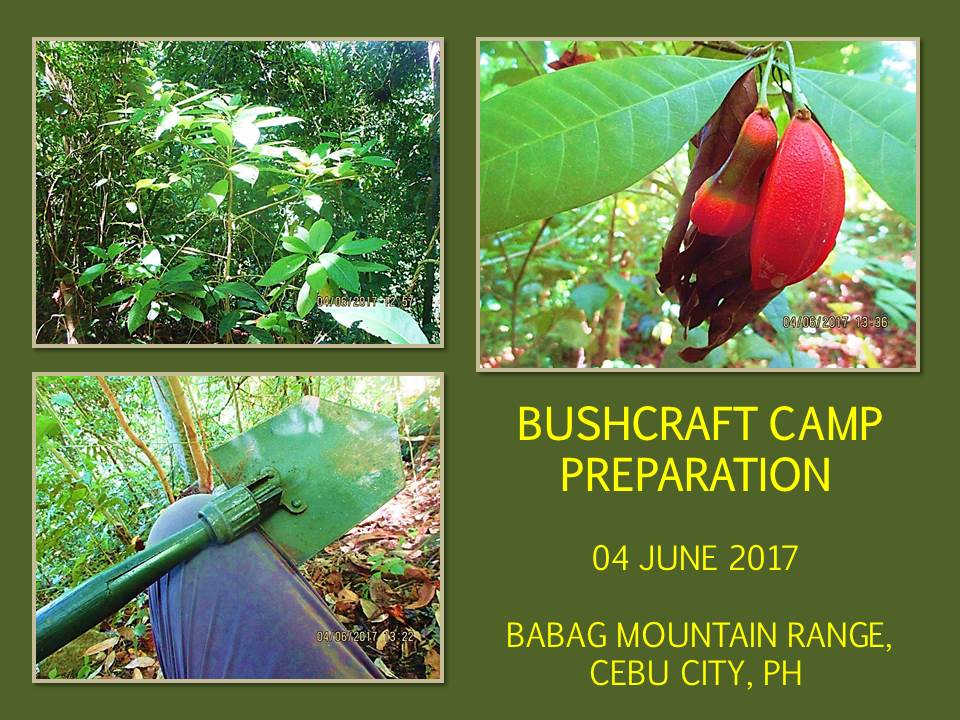
THE PHILIPPINE INDEPENDENCE BUSHCRAFT CAMP is less than a week away. Today, June 4, 2017, is a day reserved for preparing the campsite. The last time I visited Camp Damazo was five months ago during my psyching up for the Thruhike. It had been jungle when I discovered it many years ago and still was jungle when I last saw it. I believed it would stay that way for as long as you kept it a secret to the mainstream crowd.

I come today with the right people. My kind of people and all belonged to the Camp Red Bushcraft and Survival Guild. Most of these guys who are present today cut their teeth here like Ernie Salomon in PIBC 2011, Jhurds Neo in PIBC 2012 and Richie Quijano during the Bonifacio Day Bushcraft Camp in 2015. The rest like Jingaling Campomanes, Mirasol Lepon, Jonathaniel Apurado, Glyn Formentera and Jhops Burbe either took the PIBC 2015 or in 2016 at Liloan.

 
These guys can work on their own without so much supervision. Before we left Guadalupe, each guy had been briefed of what we will all do and all are prepared for the tasks at hand. We all have some of our blades with us and the opportunity for another dirt time in a jungle is sheer joy. Nobody could beat that anytime. I am doing the point and my outdoor awareness level are again at its max. I expect reptiles lurking, especially that it rained hard last night and in the early morning.

The ground is wet, leaves dripping with dew. We move slowly among this man-made forest of Burma teak, its wide leaves that fell to the ground do not make pop-corn sounds anymore like it used to during the warm summer days. The trail follow a low ridge which is sandwiched between two small streams. We follow the bigger one (Creek Alpha) downstream. The water is clear and flowing, the stones among them glossy and shiny. Rubber works on most wet rocks but it is much safer if you go it slow.

The vegetation changed from a single species into a diverse chain of indigenous shrubs and vines that line the stream banks. Here, the birds and insects are much alive. The cacophony of sounds are just amazing. That is what rain can do to a parched land in so short a time. The stream is tricky on some point but I know these parts very well. I caught sight of the trail and we are walking on ground once more. This is a mixed forest of teak, mahogany, gmelina and thick undergrowth dominated by rattan, rhododendron, wild ginger and wild yams.

 
This is part of Lensa Trail which actually crisscross each other through the vast Buhisan Watershed Area. We keep to the high ground from then on until we cross another small stream (Creek Bravo) to proceed to another trail across. The path led me to a ridge which transforms into a beautiful forest of mixed indigenous and exotic species. For a moment, I seem to be in another world but it ended as wild vegetation claimed ground what was once theirs.

We are now at Camp Damazo, pure jungle environment and, soon, home-to-be to the PIBC once more. As we were approaching it, I did my usual trail maintenance work, clearing the path of obstacles and debris, bringing dry twigs and branches with me. The rest of the guys carry dry bundles of twigs collected along the way. We would need dry firewood for our cooking later on and these are few after a downpour. There would be a lot of work but the promise of a good meal would put more heart to our combined effort.

 
First things first, is to make fire and keep the smoke thick to keep daytime mosquitoes, hornets, ants and creepy crawlies away. In jungle environments, these insects are pesky and thick and they are attracted to human presence. It could be your carbon dioxide exhausts from your breath and perspiration or it could be your artificial odor on your clothes. Sometimes, it is just the wrong kind of shirt and bag color but we keep that annoyance to a minimum by using fabric with natural-toned colors.

Ernie will do the cooking and he is supplied with a generous amount of dry firewood that we collected along the way. Jingaling and Mirasol will assist him in his airy kitchen. Jhurds, Jon, Jhops and Glyn will work on a firepit and the kitchen furniture and stock it with more firewood. Me and Richie will dig a latrine for male and female. We just have to retrace our route and look for those perfect spots to commune with nature. Richie has his small pick-axe while I have with me a US-surplus folding shovel, given by Hawaii resident Remy Ababa a few months ago.

The work on the latrines were easy due to modern tools and we were able to finish it earlier than we expected it to be. We go back to the camp and Ernie and girls are in the middle of preparing the food while a cooking fire is doing its work on two blackened pots which, most likely, contain rice. Jhurds and his crew are busy with their blades splitting firewood picked up from the ground. Richie joined them while I go check the water source. It is located 150 meters away. The bamboo trough is now missing and it needs replacement with a new one. Time to look for bamboo poles.

 
In this jungle, only a few groves of bamboo grow. Most of those that grew are the hardy type which are protected by a screen of thorns. I saw one in a nearby stream (Creek Charlie) and I unleashed my big AJF Gahum knife to forage one pole. I am able to clear the thorns away, work which is quite painstaking and time-consuming, so I could have access to a pole. The sound of chopping reverberated in the silence of the place, disturbing the bird calls and the chirp of cicadas and other insects. All sorts of ants fell from the foliage and dropped on my person and it made this work more difficult. I should have smoked it before I commenced.

I cut the pole but it hanged forever above me, its foliage and branches completely intertwined with its own kind. Forcing it with all my strength only budged it just a few inches down. My footing is only limited to two narrow boulders and there is not much I can do except pulling it with a rope from the streambed which is eight feet below. The more I pulled, the more ants falling over me. Some bit and some leave substance that stung. It crawled over my hair to my face and it caused me eye irritations. The pole moved just a foot. I tried to force the pole down by grabbing it and jumping down to the stream like Tarzan which is very dangerous and it budged just a little.

 
Leaving it hanging, I go back to Camp Damazo. I would just hire a local to bring it down to earth in time for the PIBC. I need two green bamboo poles though for survival tool-making and for knife dexterity exercises for the participants and another short piece of dry bamboo for friction fire-making. Anyway, I got a piece of the green bamboo and go first to the water source and insert this to replace the missing trough. The kitchen fire pit is already done when I returned and two iron bars are placed over it. These will hold the pots and pans when it is operational during the PIBC.

I sipped my cup of coffee and enjoyed the sight of the kitchen furniture frame already standing. Soon a platform of round sticks will be laid across the two wooden beams. Meantime, I have to help in collecting firewood and identify more ground for tents and ground sheets. I brought two 4 feet x 10 feet laminated nylon sheets for the latrines but it would be best if this is installed on the day of the event and so I have to cache it securely where its unnatural color of blue and orange would be an obvious sight in a jungle environment.

I looked around the hidden beauty of the jungle even the sinister presence of stinging plants gave off its enchanting allure to butterflies and bees. The “giraffe tree” is now threatened by man. Its surroundings gets cleared as a hunter’s blind is erected near it. Hunting of jungle fowls, ground pigeons, palm civets, leopard cats, monitor lizards and pythons are frequent here and the government do not have the manpower nor the resources to enforce laws in this protected area.

 
The camp preparation work and the walk in a humid environment left me sweaty, thirsty and hungry and a shout from Ernie says that food is now ready along with a rapping of spoon on metal cup. Food are fried mixed vegetables, lo-me (local noodles), seaweeds in vinegar, grilled pork and cupcakes baked in Dutch oven. Truly, this meal is a meal fit for kings considering it is just a day activity. In the Camp Red Bushcraft and Survival Guild, this is regular. Someday, I might entertain of elevating it into bushcraft glamping.

Well fed and invigorated by coffee, camp prep work continue to the rest of the day until we have what we need: firewood placed on a platform above ground, latrines, fire pit for the kitchen, kitchen furniture and trough for the natural spring. The bamboo poles could contracted to locals which I would do when we get out of the jungle on the way to Lanipao. The return of the PIBC to Camp Damazo is very well-considered as participation increased from last time and so are volunteers. But I trust in my people to practice Ethical Bushcraft when they are in pristine environment. I taught them how.

Document done LibreOffice 5.3 Writer

Wednesday, March 1, 2017

BUSHCRAFT BUHISAN XL: Lost in a Weekday


I STILL POSSESS A MINDSET as if I have a day job and waited for a weekend before I engage in a joust with the outdoors.  I tried to think it over and over and I laugh at myself for taking change so slowly.  In fact, I have left that job on the last day of 2015.  I seem to be busy on weekdays doing nothing and, yes, wired to an electrical outlet.  It is indeed strange for someone who found the great outdoors home!

I got guests for this coming weekend and I need to prepare a campsite deep in the hidden jungles of the Babag Mountain Range today, November 10, 2016, a Thursday.  Yes, today is a weekday but I do not have the same enthusiasm I showed for a weekend.  I need to pressure myself to move out of my comfort zone and, when I did, the sun was already high and warm.  It is always like that.


Like now.  It is already 10:20 when I arrive at the trailhead coming from Guadalupe by motorcycle.  The good thing is that when I am in my environment everything changes so quickly as if I am a different person.  I am instantly transported into a weekend mood.  My mind shifts from conventional to native idiosyncrasies.  The smell and sounds of the forest changes me.

I follow a path down to Lensa Trail.  The vegetation all around me is very healthy except on a wide patch of Burmese teak forest where every tree is healthy and the rest are not.  You could not even hear the buzz of a bee.  People come here to gather firewood.  Indeed, this wood is good for furniture.  It is impervious to termites and is prized by wood carvers and demand a good price.  I see a baby serpent slithering away.

The trail goes down and, after walking just a few meters, I espy a slender arm of bamboo, much thicker than the bagakay variety and those crawling ones called bokawe.  I did not saw it before and it grew on a dry ravine where all indigenous species thrive.  I approach it.  There is running water on the small ravine and the bamboo is of the butong variety.  It is healthy and seems to have not been touched yet by humans.


I am elated at this discovery for I would have another source of bamboo in this mixture of man-made forests and naturally-thriving jungle, which is really rare.  I reach Creek Alpha and I follow it downstream.  It has running water and it flows briskly where there are cascades.  Here birds make its presence felt.  A Brahminy kite (Local name: banog) called overhead thrice while a yellow sunbird (tamsi) fleeted by infront of me.

I see fresh footprints of three individuals, a few hours old, and it came from downstream.  One is deep for a small person – a woman’s – and it could have carried something heavy, firewood perhaps.  I always love this moment, trying to unravel a tale, a puzzle, by the mere study of trail signs like footprints and what humans leave behind.  You should try this and it would be good to develop your creativity.

I left the stream and I am onto dry ground.  The first trace of human activity here other than footprints meet me.  They were harvesting leaves of young fishtail palms.  The leaves are used as decorations of flower bouquets.  They were also cutting long leaf stalks of wild ginger called galangal and used this as a mat to sit on when they were working on the fishtail palm leaves.


I go down a path to check on the state of the campground of the old Camp Damazo.  I used this place the last time in January.  I did not bring people here after that so it could recover.  It had recovered very well and so is ripe again to host a camp.  This would where I would bring my guests this Saturday.  Everything is okay except that I have to forage and stash firewood and old and green bamboo poles as well.  Then I would need to find a good place for the latrine.

I begin my work on the firewood first.  I do not need big pieces of wood.  What I would need are just dead branches that have fell where it has still dry twigs and leaves on it.  I found many on Lensa Trail and drag the best ones to as near as possible to the campsite and place it above ground.  It is humid here and I would know it would rain starting this day onwards.

At Camp Damazo, I walk a few meters downstream where there is a tree that had fallen across the stream.  There is a path on the left leading to a cleared ground.  Around it are good places to answer the call of nature.  I marked the clearing with a shred of yellow plastic tied to a young tree and another shred of white plastic tied to another young tree to mark the path to there.


When I was finished with the latrine and the firewood, I proceed to Creek Bravo where I could see the state of health of my prized water bamboos.  It is a warm day and I have to walk easy.  I do not have had breakfast nor a slurp of warm coffee.  I do have bread inside my Lifeguard USA rucksack but I reserved that for a simple lunch.  I would boil water when I get to Creek Bravo.

I arrive at the next stream and I immediately study the foliage of the bamboos.  This is a rare spot of the jungle where there are groves of bamboo.  About seven of them.  Almost all of these have not recovered well from a destructive human activity of three years ago.  Only two groves are healthy and are producing poles of normal growth and width.

I would not cut one today and I would reserve that for Sunday – the second day of this weekend’s camp – and searched instead for a dry pole.  Usually, I stashed leftover poles above the ground when I cut one that is too long and I found one, a leftover of the Bonifacio Day Bushcraft Camp in November 2015.  It is not perfect but it would do during a firecraft session.  I cut a small branch with roots on it so I would introduce bamboo in Creek Alpha.

I go down the hill with the pieces of dry bamboo and the young branch and walked upstream where there is another smaller stream that branched into Creek Bravo.  On this watery junction I will boil water for coffee.  I retrieve my Swiss Army emergency stove and make it ready for a fire.  From nearby dry twigs and from tinder scratched from the old bamboo, a fire begins inside the chamber of the stove.  Water I get from the smaller stream and start boiling.

After almost an hour of tinkering with the simple gadget, I have my coffee break and my bread.  It is wonderful to just sit still and enjoy warm coffee in a very humid jungle alone.  How many people would do this on a weekend, let alone a weekday?  None that I know of.  In silence, I have peace.  Water cascading on rocks is like music to the ears.  The clouds becomes dark and wisps of moisture fall down but it did not last long.  Sky starts to clear and a raptor just crossed overhead while ground pigeons scamper to safety.


When you are into bushcraft, you could see everything.  You are far better than all these adrenaline junkies who think they are the fastest sperms in the planet.  Hand it to them their exploits but when difficult terrain and bad weather begins to claim them, they would discover late in the day that they had not used their brains well.  Bushcraft is a cerebral activity.  It is zen happening in the woods.  It uses the brains and patience more than it uses strength.

My existence and lifestyle justifies the need for Filipinos to look back to where they came from and learn some bushcraft skills.  Never ever stereotype the Aetas as bushcraft for bushcraft is broader than you think.  What the Aetas are doing is showcasing their culture and their hunter-gatherer society and urbanized people (I do not call them civilized) had taken advantage of the Aetas for entertainment and making money in their behalf just like whites did to Native Americans in circuses and expos.

After my simple meal, I go back to the old Camp Damazo to plant the bamboo and to stash the old pieces.  I notice that the path I used in 2011 in coming down here have been also used by the locals and now has an appearance of a trail.  I follow it and I climb up a ridge where there is still an existing trail.  I am now at the top of Boy T’s Hell, a hill that had given Boy Toledo nightmares during an exploration in 2010 here.  Across me is Starbucks Peak and I would love to visit it again someday.

I go down the hill and followed a thin ridge that linked to another ridge.  I looked for the trail that led to here but it is gone.  Mind you, this is the part where you miss a trail and it brings you far from your destination.  I remembered my trips here the previous years where me and my party travelled off-course from our intended objective.  I looked again and I opt a path that I thought would lead me back to the trailhead.

The trail I am following begins to lead me off familiar territory and dumped me back to Creek Alpha.  I followed it upstream and I found the trail back to the trailhead.  It is 15:00 and I have to go early to prepare my things and my unfinished tasks for the Saturday.

Document done in LibreOffice 5.2 Writer