Showing posts with label amateur radio. Show all posts

Sunday, September 24, 2017

CEBU’S BEST | INFEX & DX CONTEST 2017


I JUST FINISHED THE THRUHIKE and, four days later, on this morning of February 18, 2017, I would be standing on a stage before different troops of the Boy Scout of the Philippines belonging to the University of San Jose-Recoletos. I would be presenting a talk on the topic – A Boy Scout as an Environmental Warrior and, on another one, Survival in the Outdoors. Fortunately for me, both are subject matters closest to my heart.

I am gracing this occasion upon the invitation of the USJ-R Greenbar Council, without them knowing that I once cut my teeth as a Tenderfoot under the aegis of the greatest scoutmaster Cebu had ever produced, the late Sergio P. Damazo Jr. That was in the ‘70s, when I was then an element of Troop 38, in their old campus at Magallanes Street, Cebu City. They have not erred in contacting me.

This is my first time to visit their campus in Basak, some thirty-nine years after my last days with my alma mater. I am excited but I am well prepared even though I was tapped on short notice. I made it to the gate incognito and, upon entering a second building where the real activity is held, I saw the picture of my dearly beloved scoutmaster. The friars had cherished his memory well by devoting a small museum for him. I am touched.

 
After meeting the acting scoutmaster, Romulo Sevilla Jr., his most senior scouts led me to the Audio Visual Room where I am going to give my talk and to meet my audience. This AV Room is much much bigger than the one they have at Magallanes. It is still empty but it soon will be filled by warm bodies. There is a projector and screen on standby and, pretty soon, a laptop will be provided for my Powerpoint presentation.

Then they came in military cadence and order, 250-strong. The newer versions of Cebu’s Best. This is their first day and they were on drill formation earlier. They must be tired and so I gave instruction to the troop commander to make them sit on the concrete floor. My greatest challenge today is how to prolong their short attention spans. These are pampered kids studying in one of the finest Catholic schools of Cebu.

When I studied on my first year at the old campus, back in 1975, I felt that my father had made a mistake of enrolling me in a wrong school. I was a product of a public school system but he was happy I passed the entrance test. He thought I have a good head but he never could imagine I was out of place. My classmates where well off, smart and bigger. Every week was a meat grinder for me and I was a weekly customer of the guidance counselor.

We were taught to be pious. Oh yeah, I did more kneels than any of my classmates. I do not have to go to the altar. The space near the teacher’s table or the principal’s office were the right spots to tame me. I was a wild kid in a well structured environment. Then Mr. Damazo took me into his care and responsibility and I understood why the Josenians wear shorts as against other schools who parade on streets in long pants.

 
One member of the Order of Agustinian Recollect is attending as audience as well as the scoutmasters of the University of Santo Tomas-Recoletos, from Negros Occidental, and the USJ-R Balamban Campus. I think they were there to reign in their boys. But there are girls among them. Yes, I saw many marching with the boys at the quadrangle with the same uniforms as the boys were. And THIS is a Boy Scout event.

After the preliminaries, I deem it proper to give my audience a peep into my past, as a Josenian Boy Scout which jolt them from their stupor, and my present life, which everyone now were all ears of my accomplishments as an outdoorsman, enjoying the life of a wandering bushcraft enthusiast and living the dreams of a Boy Scout of long ago. My Thruhike across Cebu’s 400-kilometer length in 27 days got them thunderstruck and bewitched.

A Boy Scout can never be an environmental warrior if the lessons he learned as a citizen scout are different from what he witnesses in his home, the community and even inside malls. It erodes his youthful enthusiasm. If push comes to shove – like the threat of climate change – then he has to lessen his carbon imprint if he wanted to extend the living years of our only home in this universe.

Climate change and man’s manipulation of the environment to suit his needs caused this environmental degradation we are experiencing right now. It had already been mentioned in the time of Noah, Joseph and Moses of the Old Testament. The impacts now are bigger and everywhere: mountains, river systems, lakes, the ocean, the atmosphere, the arctic regions and even on urban centers. Industrialization, mining, logging, consumerism, you name it, causes degradation and pollution and it has a common denominator – greed.

 
How do we overcome this? Almost impossible but there are organized activities that influence the mindsets of people or compel them to, about the state of our planet. We now have peaceful mass actions, legal actions, even extreme strategies. Greenpeace is on the vanguard of this for so many years. Leave No Trace was introduced in national parks across the globe and are being used incorrectly by activists, forcing people to toe the line. Then we have the grey wolves of this movement – the Sea Shepherds.

As a Boy Scout, the above methods are themselves equally daunting since it exposes them to harm’s way. But there are more peaceful ways that are much better and much more proactive. Planting trees or mangroves may be one of the best but organizers almost always choose the wrong species, mostly exotic, or monopolize one species on a big area. You can plant your own trees without having to join mass tree planting activities.

Join or organize community projects which keep away residents from engaging in destructive methods on the environment. These could be tree planting, coral propagation, beautification projects and alternative livelihoods. Information and education will guide simple folks from ignorance, indifference, superstition and half-truths. Engage in a personal crusade that does not involve people like practicing Reduce Reuse Recycle and LNT.

Can you change the world on your own? Yes you can. There are many advocacy tools. Documentation for a community or school magazine about the environment is a good start. Or you could start a blog. Internationally-acclaimed blogs about environmental awareness started from small ones and there are many free platforms to choose from. Create more awareness on online petition websites like 350.org or transcend borders and government control by posting on social network sites to a much wider audience.

A Boy Scout can indeed be an environmental warrior. I once was that Boy Scout and I am on this personal crusade as an activist for no one, a blogger, a writer and a lecturer for the environment. The methods I used are simple but I am always on the frontlines where man and environment clashed, never a good consequence for the latter. Someone has to fight for the environment – peacefully. A photo with a caption of facts is good enough to catch fire in people’s consciousness across the Internet.

That was a long talk and I may have delivered my message to the majority of my audience or not but, it does not matter, because I am not expected to convert all into environmental warriors. I only need one from the 250 and he or she could already make a big difference.  The next topic – Survival in the Outdoors – would be the most awaited one and everyone begins to reposition themselves after a break of five minutes.    

 
The outdoors, for most, is a beautiful romantic place. Simply because they may have experienced and enjoyed it on the frontcountry. The backcountry is different for only a few people visit it. It is mountainous and navigation is difficult. Then there is the wilderness. All these places found in the outdoors are dangerous. It has an unpredictable weather system and streams go suddenly wild even if the day is warm. It has a mean wildlife population and thick stands of forests that no sunlight could penetrate.

Getting caught in the outdoors in the wrong weather or time causes you stress which tend to force you to make mistakes. Small mistakes can create a big impact on your thinking. When you are lost or helpless, survival mode begins. Your increased awareness is a result of uncontrolled release of adrenaline. Your thoughts are fed by the senses, the nerves and the guts, all agitated, causing you confusion and more mistakes.

Our prolonged survival depends upon our discovery and rescue. If it does not happen, you need to have nutrition. Hydrate as much as possible because a deprived brain cannot function properly. Eat some food. If you do not have enough, look for one. Fruits supply you natural sugar, which is converted by enzymes into adrenaline. Fat is the hardest to find in a jungle environment but, unknown to you, you have layers of fat that your own body would subsist on when food becomes difficult to obtain.

Water is the first thing to find during survival. If you still have strength, you look for a shelter or make one. Food is the next thing to look for. When you have water, shelter and food, you start to go warm. Make yourself more warm by making a fire. If making a fire is impossible, do not expose yourself to the elements. Increase your security by blending in with the environment or standing out. It depends if there is an immediate threat. These are the priorities during a survival situation and could change with water always on top.

When you are outdoors, there is a thing we in the bushcraft community called as “outdoors common sense”. Bushcraft is a hobby and a lifestyle which uses the outdoors as a learning environment for survival. The purpose of this outdoors common sense is to increase our safety and security. We have developed certain protocols that guided our behavior and our presence in the outdoors. This set of protocol includes how we deal with wildlife encounters.

 
You do not learn these things in a classroom. I teach these in a bushcraft camp. Those who learned from me became members of the Camp Red Bushcraft and Survival Guild. Instantly the guild logo and my activities appeared on the projector screen. The images swelled their pride, knowing that an alumnus of their school does these things for a living and brought sparkles of interest in adventure in their eyes.

My talk ended at just the right time. I was presented by the USJ-R Greenbar Council with a certificate of appreciation and an invitation for lunch. Outside, the field begins to be filled by the Boy Scout units. Platoon formations are hurriedly organized under the bare sky. The units began counting off the elements in preparation for their own meals. It will be a long day today, to include night activities and campfire rites.

Meanwhile, my day is not yet finished. I have to join and witness the International Friendship Exchange and DX Contest which will be participated in by the Girl Scout of the Philippines unit of USJ-R under the adult supervision of Ham Radio Cebu. It would be held at the Talavera House of Prayer, in nearby Quiot, for the whole afternoon. Ham Radio Cebu is an amateur radio club which I also belonged. INFEX is a worldwide event that uses high frequency radio to contact amateur radio stations on far locations at 7.095 MHz.

Under the guidance of Jet (4F7MHZ) Manuel, Nick (DV7FCC) Manuel, Ariel (DV7FAL) Lim, Wilson (DW7REE) Aliganga and Marvin (DW5CIA/7) Reynes, the USJ-R Girl Scouts were able to contact twenty-three amateur radio stations from all over the Philippines at the end of the day. This is a friendly competition where the winners and their tutors are rewarded points and certificates by the International Amateur Radio Union and their local counterpart, the Philippine Amateur Radio Association. It is an event designed to rekindle the love of amateur radio propagation to the younger generations.
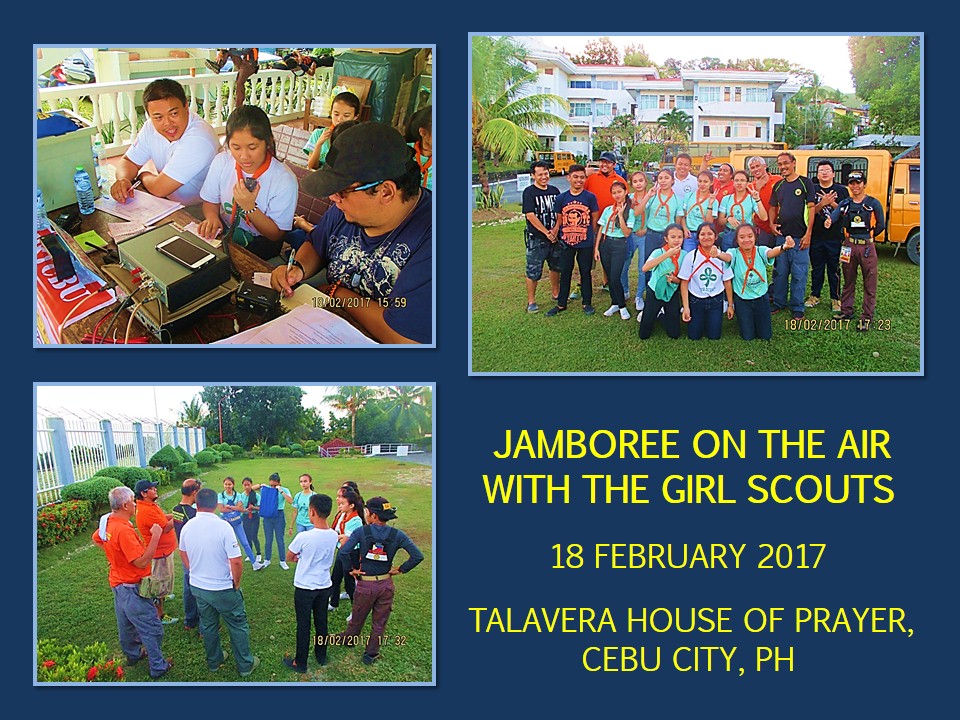
 
It was really a busy day for me. I reconnect with the beloved school of my youth. The only familiar face I met is the framed picture of my dear scoutmaster. I am happy that the Boy Scout spirit of the Josenians lovingly nurtured by Sir Damazo are kept alive and burning, along with their traditions and lore. I have been part of Cebu’s Best during my younger years and I am proud the present descendants behaved like one. I am also elated to know that their Girl Scout counterparts have partnered with Ham Radio Cebu and will earn themselves badges in amateur radio. Adelante!
 
Some photos courtesy of Markus Immer
Document done in LibreOffice 5.2 Writer

Sunday, January 22, 2017

MAN-SIZED HIKES XXIII: Nug-as to Liloan Point

IT IS ALMOST OVER. Just one segment more and the CEBU HIGHLANDS TRAIL PROJECT will be all over. The Year 2016 will always be a very memorable year for me. Kind of busy. Busy of doing things that I loved most like travel, teaching, blogging, humanitarian work and explorations. I had put to history Segment IV, Segment VI and Segment VII and, mind you, these were not easy walks. It resulted to an estimated total of 190 kilometers walked in just a single year, not counting Segment VIII yet.

Segment VIII is that walk from Upper Beceril, Boljoon to Cebu’s southernmost tip - Liloan Point, Santander. But, me and my Exploration Team will start from Nug-as, Alcoy instead and I gave just four days for this exploration hike. Can you dig that? It is not impossible, you see. When you are focused on something, everything can be done. I wished outdoorsmen with a purpose will be inspired by this and would develop the ability to replicate Cebu in their native Palawan or Negros or even combining Samar and Leyte.

Today, September 21, 2016, the Exploration Team composed of this writer, Jonathaniel Apurado and Justin Apurado are on a final mission. We are all pepped up and we are grim and serious. We know not what lies ahead after Boljoon but, definitely, we will try all routes where there is a good sense to walk. We know we would be at Oslob, at Samboan and at Santander a day or some days after but we know not if we will be at Malabuyoc or at Ginatilan. That remains to be seen.

We were all buoyed up by the success of Segment IV last January, of Segment VI last February and of Segment VII last month, even though we aborted this at a point when we were almost at the end. It was not a big deal. We could return any day to finish that short stretch. We were also on a high morale for our benefactors delivered when we needed it the most. Without them, maybe it would take another two years to complete this Project. I will deliver the CEBU HIGHLANDS TRAIL in January 2017 and that is a promise that I will fulfill.

Notable among our sponsors who provided funds and very useful gears and equipment are Titay’s Liloan Rosquillos and Native Delicacies, Alvin John Osmeña, Aljew Frasco, GV Hotel Philippines, Silangan Outdoor Equipment, Jonathan Blanes, Glen Domingo, Alan Poole, Jose Neo, Tactical Security Agency, App Ops Philippines, Lester Padriga, Harold Butanas, Lavilles of Australia, Bakhawan Beach Home, Melo Sanchez, Glenn Pestaño, Amaya Montecalvo, Marc de Egurrola and Markus Immer.

Not to be outdone, the following had contributed to the CEBU HIGHLANDS TRAIL PROJECT in the form of services, perishable goods and their acknowledgments. They are Drinox’s Kitchen, the Quijano Family, Jeremiah Dayto, Matthew de Leon, Mountain Stories Blog, Ham Radio Cebu, the Mountain Climbers Alliance of the Philippines, the Camp Red Bushcraft and Survival Guild, PAC Gear, and the Philippine Mountaineering Blog.

All that is or what had been, with regards to the CEBU HIGHLANDS TRAILS PROJECT, are chronicled in WARRIOR PILGRIMAGE as the Man-Sized Hike series. This is the blog that inspired the exploration and this is the exploration that exposed the blog to more readership following. Below is the itinerary of the days, time, events and other useful information where the Exploration Team boldly finished Segment VIII in three days instead of the four days allotted to it:

SEGMENT VIII, CEBU HIGHLANDS TRAIL PROJECT
NUG-AS, ALCOY TO LILOAN POINT, SANTANDER

FIRST DAY
SEPTEMBER 21, 2016


04:30 – Leave Cebu South Bus Terminal, Cebu City for Alcoy by bus.
07:00 – Arrive Poblacion, Alcoy. Take breakfast in town proper.
07:15 – Leave Poblacion for Nug-as, Alcoy by motorcycles.
07:50 – Arrive Nug-as. Prepare gears, tighten straps.
07:55 – Leave Nug-as for Nangka, Boljoon. Pace: Moderate to fast. Weather: Warm with cloudy skies.
09:15 – Arrive Nangka. Rest to repair external frame backpack of Justin.
09:20 – Leave Nangka for Cerdeña, Malabuyoc. Pace: Moderate to fast. Weather: Warm with cloudy skies.
09:45 – Arrive Cerdeña. Chance meeting with village official and make courtesy call.
11:00 – Leave Cerdeña for San Antonio, Boljoon. Pace: Slow to moderate. Weather: Very warm and sunny.
11:30 – Arrive San Antonio. Rest and rehydrate. Coffee break with snacks.
13:00 – Leave San Antonio for Cansaloay, Oslob. Pace: Moderate to fast. Weather: Very warm and sunny but with thunderstorms in the middle of afternoon.
16:10 – Arrive Cansaloay. Courtesy call on village head but we were refused audience. 16:45 – Eagle One decides to make a stealth camp in darkness on an unfinished house in vicinity. Dinner is crab meat soup, rice and fried chorizo. Strong thunderstorms east and west of us. Sleep on ground with shelter wrapped like blankets expecting both storms to pass over our camp.
20:00 – Taps.
Distance Covered: 15.3 Kilometers but only 9.7 Kilometers is officially recognized.


SECOND DAY
SEPTEMBER 22, 2016


06:00 – Wake up call. Immediately break camp. Proceed exploration for another route to bypass Cansaloay and climb Mount Bandera instead. Pace: Slow. Weather: Cool and cloudy.
07:00 – Arrive at a natural spring on the way to Mt. Bandera to rest and rehydrate and to prepare breakfast of rice and egg omelet with sliced chorizo Bilbao.
08:00 – Continue exploration. Chance meeting with a village official of Cansaloay and decide to inform our presence and purpose which turned out very well.
09:00 – Arrive Mt. Bandera. Propagated VHF signal using a Cignus V85 portable radio with stock antenna at 5 watts power to a repeater tower of Ham Radio Cebu located in the Babag Mountain Range, Cebu City, 118+ kilometers away. Communicated successfully with amateur station DY7EYN.
09:20 – Leave Mt. Bandera for Manlum, Oslob. Pace: Moderate to fast. Weather: Very warm and sunny.
10:55 – Arrive Manlum. Rest and rehydrate.
11:30 – Leave Manlum for Can-ukban, Oslob. Pace: Slow to moderate. Weather: Very warm and sunny.
12:35 – Arrive at the Vincent de Paul Hermitage. Rest and rehydrate. Prepare meal of spicy noodles and rice.
14:15 – Leave Vincent de Paul Hermitage for Cañang, Oslob. Pace: Moderate to fast. Weather: Warm and cloudy.
15:45 – Arrive Cañang. Make courtesy call to village head at his home. Invited to a fiesta dinner later. Set up hammocks and shelters at a copse of trees.
17:00 – Failed to propagate VHF signal this time to Cebu City even when a transmission coming from DX7CBU was very audible.
19:00 – Dinner at the home of the village official.
21:00 – Taps.
Distance Covered: 16.9 Kilometers.


THIRD DAY
SEPTEMBER 23, 2016


06:00 – Wake up call. Start cooking fires and breakfast.
07:45 – Leave Cañang for Monteverde, Samboan. Pace: Moderate to fast. Weather: Warm with sparse clouds.
10:05 – Arrive in the vicinity of Monteverde. Rest and rehydrate.
10:30 – Leave Monteverde for Cabutongan, Santander. Pace: Moderate to fast. Weather: Very warm and sunny.
11:45 – Stop at a crossroad of three rugged roads. Rest and rehydrate. Start cooking fires and lunch.
12:45 – Proceed hike. Pace: Moderate to fast. Weather: Very warm and sunny.
14:45 – Arrive Cabutongan. Rest and rehydrate.
14:50 – Leave Cabutongan for Liloan, Santander. Pace: Moderate to fast. Weather: Very warm with sparse clouds.
15:30 – Strong thunderstorm overtook us at Bunlan, Santander. Fog caused whiteout and obliterated trails and landmarks at five meters beyond. Have to stop at one point.
18:00 – Arrive the national highway in Liloan. Proceed to Liloan Point despite pain in muscles and feet.
18:30 – Arrive Liloan Point. Rest and rehydrate. Dinner at port restaurant.
20:00 – Leave Santander for Cebu City by bus.
22:30 – Arrive Cebu South Bus Terminal, Cebu City. Terminate exploration.
Distance Covered: 19.7 Kilometers.


TOTAL OFFICIAL DISTANCE COVERED: 45.30 Kilometers

When darkness overtook us at a road corner fronting the national highway in Liloan, Santander, there really was no stopping even as we knew we still have a day on our schedule left, a day good enough to nurse our aching muscles and sore bones and our tender feet soles. We all felt the nagging pains and the obtrusive weight on our backs telling us to stop but it was just about a half kilometer to Liloan Point, the culmination of our collective sacrifices. IT IS OVER!

For me it was more than five years’ worth of painstaking planning and labor that found many skeptics and a few dissenting voices, overheard or not, from an older crowd who thought they were God’s gift to Philippine outdoors. Creating a route along the length of Cebu is not my original idea and it had been there for the taking right after Judge Menmen Paredes abandoned it. These same people could have taken up the slack but they did not. They were just busy building up their hype and making money from it. They have all the chance but they were not the resilient kind.

I have gained back REDEMPTION and ACCEPTANCE of my place in the outdoors with completion of this bone-jarring project called the CEBU HIGHLANDS TRAIL. It is beyond my comprehension if I were to gauge this on the very first day I started this thing, which was a dayhike from Lutopan, Toledo City to Guadalupe, Cebu City on February 20, 2011. It was impossible, logistics-wise, but I have chopped this beast into segments and sub-segments at my own pace and tamed it and I have made history and there is no denying that.

Even as I sifted the sand along a shore in Santander, my mind is working on the unfinished 7-kilometer stretch in Daanbantayan that was denied me last month which I will cover on the next few days and that Test Hikethru of the CEBU HIGHLANDS TRAIL in January 2017, right after the Sinulog Festival. The CEBU HIGHLANDS TRAIL is my gift to the Cebuanos, especially to the dozens of outdoor groups who are not under the yoke of one super organization. This is for you guys. This will be your playground soon.

The finished CEBU HIGHLANDS TRAIL is not perfect for it trudged on a lot of roads where it used to be trails. When I started on this thing, the Cebu Provincial Government was already clearing ground for their Cebu Trans-Axial Highway. A lot had been paved and I could do nothing about it and roads are a blessing to residents of these remote places. Although I am able to overtook and finished my project before they did, it was not what people expected it to be. It could be refined though in later years. I just made a template for the future.

Testing and propagation of radio VHF signals as a side event of the CEBU HIGHLANDS TRAIL PROJECT is a necessity since it gives hikers the flexibility of communicating to stations from places where it is deemed remote and beyond the coverage of cellular signals. As a licensed ham, this is a necessity. It places responders a better advantage of locating lost hikers and would hasten response time. My thanks to Ham Radio Cebu and to Mr. Ferdinand Mercado of the Municipality of Alcoy for allowing Eagle One to ride on in their repeater stations.

It was my first time to encounter unusual thunderstorms in all my exploration hikes of the CEBU HIGHLANDS TRAIL PROJECT and it happened to us twice at Cansaloay, Oslob and Bunlan, Santander. The first one on the first night, two storms were approaching towards our campsite coming from the east and west. Just when we were about to receive the full brunt of their furies when they clashed, it disappeared, leaving us a very peaceful night and starry skies. The second one on the third day came from the land mass of Negros and unleashed its wrath obscuring trails and landmarks in a complete whiteout.

The present provincial police director, PSSUPT Jose Mallari, is a very thorough officer who does not let this small activity let slip from his attention. I was provided assistance by his staff and I was able to liaison with all the police stations that has jurisdiction on the routes I would take. It was a very big help on my part and it removed the difficulties that I could have had if there was no such gesture. I did encounter a slight problem in Cansaloay but it was not a big thing compared to the ones I encountered in Mabuli, Tabogon and in Lanao, Daanbantayan during Segment VII.

The CEBU HIGHLANDS TRAIL is now open and ripe for the taking this January 2017. I would be bringing Jonathaniel Apurado again with me since he would be the only one available among the Exploration Team and it would be another round of looking for another set of sponsors. The Test Thruhike is a month-long activity, about 32 to 35 days, and demand resupply of food in designated cache areas. Someday you will walk the CEBU HIGHLANDS TRAIL and you will be proud to walk in it. Someday.

Document done in LibreOffice 5.2 Writer

Friday, January 6, 2017

SEQUELS AND NONSENSE PEOPLE

ASK ANY AVID MOVIE GOER about Mission Impossible II and they would almost always tell you that “originals are the best and sequels are not”. The 1st Responders General Assembly and Conference of September 16 and 17, 2016 was reportedly a sequel to the first one which was held last year. It was not a sequel but just a reunion and an attendance check of all Disaster Risk Reduction and Management Offices in Cebu Province.

I was there to represent both the Camp Red Bushcraft and Survival Guild and Ham Radio Cebu. Both non-government organizations were part of the summit of last year and have been invited again to take part in this conference. I arrived early at Camp Marina, located at Kalunasan Hills, Cebu City and my tribe from the Camp Red Bushcraft and Survival Guild came a few minutes after me. We set up our hammocks and overhead shelters between trees behind the big tents.


Mark Lepon, Nelson Tan, Nelson Orozco and Leomil Pino, along with Chad Bacolod of the Provincial Information Office and Marcus Tiu of Ham Radio Cebu, set up theirs near mine. Contingents from the north, south and central parts of Cebu Province began to arrive to register and to claim big empty tents as their shelters. There was a big amphitheater on the lower ground where all activities will be concentrated but the reception area was quite busy during the early hours.

The big names of last year’s summit are not around anymore to give it a moral boost and an ascendancy of why should there be another big one. The three-day 1st SAR Summit, an original idea of Dennis Cortes, was a big success and it provided the moving force by which the requirements of Republic Act 10121 should be strictly implemented by all local government units, which a lot failed then to allocate and/or provide office space, personnel and budget.

However, the staff of the Cebu Provincial DRRMO gave it their all on this occasion even with what few funding and logistics they may have mustered from their budget so a good tradition started by the first summit would continue, although a bit late, but just the same, an important event. It does not matter if it paled in comparison to the original but, it would be the proper forum to talk again the spirit behind RA 10121 and to review the strides taken by the PDRRMO in behalf of these LGUs.


The 1st SAR Summit slogan of “Interoperability, Camaraderie and Cooperation” had been remembered and it achieved satisfactorily with a good turnout of contingents for September 16 but I thought we got a bigger crowd back then. There was not a high government official or any subaltern to grace the occasion and this is where this event failed to live up to the prestige of the first. Even PDRRMO head, Baltazar Tribunalo Jr., appeared only once, a far cry from last year where he was everywhere.

I do not know what happened to the whole PDRRMO setup? It seemed demoralized? In fairness, it is the best outfit in Central Visayas and, probably, including the whole Southern Philippines. Would politics have a hand in its current operation? Its selection of personnel, perhaps? We know that it was just a few months after election and those that won seats would claim that privilege (bad practices that keep recurring like nightmares) of placing relatives and supporters under government employment.

The PDRRMO needs skilled people and the very experienced. It has already that in its old roster. Why fix something when it is in good working order? The successful campaign launched by Mr. Tribunalo and Mr. Cortes to inculcate the value of implementing properly RA 10121 to the LGUs is commendable. There never was a precedence (and a challenge), such as the implementation of the DRRM Law, and we are all running out of time to mitigate climate change, which is almost close to impossible.


I guess, in my own opinion, too much politics often destroy what would otherwise have been a good tradition in the making. People holding the reins of governance, along with their different streaks of character and psyche (unsavory or not), as well as their priorities and their promises to their constituents which, most of the time are just that – promises, almost always influence the outcome of running simple bureaucracies like the PDRRMO and its LGU counterparts.

I have seen many new faces brought on by the changes imposed by the newer elected officials of the towns and cities and on Capitol itself, willfully and whimsically, that put to waste the efforts put forth by the last administrations to equip their responders with valuable knowledge and hard-to-get trainings. It is indeed a waste to see these experienced and trained people go in exchange of politicians playing favorites to their backers. Except for a few ones.

The first of the LGUs that I have trained in wilderness survival, the Municipality of Liloan, have gone a long way since, from being upstarts last year to become one of the top-tier DRRMO of the province. I did not even recognize them were it not for their attractive rescue uniforms bearing the name of Liloan. If their morale was that high, it is because their municipality fully supported them in terms of logistics and trainings and implementing faithfully RA 10121. Surely, there were no ugly politics poking in their office.


Team-building activities and meals took the whole of the first day until dusk came, accompanied by rain. Then it was time for my Camp Red Bushcraft and Survival Guild to present a show. We were tasked to light a bonfire from a flame made by friction and it came at a worst time: it was already night and everything was wet. I assigned two teams for this task. One on pieces of bamboo and the other on bowdrill. We succeeded in making a small fire from friction but burning wet wood was difficult until a bonfire did succeed.

The second day – September 17 – was devoted for the drafting of a protocol for response and another for communications. It was for this reason that top guys from amateur radio clubs like Randy Pancito of Cebu Amateur Radio League and Jet Manuel of Ham Radio Cebu were invited along with civic radio clubs ACER and REACT-Metro Cebu. The amateur clubs have the expertise and the technical know-how to propagate signals in extreme conditions and would be willing to extend trainings at no cost to the LGUs.

That turned on a sour note when a government functionary from the National Telecommunications Communication insisted on the use of cellular phones. He was talking nonsense there since we all know that as an unreliable communication tool because we were there after a 7.2 earthquake in Bohol and, later, after Typhoon Yolanda and it failed miserably! Even without calamities, its coverage is limited. All outcomes of accidents do not stay on open terrain. Most of the time, it is found in places where you do not thought people would visit. Places where even a sliver of sunlight cannot penetrate.


Then this functionary proposed and promised for the creation of a special frequency, solely for emergencies when, in fact, there was already one at 145.000 MHZ VHF provided by law for such uses, only the NTC office here assigned it to another amateur radio club. Breaking its own rules and behaving as if it is alright. Disgusting! The NTC should have done damage control right after Yolanda instead of impressing people with promises as if they know when the next disaster would come.

We from the amateur radio community follow rules because that was what is asked of us from the NTC. We are different from the rest because we need to pass a written examination before applying for an amateur radio station license. We help the government, even if not requested, and be available in places of catastrophes to provide direct communication links to the outside world. We help by way of trainings and offer equipment and time to help communities, LGUs and NGOs develop their communication capability (at no cost because we are amateurs) and to instruct proper radio etiquette.

I can not understand why the regional NTC office does not recognize the role of legitimate amateur radio clubs? Amateur radio stations and clubs will stay forever while government workers retire, can be transferred or gets dismissed and they cannot dictate the preferences of their replacements. We just hope that the next NTC director would be fair on legitimate, but true, amateur radio clubs and not be consumed with prejudices and petty politics. The next one should clear the VHF emergency channel of 145.000 MHZ for use of all amateurs instead of one club.

Spent the rest of the second day in my hammock since I had lost interest with what that NTC employee was incoherently babbling about. Closing ceremonies began right after lunch and the best LGUs were given recognition for their exemplary achievements. The Liloan DRRMO snared the top award besting the rest of the field, even the highly-urbanized cities which has more resources at their disposal. What Mr. Cortes, Mr. Manuel and I have taught them they applied in the real world and they came out the best.

The Responders General Assembly and Conference is an important event and, I hope too, in the next chapter (that would be next year), that our elected officials in the province or whoever are the substitutes will be, should take the highest consideration of gracing this since DRRMOs can make politicians look good on public. Appreciation can be best felt when being seen and not by excuses.

Document done in LibreOffice 5.2 Writer

Saturday, November 26, 2016

BEBUT’S TRAIL XIV: The Italian-Sounding Abomination

WE AT THE CAMP RED BUSHCRAFT and Survival Guild begun to love Baksan when we discovered its secrets that we decide to transfer our “dirt times” there. At Baksan, we do not meet anymore colorful corporate hikers. Of course, they know where it is because it can be searched in Google Earth but going there is still a puzzle for them. Even if they will accidentally find it, they cannot fit in because there is nothing spectacular to talk about.

In the old Roble Homestead, we frequently meet them there. Meetings are mutual and friendly but we know that they talk behind us because we are different. We do not worship Leave No Trace, like they do in such vociferous manners on other people, yet they cannot impose it on us. We have our own set of values when it comes to enjoying the outdoors and LNT is not one of those.

We carry knives and we know most of them cringe at the sight of even the smallest Swiss Army Knife. We regard our knives as mere tools and we know the value of this simple tool in simple outdoor functions or, worse, during SHTF. Our difference from them stood out glaringly with our joyous attachment to our unique tradition of the blade porn. We delight at our “wrong turns” and it is the best thing in the world.


We blend well with the landscape by just being there and not mere passersby. We can sit idly by a campfire and enjoy its companionship of warm food and steaming coffee while some of these colorful hikers would be busy spying on other campers of their misplaced garbage. While some of them pounce people in Facebook by posting pictures that hurt their make-believe LNT sensibilities, we dare them with ours that totally ground against their beliefs.

We are now at Baksan always to save them of their frustrations of seeing us doing many things that ran contrary to their Western-inspired outdoor principles. We regret to inform them that we never camp on bald peaks nor make campfires there. These are the very places we evade for it ran counter to our adherence of Blend, Adapt and Improvise. On the other hand, we do not stay a minute and we had rather be on our way quick.

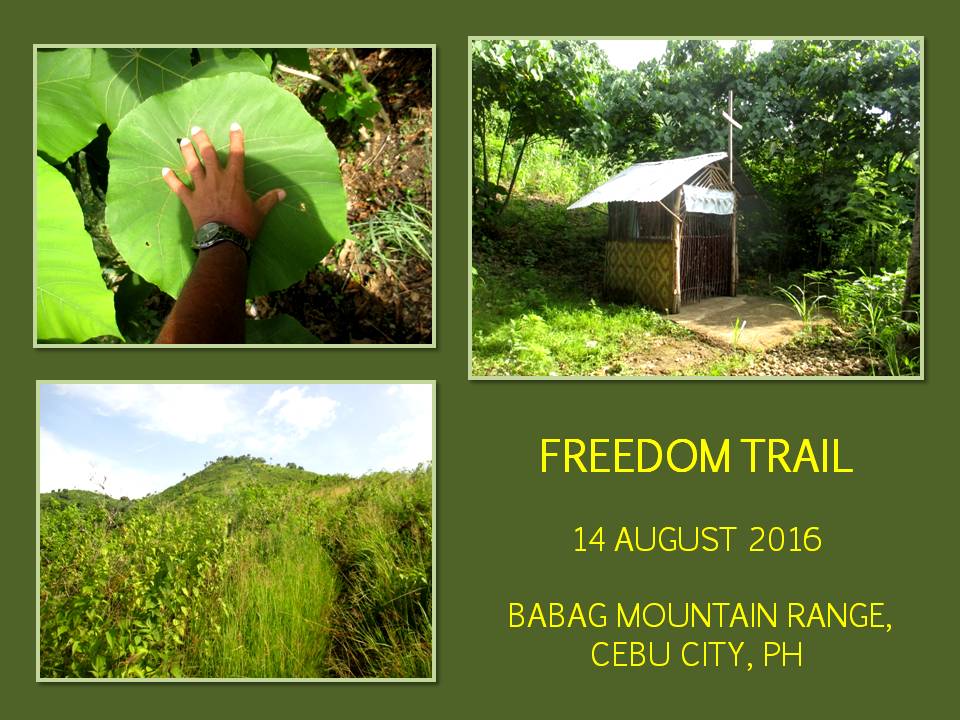
This day – August 14, 2016 – I am with these crazy bushcrafters. Two male guests came along upon the invite of one. Our plan would be to test the route between Tisa and Kilat Spring for we heard rumors of this greedy Italian-sounding abomination called the Monterazzas de Cebu trying to gobble up the whole of Banawa Hills and part of Tisa Hills, thereby, close access to a valuable water source at Kilat forever.


Although it is still 07:30, by my own experience walking both Tisa and Banawa Hills at this hour, it should already be warm. The hills are grassy but devoid of trees. It is rare to find a copse of different trees, most of it among deeper cleaves and on a few ridge tops. A power pylon stood guard on the trail. Its presence a hint that a corridor underneath it and its cables are government property. Why would this Italian-sounding housing development pursue its project?

Behind this low mountain range facing Cebu City is a watershed where Kilat Spring is found and the imaginary boundary is just a couple of steps away. Do not the Metro Cebu Water District find this position irregular? Is it okay to supply water to the metropolitan area whose source partly comes from the Buhisan Watershed Area which is now a close-door neighbor of this Italian-sounding residential area?

Did they check where their drainage flowed this time because there had been silence lately of places which had been inundated with water and mud coming from them in the past? I am just curious because one small stream in the Buhisan showed brown and silty effluents during a downpour. I understand it has been issued an Environment Compliance Certificate by the DENR because you cannot proceed with earth-moving activities without one? Is this ECC acquired with all the proper requirements? Is it above board?


Is it not a part of this Italian-sounding residential area transgressed by a corridor of high-voltage power lines supported by two steel towers on two separate points can be a risk to life and property? Can City Hall just allow and provide them building and land development permits without closely scrutinizing its close location to a watershed and a power corridor? Would City Hall not consider preserving a historical landmark that is now being trampled underneath this Italian-sounding abomination? It is a kilometer-long Japanese tunnel.

I waited for the others as they slowly negotiate the trail. I found a branch of a trail that would lead us to Kilat Spring. I know most of them have exhausted their water bottles but, over that ridge where there is an old mango tree, a path goes down into the Buhisan Watershed Area and abundant water. It did not take long and we reach Kilat Spring. We have all the water in the world. We celebrate by boiling water for coffee.

Water from Kilat Spring, according to an old-timer that I met some years back, burst forth after the ground was hit by lightning. A stump of a burnt tipolo tree is a testament to this incident which happened many many years ago. The water is now caught inside a concrete box and is diverted to the dam structure to serve as water supply for the MCWD engineers while the rest just flows freely thru a tap. Above the spring is a talo-ot tree, which nurtures the fine quality of the spring.

After 45 minutes we proceed to the Portal. We are now traversing thick jungle on a path that had not been used frequently by many people as before. Some parts of the trail are beginning to be overrun by weeds and it came at a point where there is a spot that had, so many times, led me to walk in circles and I am doing it again. I finally caught the true path and it relieved all the stress that I am now beginning to accumulate.


We pass by a forest of mixed sugar palms (Local name: idyok) and upland marsh palms (saksak). There has been an attempt to burn down these and a few of the palms are molested and cut without meaning. How could anyone be so vicious on these palms? I carefully pull the hair-like fibers of a sugar palm and the others did so. We collect this for our fire-making needs as it is a good tinder. I stuffed mine inside a small plastic bag where it will be transferred to my fire kit soon.

We reach the Portal but we continue until we reach Sibalas, the “Navel of Baksan”. There is also a natural spring here which is now housed inside a concrete box. Nearby, is the resting hut of the old steward of the water source and of the big swath of the place itself – Luceno Laborte or Noy Ceno. He is around and Jhurds Neo, the head shed of the Camp Red Bushcraft and Survival Guild, gave him two brand-new stainless-steel cups which elicit a very happy smile from him.

Everybody settled down and proceed to the foraging of dry firewood, which are few. Nevertheless, we have ways to make it fire-ready. The sound of wood being split by knives echoes down to where I sat talking to Noy Ceno and Jhurds. I watch the two guests, both wearing red t-shirts, watching silently the show the guys are now running. It would be their first time to see “dirt time” and they are glued to the spot where they are crouched.


Ernie Salomon, the camp fixer, is busy preparing the food while the rest are keeping him company in the slicing business. Fires are lit on two hearths. A pot for coffee is now above one while another pot of rice claims the other. Ernie’s home-made hobo stove spews out a smoke and a tin cup for coffee is placed over it. I was tired of the hike. Maybe I am just too busy. I was guiding people yesterday. Or maybe I am getting old.

I drank coffee again and I tinker with my Cignus V85 VHF radio. I am able to contact amateur station DV7FAL of Linao, Talisay City from my hidden location in Baksan, bouncing my signal to a steep flank of Banawa Hills which then makes a ping-pong to a repeater in Busay. Ingenious maneuver. When you are into ham radio, you tend to experiment and that is what I just did with an inferior made-in-China equipment. Think of what I could do with a Japan-branded radio?

Immediately after that, I caught the attention and interest of Christopher Ngosiok, Nelson Tan and the two guests about ham radio. We talked about licensing, acquisition of radios, review classes and preparing for that written examination administered by the National Telecommunications Commission. I am a licensed ham operator for three years now and I carry a callsign of DW7EUV. Many of the guys from the Camp Red Bushcraft and Survival Guild are licensed hams.

Radio equipment is always part of mine and someone else’s gear. Radio communications is essential when SHTF sets in. I have personally witnessed cellular signals fail in the aftermath of a 7.2 earthquake in Bohol and in places in the path of Typhoon Haiyan. Only radio signals were able to provide a link between the distressed communities and relief agencies. It happened in 2013 in many places of Bohol, Leyte, Samar and Northern Cebu.


Spoon is rapped on a pot lid, signalling the start of our late lunch. Ernie did wonders with chicken meat with an estofado dish. For a dayhike, we at the Camp Red Bushcraft and Survival Guild are pampered to feast like kings! How could we reduce our weight with food like that? More servings please! We gave a share of the meal to Noy Ceno and his family and our bellies bloat like that of Jhurds’. Hahaha…

When dark clouds begun to appear in the middle of the afternoon, we decide to pack our things back into our bags, including the blackened pots. We will be exiting to Guadalupe this time but, first, we will have to pass Enas. I lost the trail to there and I decide to explore the many strange trails that crisscross Lower Baksan until I call it quits and followed a trail that led to high ground. So familiar. So, Bebut’s Trail it is.

We go down that dreaded place called “Heartbreak Ridge”. We walk on the fringes of that Italian-sounding abomination and I see they are now starting to fence off the poorer quarters. How can you fence off a fault line? It is recently discovered in Buhisan, just at their back. I wished the new homeowners well.


Document done in LibreOffice 5.2 Writer

Monday, February 15, 2016

BECOMING A HAM

I ENTERED THE WORLD of amateur radio because it is a necessity. The transceiver radio, in its simplest form, is a vital piece of signal equipment that can improve communications of two individuals who are not visible to each other. That is the only purpose why I am into this. I am not the hobbyist type. I do not have the means to upgrade an equipment to seek that plateau of contentment and pleasure. I will only upgrade if it is really necessary.


I have always been interested in the use of radios. Owning one might be easy but you are subject to the laws of the land. In the Philippines, we have the outdated Republic Act 3846. The National Telecommunications Commission (NTC) enforces this law and implements its rules and regulations in the use, trade, transit and licensing of all equipment which transmit radio waves and assigns frequencies for amateur, commercial and civic use.

To legalize your ownership and use of radios, you must have a license. For civic and commercial categories, you only have to attend a half-day seminar at any NTC regional offices, provided you are working in a company where it has an existing commercial radio station license and owning licensed radios where a Restricted Land Mobile Operator Permit (RLMOP) is issued to you. It will be valid in one to five years, depending, and can be renewed.

For amateurs, you would have to take an examination before you earn an Amateur Radio Station License (ARSL). Entry level would be the Class D License. After considerable experience and know-how, aspiring the Class A License would be the pinnacle of the ladder of advancement. If you pass the Class D License, the NTC will assign an official callsign for you which will be yours for life. When you have a Class A License later on, you will have many privileges, including the use of another callsign.

After passing the Class C examinations in September 2013, I was provided a callsign by the NTC - DW7EUV. The ARSL is good for one year and is renewable for as long as you are able to pay the fees. I am allowed to use high frequency (HF) and very high frequency (VHF) radios at 100 watts peak power. To use my license, I legally purchased a Cignus V85 Portable Radio, keen on joining an amateur radio club to practice my radio communication skills and, if possible, to volunteer time as an emergency communicator.

When a 7.2 magnitude earthquake struck Bohol a month after, all cellular signals went out but radio communications were active. When Typhoon Haiyan overwhelmed Eastern Visayas and parts of Northern Cebu in November, power and cellular signals went missing. I turn to my radio to reach and communicate with people. I carried my only radio during humanitarian aid missions in Bohol and in Guintarcan Island.

At the start of 2015, I finally joined HAM RADIO CEBU, INC. as a pioneer member. We had our initial meeting where a provisional set of officers where chosen, led by Jet Manuel (DU7MHZ) and Charlie Saceda (DW7FBI), to steer our organization to the next phase, which is to be accredited with the Philippine Amateur Radio Association (PARA) as a member club and then recognized by the NTC as a Club Station.

We have no problems to meet the number of licensed members set by PARA and by NTC as I have been encouraging my people at the Camp Red Bushcraft and Survival Guild to obtain license for Class C and Class D to populate Ham Radio Cebu. Radio communications is very important in my outdoor activities and we do not go out to the mountains without it. It is used in emergencies and for experimentation.

Experimentation cover many fields. I concentrate on the places where radio contact is believed to be difficult. Mountains and rugged terrain are places which all communicators considered as obstacles. Nobody do tests there. I am highly-mobile and can go to these places as exemplified by my current explorations and discovery of routes for the Cebu Highlands Trail Project. This exploration activity traverses the highlands of Cebu from southernmost tip to the northernmost tip.

In my sojourns, I found existing locations and coverage of radio repeaters very wanting. If ever there is one, radio courtesy and ethics would be working at its finest. To meet the demands of these very difficult places, I may have to upgrade my present equipment. Upgrading for a purpose not because I want people to know that I have branded radios. I know there are many cheap radios flooding the market but I prefer better than that. Made in China radios are not in my shopping list.

The amateur is a patriot” and I can never forget that during my orientation to amateur radio operations. Because I am a patriot, I will not buy Made in China radios anymore, nor do I endorse these. I will not condone either my fellow Hams selling these radios online or personally. By that declaration, I may offend fellow Hams but that is not my fault. I stand by my principles and by my choices as asked of each of us as a citizen of the Republic of the Philippines.

Yes, I do not want my money to be spent for the manufacture of weapons and ammunition that would be used someday against me and my countrymen nor do I want to part my money to be spent in the construction of artificial islands in territories claimed by our country. My money will not be wasted on sub-standard items that add more radio pollution. One more thing, many of these things transmit electronic signals that will be used by Chinese spy agencies. It is indeed shameful to sell these China-branded radios to Filipinos.

I would be very careful with that since price can be very tempting at times, especially when you are in the quest of your upgrade. Net calls conducted regularly by my radio club can be very challenging when working with an inferior equipment which I am presently using. A net call is a sort of attendance check through the airwaves. That means I must secure an external antenna and, if I have enough funds, acquire a good VHF base radio. The radio will come later. Antenna first because it is much cheaper.

It is just fortunate that Ham Radio Cebu hosted an antenna-making workshop last November 8, 2015. I took advantage of this by attending this activity so I could pursue my upgrade. I now have all the materials and the most important – knowledge - to make a 2-stack collinear antenna for amateur use. It is not that easy but it is a different thing when you will make your own antenna. I can feel the adrenaline rising as I looked forward to the day when I will commence on this project.

I am also in the planning stage to acquire an HF radio soon. HF radios are very expensive but I heard that pioneer Cebuano hobbyists have assembled theirs from scratch. It is legal and it can be licensed according to Engr. Jesus Laureano of NTC Region 7. I may have to go that route once I have a lot of time for myself. I will just have to search hard a circuit diagram for that. If ever I will reach this stage, I can then proudly call myself a Ham – a real amateur radio hobbyist.

- - - - - - - - -

HAM RADIO CEBU Inc. is registered with the Securities and Exchange Commission as a non-stock non-profit corporation in the Philippines in the field of amateur radio on February 14, 2015. It is affiliated with the PARA and is operating legally as a radio club and repeater station by the NTC. It has its official address at PECOJON, Escario Street, Capitol Site, Cebu City. Its club station callsign is DX7CBU operating at 144.960 Mhz (-600 Khz).


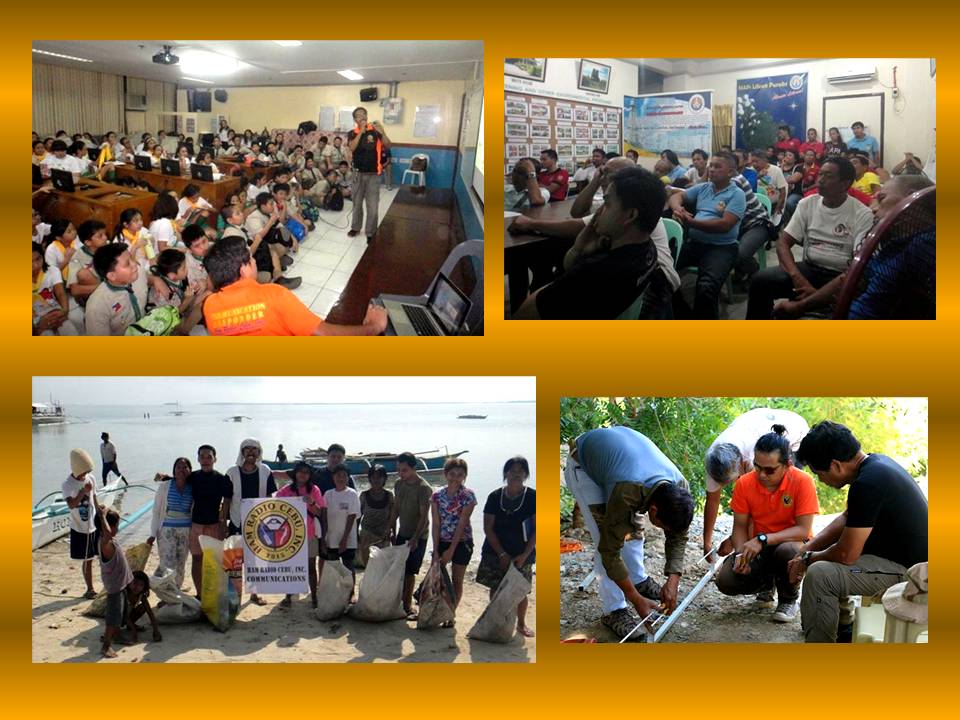
Despite being new, Ham Radio Cebu already has 48 licensed members and still counting. It is the envy of other radio clubs – civic and amateur. We encourage and support our members to acquire an amateur license or upgrade to the next level. We conduct orientations and pre-examination reviews to our members, applicants and those that request these, notably civic radio clubs, schools, the Boy Scout, the Girl Scout, ROTC units, the LDRRMOs and church organizations.

Our advocacy is to propagate the hobby of amateur radio through experimentation and long-range communication expeditions, assist in civic activities and rescue-humanitarian operations by providing communication support, educate the public about amateur radio through constant outreach educational activities, encourage the legal use of radios by helping owners acquire licenses, and be a partner of the government and the NTC through education and awareness.


The following are Ham Radio Cebu's modest achievements and activities in only its first year of existence:

  • Event Communications for the Order of Discalced Agustinians. Tabor Hills, Talamban, Cebu City. April 2-4, 2015.
  • 22nd International Grand Eyeball QSO and 83rd PARA Hamvention. Belmonte Farm, Naga City, Camarines Sur. April 10-11, 2015.
  • Orientation to Amateur Radio Operations and Element II Review for New Members and Applicants. Cebu Provincial Capitol, Cebu City. April 24, 2015.
  • New Class C Passers: Rommel Mesias (DW7EYH), Justin Abella (DW7EYX) and Justin Apurado (DW7EZL).
  • New Class D Passers: Faith Gomez (DY7EYY), Nami Fajardo (DY7EZF), Jonathan Apurado (DY7EZH), Kenny Ray Gacasan (DY7EYS) and Rin Estrada (DY7EYU).
  • Orientation to Amateur Radio Operations, Situation Report and Net Call for Barangay Workers and Island Stations. Guiuan, Samar. May 11-15, 2015.
  • Coastal Clean-Up Drive by Bureau of Jail Management and Penology. Medellin, Cebu. June 21, 2015.
  • Orientation to Amateur Radio Operations for Teachers and Students. Barrio Luz National High School, Cebu City. July 11, 2015.
  • Medical Dental Civic Action Program by 5th TAS Brigade and 1901st Infantry Brigade (Reserve). Compostela, Cebu. July 12, 2015.
  • Coastal Clean-Up Drive and HF/SSB/VHF Propagation by Municipality of Cordova. Hilutungan Island, Cordova, Cebu. July 18-19, 2015.
  • Orientation to Amateur Radio Operations for REACT Philippines and the AFP Community Relations Service. Camp Lapulapu, Cebu City. July 26, 2015.
  • Orientation to Amateur Radio Operations for Emergency Responders and VHF/UHF/HF Propagation for the Organizers of the 1st Cebu Provincial Search and Rescue Summit. BSP Camp, Cebu City. July 29-31, 2015.
  • Event Communications for Cobra Ironman 70.3. Lapulapu City-Cebu City-Talisay City. August 1-2, 2015.
  • Kahayag Forum by Brothers of Saint John. Sacred Heart Center, Cebu City. August 21, 2015.
  • Orientation to Amateur Radio Operations for Barangay Workers and Emergency Responders. Liloan, Cebu. August 27, 2015.
  • New Class C Passer: Jose Gochangco (DW7EZI).
  • Orientation to Amateur Radio Operations for ROTC Cadets. St. Alphonsus College, Lapulapu City. September 19, 2015.
  • Element II, III and IV Review for New Members and Applicants. Handuraw Events Cafe, Cebu City. September 21, 2015.
  • Element II, III and IV Review for DRRMO Members. Liloan, Cebu. October 2, 2015.
  • Antenna Making Workshop and SSB Propagation for Members. Talisay City, Cebu. November 8, 2015.
  • Orientation to Amateur Radio Operations for Boy Scouts and Girl Scouts. University of Cebu, Cebu City. November 14, 2015.
  • Element II, III and IV Review for Applicants. i1 Building, Cebu IT Park, Cebu City. November 14, 2015.
  • Practical VHF Radio Operations for Girl Scouts. University of Cebu, Cebu City. November 28, 2015.
  • New Class D Passers: Honey Alquizola, Malaya Bolito, Ham Bugtai, Mike Cabras, Nathan Chu, Joy Quito and Eli Bryn Tambiga.
  • New Class C Passers: Tristan Bonghanoy, Eric Guillermo, Nonoi Ibañez, Ariel Lim (DW7FAL), Locel Navarro, Jerome Tibon and Angel Villaganas.
  • New Class B Passers: Charlie Saceda (DV7FBI) and Arman Abaquita.


Document done in LibreOffice 4.3 Writer