Showing posts with label talk circuit. Show all posts

Tuesday, January 22, 2019

GIRL SCOUT AND BUSHCRAFT | SACRED HEART SCHOOL-ATENEO DE CEBU

DAYS AFTER GUIDING ADVENTURE bloggers on one major segment of the Cebu Highlands Trail, I am invited before a Girl Scout gathering at Camp Marina, Capitol Site, Cebu City on March 3, 2018. It is organized by the Senior Planning Board of the Sacred Heart School-Ateneo de Cebu GSP Council. I will be talking about Introduction to Bushcraft to both junior high and senior high students.

SHS-Ateneo is one of the premier schools in Cebu. I know some people who have graduated from this school and they had created an impact on the fields where they focused their energies on. It is a fact that many of them became somebody in business and society, became great entrepreneurs and innovators, and some became captains of their industries.

I am fortunate enough to mentor a few of their alumni in my yearly Philippine Independence Bushcraft Camp and am most happy to have them embrace the forgotten art of bushcraft which rural guys excel at. These few seek challenges outside of their usual realms. They are prepared, to a certain extent, any SHTF scenario and I have confidence in their abilities to survive and overcome adversities and disasters.

It is really an honor for me to be invited to talk before the SHS-Ateneo GSP Council and I thank Ms. Ann CastaƱares for this. I came fully prepared so I could leave an impact upon our youths. Coming with me is one of my underlings, Jenmar de Leon. He has just taken a board examination for teachers. This would be a good exposure for him once he passes that exam and gets his teaching license.

But what really is bushcraft? For starters, bushcraft is a term coined by an Australian, presumably, to describe his activity which really is similar to the ones done in other places and it is known there as woodcraft, fieldcraft, woodlore or primitive-living skills. It is a lifestyle and it is a hobby, depending on which side of the place you are. Actually, it is a way of life for the indigenous people so they could survive on their harsh environments.

What was a way of life for natives was adopted by outsiders (foreigners) in order for them also to survive and make a living in the same environments. These are the hunters, explorers, travellers and homesteaders. Civilization improved the way of life for all people through the years yet there are still spots of wilderness left which bushcraft is still useful. In fact, it is still useful in modern day-to-day living, even in urban areas. 

Modern native peoples here, now collectively known as Filipinos, forgot about bushcraft because living now is not that challenging anymore. These are the people who lived in urban centers and those who populate most of the coastlines and where roads exist. The frontcountry. These are the places where people mostly travel, make a living and engage in recreational activities.

The backcountry are the places where people practice bushcraft in all their lives. On these places, solitary houses exist, so far away from their next neighbors. Many of these are homesteads. They carved the wilderness into farms for their main source of food and to hunt the forests for protein and herbs. They have adapted with their environment well and learned primitive living skills by studying the habits of nature closely.

The only tool that they relied so much for their survival is the blade. They took care of this vital equipment and, from this same equipment, they manufacture other tools sourced from nature designed to do other tasks and chop wood for firewood. They have mastered the making of fire with just one matchstick to light a tinder bundle. To save matches, they keep the embers always burning.

Because they are closer to nature, they know the qualities of all plants found in forests and jungles and that made a big difference in how they treat themselves when ill. Plant identification and foraging is the most important of all skills in bushcraft. You cannot move your way around harsh environments without knowledge of plants. These same plants lead them to their best food: meat from animals.

It was an opportunity for me to demonstrate knife safety to the Girl Scout without the necessity of them holding one. These are sheltered kids who grew up in a politically-correct home environment. Their parents always has the last say on what to watch and surf in the internet and what company of friends or individuals that they should be with. Knives are the last things they would touch unless it is used to harness cooking skills.

With adult supervision. Maybe. But they are just too many and I only have Jenmar and me to look after them if we go through a knife dexterity session. The demonstration would suffice, repeating it twice or thrice for emphasis and memory retention. With the same knife, I let them crowd around me in a circle and showed them how to make an improvised pot made from a bamboo pole.

I also showed them how a thick stick could accomplish the task of making a bamboo pot easier for the knife. I am showing to them another tool to pair with my knife. What it lacked now is something to cook and a fire. Fire is another thing that is off-limits to these kids at home. It needed close adult supervision when striking a match and a lighter or turning the knob of a gas stove in kitchen or home premises.

But, today, they do not need any. They would ignite fire from a ferrocerium rod. It is the first time that they see one and everyone’s attention where now on me when they saw sparks of flame streaking down the ground when I scratched steel on a rod that got caught by a downy material which burst into a flame. Slowly repeating my demonstration, sparks get caught by the same material.

Distributing four sets of ferro rod and the downy material among the girls, the covered stage soon became a workshop of sparks and smoke. For a full 20 minutes, the ferro rod sets changed hands in tight circles, providing the girls a personal experience of non-conventional way of making a fire. Gaining knowledge from this, the girls appreciate better how fire works and how it is done safely.

 
Since it is an afternoon affair, my presentation ended at 15:00. Jenmar and I were recognized by the SHS-Ateneo GSP Council with certificates of appreciation for our wholehearted commitment and judicious efforts to introduce their wards towards bushcraft. It was a very productive afternoon and, for my part, it warmed my heart to be closer with these future leaders. I just wish that we have more time.

Document done in LibreOffice 5.3 Writer

Saturday, September 1, 2018

PINOYAPACHE MENTORS LILOAN PEACEKEEPERS

THE MUNICIPALITY OF LILOAN, Province of Cebu, celebrates the National Peace Consciousness Month every year as mandated in Proclamation 675 of 2004, by initiating a 4-day Revitalization Program and Training for the Barangay Peace Action Team (BPAT) on September 20 to 23, 2017. This will be participated by the BPATs of Cabadiangan, Calero, Catarman, Cotcot, Jubay, Lataban, Mulao, Poblacion, San Roque, San Vicente, Santa Cruz, Tabla, Tayud and Yati.

This is to instill greater consciousness and understanding among the citizenry on the comprehensive peace process to strengthen and sustain institutional and popular support for and participation in this effort; and to promote a Culture of Peace based on non-violence, respect for fundamental rights and freedoms, tolerance, understanding and solidarity. This year’s theme is “Puso para sa Kapayapaan, Magkaisa para sa Bayan”.

This event attended by BPAT is held at Dulce & Edwin Catering Services in Tayud, where all topics are to be discussed, such as: Orientation on Barangay Policing, Police Community Relations, RA 9262, RA 9208, Improvised Explosive Devices, Barangay Blotter System, RA 9165 and Relevant DDB Regulations, BADAC, MASAMASID, Report Writing, First Aid/BLS, Incident Command System, Katarungang Pambarangay and General Welfare Ordinances. 

My participation is anchored on the invitation of the Municipality of Liloan, through their municipal administrator and MDRRMO designate, Mr. Hammurabi G. Bugtai. My topics are Batas Pambansa Bilang 6 (BP No. 6), RA 10591, and Role of a First Responder to the different BPATs on September 21. The participants filled a large room full and I have the whole afternoon and their wholehearted attention to myself. 

A BPAT member, whom we knew before as a barangay tanod, is the village peacekeeper. Although, they serve the public on volunteer basis, they are not law enforcers. They simply do not have the training and the capacity to carry out the job of a regular public servant tasked to enforce laws and go after armed criminals. They cannot be issued government firearms either and so could never defend themselves.

They do not receive salaries. What they get is a monthly honorarium, which is so minuscule that it could not support themselves for a week, much less to those who has a family to feed. They simply do not have the motivation to expose their life to danger in the service of their community. They are reliable if you need information but you cannot compel them to fight street wars for you.

I understood the obstacles why a village peacekeeper would not gamble their lives to suppress crime. I am a former law enforcer myself and their brethren aided me when things get complicated. They can be helpful in many ways and it is these kind of help where you would want the most. But, first, you have to train them. Teach them the finer ways of peacekeeping and that is where I appreciate the initiative of the Municipality of Liloan.

During my years with the force, I developed that street smartness which helped me survive the streets and crime-prone areas, enforcing laws in the dead of night where chances diminished by a slim thread. Yes I was armed but it does not make me bullet proof. It is those instances that would guide my empathy towards the BPAT and they should be taught urban survival.

My first topic is about the law on gun possession and ownership. I gave them an overview of PD 1866 and RA 8294 so they could see and distinguish for themselves how our gun laws evolved before I would discuss RA 10591. I wrote on the whiteboard, the state agencies tasked to enforce this new law and the only government office given the authority to process and issue firearms licenses.

In much the same way, I let them know the persons who are authorized, by law, to possess, keep, own and use firearms; the type of firearms that can be legally issued or registered to; and the different types of licenses that can be issued to any private individual. Ownership of firearms in the Philippines is not a right but a privilege only and the state has the right to remove that privilege anytime when it sees need.

On this topic, the BPATs understood very well the obstacles why they cannot be issued any government firearm, much less, use it in the performance of their duties. They may own a firearm as a private citizen though, provided they have complied with the requirements and, using that as basis, can even be authorized to carry it outside residence. It becomes complicated only when its use is beyond what it is intended for.

The next topic is BP No. 6. This law is the amendment of PD 9 and it reduced the penalty in the possession of bladed, pointed and blunt instruments to imprisonment of less than one year or fine of less than P2,000. BP No. 6 is used to regulate the carrying of knives outside residences and in public places unless used as instruments to earn a livelihood or in pursuit of a lawful activity.

It is important to impart to them that fishermen, farmers, butchers, foresters, cooks, outdoor guides, electricians, gardeners, knife collectors, vendors, tailors and any person who happen to use knives to earn a livelihood are considered lawful calling. Lawful activities may be cooking, fishing, farming, hiking, bushcraft, mountaineering, camping, knife shows, film-making, vending, etc. Going in transit to fulfill an occupation or a lawful activity is considered legal.  

Bladed weapons, despite its obvious appearance as instruments of harm, has its lawful users like the military, law enforcement officers, houses of royalty, traditional martial artists and the indigenous people. Its activities include tactical and peacekeeping operations, cultural ceremonies, martial arts demonstrations, hunting, film-making, etc. Like bladed tools, it is legal to transit it in the fulfillment of a lawful calling and activities.

Role of a First Responder is the last topic. I am retrieving my many years of experience as a law enforcement officer and share it with the BPATs. What should be the role of a BPAT when responding to an incident? What should he or she do when arriving first at the scene? And what thereafter? There are many scenarios and I discussed to them the best possible way to act in consideration of the limited resources at their disposal.

First Scenario: Low-Risk Incidents. These are reports of domestic violence, drunk persons and petty crimes. You can pacify on the spot the people involved and, if that could not be helped, call for back-up and let things settle down in your barangay hall. No unnecessary force needed. It is a social problem which only the community could help solve.

Second Scenario: High-Risk Incidents. These are reports of suspicious person(s), armed individual(s) or a crime in progress. You have no firearm and you are not allowed by law to carry one. There is nothing you can do by yourself there or you will be exposed to harm. You immediately call for back-up and the police. Describe the person(s) involved and the place(s) where you last seen the suspect(s).

Third Scenario: Crime Scenes. This is crime that had already been consummated. What you have there is the body of the crime and the evidences. Preserve the crime scene by cordoning it off from bystanders to prevent adulterating and tampering, accidental or not. If you happen to posses an evidence with you, do the necessary documentation and preserve the custody chain to as few people as possible.    

Fourth Scenario: Medical in Nature. These are subdivided into three classes: Minor Emergencies, Less-Grave Emergencies and Grave Emergencies. Minor Emergencies are cuts on non-vital organs, sprains or a case of malnutrition. Less-Grave Emergencies are pregnancies, animal bites, dislocations, minor burns or slight hypothermia. 

Grave Emergencies are stab and gunshot wounds, snakebites, head injuries, drowning, unconscious person, severe burns, bone fractures, severe bleeding, traumatic amputations, heat stroke or severe hypothermia. If you are trained in BLS/CPR, you may proceed in reviving victim or treat victim of injury, wound or shock and then transport it to the nearest hospital. If you are not, call immediately for back-up and EMS, Fire or Police.

Fifth Scenario: Disasters and Calamities: These are bigger incidents caused by man or by nature like Conflagrations, Severe Floods, Landslides, Capsized Boats or Armed Encounters. Evacuate immediately all residents to safety, except for capsized boats, and immediately alarm DRRMO, EMS, Police, Fire and all available civic rescue units. Initiate early ICS. For sea disasters, utilize any available rescue crafts and give an alarm.    
 
On September 23, I am invited to be one of the judges for the showdown among the BPATs based on what they learned for the past three days from different resource speakers. The venue is the Liloan National High School. They would be graded according to their performance on Arrest Procedures and Report Writing. In the final tabulations, the Poblacion BPAT came out the winner, followed by Calero BPAT and San Vicente BPAT.

The opportunity to share my knowledge with the BPATs of Liloan, along with the other resource speakers, gave them the understanding of their limitations, enhanced their policing skills and further boosted their knowledge that would result to a better system in maintaining the peace and order situation in their respective communities. On my part, it had also tapped knowledge which need to be shared to prevent waste of lives.

Furthermore, the learning processes which were tested on the last day exposed their weaknesses and it is recommended that the Revitalization Program be held yearly, concentrating more on where they are most wanting by providing them better instructions. It is also recommended that relevant topics be taught and remove those which are not necessary anymore.

Finally, this writer salutes the initiative of the Municipality of Liloan and may their program be replicated by other local government units. Congratulations then to the Hon. Mayor Ma. Esperanza Christina G. Codilla-Frasco for her vision, leadership and in initiating this program. Congratulations also for her council for their unwavering support and to Mr. Bugtai for implementing this and the invitation.

Document done in LibreOffice 5.3 Writer
Some photos courtesy of Hammurabi Bugtai

Friday, July 20, 2018

THE TRAILHAWK JOURNEYS: AkyatCon 2.0

UNIVERSITY OF THE PHILIPPINES MOUNTAINEERS, Inc. introduced AkyatCon in 2016 to the outdoors community. This was a national convention for responsible mountaineering and for the conservation of mountain environments. It is where professional and leisure hikers, local communities, conservation workers, students and academics, national and local government agencies, and other stakeholders share their accomplishments, projects, technology, information, knowledge, and experiences.

The following year – 2017 – the UP Mountaineers celebrated their 40 years as a school-based mountaineering organization, and as an advocate of responsible mountaineering and environmental protection. Running parallel to that was their hosting the second sequel and highly successful AkyatCon, in cooperation with the UP-Diliman Institute of Biology, on the dates of July 28 and 29, 2017, at the Institute of Biology Auditorium, Diliman, Quezon City.

AkyatCon 2.0 featured discussions on mountain biodiversity and conservation, outdoor ethics, mountain-related policies and implementing issues, cultural and gender aspects of mountaineering, explorations and expeditions, emerging/current mountaineering techniques, technologies, issues and trends in mountain sports. UPM aimed in enlightening participants of such topics especially with the growing popularity of mountaineering as a sport and as leisure activity available for everyone who wishes to experience the outdoors.

From out of the blue, I was invited to give a talk about the Cebu Highlands Trail for AkyatCon 2.0, which I accepted. I could not believe it then. No less than the UP Mountaineers extending that invitation to me even when I have not submitted any abstract nor an application. It was beyond my expectations yet I had to honor that and prepared my presentation and sourced funds for my travel to UP-Diliman in the National Capital Region. This was something big which I did not let pass away.

I did not know that the AkyatCon 2.0 organizers have taken an interest in my Thruhike of the CHT – all 400 kilometers and 27 days of that – and it took place on center stage, which is one of several plenary talks scheduled for two days inside the 150-seat auditorium. I added more spice to that by mentioning the explorations of the eight different segments for almost six years and the difficulties of engaging an expedition without support from big corporate names. These were the very ingredients that the CHT came to be.

I forgot to tell you that I am not a mountaineer. I am just an ordinary outdoorsman who walked and ranged mountains as a form of exercise, as recreation and where I earn my keeps. I am a bushcraft enthusiast, a wilderness guide and an experiential educator specializing in the outdoors. The CHT is just a by-product of my creative mind. I just want to inspire people that you can make your dreams come true with hard work, patience, persistence and a dash of audacity.

I arrived at NCR by plane on July 26 in a very dour morning. There was a tropical depression and it was raining hard. I need not worry about AkyatCon 2.0 since it is mostly indoors. I availed of the offer of a mining executive and friend to enjoy the privilege of staying at the Holiday Inn Manila for a day. Yes, for a day, this lowly bushman lived like a king and I took advantage of the uncooperative weather by exploring every nook and cranny of my comfortable kingly chamber.

 
On July 27, I transferred residence to Navotas City. The couple Jay Z and Carla Jorge have hosted me several times when I visit Luzon for my training sorties and I took this opportunity again. Carla is a public teacher while Jay Z takes care of their startup business – Pacing’s House of Barbecue. They are very generous when it came to sampling their menu to me. I could never say no for theirs is the most delicious fare on this side of town. This time, I dined like a king.

Then came the BIG day, July 28. That was my schedule and I was the second speaker. The AkyatCon 2.0 have already started when I arrived and the first of three plenary talks for this day – Eco-Climbing in the Philippines by Anthony Arbias – was now in its infant stage as I settled in one of the cozy seats of the auditorium. Listening to Mr. Arbias, I began to learn many things. AkyatCon 2.0 was a very good event for improving your stock knowledge and I commend UPM for this idea.

My turn came and I talked casually about the CHT without any script. The slides lets you in on the groove naturally. Did you not know that long ago I have this fear of speaking before a crowd? I do not know what happened in between but I found out that I have this natural gift later in life like wine when it goes through its aging process. Yes I was quite aware that I was in a bigger stage. I was in UP-Diliman! Right before me were authorities in their own right, academics and idealistic thinkers. The best in the land.

 
I was given an hour for my discourse and that was fair. I just add incongruencies to elicit laughter so I could steer my presentation back and forth without interrupting the natural rhythm of the slide sequence. Adding icing on the cake, I talked about my recent Camino de Santiago, which overlapped some of the routes of the CHT. Questions came my way but they were the merciful kind and I was able to satisfy people. A token of appreciation, a terracotta plaque designed by Roberto Acosta, was presented to me after my talk.

With my talk over, I went back to the lobby area so I would meet the very people who made possible my participation in AkyatCon 2.0 and they were Leonard “Bunny” Soriano and Jom Daclan, the UPM President. Tope OrdoƱez, also of UPM, informed me of a room reserved for me. I returned to the auditorium to listen to the last plenary talk – An Everest Base Camp (EBC) Backpacking Experience by Ed Magdaluyo and Doreen Candelaria.

Lunch got served in the canteen of the Institute of Biology Building for the registrants, organizers and guests. Bottomless coffee was available provided you brought your own cup, this is in line of UPM’s pro-environment advocacy: Green Is Good. UPM was generous of my participation that they had provided me free stay for one night at the UP NISMED Hotel, where I headed that way on foot. The weather was still gloomy and the star gazing session at nighttime was now in peril.

 
In the afternoon, breakout sessions were held. There were three topics each hour and you have to choose one and you have all the four hours of the afternoon to navigate your way from one topic to another. For the first hour alone you have the following subjects to choose: 1) Down-to-Earth Approaches to Light Backpacking; 2) Speed Ascents; and 3) Top of the World: Identifying Factors that Influence a Person to Become a Mountaineer.

For the second hour: 1) Mt. Maranat, Mt. Balagbag, and Oriod: Forest Protection Activities and Rules and Regulations for Hikers; 2) Wildlife Act: Reporting Protocols and Do’s and Dont’s; and 3) Mountains on Hiatus. The third hour was this: 1) On Philippine Caves; 2) Open Source Mapping, GPS and the Mountaineering Community; and 3) Friend or Foe: Introduction to Philippine Snakes for Mountaineers.

For the last hour of the day the talks were: 1) Experiences of a Woman Backpacker Traveling Solo; 2) Bikepacking 101; and 3) Trail Running 101. After the first-day sessions, I walked back to the university hotel in a slight downpour, following a path that passed through their famous botanical garden. Rare trees that I often saw on my ranging were all here and, where a few that I know not its name, it was here with labels. I wished I had more time and better weather to be with these native trees.

Second day, July 29, I checked out of the hotel and went back to the event site. The plenary talks started as scheduled and these were: 1) Accessing the New Adventure Economy as a Tool for Landscape Conservation by JP Alipio; 2) Carrying Capacity and Beyond by Caloy Libosada Jr.; and 3) Best Practices in Mountain Management by Philip Bartilet. When the talks were finished, everyone went out of the auditorium and into an indoor market.

 
The lobby was dedicated for booths and tables displaying branded outdoor bags, apparel, shoes and other items, sold at slashed-down prices, and I took advantage of that by acquiring a pair of Hi-Tec shoes. The crowd had doubled and I began to see familiar faces like Adonis Lloren of Lagataw, who would be giving a talk later in a breakout session; Jay Servano of Silangan Outdoor Equipment, my CHT sponsor; and Marc Gana, whom I mentored in a bushcraft camp at Mt. Balagbag in 2012. Or virtual FB friends like Fred Ochavo, Vernie Villarosa and Jay Plantinos

After lunchbreak, the breakout sessions began where you would have to choose one topic again from among three on the first hour: 1) Useful Plants in the Wild; 2) Impact of Social Media in Mountaineering; and 3) On Biodiversity. The second hour came: 1) From Capitalist to Naturalist; 2) The Tungtong River Conservation Project; and 3) Project AlaGALAan: Proper Etiquettes in the Outdoors.

The last breakout hour sessions were like these: 1) The Sicapoo Exploration; 2) The True Story of Rene, Abel, Kit and Lorna; and 3) The Palanan Co Sierra Madre Trek. Then all the audience returned to the auditorium once again to listen to Carina Dayondon talk about her topic – First Filipina Attempt on the Seven Summits. There was a raffle session after this where the top prize was an Insta360 camera.

It was just unfortunate that the outdoor activities of bird watching and the native tree tour got aborted due to unfavorable weather, along with last night’s star gazing session. On the whole, AkyatCon 2.0 was another success, maybe better than the first, and I wished there would be many sequels to come or maybe they would bring AkyatCon to the rest of the country. In my own little way, I would endorse AkyatCon anytime to as many people as possible. It is a treasure trove of knowledge and a bridge to start new friendships.

Document done LibreOffice 5.3 Writer
Photos 1, 3, 4, 6, 11, 12 & 13 grabbed from AkyatCon 2.0
Photo 5 & 9 courtesy of Jay Plantinos
Photo 8 courtesy of Vernie Villarosa
Photo 10 courtesy of Fred Ochavo

Sunday, April 1, 2018

PECHA KUCHA NIGHTS

ANOTHER SPEAKING ENGAGEMENT.

Another set of a paying crowd listening to a sunburnt relic talking about cold mornings, bad breakfasts and irate people.

Like geeks to a Greek?

No. Not this time, dude. This one’s more chic and metropolitan.

They know a little Greek and some highland yells, I think?

Yeah, they do not come to hear me but they also want to know of other people making good and having fun in their own fields of expertise. I just share the stage time with eight other distinguished individuals.

 
I am invited to Cebu’s own PECHA KUCHA NIGHT at its 17th sequel. Ms. Regil Cadavos made that possible.

I will be talking about meself in ASPACE BAR Cebu at the Crossroads, Governor M. Cuenco Avenue, Cebu City on May 18, 2017. I am asked to provide twenty photos of me, my work and my Thruhike of the Cebu Highlands Trail which I just did in 27 days churning mileage of around 400 kilometers. No cold mornings, bad breakfasts and irate people to talk about this time. Maybe, not a good idea.

I need to describe each photo in not more than 20 seconds. 

That short?

Hmmm, that would be 20 by 20 equals 400 seconds or 6 minutes and 40 seconds.

I think, I got myself cut out for this thing? Like that 20-second rule. 

Why?

You see, I used to get the whistle for hugging the ball for more than 3 seconds inside a shaded lane. Sometimes I do not and it is a big thing if I made a shot. 2 points to my name. A few times, a bonus shot from the line.

They don’t print your scores in the sports section now, did you know that?

But this ain’t basketball, dude!

Okay. No defenders to worry. Yes. Well, ah, but, ah, okay…there is still a crowd. They don’t throw bottles, do they? But I would be willing to be hit this time with…ah…crumpled bills. Do they do that here?

Ooops! My name is called and here goes:

PHOTO 1: As a Husband and Father.
PHOTO 2: As a Writer and Blogger.
PHOTO 3: As a Wilderness Guide.
PHOTO 4: As an Explorer and Adventurer.
PHOTO 5: As an Outdoors Educator.
PHOTO 6: As a Knife-Rights Advocate.
PHOTO 7: As an Amateur Radio Hobbyist.
PHOTO 8: As a Pioneer of Modern Philippine Bushcraft.
PHOTO 9: As an Actor for a Reality Survival TV.
PHOTO 10: As a Product Tester, Reviewer and Endorser.
PHOTO 11: As a Resource Speaker.
PHOTO 12: As the First Person to Hike Through Cebu.
PHOTO 13:
PHOTO 14: Day One – Start of Thruhike from Liloan, Santander.
PHOTO 15: Day Eight – Foot Blisters Treated at Mantalongon, Barili.
PHOTO 16: Day Eleven – Halfway Point of Thruhike at Cebu City.
PHOTO 17: Day 12 and 15 – Crossed Big Rivers in Cebu City and Balamban.
PHOTO 18: Day 21 – Lost 30 Pounds at Kanluhangon, Tabuelan.
PHOTO 19: Day 22 and 23 – Lost in the Wilderness of Doce Cuartos Mountain Range.
PHOTO 20: Day 27 – End of Thruhike at Bulalaque Point, Maya, Daanbantayan.

 
Don’t you want to go back what you missed?

Like what?

You failed to talk about PHOTO 13.

Look dude. You’re not supposed to talk about 13. That’s bad luck! 

But…

Okay. Okay. I tried but I stuttered.


Promotional graphic by Pecha Kucha Cebu|ASPACE Cebu|_COLLAB
Photo No. 3 courtesy of Jad Tupaz
Photo No. 11 courtesy of Markus Immer
Photo No. 12 is a design by Ronald Abella

Thursday, January 11, 2018

ADVENTURE ENTREPRENEURS

ADVENTURE ENTREPRENEURS. Exalted description of vagabonds who are doing well.


I seem to know what it meant and I felt high, even though I know that I do not made the grade.

I am into adventure but entrepreneur I am not. I simply do not have the means.
  
Anyway, you do get that high feeling when you have people’s attention though.

It is not everyday that I get moments like this. Bright lights and all. Mic in hand and images of you on a white screen, flipping and changing in timed sequence.

I am before a paid crowd talking about bad breakfasts, cold mornings and irate people. It is about my recent Thruhike of Cebu that snared people’s imagination lately because it had not been done before. I did it in 27 days between January and February 2017 from Santander to Daanbantayan. Tip to tip. Shore to shore. 400 kilometers.

 
TECHTALKS Philippines, thru Ms. Tins Amper, invited me here at iiOFFICE Cebu today, April 5, 2017, to talk under a theme of Adventure Entrepreneurs + Social Media Clinic.

The place is a shared workspace for geeks and the not-so-geeks located at Don Pedro Cui Street, in Capitol Site, Cebu City. 

I am more like Greek to geeks. I am a sunburnt relic. We both speak a different language, in case you do not know that. They speak algorithm while I communicate in highland yells.

I am with glamour guy of trail biking, Gene Faelnar.

He has assets. I have liabilities. He is entrepreneur. I am vagabond.

He owns Cebu Mountain Biking Tours.

He speaks about his venture.  

The audience loved his presentation.

That appreciation extends to mine when I had my turn on the stage.

They should be.

 
I would not have been here without the support of my benefactor and good friend, Markus Immer. He brought with him cupcakes for everybody, baked by his wife Analyn.

Thank you very much!

Markus had a big role during the Thruhike. He kept us going with the supply runs he undertook. He even walked the final 40 kilometers to Bulalaque Point.

He had been into many adventures around the globe. Sailing. Diving. Hiking. Climbing, Cross-country skiing. You name it. And he is an entrepreneur himself.

 
Entrepreneur. A high sounding word.

That will take form, perhaps, when I get guideship calls for the Cebu Highlands Trail and, soon, the Camino de Santiago de Cebu.

Meanwhile, I am more into outdoors education. It had kept me rolling over rough ground for more than a year. It is my main bread and butter.

I teach tropical bushcraft, wilderness survival, land navigation, campsite management, knife safety, urban prepping and survival, plant identification, and good old outdoors common sense to kids and adults, outdoorsmen and responders, corporations and government.

I travel with the tools of my trade and my knowledge. A journeyman.

Maybe a few speaking engagements like this. I do not know.

Someday I may finish my books and that is all about this entrepreneur thing.

It is never easy to be a vagabond.

There is no fortune and riches in there.

You only have a life well-lived by a good dose of adventures.

A survivor.


  Promotional graphic by TechTalks Philippines

Sunday, September 24, 2017

CEBU’S BEST | INFEX & DX CONTEST 2017


I JUST FINISHED THE THRUHIKE and, four days later, on this morning of February 18, 2017, I would be standing on a stage before different troops of the Boy Scout of the Philippines belonging to the University of San Jose-Recoletos. I would be presenting a talk on the topic – A Boy Scout as an Environmental Warrior and, on another one, Survival in the Outdoors. Fortunately for me, both are subject matters closest to my heart.

I am gracing this occasion upon the invitation of the USJ-R Greenbar Council, without them knowing that I once cut my teeth as a Tenderfoot under the aegis of the greatest scoutmaster Cebu had ever produced, the late Sergio P. Damazo Jr. That was in the ‘70s, when I was then an element of Troop 38, in their old campus at Magallanes Street, Cebu City. They have not erred in contacting me.

This is my first time to visit their campus in Basak, some thirty-nine years after my last days with my alma mater. I am excited but I am well prepared even though I was tapped on short notice. I made it to the gate incognito and, upon entering a second building where the real activity is held, I saw the picture of my dearly beloved scoutmaster. The friars had cherished his memory well by devoting a small museum for him. I am touched.

 
After meeting the acting scoutmaster, Romulo Sevilla Jr., his most senior scouts led me to the Audio Visual Room where I am going to give my talk and to meet my audience. This AV Room is much much bigger than the one they have at Magallanes. It is still empty but it soon will be filled by warm bodies. There is a projector and screen on standby and, pretty soon, a laptop will be provided for my Powerpoint presentation.

Then they came in military cadence and order, 250-strong. The newer versions of Cebu’s Best. This is their first day and they were on drill formation earlier. They must be tired and so I gave instruction to the troop commander to make them sit on the concrete floor. My greatest challenge today is how to prolong their short attention spans. These are pampered kids studying in one of the finest Catholic schools of Cebu.

When I studied on my first year at the old campus, back in 1975, I felt that my father had made a mistake of enrolling me in a wrong school. I was a product of a public school system but he was happy I passed the entrance test. He thought I have a good head but he never could imagine I was out of place. My classmates where well off, smart and bigger. Every week was a meat grinder for me and I was a weekly customer of the guidance counselor.

We were taught to be pious. Oh yeah, I did more kneels than any of my classmates. I do not have to go to the altar. The space near the teacher’s table or the principal’s office were the right spots to tame me. I was a wild kid in a well structured environment. Then Mr. Damazo took me into his care and responsibility and I understood why the Josenians wear shorts as against other schools who parade on streets in long pants.

 
One member of the Order of Agustinian Recollect is attending as audience as well as the scoutmasters of the University of Santo Tomas-Recoletos, from Negros Occidental, and the USJ-R Balamban Campus. I think they were there to reign in their boys. But there are girls among them. Yes, I saw many marching with the boys at the quadrangle with the same uniforms as the boys were. And THIS is a Boy Scout event.

After the preliminaries, I deem it proper to give my audience a peep into my past, as a Josenian Boy Scout which jolt them from their stupor, and my present life, which everyone now were all ears of my accomplishments as an outdoorsman, enjoying the life of a wandering bushcraft enthusiast and living the dreams of a Boy Scout of long ago. My Thruhike across Cebu’s 400-kilometer length in 27 days got them thunderstruck and bewitched.

A Boy Scout can never be an environmental warrior if the lessons he learned as a citizen scout are different from what he witnesses in his home, the community and even inside malls. It erodes his youthful enthusiasm. If push comes to shove – like the threat of climate change – then he has to lessen his carbon imprint if he wanted to extend the living years of our only home in this universe.

Climate change and man’s manipulation of the environment to suit his needs caused this environmental degradation we are experiencing right now. It had already been mentioned in the time of Noah, Joseph and Moses of the Old Testament. The impacts now are bigger and everywhere: mountains, river systems, lakes, the ocean, the atmosphere, the arctic regions and even on urban centers. Industrialization, mining, logging, consumerism, you name it, causes degradation and pollution and it has a common denominator – greed.

 
How do we overcome this? Almost impossible but there are organized activities that influence the mindsets of people or compel them to, about the state of our planet. We now have peaceful mass actions, legal actions, even extreme strategies. Greenpeace is on the vanguard of this for so many years. Leave No Trace was introduced in national parks across the globe and are being used incorrectly by activists, forcing people to toe the line. Then we have the grey wolves of this movement – the Sea Shepherds.

As a Boy Scout, the above methods are themselves equally daunting since it exposes them to harm’s way. But there are more peaceful ways that are much better and much more proactive. Planting trees or mangroves may be one of the best but organizers almost always choose the wrong species, mostly exotic, or monopolize one species on a big area. You can plant your own trees without having to join mass tree planting activities.

Join or organize community projects which keep away residents from engaging in destructive methods on the environment. These could be tree planting, coral propagation, beautification projects and alternative livelihoods. Information and education will guide simple folks from ignorance, indifference, superstition and half-truths. Engage in a personal crusade that does not involve people like practicing Reduce Reuse Recycle and LNT.

Can you change the world on your own? Yes you can. There are many advocacy tools. Documentation for a community or school magazine about the environment is a good start. Or you could start a blog. Internationally-acclaimed blogs about environmental awareness started from small ones and there are many free platforms to choose from. Create more awareness on online petition websites like 350.org or transcend borders and government control by posting on social network sites to a much wider audience.

A Boy Scout can indeed be an environmental warrior. I once was that Boy Scout and I am on this personal crusade as an activist for no one, a blogger, a writer and a lecturer for the environment. The methods I used are simple but I am always on the frontlines where man and environment clashed, never a good consequence for the latter. Someone has to fight for the environment – peacefully. A photo with a caption of facts is good enough to catch fire in people’s consciousness across the Internet.

That was a long talk and I may have delivered my message to the majority of my audience or not but, it does not matter, because I am not expected to convert all into environmental warriors. I only need one from the 250 and he or she could already make a big difference.  The next topic – Survival in the Outdoors – would be the most awaited one and everyone begins to reposition themselves after a break of five minutes.    
 
The outdoors, for most, is a beautiful romantic place. Simply because they may have experienced and enjoyed it on the frontcountry. The backcountry is different for only a few people visit it. It is mountainous and navigation is difficult. Then there is the wilderness. All these places found in the outdoors are dangerous. It has an unpredictable weather system and streams go suddenly wild even if the day is warm. It has a mean wildlife population and thick stands of forests that no sunlight could penetrate.

Getting caught in the outdoors in the wrong weather or time causes you stress which tend to force you to make mistakes. Small mistakes can create a big impact on your thinking. When you are lost or helpless, survival mode begins. Your increased awareness is a result of uncontrolled release of adrenaline. Your thoughts are fed by the senses, the nerves and the guts, all agitated, causing you confusion and more mistakes.

Our prolonged survival depends upon our discovery and rescue. If it does not happen, you need to have nutrition. Hydrate as much as possible because a deprived brain cannot function properly. Eat some food. If you do not have enough, look for one. Fruits supply you natural sugar, which is converted by enzymes into adrenaline. Fat is the hardest to find in a jungle environment but, unknown to you, you have layers of fat that your own body would subsist on when food becomes difficult to obtain.

Water is the first thing to find during survival. If you still have strength, you look for a shelter or make one. Food is the next thing to look for. When you have water, shelter and food, you start to go warm. Make yourself more warm by making a fire. If making a fire is impossible, do not expose yourself to the elements. Increase your security by blending in with the environment or standing out. It depends if there is an immediate threat. These are the priorities during a survival situation and could change with water always on top.

When you are outdoors, there is a thing we in the bushcraft community called as “outdoors common sense”. Bushcraft is a hobby and a lifestyle which uses the outdoors as a learning environment for survival. The purpose of this outdoors common sense is to increase our safety and security. We have developed certain protocols that guided our behavior and our presence in the outdoors. This set of protocol includes how we deal with wildlife encounters.

 
You do not learn these things in a classroom. I teach these in a bushcraft camp. Those who learned from me became members of the Camp Red Bushcraft and Survival Guild. Instantly the guild logo and my activities appeared on the projector screen. The images swelled their pride, knowing that an alumnus of their school does these things for a living and brought sparkles of interest in adventure in their eyes.

My talk ended at just the right time. I was presented by the USJ-R Greenbar Council with a certificate of appreciation and an invitation for lunch. Outside, the field begins to be filled by the Boy Scout units. Platoon formations are hurriedly organized under the bare sky. The units began counting off the elements in preparation for their own meals. It will be a long day today, to include night activities and campfire rites.

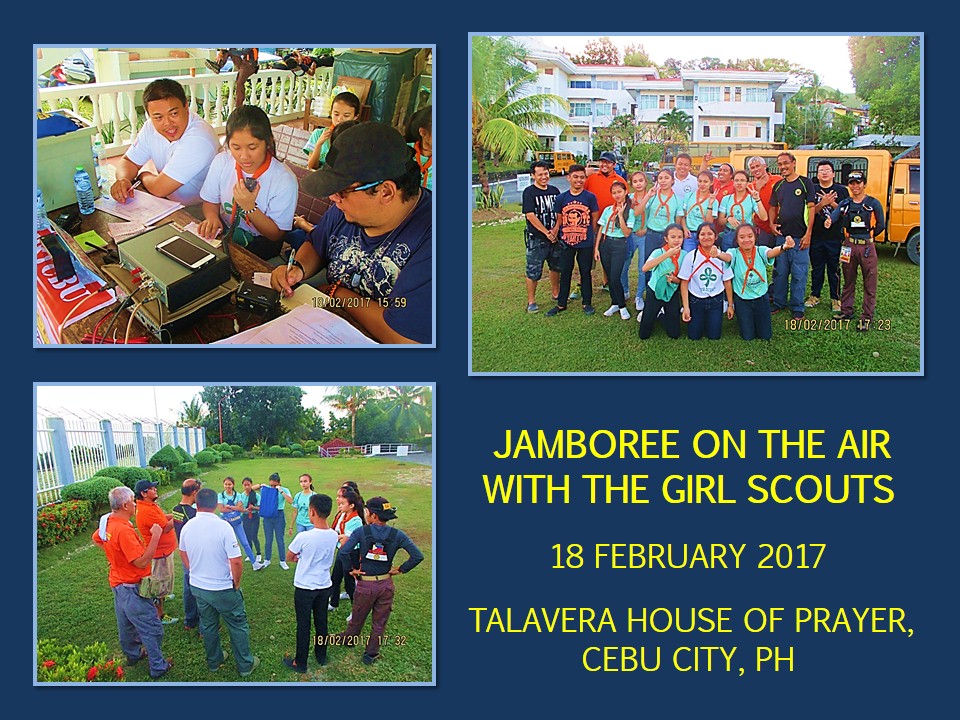
Meanwhile, my day is not yet finished. I have to join and witness the International Friendship Exchange and DX Contest which will be participated in by the Girl Scout of the Philippines unit of USJ-R under the adult supervision of Ham Radio Cebu. It would be held at the Talavera House of Prayer, in nearby Quiot, for the whole afternoon. Ham Radio Cebu is an amateur radio club which I also belonged. INFEX is a worldwide event that uses high frequency radio to contact amateur radio stations on far locations at 7.095 MHz.

Under the guidance of Jet (4F7MHZ) Manuel, Nick (DV7FCC) Manuel, Ariel (DV7FAL) Lim, Wilson (DW7REE) Aliganga and Marvin (DW5CIA/7) Reynes, the USJ-R Girl Scouts were able to contact twenty-three amateur radio stations from all over the Philippines at the end of the day. This is a friendly competition where the winners and their tutors are rewarded points and certificates by the International Amateur Radio Union and their local counterpart, the Philippine Amateur Radio Association. It is an event designed to rekindle the love of amateur radio propagation to the younger generations.

 
It was really a busy day for me. I reconnect with the beloved school of my youth. The only familiar face I met is the framed picture of my dear scoutmaster. I am happy that the Boy Scout spirit of the Josenians lovingly nurtured by Sir Damazo are kept alive and burning, along with their traditions and lore. I have been part of Cebu’s Best during my younger years and I am proud the present descendants behaved like one. I am also elated to know that their Girl Scout counterparts have partnered with Ham Radio Cebu and will earn themselves badges in amateur radio. Adelante!
 
Some photos courtesy of Markus Immer
Document done in LibreOffice 5.2 Writer