Showing posts with label Ham Radio Cebu. Show all posts

Tuesday, August 7, 2018

PINOYAPACHE GOES TO HOMONHON ISLAND

RADIO COMMUNICATIONS ARE an essential means by which coastal and island communities communicate with each other and to government centers where aid most likely would come when in times of weather disturbances and calamities. Regular cellular phone signals are simply unreliable during such times. It only improved a little of their lives and most of that are where communications infrastructures are present like urban centers.

Let me remind you that these same communities have had bad memories of strong typhoons, like the recent Tropical Cyclone Haiyan (Yolanda), which caused so much grief and destruction; and that they have lived everyday with the unpredictable whims of the Pacific Ocean. Radio communications empowers these communities to experience at least a good control of safety and security of their own lives.

 
Travel to and from coasts to islands and vice versa would benefit so much from radio communications due to the favorable presence of a wide body of water that necessitates a good propagation of radio signals. A base radio station on simplex, with antenna properly placed, preferably on a high ground, covers so much area in relaying and receiving messages. While it may have its advantages, its main disadvantage is that it is stationary.

A stationary base radio station, unlike hand-held portables, operates on a system consisting of an antenna, lengths of cable wires, a power source and a power regulator. It only becomes mobile when it is installed in sea vessels, airborne crafts and land vehicles. While it may be effective there, the problem is you cannot operate on a continuous and uninterrupted power supply that a stationary land-based radio station offered.

Let us talk about the post-Haiyan rehabilitation efforts. The Peace and Conflict Journalism Network (PECOJON) partnered with Caritas Germany, the Archdiocese of Borongan, CordAid Netherlands and the Philippine Misereor Partnership in improving the communications capability of the affected areas by installing several base radio station systems along Eastern Samar and off the islands of Sulangan, Homonhon, Manicani and Suloan.

Pecojon contracted C5 Electronics of Mandaue City for radio equipment and services; and, likewise, tapped a Cebu-based amateur radio club, Ham Radio Cebu, for manpower, training and technical support. The first recipient of this grant from Misereor was the Municipality of Guiuan and the aforestated islands in 2015. This author belonged to Ham Radio Cebu and possesses an amateur radio station license, DW7EUV.

 
Ham Radio Cebu is registered with the Securities and Exchange Commission and given a license by the National Telecommunications Commission to operate and exist as an Amateur Radio Club in District 7 last February 2015. It is a member of the Philippine Amateur Radio Association and legally operates a repeater station. Through the leadership of Jet Manuel 4F7MHZ, Ham Radio Cebu grew by bounds and leaps for just a few years and we now are the most dynamic and most active club in Cebu and District 7.

This association encourages its new members to aspire for an amateur radio station license which could be acquired after passing the NTC examination. It also inspires its current license holders to upgrade to the next level. Aside that, this club is into antenna making done on weekends; participate in DX contests; volunteer as communicators in civic and religious activities; support PARA and DRRM events; and mentor fledgling civic and amateur clubs.

In May 2016, this author was part of the second wave of volunteers from Ham Radio Cebu requested to conduct training, helped C5 Electronics personnel install the antennas, and propagated signals for testing and fine tuning. The recipient was the Archdiocese of Borongan and base radio systems were installed at the parishes located in Borongan City, Lawaan, Hernani, San Julian and Oras from the donor, Caritas.

 
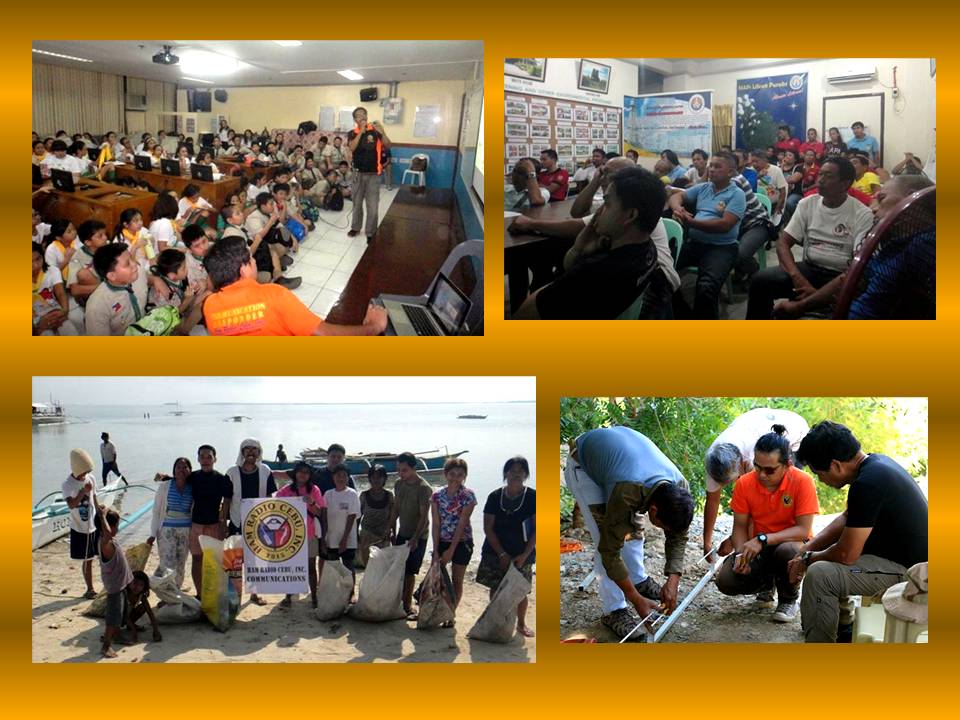
On this same trip, Ham Radio Cebu went back to Guiuan to train fish wardens and coastal management volunteers in the operation and maintenance of radio equipment; taught them phonetics and reporting protocol; and practiced them radio net call. C5 Electronics brought them three base radios, a mobile base, portable units, antennas and their cables, batteries, power regulators and other accessories provided from a grant by CordAid.

Recently, Ham Radio Cebu and this author went back for another mission to Eastern Samar, particularly in Guiuan, last September 1, 2017. We were again requested by Misereor, through Pecojon, to conduct an emergency communications operation based on a scenario of a Signal No. 5 typhoon. We would focus more on the islands of Homonhon and Manicani and mobilize existing village DRRM units and NGO volunteers.

We arrived at the Port of Ormoc early in the morning and travelled overland to Tacloban City where we took our breakfast. Misereor provided the vehicle for the twelve of us while Pecojon accommodated two more on its staff veicle. The scars of Haiyan are still there and it cuts deep into the memories of the people of Tacloban. I could understand their sufferings as I have been here a few months before that storm with its killer waves, called the storm surge, flattened everything in its wake.

I navigated through my mind the memories of houses and buildings and people that used to exist on the very places and streets where the vehicle passed along on its destination to the San Juanico Strait and its famous bridge. There are a lot of blank spaces in between which I barely noticed in my last visit there. I closed my eyes as I controlled my emotions. I peered at the back mirror and each one was in their own deep thoughts, staring at something faraway.

Our convoy parked at the side of the middlemost part of the bridge and it broke the spell. Everyone streamed out from their seats and posed for a group picture with part of the bridge and strait as the background. Then we continued, the highway goes south of Western Samar, passing by thick mangroves and rugged mountains. It passed the coastlines with many bridges and what I liked most was the one where there were karst formations by a river mouth.

We arrived in Guiuan at 12:00 and took lunch at a popular restaurant there. Afterwards, we were toured around the general locations of Guiuan going to Sulangan and back passing by a beach that is a surfer’s paradise and an abandoned American base which, at its point of history, received and hosted White Russians during the Russian Revolution of 1918 and, later, European Jews during the prelude to World War II.

In that old American base, there is still an existing landing strip and around it are spaces that may have housed the asylum seekers before their transfer to countries of their own choice. What struck me odd is the presence of the flag of mainland China. It was mixed with the flags of countries that fought Japan in the Pacific like the US, UK, Australia, Canada, New Zealand, Netherlands and ours. What would be more appropriate there instead is the flag of Taiwan, a remnant of that original nation usurped by the communists.

We visited the office of Misereor and got to know the staff. Our convoy proceeded to the East Visayas State University and we had an audience with the university president. When it was over, eight of ours, the ones assigned to Manicani Island, stayed at its campus hotel while the rest of us went to check in at a local hotel. This blogger would lead the group that would be assigned at Homonhon Island which were composed of Nick Manuel, Nonoi IbaƱez, Honey Alquisola, Loisa Roa, John Sala and Misereor representative, Wilson Catalan.

Second day, September 2, we woke up at 04:00. A van would pick us up at 04:30 so we could meet with the guys staying at the EVSU Hotel, get our equipment and take a hasty morning coffee. My group left the mainland for Homonhon at 05:30 over a very rough sea. We were prepared for that with our equipment and gear sealed inside waterproofed bags. The rest would start to cross to the smaller Manicani Island but much near to the mainland.

Homonhon Island is south of Manicani and Sulangan Island and is between 10 to 15 kilometers from the latter. Sulangan is connected to the mainland by a bridge. Homonhon is about 20 kilometers in length with about 3 kilometers at its widest which is found on the north and about 1.5 kilometers at its narrowest found at the middle where the village of Casugoran is located. We will be staying there in the staff house of Misereor.

This island is mined for chromite deposits by locals and, for that, the southern part is barren, except for a thin layer of vegetation growing along the coastlines. Its northern part is where the original forests are located. The highlands rise majestically about 400 meters from the shores and are very rugged. It is said that it is still a habitat for deer, wild boars, tarsiers, macaques, big pythons and lizards, and rare plant species. Interesting!

Aside from Casugoran, other villages are scattered all around the coastlines of Homonhon like Bitaugan, Habag, Inapulangan, Kanawayon, Culasi, Pagbabangnan and Cagusoan. There is an islet off Inapulangan called Mantukanon. Farther south of us is the island of Suloan. Casugoran is the main village and it is where the St. John the Baptist Parish and the Homonhon Community Hospital are located.

We arrived at Casugoran at 07:35 and took breakfast. We started our Emergency Radio Communications seminar at 09:00 to the village officials and peacekeepers of the mentioned villages. Misereor requested for this activity since they will be turning over the radio equipment to them as their timetable for rehabilitation work was approaching its end. With the approval of the parish priest, we used the church as our classroom.

After an orientation by a Misereor staff, I talked about Introduction to Radio Basics which include radio anatomy, battery, chargers, propagation, etiquette, protocol guidelines, restrictions and priorities. I was assisted by Loisa DW7FFB and Honey DY7FAR. Nonoi DV7FAQ discussed about Basic Radio Troubleshooting and the topic covered general problem areas, emergency communication, vital resources, power sources and deployment procedures. 

As part of that discussion, Nick DV7FCC lent them his know-how in the construction of the Quarter Wave Antenna. The participants were provided the materials and the tools to construct their own after a demonstration was done before them. After this activity focused on antenna making, each was able to make and proudly hold their antennas. A SWR meter provided by Nick measured the nearest possible ratio which required a good propagation.

After lunch, at 13:00, all returned to the church to listen to Nonoi explain the Incident Command System to them. The ICS is the standard protocol adopted by our country to address casualties and damage reports during calamities induced by natural hazards or of a consequence made by humans or just the effect of climate change. For two hours the participants listened intently about this topic.

 
The seminar ended at 15:00 but they would have to perform a simulation of emergency communications operation using their present portable radios issued to them and pairing it with the quarter wave antenna which they constructed for, at 16:00, a general net call would be propagated from the mainland targeting Homonhon and Manicani. Everyone returned to their villages.

Nick, John 7HAJS and Wilson would be stationed overnight at Inapulangan to assist the neighboring villages of Bitaugan, Kanawayon and Habag and Nick has a personal mission for himself later – a DX Contest. Nonoi and Honey would be based in Culasi to link up with Inapulangan, Casugoran and Pagbabangnan. Meanwhile, Loisa and I would stay at Casugoran Base. We heard Manicani performed well since it is near to the mainland.

In Homonhon, only Casugoran, Cagusoan and Inapulangan were able to successfully link up with Guiuan. Casugoran was able to relay the message of Culasi. Pagbabangnan was unheard of. We went to investigate what went wrong. We found out that Pagbabangnan was able to hear Inapulangan talk with Culasi and Guiuan but cannot propagate to same. We also found that Pagbabangnan is surrounded by mountains since it is at the backmost.

There is an existing antenna erected by Misereor on a hill in the middle of the island but it was not high enough to be effective. It has limited coverage which only benefit Culasi and Casugoran. If this antenna could only be transferred to the highlands north of the island, powered by solar energy, it could propagate better to as far as Borongan City on a good day and south to Suloan Island. We have to work with less, compounded by instructions that changed at the last minute. Someone at base control could not handle pressure.

We could do nothing about the problem in Pagbabangnan and we have to return to Casugoran at dusk. Along the way, I saw a forest fire raging in one of the last forested enclaves of the mined area. That is why I saw a few hours ago ashes falling down at Casugoran. Probably, the thick smoke from the fire might have to do with our failure to have Pagbabangnan join the circuit of communications, since it was above it.

When I arrived, I set up my hammock between two trees to include the taffeta shelter. I would sleep outside at the back of the staff house to give more room and privacy to the occupants. Dinner came at 06:30 under a bulb powered by solar energy. Outside of us – the main plaza – it was dark. If that fire would rage towards Casugoran, I would have the advantage of knowing it since I am outdoors. Thank God, it did not come.

The next day, September 3, my last day at Homonhon Island, we ate a very nice breakfast. We left at 07:45 for the mainland. The sea this time was very calm but treacherous since sandbars I saw the last time were missing. Passing by the last coastlines of Homonhon, I saw a very beautiful secluded beach but scraped on a limestone wall are the words “Habag Beach” and other vandalism which destroyed the aesthetics of the place. Further on among bare rocks, I see many carved with “No to Mining”, a wrong means to what could be a good end.

We arrived at Guiuan at 09:15 and proceed to EVSU after our service arrived. We stayed for a while to rest and to wash. Our equipment and bags were loaded to the vehicles. From there, we proceed to a local restaurant for a sendoff lunch. The staff from Misereor were there and we had a grand time of the delicious food. After the meal, we passed by the office of Misereor before proceeding back to the San Juanico Strait and into Leyte.

We arrived at Tacloban City but stopped to stare in awe of a relic of a boat stranded inland for more than a kilometer from its moorings after it was carried by storm surge caused by Typhoon Haiyan. The van made its way to downtown and dropped Wilson, himself a survivor of that sad chapter. I knew Wilson’s story but it would be appropriate that I do not mention that. My heart pains whenever I see him staring faraway.

We arrived at Ormoc City just before dusk and we dined at a very popular public eatery. Serving us food is a beautiful lass who was the winner of the Miss Ormoc City beauty apgeant. I saw Nick behaving this time. We made a beeline for the gangplank into our boat. There were many passengers but we had our cots. At 21:00, our boat left for Cebu. Ham Radio Cebu added another accomplishment to their warm antenna. Did they not say that “HAM is not processed food but a happy person with a warm antenna”?  
 
Document done in LibreOffice 5.3 Writer

Friday, January 6, 2017

SEQUELS AND NONSENSE PEOPLE

ASK ANY AVID MOVIE GOER about Mission Impossible II and they would almost always tell you that “originals are the best and sequels are not”. The 1st Responders General Assembly and Conference of September 16 and 17, 2016 was reportedly a sequel to the first one which was held last year. It was not a sequel but just a reunion and an attendance check of all Disaster Risk Reduction and Management Offices in Cebu Province.

I was there to represent both the Camp Red Bushcraft and Survival Guild and Ham Radio Cebu. Both non-government organizations were part of the summit of last year and have been invited again to take part in this conference. I arrived early at Camp Marina, located at Kalunasan Hills, Cebu City and my tribe from the Camp Red Bushcraft and Survival Guild came a few minutes after me. We set up our hammocks and overhead shelters between trees behind the big tents.


Mark Lepon, Nelson Tan, Nelson Orozco and Leomil Pino, along with Chad Bacolod of the Provincial Information Office and Marcus Tiu of Ham Radio Cebu, set up theirs near mine. Contingents from the north, south and central parts of Cebu Province began to arrive to register and to claim big empty tents as their shelters. There was a big amphitheater on the lower ground where all activities will be concentrated but the reception area was quite busy during the early hours.

The big names of last year’s summit are not around anymore to give it a moral boost and an ascendancy of why should there be another big one. The three-day 1st SAR Summit, an original idea of Dennis Cortes, was a big success and it provided the moving force by which the requirements of Republic Act 10121 should be strictly implemented by all local government units, which a lot failed then to allocate and/or provide office space, personnel and budget.

However, the staff of the Cebu Provincial DRRMO gave it their all on this occasion even with what few funding and logistics they may have mustered from their budget so a good tradition started by the first summit would continue, although a bit late, but just the same, an important event. It does not matter if it paled in comparison to the original but, it would be the proper forum to talk again the spirit behind RA 10121 and to review the strides taken by the PDRRMO in behalf of these LGUs.


The 1st SAR Summit slogan of “Interoperability, Camaraderie and Cooperation” had been remembered and it achieved satisfactorily with a good turnout of contingents for September 16 but I thought we got a bigger crowd back then. There was not a high government official or any subaltern to grace the occasion and this is where this event failed to live up to the prestige of the first. Even PDRRMO head, Baltazar Tribunalo Jr., appeared only once, a far cry from last year where he was everywhere.

I do not know what happened to the whole PDRRMO setup? It seemed demoralized? In fairness, it is the best outfit in Central Visayas and, probably, including the whole Southern Philippines. Would politics have a hand in its current operation? Its selection of personnel, perhaps? We know that it was just a few months after election and those that won seats would claim that privilege (bad practices that keep recurring like nightmares) of placing relatives and supporters under government employment.

The PDRRMO needs skilled people and the very experienced. It has already that in its old roster. Why fix something when it is in good working order? The successful campaign launched by Mr. Tribunalo and Mr. Cortes to inculcate the value of implementing properly RA 10121 to the LGUs is commendable. There never was a precedence (and a challenge), such as the implementation of the DRRM Law, and we are all running out of time to mitigate climate change, which is almost close to impossible.


I guess, in my own opinion, too much politics often destroy what would otherwise have been a good tradition in the making. People holding the reins of governance, along with their different streaks of character and psyche (unsavory or not), as well as their priorities and their promises to their constituents which, most of the time are just that – promises, almost always influence the outcome of running simple bureaucracies like the PDRRMO and its LGU counterparts.

I have seen many new faces brought on by the changes imposed by the newer elected officials of the towns and cities and on Capitol itself, willfully and whimsically, that put to waste the efforts put forth by the last administrations to equip their responders with valuable knowledge and hard-to-get trainings. It is indeed a waste to see these experienced and trained people go in exchange of politicians playing favorites to their backers. Except for a few ones.

The first of the LGUs that I have trained in wilderness survival, the Municipality of Liloan, have gone a long way since, from being upstarts last year to become one of the top-tier DRRMO of the province. I did not even recognize them were it not for their attractive rescue uniforms bearing the name of Liloan. If their morale was that high, it is because their municipality fully supported them in terms of logistics and trainings and implementing faithfully RA 10121. Surely, there were no ugly politics poking in their office.


Team-building activities and meals took the whole of the first day until dusk came, accompanied by rain. Then it was time for my Camp Red Bushcraft and Survival Guild to present a show. We were tasked to light a bonfire from a flame made by friction and it came at a worst time: it was already night and everything was wet. I assigned two teams for this task. One on pieces of bamboo and the other on bowdrill. We succeeded in making a small fire from friction but burning wet wood was difficult until a bonfire did succeed.

The second day – September 17 – was devoted for the drafting of a protocol for response and another for communications. It was for this reason that top guys from amateur radio clubs like Randy Pancito of Cebu Amateur Radio League and Jet Manuel of Ham Radio Cebu were invited along with civic radio clubs ACER and REACT-Metro Cebu. The amateur clubs have the expertise and the technical know-how to propagate signals in extreme conditions and would be willing to extend trainings at no cost to the LGUs.

That turned on a sour note when a government functionary from the National Telecommunications Communication insisted on the use of cellular phones. He was talking nonsense there since we all know that as an unreliable communication tool because we were there after a 7.2 earthquake in Bohol and, later, after Typhoon Yolanda and it failed miserably! Even without calamities, its coverage is limited. All outcomes of accidents do not stay on open terrain. Most of the time, it is found in places where you do not thought people would visit. Places where even a sliver of sunlight cannot penetrate.


Then this functionary proposed and promised for the creation of a special frequency, solely for emergencies when, in fact, there was already one at 145.000 MHZ VHF provided by law for such uses, only the NTC office here assigned it to another amateur radio club. Breaking its own rules and behaving as if it is alright. Disgusting! The NTC should have done damage control right after Yolanda instead of impressing people with promises as if they know when the next disaster would come.

We from the amateur radio community follow rules because that was what is asked of us from the NTC. We are different from the rest because we need to pass a written examination before applying for an amateur radio station license. We help the government, even if not requested, and be available in places of catastrophes to provide direct communication links to the outside world. We help by way of trainings and offer equipment and time to help communities, LGUs and NGOs develop their communication capability (at no cost because we are amateurs) and to instruct proper radio etiquette.

I can not understand why the regional NTC office does not recognize the role of legitimate amateur radio clubs? Amateur radio stations and clubs will stay forever while government workers retire, can be transferred or gets dismissed and they cannot dictate the preferences of their replacements. We just hope that the next NTC director would be fair on legitimate, but true, amateur radio clubs and not be consumed with prejudices and petty politics. The next one should clear the VHF emergency channel of 145.000 MHZ for use of all amateurs instead of one club.

Spent the rest of the second day in my hammock since I had lost interest with what that NTC employee was incoherently babbling about. Closing ceremonies began right after lunch and the best LGUs were given recognition for their exemplary achievements. The Liloan DRRMO snared the top award besting the rest of the field, even the highly-urbanized cities which has more resources at their disposal. What Mr. Cortes, Mr. Manuel and I have taught them they applied in the real world and they came out the best.

The Responders General Assembly and Conference is an important event and, I hope too, in the next chapter (that would be next year), that our elected officials in the province or whoever are the substitutes will be, should take the highest consideration of gracing this since DRRMOs can make politicians look good on public. Appreciation can be best felt when being seen and not by excuses.

Document done in LibreOffice 5.2 Writer

Sunday, March 27, 2016

BAYANIHAN IN COMPOSTELA

WHEN WAS THE LAST time I rode a military truck? I had never forgotten the date and that was in 1988. Yeah, that was 27 years ago! That time, I was whisked from Metro Manila to Camp Capinpin in Tanay, Rizal, along with many young men like me who felt it as personal adventure and as employment opportunity to join the enlisted ranks of the Armed Forces of the Philippines.


Today, July 12, 2015, Lady Reminisce comes knocking in my memory as I sat on the spartan seat of an Army M35 truck. The ribs that support the tarpaulin covering at the back and the wooden seats and backrests are noisy as was the last time I had ridden these. The rattling sounds are very familiar but gone are the fears and anxieties which I have experienced on my last transit with the M35.

The smoke from the overhead muffler found its way at the back and stayed until breeze sweeps it away when the truck moved. I hear coughs from among my co-passengers and sighs of relief when the smoke cleared. When the truck braked for a stop all passengers would squeeze forward and would squeeze backward when brake is released. Good thing we were not standing else we would ape Tarzan.


I am not into personal adventures this time but am a part of an army of volunteers for the Medical Dental Civic Action Program of the 1901st Infantry Ready Reserve Brigade of the Philippine Army's Regional Civil Defense Group and the 5th Technical and Administrative Service Brigade of the AFP Central Command. The Municipality of Compostela would host this activity inside their DM Reynes Sports Center.

CPT JOSE MARI GOCHANGCO JAGS (Res) of the 5TAS BDE personally invited me and the Camp Red Bushcraft and Survival Guild to assist his unit for this mission. Camp Red's president, Jhurds Neo, made himself available and, I know, that he will be surrendering precious family time to be on this team. Likewise, father and son, Jonathaniel and Justin Apurado. Christopher Ngosiok take leave from his unit and joined us instead.


On the other hand, Army reservist Locel Navarro is participating in the mission but she is with the 1901IBRR while Rommel Mesias is attached with the contingent from the Ham Radio Cebu of Jet Manuel. Ham Radio Cebu would set up the radio communications network for this activity and, if possible, conduct a short orientation on radio operations.

Meanwhile, Camp Red's presence is anchored on the possibility of conducting survival skills for the masses who would avail of the free medical and other services offered jointly by these two distinguished units – the 5TAS and the 1901IBRR. I have foreseen and evaluated that prepping is more realistic and is in tune with the conditions that have occurred in the localities.


We all meet at 05:00 at the 7RCDG Headquarters in Camp Lapulapu, Cebu City where we were feted to a traditional military breakfast of rice gruel, hard-boiled eggs and roasted corn coffee. I enjoyed it minus the fast counts of one to ten that PNCOs with big sticks usually does to trainees. The trucks are coming and, one by one, volunteers struggle to climb up to the decks where the seats are.

We arrive in Compostela at 06:55 and settled inside the DM Reynes Sports Center. People come in trickles and, by 07:30, a Eucharistic Mass was celebrated by the AFP Central Command's military chaplain. After singing the Philippine National Anthem, an opening address iss given by the Hon. Josephine Abing, representing the mayor of Compostela, Hon. Joel QuiƱo.


Then the tables get populated by medicines, instruments, tools, papers, pens and people sat behind it while across them are people queuing. Camp Red and Ham Radio Cebu transfer to the stage area and we help each other set up an aerial antenna and a VHF base radio. Communications would be very vital since M35 trucks would be very busy ferrying folks from the hinterlands to the town center and back.

Many volunteers assisted the military reservists and these came from the municipality's own government and their resident doctors, specialists, nurses, pharmacists, health workers, dieticians and other occupations of note. Coming too are medical students from the Cebu Institute of Medicine. The gymnasium is full of people: the young, the sickly, the old and those who serve.


In all, there were 3,207 constituents of Compostela served. Here is the report on the number of people served by each component of the joint Medical Dental Civic Action Program by the 5TAS BDE, RCDG7, the 1901IBRR and a medical team from the Philippine Navy Reserve:

Derma - 66
Dental - 275
Medical - 946
Surgery - 41
Lab
oratory - 125
Optical - 433
Psych
iatric - 17
Haircut - 205
Legal
Matters - 21
Marriage
Counselling - 35
Confession - 35
Diet
Counseling - 101
Massage - 53
Storytelling &
Parlor Games - 75
Feeding - 75
Blood
Sugar Testing - 725
T
OTAL SERVED – 3,207


Both Camp Red and Ham Radio Cebu sees no need to conduct orientations for the served constituents as their health-related issues are more in priority over trivial matters such as what we offer. We at Camp Red observed that we could never fit in activities such as these but we could adapt well and improvise how we would conduct our lectures in the future in a manner much more comfortable to people and to ourselves.


Document done LibreOffice 4.3 Writer

Monday, February 15, 2016

BECOMING A HAM

I ENTERED THE WORLD of amateur radio because it is a necessity. The transceiver radio, in its simplest form, is a vital piece of signal equipment that can improve communications of two individuals who are not visible to each other. That is the only purpose why I am into this. I am not the hobbyist type. I do not have the means to upgrade an equipment to seek that plateau of contentment and pleasure. I will only upgrade if it is really necessary.


I have always been interested in the use of radios. Owning one might be easy but you are subject to the laws of the land. In the Philippines, we have the outdated Republic Act 3846. The National Telecommunications Commission (NTC) enforces this law and implements its rules and regulations in the use, trade, transit and licensing of all equipment which transmit radio waves and assigns frequencies for amateur, commercial and civic use.

To legalize your ownership and use of radios, you must have a license. For civic and commercial categories, you only have to attend a half-day seminar at any NTC regional offices, provided you are working in a company where it has an existing commercial radio station license and owning licensed radios where a Restricted Land Mobile Operator Permit (RLMOP) is issued to you. It will be valid in one to five years, depending, and can be renewed.

For amateurs, you would have to take an examination before you earn an Amateur Radio Station License (ARSL). Entry level would be the Class D License. After considerable experience and know-how, aspiring the Class A License would be the pinnacle of the ladder of advancement. If you pass the Class D License, the NTC will assign an official callsign for you which will be yours for life. When you have a Class A License later on, you will have many privileges, including the use of another callsign.

After passing the Class C examinations in September 2013, I was provided a callsign by the NTC - DW7EUV. The ARSL is good for one year and is renewable for as long as you are able to pay the fees. I am allowed to use high frequency (HF) and very high frequency (VHF) radios at 100 watts peak power. To use my license, I legally purchased a Cignus V85 Portable Radio, keen on joining an amateur radio club to practice my radio communication skills and, if possible, to volunteer time as an emergency communicator.

When a 7.2 magnitude earthquake struck Bohol a month after, all cellular signals went out but radio communications were active. When Typhoon Haiyan overwhelmed Eastern Visayas and parts of Northern Cebu in November, power and cellular signals went missing. I turn to my radio to reach and communicate with people. I carried my only radio during humanitarian aid missions in Bohol and in Guintarcan Island.

At the start of 2015, I finally joined HAM RADIO CEBU, INC. as a pioneer member. We had our initial meeting where a provisional set of officers where chosen, led by Jet Manuel (DU7MHZ) and Charlie Saceda (DW7FBI), to steer our organization to the next phase, which is to be accredited with the Philippine Amateur Radio Association (PARA) as a member club and then recognized by the NTC as a Club Station.

We have no problems to meet the number of licensed members set by PARA and by NTC as I have been encouraging my people at the Camp Red Bushcraft and Survival Guild to obtain license for Class C and Class D to populate Ham Radio Cebu. Radio communications is very important in my outdoor activities and we do not go out to the mountains without it. It is used in emergencies and for experimentation.

Experimentation cover many fields. I concentrate on the places where radio contact is believed to be difficult. Mountains and rugged terrain are places which all communicators considered as obstacles. Nobody do tests there. I am highly-mobile and can go to these places as exemplified by my current explorations and discovery of routes for the Cebu Highlands Trail Project. This exploration activity traverses the highlands of Cebu from southernmost tip to the northernmost tip.

In my sojourns, I found existing locations and coverage of radio repeaters very wanting. If ever there is one, radio courtesy and ethics would be working at its finest. To meet the demands of these very difficult places, I may have to upgrade my present equipment. Upgrading for a purpose not because I want people to know that I have branded radios. I know there are many cheap radios flooding the market but I prefer better than that. Made in China radios are not in my shopping list.

The amateur is a patriot” and I can never forget that during my orientation to amateur radio operations. Because I am a patriot, I will not buy Made in China radios anymore, nor do I endorse these. I will not condone either my fellow Hams selling these radios online or personally. By that declaration, I may offend fellow Hams but that is not my fault. I stand by my principles and by my choices as asked of each of us as a citizen of the Republic of the Philippines.

Yes, I do not want my money to be spent for the manufacture of weapons and ammunition that would be used someday against me and my countrymen nor do I want to part my money to be spent in the construction of artificial islands in territories claimed by our country. My money will not be wasted on sub-standard items that add more radio pollution. One more thing, many of these things transmit electronic signals that will be used by Chinese spy agencies. It is indeed shameful to sell these China-branded radios to Filipinos.

I would be very careful with that since price can be very tempting at times, especially when you are in the quest of your upgrade. Net calls conducted regularly by my radio club can be very challenging when working with an inferior equipment which I am presently using. A net call is a sort of attendance check through the airwaves. That means I must secure an external antenna and, if I have enough funds, acquire a good VHF base radio. The radio will come later. Antenna first because it is much cheaper.

It is just fortunate that Ham Radio Cebu hosted an antenna-making workshop last November 8, 2015. I took advantage of this by attending this activity so I could pursue my upgrade. I now have all the materials and the most important – knowledge - to make a 2-stack collinear antenna for amateur use. It is not that easy but it is a different thing when you will make your own antenna. I can feel the adrenaline rising as I looked forward to the day when I will commence on this project.

I am also in the planning stage to acquire an HF radio soon. HF radios are very expensive but I heard that pioneer Cebuano hobbyists have assembled theirs from scratch. It is legal and it can be licensed according to Engr. Jesus Laureano of NTC Region 7. I may have to go that route once I have a lot of time for myself. I will just have to search hard a circuit diagram for that. If ever I will reach this stage, I can then proudly call myself a Ham – a real amateur radio hobbyist.

- - - - - - - - -

HAM RADIO CEBU Inc. is registered with the Securities and Exchange Commission as a non-stock non-profit corporation in the Philippines in the field of amateur radio on February 14, 2015. It is affiliated with the PARA and is operating legally as a radio club and repeater station by the NTC. It has its official address at PECOJON, Escario Street, Capitol Site, Cebu City. Its club station callsign is DX7CBU operating at 144.960 Mhz (-600 Khz).


Despite being new, Ham Radio Cebu already has 48 licensed members and still counting. It is the envy of other radio clubs – civic and amateur. We encourage and support our members to acquire an amateur license or upgrade to the next level. We conduct orientations and pre-examination reviews to our members, applicants and those that request these, notably civic radio clubs, schools, the Boy Scout, the Girl Scout, ROTC units, the LDRRMOs and church organizations.

Our advocacy is to propagate the hobby of amateur radio through experimentation and long-range communication expeditions, assist in civic activities and rescue-humanitarian operations by providing communication support, educate the public about amateur radio through constant outreach educational activities, encourage the legal use of radios by helping owners acquire licenses, and be a partner of the government and the NTC through education and awareness.


The following are Ham Radio Cebu's modest achievements and activities in only its first year of existence:

  • Event Communications for the Order of Discalced Agustinians. Tabor Hills, Talamban, Cebu City. April 2-4, 2015.
  • 22nd International Grand Eyeball QSO and 83rd PARA Hamvention. Belmonte Farm, Naga City, Camarines Sur. April 10-11, 2015.
  • Orientation to Amateur Radio Operations and Element II Review for New Members and Applicants. Cebu Provincial Capitol, Cebu City. April 24, 2015.
  • New Class C Passers: Rommel Mesias (DW7EYH), Justin Abella (DW7EYX) and Justin Apurado (DW7EZL).
  • New Class D Passers: Faith Gomez (DY7EYY), Nami Fajardo (DY7EZF), Jonathan Apurado (DY7EZH), Kenny Ray Gacasan (DY7EYS) and Rin Estrada (DY7EYU).
  • Orientation to Amateur Radio Operations, Situation Report and Net Call for Barangay Workers and Island Stations. Guiuan, Samar. May 11-15, 2015.
  • Coastal Clean-Up Drive by Bureau of Jail Management and Penology. Medellin, Cebu. June 21, 2015.
  • Orientation to Amateur Radio Operations for Teachers and Students. Barrio Luz National High School, Cebu City. July 11, 2015.
  • Medical Dental Civic Action Program by 5th TAS Brigade and 1901st Infantry Brigade (Reserve). Compostela, Cebu. July 12, 2015.
  • Coastal Clean-Up Drive and HF/SSB/VHF Propagation by Municipality of Cordova. Hilutungan Island, Cordova, Cebu. July 18-19, 2015.
  • Orientation to Amateur Radio Operations for REACT Philippines and the AFP Community Relations Service. Camp Lapulapu, Cebu City. July 26, 2015.
  • Orientation to Amateur Radio Operations for Emergency Responders and VHF/UHF/HF Propagation for the Organizers of the 1st Cebu Provincial Search and Rescue Summit. BSP Camp, Cebu City. July 29-31, 2015.
  • Event Communications for Cobra Ironman 70.3. Lapulapu City-Cebu City-Talisay City. August 1-2, 2015.
  • Kahayag Forum by Brothers of Saint John. Sacred Heart Center, Cebu City. August 21, 2015.
  • Orientation to Amateur Radio Operations for Barangay Workers and Emergency Responders. Liloan, Cebu. August 27, 2015.
  • New Class C Passer: Jose Gochangco (DW7EZI).
  • Orientation to Amateur Radio Operations for ROTC Cadets. St. Alphonsus College, Lapulapu City. September 19, 2015.
  • Element II, III and IV Review for New Members and Applicants. Handuraw Events Cafe, Cebu City. September 21, 2015.
  • Element II, III and IV Review for DRRMO Members. Liloan, Cebu. October 2, 2015.
  • Antenna Making Workshop and SSB Propagation for Members. Talisay City, Cebu. November 8, 2015.
  • Orientation to Amateur Radio Operations for Boy Scouts and Girl Scouts. University of Cebu, Cebu City. November 14, 2015.
  • Element II, III and IV Review for Applicants. i1 Building, Cebu IT Park, Cebu City. November 14, 2015.
  • Practical VHF Radio Operations for Girl Scouts. University of Cebu, Cebu City. November 28, 2015.
  • New Class D Passers: Honey Alquizola, Malaya Bolito, Ham Bugtai, Mike Cabras, Nathan Chu, Joy Quito and Eli Bryn Tambiga.
  • New Class C Passers: Tristan Bonghanoy, Eric Guillermo, Nonoi IbaƱez, Ariel Lim (DW7FAL), Locel Navarro, Jerome Tibon and Angel Villaganas.
  • New Class B Passers: Charlie Saceda (DV7FBI) and Arman Abaquita.


Document done in LibreOffice 4.3 Writer