Showing posts with label Leyte. Show all posts

Tuesday, August 7, 2018

PINOYAPACHE GOES TO HOMONHON ISLAND

RADIO COMMUNICATIONS ARE an essential means by which coastal and island communities communicate with each other and to government centers where aid most likely would come when in times of weather disturbances and calamities. Regular cellular phone signals are simply unreliable during such times. It only improved a little of their lives and most of that are where communications infrastructures are present like urban centers.

Let me remind you that these same communities have had bad memories of strong typhoons, like the recent Tropical Cyclone Haiyan (Yolanda), which caused so much grief and destruction; and that they have lived everyday with the unpredictable whims of the Pacific Ocean. Radio communications empowers these communities to experience at least a good control of safety and security of their own lives.

 
Travel to and from coasts to islands and vice versa would benefit so much from radio communications due to the favorable presence of a wide body of water that necessitates a good propagation of radio signals. A base radio station on simplex, with antenna properly placed, preferably on a high ground, covers so much area in relaying and receiving messages. While it may have its advantages, its main disadvantage is that it is stationary.

A stationary base radio station, unlike hand-held portables, operates on a system consisting of an antenna, lengths of cable wires, a power source and a power regulator. It only becomes mobile when it is installed in sea vessels, airborne crafts and land vehicles. While it may be effective there, the problem is you cannot operate on a continuous and uninterrupted power supply that a stationary land-based radio station offered.

Let us talk about the post-Haiyan rehabilitation efforts. The Peace and Conflict Journalism Network (PECOJON) partnered with Caritas Germany, the Archdiocese of Borongan, CordAid Netherlands and the Philippine Misereor Partnership in improving the communications capability of the affected areas by installing several base radio station systems along Eastern Samar and off the islands of Sulangan, Homonhon, Manicani and Suloan.

Pecojon contracted C5 Electronics of Mandaue City for radio equipment and services; and, likewise, tapped a Cebu-based amateur radio club, Ham Radio Cebu, for manpower, training and technical support. The first recipient of this grant from Misereor was the Municipality of Guiuan and the aforestated islands in 2015. This author belonged to Ham Radio Cebu and possesses an amateur radio station license, DW7EUV.

 
Ham Radio Cebu is registered with the Securities and Exchange Commission and given a license by the National Telecommunications Commission to operate and exist as an Amateur Radio Club in District 7 last February 2015. It is a member of the Philippine Amateur Radio Association and legally operates a repeater station. Through the leadership of Jet Manuel 4F7MHZ, Ham Radio Cebu grew by bounds and leaps for just a few years and we now are the most dynamic and most active club in Cebu and District 7.

This association encourages its new members to aspire for an amateur radio station license which could be acquired after passing the NTC examination. It also inspires its current license holders to upgrade to the next level. Aside that, this club is into antenna making done on weekends; participate in DX contests; volunteer as communicators in civic and religious activities; support PARA and DRRM events; and mentor fledgling civic and amateur clubs.

In May 2016, this author was part of the second wave of volunteers from Ham Radio Cebu requested to conduct training, helped C5 Electronics personnel install the antennas, and propagated signals for testing and fine tuning. The recipient was the Archdiocese of Borongan and base radio systems were installed at the parishes located in Borongan City, Lawaan, Hernani, San Julian and Oras from the donor, Caritas.

 
On this same trip, Ham Radio Cebu went back to Guiuan to train fish wardens and coastal management volunteers in the operation and maintenance of radio equipment; taught them phonetics and reporting protocol; and practiced them radio net call. C5 Electronics brought them three base radios, a mobile base, portable units, antennas and their cables, batteries, power regulators and other accessories provided from a grant by CordAid.

Recently, Ham Radio Cebu and this author went back for another mission to Eastern Samar, particularly in Guiuan, last September 1, 2017. We were again requested by Misereor, through Pecojon, to conduct an emergency communications operation based on a scenario of a Signal No. 5 typhoon. We would focus more on the islands of Homonhon and Manicani and mobilize existing village DRRM units and NGO volunteers.

We arrived at the Port of Ormoc early in the morning and travelled overland to Tacloban City where we took our breakfast. Misereor provided the vehicle for the twelve of us while Pecojon accommodated two more on its staff veicle. The scars of Haiyan are still there and it cuts deep into the memories of the people of Tacloban. I could understand their sufferings as I have been here a few months before that storm with its killer waves, called the storm surge, flattened everything in its wake.

I navigated through my mind the memories of houses and buildings and people that used to exist on the very places and streets where the vehicle passed along on its destination to the San Juanico Strait and its famous bridge. There are a lot of blank spaces in between which I barely noticed in my last visit there. I closed my eyes as I controlled my emotions. I peered at the back mirror and each one was in their own deep thoughts, staring at something faraway.

Our convoy parked at the side of the middlemost part of the bridge and it broke the spell. Everyone streamed out from their seats and posed for a group picture with part of the bridge and strait as the background. Then we continued, the highway goes south of Western Samar, passing by thick mangroves and rugged mountains. It passed the coastlines with many bridges and what I liked most was the one where there were karst formations by a river mouth.

We arrived in Guiuan at 12:00 and took lunch at a popular restaurant there. Afterwards, we were toured around the general locations of Guiuan going to Sulangan and back passing by a beach that is a surfer’s paradise and an abandoned American base which, at its point of history, received and hosted White Russians during the Russian Revolution of 1918 and, later, European Jews during the prelude to World War II.

In that old American base, there is still an existing landing strip and around it are spaces that may have housed the asylum seekers before their transfer to countries of their own choice. What struck me odd is the presence of the flag of mainland China. It was mixed with the flags of countries that fought Japan in the Pacific like the US, UK, Australia, Canada, New Zealand, Netherlands and ours. What would be more appropriate there instead is the flag of Taiwan, a remnant of that original nation usurped by the communists.

We visited the office of Misereor and got to know the staff. Our convoy proceeded to the East Visayas State University and we had an audience with the university president. When it was over, eight of ours, the ones assigned to Manicani Island, stayed at its campus hotel while the rest of us went to check in at a local hotel. This blogger would lead the group that would be assigned at Homonhon Island which were composed of Nick Manuel, Nonoi IbaƱez, Honey Alquisola, Loisa Roa, John Sala and Misereor representative, Wilson Catalan.

Second day, September 2, we woke up at 04:00. A van would pick us up at 04:30 so we could meet with the guys staying at the EVSU Hotel, get our equipment and take a hasty morning coffee. My group left the mainland for Homonhon at 05:30 over a very rough sea. We were prepared for that with our equipment and gear sealed inside waterproofed bags. The rest would start to cross to the smaller Manicani Island but much near to the mainland.

Homonhon Island is south of Manicani and Sulangan Island and is between 10 to 15 kilometers from the latter. Sulangan is connected to the mainland by a bridge. Homonhon is about 20 kilometers in length with about 3 kilometers at its widest which is found on the north and about 1.5 kilometers at its narrowest found at the middle where the village of Casugoran is located. We will be staying there in the staff house of Misereor.

This island is mined for chromite deposits by locals and, for that, the southern part is barren, except for a thin layer of vegetation growing along the coastlines. Its northern part is where the original forests are located. The highlands rise majestically about 400 meters from the shores and are very rugged. It is said that it is still a habitat for deer, wild boars, tarsiers, macaques, big pythons and lizards, and rare plant species. Interesting!

Aside from Casugoran, other villages are scattered all around the coastlines of Homonhon like Bitaugan, Habag, Inapulangan, Kanawayon, Culasi, Pagbabangnan and Cagusoan. There is an islet off Inapulangan called Mantukanon. Farther south of us is the island of Suloan. Casugoran is the main village and it is where the St. John the Baptist Parish and the Homonhon Community Hospital are located.

We arrived at Casugoran at 07:35 and took breakfast. We started our Emergency Radio Communications seminar at 09:00 to the village officials and peacekeepers of the mentioned villages. Misereor requested for this activity since they will be turning over the radio equipment to them as their timetable for rehabilitation work was approaching its end. With the approval of the parish priest, we used the church as our classroom.

After an orientation by a Misereor staff, I talked about Introduction to Radio Basics which include radio anatomy, battery, chargers, propagation, etiquette, protocol guidelines, restrictions and priorities. I was assisted by Loisa DW7FFB and Honey DY7FAR. Nonoi DV7FAQ discussed about Basic Radio Troubleshooting and the topic covered general problem areas, emergency communication, vital resources, power sources and deployment procedures. 

As part of that discussion, Nick DV7FCC lent them his know-how in the construction of the Quarter Wave Antenna. The participants were provided the materials and the tools to construct their own after a demonstration was done before them. After this activity focused on antenna making, each was able to make and proudly hold their antennas. A SWR meter provided by Nick measured the nearest possible ratio which required a good propagation.

After lunch, at 13:00, all returned to the church to listen to Nonoi explain the Incident Command System to them. The ICS is the standard protocol adopted by our country to address casualties and damage reports during calamities induced by natural hazards or of a consequence made by humans or just the effect of climate change. For two hours the participants listened intently about this topic.

 
The seminar ended at 15:00 but they would have to perform a simulation of emergency communications operation using their present portable radios issued to them and pairing it with the quarter wave antenna which they constructed for, at 16:00, a general net call would be propagated from the mainland targeting Homonhon and Manicani. Everyone returned to their villages.

Nick, John 7HAJS and Wilson would be stationed overnight at Inapulangan to assist the neighboring villages of Bitaugan, Kanawayon and Habag and Nick has a personal mission for himself later – a DX Contest. Nonoi and Honey would be based in Culasi to link up with Inapulangan, Casugoran and Pagbabangnan. Meanwhile, Loisa and I would stay at Casugoran Base. We heard Manicani performed well since it is near to the mainland.

In Homonhon, only Casugoran, Cagusoan and Inapulangan were able to successfully link up with Guiuan. Casugoran was able to relay the message of Culasi. Pagbabangnan was unheard of. We went to investigate what went wrong. We found out that Pagbabangnan was able to hear Inapulangan talk with Culasi and Guiuan but cannot propagate to same. We also found that Pagbabangnan is surrounded by mountains since it is at the backmost.

There is an existing antenna erected by Misereor on a hill in the middle of the island but it was not high enough to be effective. It has limited coverage which only benefit Culasi and Casugoran. If this antenna could only be transferred to the highlands north of the island, powered by solar energy, it could propagate better to as far as Borongan City on a good day and south to Suloan Island. We have to work with less, compounded by instructions that changed at the last minute. Someone at base control could not handle pressure.

We could do nothing about the problem in Pagbabangnan and we have to return to Casugoran at dusk. Along the way, I saw a forest fire raging in one of the last forested enclaves of the mined area. That is why I saw a few hours ago ashes falling down at Casugoran. Probably, the thick smoke from the fire might have to do with our failure to have Pagbabangnan join the circuit of communications, since it was above it.

When I arrived, I set up my hammock between two trees to include the taffeta shelter. I would sleep outside at the back of the staff house to give more room and privacy to the occupants. Dinner came at 06:30 under a bulb powered by solar energy. Outside of us – the main plaza – it was dark. If that fire would rage towards Casugoran, I would have the advantage of knowing it since I am outdoors. Thank God, it did not come.

The next day, September 3, my last day at Homonhon Island, we ate a very nice breakfast. We left at 07:45 for the mainland. The sea this time was very calm but treacherous since sandbars I saw the last time were missing. Passing by the last coastlines of Homonhon, I saw a very beautiful secluded beach but scraped on a limestone wall are the words “Habag Beach” and other vandalism which destroyed the aesthetics of the place. Further on among bare rocks, I see many carved with “No to Mining”, a wrong means to what could be a good end.

We arrived at Guiuan at 09:15 and proceed to EVSU after our service arrived. We stayed for a while to rest and to wash. Our equipment and bags were loaded to the vehicles. From there, we proceed to a local restaurant for a sendoff lunch. The staff from Misereor were there and we had a grand time of the delicious food. After the meal, we passed by the office of Misereor before proceeding back to the San Juanico Strait and into Leyte.

We arrived at Tacloban City but stopped to stare in awe of a relic of a boat stranded inland for more than a kilometer from its moorings after it was carried by storm surge caused by Typhoon Haiyan. The van made its way to downtown and dropped Wilson, himself a survivor of that sad chapter. I knew Wilson’s story but it would be appropriate that I do not mention that. My heart pains whenever I see him staring faraway.

We arrived at Ormoc City just before dusk and we dined at a very popular public eatery. Serving us food is a beautiful lass who was the winner of the Miss Ormoc City beauty apgeant. I saw Nick behaving this time. We made a beeline for the gangplank into our boat. There were many passengers but we had our cots. At 21:00, our boat left for Cebu. Ham Radio Cebu added another accomplishment to their warm antenna. Did they not say that “HAM is not processed food but a happy person with a warm antenna”?  
 
Document done in LibreOffice 5.3 Writer

Thursday, January 1, 2015

BADJAO SAFE DIVING

THE BAJAU PEOPLE HAS created a deep impression on Silke de Vos during the time when she was part of a production outfit doing a documentary story about the indigenous fishing methods of these sea-faring people who, sometimes, are known as the Philippine Sea Gypsies.  I was also with her for four days, being part of the team organized by film maker Matt Everett from April 28 to May 1, 2014 in Bato, Leyte.  (Read my article Conversations with the Bajaus.)


Silke decided to organize a team of her own to document the Bajaus again.  I am again part of this and there is a reversal of roles:  Matt will be her cameraman.  She has commissioned her diver friend, Lisa English, to help her on this project titled BADJAO SAFE DIVING, which really is a brainchild of Silke and her husband, Peter de Vos.  Silke and Peter owns Amontillado Beach and Diving Resort, located in Dauin, Negros Oriental.   


Badjao Safe Diving aims to improve the survivability of the Bajaus through education and actual training on the proper procedures of safe diving standards which are respected by all professional scuba divers around the world although it does not recommend or support the use of air compressors in diving.  Through this direction, the hazards of unsafe diving practices among the Bajaus would be minimized.  In the end, it will provide the Bajaus more years to enjoy their main livelihood and more years to bring food on their tables.  

To recall, the Bajaus catch their fish through diving, breathing air supplied by air compressors.  These air compressors are either the commercial kind bought from hardware stores or those that are improvised.  Improper diving causes decompression sickness which leads to coma, paralysis or death.  A lot of local government units have good reasons why it prohibits fishermen from engaging in compressor diving because of health concerns.

We start at 07:30 of May 10, 2014 from Kon Tiki Diving Resort in Lapulapu City, Cebu where Lisa and Silke were staying the previous night.  Silke rented a good-sized boat for this project.  Very spacious unlike the last time.  The plan is to cross the Camotes Sea into Isabel, Leyte and find the crippled Bajau man that another Bajau, Jerry Balansi, had mentioned last April 28 and interview him.  We do not know the exact place where he lived, much more so, the name of the man.


We took the chance even though it begins to look like finding a needle in a haystack.  But it is a better option than going to Bato first to look for Jerry then go up to Isabel and back to Bato.  That way, we can save on fuel and time.  We only have two days to do this project.  The problem is, the boat crew have no idea where Isabel is and they have to fetch another guy who does.  I had traveled to Isabel as a boat crew but it was night time and that was 28 years ago!

Anyway, the EZ Map that Silke bought was a big help.  Fishermen off the coast were also a big help, giving us information.  We dock at the Port of Isabel at exactly 12:00 and walk to the village of the Bajaus in a place called Marvel.  We introduce ourselves to the village chieftain and tell him our story.  It helped to mention the name of Jerry and they were very accommodating.  It would have been easy to locate our man but he was not in the village.  He left three days ago for Baybay City.

Challenged by this situation, the trip altered into something adventurous but, at least, we now have a name.  The quest continues back to the Camotes Sea, passing by Ponson Island, where a lone fisherman gave us directions to Baybay like someone would on a street.  We reach the Port of Baybay at 16:00 and see a man with crutches.  He is with several Bajau women and children and I am sure he is the one whom we seek and interview.  


He is Matlan “Sonny Boy” Kalingkopan, a former compressor diver.  Incapacitated by his injury caused by decompression sickness, he now make his living begging on the streets to feed his family.  He is 48 years old, married and a father to a 6-year old girl and a 2-year old boy.  He is an expectant father to a third child five months on the way.  He converted to Roman Catholic years ago and christened as Sonny Boy.  His is a sad story.

He was born in Basilan and started diving at a young age.  He met his accident some thirty years ago while in Zamboanga.  He narrated that he stayed below at about 30 arm lengths for a duration of the time you finish two cigarettes.  He remembered he floated to the surface fast and stayed on the boat to enjoy a cigarette when he began to feel numbness on his legs, tingling of the skin, headache and difficulty of breathing.  He lost consciousness and, when he regained that, three days had passed.  

He never was able to recover his full health despite being subjected to home and traditional remedies.  He left his place of origin when his father was murdered by pirates and their boat stolen away and he journeyed with his wife into the cities of Pagadian, Dipolog, Iligan, Surigao and Cebu to try their luck but he was disappointed.  He settled in Isabel for good and begged on the streets of Ormoc City for many years but he was apprehended recently and dumped in Baybay, where he goes back from time to time.


He says, a lot of good people in Ormoc knows him and he was able to give his family a decent meal.  The aluminum crutches he uses now were given to him by a kind doctor from an Ormoc hospital.  In Baybay, he is still feeling his way and he do not earn much unlike what he used to in Ormoc or when he used to dive for fish long ago.  He cried when he talked about his predicament and placed his faith in God that He will not abandon him.  

He is happy to learn that we are doing something for the Bajaus and he would have joined our tomorrow’s workshop should he be in good health.  The interview on Sonny Boy was done on camera at Baybay’s waterfront.  Later, we film him begging at a street corner where there is a popular fastfood chain.  The shooting wrapped up at 20:00 and we facilitate for his transfer to his temporary address here but not after we parted some cash for his upkeep.  After we had taken supper, we stayed at the GV Tower Hotel.

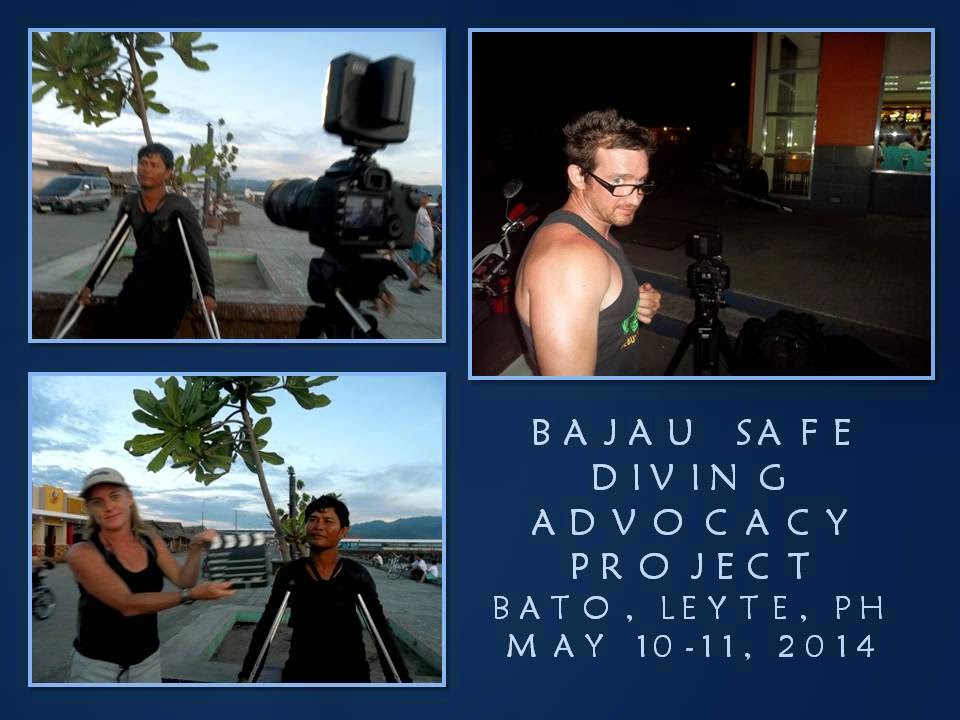
The following day, May 11, we left Baybay at 05:10 for Bato.  We were there last week, except for Lisa.  The boat reach the Port of Bato at 07:40 and, immediately, we proceed to the Bajau village of Dolho, crossing an estuary by a raft made of Styrofoam scraps.  We carry equipment, cameras, visual aids and literature for an impromptu workshop on a beach.  We meet Jerry, his brother Kapolisan Balansi, and Dulhussein Jumaldi and all agreed to attend and to learn the basics of safe diving procedures.

Lisa is the main instructor of the workshop while I interpret for her and for the Bajau should they comment or ask questions.  The simple illustrations provided quick learning and, sometimes, I need to be very creative when explaining very technical terms like “oxygen”, “nitrogen” and “decompression sickness”, which does not have an equivalent in the Cebuano dialect.  A shaken softdrink bottle, with its bubbly contents, provides them understanding why gases expand in the human body if under pressure.


When the theoretical part of the instructions had been finished, Silke decide to rent a boat owned by a Bajau complete with a compressor machine.  Silke needs to apply the theories to an actual situation and we all get ready to move offshore.  Our destination is one of the lighthouses of Dawahon Reef.  We drop anchor there while Silke and Lisa prepare their scuba diving gears.  Dulhussein, together with two others, transfer to our boat to get a last-minute review of the lectures from Lisa which I interpret for them.

Dulhussein and another will dive.  Lisa will dive with them and will give signal communications underwater.  Silke will also dive with them but she will take footage of the training.  The third Bajau will stay on their boat and will act as watchman.  He will see to it that his companions will be supplied with air and will signal same when their time under the water is about to approach the allowed time.  He will jerk at their compressor hoses and he will rap the side of the boat.

Matt stayed on our boat and shoot footage on the Bajaus’ boat and the surface where the ongoing training is being done below.  I keep reminding the Bajau watchman, above the din of the compressor, to be attentive of the time.  The current is swift, the compressor hoses are stretched almost horizontally.  We wait for the tell-tale signs of bubbles.  It came, but,  whoever is below the surface, especially at the five meter level, stayed according to the length of time allowed.  


Dulhussein surfaced first then the other Bajau.  They were trained to ascend slow – to never overtake their air bubbles - and to stay five meters below the surface at three minutes before surfacing.  Since both do not have waterproofed watches, they were instructed to count slowly from 1 to 180.  When Lisa and Silke, likewise, surfaced, all gathered on our boat for their final evaluation.  

Lisa and Silke observed that the swift current caused the air hoses to wrap tight on the Bajau divers.  Should those conditions arise, the boat should flow with the current.  It was a difficult situation for the Bajaus yet they followed the instructions to the letter.  Asked of his opinions regarding the different dive routines that he was undergoing, Dulhussein narrated that he felt good.  He did not feel the usual uneasiness that came to him after every dive using the old unscientific way.  “Mas maayo ni (This is better)”, he says. 

Happy on the progress of the workshop and training, Silke gave Dulhussein and his companions, all representing the Bajau community of Bato, a set of waterproofed instructional illustrations.  These illustrated cards would now be the cornerstone of safety whenever the Bajaus go diving.  Aside this, a quartz wristwatch with bezel ring is donated to the Bajaus so somebody on the boat would keep track of time in their underwater search for fish.

We officially terminated our business with the Bajaus and part ways from them at 17:00 for Cebu.  The team reach Lapulapu City at 22:30 and enjoy a very filling late supper at the Kon Tiki Diving Resort.  It was a memorable experience for me to work with professionals who know their line of work and exposed me further on the intricacies of the rules of proper underwater diving, which is very educational.

I am hoping that this advocacy of the de Vos couple would be made into a documentary and generate interest among well-meaning organizations and individuals on the plight of the Bajau people.  The sea is their only source of income and they have to adapt to dangerous fishing methods so their children could live.  Teaching them the right way like Badjao Safe Diving would improve their lot.      


Document done in LibreOffice 3.3 Writer

Tuesday, December 16, 2014

CONVERSATIONS WITH THE BAJAUS

I WALK OUT FROM my house at 04:00, April 28, 2014, into the back streets until I reach Plaza Independencia.  I have a backpack with me stuffed with clothes good for five days, fully waterproofed inside a 30-liter Triton dry bag.  I will be part of a small production outfit that would do a documentary about indigenous fishing of the Bajau people who lived in Bato, Leyte.


Yes, we will be at sea most of the time on small outriggered boats.  Matt Everett, from England, is the producer and director.  It has been his passion to make videos about the indigenous people in the Philippines.  He has completed a short documentary about the Matigsalug tribe of Mindanao which was shown last year during an indie film festival here in Cebu.  He also did a made-for-cable TV reality video about the Aeta people which I had a  substantial role on screen.

For this project, however, I am the interpreter.  I will do the interviews behind the camera while the interviewee gets to answer or narrate on camera.  The Cebuano dialect will be used during the conversations and, hopefully, English subtitles would be added during the editing.  Coming also are Paul Blackmore, from Ireland, who will be Matt’s second-in-command and cameraman, and Silke de Vos, of Germany and long-time Philippine resident, takes care of underwater shoots. 

Supporting the video crew is Angel Gumere, Matt’s personal assistant; Australian John Creane; and Renzy Gumere.  Matt hired an outriggered boat belonging to the Sama Bajau Community Tribal Association, based in Mambaling, Cebu City.  We embark on the small boat at the coastal road near the MalacaƱang sa Sugbu, a short walk from Fort San Pedro.  This artificial coastline, a by-product of reclamation work, had been used as a beach by people from the poorest quarter of the city last Easter Sunday.


We leave Cebu at 06:50 cruising past the two bridges of Mactan Channel, winding out of Punta EngaƱo into open water north of Bohol.  It is a very sunny weather, the sea very flat, the wind only a whisper.  We arrive at the Bajau village of Dolho in Bato, Leyte at 13:00.  Their houses occupy dry land on stilts.  A lot of boats are either beached or raised on platforms undergoing repairs.  Some of the boats are anchored offshore.

The beach is crowded as well as the houses and it would not be a good idea to spend nights there, so we transferred instead to the center of town.  We found two vacant rooms of a pension house that could accommodate us and our equipment before taking our only meal of the day at 16:00.  By 18:00, we go back to the village to start our work.  My skill as interpreter would be tested that night on a set of questions which Matt prepared but I added some of my own, based on my broad knowledge of local ways.

Jerry Balansi, 49 years old, a Bajau born in Zamboanga and one of the very few who converted to the Christian faith, volunteered to be interviewed in behalf of his people.  He is a registered voter in Isabel, Leyte and had finished Grade 5 in Cebu City.  He says that his family came from Zamboanga and migrated to Cebu because of strife and piracy.  They searched for good fishing grounds and came upon Bantayan Island where diving with the use of an air compressor is rampant.


Later they were hired by a Chinese businessman to spear for good-sized groupers (Local name: suno, pugapo) and monocled breams (Local: gapasgapas) in Palawan.  It was a good time for them then yet it did not last long and they were forced to go back to Bantayan.  Compressor diving was already prohibited and many of their former fishing grounds were converted to fish sanctuaries and they were chased away until they arrive at Bato, Leyte.  

They found the local community receptive and the fishing grounds very rich.  Compressor diving was allowed until such time that it was prohibited there.  But enforcement is very lax so they continued with what they do best: spear fishing using the air compressor.  Other people believed that they used poison and other prohibited methods but it is not so.  The truth is, they do not want to antagonize law enforcement agencies and government officials by fishing the wrong way.


He says that he is not an elder but the village chief is a cousin of his.  Another branch of the tribe lives across an estuary and headed by another chief.  They still practice their tribal customs but the younger generations do not want to learn preferring instead their desire for alcoholic drinks.  A tribal priest still performs rituals and weddings but his sons are not interested.  There is also a healer among them but he might be the last in their village.   

I asked him how many have had accidents during compressor diving?  He named two and both cannot walk anymore.  One is in Surigao while the other one is in Isabel.  Another diver got stung by a poisonous fish, but he was able to recover.  Although sharks are always a threat, he could recall only one being attacked and had survived.  Jerry himself was threatened by a tiger shark in Palawan when it made a pass at him but he faced the predator and it swam away.

When the interview on Jerry was concluded, a Bajau climbed the stilt house where we were in and proudly showed two large groupers.  The Bajau says that he caught these with a hook and line.  How incredible!  I know, for sure, how difficult it is to pull a grouper to the surface when it swallows bait and retreat into its hole.  I have done this many times in 1986 when I fished at the Visayan Sea and it was not even a tenth of the size he is showing!  It takes skill to hold breath in depths of 10 feet or more to wriggle it out of its hole. 


The next day, April 29, 2014, we wake up early and go back to the village.  Everybody is already up.  The children milled around us and the crew are busy with the kids.  I focus my attention instead at a Bajau bending the prow of a boat with a couple of C-clamps and a hand saw.  Each time he ran a shallow cut with the saw on the wood running the length of the prow, he turn tight the clamp screw, wood would bend slightly and then held steady by a copper nail.  He repeated the process on the rest of the wood until it follows the shape of a banana.

Today, we hired two compressor divers and a couple of free divers with another boat.  We will be making a video shoot at a reef bank near Dawahon Island.  Along the way, the Bajaus caught a garfish with a spear on the surface and proudly showed it to us.  It happened so fast when their boat was at half-speed passing by a spot where a flock of terns flew close to the surface in circles.  A subtle splash in the water and a flash of silver and, voila, they have food. 

When we reach a good spot, Silke goes first into the water in her scuba gear and her underwater camera.  The divers prepare their gears.  They use flippers made of plywood or PVC and rubber and they are very adept at navigating the depths using these.  Their spear guns are made of wood, rubber and pieces of metal with the spear coming from a spoke of an umbrella.  They use regular dive masks.  The long compressor hose which they breathe from are coiled around their torso with the end held by their jaws.      


The divers would not have to spear fish but will just show for this documentary video of how deep and how long they would stay underwater and in what manner by which they would dive to the bottom and float back to the surface.  For Silke, it would be a new experience which she had not had witnessed in all her years of diving here and abroad.  She holds an international license of Master Diver and is an instructor where she teaches basic diving at Amontillado Beach and Diving Resort in Dauin, Negros Oriental.

After about 15 minutes, the Bajau divers returned to the surface.  Fifteen minutes more and Silke appeared with her underwater camera.  She showed me her dive computer which registered a depth of 24 meters from which she and the Bajau divers were but it was the rapid way the divers floating back to the surface that alarmed her.  The Bajau divers were doing what everyone in the scuba diving profession would not:  accelerating faster than your air bubbles!

She explained to me about the procedures of safety diving and how long should one stay underwater when breathing pressurized air.  I begin to understand her concern and she would talk to me more of it once we are on dry land as the sound of boat engines begin to drown out our conversations.  We transferred to a shallow depth where corals and fishes could be seen below.  This time, the free divers would show their stuff. 


Two young Bajaus, Tyson Bangcongan and Pooms Aslani, came with us from Cebu.  Both are 19 years old.  Both were born at the Bajau community of Mambaling.  They learned free diving while young at Cebu Harbor.  Coins would be tossed by boat passengers and the Bajaus are known to dive after it and retrieve it even though how murky the waters are.  It is entertainment for passengers but it is a hard way to earn a living for the Bajaus.  

Tyson and Pooms make ready their home-made flippers, masks and spear guns while Silke takes another dive on a second oxygen tank with her camera.  The divers appear over and over at the surface with small coral fishes skewered on their spears.  They prefer the short spear guns since they would shoot the fishes at short range.  Tyson was able to stay and hold his breath for 33 seconds at fifteen meters depth, at one time, surfacing with a speared garfish.

We leave Dawahon Reef, going back to the Bajau village.  From there, we go back to the hotel and take a bath before going out to take our only meal of the day at four.  We go back to the village to do an interview shoot on one of the Bajau compressor divers.  Sound conditions were not conducive and we ran out of daylight time and we go back to the hotel to take a well-deserved rest.  At 20:00, we visit the town’s “baywalk” area and talk about our next day’s plan over glasses of cold beer.  

On April 30, 2014, we wake up early so Matt could shoot sunrise over the village using the timer to run for an hour.  After that, we begin the interview on one of the compressor divers yesterday, Dulhussein Jumaldi.  He is 38 years old and is a registered voter of Bato.  He says he used to be a free diver.  When his band went to Bantayan Island, local fishermen there were able get a lot of catch using the air compressors which they could not accomplish by just holding their breathe.  At Bantayan, he learned compressor diving.


They usually dive during nighttime.  The fish are not so active and it is easy to shoot these with a spear.  They could swim close to their prey and then shoot it.  The spear guns they use during nighttime are short unlike in daytime where they use the longer spear guns.  He explains that long spear guns are used to take down fish from a long distance and it shoots faster, taking a prey by surprise.  The shorter ones, on the other hand, do not need accuracy as it shoots fish at short distances.  All spears are connected to their guns with a long nylon cord.

Preparations before going out to see sea is very crucial to a Bajau diver, according to Dulhussein.  First, he has to take a long rest and must refrain from drinking alcoholic drinks 24 hours before he dives.  Second, he must check that his equipment, to include the boat engine and the air compressor, are in good order.  Third, he must have ample fuel for the boat engine.  Fourth, he prays and asks protection from his god and from the spirits.  Last, he must have a good meal before setting out to sea.

We take a break after the interview with Dulhussein and return to the hotel to take a meal.  We go back again to the village to pursue on our interview on a man who had survived a shark attack in Zamboanga.  Matt is so excited to learn from the man and we caught him gouging wood from a boat keel.  He is Uladji Lampinigan.  He does not know his age but it would be somewhere between 60 to 65 years old.  He used to be a free diver but now he makes boats.

Uladji, narrated that he was diving at 25 meters deep holding his breath.  His concentration was on the lookout for fish and failed to notice a shark from behind him.  It jolted him when he felt something tearing at his back.  He tried to evade and he was able to move sidewards as the jaws of death clinched at his left shoulder.  He wriggled and he was able to break free.  He tugged on a rope and his companions pulled him to safety.  Ugly scars remain to remind him of his close encounter with death.

Matt needs to do one more interview for this day.  He asks me if it would be possible to ask a tribal priest.  I am able to convince Jerry’s older brother, Capulisan Balansi and I am also able to ask a favor if he could demonstrate a tribal ritual which is still part of their culture.  That done, we wait for several hours to produce the needed items for a spiritual rite which had been practiced by their ancestors before the advent of Islam in Southeast Asia and is passed to the succeeding generations.

Capulisan, cannot ascertain his actual age but he would be around 60 to 65 years old.  He is a well-travelled Bajau and a real badass when it comes to free diving.  He says he was born in Basilan and his family travelled across the Zamboanga Peninsula for a year.  That time, compressor diving and makeshift flippers were not yet invented.  They would dive at depths of 30-40 meters and hold breathe for more than a minute and they could swim fast without using flippers.


He says his family crossed the sea to Dumaguete City in Negros Oriental and stayed there for half a year before taking root in Cebu.  With Cebu as base, they go diving for fish at Bantayan Island, at the coastal towns of Masbate, reaching as far as Gigantes Island, then to the islands of Sicogon, Calagnaan and Semirara in the Visayan Sea, and on the coasts of Southern Leyte, Dinagat Island and Surigao del Norte.  Eventually, they settled in Bato.

According to him, he was appointed by their elders to be their tribal priest.  He learned the Bajau tribal rituals from the elders and, since he has no formal religious education, taught himself prayers in Islam and was able to marry couples, pray for the dead or ask blessings from the spirits this way, combining Islam with Bajau customs.  The items that Capulisan wanted to procure had arrived and the women had processed the food that are part of this.

The food and the items would have to be brought offshore.  Capulisan’s own boat was used for this ritual which is really appealing the spirits of the wind and the sea for blessings of good harvests and for protection.  The boat is filled full to the brim as Capulisan, Jerry, another elder, his son, Matt, Paul, Silke and me rode it beyond the wharf of Bato.  Capulisan prayed to the spirits and released the offered food and items to the care of the sea.     

All the people in the village appreciate our gesture of initiating this rare ritual and for providing the offering which, to them, is already a luxury.  They are, by their own beliefs, now assured of the blessings of the spirits.  Satisfied with our day’s coverage, we go back to town with our equipment and take a bath at the hotel.  We get ourselves a good good dinner at Bato’s baywalk area after which we wash it with cold beer.  We slept early.

On the fourth day, May 1, we begin to pack our things.  We would leave Bato but we will do a last shoot at the floating huts of Dawahon Reef on the way to Cebu.  Matt needs to know the life on the seaweed farms which he wants included on his documentary.  We saw, from a distance, water rising high above a group of small boats then we heard, three seconds later, the unmistakable sound of an explosion – dynamite fishing!  Then four more spouts of water then four explosions.  Matt wanted to go that way but I forbid him.  

We choose one such hut and asked permission to come aboard and to interview a seaweed farmer, Victor Torreon.  He is 51 years old and a resident of Dawahon Island.  He had been farming seaweed for a long time and, he says, when not farming they catch fish using nets and sold it as dried fish.  The hut, which they use as a resting and storage place (Local: kamalig), had been destroyed by strong typhoons and rebuilt many times.  They culture the Espinossum carageenan (Local: guso) only and sell it to Cebu.  When we left at 13:00, Victor and his nephew continue weaving nets.

The sea is very calm as we travel back to Cebu but current is very strong since low tide is starting to move water from the inland seas out to the Pacific.  We pass by Caubian Island and then into the Camotes Sea.  Ebbing water exposes a very long sandbar.  Footprints from an absent fisherman are all over it and a live hook and line are left.  The afternoon sun is beginning to get soft as the horizon of Cebu is getting nearer and nearer.  

When we got past Punta EngaƱo, the boat has to stop at the north entrance to Mactan Channel so Matt could shoot Silke talk of her opinion on the Bajau way of diving with an air compressor machine.  Sequence has to be restarted over and over again when channel current either move the boat closer to the shore where voices of people could be heard or when an airplane arrive and depart from the Mactan Cebu International Airport.  

Matt wrapped up the project after a rare uninterrupted sequence and go back to where we came from four days ago, which is at the coastal road near the MalacaƱang sa Sugbu.  It is 19:00 and I got invited by Matt, Angel and Paul for a dinner at the Texas Rex Bar-B-Cue Restaurant in Mandaue City.  I am tired but I am rich with the experience of working with a film crew and with the Bajaus.

Document done in LibreOffice 3.3 Writer

Saturday, November 15, 2014

A “RETURN OF THE COMEBACK” STORY

SEA TRAVEL TO NORTHERN Mindanao and Southern Leyte are cancelled tonight – March 21, 2014 – due to an oncoming tropical depression entering the Philippine Area of Responsibility.  However, my trip to Baybay, Leyte is not cancelled, so I gladly run my Sandugo Khumbu 40L backpack on the rubber conveyor of the x-ray machine before I entered the terminal of the Port of Cebu.


With me are my buddies from the Camp Red Bushcraft and Survival Guild – Aljew Frasco and Christopher Maru; and old hands from the Cebu Mountaineering Society – Boy Olmedo and Boy Toledo.  We are on a Jungle Environment Hike and Expedition so we could find and create a new route to Mount Pangasugan after some trails had been washed away by Super Typhoon Yolanda last November.


All of us had been to the jungles of Mt. Pangasugan, at one time or another, and had considered this peak as something that had gotten away.  Boy O and me came here with a large party of climbers in 1992 on a different route; Boy T with his club on that same route in 1994; and Aljew and Christopher on a video documentary project here in 2008.  We all failed.  But, this time, we hope, we will bring home the bacon.  Call it the “return of the comeback”. 

Although I had climbed a few minor peaks before I visited Mt. Pangasugan, I consider this mountain very special for me.  For one, it had marked the beginning of my passion for the outdoors and the environment.  Also, it had given me that rare privilege to witness a Philippine eagle in the wild at close range.  In short, Mt. Pangasugan is my benchmark when talking about terrain difficulty and richness of flora and fauna.

Without much funfare, the MV Sacred Star set sail at 21:00 in wet climatic conditions for the Port of Baybay.  We arrive in rainy weather the following day (March 22) at 04:00 and we proceed directly to our host, which is at Cienda.  After a light breakfast and procuring food provisions of two days, we walk to a tree nursery farm of the Leyte Reforestation Project where we register our names and our purpose and getting briefed of the area that we are hiking into.

We are introduced to our guides: Procopio and Ruben.  Ruben is a small fellow approaching 50.  Procopio is the older of the two at 60 years.  He still practices the old way of chewing a concoction of lime, tobacco, betel leaf, cinnamon and a palm nut.  Me and Aljew try this, out of curiosity, but we were warned that this will make you light-headed.  Indeed, it had, but it is as if I had just brushed my teeth after I had gurgled out the ogre-looking liquid.  


We start our journey at 08:20 under a light shower.  Aljew, Christopher and I carried openly our knives by our side like our guides do.  We traverse over rice fields and then engage our first river crossing of the Tubod River.  Current is strong but water is clear enough to see the stones underneath.  I have a heavy load – about 28 kilos.  Once I tripped over a stone and fell, that load becomes close to 40 kilos!  I paid dearly to carry extra with my carelessness.  

I may have to find wooden staffs to aid me, Boy O and Boy T in our river trek.  Ruben the guide, produce two mature bamboo staffs while I picked up a wooden stick for myself along the way.  Aljew and Christopher are both still flexible in their balance, being much younger than us and do not need it.  The sticks would later make a difference on us old citizens, except for Ruben and Procopio, who both are in their natural elements.

Tubod River is wild and brisk marked by uneven levels and different obstacles, which needs to be overcome.  The rocks and boulders are fine with hiking shoes, even with rubber Spartans (local brand of rubber flip flops), but appearance of surfaces can sometimes be deceiving but it is not a hindrance, as it had been for many times in the past, for both Procopio and Ruben, who both walked barefooted. 

All the while, it rained; from light to moderate, back to light to moderate and so on.  My senses peaked another notch.  My observation skills becomes sharp noting regularly for any deviations of water color and ripples of the current.  My eyes scan everything even to the extent of observing the awkward footing of those who are ahead of me.  My skin is constantly feeling wind velocity and rain intensity.  My ears catching every sound.      


As we tackle the river upstream, the riverbanks are now closer and it becomes a gorge.  It is much wilder here, the river more noisy.  Tributaries come from all sides.  Typhoon Yolanda had created a lot of damage on the landscape; uprooting trees and causing landslides; and routing new water channels when the original ones are filled with debris or blocked with huge boulders.

These conditions are a threat to our activity and the longer we stay on the river by the hour the higher the risk.  We reach a huge rock overhang and we decide to rest here from the onslaught of constant rain and from a shivering wind that came upstream. We decide to eat our noontime meal here but, in these conditions, a hot meal is best.  I understand that both Boy O and Boy T brought packed meals but that is not enough.  What about the guides?  

I still do not know yet how far we will walk or how many obstacles we will clamber up and how long we will keep our body heat to resist nature’s pounding.  For the greater interest of this group, being the expedition leader and safety officer, I decide we eat our meal hot and, that means, cooking it in an open fire in spite of this inclement weather.  I would rather sacrifice time for that.  

As was practiced and done by Camp Red in every outdoor activity, Aljew, Christopher and me proceed to forage dry firewood (which is now rare) and produce fire (which is now difficult) then cook rice in two pots hanged on a tripod.  Boy T help with the cooking of a mixed vegetable soup on his camp stove.  Meanwhile, Ruben and Procopio are shivering as they watch our activities.  When lunch is ready, all shared evenly the hot food. 

After the meal, we proceed on to more difficult terrain.  That infamous typhoon obliterated of what used to be a continuous trail going to the Chapel, the LRP Bunk House, the waterfall and to the ridge at Marabon that lead to the summit of Pangasugan.  For that, we are now confined to more river crossings, more daunting obstacles and more risks to flashfloods, landslides and rockfalls.  My dependable Rohan hiking pants opened up on the crotch during a scramble for a foothold.


Facing us is a small cliff.  It marked the joining of two rivers.  The rightmost is the Tubod River while the leftmost is a smaller but turbulent stream.  We follow the rightmost one.  Above this headland is a gang of Philippine macaques (Local name: amo, unggoy) swinging wildly among branches, probably attracted by our cooking.  On my first trip here in the Leyte Cordilleras, I did not see a single monkey but today they are many. 

We proceed on into some of the most dangerous obstacles that Yolanda had left for humans to overcome but we are persistent until we reach the site were there used to be a chapel.  What remained of are four roofless posts.  But behind the ruin is a hidden chamber that house a plaster statue of the Virgin Mary which was not washed by floods.  Ruben says people from San Vicente come here to celebrate Holy Mass to honor her every September 15th.  Amazing!

Procopio announced to us that the bunk house would not be that far, just a little more than an hour of walk – by their standards.  We slip past a cave-like opening among rocks and go into another part of the river where the water is calm but it is almost a dead end save for an opening ten feet above us.  Procopio propped a hardwood log and hacked steps into it so all would climb up the notch.  It is difficult as rubber do not grasp well on wet wood and then balancing your way up with a heavy load on your back.

I weigh about 102 kilos plus an almost 40 kilos of load on my back.  It just amazes many people why I still climb mountains and go on in extended hazardous trips at my age and bulk when most of my peers would rather slouch on their sofas and watch DVD movies.  When I think the obstacles are just too much for me as time goes by, I would just remove my backpack and pass it on to those above of me.  I do this several times because it is better that way but putting it back needs Herculean strength.

I walk up the log with my backpack on because I know it does not break in the middle.  When I climbed up the notch, another much more formidable obstruction faced us.  This is in the form of an old river pass that Yolanda filled with all sorts of debris 20 feet high!  That meant we have to overcome slippery wood that do not work on rubber and where the chances of some debris giving in to weight is high.


Procopio devised another system of poles to act as a bridge from one part of the debris to another higher part.  This would had been madness were it not for the 35-foot utility rope I brought for this hike.  Once the rope had been tied on to the steadiest of logs, one by one, in slow but deliberate progress, we overcome this greatest of obstacles.  Above us are Philippine hornbills (Local: kalaw) flying from tree to tree while a yellow horned toad (Local: baki) waits for prey as it perch on a stone. 

I heard the cry of a boar (Local: baboy ihalas) from about a hundred meters before I see its sign.  The boar burrowed on roots by the riverside and did not notice us until we are so near.  We came downwind and the rain hid our man smell.  The boar must have heard us talking and ran as fast as it could and then belch out a warning whine.  If I were hunting that day, it would had been a good and glorious chase.  Then rain started to fall heavy and we just forded the last of the river crossings.

It is 16:45 when we reach the LRP Bunk House.  It is a wooden structure constructed through funds coming from the German aid agency.  The storm might now be approaching landfall somewhere in Mindanao considering that the weather becomes so grim and discouraging.  We from Camp Red immediately start a fire and started cooking the rice and make ourselves comfortable.  Procopio and Ruben, who both were shivering from cold and exhaustion, gladly welcomed the heat.

We are all exhausted and approaching mild hypothermia but the promise of eating another real hot meal dissipate away the worries and fears, especially to our two guides.  I start slicing the pork meat and the vegetables with my Victorinox SAK Trailmaster.  Boy T volunteered to cook the pork adobo and the mung bean soup.  The hot meals are our saving grace and soon the morale of the men are back despite the leaks on the roof.

We celebrate our success and our good fortune today by drinking local brandy.  We carried the contents of the two bottles here just for this occasion.  We decide not to push through with the hike to the summit tomorrow because of this uncooperative weather.  We were not supposed to be here, in the first place, because of that.  I have arrived at a conclusion, after witnessing close hand, that the topsoil of Leyte are not that stable and are prone to landslides.  We chose to cut our journey to the summit also because of this.


The brandy gave us warmth for the most part and a chance to open up worthy conversations.  I showed my thinning black bonnet which I first brought here in 1992.  It had coaxed up interest when I start the tale of how it had also been with me at Mount Apo, at Mount Dulangdulang, at Camp Damazo and on every worthy peak.  Procopio is a wonderful fellow to be with around a campfire with his good knowledge of woodlore and churns out local names of plants and animals, both familiar and the unheard.  Lights out at midnight. 

I wake up to a distant boom of a falling object.  The ground slightly shook.  Strong gusts of wind carry spray into the insides of the bunk house.  Rain is still heavy.  It is 02:00 of March 23.  Too early to make noise and I sleep back but wake up shivering at 04:30 as the first light of dawn showed on the window.  In a couple of hours we will be packing our things back in our bags.  The rain had not abated ever since.  On the river below is a huge tree.  It was not there yesterday!

After drinking coffee, we prepare the food ingredients for our early lunch.  It seems that the weather had slackened a bit and we have to take advantage of this by leaving at noon.  I help Boy T in the preparation and cooking of escabeche (dried fish cooked in tomatoes) and eggplant strips fried with egg.  Everyone take their fill knowing that these might be their last meal.

We leave the bunk house at 12:00 but we turn back when the Tubod River is unaccommodating.  It is now brown hiding visibility below; it is now ten inches higher; and the current too strong to fend off.  Procopio do not want to entail risks crossing the river at these conditions and everyone agreed.  When all had returned to their places inside the bunk house, I decide to look for firewood.  I use both my AJF Gahum heavy-duty knife and my tomahawk to chop and split firewood. 

For a whole day, the men are in a gloomy state.  Talks of rescue is the main topic and Boy T becomes worried about our diminishing food supply.  I am really not worried about all these.  This is just a temporary inconvenience that only affect our schedule.  For us at Camp Red, survival is our game and we had prepared for situations like this unlike Boy O and Boy T who are more oriented in packaged activities that their club usually undertake.  Although both had attended a bushcraft camp under my tutelage, both did not practice, in their own free time, what they learned.  Lacking that, you lose self-confidence.


I do not worry about food.  There is food for the taking in these dense jungle if you know where to source it.  I have an advantage because of Procopio and Ruben and they could complement my knowledge anytime so the rest could eat.  I have foreseen this delay and I could live with it.  Without everyone knowing, I have two packs of pork and beans and a kilo of deep-fried pork secretly stashed in my backpack.

Rain fall hard again and seem endless and it added to the misery of the men.  I jot down the conditions for this day in my small notebook.  It is getting cold again.  By early evening, the men devoured the leftover food from our lunch.  I open a pack of pork and beans to the fray to perk up the mood.  The last of our procured coffee is gone and everyone settled back to their sleeping spaces.         

At around 22:00, something huge fell nearby our camp.  Constant rain for three days had caused soil to melt and I worry the high ground above where we stayed might slip also.  The bunk house is silent and cold, a far cry from the other night.  We sleep early but I toss and turn on the floor.  It is cold.  Winds seep in the cracks while rain water splatter everywhere.

On the morning of the third day, March 24, our collective effort produce a mixed coffee-and-chocolate drink and a loaf of bread and these becomes our breakfast.  It is a good start.  Surprisingly, the rain had stopped.  The shrill whistle of a Philippine squirrel (Local: kansik) can be heard clearly.  Across us, the hillside is scoured by last night’s landslide.  We cook the last of our rice and intend to eat it somewhere downstream at noon. 

The river is now clear and it subside down to almost the level the first time we trekked it.  We hurdled the first of the several river crossings back to where we came two days ago.  The difficult obstacles, if taken from upstream are easy.  You either have to slide on your butt down the rock or create a route on the steep hillside.  For several occasions, we rather hack away dense jungle than take risk stepping on unseen rocks or logs.  It might be slow progress but it is safer.


Finally, we reach the rock overhang and we decide to eat our meal here.  I retrieve my deep-fried pork and everyone devour it with much enjoyment.  After that, we continue on and reach the tree nursery farm at 15:30.  Immediately, we open cellphones and receive a lot of worried messages from Cebu.  I replied mine that we are all alright and safe.  Well, unknown to us, a search and rescue party would have been organized if we remain unheard of at 15:00 today.

We just crossed 28 times the Tubod River and overcame 25 obstacles on the first day and repeated these today.  We are tired, hungry and cold but we deserve cold beer which immediately appear.  After changing to dry clothes, we leave Cienda for the port area to secure boat tickets and to eat a good supper.  I bring six Philippine ginseng plants and cinnamon barks which Procopio foraged for me.

As the motorcycle I am on cruise the Pan-Philippine Highway, I see from a distance, Mt. Pangasugan, dark and foreboding.  On the foreground are six egrets flying in a V formation.  Three more joined in mid-flight.  I have learned long ago that there is more to a mountain than just bagging peaks.  I have always considered this mountain as a friend and it showed me its power and its gentleness.  

We leave Baybay at 20:00 for Cebu on board MV Rosalia.


Document done in LibreOffice 3.3 Writer