Showing posts with label outdoors cooking. Show all posts

Saturday, September 22, 2018

THE TRAILHAWK JOURNEYS: Bukidnon Bushcraft Training

MINDANAO IS UNDER MARTIAL LAW and I do not forget that. There was an urban war in Marawi City fought by the government forces against ISIS which had ended more than a month ago. I travelled a month earlier to Davao City to test the climate of uncertainty painted by media. There was indeed a military presence there, which is fair enough. Would it be okay to travel there again with bladed tools? I have to find that out myself.

You know, I have never taught bushcraft and wilderness survival in Mindanao and I waited for many years for that opportunity until Earl Ryan Janubas and JP Echavez, both of Cagayan de Oro City, organized one for me. Martial Law have curtailed travel of Mindanaoans to their most famous mountain destinations and they needed an alternative outlet for their thirst of adventure. That is when they contacted me.

Going by plane to Mindanao is out of the question for me, although travelling in it with blades is the most convenient. The transfer of the airport location of Cagayan de Oro, in Lumbia, to the Municipality of Laguindingan a few years ago is too far for my own comfort. The boat is my best option even if I have to unload my bladed tools to security for safekeeping while I am in the boat and it would travel with me anyway.

As an outdoors educator and survival instructor, blades play a very important role in all my classes and training instructions. Blades make easy work and these are educational aids and tools. Trusting to my good judgment, I carried some of my best blades with me like the AJF Gahum, Pandoy Pulido Pinahig, Condor Bushlore, Mora Companion, Knifemaker Camp, Seseblade Sinalung, Seseblade Matavia, a Browning and a Victorinox Trailmaster. Coming also is my veteran tomahawk.    

I travelled by boat in the evening of October 29, 2017 bound for Cagayan de Oro. Earl and JP would be expecting my arrival the following day. I arrived in the morning of October 30 and JP came to fetch me and whisked me to Focal Matters, a photography studio located at Capistrano and Yacapin streets where Earl is the resident photographer. After lunch, Earl and I travelled to Libona, Bukidnon on his Honda CG125, along with JP with his motorcycle.

We followed a newly-opened road that go through the backcountry of Indahag and Gango and arrive at Libona at around 15:00. We made a courtesy call to the village head of Poblacion and then to the community leader where we would make our camp for three days. It is in the property of Earl’s brother. We visit it for a brief inspection. It passes by a big pineapple farm and a trail lead to a stream.

Beside the stream is a narrow piece of ground good for eleven tents and some trees could host a few hammock pieces. It had been raining here for the most part of the week and the stream is deep with color associated with floods. I have my concerns but I am hoping that weather will get better. It is sunny and warm but the highlands has a weather of its own. I cannot rely on a weather forecast from a mere phone application.   

Earl and I returned to the town and made it to the house of his brother. We will both sleep there so we could be early to the campsite while JP need to go back to CDO. Bukidnon, by its location in the highlands of Mindanao, always has cold nights. It was colder still when there was a heavy downpour in the middle of the night which did not stop until the earliest hours of dawn. That got me worried about the stream and the campsite.

After breakfast of October 31, Earl and I went back to the campsite at 07:00. The stream have not risen that much. Only the color became more brown and the current more brisk than yesterday. I am assured of a very sunny morning and I hoped that the weather will turn out the better for the rest of the day. We choose this site because of its proximity to a natural spring located across.

I looked for a couple of trees, not far enough from each other and not near enough, and finding one such place, I left my bag. I choose the best location where I would be safe if the stream overflow but near enough to the rest. Open carrying my AJF Gahum, I go back up the slope and looked for a good place to make a latrine. Found one under a copse of cassia trees and dug a hole with a digging stick sharpened by my knife.

Then I foraged materials as educational aid for the outdoors seminar like dry and green bamboos, firewood and dry leaves. After an hour, JP and eleven participants arrived, including two high school students from Xavier University. One participant even brought his two dogs. All set up tents on the grassy ground while two of them found a place for a hammock.

Part of the morning was spent setting up shelters and diverting the flow of the natural spring by a bamboo viaduct, crossing over the stream into our campsite. Dry bamboos are abundant and I do not have to cut poles since there are many left rotting on the ground and a few are left hanging. I choose the clean ones for our improvised water span, propping it high enough from even an increase of a meter of flood.

The BASIC TROPICAL BUSHCRAFT COURSE is almost the same as that of the ones I do and organize in the Philippine Independence Bushcraft Camp, held in Cebu annually. It always start with Introduction to Bushcraft. The participants learned the terminologies and jargon used in bushcraft; its preferred environment; its own psychology; its methodologies; and its difference from survival and from mainstream activities.

 
Then next is Ethical Bushcraft. The best practices of leisure bushcraft, using its own principles of Blend, Adapt and Improvise, to lower your obtrusive presence among forests and jungles and increases an individual’s safety and security. It covers trail travel, courtesy to locals, campsite location, fire management and camp hygiene. Ethical Bushcraft is taken from this author’s unfinished book of the same title.

After lunch and siesta, it is the turn for Knife Care and Safety to be discussed. This chapter changes the perspective of the knife into a useful tool instead. The Philippine law on the regulations of carrying a knife – Batas Pambansa Bilang 6 – are explained thoroughly and clearly as well as ethics and safety, care and sharpening, blade shapes, parts and grinds, and the Nessmuk Trio.

At 14:30, this author demonstrate Survival Tool-Making to the participants. This chapter is a practical exercise in knife dexterity and safety; taught them how to carve spoons, jugs and an improvised cooking vessel from a green bamboo pole; and create a digging stick from a thick straight branch. Aside that, this blogger gave them the idea how and where to source cords from nature. Next is Notches. Another knife dexterity session aided, this time, by a baton.

When dusk came, all activities ceased and the participants focused on the preparation of their meals under a slight shower. By 19:30, the campfire is lit and becomes the social center for the Campfire Yarns and Storytelling. This camp tradition does not need great company as long as the train of tales and laughter begins. Sometimes, a moderate round of alcoholic drinks move that into more tales and laughter. Rains came and ended abruptly the night socials.
  
The second day (November 1) starts with breakfast but after that, all will deny food the rest of the day, not until they have accomplished foraging their own food which comes later in the night. This is to simulate the hunger pangs associated when you are stressed in a survival situation. Everyone steeled themselves for this occasion. The day is warmer than yesterday but the ground is muddy.

The first chapter for this long day is Customizing the Survival Kit. It is better that survival kits are made from scratch than bought commercially because its size and components depend upon the type of the activity you are indulging in and the kind of environment you are going to visit. Your personal preference still matters although redundancy of some functions, like fire tools, luminosity, water collection and cutting devices increases security.

Then I proceed to Foraging and Plant Identification. This author discusses about traps and snares and what are the difference between the two; luring methods and trap lines; and foraging food and non-food. It also identifies which plants are edible, harmful and poisonous. The participants are then shown the different traps and snares that are set up in camp before touring the area around the camp for the common plants growing here.

Hearing distant thunder, I decide to proceed to Fire, Fuel and Campfire Safety. Understanding first how a fire is made is very important. You have to know the three elements of the fire triangle: fuel, heat and air. You cannot produce fire if lacking one element. Conversely, you can put out a fire by removing one. Lately, they added a fourth element – chemical reaction.

Making fire by friction is 80% common sense, 10% skill and 10% perspiration. Your fire can start if you can acquire and identify the right tinder, if you are in a dry place, and if you have the patience. In a very humid location, the presence of moisture in the atmosphere almost always hinder the production of ember needed to start a fire. Most of the time heat is stolen by the cooling effect of watery air.

Aside from friction, there is the conventional method which are matchsticks, lighters, ferro rods, and the flint and steel. Then there is solar magnification which can be done with magnifying lens in a cloudless day. Then you have pressurized air, exemplified by the fire piston. Since I do not have the luxury of time, I limit my demonstrations to the flint and steel, and the ferro rod. I also showed them how to make a tinder bundle. 

Demonstrated how the bow drill method is made and spun. Unfortunately, I could only make thick smoke as sawdust embers refused to light up my tinder due to humid conditions. Dark clouds are now overhead as the thunder gets nearer and nearer. I let others try the bowdrill, the ferro rod, and the flint and steel. The participants properly learned how to use the ferro rods. It ignites easily natural tinder.

By now, wisps of moisture started to drop. I demonstrated how the bamboo-saw method is made and scratched. As with the bow drill, I could only produce smoke. Moisture have penetrated the grains of bamboo. Racing against the rain, I tried again and failed. Four participants tried but in vain. I made another derivative of the bamboo-saw that could be done with two people. Smoke is thick and there is a promise of ember but it lived shortly. Then a strong downpour fell.

For the rest of the afternoon, we could do nothing but stay in our shelters. I could not discuss the rest of the topics and our Nocturnal Hunting is even jeopardized. Owing to circumstances beyond our control, I aborted it and gave a go signal to prepare their food for dinner. In wet conditions, I am able to make fire in my Swiss Army wood burner to boil water first for coffee and then for Japanese seaweed soup.

The heavy downpour caused the stream to overflow on the lowest places of the campsite but it necessitated the transfer of three tents nevertheless to better locations. The water current increased and became very noisy, alarming everybody. For a couple of hours we were awake, watching the stream, until the rains began to slow down. I relax with my watch and half-chased sleep.

In my comfortable hammock, rainwater found its way to my chest. I shifted my body so the drips would not fall on me but a cotton rope I used to tie the hammock with snapped and I fell hard with my hammock on the ground. I re-strung my hammock and my shelter setup hoping to stop the drips. I placed drip cords on the ridgeline of my shelter just like I did before on the ends of my hammock. After I have done so, the drips have stopped.

The last day (November 2), I was surprised to see that the bamboo viaduct have withstood the stream’s rising water last night and still supplied us with an uninterrupted clean water. The water is not cloudy. We prepared breakfast early for I have four more topics to discuss. Yesterday’s muddy ground are smoothed out by water but it is wise not step on the same surfaces.

After breakfast, we break camp and transferred uphill to be away from the din created by chainsaws used by locals who took advantage of a holiday to cut trees. The first one is Understanding Cold Weather. During mountain climbing, exposure to the elements is expected. There are five physical mechanisms that steal away body heat and the things that we should do to keep us constantly warm.

Next is Outdoors Common Sense. This is the subject matter that I based from my yet unpublished book, ETHICAL BUSHCRAFT. It is about trail courtesy and behavior while on the trail; choosing the best campsites; practicing stealth camping; increasing individual safety and security; wildlife encounters; and introduce people the idea of Blend, Adapt and Improvise.

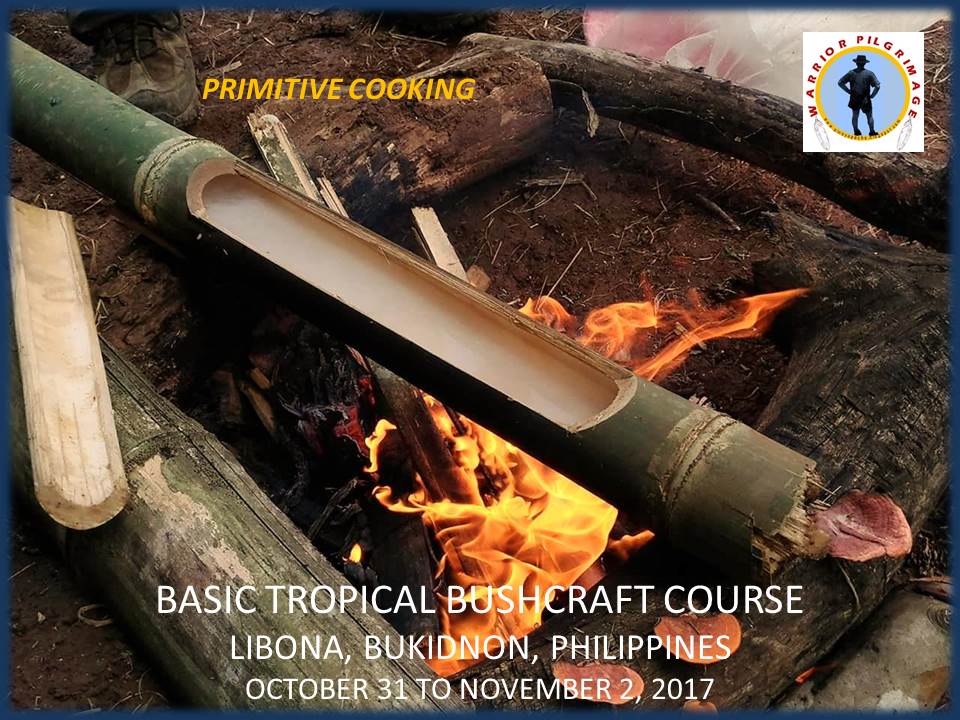
Finally, the topic of Outdoor Cooking and Food Preservation gets its slot. Different ways of preserving meat, fish, vegetable and fruits. Getting equal discussion are the different kinds of fireplaces. After the lectures, author shows how the Trailhawk System of cooking rice in bamboo is done. The participants prepared their meal for lunch and when all got cooked, to include the rice inside the bamboo, we had our meal.

We packed up everything and hiked the three kilometers back to Libona and then to the terminal. From Libona, we rode on tricycles to Manolo Fortich and transferred to a van-for-hire. Destination is Cagayan de Oro City, which we reached at 18:00. We stayed for a while at a local restaurant for dinner and the post-event discussion and socials. I was tired but I was not sleepy. I noticed there was no curfew here but we have to end after midnight.
 
I found a vacant room at Rosario’s Place for I have a speaking engagement tomorrow evening (November 3) at Viajero Outdoor Centre. Coming here to Cagayan de Oro with a cargo of blades gave me fears of travel restrictions brought about by Martial Law. It turned out well but, going back to Cebu, a security guard made it a little hard for me with his wrong presumptions. Or was he just interested with my properties? My spring-bound lecture handbook made all the explaining for him.

The unpredictable weather of the highlands of Bukidnon is something that I have to give an extra consideration next time. I expected it to behave like all highlands do but I failed to give a thought that Bukidnon is a plateau where rainwater would be collected on a wide area instead of travelling fast and quick to the sea. Here, it accumulates slow and long before going down the different drainage systems.    

It was a productive moment not just for me, but also for my newly-found friends of Mindanao. At last, I was able to introduce bushcraft there and helped them become better outdoorsmen. My trip there would not have been possible without the sudden sparks of creativity by Earl and JP. For their efforts, I part my couple of Seseblades to them, courtesy of Dr. Arvin Sese, whose quality but affordable blades I had endorsed everytime I have training sessions.  

Document done in LibreOffice 5.3 Writer

Monday, January 18, 2016

NAPO TO BABAG TALES LCV: Unconventionals

I ALWAYS IGNORE THIS trail whenever I do a reverse of the No-Santol-Tree Trail. I find it unnecessary to go over a peak in order to go down and climb another one. Why make life difficult? Common sense always win over me. On the other hand, this particular trail was not here when I embarked on an exploration frenzy around the Babag Mountain Range in the years 2008 to 2011. I just noticed this in 2012.

Anyway, I promised my adherents at the Camp Red Bushcraft and Survival Guild today, May 10, 2015, that we would be doing some little explorations in the hills between Kalunasan and Sapangdaku. I have not even thought of this trail when we begin from the trailhead at the Kalunasan Road. We are fourteen people – all men – and it is a very warm day. It is already 08:30 and not a very good hour to start.


I stare at this trail and I begin to get interested. I would have to drag my feet though to make life comfortable for those who are not used to walking rugged terrain or the lack of it. Behind me are Camp Red regulars Jhurds Neo, Ernie Salomon, Jerome Tibon, Dominik Sepe, Eli Tambiga, Mayo Leo Carrillo, Nelson Orozco, Justin Apurado, Bogs Belga, Mark Lepon, Jonathan Apurado and Nelson Tan. A mix of the serious, the amusing and the outrageous.

Most are in their best earth-toned clothes and bags and we looked more like spec-ops guys instead of colorful gadflies. Gadflies? Well, we see them from time to time usually on the parking lot of Guadalupe church or in our favorite dirt-time place and you would not know if there are males among them. Well, today, I do not expect to meet any of them, much more so on this trail in the heat of the day.

I look up the trail and I barely see green. The trees and thickets have wilted and are opaque brown and in different shades of it. Worse, the hillsides are scorched by grass fires of a few days old! So on we walk with sparse shade on a ground that is loose and dusty. I forced myself to move like a snail. The strongest walkers are impatient behind me but we are not in a race. We are in a humanitarian hike. It is humanitarian to be kind to the slowest walkers, is it not?

We reach a point where there are two tamarind trees. It could barely give a shade. The NST Trail branch from here while this trail that I am planning to explore is on another branch. Right now it is beckoning me up. I clear the path of dry wood and other debris. I do not want an accident. People tend to overlook a lot of things when they are subject to fatigue and heat which they could have noticed when under good conditions.


I have not carried a big knife although I open carried a smaller knife but it is of no use against dry wood. You simply cannot hack and slash with it. With both hands, I drag the wood one by one, moving it on the side of the trail. It is difficult because these are dried branches that have tangled against each other and I have to use considerable strength which I am supposed to be conserving.

Being generous of your energy in a harsh condition like today would drain you faster than you could recoup it. The secret thing here is you do not overexert. The dust rise as I drag the dry wood to the side while maintaining good balance on a steep terrain made difficult with loose topsoil. Good thing I have covered my head with a “krama”, a checkered clothe popular in Cambodia which Jonathan had given me a week ago. I looked like a fierce follower of Pol Pot of the Khmer Rogue.

We pass by a couple of tamarind trees that had been cut down a few weeks ago. I still could not comprehend why some people cut down fruit trees that had given them an income for some time? I remembered the 51 sacks stacked higher than a standing man along the road that we passed by an hour ago. I let go a sigh of frustration and stare heavenward. Up ahead is a lone whitelead tree (Local name: biyateles) surviving a grass fire. One half of its foliage is green while the rest are scorched.

I reach the top and it is shady. It is 09:30 according to my Guess watch. Wow, I cannot believe it took me one hour to reach this place which is just about 300 meters in length! I am indeed humanitarian. The place is a ridge with another ridge going southeast. I notice an orange paint sprayed on a trunk of mango. So, this had been used as a race route. Anyway, this is a good route for runners but just be careful going downhill.


I waited for the rest and I am sure where I would go next. Up ahead is the steel hulk of a transmission tower looming above the trees like an alien machine and the trail goes there. The guys take a rest and begins their conversations. I ventured alone to that other ridge to have a look. It goes downward to a series of lower hills where, I believed, there is a community. I go back where the rest are and proceed to the tower.

The ridge is planted with mango trees and I see traces of chemical-spraying activities here: orange-colored rubber hoses, blue PVC water barrels, small water pumps hidden under tarpaulin, paper with Arabic literature, ropes, bamboo ladders and empty pouches for chemical compounds. Over the side are plots of roses, another plant that people shower with generous amounts of chemical. Ferns thrived under them mangoes while algae are growing fat on their branches and barks.

I go down a saddle where the steel tower is located and go up to the rest of the ridge. Immediately, I see the route where I had taken my team last January that led me to a cul-de-sac filled with a forest of roses. It was some mistake which I do not want to repeat. We go up where there is a farm shed and shady trees and then I heard water.

I begin to look around and I see water pouring out of a black PVC pipe into a big hole filled with clear water. It is clean. There are small fish (gurame) swimming in it and some golden Japanese snails (kuhol). I wonder where the water came from because it flows very briskly in this mild El NiƱo. I look again at my watch and it is now 09:45. I decide to make our “dirt-time” here. The place could accommodate us all and a different place would induce good conversations and plans.

So we find places for our backpacks and begins to disembowel it of our pots, knives, tools and the food ingredients which we will prepare and cook here. We gather dry firewood and tinder as we set up our fireplace. It was quick. Fire begins to appear. Water are plenty. We could use it generously in our cooking but there should be coffee first. Even on a very hot day, warm coffee is very welcome.


I see another hole where water flows from a green rubber hose. Water is cloudy and is not of good quality like the first. Jonathan and Justin set up hammocks near this hole. Bogs and Eli cut the meat, onions, potatoes, cucumbers, green pepper and a vegetable pear with a Mora and an antler-handled knife made from Sheffield. The second knife is a gift given by Alan Poole of the United Kingdom to me. This is the moment where it will be tested.

Ernie concentrates on the fireplace while Mayo, Mark, Nelson and another Nelson assisted him. Jhurds secretly pour cold Pepsi in a cup while Dom and Jerome secretly are in a middle of a personal discussion. When all these guys are not doing something, they swap places and strike conversations with anybody. It is a healthy atmosphere and I am amongst them taking photos or testing equipment like my new knife and a Suuntu MC-2 Mirror Compass given by the same donor.

I found this place a very great campsite for a “Survival Day” activity – if ever its water source is working all the time – and there are bamboo groves nearby. Although quite shady, it is not a good idea to make camp at the top of a hill because it is exposed to winds and you get easily skylined. Instead, you would have to set up shelter down a saddle where there are mango trees because bushcraft is about blending with the landscape.

By now, the food had been cooked. As always, another kingly banquet for hungry bushmen. After a prayer, the boodle-fight starts. Open for decimation are grilled pork sliced in bite sizes; “pancit” - a popular noodle meal; steamed potatoes; rice; and a side dish of raw cucumber dipped in spiced vinegar. Many trips to the food had found me full and the dining place a puzzle of blank spaces.

There were some food left and a kilo of uncooked rice which we left to the farmer's wife who unexpectedly came while in the last parts of our lunch. Then we begin to clean the dishes and pots and pack all the things into our respective bags. The journey continues. We go down the hill into copse of mangoes where the trail wind among it and crossing other trails. I post familiar places but my adventure juices prefer the unfamiliar ones.


I take a route going south and east and south and west, passing by a long narrow ridge, then standing below another steel pylon. I end up on a flower farm and a farmer shows me a way to the rest of the path. It curves into another ridge that goes down into a dry waterway and a small marshy area thick with birds of paradise. The route goes down once more into a stream, which I later understand as the Sapangdaku Creek. We cross the stream and come unto a small flat valley.

We all take a rest here since it still 14:00 and very shady. Jhurds introduce me to a woman living in a single-room house with a small child. She carries a surname Labrador and I remembered her at the Roble homestead last December where we had an outreach. His husband is away but I could not dismiss the good location of this place. It could host a good number of people as it is not a fragile environment and can be used as a bushcraft camp.

The place is called Kangsi. It is nearby a stream and a natural spring. A small rainforest is across it with groves of bamboo and is perfect for a plant ID lecture. The Napo Main Trail is just above us and this makes it friendly for bulky people and senior citizens. I walk to the water source and fill my bottle. When I got back Mayo is doing something with a discarded but still green bamboo pole while the rest are hitting a target with their catapults. I lend mine to make it five.

Jhurds is carving a bamboo to make sheath for a local boy who carried a knife with a flimsy cardboard one. He secured two pieces of bamboo with packaging tape and gave a piece of his paracord to tie the sheath with knife to the boy's waist, eliciting a thankful smile from the boy. Meanwhile, Mayo made bow limbs and another shorter piece to support the longer one. He is making a Penobscot bow. This type provides good power for an arrow if used with ordinary wood, in this case, bamboo.


For almost a good two hours we made the place into another playground but it would not be our last here. For sure, we will be coming back. I like the place and I would like to spend a night here sometime. We leave for Napo at 15:45, following a route that goes downstream. This is a difficult route because it passes by water and it causes rocks to be slippery. Besides, I never like to walk along streams.

Ultimately, we reach Napo and made a mad dash for Red Hours, our favorite water hole. It was a good day. Our little exploration snared us to two good places that make our patented dirt-time as good as those we spend most often. It was a good time also to prepare the rough cuts extra sharp for the Philippine Independence Bushcraft Camp this June.


Document done in LibreOffice 4.3 Writer

Monday, December 14, 2015

NAPO TO BABAG TALES LCIV: Healing and "Chapter One"

AS I HAD PROMISED to myself and to all those that are following my Facebook updates, that I should spend all my Sundays in a month outdoors and, should there be five Sundays of a month, then I go out five times. It is not difficult. In fact, it is a no-brainer. I still believe that I can enjoy quality outdoors even if I have been to a place a thousand times. What do you think?

It is just a matter of practicality, a different perspective and less of daydreaming. I do not make my life difficult. I gladly adapt to a very favorable location which our friends in Metro Manila can not. Over there, they may climb their nearest mountains but they have to travel far and they have to spend more time, money and effort. Here in Cebu, we could easily pick any route and place as easily as one would change numbers of a mobile phone.


The presence of the Babag Mountain Range is a blessing to us Cebu residents. Not only would it protect us from typhoons passing over on the other side of the island, it is a mountain range where there are so many features. You name it. It has solitary peaks. It has ridges for a three-peak traverse, even a 5-peak, if you use your imagination. It has waterfalls. It has forests and pockets of jungle. It has clean streams. What is more important is it is all FREE!

You go to any place and, most likely, you will have to pay usage fees, entrance fees, guide fees, porterage fees, parking fees and etcetera and you get what you pay, even less than what you would expect. You rant in Facebook because you were not issued receipts or the fees exacted were much higher than what was agreed and even the guides do not know the places. It sucks but you go back again and again and you rant and rant and rant where, supposedly, you had learned from the first encounter or from someone else’s rant.

Make your life simple. Make use of what you have or the place most accessible to your weekend pursuits. Make use of only yourself or with a few friends. The less the better. More people would mean more noise and the line stretches far. More people means higher chances of accidents and you cannot go intimate with nature. More people also means ignoring the sanctity of mountains and all your shoes leave a mark on every blade of grass while converting a muddy trail into a primitive water slide.

Stay humble. Dress simply. Color of your attire says so much of you. Nod your head or give a greeting to any local you meet. Show a smile. Make them locals important by engaging them in conversations if you happen to share a shade under a tree. Ask before you shoot pictures. Share your chocolate bar or biscuit to a child. Be attentive. They have priority over a trail. Give way. Remember, we are just visiting.


Come to this mountain with an open mind. Leave your worries behind. Travel light. Even some great things you learned in a university classroom or of complex problems you inherited in a corporate boardroom are unwanted luggage here. Seek solitude and dump technology for it does not work all the time here. Develop your own philosophies in life in the company of nature’s soothing sounds. Place your heart close to the ground.

Do not hurry. Do not be consumed about time. On the other hand, relish every moment with your camera. Stop often and be connected with nature. Understand the tale of each insect, bird, plant or stream as you move by and, who knows, you may get answers from them of life’s most perplexing troubles. God moves in mysterious ways from those who calls out His Name.

I may sound poetic here but nature had made the best out of people. The mountains heal. It is your ticket to regain your self-worth and your re-acceptance with society or with your relations. It is not done overnight nor it is a scientific process. Your frequent participation in the celebration of life among mountains is a testament of your maturity. Wisdom are inherited everywhere there and it makes you more human.

The mountains never failed to lure me back to its bosom. How about you? Come out often else it will be off-limits someday. Remember this: Land developers, big business and the government always win over environmentalists and small farmers. Most of the time. The Babag Mountain Range may not be like what you enjoy today in 10 to 15 years time. I do not know but it is a disconcerting trend which the greedy always win.


It is a sad idea and I can live with that, although with a heavy heart. While it is still blissfully free, I visit her again on this 26th day of April 2015. Going along with me is Ernie Salomon, old man he is but the best outdoors cook in Cebu, hands down. It is a warm day but it is not a problem. I just want myself to be ready and stay fit when two big adventures would get hold of me next week.

Tomorrow, I would go to northern Cebu so I would engage on a solo on this island's swampy isthmus which no outdoorsman had done before. Then on Friday, I will be with the Exploration Team of the Cebu Highlands Trail Project for a long hike in the southernmost part. Both activities would be very demanding physically and psychologically but just a Sunday visit to the Babag Mountain Range can make a big difference on my preparations.

The weather is fine today. I follow Ernie as I focus more in releasing all the stress I have accumulated while planning and preparing the details of that two big events I mentioned and of my day job. Today I just go with the flow of Ernie's pace. I throw a lot of jokes at the old man, getting some in return. I know the trail like it is the back of my hand. We did not rest until we reach Lower Kahugan Spring.

Then something very loathsome comes into my view. The pump tender guy of last week. I never forgot him. He never listened to me. He threw his empty chemical packaging back into the stream, along with empty fertilizer bottles, that I had collected in his behalf. He cannot escape now unlike the last time where he was not at the scene. He is the perfect audience for a piece of my mind.


I take a picture of him and I proceed to “Chapter One”. I raised my voice above the din that the pump produced and I think I was spectacular there. He was trembling and pitiful. He begins clearing every waste he has strewn this morning. He has nowhere to go and I pointed to him more packaging he hid underneath vegetation and he picked that up too and pile it in one place away from the stream.

Then I remind him that I complained about him last week to the auxiliary police of Sapangdaku and that I will effect a citizen's arrest on him should I find his rubbish again when I come back in the afternoon. I am dead serious. Before leaving, I reminded him who I was and he stared unsteadily as I look at him in the eye. I have no business anymore here and it is time to go up to the Roble homestead.

Ernie is laughing as the level of the route begins to go steep. The guy that I had scolded seemed to him to have pissed in his pants. Funny. I did not notice that. We squeeze into a bitter gourd farm before going on to more steep terrain. We arrive at the Roble homestead and we take rest for a while. I have a small cargo which would be useful to Fele Roble. It is a small hand-cranked drill. It will be useful boring holes on their unfinished house.


Ernie gets busy making a fire while I fetch water for the pot. Need to boil water for coffee. I got my coffee and another serving. I believe Ernie is fixing something fit for this day. I cook rice while he pursues the viand. I cook a lot of rice so I could include the Roble family into our meal. The cooking took early to finish and we are on to an early meal as well. Pansit, a local noodle version, is the food and it is wonderfully done.

Green coconuts appear and I open one with a different technique. Instead of chopping off the bottom with a big blade like we used to do, I pierced the top with the smaller Seseblade NCO knife and remove the unwanted part. It is a neat square hole. Skills with a knife are very important in bushcraft. You learn it by transforming this instrument instead into a useful tool. That way, you will appreciate better your knife.

I enjoy seeing Josel and his cousin firing at will with my Canon Ixus camera at just about anything. Afterwards, I begin to pack my things into my bag. Fele's wife, Tonia, gave me a flat bottle containing pure honey which Fele had helped collect from a big beehive a few days ago. It is so sweet! I thank them and bade them goodbye. No need to overexert. I have to remind myself that I have to rise up early tomorrow so an equally early departure is essential for today.


I pass by Lower Kahugan Spring. The drums, the water pump and the pumpman are not there anymore. The place is cleaned up. I look under the weeds and bushes. I found no empty fertilizer packaging. No empty plastic bottles for chemicals. Well, at least the lesson of “Chapter One” was plain understandable.


Document done in LibreOffice 4.3 Writer

Monday, February 23, 2015

NAPO TO BABAG TALES LXXIX: Sumptuous Lunch

IT IS AN UNUSUALLY COOL morning of June 22, 2014. For several months now, Cebu had been experiencing a hot spell. Officially, this month is supposed to be the start of the rainy season but climate analysts are forecasting an El NiƱo weather pattern, which may last up to November. So, for now, it is not warm.

The ground is wet as I follow Bogs Belga and Mayo Leo Carillo. The Sapangdaku Creek is clear and flowing brought on by last night’s rain. Behind me are Justin Apurado, Jhurds Neo, Ernie Salomon and Jingaling Campomanes. This would be the first time for Justin to join an official Camp Red Bushcraft and Survival Guild activity. He just attended the Philippine Independence Bushcraft Camp more than a week ago in Sibonga.


I am carrying a smaller backpack. It is an old-school canvass rucksack with a Lifeguard USA label. I open carry a Puffin Magnum knife ripoff dangling inside its handsome leather sheath. We walk non-stop until we reach Lower Kahugan Spring. The sun begins to show up so I don my desert camo sniper’s veil on the head with a black cord holding it from falling down – Arab man style. I am expecting a very warm morning.

After we had filled our water bottles, we proceed on. The Roble homestead is our destination. As always, by our desire to eat food fresh from the cooking fire, we will cook our meal there. Jhurds had promised to bring shrimps and salmon strips. We complemented it by procuring rice and pork belly bought from the roadside market in Guadalupe.

We take a short cut to the place and arrive at about 09:30. Some hikers are already there sitting on a bench underneath a mango tree but leaving the visitor shed vacant. We occupy the shed. Meanwhile, I forage three sticks and lash it with a cord so it could stand as a tripod from where our pots would be hanged. Fele Roble and son, Manwel, offered to share their dry firewood for us.

I split bigger firewood with my Puffin Magnum while I make small ones with my William Rodgers bushcraft knife. Bogs shaved a feather stick with his Mora to add to my retinue of tinder and kindling from my fire kit. Firewood is arranged while a dried Spanish moss burned underneath, the wood catching the flame and giving the impression that our meal is feasible.


Justin watch the fire while I prepare the bigger of my two pots for the rice. Once it is suspended above the fire, I talk with Jhurds about my project, Survival Day. It is a practical test of endurance and resourcefulness for members of Camp Red. Two members would be selected each weekend to undergo this overnight activity, which has an escape and evasion element.

The pair would be equipped between themselves with only one knife, a fire-making device of their own choice, a metal cup and a simple shelter, also of their own choice. They would have to source their own food and water while in the mountains and the setting up of a camp that would blend well with the surroundings. A third member would accompany them to document and observe. The third man will be their lifeline should things go wrong and the umpire should they cheat.


Three places in the Babag Mountain Range – the Buhisan Watershed, Tagaytay Ridge and Kalunasan Valley – will be the pilot places for the pairs to engage in their craft. A pair could only choose one place and they have the option to repeat it on the other two places if they so desire. The pairs would be graded according to their performance based on the documentations and the giving of recognitions or badges for their effort is well considered. Perhaps.

Everyone are mesmerized by this conversation that they abandoned their chores to involve themselves in the talk and at Survival Day itself. Everyone laud this project but safeguards would have to be set up once it starts. There has to be a medical team on standby along the route and radio communications have to be set up. Survival Day would start on July 5 and would end on December 31.

When that conversation was wrapped up, Mayo returned to his place and cook the pieces of pork belly on an iron grill and charcoal. Bogs set up three stones and give life to a fire in the middle of it and a large frying pan with oil is heated. Ernie prepared the ingredients while Jingaling helped in the slicing of vegetables. Jhurds unleashed his shrimps and salmon strips. He went on to clean the salmon of its scales.


And so it happens that Ernie is present, we gave him the ladle and a wide berth at his “office”. There are a few individuals who could dish out a number of good menu in an outdoor setting and old Ernie is one of those. Well, he start with the swamp radish and diced pork and saute it with soy sauce. Then he begins with the shrimp soup, adding pieces of eggplant, radish and iba (Sp. Averrhoa bilimbi), to achieve that tamarind-like taste which in local parlance is known as “sinigang”.

As if that is not enough, Ernie converted the salmon strips into a thick and spicy concoction. Jingaling prepared raw cucumber, tomatoes and onions in sweetened vinegar as our dessert. All the blades where used including Jingaling’s new Seseblades NCO knife. People are now beginning to feel hunger pangs even though we had blunted it for a while with hot coffee.

After lunch, we talk on more about Survival Day, about knives, ideas and the recent PIBC. It is the usual conversations which people at Camp Red are known to indulge in. Mayo is excited and decides to volunteer for Survival Day but he is not familiar with the places where it will be engaged in but he is curious about Tagaytay Ridge. I invited him instead to go with me to Tagaytay next week (June 29) to do a survey which he would. Good.

We left the Roble homestead at 15:00 back to Napo. It is a beautiful afternoon for a walk. I pass again the place where I saw some week ago of a flowering durian tree and a flowering marang tree (English: johey oak). Many people thought these trees do not grow and bear fruit here in Cebu. I do not think so. I always believed that what grows in Mindanao or, for that matter, in the tropics, grows also here. I just saw healthy fruits of both trees and I envy the person who planted these.


We reach Napo and then Guadalupe. We proceed immediately to our watering hole in M. Velez Street to talk about the just-finished activity and about Survival Day over a few munches of pizza and cold beer. Jhurds decides to partner with Mayo for Survival Day on July and I advised them to expect for my briefing after next week’s recon hike.

For myself, I am also excited since this activity had never been done by any outdoors group here in the Philippines and Camp Red would be a pioneering club that would indulge on this. Why is it different? First, this is done by only two people sharing a knife, a match, a simple shelter and a cup between themselves. Second, aside from sourcing their own water and food, they have to blend with their environment. And, last, they have to navigate on unfamiliar terrain under pressure by time.

If, later, both Mayo and Jhurds should find the activity too daunting for their own comfort, I could choose another pair or, possibly, try this myself – alone. I have a good reason for the latter possibility since this is my idea. Maybe they could follow my gist and wisen up.


Document done in LibreOffice 3.3 Writer

Thursday, January 8, 2015

NAPO TO BABAG TALES LXXVII: Men of Hard Stock

ALTHOUGH THE OUTREACH will be next week, Jhurds Neo and Dominic Sepe found it imperative that the donated school supplies which were collected during the Who Put the “N” in Nature III Concert-for-a-Cause last Friday at the Handuraw Events Cafe be immediately transferred to Kahugan. I go with the flow of the two and I am here at the parking lot of the Our Lady of Guadalupe Church today – May 18, 2014 - because of that.

There would be a lot of notebooks, writing pads, pencils, crayons and other items and I will have to maximize my presence and usefulness by bringing a big bag for this purpose. For the first time, I will use an olive-green duffel bag that used to be the property of the South Korean military which a cousin had given me many months ago. No, my cousin is not Korean and he neither looked like one.


Jhurds, on the other hand, will also be using a vintage rucksack that was issued to the Swiss military and once belonged to his uncle who was drafted in the early ‘70s. It has a 50 liter room space. He showed me the spacious insides and it had already been claimed by two 1.5 liter plastic bottles of iced Coke. How does he plan to place some notebooks in there?

Anyway, aside from Jhurds, Dominic and I, those who also come are Aljew Frasco, Christopher Maru, Eli Bryn Tambiga, Jerome Tibon, Bogs Belga and Tope Laugo. This had not been an announced activity but the idea of this worked its way through cellphone messages. This is strictly a Camp Red Bushcraft and Survival Guild activity. Although the donated items are many and may be heavy, but it is not daunting. We have many good reasons why it is not despite this oppressive heat.

We leave at 08:00 and, thankfully, Aljew had brought his Toyota pickup and it saves us money to pay for motorcycles. The pickup found parking space in Arcos and we only have to hike a few meters to Napo. My duffel bag is heavy, fully loaded with children’s books, notebooks and writing pads. As usual, I have my dirty cook pots, my EDC kit, my blades, extra shirt, a water bottle and a Silangan “stealth hammock” which I used as a cushion between pot and my lower back bones. Aside that, I add a kilo of pork meat into my cargo.


From Napo, I readjust the tilt of the duffel bag from time to time so I could maintain balance and prevent chafing on one of my shoulders. The uneven terrain causes the bag to shift many times and I also have to adjust this the same number of times. When I reach a mango tree, I stop to rest. It is good to just stop for a while and listen to your body talking in its very peculiar manner. After 10 minutes, I move on.

I reach Lower Kahugan Spring and drink a lot of water. I am deprived of that since my water bottle is empty and placed inside the duffel bag. Oh, it is a blessing to just remove it from my back. I am beginning to experience a little pain on the flesh of my shoulder blades. It is because, while it is heavy, there are no cushion pads on the shoulder straps. It will be painful once the terrain begins to go steep and I am now facing an ascending trail with dread which I will soon walk.

This first person monologue also applies to the rest. While I may be explaining my predicament, the others have had also their own difficulties. Even with smaller backpacks and lesser cargoes, they are also in a struggle with the heat and their hands are holding plastic bags of school supplies. These are men of hard stock and they manifest their presence on this day by doing something good here instead of being somewhere else. They are not mainstream and does not want to be.


These are men whom I could rely on any SHTF situation anytime. They do not blink and give alibis at the last minute. They are very austere in their gears and the lack of it does not cause a problem for them since what they do not have they make. They carry knives openly, hanging proudly at their sides, which showed their true worth as gentlemen of the outdoors. These are not carried for anything else except as an extension of their working hands in union with their thinking minds.

Enough said! I walk Kahugan Trail with a liter of water added as weight. I concentrate on my breathing in cadence with my steps. I close all perceptions of discomfort and focus on how I could deliver my precious cargo to the Roble homestead. The Roble family will again host the outreach on May 25, 2014 and, for the time being, we will use their home as a storage space for these school supplies. I know there will be more donations of this kind when we will do the event reprise at The Outpost on Friday.

Slowly, I ascend. The bag straps digging into my shoulders. The load conspicuously present all the time. Behind me is Bogs, the rest are beyond my vision. The warmth of the day is relentless but I have a camouflaged veil protecting my face and my nape. I looked like a queer Arab though with my improvised headgear. I yearn a drink but it is in the duffel bag and I do not have the patience to unhook the straps from my shoulders and putting it back after a mere sip.


Good thing the route pass by a lot of old mango trees. Shady spots keep your head high, especially when there is a cool breeze. Every so often I rest under these spots. If a cloud passes overhead, I take that opportunity and walk a good distance until the sun take back what little joy I had. Regardless, I push on, passing by an even steeper path, rocky and uneven, but with a lot of handholds. I could already see the great tamarind tree and the house neath it from half a kilometer away.

Finally, at 10:30, the heavy duffel bag is off me. It now sits on a rough-hewn wooden bench, its precious cargo are being unloaded. I take a much-deserved drink and I begin to scrutinize a Mora Companion knife that Jerome had given me hours ago. I never had a Mora before and I appreciate Jerome’s generosity. It is genuinely Made in Sweden. As with all Scandinavian knives, it is rat-tailed, the tang buried by a rubber handle. The blade is made of carbon steel while the sheath is PVC with a clip to hook on a belt.

I snatch the pork meat I carried and sliced it with the Morakniv according to the menu: Squarish for the pork adobao and slender for the mung bean soup. It is effortless, of course, with the great reputation these Swedish knives have for its edge. Deboning the meat is seamless as well. Trust that to the dexterity of the hands. Meanwhile, Bogs offer me a sachet of gourmet chocolate drink and I would not pass this chance while the place is still blissfully empty. When the rest arrive, it will be pandemonium!


My waiting for the rest of the stripes took quite a while. They had not anticipated the heavier load they carried on a warm sunny day. Jhurds is winded but ever smiling. Jerome feel something bad in his stomach. Aljew is speechless but unbothered. Christopher gave a sigh but shrugged off the predicament. Doms is scowling as sweat drip on his face. Eli, unbothered, just keeps his silence. Tope, on the other hand, prays for blessing on a board exam he is going to take.

Like sudden rain that fall on land, the Roble homestead gets flooded with the sound of chopping wood. The famous blades of Camp Red gets unleashed by their masters. Even with that, you feel safe as all use their knives responsibly. All know their knowledge of knife etiquette learned during the Philippine Independence Bushcraft Camp.

Tripods are immediately set up when the first flickers of fire showed among the matting of tinder and kindling. Firewood are collected and split by large blades or by smaller ones with help from wood batons like Aljew did with his KaBar fighting knife. You do not do that to a vintage blade but Camp Red uses their blades on all kinds of work unlike some people who treat it like some sort of Barbie dolls. All the food ingredients are unloaded, as well as all the school supplies.

Dominik, Eli and Tope gets busy doing an inventory of the donated notebooks, pencils, crayons and other items. Christopher, Jerome and Jhurds help among themselves the slicing of onions and vegetables. Garlic are crushed while the fern tops are washed. The pot of rice is suspended over the fire while another pot of mung beans is boiled. Preparing a meal with the stripes of Camp Red are done the old way.


When all the food are cooked and ready for serving, all fall to order and behaved like gentlemen. The food, oh yes, the food, it tastes good. The mung bean soup is the first to get decimated, then the pork adobao. It is not everyday that you get to hike the mountains, do something good, test your prized knife, drink coffee under the sun, talk of bushcraft trends, sweat as you work with your hands and eat good food.

Then the conversations rises to a high crescendo when the blade porn is unleashed. We leave at 16:00, retracing our route that we took hours ago. We arrive at Guadalupe and go on our separate ways. But the best thing we did was the launching of the precious cargo for the children which we will be distributing next Sunday.


Document done in LibreOffice 3.3 Writer