Showing posts with label Camino Filipinas. Show all posts

Wednesday, December 1, 2021

2021-046 | THE 3RD CAMINO DE SANTIAGO OF CEBU: DAY 4 & 5

A RAINBOW GREETED ME as I enjoyed a cup of coffee on the balcony of the San Pedro Calungsod Parish rectory on the fourth day (June 21, 2019) of this Camino de Santiago from the North. The hills were still swathed in mists as an early rising sun bathed it in golden light. It was a magical feeling, almost surreal. 

Behind me was the imposing height of Mount Manghilao, a great landmark of Masaba, Danao City, as seen from anywhere. Across me, far more distant than these hills swathed in mists, was another landmark: an unnamed peak. That mountain would be my signpost later on my journey to Compostela. 

I arrived here yesterday at the San Pedro Calungsod Parish together with fellow pilgrims Renita Reynes, Erl Durano and Grace Lina. Fr. Junly Cortes, the parish priest, had welcomed us and took care of our comforts and needs. We had taken baths in the early morning and were now seated with Fr. Junly at the breakfast table.

This Camino de Santiago from the North was the last of the three Camino de Santiago established in Cebu, at the behest of the former parish priest of the Archdiocesan Shrine of Santiago de Compostela, Fr. Scipio Deligero. We started from the St. James the Apostle Parish in Sogod four days ago and this exploratory Camino Cebu has brought us here in very good hands. 

We have stamped our credenciales with the parish seals of St. James in Sogod; the San Guillermo de Aquitania in Catmon; the St. Joseph the Worker in Binongkalan, Catmon; the Our Lady of Mount Carmel in Cantumog, Carmen; even that of the St. Benedict Monastery in Corte, Carmen. We have also secured one from Fr. Junly’s parish. 

This was a journey that had turned out well despite it being exploratory in nature. I was commissioned by Fr. Scipio to find and identify the routes but I decided to involve the three ladies instead, who really were all veterans of another but much longer Camino de Santiago from the South which they walked in January 2019.

Fr. Junly, who is an adventure racer, knows the hinterlands of Danao City for this was his training ground. He showed me a path and mentioned all the places that we needed to pass in order to reach the next parish: Our Mother of Perpetual Help in Ibo, Danao City. This time, the Camino Cebu would pass long stretches of trails and unpaved roads. 

We left Fr. Junly and his parish at 07:30, following a low ridge which goes amongst farms and homesteads. The appeal of trails on this fourth day for the Camino de Santiago was a different experience. The soft ground that crunch underneath your shoes was most welcome for any feet but it brought with it a certain caution when you experienced the usual skids.

These part of the Camino Cebu was unexpected and was never thought of in my itinerary. I literally created another itinerary based on this and shall be permanent. We were walking over ridgelines, among meadows, within pocket forests and small communities where residents helped us with our journey. 

We crossed a small stream and went over another trail that led to an unpaved road where there was a chapel which then led to a paved one in the village of Mantija, Danao City. We arrived at 08:30. After fifteen minutes of rest, we resumed our journey. Then it passed by sparsely-populated areas, farms and more pocket forests.

The weather cooperated and we really enjoyed this part. We just walked without so much strain. We were just killing time. I even forgot the mandatory rests of fifteen minutes after each hour of walk. This casual-like walk led us to a steel foot bridge. Below us was the Danao River. Across us was the village of Ibo, Danao City which we came upon at 10:15. 

While I was walking searching for their parish, I mistakenly presumed a local wearing a palm hat and an open-carried bolo as a farmer until he identified himself as Fr. Porferio Mahinay Jr., the parish priest of the Our Mother of Perpetual Help. What humility! I even learned later that he was a licensed civil engineer! 

He welcomed us into his rectory. His parish is kind of busy since their village fiesta was approaching. On the dining table were fruits and vegetables brought by his parishioners as offerings and donations. There were no concrete structures yet for the church. Fr. Jun utilized a chapel as their temporary house of worship. 

Fr. Jun was very much happy to receive us but he has no word of our coming since his locality has no cellular phone signal yet, much less, the internet. It was cool inside and we were served cold juice which helped to our cause. After 30 minutes of rest, it was time to leave again for the Camino de Santiago.

Taking the hint from Fr. Jun, we followed an unpaved road bound for the village of Togonon, Danao City. Midway, the road became paved and the air became warm. This familiar landmark of a mountain that had left me marveling in the past was now in my midst. It has bare karst formations which are used by local rock climbers. 

We stayed under the shade of a small store by a road junction to spend our noonbreak. The lady storekeeper was most happy to serve us instant noodles and, later, just coffee for me. After an hour, after asking directions from her, we took the road on the left which goes up to the higher elevations of this unnamed peak. 

At 13:00, we huffed and puffed on an ascending road but, once we were on a level terrain, the road became unpaved and showed its true character. It was very shady, due to presence of a second-growth forest and there were no houses along the route. Another enchanting road that gave you the creeps. 

This was a rather long stretch and I liked it that way. I could see valleys below and the mountains that shaped this new landscape that I have seen for the first time. Beyond, far away, are familiar trysting grounds. Then the enchantment gave way to a small community and more of it as the gravelly road became concrete again and goes downhill. 

We now crossed into the village of Dapdap, Compostela. In a very spacious community shelter, we found rest at 14:30. I have never been in this part of Compostela. After 15 minutes, we proceed passing by a junction which led to the village center of Dapdap on the right and to another village, Mulao, Compostela, on the left. I took the left.

The road goes downhill, crossed a stream, goes a little up and goes down again and we were in another junction: the right goes to village center of Mulao while on the left to the village of Basak, Compostela. I know this part very well and what to expect. Just like yesterday, we climbed a hill in the morning and another in the afternoon. This time it was at lesser proportions and I know where I was going. 

We finally arrived at our resting place for the night at 16:00. It was not a parish that we were so privileged to rest for three nights but a humble home that a family had dedicated to welcoming pilgrims of the Camino de Santiago. This was the third time that Frank and Minnie Catampatan hosted me and my pilgrims and I could not find the happiest second home but here.

Woke up to the crowing of the cocks for this fifth and final day (June 22) of this Camino de Santiago from the North, we were treated to a good breakfast again. We were that pampered, thanks to Santiago de Compostela, who provided, from out of nothing, comfort, kindness, empathy, protection, nutrition, charity and piety. At 08:00, we left our kind hosts and proceed to finish this exploration and pilgrimage today. 

It was getting warm by the time we left Basak although the path was very shady. We were approaching the great highlight of all the three Camino de Santiago: the “Cross of Triumph”. This cross was erected in 2016 on top of a hill and is a hundred feet high, the biggest in the island of Cebu. Upon this cross, pilgrims leave their pebbles carried since Day One of their spiritual journeys. 

We arrived on the great cross in Bagalnga, Compostela at 09:15. I left another pebble. Renita, Erl and Grace did, likewise. Aside from pebbles, which actually represents our old self, we said our personal prayers here as well as prayer petitions from relatives, friends, classmates and neighbors, hoping for small miracles in their lives. These prayer petitions came in verbal requests or written on papers.

The morning was just so perfect. There was no pressure and we just enjoyed the view and prayed the five decades of the holy rosary facing the lowlands and the Camotes Sea. By 10:00, we went down the hill and followed a narrow concrete road down to a much busy road in Guila-guila and sate our thirst with cold soda drinks inside a small store at 10:45. 

After 15 minutes of my standard rest time, we walked again this busy thoroughfare, muddied and hosting puddles of turbid liquid after a hard rain last night. We turned right on a much better road but lacking in shades. It was now very warm and the road rose up but I know where it would take me. This was the last obstacle. 

We arrived at last at the Archdiocesan Shrine of Santiago de Compostela at 11:40. Bells herald our coming and the welcoming committee was most happy of our arrival for we had accomplished our mission: that of establishing and completing the third route of the Camino de Santiago for Cebu. Fr. Scipio Deligero had delivered his promise before ending his stint in this parish come August where another priest would assume his post.

Renita, Erl and Grace had the distinction of the only other pilgrims who walked this Camino de Santiago from the North, as well as that rare feat of walking both this northern passage and that of its much longer route from the south. All three have grasped the full meaning of being a pilgrim and so have found a different avenue of spirituality. However, Renita, most of all, had achieved a most rare deed: that of walking the three different routes of the Camino Cebu.   

On my part, the opportunity to work with the Roman Universal Catholic Church, notably with the Archdiocese of Cebu, and to my close devotion to St. James the Apostle, had transformed me into someone that I have not had dreamed of before. It was a calling and I answered it. I am in a unique situation after I helped establish the two longest routes of the Camino de Santiago here. 

This special relation granted me certain spiritual privileges, or indulgences, if you may, which I could never achieve with my sinful ways, past and present. This was more than monetary compensation, titles and prestige. My church is kind enough to give me certain earthly privileges as well to work as an independent guide. While it may have a certain air of prestige but, do not be misled, it is a very demanding work. 

Cebu now has three Camino de Santiago routes. The first one was the one from the south, starting from Badian, 175+ kilometers long and walked in ten days. It was established in 2017 and is now the premier route. The second is the one walked around Compostela and Liloan, which is 28+ kilometers and walked in two days. This was first walked in 2018 and is the most popular. Then we had the one from the north, walked in five days at 65+ kilometers.

iBuen Camino!

Sunday, November 7, 2021

2021-043 | THE 3RD CAMINO DE SANTIAGO OF CEBU: DAY 3

WE PILGRIMS ARRIVED AT the Our Lady of Mount Carmel Parish, Cantumog, Carmen yesterday afternoon, June 19, 2019; which was the second day of the inaugural pilgrimage of this third Camino de Santiago of Cebu. This route started from the St. James the Greater Parish, Poblacion, Sogod on the first day, June 18th. 

While this may be an exploratory walk, which the then parish priest of the Archdiocesan Shrine of Santiago de Compostela, Fr. Scipio Deligero, have commissioned me to be realized before he would end his term, it is also an educational campaign. My team of pilgrims played their role very well as the unofficial representatives of St. James or Santiago de Compostela. 

The pilgrims were Renita Reynes of Compostela; and journalists Erl Durano and Grace Lina. They were the only ones available when I knocked on former pilgrims for company. All were veterans of the Camino de Santiago of January 27-February 5, 2019, which arrival coincided with the 2nd National Congress of St. James the Apostle Parishes and Devotees hosted by Compostela. 

We were very blessed to have attended two Eucharistic Celebrations. The first was on the very first day, before we started from Sogod; and the second was here which was concelebrated by fourteen priests led by the parish priest, Fr. Fiel Suico, yesterday evening. This early morning of this third day, June 20, we would be blessed again to attend another Holy Mass. 

Fr. Fiel invited us for breakfast first with his guests, all of them his classmates in their seminary days. They were having a reunion and Fr. Fiel was the host. To everyone on the table, we explained the Camino de Santiago. They have heard of that but they never have an inkling that it was already established here since 2017. In fact, they were witnessing an actual Camino de Santiago with our presence. 

After breakfast, we proceed to the Our Lady of Mt. Carmel Parish for another concelebrated Mass at 06:30 led by Fr. Fiel and seven other priests. It is good to be in the middle of all these. The adrenaline rush of an unexpected journey tempered by the familiar rites of my faith. The good thing is you get to know those who worked in the parish and listen to their stories. 

At 07:15, we bade goodbye to Fr. Fiel and his peers and the people who made our stay worthwhile. We were encamped yesterday on the fringes of the parish grounds where there where trees but, even so, we were invited to enjoy coffee, biscuits and fruits at the rectory when their parish priest was out. I have a souvenir from them – an avocado seed – which I intend to bury on the last day when we are at the Cross of Triumph.

I already know where Fr. Fiel would be next assigned and I hope we would meet again there in his new parish on another Camino Cebu. So was another classmate of his. Hefting my heavy High Sierra Titan 50 with much greater confidence, I set on leading this last of the Camino de Santiago from the north on its third day. We are going down a road which joined a wider but busier road.

We arrived at a part of this road where one goes to Caurasan and the other to Corte, where all the monasteries are. We chose the latter because it is in our itinerary. Surprisingly, despite its remoteness, the pavements are concrete. The width of the road is wide enough for two trucks. It goes steep and, along the way, we find mountain resorts that we thought never existed here. But there they were. 

At its steepest part, another road branched on the right. A concrete arch says we are at Saint Benedict’s Monastery. This one I have heard many times and I was tempted to explore the place. Monasteries are places of worship where isolation plays a big part in the residents’ spiritual growth and I might be visiting at the wrong hours?

The neat courtyards beckoned me the more to intrude into its solitude. There is a sense of holiness in the place, especially at the part where there is a long flight of stairs that led to a huge image of the Santo NiƱo de Cebu amongst the backdrop of verdant mountains. When I was about to turn back for the Camino de Santiago, a man came out from another flight of stairs and asked us of our purpose here.

We told him that we were just carried away by our curiosity. He identified himself as a priest but he has a different accent. He was from India and he was the administrator and spiritual director. He invited us instead to the monastery building where he explained the origin of their order and how did they started here upon learning that we were in a pilgrimage. 

Inside were beautiful paintings, statues and glass mosaics that you only saw in TV documentaries and encyclopedias and, later, in the Internet. It is as if we were in Italy or some other European city. One painting caught my interest. It was that of Pope John Paul II meeting Mother Teresa. Two of the holiest people in contemporary times who are now saints. 

In a corner was a glass showcase where the monastery sold items and souvenirs for their upkeep. All nice things! As I was choosing one from among the many, my attention was called upon by the arrival of a team of policemen from the Carmen Police Station. I have been expecting their presence since I made a courtesy call a week ago on their mother unit – the Cebu Police Provincial Office. 

After a photo documentation with the policemen, we decided to stay longer here by praying the five decades of the rosary inside the Our Lady of Manaoag Chapel. When we left the monastery, it was already 10:25, yet we managed to have our credenciales unexpectedly stamped with their seal. We have stayed more than an hour and we have far to go. 

Good thing, even at this hour, shades from an exotic mahogany forest occupied both sides of the road. We passed another Franciscan monastery but it is best that we do not disturb their solitude. We hiked on up this steep road until we were now at another corner where a sign says Cebu Safari and Adventure Park. 

Nearer to that is a small restaurant constructed out of two steel cargo containers. It is 11:10 and it is near noontime. Why not spend noonbreak here? For a good reason, I forego of cooking lunch when on the long trails. The lady pilgrims brought cereal bars and chocolates for nutrition to save on time and to enjoy a longer siesta.

By 12:00, we resumed our walk and finally reached level ground. No more uphills this time and it is lushly forested with a mix of exotic and indigenous trees. I have never been here and I believed we are now on the highest ridges of this mountain range in Carmen. The road feels so enchanting under the noontime day. This would be eerily dark at night. 

A concrete signpost says that we are in the village of Lanipga. Five minutes later, we were now on a road where there is another branch. I consulted my compass and the needle pointed favorably on the unpaved branch. This road goes downhill this time, passing by a well, then on to hillside farms.

We left the safety of the shady trees into paths lined with coconut trees. The warmth of the day became real once more. When a breeze slapped through you, what a relief it would bring, even though how brief. Communities began to take shape here. We stopped by a shed to rest away from the sun and we learned that we were now in Canhumayan, Danao City. 

I was now filling in the blanks that my itinerary could not identify right after leaving St. Benedict’s Monastery. There were so many surprises brought about on this third day of the Camino of the North. The familiar rush of adrenaline with the discovery of new places was revving up and playing on my juices. The weight on my back became nonexistent as I put forward one foot over the other. 

I have been navigating, most of the time, on dead reckoning and my directional sense have never failed me except of a few occasions where a blunder would cost me more time and energy and doubled the distance. Over the horizon is Mount Manghilao, which became my landmark. Below that hill is our theoretical destination.

Crossing a small stream, we are on another pebbly road which connect to a paved one which seemed to be busy. We arrived at a very busy corner next to a public school and enjoyed iced candy to cool ourselves. Crossing a small bridge, we were now following another steep road which seemed to have no end.

We were now tired. We just hurdled a mountain range in the morning. Now, in the middle of the afternoon, where our energy reserves were on the wane, another mountain range. The road bent and snaked its way up the hills until we saw the most welcome sign: San Pedro Calungsod Parish. It is 16:05 and we are in Masaba, Danao City. 

We were expected and Fr. Junly Cortes welcomed us into his parish. The parish is under construction but the rectory is very neat and modern, being new. I was assigned a room while the ladies have their own. Cold juice drinks were prepared and it is most appreciated by a thirst-tortured throat. Then I saw a small statue of St. James on a small altar near the balcony. We were almost home!  


Thursday, October 7, 2021

2021-039 | THE 3RD CAMINO DE SANTIAGO OF CEBU: DAY 1 & 2

THE CAMINO DE SANTIAGO that caught the awareness of pilgrims in Cebu and, as far as Santiago de Compostela, Spain, is the one that was pioneered and walked by both Fr. Scipio Deligero and Mayor Joel QuiƱo last July 6-15, 2017. It started from Badian and seemed to disintegrate on the first day but, by divine designs, the pilgrims went on to finish it in on its tenth day at Compostela as planned. 

I am talking about the Camino Cebu from the South. It was the stuff of legends. Although I was there as the guide, the one who keeps everyone worried everyday, but it was not my show. My role was not that important for me. What is important is I helped Fr. Scipio and the Municipality of Compostela establish the Camino de Santiago in Cebu; a most ambitious undertaking for it was 175+ kilometers long.

Then came the second Camino de Santiago, which is a local version, but is the most popular, for it is kind to the knees and age. It is 28+ kilometers, walked for two days around Compostela and parts of Liloan. Fr. Vhen Fernandez and a pioneer 10-day pilgrim, Mizar Bacalla, takes credit for creating this route. Nevertheless, Fr. Gonzalo Candado walked its inaugural pilgrimage last July 18, 2018. 

The Archdiocese of Cebu has three parishes that are named after St. James the Apostle, from whose footfalls evolved the Camino de Santiago, first in Spain and, now, here in the Philippines, most notably, Cebu. These are found in Compostela, Badian and Sogod. The Camino de Santiago from Badian to Compostela had already been established. The one from Sogod to Compostela is expected to be next. 

But that has to take a back seat owing to the hosting by Compostela of the 2nd National Congress of St. James the Apostle Parishes and Devotees last February 5-6, 2019. Fr. Scipio directed this writer to refine the Camino from the South and the exploration work for routes were confined there in preparation for another Camino pilgrimage which would coincide with the event upon its tenth day. 

Then in June 2019, came the break. Fr. Scipio wanted the third Camino de Santiago established before he would end his term as parish priest of the Archdiocesan Shrine of Santiago de Compostela come August. I was again commissioned to explore a route that would start from Sogod and end at Compostela. Studying the map, I concluded that I could accomplish this in five days.

My initial plan was going on solo but, then again, would it be nicer if I involve my fellow pilgrims? I tapped three ladies whom I guided on the Camino Cebu during the 2nd Jacobean Congress. These three were, to my observation, the fittest walkers among the ladies. So I accommodated Tata Reynes of Compostela and journalists Erl Durano and Grace Lina.

With blessings from Fr. Scipio, we proceeded individually to the St. James the Apostle Parish of Sogod in the early hours of June 18, 2019. I have already coordinated this route exploration with the Sogod LGU, the Capitol and the Cebu Police Provincial Office and I am expected at the places I marked in my itinerary. One last thing, I made a courtesy call to the parish priest. 

Fr. Eduardo Marcellones was very receptive as I explained to him my purpose and he invited me to speak before his parishioners in the middle of the Eucharistic Celebration and explained the Camino de Santiago to them. After the mass, we four were invited to breakfast by Fr. Marcellones. Then we departed at 07:45 after stamping our credenciales and officially started this northern Camino de Santiago.      

In my previous study of the map, there were no parishes located on the interior of Sogod and the nearest parish was that in Catmon town. I avoided, as much as possible, the Cebu North Road and seek parallel secondary streets going south but, at the end of a corner, I have to accept walking on this busy but dangerous highway.


I choose the part of the road were I and the rest of the pilgrims could see the oncoming traffic. We crossed the bridge over the Bawo Creek and we were now in Catmon. Their parish is located on a hill and I previously marked that spot before the town center where there is a narrow road going to there. At 08:45, we were now at the San Guillermo de Aquitania Parish seeking their parish stamp. 

The presence of the three ladies made it easier for people to understand the Camino de Santiago and the life of St. James the Apostle. So, this Camino of the North, was not only a pilgrimage, an exploration, an exercise of faith, but also as an informational campaign and awareness on the faithful Christian or otherwise. We now were, unofficially, the ambassadors of St. James or Santiago de Compostela. 

After securing the stamp mark at Catmon, the next parish nearest would be in Binongkalan, Catmon. It would be found by near the sea but you would have to walk this same highway. We left at 09:15 and avoided this highway by following another side street parallel, however short, then grit your teeth as the racing buses swept past by you. 

We arrived at Macaas, Catmon at 10:15 and sat on a shaded road shoulder where there is a beach nearby. The sea seemed to invite you amidst all this warmth. After 30 minutes of rest, we resumed our journey. At 11:45, in Catmondaan, Catmon, we decided to seek lunch in a family-run eatery. In a nearby public gym, we enjoyed siesta time, oblivious to a game of basketball by kids. 

By 13:00, we walked again on another but longer side street. It is very warm and the choice shades are on the other side of the road but we cannot exchange our safer side for that so we had to endure the exposure to the sun. At 14:00, we stopped by Panalipan, Catmon for rest, but we have to cross the highway to avail of shade which seemed to be plentiful on that other side. 

After 30 minutes of rest and cold soda drinks, we crossed again this highway to be on the exposed but safer side. We crossed over a bridge spanning Panalipan River and, this time, the highway goes steep and narrow and, with that, we go carefully and slowly. At the top of the rise, the familiar roof of the St. Joseph the Worker Parish loomed ahead. Our first day is about to end in Binongkalan. 

It is 14:50 and plenty of daylight hours left. But the parish and its rectory is abandoned. No matter, we would set up our shelters on its parking lot lined by pygmy coconut trees. Erl and Grace would share a tent while Tata opt for a hammock. Likewise, mine is a hammock which I find very convenient. We cooked our food and dined early. Then we called it a day at 19:00.


On the morning of the second day, June 19, a pickup arrived and out came Fr. Carlito Salve, the parish priest of St. Joseph the Worker Parish. He just came from Cebu City and did not know our presence. But he did expect us but not this day. He welcomed us but we had already taken our breakfast and, we thanked him for allowing us to camp at his parish even without his permission. 

We left at 07:45, after stamping our passports and carrying the blessings of Fr. Salve, following the same highway, passing by the KM 47 mark. After a false try on a road corner, I found the one true feeder road that would lead us to the hilly regions. I have not been here but I have explored places before that were much remote, beyond your comprehension. 

The road we followed was very serene, meeting just a few locals, who all were friendly, and replied our greetings with a smile and a nod of the head. Rustic farm scenery and remote homes dotted the countryside and, after a considerable walk of more than an hour on the bends, the rises and the downs of the hills, we rest at CaƱangpas, Carmen at 09:00.

After a half hour, we proceed with our journey on places that are beautiful and peaceful until we reached a community where there is a village center at 10:00. We were now in Cantipay, Carmen. We decided to make a courtesy call to their officials and the ladies helped me explain our event – the Camino de Santiago and Santiago de Compostela. 

The hinterlands of Carmen is one of the places that experienced the presence of a militant organization whose purpose was the overthrow of the government. They came here disguised as missionaries, educators, businessmen, government representatives, politicians, community organizers or NGO workers. Then came the armed progressives who influenced and disrupted their way of living. 

Those events, which later led to conflicts and the polarization of communities left a bad imprint on the residents’ collective memories. It is very important that I show sincerity and respect on every community I passed and take time to explain to them that I am not what they think of me. I always have papers and identification cards for their own appreciation and understanding. 

After another fruitful 30 minutes of rest and rapport with village officials, we continued on, passing by more rustic farm scenes and crossing a bridge over Luyang River, where there is a signboard that it is under rehabilitation. It is under threat from commercial farming whose owners and managers has this habit of pouring huge amounts of chemical fertilizers in return for high yields. 

We arrived at a busy road and crossed it for another road corner which has a signage that we are now in Cantumog, Carmen and just 800 meters to the Our Lady of Mount Carmel Parish. We climbed up the road and arrived at the parish at 11:15 where we were received by the church workers. This parish is located on a hill where there is an adjacent family cemetery. 

Fr. Fiel Suico, the parish priest, we were told, was accommodating his seminary batch to a tour of the nearby Cebu Safari Park. He would return later for there would be an evening program. Meanwhile, we set up our shelters on the fringes of this very clean memorial park where it afforded a majestic view of the lower hills and the coastline. Likewise, we prepared our food for lunch.


At around 16:00, people began to converge on the open fields of the park and installed trappings for an event, which we knew would be in the evening. Later, a caravan of vehicles arrived where Fr. Fiel and his classmates alighted. They came from a field trip and it looks like there would really be a big event.

At 18:00, a Eucharistic Celebration was celebrated by Fr. Fiel and thirteen of his classmate-priests. What a blessing we were in. We never expected this. After the mass, many guests came to join in their celebration. An al fresco buffet table with all the food was made ready for everyone, including us “gate crashers”.

A five-piece band played danceable tunes to pep our appetite. In the mild melee of the early evening, we introduced ourselves to Fr. Fiel and our purpose of coming. He appreciated it that we made his parish as a stopover of this Camino from the North and he welcomed us to partake of more food as we wished, yes we would, and sing, which we could not. 

Fr. Fiel then gets hold of a guitar and sang songs popular in the ‘80s and the ‘90s. Fr. Fiel is a good singer and he is comfortable in singing at the repertoire of songs he had chosen. He is a rock star in his own right and he entertained everyone until his voice became hoarse. He is a priest that his flock could easily relate to. 

The night entertainment continued until 02:00 of the next day and, by that time, I was already dosing half-heartedly in my hammock. The dawn was cold but I am used to sleeping outdoors. In a few hours, I would be waking up with the crowing of the cocks for the third day of the Camino de Santiago which I hope you would read in the next episode. Thank you. iBuen Camino!

Friday, July 16, 2021

2021-028 | THREE MIRACLES OF THE CAMINO CEBU

WHEN COMPOSTELA, CEBU, PHILIPPINES decided to establish its own Camino de Santiago on July 6, 2017, many of the Cebuanos do not know what it looked, smelled or tasted like. Even of those few who have an idea about the Camino de Santiago raised an eyebrow and a scorn on our prevailing Filipino trait of copying anything from foreign singers to K-Pop and now this Camino de Santiago. Well, they may be partly right and they may be wholly wrong. 

Surely, the Camino de Santiago belonged to Spain and it is a fact. Originally, it was that route that King Alfonso II took in the 9th Century which started from Oviedo, Asturias, going to the burial place of St. James the Apostle in Compostela, Galicia. It became the Camino Primitivo in later times because pilgrims lengthened the Camino de Santiago starting from France and called it Camino Frances. Then they have a route for the English which they called the Camino Ingles and another for the Portuguese which they named Camino PortuguƩs.

To connect Camino Primitivo with France, more pilgrims created another Camino del Norte along the Bay of Biscay. Inside Spain and the rest of Europe, there are more than a dozen mutations of the Camino de Santiago, all converging in Compostela. Just because these were not Filipinos it is not called imitations from the original? And they have their origins and inspiration from no other than St. James the Apostle, which also is in Cebu. Right? Now let me continue. 

Cebu should not be left behind since our Roman Catholic faith came from Spain, on account of an earlier journey of St. James to the Iberian Peninsula from Jerusalem. And it is in Cebu, where the first mass baptism of natives, now known generally as Filipinos, happened on April 14, 1521. Whether we liked it or choose not to like it, the faith that Jesus Christ introduced to this sinful world, was propagated by his disciples throughout the known world, of which St. James has a big role on ours, thru Spain.

It does not stop from there, a friar from Zaragoza, Spain came to Cebu in 1865 and established a parish known as SeƱor Santiago de Compostela on a place which eventually became the Municipality of Compostela. Our very own Compostela became a namesake of that famous pilgrimage city in Spain. So was our small parish that became the Archdiocesan Shrine of Santiago de Compostela in 2007, is also a namesake of the Metropolitan Cathedral of Santiago de Compostela where St. James is laid to rest in eternal repose.


Who would not, in his right mind, establish a Camino de Santiago here in Cebu with all the right historical ingredients and perspectives fed not by human ego but by something close to divine in origin? It is not coincidence. It is planned Up There and it moved on its own graceful time through centuries, not years. Right? It is for those who have no means to travel to Europe and why deny this pilgrimage to them? It is for those who nurtured their pride of their place and why again deny their desires? It is for those who need miracles in their lives and why deny these spiritual gifts to them?   

Anyway, the former parish priest of the Archdiocesan Shrine of Santiago de Compostela, Fr. Scipio Deligero, has this close-to-divine inspiration by involving the people of Compostela and this writer to help establish a Camino de Santiago here. The townsfolk were electrified of such development that the municipal government worked with the parish to have this realized. And so it did when the Honorable Mayor Joel QuiƱo decided to walk with Fr. Deligero as the first pilgrims of this Camino de Santiago, known by its other name: the Camino Cebu. 

Stories of miracles attributed to St. James the Apostle have been told and found its way in books and theological manuscripts by pilgrims and non-pilgrims through the years. This writer barely knew this intrepid apostle until I walked with the first pilgrims on July 6-15, 2017, which started from Badian and ending on the tenth day at Compostela. I was part of history, so to speak, and I was privy to the sacrifices and pain that the first pilgrims of the Camino Cebu endured.


One of those that I came to learn and admire was Fr. Deligero. During the Camino Cebu, he was not walking. He hobbled and dragged his heels from end to end, all 175 kilometers of undulating terrain of the Central Cordilleras of Cebu. He had gouts on both ankles but he insisted to be on that Camino de Santiago even when everyone scoffed at his decision. So he did join and the pain was almost unbearable for him but he had a wooden staff to lean on. 

Those gouts, according to him, were so painful and it hindered his movements and his pastoral obligations like visiting his parishioners in the far-flung areas, walking to the altar and back to the rectory, climbing that flight of stairs to his inner sanctum and even standing for a few minutes. His courage to endure, just like everybody else, of pain, the distance, the Spartan living, fatigue, the elements of nature, the higher elevations and his fear of heights, the cold and his disdain for early-morning baths. 

He fought on hour after hour, day after day, and kilometer after kilometer, until he arrived triumphantly in his own Archdiocesan Shrine of Santiago de Compostela, together with the rest of the first pilgrims. The constant movement, so much under the stress of arriving at our nightly stopovers, have removed these annoying gouts from his ankles. But it was the power of prayers and of his faith; of giving up everything for the Camino de Santiago. This was the first miracle attributed to St. James that I instantly came to know of.

My second knowledge about another miracle attributed to St. James came from a pilgrim whom I guided through the Camino Cebu on July 8-17, 2019. This pilgrim is Dr. Marianne Leila S. Flores, a professor of veterinary medicine in UP-Los BaƱos. She was with her daughter, Frances Marie. On the seventh day of the Camino Cebu, she was placed under severe stress upon learning of the death of her mother-in-law that she gave me an instruction to abort their pilgrimage. 

It so happened that she had a change of mind and continued with their Camino de Santiago. Upon arrival at the Cross of Triumph on the last day, she unloaded her pebble and special prayer intentions at the bottom of the cross. She repeated these same prayer requests before the relics of St. James in the Archdiocesan Shrine of Santiago de Compostela. She mentioned that friends sent her messages about their special prayer intentions which included a friend of her sister. 

On July 25, 2019, during the feast of St. James the Apostle, I received a message from Dr. Flores. It was a forwarded message which came from her sister whose contents was a message from her sister’s friend. It was about her sister’s friend’s niece. The girl has a rare type of brain cancer – pineal gland glioblastoma – but she is the youngest to have this. They gambled on to proceed with radiation treatment and it was a deviation from the conventional plan of care for brain cancer patients.

Previously, on July 18, the girl could not walk, nor talk, and has no focus. Movement was compromised. On July 25, however, there was a miracle. The doctors cannot explain why she responded to the treatment. Aside from her age and determination, the sudden development, they averred, was all God's work. When I read the complete text of the message, I felt goose bumps all over. It was a prayer heard that was said during the Camino Cebu. God is Good! 

This last miracle which I personally know is small by standards and it happened to me. It was my fourth Camino de Santiago as a guide and as a pilgrim. I was guiding three pilgrims on January 3-12, 2020. What sets apart this latest Camino Cebu from the others is that I was walking in great pain due to sprains I received on my upper spinal column and in my upper right chest which happened on separate occasions last December 2019.

The last sprain got worse after a guided hike with paying clients from Boljoon to Santander before Christmas Day 2019. I suspected a slight fracture caused such great pain. Breathing in deep was very painful. Turning my body left or right was limited and also painful. A sneeze would send me into fits of great pain as if an ice pick is stabbed through my lungs. I persevered and complained not. No alibis as I toiled to lead pilgrims from Badian to Compostela with a heavy bag over extremes of terrain and weather and distances.


I just prayed and wiped camphor oil on the affected parts every night. As the journey reached its eighth day, I felt stronger. The pain caused by sneezing and breathing are no longer felt although I still experienced a stiff neck and back. I really thought that the sprains would go worse and I gambled on just a few days’ rest, hoping I would recover. I could have re-scheduled this but I cannot disregard my commitment. It was my faith that kept me going and I placed all my trust in Him on the Camino Cebu.

The Camino de Santiago here in Cebu, just like in Spain, have evolved into three different routes. The premier route was the one I was talking about: 175 kilometers long and walked in ten days from Badian to Compostela. Another route, still undergoing refinement, is the one coming in from Sogod. It is 65-70 kilometers long and walked in five days. The third one is popular because it is shorter at 28+ kilometers and walked in just two days in a loop from Compostela to Liloan to Compostela.

Both Badian and Sogod has parishes which carried the name of St. James the Apostle. All the three Camino de Santiago would pass on their respective last day at the Cross of Triumph, a huge cross built on top of a hill in Bagalnga, in memory of the late Gloria Jordan. The owner decided to let the Archdiocesan Shrine of Santiago de Compostela use the area for the Camino de Santiago. Second-class and third-class relics of St. James are housed in separate reliquaries and are found beside the main altar.

An 11.5-foot botafumeiro is placed on another side of the parish, waiting for its time to be hung and swayed from a rafter. The structure from which the botafumeiro is to be placed is already finished and is found across the parish, 40 meters from its frontage. Currently, the parish is undergoing expansion under the direction of the current parish priest, Msgr. Ildebrando Leyson. 

Last, but not the least, the Camino Cebu receives the same spiritual rewards and plenary indulgencies as if you are walking the Camino de Santiago in Spain by virtue of the Spiritual Bond of Affinity. This was possible when Compostela hosted the 2nd National Congress of St. James the Apostle Parishes and Devotees in February 2019.   

Monday, June 14, 2021

2021-024 | A CAMINO OF A MOTHER & HER DAUGHTER

IF YOU WOULD JUST BELIEVE, nothing is impossible. Marianne Leila S. Flores, a veterinary doctor and professor of the University of the Philippines, Los BaƱos Campus, Laguna, decides to take a leave of absence one morning of July 2019, for a different kind of vacation to Cebu. She brought her daughter with her, Frances Marie, to treat her for graduating BA in Fine Arts from the University of Santo Tomas. 

That vacation plan was intended for a pilgrimage walk through Cebu’s own Camino de Santiago, recently recognized by the Metropolitan Archdiocese of Santiago de Compostela in Galicia, Spain, as an equivalent to the ancient but more famous Camino de Santiago during the 2nd National Congress of St. James the Great Parishes and Devotees held last February 2019 in Compostela, Cebu. She believed there is something of a connection with her to St. James since her maiden name is Santiago!   


The Camino Cebu is 175 kilometers in length, which starts from Badian in the south and climbs over the southern mountains going north before it goes down to Compostela. It is walked in ten days with a guide, since the Camino Cebu does not have directional signs yet compared to that in Spain. Likewise, there are no waypoints to follow the route online and cellular signals are wanting and weak on almost all of the places.   

It does not have albergues yet but what it has are eight mountain parishes which becomes your resting places for each night. Meals and beddings are provided in exchange for tokens of donations. What is more is, you can catch and attend a Holy Mass that might be scheduled on an early evening or an early morning, depending on each parish. It is a Camino that is still in its unadulterated form reminiscent during medieval times. 

As of this time in the development of the Camino Cebu, hiring a guide is the only option but guideship tours are nonexistent except for this writer. He is the only one available because this route was established through his industry and of his specialty as a local explorer and adventure guide. It is by a predictable twist of fate, that Doc Lei and Frances Marie choose this blogger as their guide.


I met them at the Cebu South Bus Terminal on the early hours of July 8, 2019. They arrived last night from Manila and they were sorely deprived of sleep. I hope they could catch up on sleep during our travel by bus to Badian, which is two-and-a-half hours away. The bus left the terminal at 03:25 and we expect to arrive at the earliest at 06:00, but we arrived at 05:35 instead.

We proceeded to the ancestral house of Fr. Scipio Deligero, located across the St. James the Apostle Parish. Fr. Scipio was the parish priest of the Archdiocesan Shrine of Santiago de Compostela, our destination on this pilgrimage ten days from now, and he was visiting his aging mother. We came by way of an earlier invitation by him to partake of breakfast before we set out on our journey. 

The Camino de Santiago of Doc Lei and Frances Marie officially started at 06:50 of July 8 after having their credenciales stamped by the parish seal of St. James of Badian. The first day route is the hardest since you would be starting from almost sea level and progress to 780 meters elevation and it is 18+ kilometers long. Day One decides who proceeds to go on the journey and who does not. I aim to have both proceed and I led them along on an easy pace.


By 11:00, Doc Lei almost bogged down two kilometers before Tigbao, an upland village of Badian where we would take our noontime meal and rest. Lunch could wait and I let her rest for 30 minutes so she could recover from the fatigue of acclimatizing with the humid weather and the elevation gain. After that, she claimed her second wind and enjoyed the meal after arriving at 13:15 and claimed that one-hour rest.

We resumed at 14:30 and reached the Our Lady of Consolation Parish in Manlapay, Dalaguete at 19:05 after a lengthy fight on the notorious Ilong-ilong route of steep grades among forests. We were expected even though Fr. Eligio Almazol Jr. was not around to receive us. This was the first night stop and dinner was prepared for the three of us. The soft bed received my tired bones and body gracefully. I believed the mother and daughter felt the same and more! It rained that night. 

We left the Our Lady of Consolation Parish after breakfast and the parish seal stamping at 06:30 of July 9th – Day Two. We were walking on the “vegetable highway” to the next destination of the Our Lady of Immaculate Conception Parish, Colawin, Argao. Dalaguete’s mild weather changed to humid, when we crossed the municipal boundary into Argao. However, the presence of so many water sources and the different flowering plants along the road kept us hydrated and inspired.


Doc Lei could not believe that anthurium of all colors are left on the roadsides without being “molested” by plant collectors. We stopped for a while at the 600-year old sacred fig tree (Local: balite) at Botong which nurtured a clear spring spouting through its roots. We stopped for lunch at 12:00 at the small market of Bayabas. After a mandatory rest of an hour, the Camino Cebu resumed and we reached our destination at 17:26 where Fr. Benedict Into welcomed us in. 

The third day (July 10) would be the longest of the routes at 26+ kilometers and the Camino de Santiago would snake along the “vegetable highway” once again in another expected warm tropical weather. After breakfast and the credencial stamping, we left at 07:35, already quite late due to the warm hospitality imposed on us by the parish ladies, who insisted that we carry food along for our mid-day meal and for snacks.

After crossing over to Sibonga, it became very warm. We rested at Bae, Papan and Basak to conserve our energies and to keep us cool. We stopped at Cauluhan, Basak, to partake of lunch that we dutifully carried for hours. By 13:15, we continued and then it begins to go cloudy. We walked without rest until we arrived at Hunob, Guadalupe, Carcar City at 16:30. After 15 minutes, we walked on and arrived at the San Isidro Labrador Parish, Mantalongon, Barili at 18:30, where we were expected and welcomed by Fr. Dennis James Acedo and Fr. Lyle Carungay.


We heard our first Eucharistic Mass at 06:00 on the fourth day – July 11, celebrated by Fr. Carungay. We dearly need it and wished it everyday. Breakfast came at 07:30 and we bade goodbye at 08:00 after the passport stamping. The day was uncomfortably warm and we had to take a breather at Bagakay, Valencia, Carcar City at 09:40. By 10:00, we were on our way to Calidngan and stopped at the San Isidro Labrador Parish to observe our mid-day rest after lunch. 

At 13:00, we resumed with the Camino de Santiago. At Lunas, I wasted 70 minutes looking for the right road to Pit-os. It was dĆ©jĆ  vu again for me in this same location just last January, guiding another set of pilgrims. At 16:30, quite rested after recovering from the exhaustion of my bewilderment, we set on again, arriving at 17:41 in the St. Augustine de Hippo Parish of Magsico, San Fernando. We were expected even when Fr. Murphy Sarsua was away on a personal errand. By the time he arrived he was happy to see us and invited us for dinner. 

Day 5 (July 12) would be the last of the long routes. We ate breakfast at 05:30, stamped our credencials and left Magsico at 06:00. It is a cool morning but once it is past nine in the morning, the world goes unbelievably warm. At 08:00, we stopped for a breather at Bandilaan, Patag, Naga City while enjoying the landscape. We proceed after 15 minutes and took another 30-minute rest at Alpaco. We resumed at 10:00 and arrived at Taghaguimit at 10:45 to take an early noonbreak.   

At 11:45, the Camino de Santiago of Doc Lei and Frances Marie continued under a favorable mild weather, the third straight so far. I wished this weather be everyday. We arrived at the San Roque Parish in Uling to rest for 15 minutes. By 13:25, we were on our way again until we arrived at the San Pedro Calungsod Parish in Cantabaco, Toledo City at 15:00, and warmly welcomed by Fr. Armando Orehuela. We nursed our blistered toes and washed our clothes due to a good surplus of time made on account of a very kind sky. 

Day Six – July 13 – is the turning point of the Camino Cebu when long days would be bygones and longer rests would be welcomed. The route is 14+ kilometers but it would be uphill. After leaving Cantabaco at 07:30, another “camino weather” day is before us, aiding our travel in the most generous way passing Camp 7, Minglanilla. After a 15-minute rest at Sinsin, Cebu City, we arrived at Sudlon I to enjoy an early lunch at 10:45. We resumed at 11:45 and reached the St. John the Baptist Parish at 12:45, under light showers. Fr. Bernard Oyao expected us and welcomed us in.


On July 14 (Day Seven), we heard our second Eucharistic Celebration at 06:00, celebrated by Fr. Oyao. After breakfast and passport matters, we bade this parish on the hill of Tabla goodbye at 07:30. This day’s route is the shortest – all downhill – and there is an absence of an urgency, even aided by another day of “camino weather”. After a 15-minute rest at Consit, we resumed at 08:45 until we arrived at a roadside market of Bonbon for an early lunch at 10:45. At 11:45, we continued on and arrived at the Birhen sa Guadalupe de Cebu Parish, Babag, Cebu City at 12:30. Fr. Mark Barneso knew our coming and welcomed us despite his busy schedule. 

It was on this day that Doc Lei received a not-so-good news from his husband. She decided to terminate their journey on the Camino de Santiago on account of a very grave nature and I had to respect that. Things happen which are beyond our control which she was experiencing in the middle of the Camino Cebu. However, she has to consult her husband when he calls back. The following day, July 15 – Day Eight – Doc Lei informed me that her husband decided that she has to go on with their journey and assures her that he understood their absence in his most wanting moment. 

With heavy hearts, we proceed to the next destination: Sto. NiƱo Parish of Guba, Cebu City. After breakfast and the matter with the credencials, we bade goodbye Fr. Barneso at 08:00. Upon arriving at Sirao at 09:40, we decided to stop when heavy raindrops fell. We resumed our journey at 10:20 after it stopped. We arrived at Santo NiƱo Parish at 11:40 where Fr. Peter Necesario had been waiting of our coming. Frances Marie was a revelation today. She was ahead all the time unlike on the first few days where she was adjusting to the long walks and saw her frequently stopping.


The third Eucharistic Celebration we heard was celebrated by Fr. Necesario at 06:00 of July 16 – the ninth day of the Camino de Santiago. After breakfast and the passports, we bade goodbye at 07:15. We crossed over the boundary of Consolacion and then of Liloan, where we took rest at Mulao at 10:00. After 15 minutes, we resumed our Camino Cebu, knowing that we are now in the threshold of nearing to our destination. We arrived at Mulao, Compostela at 11:00 for our noonbreak and resumed at 12:00. 

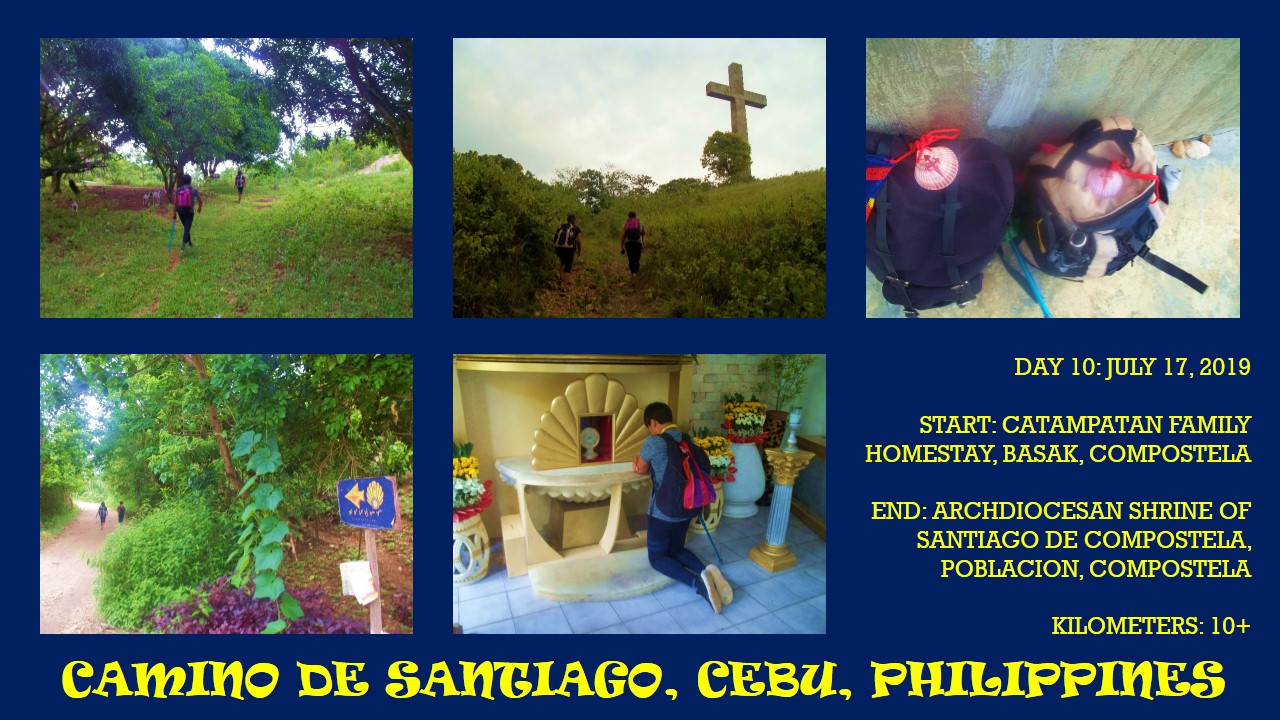
By 13:30, we arrived at our day’s resting place in Basak which is not a parish. It is the home of the Catampatan Family, who volunteered to convert their abode into a homestay for pilgrims of the Camino de Santiago. Husband Paul is a lay minister of the Archdiocesan Shrine of Santiago de Compostela while wife Minnie, takes care of their candle-making business. It was the second time that Paul and Minnie hosted me and my pilgrims in their humble home. The first being last February with my 10 pilgrims. 

After breakfast, the last day of the Camino de Santiago of Doc Lei and Frances Marie begun at 06:00, July 17th. By 06:45, we were already at the Cross of Triumph, on a hill of Bagalnga; thanks to the blistering pace of Frances Marie and the “camino weather”. This was the highlight of the journey where the pebbles you carried along the whole length of the ten days is gently placed on the bottom of the huge cross. It is here where you unload all your hurts, your most profound prayers, confessions of sins and prayer requests from relatives and friends.


At 07:30, it was time to go down to finish the last few kilometers of the Camino de Santiago and on to the Archdiocesan Shrine of Santiago de Compostela, which we reached at 09:45. Doc Lei and Frances Marie were received with leis by the welcome committee and both proceeded to the reliquary of St. James the Apostle, to offer prayers of gratitude and thanks and whisper once more prayer requests from relatives and friends. Fr. Scipio Deligero invited Doc Lei, Frances Marie and I to an early 10:30 lunch.

Both Doc Lei and Frances Marie endured the ups and downs and the trials of the Camino de Santiago and both connected perfectly with it. They each had the Certificate of Finish to show, signed by His Excellency Jose S. Palma, the Archbishop of Cebu. On our lonely journey in our threesome, there was enough space and distance for each to process thoughts privately and not too wide as to hinder a good conversation and sharing jokes. The Camino Cebu is most perfect this way.


On my part, I let them walk ahead so they could have privacy and not be stressed by somebody up ahead dictating the pace. They set their own pace and they stopped to look back, once in a while, at me, when the paths crossed one another and I would gesture with my hand going left or right or straight ahead and they would go on their way. It was kind of awkward to march up ahead or breathing next to them and walking behind is the best method that even endeared me to Frances Marie that she drew a cartoon version of me later. Funny… 

Doc Lei and Frances Marie ultimately spent a day in Cebu before planing back to Manila on the early morning of July 19, 2019. They brought with them their appreciation of their journey (disguised as a vacation) on the highlands of Cebu and rediscovered the other facets of their Christian faith by knowing better St. James the Apostle through the Camino de Santiago. A few days after this, Doc Lei informed me of a minor miracle of her sister’s friend’s niece. The sister requested her to pray for the recovery of the girl, which it did. 

Such are the ways of the Camino de Santiago and its spiritual healing on people and pilgrims. There are a lot of stories and this is one of the many experienced in our own Cebuano version. iBuen Camino! Viva SeƱor Santiago!

Pencil sketch by Frances Marie S. Flores