I
HAVE PROMISED DR. SHAWN ESPINA that I would be back. I stayed overnight last
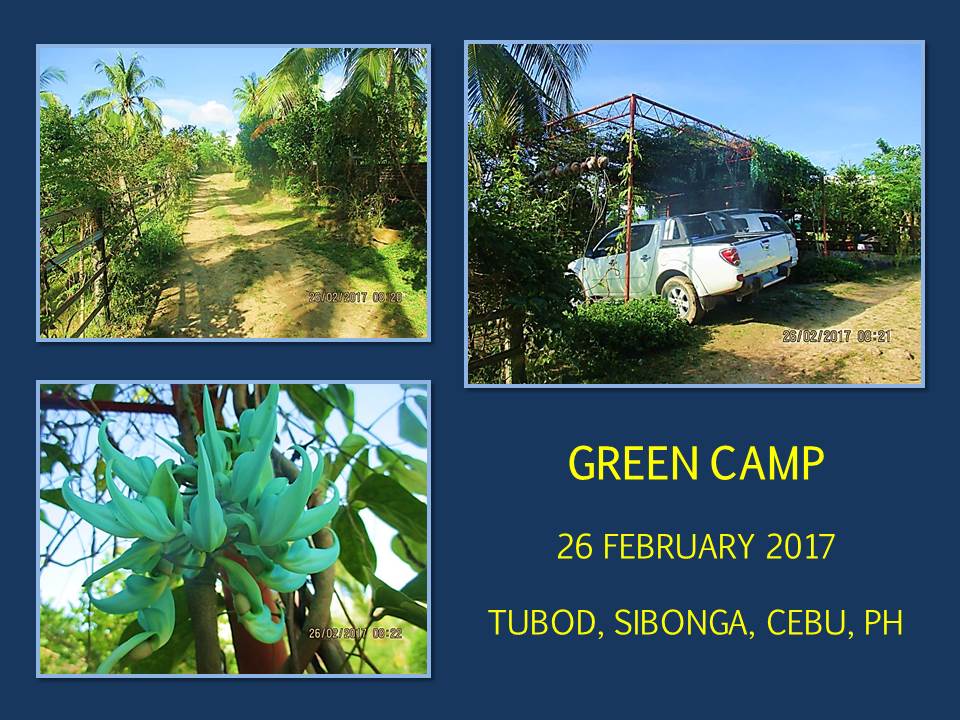
February in their farm estate, Camp LOV, located in Tubod, Sibonga. That time,
I was pampered well with rich but healthy food that was sourced from the
bounties of their organic farming. They developed, grew, fed and prepared these
things – plant and livestock – for soon they will be opening Camp LOV to
visitors, in a setting of agricultural tourism and the healthy lifestyle fad.
They
have designated camping grounds for tents and hammocks for those who would stay
overnight, a meditation nook, a dedicated path to tour around the farm estate,
which is halved into two by the presence of a farm road that connect Sibonga
with Colawin, Argao. The farm is accessible by SUV or pickup trucks and by
motorcycles. I took a motorcycle the last time but, today, April 7, 2017, I am
inside a Toyota Hi-Lux double cab, driven by Markus Immer. Going with us is
Jonathaniel Apurado.
Jon
have walked with me during that great Thruhike of Cebu from Liloan Point,
Santander to Bulalaque Point, Daanbantayan for 27 days last January 17, 2017.
It was one of my greatest adventures and we held the outdoors community in awe
and unbelief with the feat. Markus, on the other hand, lent his support to the
Thruhike by leading the supply run on five different rendezvous points and even
walked the last 40 kilometers or so with us. We three deserve tranquility in a
peaceful place like Camp LOV.

We
arrived at Camp LOV at around 11:00 and we three proceed to a couple of big
mango trees, past the pigeon bean (Local name: kadyos) plot, to set up
our hammocks. Coconut tree trunks provided us places to tie our hammocks and
the overhead shelters. We choose the kind that has the tops leaning away from
us. There were just few places which favored me and Jon. We gave the privilege
of the best spot to Markus on a mango that has low branches. The day was bright
and sunny but breeze came uninterrupted.
When
we were done, we proceed to the lanai where Doc Shawn and wife, Doc Jacqueline,
were lounging under a shaded pergola. It is a warm day but there is breeze that
blew away the warmer air. A few minutes passed by and the most awaited Camp LOV
moment of organic food got served 15 past twelve. A prayer of thanks to the
Almighty for placing me on the right place on the right time. He has a task for
me tomorrow and how He prepares His servants well before going out to battle.
After
the meal, Doc Shawn talked to us about tomorrow’s activity. What we would do is
find a route from the highway somewhere in Bagacay to Lindogon, where the
Shrine of the Virgin Mary is located. It would be a pilgrimage route, since it
would be faith-related. His son Mico would arrive soon and he would bring his
quadcopter drone to support the exploration.

Even
without the benefit of a map and compass, much less with a GPS, I found
tomorrow’s exploration a walk in the park. I have done much harder and longer
ones before. The 400-kilometer Cebu Highlands Trail is my crowning glory. It
took me almost six years to complete it. But a pilgrimage route is different.
It has more meaning. I would dedicate tomorrow for bigger things and as
preparation for Cebu’s own Camino de Santiago which is now on its incipient
stage.
After
about two hours on the lanai, we three went back to the hammock area to enjoy
coffee. It is 15:30 and it would be super nice to go horizontal after coffee
time and enjoy a late siesta. The breeze is beginning to go cool and your tummy
is full. It is like living the life on a ship. Did I not tell you that I once
worked in one? Sail a few days, anchor at a bay for weeks. Meet beautiful island
maidens and drink native wine. Markus could relate. He skips his own boat.
I
awoke at 17:30 and mosquitoes began to torment me once I am out of my bug net.
I do not worry about the suckers that fly during nighttime. What I worry are
the ones that appear at this hour. They are bigger, hurts more when they stick
their needles into you, and therefore annoying. I need to make a fire and smoke
them out. The thicker the smoke, the better. Fire, or the smell of smoke, is a
genetically-acquired memory that puts them on flight. Have smoke, will
travel.
We
three go back to the lanai and another superb meal is laid before you. God is
so kind! The Espina couple are such gracious hosts and they pamper you with
their hospitality and tales. Mico is already here with wife and daughter. We
conversed the hours away until such time when it was quite late to be
comfortably awake, with the cool breeze nudging you, now and then, to make a
quick bee line to the hammocks. The path back is now lit with kerosene lamps
placed above bamboo poles stuck to the ground.

I
opened my eyes when the first streaks of light caressed my eyelids on the
second day, April 8. It is 05:30 and too early to rise. I listened to any
rustlings from Markus and Jon but found them still. I would have loved to sleep
again but we have a task to fulfill later. The Espina couple might have
prepared breakfast early so we could start also early to the town center. When
my zipper started to make its opening sound, the other two people did likewise.
We return to the lanai and refresh ourselves with home-brewed coffee.
Glenn
Pestaño would be here soon and he arrived as he promised he would. He came with
his Yamaha DT motorcycle. Glenn would join with us later but, first, we need to
have that breakfast. We left the farm at 08:30 in a convoy of one SUV and two
pickups. Glenn rode with us. It seems we have more people who wanted to join
with us once we reach the town center of Sibonga. They are Justin Apurado,
Locel Navarro and Cleos Navarro.
The
convoy arrive at 09:00 and, just a few minutes later, the newcomers joined us.
We all proceed south to the village of Bagacay. Waiting at the Buko Beach
Resort are Elfin Mendez, the owner of the resort, a representative of the
municipal tourism office and a local scuba diver. Our presence here is part of
the bigger picture in making the Municipality of Sibonga into a well-planned
ecological, cultural, religious and agricultural destination of Cebu.
Buko
Beach Resort is located on the northern part of the mouth of the Sta. Filomena
River. The diver would scour the coastal waters and along the estuary of the
river to determine the health of the seabed and coral reefs. More than a month
ago, Dr. Espina initiated an exploration into the Sta. Filomena River. That
time, Randy Salazar and his group of SUP and kayak enthusiasts, paddled
upstream to probe its navigability, the health of mangroves and presence of
aquatic life.

On
our part, we would start here in Buko Beach Resort. This is a logical location
to start. It has a wide parking space for vehicles should people think of going
on pilgrimage – on foot of course – to the Shrine of the Virgin Mary. We would
also be documenting vegetation. As we were about to launch that, a huge tree
caught my attention. It bore nuts. I discovered that Sibonga hosts a
still-living boat-fruited mangrove (Local name: dungon). This is a
valuable find and it is worth that both Doc Shawn and Elfin know this.
We
arrive at the Cebu South Road, cross the river on to the other side on a steel
bridge, and cross the road and go down a short staircase into the upper bank of
the river. We will be following the Sta. Filomena River upstream by its upper
banks on the south side. There is an open well that supply people of fresh
water, some bananas, a few houses and, beyond, wild vegetation. Three years
ago, the river overflowed during Typhoon Ruby and washed away the old concrete
bridge and Elfin’s prized vineyard.
What
trail it may had is now overgrown by thick vegetation. Fortunately for me,
somebody have walked here just a few minutes ago, perhaps a farmer. The broken
leaves parted by feet are still fresh. We have glimpses of the
aquamarine-colored river, indicating that it is deep. At bends, sand and rocks
accumulate at where water current is not strong and carved steep banks at where
it is most strongest. There is a natural bathing area where a very
well-polished tree trunk tilted towards midstream. People used this to jump
down the stream.
The
path goes through shoulder-high vegetation and, over a high ground, I glimpsed
the man whom I had been following invisibly for minutes. In a matter of a
couple of minutes, I was on the same spot I saw the man. There is an abandoned
field and there is a trail. That trail leads to another trail and another and
this is where my skills began to work. Would I take the high ground? Or would I
take the ones lining the edge of the stream? Or would I opt to take the middle
which goes past a bent coconut tree?

When
in doubt, you should do a short recon and you can determine where the gist of
the trail goes. The trail I am taking took me to a farmed lot and twisted past
an old ruin and then I meet carabaos and people. A party of teenagers are
digging and plucking cassava rootcrops from the ground. I saw a path going down
the streambank and into water and across the other side. This is not the one I
am looking. I pursued the main trail.
The
trail forked up ahead. There is only one to choose from. Which is which? I did
a recon on one and I found the path well-beaten and populated but it is not the
one I am looking for. I pushed on the other and it goes to higher ground and
uphill where I could see the lay of things. Far away from us, I could see a
road and behind us is the coastline. Everyone were exhausted by the stifling
humidity near a stream and the whiff of fresh breeze on open country is most
welcome.
The
trail took us on open ground dotted with coconut trees and it ended at the same
road I saw many minutes ago. We are in Lindogon. Across us is a terminal for
public-for-hire vehicles that park here after disgorging their passengers at
the holy place where they wait when they would pick them up back to Cebu City.
The road going to the shrine is moot and academic. There is no sense of
continuing the route exploration.
The
village of Lindogon is where the Shrine of the Virgin Mary is located. It is
NOT located in Simala. Simala is just a village near the coastline where the
road to the shrine is located and it is unfair for the people of Lindogon to be
denied of that privilege of being known by that place where this popular shrine
is located. The misconception is very alarming. What if donations and community
projects given by generous pilgrims that should have been theirs would be given
to those less deserving? Credit should be given where it is due.
A
pickup driven by Doc Shawn came to pick us all up and we made it back to Buko
Beach Resort. A lunch of roasted chicken, braised pork and rice are laid on one
long table courtesy of the Espina couple. We stayed for two hours at the resort
until the scuba diver finished his work and made it to dry ground. Then we
proceed back to the town center so Markus could complement the farm food stock
since our company are increasing in size. One of those is a case of pilsen to
celebrate our quick exploration. It took us just an hour!

We
arrive at Camp LOV at 17:30 and Justin, Locel and Cleos set up a lone tent to
house the three of them while Glenn opted to sleep at the lanai when it is
abandoned. I left the company of people for the inner peace of my hammock. I am
tired and I need a private time for myself and the music files of my Lenovo
A7000. I am awakened by Jon when dinner time is ready at 19:00.
The
more people for company, the merrier. The pale pilsen supplied the lubrication where
good conversation moved flawlessly to here and there. Then the lanai is slowly
abandoned until only me and Glenn are left to finish off the last bottles. Then
it was time to leave Glenn at 01:30 as I tread the lighted path for my own
refuge. Too much beer gets you drowsy but, even without that, I could get it
here in Camp LOV, where the breeze blow the whole day through.
People
are all up and noisy on the third day, April 9. Justin and Locel are in the
business of folding the tent inside its bag. Jon’s hammock is nowhere on its
place. His bag is packed tight and ready. So is Markus. It seemed I am the only
one still riding my dream ride. It is still 07:45. Why the rush? It is Sunday!
Besides, they have not taken breakfast yet. I leave them to their wits and walk
towards the lanai where all the action is.
Ah,
just as I have expected, farm-brewed coffee! Relax! Enjoy the day. Glenn have
packed his things to give space for the diners. Doc Shawn and Doc Jacq are
already there, sorting out yesterday’s activity. The crowd arrive just in time
when breakfast got served. Farm-prepared chocolate paired with sticky rice,
plain rice and Valenciana rice, organic meat and sausage, salted eggs, bananas
and mangoes. God is kind to me today.
After
the meal, Doc Shawn toured the visitor all around the farm. I have noticed the
Central American imports, the pittaya and the prickly pear, growing big quickly
with all those sunshine and generous tropical rain. All the plants, native
fowls and livestocks are healthy as was the last time I saw them. I see
fruiting black mulberry shrubs lining a path towards the shed where the native
pigs are bred.
We
cross a dry stream and climb up a low hill. In the navel where upland marsh
palms (saksak) abound, is a natural spring. Before that, I was wondering
all the time how could such a place be called “Tubod” (English: water spring)
when it is denuded of forest cover necessary to produce water from out of rocks
and mountainsides? I was using my Westernized brain when I made this observation.
The
original inhabitants knew what they were talking about and, thereafter, naming
places according to terrain features and plants. They know where to look for
water and staked homesteads. I am just amazed at how their knowledge about the
land and my own are universal as if we came from the same mothers?
Document
done in LibreOffice 5.3 Writer