Showing posts with label camp burner. Show all posts

Friday, December 24, 2021

2021-050 | TRANGIA SPIRIT BURNER

IN OCTOBER 2014, A US-based benefactor provided me a TRANGIA Spirit Burner set for use then of my ongoing route-finding explorations of the Cebu Highlands Trail Project. This project is a long trail of a north-to-south axis that would traverse over the middle backbone of the island province of Cebu, in Central Philippines, which I finished in November 2016.

The exploration has no source of funding nor big-name sponsors and I was asking a little for blessings from friends and appreciative people. A trickle came and one of these significant donations was a TRANGIA Spirit Bunrer set. It is made of brass. It weighs 108 grams, 7.5 centimeters in diameter and 4.5 centimeters in height. It has a screw cap and another cap where you could adjust and control the flame.  

It comes with a windscreen that can be dismantled in three pieces and assembled, which has a total weight of 115 grams. The windscreen complemented well with the burner as it propped the pot above it aside from its other function as a mechanical wrench. By its size, weight and simplicity, I favored this burner set in all my outdoor activities. Fuel I used is denatured alcohol which are sold in 375-milliliter bottles.  

During my explorations of the last six segments of this project between 2015 and 2016, where weight was very essential, the TRANGIA Spirit Burner set was just perfect. Each segment was between two to seven days duration and the volume of fuel I carried was fixed at 3 bottles x 150 ml or 450 ml total. With a self-contained load, the burner set fit into the tight spaces available, to include the fuel bottles. 

Because it was very simple to set up and use, I found myself many times, boiling water for coffee or cooking instant soups by the trail. The process takes just inside of fifteen minutes and the TRANGIA Spirit Burner set had saved me many times regaining my strength where I need it most. This burner set have done well to the demands of my explorations, the terrain and the tropical climate.

Although this was an equipment designed for the individual, I have used it many times to cater to two other persons while in camp. The simmer cap regulates the flame and saved fuel consumption as well as of overcooking; but when you have used this so many times, you could already estimate the amount of fuel you need and discard the simmer cap. 

When I tested the Cebu Highlands Trail with a thruhike, naturally, the TRANGIA Spirit Burner set was part of my equipment. This thruhike was done in 29 days of January and February 2017, from the southernmost point of the island of Cebu up to its northernmost tip, covering 408+ kilometers of rugged terrain along the middle cordilleras. 

The alcohol burner worked mornings and evenings everyday; be it rainy or warm; cold or humid; and, on a few occasions, mid-afternoon coffee breaks when I arrived at my destinations very early. I have never experienced with a component failure since it has no movable parts. For as long as I could feed it with denatured alcohol, I will have my meals. Or coffee.

On other instances, like dirt-times with my bushcraft guild or travelling during training sessions, I experiment in pairing the TRANGIA Spirit Burner with a Swiss Army Wood Stove, when I still have the latter, and, lately, with a Solo Wood Stove. I would use the wood burner as an effective wind screen while increasing the heat efficiency of the alcohol burner, utilizing the construction and design of the wood stoves. 

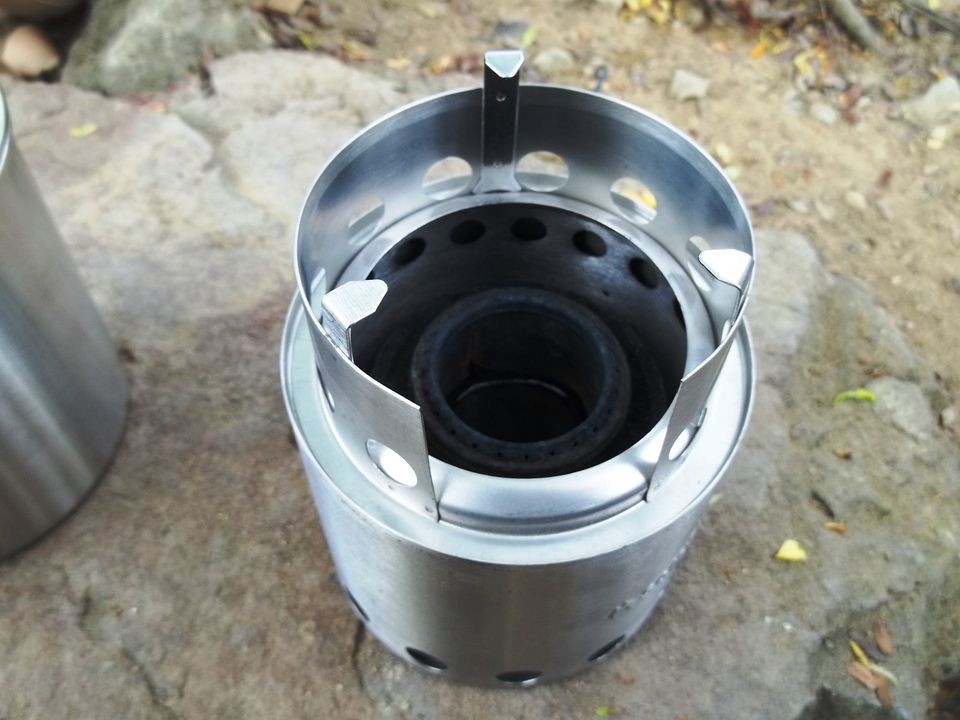
Presently, the TRANGIA Spirit Burner totally complements my Solo Wood Stove by providing the latter the capacity to use denatured alcohol when not using wood. The alcohol burner perfectly fits inside the wood stove when packed that it transforms into one unit although each could function without the other.

The TRANGIA Spirit Burner set has seen a lot of rough handling and use. I had seen it used for more than an hour of cooking under warm tropical conditions, stopping only when it burned all the fuel down and refilled and re-lit and repeating the process a couple of times more. Once the flames turned blue, it told me that the burner achieved a stable temperature ideal for cooking. 

I had seen it fall several times with nary a dent. Saw it explode a few times when invisible flames lit fresh fuel poured in its superheated cauldron. I once saw the metal surface where the blowholes are located glow red hot. One time, spilled fuel burned all over it and I have to wait for several minutes before I could intervene and cool it down.
The TRANGIA Spirit Burner is built to last. It is old technology yet quite relevant in these present times. It is made in Sweden and probably was designed in temperate and arctic regions yet it performed well in the tropics without fear of a meltdown. So simple and no movable parts and valves. What it has are a couple of screw caps. 

This is an equipment that I highly recommend for the active individual engaged in leisure outdoor activities, like overnight camping, light backpacking and hiking the long trails. Its fuel, the denatured alcohol or its similar derivative can be acquired everywhere, comes very cheap and very safe to store. It does not need a special container.

The TRANGIA Spirit Burner, which is a set, is available online in Amazon, eBay and most outdoors specialized stores. The windscreen is sold separately. Closer to home, it is available online in Lazada Philippines at 1,350 Philippine peso ($27.92), to include a mini-windscreen. But watch out for imitations. Insist on the original.    

Picture Nr 1 grabbed from Trangia website.

Saturday, April 1, 2017

BUSHCRAFT BUHISAN XLII: Sacred Ground

I DO NOT OFTEN BRING people to Camp Damazo. It is sacred ground for the Camp Red Bushcraft and Survival Guild and it had hosted the 2011, 2012 and 2013 editions of the Philippine Independence Bushcraft Camp and the 2015 Bonifacio Day Bushcraft Camp. There are no seas of clouds nor exhilarating views to gaze upon golden sunsets and luxuriant valleys. It is dreary and humid and all jungle. You will be disappointed. To us who find bushcraft a way of life, it is paradise.

The camp is named after the late Sergio Damazo Jr., my scoutmaster during my high school years at the then Colegio de San Jose-Recoletos (now USJ-R) when it was then housed in its old campus near Freedom Park and Carbon Public Market. During his time, he was a legend among his peers. He was a very good teacher and he was equally a very good storyteller. His tales of his experiences and anecdotes placed all ears to an unflinching attention.

It was that time when a Boy Scout IS a Boy Scout and my school basked under his giant shadow snaring accolade after accolade, recognized and represented in every international jamboree. He was a natural prepper and a master of all crafts that were taught in the Boy Scout. His loss left a big vacuum in the local Boy Scout community which, sadly, stagnated to glamour camping, cater service food and all that is politically correct imposed by overprotective parents.


It is my privilege as his former student to name this place in the wilderness in his honor and memory. There never was like him and his is a big shoe to fill in. Camp Damazo does not appear in Google Map nor it is kind to cellular signals. It is a hidden nook in the Babag Mountain Range yet, despite its remoteness, it can be walked direct from Guadalupe, the route of which is also a mystery. It is a privilege then if you are personally invited.

One of those that I welcomed today – November 26, 2016 – is my Swiss benefactor and friend. I cannot say no to him if ever he rings me for a hike in the woods. He is a typical individual who has a heart set for the outdoors. His is a rare breed in a Europe that is now harboring a highly-urbanized generation which is perpetually wired to the electrical outlet and the Wi-Fi. He is not that young anymore and he is intent to shed off some weight off his frame.

We have spent time together in other places testing equipment and gear and I am more than willing to try anything new. I write my own unsolicited reviews in this personal blog and in my Facebook wall and I somehow liked it in so much that it have helped people in their choices. My Swiss friend is carrying a bag that seem to have a bulky cargo inside. Whatever it will be, I just want to steer him safely along the trail to Camp Damazo.

We walked at a slow pace at ten in the morning on wet ground past a man-made forest of Burma teak. A strange red shark far way from home greeted us. The path ends at Creek Alpha but we walked downstream to get to another trail which would pass an old campsite and more of teak forests with a mixture of non-native species. When I am here, it seems that I am in my natural environment and every stress and worry is forgotten. I am a freelance wilderness guide and this is my office.


I am not a mountain guide. I do not give you the cold shoulder and that perpetual silence while you struggle to keep up with a pace. I do not work that way. I talk to make you more alive and watchful in a pace much to your liking. Along the way are harmful plants which without your knowledge gets you snagged or stung. You begin to wonder how such a living forest is dead? It is so silent.

I was wrong. Here upon a tall teak tree, a stingless bee colony (Local name: kiyot) made a honeycomb inside its trunk which is rare. Honey overflowed and oozed down it. The viscous fluid is sticky and sweet. It is a matter of choice for one native species trying to adapt to a foreign host to keep away competition and ensure its survival. These are small wonders that do not take attention from an untrained eye and the matching wisdom to explain why? That is why I am no mountain guide.

We reach Creek Bravo and take a rest. The humidity of the tropics might be too much for my friend. When I am on this spot, it gives me happiness just to stare across me of the only place in the whole Buhisan Watershed Area where a good concentration of water bamboos (butong) grow. How it colonized that part left me wondering? Whatever, it is a source of material and nourishment for a bushcraft camp. I took special care of these bamboos leaving it untouched for long periods of time.


We resume our hike. We climb up a steep trail to reach a ridge and two parallel trails. One goes down Lensa Creek while the other follow the back of the ridge and then to Camp Damazo. The forest is now alive of birds and insects. I still see Burma teaks, gmelinas and mahoganies but, amidst them, are native species which attract these living creatures. A few branches blocked the path and we have to watch over our heads of unstable ones bound to fall at the rock of a breeze.

Jungle jumble becomes a beautiful forest, for a time, and becomes both as we approach more elevation. Soon we will be at the fabled Camp Damazo. At thirty before twelve noon, we reach the place. In the center is a cairn, marking the fireplace. A bell pepper with a single fruit grow beside it. Above us is a Moluccan ironwood tree (ipil), whose foliage protect us from the eyes of sun and drone. Beside it is a stinging tree (alingatong) which, for all of its ill repute, is harmless. For now.

What makes Camp Damazo special? First of all, I discovered this while exploring Lensa Creek in 2010. It was when I saw a sickly bamboo that I noticed a trail which led to three other trails, which one of these brought me to here. I came back to explore the other trails and found a natural spring and an exit in one and Creek Charlie on another. The camp is on a low peak covered by trees and surrounded by thick jungle where teaching plant ID is perfect. Ground is a mixture of rock, sand and loam and absorbs rainwater quickly.


You would likely see ground pigeons, palm civets, jungle fowls and hawks here at closer distance than you would have expected these to be. Creek Charlie is a source of food which is very vital in a nocturnal hunting episode. Camp Damazo is a wild place but succeeding bushcraft camps have tamed it briefly and I decide to leave this place untouched for every couple of years so wild vegetation would recover. But on some weekends, we come just to cook meals and be gone.

Today, we will just be testing gears and have a cup of coffee and some bread. My Swiss friend retrieved a Kelly Kettle. That is why his bag looked so bulky. It is my first time to personally see, touch and hold a Kelly Kettle. It is a camp burner which you can use to cook food and boil water simultaneously. It is made of high-grade stainless steel and weighs 1000 grams. It consists of the fire oven, a kettle looking like a doughnut with bail and a chain near the bottom to tilt the liquid out, a standard pot and a collapsible pot adapter to handle bigger pots.

We tested it with a commercial alcohol-gel fuel but it never dished out enough heat to boil water in the kettle and it took us the whole of 15 minutes to observe a steam, which did not came, so we decided to add small bits of firewood in the oven to stir the water alive. It did in a few minutes. The Kelly Kettle is more efficient if it uses solid fuel like dry wood, twigs and other kindling. It is best in expedition base camps and in boats where exposure to elements are high like rain, snow and wind.

Buried below the spotlight of the Kelly Kettle, is an Advanced Fire Starter Pro donated by Paul Sidney Uy for my use during my Thruhike of the Cebu Highlands Trail in January 2017. It looks like a tactical pen where the parts can be unscrewed from each other. There is the one holding the striker, another one holding the ferromagnesium rod and another as container for tinder. At the end is a small button compass while the other is a lanyard holder.


I scratched the rod with the striker on the alcohol gel and it caught the sparks and blue flame erupted which then was used for the Kelly Kettle. This fire starter creates a good volume of sparks unheard of for its small size. Actually I tested it on a tattered piece of tissue at Frontgate Burger Restaurant the previous night and the tissue caught fire. Sidney owns Frontgate, located in Baseline, Juana OsmeƱa Street, Cebu City, which serves the finest burgers and steaks in town. The demo was witnessed by other Frontgate patrons.

After we had our coffee and fully satisfied of time spent well, we leave Camp Damazo for Guadalupe. We walk on the exit trail where the natural spring is located and more strange plants to understand and learn. Streaking away to put more distance from us is a jungle fowl. It is a rooster and it is the first time I saw one fleeing away on the ground. Most often when surprised it flies in a trail of dropping plumes. It may have freshened itself with water from the spring and caught unaware of our coming until about a few meters.

After crossing the upper part of both Creek Alpha and Creek Bravo, which were slippery, we arrive at the Pamutan-Sapangdaku Road. We cross it for another much tame trail going to Lanipao where we found cold refreshment. From there, we walk towards Napo where we ride motorcycles-for-hire to Guadalupe. From the church, we walk again to my favorite watering hole and cap our outdoor workout with the coldest beer.

Document done in LibreOffice 5.2 Writer