Showing posts with label gear review. Show all posts

Monday, September 6, 2021

2021-035 | SWISS ARMY WOOD STOVE

THIS WAS ONE OF MY BEST cooking equipment. It is made in Switzerland and, in fact, I owned two. I came to possess these because I have a Swiss friend as a benefactor. My friend ordered twenty of these surplus military equipment from Switzerland but I have to do field tests first before he would dispose these by selling it here in the Philippines. 

First of all, the camp stove is designed as an equipment for the individual soldier serving in the Swiss military. It is genuine and is in mint condition. This is known commercially online as the “Swiss Army Volcano Ranger Stove” or the “Swiss Army Volcano Stove” but I just call this simply as the Swiss Army Wood Stove as the term volcano seemed to be overly-exaggerated.

This stove comes as a set: burner, cup and bottle. It is made of ordinary aluminum and weighs a total of around 370 grams. Very light despite the three components. The bottle or the flask has a cork cap and can be filled with liquid of up to about 945 milliliters. The cup, has a capacity of 590 milliliters, and can be held by a pair of wire handles which can be folded. 

The burner is constructed of a ribbed can with a main rectangular hole for feeding fuel and several smaller round holes found near the rim and the bottom of the can which are designed to let oxygen flow in the fire chamber. It has a wire bail which is designed to hold the cup when it is used. When not in use, the bottle is placed inside the can while the cup acts as the lid and is secured by the bail.

When assembled, the Swiss Army Wood Stove stands around 27 centimeters (10.5 inches) tall and has a diameter of 8 centimeters (3.15 inches). The cup does not separate from the burner when stowed inside the bag, especially during a very fast pace marked by bounding over rocks and leaping over streams. It is not obtrusive inside the bag since it is round in construction. 

Since this is an individual equipment, I used it to boil water for coffee in its complimentary cup and, if need be, in the bottle. The cup’s rim is wider than the burner rim and it stays suspended above the fire chamber. As I had observed always, water boils quickly inside of five minutes. It is perfect for quick warm beverages like coffee and chocolate and a quick meal like noodles.

As for the bottle, you fold the burner bail back where its tip fits into a small hole and then you slid in the bottle. That part of the bail that slips into the hole catches the bottle and let it stay suspended above the fire. The problem is you can never remove an extremely warm bottle from the burner with your bare hand unlike the cup where there is a pair of folding wire handles.  

It looks clumsy when you balance a cooking pot over it. The 3-inch diameter of the burner is only good for flat surfaces like concrete or table tops but in the field it is tricky. If only it was shorter but it is about 8.5 inches tall. Because of this there is a tendency that you might ruin your cooking. So be careful not to accidentally bump it when cooking something over uneven ground.

I have tried different fuels when I used this. Most of the time, I used either twigs, bamboo shavings, wood chips or dry coconut leaves when I am at camp. I tried crushed charcoal twice and it worked perfectly. Some other times, I experiment with paper and cardboard which gets digested quickly by the hungry burner. But the most perfect is when I paired it with a Trangia alcohol burner placed at the bottom.  

What I liked about the Swiss Army Wood Stove is it extinguishes all the organic fuel I used to ashes. I just wait for it to cool down then I tilt the open end towards the ground and out went the clean ashes, leaving the insides of the burner very clean. If I am in a hurry, I hold the bail while still warm and out goes hot ashes. This is really a very efficient burner notwithstanding the bad feedback from people.

I have encountered two of these burners damaged to overheating. The aluminum body wilted before extremely high temperatures and melted. These were designed to function in frigid environments and the tropical heat is unkind on the Swiss Army Wood Stove. But mine did not despite the many times I tested these. I just control the flame and feed it from time to time with pencil-sized sticks and lesser sizes. 

Most people used bigger fuel, finger-sized, so they could leave it continuously burning and proceed with the other tasks. Once these wood became embers, the chamber is already very hot and could cook your food already. But unfamiliarity of how it functions and failing to understand thermodynamics caused it to melt when you give these embers life by blowing through the big hole.

One of the improvisation that I and my friend did was complement it with a pot holder. When you placed a pot over the burner rim, heat is trapped and goes out of the small holes located an inch below the rim where it is pushed back when breeze comes in. To remedy that, the pot holder allows warm air to escape through wider openings and remove the pressure inside the chamber and prevent meltdowns. 

I tested the Swiss Army Wood Stove during weekend dirt-times with my outdoor guild here in Cebu, Pilippines, which is kind of very regular. I carried this when I have training engagements teaching wilderness survival in different places in the Philippines like Baguio, Iloilo, Bukidnon and Rizal. I gave away both my Swiss Army Wood Stove, along with the detachable pot holders, as my appreciation for my hosts.

The Swiss Army Wood Stove is a very efficient and very lightweight equipment for the outdoors. While it may be designed for an individual, you may use this as a camp stove that would cater to a group of 3-4 persons provided you have a pot holder. As I had explained above, the pot holder prevents meltdown of the burner as this facilitates the efficient release of heat from the chamber. 

When I had the Swiss Army Wood Stove with me, I removed the bottle and replaced it with a bundle of sticks wrapped in plastic. The bottle was unnecessary in that I have already carried a Nalgene and a Camelbak and a couple of dry bags which I could use as emergency water containers. The bundle of sticks is necessary should the world suddenly turn wet and I am in need of coffee.


Unfortunately, this is not available in the Philippines. Should the Swiss Army Wood Stove be available online, be prepared to acquire this immediately. This is most perfect as a survival equipment in your vehicle, in your bug-out bag, even in your own home as a backup wood stove. But never forget to complement it with a pot holder of any design.

Tuesday, June 1, 2021

2021-022 | THE KNIFEMAKER CAMP KNIFE

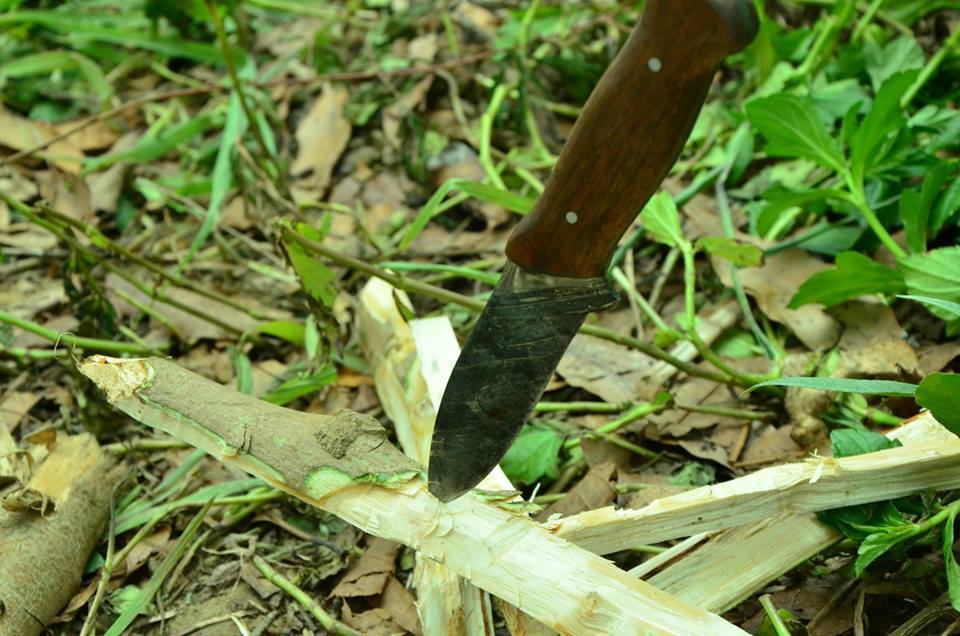
LAST JUNE 12, 2016, THIS blogger came into possession of a prototype of THE KNIFEMAKER Camp Knife which has a complement of a tight-gripping Kydex sheath. THE KNIFEMAKER is a custom knife maker based in Mandaue City, Cebu, Philippines, which has been in existence since 1983. It is owned by Lily Cortes Monteith and managed by his son, John Robert Monteith. It has a Facebook page for inquiries and for orders or you may call or text to +639272226975.

This prototype camp knife is designed by Madame Lily herself. The blade profile is drop point and is in full tang construction made from 5160 steel. The overall length is 8” (203.2 millimeters), with 3-5/16” (84.1 mm) reserved for the working blade and the other half for the handle, and has a thickness of 1/8” (3.175 mm). The hardwood scales tipped the weight of the small knife at 230 grams. It is built like a tank.    


Although heavy for its size, I did not encounter any problem or difficulty in carrying THE KNIFEMAKER Camp Knife inside its sheath on my waist, held in place by just an elastic garter of my basketball shorts. That happened days after I received it and walked over difficult terrain going to some hidden waterfalls down a deep valley in Balamban. That was its first test. 

Previously, a year before, this same prototype was tested in Liloan. That time, as per testimony of Jhurds Neo, “it was thrown to a tree by Jing de Egurrola (that is me) at about 5 meters distance and landed multiple times successfully. Justin Apurado made a couple of feather sticks, then whittled bamboo pieces and carved a spoon and cleaned the surface of the bamboo mug out of it

Nelson Orozco used it to prepare the food for dinner and sliced the meat and veggies like a champ. Dominic Sepe used it to baton a couple of bamboo and a piece of wood with ease as it has a good edge. The knife surpassed the needed task to accomplish intended for its size and purpose. One of the few knives with wood handles that would look nice with a Kydex sheath. The knife went home happy with great edge retention.”


It was posted as a thread starter in the group page of the Camp Red Bushcraft and Survival Guild in Facebook, I commented twice. This one was the first, “Even with that size it is still a monster when it goes into hard work. Because it is small, mountain climbers would prefer it because of its weight and it is strong enough to do menial tasks like food prep”. 

This one was my second comment, “I just love the look of the spin as the blade travels from hand into empty space and touching true on the trunk. I don't do knife throwing nowadays but it feels good to bring back memories. The sound of steel on softer target and the glint of the blade are such pleasant to hear and see. The adrenaline rush almost like the feeling of a call to arms”. 

It finally came into serious use when I went to Itogon, Benguet to teach Basic Wilderness Survival Course last March 2017. It was one of the blades that I carried on my travel there and was used by participants during practical exercises in blade-dexterity and on batoning techniques. Days after that, I personally used this for three days in Masinloc, Zambales, as my main camp knife and for a torture test chopping a dry casuarina hardwood. 

THE KNIFEMAKER Camp Knife became part of my regular blades that I carried for use during the Philippine Independence Bushcraft Camps in 2017, 2018 and 2019; the Bonifacio Day Bushcraft Camps of 2018 and 2020; the different wilderness survival training in between 2017-2020 in Cebu, Sumilon Island, Bukidnon, Iloilo and Rizal; and several bushcraft for kids in schools, kiddie clubs and orphanages on those same years.


Kids, ladies and guys with small hands preferred this because of its size and the shaped handle helped them with their grips. I got a big hand and I have to adjust by using a batoning stick when I am in the midst of heavy chopping work else the small finger has to curl full circle to keep contact with the far end of the handle in aiding the rest of the hand for a good grip when whittling and scraping. 

With its present handle length and by its design, the prototype knife would be very awkward to use by people with bigger hands like me. Simplifying the handle design into sleek straight lines might be a good idea to attract these individual types. Besides, the scale design on the hilt also made the blade length seems much shorter and would obstruct work as well as expose it to chipping, which happened on one scale. 

This blade had already achieved the build and the temper required for a small heavy-duty utility tool. For almost five years now, this prototype had not kissed abrasives just yet. Yes, the edge held that long, although not that scary sharp anymore, which only gave a good testament to the craftsmanship ability acquired and mastered by the builder, THE KNIFEMAKER, in providing the local market of a good edged tool for camping and bushcraft use.


Before I finish this review, THE KNIFEMAKER also accepts turquoise and synthetic stone inlays and appearance modifications of your Swiss Army Knife scales and knife handles. They would also accept orders for wood, leather and Kydex sheaths of your prized blades. They also make customized silver jewelries and cutleries that suits to your tastes and lifestyles at very affordable costs.

Thursday, September 1, 2016

SHOWDOWN OF POCKET SAWS

I HAD NEVER HAVE owned a folding saw except, perhaps, a very small one which is hinged along with other micro function tools in my Victorinox Trailmaster. I used it many times in my bushcraft camps and on dayhikes. It had cut through dry and green wood as thick as 3.5 inches, as well as on tough bamboos. It had accomplished its work quite well in a tropical environment and it gave me total satisfaction to own such dependable piece of equipment.


However, my folding saw looks so puny when ranged against larger wood like thicker poles and tree trunks although it is the best of its kind when you talk about multi-tool sets. What could a slender saw that is 11 mm at its widest and 88 mm in length do on thicker wood even if it has a skillful owner? The answer to that, my friend, is you get a bigger one.

For this occasion, I would use my Victorinox Trailmaster for size comparison and as a benchmark only for the cutting jobs that may be undertaken by some of the bigger pocket saws available in the market. Not all are folding saws but, just the same, these are lighter and portable than conventional ones and all can cut wood or flesh if you are careless.

THE PROTAGONISTS


NOTE: Measurements in length, width and thickness were taken with a standard Orion transparent plastic ruler. Thickness are deemed as estimates only since only a Vernier caliper could accomplish such accurate measurements. Weight measurements were done with a small made-in-China spring-loaded gravity weighing scale and are also deemed as estimates only except where it is not indicated.

THE MATERIALS

Primary material for cutting work would be green and dry bamboos, a member of the grass family that is not available on temperate areas where these saws originate or was designed from. These bamboos are of the thorny variety (Local name: kagingkingon) which are known for its hardness. The green one is designated as JOB #2, is about 2.75 inches in diameter and about 0.5 inch thick. Meanwhile, the dry one is about 3.5 inches in diameter and about 0.45 inch thick. This will be JOB #3.

Another material that may make or break its will on the saws would be a hardy star-apple tree trunk (kaimito). It is a misunderstood wood that is exceptionally hard yet it is surprising that it had not been utilized as material for furniture and tool handles. Quite knobby and almost lacking in grains, it will be the proving ground for the pocket saws. The trunk is about 5 inches thick and might be 5.25 inches on some places where there are knobs. This is assigned as JOB #4.


One wood material that is included is a straight branch of a Mexican lilac tree (madre de cacao, kakawate). I selected a green one and its main purpose is for the speed test: How quick can each saw cut green wood? The branch is about 1.88 inches thick and is designated as JOB #1. All of these items are foraged from the ground. Meaning, all are left unused and scattered by local farmers after being cut some days ago.

THE DATE, PLACE AND WEATHER

The field tests were held on June 16, 2016, along a bank of the Sapangdaku Creek, in the mountain village of Sapangdaku, Cebu City, Philippines. Weather was fine with cloudy skies and a bit of shower in the morning. The rest of the day was warm and humid.

HOW THEY FARED?

JOB #1: It took the Victorinox Trailmaster 50 seconds to cut the upper end; the Greenfield 43 seconds; the Creston PSW-508 in 11 seconds; the Stanley AccuScape Pro in 8 seconds; the Opinel No. 12 also in 8 seconds; the Gerber Slide Saw at 18 seconds; the Bahco Laplander in 9 seconds; the Sven-Saw 15UL-3 in 8 seconds; and the UST Sabercut in a whirlwind of 7 seconds.

Although the UST Sabercut cut it quickly in 7 seconds, it left a lot of things to be desired. For one, it resulted to an ugly and brutish look on where the wood was cut. On the other hand, the Stanley AccuScape Pro and the Opinel No. 12, which both made it in 8 seconds, made very clean cuts. The Sven-Saw 15UL-3 also made it in 8 seconds but it was not good to look at. Maybe I was using the wrong blade but since there was only one available, the result reflects its character.

JOB #2: The Victorinox Trailmaster cut a slice of the bamboo in 94 seconds; the Greenfield at 110 seconds; the Creston PSW-508 in 11 seconds; the Stanley AccuScape Pro in a very fast 7 seconds; the Opinel No. 12 in 11 seconds; the Gerber Slide Saw at 24 seconds; the Bahco Laplander in 17 seconds; the Sven-Saw 15UL-3 also in 17 seconds; while the UST Sabercut failed to cut it after getting stuck and going over the 120-second limit.

The Stanley AccuScape Pro made a very outstanding display of cutting virtuosity at 7 seconds. Slower at 11 seconds yet showing smooth finishes, the Opinel No. 12 and Creston PSW-508 made good marks here as also rans.

JOB #3: Another slice fell off after 115 seconds courtesy of the Victorinox Trailmaster; the Greenfield in a slow 145 seconds; the Creston PSW-508 in 16 seconds; the Stanley AccuScape Pro in another searing 12 seconds; the Opinel No. 12 at 18 seconds; the Gerber Slide Saw at 52 seconds; the Bahco Laplander in 25 seconds; the Sven-Saw 15UL-3 in 26 seconds; while the UST Sabercut failed again to cut it after a time limit of 3 minutes.

The Stanley AccuScape Pro showed consistent results by leading the pack here at 12 seconds. Not to be outdone, the Creston PSW-508 came in at 16 seconds while the Opinel No. 12 breathing close at third at 18 seconds. All made smooth finish on the surfaces.

JOB #4: The Sven-Saw 15UL-3 opened up the last test by cutting the endmost inside of 110 seconds; the Bahco Laplander followed at 165 seconds; the Gerber Slide Saw failed to make the time limit of 300 seconds or 5 minutes; the Opinel No. 12 almost made it but succumbed to time; the Stanley AccuScape Pro produced the day’s best of 100 seconds; the Creston PSW-508 in 216 seconds; and the UST Sabercut failed to make the cut. Likewise, the Greenfield. The Victorinox Trailmaster was not up for this last job since it was just a “guest”.

No doubt about it, the Stanley AccuScape Pro snagged the day’s best here at 100 seconds or a minute and 40 seconds. The Sven-Saw 15UL-3 came in second but it was a far second if you consider the manner of finish on the surfaces it cut. The Bahco Laplander finally made a good account of itself here by making it in 165 seconds while the Creston PSW-508 completed the cast of the only saws who made it in under 5 minutes by cutting through in 216 seconds.


For those that did not made it, the Opinel No. 12 would have cut the trunk if it would have been given 30 seconds more of overtime. Its 124 mm blade length proved to be its undoing but if given the chance to work from its No. 18 big brother, I am sure it would have given the leader a worthy competitor. It had progressed around 90-95% of the job when the 300-second mark came.

The UST Sabercut made some 85-90% progress until it got snagged but it was ugly work. The Gerber Slide Saw crossed the lane for about 40-45% when time expired. The Greenfield did at about 10-15% of work when it was time to drop the mop. There was no timer used. I relied on the second hand of my quartz wristwatch and therefore not accurate but who needs accuracy when you are not in the Olympics? For the speed test, special attention was needed, repeating when I needed to, and I believed I have given justice to all.

CONCLUSION

Obviously, the Stanley AccuScape Pro came out the winner here. It is designed for any type of cutting work regardless of what material you throw at its teeth at any angle. (Yes, the sawblade can be shifted to a desired angle.) Besides that it is around 178 grams in weight, which is just about okay, and has a respectable blade length of 186 mm to ensure good cutting progress. The handle material is a combination of plastic and rubber, wide at its south end to check slippage. The only drawback is the location of its lock. It is susceptible to being accidentally pressed when in the middle of an intense workout.

The Opinel No. 12 could give the Stanley AccuScape Pro a run for its money if it were only longer in blade length. It is the lightest of them all at an estimated weight of 100 grams owing to the construction of the handle which is made of beech wood that is flared at the endmost to counter slippage. It also has the safest lock design. I would recommend the Opinel No. 12 for outdoor trips and where such cutting work is not that much. If you insist so for hard cutting, try the longer Opinel No. 18.

The Sven-Saw 15UL-3 is supposed to have a set of three different sawblades. For this occasion, I used only one kind. It was perfect on Job #1 and Job #2 but on a dry bamboo, it was not up to it. Barely. On the star-apple trunk, it cut its way almost easily until resistance begins to be felt. The good thing about a framed saw is you can apply weight and pressure on the cutting work and it gets the job done until the blade begins to shake. Ooops! The wing nut got loosened. I believe, this saw could have been flexible if you use the right blade for a certain job. This is good for heavy work, especially on an extended time frame in one place because you will be packing around 245 grams of weight.

I know that the Bahco Laplander is something you desire but when you are up to it, especially in the middle of something where you need the cutting teeth most, that is when you begin to realize that it is not what you really desire. On the first three tests, it did not belong to the top-tier finishers but on the last job, it gave a good account of itself but, just the same, it was not a smooth cut. I gave it two pluses instead owing to its excellent design and look and a very secure lock built on the side for a good feel.

The Universal Survival Technologies Sabercut is a good equipment which would need not less than two people to make good progress. I found out that it cuts better with green limbs in a somewhat brutish manner. Using this by only one person demands an equally brutish strength but very strenuous just the same. When cutting wood or something by yourself especially if its done propped on the ground, special care must be observed on one foot pressed on the material as the sawing action tend to be impulsive and violent when it gets jammed. You need to think it over many times if you really want to acquire this.

I thought it at first that the Creston PSW-508 was a Stanley-inspired product but I beg to disagree. It has the same locking mechanism design as that of the Stanley AccuScape Pro and it stayed breathing down its neck on the first three tests as the sawtooth design is almost similar. But, like I said, the last test would be the proving ground and would separate men from the boys. The Creston PSW-508 did make it but it was a far placing than what it did for the first three tests. Just the same, it is a good pocket saw deserving a second look.

Brand reputation endorsed by survival TV celebrities make this Gerber Camp Sliding Saw a force to reckon with, or should we say, a force to wring out of. At first impression, by its slide design instead of the swivel joint, it would make the owner happy and worth the money acquiring it. For the first three tests, it stayed just ahead of the doormat and on the proving ground it miserably failed. Not worth the money.

What about the Greenfield? Do not ever think about it. It is absolutely crap!


Document done in LibreOffice 5.1

Saturday, August 15, 2015

WHAT IS THAT POUCH?

YOU MIGHT ALL WONDER why I always carry a small camouflaged pouch attached to the front of my Silangan Predator Z backpack? You might also wonder what is inside that? On first impression, it is an item used and issued to the military. Yes, it is. In fact, it is issued to individual soldiers belonging to the United States Army. If you think I am military, you are absolutely wrong.

I could not do about its appearance. Maybe I could alter its color later on but, no, as of this writing, no. Not today and the photographs attests to its military origin. Please be kind and be patient as I will digress of what really is this thing? I could assure you that there are absolutely no explosives stuffed inside. It is just a box that could save a life or lives. It is just an IFAK or the Individual First Aid Kit.


Now you can heave a sigh of relief. It is a first aid kit but not an ordinary one. It is really a trauma kit designed for bullet and shrapnel wounds that causes hemorrhaging and difficulty in breathing. Would it be applicable in my environment or on my outdoor sorties? Maybe yes or may be no but I would rather be optimistic that it does. You would never know. Would we?

It might as well that all the items inside are retained. You add a few things and it becomes an improved IFAK. Besides, the only thing that you hate is the appearance. Is it not? But you would disregard it when you begin to know the wonderful items found inside it if I start to disembowel the pouch. But let us start with the Pouch first.


According to The Prepper Journal, the IFAK Pouch alone costs around $9.99. But wait! Included is the IFAK Insert which is attached to the pouch by a coiled cord. It is a set then. The IFAK Insert have several elastic holders and is designed like an organizer with velcros to secure the items when folded. The pouch, on the other hand, has a flap which can be closed with a PVC clip lock and has a drain hole at the bottom. The IFAK can be attached as rugged kits to a MOLLE webbing.

The first item you will see once the IFAK Pouch is opened is the Combat Application Tourniquet or CAT and is priced in eBay, Amazon and other sites at $26.50, which is the most expensive item of the IFAK. It is produced by North American Rescue and features their Red Tip Technology. It is an efficient one-handed tourniquet operation with hook and loop closure for securing a wounded arm. This is a very important item set and a must-have in an IFAK.


The IFAK Insert, when unfolded, contains the original items like an Emergency Bandage Kit, a Compressed Gauze, an Adhesive Surgical Tape, a Robertazzi Nasopharyngeal Airway and Patient Examination Gloves. All are secured neatly in their places by elastic holders. The additions are inserted in empty elastic holders and lipped side-by-side with the aforementioned items.

The Emergency Bandage Kit is housed in a sealed sterilized pack and consists of a Trauma Wound Dressing and a 4-inch Hemorrhage Control Bandage. It already consolidates a Pressure Applicator, a Non-Adherent Pad, a Plastic Secondary Dressing, a Stop-and-Go Release Apparatus and a Closure Bar. It is made by First Care Products of Israel. Its price tag is pegged at $5.30 at Rescue Essentials. A very essential piece of emergency medical equipment.


The H&H PriMed Compressed Gauze is vacuum packed for easy storage but expands to cover large wound areas. The Compressed Gauze is a perfect companion to the Israeli Bandage so it could stop blood loss and save lives. It has a width of 4-1/2 inches of 6-ply cotton-fluff bandage roll which can be stretched at 4 yards. It is made in China and distributed by H&H Associates, Inc. of Virginia, USA. Available at Rescue Essentials at $2.40.

The Adhesive Surgical Tape is made by 3M. 3M Durapore is the gold standard in surgical tapes and it has a dimension of 2 inches and 10 yards. The silk-like clothe tape features strong adhesion for securing dressings or devices. Strong, highly adhesive and non-irritating, hypoallergenic Durapore silk surgical tape features maximum comfort and bilateral tearing for quick application without the need for scissors. Individually sold at $2.15 at Rescue Essentials.

The Robertazzi Nasopharyngeal Airway, manufactured by Rusch, is made of soft Ultrasil material that provides greater patient comfort than other rigid plastic nasal airways. It is sold at $3.25 per kit at Emergency Medical Products and does not contain latex. The airway tube is 9.3 mm (28 Fr) thick and has a length of 125 mm. It is very flexible for complete patient comfort, rounded tip allows for gentle insertion and the soft material avoids damage to nasal passageway.

There are four pieces of Patient Examination Gloves inside the standard IFAK. The gloves are of synthetic vinyl with polymer emulsion coating. Features a soft, stretch feel that provides comfort, total dexterity and added durability. Contains no natural rubber latex proteins or allergens. An individual glove has a thickness of 8.4 mm and 9.6 inches in length and all are in cream color.


The IFAK is designed primarily as a self-aid and a companion-aid and provides interventions of incurred wounds, serious or not. It increases individual survivability during exposure to a high-threat environment and is expandable to include other additions. The complete IFAK weighs one pound (2.2 kilos) and costs $265.00 per unit according to the Rapid Force Initiative.

Now, let us know the items I added.

  1. Trauma Shears. It is made by Salim1 of Pakistan. It can cut through clothing and other tough materials. It has yellow handles with stainless-steel cutters, weighs 40 grams and is priced $6.00 at Alibaba. One pair.
  2. Emergency Rescue Blanket. For securing patient against hypothermia. A strong foil-like material in golden color that has a dimension of 160 mm by 210 mm and is neatly folded inside a sealed plastic. Donated by Death Valley Magazine during a humanitarian mission in Cebu. One piece.
  3. Triangular Handkerchief. It is a cotton neckerchief commonly used by the Boy Scouts of the Philippines and is in a light blue color. For cravat bandage purposes, it can also be used as an arm sling or a splint strap. It is also neatly folded inside a sealed plastic. One piece.
  4. EyeMo Eye Cleansing Formula. One 7.5 ml bottle. Manufactured by GlaxoSmithKline in Tianjin, China. For eye irritations. Can be bought locally over the counter.
  5. BD Persist Skin Prep. Two pieces. Swab sticks containing 10 % povidone iodine and 70 % ethyl alcohol. Made by Becton Dickinson Infusion Therapy Systems Inc. of Utah, USA. A very good replacement to a bottle of betadine, especially when space is wanting.
  6. Mediplast Plastic Strips. Instant waterproofed adhesives to cover small wounds. Three pieces. An over-the-counter item.
  7. Bluecell Fastening Wrap Strap. Wraps anything smaller than a wrist with velcro. Would complement with bandaging and quite useful in securing scattered items with a quick wrap. Blue color. One piece.
  8. Identification Card. The edges can pry a tip of a surgical adhesive that a gloved fingernail cannot.

Am I competent to use this against an injured person? No I am not, if there are others who are, then I will just be an assistant. If none, then you will have to suffer. Just joking. The truth is, I have little knowledge in the treatment of injuries, sprains and fractured bones. If being trained by the Emergency Rescue Unit Foundation in 1993 qualifies as “little knowledge”, it does make a difference when I am alone by myself or just you and me, is it not? Except for the RNA insert application, I can manage to treat injuries with these wonderful items.

And now you know what is inside my IFAK.


Document done in LibreOffice 3.3 Writer

Thursday, January 15, 2015

WARRIOR REVIEW: Silangan Greyman Hike Pants

A PAIR OF LONG HIKING pants are essential in my outdoor activities. Bushcraft and survival demands such apparel for it protects you from scratches and some harmful plants as the playground it chooses to be are thickly wooded areas and jungle. There is a big difference when you wear a pair of long pants that I decide to purchase a few pairs. One of these is made by SILANGAN OUTDOOR EQUIPMENT.

SILANGAN OUTDOOR EQUIPMENT is a local company based in Talisay City, Cebu that had made its name making quality tents like the REV 20, the REV 20+II, the AMIEL 5 and the EIS 8. These tents had taken by storm the local mountaineering community because of its revolutionary designs. The tents had been to all of the most notable peaks in Luzon, Visayas and Mindanao and had stood toe-to-toe with imported brands when it comes to weight and resistance to the elements. Its prime advantage is its price.


When Jay-R Serviano thought of experimenting about branching into outdoor apparels, he begun to produce rain pants and wind breakers. Then he made a prototype short pants that Wil Rhys-Davies of Snakehawk Wilderness School volunteered to test. I liked the fabric that he used that I insisted to order a pair of long hiking pants, based upon a simple design. I even suggested to make it custom-made for me and so the SILANGAN GREYMAN Hiking Pants was born. It is the only one of its kind since the SILANGAN tab is stitched, by mistake, at a different place.


Why is it called a GREYMAN? Well, for one thing, it is in gray color. Gray is a neutral color. When you are wearing something gray, you could blend well on any environment, whether you are in an urban area or in the mountains. Gray had been associated with people who remain inconspicuous or go unnoticed in places where they live or operate and these are people with dangerous occupations or doing clandestine jobs. The street lingo “grey man” is meant to describe these certain individuals.

In fact, when wearing gray, you could pair it with anything. Whatever shirt or semi-formal upper attire you wear or whatever color, gray seems to melt into the background and becomes one with what you have on. The color is just so flexible and the SILANGAN GREYMAN had given justice to the flexibility of gray by using a very flexible fabric that stretch for almost an eternity. The GREYMAN is made from a light synthetic cloth that is available locally.


It has two main slip-on pockets on the front and another pocket at the back, which has a zipper, found at the right. The front opening is secured by a good-quality velcro tape and a durable zipper. Four belt loops are stitched at the waistline which could accommodate standard operator belts. A black PVC key ring is stitched at the front to keep those small items handy all the time.


I had worn and tested the GREYMAN for the first time during the Outlaw Bushcraft Gathering held at Sibonga, Cebu in 2012. For three days and three nights, I had not removed it away next to my skin. It was a hot and humid three days yet the fabric had not caused suffocation on my skin since it is very breathable. Its lightness had added to the comfort. During the coldest temperatures brought on by dawn, the GREYMAN surprisingly held my body heat in check, particularly at the lower legs.

I had also worn the GREYMAN on thick forests and jungles. Many times, I got caught with the spines of rattan palms. This is a very formidable vine-like plant where spines grow on its stems, leafstalks and leaves. Its tendrils are thin and would always catch fabric and skin unnoticed until you get tugged. Miraculously, the GREYMAN had survived such ordeals with nary a tear except a few dismounted strands which can be easily returned to its place with a few stretch of the fabric.


One time, it was accidentally sliced by a knife. I leave it be. Instead, I observed the damage over a period of time, whether the cut would extend to other areas like most wearable materials do. It had not run and the edges had not frayed despite exposure to sustained tropical outdoor activities. The cut had not widened either.

I have used the GREYMAN as my main working pants during humanitarian missions in Bohol, after the 7.2 earthquake, and in Northern Cebu, after Typhoon Yolanda. It was soaked many times by saltwater when I had to wade beaches to transport relief items from boat to shore. I had also used this during a week-long filming sessions that documented the Bajau people in Leyte. I was partly wet all the time but I had not encountered chafing on the inner thighs by its smart design.


The GREYMAN fabric, not only is very light, flexible, breathable, stretchable and tough, it is also quick-drying. You may get wet, but as you walk by, it dries very quickly. Washing it with regular laundry detergent is no problem inside a washing machine or by traditional means. It is tough and could withstand rubbing and wear-and-tear at its most vulnerable condition like being wet.

After more than two years, my pair of SILANGAN GREYMAN Hike Pants is still in good condition. It had received abuse by any conceivable form in the furtherance of my outdoor activities. I would want another pair because I am quite satisfied with the material used and the workmanship of SILANGAN OUTDOOR EQUIPMENT.


Unfortunately, this apparel is not sold openly on the market yet but you could order it personally from Jay-R Serviano or thru me but it is best if you could visit the SILANGAN OUTDOOR SHOP located at Sangi, Tabunok, Talisay City.


Document done in LibreOffice 3.3 Writer