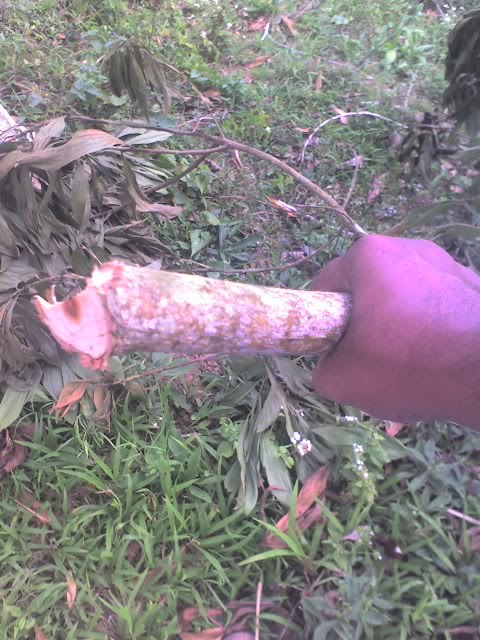
CARVING A WOODEN SPOON is valued highly in bushcraft and survival. In temperate zones where there is a winter season, extreme cold can be brutal and metal would adhere to bare skin and it is rather painful to remove that from your hand unless you have an elastic skin. A lot of Filipino soldiers learned this lesson the hard way when they were assigned in the frigid winters of the Korean peninsula during the 1950-53 Korean War.
In the tropics, a wooden spoon is also very important. Let's say you are stranded in the jungle and you lost all your belongings except your safety matches and your Swiss knife. You can cook, yes, but you can't rely on any stick to stir your food much less your hand to eat your food with. Eating directly from the hand may expose you to tropical diseases and you don't want to take those chances, would you?
Most likely you have to make a spoon. Tool making is an art and carving a spoon from wood is a skill that every bushcrafter worth his salt should learn and know. For starters, select any soft wood as your material for a spoon. Any sturdy cutting tool would do. In some photos, I am using a throwing 'hawk. I am into wood carving for sometime and using a knife or a hatchet is so natural for me that I couldn't care less which one I use. For beginners, a knife is best.
Always observe safety precaution. Wear a pair of gloves and place a piece of thick clothe or leather to cover your legs for protection. As you can see, I am wearing without any protection in the photos and do not imitate these. One thing to remember though: you have to develop a bond with the blade and become skilled in its use but that is another chapter – long and painful.
Cut the best part and then slice the wood according to the style of the spoon you have blueprinted in your head. If you are doing this in the comforts of your home, draw a pattern on a piece of paper and follow the specs. Chop the sides where you would want your handle to be carved from and retain the part where you will make your spoon head. Then whittle it down until it is thin enough to start scraping the wood.
Whittle and scrape. Whittle and scrape. Whittle and scrape. It is like that else you will commit an error in judgment that may cause your spoon with a flaw. Unlike paper and pencil you cannot undo what you have erred in doing when carving a wood. If you're really very good you could, however, improvise on the flaw and make it look natural. Misjudgments happen. Otherwise, be patient. Whittle and scrape. Check the lines and curves always. Whittle and scrape.
The most difficult part to make would be the spoon head. It is the part where it would hold soup. A spoon that could not hold soup is not a spoon but a back scratcher. A good back scratcher though. Pierce the head with the point of your knife and lever. Repeat it many times. You gouge out whatever excess wood until you have created a concave – a depression. Scrape away the excess wood and deepen the depression. Scrape, scrape, scrape.
You will now have a rough spoon. Most people finish their spoon with a curved knife. A spoon knife. But we don't have that. Improvise. A broken piece of bottle is a good alternative. Use it to scrape away the rough edges not too hard as it may chip away. Scrape away and arrive at a finished look. Feel the grain of the wood for any bulges and concentrate your glass on that part until all surfaces are even. Rub it with fine sand or sand pebble if you are outdoors else use a fine sandpaper.
Most people like their spoon in their natural state but if you would want your spoon to last for years, coat it with varnish. You will now have a spoon to boast of. Make another one and another until you will become versed with the process. A process that come in handy later when you are in a real-life survival situation.
BUSHCRAFT SKILLS SUNDAY, May 16, 2010. Taking out Boy Toledo and Ernie Salomon today to the Roble homestead, just below Mount Babag, for a spoon carving session. Need to teach new tricks to these two old trail dogs about tool making.
I have to change their mindsets and not let them drift back to an interest that only accumulate altitude, distance and expensive gears. I can't even remember there is one here in this country if you believe the UIAA1. You know what I mean.
What I am doing is starting out a new culture about bushcraft and survival here in Cebu and this is more on useful survival skills that do away those gears. This is more on improvisation and adapting to nature and endurance.
Along the way, I searched for things that are essential in bushcraft and survival and mapped this in my mind aided, now and then, by my camera. Though it is still summer but we were blessed with cloudy skies. We arrive very early and, as usual, I bring bread for the kids Manwel, Juliet and Jucel Roble.
I choose a hard driftwood called “lubas”. It is grainy and gnarled and great skill is needed to cut away the wood with just a jungle knife. It will be a hard undertaking but I have to try and impress the duo. I will have my dependable rainbow-colored Mantrack knife as my cutting tool.
Meanwhile, Ernie and Boy T prepared our meal for lunch. I offered my stove and pot to cook the milled corn and we will be eating pork adobao and they watch me while they work. Old men. Yeah, full of wisdom!
The collaged images below tell the whole story of this Camp Red activity -
Right after this event, we take a customary post-activity discussion and rehydration ritual in our watering camp in V. Rama Avenue. Paul Ceniza (Ridge Outdoor Shop) came from Lilo-an just to listen to the tales of Boy T and Ernie.
Document done in OpenOffice 2.1 Writer
JPEG converted images done in Microsoft Powerpoint 2007
1Union of International Alpinists Association. The UIAA describes mountaineering as an activity done 4,000 meters above sea level.
AS I WAS UPLOADING the pictures of my recent day hike down the Upper Kahugan Trail of December 27, 2009, people can't help but notice the bare trail which months ago have been thickly-populated by madre-de-cacao trees locally known as kakawate. These same people are people I know and they belong to local mountaineering groups. They love to pass by this trail going down to Napo then Guadalupe after a day of climbing Mount Babag.
It inspired me as they commented on the present situation of the Upper Kahugan Trail and it gave me a thought of how to revive the tree cover along that route. The idea of tree planting is foremost in my mind but to bring the seedlings to the site where it will be planted demand a lot of people, muscle, logistics and patience.
I will just simplify things and start the tree-planting activity from Ground Zero - at or near the site itself – without having to carry all those plants and soil inside those black little plastic bags from a long walking distance, most of whom are over steep and difficult terrain. The house of Manwel Roble is a perfect place for a seed bank considering its accessibility and in vicinity to the site.
Then I will be choosy with the kind of trees to be planted. I prefer fruit trees. With fruit-bearing trees, at least, the local residents will think twice of cutting the tree down for firewood or for charcoal when he could earn instead from the fruit itself during harvest time. Any tropical-fruit trees, except mango, is most welcome.
Why exclude mango? When you grow and care a mango tree you have to take special care of the buds, the flowers and the fruit by shielding it with different layers of chemical like insecticides and fungicides to protect it from pollinators, worms and fungi. Then you have to use another chemical to induce the flowers to bloom. All these toxic fluid come down and harm the soil and the aquifer. Then there are the pieces of paper.
I have started this seed-collecting activity on my own private capacity on February 28, 2010 by bringing two kilos of lanzones and mangosteen fruit and sharing it to Manwel and his family where the precious seeds were segregated and treated by drying before it is driven into the soil. Although bringing a fruit to their abode is quite heavy, I wouldn't mind, because I could split the result in three ways: (1) the flesh of the fruit will satisfy the children; (2) the seeds will be the core of the seed bank; and (3) it gives me pleasure to share to the mountain folks.
And, somewhere along the way, the Circle of Friends for Enviro Concern, thru Green*Point, lend a hand to make this idea a reality. So, Earth Day came on April 22, 2010 and it fell on a week day which is not possible for a working-class like me. I decided to celebrate Earth Day instead on the 25th, a Sunday, and I posted this in Facebook Events as “Seeds for Earth Day” and invited as many people as my mouse could click.
Assembly area is in the churchyard of Our Lady of Guadalupe de Cebu and several outdoors people came but it was for two different activities. At 7:30 AM, I decided to take a lonely walk up on the road to Napo. Dejected but not hopeless. Anyway, this is an activity of Green*Point and Camp Red, but two of the staunchest supporters for this activity – Boy Toledo and Ernie Salomon – were unavailable today after they helped out Jungle Wil guide two high-end guests to Mt. Babag yesterday and are very tired. I guess, I have to do this thing on my own. No excuses. Complete the mission!
Inside my backpack were two kilos of lanzones, a kilo-and-a-half of apple mango, two kilos of chico, two kilos of well-milled corn, a kilo of pork meat, a liter of water, a stainless-steel cooking pot, a stainless-steel cup and plate, camping stove with fuel can, a fork-and-spoon set, a survival knife and my ever trusty tomahawk. I am a bushcrafter and I carry blades all the time and I don't give a damn about LNT1.
I walked part of the way on an empty stomach and stopped for awhile at my favorite eatery where a lady cook good food at a very cheap price. Rested here for about twenty minutes or so before I continued again on my advocacy for the environment. I arrived at Napo at fifteen past eight and stop only to buy a sachet of instant coffee and continue by crossing a dry riverbed where, months ago, used to be full.
The El Niño phenomenon have dried up rivers and creeks in the bosom of the Babag Mountain Range and people have to dig up water holes in the dry river bed to source water but these too slowly disappear with their precious contents. I know, beyond those hills, people are cutting trees in a slash-and-burn method to eke out other means to feed their family after their farms wilted away because of the extreme heat.
That is why I am here and initiate this “Seeds for Earth Day” activity sans fanfare and company to effect a lofty goal which is, to help reforest the hills and to give the mountain folks another alternative to gain an income, that is, if the seeds turn out healthy to bear fruit someday. That is the simple plan. Then I will wait for the rainy season and I will feast and plant trees together with the Robles and other outdoor clubs.
In thirty minutes time I was now at the second river crossing where there is a natural spring that locals source for their drinking water. The natural spring still spewed water at a lesser volume but it could fill your Nalgene bottle in just a matter of three minutes. I drank from the source and refilled my bottle and checked my backpack before starting to climb the hills of Sitio Busan.
I persisted, despite the heat and the weight of my cargo, and arrived at the Roble homestead at 9:44 AM. Just a little over two hours and I am here. My weekend sorties in the hills had made a difference in my pace and my stamina. Wow! You should be envious. I am approaching 50 yet I exude the grit and vitality of a 20-something. My trail running is a side effect of my good physical condition, give or take a pair of arthritic knees, mind you.
I unloaded my cargo and transferred it to a makeshift table. These make a good offering for Mother Earth with all those fruits, raw meat, grain and ube buns. I gave the buns to Jucel, Manwel's 4-year old brother, and the boy seemed to float in Cloud 9. Wow! I feel good with what I have just done. I gave the milled corn and pork to Manwel's mother so they could prepare a meal for lunch and I left the fruits untouched.
I retrieved a cast-away piece of a broken branch that was left uncharred by burning and, with my tomahawk, I chopped away the forked end. More than an inch thick, the wood is a perfect material for a spoon-carving activity that I included in this meaningful event. With the same cutting tool, I sliced off away the thickness and whittled it into shape.
While I was in the middle of my carving session, Ariel Montuerto of the EWIT Mountaineers arrive at about 10:12 AM. He is with four other people and another four guys arrive two minutes later with Paulo Tallo in the lead. They were here for the Seeds for Earth Day! Eric “Ice” Rio, their top hombre, decided not to come but he made it sure that they attend this activity after he made his confirmation to attend. Word of honor are hard to come by these days but EWIT does have IT.
After the introductions and picture-taking, all became still, drowning out their thirst with water or munching on the offered fruit and, at the same time, delicately segregating the precious seeds from the meat. Amidst all these, I pursued on my spoon carving activity that was interrupted a while ago that drew so much interest from them. Pieces and chips of wood are scattered all around in my “work place”.
At twelve noon, lunch is served. All the guys brought packed lunch but they never expected a meal was cooked and readied for them. The viand is pork adobo and I took several servings of that and the milled corn. Everyone took their fill and enjoyed the view of the lower valleys and hills and the circling flight of a Brahminy kite. Afterwards, dessert with the fruits continued.
By 2:30 in the afternoon, the EWIT Mountaineers bade goodbye and climb Mount Babag by way of Ernie's Trail. I appreciate their coming and their involvement with preserving the environment of the trails of Napo to Mt. Babag. At least, I am not alone with this advocacy! I silently prayed and blessed their journey.
After that, I continued in carving my spoon. I gouged out the spoon head where it would hold the soup and scraped off the rough edges and, finally, the spoon became a small ladle or a big spoon or whatever. This is a work of art for me, considering that I did not use special tools except my hatchet, not an ideal tool for carving delicate lines.
Having done that, I bade goodbye to the Roble family at 4:00 PM. Manwel went with me at the place I called “mango avenue” and I set my camera on video mode. Manwel stood aside behind me and record a video of me as I throw my Mantrack knife in the trunk of an ancient mango. He took another video as I throw my tomahawk into the tree. Then, I repaid Manwel with a practical knife-throwing tutorial and he spun the knife true on his second attempt and the next six after that. You could hear the thud of the blade as it dig deep into the trunk.
Bade adios to Manwel again as I went down into the valley. It was almost dark when I arrived at Napo and darker still when I arrived at Guadalupe. I espied Boy T and Ernie in our favorite hang-out a.k.a. “Camp Red” as I rode in a public utility jitney for the downtown area. Getting a chance to rehydrate with cold beer, I abruptly ended my ride and went down and joined the duo. It is a good moment to talk of today's activity and of yesterday's.
It's bushcraft paradise day.
Document done in OpenOffice 3.1 Writer
1The 7 Principles of the Leave No Trace. A must for mountaineers but not for bushcraft and survival practitioners. It forbid you to carry hunting knives and other bladed weapons.
AFTER OUR PURPOSE in Asturias, Cebu is finished for this day on February 24, 2010, we sped back to where we came from three hours ago to the Trans-Central Highway and then to Cebu City. This mountain highway links Metro Cebu to the western coast particularly to Balamban town where there is a major ship-building facility located.
Omar Pace drove the Suzuki Multicab to the Trans-Central Highway and as it climbed up the road it overheated and conked out at the vicinity of Cansumoroy in Balamban, a small village nestling at around 600 meters above sea level. Feeling stranded and nothing else to do until the small 3-cylinder engine of the multicab cools down, I decided to take a short walk to a small house with a palm-thatched roof and bamboo-shingled walls.
I exchanged pleasantries with the occupants - an old couple - and I learned that they sell freshly-collected coconut wine, known as tuba, where it is patronized by locals. I tasted a sample of their wine and it is indeed fresh and harbor a natural sweetness. I bought a gallon for just seventy pesos (1 Dollar=44.50 Pesos) including the plastic gallon and a small glass jar which I will utilize as drinking glass.
Hehehe. Naughty me.
Omar is all smile as I came back with a gallon of this locally-fermented drink which is a good alternative to those processed alcoholic drinks like beer, brandy or rum. Not only this is a natural beverage, it is also organic and an anti-oxidant. Instantly, Omar helped himself with the coconut drink and tasted a sample. He held a thumbs up sign to my direction and refilled the small jar.
After an exchange of two rounds, Omar started the multicab to life and we continued on our way climbing up 200 meters more above sea level until we reached high Gaas and rested the multicab for a while. Temperature here is a “cool” 25-degree Celsius and we both know that it will be a sizzling 35 to 36 in the urban jungles of Metro Cebu. We stayed and took four rounds each before leaving at noon.
We crossed the boundary and drove into the highlands of Cantipla in Cebu City and found a tributary road where there is a shady spot offering a good view of the Cantipla and Bonbon river valleys, the hills and ridges in between and the distant Babag Mountain Range. It is a nice place to spend siesta and to finish the rest of the coconut wine. It is also a good place to cool down the troublesome engine.
I ripped the seats from the multicab and placed it on the ground and I sat on it and enjoyed the scenery, the cool clime and the coconut wine. After the plastic gallon ran its course, Omar took a nap at the back of the vehicle while I tinkered with my Motorola V3 cellphone to find a good signal and, finding none, I decided to make use of the built-in camera to take pictures.
Then an idea flashed on me. I would test my bushcraft skill to kill time and carve a wooden spoon from an inch-thick tree branch with just a folding knife and take pics in between. In bushcraft, it is a good test of your survival skill if you could make a spoon with a combination of cutting tools and knives and several threads are dedicated to this. In my case, I would just need my Boker folding knife.
Where I am resting, several hardwood species of trees abound. I chose a tangguele, an endemic variety. Some of the lower branches have been freshly-chopped and I selected a fine branch, still green and 1-3/8 inches thick. I cut above maybe six inches from the base by slowly whittling away the part from where I would break the wood then cutting it clean with the serrated edge of the knife from the rest of the limb.
Having done that, I sliced and separated a 3/8-inch slat from my wood by levering my knife and working downwards until I freed the piece from the rest and work my spoon here. This is not easy and you have to use extreme caution else you break the blade or disjoint it from the swivel point of the handle. From there, I whittle and scrape off wood until I get the desired shape and thickness.
One last thing. It isn't called a spoon if it cannot hold soup. With the same knife, I was able to carve a depression on the widest part of my wooden spoon. The knife is a tanto blade with a serrated design on the other half of the cutting edge and I almost cut myself with it after countless slips. Anyway, I could slurp a bit of soup from this crude spoon and I'm smiling. This all done after 40 minutes, more or less.
...is about tropical bushcraft and survival and adventure travel. It will be a support hub for the outdoor activities of Camp Red Bushcraft and Survival Guild and the main bulletin for my own adventures. It is my conduit to promote bushcraft and survival in Cebu and the rest of the Philippine islands and will be the umbrella name that I will use when I conduct seminars and outdoor events.
Should you be interested to learn bushcraft & survival, or willing to join my adventures, please, feel free to email me at pinoyapache (at) yahoo (dot) com or contact me at +63 935 860 1460.
Three-day camping and skills learning workshop designed for outdoors people, responders, field workers, as part of extracurricular school programs, for the military and the police, character building for youths and for every other citizen.
BASIC TROPICAL BUSHCRAFT COURSE
Three-day camping and skills learning workshop designed for outdoors people who choose bushcraft and survival as a lifestyle.
URBAN SUBURBAN SURVIVAL BASICS
Two-day indoors seminar designed for urban survival enthusiasts, preppers, homesteaders, the military and the police, and situationally-active people with a few practical exercises.
CEBU HIGHLANDS TRAIL
Guided walk limited only to segment hiking with duration of 2 to 6 days. There are eight segments in the CHT. Hiking through the CHT can be arranged by extraordinary considerations.
CAMINO DE SANTIAGO OF CEBU, PHILIPPINES
Guided walk applicable for the 10-day Camino from Badian to Compostela; the 5-day Camino from Sogod to Compostela; and the 2-day Camino in Liloan-Compostela.
GUIDESHIPS & ADVENTURE TRAVEL
Guided hikes on popular and remote destinations within the island of Cebu and its satellite islands.
SPEAKING ENGAGEMENTS
Accepts invitations to speak before schools, organizations, clubs, events and companies on topics related and limited to my outdoors lifestyle and experiences.
PRODUCT TESTS & REVIEWS
Send me your products and goods for field tests in all my activities and events and get a review in return. I am also open for product ambassadorship and willing to grace events.
EXPLORATIONS & EXPEDITIONS
Would accept and assist to help organize, identify and guide through areas for scientific studies, school activities, sporting events and company ventures. Would also accept to finding routes over mountains for certain organizations.
Warrior Bulletin
CHRISTMAS UNITED 11
Balamban, Cebu
January 21-22, 2023.
SEGMENT 2, CEBU HIGHLANDS TRAIL
Toledo City to Barili, Cebu, PH
February 4-5, 2023.
BASIC WILDERNESS SURVIVAL COURSE
Bukidnon, PH
February 2023.
EVENT SECURITY MANAGEMENT
Cebu City, PH
March 6-10, 2023.
SEGMENT 3A, CEBU HIGHLANDS TRAIL
Barili to Argao, Cebu, PH
March 11-12, 2023.
SEGMENT 3B, CEBU HIGHLANDS TRAIL
Argao to Dalaguete, Cebu, PH
March 25-26, 2023.
PHILIPPINE INDEPENDENCE BUSHCRAFT CAMP
Liloan, Cebu, PH
June 10-12, 2023.
Google Search
Top 40 Bushcraft Blog
The only Filipino, Asian or blogger from a third world country to be in the list.
Badge of Recognition - FINALIST
Sports and Recreation, Bloggys 2015 Philippine Blogging Awards