Sunday, March 27, 2016

BAYANIHAN IN COMPOSTELA

WHEN WAS THE LAST time I rode a military truck? I had never forgotten the date and that was in 1988. Yeah, that was 27 years ago! That time, I was whisked from Metro Manila to Camp Capinpin in Tanay, Rizal, along with many young men like me who felt it as personal adventure and as employment opportunity to join the enlisted ranks of the Armed Forces of the Philippines.


Today, July 12, 2015, Lady Reminisce comes knocking in my memory as I sat on the spartan seat of an Army M35 truck. The ribs that support the tarpaulin covering at the back and the wooden seats and backrests are noisy as was the last time I had ridden these. The rattling sounds are very familiar but gone are the fears and anxieties which I have experienced on my last transit with the M35.

The smoke from the overhead muffler found its way at the back and stayed until breeze sweeps it away when the truck moved. I hear coughs from among my co-passengers and sighs of relief when the smoke cleared. When the truck braked for a stop all passengers would squeeze forward and would squeeze backward when brake is released. Good thing we were not standing else we would ape Tarzan.


I am not into personal adventures this time but am a part of an army of volunteers for the Medical Dental Civic Action Program of the 1901st Infantry Ready Reserve Brigade of the Philippine Army's Regional Civil Defense Group and the 5th Technical and Administrative Service Brigade of the AFP Central Command. The Municipality of Compostela would host this activity inside their DM Reynes Sports Center.

CPT JOSE MARI GOCHANGCO JAGS (Res) of the 5TAS BDE personally invited me and the Camp Red Bushcraft and Survival Guild to assist his unit for this mission. Camp Red's president, Jhurds Neo, made himself available and, I know, that he will be surrendering precious family time to be on this team. Likewise, father and son, Jonathaniel and Justin Apurado. Christopher Ngosiok take leave from his unit and joined us instead.


On the other hand, Army reservist Locel Navarro is participating in the mission but she is with the 1901IBRR while Rommel Mesias is attached with the contingent from the Ham Radio Cebu of Jet Manuel. Ham Radio Cebu would set up the radio communications network for this activity and, if possible, conduct a short orientation on radio operations.

Meanwhile, Camp Red's presence is anchored on the possibility of conducting survival skills for the masses who would avail of the free medical and other services offered jointly by these two distinguished units – the 5TAS and the 1901IBRR. I have foreseen and evaluated that prepping is more realistic and is in tune with the conditions that have occurred in the localities.


We all meet at 05:00 at the 7RCDG Headquarters in Camp Lapulapu, Cebu City where we were feted to a traditional military breakfast of rice gruel, hard-boiled eggs and roasted corn coffee. I enjoyed it minus the fast counts of one to ten that PNCOs with big sticks usually does to trainees. The trucks are coming and, one by one, volunteers struggle to climb up to the decks where the seats are.

We arrive in Compostela at 06:55 and settled inside the DM Reynes Sports Center. People come in trickles and, by 07:30, a Eucharistic Mass was celebrated by the AFP Central Command's military chaplain. After singing the Philippine National Anthem, an opening address iss given by the Hon. Josephine Abing, representing the mayor of Compostela, Hon. Joel QuiƱo.


Then the tables get populated by medicines, instruments, tools, papers, pens and people sat behind it while across them are people queuing. Camp Red and Ham Radio Cebu transfer to the stage area and we help each other set up an aerial antenna and a VHF base radio. Communications would be very vital since M35 trucks would be very busy ferrying folks from the hinterlands to the town center and back.

Many volunteers assisted the military reservists and these came from the municipality's own government and their resident doctors, specialists, nurses, pharmacists, health workers, dieticians and other occupations of note. Coming too are medical students from the Cebu Institute of Medicine. The gymnasium is full of people: the young, the sickly, the old and those who serve.


In all, there were 3,207 constituents of Compostela served. Here is the report on the number of people served by each component of the joint Medical Dental Civic Action Program by the 5TAS BDE, RCDG7, the 1901IBRR and a medical team from the Philippine Navy Reserve:

Derma - 66
Dental - 275
Medical - 946
Surgery - 41
Lab
oratory - 125
Optical - 433
Psych
iatric - 17
Haircut - 205
Legal
Matters - 21
Marriage
Counselling - 35
Confession - 35
Diet
Counseling - 101
Massage - 53
Storytelling &
Parlor Games - 75
Feeding - 75
Blood
Sugar Testing - 725
T
OTAL SERVED – 3,207


Both Camp Red and Ham Radio Cebu sees no need to conduct orientations for the served constituents as their health-related issues are more in priority over trivial matters such as what we offer. We at Camp Red observed that we could never fit in activities such as these but we could adapt well and improvise how we would conduct our lectures in the future in a manner much more comfortable to people and to ourselves.


Document done LibreOffice 4.3 Writer

Monday, March 21, 2016

NAPO TO BABAG TALES LCVIII: Rain or Heavy Rain

RAIN IS A FACT OF life. Rain is omnipresent. It appears then it is gone and might come back and be gone again and so on and so forth. Almost half of the year, maybe more, it rains for a whole day and sometimes for a full three days when weather is really that depressing. To be honest, we cannot do nothing about that except stay indoors and count sheep or watch DVD to your heart's content.

For those of us who do not conform to a conventional way of thinking, rain is something that we give respect to. Respect is not disdaining its presence but taking it as a chance to embrace it like a brother. If you do not respect it, you will get sick, feel cold or curse heaven. I would rather be wet on an outdoor sortie on a Sunday than staying under a roof and blame rain for a missed opportunity. I would rather have my body develop a stronger resistance to the elements by living within that context.

You have to adjust your way of thinking by adapting to the way how nature works. Resisting is spending for medicine and hospital. Adapting is relishing what you do, especially outdoors, regardless of situations and events. I cannot explain how most, born in a tropical country besieged by strong typhoons year after year, cannot yet comprehend this situation and rather adapt to a cinematic way of life, free of cares and perfect weather.


Rains have come to be part of my world and I do not mince words at it like I used to do in my younger days. The older you get, you get to appreciate of things great and simple, even if it had caused you grief in the past. Rain plays a big part in all our life. It brings blessings or it may bring inundations. I would not want the latter but have to live with it. Yes, heavy rains have caused me misery in the past like staying awake waiting for flood to subside while your neighbors are blissfully asleep.

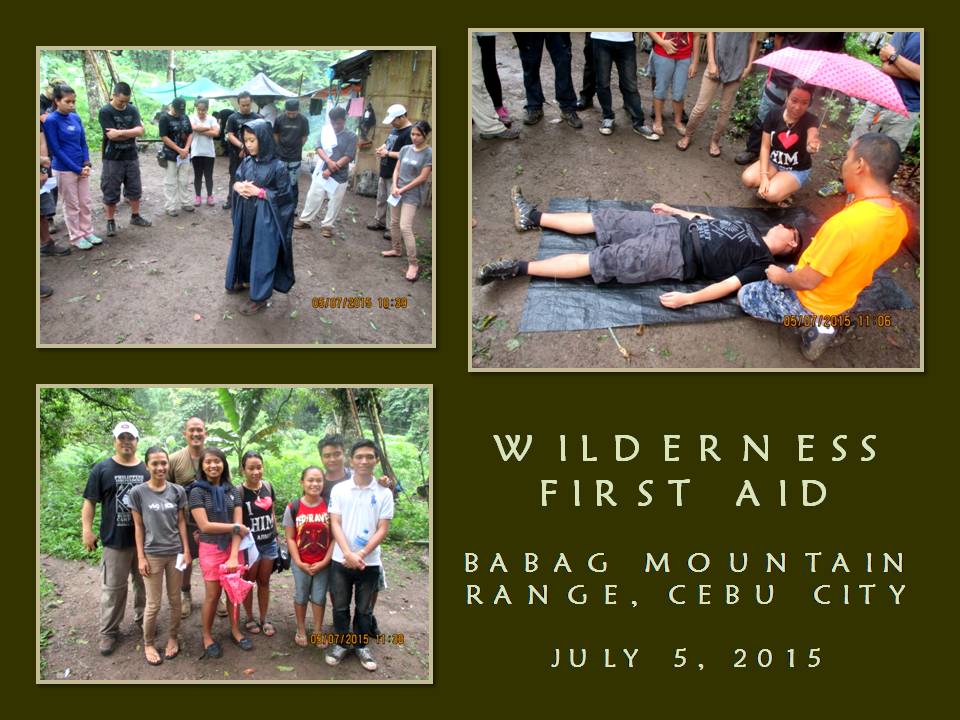
It had rained a few hours ago on this gloomy morning of July 5, 2015. Shio Cortes and Val Cruz III of the Cebu Provincial Disaster Risk and Reduction Management Office will lend their time to teach Wilderness First Aid for my wards at Camp Red Bushcraft and Survival Guild. This is a rare opportunity to learn from people who know their business well and it would be unfair if I confine this activity to ourselves and so I invited people from the Visayan Trekkers Forum where Barry Paracuelles, Neil Mabini, Randy Alforque and Chad Bacolod thankfully accepted.

We start from Napo after a short motorcycle ride from Guadalupe. The ground is wet and parts of it are muddy. We will be on a short walk only to a place where I see a good potential to host future outdoor activities. The name of the place rhymes as Camp Xi. It is a small open plain found beside the Sapangdaku Creek but it is three meters above the stream. It is totally safe and high enough from a flood. A lone family make their living there farming adjacent hills and selling firewood. It has a water source.


We arrive there at 09:30 and immediately my wards set up a fireplace. Coffee breaks the humdrum of the uncomforts caused by partly-soaked socks. Holes on overused rubber soles seep inside like mine. My 5.11 Tactical shoes are starting to disintegrate and I am afraid I may have to acquire a new pair. It had served its purpose well. It had taken me from Mantalongon, Barili to Mantalongon, Dalaguete to Poblacion, Boljoon over the rugged spines of southern Cebu last February and May and a host of long training hikes in between.

In the center of a flat piece of ground, a black laminated plaited-nylon sheet is placed. Any time soon, the outdoor lectures will start. It did start at 10:40 after a short prayer by 10-year old Michaela Lim. I see two other minors and six college students who did volunteer work with Camp Red on a pre-school opening outreach. This is just amazing! All stood in a big circle, braving the rain that have started to fall.

On top of the plaited-nylon sheet is a black tactical-looking bag lent to us by Cpt. Jose Gochangco JAGS (Res) of the 5TAS Brigade of the AFP Central Command for this occasion. The bag contains all the wonders of emergency medical response. It is an emergency medical bug-out bag and everybody is toying with the idea of owning one even if it is a smaller version.

Shio starts the introduction about Wilderness First Aid. It touches on the whole context of WFA and then the overview of emergency response which are focused on Locate, Access, Stabilize and Transport or LAST. Then he distinguishes the difference between Search and Rescue as against Search and Recovery.


Val demonstrates how the Primary Assessment is performed starting from the sizing up and assessment of the scene of incident and the manner by which the victim is found. First thing to do when examining patient, if unconscious, is to feel the airway if patient is breathing and then check pulse. Where no breathing and pulse are felt, proceed to CPR or the cardio-pulmonary resuscitation. Again check airway. There may be obstruction of foreign objects else, if patient is healthy but only choking, proceed to effect the Heimlich maneuver.

If patient is injured, proceed to the management of bleeding by (a) direct pressure, (b) through elevation and (c) by placing pressure points. The fourth – by tourniquet – should be applied as a LAST OPTION only! The rule of thumb would be that the affected part where tourniquet is placed should be released from pressure every fifteen (15) minutes and that tourniquet should be applied to not more than two (2) hours. Failing that, it causes suffocation and permanent damage of arteries of the appendage.

For this part, the participants are urged to join in and use triangular handkerchiefs, bandannas or any other type of thin clothing as cravat bandage to wrap imaginary wounds or to stabilize fancied dislocated joints among themselves. Then these same cravats are used to perform a tourniquet on each other. A more sophisticated tourniquet appeared that could be performed by even on himself. It is called the Combat Application Tourniquet.


Other injuries which cause patient difficulty in their mobility are the muscuskeletal injuries which are simple fractures and complex ones which can be remedied by providing splints to the affected part to prevent unnecessary movements. Immobilizing the affected part is very important also when patient is a victim of a venomous bite. The purpose really is to delay the suspected venom or poison to travel quickly to the brain through the veins and arteries. Treat each bite as venomous or, at the least, as carrying rabies.

While the lecture went on, Ernie Salomon took care of the cooking for our meantime meal. Jhurds Neo, Jonathan Apurado and Francelyn Quijano assisted him. Food served were grilled pork, mung bean soup, pork adobao and it is laid on banana leaves, along with rice, another grand mimic of the Philippine military's popular “boodle fight” fete. Lunch was dished out at 13:00, a trying hour of empty stomachs yet warm enough to stave off the cold.

Shio then takes over where Val had left and proceeds with the presentation of the Secondary Assessment on a patient. The rain had not abated and we see Christopher Ngosiok assume the role of the “patient”, lying on his back on the black laminated-nylon sheet in the center of the circle. An umbrella protects his face while the rest of his body is exposed to the uncomforts brought by rain. This is real-world training in a place and condition not to anybody's liking.


It is very important to focus patient assessment from head to toe. Examination should be very detailed and complete. Vital signs that need to be addressed are the respiratory organs, foreign objects inside muscle tissues and the coherence of mental awareness of patient. If patient is unconscious, information about his condition before the incident should be retrieved from the persons close to him or those with him, otherwise the patient would provide you his allergies, his medications, medical history, last food eaten or liquid intake and the events leading to the incident.

The black laminated-nylon sheet are then turned over to the participants to try the patient assessment among themselves. By now, rains have stopped and “patients” are now more willing. Fritz Bustamante and Fritz Jay Hortelano applied what they just learned on Randy Alforque as the “patient” coached by Shio and Val while, on the distaff side, Faith Gomez is scrutinized by both Locel Navarro and Abegail Villariza.

Last topic is patient transport and packaging. First to be discussed are the easiest and which are the most commonly practiced like the single and the two-man carries. Then the most complex carrying-and-packaging methods are demonstrated where you need ropes or cords, sturdy sheets and some common everyday items. Evident of these methods are the Daisy Chain Package and the Georgia Litter Rig.

One improvised litter setup is using the ball cap and the small backpack to prevent unnecessary head movement where the visor of the cap acts as an improvised neck brace and the backpack's waist strap are used to hold the forehead from swaying side to side aside that it acts as a cushion to the back of the head. Officially, the training ends at 15:30 as the skies begin to show signs of rain again.


For this life-saving activity, Camp Red is indebted to Shio Cortes and we presented to him our token of appreciation in the form of a classic Swiss Army Knife Camper, courtesy of the club president, Jhurds Neo. Likewise Val Cruz III will have his token given during the scheduled 1st Cebu Search and Rescue Summit this July 29 to 31. We were fortunate that they have pushed on with this event even under the threat of rain and heavy rain.

Camp Red and the rest of the participants have gained additional knowledge in wilderness emergency response where improvisation and adaptation would spell the difference on the survivability of a patient, granting that professional aid and hospitals would be several hours away. Since we are masters of expediency, Wilderness First Aid blended well with our summary of skills and we could not have appreciated it better except than being under the tantrums of rain.


Document done in LibreOffice 4.3 Writer