Thursday, November 22, 2018
MAN-SIZED HIKE XXVIII: Lutopan to Guadalupe
THERE ARE SOME
PEOPLE WHO just does not give up. Failure is not an option for them but an
opportunity to better them next time. I led a Selection Hike last time in
October from Lutopan, Toledo City to South Poblacion, San Fernando which was
41.64 kilometers. There were twenty-one people at the start yet only fifteen
made it less than twelve hours. The rest would have to do a repeat which I am
organizing today, December 30, 2017.
The route, this
time, is the traditional route of the Camp Red Bushcaft and Survival Guild,
which is from Lutopan to Guadalupe, Cebu City. It is 36 kilometers yet it has
to climb up the Babag Mountain Range and be finished in under 12 hours. Many
have cut their teeth here and I just hope that those who were denied the last
time would finally be able to break the curse. The Selection Hike is one of the
requirements for membership into the guild.
We meet at the
Cebu South Bus Terminal at 05:00 and I forgot about the holiday weekend rush.
There were many people going home to the towns to celebrate New Year and the
line is very long. We were able to ride a Toledo-bound bus at 06:45 after
almost an hour of standing along the queue. Once the bus made its way, it
stopped to pick up more passengers. It arrived at Lutopan at 09:00 and so we
begin this stark holiday-season walk.
The pace I pushed
was moderate, intending to preserve strength at its most crucial moments, which
is the last half. We would arrive in darkness, I am sure of that, because of
our late start, which was beyond our control. The 6-man Liloan Triathlon Team,
totally driven high by the result of their participation of the October
selection hike, came again to better their time in a terrain almost the same as
from last time.
Bonabella Canga
and Glyn Formentera, who both were overcame with fatigue and the 12-hour time
limit during the last test, made themselves available now, along with
first-timers Aaron Binoya and Kim Binghay. Going along as overwatches are
Jhurds Neo, Aljew Frasco, Christopher Ngosiok, Justin Apurado, Locel Navarro
and Mark Moniva. We all sacrificed comfort for this, which most are doing now
for the approach of New Year’s Eve.
From Lutopan, we followed
the paved concrete road over Cantabaco and Camp 8, Toledo City; Camp 7,
Minglanilla; and stopped at the road corner found in Manipis, Talisay City for
rest and rehydration. From this road corner, we took another road, partly paved
and partly bare, most of this downhill, passing by Cebu City’s remote mountain
villages of Sinsin and Buot. When everybody arrives at Buot, we stop to rest
and to rehydrate.
There would be a
one-hour noonbreak but there would be no lunch of cooked meal. What we would
eat could either be bread, sandwiches or pre-cooked food. The Selection Hike is
designed not as a race, despite its time limitation, but as a physical test for
people from Camp Red and those who would like to associate with us, as a sort of an
evacuation drill, under a scenario of foreign invasion, war or increasing
distance from a threat of biological and chemical gases or radioactive
fallout.
Across us is the
hanging bridge which spans our side to the other bank 30 meters away over the
Bonbon River branch of the mighty Mananga River. We cross this swaying span and
the misery of the hikers begin. The trail goes up to Mount Samboryo, a hill
held in awe by locals. It should be because it is steep and there are swamp buffaloes on the loose with their young. You give it a wide berth when it stares
at you with the evil eye.
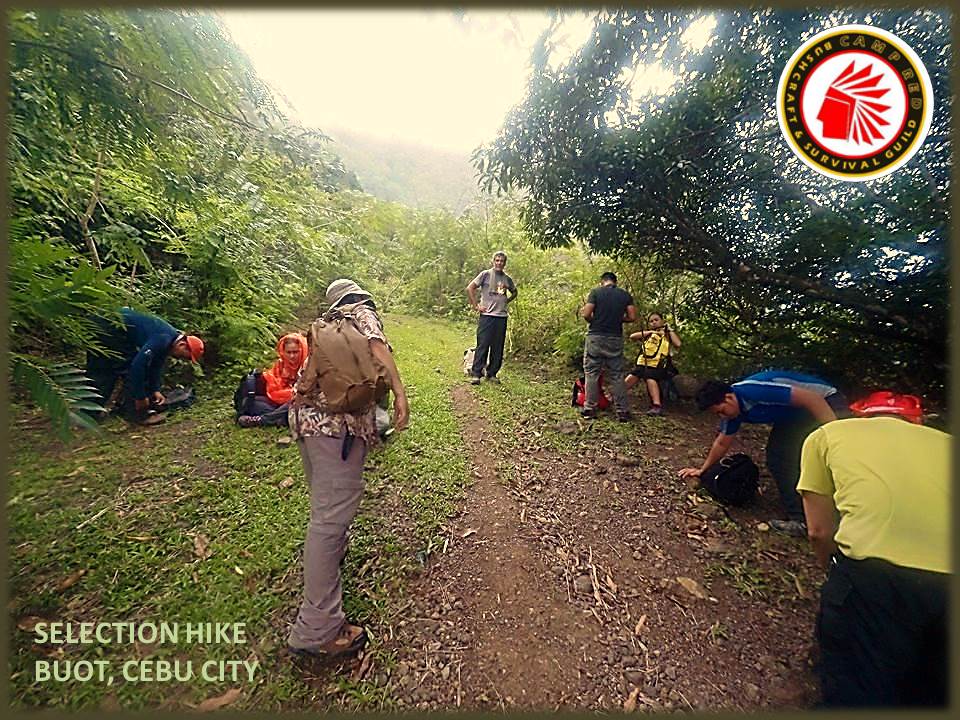
We stop for a
moment halfway to gather water from a water source. We proceed on and pass by a
farm then climbing up a ridge and rest again. Two trails faced us: the older
one which led to Cabatbatan and another newer path that goes up over the divide
of Samboryo, passing by a razor-edged ridge and grassy meadows among muffin
(sic) peaks. I lead the party slowly up the mountain, containing adrenaline
level to a minimum.
The ground is
stable than was the last time I passed by here a month ago. Dirt motorcycles
causes so much damage to the trails here to the consternation of locals who
used these trails to carry their produce to the markets and back with their
week’s subsistence and also where their children use in going to school. Some
homesteads decide to fence off the trails going to their farms for good
measure. Seems the best way to discourage mindless cockroaches astride these
machines.
The trail goes on
a rolling terrain of short grass and farms on one side and forest line on the
other side. Across us is the Sudlon Mountain Range and the wide Bonbon River
Valley. Our quest took us to a beaten trail that goes down gently until one
section of our party encountered a farm animal tethered across a trail. I
passed by this cow and it moved timidly to the side when I made noise.
I find cows and
swamp buffaloes blocking a trail normal although it should not be there.
Farmers are just totally irresponsible and they never give a thought that people
use these trails but what could we do when they grew up with this wrong habit.
The cow became spooked when Jhurds brandished a stick to move it away and fell
on all fours. The owners noticed it and they became agitated. I go back to
control the situation.
All is well when
the cow stood up. But it is best not to add fuel to a spark and thaw it with
apologies instead even though it is their fault in the first place. There was a
rush of adrenaline on this episode and we took advantage of it with increased
speed over many road rises which seemed to never end. We reach Pamutan Junction
at 16:30 and stop to rehydrate. We were all stressed out and that is not good.
Jhurds decides to pull out due to a household errand.
From hereon, it
would all be downhill through paved roads that pass by Baksan. It is a long
concrete road and not friendly to our now-tender soles. I would have loved to
take a trail that goes direct to Guadalupe but it is now dusk and most of those
who compose this party has no experience in night navigation. I would not dare
compromise safety for pain. Pain can be tolerable at times if you know how to
turn off nerve receptors.
Those who are most
fit and who seemed to have a high tolerance for pain vanished from view. I
would have loved to be at the forefront but I have other matters to attend. I
need everyone to beat the 12-hour limit and I decide to be at the tail, to be
where the last people are. I became a one-man cheering squad trying to raise
the morale of the last people in my field of vision.
I am with the last
group and we arrive at the parking lot of the Our Lady of Guadalupe Parish at
20:44 or 11 hours and 44 minutes. The Liloan Triathlon Team, six people,
arrived first at 20:21 or 11 hours and 21 minutes. Bona and Glyn, finally made it, especially
for Glyn who failed on two occasions. It cannot be denied that both arrived at
20:31 or 11 hours and 31 minutes. Bona has her iPhone application to show me,
to include the number of steps and calories burned. All that, for a happy 36
kilometers of torture.
Happy New Year!
Document done in LibreOffice 5.3
Writer
Photos by Christopher Ngosiok
Posted by
PinoyApache
at
09:00
0
comments
Labels: Camp Red, Cebu City, Minglanilla, Mount Samboryo, selection hike, Talisay City, Toledo City
Wednesday, November 14, 2018
WARRIOR REVIEW: AJF Gahum Knife
I HAVE BEEN A
LONELY VOICE in the outdoors, propagating a strange interest here in Cebu, the
Philippines, called BUSHCRAFT. In the middle of 2009, only two people, apart
from me, could comprehend its idea and how it is done or enjoyed of as a
leisure activity. I was then in the process of distancing myself from
mainstream outdoors. I love camping with a real fire and using a knife. Uh.
Sorry. Knives.
Backpacking,
sometimes mistaken here as mountaineering, is very popular. Urbanites regularly
trekked to the mountains carrying heavy loads to spend overnight or a few days
on those barren and exposed places. They looked cool carrying branded bags with
matching shoes and brightly-colored clothes. If you look closer on their
activities, you would notice the absence of a respectable knife.
I could not
comprehend why people replaced a real knife with ceramic or plastic ones, and
sometimes by nail files? Is it because of weight? Regulations? Fear? Whatever
it was, the lack of that was influenced by no other than by ignorance. Then it
became an advocacy for me to re-introduce the knife back to camping life, the
knife-carry rights, and to educate more people about knife law, ethics, care
and safety.
When I organized
the first Philippine Independence Bushcraft Camp in 2011, the topic about the
knife was given paramount importance. It was here that the participants began
to understand the knife and it was also here that the knife culture began to
slowly reclaim its spot in Philippine outdoors, thanks to my new converts (to
include the next PIBC batches), which became the tiny sparks that started the
organization of the Camp Red Bushcraft and Survival Guild.
Recreational
bushcraft activities every weekend fascinated the outdoors community in social
media. My activities always placed the knives at stellar attraction with the
introduction of the first (and succeeding) “blade porn”, a traditional
bushcraft showcase. An online prepping community began to appear and their
members start to feature knives regularly. So were an online survivalist
community and another online group that specialized more on blades.
One of those who
participated in PIBC 2013 is a collector of expensive knives. He had been
searching in the internet for any bushcraft activity in the Philippines so he
could use his blades and it surprised him that his search brought him back to
Cebu, of all places, his home province. He is Aljew Frasco, a gentleman from
Liloan and a baker by profession. After the PIBC, he toyed on the idea of
making knives from his DIY shop.
He just wanted to
develop that skill as a hobby. That is all. Profiting from that was out of his
thoughts. He had been searching long and wide for a perfect knife – a knife
that could do all things. He found out later that he had been looking for the
wrong places and it was with him all the time and they were a combination of
threes or twos. What he lacked was time in the outdoors. The best place to test
a knife. The PIBC gave him a different perspective this time.
One day after PIBC
2013, I got a call from him. He wanted me to test a knife. He made it himself.
His first. A set of three letters were etched near the spine – AJF. His
initials. With a sheepish smile, he named the knife as the AJF Gahum. Gahum is
the literal Cebuano for “power”. Well, I thought to myself, I really need all
the power in my arm to wield this steel blade. It was heavy but it suits me
anyway and my outdoors lifestyle. I am used to hard work.
A few months
later, he asked me of my opinion of the AJF Gahum. I gave him my honest
observations; and the knife back to him. A few weeks passed and I got a call
from him again. This time, the AJF Gahum sported a new set of wooden scales
made of Philippine rosewood (Local name: narra) and Leichardt pine (hambabalod).
Heavy mechanical work on the blade surface and the tapered distal made it
lighter. It now has a convex grind and, likewise, thinner by a few micrometers.
It is now sleek, vicious and hungry. There is only one thing to do: TEST IT
OUTDOORS!
The AJF Gahum is a
straight-backed knife. A very simple one. Of a very basic design, it is 235
millimeters long from tip to hilt. The full tang that held the scales is 130 mm
from ricasso to end. It is 47 mm from
its widest measure and 6 mm at its thickest. It weighed 610 grams. With its new
scales, it looked very handsome and caused a stir of interest, desires and more
stares. It had lived up to its name. But appearances are different from
performances. It had to be worn out and break something or be broken.
And so it became a
regular customer on my side during dirt times and it made my work on the fields
much easy, easing out my beloved tomahawk. The longer edge made cutting seamless
and it never missed wood or bamboo. The extra, yet very manageable, weight made
chopping effortless. I only have to raise it up and let gravity do its work.
The weight assures me that it is there inside its sheath all the time and it
erased my fear of it getting lost.
Weekends are my
favorite days with the AJF Gahum. I test it on hardy bamboos, whose denseness
in grain and skin could undo the superiority of branded knives into so-so ones.
The Gahum, could cut it all seamlessly whether it be on the woody part or on
wiry types whose thin tubes crack to splinters with a wrong swing. It does not
matter if it is green or matured. This big knife is native born and is made to
cut bamboo and wood, cane grass and shrubs.
The spine is
friendly to batoning sticks which guide the strong-willed Gahum to a finer
cutting tool. The same spine flaked off quartzites and iron pyrites from its
mother stones, creating sparks from the clash of 5160 carbon steel and raw, but
harder, material. As it is subjected to heavy usage, one of the rosewood scales
went missing. The other half splintered into two pieces during a knife-throwing
session. But the Leichardt wood scales remained.
For want of a
hammer, a heavy stick, or a stone, the AJF Gahum drove sharpened sticks into
the ground when I set up fly sheets for shelters. Some grounds are soft and
some need power to penetrate. It happens all the time when I carried a hammock
and where anchoring needed wooden pegs. I usually hit the top of the pegs right
on the face of the blade. The same spot over and over again and the blade had
not warped nor bent a slight angle. It is straight as ever.
I carried openly
the Gahum at my belt during the exploration phase of the Cebu Highlands Trail,
starting January 2015. The project is divided into eight segments, north to
south, and this knife had been brought and toured on the six segments. I
expected heavy knife work but I was glad it did not come to that. The
opportunity to show off the AJF Gahum in open carry was just to familiarize
locals, instead, about knife-carry rights for outdoorsmen.
The AJF Gahum,
with its bulk and appearance, travelled with me, along with six to nine of my
other knives, to Luzon, Visayas and, later, Mindanao. I did part-time classes
in bushcraft and survival when I had a day job. When I pursued full time this
journeyman occupation in 2016, I already knew how to bring my entire sharp
tools through security, legally, for just as long as you follow regulations and
protocols. Just do not carry the wrong item. Nor give a joke about bombs.
I let my students
handle the Gahum during knife dexterity sessions. After each activity, I always
examine the edge if it had dents and cracks. You would never know how people do
to other people’s knives. Especially the “uneducated” ones who see knife as
nothing but pry bars or digging tools. As a knife-carry rights advocate and
teacher, your satisfaction goes ten-fold when you see no such marks. It is not
a question of how perfect the temper of your knife is but of how your students
fully absorbed the lectures well.
If you are skilled
with a knife, you can use an AJF Gahum with a deficiency to its handle. I did
that for more than a year. The missing rosewood scales allowed me to move back
an inch to grip on the remaining scales. I used the baton stick instead to do
the work for me. I cannot tolerate an absent AJF Gahum in my activity so the
missing scales could be replaced. Despite the insistence of the maker to do
that task for free.
However, I did acquiesce
to the wishes of the maker at last. He asked me what material would I want to
replace the scales. I provided him industrial micarta, a hardy material which
were shaped to hold superheated shaft bearings of mining machinery that I found
in an abandoned mine in Misamis Oriental in 2012. The mere fact that it is for
industrial use and bear the Hitachi logo, makes it indestructible and would
stay for keeps.
Just in time
before the start of the PIBC 2017, I held the AJF Gahum once again. This time,
it sported a different look and character: dark, brooding, unpredictable and
incorruptible. From a blade with flamboyant two-toned scales, it now sports
gloomy black scales. More like the Dark Knight. I like it that way. Very
proletarian. Knives are just tools and should be used according to what it was
intended for when early man invented it.
The AJF Gahum,
however, is not a perfect knife. It has to be paired with a smaller one so I
could accomplish my tasks outdoors. The built, temper and design are perfect in
tropical settings. The edge has dulled just a bit and I liked it that way for
my classes. I could not remember the time I sharpened it myself. It never came
to that. I am a satisfied recipient of an excellent knife and it is a privilege
to own the first of just a few blades made by AJF.
Document done in LibreOffice 5.3
Writer
Posted by
PinoyApache
at
09:30
0
comments
Labels: AJF Gahum, knives, product review
Subscribe to:
Posts (Atom)