Showing posts with label Babag Ridge Trail. Show all posts

Saturday, May 21, 2016

NAPO TO BABAG TALES CI: Ever Fearless

I HAVE TAKEN TO a liking of the route that passes over Tagaytay Ridge which links up with the main ridge of the Babag Mountain Range. Going to the Caburnay homestead, which sits before Babag Ridge takes about three to four hours, so you can prepare a meal, is a perfect option. Water is nearby which actually is sourced afar. Besides it is shady there too.

I am going there again today, August 23, 2015, to loosen up some muscles so I could prepare myself for that very difficult Segment IV of the Cebu Highlands Trail Project, which is in October. Coming with me are my adherents from the Camp Red Bushcraft and Survival Guild namely Jonathan Apurado, Justin Abella, Faith Gomez, Richie Quijano and Nelson Tan.

I have last walked here in July 19. Jonathan and Richie were with me then. It had rained for many days but today it had not but I am quite sure the ground would be wet and vegetation would be thick. Once we cross the footbridge, we begin the ascent. Manggapares Trail is an old forgotten route which I began to revive when I rediscovered it in 2013.


I am wearing my worn-out 5.11 Tactical Series Shoes. It is almost disintegrating but I choose where I step and I have to be very careful. Upward we go into the back of the ridge yet it is very shady, almost gloomy. I have not met other hikers here except by a very few locals. I am following a fresh set of spoors made by a pair of rubber boots. Reading trail signs gives a different dimension on my purpose here and my mind work out the puzzles left by somebody.

I meet a mother and a daughter in their Sunday's best of clothes going downhill. Both carried baskets of mangoes above their head and both were sweating. Familiar faces and they were both smiling despite the toils they are having. I give them the privilege of the trail and on they would go to Guadalupe to hear mass. Me and my friends still have a long way to go.

We reach the first tower after an hour. We have started our walk at 07:30 and it is a good pace. For now. We will soon be exposed to sunlight but we will have a good view of the countryside scenery that goes beyond the coast and the harbour channel. The second tower stands very imposing at a higher height and I wish the clouds stayed as they had been when we started our climb.

We take a short rest after hurdling the second tower and our sights gaze on to the next three, which are not that difficult anymore. The relic of a backhoe is still there and I am quite surprised that people had not cannibalized the abandoned heavy equipment. So be it and I hope it shall remain as part of the landscape.

There is a trail up ahead that veer to the right and I go down to follow it then take another branch on its left. The second trail is very difficult to discover unless you are now very familiar to it as I am now or you know your lessons well in trail sign reading as I had done some eons ago. This is the Liboron Trail and I shudder at it everytime it becomes soft and muddy. But today it is not despite the heavy rain of yesterday.


I hear noises below us, some human activities. I hope it is not Timoteo Gabasan because I am waiting for him to make good his threats. I follow Liboron Trail as it weave itself in and out of the lower contours of Tagaytay Ridge until I come upon the hidden coconut plantation where there is level ground.

I saw a young man and I noticed that he showed fear and anxiety upon seeing us. I smiled and gave a morning greeting and walked directly to a tree full of ripe Chinese currants (Local name: bugnay) hanging down in its dark purple and red splendor. His tenseness is gone when he saw me and us as harmless and he smiled a little. He is with an old woman, who hid among tall grass. I wonder why they acted so strangely?

All of us plucked the ripe fruits of the Chinese currant tree and indulge at its tart sweetness. I wished Jhurds Neo was here. He would have brought all of the tree to town. We had a happy disposition when we enjoyed the fruit. It has dissipated our fatigue and little stress that we felt when we climbed up Manggapares Trail. When we were done with that we proceed to the Caburnay homestead.

There is warmth as we climb up a hill overgrown with waist-high grass. Once we top it, the path would swing down onto a couple of sentry groves of bamboo and then up another hill where the homestead is located. Along the way I foraged the driest tinder I could find so we could start our cooking fire. Julio Caburnay is around and he welcomed us into his humble place.

When we have settled our bags we begin the fire with the sparks of the ferro rod. Although we have matchsticks and lighters, it boosted our confidence to start a fire with the rod. It might be unnecessary but, when you are outdoors, you take that chance. Some sort of training. Everybody then pooled their hands in the preparation of our food.


Julio offered us his organically-grown little bananas, which everybody relished very much, and his red dragonfruit. We reserve the dragonfruit to Nelson. His wife is expecting their first baby and it would be good for the wife – and the child – to get some nutrients from this exotic fruit which had adapted well in our environment. Julio also parted a bunch of his recently-harvested corn.

Jonathan takes charge of the cooking. What's cooking then? We got rice, yes. Then that sweet smell of pork adobao wafted by your nostrils, while the rest help themselves in cooking the corn on naked embers. We got a treat, wow! Then you add a pre-cooked “pancit guisado” (Local noodles) that Faith and Justin brought and our lunch takes on a different dimension.

I keep a share for Julio and his wife plus sachets of coffee, sugar, salt, vinegar, soy sauce and a can of unopened tuna flakes which I intentionally brought for their consumption. After staying for more than two hours we are now ready to take on the rest of our journey. Before we leave, Julio gave me six stems of his prized dragonfruits so I could propagate it. I could give it to anyone interested.

It is cloudy and that is fine with us as we negotiate the last part of Tagaytay Ridge before it joins the main ridge of the Babag Mountain Range. The path is now thick with overgrown shrubs and cane grass and I unsheathed my AJF Gahum for this clearing work. A tree had fallen between today and the last time I passed by here and it blocked the path. I have to do a little detour and slash more shrubs and those hardy crawling bamboos (Local name: bokawe).

I follow the Babag Ridge Trail – a very fine old trail – which I lost long ago and rediscovered it in January 2013. I always love this stretch. It gave me serenity by just walking on it. This is a good place to reflect on things and too few locals come here. Unfortunately, off-road motorcycles and their riders pass by here every so often disturbing the calmness and the sanctity of the ridge leaving ugly furrows on the path.

More disturbing, is the presence of a habitation located before the old campsite. It had cleared vegetation along its premises for a small farm and it may expand soon when no one from the DENR is checking. I do not want this to become another “Forbidden Farm” which one homestead is claiming and blocking a route as theirs when you climb Mount Babag from Napo.

This is a historical place. Small battles were fought here between the local resistance and against succeeding colonizers from Spain, the United States and Japan. Then a bigger battle between Japanese defenders against the American liberation forces have made this mountain range famous. It is still home to an artery of war-time tunnels that had been exhaustively explored by crazy treasure seekers.


We are now going down a ravine because fences have blocked access to the rest of the ridge by one family who claimed a part of the path as theirs by mere possession of a tax declaration. This is government land classified as timberland and inalienable and the DENR is an inutile institution. These documents came from them and they cannot regulate the recipients who have been using their privileges the wrong way, blocking access to water sources and rights of way.

We climbed up from the ravine and continue on the rest of the trail. Before reaching the tower area, we slip down the East Ridge Pass to the Upper Kahugan Spring where there is a water source and where “Forbidden Farm” is located. Then we continue until we reach the abandoned homestead of Fele and Tonia Roble, where their children Manwel, Juliet and Josel used to live and play and study at Napo and at Guadalupe.

It is now silent except for a PVC pipe which pour water that is channeled from the Upper Kahugan Spring. Fele's brothers, Zene and Roger still clung to the place in constant fear of Timoteo Gabasan, who have been discovered to have prowled their place at nighttime by neighbors, still hoping to finish off the absent Fele. Anyway, I part a gift for Zene, courtesy of the guys from Camp Red, and two of the dragonfruit stems.

My pair of turkeys have successfully laid another generation of young ones but all died. I could do nothing more about it except wish that Zene and his wife focus more attention to caring for the chicks. I have given them the opportunity to gain from it but their half-hearted attitudes on the turkeys gets into my nerves to the brink of sheer disappointment. I am tired of giving the best advice and seeing the same results. I am tired of seeing this place!

The afternoon is getting late and it seems I have no more business here. I look at the unfinished house and it begets a frown and an anger from me at the sight of this failed project. I have involved many people and I was very optimistic about this when that tragedy on Fele struck. Because of overconsumption of alcoholic drinks which led one bad thing to another like the burning of their home. It destroyed the children's future and my hopes for them.

Yes, I have no business here. I just hope the dragonfruit stems would be taken cared of and bear fruit. That would be a good reason to inflame back a dying ember that I have felt of this place. If not, I leave the dust of my shoes and take my kindness elsewhere.


Document done in LibreOffice 4.3 Writer

Friday, April 1, 2016

NAPO TO BABAG TALES LCIX: Fearless

I AM IN NO MOOD to write this. I have arrived at an episode where I found writing an article on the same places on its 99th episode begin to look boring and provide me no inspiration. Why? That answer would be a no-brainer to a person who had no knack of sharing his joys and experiences to another. If he or she would be a blogger, they would have written one article for a particular place for one time only. Except for few tenacious ones, writing is fun, constant and a stress reliever.

I really do not know why? The “Napo to Babag Tales” had many sequels and its last was NBT 98: Rain or Heavy Rain. This time, the magic is gone. Would that, perhaps, be related to the tragedy that beset the Roble family? Probably, yes. Of course, it would have to be YES. The existence of the Roble homestead along the route to Mount Babag had inspired me to write these many episodes about the trail there coming from Napo or reverse.

I saw the transformation of the Roble family from its impoverished beginnings, hacking a living on the mountain fastness of the Babag Mountain Range, to the time when their very place hosted groups after groups of hikers finding a place to rest and to savor green coconut water on their way to the peak of Babag. Their place is a favorite among weekend hikers and these people have appreciated the family for the use of several bamboo benches, a hut and a platform built on a mango tree.


I have brought my adherents from the Camp Red Bushcraft and Survival Guild here long ago and we made the Roble place as an area where we make our “dirt time”. We honed our cooking skills here and feast on food fit for kings. We had made their place as a launch pad for the several editions of outreach events like the Who Put the “N” in Nature which is focused on the distribution of school supplies before the opening of classes in June and the Christmas United in December.

A few kind outdoorsmen provided them goats for breeding while I brought two live turkeys there. When their original house was brought down to its knees – typhoon after another, named Yolanda, Ruby and Seniang, the community of outdoorsmen pitched in to donate cash and material so a new house would emerge. Sacks of cement, nails and roof sheets made its way and a house was erected, although unfinished yet, a concrete testament to the spirit of goodwill and unity of hikers endeared to the good ways of the Roble family.

The Roble family is a good case study. If a family who had gained an income that was provided before by a destructive charcoal-making industry and if given an opportunity to earn an alternative source of income, would help create a better difference on the environment. That is how I see it and it helped to write about the Roble family and the Napo to Babag Tales over and over again. Like a novel. Then tragedy came.


Feleciano Roble was shot by a neighbor – Timoteo Gabasan – last July 3, 2015 at Kahugan with an unidentified vintage caliber .30 rifle. Although Fele survived the attempt on his life but he lost a kidney and their temporary shelter was razed by the same suspect a few days after. The clan to which the suspect belonged to refused to cooperate with the police and harbored the suspect instead. Threats were flaunted to the remnants of the Roble clan as well as to the hikers, especially to those who had helped Fele.

So that same threat is directed at me for I have helped Fele escape the finishing bullets which the suspect would have unleashed during the flight of Fele to safety and hospitalization. Same with Jhurds Neo and Ernie Salomon. I take no threats lightly. I had never changed my approach with how I dealt with those whom have issued threats directed at me. I walk into it. I will always take the initiative and bring that on their doorsteps.

Today, July 19, 2015, I will test how that threat will turn out. I will be the “white mouse” for that experiment which the suspect will impose. My plan is to take Tagaytay Ridge straight up right after crossing the bridge from Napo. I will follow Manggapares Trail and the Babag Ridge Trail before going down the East Ridge Pass into the abandoned Roble homestead. From there, I will proceed back to Napo.

Coming with me is Jonathan Apurado, Justin Apurado, Richie Quijano, Nyor Pino, Locel Navarro and Mark Lepon. I have a guest from Poland who does not want to be identified but he goes by the pseudonym of “Jologs”. Yes, he can understand Cebuano and can speak basic Cebuano words. We aim to cook food somewhere along Tagaytay Ridge and we provide ourselves ingredients for our meal.

Of course, we also have our blades carried openly like we used to do. It is standard fare for our tribe at Camp Red when hiking outdoors. It gives us a better purpose than not carrying one at all. It provides deterrence against those who have ill motives and it projects an image of a bunch of alert outdoorsmen. I have changed how people should enjoy the outdoors and, slowly, my tribe increased.


It is a beautiful morning as we slowly ascend the seldomly-hiked ridge. Clouds partially cover the sun and the path is quite shady. Meanwhile, a vagabond dog joined us. I do not know what is in the mind of the canine and what it perceive of us but I take it as a sign of good omen. Could be a blessing and protection from the patron saint of Napo – Saint Roch. Perhaps.

As I walk, I talk about plants. Jologs gets a good education of tropical plants. He gets to see and know useful and edible plants, as well as the ones you are going to evade. We meet a hunter with an air rifle. He has a live wild fowl with him that he caught with a snare. The Manggapares Trail is thickly vegetated and nobody lives there. The only structures found on this beautiful ridge are seven power pylons and an abandoned backhoe.

Cables are now strung to connect these from the power source in faraway Naga City, passing over Minglanilla and Talisay City and to here, then crossing over to Kalunasan and Budlaan, before ending at a distribution plant in Cabancalan, Mandaue City. We walked underneath five of these towers before switching to Liboron Trail. Nobody uses this scant path except the locals and me.

We reach the Caburnay homestead at 11:00 and Julio welcomed us. It is along a route to Babag Ridge but there is water spewing from a black PVC pipe which comes from a natural spring far away. The place is perfect since it has two bamboo benches and a center table. I have visited this place many times and the couple who lived here are quite accommodating, to the extent of sharing their organically-grown fruits to us like bananas, jackfruits, avocados and dragonfruits.

We immediately boil water for coffee since the uphill hike had cost us some reserves of energy. When coffee got served, the zest returned to us and we concentrate on the preparation of our meal. It is now almost noon and we thanked Providence for shading us most of the time from the sun going here else our pace would have been slower. Our regular chef is not around, so time for the rest to learn how to cook.

Jonathan picked up the chore and we will be cooking mixed-vegetable soup with some ingredients plucked wild along the way. As always, monosodium glutamate and those spurious food additives are not part of our cooking. We keep our food close to nature as much as possible. It is a skill that men should possess.


We left the Caburnay couple at 14:30 and continue on our journey. We reach the ridge of Babag after an uphill walk without trouble where shades abound to keep us from the intense heat of the sun. It is a long walk to the main peak but, along the way, I decide to visit a World War II ruin. This is the main entrance of the gamut of tunnels constructed by the Japanese in a losing but last-ditch effort against the liberation force of the Americal Division and some rag-tag Filipino guerrillas.

The wind played among the leaves trying to talk sense into me but I am an opaque card today, denuded of clairvoyance and hindsight. My thoughts are focused on our safety later on. I would find that out if Fele's tormentor keeps his word. I would not go to the peak of Mount Babag where the trailhead down to Napo is found. Instead, I would explore a beaten trail, if it is true, that it would lead down to the same trail to Upper Kahugan Spring.

It is steep and straight but very manageable. The ground is stable even if it is wet. It passes by a healthy grove of sand bamboo (Local name: bagakay) and goes down to cross a small dry gully and continues onto a field of wild taro (lutya) then to a very narrow pass. Along the way, I saw pepper vine (buyo) and a forest rat (balagtok), seemingly unafraid of human intrusion. It could well be that it found the spines of the thorn bamboo (kagingkingon) enough protection from us.

Anyway, I do like the trail and it indeed led to the Upper Kahugan Spring, which water I found very refreshing. Then I heard a shout from afar. It was unintelligible but it is directed against us. I shouted back contemptuously. I exchanged more shouts at that unidentified man and I decide we better leave towards the Roble homestead as shadows are getting long. There has been a problem with this farm owner. He frowns at hikers passing by his farm and block its access to Mt. Babag.


As we were midway to that place, a man showed up at the heels of Nyor quite angry that I have shouted back at him. It seems his right hand was hidden from view to project to us that he has a weapon but I am used to this kind of situation. Then he recognized me and became apologetic of his behaviour. He said he was shouting at someone not from our party but I took it as an affront instead on our right to roam on government land.

So many ignorant people here pretending that they own a piece of land even when they just possess a mere photocopy of a land tax declaration. They thought they own the place forever and block right of ways. The government should know these things, especially the Department of Environment and Natural Resources, because these documents came from them. I believe some corrupt government officials are making a killing here. So, for that matter, I advise people to refrain from passing by “Forbidden Farm”.

We reach the abode of Fele's older brother, Zene, and they are in a state of fear. I could feel their relief at seeing us. With our presence, they are safer, but it would not be long when their agitation at the thought of the suspect roaming free and stalking them in the middle of the night returns. I look at my adult pair of turkeys and it is alright. From its six young ones, only three survived. When the Roble home was burned, the perpetrator also slashed the necks of my two young turkeys and caused injury to a third.

Suddenly, I begin to feel a very familiar feeling that had been constantly present in my past. It is a rage that I have no assurance of control. I pick up a stick that is as thick as a wrist and about 20 inches long. Miyamoto Musashi had vanquished most of his adversaries armed with just a stick. They were the finest warriors of 16th century Japan who take pride of their weapons from swords to halberds to chain-and-blade with matching skills, superior than most, and whose reputations struck awe.

I could feel my blood boil causing my individual muscles to revolt. I need to release this bottled up rage and walking would only be a slight liberation from that but, at least, it is a relief. My eyes scan everything, ears up, while my mind begins to process all possibilities of cause and effect like a chess player would with his two knights. With a stick I had humbled some people even with superior weapons. Just give me the right distance.

The threat-maker chooses his time and place and he has the element of surprise. It is my disadvantage. As always. It had never changed, quite unfair, but just give me the right distance and my speed would do the rest. I once disarmed a spoiled brat with a rifle and a sidearm in a crowded bar in Urgello with just a stick; a hoodlum with a revolver in F. Villa; a serial killer in Davao City; and many others more but those are stories quite different from today.


The sight of the burned-down house had caused my temper to rise. I got agitated by noise caused by unnecessary talking at the back of me and I pleaded for silence and asked them to keep their eyes open. I am now in a different world and I see only black and white. You might call that paranoid but it is the way it is and I am still living because of it. I am only after my imagined adversary which I expect to appear anytime. Even so, I now have a strategy. If he appears and makes a wrong move, the stick will do my work.


I reach Napo at 17:00 and I still have the stick. The adversary did not materialize contrary to his threats. Might as well bring this stick home. It will be put to good use. I will need this in my bushcraft class in a few days in Capiz but it would have been better if this stick squash his thick skull. What a boring day.

Document done LibreOffice 4.3 Writer  
  

Saturday, August 22, 2015

NAPO TO BABAG TALES LXXXIX: An Exploration Team Tryout

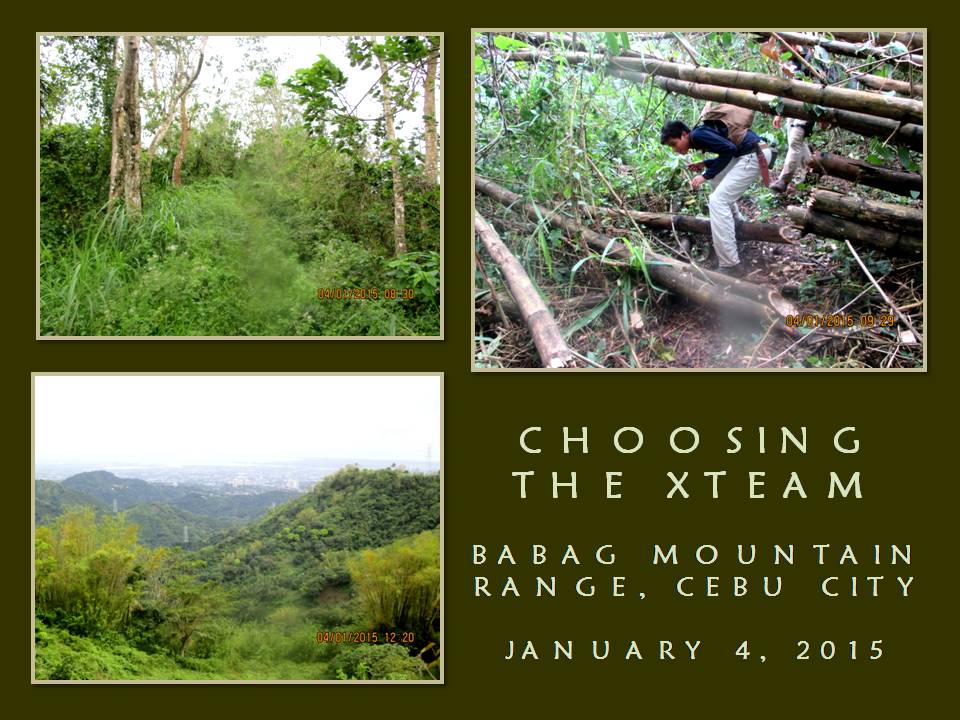
I JUST HAD A VISIT to the Babag Mountain Range yesterday, but, here I am again today, January 4, 2015, traipsing almost on the same route. I have no reservations about the idea of making this range as my playground. The mountain range IS my second home. I have no reason to go tramping elsewhere for Babag is big enough to satisfy my spirit of adventure and for training purposes.

Besides, I am on an urgent mission to select my team for Segment III of the Cebu Highlands Trail Project. Segment III will start on February 19 at Mantalongon, Barili and will end on February 22 at Mantalongon, Dalaguete. The route will pass by the mountain highlands between them. On the other hand, the Cebu Highlands Trail is the bigger scale. It will encompass eight parts – or segments – from north to south or reverse.

I offered only two slots for Segment III aside from mine being the project organizer and the team leader for that exploration. Five people of nine whom I invited came on this day at the parking lot of the Our Lady of Guadalupe Parish. The other four automatically forfeits their right to be selected. Good. The lesser people, the better will I manage and instruct them and the faster will our pace be.


We leave Guadalupe at 07:00 for Napo by motorcycles. Once we cross the foot bridge, we engage on the trail immediately. It is not the Napo Trail but the full route of Manggapares Trail. It starts where the Sapangdaku Creek and Tagaytay Ridge meet. It is an old route which had been forgotten by the present leisure hikers after an easier route to Mount Babag had been discovered. I talk when I walk and I do that when I need to.

This is a trail which I could have walked in the early ‘90s but, through my persistence to discover places here, re-discovered it in January 2013. The path led us abruptly to elevated portions which needs some very brief rests from time to time. We took our real rest when we reach a tamarind tree to rehydrate. From there, it is all walk until we reach our first steel tower and we rest again.

I used the steel power pylons as landmarks everytime I walk Manggapares Trail and I would know which tower has side trails and which one has not. The walk continues on until after the fifth tower, where a path cut down to a low ridge but, midway, I shift to a very scant path that I called Liboron Trail. It is a short cut but it is very difficult when it is wet. The ground is very soft since it had been raining almost uninterruptedly for the past months brought on by storms.

My new 5.11 Tactical Series Shoes gets its real baptism of mud. I fight off gravity by changing steps as long as the shoe held its grip but, on a few occasions, I am unsuccessful and I have to start another strategy. My shoes are wet as well as my new Kailas hiker socks inside. Pressing on, we reach a saddle and it is another rest that is very well deserved after that nightmare of a trail.

Facing us is a low hill and we climb it. I point the grassy place where I saw a grass owl. I begin breaking off dead twigs that are not touching ground. Everybody do likewise, looking for dry kindling as we walk down into another saddle where bamboo poles blocked the path. We crawl below it and walk on towards a small house on the hill. A dog’s bark greeted us and I look for the owner, Julian Caburnay.

Found him walking behind us and he is glad to have company. I ask permission to use a part of his place to prepare our food. It is still 09:30 and, by God, we are very fast. Immediately, I retrieve my AJF Folding Trivet and gave the task of boiling water for coffee to one of the guys. I have to slice the pork meat, onions and pepper and crush the garlic.

Wet conditions kept the guys from starting separate fires immediately but, after two or three tries, they got success. Two other AFJ Folding Trivets appear and three fires are now burning underneath a big pot reserved for the milled corn, a small pot for coffee and another pot for the cooking oil which the sliced ingredients would be dumped upon soon. We have to feed the fire from time to time with thin pieces of firewood.


While doing that, Julian gave us ripe bananas, papayas and a sliced jackfruit. The fruits are organically grown and the banana is uncannily sweet. Then it rained. Good thing one of the guys has a tarp sheet and we were able to rig it up to cover our fireplace. At this juncture, Julian lent us his big laminated-nylon sheet and the cover provided us and our things from rain.

The food would be a very spicy pork adobao. I place basil leaves for garnishment. A guy produced a banana leaf and frayed it over the fire before resting it above a table. Then the steaming milled corn are spread over the leaf, then the pork adobao with its spicy sauce. After a prayer, the hungry bunch picked and eat to their heart’s content at 12:10. I reserved a portion for Julian which I gave after the “boodle fight”.

We leave the place cleaned and resume our training at 12:45, hiking over the rest of the trail to Babag Ridge. I use my open-carried AJF Gahum heavy-duty knife to slash at the thick vegetation that had been blocking the path. Notable among the vegetation were the devil’s coach whip (Local name: kanding-kanding) and the rattan vine (Local: uway). Both are harmful to the skin and would snag on fabric.

We pass by two hunters with “alcohol rifles” sneaking on some birds. Walking further on the path, it is blocked by falling debris caused by Typhoon Ruby and then by Typhoon Seniang and we have to go around it. Up ahead the path is blocked again by wooden fences which was not there the last time I passed by here in November 2014. We just climb over it and go on the other side.

We reach the Babag Ridge trail and it is squishy. All sort of debris are on the path, big ones blocking it while big rattan vines snag and make walking a delirious undertaking. I liked the way how the trail looked for it makes life miserable for those weekend Enduro bike riders. I have seen them only once but I could hear their presence on some occasion when the weather is right. Today they won’t dare.

We follow the path and I show them the old war-time campsite. I notice some fresh earth nearby had been disturbed, dug and moved. Treasure hunters! I have heard of a recent story of how some Japanese nationals and their local counterparts were able to locate a hoard of gold bars from there. Speculations are always ripe but greed only begets more greed which some people would capitalize on.


The guys gazed at the twin peaks across us, divided by the Bonbon River Valley. They asked me the name of the place. It is Barangay Pung-ol Sibugay, said I. I point at the peaks and that is how the village got its name. Mount Pung-ol is on the left and Mount Sibugay on the right. It is my self-appointed mission to inform people of the correct names of places and the origins behind its meanings.

The top of Mt. Pung-ol looked like it had been chopped and that is where it got its name. Mt. Sibugay got its name because it moves towards the sea away from Mt. Pung-ol. The frequent cracks on the Transcentral Highway fronting Ayala Heights is a testament to the peak’s migration. Most of the time, the latter is referred to by people as either “Mount Kan-irag” or “Sirao Peak”. Now they know better.

I show them how my trailsign looks. More knowledge about my ways equip the guys better how to navigate in woodlands and mountains. We follow a long path with a fence to the right of us which goes down and then up to a road. This road used to be a trail and this trail once trod on high ground – at the ridges – but it was fenced off by people who believed they have the right to own a piece of a mountain which actually is timberland and, therefore, owned by the government.

We rest and rehydrate on a bench before pursuing the route to Mount Babag. Along the way I see children making the most of a narrow strip of concrete and a few scraps of plastic. They were so happy sliding down that concrete on plastic. What gave me joy is that they were not “wired” to the electrical outlet, the Internet and Facebook. Simple joys from unstructured outdoor games are vital in the child’s development and of their creativity.

I look down at the path from where I stood. It is muddy and it looks like it is going to be slippery. At least, for this occasion, it does not look like a water slide yet. Slowly, I test my 5.11s on the middle of the but it is just too slippery. I changed to the sides and I got good progress but slipped when I turned to look back to see how the rest are doing. Blag!

Smiling to myself for my own boo-boo, I continue down on this long slippery but narrow descending trail. Not trusting to the change in texture of the ground, I walked on the green side, making use of the vegetation for balance. Some parts of the trail needs maintenance and widening since these are crumbling or are very threatening. I would rather take this route uphill than going downhill in rain.


Finally, after almost an hour of working our brains to solve the slippery ribbon of ground, we reach friendly territory - the Roble homestead. It is 14:45 and we are just too fast. We sat exhausted but undefeated. The candidates had been patient with the weather and the terrain and are now rewarded with water from young coconuts, a natural electrolyte. We leave after 30 minutes and continue on the last phase.

We cross Sapangdaku Creek and doubled our pace, sometimes trotting when the path is easy enough. We pass by the trailhead where we started in the morning and I am just amazed at our pace. We reach Napo at 16:00 with enough light for another round. That would be crazy but feasible. Anyway we ride on individual motorcycles-for-hire for Guadalupe. We found solace at the Bikeyard Cafe and rehydrate cold beer to our heart’s delight. All passed the selection. Round Two coming.


Document done in LibreOffice 3.3 Writer

Wednesday, July 15, 2015

NAPO TO BABAG TALES LXXXVI: Real-World Education

IN THE COURSE OF MY outdoor activities, it cannot be denied that people would ask and wish they could join me. I am very gracious when it comes to that but I cannot accommodate all since I find most of my weekend time focused on the development of the Camp Red Bushcraft and Survival Guild. Another reason is that I am a bit choosy now of the kind of people I welcome.

I would be very happy to bring people to the seldom-known places that I frequent but, at the same time, I have second thoughts. The main cause for that is these people I bring are bound to abuse this privilege. I would always assume that everyone understood fully about the Leave No Trace principles, especially those that professed to be “mountaineers”, but, on the contrary, they use their “new discovery” as an opportunity to promote themselves and gain a profit from the very people they invite. The more people coming, the better the profit, is it not?


Wrong! The more people coming, the more you get to disturb these pristine places and the higher the chances of accidents. People would only follow LNT when somebody is watching and when there is a profit to gain they do not care. That is why I found LNT amusing and cumbersome since the very people who are supposed to promote it, even to the extent of quarrelling and threatening other people over it, are the ones who are likely bound to discard it.

LNT is taken advantaged of by the outdoors-gear industry and the people that thrive in it like travel agencies and income-driven individuals that they used the logo as part of their corporate symbol and a tool to gain profits. I do not follow LNT because I found it shameful to be associated with these people but I respect its intent and I believe it will give the uninitiated the proper knowledge and guidance when in the outdoors and on their everyday life.

Let me remind all that you cannot, and never could, impose LNT on everyone and that includes me. If you think it is a rule, suit yourself, for you are only exposing your ignorance and naivete. Do not worry. For the many times that I have been invited in a mainstream activity, I would always show courtesy to the crowd and blend in with the activity as if I know my LNT well. That is flexibility for you. I hope you have it also.

On the other hand, I would always inform people that had been fortunate enough to tag along with me about my methods else they might find it revolting. I do not want to give an impression that what I do is conventional and ordinary like everyone is doing. When you are with me, you will act like real outdoorsmen. You will appreciate silence and nature to the very core. You will learn a lot aside from doing all your “jump shots”.

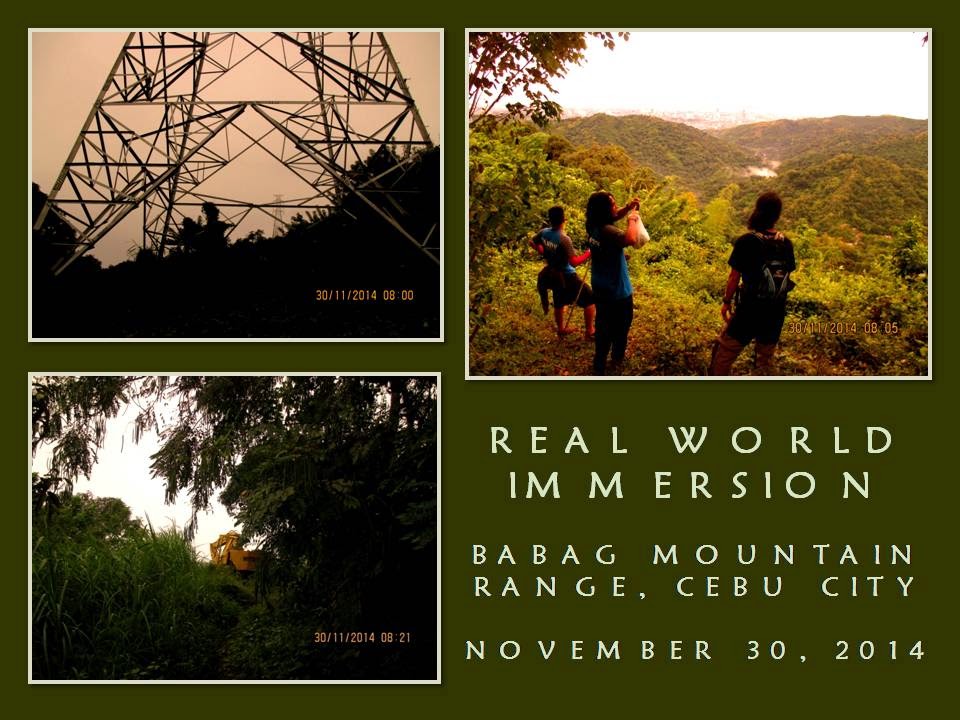
That is what is happening today, November 30, 2014, when I answered a request by four guys who worked in a business process outsourcing company to join me. They name their informal group as Takoy Outdoor Club and one member looks familiar. He looks like my eldest son. Anyway, I demand that we should leave by 06:30, which we did. I place great emphasis on punctuality from hereon and I do not want somebody derailing my itinerary again.


We hit the trail once I gave them an on-site briefing at Napo. Our route is the “Rosary Loop” which consists of the Napo Main Trail, Manggapares Trail, Liboron Trail, Babag Ridge Trail and the East Ridge Pass. It had been raining for the past two days and two nights and the ground is wet and muddy. Today, it had not, although, I expect heavy rains caused by an approaching weather disturbance.

Running parallel to our activity is a patented dirt time by members of Camp Red. They will be passing the same Manggapares Trail later. However, they would start at 10:00. I found the trail undisturbed yet by footprints made by yuppies. The sky is gloomy with a high chance of precipitation. I inform everyone the proper name of the river below the trail. It is important that correct names of places be known to everyone so you would not look stupid by giving it another name in Facebook which a lot of people unintentionally do.

We reach the trailhead to Tagaytay Ridge at 07:10. I told everyone that we are too fast. We may suffer for that when the terrain becomes steep since we did not stretch our muscles prior to walking. It could be muscle cramps, overfatigue or loss of body heat. It is important that they know this. Now they understand why you have to control your pace. The path to Manggapares is thick with weeds and I regret I did not open carry my AJF Gahum heavy-duty knife yet.

It is 07:30 when we we arrive at the first steel pylon. I take the time of rest by retrieving the AJF Gahum from my Silangan Predator Z tri-zip sack. I talk about the history of this trail and how I re-discovered it. I could see the adrenaline of the four beginning to show for the reason that they had been yearning to explore for themselves of this place which they only heard as the “Six Towers Trail”. They are now on the threshold of it and they will not regret their luck today for they will see and learn more.

Going to the second tower, I show them an edible snail. This is a snail that lives on trees and it is abundant here. We push on down to a saddle, cleared some vegetation with the knife, and up again until we arrive at 07:50. The guys are exhausted but desiring for more. We did not tarry and proceed to the third one, which we reach at 08:00. Along the way, I showed them fruit trees which are free for picking like I did with a pomelo (Sp. Hystrix grandis). The view from up here is just too stunning for the four. They are now smiling.

They begin to appreciate the beautiful trail that lead to the fourth tower. We reach it at 08:15 and I inform them that we are now walking on a dirt road. They are confused since they only see a trail but, up ahead, they saw an abandoned payloader. They are now beginning to make sense in everything I talked about. The fifth pylon is easy to reach and we got underneath it at 08:25. They are now staring at the sixth.


I shift to another trail and the sixth power pylon faded from view. I am onto a path that is very difficult as it is very challenging which make passage of the sixth tower unnecessary. This is the Liboron Trail and it had returned to a condition when I first walked here. Rains caused the softening of the ground and my footing slip time and time again despite my effort not to ruin the path. It was for this reason that I insist that everybody should wear shoes.

I point to the place where I fell six meters and everyone are now very careful. After that very tiring walk, we rest at a saddle and enjoying the chance to drink water. I teach them water discipline since they swallow a lot of water. When we think it is alright to proceed, we shoulder our bags and walk up a hill. I tell them the story of my encounter with a grass owl as we pass by a field of cogon grass.

We go down into another saddle where bamboo poles fell during the recent typhoon called “Queenie” and blocked the path. I crawled underneath and the rest followed. A barbed-wire fence is another obstacle that we have to go over. Fortunately, a path had been cleared between it and another grove of spiny bamboo. I pass by between it but I advised the rest to watch out for the spines which might catch their eyes.

We walk on, crossing a small brook and climb another hill where the Caburnay homestead is located. Barking dogs greeted our arrival as Julian Caburnay welcomed me and my companions. I showed the guys the water source and I begin to boil water for coffee with a butane stove. Leaving that, I went out of the homestead to gather dry firewood and kindling. It is hard to find dry wood but I am able to bring back partly-moist small branches, old banana leaves and cloth-like coconut fibers called “guinit”.

I drink my share of the coffee. I found a cord from my bag and begin to make a tripod where the cook pot will be hanged over a fire. Once done, I cut a whole leaf from a giant taro and laid it on the wet ground. I break the small branches and arrange it over the leaf. With my William Rodgers Bushcraft knife, I shave some wood and made several feather sticks. I remove bark from the bigger wood and split it so it could air out moisture.

I crumple the guinit and the leaves into a tight bunch and rub it with my hands until it begins to break in small pieces as friction warmed it a bit. I place the kindling above the fire nest. I retrieve a black hair-like kindling from my fire kit and place it underneath the nest. I struck a single match and the material caught the flame and it spread rapidly. Thick smoke begins to show from the coconut-and-banana material as heat begins to wick it of moisture.

Everyone watched of how I prepared the fireplace in such a different way from what they had known; of the careful way of how I made the firewood and the kindling ready prior to the introduction of fire. When fingers of flame begins to consume the smaller wood, I place more twigs over it and I start to measure rice into a pot and then pour water. I hang the pot over the fire, adjusting the tripod so the bottom of the pot touches the fire. They watch and feed the fire while I get busy with the pork meat.


Julian gave us ripe bananas to munch on. It is organically grown and it is very sweet. Meanwhile, the guys look over the dragonfruit plant and the different ornamental plants that Julian had been growing here. The sky remained gloomy and it is our lucky day that it had not rained. When the rice got cooked, I hanged another pot over the fire. I pour cooking oil then saute crushed garlic and sliced onions. Later, I added sliced green pepper to the fray and finally the meat. I pour soy sauce and waited for it to boil.

As we were in the middle of the cooking, a lone hawk whistled. It circled above us. We continue our cooking when it disappeared from view. I let one of the guys improve the taste with just salt and then I add basil to enhance aroma. Now, time to enjoy that well-deserved meal served hot in a real boodle-fight location. The food was wiped out clean from the banana leaves and just a few morsels for the dog. However, I made it sure that Julian has a fair share, including uncooked rice and canned goods I brought specially for him.

Before saying goodbye to Julian, I show the guys how a basil herb looks like. Beside the basil, is a miniature guava tree with small fruits. They were just amazed at these discoveries and hoped to come back again. I brief them again of the remainder of our journey. We walk up to a ridge and the guys gets a good view of the wide landscape again. The trail now is thick with vegetation so I let the knife work – again.

Branches fell during the typhoon and it littered the trail as well. It is hard work but I love it. The knife cuts efficiently and, when there is nothing to cut, I return it to the sheath; then I start again and again until I reach the Babag Ridge Trail. I let them know that this is an old trail that I had used as training ground in the early ‘90s. It is a trail I lose track of when I laid low from climbing mountains and re-discovered it just more than a year ago.

They were all amazed at the wrist-thick rattan trunks that cross the trail. I also let them know that this trail is frequently used by off-road Enduro riders on weekends. Up ahead the trail would be fenced and we would make a long detour. Property owners had blocked access to motorcycles but these had not stopped. Some trees had fell, blocking the path, but we manage to go over it. I scan the upper part of the forest to see if there are hazards above.

We pass by the place where there is a cave. The path going there had been destroyed by the typhoon and we were not able to climb up to that higher ridge. So, I just told them that it was used by the Japanese as a defensive camp during World War II. We walk on and pass by a tunnel entrance that was blocked by logs. I told them that this is just one of many that the Japanese had constructed. I pointed to them the place that I referred to as the “last wild place”. I pick up a broken branch and remove Spanish moss. Future tinder.

We stop at a saddle and, there, the guys fell in love with the view of the Bonbon River Valley. This vantage do mesmerize a lot of people for it expands their adventurous spirits when gazing at the far wide-open spaces. One of them asked if I leave trailsigns. Good timing of question. I do not frequently leave signs unless it is for a last resort. I showed them my only trailsign on this whole route which, coincidentally, is located just a few meters away.

The route passed by along fences down into a dry brook and up into a different ridge, crossing it, down into a saddle and up to the Babag Ridge. Winded, we rest on a bench. A dirt road leads to the “tower area” where the highest peak- Mount Babag (752 meters) – is located. There is a trail going down - the East Ridge Pass - which lead to the Roble homestead, which we reach at 14:00. The guys are happy to get a respite from that downhill knee killer


After drinking green coconut water, the guys climbed the tree house and took rest there while I take time to talk with Fele and Tonia Roble. The children Manwel, Juliet and Josel are here too. They cook wild sweet potato for me and I munch on it. I will bring some for home and this is the kind that my wife loves best. We leave the Roble family at 15:00 for Sapangdaku Creek. We reach the stream and walk back to Napo. I notice six sets of shoe prints, to include a female, and it had already disintegrated due to contamination of other footprints made by locals.

We ride motorcycles-for-hire at Napo for Guadalupe. We transfer to the new watering hole, the Bikeyard Cafe. It is still 16:00. We had walked fast and one of my knees suffered. It is numb. But we are on safe ground now with plenty of cold bottles of beer on a bucket full of ice to curb dehydration. I just taught real-world education to these guys which they cannot find in LNT-laced activities.


Document done in LibreOffice 3.3 Writer


Friday, March 6, 2015

NAPO TO BABAG TALES LXXX: Nasty!

WHEN YOU GO INTO BATTLE, you should know your adversary and, along with that, the battlefield. It seems a very wise decision when Mayo Leo Carillo requested me to scout on the route that he would plan to take on Survival Day, where he volunteered to undergo on its dry run scheduled for July 5 and 6, 2014. The place is the ridge of Tagaytay, a part of the Babag Mountain Range, of which place he has no knowledge of.


Survival Day is a two-day test of endurance and resourcefulness which I had floated for all members of the Camp Red Bushcraft and Survival Guild to try. This challenge is also open for those who are not members of Camp Red but had taken bushcraft and survival trainings during my visits in Luzon.

It will involve two participants who will work as a team and, in between them, they will be allowed to carry only one knife, one simple shelter, one metal cup and one kind of firemaking gadget. They will choose one route from among three and hike it and they will have to source their own drinking water and food, build a campfire and stay overnight on the first day. They break camp on second day and be at the rendezvous point before sundown.

A different set of two individuals would then be released twice monthly and this will run up to the end of this year. A third man will accompany a pair to document and to observe. The third man will be their lifeline should things go wrong and the umpire should they cheat. The pairs would be graded according to their accomplishment, to initiate a friendly competition, but this will never become a race.

I had granted Mayo’s request and, not only that, I will personally lead the reconnoitering activity. Today, June 29, 2014, Mayo will see, for the first time, the terrain and vegetation on Tagaytay Ridge, so he will know his “enemy” along with Ernie Salomon, Jhurds Neo, Patrick Calzada and Justin Apurado. We start early from Guadalupe and start our hike at 07:45 from Napo.

It was Jhurds who chose this route when he got paired with Mayo earlier but he backed out when a teaching job was offered to him by a local university. Ernie volunteered to fill in the vacuum and it is now his mission as well. The day is warm but cloudy. We reach the trailhead of Manggapares Trail at 08:15 and I advise everyone that it will be a hard walk.

We reach the second of the seven towers that rise along Tagaytay Ridge. The third tower is situated further up a rise which is separated by a saddle. The trail had been obliterated by thick vegetation where I create another path for my five companions. My hands and my Puffin Magnum knife are put to good use. It is a tiring work, more like swimming on land with the sun beating hard on you but it is labor that I welcomed.

We pass by the fourth tower and I find it desirable to rest under the welcoming shade of Mexican lilac trees (Local name: kakawate) for a good ten minutes. I was really exhausted that I took three swigs of water. We proceed to the fifth tower where I showed to them of pepper, sweet potatoes and taro growing wild along the way. Not only that, there are mango, jackfruit, Java plum and lime trees bearing fruit.


The fifth tower, as I had known it, had not yet been erected except for four big holes that were poured with concrete as foundations. Today, it is complete and standing. Besides that, an easy route had been established by workers which curved around the posts. The day is getting warmer as the hours drag by towards noon. After this tower is another one but we will be walking on a dirt road that begins to be reclaimed by vegetation.

While walking uphill, we meet eleven men going the opposite way. It is an unusual number of locals if you consider the kind of place to be at. All of them are carrying openly local blades known as a bolo and one of them is armed with a CO2-powered rifle. Locals often band together to clear fields for collective farming, cut trees for charcoal or harvest mangoes. Sometimes, very rarely, they organize into a posse to search for stolen livestock.

I open carry my Puffin Magnum knife, dangling in swagger fashion by my side. Jhurds has his big Spyderco Forester on the side of his vintage Swiss rucksack. A knife in full view always make men think twice, especially if it is a KNIFE. However, if they would had been an enemy patrol they would have had the advantage of high ground and would have had beaten us hands down. Fortunately for me, it was just my tactical brain playing games on me.

The abandoned backhoe is still there but its transmission gears are now missing. Oil from the transmission had leaked to the ground and, although dry now, it had blackened the soil. We cross a low saddle and pass by the sixth tower. I look for the cement mixer but it is gone now, perhaps brought back by the workers who constructed the fifth tower. I saw the trail and follow it. Thank God, it is still there.

It is 11:00 and I hurried my pace. It goes through thick vegetation now and, somehow, we meet three youths carrying empty baskets. They said they were delivering mangoes and they are going home to Bocawe. We all rest on a saddle, trying to normalize our breathing and to rest. Infront of us is a low hill while, behind, is Mount Liboron. I have not been there and I have no intention. Perhaps, I might visit it one of these days just to gaze how the view would look like from up there.

We push on along high grasses and down into groves of bamboo. We have to crouch to pass by sagging poles with its protective thorns. When we got past it, the trail is fenced off by two strands of barbed wires. I break an old bamboo pole and prop it as a platform over the lowest strand. We cross the wires and are now on the other side. We climb up another hill and reach the garden of Julio Caburnay. It is exactly 12:00 but we have to rest to recover from the intense exertions. Here, you could source your drinking water and Mayo and the rest noted it well.


Ernie begins to work on the food ingredients while Jhurds starts to assemble a tripod and notch wood to make a wooden hook. Patrick, Justin and I scrounge for firewood. Justin personally kindle a tinder nest to life using sparks from a ferro rod. Mayo set up his small tarpaulin sheet above a bench that we cleared of potted plants. The fruit from the dragon cactus is almost ripe while the tiger vitex (lagundi) is blooming. The heaven begins to go gray. Rain is ominous.

Immediately, the rice pots are hanged from the tripod. Once these are cooked, Ernie starts with the mixed vegetable soup. Diced pork and shredded bamboo sprouts are mixed to the soup giving it a much better flavor. On the side, pork adobo is also cooked. Although thunder begins to rumble and raindrops are now falling hard, these did not dampen our appetite. Fortunately, Mayo’s a small tarpaulin overhead made it possible for us to take a decent lunch.

The rain stayed for a half hour until it goes to the lowlands, which is east of us. We do not have time to rest as it is now almost in the middle of the afternoon. Slowly, under light drops of rain, we pack our things and gave the rest of our food to Julio, along with a portion of uncooked rice, a canned tuna and sachets of coffee. We said goodbye to Julio and gave thanks. We will tackle the rest of the trail to Babag Ridge.

The rain had left the trail so muddy at where the ground was broken for a small farm. It is so slippery and so soft. If I wanted to walk on the middle so I could gain a few meters, that would be very easy, but I would be condemning the rest to a very taxing scramble. To walk at the sides are my best option but it is very much the same but, at least, I do not wreak havoc on the middle of the trail. Legs akimbo, I put a step forward, slide two steps backward and start over again.

As a long-time student of the trails, I always take consideration of the ones following me, especially those who are not used to walking on a mountainous terrain. If I could not help it, I would rather break off from the main path and start another route. This is how my mind always operate and it is now an inbred habit on my part. Once I reach a good grassy part, it becomes easy on me but my hard breathing unmasks my condition.

I watch the rest though, as they try to keep a good foothold in the mud and they gained slowly up to my level. I am not amused at what I see. I treat every walk on a trail as a serious matter. I always keep a stoic front so horsing around would be limited. Once a member gets hurt, it slows me and exposes me to more problems. I keep a sharp watch on everything and sees to it that all are alright.

As they reached where I stood, I turned my back and face the trail. I reach the old trail but I walk slowly now so the rest could catch up. We all stoop under the now-heavy but quite spiny vines of rattan palms which seem to block the path. Debris had covered again the trail but these off-road Enduro bikers never gave up. They always come back and clear obstacles, even to the extent of hacking the trunks of a threatened forest plant.

We proceed on and pass by a place used as a camp by Filipino guerrillas and, later, by the Japanese. The latter had used this as an almost impregnable redoubt, utilizing the high ground, in the defense of their occupation of Cebu before superior Allied force in 1944. What is left are a complex system of tunnels that had been condemned and closed, stacks of quarried stones and whispers of the wind that may be telling a story. No riders nor recent visitors passed by here because it cannot be seen from the trail.


As we walk on, we came upon another recent camp that had not been used anymore when some parts of the Babag Trail were fenced-off in the late ‘90s. The path is channeled down into a dry stream and up to the ridge by barbed-wire fences. We take rest on this ridge that offered views of both the east coastline and the west valley of the Bonbon River. We did not stay long for it is now getting late.

We arrive at the vicinity of Mount Babag where the trail to Sapangdaku Creek and thence to Napo starts. I see a lot of mud from the lower trail carried by several sets of shoeprints to the dirt road where I stood. I guessed around 20-30 people are going up here, basing on the mass of mud and prints. We begin our descent but I am quite disappointed to see the path smothered flat and looked like a primitive copy of a water slide.

I advised everyone to follow the path I will make and imitate how I move along difficult stretches and they should mark it where. The most basic of trailcraft is to learn and develop your own walking techniques, study the terrain, improve balance, learn to navigate and how to defy gravity. Adroitness and flexibility are qualities that I still possess despite being an old citizen now. I travelled along the rims of this long and winding water slide of a trail and cut in through untried, but safer, grounds.

Meanwhile, I met many locals going to their homes and they were having difficulty even though they know their environment so well. They were muddied up to their knees and I did not saw them at this condition ever since. Except today. Quite nasty! Walk single file on the middle of the trail, even though it is muddy and wet – as people without skills loved to quote it in Leave No Trace. What ignorance and indifference! Would that make you a champion of the environment or a scourge to locals?

Apparently, if you follow that LNT idea I mentioned, you are doing a great disservice to the locals, who have used the trails as a lifeblood to their existence. You are making yourself inconsiderate to them and to other people using the trail if you treat yourself like a blind horse from Duljo. I always thought that people who visit mountains are adventurous and creative. Creative people work around rigid lines and stiff templates, so why walk like a zombie?

I reach the Roble homestead. Justin had kept his distance close to me and so arrived after two minutes. I wait for the others. I begin to imagine how the bulky Jhurds would maneuver on that slippery descent. I stifled a laugh but, at the same time, I am worried. In a group, the rest arrive after 25 minutes. Jhurds and the rest are muddied up to their knees and two of them have muddy seats. Mayo had used his alpine canes and it had helped him stave off gravity.

We take rest. It is now 17:00 and soon it would be dark. We resume our walk in semi-darkness where the glow of LED lights had preserved well my trail mates’ confidence. We arrive at Napo and whisk ourselves away to Guadalupe. It is 18:15 and the rest have had enough of the day so we decide to end the day without much fanfare and set out for our respective routes to home.


Document done in LibreOffice 3.3 Writer