Showing posts with label pilgrimage. Show all posts
Tuesday, January 14, 2020
2020-002 | COULD A CAMINO DE SANTIAGO BE POSSIBLE IN CEBU?
WHAT IS THE CAMINO
DE SANTIAGO? For those who have no idea what this is, it is the oldest known
pilgrimage route in Europe. Its most popular route is the one called Camino
Frances. It starts from St. Jacques Pied-de-Port, France and rolls out west on
the plains and hills for 790 kilometers until you reach Compostela, Spain,
where the remains of St. James the Greater is buried in a crypt underneath the
Cathedral of Santiago de Compostela. The pilgrimage changed many people’s lives
or started a new one, in case you do not know that.
St. James
evangelized the Iberian Peninsula, west of the Ebro River, right after the
Resurrection of Jesus Christ and was ordered beheaded by King Herodias when he
went back to Jerusalem, thereby, giving him the distinction of the first among
the Apostles to shed his life, or martyred, for the Christian faith. His
disciples brought him back to Spain and buried him in a cave and forgotten
until a monk dreamt of St. James under a “field of stars” which led to the
discovery of his grave and given a proper burial on the present site.
When the faithfuls
heard of this, pilgrims begun to set out on a holy journey from as far as
Dublin, Oslo, Morroco, Istanbul, Malta and Moscow, to atone for their sins and
to gain for themselves spiritual indulgences. For more than a thousand years,
the Camino de Santiago provided more than a million pilgrims hopes of prayers fulfilled,
of new beginnings, of stepping out of their traumatic pasts and of redeeming
themselves before their families, their communities and their Creator.
Walking the Camino
de Santiago is not an obligation nor it is the sole domain of Christianity. It
welcomes everyone regardless of faith, color, gender preference, economic
standing and creed. However, it really is not possible for a poor Roman
Catholic from the Philippines taking a shot at redemption in his own terms on
the Iberian Peninsula. It can never be unless he wins a million in a lotto
draw, talented enough to play for Atletico Bilbao or be in a state of an
out-of-body experience. Economic considerations dictate that.
But it does not
have to be that way forever. In order for the Camino de Santiago to be
accessible for everyone, it has to morph itself and be replicated everywhere so
that the poorest of the poor could have access to the spiritual rewards that
everybody has been talking about for a millennia. Every Filipino pilgrim
returning or of those who have read about it yearned to have one or something
like this in the Philippines and those prayers were indeed heard upstairs.
Shall I talk about
the Camino de Santiago in Cebu? Well it took a Cebuano priest, Fr. Scipio
Deligero, to have this realized. He had not been to Spain but he knew the
significance of a Camino in Cebu since he was, at that time, the parish priest
of the Archdiocesan Shrine of Santiago de Compostela, located, of all places,
in Compostela, Cebu. The namesakes of both the cathedral and the town in Spain
is right there on that sweet spot of Cebu; the same Cebu which figured
prominently in Antonio Pigafetta’s diary of 1521.
I have read also
about the Spanish Camino and had been planning in 2012 (which I never did) to
establish a pilgrimage route that would start from Cebu City and ending at the
Municipality of Badian, because St. James the Apostle is the patron saint of
the latter. I did not know then that the Municipality of Compostela also has
St. James the Apostle as their patron. It was my meeting with Fr. Deligero in
March 2017 that changed all that and then we had our first-ever Camino de
Santiago in Cebu a few months later.
We started from
Badian on July 6, 2017 and reached Compostela ten days later. The first pilgrims
were myself, as guide; Fr. Deligero; the mayor of Compostela – Hon. Joel Quiño;
the couple Roderick and Jem Montesclaros; Mizar Bacalla, lay minister; Roger
Montecino; Alvie Rey Ramirez, the assigned photographer; and Jonathaniel
Apurado, the non-Catholic among us as our sweeper and medic. We succeeded and
reached Compostela in ten days despite the difficulties encountered on the
first few days.
The 10-day Camino
de Santiago or, to its more appropriate designation, Camino Cebu, traverses
over the mountains of Cebu Province from south to north. It is about 175
kilometers long and the pilgrims are assured of proper rests among the convents
of the mountain parishes located along it. The last day is the highlight of
this local Camino as it passes by a giant cross on the hill. Following
tradition of the older Camino, pebbles are placed on the bottom of the cross.
On July 14-15,
2018, the Archdiocesan Shrine of Santiago de Compostela introduced a very short
Camino of two days and 28 kilometers. It starts from the parish, cross a river on a footbridge into Liloan town and back to Compostela through a hanging
bridge. The second day passes the giant cross and go down and back to the
parish. Fr. Gonzalo Candado, the parochial vicar of the parish, and then deacon,
Fr. Vhen Fernandez, pioneered this route along with 65 other pilgrims which
included me. This 2-day Camino can be done anytime and many such sequels
followed.
On January 27,
2019, I led again another party of pilgrims on the Camino Cebu. The arrival of
these pilgrims of this Camino on the tenth day will coincide with the start of
the 2nd National Congress of St. James the Great Parishes and Devotees on
February 5, which both the municipality and the parish of Compostela are jointly
hosting. Meanwhile, another 2-day Camino Cebu was held simultaneously
on February 4. There were 78 pilgrims for the latter and there were eleven for
the longer and harder Camino.
The pilgrims that
were with me then were Fr. Wilfredo Genelazo of the Archdiocesan Shrine of Our Lady
of Fatima of Basak, Mandaue City; Randy Salazar, adventure entrepreneur who
would walk the rear; ship electrician Rafael Gica; journalists Erl Durano and
Grace Lina; Big C survivor Renita Reynes; Jocelyn Baran; travel tour operator
Jean Antipuesto; Sheen Mark Deligero; and Razsil Zuasola. I led them on a
much-better route than the last one and at a much better pace which ended each
day ahead of schedule.
The 2nd National
Congress was an occasion where the Camino Cebu was officially recognized by the
Metropolitan Archdiocese of Santiago de Compostela, Spain as an equal to their
own Camino de Santiago. Msgr. Eduardo Villaverde Temperan, chancellor of the
Galician cathedral brought very special gifts to Cebu: relics of St. James and
a document called the “spiritual bond of affinity”, signed by the Archbishop of
Santiago de Compostela, Spain. The document states that what spiritual
indulgences you received by walking and completing the Camino de Santiago in Spain
is the same as walking it here and vice versa.
The congress was a
success and it gave the Archdiocesan Shrine of Santiago de Compostela a sense
of urgency to put itself on the map of pilgrimage routes and religious tourism,
most notably, for the occasion of the 500th year celebration of the Christianization
of the Philippines come 2021. A huge structure, designed to hold an 11.5 foot
botafumeiro was constructed for this purpose. It is now almost finished and
soon the giant censer would be hanged and swung from the rafters, following the
tradition in Santiago de Compostela, Spain.
The Camino Cebu
made it synonymous with me. Individuals and organizations sought me out to
guide them personally, whether it be 2 days or 10 days. A mother and daughter
from Los Baños, Laguna walked the 10-day Camino on July 8-17,
2019. Dr. Marianne Leila Flores, a professor in veterinary medicine of the
University of the Philippines, decided to treat her daughter, Frances Marie, to
a journey of meditative walking after graduating fine arts from the University
of Santo Tomas. Both were a revelation when the Camino went on its final days
despite receiving a sad news from home.
Notable pilgrims
that I have guided on the 2-day Camino Cebu were five original members of the
Cebu Mountaineering Society who laid aside their adventures for a
while and walked the Camino in the middle of Lent of April 2019. Fr. Jose
Quilongquilong SJ, spiritual director of the Ateneo University System, walked at the
spearhead of 35 businessmen and veterans of the Spanish Camino, known as the “El
Caminoans”, in August 2019. Last November 2019, Fr. Gerry Quejada, chaplain of
PAREF Springdale School of Cebu, walked and finished the Camino, even with the pains of an
old injury, and brought six of his wards through to the welcoming peals of
church bells.
Could a Camino de
Santiago in Cebu be possible? Quite positive. Just this January 12, 2020, three
pilgrims reached Compostela after starting in Badian ten days ago. These were
Rafael Gica, a repeat pilgrim; Vladimer Acain, a master of an ocean-going
vessel; and Markus Immer, a 68-year old Swiss national who dreamt of walking
the Camino del Norte and the Camino Primitivo in 2021. The routes of the Camino
Cebu are now established, although not as perfect as in Spain which has signages and albergues along the way. Ours is still primitive and it may well
be a Camino at its still unadulterated form prevalent during the medieval
years.
But last June
18-22, 2019, through the request of Fr. Deligero before he would finish his
term in the Archdiocesan Shrine of Santiago de Compostela, I established the
third and last route of the Camino Cebu – the one coming in from the St. James the Great
Parish in Sogod town; which can be walked in five days over the mountains of
Carmen, Danao City and Compostela at about 65 kilometers in length. St. James would play an
important role come 2021 during the quintecentenial commemoration. It was he who
introduced the Christian faith in Spain and from them we got ours in 1521. Buen Camino!
Document done in
LibreOffice 6.3
Posted by
PinoyApache
at
08:30
4
comments
Labels: Camino Cebu, Camino de Santiago, Camino Filipinas, guideship, pilgrimage
Saturday, July 7, 2018
CAMINO CEBU JOURNAL: Day Ten
DAY TEN :::: AM I IN A DREAM? Today
is July 15, 2017 – a Saturday – and, later in the afternoon, the Archdiocesan
Shrine of Señor Santiago de Apostol of the Municipality of Compostela, would
kick off the novena for the town fiesta which would be celebrated on July 25.
What timing? Or that the itinerary for this first-ever pilgrimage of the Camino
de Santiago is just being true to what it was indicated therein. It is easy to
say that but, the truth is, we pushed ourselves hard for eight straight days to
reach this threshold. Yesterday’s leisurely pace – Day Nine – was unexpected. A
bonus!
We started from the St. James the
Apostle Parish in the Municipality of Badian on July 6th and crossed over the
high Southern Cebu Mountain Range in 13 bewildering hours for the other side of
Cebu, where most of the route of the Camino de Santiago is walked. We stopped
and slept in six more parishes located in the most remote places of Cebu and we
have their parish seals stamped on our provisional Camino Passports. On one
occasion we slept under a covered basketball court which was converted into a
chapel, another in a village chief’s home and, last night, in a local resort.
I am the guide for this Camino
Cebu, patterned after its most famous ancestor in Spain, a long pilgrimage trail
of almost 800 kilometers that St. James the Apostle travelled and it has
existed for more than a thousand years. I have dreamed of establishing a Camino
here in Cebu long ago but it remains a dream. But when a priest of the
Archdiocesan Shrine of Señor Santiago de Apostol of Compostela, Cebu suggested
it to me, it became a reality in three months’ time. The Camino Cebu is for
those who are underprivileged and who cannot afford the expensive travel to
Spain. What you will gain here is the same as what you gained for your soul
there. But harder.
I believed I have led the eight
pilgrims to walk more than 150 kilometers of rugged highlands terrain under a
climate that was already harsh before the advent of global warming. This priest
who suggested that Cebu establish a Camino for the poor is Rev. Fr. Scipio
“Jojo” Deligero and he is one of the pilgrims. It is ironic. Fr. Jojo
disdained walking for he has gout growing in each ankle which is very painful,
but he accomplished that distance already in his hobbled pace. In that painful
state, he has already performed his sacerdotal duty for his parish. In the
Camino? He was simply biblical.
Another pilgrim worth mentioning in
length is the incumbent mayor of Compostela. He is the Hon. Joel Quiño. This is
his second term. Before he leaves for private life, he would like to see his
municipality and his constituents earn the honor of being the pilgrimage
destination of the Camino de Santiago of Cebu and for being the namesake of
that famous place in Galicia, Spain. He is aware of that and he made himself
available for this Camino to experience it, despite all the pressing problems
and issues that hound a local executive. He came incognito without a police
escort.
There is the couple Jemmelyn and
Roderick Montesclaros. Then you have the parish lay ministers, Mizar Bacalla
and Roger Montecino, and Alvie Rey Ramirez, a municipal employee, and all are
from Compostela. Last is my subaltern, Jonathaniel Apurado. The only
non-Catholic among us but he found the Camino a good exercise for the body, the
mind, the heart and the spirit. Jon and I are from Cebu City and we are more
identified with our Thruhike of the Cebu Highlands Trail, a route that
traversed over the mountains from the Santander shoreline to Daanbantayan’s cliffs
by the sea, 400 kilometers in 29 days.
All are now wearing the
commemorative t-shirts that we carried through the rugged length and the
unpredictable weather systems of the Camino. The t-shirts were provided by Bro.
Cedee Neo of the Doneo Host Making Community, an ardent supporter of the
establishment of the Camino de Santiago in Cebu. His involvement revolves
around creating liaisons with the Metropolitan Archdiocese of Santiago de Compostela and with our own Archdiocese of Cebu, the Philippine Embassy in Spain, in a few
offices of the Vatican, even engaging in the Camino Portugues together with his
wife, Julie.
After a breakfast of the last two
packs of spicy Korean noodles, a half kilo of rice and the remaining fingers of
chorizo Bilbao, we leave Gatubod Spring Resort, found in the village of Basak,
at 08:35, and proceed on the last remaining kilometers of the Camino to the
town center. We just crossed a dirt road fronting the resort and we are now on
the outskirts of another village of Bagalnga. We need to climb up a hill
through a trail to reach a big cross that was erected and finished there just
recently. In all my travels up and down Cebu, I have not noticed this cross but
I saw it yesterday for the very first time.
We passed by a remote abode with a
small altar infront. The small earthen image of Señor San Roque is broken but
it is vintage. Living there are two elderly sisters, in their late ‘70s, who
are both unmarried. Both were deprived of cash doleouts afforded to senior
citizens of the municipality since both are not registered voters and they have
no birth certificates either. They remembered though that they were baptized in
the parish when they were young. Mayor Joel promised both ladies that he will
personally have their birth certificates and voter’s registration processed and that
they will receive their senior citizen privileges before the year ends.
As was practiced in all my hikes,
Jon and I leave to the elderly ladies some foodstuffs and items which we have
reserved for lunch, to include the extra emergency meals good for one day. The
rest of the pilgrims did so with their untouched snacks. Mayor Joel left them a
little something for their upkeep. Fr. Jojo blessed them and he just opened the
floodgates of grace from heaven on the elderly women and on us all. My backpack
is strangely light as we proceed to the higher heights where the big cross is
located. That goes also for my footfalls. I am excited for this moment spurred
on by my act of charity.
Right in front of me is indeed a
cross but it is about 30 feet high and the trunk is about 6 feet wide. It is
now almost finished except for the landscaping work. I reach it at 09:00. I
learned the story from Fr. Jojo of how this cross came to be. This is a
by-product – an inspiration – of a pilgrimage to Jerusalem which a
well-to-do couple of the neighboring town of Consolacion engaged in many years
ago. The husband had an illness and, before he would leave this world, he would
first cleanse his soul by doing that pilgrimage with his wife.
When they came back to Cebu the
couple planned to dedicate their experience of their Jerusalem visit by
building a huge cross in their own place in Consolacion, then in Liloan. They
were not able to do that and, finally, settled on a barren hill in Bagalnga,
Compostela. Construction of the cross was stalled. In fact, it had even been
abandoned for sometime when the wife suffered an illness instead and eventually
died. To honor her memory, the husband brought all his energies, resources and
time to erect the unfinished project. It became also a monument of love. The
surviving husband is Celso Jordan.
At the base of the cross, I placed
the pebble that I brought with me from my home in the earliest hours of Day One
and the fossilized scallop that I found in Dagatan, Badian, also on that first
day. That pebble represented my transgressions and I carried that weight all
through the crests and troughs of the Camino Cebu. I took a knee before the
cross and prayed for forgiveness. I wept and I felt static electricity run
through my whole body, sending all my body hair on tiptoes. It is a very warm
day but my sweat was cold, dropping on the concrete footing.
From behind me, I heard the
footfalls of the oncoming pilgrims as I remained on one knee. Everyone
reverently placed their pebbles on the foot of the cross and began their
personal conversations with the Holy Spirit. I even notice roses included as
offerings. I slowly back away and leave them in their own privacy. A cloud
passes overhead and shaded the whole place. Cool breeze from the far coastlines
removed a little of the day’s heat. I walked around the perimeter of the cross
and it is well placed. A new landmark for sea travellers.
It is interesting to note that the base of a pillar that propped at its top an iron cross on the route of the Camino Frances became a mound made by pebbles thrown from the many generations of pilgrims. The pilgrims would pick up a pebble
on the way and tossed it there and it would soon become a hill. This I read from a Cadoggan travel guide for
Northern Spain. Our pebbles would soon start another one here in Cebu, perhaps
in the Philippines and, maybe Asia, but it would not be tossed. The triumph of Jesus, represented by a
cross, over sins! The Cross of Triumph.
The cross on the hill was the
climax of the pilgrimage. What goes after here is another leisurely walk down
the lowlands, among communities and into the national highway. We arrive at the
Green Lagoon Park, a seaside resort, at 12:30. We rest for a while as we waited
for our lunch to be served. From here it would just be a 20-minute walk to the
Archdiocesan Shrine of Señor Santiago de Apostol. We arrive there at 13:30
under a pouring rain and we are way too early for the 15:00 Eucharistic Mass
which will be celebrated by Rev. Fr. Gonzalo Candado. We spent the time for
wash and rest. How I wished we have a large censer.
The celebration of the Holy Mass
came at its exact hour, with bells clanging, and we were, at its timely part,
received and presented to the whole congregation and community of Compostela.
We were given white capes with the Cross of St. James printed in red at the
back, locally-sourced scallops signifying our personal pilgrimage and the
Certificate of Completion signed by Fr. Candado and Vice Mayor Fe Abing. Among
those who witnessed the ceremony were family members and friends of each
pilgrim. There was a feast afterward at the rectory and everyone partake of the
food and refreshments.
Thus ended the First Pilgrimage of
the Camino de Santiago in Cebu; in the Year of our Lord, July 15, 2017, at the
Archdiocesan Shrine of Señor Santiago de Apostol, Municipality of Compostela,
Province of Cebu, Philippines. I heeded the call of St. James the Apostle. So were Fr. Jojo, Mayor Joel, Jem and Roderick, Roger, Mizar, Alvie Rey and Jonathaniel.
Total Distance Walked: 9.93
kilometers.
Highest Elevation Gained: 772 feet.
THE CAMINO DE
SANTIAGO IN ITS WHOLE LENGTH
175.18 KILOMETERS
Document done in LibreOffice 5.3
Writer
Posted by
PinoyApache
at
10:00
1 comments
Labels: Camino Cebu, Camino de Santiago, Compostela, journal, pilgrimage
Sunday, July 1, 2018
CAMINO CEBU JOURNAL: Day Eight and Day Nine
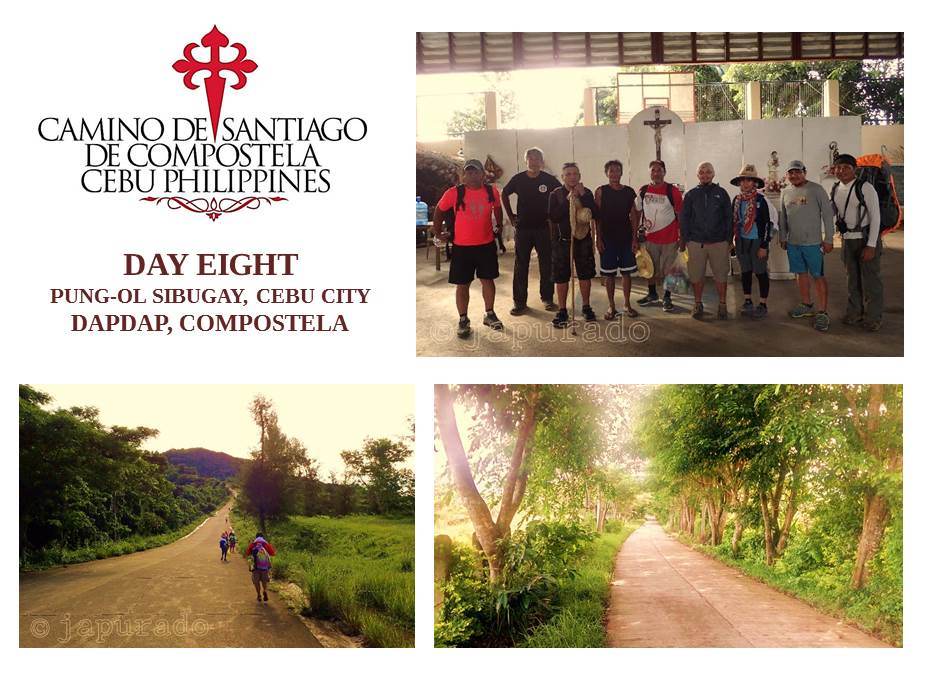
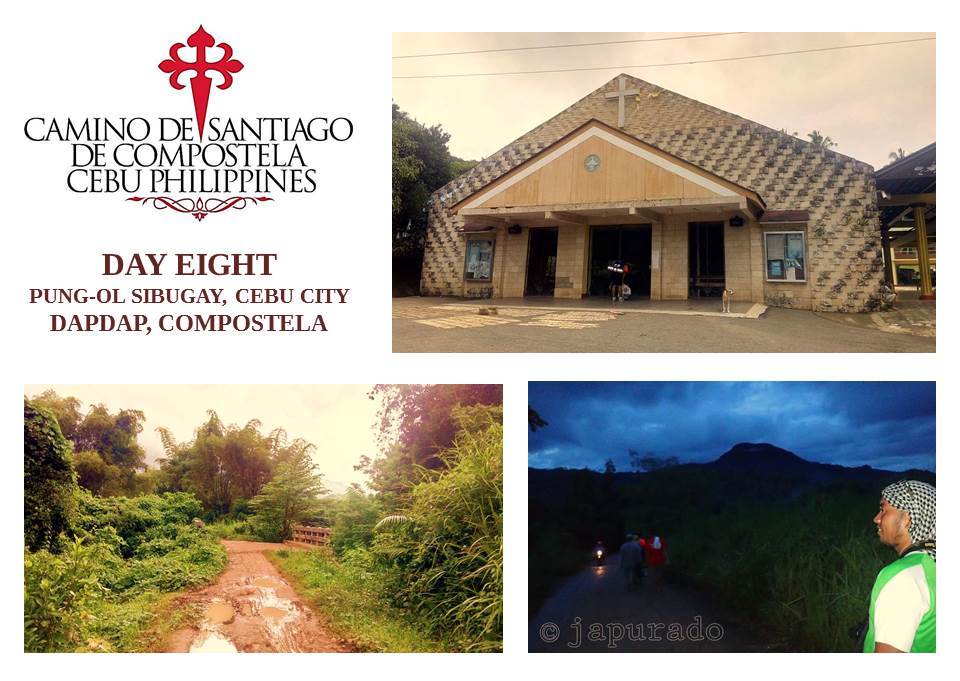
DAY EIGHT :::: SLEEPING HERE UNDER
A COVERED basketball court converted into a chapel was never part of my
itinerary. Neither that was part of the plans of Rev. Fr. Scipio “Jojo”
Deligero. We are now in between the villages of Malubog and Pung-ol Sibugay, in
Cebu City, and along the Transcentral Highway. We are simply here by an
unexpected circumstance. We simply ran out of daylight. It is the eighth
morning (July 13, 2017) of our pilgrimage of the Camino de Santiago of Cebu.
We started in the Municipality of
Badian last July 6 and, thinking of the distance we covered and the
difficulties the pilgrims encountered and overcame, I shook in disbelief. This
crowd are not hikers. They rarely travel on foot half a kilometer away from
their homes and their workplaces. Much less with the Hon. Joel Quiño, the
incumbent mayor of the Municipality of Compostela. He may walk down or up the
stairs to his office or bedroom but, once out of the doorway, he would rather
ride a government-issued car or his personal SUV to an official function or a
private family affair even if it is just 50 meters away for security reasons.
Much less Fr. Jojo. He could barely
perform his priestly duties as gout growing in both his ankles prevented much
of his movement. To think that the distance to the altar from the rectory is
just 20 meters long, more or less. Badian, Dalaguete, Argao, Sibonga, Barili,
Carcar City, San Fernando, Pinamungahan and Toledo City are now but history to
Fr. Jojo and is it not amazing for someone who hobbled instead of walked? We
are now in Central Cebu and are two days away to Compostela. Right now, the
pilgrims could smell the familiar aroma of home and their morale is
unstoppable.
It is amazing indeed! Even if I
could stretch the itinerary to three more days to accommodate the crawling pace
of Fr. Jojo, the accomplishment itself over an unlikely endurance to pain was
incredible. But sticking true to the itinerary is badass! It is like Fr. Jojo
climbing Mount Everest backwards. I cannot explain how he did it, especially on
Day One, but I can only tell you that Fr. Jojo was in a different level. We
have a term for that: mind over matter. On my part, I just shut off pain
receptors in my brain and it needs intense concentration practiced for a long
time. But Fr. Jojo’s way was different. His was meditation.
As breakfast is prepared, another
kilo of rice is removed as weight from my bag and that of Jonathaniel Apurado.
Better late than never! Along with that are four packs of spicy Korean noodles,
two fingers of chorizo Bilbao and 275 milliliters of denatured alcohol which we
used as fuel for our lightweight and very efficient Trangia and Alocs burners.
I slept last night in my hammock tied to square concrete posts. It was better
than my first option of a thick plyboard balanced over benches. The hammock has
a bug net while those who slept comfortably at first on the plyboards
complained of mosquitoes later.
We leave the covered
court-cum-chapel at 07:15 to the next destination. I have identified a
religious structure in the hills of Consolacion for that purpose, passing by
the villages of Sirao, Pulangbato and Pit-os but, like water, plans could
change on suggestions just like Day One where we got lost and travelled more
than what our feet and legs could accept. The latest suggestion did not come
from a local this time. It came from Fr. Jojo and he wants a parish in the
village of Guba as the next destination which, I am bound to look for ways to
get there.
We followed the Transcentral
Highway once more, going west and taking a smaller road that goes to the
mothballed Kan-irag International Golf Course, passing by the shoulders of
Mount Sibugay and into the famous flower gardens of Sirao, which I am visiting
for the very first time. The manicured flowery landscape is indeed a surprise
vista of this Camino de Santiago. The pilgrims even have their provisional
Camino passports stamped with the entrance seal of one of the garden resorts as
a sport. At this hour – 08:00 – it is already swamped with many visitors.
We proceed on following the shaded
road that passed by many scenic spots on the left and right of me. This is my
first time here but I do not have problems with finding the correct route.
There are people to ask of that and, for as long as you are polite, they give
you back their politeness. The day begins to go warm, you move to the curbs and
grassy ground to escape direct sunlight and the heated surfaces. Everyone are
light-footed, including Fr. Jojo, as the distance to Compostela is whittled
foot by foot.
There are a lot of people indeed to
ask questions. Most of them were warm in their conversations while a few were
aloof and evasive. Cannot blame them. Perhaps, bad memories of a sad chapter
when the barrios were swarmed then by idealistic strangers embracing rifles and
an alien ideology. It wears away very slowly and the sight of a group of
strangers like us could instantly trigger fear and suspicions. I am leading the
pilgrims and I am the first to see and feel. Body language never fails to keep
me updated.
We reach the village of Guba. This
is one of the most familiar names for a hinterland village in Cebu City because
it is not named after a plant or a prominent landmark like most places do. If
you translate it to the English language, the name meant “broken”, “damaged” or
“busted”. Long ago I chuckled whenever I saw public utility jitneys bearing the
name of Guba as it cruise the downtown area picking up passengers. I just could
not comprehend how is it associated to the hopeless when it is a beautiful
place with beautiful residents?
We arrive at the Santo Niño de Cebu
Parish at 11:30. We were really pinched off by the warmth of the day. The shade
of their covered promenade and their lofty location which catch cool breeze is
most welcome. Just sitting on a wooden bench there is enough to return your
strength and fix your awry nerves. We waited for a while as the parish priest
is running a personal errand for himself but once Rev. Fr. Pete Necesario
arrived, the mood of the occasion changed. It is always a good indicator of
happy moods when two priests meet, don’t you think so?
We were treated to a good lunch by
Fr. Pete. The soup was steaming hot notwithstanding the warmth of the day that
we have just hurdled and barely survived from and would soon be embraced again
anyways. It is delicious and who cares about the sun. Fr. Pete brought out the
entire banana, papaya and other fruits he had received from his parishioners as
offerings. We helped ourselves with eating all kinds of banana for soon it
would deteriorate if left uneaten. We even carried some, placed inside plastic
bags.
We thanked Fr. Pete and marched out
into the bare day at 13:15, stomachs full but bodies fully rested. From here,
there will be three more villages before we could reach the farthest limits of
Compostela. These places are not very familiar to me since I have not been
here. My guide would be local knowledge and that is where I aim to retrieve
most of the information for navigation. As soon as I got a good cellular
signal, I sent a text message of our location to the Operations Section of the
Cebu City Police Office. I get an instant reply and felt safe.
I reach a crossroads in the village
of Binaliw and I saw a group of uniformed policemen talking to some locals and
they were in a festive mood. They were not from the Talamban Police Station and
they were from another unit doing a different tasking. They do not know our
pilgrimage and they were alarmed at my sudden presence. I thought these were
the same policemen notified by CCPO to assist us. Not until I told them that
one of my companions is a parish priest and another one a municipal mayor, did
they lower their guard. It was a nice feeling to leave them all behind.
We reach the outskirts of the
village of Mabini and we saw another group of uniformed men resting on both
sides of the road. I talked to their officer and introduced myself and told him
the purpose of our presence. On the other hand, they were from the Philippine
Army and they were on a field training exercise. I can understand why there
were policemen. They were doing security for this. The problem is that CCPO
Operations failed to coordinate with their own units and on us since they knew
of our activity weeks before. I made it sure that they are notified properly
and early with my letter request.
Another close call and I thought
that was the end of it all. But it is a good thing if the policemen or the army
found our presence by themselves on the spot. What if a half-literate informant
would report our presence to them? That was what happened when our presence was
reported in exaggeration. An alert Army sergeant on another group of soldiers
asked of my identification card. I even gave him my letter requests addressed
to the governor and the police even if he asked none of that. We were reported
as members of the Maute Group and he has to be sure that we are not.
Funny, but presence of government
forces made you more uneasy instead of feeling safe, is it not? It is ironic on
my part since I am a former man in uniform. How could that be? Communication!
Sloppy handling and disseminating of correspondence and messages could result
in confusion. In warfare, you lose battles. In peacetime, the very people you
protect will lose trust on you because your line of communication are full of
bugs and holes. CCPO is short of trained professionals handling correspondence.
If that is low priority on their order of things, innocent people like us
pilgrims could get hurt on mere rumors.
I understand we had been walking on
a ridge for some time. I could now see a small glimpse of Metro Cebu. Across me
is Alvero Peak, the highest point of Consolacion, found in the village of
Garing. We arrive at the village center of Mabini at 15:30 to rest and
rehydrate and to ask for the quickest way to Compostela. A village peacekeeper
pointed to me a way to the Municipality of Liloan by way of Lanipga and Mulao.
I consulted Mayor Joel on this information but he preferred that we follow the
main road we are walking for most of the afternoon. We now know that down this
road is Paril, the last village.
It is a long way to the village of
Paril and we passed by lonely stretches, full of bends and turns, farms and
solitary houses. Also, when you go down a valley in a late afternoon, light
becomes duller and grayer, projecting dusk ahead of its time. As you are in
that situation, your footfalls tend to go quicker, so you could arrive to your
destination with daylight to spare. Unknown to me, Mayor Joel knows these
places very well and he had a calm composure and a cheery smile when I last saw
him. It simply does not matter if we arrive in darkness. This is his homecourt.
Schoolchildren streamed out of
their classrooms and are now company on the road. A lot of people to ask
directions to. I bypassed the village hall and followed a road that goes at the
back and crossed a small bridge. I am now on the side of Compostela. I remove
my High Sierra Titan bag and waited for them here. The stillness of the place
and the rest from the walk removed the stress of the day from my body and from
my mind. A few sips from my Camelbak bladder are enough to remove thirst and to
cool my body a bit. Ahhh, what a day. I believed my next destination would be
the village of Tag-ubi.
From out of nowhere a red-plated
white Isuzu pickup came from Paril and in it are Fr. Jojo and Roger. The driver
and a companion were here on the instructions of Mayor Joel so he could sign
checks for official government disbursements. The others have already crossed
the stream and are on their way minutes ago to the village of Dapdap through a
short cut, bypassing Tag-ubi. It is already 17:45 and, in a few minutes, it
would be dusk. I get inside and settled beside Roger. This road we are
traveling on are full of big holes and deep furrows caused by running water and
the driver has to drive slowly. It is much safe to just walk. Good thing, this
beast is in 4-wheel drive.
We passed by them in the last
minutes of daylight, which meant that they were making better progress on foot
than us inside the pickup. From them, it is but a mere 200 meters as the Isuzu
parked beside a well-built house. We are now in Dapdap. Coming towards us in
just a few minutes, with headlights, are Mayor Joel, Jem, Roderick, Mizar,
Alvie Rey and Jonathaniel. The last one arrived at 18:40. The house belonged to
the village chairman, Mayor Joel’s father-in-law, and we were welcomed to dine
there, as well as to nurse our aching bones and sore muscles. I will have my
revenge on my stinking body come morning.
DAY NINE :::: THERE IS AN ABRUPT
CHANGE in the face of each pilgrim. They are in a joyous and victorious mood.
It meant to them very much that they are now a day-and-a-half away from
completing the first Camino de Santiago in Cebu and they are now in their home
turf of Compostela. Today, July 14, 2017, there is not much to do except walk
leisurely and rest longer. The determination to reach Compostela, by all means,
has already been achieved. The stress and the pressure are beginning to lose
its hold on them. I have felt it too and it looks like somebody from behind me
just removed an arrowhead sticking out of my back. I have just finished
freshening up and I am ready for today.
I have been wearing for eight days
my dry-fit t-shirt provided by my sponsor, Silangan Outdoor Equipment, which I
used during my explorations of the last six segments of the Cebu Highlands
Trail and this, would be its last day. Silangan also provided me its
quick-drying elastic hiking pants during the Thruhike of the CHT which I have
worn for the last eight days too and would be so for this day and tomorrow. The
pair of Jack Wolfskin Kreisel 1 hiking shoes, provided by Niño Paul Beriales
for the Thruhike, have seen better days and is still much in demand for the
Camino Cebu, although the traction have lost some of its zeal.
The High Sierra Titan, 55 liters of
storage space, is now lighter and it would be much lighter still tomorrow – the
last day. This bag which was provided by fellow blogger, Gian Carlo Jubela of
Adrenaline Romance, have helped me complete the last half of the CHT and, in
this Camino de Santiago, the big storage is a plus, as well as its comfortable
shoulder straps and waist belt. I carried the name of Titay’s Liloan Rosquillos
in all my activities and I made it possible that the pilgrims consume and
supplied with this famous indigenous pastry called the rosquillos.
My blisters are healing well and I
am bronzed dark to too much exposure to the sun. My meshed shawl, used to so
many occasions outdoors, has protected my face. A pair of dark glasses provided
by Zue Fashion, which I used during the Thruhike, protected my eyes from glare
and harmful UV rays. Inside my bag are my primitive cook set, Trangia burner
set, Camelbak bladder, taffeta sheet, hammock, two spare t-shirts, used elastic
undershorts and socks, flip flops, survival kit, first aid kit, fire kit,
William Rodgers camp knife, Mora Companion and Victorinox Trailmaster. Secured
outside is a map case, journal and a Therm-a-Rest sleeping pad.
We depart from Dapdap at 08:30
after another filling breakfast. This Camino de Santiago, I noticed, is hiking
in style compared to the Thruhike which I did for 27 days from January 17 to
February 14, 2017. That time I ate spartan meals and the best part of that were
warm suppers. It is nice to have Fr. Jojo and Mayor Joel as company for,
without them, the pilgrimage would have been subsisting on simple fares of
instant noodles, instant soups, energy bars, bread, coffee and limited rice.
Also, with them, conversations with suspicious locals become smooth and trouble-free.
The dirt road led us to the village
of Mulao. This one I am familiar with. Been here last year to rendezvous with
my transport after the Philippine Independence Bushcraft Camp. We passed
through it today. Strangely, I am not leading the pilgrims anymore. Mizar is. I
am now crowding Jonathan at the back. I enjoyed the moment of being released
from that responsibility. No more stress. No more worries. No more thinking.
The Holy Rosary is prayed and, this time, I participated for the first time.
It was a good moment for a mayor to
exchange pleasantries with his constituents. As for the priest, his
parishioners. Whenever we walked, people would stop to greet Mayor Joel and Fr.
Jojo. Sometimes, people would stand on their frontyard and waved their hands.
We stopped by a small kiosk and the villagers offered us jackfruit. It was a
stress-free moment for a mayor on leave when a caravan for St. James the
Apostle, led by Rev. Fr. Gonzalo Candado, passed by. One of the passengers
happened to be the wife of Mizar and they had a tearful but happy reunion. The
caravan went on its way while we bade goodbye to the old folks.
We arrived at a place called Tagasa
at 10:00, in the outskirts of the village of Basak. We rest in a stag farm
owned by Mayor Joel. He is a fighting cock breeder and organizes stag derbies
during fiestas and special occasions. We just sat and talked while drinking
cold softdrinks. At exactly 12:00, our food is delivered by a private SUV. The
sun shone hot and the shades were most welcome. Some of the pilgrims dried
their wet clothes on makeshift clotheslines. As soon as it is 13:00, we proceed
to our next destination, possibly, our host for the night.
We reached it at 14:30 and what a
pleasant place to be in. It is a local resort called Gatubod Spring Resort.
Mayor Joel chooses a long house and, for the first time in this Camino, all the
hammocks are used. Colors come in red, blue, black and pink. After 17:00, when
the resort will be closed to the public, the swimming pools will now be ours. A
kilo of rice and four packs of spicy Korean noodles becomes our dinner. After
the meal, we each gave our testimonies about our expectations of the Camino de
Santiago and how it changed our personal convictions. It was a beautiful
evening.
Total Distance Walked: 33.81
kilometers.
Highest Elevation Gained: 2,047 feet.
Document done in LibreOffice 5.3
Writer
Posted by
PinoyApache
at
10:00
0
comments
Labels: Camino Cebu, Camino de Santiago, Cebu City, Compostela, journal, pilgrimage
Tuesday, June 19, 2018
CAMINO CEBU JOURNAL: Day Seven
DAY SEVEN :::: I HAD TROUBLE
SLEEPING after being awakened by my right forearm touching the cold floor at
23:00 last night. I did not notice icy fingers of wind slipping through opened
spaces between glass blades of the jalousie windows while I was asleep. The curtains
quivered a bit as the breeze work their way inside, bringing with it mists
which now occupy my special sleeping space underneath the long table. Suddenly,
the dining room looked so small in the dark but, fortunately, for me I have no
fear of closed spaces.
In my half-conscious state, I tried
to relax my mind so I could sleep but, it seemed, the more I tried, the more
elusive it became. Then I heard the crowing of the cocks heralding the arrival
of dawn and it sounds like I have just been cheated of sleep. Then the curtains
showed faint light from outside. This time I was able to catch Lady Starlight
when the temperature was just about right but the brush of slippers on floor
awakened me. Too late for me to dream of sleep.
I have to surrender to the reality
of the coming day’s business. The kitchen is now lighted and the staff of Rev.
Fr. Bernardo Oyao woke up early for this occasion to cook breakfast for us
pilgrims. They had been instructed to keep us comfortable and well-fed in his
absence. The familiar smell of camphor still float around the rectory in the
early hours of the day. It went with us since Day Two when it was generously
smeared on sore muscles and aching joints and is an accepted presence.
I went to the bathroom and,
fortunately, it was open and empty. Just as I sat on the seat, someone from
outside tried to push the door open. I locked it from the inside, of course.
Who could that “unlucky” soul be? Yesterday’s dining became history and is
flushed down the drain and now I am ready to accept another set of menu.
Preferably warm. The few minutes inside the bath let me enjoy warmth but as
soon as I opened the door, the cool atmosphere slapped my face and my wet hand.
I went outside of the rectory to
inhale the cold air. The mountain air is clear while the hills are verdant.
Sunrise had not yet hurdled past the crests of the Babag Mountain Range but its
golden fingers of light are now beginning to reclaim its space and should be
intense in an hour. The St. John the Baptist Quasi-Parish sits on a high
plateau beside the bald peak of Mount Tabla, in the village of Sudlon I, Cebu
City. Fr. Bernard would arrive today but not early.
Meanwhile, Rev. Fr. Scipio “Jojo”
Deligero of the Archdiocesan Shrine of Señor Santiago de Apostol, our chaplain
for this first-ever pilgrimage of the Camino de Santiago in Cebu, is all set to
resume the journey today, July 12, 2017, for the next parish but we need to
freshen ourselves first. The other pilgrims are busy with themselves, most of
them braving the morning cold, taking a bath. I just wiped myself with my wet
face towel and I am set to face the rest of the day.
When all were done, breakfast is
served. Joining Fr. Jojo and me on the table is Mayor Joel Quiño of the
Municipality of Compostela, the couple Jemmelyn and Roderick Montesclaros,
Mizar Bacalla, Roger Montecino, Alvie Rey Ramirez and Jonathaniel Apurado.
Omelet, hotdogs, fried rice and a leftover soup from last night’s dinner is our
food. All had the same appetite as yesterday’s and are extremely motivated by
the knowledge of being nearer to Compostela than ever before in this pilgrimage
of the Camino de Santiago.
We left at exactly 08:00 after
thanking the staff of the St. John the Baptist Quasi-Parish. We retrace our
route towards a street corner where we found the directional signage for the
church. It is a long walk among highland farms and small valleys, going up and
down, twisting among lonely hills. Mizar led again the prayer of the Holy
Rosary while the rest answered with the usual Hail Marys. Jonathan took the
rear, camera in hand, as I walked hearing distance forward of them.
Profusely sweating and extremely
excited caused by the walk on rolling terrain on an early morning, the pilgrims
paused for a while to eat rice pudding (Local name: bibingka) cooked and
sold on that street corner. While still warm, it is a meal good enough to give
energy to farmers working on their fields. I brought three palm-sized ones with
me, intending to eat it further up ahead. I eat all three when I reached a crossroad
where there is a police detachment. I was minutes ahead and I was alone under a
shed waiting for the pilgrims.
One road goes all the way to the
next village of Sudlon II while another one goes down the Bonbon River Valley.
It is all downhill and it is beautiful to walk where it is most moderate but
rather painful for the soles and the knees where it is most steep. It is a long
downhill walk and it would be harder if you do a reverse here. I have not done
it here yet but the mere thought of that gave me a frown. I hope I do not but
locals used this road to go places whether uphill or down the valley.
I am worried about Fr. Jojo. I
looked back many times to observe his gait. The walking aid we picked up in the
forests of Sohoton, Badian is still with him and it is most useful here. That
stick, if ever it is not laid or thrown aside or if ever Fr. Jojo survives this
Camino with it, will become an object of reverence. Without it, Fr. Jojo’s
misery would have been intense and grave but, with that, he looked like Zato
Ichi – the blind swordsman.
We reached the village of Bonbon at
12:00 and grabbed lunch inside a food store. The day is very warm made more
warm by the concrete road bouncing off heat to us. I choose the farthest
recesses of the wooden structure and ate in silence amid the exchange of tales
between pilgrims. Oh God, do they ever tire? Cold soda drinks washed away the
dust down my throat and kept my sanity checked. I opt for another cold glass
and it settled my body’s state of affairs.
After an hour, we proceed and
walked the paved road going to the Trans-Central Highway. While doing so, Fr.
Bernard arrived alone with his pickup and stopped for a while for a short
conversation with Fr. Jojo. He was shopping for grocery and for other needs of his
parish. His back seat were full of these goods and a few were placed on the
cargo space. We thanked him for his kindness and bade goodbye to him as he sped
away to fulfill his sacred office. May God bless him!
By 14:00, we arrived at the St.
John Marie Vianney Quasi-Parish. I always passed by this place and sometimes
stopped to perform genuflection. Today, I stayed a little longer. We looked
around but it was closed. We rest for five minutes here and, after that short
inactivity, we returned to the hard concrete road once again that goes up from
the valley. We were relieved to reach the Trans-Central Highway after an hour
or so and doused our thirst with cold soda drinks.
It is now less than two hours of
daylight before dusk will overcome us and Fr. Jojo does not know where to stop.
Neither am I but I remembered a monastery along the way near where there is a
chapel on a hill. We walk towards there and I find it strange that it is fenced
off. The place seemed abandoned and I hollered towards a closed door 25 meters
away. A resident living across the place came to investigate our presence and I
explained it to him in explicit detail.
Fortunately for us, the local
personally knew Mayor Joel and he helped us find a place for the night’s rest
stop. We found it inside a covered court that had been converted into a chapel.
It sits on the border of the villages of Malubog and Pung-ol Sibugay. The two
villages have been at odds with each other as to the location of the basketball
court and the proceeds of its use and so have agreed to use it into a chapel
instead. There are wooden benches, monobloc chairs and thick plyboards to make
impromptu beds. It is 17:30.
The caretaker of the government
building happened to be our guide’s uncle and welcomed us to use the temporary
chapel. For water, we only have to go out of the back entrance into his house
to fetch it. The same with using a washroom, only you would have to adapt how
mountain folks answer the call of nature. For the first time of our journey, we
cooked our supply of food. That means the weight of a kilo of rice and four
pieces of Korean spicy noodles, along with 250 milliliters of denatured
alcohol, will be permanently removed from the spaces of my High Sierra Titan
and that of Jonathan’s.
The spartan comforts of our night’s
stopover are good enough to give us a place to consolidate our ebbing strength
that we expended during the whole of the day and the rest is sufficient to
prepare us for tomorrow’s journey. Fr. Jojo gave his wooden staff to Roger for
safekeeping as he lay prone to accommodate once more a generous amount of
efficascent oil on his calves and thighs, on his upper body and torso, and on
his biceps and forearms. I removed my shoes and socks and the blisters on my
toes seemed to be healing faster than I have expected it to be.
We have covered seven days of
hiking into some of the most rugged places of Cebu and it is now history. That
leaves us three days more to complete the first, and real, Camino de Santiago
of Cebu, probably, in the Philippines, before we could lay claim that we really
were the first. As I have said before, the Camino could be everywhere and in
everybody’s heart, but a Camino which we now have walked more than a hundred
kilometers in length; in an island which host rugged mountain ranges and clime
that is harsh already before the advent of global warming is legit. And
bittersweet.
What would be the kind of reception
the townsfolk of Compostela be upon us? This is a strange undertaking
understood only by a few Roman Catholics. Mostly, the upper class of society
and the clergy have the capacity and the means to undertake this in Spain. The
Camino is not exclusive to them and this same Camino which has its origin from
there does not discriminate the poor from engaging their own Camino de
Santiago. The far provinces of the Roman Catholic faith should not be deprived
of such privileges.
One by one, the bright lights of
the covered court are switched off. In the late evening hours, few motorcycles
would speed by on the Trans-Central Highway and brought with it annoyance and cursing but, once the road is
silent, crickets claimed the night air and it is most sweet to the ears. Under
a lone light, I sat studying my maps. Tomorrow’s route would be my first time
there. My skill in navigation would be tested once more and I accept any
challenge.
Walking the rugged spines of Cebu
has never been a problem with me. Local acceptance is. Ignorance, for most of
the time, make interactions complicated. Sometimes, political partisanship
during an election period. Armed rebellion is now absent in most of the places
I know in Cebu. What is left are just residues of distrust and a bad memory. I
see people smiling again. Watch when they get used to the Camino of Cebu, their
places will brighten and they, themselves, engage their own spiritual journey.
Would you not be happy with that?
Total Distance Walked: 14.93
kilometers.
Highest Elevation Gained: 2,449 feet.
Document done in LibreOffice 5.3
Writer
Posted by
PinoyApache
at
10:30
0
comments
Labels: Camino Cebu, Camino de Santiago, Cebu City, Compostela, journal, pilgrimage
Saturday, June 9, 2018
CAMINO CEBU JOURNAL: Day Five and Day Six
DAY FIVE :::: THE STAY INSIDE THE
HIDDEN Valley Mountain Resort, in Lamac, Pinamungahan, last night had taken
away the burrs of fatigue and emotional torment that the pilgrims have
unconditionally accepted in return for that rare privilege of walking the
Camino de Santiago – their own Camino – for the past four days. The cool night
bath, repeated again this early morning, had freshened up the tired bunch. The
soft bed, well received by a sore body last night, became an object that we
found again hard to leave behind.
The last two days of walking I
found unbelievable. 53.33 kilometers! Can you dig that? It simply defied
reality and a long argument between the numbers and my own calculations took
place and the numbers were winning. That in just a total of 21 hours walk! How
could that be? Of course, we rode a patrol jeep on Day Three for around 45
minutes at Libo, Sibonga to Dakit, Barili, and that would be 4 to 5 hours
walking for the same distance but, would that made a difference to the journey?
For me it did not. The load I carried since Day One are still the same. It
should have lightened up if we follow our food plan.
Today, July 10, 2017, is Day Five
of the pilgrimage. We lived on the generosity of the parishes that hosted
dinners for us for four nights and breakfasts too. That also include a bath and
a cozy place under the protection of a roof. Probably, another parish this
night would open its sacred doors for us. Fr. Scipio “Jojo” Deligero seemed to
be in a different mood today. He fully knows that the most challenging
“principalities” are beginning to lose its grip on us as we crept slowly closer
and closer to our destination north.
But there is one thing that kept
tearing at my mind. Yesterday’s ride. The offer of conveyance from the cops of
Sibonga was hard to refuse and it seemed like it came from heaven. I tried to
protest the free ride but who am I to question Providence? Like I said, there
is a parallel universe in the heavens for navigating the Camino de Santiago. If
it benefited the pilgrims, it would, perhaps, benefit me. I hope it would. I
still carry our food supply in its untouched state, you know.
Rev. Fr. Wilfredo Genelazo, our
host, came to fetch us and brought us all back to the San Isidro Labrador Parish for breakfast. His
parish exists from modest contributions of the communities he served. These are
just small tokens and for as long as he respect the other faiths of his
part-time parishioners. These other faiths are a conundrum of mixed Christian
and indigenous beliefs which survived in the village of Lamac and these have
influence on the affairs of people’s lives there. All told there are 27
different pseudo-Christian sects competing with the Roman Catholic faith and
Protestant churches for the salvation of souls. A stronghold.
We leave at 09:00 and my second,
Jonathaniel Apurado, is good for another long walk behind the last of the
pilgrims and he seemed to enjoy the company of Roman Catholics. He is a
Protestant and he does not mind. It is all about the soul, you see. The Camino
de Santiago does not discriminate. It is open to all who has an open mind and a
humble heart. When we had overcome the last rise, Mizar Bacalla begins the
rosary while Fr. Jojo, Mayor Joel Quiño, the couple Roderick and Jemmelyn
Montesclaros, Roger Montecino and Alvie Rey Ramirez, replied with a string of
Hail Marys. We are now entering Toledo City.
Mayor Joel is the incumbent mayor
of the Municipality of Compostela, from where all the pilgrims came from,
except me and Jon. His participation is a commitment for the future of
Compostela. Its being a namesake of the original Compostela of Spain is
something that should not be left to the mercy of the four winds. Nor its
favorable position in sharing the same patron saint and a relic which
originally came from there. The town has to rise from the trivial and the idea
of introducing the Camino de Santiago to Asia is well received by many of the faithful.
The Camino does not deprive the far
provinces of the faith and to those who cannot afford the expensive travel to
Spain. The Camino could be everywhere and could be in anybody’s heart. Tangible
steps have to be made to establish one in Cebu and our Fr. Jojo and Mayor Joel
crossed that line of the impossibility. I, too, shared in that idea. I have a
great purpose in participating this pilgrimage which could have been
predetermined when I was still in the womb of my mother. In all my life before this,
the Camino or its equivalent takes up some of my reflection time.
I am not toying with obsession. I
could have but I am humble enough to recognize that I do not have the resources
to engage in it nor the skill to fleece people’s money so I could proceed
there. I am just a servant and discernment of invisible messages is my eternal
task. I move in God’s own time and so here I am in Cebu’s version of the Camino
de Santiago. It overlapped my own creation – the Cebu Highlands Trail – which I
walked and finished in 29 days last February 2017. Never did it occurred to me
that I would walk this same route again in a span of six months, this time for
the Camino.
My 55-liter High Sierra Titan
backpack is heavy as was the first day. My most important cargoes are my
original Camino passport now stamped with five seals from five different
parishes, a bleached scallop from Compostela, Spain with a red-painted St.
James cross and a pebble from my doorstep. I may add a fossilized scallop I
found in Dagatan, Badian. A camera would have been useful to document what I
saw and discovered but I trust Jon and Alvie to share me what photos they took
afterwards. The photos guide me in my writings of my online journal and blog
contents. I am the author of this 10-year old blog.
By this time, the effects of two
multivitamins a day and a capsule of Natural Raw Guarana would work on the
stamina of the pilgrims. I used this same formula during the Thruhike and I
know the day when it would finally fill your body system and give you that much
needed boost to push ahead day in and day out. The day is warm. It would only
slow them but it would not tire them. The road bounced the sun’s heat to our
faces and bodies and there are a few shady places. For want of that, I
increased my pace and arrive at the village of Bunga at 10:30. Another waiting
game.
For sure, they would have passed by
a roadside stall selling jackfruits and beside it is another stall selling
food. Cooked warm food. I would have stopped there earlier but the glare was
too much and the heat radiates from the paved road. I am sitting in a very cool
place munching on my energy bar and Titay’s Rosquillos and sipping a cold Coca
Cola. After an hour of waiting, they finally passed and I rejoined them. We
reached the Naga-Toledo National Road and we opt to bypass the big village of
Don Andres Soriano by walking on the same highway.
A strong storm overtook us and we
decide to take shelter under whatever awnings we could find. We just stood
there for around twenty minutes or so to wait out the rain. It was already
12:30 when we lurched forward for our destination of the day: the San Pedro
Calungsod Parish, in the village of Cantabaco, Toledo City. The abrupt change
in the weather system have made walking on the road better. We arrive at the
parish at 14:25 and Rev. Fr. Armando Orehuela is very accommodating and showed
us the rooms to spend the night.
After refreshments and snacks, some
of the pilgrims took a bath and washed their clothes at the back of the
rectory, trying to take advantage of our early arrival and enough time to do
chores which were denied them for the past four days. I would take a bath early
morning tomorrow but, for now, I joined Fr. Jojo and Fr. Arman in a discussion
about the latter’s aquarium containing riverine vegetation. Then I found out
that I got blisters on my toes. I let it be and tomorrow it will be dressed. A
bottle of cold beer came my way and I cannot refuse.
DAY SIX :::: WE ARE NOW ON THE
second half of the Camino de Santiago today, July 11, 2017. Day One to Five was
now history and the worries that hound me for the past five days are still
there, although a bit slighted by the idea of hurdling only five days more. I
am refreshed by the early morning bath and I am now plugging my blisters with
Band-Aids. I checked on the other pilgrims’ toes and theirs are not too good
either. Jemmelyn has all ten of her toes bedecked with Band-Aids. The petroleum
jellies I bought as part of our first-aid supply would now be most useful. They
ignored it when their toes were healthy then.
The next vulnerable part – the
inner thighs – have not been affected. I also bought three pairs each of
elastic undershorts for each pilgrim. It is quite amusing to see Fr. Jojo
trying one and he found it unmanly at first but soon found out that it is more
comfortable than wearing a brief. You know how older guys are, especially those
who are brought up in a traditional environment tend to accept change in the
way of how they think, feel and look but, once the undershorts were worn, they
began to like it. Just like tinkering a smartphone. That goes for Roger and
Mizar too and maybe Mayor Joel. They changed one everyday and washed the worn
pair to remove abrasive salt crystals.
After a lovely breakfast and the
stamping of the passports with the sixth seal, we say goodbye to Fr. Arman at
08:45. Fr. Arman instructed me the way to the next parish, which would now be
in the highlands of Cebu City. It would be very enticing for me since I have
not been there before. We follow the road once more but the temperature is
cooler here, maybe because of the presence of a man-made forest which we get to
pass at the village of Camp 7, of the municipality of Minglanilla. The
pilgrims’ stamina have now increased and are now used to the abrupt changes in
terrain difficulty and weather.
We stop by at a small store in
Lantawan, in the village of Sinsin, Cebu City. With cold soda drinks, they
finally munch on their energy bars, Titay’s rosquillos and biscuits. Fr. Jojo
complained as he felt something unfulfilling inside. He eats another bar. He
does not know how energy bars work. It works the same like the altar bread when
introduced with water. It bloats inside your stomach. After an hour, we
proceed. We passed by the famous Sinsin Ridge that stalled American forces
during their campaign to take the Katipunero stronghold of Sudlon. It has a
narrow passage that is now heavily eroded caused by heavy usage of quarry
trucks.
The road begins to ascend and
ascend and ascend like it is going to heaven. It is concrete but the roadsides
are thickly vegetated, giving you enough shade. There are many places here
where you could establish campsites. The Sudlon Mountain Range is a place that
exudes an aura of mystery and most of its trails and remote peaks beyond the
habitations had not been visited by urban hikers. Slowly, inch by inch, we are now in the
village of Sudlon I. Sudlon hosts a large community of an indigenous cult that
is a mix of Christianity and spirit worship. It was established by the late
mystic, Hilario Moncado.
The climate begins to go cooler as
we reach higher elevations. The heat of the sun do not bother us anymore. We
are sweating hard because of the effort yet we were not tired. We reach a very
populated community where a road sign says, with an arrow for emphasis, that we
are on the right direction to the St. John the Baptist Quasi-Parish. We arrive
there at 16:45 and, just a few minutes after, thick fogs cover us and the
church. I am a bit disoriented by its sudden appearance. I could not relish
anymore the beauty of the landscape that I saw a few minutes ago.
The parish priest, Rev. Fr.
Bernardo Oyao, was not present. He was on a personal errand and has to travel
downtown. Anyway, his staff expected our coming and welcomed us inside. The
rectory, which doubled as the living quarters of the priest, shielded us from
wind chill. Fr. Jojo and Mayor Joel used the room of the absent Fr. Bernard
while the office was now the refuge of the Montesclaros couple. Despite the
cold weather, a few bold pilgrims took a bath. I would have but I decide not to
at the last minute. Perhaps, I would have that tomorrow morning.
The parish is made of concrete,
painted white, with the bell tower located on top of the main door. It is
facing a deep valley and the faraway Babag Mountain Range, with its distinct
feature of one peak crowned with many telecommunication and television towers.
That range is my playground and I have not seen it from the vantage of Mount
Tabla, a peak that is 2,342 feet above sea level, where I am standing beside. I
asked Fr. Jojo about the difference of a parish from a “quasi-parish”, but it is
still God’s Country, nevertheless.
Meanwhile, the helpful staff of Fr.
Bernard cooked a very enticing brew: a steaming broth of pork knuckles. Despite
the cooler climate, I could feel minute fingers of sweat streaming slowly down
my temples as the soup warmed up my body. Outside, the wind howled and it would be foolish for me to sleep outside.
After that very filling dinner, I found the dining table a very good place to
stretch for the night. Not on the table top but underneath it. I unrolled my
Therm-a-Rest sleeping pad on the cold tiled floor and inspected my bruised toes
before saying goodnight at a late hour of 20:30.
Total Distance Walked: 24.38
kilometers.
Highest Elevation Gained: 2,342 feet.
Document done in LibreOffice 5.3
Writer
Posted by
PinoyApache
at
09:30
0
comments
Labels: Camino Cebu, Camino de Santiago, Cebu City, Compostela, journal, pilgrimage, Pinamungahan, Toledo City
Subscribe to:
Posts (Atom)