Showing posts with label Bohol. Show all posts

Monday, March 1, 2021

2021-009 | PINOYAPACHE IN A TOURISM PROGRAM

IN 2019, THIS BLOGGER was part of a team of resource persons contracted by the Department of Tourism, Central Visayas Region, to train, educate and enhance community guides of the different local government units (LGU), whose tourism programs are focused on adventure or cultural or both. This national project is called the Tourism Industry Skills Program (TISP) and was implemented by every region since 2017.

DOT-Central Visayas did not fall behind and, in fact, it was running in full steam. Credit that to its Regional Director, Mr. Shahlimar H. Tamano, and the equally hard-working duo of Senior Tourism Operations Officer, Ms. Cynthia O. Monzon, and Tourism Operations Officer, Mr. Eli John Eduave. They were able to assemble a veteran team composed of tourism service specialists and outdoor educators and they were Ms. Agnes Tuling, Mr. Ruel Rigor, Ms. Rosebelle Daculan, Mr. Ramon Vidal, Mr. Randy Salazar and mister yours truly. 

Many aspiring community guides participated in the TISP. Those who passed the series of tests and evaluation given by DOT-Central Visayas are issued special tourism guide license, which scope are confined to the LGU where they belonged or recognized thereat as a community guide. The license gives the holder legitimacy to undertake work of a community guide and, therefore, protects the tourists and their LGU from fly-by-night opportunists. 

The following are the LGUs that have benefited from the TISP offered by DOT-Central Visayas. Each has its own existing tourism programs based on its identity which had already been carved from or associated with the landscape and the landmarks and these had made each LGU unique and worth a visit. This writer would add his personal observations, in italics, as you sift through each LGU on the visit of Team TISP. 

MUNICIPALITY OF BADIAN

Province of Cebu

August 17-24, 2019 

ATTRACTIONS: Kawasan Waterfalls; Matutinao River; Lambug Beach; Badian Island; Osmeña Peak; Candung-aw Peak and Tañon Strait. 

ACTIVITIES: Canyoneering/River Trekking; Swimming/Bathing; Picnic; Snorkeling; Hiking/Camping; Zipline Gliding.

TISP was held at Eskapo Verde, an eco-tourism resort located on an islet off Bugas, Badian. The area is conducive for learning since it is accessible through a 250-meter long bamboo walkway over an estuary where mangroves grow, far away from the Cebu Southwest Road. Accommodation for the DOT-Central Visayas TISP Team was also in Eskapo Verde. 5 stars out of 5.  

Eskapo Verde is a perfect magnet to develop and to include water sports, like kayaking and stand-up paddling (SUP), into the tourism map of Badian LGU. Besides, the five small islets and a half-buried shipwreck all in close proximity to Eskapo Verde is also another venue to develop a new tourism activity of mangrove kayaking. 

What a lot of people in Badian do not know is that the longest Camino de Santiago in the Philippines starts from their own St. James the Apostle Parish, located in Poblacion. This is a pilgrimage route that climb over the mountains to Dalaguete and goes north to Compostela, 175 kilometers away. This is patterned after the one in Spain and have been established here in Cebu since July 2017. It passes by the barangays of Dagatan, Malhiao, Sohoton, Tigbao and Santicon.   

CITY OF CARCAR

Province of Cebu

August 27-September 1, 2019 

ATTRACTIONS: Preserved Spanish Colonial Infrastructures; Carcar City Museum; Indigenous Food/Delicacies; Guadalupe Mainit-Mabugnaw National Park; and Theotokos Shrine. 

ACTIVITIES: Cultural/Historical Tour; Gastronomic Tour; Spelunking/Cave Tour; Hiking/Camping; Sightseeing/Birdwatching; Warm Water Bathing.

TISP was held in a vacant room of the new Carcar City Hall. The seminar is partly shouldered by the Department of Environment and Natural Resources, Region VII, because of the inclusion of the GMMNP in the city’s tourist mapping. Accommodation for the DOT-Central Visayas TISP Team was at Tatope Travel Lodge, located along the Cebu South Road, Carcar City. 1 star out of 5. 

Most people in Carcar City do not know yet that both the 400-kilometer Cebu Highlands Trail and the 175-kilometer Camino de Santiago pass by their city. The two long trails both enter Barangay Napo on the same way and exits from Barangay Calidngan at two different paths. 

On the other hand, Carcar City still has remnants of the industries that it had once depended on in the past. Instead of placing them in the dustbin of existence, why not include these into their tourist map. I am talking about leathercraft and bladesmithing. Why not fuse these two and develop a new tourism destination under “blade tourism”? 

MUNICIPALITY OF SAMBOAN

Province of Cebu

September 8-15, 2019

ATTRACTIONS: Aguinid Waterfalls; Binalayan Waterfall; Dao Waterfall; Preserved Spanish Colonial Infrastructures and Tañon Strait. 

ACTIVITIES: River Trekking; Swimming/Bathing; Snorkeling. Picnic; Cultural/Historical Tour; Sightseeing/Birdwatching.

TISP was held inside the session room of the Samboan Municipal Hall. Accommodation for the DOT-Central Visayas TISP Team was at Chelan Resort House, located along the Cebu Southwest Road, Poblacion, Samboan. 3 stars out of 5. 

The Cebu Highlands Trail established a campsite on a ridge of Barangay Monteverde. It would be best if the Samboan LGU would develop it into a camping area because of its proximity to a water tank. 

MUNICIPALITY OF SAN FRANCISCO

Province of Cebu

September 22-29, 2019 

ATTRACTIONS: Lake Danao; Paraiso Cave; Amazing Island Cave and Beach Resort; Timubo Cave; Santiago Bay; San Francisco Baywalk and Causeway; Indigenous Handicrafts. 

ACTIVITIES: Hiking/Camping; Zipline Gliding; Kayaking/Paddling; Picnic; Spelunking/Cave Tour; Swimming/Bathing; Sightseeing/Birdwatching.


TISP was held inside the function room of the San Francisco Multi-Purpose Cooperative, Poblacion, San Francisco. Accommodation for the DOT-Central Visayas TISP Team was at Dayon Lodge, also in Poblacion. 1 star out of 5.

MUNICIPALITY OF TUDELA

Province of Cebu

September 30-October 6, 2019 

ATTRACTIONS: Bukilat Cave; Buenavista Heritage Tree; Villahermosa Giant Clam Sanctuary; Tudela Mangrove Forest; Busay Waterfall; Makalabad Peak. 

ACTIVITIES: Spelunking/Cave Tour; Cultural/Historical Tour; Sightseeing/Birdwatching; Swimming/Bathing; Snorkeling; River Trekking; Hiking/Camping; Kayaking/Paddling.


TISP was held in the function hall of Villa Alicia Resort, Poblacion, Tudela. Accommodation for the DOT-Central Visayas TISP Team was also at Villa Alicia Resort. 3 stars out of 5. 

All blacksmiths in Tudela LGU still used improvised oven and blower and still produce the best blade tools that are used by farmers and homesteads on the islands of Poro, Pacijan and Ponson. It may be worth the effort to include these blacksmith shops into the tourist map of the LGU under the new destination of “blade tour”. It may be even viable if the three other LGU of the Camotes Group of Islands decides to join hands and save this dying industry. 

MUNICIPALITY OF ALICIA

Province of Bohol

October 9-16, 2019 

ATTRACTIONS: Alicia Panoramic View; Birhen Nature Resort; Cagong-cagong Cave; Princess Manan-aw Cave; Chocolate Cave; Alicia Schist Rock. 

ACTIVITIES: Hiking/Camping; Trail Running; Bathing; Sightseeing/Birdwatching; Spelunking/Cave Tour; Cultural/Historical Tour.
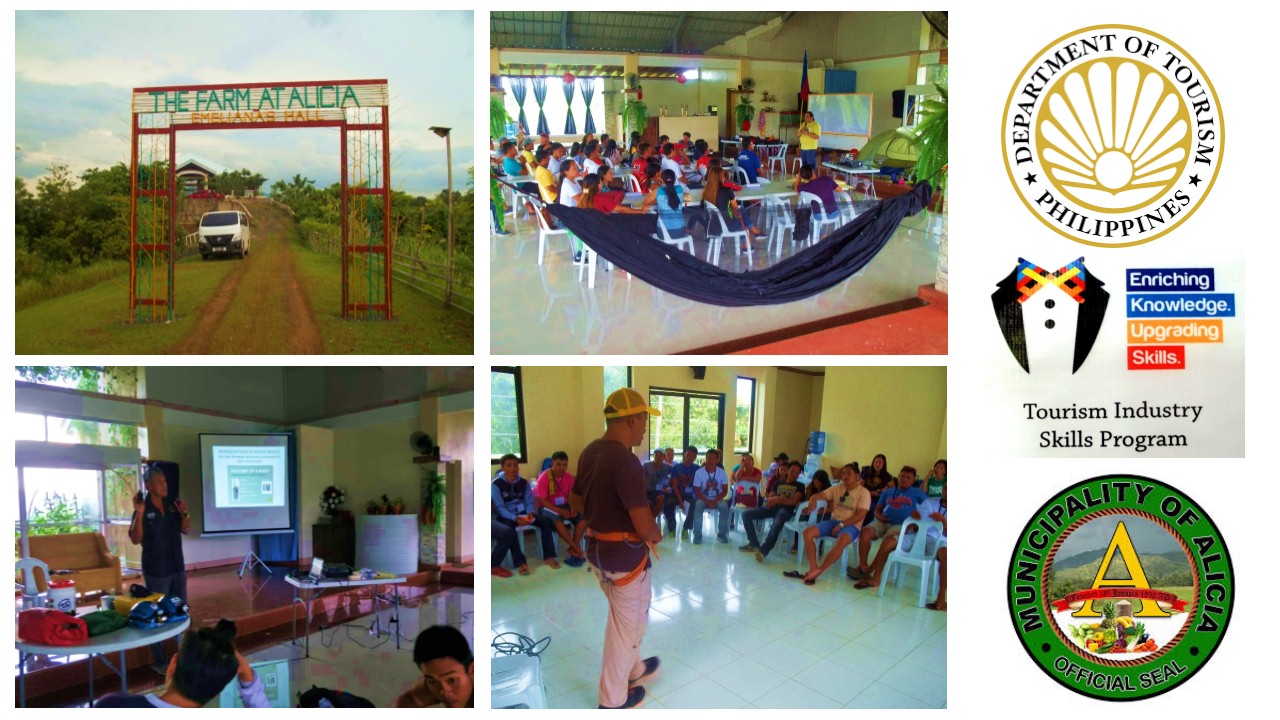
TISP was held, respectively; for the first three days, at The Farm in Alicia, Cambaol, Alicia; and for the rest of the week, in the function room of the Alicia Municipal Hall Annex. Accommodation for the DOT-Central Visayas TISP Team was also at the Alicia Municipal Hall Annex. 1 out of 5. 

=> => o0o <= <=


WHILE TOURISM MAY BRING in revenues needed by the LGUs, it has its downside as well. We have seen the decay that over-commercialization and over-development have done on so many places and are now shunned by most tour operators due to lesser tourists. The TISP is just not improving skills on the tourism operators but also considers the health of the environment of a destination as an integral part of development and the team emphasized that in our 2019 LGU tour.

Saturday, March 16, 2019

BUSHCRAFT FOR ALL IN BLUEWATER PANGLAO

AFTER A STINT AT BLUEWATER Maribago Beach Resort, in Lapulapu City, Cebu, last March 17, 2018, I set sail for my next assignment, which would be done at the Bluewater Panglao Beach Resort in Panglao Island, Bohol. Today is April 14, 2018 and it is the start of the election campaign period for barangay officials.

Travelling in that period is critical for someone who carry blades in the course of his work. In my case, as a survival instructor, I carry a lot. All are shorter than nine inches except for a Cold Steel Bushmaster which I am still undergoing field tests. I have with me a total of seven work blades and I checked it in along with my Mil-Tec bag as baggage.

I am with my assistants Jonathaniel Apurado of the Camp Red Bushcraft and Survival Guild and the couple Jethro and Marianne Ocubillo of Bukal Outdoor Club; and they also have blades with them which would complement mine. They breeze in through security without a hitch and followed my course. We responsible blade owners always follow regulations.

After an hour of crossing Bohol Strait on a fastcraft, we arrive on the Port of Tagbilaran. A passenger van provided by Bluewater Resorts came to pick us up and whisk us away to Panglao Island. I have never been to Panglao, a very popular tourist destination of Bohol, where white-sand beaches and great resorts abound plus a bathable cave.

One of the best resorts in Panglao, an unmatched gem in itself, due to its being designated as a Green Resort by no less than the ASEAN Tourism Committee, is the Bluewater Panglao Beach Resort. It would be my very first time there and I am awed at the tidiness and orderliness of the resort and the design of the pool when I arrived.

Anyway, a two-level family loft is assigned to us as our accommodation for two days and two nights free. Tomorrow, April 15, is the day when we will demonstrate our skills showcase. We liked how the staff treated us and it is a nice feeling. We proceed to Aplaya Restaurant for our free breakfast and begin stuffing ourselves.

Stretching outside after the meal, we decide to inspect the place where the short bushcraft workshop would be held. The iconic seven dolphins that became a lore in Bluewater Maribago Beach Resort, is shining under the glare of the noonday sun. We follow the stone-tiled footpath amidst rows of sprightly bamboos on each side.

On an empty lot is a playground reserved for children and a hotel personnel confirmed my hunch. I would be back in late afternoon, when it is cool enough and start to search for the items that I would need like green bamboo poles and dry wood for a fire. Then we head for our rooms. It is much cooler there. 

I almost slept the whole afternoon and was about to forget my task. The cooler temperature inside the loft and the soft bed had left me lazy. By sheer will power, I bravely left my comfort zone and go outside. I got the bamboo poles and cut it at the desired size with a small saw. I found lots of dry wood, a discarded PVC pipe and a 2-ft x 2-ft plain roof sheet.

Then it is time to prepare for dinner once again. After a cool shower, I join the rest at Aplaya and enjoy a free dinner, courtesy of Bluewater Resorts. Evening in the resort is so soothing and relaxed. I am tempted to walk on the beachfront but I am not prepared for another bath. The salty breeze added to the ambiance of the place.

I decide to walk back to the loft and check the things that I need for tomorrow while the rest take a stroll on the beach. There is an electric kettle and there is coffee and sugar. I enjoyed the night alone in my room before it gets populated by Jon and the couple who would be sleeping on the lower part.

The second day (April 15) opens up with a short walk to Aplaya Restaurant for another free breakfast. During Saturdays, the restaurant serves Barrio Fiesta, a galore of Filipino food favorites. We stuff ourselves full knowing that we will have a long day ahead of us. The day is warm and humid but we are excited.

We go back to the loft and retrieve our tools and gear and proceed to the children’s playground. My bamboos are ready and the firewood and I secured long benches from the resort's maintenance department. We laid all our things on one of the bench and place my folding seat behind, facing the participants.

I begin setting up the two different snares which I located a distance away from the main area. Then, with much time on our hands, I tie a hammock between two trees. Its presence is for nursing mothers who might be present. Jon, Jethro and Marianne gathered the firewood and stacked it. For insurance, we ready our first aid kits.

At 09:00 the participants arrived. Facilitating this activity here is Ms. Ivy Mae Palonpon, one of the few Bluewater Resorts staff who took my 3-day Basic Island Survival Course last May 2017 at Bluewater Sumilon Island Resort, Oslob, Cebu. Attending this activity are off-duty resort staff and two of them brought their kids.

Although this little workshop was designed for children, I could easily tweak the lecture to my advantage to make it very flexible. I have the best assistants with me right now and their presence are most welcome. But it is easier this time because I speak a common dialect with them: Cebuano.

I talk to them first the meaning of the word bushcraft and its relation to survival so all could understand the very nature of the discussion. Then I proceed to the many reasons why they should count themselves fortunate to attend in this rarely-offered session. The knowledge gained from their participation is a big advantage when dealing with calamities and disasters with which example is the 7.2 earthquake that hit Bohol in 2013.

If you are a native of Bohol, you would know your way around making a fire and the cooking that follow. But what if a typhoon of a magnitude like Haiyan (Yolanda) hit your place and you found yourself unprepared and all your cooking utensils swept away? That also goes with your matchsticks and lighters and everything dear to you.

Preparation is the key here and I have to teach the Boholanos another way to make a fire. But first, they would have to stock vital tools and grab it the first chance before they escape to safety. I show them how a Go Bag would look like and what are its contents. Then I emphasize why redundancies of certain items are the best practice.

Making a fire with matchsticks and lighters is easy in under favorable conditions. When tinder and kindling are wet and you are stressed, hungry and thirsty, you would surely waste matchsticks and gas; the same commodities that would be hard to find in an environment where people feel the same as you.

Elementary Firecraft simply teaches you to identify, collect and process better tinder and kindling than the ones you are familiar with. It also teaches you how to pair these primary fuel with a ferrocerium rod. The ferro rod, for as long as your tinder are dry, provide sparks in your whole lifetime and are impervious to water.

The novelty of making a fire by ferro rod increased the interest of the participants. All are taught how to properly scratch it and how to place it in relation to the combustible material. Even the dependents, as young as 5 years old, are able to produce sparks and then flame and it fattens the heart when they ask for more.  
  
My next topic is Knife Safety. It is not taught in classrooms but it is learned through experience which takes many years or maybe half of your lifetime. In their case now, what they learned are supplemented by this topic. Even more. Situations which they did not expect to happen are discussed and they prided themselves of learning so many in less than an hour. Which I know they would remember well in their hearts thereafter.

Rightly so, for I would not let people touch a knife in any of my class or workshop without undergoing this. Rightly so, for they would be using a knife for Survival Tool Making, a practical exercise on knife dexterity. But, first things first, I show them how to make an improvised bamboo cooking vessel, in my Trailhawk System style. Part of that is cooking rice in a different way.

Using sparks from a ferro rod, I produce a flame on a tinder and transferred this flame to more tinder and then kindling and, finally, to bigger fuel like firewood. I am attempting of cooking rice on bamboo. While the flame makes its work, with the constant watch of Jethro and Jon, I proceed to carve a spoon from bamboo.

Getting the hint, they would be making their own spoons but, we need to take noonbreak first. The participants go on their way to take theirs in a place they know while we four return to Aplaya to eat another free Barrio Fiesta meal. With just a few minutes of rest we go back to the lecture area.

A mother and her little daughter slept in the hammock and that helped. We wait for the rest of the participants until they are all here. I ask them if they could still remember how I carved a spoon. When I had affirmative answers I let them choose any knife they wished. The blades I have are for educational aids and I do not use it for any other purpose.

I leave them to the comforts of their own world but with constant supervision. The small boy join the spoon carving session and I guide his every stroke until a spoon is formed. It is so nice to see the face of the boy light up with a big smile as he proudly showed his spoon to his father. The adults also did good and finished theirs in much faster time than what it thought they would.

We almost forgot the rice that was cooked in bamboo. I do not worry about it. The rice is now ready for serving. The two snares I set up are now ready for demonstration. One is a pressure-trigger snare while the other is a tube snare and both are very efficient. The former does not need bait and could catch a foot no bigger than goat. The latter is good for snakes, lizards and monkeys.   

We finish before 15:00 and that gave us a lot of time to tidy up the place, collect our gear and proceed back to our accommodation hoping to steal a nap. We celebrated the day with a few cold bottles of beer on the poolside cafe. Just sitting there and be away from the heat is a blessing.

The cool airconditioned room and the soft bed upstairs beckoned me. Immediately, I fell in the spell of Lady Dreamtime. The bathroom could wait and I forgot everything until Jon woke me up. By that time it was already 18:30 and they are preparing for another dinner back to Aplaya. The bed would not let me go.

When I woke up a few minutes later, everyone had gone away. I hurriedly took a bath and proceed to the restaurant. It was still open but they reserved food for me, just in case. They know how to pick my favorites. There were still guests and we stay longer on our table. Jethro and Marianne decide to take a stroll on the beach for a swim. Romantic moments for them and we leave them to their privacy.

I take advantage of free WiFi and begin updating my Facebook with photos from Bluewater Panglao Beach Resort. Jon opts to return to the loft to find entertainment on TV. I stayed long enough at Aplaya until such time that the place is almost deserted. I look over the beach and found the couple sitting on separate divans.

Tomorrow, we would check out early after our last free breakfast and proceed to Tagbilaran City. Our boat tickets back to Cebu are already taken cared of. Meanwhile, I need to prepare for our departure and I followed Jon’s footsteps to the loft. Need to remove the clutter into my Mil-Tec and fully enjoy the comforts of Bluewater Panglao Beach Resort.

Document done in LibreOffice 5.3 Writer
Some photos courtesy of Jonathaniel Apurado

Tuesday, July 26, 2016

THE BOND OF THE FIRST BORN

THE OPPORTUNITY TO TRAVEL on a weekend to Bohol is such a good thing. The Bohol that is in my mind is a Bohol that I once knew which, surprisingly, still had retained its rustic beauty. But this time, its special significance on my boyhood memory had evolved into something of a different dimension. My bond with the island is not ordinary. It goes beyond comprehension.

I am overwhelmed of my thoughts as I lay on a cot of the small boat going to the Port of Talibon on a warm night at sea. I feel a sheer longing, bordering on the sentimental, which caused a few tears welling in my eyes. I was not born in Bohol. My mother was but it was in the middle of a harsh war where my grandfather was forced to hide from the Japanese. I only spent a small part of my childhood there with my grandpa on our visits in the late '60s and the early '70s.

I am with my eldest son, Charlemagne, and his sister, Laila. Going with them are their officemates Ariel and Edah. We arrive at the Port of Talibon on the early morning of November 14, 2015 and proceed on to the next town of Trinidad. Seeing the verdant hills and the ricefields during travel, I am suddenly enveloped in nostalgia, expectant of meeting someone whom I have not met before but someone who is closely related to me.

This same someone will notice this same scenery that I am seeing today and this is his home. Today, I will meet my first grandson and, for the first time in my life, I am entitled to the role of a real grandfather. Today is his christening under the rites of the Roman Catholic Church and my feelings are ambivalent which I am not open to expressing. Meeting us at the door cradled in his mother's arms is a handsome baby boy, eyes half-closed, but awake. He has the striking looks of his father.


Once my grandson is in my hands I raised him up above me. I gave thanks to the Creator and the offering of my grandson to the heavens is a gesture of my gratitude to the Giver of Life. I felt in my subconscious that my late grandfather have once done this same thing to me, in the full daylight of his life, which I am also relishing today, and which his grandfather before him might have addressed his Creator.

I cannot explain this bond in explicit details except that it is a rite that is reserved to the circle of the grandfather and his grandchild. It has no scientific significance but it is spiritual in nature borne out of the complexities of a forgotten culture which an outsider could not relate to. Not even the father of the child has this same privilege. My spirit is in its joyful mood and I can feel its aura reaching out to the infant boy raised in the air.


For the moment, it is enough that the little boy know of my voice, my odor, the beat of my heart and the rough texture of my hands. Later on, when he is strong enough, he will know the songs and the lore of his forefathers which will come to him as if in a dream. We will have time together, just as my late grandfather had spent precious time for me. It will come in God's own time.

As the night starts to mellow down the day's heat, me and the rest who came in the morning will have to depart for Cebu. With a heavy heart, which my son also felt, I have to part with my dear grandson. It is just a temporary void. In time, we will be seeing more of each other again. December would be a good time.

Oh, ha le…Oh, ha le!
Awbizhaye
Shichl hadahiyago niniya
Oh, ha le…Oh, ha le
Tsago degi naleya
Ah-yu whi ye!
Oh, ha le…Oh, ha, le!

Through the air…I fly upon the air
Towards the sky, far, far, far.
Oh, ha le…Oh, ha, le!
There to find the holy place,
Ah, now the change comes over me!
Oh ha le…Oh, ha le!


Document done in LibreOffice 5.2 Writer

Monday, December 16, 2013

TACTICAL SECURITY RELIEF WORKS AFTER THE EARTHQUAKE

AFTER THE 7.2 EARTHQUAKE shook the islands of Cebu and Bohol on October 15, 2013, the company where I worked in, authorized me to organize a relief mission to concentrate on the severely damaged areas. My company – Tactical Security Agency, Inc. - employ security guards assigned at the different PhilHealth and Pag-IBIG Fund branches in Bohol. Aside that, a lot of our guards came from these places and it is my task to determine which guard will be given aid.

I decide that we concentrate on the areas between the town of Talibon in the north, then going south to Tagbilaran City, as the very places that will be prioritized for relief goods giving, to include the islands. Approved during the discussion were the procurement of rice, canned goods, instant noodles, biscuits, sugar, milk, chocolate drinks, coffee, salt, “bihon” and dried fish and the people that will comprise the team.


After allocating funds good for twenty-one families of our security guards, the company’s relief mission moved forward. So, on October 26, this blogger commenced to undertake this humanitarian mission alone. I facilitated for the transfer of relief packs for the first batch of nine families from Cebu to the Port of Talibon.


The original plan was to distribute the goods on two company motorcycles to be shipped from Cebu but it was shelved due to safety, less info on road conditions and unreliable supply of gasoline on the affected areas. The PhilHealth office in Talibon then becomes the depot of relief goods intended for the guards who are residents of the towns of Getafe, Buenavista, Talibon, Inabanga, Sagbayan and Carmen.

Then on November 2, this blogger again went on another solo relief operation for the second batch comprising twelve families, with which relief bags I again facilitated for shipping from Cebu to the Port of Tagbilaran. The PhilHealth office in Tagbilaran City was used as the storage area of the relief goods servicing the guards who are residents of Tagbilaran City, Catigbian, Loon, Antequiera and Dauis.


During the two trips I took, I made many guards happy. Not because of the relief packs but because this company took pains to recognize their importance in our policies. We take care of our people and that’s what counts. Our security guards are our frontliners and we never abandon them when SHTF comes so we give back. They are our jewels. It is for this reason that Tactical Security is on top of its game in a very competitive industry.


Document done in LibreOffice 3.3 Writer

Sunday, December 1, 2013

THE DAY THE EARTH WENT WILD

IT IS THE FEAST OF Sacrifice for the faithfuls of Islam – Eid’l Adha – and it is a bright sunny day. It is October 15, 2013 and it is a legal holiday here in the Philippines and it made many people happy, especially children for there are no classes. My wife did not bother to wake me up early that morning. When I do rise from the bed it was almost 8:00 AM.

I enjoy the day as if it is a Sunday and, as usual, I drink a glass of water coming from the tap before going to the bath. My wife and grandson Jarod are watching TV and I join them in the living room. It is 8:20 AM. Suddenly, without warning, I felt the unmistakable shake of the ground coming from an oncoming earthquake before it begins to accelerate.

I immediately stood up to take shelter under the stairs. The stairs, along with the doorway, are my assigned refuge areas should an earthquake hit Cebu. The stairway is made of steel anchored on a landing three-feet high with the highest step welded to six-inch wide steel purlins and attached to three angle-bar trusses. My wife, together with Jarod, ran towards the doorway.

As me and my wife were shouting for the rest of our household, who all were still asleep upstairs, to evacuate the house, she automatically switch off the main electrical switch while I hold the TV set from falling down and lean my body weight towards my book shelf to keep it from falling. It is like wrestling a brute animal. The earthquake is persistent but I did not give an inch, no matter what, and no book fell.

One by one, Lovella, Gringo, Rocky, Kurt and Gabriel stream down the stairs for the outdoors. I admit I got goose bumps when the quake rose in intensity with such magnitude that had never ever been in my memory. I wished it would stop but it seemed to shake itself forever. The pandemonium caused was like a thousand 18-wheeler loaded trucks running full-speed on a rough road beside your house.

When I think that the shaking of my house was too much and too long, I unashamedly shout to Providence begging the earthquake to stop and my plea was heard or so it seemed. It stopped. Silence. I see my wife crying by the doorway. The rest of my household were on the footbridge and are quite shocked but okay. I trust on that bridge since I know how it was built and how thick the steel bars used.

I go back the house and check on the damage. I see no major cracks on the walls on ground level then I run up the stairs. When I am at the second floor, a strong aftershock hit my house again and I see my firewall swaying east and west. Amazingly, this house is so resilient. During its construction, all the beams, posts and frames are made of steel. I know very well that steel is very flexible unlike concrete.

All the bottles are down but no breakage, especially my Yellow Tail Shiraz and Johnnie Walker Black, which were placed above the ref and fell to the floor but, miraculously, remained intact. Another aftershock came, this time swift, brief and strong. I quickly filled a Nalgene bottle with cold water and went out with it together with my cellphone, my William Rodgers knife and the Cignus V85 VHF/UHF radio.

Once I rejoined my family on the bridge, some of my neighbors are already there. I turn on the radio and scan the different channels. I monitor each and caught some important communications like one individual’s observation of bubbles coming from the depths of the harbor waters at the waterfront, another’s alarming report on the damage of the Cebu South Bus Terminal and another report on a fire in Duljo-Fatima.


I sent text messages to my Camp Red network for the epicenter of the earthquake since I have no Internet connectivity in my home. I got replies and all tell that it is a 7.2 magnitude on the Richter Scale and its center is two kilometers south of Carmen, Bohol. Holy Toledo! I cannot believe it. I noticed the black creek beside my house shaken from its murky stupor.

My estimate was that it was a 6.6 but later reports says it was a 6.8 that hit Cebu. I check the outer walls of my house and along its foundations like the creek retaining wall and the bridge itself where we took our refuge. I check for tell-tale signs of dust and I found plenty on the bottom of my firewall since the outer part is unfinished. That is the weakest part of my house and I will retrofit it once I have a budget.

Aftershock after aftershock, we all stayed on the bridge and when the tremors are not that intense anymore, I visit the backstreet where most of my neighbors lived. All stayed outside and I have never seen so many neighbors! There seemed to be no major damage on their homes and other structures so I go back to the bridge and inspect the wall of a public school for tell-tale signs.

I walk past the school onto the main thoroughfare and looked for structural cracks on the old MJ Cuenco Bridge but I see it had not sagged in the middle nor the problematic soil erosion on one of the foundations where a warehouse is presently built was disturbed. A lot of people are on the street though and too few vehicles.

I go back to the rallying point and we all decide to go back inside the house but two successive aftershocks cause all to go back outside. Another calm interlude and we all found ourselves back inside. When another tremor came, all refused to budge anymore because they could now discern the difference in intensity.

When I think everyone is calm and confident, I leave the house astride a company motorcycle to make a tour of the city and of the offices where the company I worked for are servicing. I pass by GMC Building near Plaza Independencia and it was all rubble on their front parking lot as a parapet fell from its facade. Detritus on the bases of buildings tell of damage overhead and a good sign to evade those areas.

I proceed to the Basilica Minore del Santo Niño but it was cordoned off. I continue on foot and take pictures of the severe damage of its belfry. Across this holy place is a commercial building where its top annex serving as a penthouse, collapsed. Two blocks away, the steel tower of the 14-storey Century Hotel is bent at the half.

I arrive at the Cebu South Bus Terminal and the covered interiors are now off-limits to people. A lot of the acoustic boards that cover the ceilings, to include its metal holders, collapsed and fell to the floor. A row of fluorescent lighting units are suspended by their wires after the boards fell and a lot of glass blocks on the entrance and exit facades are crushed and splintered.

From downtown, I cruise for the uptown area and arrive at the Cebu Provincial Capitol, the seat of government of the Province of Cebu. There were a lot of structural cracks on the old building but the greatest damage is from its annex building where a slab of concrete fell on the parking lot infront of the post office. Moreover, the ceiling panels of the Vice Governor’s Office have collapsed to the floor.

I move on next to the Capitol Central Hotel, Leadamorphosis BPO, Escario Building, Cebu Grand Hotel, KIA-Gorordo before making a coffee stop at the Pag-IBIG Fund in Cebu Business Park. From there, I motor on to Sky Rise 1 and Sky Rise 2 at the Cebu IT Park and continue on to the Banilad Town Center. I park momentarily to take a walk to the nearby Gaisano Country Mall, where a big slab of concrete supporting an access stairway broke and fell to pieces.

After that I go to the office to monitor the damage online before leaving at 6:00 PM for home. In all that time, there were already several strong aftershocks and my wife had been texting me to come home as it is already dusk. I returned the motorcycle to its parking area in my neighborhood and everyone are staying outdoors afraid of being caught inside in darkness during strong aftershocks.

My presence brought back assurance of safety to my household as they were held hostage to anxiety and fear when darkness fell. I feel the warmth of homelife beginning to glow as everyone are present and engage in conversations. Calamities such as these brought us more closer as we tuned in to primetime news. Dinner is served and I assume my position as the house patriarch.


The island province of Bohol was the most affected area. 17th and 18th Century Catholic churches, most of these heritage sites and natural treasures, were not spared. The old structures crumbled like sandcastles and the grandeur of yesteryears vanished along with it. I am quite sure that there would be a lot of casualties in Bohol as there were in Cebu.

It was the strongest earthquake I have experienced yet, surpassing the 5.6 magnitude that shook Negros Oriental last year which unleashed a grand tsunami scare in Cebu. Before that, it was a 4.5 in 1989 with epicenter at Southern Leyte. Cebu may be protected by other islands from tsunamis, but it is not anymore immune from big tremors. I am quite alarmed that crust movements are getting uncomfortably intense and so close.

That recent quake lasted THIRTY-TWO SECONDS. If that would go one minute, I am very sure that there would be a lot of old and recent structures tumbling down along with a high casualty rate. I would have survived, of course, underneath my steel staircase even with falling debris but the cost of repairing the damage would have been appalling but not insurmountable.

Always always ALWAYS designate a refuge spot inside your house. That spot is, by your own judgment, the safest place to weather a strong quake. If that cannot be possibly available, prepare an escape route and practice it by memory. That route should take you away from standing structures like unfinished firewalls, electric posts, water tanks, high fences and glass-paneled high-rises. You must also avoid standing below cliffs and coconuts.

Almost always, electrical power will stop and cellular communications will bog down in the first ten minutes. Use the hand held radio, if you have one, to monitor communication traffic and to inquire information. If you do not have two-way radio, use an old-school transistor radio instead and tune in to AM channels. Through these, you will dispel uncertainty and panic among your family and your neighbors.

If you had prepared yourself well from disasters, you and your family would survive the first three days. This time frame is very critical since help would usually come, at the most, 72 hours after the initial impact. Within this span, you and your family will subsist on food and water you stocked prior to disasters. I would encourage people to start learning about prepping and urban survival.

Document done in LibreOffice 3.3 Writer

Sunday, January 8, 2012

PINOYAPACHE GOES TO UBAY

I HAVE NEVER BEEN to Ubay, Bohol but, today, I'm gonna change all that. Yes, the today I mean is the night of October 14, 2011. Tonight, I'm going to board a boat from the Port of Cebu for Talibon, Bohol – my first time. We leave at 10:00 PM but I already slept an hour ahead on a cot too small for my frame.

Yeah, it really is small and I remedy that by changing position: with my head at the bulwark side and my feet hanging at the end. Simple. Improvise and adapt. BTW, I am an “outlaw bushman” and I mean what I write or say.

The boat arrive at Talibon the following day – October 15 – at 2:00 AM. Since it is too early and too dark to find my way through unfamiliar territory, I decide to sleep for another two hours. I wake up to a beautiful red dawn instead after I rubbed sleep from my eyes. Oh yes, give me that camera please!

I walk in the early morning from boat to terminal and sat on an aging public jitney that would take me in the fastest time available on a land known for a creeping sense of time. I don't mind. I am ahead of schedule anyway. My official itinerary says that I would be at Ubay by 7:00 AM and I have already a surplus of one hour!

The jitney did leave at 5:30 AM and it rumble its way along the highway passing by Trinidad and reach Ubay at exactly 7:00 AM. Immediately, I need something to eat and look about Ubay's own distinct taste but found none and gets consoled instead with the biggest “ukoy1” that I have seen and eaten.

After the meal, I look for the fabled sea produce of Ubay at its wet market. I carry with me a rectangular Tupperware® inside of my Baikal 35-liter backpack for this purpose but I was disappointed. I meet instead a meth-head who signalled to me that he sells amphetamines! Shucks! I could only shake my head of why and how this vice reach this far.

From afar, I see boats secured along the single wharf of Ubay and I understand that this town is the gateway to Bato, Southern Leyte. I'm tempted to go over the waterfront area but I need to go to the National Dairy Authority fast as I am not here for leisure. I hire a motorcycle and am brought to Calanggaman in less than 30 minutes by the driver.

I introduce myself to the farm administrator and commence my work taking pictures of the government-owned dairy farm. The ranch is pure pastureland set on rolling terrain and small catch basins. It hosts a small dairy plant and a milk-storage facility is undergoing construction.

After that, I transfer to Lomangog and visit the Philippine Carabao Center where I am able to drink fresh carabao2 milk sold in plastic bottles. I order four more and finally get to use the empty and bulky Tupperware® that I have been carrying all along. Finished with my purpose, I directed the driver back to Ubay to do sightseeing and souvenir hunting.

After taking refreshment at a local bakery, I snuggle myself inside a van-for-hire that is bound for Tagbilaran City at 10:00 AM. The route would pass through the eastern and southern part of Bohol that would host places whose names sounded so sweetly and very familiar from what tales I heard of long ago from my grandparents and their acquaintances. Places that I have not been to and have not seen since.

It is such a treat then to be given an opportunity to cruise by this sun-splayed land of wide open spaces, chocolate hills-like mounds and robust streams that are populated by smiling inhabitants who loved to pronounce the letter “y” as a “j” and the “k” as an “h”.

It's just a shame that I could not use a camera due to the enclosed design of vans that keeps cool air from escaping but does not really cool the passengers at all because all are packed like sardines and air could not circulate freely. Sweat comes down from somebody else's forehead as the cramped space and lack of movement take its toll on the body.

I really hate riding in one. It would have been better if the windows are kept open but women don't like the idea of having windswept hair and caked makeup so it is kept shut. Never mind if the engine is overheating and some foul air from someone's behind is released.

Fortunately, by my location nearest the door, I am able to inhale natural air every time a passenger disembark or going in to ride. Sure, it is taxing to a person of lesser ability in body and mind but I welcome the disturbance. The breeze cools me as well as giving my body the needed blood circulation.

The van arrive at Tagbilaran at 12:30 noon. Since it is too early, I decide to visit again the PhilHealth office in Mansasa which I last went to two years ago then pass by the ThreeSixty Pharmacy in J. Clarin Street to leave a package before ending my time in Bohol reading a book at the fastcraft terminal.

As I was reading, the Apostleship of the Seas in Tagbilaran celebrated a mass inside the terminal and I ditch the book. Assisting the dear priest is another priest from the Archdiocese of Seattle, USA who was with a group of Catholic Americans doing pilgrimage. After that, it's time to leave Bohol again and the vessel leave Tagbilaran for Cebu at 4:10 PM and the in-house movie entertained me so much that I chuck the book again.

By the way, I came to realize at mid-sea that I have completed my circumferential journey of Bohol two years late. In October 2009, I arrive at Tagbilaran and travelled overland to Talibon. This present trip closed this chapter when I arrive at Talibon, thence onwards to Ubay and, from there, Tagbilaran; churning out a distance of more or less, 560 kilometers.

You know what, my complete tour of Bohol Island took two years in the making compared to the twenty-eight years3 I did for the island of Cebu – my home province. Maybe, in the years to come, I would replicate this feat in other island provinces and not just step on one place and brag that I had been there and done that in Lakbayan.

Anyways, this blog ensures its readers and followers that Warrior Pilgrimage is also about adventure travel and it may also try the not-so-travelled circuit routes in the future as in the case of the islands of Palawan, Basilan, Sulu, Tawi-tawi or Sibutu as part of its itinerary. Let's just cross our fingers that PinoyApache will accomplish these and bring goodwill among the inhabitants.

Document done Libre Office 3


1Shrimps or anchovies baked in thin flour and eggs and fried in oil. A local delicacy in the Visayas.
2Swamp buffalo.
3June 28-29, 2009: going south and north and back to Cebu City. One stretch of road is left untravelled though and that is the coastal highway from Bogo to Tabogon to Borbon which I passed on January 4, 2011.