Showing posts with label Guintarcan Island. Show all posts

Sunday, November 13, 2016

THE MATRIARCH OF GUINTARCAN ISLAND

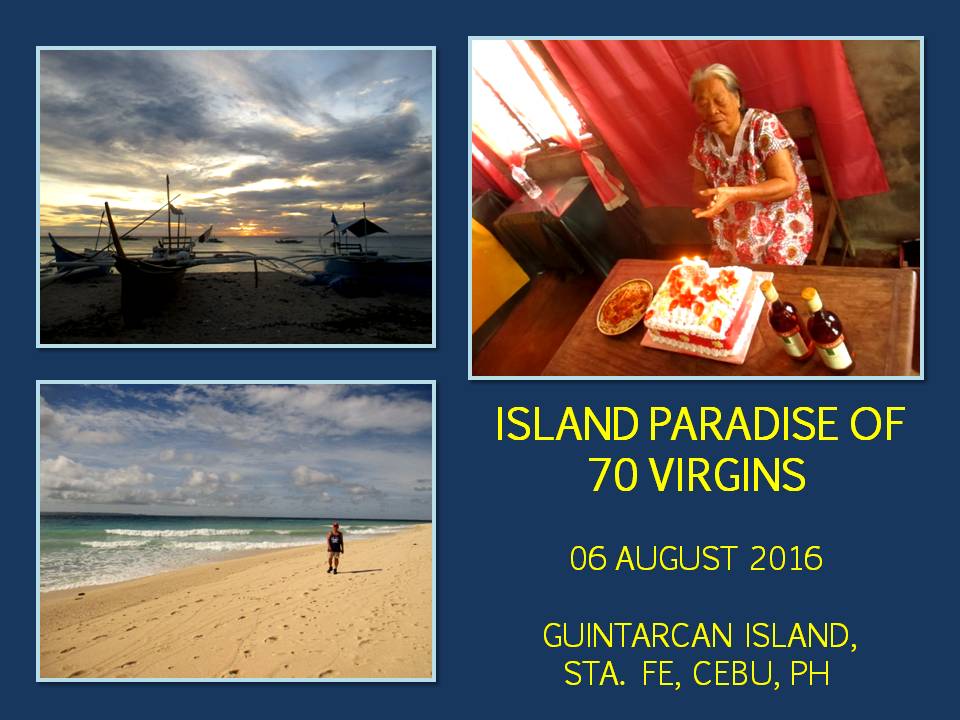
IT IS A SUNNY AUGUST 6, 2016 MORNING. The storm just left a day ago and I am here standing at the edge of a shoreline in Kawit, Medellin, Cebu waiting for my turn to board the wooden-hulled boat for Guintarcan Island. Boy Toledo is now climbing up a narrow ramp towards the deck of the prow followed by his wife Belen, his daughter and son-in-law. Ernie Salomon and Boy Olmedo are repeat visitors while the rest are first timers.

Everyone are excited. Even Boy T, and Belen, who is a native there. This would be my ninth visit after more than a year. I was there last time as the local coordinator and guide for Wine to Water last December 2014. It was a humanitarian mission geared towards improving the potability of water for residents affected by Typhoon Yolanda and by Typhoon Ruby with the distribution of Sawyer water filters.

I am here as an unofficial tour guide this time, gaining nothing for my time and nothing again for my efforts of resisting the island heat. It was Boy T’s idea after all, borne out from that liquid sucked from the mouths of frosty below-zero beer bottles, and I have to dance with his tune. Boy T always loved to celebrate and, this time, he will celebrate his survival of another mild stroke which happened a few weeks ago. I am happy about his recovery and I am generous with his idea.


We will all stay three days and two nights at his mother-in-law’s house. Tita Rosos, the matriarch, will celebrate her 88th birthday on the second day and the Toledo family will witness that occasion along with us. Boy T and Belen even brought a brand new freezer to add to the old refrigerator. The house, which was destroyed by Typhoon Yolanda in November 2013, would now have been repaired by this time. I have witnessed how the community of storm survivors rallied around the old house to make their lives bearable.

The sea looked serene but when we are now about two kilometers offshore, waves tossed and rocked the small boat and spewed spray and mist above the gunnels. The island’s lighthouse stood prominently on a hill, its white paint reflected sunlight in a glare. Right in the middle of the island is a patch of white sand that extend all the way below the lighthouse. The boat helmsman is aiming now for that patch of white.

Out came the passengers, one by one, when the boat landed on the beach. The narrow ramp served as the ladder to reach dry land. When I visited here the second, third and fourth times, I jumped from the prow into the beach like a swashbuckling Pizarro, even as the boat was still lurching in the waves and unable yet to secure rigging, probably causing the skipper’s heart to skip a beat with my act. I have mastered this stunt while as tugboat crew in my younger days. That agility is not yet gone but it just lacked the opportunity as I was astern.

The old house is completely repaired except that the retaining wall facing the shore have not been rebuilt. The serpentine papaya that hugged the ground is gone. In its place is a pile of hollow blocks waiting to replace the crumbling fence. Lola Tita, smiling and upright despite her age, meet us at the foyer and welcomed us all into her home. I kissed her right hand and went back to the courtyard.

I found a spot to set up my bright red Silangan Rev20 tent. I bought this last December 2014 yet I have not had the opportunity to learn how to set it up and to sleep in it and this would be the very first time ever for me. It is almost brand new since it was only used a couple of times by my son and by clients from Poland. It is not free standing and would need pegs to keep the outer shell erect when the stringed pole is inserted and fastened to the retaining grommets on both ends.

The inner shell could be attached inside the outer shell by a system of ladder locks. Then you have to insert two short poles on both ends of the tent to add rigidity. Right. The problem is the sleeves of both pole inserts are just too tight to make attachment seamless. I tried hard and gained success only after I have worn my reading glasses. What if it were in darkness? A dog stops by and quickly took a leak on my tent. Quickly too, a pebble came its way.

Justin Apurado, Locel Navarro, Judy Jane Neo, Christopher Ngosiok, Amaya Montecalvo and Marilyn Mansukhani and husband decide to keep me company on the courtyard in their tents or in their hammock sets. Everyone’s busy with their adjustment to a new environment. There is food cooking as the aroma wafted into my nostrils. I surveyed the back of the house where the “dirty kitchen” is located. I believe I need coffee to let my thirst settle down.


When I have that first slurps of coffee, immediately, my mind goes working. Planning and organizing a trip on the spot on an island that offers a wide variety of features are sometimes knotty. I have suggested to Boy T that we visit the La-aw Lagoon after a few minutes from now and we would have to hire a small boat to bring us to its seaward side. I came to appreciate the value of the lagoons and it is just right that the islanders managed it themselves that no structures be ever built.

Guintarcan Island, for all its location, accessibility, beautiful features and bounty, is surprisingly undeveloped. For me, I would rather have it stay that way. The islanders seemed content with what they have and with what they reap from fishing and farming and, besides, they were able to sustain the education of different generations of children for so many years with their present means of livelihood. They do not need expansive tourism and all those resorts. Drug addiction and crime is absent here.

Let Guintarcan be spared of development and commercialism which other islands are supposed to be reaping. I have known of many island resorts that became popular tourist destinations but behind that glitter and pomp are social problems hounding the communities like high cost of living, increasing crime incidence, drug addiction, pollution, diminishing fish catch, land ownership squabbles, sea access problems, environmental degradation and scarcity of resources. Only the resort owners became rich.

After a few moments, we took a shortcut by sea to the mouth of the lagoons. The boat has to enter a narrow channel where a rock concealed the outer lagoon from the sea. The boat skipper cut the engine out and slid his small boat slowly between the rocks. We are now inside the outer lagoon where a big rock canopy obscure the sun and Google Earth, completely putting us in its shade. Meanwhile, a fisherman and his family are drying kelp on the other side of the rocks.

A passage in the hole on the rock lead all to the second and third lagoons. The color of water here changes into a bright aquamarine. Below the surface are grape-like seaweeds (Local name: lato) growing wild. Swimming is ideal. All around are steep rocks with wild vegetation. I spied a couple of fruit bats hanging upside down from one of the tallest trees. I left the bathers to meet the second batch of bathers that will soon arrive.

For two hours, everyone enjoyed the novelty of swimming on the lagoons while I stood watch on a ledge. My curiosity somehow peaked a bit as I see a scant path leading into an opening. There are small cave mouths among the rocks and there are traces of recent digging activities. Going further, I found an open area that seemed to suggest of an old human intrusion or habitation. Much much older than we thought it to be. This could be an old burial ground or where they do their rituals.

I looked around in the open for animal bones. Perhaps, if I have more time, I could sift it below the ground. I might even find pottery shards or crude tools. One by one, the bathers have had enough of the lagoons and are now in the process of transiting into exit mode. A trail wind among the small but wild forest into a narrow pass that somehow gave a bit of protection of the place from overland intrusion. We walk on flat terrain then onto a dirt road.


I decide to bring the troupe to a long flight of stairs down to an iconic beach that I loved to post in Facebook: Hagdan Beach. It is a small cove and fishing village with pristine white sands and hundreds of small fishing boats secured by stilts on dry land. It is a beehive of activity today. Kids are swimming everywhere, playing tag-and-go in the water, the women busy drying kelp and fish while the men mend their fish nets. We joined the kids and become like them.

But not for long. We climb up the stairs and made our long journey back to Dapdap on foot. Our lunch would be available by now. It is already 14:30 and everyone’s hungry and it is five kilometers away. Vacant motorcycles-for-hire called for passengers which some took but the rest brave it on the narrow concrete road. I noticed the islanders do not walk far distances anymore relying more on the swift and relaxed travel that motorcycles afford.

Prickly pear fruits are now ripe and we pick some on the way, including the leaves. The islanders have never understood this cactus plant for it is an introduced species from the deserts of North America. On the other hand, the wide fleshy leaves are made as canvass board instead to write personal graffiti or as target board to shoot marbles at. I must teach them that this is another source of food and to introduce to them an obscure Cebuano name for that as tabal.

I was the last to reach the Rosos house and I enjoyed the late meal at 15:45 but I am used to it. Afternoon is now coming to an end and, soon, it will be dusk. Boy T had already opened a second big bottle of San Miguel Pilsen. Cold beer is a rarity in Guintarcan. Electricity is available only at 18:00 until 22:00. We brought frozen ones in five cases and stuffed them inside ice boxes and what available space inside the refrigerators. Soon there will be electricity to keep those beer perpetually cold.

It did not. We eat supper under the glow of candlelights and it sufficed to improve our appetites better than being under artificial lights. Sitting on the courtyard in total darkness holding a cup of beer is a wonderful experience. The Milky Way and all the stars are strikingly clear in an island sky. The glows of Daanbantayan in mainland Cebu and the combined one of Ormoc City and Isabel in Leyte stood out on the far horizons. Blinking red lights marked the passing of jumbo jets. I wonder if we could catch an orbiting satellite?

When the crowd on the courtyard begins to go sparse until I am alone with Ernie on the last bottle for the day, I would now have the honor of claiming the sleeping space inside the Silangan Rev20 and my first time ever so. The tent’s length is just enough for my reclining height. My crown touched the fabric and the balls of my feet as well. It is a single-person tent. It does not matter. It has enough space to store all my things dry. I wonder how the two Poles fit in?


The second day – August 7 – starts on a good note of a glorious sunrise. After the usual early morning ritual of sun worship and coffee, I see a broken axe. I volunteered to fix it. I will have to remove first the remnant of the handle wedged tight by several nails inside the eye of the axe by burning it. The extreme heat might affect the temper of the steel but the axe is not a precision tool so I let it be. Besides, its use is confined only to splitting firewood.

I looked around for a handle material and found a discarded piece that used to be part of the old house. It is a hardwood known as molave (tugas lan-han) and it is old and well-seasoned. Immediately, I shaped it with a native bolo and, finding it unfit for the job, I looked for another and borrowed Amaya’s Knifemaker Custom Bolo which does a respectable progress.

I was engrossed in my work and I stopped it when Lola Tita was presented a cake and a candle to blow. We sang a birthday song for her and everybody took a piece of the cake. Breakfast is served and, soon, we will be on another tour on the other side of the island. Marilyn and husband, meanwhile, decide to leave early to pursue their household chore of rearing a child and caught an early trip to the mainland.

Meanwhile, I have to bring with me the axehead and the hardwood to Cebu so I could make a better job with all the tools I need. It would not be perfect, unlike machined lines and curves, since it would be hand-made but it will be a custom classic once it is done. I make my own wooden handles for my hatchets and hammers and these are unique pieces complemented with Southwest Native American art carved on it.

The morning turned into a very warm sky. The heat from the sun bounced off the fine white sand as we walked the shoreline to our destination, which will be Cantingting Cave. It is a big cave which I first entered on my first visit in 2009. That time, I was experimenting a novel idea of catching cave bats for subsistence. I caught four. I used this same method during my fourth visit in 2012 while co-hosting in the filming of NATIVE INSTINCT, a reality survival TV project. The show failed to take off due to severe technical problems.

The way to the cave is now about to be guarded by a government building – the Langub Barangay Hall – still in the works. It is a Sunday and it is abandoned. We followed the path up the hill and found the cave. Everyone donned their headlamps and carefully navigate along irregular levels of ground. The cave is now cleaned of guano but it still stank. The chamber walls are dotted with excrement of individual bats and it looked like a giant leopard hide.

The cave bat population is not that great anymore as when I first encountered them. In 2009, it swarmed the entrance as it flee from our intrusion and disturbance. Although a lot are flying all around near the roof, they seemed not threatened with our presence and did not even bother to swarm out of their habitation. I waited outside as the neophyte cavers take their fill of Hades.


We are following a road back to Dapdap but there is one more feature of the island that I need people to visit. It is the lighthouse and it is on top of a hill. The route to there is already obscured and I have to use my tracking skills if there are still traces of people and grazing animals. If not, I would use traditional navigation to reach the top.

I and the rest failed to bring a big blade for clearing a path and I have to use my hands to break off branches getting in my way and feet to bend bigger branches back. It is slow painstaking work and draining. My hands are sore, my arms and bare shins suffered cuts. I have to pay special attention for anything that might threaten an eye and remove it away even though I consume so much time.

We reach the lighthouse and the fence is locked. It is operated by solar energy and people came here often to maintain the batteries. On one corner of the fence, outside the property, are empty plastic bottles of what used to be distilled water and battery solutions. Improper disposal of toxic material is happening right on this island paradise without the residents knowing.

We retraced our path and walked the rest of the way to Lola Tita’s house. Boy T bought a pail of fresh seashells composed of spider conch (sa-ang), juvenile giant clams (takobo), leopard cowrie (sigay), mother-of-pearl oysters (kapis) and conetips (ahong). This would be a good addition to the goat meat dishes that is now being cooked in honor of the birthday celebrator.

The house is busy with some visitors and I have to scurry myself to the beach to dip in the coolness of the sea, away from the heat, and to heal my cuts with the natural saline solution. When I am done, lunch had already been served and I made a backdoor maneuver to zoom in on the spicy goat innards (paklay) that Ernie had been cooking. On a neighboring smoldering pot is goat stew (kaldereta) which I wolfishly placed on top of the other on my plate. 
 
There was not much to do the rest of the day. The last bottles of beer have been consumed and it is too hot inside the tent to sleep. I decide to thin the axe haft with the Knifemaker Custom Bolo. Then when it got cooler, I crawled inside the tent, with the door opened wide so breeze could enter. I read a book – National Geographic’s New Age of Adventure – and got drowsy. It rained. I woke up and closed the tent door and resumed my dreamtime.

I woke up again and it was almost dusk. I got up and made for the house in time to see the same dog yesterday marking his territory again on the same spot of my tent. I was too late. I resumed reading sitting on a chair. Another dog, raised his right leg to take a peek and a pebble got him this time and it yowled in pain. I washed the abused part of my tent and placed a barrier.

Dinner time came early and seashells galore. People do not know anymore how to cook seashells. All the flesh have contracted deep into its shell during the time when it was boiled and you have to smash it with a hammer to get to the meat of it. It was a nasty undertaking and I have to revert to food that was served during lunch.


We waited for the lights to appear and it did an hour after 18:00 and it only lasted about 15 minutes. Now I am talking with Boy T about energy self-sufficiency and renewable energy. Without beer, the drinks shifted to something stronger like Emperador Light Brandy. Only a few took the chance to join us. Nevertheless, we have to empty the bottle before calling it a day. I crawled to the comforts of my tent and forgot everything.

Early morning of the third day, after coffee, we break camp. Stowed everything inside my Silangan Predator Z bag. The rest did theirs. We are now ready to leave the island for the mainland. Lola Tita walked to the shore to send us off. She never left the place where she stood until I could not see her anymore as the distance become so great. I wished her well and may she have more years. She is really a good lady. A perfect matriarch.

Document done in LibreOffice 5.2 Writer

Saturday, July 25, 2015

POST-TYPHOON RUBY ISLAND MISSION

I GOT TAPPED AGAIN to assist and be involved in yet another humanitarian mission to Guintarcan Island, off the coast of Northern Cebu.  I had been there seven times; four as a local tourist and three more as a relief worker.  So, this would be my eighth trip there.  The Children of the Coast Foundation, for the second time, make use of my familiarity and knowledge of the island today, December 13, 2014.  Aside that, I will do the documentation.

CCF is engaged in philanthropy works that focuses in the betterment of marginalized children, those of which are considered vulnerable.  CCF is working with Wine to Water, a US-based charity organization that specializes in providing potable water to the poorest communities of the world by any means using technology.  The recipient of this mission is the post-Typhoon Ruby (Hagupit) community of Langub.


Supervising this activity is Wine to Water’s international project coordinator, Mr. Brad Ponack, who came here all the way from Cambodia.  Joining us is CCF’s executive director, Ms. Jonnette Alquizola.  A coaster van and a double-cab pickup are loaded from CCF’s depot at Mandaue City and left for Daanbantayan at 05:45.  By 09:30, me and my three crews begin transferring the items from wharf to a small outriggered boat.

The items were 50 pieces Sawyer Bio Bucket Filter, 40 pieces 20-liter water container, 40 pieces 20-liter bucket, 40 kilos rice, 80 sets basic health and hygiene kit and 80 pieces towel.  Mr. Ponack came along for a ride together with two of the crews while Ms. Alquizola opt to stay behind and utilize the remaining crew to help her distribute the other items not loaded into the boat to a community in San Remigio.  

Typhoon Ruby did not intensify into a super typhoon as was forecast but it stayed for four days in the Visayas region bringing rain and storm surges of 3 to 5 meters high which threaten shoreline communities and small islands.  As we cross the Bantayan Channel, swells of up to one meter threaten our small boat brought on by another weather disturbance approaching the islands.  We reach the village of Langub at 10:40 and, immediately, we transfer the items straight into the home of the village chairman, Mr. Rolando Villacarlos.


Mr. Villacarlos welcomed us and showed us his rain-impounding system installed on his house after Mr. Ponack inquired of how they source fresh-water.  This system is common in most households but is not altogether reliable owing to the need of frequent rainfalls as a source of drinking water to support a family the whole year round.  Then you have hygiene issues.  Impounded rain would have to be boiled or filtered for it to be potable.  Boiling needs heat which a private power plant supplies electricity for just a few hours only which is costly.

After Typhoon Yolanda (Haiyan), several relief agencies and non-government organizations donated different water filter systems to improve the living conditions of Guintarcan residents.  Mr. Villacarlos showed one such type, which is a Korean-made ceramic-type filter.  It is well-maintained but the lack of replacements for the filter elements have hounded the other households to condemn it and utilize it for other uses instead.  

We had observed that relief agencies/NGOs had not bothered about the filters that they had donated and left it to the fate of the locals or that it had not been their priority.  Actually, the supply of filters are available in the big cities like Cebu and Manila and it is just that the residents are not knowledgeable of its availability or that the filter replacements are expensive.  But the big obstacle is maintenance.  The residents just lacked the know-how in the care of their filters.


We learned also that a private enterprise located on the island are supplying households of drinkable water.  The water is sourced from a deep well in the middle of the island and pumped to the surface and converted from brackish to fresh water by reverse osmosis.  A 5-liter container costs 35 pesos but not everyone have cash to buy one bottle to last for a week.  So we looked instead to some residents who really are vulnerable for which Mr. Villacarlos is now tasking himself to produce with a list.

Meanwhile, we decide to check on the lone public school of Langub.  We talked to one teacher and we were informed that there are a total of 344 students in seven different grade levels.  The school has two modern rain-impounding systems which were built and donated by Mercy Corps and each classroom is equipped with a Sawyer filter system each given by the All-terrain Medical Relief Organization.  Almost all filters are working but a few had worked below its expectation.  This is caused by lack of knowledge.

Mr. Ponack fixed one existing filter system and added another better system for the Grade 4 Classroom.  For good measure, Wine to Water donated a total of seven Sawyer Bio Bucket Filters to the Langub Elementary School to bring to a total of 14 filter systems or two filters each per classroom.  The present system is an improvement of the existing which only utilized a plastic jerry.  This time, Mr. Ponack ensures the students have a stock of enough water by attaching the filter to a bucket with a lid and its flow of clean water going into a jerry.


Before leaving the school, we gave the Grade 4 teacher 56 sets of hygiene and health kits for her 56 students.  When we got back to Mr. Villacarlos’ residence, we were feted to a lunch of freshly-caught fish, grilled on charcoal, to add to our packed meals of fried chicken, spring rolls and rice.  It is 13:10 but Mr. Ponack have a lot of work to do.  He has to attach the rest of the Sawyer filters plastic jerries and buckets and he has two of the crews to help him as I will do a little exploring.

I found four rowhouses of 10 units each which gave shelter to the households that was displaced by Typhoon Yolanda.  The vegetation had recovered well and youths are playing basketball on a concrete court.  I walk past houses whose concrete floors are half-covered with white sand.  I understand a strong storm surge had caused sand erosion from the seabed into the shoreline and into the main road of this side of Guintarcan.  Langub had bore the brunt of Typhoon Ruby on the island.

I visit Judith Illustrisimo, who had hosted me during my first relief mission here last year together with the crews of the Death Valley Expeditionary Corps, a US-based humanitarian aid group composed of private security and military contractors.  She is selling fresh fish for me – cheap – and I ordered two kilos, for which she gave me more than that for 200 pesos.  I gave thanks and said goodbye and went back to where I came from, passing by the road.


On the way, I saw a white steel box.  I came nearer and I discovered a small solar-powered desalination plant.  This was donated by the Italian contingent of Oxfam just this year.  It gets its water from a very deep hole in the ground, pumped to the surface by clean renewable energy supplied by photovoltaic panels and by wind vanes.  Ultraviolet tubes cleans the water of impurities and bacteria before it pours out of the taps.  Ingenious.

By now, people are beginning to converge at the house of the village head.  Mr. Ponack and the crew are almost finished with the assembly of the water-filter systems.  Joseph Rojo, one of the crew, begins to explain to the residents in plain Cebuano dialect, how and when to clean the filters.  Then we delegate the distribution of all the relief items to Mr. Villacarlos.  

It had started to rain when we left the island at 15:00 and boarded the small boat back to the mainland.  We encountered slightly rough seas in the middle of the Bantayan Channel but I am undaunted.  The boat touched base at 16:00 and, immediately, we left the wharf for Mandaue City. 


Document done in LibreOffice 3.3 Writer
Wednesday, May 7, 2014

ONE LAST BIG SUPPLY RUN

AFTER LEADING A SERIES of small humanitarian missions which my company had recently engaged me in at Bohol (after the earthquake) and at Northern Cebu (after Typhoon Yolanda), I was tapped again to lead another one. This time it will target the island of Guintarcan. I had been on a similar mission to this same island – twice – with the US-based Death Valley Expeditionary Corps last November but this will be bigger. Under me are nine people who will share the burden with me.

My company had been requested by a local foundation to provide personnel and security to accompany and to compose the manpower by which this relief action would pursue. The relief goods and all the funding for the logistics, travel and victuals were provided for by an organization from Copenhagen, Denmark which were channeled to this foundation. Off for distribution are 3,800 liters of drinking water, 3,800 kilos of rice, canned goods and six sets of “wine to water” filter system.


We started loading the relief items from the depot to two trucks in the late afternoon of December 20, 2013. By 2:00 AM of the following day (December 21), we left Mandaue City for Daanbantayan, northern Cebu. We arrive at 5:30 AM and proceeded to the municipal wharf to eat pre-cooked breakfast and to await the coming of the contacted boats. Only two came instead of three and I find it inadequate and time consuming should I utilize these same boats for another run.

I used my connections with some residents of Guintarcan Island and I am able to secure another two boats to haul the rest of the cargoes. All the boats were loaded to its full capacity and each boat were accompanied by, at least, two of my members. The boats are destined for the village of Bitoon from where all the goods will be distributed to all island residents, which also includes the neighboring villages of Hagdan and Langub.


We had already developed a system to distribute the items and my previous experience of humanitarian trips in Langub had given our relief work some degree of smoothness. I had solved half of the difficulties pertaining to the organizing and the distribution and the rest is up to the village chiefs. The island residents converge in the village square of Bitoon as they learned of our coming and my companions are awed by their helpfulness and their honesty when we need hands to unload the goods from boat to shore to village square.


First to be provided the relief goods were the inhabitants of Bitoon, who formed lines according to their respective neighborhoods with four tables used as the receiving area. Coupons were distributed and each coupon-holder will receive two liters of bottled water, two kilos of rice and two canned sardines. After them, came the turn of Langub residents and then last are those coming from Hagdan. The items were evenly distributed and I see a lot of smiling faces.

We eat our lunch, provided for by the village council of Bitoon in appreciation of our purpose, whenever one or two of us are momentarily free during the relief-goods giving. When all this are finished, one of my members, Allan Nadela, explained to the three present village chiefs and their respective councils about how the water filter system work. A filter is attached to an outlet pipe from a 10-gallon pail and soiled water is poured into it where clear water gushed forth from the filter spout.


Allan drank from this water to demonstrate to all that it is clean and very safe to drink. Two filter systems each are then donated to the villages of Bitoon, Langub and Hagdan, whereby it will be used as communal drinking-water source. Guintarcan Island do not have surface fresh water and they source their drinking water from the mainland and from rain. Some households own water tanks to store rainwater but Typhoon Yolanda had destroyed all houses here and catching a good volume of rain is now difficult.

We leave Bitoon at 2:30 PM and proceed to Langub by a motorboat to pick up dried fish to bring home and a hot meal of a big fresh rabbit-fish provided for by Judith Illustrisimo. We arrive at Daanbantayan at 4:30 PM and proceed to take our places on the two trucks which we parked at the wharf in the morning. We arrive at the office at AS Fortuna Street at 8:30 PM after a thankful supper in a popular but very cheap diner at AC Cortes Avenue.


Just like all relief operations undertaken in Tacloban City and in Samar, a political clan tried to take credit that the distributed goods are coming from out of their good nature. A septuagenarian form Bitoon approached me and asked me about this which I denied outright. A big tarpaulin is attached at the stage to where we are using as a distribution point with the big bold letters saying that it is FUNDED BY THE FILIPINO DANISH COMMUNITY.

What a shame!

Document done in LibreOffice 3.3 Writer


Saturday, March 8, 2014

OPERATION GREENE


AFTER TROPICAL CYCLONE HAIYAN pummelled the Philippine Islands last November 8, 2013, the Death Valley Magazine, through their Death Valley Expeditionary Corps, came to Cebu to engage in a humanitarian mission. Also known as Typhoon Yolanda, Haiyan was the strongest storm that the world had ever experienced in its entire modern climatic history with wind strength at 215 KPH and above. The islands of Samar and Leyte bore the full brunt of the storm as well as Northern Cebu and some parts of the Visayas.

DVM is an online magazine about professional adventurers and interesting people while the DV Expeditionary Corps is its humanitarian arm. It gets its crew from the very places where they go to execute their relief missions and expeditions just like they did at Guintarcan Island on November 23 and 24. Their Philippine contacts were from the Camp Red Bushcraft and Survival Guild, a Cebu-based club of outdoorsmen who are passionate about primitive-living skills and knives.

James Price, founder of DVM, decided to continue with what he started in Guintarcan by pushing for more aid for the island residents and so the DV Expeditionary Corps executed OPERATION GREENE. It is a much bigger relief operation and much more organized with the involvement of two trucks, a good-sized motorboat, a chainsaw, carpentry tools, 20 gallons of gasoline, five kerosene lamps, a stove set and more manpower. Crews coming from Camp Red (with support from the Don Bosco Technical High School Batch ‘94) assisted Operation Greene that targetted the small communities of Pasil and Dapdap in Guintarcan Island.

The DV Expeditionary Corps left Cebu City for Medellin on November 30 in a convoy of four vehicles provided for by DBTHS ‘94 with cargo of locally-sourced goods like old billboard tarpaulins, laminated nylon sheets, mushroom nails, GI wires, roof sealants, biscuits, candies and a ton of bottled water which were transferred from shore to shore over the Bantayan Channel.

Operation Greene is named after American philanthropist, Brett Greene, who gave the bulk of the funds which the people of the United States of America provided for this second segment of the Typhoon Haiyan Humanitarian Mission. Moreover, Operation Greene assisted and donated cash to one household to rebuild a damaged motorboat and on another household to put roof over a battered house.

The crew returned to mainland Cebu on the evening of the following day, December 1, after a very successful aid mission. Camp Red crews who participated were Jing de Egurrola, Ernie Salomon, Glenn Pestaño and Justine Ianne Abella with Jhurds Neo as base support. The succeeding montage of images told of the two days that Operation Greene undertook:


Document done in LibreOffice 3.3 Writer

Friday, February 14, 2014

A HUMANITARIAN MISSION OVER GUINTARCAN ISLAND

DEATH VALLEY MAGAZINE, through their Death Valley Expeditionary Corps, came to Cebu recently to engage in a humanitarian mission to ease the plight of the communities caused by Tropical Cyclone Haiyan. Haiyan, also known as Typhoon Yolanda, was the strongest storm that the world had ever experienced in its entire modern climatic history with wind strength of 215 KPH and above. It struck the Philippines on November 8, 2013 leaving a wide swath of destruction and death. The islands of Samar and Leyte bore the full brunt of the storm as well as Northern Cebu and on the rest of the Visayas.


DVM is an online magazine about professional adventurers and interesting people while the DV Expeditionary Corps is its humanitarian arm. It gets its crew from the very places where they go to execute their relief missions and expeditions just like they did at Guintarcan Island recently. Their Philippine contacts were from the Camp Red Bushcraft and Survival Guild, a Cebu-based club of outdoorsmen who are passionate about primitive-living skills and knives. They were Jing de Egurrola, Glenn Pestaño, Ernie Salomon, Dominic Sepe, Faith Gomez and Justine Ianne Abella with Jhurds Neo as base support.

James Price, founder of DVM, arrived at the Mactan Cebu International Airport in the early morning of November 22, 2013 and brought with him relief goods donated by the people and servicemen of the United States of America. Mr. Price decided to augment his cargo with locally-sourced goods like powdered milk, canned sardines and beans, biscuits, laundry soaps, candies, disposable lighters and bottled water.

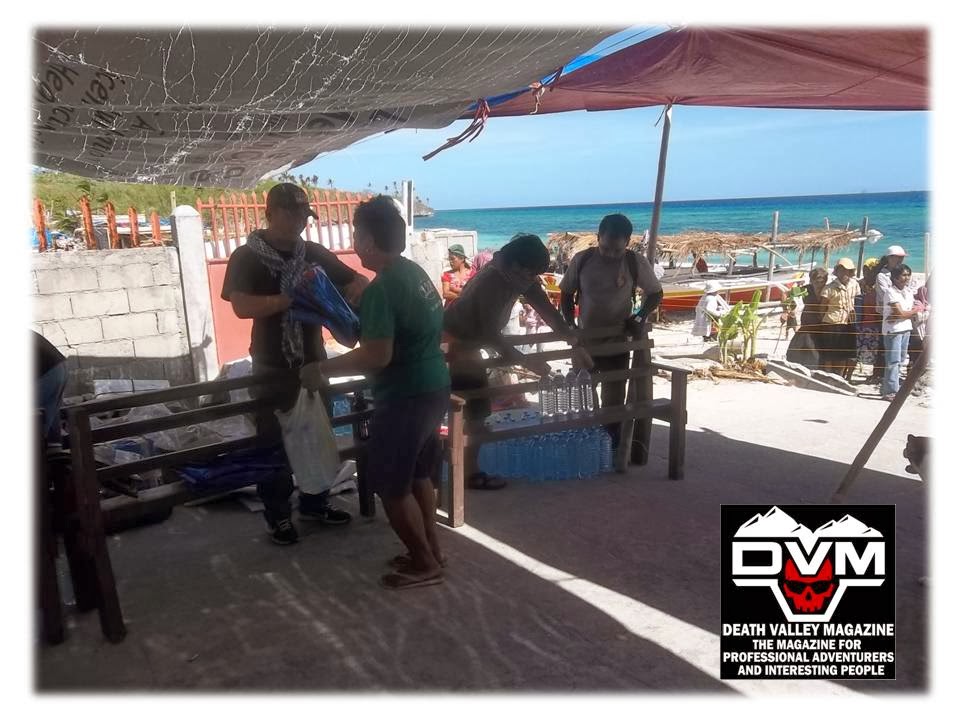
On the morning of November 23, the DV Expeditionary Corps proceeded to Medellin in a convoy of two vehicles provided by Gerald Ortiz and the Don Bosco Technical High School Batch ‘94. A small motorboat ferried the crew and cargo over the Bantayan Channel into the small village of Langub in Guintarcan where the relief goods were distributed. A good number of affected households came to avail of the said items that Mr. Price personally distributed.

The DV Expeditionary Corps transferred to a seaside community of Dapdap and used the partly-damaged house of Tita Rosos as its base camp from where it reached out to the needs of the residents like the field treatment of the wound caused by burns on a youth that Mr. Price dressed and ocular assessment of the area. The crew returned to mainland Cebu on the following day, November 24, after that successful aid mission. Below are the collage of photos that document this activity of two days:


Document done in LibreOffice 3.3 Writer

Tuesday, July 23, 2013

PINOYAPACHE AS AN "ISLAND CASTAWAY"

REALITY PROGRAMS MADE for cable TV are very interesting and educational and command such attention by viewers all around the globe, especially concerning primitive-living skills and survival. Bear Grylls is the name that usually crop up when my mountaineer-friends talk among themselves ever since I begin to attend again membership meetings with my old club after a long hiatus of eleven years.

That was in 2007 and, unfortunately, I do not have a cable TV connection. Even today. Anyways, the things that Grylls did, which I overheard from my friends, were quite familiar to me and I could do that as well with much finesse and sanity but, being a mountain climber then, I was wrench-locked to follow the principles of this foreign ideology called Leave No Trace.

As I slowly veer away from LNT, from insane mass climbs and from my former club, I begin to practice free-rein outdoorscraft like survival and wilderness skills. A recent Cebu visitor, Thomas “Tomahawk” Moore, have greatly influenced me on this when we met in September 2009. The joys of having a small campfire is a freedom that I love to cherish most as well as my freedom of unimpeded movement like solo hikes and cutting across virgin ground.


In January 2010, I established a club called Camp Red Bushcraft and Survival Guild. This is the only one of its kind in the country and I organized the annual Philippine Independence Bushcraft Camp every June 12th as its main activity. Not only that, I begin to make videos of myself doing things I loved best and uploaded these to the Warrior Pilgrimage Channel in YouTube.

As the pleasures of my new-found interest guided me, names of other TV survivalists like Les Stroud, Ray Mears, Mykel Hawke, Cody Lundin, etc. begin to surface up. To be honest, I have never watched a single show of these survival shows and it was only in August 2012 when I finally saw what Grylls looked like and what he did in his show when a video was uploaded at Camp Red’s Facebook site by one of the members and it was about le Legion Etrangere.

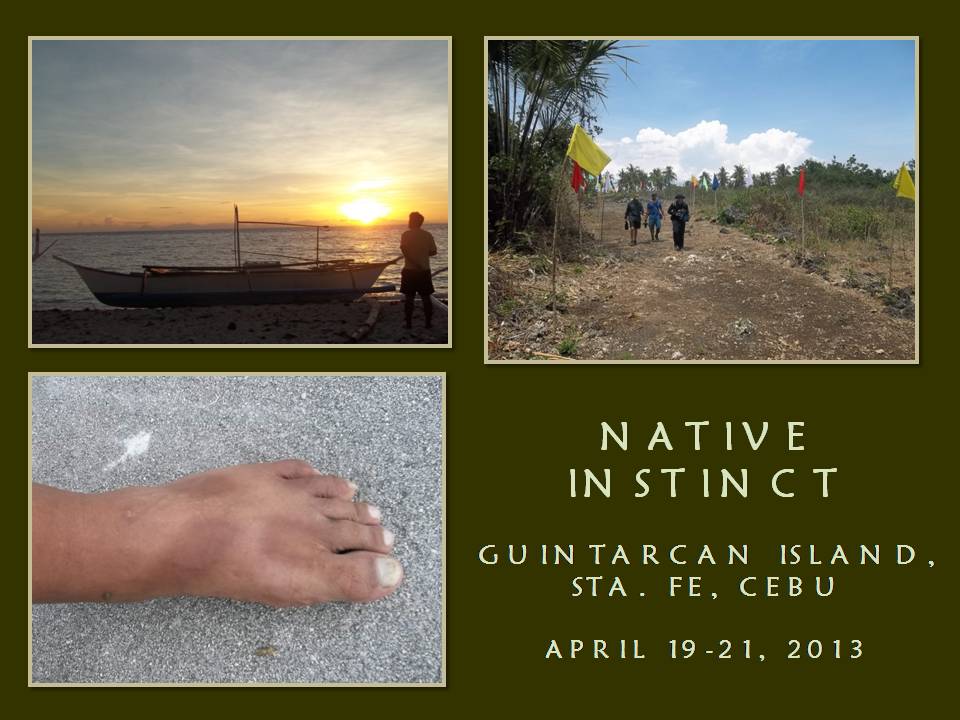
When I teamed up with William Rhys-Davies in January 2013 to put up Snakehawk Wilderness Skills School, a small production outfit wanted to do a series of video shoots about tropical bushcraft and survival in the Philippines. The location of the first episode would be in Guintarcan Island, Santa Fe, Cebu and it would star, no less, by Rhys-Davies and myself. For this project, I was provided two videos of Ray Mears for study. It was the one shot at Costa Rica and another at Palawan.


On April 19, 2013, we left the mainland and cross the Bantayan Channel for Guintarcan. Our host is Mrs. Tita Rosos, who accommodated us all into her residence which became our base camp. The video crew consist of the producer/director/cameraman – Matt Everett; cameraman – Prem Ananda; two personal assistants; and a medic – Casey Ballard. Aside that, we hired Tady Rosos as our man Friday and the boat owned by Inday Dabalos

The videocam begin its shoot as the outriggered boat begins to set sail for the island. The weather is perfect giving us a very calm sea although the heat and humidity are at a high swing and would later take a toll on the exposed skins of the cameramen, the medic, Rhys-Davies and, mildly, on myself. The show, according to the producer would almost follow along the lines of Dual Survival of Cody Lundin and Joseph Teti but with a different twist.  Guess what that would be? But, who are these guys? 

The first segment for the first day is catching us swimming from boat to shore about 100 meters distant in our clothes. I am wearing a light-blue rayon T-shirt, a dark-blue Rohan long pants and a pair of beachcomber shoes. Rhys-Davies is in his Lowe shirt, a Silangan hike shorts and a pair of Salomon shoes. There were a lot of shots from different angles above the surface and underwater; two-way dialogues; and one-on-one talks to the camera.

Talking before a camera is nothing new to me especially if it is a self-shoot or done in jest with another. But with a professional-looking camera with a professional behind it, my self-confidence begins to waver. Feelings that I knew of during job interviews done long ago, suddenly came back at light speed. My eyes kept rolling to retrieve missing words, stopping me in mid-sentence, and, possibly, would make me look like a clown before a wide audience if not for retakes.

In the afternoon, the director need to do many retakes of our swimming prowess. We shifted scene afterwards and asked to make a debris shelter. While doing that, there are the usual dialogues between Rhys-Davies and me and then the one-on-one on camera. I was asked to forage for food, which I did, by plucking a ripe fruit of a pandanus tree. We ate the fruit explaining to the invisible audience of its taste and how it is eaten.


I split and cleaned both green and mature coconut palms with a William Rodgers bushcraft knife. The dry palm is hard but the blade make short work of this. While I was in the middle of driving the edge hard in the middle of the palm, the knife point nicked one of my fingers and blood spurted out. I have already expected getting cut by my new knife and it created a bond between new owner and blade. I remedy the discomfort by making a poultice out of Indian mulberry leaf buds after stopping the bleeding by elevation and direct pressure.

The knife had been given to me by the CEO of a native delicacy company just recently in appreciation of my outdoors prowess and for friendship’s sake. He is not just a knife collector but work on his knives to their ultimate limits. The knife comes with a leather sheath with Kydex lining which he himself made and dyed; quite rare for a business executive.

I was really exhausted after doing several repeats of sequences of holding breathe under water for almost the whole day, swinging from coconut palms in the hope of detaching it from the upper trunk and trying to polish off my pidgin English that I collapsed onto my ground tarp splayed on hot concrete after supper unmindful of the heat it refused to surrender. I slept like a baby under the bare sky.

After breakfast of the second day (April 20), we went back to our shelter and, part of the script, I would again forage for water and food which I found up a coconut tree which need to be climbed. I ascended below the crown and twisted two fruits with my hand and let it fall, cut a hole and drank its sweet water, and split it open to scrape the white meat. All these are but natural for me while Rhys-Davies made himself helpful by teasing a fire to life with his firesteel.


In the afternoon, we walked up a hill to shoot a scene inside and outside of Cantingting Cave to look for food. After some dialogues and talking to an invisible audience, I foraged old coconut palms and fashion these into three flame torches which we will need to light our way inside the cave and, hopefully, catch our prey. The script goes that we need to catch bats to sustain our survival.

The light from the flame torches are inadequate and make it impossible to catch bats so I place the torches upside down so it would bellow thick smoke and agitate the bats from its stupor high up on the ceiling and waited for them to swarm out of the cave. I position myself outside the cave mouth with a three-foot stick like Barry Bonds while Rhys-Davies stayed inside to shout and scare the bats. The bats did start to fly into my position and I whack five of these senseless. We now have solid food for the day!

It is dusk when we returned to the beach where our shelter lay. The camera focused on my skinning of the bat and I explained to the absent audience why I need to remove a certain part of the animal so it won’t spoil the meat. On the other hand, Rhys-Davies tried his darndest best to ignite a fire with partly-moist coconut fibers which he used as tinder. After a considerable amount of sweat running down on his brows, the flame flickered and danced.

Rhys-Davies sharpened the points of two bamboo sticks and I pierced all the dressed bats unto it and cook it on open coals. I talked to the camera how I reacted when Rhys-Davies failed to produce fire and talked also of my plans for the rest of the day and of the following day. We leave the set and returned to base camp. There was a slight shower after dinner and everyone heaved a sigh of good relief that the extreme heat of the day will soon dissipate!

The third day – April 21 – found us swimming by the shore and skimming for food on its part-sandy part-rocky bottom. This island is abundant of shellfish of different varieties and, it is only a matter of time before we will fish it out of the sea ourselves. There were many sequences taken by underwater cameras and too few moments to recover our breathe. It was a never-ending battle to stay under despite the onset of tidal current.

To counter buoyancy, I held on to rocks and, in the process, detaching these. Beneath some of these rocks are juvenile giant clams (sp. Gigas Pacifica). Elated with these discovery, I plucked out four clams while Rhys-Davies was successful with one. Using my knife, I forced it all open and removed the flesh from the shells and skewer it with last night’s barbeque sticks and cooked it again on bare coals which Rhys-Davies expertly provided.

When we have finished lunch, the rest of the afternoon is dedicated to foraging bamboo poles, which are abundant on the island, so we could make and float a raft and make a run for the mainland. We found a grove of spiny bamboos. The problem with this kind of bamboo is that the base is protected by a screen of thorns. I explained to the camera how I would extract the poles using a bolo and a knife.

I created a corridor by slowly removing the lower branches where there are spines. When these tangle with each other, these create a screen and always snag on anything soft like fabrics and human skin. I got snagged on the base of my thumb and blood begin to ooze as I started to cut and remove these. Altogether, I cut three poles which is about twenty feet each and drag it each time it is caught on the branches of a mango tree.

Slowly, one by one, to and fro three times, we shoulder the bamboo poles from the interior to the shore. I measure the pole by their segments and cut it with the bolo. The knife cleared and cut the knobs and branches. We were able to make six eight-foot long poles as our main deck. We have also provided four poles as our cross bars eight feet long. On the beach are four abandoned 5-gallon plastic containers with caps and a considerable length of nylon rope which a fisherman abandoned.


Rhys-Davies did the lashings as he is well-adept at this while I assisted him in feeding the ropes or reaching a rope end at the most difficult corners with a finger. The containers were distributed along the four corners of the bamboo raft and would be the main buoyant component while the cross bars would hold it like a vise. I provided two coconut palms, stripped of leaves and carved, as our paddles. We tested the raft’s sea-worthiness and it floated well with me and Rhys-Davies on board.

The last scene would be rowing from shore to other shore thirty kilometers or so away crossing the Bantayan Channel. Could this be possible? Are we in our right minds? Perhaps or perhaps not. But with perfect weather, with a sail and lots of fortitude and luck, why not? We could even make it by morning. This was the crux of the show but the director intervened by towing us back to shore with a motor boat and Rhys-Davies capped it off by promising his imaginary audience that we would be back for the next episode.

Document done in LibreOffice 3.3 Writer

Saturday, February 9, 2013

POEM #8: Crossing Bantayan Channel


-->

Just a speck on a map
is an island on the Visayan sea;
I cross the channel on a trimaran
guiding a group of Danes and friends.

Swollen waves, white-crested;
shook the small craft splashing spray.
I hold on to the mast and gripped a cam;
assuring my guests that it is alright to shoot pics.

A half-hour seemed eternity
as the boat struggled in mid-stream;
all are wet except our gear under a tarp;
ashen-faced and cold, perhaps, murmuring a prayer.

A half-hour more and it is shore.
The determined skipper ably steered
his boat through huge waves as it rocked.
Oh, what skill; now, spurred on by all eyes on him.

The last of the nautical miles
came fast as the last of giant swells
loosen its grip upon the hapless outriggers
gifting us pristine white sand and a preview of paradise.

A virgin island lay bare;
a prize for anyone with a stout heart
to cross rough seas on a northeast monsoon
with just a prayer, a paper sail and a banana in hand.