Showing posts with label Snakehawk Wilderness. Show all posts

Friday, February 7, 2014

THE GATHERING

I HAVE A HEAVY backpack today, August 30, 2013, and I see the trail that leads to the campsite in Lower Sayaw, Sibonga, Cebu quite daunting.  Although I am blessed with mild weather but it is humid caused by last night’s downpour.  It is quarter to nine in the morning and not the best time to start a hike.

I am with Faith and Justine.  Both have heavy backpacks as well and both are participants of the first-ever OUTLAW BUSHCRAFT GATHERING of which I, together with Wil Rhys-Davies, have organized under Snakehawk Wilderness School.  This activity is the brainchild of Wil.  It goes on for three days until September 1 and will be thoroughly different from the bushcraft camps that I myself convene every now and then.


I am sweating, breathing hard and my knees are uncannily so uncooperative today.  I stop so often to adjust to the pace of Faith and Justine who both are as much in a difficult bind than me.  It is a long way from Napo, Carcar from which we started our uphill walk and trees are a welcome refuge to shield us from the sun’s tormenting rays.

With my hand on an eco bag, I carry a big hard-bound children’s dictionary, vegetables and spices and a kilo of milled corn.  As we reach the middle part of the route, I volunteer to carry the two kilos of milled corn that Justine had been lugging so he could free his other hand which had been holding a tent set.  Wisps of moisture drop from the sky and cool me a bit but that’s all.  It is warm again when it is gone.

After ninety minutes of walking and getting winded of the effort, we reach the shoulder of the hill where the others are now waiting.  By now, the camp is only two hundred meters away but it is a far 200 since it is now 10:15 AM.  Nevertheless, I push on at a crawling pace and stopping short of our objective to avail of a shade offered by a mango tree growing on a hillside.

Beyond the bend, I see another mango tree and then another and then a tent.  Wil meet me and show me the rest of the campsite.  The designated camp is empty as all the shelters are erected at a small valley down on the other side of the hill but I need to give the book to the Ramos family first.  Then I go down and meet the rest of the guys like Glenn, Jhurds, Aljew, Christopher and Allan. 

Wil gave a welcome speech to everyone and talk about campsite selection and safety and personal hygiene.  As he was discussing, coffee is served and I drink a cup of it to pep me up after that tiring walk.  It is good to just be sitting under a cool shade but there is no breeze here.  Since it is almost noontime, everyone gets to work preparing to cook their meals. 

I need to secure water first for drinking and washing.  Coming with me to the water source are Jhurds, Justine and Faith.  When we have returned, they are now in the middle of their lunch.  We go back up the hill to prepare also our meals.  When we have eaten, the rest are gratefully taking their siesta.  It is cooler on the hill and I cannot understand why people camp at that small valley when I did not designate it as a campsite?

But I have an unfinished business and this will be the first activity:  Making a tripod seat for the men’s latrine.  I rally everyone to come up the hill with me where I stashed the wooden poles and retrieve it.  I will need it as the latrine seat.  Despite deprived of rest, I make an effort to do this task immediately.  

When we had brought the poles to the site, Wil and I proceed to lash a tripod together with cheap paracord.  When it was done, I chop a notch on two of the poles where a smaller pole will be lashed horizontally providing as the seat.  The tripod seat is then placed above the latrine hole which I have dug twelve days ago (CB 06: Digging Holes).   

Wil instructed the male participants to install a tarpaulin sheet all around the latrine in the same manner as that done earlier on the women’s latrine which was secured to six upright poles.  When we have finished the latrines, I go back up the hill and begin to set up my own shelter.  I need to set up my sleeping quarters before I could claim rest if ever there is one for daylight.


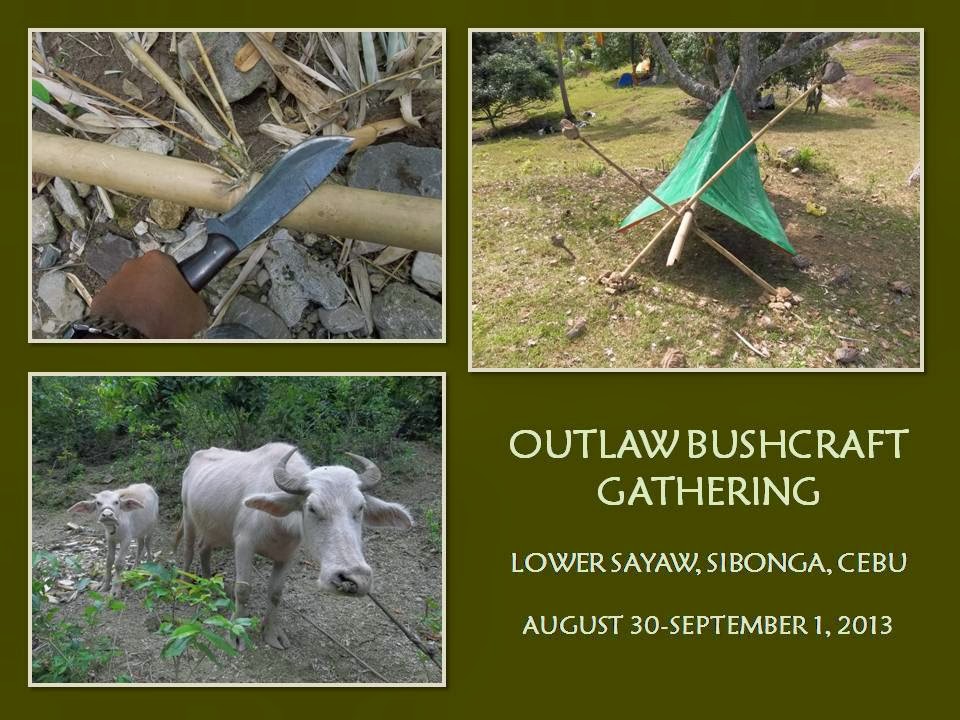
It is just a simple shelter with the longest bamboo pole of a tripod used as a ridge to connect to a jackfruit tree propping the tarpaulin whose four corners are secured by cords and wooden pegs.  A used advertisement tarp make up my shelter footprint.  The ultimate budget backpacker’s way.  Breeze will flow freely to cool the insides.

As I was setting up my shelter, those that had set up tents at the small valley transfer residence nearby Wil’s.  They opt to take advantage of shades under the mango trees and the uninterrupted breeze that their former campsite cannot provide.  Although the former site is a good place, it is not a safe area since it is a natural drainage and, aside that, it is hot and humid there.  

That is why I chose the upper ground as the designated campsite.  I could recognize a good campsite when I see one and Wil also could, based upon his wide experience.  Although there are coconut trees but these are planted in straight lines and you could set up your shelters in between and not underneath it.  You just watch out where you walk though.    

The rest of the afternoon are dedicated to conversations and socials.  Wil, by his many years at the outdoors, talked about his experiences as a traveller whether it be on a desert, a mountain, on snowed places or even on a city.  Conversations such as this are good staples in a campsite, especially in a bushcraft camp, although it is best beside a campfire with coffee or moonshine.            


When it is late afternoon, everyone prepared dinner for the first night.  Aljew, Allan and Christopher helped themselves to cook their own dinner while Jhurds and Glenn collaborated for their own.  Same with Justine and Faith.  Wil joined the group of Aljew while I make my own meal of mushrooms that I foraged.

The evening is allotted for Campfire Yarns and Storytelling.  Aljew provide the fire while a local moonshine – a coconut wine – appeared to coax the participants into a fluid state of telling tales.  Jhurds, Glenn and Wil took turns in doing that while the rest gets entertained.  This goes on until the last drop of the “jungle juice” had ran out its course.

On the second day (August 31), the Gathering is dedicated for primitive-living skills.  Bamboos – green and mature – are gathered from below the camp after breakfast and tools are made out of the green ones like drinking jugs, spoons, cooking vessels and weapons.  Wil showed how the Aeta cook their rice while I showed my own system of cooking anything in it.  Both are efficient though if you know how. 

The dry bamboos are used as firewood, bows and arrows and a blowgun.  Wil is the expert on bows and arrows and he made one for Faith to test on.  I made a blowgun from a tube of a sand bamboo with a bamboo dart.  Flight is made from the husk of a mature coconut and quite light.  I try it against a trunk of jackfruit tree 30 meters away but a crosswind blow it off course else it would have hit target.

From a short pole of a green water bamboo (Local name: butong), I cook rice.  From a green tube of a sand bamboo (Local name: bagakay), I experiment the cooking of rice in it.  I failed to cook it properly on the latter but I am wiser now and know how to do it next time.  We took our meal at 1:00 PM when the rice was cooked inside the bigger bamboo.  Then all take time to enjoy siesta. 


Next activity is a plant identification tour.  It is my specialty but, unfortunately, I cannot be with them since I will rendezvous with Fulbert and Dominic and the owners of Silangan Outdoor Equipment - JR and Rev Cheryl Servano at Candaguit, Sibonga.  Silangan Outdoors is one of the sponsors of the Gathering.  Wil and I endorse their products when we do outdoor seminars together or separately.

That activity proceed on in my absence but without the plant ID session.  When I do arrive back to camp, it is already 7:30 PM.  The Serviano couple set up their prototype tent nearby and join the participants in the middle of another Campfire Yarns and Storytelling greased by two gallons of coconut wine.  After my own dinner, I join the campfire crowd.

When the native wine is sucked dry, it was replaced by bottles of Tanduay Rum which made the conversations more animated and more amusing.  It run from knives to urban legends to witchcraft to ghosts.  Scary stories put a lid to the night activity and everyone silently crawled to their respective sleeping quarters including Dom whose legs became rubber that night.

On the third and final day (September 1), I woke up late to find the Servano couple already gone.  I had a good night’s sleep.  It was cool.  After coffee time, I need to take a walk to the main village of Sayao, which is located uphill.  A dirt road goes up there winding among farms set in long valleys and among hills.  Coming along is Jhurds and Fulbert.  I need to tour the house of the village chieftain.


I reach the top of the hill but a route goes down into a small water basin – Lake Sayao.  All around it are vegetation and a small shore for people to take a swim or to catch fish.  On the side is a waiting shed.  Across the shed is a limestone cave.  It is said to be deep but I have no appetite for caving right now as I do not have the proper tools.

Going further on, I see a big gate with an elephant fruit tree (Local name: catmon) and a rare black banana (Local name: malumbaga) on its approach.  The village headman – Dionisio Navasca – owns the property where we are right now.  He was born in Hawaii but returned here to manage his ancestral property.  He practiced sustainable living and, without his knowing, prepping.  He preserves the landscape and forbids the wanton cutting down of trees, slash-and-burn farming and hunting of wildlife and birds.

I toured the rest of his property and I see a small amphitheatre which is used as a cockfighting arena, stones broken from hills arranged as walls, a big Malay apple tree (Local name: macopa), a chapel that contains the remains of his ancestors and antique statues, a fishpond, farms of different vegetables, a blacksmith shop, fossils, a small hardwood forest, a ham radio station, a lookout deck, ancient millstones, a herd of goats, cows, swamp buffaloes and lots of free-range chicken.

I was surprised to see a huge Philippine ebony tree (Local name: kamagong) here.  I instantly recognized it when I walk above a catwalk following the footsteps of Jhurds and Fulbert.  Both are awed by it and it is their first time to see this tree, which both did not recognize when they pass beneath it.  I smell the leaves as I bury my head amongst it.  It is so nice to see one after a very very long time.


One of the things that is worth mentioning are the old stone grinders.  One is made for grinding corn and constructed of Mactan stone.  The other one is made of basalt rock, made in Negros, designed to grind rice.  These were brought by Dionisio’s great grandparents when they left Cebu for Hawaii in 1905 to work on the sugar cane fields there.  Dionisio brought it back home for good.  I touched the basalt stone and I embrace it close to my heart, tears welling on my eyes.         
      
When we returned to the campsite, I seek the items for giveaways given by our sponsors like the packs of Titay’s Lilo-an Rosquillos to the organizers and participants.  Two gift certificates from Vienna Kaffeehaus and another one from St. Mark Hotel are raffled off to two lucky persons which Faith got for a free dinner for two and Allan for a free overnight accommodation and breakfast.  

When it is done, I pick up my tomahawk and dagger to start the knife-throwing session.  The target is a coconut tree trunk.  Gosh, it is hard.  My hawk just bounced off it even though the throw caught it true several times.  Glenn join me and his hawk caught the trunk on its steely grip at last after several tries.  I throw the knife on different distances and on different force but my timing was off, clearly a result of a rusty skill that have seen better days in the past.

When I have had enough of that, I place my tomahawk and all my blades to start the Blade Porn.  Everyone followed the gist and laid down their blades.  Branded ones are laid side-by-side with locally-made blades, with folders and multi-tool sets baring their teeth.  The blade porn is a valued tradition in a bushcraft camp and I do that every now and then, especially during the Philippine Independence Bushcraft Camp every June 12th. 


Afterwards, Glenn called everyone to gather around a sheet of laminated nylon to start the Blanket Trade.  He explains to all how it is done.  He placed a set of items which I matched with mine and it does not have to be that the items up for trading have the same value.  The individual’s preference is taken into consideration but if the initiator of the trading do not “take the bait”, the other would match it up by “sweetening the pot”.  In my case, Glenn took a liking to my offer and it is consummated.  Then the trade goes on.

Before breaking camp, Glenn offered to have his Benjamin air-powered rifle for testing and firing.  Impromptu targets are set infront of a cairn 30 meters away.  Fulbert, Justine and Faith fired away at targets from as big as an empty sardine can to as small as bottled-water caps.  Then we finally leave with all ten of us inside Aljew’s pickup for the big city.        


Document done in LibreOffice 3.3 Writer

Monday, December 9, 2013

COMPLEAT BUSHCRAFT IV: Campsite Hunting

I HAVE BEEN LOOKING for a place that has a good carrying capacity which could not create environmental concerns in the event Snakehawk Wilderness School starts to accept extended activities on a regular basis. Although the Buhisan Watershed Area and among its fringes is a very perfect site, I could not help it when my activities use up forest resources like bamboos (which is very rare there) and would defeat my own preservation effort.

You see, my partner – William “Jungle Wil” Rhys-Davies – is working full-time to get Snakehawk forward. I have never seen him so dead serious so I suggest a place down south to get Snakehawk over the horizon. I have been to Lower Sayaw, Sibonga last April to scout the area for its resources and to assess its carrying capacity should Snakehawk pushes to host a great number of clients. It was during the time when we were negotiating with a maritime school to equip their students the necessary survival lessons.


Jungle Wil need to visit the place ASAP and I arranged Glenn Pestaño to accompany us there. This is the favourite haunt of Glenn and he knows the locals there very well and so, on July 21, 2013, we meet at the front of the San Nicolas de Tolentino Parish in Pardo, Cebu City to board a bus bound for Carcar. In less than 90 minutes, we were dropped at Ocaña, where there is a road going to Napo. From there, we ford a stream and follow a dirt road going uphill.

In less than an hour, we reach the house of our host: Rufing Ramos. We unpack our things to change into dry clothes since we were sweating quite a lot from the uphill walk. Last night it was raining very hard in the city and it stopped at dawn. When I woke up that early morning, it was still raining but I ignored the weather as I am an amphibian. By the time we start the hike, the sun shone.

I tour Jungle Wil around the house of the Ramos family and showed him the different fruit trees and herbal plants grown by Rufing. Then we move to an open meadow on a hill and showed him the campsite which could accommodate more than twenty tents. We follow a path down into a very small valley where there is a dry small brook and show him three different types of bamboo growing.


Further up another hill is another path which goes down to a natural spring that feeds an irrigation canal for a small rice field. The waterway would be perfect for nocturnal hunting as it might be teeming with rice frogs, fresh-water crabs and, possibly, shrimps during night. Along the way is a perfect trail to teach people plant identification and a sort of a “discovery hike”.

We return and I see Rufing setting up two snares with a pressure-trigger mechanism nearby his house. This kind of snare is designed for fowls and birds and he funnel his intended prey by blocking all the spaces in between except through the snares. Hopefully, what would be caught by the snares would be lunch and he did not even bother to place bait.

As we were talking and having coffee, an unmistakable cry of a fowl came from where the snares are located and we proceed immediately to investigate. Indeed, a rooster was caught with one foot raised up high by the cord attached to a branch that served as a spring mecahnism and we have now food. Rufing’s wife dispatched the chicken in the kitchen along with the two kilos of rice which we brought.

Sure enough, we have our lunch at 1:00 PM. The chicken was not tender but it is tasty as it was free-rein. I keep going back to the pots for refills of rice and soup. I see Jungle Wil enjoying very well the food with his old canteen cup. While resting after the meal, Glenn arrive with a gallon of frothing jungle juice. It is not sweet but it is fresh nonetheless.


I go down to another steep valley where groves of spiny bamboos grow. I need to retrieve a short dry pole, a remnant of the ones I cut last April, for use as a trap. This pole would be utilized as demo for a scheduled activity. I return to the house to work on it when Rufing notice fungus growing on the rim and on the insides. I am always wary of mushrooms and fungus because I have limited memories of it but Rufing assured me that it is edible and tasty.

Rufing showed me to a place where a lot of it can be found. It grows on decaying and burnt wood and, indeed, there are a lot of it growing. I ask Rufing what name do they used for the fungus and he said that they call it as “kwakdok” and it sounds funny because it rhymes with “quack doc”. Anyway, we harvested a lot of it and I get to fill a half-full inside a plastic bag. Rufing even taught me how to prepare it before cooking.

Well, after that useful time of foraging, we both go back to the house and proceed to work on the bamboo pole and help finish the coconut wine. When it is about 4:00 PM, we decide to go down back to where we came from in the morning. We got into a snag with a group of old villagers wanting to know more of us and our purpose. Here, we get to drink hard liquor as a matter of respect and concoct alibis so we could leave.

When we thought we are free of them, we again are delayed by another group of drunken, but younger, people on the farther stretch of the road. Here, we have to use all our cunning to get rid of them because, it seemed the glasses of strong drinks are plenty and it is getting dark. When we had finally been freed of “social impediments”, it was already dark by the time we reach the highway.


We leave Carcar at 7:00 PM and reach the big city at 8:15 PM, thanks, in part, to a flying public utility jitney disguising as a bus! I did get home in one piece but I was subjected to bouts of fear on the highway.


Document done in LibreOffice 3.3 Writer

Wednesday, November 13, 2013

BUSHCRAFT BUHISAN XXIII: An Experimental Tour

WHEN A TOUR AGENCY took interest of what I do in the mountains here, I immediately refer them to William “Jungle Wil” Rhys-Davies, my partner at Snakehawk Wilderness Skills School. He is my marketing director and I am just the lowly mechanic. I just do the dirty stuff, the down-to-the-knee work; while he, does the finesse side of things. Go ask him if he still has business cards left.

Seriously, the Cebu Trip Tours wanted to expand their tours through Cebu’s backwoods and the idea of a peep into a survival activity by their clients would do well with their business. Jun Barretto, the owner, gave me a call one day and we met and he explained to me the details of what he has in his mind. I promised him I would look into it and I nudge Jungle Wil right away to arrange anything they want to know of what we could offer.


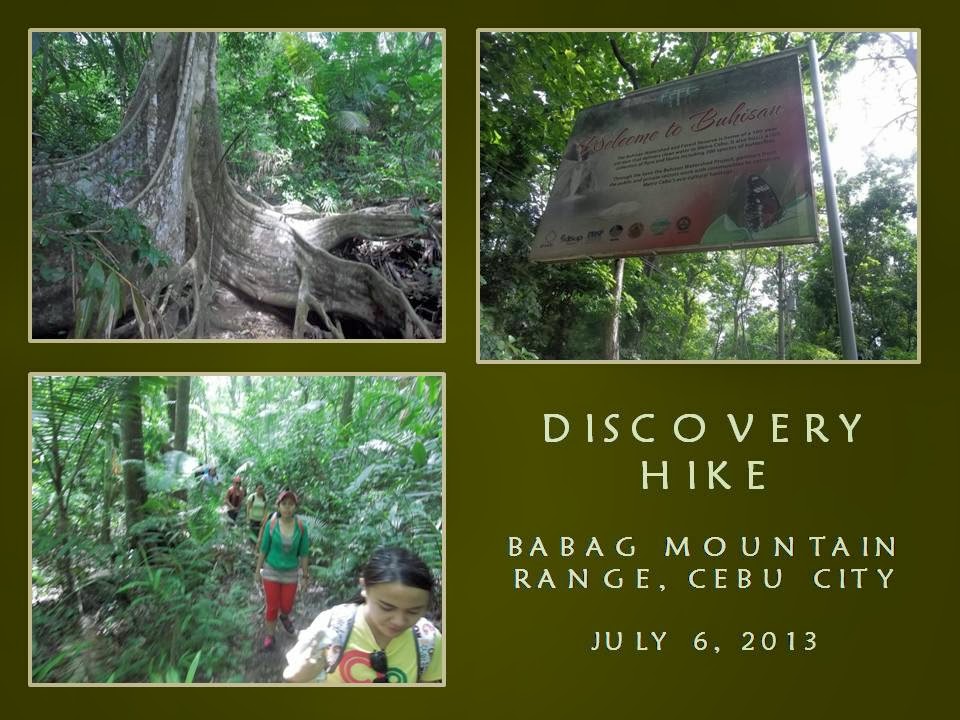
That done, we set July 6, 2013 as the date to test this backwoods tour in the Buhisan Watershed Area near where the dam is located. The Buhisan is the perfect place to do this as it is a thickly wooded area with beautiful trails shaded by a forest of mahogany trees. It is a day activity and, if we are lucky, we might find a rare bamboo thicket, harvest a pole and then cook rice and vegetable stew in it. That if we are lucky.

Through my recommendation which Jungle Wil liked and which Jun appreciated very much, he arranged that all his staff join and experience the “Discovery Tour” which I just designed in the back of my head. Anything could happen, give or take a few or all of the items on the itinerary but it does not matter to Jungle Wil and me as we are flexible enough to put aces on the table where there are none.


Truth to say, we have more than sixty years of outdoors experience between us and this experimental day tour is one of those times where our creativeness pops out like second nature. Although I have been to the Buhisan a lot of times, this is the tamer side which I do not visit often. Sure, there are trails but which one to take and I need to know who is with me so I could assess what measure of difficulty that I could force out of their sweat glands.

It is always second nature, my friend. So we got Jun and his wife, their nine staff – all ladies – and their lone driver. Jungle Wil also invited Paul Thomas, a native English speaker and instructor, to study the viability of teaching English to his clients in an outdoor setting. Last, but not the least, JR Serviano of Silangan Outdoor Equipment sent his representative to give a demo of their products.


Silangan Outdoor Equipment, by the way, is one of Snakehawk Wilderness’ valued partners. It is a wholly Filipino-owned company that manufactures high-quality but quite affordable tents, sleeping bags, rain jackets, fly sheets, hammocks and other outdoor accessories while giving employment to local sewers. Aside that, they are now into outdoor wear where a prototype hiking shorts is now under the crucible of tests by Jungle Wil.

Cebu Trip Tours provided one their own fleet of 10-seater vans from their office at the Persimmon at Mabolo to the Buhisan. We all arrive at 9:00 AM after a visit to the market in Labangon in between. I start the tour by giving the history of the Buhisan Dam and what were the kind of trees planted here to support the watershed.


Along the trail, I give the names of the most common trees growing here (mahogany, teak and arbor); the types of plant to evade (rattan and the stinging tree); and the invisible but very audible avian presence (kingfisher, bankiyod, tamsi and the wild fowl). Everyone is encouraged to take pictures of anything to foster their knowledge.

During rest stops, Jungle Wil would take over and talk about outdoors safety and wilderness emergency preparedness; the need to rehydrate regularly; proper clothing; the important tools and gears; and how to process information useful to an outdoors activity. On another setting, Jungle Wil digest the fine points of selecting a good campsite and choosing a good spot for a campfire.


I take them to a deep part of the forest where the trail vanish. Too few people visit this place since it is choked with spiny rattan vines. However, keen observation point me to a path which cannot be read by an untrained eye and I see a trace of where a hunter had stayed last night. A logical spot since across, divided by a stream, is a place where there is a wild rooster crowing.

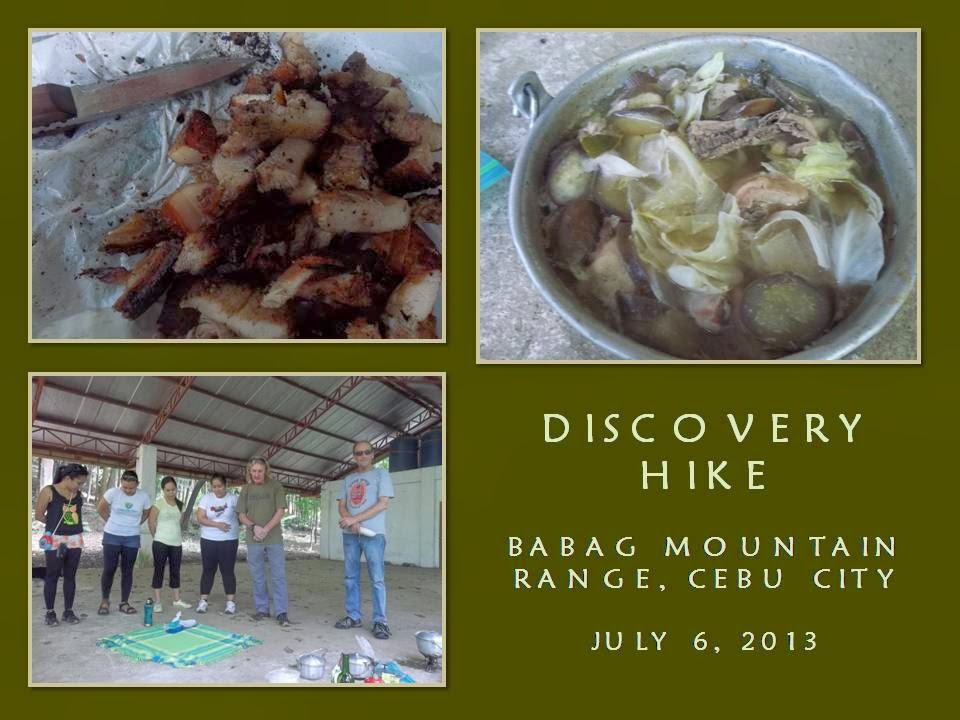
We all returned to where we had started and it is already 11:00 AM. I retrieve all the food ingredients from the van and start preparing the meal. I cook milled corn and rice on separate pots and another pot for chicken sinigang. JR’s man help me with fetching the water and, later, the cooking of pork meat on glowing charcoal. Since Jungle Wil is busy with the group, I cooked his meal which is a stew of chopped carrots, radish and garlic; sliced tomatoes and cabbage leaves; and seasoned by onions and garlic in an Army canteen cup.


While I am doing my thing with the stoves and pots, Jungle Wil gets the group busy by engaging them in classic team building and group dynamic activities. I snatch a quick look when I can and it was fun. When everyone settled down, Jungle Wil demonstrated how to construct a simple shelter by installing a Silangan hammock between two trees underneath a fly sheet. Lunch is served at 1:30 PM and it was an excellent meal that gets two or three servings by some.

Sadly, a grove of bamboo on this side of the Buhisan is very rare. There are only a very few places where it grow here but those are on the wildest side which is a bit far. I was not able to give them a demo about how to cook something in a bamboo pot but I give them something to keep busy: Making fire by friction on two mature pieces of bamboo which I prepared and brought for this occasion.


It is hard work even when it smoked so thick yet the magic was not there. Even when the width of an inch-wide bamboo was reduced to a half-inch. Even when the face of one bamboo was littered with blackened troughs from left to right. Even when the tinder was showered with minute embers. Even when the main bamboo split apart to the sheer weight of the force it received.

It was fun and Jun and his staff at Cebu Trip Tours now have an idea how to make their backwoods tour a reality. I promised them more places to discover and put it to good use; more quality outdoor seminars; and a chance to bring clients where none had done before.


Document done in LibreOffice 3.3 Writer

Monday, September 2, 2013

RAVICHANDRAN THARUMALINGAM IN CEBU

ONLY A FEW SOUTHEAST ASIANS climb Mount Everest and fewer still who climb it twice. That honor belong to a Malaysian mountaineer. He is no other than Ravichandran Tharumalingam. His first ascent was done in 2006 at the North Face from the Buddhist Kingdom of Free Tibet and the second was in 2007 from the Kingdom of Nepal via the South Face.

Aside that, he is busy training for the completion of climbing all the fourteen highest peaks in the world that stood at 8,000 meters and above; as well as aiming to finish the Seven Summits very soon by climbing all the highest peak of each of the seven continents. Despite a handicap of missing fingers lost to frostbite, he is set to climb Everest for the third time in 2014 without the aid of oxygen.

During his preparation for the big climbs, he came to the Philippines for some serious training by climbing with members of the Mountain Climbers Alliance of the Philippines (MCAP) at Mount Pulag via the Akiki Trail in Benguet and at Mount Batulao in Batangas. He travelled down the Visayas and climbed with the Negros Mountaineering Club (NMC) at Mount Canlaon in Negros Occidental.

When not climbing, he is generous enough to speak about Acute Mountain Sickness based on his experiences at alpine altitudes which he did before MCAP in Metro Manila and the NMC in Bacolod City. As his schedule will take him down to Cebu, he is also set to talk about AMS which the MCAP Secretariat had arranged except for the venue.

Since this blogger is a member of MCAP, I staged this event under the endorsement and sponsorship of Snakehawk Wilderness School which kept the tab for the rental of the function room of St. Mark Hotel, located at Queens Road, Redemptorist Plaza, Cebu City. The date was set for August 5, 2013 at 6:00 PM where thirty-eight people came.

Ravichandran’s patron, Habagat Outdoor Equipment, came in full force to support their veteran climber by giving away free items after the seminar. Backpacks under the Habagat brand, especially their Venado II and Sigbin models, were essential gears used by Ravichandran’s solo expeditions in the Himalayas.

Silangan Outdoor Equipment big boss, JR Serviano, also came to study the possibility of testing his renowned Rev 20, Amiel 5 and Eis 8 tents in alpine conditions during Ravichandran’s next big climbs. Silangan is a valued partner and sponsor of Snakehawk which, after this event, is set to stage the first ever Outlaw Bushcraft Gathering in Asia on August 30, 31 and September 1, 2013 at Sibonga, Cebu.

A million thanks then to the other owner of Snakehawk, William Rhys-Davies, who did the legwork of staging this successful presentation by an Everest climber here in St. Mark Hotel which come so rarely in Cebu and to Randy Su of Habagat, for his all-out support of this event.

Worth mentioning are MCAP Cebu members Maria Iza Mahinay, Darean Heyrosa, Chad, Bacolod and Johnas Obina; and Dominic Sepe of Camp Red Bushcraft and Survival Guild – all for working behind the scenes. Special thanks is given also to Ramon Corro of First Gen Energy Solutions for his useful laptop; to Ronald Ramiso for providing technical expertise; and the coffee boys of St. Mark Hotel for the bottomless refills.

Below are the collage of photos from the seminar on Acute Mountain Sickness:


Document done in LibreOffice 3.3 Writer

Tuesday, August 20, 2013

PINOYAPACHE IN THE LAND OF THE AETAS

AFTER THE GUINTARCAN ISLAND video shoot have been wrapped up last month, the small production outfit that I am cast with as a co-host, now set their sights on an Aeta village up north in Luzon. This made-for-TV show targetting an international audience is the first of its kind in the Philippines since it will utilize a Filipino as lead cast as well as location shootings are all done here. My co-host is my partner at Snakehawk Wilderness Skills School, William Rhys-Davies.


On the afternoon of May 8, 2013 we left Cebu for the Diosdado Macapagal International Airport, formerly Clark Air Force Base. It is my first time to fly through there although I have, a couple of times in 2002, gone there by land. The Cebu Pacific plane touched down at 6:30 PM and we transfer to the Dau Terminal in Mabalacat, Pampanga for our trip to Olongapo City in a Victory Liner.

We arrive at Olongapo and Mylene Castro of the Pastolan Aeta meet us to arrange our journey to her village. We spend the night at her humble home and arrive before midnight. It is a long ride to the village through a long and complex detour caused by the presence of SCTEX. I have never been to an Aeta village before although I met a lot of them in Metro Manila after Mount Pinatubo dislodged them from their homes in 1992.

The following day, May 9, the film crew is hampered by lack of equipment so they went to Pangasinan to purchase a slightly used Canon EOS Video Camera. Rhys-Davies and I spend the whole day in Pastolan and hike the dirt road to Pamulaklakin. Pamulaklakin is an eco-tourism park put up by the Subic Freeport Authority to provide livelihood for the Aetas. The park showcases the best in primitive-living skills of the Aetas and the Pamulaklakin Forest Trail.

Rhys-Davies and the chief elder of the Pastolan Aeta – Dominador “Tata Kasoy” Liwanag – are old friends when the former was a visitor in 2007 and twice in 2009. It was a happy reunion for both when they meet again at Pamulaklakin. Tata Kasoy, despite his 72 years age, is still lithe, agile and strong and he demonstrated this by climbing an upright tree so easily and then jump on the ground from twelve feet up on barefoot.


He is a wonder to watch as he explained to tourists in his pidgin English about how the lowly bamboo can be converted into a survival tool. With great dexterity, Tata Kasoy used his traditional Aeta bolo as if he is using a small knife and carved spoons, drinking jugs, plates and cooking pots with it. Not only that, making fire with two pieces of dry bamboo is just a stroll in the park with him. Done in less than two minutes!

I also get to know Miguel Abraham and the other Aetas and I feel very fortunate for this rare opportunity. We went back to Pastolan to spend another night in Mylene’s house. I observed, as I was walking along the way, the Aeta aboriginal land is lush with three layers of rainforest and it is home to different varieties of flora and fauna which have given the Aeta people sustenance. They are great hunters and could travel in the forest deftly and silently.

While in Pastolan, we visit the house of Tata Kasoy after dinner and he welcomed me and Rhys-Davies inside and we have a long conversation. When it is time to depart, Tata Kasoy accompanied us and bring us to a tour of the whole village. He introduce us to his brothers, his children and grandchildren, his other relatives, the village center and the oldest tree.

On the early morning of May 10, me and Rhys-Davies are invited to hunt with them. I am excited and I bring along my tomahawk, just in case, if the need arises. They were armed with air-powered rifles and bows and arrows. We go down into a stream and up a trail where there is a very tall fig. Hanging like huge black fruits from below the branches and twigs are actually fruit bats sleeping in their hanging-down fashion.


An Aeta with a bow climbed up an adjacent tree to get a good vantage of one fruit bat and, once settled on a high branch, he takes a position to ready his bow and arrow and take aim at the nearest bat. The first arrow got deflected by a twig and missed the bat by inches but the nocturnal creature remain unperturbed. The second one, this time, hit the target true and the bat plummeted to the ground after trying to extricate itself from the protruding shaft sticking in its body.

Another bat was taken down using this method and the Aetas decide to end this hunting foray and we all returned to Pastolan. The Aetas offered one bat to us which I accepted provided I know how to dress it. I tell them I can and they were happy to part it away to me. Me and Rhys-Davies arrive laughing at our base camp with a booty which soon will be food either for lunch or for dinner.

Noontime came, the film crew arrived with their video camera and they decide to change location and want to transfer to the place of Miguel. We proceed to Parapal, Hermosa, Bataan, which also follow a very circuitous and complex route borne out of the SCTEX operation. We arrive in the early afternoon and immediately start shooting the scenes. The routine of talking to the cameras are much easier to do now compared to the last time in Guintarcan. I am now in the groove and retakes are now few.


Miguel prepare to cook rice and cassava in bamboo. Traditional Aeta cooking of rice in bamboo provides a small hole to place water and rice grains and then closed by a lid. After the rice have been cooked, the bamboo is split open with a bolo to get the rice. It is so different from my own system but it is, as well, efficient.

Meanwhile, I start to skin the fruit bat. The camera crew focus on my work as I talk and explain of what I am doing. Rhys-Davies provide me a meter long pointed bamboo stick. The skinned bat will be cooked over an ember. I bury the skin and head underneath a big mango tree and said thank you for the meat it had provided.

A feast commenced when the last food had been cooked. Other Aetas and their neighbors join Miguel and his family to honor our presence and I was humbled. Marlon Diamzon, a minor elder, offered to perform a traditional Aeta war dance for us in traditional Aeta garb with bow and arrow. Marlon gyrated and hopped around a campfire and is documented by the production crew. Rhys-Davies, following a script, joined Marlon around the fire with bow and arrow and it elicit so much laughter among the Aetas.

On Saturday, May 11, shooting start early. Matt Everett, the producer and director, make use of time by doing some script lines that Rhys-Davies and I would talk before the cameras. It took a lot of retakes since sounds from the festivities would interfere with the audio. Miguel has guests today since it is his birthday and the video shooting take a slow drag. People arrive in a jitney and in a van. His neighbors butchered a male goat early in the morning and the place is in a festive mood. When Miguel was done with us, he returned to entertain his guests.

The day’s shooting wrapped up early due to external interference caused by excited voices and loud music. We join the crowd instead and celebrate the occasion by partaking of the meal, talking with the locals and sharing glasses of local brandy. When everyone left, the place return to normal and I help in the cleaning up of the place. Once, when everyone have gone all to sleep, I steal a quick bath without anything on outside where the water are kept and that was my first bath in four days!

May 12, Sunday, shoot starts late. Everett, wanted me and Rhys-Davies to set up traps above the hills where our present base camp is located. He is intent to catch us a live python or a monitor lizard and he is utilizing Miguel for help. While they were all busy making traps, I make my own trap on a wide meadow. It is a cage trap set on the ground with a trigger mechanism. The trigger causes the door to shut when disturbed and imprisons the prey.


Everett include Miguel during the shooting and talk to the camera following on a script provided by Everett. Rhys-Davies and I explain, respectively, to the absent audience how the snares work and what mechanisms are included like a funnel-like contraption that I constructed so a prey would found its way into the cage entrance.

The rest of the day were spent on dialogues and Everett make it work like as if I am better than Rhys-Davies and him better than me and that sort of tug war of dares and counter-dares. After a tiring day, which was interrupted by rain, I sleep early but I wake up at dawn to steal another quick bath.

When May 13 came, the shooting slackened. It is Election Day. People will go today to vote for their senators, house representatives, mayors, vice mayors and city and town councilors in their respective voting precincts. The Aetas are no exception. Nevertheless, we check our traps and snares and we come empty-handed even at the spots where we placed baits.

I came to appreciate a special spot for me up where near the snares are. Every early morning I would squat at a very vegetated area where there is space in the middle. My good knowledge about plants helped me when it comes to find an alternative “wiper”. But I would be cautious each time I approach the place. I keep an eye on snakes or whatever lurking and those “drops” I left the previous days.

Anyway, Miguel returned after lunch time, frustrated at the long lines in his precinct, unable to vote, and quite hungry. When noon came, he decide to go home. Everett asked him if he could demonstrate to the camera and to the absent audience about traditional Aeta way of bow making. From a dry bamboo, he carve a three-foot long stick which will serve as bow and an arrow.

Using a banana trunk as target, Miguel deftly shot at it accurately time and time again. Me and Rhys-Davies take the cue of Miguel and produce our own bows. I break my first when I strung tight my bow string and almost snap my second. Following the script, Rhys-Davies shows good skill with bows and I appeared a far second to him during our test with shooting arrows. Rhys-Davies smirk at my skill with the bow and arrow and it was awkward on my part to be on the losing end. 


The next day, after a visit to my favorite spot, (May 14) we left base camp to hike towards a river. There had been numerous sightings of monitor lizards there some days ago and we need to catch it. Miguel installed two snare devices at two different places. These are short bamboo poles opened on one end with a small hole above to hold the trigger mechanism. Miguel placed bait at the endmost part and we returned to base.

On the other hand, Everett need to film a real but very dangerous activity: Honey gathering. Miguel lead us to the house of Marlon. Marlon volunteered to hunt the honey which would be sourced in the forest two kilometers away. The honey is found near the top of an old santol tree (sp. Sandoticum koetjapi) which is thirty feet tall.

We were prepared for this activity. Miguel brought a mosquito net to protect Everett, Rhys-Davies and Prem Ananda, the cameraman, against the hornets should these fly berserk when their hive is disturbed. Me, on the other hand, wear a long-sleeved shirt, a sniper meshclothe and bonnet and spray myself with citronella because I want to be in the thick of the action.

Miguel and two other Aetas forage banana trunks, mature bamboos, a long wooden pole, dry leaves and some vines while Marlon climbed the santol tree. They wrap the pole with dry leaves and cover it with pieces of the banana trunk which were secured with vine cordage. They make a fire on a clump of dry leaves and once done they transfer the flame to the wrapped pole which was tied with a nylon rope on one forked end.

When smoke begins to appear, Marlon drag the rope and the wrapped pole up. By now, the hornets stream down from their hive when these got wind of our presence. Woodsmoke make them frenzy and I notice some were all around us but I covered my smell with that of smoke so I was left alone. I move slowly not to attract the hornets else they would notice me. Miguel and the other two Aetas move closer to the fire when more hornets are noticed.

Marlon place the wrapped pole underneath the hive and that’s when the hornets became more aggressive. I looked up at Marlon alone near the hive with the hornets all around and picking on him. I am afraid if he could not withstand the attacks and might cause him to fall down but I prayed that he will be safe. The full force of the hornets are all on us so I move slowly towards where Miguel is.

Then Marlon throw the other end of the nylon rope and asked for the plastic bucket. I tied the rope to the bucket and Marlon drag it up. Marlon break the hive with the pole and it split causing small pieces of honeycomb to fall down and drops of pure honey dripping. The rest of the hive and the precious honey were placed inside the bucket and slowly go down towards us as Marlon released the rope little by little.

When that secured, I could see that the hornets lose their battle and began disappearing. All these were recorded by Everett and Ananda in their safe comforts of the mosquito net almost without retakes. Marlon suffered a lot but he did not wince or let go of his grip on the tree branch. He is a true Aeta warrior and he showed the stuff of what he is made of and I have my great respect for him.

We all went back to the road that lead us to the village of Parapal. Along the way, we pass by the house of Marlon and we were welcomed to grab a meal. Marlon divided the honey amongst us. I am given a good share for my “ground support” and for braving the hornets with him. I am honored by that gesture. Ultimately, I transfer the honey into a glass jar and bring it back to Cebu as a bounty and as part of my natural food supplement.

Before the honey was pillaged, Rhys-Davies and me had a talk with the absent audience following, of course, the script provided by Everett. During the heat of the attack of hornets, Rhys-Davies covered the details well which Everett could not do so otherwise on me, Marlon and Miguel. It was quite impossible for Everett for any close-up shoots on the activity of honey hunting.


When we do arrive at Miguel’s house, we were quite spent for the day’s different activities but Everett need to do one more thing to close the day. He needs to shoot me and Rhys-Davies dressing rice-field frogs. Smaller than a bull frog, these have long limbs and quite slimy. These were acquired through another Aeta when our snares failed to produce results.

Rhys-Davies dress the three frogs with my William Rodgers knife and, with the same knife, I dress three frogs myself. At this moment, I am quite irritated why Rhys-Davies refused to use the blades of his Swiss Army Knife and his Leatherman and then it came to a point where I am made to do a very nasty thing on an already decapitated frog which I absolutely protested. Man may have dominion over animals and plants but not to the extent of using these as tools to show how barbaric we are.

Everett did not pursue that last scene and, instead, use Rhys-Davies to explain my walk-out from the set. I am tired and I lost appetite on what could have been a savory meal of frogs which Miguel prepared. It rained and I believe my body and mind need a rest that early to relieve my stress. As before, I wake up in the middle of the night and take a bath naked in the dark.

May 15 is the last day of our shooting. We each have round-trip tickets and we will stick to schedule. However, there is one more sequence to do. Rhys-Davies and me fulfilled that with a lot of retakes since the script is quite long. Then it is time pack our things and leave Miguel and his family and the rest of the Aetas, to include those in Pastolan. I am saddened to part company with them for I have developed good rapport with them.

We leave after lunch and reach the Diosdado Macapagal International Airport at 3:30 PM. Our flight schedule is 6:00 PM but is delayed and is re-scheduled for 7:30 PM. Nevertheless, we depart for Cebu. My honey is safe inside my bag along with my tomahawk and my knives. Almost left is the bamboo arrow given to me by Nestor but I insisted despite the protestations of a Cebu Pacific staff as it is harmless without a bow and quietly safe as part of a check-in baggage.


Document done in LibreOffice 3.3 Writer

Tuesday, July 23, 2013

PINOYAPACHE AS AN "ISLAND CASTAWAY"

REALITY PROGRAMS MADE for cable TV are very interesting and educational and command such attention by viewers all around the globe, especially concerning primitive-living skills and survival. Bear Grylls is the name that usually crop up when my mountaineer-friends talk among themselves ever since I begin to attend again membership meetings with my old club after a long hiatus of eleven years.

That was in 2007 and, unfortunately, I do not have a cable TV connection. Even today. Anyways, the things that Grylls did, which I overheard from my friends, were quite familiar to me and I could do that as well with much finesse and sanity but, being a mountain climber then, I was wrench-locked to follow the principles of this foreign ideology called Leave No Trace.

As I slowly veer away from LNT, from insane mass climbs and from my former club, I begin to practice free-rein outdoorscraft like survival and wilderness skills. A recent Cebu visitor, Thomas “Tomahawk” Moore, have greatly influenced me on this when we met in September 2009. The joys of having a small campfire is a freedom that I love to cherish most as well as my freedom of unimpeded movement like solo hikes and cutting across virgin ground.


In January 2010, I established a club called Camp Red Bushcraft and Survival Guild. This is the only one of its kind in the country and I organized the annual Philippine Independence Bushcraft Camp every June 12th as its main activity. Not only that, I begin to make videos of myself doing things I loved best and uploaded these to the Warrior Pilgrimage Channel in YouTube.

As the pleasures of my new-found interest guided me, names of other TV survivalists like Les Stroud, Ray Mears, Mykel Hawke, Cody Lundin, etc. begin to surface up. To be honest, I have never watched a single show of these survival shows and it was only in August 2012 when I finally saw what Grylls looked like and what he did in his show when a video was uploaded at Camp Red’s Facebook site by one of the members and it was about le Legion Etrangere.

When I teamed up with William Rhys-Davies in January 2013 to put up Snakehawk Wilderness Skills School, a small production outfit wanted to do a series of video shoots about tropical bushcraft and survival in the Philippines. The location of the first episode would be in Guintarcan Island, Santa Fe, Cebu and it would star, no less, by Rhys-Davies and myself. For this project, I was provided two videos of Ray Mears for study. It was the one shot at Costa Rica and another at Palawan.


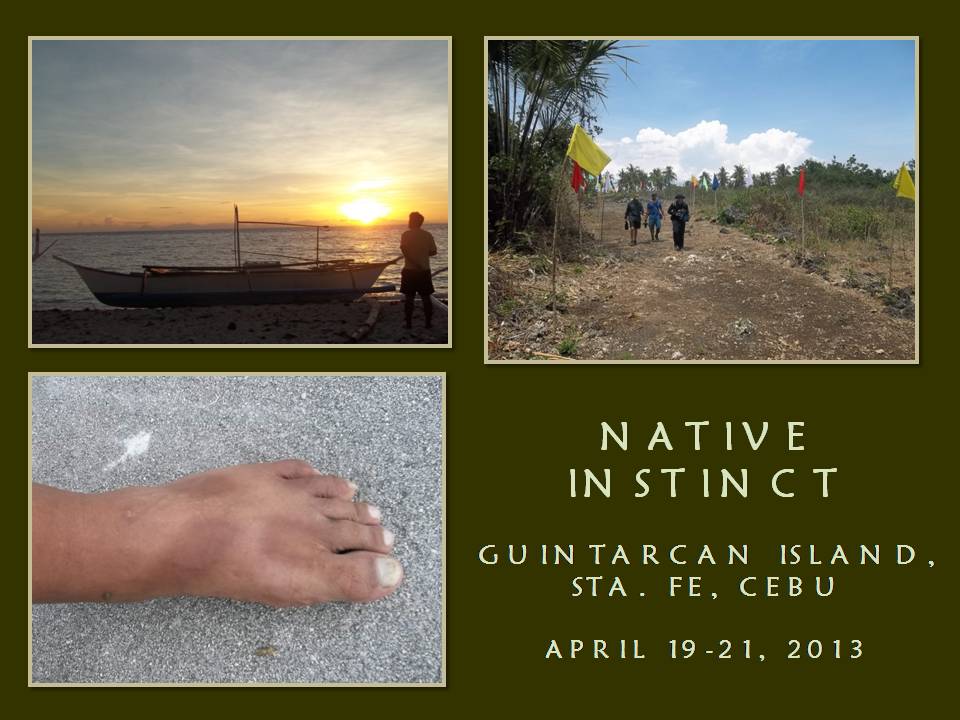
On April 19, 2013, we left the mainland and cross the Bantayan Channel for Guintarcan. Our host is Mrs. Tita Rosos, who accommodated us all into her residence which became our base camp. The video crew consist of the producer/director/cameraman – Matt Everett; cameraman – Prem Ananda; two personal assistants; and a medic – Casey Ballard. Aside that, we hired Tady Rosos as our man Friday and the boat owned by Inday Dabalos

The videocam begin its shoot as the outriggered boat begins to set sail for the island. The weather is perfect giving us a very calm sea although the heat and humidity are at a high swing and would later take a toll on the exposed skins of the cameramen, the medic, Rhys-Davies and, mildly, on myself. The show, according to the producer would almost follow along the lines of Dual Survival of Cody Lundin and Joseph Teti but with a different twist.  Guess what that would be? But, who are these guys? 

The first segment for the first day is catching us swimming from boat to shore about 100 meters distant in our clothes. I am wearing a light-blue rayon T-shirt, a dark-blue Rohan long pants and a pair of beachcomber shoes. Rhys-Davies is in his Lowe shirt, a Silangan hike shorts and a pair of Salomon shoes. There were a lot of shots from different angles above the surface and underwater; two-way dialogues; and one-on-one talks to the camera.

Talking before a camera is nothing new to me especially if it is a self-shoot or done in jest with another. But with a professional-looking camera with a professional behind it, my self-confidence begins to waver. Feelings that I knew of during job interviews done long ago, suddenly came back at light speed. My eyes kept rolling to retrieve missing words, stopping me in mid-sentence, and, possibly, would make me look like a clown before a wide audience if not for retakes.

In the afternoon, the director need to do many retakes of our swimming prowess. We shifted scene afterwards and asked to make a debris shelter. While doing that, there are the usual dialogues between Rhys-Davies and me and then the one-on-one on camera. I was asked to forage for food, which I did, by plucking a ripe fruit of a pandanus tree. We ate the fruit explaining to the invisible audience of its taste and how it is eaten.


I split and cleaned both green and mature coconut palms with a William Rodgers bushcraft knife. The dry palm is hard but the blade make short work of this. While I was in the middle of driving the edge hard in the middle of the palm, the knife point nicked one of my fingers and blood spurted out. I have already expected getting cut by my new knife and it created a bond between new owner and blade. I remedy the discomfort by making a poultice out of Indian mulberry leaf buds after stopping the bleeding by elevation and direct pressure.

The knife had been given to me by the CEO of a native delicacy company just recently in appreciation of my outdoors prowess and for friendship’s sake. He is not just a knife collector but work on his knives to their ultimate limits. The knife comes with a leather sheath with Kydex lining which he himself made and dyed; quite rare for a business executive.

I was really exhausted after doing several repeats of sequences of holding breathe under water for almost the whole day, swinging from coconut palms in the hope of detaching it from the upper trunk and trying to polish off my pidgin English that I collapsed onto my ground tarp splayed on hot concrete after supper unmindful of the heat it refused to surrender. I slept like a baby under the bare sky.

After breakfast of the second day (April 20), we went back to our shelter and, part of the script, I would again forage for water and food which I found up a coconut tree which need to be climbed. I ascended below the crown and twisted two fruits with my hand and let it fall, cut a hole and drank its sweet water, and split it open to scrape the white meat. All these are but natural for me while Rhys-Davies made himself helpful by teasing a fire to life with his firesteel.


In the afternoon, we walked up a hill to shoot a scene inside and outside of Cantingting Cave to look for food. After some dialogues and talking to an invisible audience, I foraged old coconut palms and fashion these into three flame torches which we will need to light our way inside the cave and, hopefully, catch our prey. The script goes that we need to catch bats to sustain our survival.

The light from the flame torches are inadequate and make it impossible to catch bats so I place the torches upside down so it would bellow thick smoke and agitate the bats from its stupor high up on the ceiling and waited for them to swarm out of the cave. I position myself outside the cave mouth with a three-foot stick like Barry Bonds while Rhys-Davies stayed inside to shout and scare the bats. The bats did start to fly into my position and I whack five of these senseless. We now have solid food for the day!

It is dusk when we returned to the beach where our shelter lay. The camera focused on my skinning of the bat and I explained to the absent audience why I need to remove a certain part of the animal so it won’t spoil the meat. On the other hand, Rhys-Davies tried his darndest best to ignite a fire with partly-moist coconut fibers which he used as tinder. After a considerable amount of sweat running down on his brows, the flame flickered and danced.

Rhys-Davies sharpened the points of two bamboo sticks and I pierced all the dressed bats unto it and cook it on open coals. I talked to the camera how I reacted when Rhys-Davies failed to produce fire and talked also of my plans for the rest of the day and of the following day. We leave the set and returned to base camp. There was a slight shower after dinner and everyone heaved a sigh of good relief that the extreme heat of the day will soon dissipate!

The third day – April 21 – found us swimming by the shore and skimming for food on its part-sandy part-rocky bottom. This island is abundant of shellfish of different varieties and, it is only a matter of time before we will fish it out of the sea ourselves. There were many sequences taken by underwater cameras and too few moments to recover our breathe. It was a never-ending battle to stay under despite the onset of tidal current.

To counter buoyancy, I held on to rocks and, in the process, detaching these. Beneath some of these rocks are juvenile giant clams (sp. Gigas Pacifica). Elated with these discovery, I plucked out four clams while Rhys-Davies was successful with one. Using my knife, I forced it all open and removed the flesh from the shells and skewer it with last night’s barbeque sticks and cooked it again on bare coals which Rhys-Davies expertly provided.

When we have finished lunch, the rest of the afternoon is dedicated to foraging bamboo poles, which are abundant on the island, so we could make and float a raft and make a run for the mainland. We found a grove of spiny bamboos. The problem with this kind of bamboo is that the base is protected by a screen of thorns. I explained to the camera how I would extract the poles using a bolo and a knife.

I created a corridor by slowly removing the lower branches where there are spines. When these tangle with each other, these create a screen and always snag on anything soft like fabrics and human skin. I got snagged on the base of my thumb and blood begin to ooze as I started to cut and remove these. Altogether, I cut three poles which is about twenty feet each and drag it each time it is caught on the branches of a mango tree.

Slowly, one by one, to and fro three times, we shoulder the bamboo poles from the interior to the shore. I measure the pole by their segments and cut it with the bolo. The knife cleared and cut the knobs and branches. We were able to make six eight-foot long poles as our main deck. We have also provided four poles as our cross bars eight feet long. On the beach are four abandoned 5-gallon plastic containers with caps and a considerable length of nylon rope which a fisherman abandoned.


Rhys-Davies did the lashings as he is well-adept at this while I assisted him in feeding the ropes or reaching a rope end at the most difficult corners with a finger. The containers were distributed along the four corners of the bamboo raft and would be the main buoyant component while the cross bars would hold it like a vise. I provided two coconut palms, stripped of leaves and carved, as our paddles. We tested the raft’s sea-worthiness and it floated well with me and Rhys-Davies on board.

The last scene would be rowing from shore to other shore thirty kilometers or so away crossing the Bantayan Channel. Could this be possible? Are we in our right minds? Perhaps or perhaps not. But with perfect weather, with a sail and lots of fortitude and luck, why not? We could even make it by morning. This was the crux of the show but the director intervened by towing us back to shore with a motor boat and Rhys-Davies capped it off by promising his imaginary audience that we would be back for the next episode.

Document done in LibreOffice 3.3 Writer