Showing posts with label Cebu City. Show all posts

Thursday, April 1, 2021

2021-013 | THE SIGNS OF THE TIMES

WHEN NEWS OF THE VIRUS spread its infection from ground zero in Wuhan to the rest of China and over its borders, I was quite alarmed because the Philippines does not have a very efficient health-care system. On a scale of 1 to 5, where 1 is weak and 5 is strong, my country is down there hovering between 0.5 to 0.8, nowhere near those countries where we thought are weaker than ours.

That is because we have a very large population broken into islands and regions where each has a disappointing bed-to-population ratio with its unique set of problems which may cause the prevention and the containment of the virus very difficult. The Philippines is simply not ready for a pandemic and the government lacked people with sufficient experience, knowledge and skills who could tackle this problem head on. 

This was a medical problem that needed medical solutions but the final decisions were from the retired generals and politicians who insisted on treating this as a military campaign. Our doctors and men of science were relegated to the background and bawled over when they insisted on their scientific-based opinions, just like what China was doing to its scientists. 

I could never fathom the meekness of my government to China and started accepting Chinese tourists (while others closed their borders with China) in the most vulnerable time of the pandemic. In fact, a Chinese woman from Wuhan started the circus here when she appeared in Cebu in early February 2020 and infected everyone who came into contact with her. That news placed everyone in fear and uncertainty and that was a bad sign of the times.


I am a reluctant prepper. I advocate prepping but not the type of prepping that is beyond your means. I have been prepping myself, my family and my home for all calamities, natural or man-made, if and when it comes knocking in our time. This pandemic tested me and, so far, in my self-assessment, I am slightly better than my neighbors. Simply because, I am a prepper and I follow protocols.

The “new normal” screwed people so hard that they find it hard to adapt to this and discard their old habits with which their comforts are dependent on. Likewise, the government is so inept and does not have a long-term national plan to combat this pandemic. Fake news floated in social media and added to the confusion. Everything seemed to be going against us as lockdown after lockdown were imposed to contain an invisible enemy. 

Lockdowns, known here as Enhanced Community Quarantine, Modified ECQ, General CQ and Modified GCQ, jumped back and forth, according to the severity of the statistics of a city or province. Cebu City became the “center of the pandemic” as government kept on pointing fingers at anybody except themselves. The inner suburbs indeed has people who disdained the safety protocols and have added to the problem.  

It was in these times – at the beginning, during and the current stages of the pandemic - that I braved the streets and “broadcast” my opinions, criticisms, observations, apprehensions, satires and appreciation in Facebook as “El Bandido”, in my pandemic-long “syndicated” SIGNS OF THE TIMES. I used the same hash-tags over and over: #fortresscebu, #wuhanvirus and #apocalypsis. 

FORTRESS CEBU. It is a jibe at government, and later, businesses, for taking a heavy hand on the population, creating rouge fortresses and backyard kingdoms out of fear. People too became midget castles of their mind. Travel, for a time, out of your home was forbidden as well as of people visiting you. All access to communities were barred. 

We have seen how our government reacted to the pandemic. You shake a head. Sometimes you are amused but, most of the time, you swear at them with contempt. This swirl of the pandemic in this country was caused, in the first place, by our government’s negligence, ineptness and cowardice to tackle a problem called China.   


We lost our advantage of isolation because of our government’s subservience to the wishes of China! We are already suffering from their deadly experiment and yet their nationals come and go as they please. Our local leaders are overruled by those traitors in MalacaƱan. These people placed more care on Chinese nationals than us Filipinos! 

Because they could do nothing against Chinese nationals, they locked us down against our wishes. We complied with that when it is for the common good. In fact, I encouraged people to follow safety protocols at all times; the wearing of masks; the observance of physical distancing; personal hygiene like frequent washing and self-isolation; and correct people who believed the pandemic is a scam!
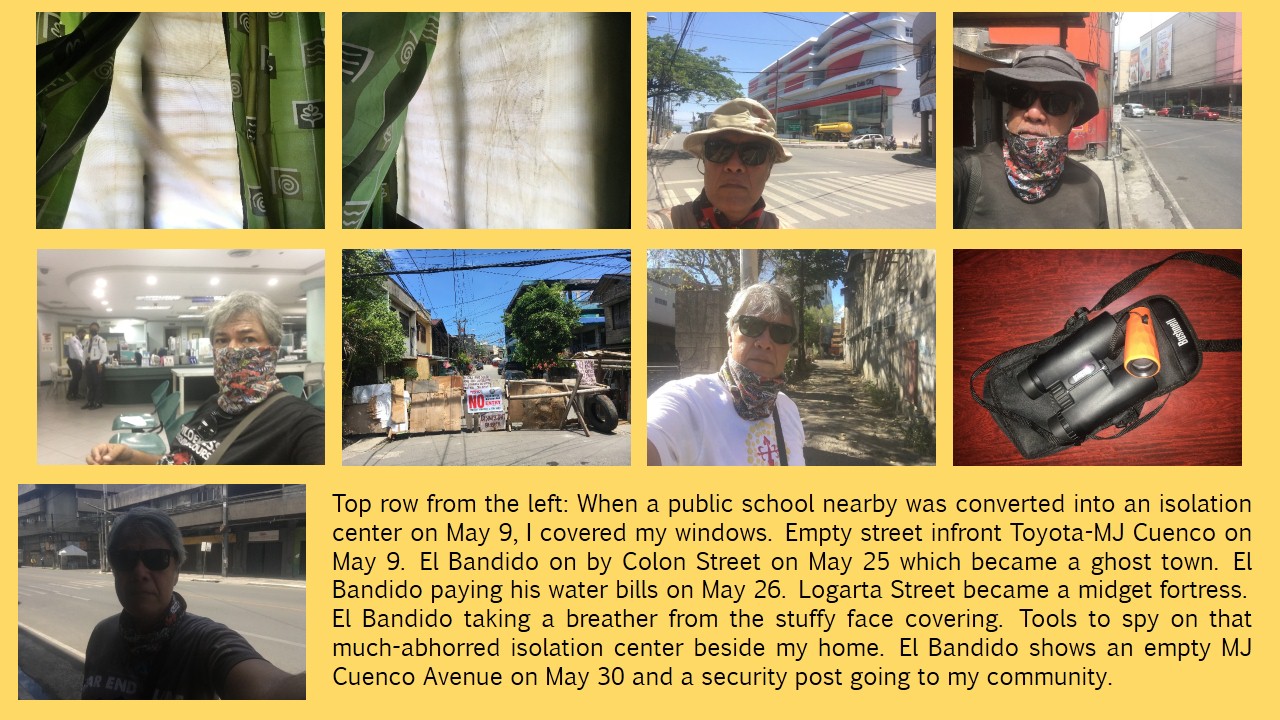
 

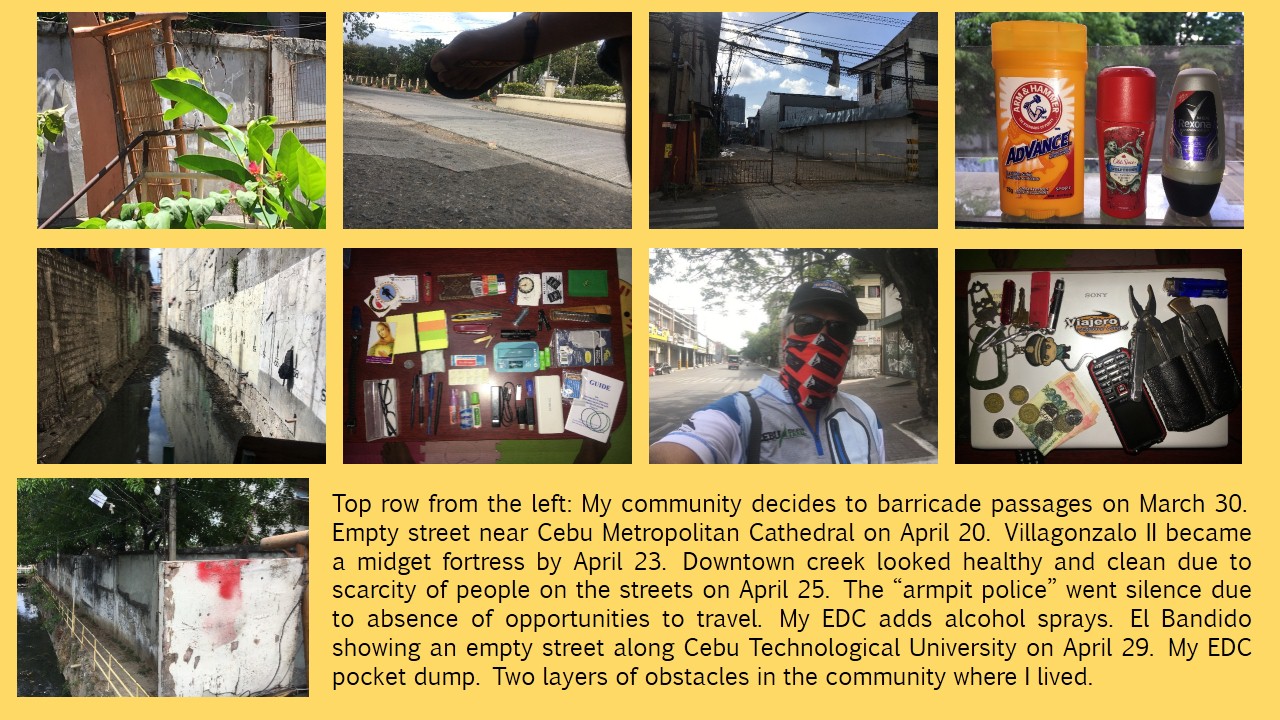
Adapting to the pandemic, I added items that would keep me protected, as much as possible, from infection: an elastic neck warmer with two medical masks as backup; an alcohol-based spray disinfectant; and a hand tool for opening doors and punching elevator keys. When the need arises, I wear a tinted “vanity” face mask or a safety goggles. And, of course, frequent washing. 

WUHAN VIRUS. As much as people, government and media would like to refer to this deadly virus as COVID-19, or novel corona virus, I would use “Wuhan Virus”, because it starts from there in Wuhan, China. To remind people with short memories, that the greatest pandemic of this decade came from there – CHINA.

Wuhan Virus is a biological weapon manufactured in one of their secret laboratories. It is meant to harm people and nations; to destroy their military and economic capacity. China do not discriminate when it wages war. Civilians are still active opposition and mouths to feed. We have seen how they committed genocide in Tibet and on their own citizens in Tiananmen Square. It is a ruthless country.


It is so easy for them to impose their draconian measures against their own population but we should never do that on our own. We are a nation of many faiths, whose population are absorbed with their own spirituality. We know our very own human rights and we know where we stand. It is against our rights then when our own government exposes us to harm.

Opening our borders with China for many months during the pandemic, despite a great clamor, was a collective violation of our rights. So was converting public schools into isolation centers for people suspected of Wuhan Virus infections – a PUI or person under investigation. These schools are in close proximity to thickly-populated neighborhoods where aerosols could go over barriers and distance. 

Every cadaver were treated as a PUI even when each have died of natural causes and accidents. When your own dead loved one is a PUI, the dead must be buried within 24 hours, foregoing the usual wakes and other rites reserved as respect for the dead. People suffering from simple ailments would never go to a hospital, afraid of being treated as a PUI, and would rather self-isolate and inhale steam. 

This Wuhan Virus is not to be taken lightly even if the lockdowns have been eased a little. There are so many contrasting stories circulating, about its origins and that it begins to be a scam engineered, allegedly, by wealthy individuals and big pharmaceutical companies. These stories only make you more susceptible to infection because you would drop your guard. It is propaganda; most likely, of Chinese origins and funding. 

APOCALYPSIS. People still could not comprehend that what we are facing against is not that so complicated. We just have to observe the protocols to the heart and rid of the old habits for a while. It is all about hygiene and human contact since infection is a two-way affair. Distance, hygiene and isolation plays a better part in this pandemic.


I value my personal freedom but it is not about me this time. I may even not know that I am an asymptomatic carrier and that what counts. I hate this herd mentality but I could blend, adapt and improvise so I could retain and enjoy my individuality. Never ever consider it defiance against the protocol but, a defiance instead against Wuhan virus and the general stupidity prevailing. 

My preferences are different than what is required. You desired the disposable mask but I liked better the elastic neck warmer, folded twice, to make my breathing difficult. If I suffered from lack of oxygen, how much more with floating aerosols? I washed it and use it again as against piling or disposing unsafe garbage. 

Then the government task force imposed the face shield on transportation and that is alright even though it is very cumbersome and has very little protection against this virus. A safety goggles is much better but I compromised and bought a tinted “vanity” face shield where I could use it as an alternative to my now obsolete Ray-Ban Wayfarer.


A certain bus company, however, would not allow me a seat with that. They insist with that flimsy acetate face shield which people placed over their heads instead of shielding the faces. If 40 passengers have this type, I am quite sure only 4 or 5 are wearing it properly. I am at a loss really if it is really safe against infection if placed over the head as against mine worn properly? 

The department stores instantly became “transportations” when they insist a face shield upon entry. That is alright for as long as they do not discriminate my vanity face shield. People do not properly wear it anyway when shopping while mine is. The only problem with face shields in walled establishments is that it adds to the stuffiness of the air you breathe.

Another of my preference was folding my quarantine pass eight times and place it in a pocket as against people who hanged it in front of their chests because a city government employee said so. They looked funny as you meet them on the streets with laminated A4-sized bondpapers on their front where a breeze would slap it against their faces.


When the filling up of contact-tracing forms became mandatory for all when entering department stores, most stores just throw their social responsibilities away at their customers by leaving them jostling for space to fill the forms. It was like somebody was tossing paper bills on a crowd. Only Gaisano Main has imposed a good system. 

=> => => o0o <= <= <=


FEAR WOULD MAKE YOU respect death. I walked with trepidity, giving a wide berth to people; refusing to be part of a crowd and the long lines of panic buyers. Frequent washing of hands are observed in my household. While all rejoice in downgrading of the ECQ into a GCQ, my house remained in ECQ status as our defense mechanism. 

New habits developed as we adapt in a pandemic. You learn to shop online but once the merchandise arrived, the packaging is washed, opened to examine the item, and left it to settle for three days while I wash my hands again. Each time coins and bills came into our possession from outside, we washed our hands.

During the most severe lockdown, the thoroughfares were empty of cars and trucks. There were almost no people. It was like 1972 again when a dictator proclaimed martial law. The silence of the nights during the lockdown curfews was very soothing despite the heat of the tropical summer. When heavy rains finally arrived in May, I bathed fully naked outside because there were no people around. 

The photos tell how I aged during the pandemic. The lockdown started so late already, in March 22, 2020, but we are not out of the woods yet. The lack of exercise left me with a pot belly. The stamina that I have nurtured for years is gone. What I have now is a white beard and an equally white long hair.
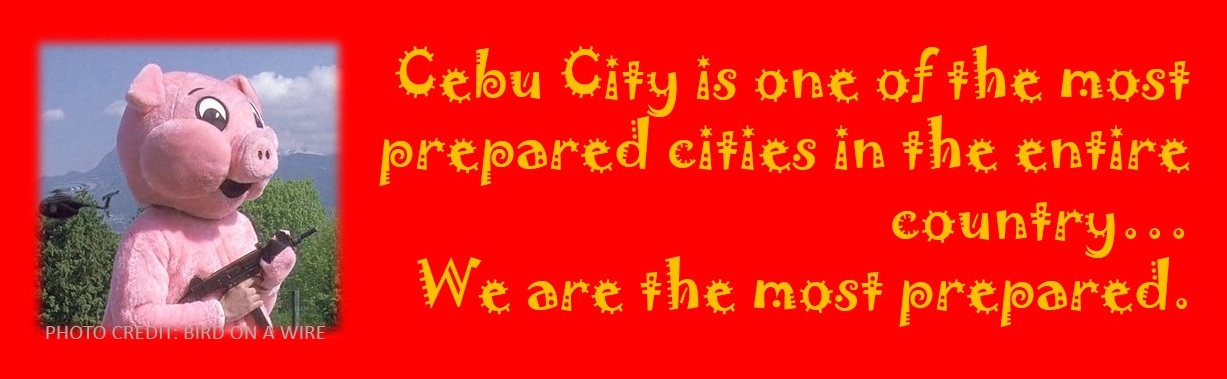
Grown my hair long since February of last year. It is my own silent protest of the government’s handling of the pandemic. I will cut it short when all the clowns are gone. It had been a long nightmare and the trauma of that comes every now and then. I hope to see the last of these clowns in 2022. If not, the hair stays long.    


Photo Nr 1 from BioWorld

Photo Nr 2 from Inside Racing

Photo Nr 3 from ABS CBN News

Photo Nr 14 from Glen PestaƱo

Monday, February 18, 2019

NAPO TO BABAG TALES CXXX: A Different Kind of Wilderness Survival Camp

THIS IS A STRANGE CROWD that I am facing today, March 23, 2018. Ricky Petiluna, the event organizer had assembled one which looked like it came straight out of Bohemia. Ricky himself is a front act of a local death metal band, the Kryptic Skulls. I assume the rest of the band are here and the rest are its fan base.

This band has a different philosophy. They are enchanted with nature and the outdoors. Everytime they have out-of-town gigs, they make it sure that, after the klieg lights, after the ear-splitting music, after the exhausting performance, after the shrieking crowds, they go straight to the hills of their hosts and launch their own nature appreciation therapy.

It has a different energy and it travels through their soundbytes. This event and the participation is testament to that. A couple of Boy Scouts took the opportunity when it was posted in Facebook and hanged on to the call of the wild. The venue would be at a place I designate as Camp Xi, easy to access but tricky to find.

 
All the participants are accounted for at the parking lot of the Our Lady of Guadalupe Parish. We all proceed to the trailhead of Napo, the gateway to the Babag Mountain Range, Cebu City, Philippines. Going to assist me are Ernie Salomon, Jonathaniel Apurado and Randy Salazar. Their mere presence already elicits awe among participants as they have created names for themselves in our small outdoors sub-culture of bushcraft.

After a hike of an hour through the beautiful trails of Sapangdaku Valley, we cross a stream and ascend a ridge leading to Camp Xi. The campsite is ready with a good water source 150 meters away – spring, waterfall and stream; separate latrines for men and women; a firepit with adequate firewood; and a grassy meadow to welcome individual shelters.

The participants set up their tents and simple shelters. Some opt to find places to hang a hammock. After claiming their spots, I let them prepare their meals for lunch. Ernie and Jon cook the food for the four of us camp staff. I would start the training after siesta and that would be at 13:00. The weather is warm and humid assuring us sunshine all the way.

Before proceeding to the first topic, I talk about the purpose and the design of the BASIC WILDERNESS SURVIVAL COURSE. You see, the mountains consist of harsh environments, steep inclines, high elevations and unpredictable weather patterns. It is remote yet people visit these places to chase passions and desires. Accidents are most likely to happen there in a flash.

After that, I proceed to the Introduction to Survival. Survival is different from bushcraft. It is immediate and would bend rules and morality in the pursuit of life – of surviving. That is a hard reality which all survivors must live with while in the course of their dire consequences and the thereafter.

While nobody has that ultimate technique to survive accidents and calamities, a prepared mind would, at least, be blest by chance. Surviving the initial impact is one half of it while ensuring your survival until help comes in is the other half of that. In between, the mind controls everything from the way you think and even to the release of adrenaline. Your brain is a supercomputer but, unfortunately, it could only process one thought at a time.

Survival situations demand that you stay tough after the initial impact. Mental stability and toughness are very important characteristics of a survivor. You must develop a survival mindset. Do not engage in prolonged mind games of fantasy and false hopes. You should rein in your mind so you would not release excess adrenaline and cause you more confusions in a very stringent moment.

The best thing to do is stay still and fill up your lungs with oxygen. Your brain need it most to help you process thoughts. You are now in a high state of agitation and so does your brain. Your brain will be in hyper mode, collating and processing many thoughts all at the same time which is beyond human capacity. We can do so one thought at a time only. Just stay still and breathe regularly, supplying your blood system with oxygen.

In the hierarchy of needs and of nutrition in a survival situation, water is always on the top of the scales of both. Rightly so, for we are in the tropics and humidity plays a big role. With that, we surrender perspiration by the acts of our exertions and by what the climatic conditions imposed on us. Along with the lost moisture, is our body heat which we let go without our knowing.

When you stay still in one place, you lessen wastage of moisture and body heat. Then you confine the latter by setting up a shelter (if you still have one) or make one from scratch. That is the second need. The third would be food then warmth. Although food, and even water, would give you warmth, but heat from a naked flame or from the rays of the sun or from a person’s body is solace. Last is security which would complement well with the rest.

Our body has four hypothetical storage tanks that need to be replenished from time to time during survival. First is constant rehydration that would offset dehydration. Second is food that would give you nutrients, carbohydrates and proteins. Third is sugar which is converted by enzymes for your adrenaline rush. Fourth is fat, hardest to find in the tropics yet are wrapped as tissues in our body.

The next topic is about Water Sanitation and Hydration. The first chapter had mentioned the importance of water during survival. Water could be sourced from natural springs, water seeps, water holes, flowing streams, the atmosphere and from plants. It could be sanitized through boiling, through filtration and by desalination. It is wise to cache water  or travel early and take advantage of shady places and breeze if you happen to have less.

We move fast to the third topic of the day which is Knife Care and Safety. The knife is a tool and should not be used to what it was not designed for like digging latrine holes and as pry bars. It is a vital piece of equipment that should be properly handled and cared for because it is your link to your surviving. In all training I conducted, knife etiquette is learned first before you touch a knife.

Besides my rules, there is a knife law that forbids the display, even of concealed carrying, in public places unless you are in a lawful activity, which we are in right now. A knife should be in a sturdy sheath when travelling and should be unsheathed when at home to keep it from rust. There are many kinds of knives and it is important that you know the parts, blade shapes, grind styles and the tang designs. You must also learn how to field sharpen a knife.

After the much appreciated instructions about the knife, we move on to Survival Tool Making. Making a tool is essential in survival or even when not in that situation. I showed them the most basic of tools like the digging stick, traps and snares from pieces of bamboo that I was able to obtain, and the batoning stick.

I let the participants practice their knife dexterity by making their own spoons, jugs and cooking pots from poles of bamboo. They work in groups of five and closely supervised. Before 17:00, the groups managed to finish their tools. The first day lecture just end and everyone goes to prepare their dinner.

The first evening of the day is reserved for the Campfire Yarns and Storytelling. This had become tradition after it had its first introduction in 2011 during the first Philippine Independence Bushcraft Camp. With the campfire as the center of social life, participants sit in a wide circle listening to funny tales and anecdotes, usually fueled by a moderate dose of alcohol. This last activity for the day ended at 23:00.

The second day, March 24, begin with Notches. There are five basic notches that are used regularly in bushcraft. These are commonly used in building shelters and creating tools. Again this is another exercise of knife dexterity together with the baton stick. Another stick is supplied each participant and they proceed to carve the five notches there.

The next chapter is Foraging and Plant Identification. Foraging food in the wilderness or on unfamiliar terrain can be very taxing to the mind. When you are stressed and hungry, you tend to remove all caution. Looks can be very deceiving in the tropics like fruits, leaves, nuts, roots, flowers and mushrooms. Likewise, you need to evade harmful plants while travelling your way in a jungle.

Short term food would be grub, tree snails, fresh-water shrimps and crabs and frogs. These can be picked by hand. Cook it if you must to remove parasites and bacteria. Long term food are meat from mammals, fish, birds and reptiles. For that, you must use a weapon, traps and snares. Traps could be anything designed to lure prey into a simple contraption of a hollow bamboo or a dam of rocks. It must work with the terrain, with gravity and the habits of creatures.

Snares are more complex. It has a spring mechanism and a trigger mechanism which would be initiated by the prey. Showed the students a very common snare employing a pressure-trigger mechanism. It could catch anything from birds to goats. Then again, you must use bait so prey would be lured to step on it. A single trap or a single snare would not yield you a catch but a trap line of 20 to 30 snares or traps would after ascertaining where would the prey would most likely pass or visit.

Related to these is the chapter on Food Preservation and Cooking. If you can eat a deer all in one setting, well and good. You are very fortunate to still possess a healthy appetite. Meat rot in a short span of time. During survival, meat can be preserved and its edibility can be extended for a few more hours to several months. You can boil it. You can dry it. You can smoke it. Or you can cook it with its own oil from its fat.

Fish can be preserved by drying and by smoking. Fruits can be digested after a drying session and provide you natural sugar. Common rootcrops, has high starch value, and should be cooked, by all means possible, to remove toxins and poison. Famine rootcrops need to be immersed in running water for five days before cooking. Salt and vinegar are good food preservatives. Vinegar can be sourced from any palm.

Last chapter for the day is Fire, Fuel and Campfire Safety. You cannot make a fire if one or all elements are not present, namely: fuel, heat and air. Lately, they added a fourth element – chemical reaction. Fire-making is 80% common sense, 10% skill and 10% perspiration. We are talking about the friction methods. Your fire can start if you can acquire and identify the right tinder, if you are in a dry place, and if you have the patience.

Aside from friction, there is the conventional method which are exemplified by the use of matchsticks, lighters, ferro rods and the flint and steel. Then there is solar magnification which can be done with magnifying glass. Then you have pressurized air, exemplified by the fire piston. Showed them how to use the flint and steel, which I paired with charclothe, and the ferro rod. I also showed them how to make a tinder bundle. 

Showed them how the bow drill method is made and spun. Unfortunately, I could only make thick smoke as sawdust embers refused to light up my tinder. Too humid. Likewise, for the bamboo method. It is now late afternoon and dusk is just around the corner. I let others try the bowdrill, the bamboo, the ferro rod, and the flint and steel.

In this second day, all the participants are exposed to a whole day of fasting. They have to experience the pangs of hunger. The stomach would crave for food and would challenge their concentration. It would increase drowsiness, decrease attention span as the humidity, the uncomfortable situation, even the crawling insects place them in an irritating mood.

After securing the fire, the four groups consisting of 5-6 participants each, begin their quest for dinner. Rice is cooked inside bamboo poles and when it is done, they go to the next phase, which is Nocturnal Hunting. No food, no dinner. All looked for edible snails on trees and fresh-water crabs on the stream. There was good foraging and Ernie cooked it for them, gourmet style. 

The second edition of the Campfire Yarns and Storytelling starts and wonderful tales begun to unravel, much more so when bottles of local brandy mysteriously appeared from out of nowhere, courtesy of two very resourceful participants, who hunted something different other than snails and crabs. The night extended well beyond midnight until the last drops have been consumed.

The third and last day, March 25, start with Customizing the Survival Kit. It is better that survival kits are made from scratch than bought commercially because a survival kit’s size and its components depends upon the type of the activity you are indulging in and the kind of environment you are going to visit. Your personal preference still matters.

Next comes Navigation and Understanding Trails. It is more on traditional navigation which use the natural terrain, shadows and the sky fixtures for travel; avoiding obstacles and exposed areas; and knowing how to identify signs on trails made by both animals and humans. Following that is Understanding Cold Weather. During survival, exposure to the elements is expected. There are five physical mechanisms that steal away body heat and the things that we should do to keep us constantly warm.

The last chapter is Outdoors Common Sense. This is the subject matter that I based from my yet unpublished book, ETHICAL BUSHCRAFT. It is about trail courtesy and behavior while on the trail; choosing the best campsites; practicing stealth camping; increasing individual safety and security; wildlife encounters; and introduce people the idea of Blend, Adapt and Improvise.

After I have closed the training camp, I let them witness how the Blade Porn looks like. This is another bushcraft tradition which is unique in itself and is not found in any outdoor disciplines. This is a staple of good conversations and Randy explained to the crowd the innate qualities of each blade. A few of the participants place their blades to the collection and they begin to understand the purpose of this.

After an early lunch, we break camp and walk down the ridge to another different ridge, crossing a bit into Kalunasan. We finally reach the road at 14:00 and a transport begins to transfer the participants back to Guadalupe. This was one of the best survival training camp put together by an independent organizer. The participants are provided an event t-shirt and a badge plus a giveaway. Congratulations Ricky, I see one future bushmaster in you. Some day.

Document in LibreOffice 5.3 Writer

Friday, February 1, 2019

BEBUT’S TRAIL XX: Foraging in the Rain

I GOT KIDS TO TEACH spoon carving on Saturday, March 17, 2018. I need them to carve the softest bamboo that is still green and thin. Kids have little hands and do not have the strength to slice and whittle bigger and harder bamboos. They will be using blades, you know, and that makes it very dangerous. Self-inflicted injuries cannot be discounted.

Why am I teaching children to use knives when parents forbid it? In my generation, we were also forbidden but we were taught by the elders how to use blades safely and properly. Growing up with blades taught us responsibility and we earned our first blades when it was observed that we have grown to appreciate the value of a knife in our everyday lives.

In a society that is too politically-correct, old values which tend to aid children into better adults are discarded because of unfounded fear brought on by sensationalism and by reckless movies which depict glory in blood and gory. Too bad, nobody teaches blade safety and dexterity to kids anymore except from a lone voice in the wilderness.

This is now my advocacy. In my bushcraft camps, there are no shortcuts to handling a knife without sitting all ears first to the topic about knife care and safety. But those were mostly adults and, despite that, it is still strictly supervised. How much more for children? The best age to introduce the knife to children is 7 years old and above.

Because I place good premium on safety, I would forage these green and soft bamboo poles myself. Although I have requested the host of the event to produce green bamboo poles, it might not be the kind of bamboo I meant. I have to be sure because I also put good premium on quality of instruction. These kids should be taught only the best.

On an unusually cloudy morning of March 13th, I left the comforts of home for Guadalupe. It is a Wednesday. I would just be on a very short hike on the hills where I thought I found a lot of healthy groves of bamboo. There are many species of bamboo that I have come to know of but I am only after one kind that is known by its local name: “buho”. 

When I arrive in Guadalupe, I buy a sachet of instant coffee and five bread. This would be my breakfast which I intend to enjoy somewhere over that hump that I love to call as “heartbreak ridge”. It is actually called Guadalupe Hills and there is a trail that goes over its bare back which ultimately goes into a thick forest of Banika and Baksan.

I am carrying my canvass Lifeguard USA rucksack and inside it is an aluminum Swiss Army wood burner, water in a Nalgene bottle and a repurposed Gatorade bottle, a cup, cords, a cheap laminated plaid-nylon sheet, a Cold Steel Bushman, a William Rodgers Bushlore, a Victorinox Trailmaster, my fire kit, extra t-shirt, my “wildlife kit” and a folding “SOP”.

 
The SOP means “seat of power” and is nothing more than a folding seat. When you are now in your middle ages, seating is way comfortable than squatting on the ground. I found it very comfortable when I am working with a fire to cook food or boil water for coffee. I just bring this in short hikes because it is heavy but I have done it lately on extended hikes.

The wildlife kit is a new addition to my usual dayhike load. It is composed of a journal, a waterproof notebook, a ballpen, a pencil, magnifying glass, a ruler and a tape measure, all placed inside a handbag. This is my tool to find and document animal trails in Cebu, whether it is about farm animals, pets or wildlife. Another project in the making.

The weather is very mild today yet two days before I was complaining to myself that it was unusually warm. It was that time I was guiding people on the Babag Mountain Range which is visible from where I stand now on “heartbreak ridge”. The ground is partially wet since it rained lightly here hours before.

Arriving on the outskirts of the forest, precipitation materializes, dampening the mood of the day. Drops of rain fall on my clothes and shoes, totally getting me wet. I cannot stop just because it is raining. Until I found a good and healthy grove of bamboo. There are many visible from the trail but it is not what I desire.

I transfer to another path which I seldom take and found one in the innermost part of the forest. The rain does not bother too much now under thick foliage and so I set up camp near the bamboo. From my bag, I splay on the ground the cheap sheet and place all my things over it. The SOP is the last item I remove and I sit for a while to stare at the bamboos.

As an advocate of ethical bushcraft, you do not cut wantonly any member of a plant you desire. In this case, a bamboo. I study the poles. There are straight ones that reach to the top of the forest cover and there are a few who bow to the will of gravity. I do not need a thick pole, long and full of strength. What I need is a tender one that is thin and soft.

I found what I was looking for and marked it. Then I turn to the business of boiling water for coffee. Light breakfast first. Although it is raining, we in bushcraft (I taught a lot of people), could make fire under any circumstances. We could find dry firewood and tinder in wet conditions and light it up with a single matchstick or with a gas lighter.

With dry twigs and a sliver of paper, a fire came alive within the confines of the Swiss Army burner. I place the stainless-steel cup with water over the rim of the blazing burner and wait for the tell-tale bubbles on the bottom of the cup to appear. If you want it quick, do away the roiling bubbling moment and save time and fuel. In five minutes I have my coffee.

After finishing the five bread and coffee, I pick up a tool most suited for this kind of work: the saw. The bamboo pole I choose is not thick and it does not need brute force to remove it from the rest. The saw-teeth design of the Victorinox Trailmaster, or any Swiss Army Knife for that matter, is a very efficient cutting tool, better than other makes.

I cut an inch above the culm on the lowest part of the pole I choose and the rest of the pole come crashing down to earth. With the Cold Steel Bushmaster, I cut away the branches, the thick bottom and the topmost part where it is most narrow. Dividing the pole into five parts, I let the Trailmaster do its efficient and neat cutting work.

I now got my five poles at about 2 meters each and I believe it would be enough for my class four days from now. I secured all together with timber hitches on both ends for easy carrying. This bamboo variety is very light and hefting on one shoulder is no big deal, especially on a very slippery downhill trail.

I am much satisfied with my foraging work and, slowly, I stow all my things back to my bag. Thanking the place for accepting my intrusion, to include the disturbance. I keep it tidy as possible. I keep the cut branches mixed in with the foliage above while the rest of the unneeded parts, I place it inside a hollow trunk of a tree.

As expected, the path is slippery for it is smooth limestone. My Jack Wolfskin pair tried its best to grip the ground and it had succeeded because I deem to walk slow. It is still raining and a spray of water just slapped my face after I had taken a selfie. Nevertheless, this foraging work is not finished, not until I reach home.

I always give my best when I am teaching people. That means I make things happen that is beyond the scope of my work. That extra mile, that extra effort, is what people want although they do not know it and, likewise, do justice to the bread that they pay you for a glimpse of unconventional education that they yearn from you.

Document done in LibreOffice 5.3 Writer

Sunday, January 27, 2019

NAPO TO BABAG TALES CXXVIII: Breaking In a New Pair

SHEILA MEI LOST HER OLD PAIR of Merrell during the last few kilometers of the last day of Segment I-A of the Cebu Highlands Trail, right after the 90-minute trek and forced river immersion along the length of Biasong Creek on the way to Bonbon, Cebu City. That happened in February 2018. Good thing it did not gave her a problem on the first day.

One sole got detached from the upper fabric and I have to tie it with a cord so it could still serve its purpose. It did not halfway through. Sheila Mei has to remove the pair and changed into rubber flip flops. That was the end of her storied Merrell. She carried it home and may well be buried in a special cemetery for shoes.

 
On March 11, 2018, Sheila Mei came back with a vengeance. She has a new pair of Merrell and she has to break it in. Gian Carlo, her partner and accomplice for Adrenaline Romance Blog, motivates her from behind, smiling devilishly. Their common friend, Halourd, is with them. All came to train and prepare for an adventure outside of Cebu. Was it the Bakun Trilogy? I think it is that.

I choose a route for them that has no hiker traffic on a Sunday. It is found on Tagaytay Ridge, one of the several east-pointing ridges of the Babag Mountain Range, and there is a beautiful path there called Manggapares Trail. It starts right away, upon crossing a foot bridge by way of Napo. The path goes through a small community which changed into steep flower farms.

I really love to hike this trail and I rarely bring people here. For the Adrenaline Romance couple, along with Halourd, it is a must that I show them the other least known side of the Babag Mountain Range. Only a few hikers walk here and they named this route as “7 towers trail” as a reference. In my walks here I only pass by five towers and disappear through another path.

Of course, that secret path would also be visited by my guests today. Tagaytay would connect with the main ridgeline of the Babag Range. I intend to bring them to Mount Babag and go down back to Napo on another route. That is my plan. Once we got past of the small flower farm, we huff and puff into a hole among the greens. It is so silent here and so cool but we sweated, nevertheless. The path is forever ascending.

We were just walking slowly but the weather had become so humid after many weeks of mild temperatures. The tropical summer is now felt abruptly. It is just too early for that and I missed the times when it came slowly in the middle of March. Must be climate change or is just that this is just a natural cycle when the globe warmed up before it gets super cool again. Anyway, sweating is a fact of life here.

Worming our way through the green tunnel, we finally come out on open ground and standing before us, from our point of view, is the first steel behemoth. Still far away is the second and the third. It rises more about a hundred feet above us with high-tension cables connecting from faraway Naga City to a distribution terminal in Mandaue City.

The presence of the steel towers became reference points of sort along the trail and I would know how long would I have to walk more or where am I on these parts. You can anticipate and conserve energy, take a rest or proceed up the ascending ridge just by counting the towers. I would know which part is the most difficult to reach and which one is not.

The second tower is far from the first and it is on a hill. We get there, nevertheless, but the next one is much higher and more difficult to approach. After willing our bodies to go up the hill, we were winded. I am now facing an easy trail and the walk to the fourth tower would not be of a problem but we have to take a rest first on another landmark, an abandoned backhoe.

As I have said before in another blog post, the junked heavy equipment is a natural magnet of conversations. It had been left by the contractor who erected these steel towers and, until now, I do not know why it had been so. From what I heard from the locals, they were quite surprised also that it was left behind when it was still in good condition, despite rolling down the ridgeline twice.

As we continue, we go past the fourth tower, I break off from the trail and followed another one. I have never shared this path except to my adherents in the Camp Red Bushcraft and Survival Guild. But, today, I make an exception. The uphill walk had cost us almost three hours already and it would be best that we have to stop to prepare lunch, preferably, a place where there is a water source. I know of such a place and I have been there many times.

The trail is wild since it is seldom walked. It cross a dry gully where there is a crooked coconut tree guarding its approach then you walk on a wide and flat grassy area where there are more coconut trees. There is a pointed iron bar standing from the ground and there are coconut husks strewn everywhere. This would have been a perfect bushcraft camp if only it had a water source nearby.

We pass by below the peak that hosts the sixth tower and goes into a saddle and up a hill where there is a mango tree. According to local lore, there used to be two mango trees growing close together here and looked almost the same that it became a reference point for locals and called this path as “mangga nga pares” (English: twin mango trees). The other tree had died and only one is left standing.

Unfortunately, someone had placed barbed wire fences on the trail along the saddle. This is not a popular hiking trail since it is not known. There could be a good reason why a farmer would fence off a land. It could be to prevent farm animals from straying in or out of the farm or it could be built to keep off-road motorcycles away. If it meant for the latter, it serves them right. However, the fence has a narrow passage good for a person to pass.

Over another peak is another waist-high field of grass where it is a favorite nesting ground of grass owls. I once spooked unaware a large owl among the grasses here and it flew away when it noticed my presence. The owl kept its eyes on me as it circled above me twice before flying over to the forest that I just left behind. We were staring at each other and it was such a fantastic feeling. A feeling of kinship.

After we go over the hump, we go down a path where there are bamboo groves on both sides. At the approach of another saddle, dried bamboo poles were intentionally stacked over the other over the trail as a sort of crude fence. A person could step over and squeeze under these poles with not so much difficulty but farm animals or motorcycles could not.

When we got past that, a path led to a garden on a hill and then a small house. I have known the couple living here since 2011 and they make their living by farming. They have water which they sourced from across another hill and it is a good place to stop and cook a meal. There are plenty of firewood and tinder but Gian Carlo and Sheila brought with them their butane burner.

I promised them that I would be the one to prepare and cook pork adobao so I let them enjoy the spectacle of the garden. The farming couple grow vegetables, root crops, flowers, ornamental plats, fruit-bearing trees, bananas and pittaya. Their dragonfruit is of the deepest red in color and so sweet. Everytime I visit the couple, I always brought with me pittaya fruit and stems for propagation.

Not this time. Their pittaya farm suffered from a recent typhoon where the structure that held the crawling stems collapsed and rendered the stems waterlogged and unproductive. This is an introduced plant that originally grows in the barren plains of Central America and an abundance of rain is just not what it needs. The stems above the ground could still be salvaged and propagated.

Harold has other ideas. He bought several of the healthy stems from my pensive farmer-friend so he could compliment his white and pink pittayas with this deep red one. He is into commercial farming and awaits his first harvest. Not everyone has this very red species and it commands a better price, I think, than its paler cousins. Sheila joined the hunt for plants and settled on ornamental and flowering plants.

While they were busy, the farmer gave me a medium-sized local blade which he called as a “binangkito” when I asked the name of its shape. The blade has a chisel grind which favored a right-handed user. The handle is wood with intricately-carved designs, the bolster tightly wrapped with copper wires. The sheath is made of the same wood with a different carving style and three sets of rattan wicker cords are woven on three different places.

 
Sheila, Gian Carlo and Halourd came back from their green search and settled with several plants being readied for transfer down the lowlands and into their homes. I am afraid there would not be a hike on the rest of the route anymore. Rather we have to take an exit to Bocawe and then to Pamutan Junction. But first, we have to eat our pork adobao and rice.

After the meal, Sheila, Gian and Halourd decide to remove most of the soil from the plants because it is heavy, retaining only that had adhered and hardened among the roots, as well as the plastic that held once the full soil content. With plastic bags, they pressed as many of the plants inside. The pittaya stems were held by layers of banana trunks and secured tightly outside the backpack.

We go down a trail and then on to a set of concrete foot paths, crossing a small stream and followed an abandoned road until we stepped on concrete. It is early afternoon and it is very warm on the pavements. While we were walking uphill, we meet many hikers. From the shapes of their bodies and the way they dress, they were all novices. Most likely, they are from call centers, forced to go with their peers under the assumption of “team building”.

 
We reach Pamutan Junction and it is difficult for Sheila, Gian Carlo and Halourd to heft the plants to more distances like going to Guadalupe on this same road. The walk from the hidden garden to here had already taken their toll on their arms and hands. The most likely action next would be to hire motorcycles. It took us a half hour or more to haggle and to look for three motorcycles. We all need to leave all at the same time.

But, once we did, the motorcycles go by way of To-ong, Buhisan and, finally, Punta Princesa. From there we transferred to public utility jitneys going to the downtown area. Halourd dropped off at Labangon while Gian Carlo and Sheila Mei has to go to SM to transfer to another passenger van. As for me, I disembark at the road to Pier 3 and walk the short distance to home.

Gian Carlo and Sheila Mei wrote about this episode in their Adrenaline Romance Blog as:


Document done in LibreOffice 5.3
Some photos courtesy of Adrenaline Romance