Showing posts with label reminiscing. Show all posts
Monday, October 9, 2017
GERVASIO LIRA LAVILLES: The 80-Year Wait for Recognition
HE WAS A CHILD OF
THE MOUNTAINS of Lambunao, Iloilo, who took a one-way trip to Cebu in 1914 to
visit his older brother who was stationed there as a Philippine Scout.
Unfortunately for him, his brother and his detachment had been transferred a
few hours before he arrived. He was a complete stranger in a big and busy port
of Cebu, knowing nothing of the local dialect, much less, no relatives to seek
refuge to.
He was living by
his own wits on the streets until, one day, a kind Cebuano from Pasil took him
in as a servant. Not only that, he was given opportunity to finish his studies.
He studied by day at the Cebu Provincial Elementary School (now the Abellana
National School) and worked at night for the Cabije Family. He graduated from
seventh grade and proceed to secondary at the Cebu Provincial High School (now
the Abellana National School) as a self-supporting student.
He had to stop on
his fourth year to serve his country. He enlisted with the Philippine National
Guards, intending to follow the footsteps of his older brother who was sent
earlier with his unit to Europe. When his turn came, Armistice was announced,
ending World War I. The boat where he and his regiment sailed with has to turn
back to Manila. After receiving his honorable discharge he was able to catch up
and finished high school after passing the final examinations where he
graduated as salutatorian next to a valedictorian classmate who would become
one day the President of the Republic of the Philippines – Carlos P. Garcia.
As a high school
graduate of an American-run school during those early years, few but better
opportunities come knocking at you. Gervasio had already been working with a
newspaper as a delivery boy and learned the tricks of the trade from the
printing presses to the fields and on the layout desks. He rose from the ranks
and became editor one day in several newspapers. He married Consuelo Lumen in 1920 and,
inspired, studied law at the University of the Philippines Junior College (now
the UP College Cebu).
In 1925, he
entered politics and was elected with the most number of votes as councilor for
the then Municipality of Cebu (now the second most important city of the
Philippines). How could an Ilonggo able to win in a premier town of a premier
province where he was not a native of the place in his first try in politics
and by an overwhelming margin? Perhaps, the newspapers made him famous but, he
once said to a grandson, that Consuelo was his lucky charm.
At the heels of
that celebration came Gloria, the first born. She married Alejandro Panganiban
Sr., a corporate lawyer. Gloria became the city librarian. Then Virginio and
Evangeline followed. Virginio became a soldier a year before World War II. He
survived the Siege of Bataan, the Death March and the horrors of Camp
O’Donnell. He married Lourdes Galon of Labason, Zamboanga del Norte after the
war. Evangeline survived her parents, her siblings and her husband, Jose de
Paula Jr. of Jaro, Iloilo. She used to teach but is now focusing her time as a
writer.
Gervasio went on
to serve two more terms as councilor in 1929 and in 1933, authoring or
co-sponsoring many ordinances that improved the well-being of the Cebuanos
while expanding the services of the municipal government to reach far-flung
places. In 1931, he authored an ordinance that would change the course of
history of Cebu. It was Resolution Number 185. It requested the Lower
House of Congress to sponsor a bill converting Cebu into a Chartered City,
which was realized on February 24, 1937. What made it sweet is that he did this
with opposition from fellow councilors, all native Cebuanos, for seven years
and him, an Ilonggo.
Then he disappeared
from politics. We do not know why? We learned that Consuelo died in 1936 and
caused him so much grief. He graduated Bachelor of Laws in 1937 from the
Visayas Institute (now the University of Visayas) and passed the bar the
following year, the same year he married again with the lass from
Potat-Bagumbayan, Purificacion Alba. World War II came and the Lavilles Family
migrated to Bohol to escape the Japanese Secret Police who were looking for him.
From that safe refuge, he fathered a daughter named Marietta, who later would
marry Diego de Egurrola and both would serve as police officers.
A resistance force
made up of a handful of American and Filipino soldiers was organized in Bohol
and Gervasio’s experience with newspapers and as lawyer gained him commission
with the rank of captain and was given the task of conducting a propaganda war
against the Japanese. He published a monthly tabloid titled Bolos and
Bullets and he became a marked man. Japanese patrols missed him many times
by just a few meters in his farm and it was the worst time for food was scarce.
He told a grandson that his dog, Dinky, helped them survive.
The Japanese even
entice Gervasio to go above ground by using Virginio as bait but that was not
to be. Virginio outsmarted his guards and soon found him reunited with his
father, the same father who personally brought him to an Army enlistment camp
when other families hid theirs to faraway places to escape conscription.
Liberation brought the Lavilles Family back to Cebu and started life all over
again from the ruins and despairs of war. That was in 1945 and life was hard
and depressing.
Fortunately, he
gained employment when he was appointed by Pres. Sergio Osmeña Sr. as the
Register of Deeds for Cebu and then chosen as one of only three senior
examiners in the country by the US-Philippine War Damage Commission. There were
over twelve thousand candidates yet he was chosen for his honesty, integrity
and industry. It was a very demanding job for it entails a lot of travel,
surmounting some security threats and fending off many bribe offers from
businessmen who wanted to pad the actual costs of the damage which would have
benefitted them financially.
The 1950s brought
back a sense of normalcy for the Lavilles Family. Gervasio became a much-sought
after lawyer, not because he was very good but because he was very kind to his
clients. It was normal for him hefting home baskets of fruit and vegetables
after a lengthy day in the courtrooms. He exacts no fixed amount but he accepts
anything even a prayer of thanks. He worked with local newspapers as
editor-in-chief and was tapped by national and international press agencies as
their local representative.
Politics came
calling him again but this time, behind the shadow of the son of Cebu’s Grand
Old Man, himself becoming a great man one day, Sergio “Serging” Osmeña Jr.
Gervasio served as his private secretary and aide-de-camp when Serging ran as
Governor of Cebu, as Mayor of Cebu City, as Congressman and as Senator of the
Philippines. When Serging was not campaigning, he would either be City
Administrator or Provincial Administrator.
He had a long
professional relationship with his employer and friend and has to let go of his
newspaper jobs. He maintained only his weekly newspaper column in the Cebu
Morning Times titled Merely My Opinion, and became a professor of
history, literature, algebra and political science for the University of San
Carlos, Southwestern University, the University of the Visayas, and the
University of Southern Philippines. He still worked as a lawyer but limited
only to consultancies and notarial services.
Despite many
opportunities of enriching himself through his lucrative occupations and
positions in government and by his association with Cebu’s most popular
politician at that time, he lived simply and begged for privacy. He did not own
a house and was content to live in government land. When Serging challenged
Ferdinand Marcos in the 1969 Presidential Elections, he went with him on the
campaign trail, sometimes accompanied by his wife and a grandson.
Martial Law
brought his association with Serging to an end. He was not subjected to
harassment and shame by the military administrators. He travelled to Bohol many
times to look after his property with his wife and grandson. One day he sold
it. Other properties, token of payments for his lawyering, choice lots now, he
returned to his former clients. Even his own inherited property in Lambunao, he
donated all to his only brother to the consternation of all. He stuck to his
oath of poverty and owes this through his inspiration from Jesus Christ and
Mohandas Ghandi.
He liked to tell
stories to a grandson when both are alone. He, on the rocking chair, while the
grandson at his side on the floor and who, most of the time, read the day’s
news for him. He is an ardent historian, orator and poet and loved to quote
literary works of Lord Tennyson, Poe, Kipling and other literary greats. He
sung the songs of his time, sometimes strange sounding ones in an unknown
language.
His eyes, healed
long time ago by the presence of a very beautiful bird he saw when he was five
years old, failed him for good. It is a family lore that smallpox brought by
foreigners early in the century caused him blindness. His mother prayed and
asked for intercession from Saint Lucia, the patron saint of the blind. On the
ninth day of her prayers, this unusual colorful bird appeared to her mother and
to young Gervasio and he regained his sight.
As a speech writer
for Serging, he still found free time to write for his column, compose poems,
write short stories for magazines and authored a book. His book, CEBU:
History of its Four Cities and Forty-nine Municipalities, was published in
1965. Because of his literary achievement, he was recognized by the Province of
Cebu during its 406th Founding Anniversary in 1975 for Best in English
Literature, along with another literary great, Natalio Bacalso, who was honored
as best in Cebuano.
He died on June
16, 1986, three days short of his 90th birthday. His epitaph - “He left us
nothing but his good name which is worth more than all the riches of this world”
- is a testimony of his uncanny humility. A street in the barangay where he
lived out his full years of his life, was dedicated in his name in June 1989.
He was an Ilonggo by birth but he chooses to be Cebuano. He was a man for all
people, creed and status. He served everyone without fear or favor.
After EIGHTY
YEARS, the Cebu City Government finally gave him the recognition that his
descendants deserved it right for him, posthumously. When he was alive, he
would have wanted none of that, not even by the urgings of his friend, Serging.
He values his privacy although it is known that he accommodates everyone in his
humble home at any time of the day and night.
There is another
reason why he does not want to be recognized. In his conversations with his
family, he was slighted by the act of President Manuel Quezon when, instead of
recognizing the efforts of the entire municipal council of Cebu, he replaced
all with people from his political party, some of whom opposed his sponsored
ordinance. He, the wellspring of why Cebu became a city, was not even invited
to the event.
Today, February
24, 2017, is a date that the descendants of Gervasio Lira Lavilles, where he
would finally be reconciled with history. All things should be placed in its
proper order, without disregarding the memory of another illustrious Cebuano,
Vicente Rama, who fought for it nail and tooth in the halls of Congress. These
two contemporaries have given the foothold that Cebu City is now reaping.
The 80th Charter
Day Celebration was held at Plaza Sugbu, infront of City Hall. Evangeline and
Marietta lived long enough to witness this official city celebration along with
their children and grandchildren. Mayor Tomas Osmeña gave the welcome address
while Evangeline, now 87, recounts the deeds of his late father. Afterward,
there was a wreath-laying ceremony before a photographed image of Gervasio. The
affair culminated in the evening at the Cebu Grand Convention where prominent
and contemporary Cebuanos who brought honor and distinction to their city were
honored.
You might wonder
why Gervasio disposed all his lands? He was a lawyer who fought for both the
poor and the rich. Most of the litigation cases he handled have its roots in
land disputes. He witnessed families parted ways, sometimes violently, because
of these inheritances. It is not uncommon for a brother taking advantage of an
unmarried sister or an administrator cheats on the children of his employer.
Absence of property disputes made descendants of Gervasio closer. Remember his
epitaph?
You might wonder
also why an unnamed grandson is always cited in this short biography of
Gervasio? The old man had many grandsons and most of them were with him in his
journeys except for a few who were still too young. This particular grandson
was fortunate because he was with Gervasio for the longest time, enjoying walks
with him in the woods, engaging in long conversations and possesses the
patience to listen to all his tales and songs. He became a repository of his
memories. He was “educated”. That grandson is me.
Document done in LibreOffice 5.2
Writer
Posted by
PinoyApache
at
09:00
0
comments
Labels: biography, Gervasio Lavilles, reminiscing
Tuesday, March 7, 2017
VISITING AN OLD FRIEND | OF BOOKS & LIBRARIES
ONCE
UPON A TIME IN SOME DARK PLANET of long ago, I was living in a
semi-nomadic existence foraging inside garbage cans and the streets
for scraps of steel or bronze or copper when I was eleven or twelve.
Sometimes I just spirit it away from under the noses of busy
machinists and masked welders in their shops. My best friend then
was the scrap buyer and it provided me “funds” to buy Coke during
recess time in school which was then a luxury. It was wrong but I am
not ashamed to tell you about this.
I
am the eldest in a brood of four sisters and one brother. We were
not rich but we were kind of living a sheltered life. My parents
were both cops and both were straight. Everyone could attest to
their honesty in their job and they have a name to protect.
Discipline in the home was sometimes harsh and, being the eldest, I
was given a certain responsibility and the privilege of the cane,
painful at first, but you get to like its familiar slap on your
behind afterward and you feel better. It adds your resistance to
pain which I found useful.
I
was the wild kid and I liked the streets better than sitting inside a
stuffy classroom. I became street smart and had unknowingly laid the
foundations of a future crime boss were it not, on one of my
class-cutting excursions together with a classmate, we came to visit
a place where there were books everywhere and people were in trance
to these. That was in Patria de Cebu, fronting the Cebu Metropolitan
Cathedral, where it housed the temporary home of the Cebu City
Library.
Why
I was there? It was accidental. Of course, there was a bowling
alley and a billiard hall nearby but the usual people I knew were not
there so we decided to hang out inside this house of books out of
boredom. I checked out some books and I kind of liked a children’s
illustrated history book of the United States of America and another
illustrated book of classical literature. I really was engrossed in
my reading and forgot about everything about the streets when a bell
rang.
We
followed a queue of people returning the books to a long desk where
there was an attendant receiving it. When my turn came, an older
woman replaced the attendant and I came face to face – of all
people – my own aunt! She was surprised to see me and seemed happy
at my sudden interest of books. I was ready to tell a lie if she
asked me how I came to be here. She checked at the books I read and
gave it back to me and told me to bring it home. It was the start of
my long romance with books and it changed my life.
Forty-two
years fast forward, I visited the Cebu City Library again at its
now-permanent home in a building shared with the Jose Rizal Museum
and the Cebu City Historical Affairs Commission along Osmeña
Boulevard. I was with my mother and another aunt and it was like
seeing an old friend. There are now fewer people than was before.
People do not read books nowadays, especially the younger
generations. They spend more time in Facebook and the malls. I
would not be surprised when books would just be an item in a curio
shop.
I
love Facebook even though there is no “book” in it. I just
supply the book in my profile pictures where I am seen holding a book
shielding half of my face, a typical unabashed self-portrait, the
most literal expression of Facebook: a Face and a Book. I changed
my profile as often as I picked up a book to read. Facebook then
becomes my vehicle to spread this advocacy of reading real books, not
PDF books! Someday, when all these technology fail, books would be
worth more than gold. Shades of Book of Eli, is it not?
Books
I read could be spine-tingling novels or a boring scientific
research. Reading on paper is so different than reading on a monitor
screen. I do not have to explain this in detail but in paper there
are no glares. As simple as that. The time-worn pages of a book
reflect a character all its own, never mind the DNA of people that
stained some pages, but it sure has an aroma all its own, much more
so when it just comes off the press.
I
have read hundreds of books, sometimes re-reading it more than twice
when I liked it very much or there is not much material to read and,
each time, I left my mark at anywhere in the last pages: a nickname
in long hand, with date and place. I even have my own private
library where every book is rubber-stamped under the name of “Warrior
Pilgrimage”. I am proud of my book shelf housing a lot of unread
and dusty books and novels. I tried to remedy this by reading two
books at a time but I am not in a hurry.
As
I scanned the books inside the Cebu City Library, I saw a lot of
books that grabbed instantly my interest. My aunt is not anymore
running the library. She died many years ago. I can not bring some
books out like the way I used to do. I guess I have to spend more
time in the library, which is good in itself which I will do for as
long as the city government will support its operation and existence.
How
about you?
When
would you rekindle your interest in reading a real book?
When
would you visit and support your local library?
Document
done in LibreOffice 5.2 Writer
Posted by
PinoyApache
at
09:30
2
comments
Labels: advocacy, books, literacy, reminiscing
Wednesday, January 11, 2017
NAPO TO BABAG TALES CXVII: Sapangdaku Creek
I
AM UTTERLY TIRED TODAY but it does not mean that I will not honor a
commitment. I have to else I will suffer credibility. I woke up
late but, nevertheless, I have to move. It is already 08:00, when I
arrive at the Our Lady of Guadalupe Parish. It is Sunday –
September 18, 2016 – and there are many churchgoers. I have not
taken breakfast but there is a bakery.
I
remind myself not to overexert. A few days from now I will complete
the Cebu Highlands Trail Project by walking its last segment that
will start from Nug-as, Alcoy to Liloan, Santander. An earth-shaking
hike not for the weak-kneed. Anyway, the guys from the Camp Red
Bushcraft and Survival Guild, I presume, will be going to the Napo
Trailhead and that is where I am going now.
I
arrive at Napo. Another group of hikers just left. I do not want to
follow in their wake nor would I overtake them on the trail. I will
give them space and distance and their privacy. There is one option
for me: hike along Sapangdaku Creek. I do not like to walk on
streams nor encourage people to do so. It is one of those moments
that I will take a chance.
I
remind myself again that I am an ancient relic now and possesses no
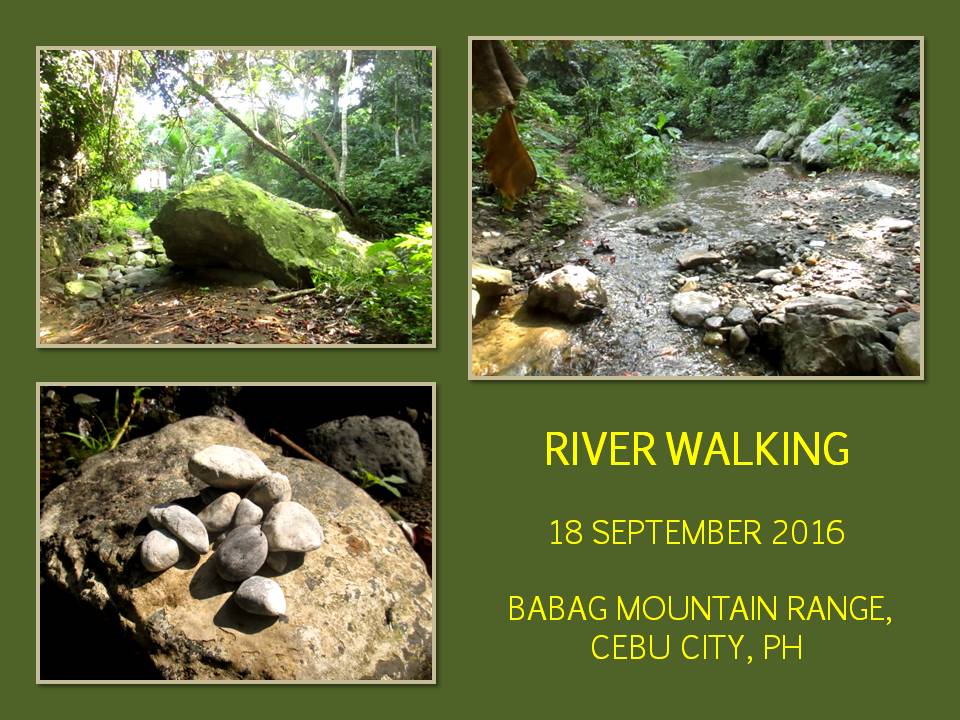
more agility to leap over stones midstream. I go down a path before
the footbridge and walk along a bank of Sapangdaku Creek. The water
is robust and noisy for it had been raining a few days ago. There is
a bend up ahead and a big rock, ancient and covered in moss, faced
me. It had been there since it was swept downstream during
prehistoric floods.
Man-made
water holes, washing wells, fishtraps and footprints complement
boulders, sand, pebbles, vegetation, debris and deep pools in the
character of the stream. The sound of rippling water constantly hum
in your ears and sometimes disappears for a few seconds before it
emerges into a stronger resonance. All those times, my awareness are
at its edge, never wavering nor retracting into complacency.
The
water passes on a small channel where current is strong but crossing
the stream is easy here. I clamber over rocks when passage forward
becomes tricky. I have to be careful of where I place foot over the
other without neglecting other concerns like venomous reptiles and
harmful plants. It is always like that. Scan the places first high
and low before reaching out for a handhold or placing a foot. All
done methodically.
I
see few people on the stream. A farmer crossing a stream unaware of
my presence. Two women with a small child washing clothes by a bend.
Another woman with child doing the same chore on the mouth of a
small feeder stream. However, human presence are everywhere. Unseen
people talking and laughing nearby. A smoke flares up with somebody
tending it. Invisible children playing, their voices echoing on the
narrow confines of the stream. Someone feeding the squealing pigs.
Pebbles gathered by somebody and abandoned.
The
stream passes by a community and sewage pours into it. Stench is
revolting. Water looks sinister. Vegetation grows thick and fat on
the water channel. Few spots to walk and the only places are nearby
canal outlets. No choice except hold breath and make an exit quick.
At other times, it passes by thick vegetation where both sides were
linked by a bridge of vines that is so low, so dark and so
suspicious-looking.
When
I am on an open field, the stream looks so glorious in the morning
sunlight. It is as if I am in another world. Upstream becomes a
conduit of much cleaner water and enchanting scenery until the
channel is blocked by felled trees. The dried leaves and branches
cover everything what is below. Would I step on stone, water or
snake? I hope my feet touch dry ground always.
There
had been reports of Philippine king cobras (Local name: banakon)
escaping from a government-run zoo in nearby Kalunasan. When you are
a snake on the loose, the fastest way to travel is going downhill
and, when you reach a stream, you got all the food and the coolness
you need, and then work your way upstream. Aside that, there are
cobras in the wild also and this is still their habitat. I had not
seen one but I had seen other kinds of venomous and non-venomous
snakes.
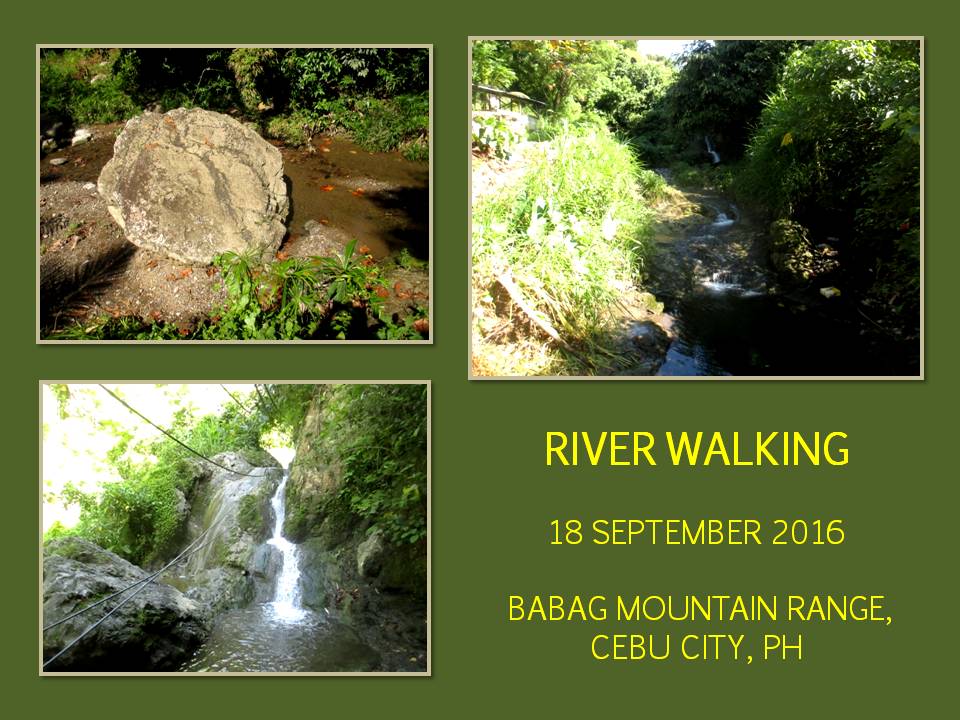
There
is that faint splashing sound that catches your attention which is
different from the usual ones made by a current ricocheting its way
on rocks and debris and shore. It grows stronger and stronger as you
approach and you discover it is a cascade, sometimes mistakenly
described by the many as a waterfall. A waterfall is a straight drop
of the stream from a height while a cascade is but a stream rambling
on solid rock from a height.
So
this is the one that caused so much racket everytime I walked the
trail above Sapangdaku Creek but I suspected it at first as a
waterfall. I do not have a name for this stream landmark nor I have
people to ask of. I have noticed that there are two pools created by
the drop. One on the bottom and the other on its middle. Besides
that, there is another separate pool on its side, created by an
overflow.
There
is a passage going to the top of the cascade but you would have to
climb a 15-foot wall of rock, which I did, thank God, I can still do
it at my age and bulk now. Scrambling rocks and boulders is no
stranger to me for I learned rock climbing in Cantabaco, Toledo City
in the ‘90s, back in the days when I was lean and strong and young
and fearless. But now, I am afraid of heights.
There
is another pool but narrow and above it is a chute on the rock that
channeled the stream at its swiftest current. This is a good spot to
take a bath since it is hidden. Maybe later. I walk upstream and
more of the wonderful features: pools, small cascades and
crystal-clear water with schools of guppy in it. Farther, there is a
trail built on a man-made pile of rocks. Motorcycles came down here
often as seen on the different wheel tracks. I just want to travel
along the stream.
There
is another deep pool, another set of big boulders and children. One
of the boys, who was crouching and unaware of my presence, dropped
his excess load into the swift current. The stream, like any other
streams in the Philippines, is a repository of everything, like
animal wastes, chemicals, garbage, sewage and excess loads. This
stream is polluted but people wash their clothes and dining utensils
and themselves with water from here.
I
am able to keep my shoes and my feet dry by my sheer wit in choosing
where I walk. In my experience, it is not wise to walk with wet
shoes unless you have no other choice. There was a time when people
were crossing Marbel River up to their crotch on their way to Mount
Apo, there I was leaping among boulders midstream over their
shoulders, not because I was showing off but because I am
uncomfortable with wet shoes and socks. That was dangerous! I was
able to accomplish that because I had a wonderful pair of shoes and I
was a fool.
The
clear water becomes white. Chemicals! I could hear a small engine
from afar. It is used to power a water compressor for spraying mango
trees. The sound gets louder as I approach and I heard another
sound, that of water being sprayed. Up on the branches of a mango
tree, a man is spraying the leaves and flowers. I held my breath and
made another quick exit. Cebu’s mango industry is the number one
pollutant of rivers! Next are the flower farms. Just look at the
abnormal growth of algae.
Once
upon a time, Cebu mangoes were the best in the Philippines and our
mangoes found its way to the US, Europe, Australia, Japan and other
countries. Not anymore. We are now overtaken by Guimaras. You know
why? They grow it organically while ours use chemicals. Food
standards are now high and very strict and, what was once Cebu’s
market, are now verboten. Sapangdaku Valley is mango country and
trees dot the landscape like broccoli. How I wished growers go back
to the basic and be less greedy.
There
is another deep pool and, above it, is a chute of water. I walk on
and there are sandbars. Two men are shoveling sand into empty cement
sacks. I walk past them and an abandoned spoon in sand. Another
small feeder stream joined Sapangdaku Creek. Passage quite tricky
but I saw a track of a person going upstream. Reading a track is a
skill. Most tracks are imprints on soft ground. That is the easy
part. Following someone on hard surfaces like stones and boulders is
extraordinary. I just love it.
Arrived
at a big pool with a good chute. The pool is dammed with stones to
make it deeper and to fence in fish. I go around it and am now in
familiar ground. Just 300 meters more upstream would be where those
crazies of Camp Red Bushcraft and Survival Guild would make their
dirt-time, if I am correct on my presumption. I walk past a natural
rectangular stone that could have been used by a local for sharpening
blades.
I
am at the spot of where they are supposed to cross the stream and
climb up a trail but I saw not one trace of them. Disappointed, I
drank my first gulp of water. I laughed at myself of why I went to
the great length of stealth-walking on a stream only to find that
they are not here. Well, it happens. Yes, it happened that I walked
that part of the Sapangdaku Creek where I have not had the
opportunity to do so. I am glad of my debacle. It was a great day.
Document
done in LibreOffice 5.2 Write
Posted by
PinoyApache
at
09:00
0
comments
Labels: Cebu City, commentary, exploration, reminiscing, Sapangdaku Creek, tracking
Tuesday, July 26, 2016
THE BOND OF THE FIRST BORN
THE
OPPORTUNITY TO TRAVEL on a weekend to Bohol is such a good thing.
The Bohol that is in my mind is a Bohol that I once knew which,
surprisingly, still had retained its rustic beauty. But this time,
its special significance on my boyhood memory had evolved into
something of a different dimension. My bond with the island is not
ordinary. It goes beyond comprehension.
I
am overwhelmed of my thoughts as I lay on a cot of the small boat
going to the Port of Talibon on a warm night at sea. I feel a sheer
longing, bordering on the sentimental, which caused a few tears
welling in my eyes. I was not born in Bohol. My mother was but it
was in the middle of a harsh war where my grandfather was forced to
hide from the Japanese. I only spent a small part of my childhood
there with my grandpa on our visits in the late '60s and the early
'70s.
I
am with my eldest son, Charlemagne, and his sister, Laila. Going
with them are their officemates Ariel and Edah. We arrive at the
Port of Talibon on the early morning of November 14, 2015 and proceed
on to the next town of Trinidad. Seeing the verdant hills and the
ricefields during travel, I am suddenly enveloped in nostalgia,
expectant of meeting someone whom I have not met before but someone
who is closely related to me.
This
same someone will notice this same scenery that I am seeing today and
this is his home. Today, I will meet my first grandson and, for the
first time in my life, I am entitled to the role of a real
grandfather. Today is his christening under the rites of the Roman
Catholic Church and my feelings are ambivalent which I am not open to
expressing. Meeting us at the door cradled in his mother's arms is a
handsome baby boy, eyes half-closed, but awake. He has the striking
looks of his father.
Once
my grandson is in my hands I raised him up above me. I gave thanks
to the Creator and the offering of my grandson to the heavens is a
gesture of my gratitude to the Giver of Life. I felt in my
subconscious that my late grandfather have once done this same thing
to me, in the full daylight of his life, which I am also relishing
today, and which his grandfather before him might have addressed his
Creator.
I
cannot explain this bond in explicit details except that it is a rite
that is reserved to the circle of the grandfather and his grandchild.
It has no scientific significance but it is spiritual in nature
borne out of the complexities of a forgotten culture which an
outsider could not relate to. Not even the father of the child has
this same privilege. My spirit is in its joyful mood and I can feel
its aura reaching out to the infant boy raised in the air.
For
the moment, it is enough that the little boy know of my voice, my
odor, the beat of my heart and the rough texture of my hands. Later
on, when he is strong enough, he will know the songs and the lore of
his forefathers which will come to him as if in a dream. We will
have time together, just as my late grandfather had spent precious
time for me. It will come in God's own time.
As
the night starts to mellow down the day's heat, me and the rest who
came in the morning will have to depart for Cebu. With a heavy
heart, which my son also felt, I have to part with my dear grandson.
It is just a temporary void. In time, we will be seeing more of each
other again. December would be a good time.
Oh,
ha le…Oh, ha le!
Awbizhaye
Shichl
hadahiyago niniya
Oh,
ha le…Oh, ha le
Tsago
degi naleya
Ah-yu
whi ye!
Oh,
ha le…Oh, ha, le!
Oh,
ha le…Oh, ha, le!
Through
the air…I fly upon the air
Towards
the sky, far, far, far.
Oh,
ha le…Oh, ha, le!
There
to find the holy place,
Ah,
now the change comes over me!
Oh
ha le…Oh, ha le!
Document
done in LibreOffice 5.2 Writer
Posted by
PinoyApache
at
09:30
0
comments
Labels: Bohol, family life, reflection, reminiscing, Talibon, Trinidad
Thursday, May 26, 2016
FIFTY YEARS: The First National Convention of the Omega Pelta Kappa
I
WALKED INTO A PLACE where the Omega Pelta Kappa Fraternity and
Sorority are celebrating today, September 5, 2015, their 50th
Anniversary - a golden – and their First National Convention. An
event that comes once in a lifetime for everyone, including me. I
would not see it happen again and I came to touch base, to see and
shake hands with my long-lost fraternity brothers and sisters and to
sing once more the Peltans Hymn.
I
am a Peltano by virtue of surviving a rite of passage that my
upperclassmen had willed on me in March 1981. I now claim that right
and that seat assigned to me inside the Sacred Heart Center.
Proudly, I wear my fraternity's commemorative black t-shirt for this
occasion but I feel uneasy. Unsure. Faces whose names I had
forgotten or whose name I cannot relate to someone else's face
questions my confidence. Of my right to belong.
I
see a small yellow paper on everyone's breast and it has their names.
My tenseness is gone and my smile becomes loose and natural. Time
to paste a yellow paper on myself also. The legendary banners of the
original chapters are hung side by side with the recent ones. Alpha
of the University of Cebu. Beta of the University of San
Jose-Recoletos. Gamma of the University of San Carlos. Delta of the
Cebu Institute of Technology.
Brod
Jerome Noel of Beta Chapter is on the stage providing insight into
this historic event as all ears are lent towards him. I walked
proudly to the place of the Delta Chapter banner, which I belonged,
when it was mentioned. It seems I am alone at first and I looked
around the crowd to give me company when, at last, Brod Dondie
Gabutan stood and walked to join me. Oh God, we are a dying breed
and so most of the old chapters.
We
need new blood to keep the flame burning. Here in Cebu, the place
where OPK was founded, only the chapter of the University of Cebu in
Lapulapu and Mandaue carried the torch of our existence but, even
with that, it cannot hold even the smallest candle to what we once
were, population-wise, during OPK's glory years. I am saddened at
this thought. We cannot turn this tide unless OPK will reinvent
itself to suit to the times.
I
reminisced in my seat when OPK was a very vibrant fraternity of the
early '80s. It was a time of the dictatorship and the rise of
adrenaline was very much appreciated by the youths of our time by
joining student organizations, legal or underground, and then engage
in extracurricular activities. It was also a time of turmoil but
youth militancy was at its height and my heart was swept onto its
revolution.
OPK
was part of my growth and had been part of the driving forces to what
I am now and I never regret the process by which they had imposed on
me, even with blindfolds. It may be harsh to most who had never ever
been there but it is bittersweet and special for the few who dared.
I am one of the few who can rightly say the “been there done that”
phrase with credibility. Scotch on the rocks, please. And make that
two. I believe, swapping stories with a peer are better with that.
I
am with my contemporaries inside this big room. The alpha males and
the alpha females of their time but now very docile and warm and
aging. The youthness had surrendered to the grayness and the
baldness and the accompanying body aches. The pillars of the OPK sat
on the front table. The gatekeepers. Soon they will pass the shield
to the Council of Elders that they will soon chose from among those
who are fit to lead OPK to the next level.
On
discussion is the official OPK Logo. Our Coat of Arms. Brod Edward
Cilocilo (1977 UC) emphasized that all the chapter leaders and
members should adhere to the original concept of the seal that the
original founders had designed. Adding other details which does not
pass the scrutiny of all chapters is hereby discouraged. The OPK
identification tattoo, the whistle, the challenge-and-password system
are also explained in great detail by this esteemed gentleman from
the third generation.
The
Omega Pelta Kappa may have had lost its zest and appeal to the
younger generations as the anti-hazing law is implemented by the
government to its fullest meaning which dealt the dearth of new blood
through the traditional lines of recruitment, not only on us but on
the rest of school organizations with Greek letters. Nevertheless,
OPK will adapt to the times and it will have to undergo radical
changes in its organizational structure, name, rituals and processes
so it would survive and entice new members.
The
only bright spot that OPK is enjoying right now are the chapters of
Pi Alpha and of Zeta. The latter had metamorphosed into different
sub-chapters that are distributed in Davao City, Davao del Norte,
Compostela Valley, Davao del Sur and Davao Oriental and, that is why,
six slots are entitled to Mindanao to the Council of Elders. On the
other hand, the chapter of Kabankalan City, Negros Occidental is a
force to reckon with, with two slots graciously assigned to them.
Saving
face, because of its large alumni population, Cebu was able to snare
two slots for the Council of Elders. Manila gets one, as a special
concession to the efforts of Brod Rey Mabasag while Iloilo gets a
slot, despite not being represented. The Council of Elders would
formulate the drastic changes that Omega Pelta Kappa will have to
painfully undergo in order to breathe above the water line. This
would not be easy.
I
believed there had been behind-the-scene debates regarding these. As
always, there are the pros and the cons and there is communication
and dialogue. A very long process but it came nevertheless on a
silver platter. Never too late and never too early. It is aged. It
is wise for its time. It is ripe enough for the picking on this 50th
year. How appropriate. It has its rough edges but it will soon be
smoothed soon to a shiny sheen. Trust that to the Council of Elders
and to the Grand Chancellor.
Representing
Mindanao are Brod Alandele Pacquen, Brod Romeo Uy, Brod Raymund
Galot, Brod Daryll Huesca, a sister and another brother. Kabankalan
City will have Brod Michel Miran and Brod Mark Dorado. Brod Jerome
Noel and Brod Glyx Gallego represent Cebu while Manila will have its
lone representative in Brod Rey Mabasag. Absent but highly
recommended, is Brod Kenneth Apuhin, who would be Iloilo's own.
Elected by this body as Grand Chancellor is Brod Jerome Noel. All
would serve two years and shall be replaced (or could continue for
another two years) on the next national convention, which will be
hosted by Davao City.
Henceforth,
the Omega Pelta Kappa Fraternity and Sorority will be given a legal
personality with the creation of the Peltans International Society of
Professionals Incorporated (PISPI), pending approval before the
Securities and Exchange Commission. OPK shall remain as it is - as a
fraternity - and would continue functioning in campuses and retain
its identity, structure and a few revisions of its rituals. When a
Peltan graduates from college and turn professional, his ties with
his fraternity continues and that is where PISPI comes into play.
PISPI
will oversee the operations of campus chapters and would guide and
inspire the collegians to strive in their scholastic endeavours as
well as paving the way for their integration into the professional
world. PISPI provides them assistance and full support – as
students and as professionals – and would function according to its
mandates. PISPI would also accept neophytes directly from the
professionals and there would be the mandatory requisites for full
acceptance to brotherhood or sisterhood, which would deviate a little
from those entering by way of OPK.
These
are the ideas that OPK need to stave off extinction. We are, more or
less, like the dinosaurs and most of our thoughts stuck to the past.
Sentimental values. It is time to move on and accept change. The
opportunity of being part of a new phase in the reorganization of OPK
into PISPI gives me reason to hope, exult and wait for that day when
I could enjoy the fruits of these outcomes that the Council of Elders
would soon implement.
I
have one concern though. Could we sing the Peltans Hymn better next
time? And could we prepare a choir of Peltans to record this song so
it would not deviate from its original form like what happened to our
coat of arms? When transferred in MP3 format, singing our hymn would
now be easy unlike the ones we did during the opening ceremonies
where it sounded like the ones tuned in for funeral hearses.
Dinner
is served courtesy of our more blessed fellow Peltans. Sharing a
table with me is Sis Elsie Imanil of Gamma Chapter while on an
adjoining table are my brothers from Pi Alpha and on another are the
old stalwarts of Gamma. Everybody are joyful and expectant of things
to happen that will solidify our existence and our bond. There is
life for a Peltan after college, and after here, after all.
One
of the things that PISPI will introduce is the Chamber of Commerce.
This body will collect and collate all the members' profile,
profession, skills, business and other information into one database,
like those of a classified ads, and shall be available to all Peltans
for referrals, networking and for other purposes. Literally, I have
snared an opportunity at that moment as Brod Nick de los Santos of
Alpha Chapter and the incumbent mayor of the Municipality of Alcoy,
Cebu, asked of my number. A future project in the making!
As
this national convention of old and new Peltans begins to show the
forms of an adjournment, I slowly leave my table to shake hands, and
bade goodbye, to any Peltan I happen to pass by as I take a subdued
journey to the door. The grips are still firm, their smiles
welcoming although a little sad at the corners, knowing that the
opportunity for meetings like this would be two years from now. And
we are not getting any younger. Two years! It is harsh on all of us
but we have to surrender to that reality.
I
would have wanted to extend my night hours into the morning to swap
stories, to fill in the blanks of the gap of years and to unseal the
enigma I might have projected to the rest of the Omega Pelta Kappa.
Not tonight, please. I am overwhelmed by too much happiness to see
so many Peltans in one place and in the creation of PISPI. I could
have that in my own sweet time. Perhaps, in Davao. Why not? Davao
is a special place for me and I have good memories there. Eating
durian is one of them.
See
you in September 9, 2017 then my brothers and sisters. ¡Hasta
siempre Peltanos y Peltanas! Peltans
Forever!
Document
done in LibreOffice 4.3 Writer
Photos
by Brod Rod Cumba and Sis Elsie Imanil
Posted by
PinoyApache
at
09:00
3
comments
Labels: events, Omega Pelta Kappa, Peltans, reminiscing
Sunday, March 1, 2015
THE DILEMMA OF BROKEN GLASSES
IN
APRIL 1975, a boy enjoyed his summer vacation shooting a basketball
on a dirt court. The ball bounced off the iron rim and landed beyond
the court and rolled into a grassy area. The ball stopped among a
clump of thick grass. The boy chased the ball and stepped on to
something that gave in to his weight. He retrieved the ball and ran
back to play basketball under the heat of a noontime sun.
He
noticed something warm and slippery on his left foot and saw a lot of
blood spurt out from a cut on the inside of his left ankle. He
looked at the long trail of blood behind him and limped back home
with his basketball under his right arm. He went to the faucet and
washed away the blood, thinking the action would improve his
condition. He could clearly see that part of his sole, starting from
the arch, was sliced clean up to the part below the ankle bone joint.
He
began to rattle and called out his grandmother. His grandma saw the
3-and-a-half-inch wound and woke up the boy’s father. The father,
seeing that a home remedy is out of the question, decided to carry
his son to a family doctor. He carried the boy on both his arms and
half-trotted to the clinic some 400 meters away. The good doctor was
around and begins to work on the wound. He has no anesthesia but he
sewed up three lacerated arteries and the skin to temporarily stop
the bleeding.
The
boy’s face turned pale through loss of so much blood and was brave
enough to see his left foot being sewed up by the doctor. He sounded
off a stifled cry each time the needle pierced his flesh and dreaded
the next action. Nevertheless, he heard the doctor and his father
talking in a better tone and found it reassuring. The boy was
transferred to the hospital for re-sewing of the skin but, this time,
anesthesia was injected around the wound.
The
boy had been on the brink of death due to loss of blood but his
courage to face his difficulty allowed him no time to faint while
limping home for help. The wound was caused by a large Ovaltine
glass jar that broke under the weight of the boy. The jar was
covered by thick grass. After that incident, the boy went back
months after to retrieve and dispose hidden broken glasses on his
playground and anything that might cause harm to anyone, especially
his playmates. It has been his advocacy ever since.
That
boy was me. I just took an examination for entry into a Catholic-run
high school that morning and, after finishing lunch, went to shoot
basketball. It was a very traumatic experience for me, especially at
the clinic. The legendary doctor was Dr. Poliento B. Dy. He passed
away many years ago. He was the last of his kind. He did weekly
house calls in our neighborhood and his clinic was located at the
corner of MJ Cuenco Avenue and Villagonzalo Street in Cebu City. No
doctor in urban centers do house calls nowadays.
Now,
back to this “broken glass” advocacy, it is nothing but a
personal commitment on my part being the best example of how
carelessly-placed, or thrown, broken pieces of glass could cause harm
on people, especially carefree children, even to the extent of
snuffing away their lives if there is no help on time. It had not
been the first time that a broken glass had caused me injury nor was
it the last. My eldest child had the same laceration on the left
foot caused by glass when he fell on a hole, just meters away where I
was wounded, when he was just seven years old.
It
pains me to see children suffering from pain, agony, shock and loss
of blood because some careless and irresponsible individuals did not
think clearly when they start leaving bottles, glass jars and broken
glasses out of doors. They even burn this as part of garbage. A lot
of people are really stupid when they know that glass, along with
empty cans, can never be burned by a small fire. In fact, it makes
glass more brittle and much difficult to pick from the flesh because
it disintegrates into small bits and flakes.
As
much as possible, I pick bottles along mountain trails and hide it
where it cannot be exposed as a target for both children and adults
exercising their marksmanship prowess. I collect broken glasses on
the same trails and bring it down the mountain and dispose it in city
garbage bins. I have to be careful when I carry it inside my bag
else a misstep would tear up my bag, slice the things inside or it
pierces through the bag and cut me up.
During
my visit to Osmeña Peak in 2009, I saw a lot of broken bottles that
the collecting and carrying of it downhill would be a herculean job
that required fifteen people. I simply pound the glasses into
powdery bits with stones and drop these into any rock I can find with
holes and plug it with stones. There were more bottles and broken
glasses thrown in the sinkholes by people who visit there though and,
I think, Osmeña Peak should be declared a national park so visits
would be regulated and ground maintenance would be imposed.
The
most hideous places where a broken glass could effect harm are on the
streams. You go barefoot when you swim and your soles becomes soft
because of exposure to water. One day in 1995, while going on picnic
at the source of Matutinao Creek with my wife and son, a boy stepped
on a broken glass. Blood were everywhere and, I believed, an artery
was lacerated. It reminded me of my wound years ago. His mother
could only apply a herbal remedy with a poultice of chewed
horseradish but I forbid it when I decide to involve myself in.
I
put pressure above the wound to control the flow of blood then I
carried the boy in my arms making sure the wound is above his heart.
Then I ran and followed the trail going down the national highway.
Those who have visited upstream beyond Kawasan Falls knows the
terrain is rocky, difficult and very slippery. I ran on it downhill
and where I am most susceptible to an accident myself. A lot of it
are above cliffs and sometimes you have to cross the stream over
coconut logs that move as you walk above it.
Bathers
at the waterfalls stare at the bloodied foot and they begun to think
twice about what is in the bottom of the part of their river.
Eventually, I reached the road. A bus passes by and I instructed the
driver to bring the injured boy and his mother to the nearest
hospital which is at Badian. In my own small way, I saved a boy’s
life but the problem with broken glasses remain. It was at this
instance that the inhabitants and other stakeholders of Matutinao
began to clean their beloved river of this hidden menace.
When
you see me stopping on a trail, picking up something which sounded
like broken glasses, do not be alarmed. I am not acting like a fool
but, rather, I am doing a service for the inhabitants, especially the
local children. I am making the world safer for them. This is
another of my advocacy. There are no corporate sponsors and there
are no media hypes. It is just me with a past. I am personally
inviting you to do your part. Let us rid this world of broken
glasses and educate people how to dispose of this safely.
Document
done in LibreOffice 3.4 Writer
First
photo courtesy of www.x199103.deviantart.com
Second
photo courtesy of www.telegraph.co.uk
Third
photo courtesy of www.artandcritique.com
Fourth
photo courtesy of www.wikihow.com
Posted by
PinoyApache
at
09:00
1 comments
Labels: advocacy, reminiscing, safety
Subscribe to:
Posts (Atom)