Showing posts with label CLIMBER. Show all posts

Saturday, July 14, 2018

PINOYAPACHE GOES BACK TO BASICS

I HAVE BEEN CLIMBING MOUNTAINS and hilly regions in the ‘80s here in my country but I do not consider myself a mountaineer. I do not know then that mountaineering clubs were already existing as early as 1970 and these guys have challenged and assaulted remote and difficult mountain ranges. You only know of this from tidbits of information from newspapers and from monthly leisure magazines, usually already so outdated. News travel so slow on those long forgotten era. Pre-Cambrian times.

When mountaineering became popular in the ‘90s, the University of the Philippines Mountaineers formulated the creation of the Basic Mountaineering Course (BMC) as a prerequisite for induction of members into their organization. Later on, it was adopted and shared to the different mountaineering clubs and the National Mountaineering Federation of the Philippines, the forerunner of the MFPI. Before or during that time, I was now a member of the Cebu Mountaineering Society and I have not heard of that. News does travel slow in that era. Jurassic times.

 
Fast forward to Facebook era. People flock to the mountains because their friends posted their exploits in social media and these places are now very accessible because it was pioneered by earlier mountaineers. While it may be good for local tourism, practicing the finer ways of engaging in leisure activities on the mountains are simply lacking and needs proper guidance and education. You see this all the time in social media: accidents, wrong attire, getting lost, rescued, retrieved, hiking on the wrong time, grassfires, unpreparedness, ignorance, garbage here, garbage there, garbage everywhere.

While the main purpose of the BMC before was more on preparedness, health and safety but, this time, the mountaineering community needed to protect the very playgrounds from these hordes of uneducated individuals. And so it became mandatory – with greater emphasis – to inculcate the Principles of the Leave No Trace to the new mountaineers as a side dish to the BMC. No, make that both the main menu. You would have to swallow both as a personal advocacy. It does not stop from there. You will ride the social media phenomena and educate people through there. Not by bashing but by intellect.

People, clubs, organizers and even government agencies are working against time in the hope of reversing a dangerous trend that social media unintentionally provided to a lot of people. One of these organizations is the Climbers League for Ideal Mountaineering and Balanced Environmental Responsiveness or simply known as CLIMBER. It is not a mountaineering club but an advocacy of long-time friends who would like to make the outdoors enjoyable and safe. They are based in the National Capital Region but they could be requested to teach and share BMC and LNT to the rest of the country.

Last July 22 and 23, 2017, CLIMBER came down to Cebu City to bring their knowledge and their resource speakers to educate members of a newly-established mountaineering club of Shearwater Health, a business-process outsourcing company based in the Cebu Business Park. CLIMBER, for most of the time, organize their own BMC in locations around NCR but, sometimes, on a few occasions, conduct BMC and other training on request just like they did in Romblon last 2016. Their instructors are some of the best in their own fields. Let us name them one by one:

 
Regie Pablo. He needs no introduction. Everybody knows who he is. For those who do not know it yet, he is the fourth Filipino to scale Mount Everest. He did it on May 16, 2007 and lost the endmost joint of a thumb for his effort, through frostbite. He is also recognized as the one who inspired the mountaineering community to form the Philippine Everest Expedition Team so it could place our country’s flag on top of the highest peak on Earth, which we did in 2006. He will be handling Introduction to High Altitude Mountaineering.

Erick Suliguin. A product of the earliest BMC batch of CLIMBER, went on to seriously pursue advanced learning in LNT at its Center of Education in the USA and came back to transform CLIMBER into a very credible outdoors learning institution. He is a holder of the LNT Master Educator, a distinction of being the only one among three Filipinos who has this learning to teach LNT here, the two being US-based. His presentation would touch on the Principles of LNT. 

 
Ronald “Fabs” Fabon. One of the most versatile resource speakers for CLIMBER. He could discuss anything relating to mountaineering and the outdoors. His long experience and wide array of skills made him very valuable to the mountaineering community. He had sharpened those skills when he was then a member of the MFPI Educational Committee. He would touch on many topics for this BMC and it is about Planning and Preparation, Gear and Equipment, Map Reading, and Knot Tying.

Ramon “Jay Z” Jorge. With CLIMBER from the very start of its inception. Currently is the administrator of their social media pages and also handles their marketing thrusts. While he has undergone many training, people here in Cebu remembered him only as a participant of the Philippine Independence Bushcraft Camp in 2012. His pioneering inclusion of survival as a subject in a BMC was revolutionary. He will be discussing Introduction to Survival.

The Boy Scouts Camp in Kalunasan was chosen as the venue. I happened to be there to support CLIMBER, along with the Camp Red Bushcraft and Survival Guild. There were eleven participants from Shearwater Health and they were augmented by people from Camp Red, to include me. I have never sat in a BMC before and I have no certificate to show that I have participated in one. Maybe this time I will have one to attach and show in my curriculum vitae.

In case you might know, this is one of the ironies of my life because I am often invited as a resource speaker in many BMCs for topics which are not found in their regular lectures. By the way, all the things my peers and I did during those Jurassic times were just common sense and it found its way in the pages of the BMC. I heard it many times from different resource speakers of many BMCs I have been in to. I learned these rudiments informally, long before it was called a BMC, and the CLIMBER event would just formally place an icing on my cake. 

After singing the National Anthem before the Philippine Flag, Jay Z opened the BMC to the participants on the first day, July 22. For a whole day, Fabs began his topics from the pre-climb meeting to choosing equipment to pacing to navigation. After dinner, Regie talked about his experience with the Philippine Everest Expedition Team which brought him to snowy regions, training and acclimatizing himself for the big day in 2006. His success came in 2007 and he did it alone. So ended the first day.

Giving Regie support is his closest friend and fellow Everest expedition team member, Larry “Hillboy” Honoridez, who came while he was in the middle of his topic. Regie and Hillboy talked about old times. Joining him in their circle were Jay Z, Erick, Fabs, Billy Anciro, Randy Salazar, Jonathaniel Apurado and me. The festive company ended only after the first few hours of the next day. I stayed with the participants in the BSP Camp and slept in my hammock.    


The second day, July 23, started after breakfast. Fabs began the part about knot-tying and ropework and culminated with the part about the post-climb meeting. After lunch, Erick took up the cudgels and discussed LNT for a whole afternoon. After dinner, and not part of the program, I found myself talking about the Cebu Highlands Trail so as to inspire the participants. Then Jay Z gets his turn exposing the participants to a survival mindset.

The BMC that CLIMBER introduced to Cebu was the 19th one ever since they existed in 2015 and the first one that I attended as a participant. CLIMBER has taken the right advocacy: Outdoors Education. With their effort, they were able to educate a lot of people relating to the different outdoor hobbies, most notably, of mountaineering. The mountains possess a different environment and unpredictable weather patterns. The BMC guides you to enjoy and cherish these places safely and help in the conservation efforts thru LNT.

Document done in LibreOffice 5.3 Writer

Thursday, December 7, 2017

PINOYAPACHE MEETS THE GREATEST PINOY MOUNTAINEER

REGIE PABLO JOINED ME today, March 18, 2017, inside a Toyota Corolla driven by Jay Z Jorge. We would all be going to Antipolo City. The Climbers League for Ideal Mountaineering and Balanced Environmental Responsiveness, or simply known as CLIMBER, will be opening the 18th Batch of their Basic Mountaineering Course in Basekamp, a private camping facility.

I stayed the whole day yesterday in the residence of Jay Z in Navotas City and I am fully rested after a week of travel, work and outdoors recreation. A wholesome dinner at Pacing’s House of Barbecue settled my equilibrium to near normal levels. My participation in the CLIMBER BMC would just be in a cameo role of bed spacer and freeloader. Jay Z must have erred in inviting me.

Sitting all to himself at the back is Regie, the renowned Filipino mountaineer and Mt. Everest summitter. It is indeed an honor to meet and share a ride with him inside the Toyota. This unassuming man made possible the Philippine dream of putting the first Filipino on Everest, with which honor belonged to Leo Oracion, who planted the national colors at 8848 meters in May 2006. It could have been him, though.

 
Unknown to many, he was the wellspring of that idea when he made known his intention of climbing Everest in 2001, after acquiring the funds, the equipment and the sponsors through his own industry and connections to sustain his expedition. He was set to claiming that honor when he was talked and prevailed upon by the local mountaineering community to involve the whole nation. So it became known as the Philippine Everest Expedition Team.

On that year in 2006, the country achieved an unprecedented feat by placing two team members on top of the peak. He did not get that chance. He sacrificed everything for that moment but his never came. Worse, he was sent packing days before caused by internal politics of the expedition team. He nursed bitterness for relinquishing his opportunity in 2001 but he will prove one day that he can climb without a team with useless people and their personal motives.

His day came on May 16, 2007. He did the impossible. He climbed Qomulongma all by himself, by his own wits and, in the process, losing the endmost joint of a thumb to frostbite. But he survived the greatest ascent of his life and lived to tell his solo adventure. Quite a feat for someone who defied age and his critics. It was the greatest insult he could flaunt in their faces! I loved individuals who thrived in obscurity. Regie is a certified Badass!

 
I remembered featuring Regie Pablo and his Everest climb in my Multiply account back in 2007. I know only that his expedition was done on his own power, bequeathing his corporate job for that one chance which elicit my appreciation. I know now that he took the longer route, after a brush of betrayal and rejection. His ascent has more substance, more drama and more sacrifice than any other Filipino before him and he deserves that honor, in bold letters, as the Greatest Filipino Mountaineer.

We arrive at Basekamp and some of the CLIMBER training staff are already there. The participants are excited to be in a seminar that would educate them into responsible individuals. They would learn a lot, considering that CLIMBER is an advocate of excellent outdoors education anchored on the seven principles of the Leave No Trace. In fact, CLIMBER is one of only a very few local partners of LNT Center of Outdoor Education.

Jay Z introduced me to the participants as an “inspirational” speaker. I was caught unprepared for I was informed at the last minute. Maintaining my composure, I tried to be esteemed as possible infront of them. I appealed to the participants to be discerning and objective of joining in mass climbs and cheap bandwagon tours which tend to drain them physically and emotionally instead of gaining good impressions and memorable experiences.

However, DIY trips and organized tours by more responsible tour agencies are much better and yields you higher sense of adventures and better memories, provided you follow protocol, which you can only learn in seminars like the BMC. As my parting message, it would be nice to the environment and to the indigenous communities to keep these unvisited places all to yourselves and it would be better, as well, not to share it in social media sites.

 
Regie would talk about Introduction to High Altitude Mountaineering during the first part of the BMC. For that matter, he brought a big bag containing the learning aids vital to imparting his lecture to the participants. Real mountaineering starts at 4000 meters because air begins to thin and low temperatures starts to be a hindrance. These two, together with ice, avalanche and crevasse, would make progress painful and dangerous.

Altitude sickness, frostbite, exposure, pulmonary and cranial edema are the main illnesses that slows down expeditions and, almost always, it claim lives. Another difficulty in higher altitudes is the difficulty of doing body functions deemed normal at sea level like breathing, eating, drinking, sleeping, defecating and urinating. Because of that, the sport of mountaineering needs special clothing, safety equipment and high-end gear and a very complicated acclimatization process.

The bag is a treasure trove of items that have seen better days when Regie brought it in many of his mountaineering expeditions in New Zealand, China, Argentina, Kyrgyzstan, Alaska, India and Nepal, but his crowning glory in Mt. Everest made these items more valuable than ever. Each has its own story to unravel and are now collectible items. These items are a decade old now and still served its purpose as valuable aids in BMC education.

I was amazed at the number of tools and thought processes to accomplish an expedition in arctic and thin-air conditions. In cold weather, deprived of oxygene, your blood circulation becomes sluggish affecting your thoughts. Simple body movement takes an eternity to accomplish. It takes years of experience to get used to these harsh conditions and an equally harsh environment. It takes also a deep pocket to make a summit timed on the most favorable time of the year.

 
It is cheap if you were born and have lived there all your life like the Sherpas but astronomically expensive when you are organizing an independent expedition on your own. Lately, commercial adventure tour agencies organize climbs in the Himalayas region and the price has diminished so much by leaps and bounds and, because of that, summitting Everest or any of the fourteen 8000-meter peaks are now possible for everyone.

The Philippine Everest Expedition Team took this very economical course and their contracted tour agency took care of everything from climb permits, lodging houses, additional equipment, oxygen, food, transportation, yaks and a small army of Sherpas to pave the way for them. It would have been much cheaper still if they start from the Buddhist Kingdom of Free Tibet but it is much safe in Nepal with all these professionals.

Regie successfully climbed Mt. Everest after cultivating friendships and connections with Nepalese tour operators and guides. He is a likeable fellow, humble and simple, but he has drive which could move mountains like his plans in 2001 where a number of people woke up from their stupors and inspired a nation. Denied his chance in 2006, which was originally his expedition, he came back and proved his detractors wrong. He won the last battle after a painful retreat.

His name in Philippine mountaineering history is already ensured and his way was the stuff of legends. Regie is an asset to any organization which could positively harness his intellect, skills, experiences and insights and CLIMBER is just fortunate to have worked together with him in educating people. CLIMBER guarantees the education of BMC participants only from the people who are the best in their fields, which followed thereafter.

 
The afternoon of the first day is dedicated to Land Navigation which is handled by Ronald Fabon and, after dinner, Basic Life Support by Christopher Jazmin. During the breaks, I set up my Silangan 2nd-Gen Hammock and an Apexus sheet at the back of the lecture hall and chased short naps. While witnessing the BMC, I get to meet again Ven Ap of Ven Going Places’ Stories Blog who had featured me many times and who have helped me with sponsorship for my Thruhike last January.

The next day, March 19, is a whole morning of Ropesmanship and Knot Tying by Marc Gana. The afternoon is dedicated for Wilderness First Aid by Chad Angelo Torres and Leave No Trace Principles by LNT Master Educator Erick Suliguin. After dinner, guest resource speaker Jeremiah Dayto talked about Prepping. Jay Z capped the final day with Introduction to Wilderness Survival and Khai Fredeluces explaining the appearance and contents of a survival kit.

It was another worthwhile weekend that I spent, this time, with my friends in CLIMBER. Some of these guys have even sat in my different bushcraft and survival classes like Jay Z (PIBC 2012, BWSC 2013), Marc (MCAPBC 2012), Jeremiah (PIBC 2016), Chad (BWSC 2016), Khai (BWSC 2016) and CLIMBER top honcho Bong Magana (MCAPBC 2012). These guys know what they are doing and, as I have mentioned earlier, they are the best in their fields.

Notable mentioning is Erick, a product of CLIMBER’s earliest BMC batch, who went on to pursue advanced learning in LNT at its US headquarters and came back to inject CLIMBER into a very credible outdoors learning institution. From him, I now own a Condor Bushlore, a Browning folding knife and a NOLS patch. It was a very fruitful weekend and my overall 14-day in visit in Luzon, which brought me to Baguio and Zambales, culminated in meeting Regie Pablo, a Filipino mountaineer nonpareil.

Document done in LibreOffice 5.3 Writer

Saturday, October 1, 2016

THE TRAILHAWK JOURNEYS: Antipolo Wilderness Survival Class

I AM ON BOARD an Air Asia airplane that had already been delayed by two hours for Manila.  The flurry of announcements and non-announcements about the prohibition of the carrying of guns and deadly weapons during travel in an election period have left me fang-less.  It is strange to travel without my blades considering that I need these in the course of my work.  I am now a full-time survival instructor and I am coming over to teach people wilderness survival.  For that matter, my bag even if it is the bigger Habagat Viajero is strangely light.

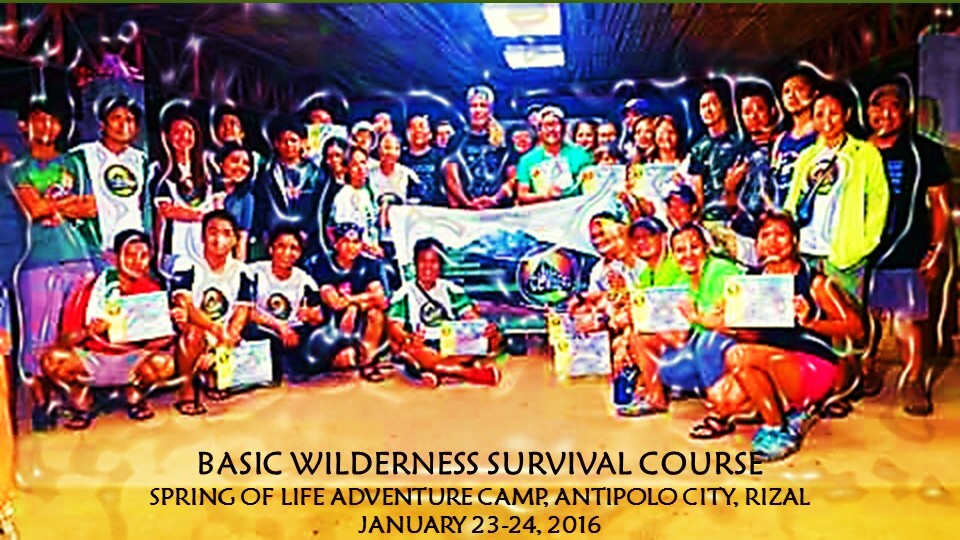
The Climbers League for Ideal Mountaineering and Balanced Environmental Responsiveness (CLIMBER) had contracted me to have 34 of their graduates of previous outdoor trainings take the BASIC WILDERNESS SURVIVAL COURSE for two days.  CLIMBER is a non-stock non-profit organization registered with the Securities and Exchange Commission that is dedicated primarily for outdoors education with the 7 Principles of the Leave No Trace as its bedrock.  Contrary to common perception, it is not a mountaineering club.


It is composed of responsible outdoorsmen whose skills and experience are varied and wide and pooled these together to create the best Basic Mountaineering Course syllabus in this country which, as of this writing, is now on its twelfth class.  They have some of the best instructors which are the best in their fields like Reggie Pablo (high-altitude mountaineering), Lester Susi (land navigation), Billy Morales (ropesmanship) and master educator Erick Suliguin (LNT).  CLIMBER is ably lead by Bong Magana, Jay Z Jorge and Sidney Orendain.

The plane touched down at the Ninoy Aquino International Airport Tarmac 4 on the evening of January 22, 2016 and I was whisked by Sidney and companion to the Mall of Asia’s Bayfront area where I was treated to an al fresco dinner and cold beer.  In a little while, Jay Z and wife Carla fetch me from there and we proceed to their home in Navotas which, perchance has it, becomes my home away from home.  I am not tired from the travel but overly excited for tomorrow’s activity.

In the early morning of January 23, Jay Z, Carla and I travel from Navotas to Antipolo City in their old but very reliable Toyota.  I learned that most of the participants for my training are already at the Spring of Life Adventure Camp.  This is the same place that I have taught members of the Mountain Climbers Alliance of the Philippines (MCAP) in October 2013 where both Jay Z and Carla attended.  Basically, this is the same course that I am teaching today except that I have added a single new chapter.

Setting up of shelters are ongoing and I choose my spot to secure my rust-colored Tingguian Tribe Sierra hammock underneath a silvery white Apexus canopy between two trunks.  The weather is perfect and I do not expect rain today although it would be cooler than usual at this latitude which is four degrees north above my dearly warm Cebu.  Over my shoulders, I expect the swarm of mites that originate from a nearby stag farm which have tormented me the last time but it never came. 

After the opening ceremonies, I got my chance to be introduced to the 34 individuals sitting inside the main hall facing me which I locked in memory with selfie shots.  Speaking about myself would have to be minimized because, from this moment onward, there will be eleven chapters which would need to be discussed within a span of two days.  I feel the pressure but I am used to it and I would have to improvise later on if it fits to be so.  All are excited at the prospect of learning survival and bushcraft.

While I would love to teach bushcraft, it might go against the grain of each individual’s belief in and interpretation of Leave No Trace.  LNT, to the most cerebral amongst us, is but a guide and an idea by which self is bound to live by, whereas, to those who cannot see beyond the true spirit by which LNT was established, it is used as a rule instead and imposed upon on other individuals.  That said, I rather not antagonize the latter by taking the middle ground teaching Basic Wilderness Survival Course to the mountaineering community.


Survival is different from bushcraft.  It is immediate and would bend rules and morality in the pursuit of life – of surviving.  That is a hard reality which all survivors must live with while in the course of their dire consequences and the thereafter.  On the other hand, the mountains consists of harsh environments, steep inclines, high elevations and unpredictable weather patterns.  It is remote yet people visit these places to chase passions and desires.  Accidents are most likely to happen there in a flash.

Chapter 1 is Introduction to Survival.  While nobody has that ultimate technique and answer to survive accidents and calamities, a prepared mind would, at least, be blest by chance.  Surviving the initial impact is one half of it while ensuring your survival until help comes in is the other half of that.  In between, the mind controls everything from the way you think and even to the release of adrenaline.  Your brain is a supercomputer but, unfortunately, it could only process one thought at a time.  

When in a survival situation, your brain works double time and, in the process, use up huge amounts of body heat, water and oxygene and inadvertently releases adrenaline for no apparent reason just like you would experience when getting lost or just plain hiking in darkness.  It is best that you stop and sit still like a rock, close eyes and breathe deeply, gather all your senses and rehydrate.  You would need water and it is your first priority to keep your blood flowing so your brain would work properly.

In the hierarchy of needs and of nutrition in a survival situation, water is tops on both.  Why?  Because we are in the tropics and the body is surrendering perspiration due to humidity and by your exertions.  Along with that, goes our body heat also which you do not know.  To sit still would minimize these wastage and keep these confined by setting up a shelter – if you still have one, or make one from scratch.  This is the second need.  The third would be food then warmth.  Last is security which would complement well with the rest.

Our body has four hypothetical tanks that needs to be replenished during survival.  First is constant rehydration that would offset dehydration.  Second is food that would give you nutrients, carbohydrates and proteins.  Third - sugar converted by enzymes for your adrenaline rush. Fourth is fat, hardest to find in the tropics yet are wrapped as tissues in our body.  Then, lastly, make sure your body is supplied with adequate oxygene.  Keep those air passages free of obstacles.  Might as well practice personal hygiene during survival.  It helps to have both a healthy body and a healthy mind.

Chapter 2 is about the Survival Kit.  It is better that survival kits are made from scratch than bought commercially because a survival kit’s size and its components depends upon the type of the activity you are in to and the kind of environment you are going on to.  Your personal touch on a vital equipment is very important to you should it be needed.  Its components are the medical kit, the replenishment pouch, the repair kit and the survival knife.  It could all be integrated in one container and should be waterproofed.


I came without my knives because I am beholden to CLIMBER to come here without a snag and make their event successful.  If I had insisted to, it could go either ways.  Anyway, Dr. Arvin Sese of Seseblade had provided me the free use (and its ownership later on) of a Seseblade Nessmuk.  Aside that, Jay Z brought his Seseblade Tabak which I also have the good liberty of using later on.  The participants will have their hands full with eighteen Seseblade knives available for sale like the Mountaineer, the NCO, the Pinahig and the popular Sinalung only after I have discussed Chapter 3, Knife Care and Safety.

The knife is a tool and should not be used to what it was not designed for like digging latrine holes and as pry bars.  It is a vital piece of equipment that should be properly handled and cared for because it is your link to your surviving.  Carrying and using it demands good knife etiquette which you can only learn in this type of trainings.  Besides that, there is a knife law that forbids the display and concealed carrying in public places unless you are in a lawful activity, which we are right now.  A knife should be in a sturdy sheath when travelling - for safety - and should be unsheathed when at home to keep it from rust.

I jump to Chapter 5, which is about Water.  The first chapter had mentioned the importance of water during survival.  Water could be sourced from natural springs, water seeps, man-made water holes, flowing streams, the atmosphere and from plants.  It could be cleansed by boiling, by chlorine tablets, betadine drops, exposure to heat, through filtration and by desalination.  It is wise to cache water in your survival camp or travel early and take advantage of shady places and breeze if you happen to have less.

We take a lunch break 30 minutes before 12:00.  Everybody proceed to their tents and group campsites to prepare their food.  I see fire being made to work up embers on charcoal.  There will be meat grilled above it soon.  While it had not started yet, I secretly place a small can filled with cuts of denim on the fire.  I will make charclothe for tomorrow’s fire-making activity.  I believe my meal is taken cared of by the organizers and I will be joining them.  After lunch, I foraged used bamboos for a class activity and other materials for my next lessons. 

By early afternoon, all assembled back at the main hall.  I need to jump further to Chapter 7 and discuss Foraging and Plant Identification.  During survival, you would need to gather food and non-food items.  Food could be meat and proteins which would only be sourced from animals and insects.  Catching animals would be very tricky and you would have to make use of traps and snares.  Food can also be sourced from edible plants.  It is fundamental that you know these because it is everywhere.  It is also important that you know the harmful ones.  Showed them photos of stingy, thorny and poisonous plants.

We go back to Chapter 4.  This is Survival Tool Making and, after this, they can use their knives.  Tool making is essential in survival or even when not in that situation.  I showed them the most basic of tools like the digging stick, cordage from a banana trunk, traps and snares from bamboo, and the batoning stick, which they would need when cutting up bamboos for their cooking pots and for their spoons and drinking jugs.  I assign 5-6 participants each to six groups for the conjoined pots employing each the Trailhawk System of cooking. 

The cooling temperature of a late afternoon coupled with rest have soothed the nerves caused by pressures to which I exposed myself teaching, talking and making my mind work a notch higher than was expected to deliver the lessons coherently and consistently.  The chance to take a bath made half of this outdoors seminar a history.  Now I am joining the organizers in their long table for a fine supper of medium rare liver, mung bean soup and a huge tuna jaw.  Cold beer flowed thereafter and it becomes a long night.  By 01:30, I checked into my inviting hammock. 


The second and final day – January 24 – started with Chapter 6.  This is about Shelters.  Before setting up one, it must be noted that you are in the safest of places.  It should not be near streams, dead trees, trails, water sources and underneath a forest of pines, cedars, pulpwood, eucalyptus and rubber trees.  You should take advantage too of early evening thermals.  Then the lecture proceed to Chapter 10, which is Traditional Navigation.  It uses the natural terrain, shadows and the sky fixtures for travel; avoiding obstacles and exposed areas; and knowing signs on trails made by animals and by humans.

After a short break, we go to Chapter 9 and discuss about Cold Weather Survival.  Since mountaineering is about high elevations, exposure to the elements is expected.  There are five physical mechanisms that steal away body heat and the things that we should do to keep us constantly warm.  The morning’s last discussion is Chapter 11 – Outdoors Safety.  This is the new chapter that I added and it is but excerpts from my yet unpublished book, ETHICAL BUSHCRAFT.

After a lunch break of two hours, I begin the last one – Chapter 8 – that discusses on the most exciting aspect of the training course, Firecraft.  You cannot make a fire if one or all elements are not present, namely: fuel, heat and air.  Lately, they added a fourth element – chemical reaction.  Fire-making is 80% common sense, 10% skill and 10% perspiration.  We are talking about the friction methods.  Your fire can start if you can acquire and identify the right tinder, if you are in a dry place, and if you have the patience.

Aside from friction, there is the conventional or modern method which are matchsticks, lighters, ferro rods and the flint and steel.  Then there is solar magnification which can be done with any lens, reading glasses, water and even ice.   Then you have pressurized air, exemplified by the fire piston.  Since I do not have the luxury of time, I limit my demonstrations to the flint and steel, which I paired with charclothe, and the ferro rod.  I showed them how to make charclothe and how to make a tinder bundle, popularly known as the “bird’s nest”.  


Then I demoed how the bow drill method is made and spun.  Unfortunately, I could only make thick smoke as sawdust embers refused to light up my tinder.  I let others try the bowdrill, the ferro rod, and the flint and steel.  All my charclothe are exhausted to an afternoon of smoke and flames.  A participant, Khai Fredeluces, does the bamboo-saw method.  Just like my bowdrill, only burnt smoke emitted.  The humid conditions might have something to do with that.

Anyway, that sums up the two days allotted by CLIMBER for the 34 participants of the BASIC WILDERNESS SURVIVAL COURSE.  Before closing the activity, Melo Sanchez of Tingguian Tribe Outdoor Equipment gave out some freebies.  Likewise, I have a surprise for all with dry-fit jerseys, dry bags, cellphone pouches and coin purses courtesy of my outfitter – Silangan Outdoor Equipment; and stickers of the Warrior Pilgrimage Blog and of Camp Red Bushcraft and Survival Guild. 

I leave Metro Manila on January 27 for Cebu on another Air Asia flight that had been delayed also, this time, for more than two hours.  I unpacked my bag once I reached home and surprised to find a Seseblade Nessmuk inside.  I completely forgot about it.  I never knew I have it all the time starting from the campsite to Navotas to NAIA and to home and I could not hide my delight with what all those noise created by COMELEC.  Well, it is mine anyway and I will have it for keeps.  Thank you Doc Arvin.

Thank you to Bong and the rest of the CLIMBER community for bringing me back to Luzon; to Melo of Tingguian Tribe for the Sierra hammock; to the Servano couple of Silangan Outdoor Equipment, who always supported me in all my outdoor endeavours; to Mr. Victor Francisco, for the treat of fine dining at the five-star Crowne Plaza Hotel; and to the couple Jay Z and Carla, for hosting me in their home and for sponsoring my tour of Corregidor Island.  Your kindness are all very much appreciated.  God bless you all.


Done in LibreOffice 5.1 Writer