Showing posts with label Manila. Show all posts

Thursday, November 1, 2018

OLD MANILA: A Gleaming Pearl After Dusk

AFTER MY ENGAGEMENT IN Rodriguez, Rizal on December 10, 2017, I went directly to Navotas City, into the home of Jay Z and Carla Jorge. That very evening, I am again treated to a sampling of the best of Navotas cuisine by the couple, right in their little restaurant – Pacing’s House of Barbeque. Tired as I was, the ambiance of the place and the food revived my soul to appreciate life better and to toast to the goodness of human character.

 
On the table was one of their specialties – spicy fish tofu served on a hot plate. Along with that was plain rice and their best-selling pork barbecue bathed in a glistening splendor of sauce, a well-kept family secret formulated by Jay Z’s late grandmother – Pacing. Grilled tomatoes on a stick completed the fare. Where I have taken off, a pint of Arce Dairy Ice Cream landed on spaces where these heavenly food used to be. A cold creamy ice cream mattered very much to a comfort-deprived heathen.

A book, just off the printing press, by the smell of the pages, passed on to my hands as a gift by the Jorge couple. Fine weather, cool ambiance, hearty reception, the best food in town, a special ice cream and a Guidebook on the Proper Use of Medicinal Plants. What else would a bushman want? These unexpected rewards somehow dampened my disappointment earlier before I came here. At least here, I am much closer to home. I got real friends.

The Jorge couple’s hospitality extended for a couple of days before I departed for Cebu. The most memorable of this was seeing the Manila that I have not seen before. That came on a late afternoon of December 11. The couple was celebrating their third wedding anniversary (I was their absent ninong) and Jay Z insisted that we dine at Barbara’s Heritage Restaurant where their wedding reception was held then. I went for a ride and found the establishment still closed.

It was at that moment when I was entering an old building of colonial proportions and beauty that I was transported back in time. Back to that time when Manila was a glistening pearl and a prized possession of Spain. The electric bulbs glowed majestically muffled, blending perfectly with the natural light of dusk. Shadows and lines and curves were at its exact places in the design of time and light and aura. It projects something unworldly yet understandably clear for the senses to enjoy.

Come to think of it. This was the same Manila that I totally disdained many years ago because of its uncontrolled development, overpopulation, high crime volume, grime accumulating on your nostrils and collars, high cost of living, floods under the slightest of rains and that ever constricting vehicular traffic. My idea of Manila expanded after EDSA '86 and became the National Capital Region. Manila, to most Visayas and Mindanao residents, is Luzon and where the conversations in Tagalog start.

Inside the courtyard of the quaint building is a beautiful fountain. Across it is a stone staircase leading to a veranda and above me are the finely-wrought windows and eaves that spoke of its Andalusian origins. I would be wrong if I have not seen this scene before in another time but in the comforts of a cushioned seat inside a cinema theater, back then when FPJ lorded it as an all-time box-office hit. 

Walking on the cobbled streets of Intramuros under twilight, devoid of vehicular traffic, was very soothing to the senses. A horse-driven carriage passes by, uprooting your mind from the present time to days when colonial life were centered around the protection of walled communities and watchtowers. Intramuros, the Old Manila, was the biggest of them all in the orient and it is here, at such hours, when the gran hombres and their doñas socialized as if they were in their home countries.

The approaching Angelus of the hour brought magic and charm all to its own reminiscent of the times. At such hours, the tropic heat does not bite anymore. The breeze from Manila Bay dislodged the warm air that radiate from the mortar walls and pavements. San Agustin Parish stood before me and, farther away, is the bulk of the Manila Cathedral. Into the great door of the San Agustin I entered for the very first time and I could smell the many years of nostalgia that had stayed up the high ceilings, which also host a mosaic of shades and tones of the different centuries.

In a cacophony of bells, a Eucharistic celebration started as I eased myself in one of the pews. I noticed older women of European descent, attending to worship, only suggests that at its height of liveability, Old Manila may have hosted a considerable population of Spanish and other nationalities, as well as Filipinos of respectable wealth and influence, doing business or serving for the Crown. I might have dreamed but in my dreamy state I locked out the tensions that separate the colonizers from the local populace.

The electric bulbs and street lights now dominated the darkened skies and the old walls looked surreal in their unnatural glow. People walked on the cobbled streets and there are too few people here, an unlikely sight of that usual densely-peopled Manila street that I came to know of. Most of those I saw are students, laughing on their way home. Then there are the office workers, still in their uniforms, walking singly to the same direction where the students went.

Jay Z and I went back to Barbara’s. Hungry acids pierced my insides as the waiters arranged the food on two long tables. They served buffet food. Toned down music of smooth melodies sprinkled the ancient room in a totally relaxed mood and, at a signal, the chairs dragged backwards and reverberated inside the dining room as the diners prepared the short walk to the buffet tables. The ladies went first, while the gentlemen among us sat and waited for our turn.

Food for the taking were Filipino and continental dishes. I went in and choose braised pork, pinakbet, kangkong adobo, fresh lumpia and pork inasal. Popular Filipino delicacies are many and I helped myself with biko and on as many pieces of fried banana. A five-piece string band regaled us with their select traditional Filipino favorites. This same banduria provided the music that were interpreted by sets of cultural dancers swaying to the tunes of Tagalog, Bicolano, Visayan and Maranao numbers.

It was a memorable night indeed in the Old Manila which I now began to appreciate as a legitimate daughter of a Spain that was then at its height of power in the Old World, a good 250 years before the coming of the Americans. This same city shone a hundred more times in the Far East under another colonizer and could have been a shining beacon in the Pacific, on the verge of surpassing of even the greatest cities of Asia, were it not for World War II.

Though her identity was usurped by many, she retained her own destiny within the confines of the playgrounds where she frolicked, danced and sang long ago. She is a free spirit and she enjoyed her past with much more vigor than people thought of her as a modern metropolis. I came to apologize on that thought and I was gifted with a rare charm that has no equal, even from my own beloved Cebu.

Thursday, October 18, 2012

MOUNTAIN CLIMBERS ALLIANCE OF THE PHILIPPINES, INC.

HAVING GIVEN MY commitment to Edwin Gatia and the just-established Mountain Climbers Alliance of the Philippines, Inc. (MCAP), I am off to Metro Manila for a one-day sneak visit on July 8, 2012 – a Sunday. I will be meeting the core members of MCAP for the first time and then sign my name on the documents as an incorporator for our application with the Securities and Exchange Commission as a non-stock non-profit organization.

On that same meeting, I will discuss the merits of bushcraft and survival training for the MCAP members as a possible requisite for full membership. Edwin, the interim President, have requested me to do that honor being Director for Programs and Operations. The gathering will be at McDonald’s, located at the corner of Bonifacio Avenue and Baranca Drive, Mandaluyong City at 1:00 PM.


The night before that, I curtailed the excitement of my expected meeting with and discussing my specialty to the mountaineers of Luzon on their home turf by going to the Outpost in Lahug for a ska gig with Dominikus Sepe, Rans Cabigas, Mark Estrella and Roger Siasar. Going home quite tipsy at 12:00 midnight have drained that fervor and I may have to perhaps deal with a hang-over in the early hours of morning.

I do wake up at 3:00 AM and go on the process of preparing myself for travel. I just carry an Ortlieb 5-liter dry bag and wear the PIBC MMXII t-shirt, an Alburqani fleece-lined waterproof jacket (since it is raining in Manila on the news), a Mammut SDT hiking pants, a Stayuplate skull cap, black socks and a pair of compound-rubber sandals. My flight to Manila is 5:55 AM.

In darkness, I travel from home to my office in Mandaue City on a Honda Wave and park the motorcycle there. From Mandaue, I take a taxi for the Mactan-Cebu International Airport in Lapulapu City. I checked in and walk through three layers of security before I wait for the announcement of the Cebu Pacific Airways flight.


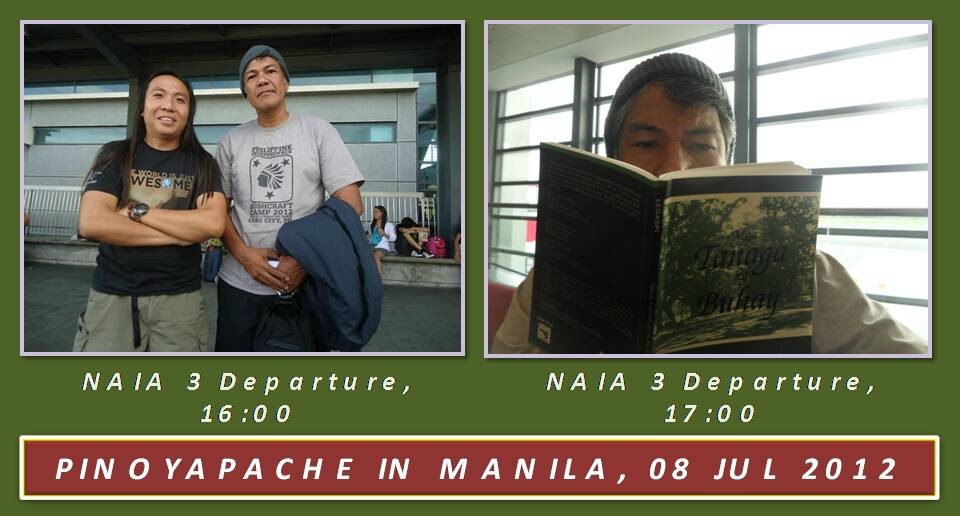
The plane promptly left Cebu for Manila and it arrive there at 7:05 AM. Jay Z Jorge and his lovely fiancee, Carla, meet me at the Ninoy Aquino International Airport Terminal III and we travel from Parañaque City to Malate, Manila to take breakfast at the Aristocrat Restaurant. There, Jay Z and Carla treat me to a sumptuous meal of arroz caldo, boneless chicken, Valenciana rice and coffee.

The hot soup of the arroz caldo tempered away my hang-over and warmed my stomach and the rest of my being. I sweat as I finish the first course; remove my jacket and retrieve my face towel to wipe some tell-tale feeling of perspiration. The second course is chicken so tender which I slice in slivers and daub in Java sauce for better taste. Grated papaya gives accent to the meal.

Coffee with milk finish my breakfast and we tarry for a long conversation just enough to waste an hour. Jay Z gifted me a book titled Mga Tanaga Ng Buhay1. It is authored by Jay Z’s aunt who is a professor of Filipino Studies – Winifreda Jorge-Legaspi. It is Tagalog poem in haiku form which were composed by Prof. Legaspi when she was still in her sick bed recuperating from a successful operation. I compose poem myself and the book will be an addition in my book shelf.


We transfer to Robinson Pioneer along EDSA at 10:00 AM. Since there is still a lot of time before my meeting, we visit the store of Conquer Outdoor Equipment located on the second level. Later, we transfer to the National Book Store looking for a fire-steel set when Raymund Panganiban arrive to meet us. It is good to see Raymund again after the Cebu Highlands Trail Project Segment II2 cross-country hike last March 22 to 25.

Raymund leave us after a half-hour for office duty while Jay Z, Carla and I return to the car parked at the basement and we all go to McDonald’s at 11:00 AM. We talk a lot of things while waiting for the 1:00 PM meeting over French fries and orange juice. I see Vicky Evarretta, the MCAP Corporate Secretary, arrive minutes before the time.

Later, the rest of the core members of the MCAP arrive and I get to meet and greet them in person. I see these guys in Facebook and now, this time, I get to shake their hands in the flesh. It’s good to be with ma’am Vicky, Reynold Boringot, Boyet Cristobal, Ephraim Alcaide Jr., Dino Sarmiento, Julius Roman, Iñigo Sarmiento, George Cordovilla, Sheralyn Asor, Max Lucentales III, Pepeton Cabauatan, Steven Dayandan, Kris Shiela Mingi, Lynda Remanes, John Paul Martires, Andrew Tarnate, Gene Jesu Arceno, Jhef Brondo and Hershey Acevedo.


Awesome! MCAP is established just this year purposely by Edwin to become an umbrella organization for all individual mountaineers in the Philippines. The core members are very humble but it is a very lively bunch nevertheless and, by the way their animated discussions are going, it would become a responsible governing body in the future. I could see their numbers increasing each day and each month for the years to come.

Ma’am Vicky express a motherly image and what coincidence for MCAP because “mothers”, according to my Native American brothers, “are makers of nations” and THAT is very true. In the middle of the meeting, ma’am Vicky is appointed, hands down, as Vice President of MCAP. Likewise, Dino got the Director for Membership Relations while Steven, a biologist, snared the Director for Environment Concerns.


Since I have a flight schedule at 5:50 PM, I have to leave early. I am pleased by the MCAP stalwarts for requesting me to stay for a few minutes, stopping their discussions, and take a quick opportunity of a group picture with them. It seems I am in seventh heaven with this gesture and I couldn’t believe it. Some of these guys created a name for themselves in their mountaineering pursuits but, here they are, according me “rock star” status. Wow! I am humbled.

Jay Z and Carla waft me away from McDonald’s and we cruised over a very open EDSA devoid of the usual traffic that had made this stretch of arterial highway a legend. We arrive at NAIA 3 at 4:00 PM after a brief gridlock at the Airport Road and I say my sincerest thanks to them. A great couple. Jay Z is a product of the PIBC MMXII3 and he will be an ambassador of Camp Red4 and bushcraft and survival for Luzon.


The Cebu Pacific Airways plane is delayed and I leave Luzon at 6:10 PM for Cebu. It is another superb landing at the MCIAA by their pilots. I take a taxi to my office where the Honda Wave is parked and sprint my way home. I am tired and I am dazed by the turn of events that occurred in one day and I am shell-shocked. I close my eyes and I say a little prayer then my spirit lie still. When I open my eyes, it is morning! 

 
Document done in LibreOffice 3.3
Photos courtesy of Jay Z Jorge and Maximus Tercerus


1Short Poems of Life.
2The Cebu Highlands Trail Project is an exploration activity that would create a trail along the middle spine of Cebu from south tip to north tip or reverse. Segment II starts from Lutopan, Toledo City; then pass over Pinamungahan, San Fernando, Carcar City and ended at Mantayupan Falls, Barili.
3Philippine Independence Bushcraft Camp 2012.
4The first non-commercial bushcraft & survival guild in the Philippines.

Friday, July 15, 2011

A JOURNAL OF AN UNFINISHED JOB

I AM OFF AGAIN for Manila. Prepared hard myself to have a “conscious” sleep so I wouldn't oversleep, of course, and miss my 5:00 AM flight. It had been raining for the past six days and I don't see any reason this weather would slack for a day or two and that makes me somewhat worried in the back of my mind. One thing that assures me though is when it is raining in Manila it is hot in Cebu and when it is hot in Manila it rains in Cebu!

Leave my home at 2:30 AM for the Mactan-Cebu International Airport on January 27, 2011 under a steady drizzle and I don my windbreaker because it is cold. The taxi take me there in less than an hour and I have a lot of time. Now my eyes badly need a shutdown as I sit inside the airport terminal doing nothing and just waiting for the gate to open.

A half-hour before departure, I follow a long queue of passengers and boarded a Philippine Air Lines Airbus A330 connected to a boarding tube. I squeeze myself on a cold seat nearest the starboard window and I imagine closing my eyes. I got jolted to reality when the steel bird got airborne.

Outside it is dark and I got lost in my thoughts and hum myself of some forgotten tune until another jolt from thermals beneath make my neck crane to a twilight horizon. Oh, it's a start of another day of work. I hate myself thinking about it. I'd rather have this plane take a quick U-turn to Cebu and forget about the stress I'm about to face later and the following days thereafter.

Take a taxi to Paco and the driver charge me four-fifty pesos and what a way to begin the day! Ninoy Aquino International Airport to Paco is less than ten kilometers and I am made to pay for an amount that is congruent to a 20-kilometer distance and I can't even see the stinking taximeter! No time to argue. Don't need a headache at this early time.

I will go to Camp Crame later in the day to answer an errand but, first, I gotta settle down to find a place to sleep during night. My itinerary demand two days and one night at the least. My best option would be to become a freeboarder under the benevolence of my wife's relatives just as I have done the previous trip in June 2009. Anyways, I get a welcome reception and eat a quick but hearty breakfast.

First thing to do is to retrace my usual route. Up ahead I espy the UN Avenue station and waited for my train to arrive that would take me to EDSA. As it came, it swallowed what few people loitering nearby, including myself, into its still-spacious vowel until the LRT became the MRT at its EDSA terminus and, this time, a mass of people converge going north and south.

I drop by the Santolan station and walk the few steps to Camp Crame, the home of the Philippine National Police, and automatically my object of attention is the Firearms and Explosives Division. Some new firearm purchases need to be processed and licensed and for a whole day I become an on-the-job trainee as a fixer. The place is like a market and people are dealing and haggling on imaginary guns drawn in brochures and saliva-soaked words.

Later in the afternoon, my papers hit a snag after a breeze in the morning. The FED is reinventing itself and is streamlining its system in accord with ISO 9001:2008 certification. Well and good. But I still see so many shady characters inside the building like vultures waiting for something to jump on. I shudder at this notion and got lost in translation as my Tagalog is quite inadequate to maintain a smooth conversation with Luzon natives.

Meanwhile, I burn Cebu with outgoing calls for some documents at that late hour that I need for tomorrow. Need it fast. I begin to sense my frailty at this moment and I feel a little old. I go back to my billeting place a little bit worried but, after a healthy all-vegetable dinner, the worries left. The Internet put some nails to that!

The second day (January 28) see me facing the same wall as yesterday as I find my way through the labyrinth of bureaucracy. The documents have not arrived in the morning and today is Friday. Meaning, no papers can be processed until Monday. Another thing. Since today is a Friday, all personnel are leaving the office early for the parade ground and the flag retreat. Shucks!

Definitely, today is not the day of my breakthrough. I sulk myself inside St. Joseph's Chapel and get on with a positive outlook. At the last hour, my documents from Cebu finally crossed over the electronic highway and that make my purpose worthwhile and for just a short while. My planned flight for today is out of the window and I have to make my last shot on Monday, I guess.

As I walk to the gate, I saw the most popular item inside the camp that is making a lot of attention long ago from media and Greenpeace. I am talking about the electric-powered public jitney ferrying people around the camp for free! Although, I am on the verge of defeat, seeing the electric car itself sends me a bolt of energy and joy. Taking pictures of the vehicle became my instant obsession.

On the way to the apartment in Paco, I buy a battery charger for my Motorola V3. I don't have one and I need one, especially now that the cellphone went dead. I pass by a small truck selling fresh vegetables and fruits and I mingle with old matrons and Manileñas haggling with the lone vendor and I bring food provisions good for several meals for my gracious hosts.

Saturday (January 29) is a day reserved as holy for Seventh-Day Adventists which, my hosts are. While they are away on worship service, I stay at the house and read a book about John F. Kennedy. I am supposed to be in Cebu today and join Camp Red in Mount Babag. Unfinished work make that impossible. I finish the book in the afternoon and start on another – The Man Who Swam the Amazon - by ultra-marathon swimmer Martin Strel.

Sunday (January 30) comes and I take a stroll after lunch. No, I don't go to a mall but I visit instead the Manila Adventist Medical Center. You see, I have something that I crave for which the Adventists only produce and sell. It is their cinnamon loaf bread. I buy three loaves plus two cans of glutein. Along the way, I also bring along another plastic bag of fresh vegetables. Finish the second book by nighttime.

In the morning of Monday (January 31), I book a plane ticket from Zest Air which has the only plane to leave Manila for Cebu at 7:00 PM. Then I go back to Camp Crame to continue my work. All my efforts went for naught as the slow bureaucratic process broke me an arm and I raise my other arm in surrender. I manage to leave the papers to someone whom I trust before exiting at 3:30 PM.

As I begin to leave, I became curious of a school of gobies frolicking in a small heavily-silted canal just across FED in Camp Crame. How they got there, beats the hell out of me. The canal is fed by clear water, probably from a leaking pipe and it is on a high ground. I could not imagine how a species of fresh-water fish could survive the extensive modernization and pollution of Metro Manila.

Anyway, I need to be on the road to NAIA before five else you get caught in its legendary traffic. Made my thanks to my generous hosts before saying adieu. My Habagat Viajero is heavy. Inside are four loaves of cinnamon bread that I am bringing for my family and for my officemates. They all love the bread, thanks to the SDA bakers.

I arrive at the domestic airport at 5:45 PM and promptly subject myself and my bag to xray machine and searches before joining a long line to a counter. Another security barrier is breezed through before I could seat on the passenger terminal. An announcement came on the speaker informing the Cebu flight delayed and reset to 9:30 PM. That's alright but I'm hungry.

I wolf a huge siopao1 as I waited for my plane and, later, the gate opens to the tarmac. I sit near the portside window of the Airbus A319 and listen to the hum of the engines as the plane is hurriedly refuelled. Once it got airborne, it squeezed through a lot of air pockets shaking and rocking the fuselage and the engines roared as it levied for more elevation.

The sound of the machine is so disturbing and it quite alarmed me. Used to work on engines and I know a part is worn by the sound of it. I may be wrong and I hope I am. An hour later, the wheels touch the runway and it is not a pleasant landing. It is still raining in Cebu and too few taxis for so many passengers making a beeline. I gamble on a colorum2 and I arrive safely home at around eleven. Cherokee, my youngest, is still up tinkering a lappy and his eyes brightened when I showed him the cinnamon bread.

Document done in OpenOffice 2.1 Writer


1Chinese bread stuffed with meat, chopped boiled eggs and other ingredients.
2An unregistered and unmarked automobile.

Thursday, October 1, 2009

THANK YOU TYPHOON ONDOY

From istorya.net. Dedicated to the victims of Typhoon Ondoy.


All I wanted to do on Saturday morning was to go to my doctor. After getting off the MRT station in Kamuning (about 10 am) I waded through ankle-deep floodwaters to accompany my wife to the TV station where she works. The rest of the day was already clear in my head: Go to the doctor, finish my business there by around lunchtime (there are usually quite a number of patients, and I wasn’t expecting to finish earlier than that), pick up my wife and we go home for some needed time with the kids.

I thought nothing of it when the doctor’s nurse texted me to say that the doctor’s clinic was already flooded. The clinic is in the low-lying Kamias area. Fine, I told myself, I’ll just go to Hi-Top and buy a bottle of wine and ingredients for dinner. My daughter had requested that I cook for dinner.

After Hi-Top, I proceeded to the TV station where my wife works. I was walking the whole time because of the rain. I felt no danger despite the rain. The rain wasn’t that strong by the time I left Hi-Top. Then I reached the corner of Panay Avenue and Sergeant Esguerra. Holy shit. The floodwaters were neck-deep in Esguerra!

I turned left on Panay, planning to take the train at the Quezon Avenue MRT then disembark at Kamuning station, so I could just walk towards the TV station. I reached Hen Lin (a Chinese fastfood) which is right under the MRT station. I was surprised to see that Edsa was flooded. The area in front of the McDonald’s outlet was waist-deep in flood.

There was a guy—he was soaked from head-to-foot—who was warning people getting off the Quezon Avenue MRT station. He was telling everyone who could hear him:

“O, wag na kayo dyan sa Esguerra. Hanggang leeg doon. Dito sa may Edsa hanggang baywang. Mamili na lang kayo kung saan niyo gustong magpakamatay.”

[Don’t go to Esguerra. The water there is neck-deep. Over there at Edsa it’s waist-deep. You guys choose which side you prefer. You choose where you want to kill yourself.]

The guy was trying to be funny. I went up the MRT station, boarded the train and got off at Kamuning. When I reached the TV station, my wife texted me that she won’t be going home. All TV news staff were required to stay because of widespread flooding.

I called the kids at home. Thank God there wasn’t too much rain in Cavite. Finally, I saw what was happening in Marikina and Rizal on the TV set at the visitor’s area. Shit. I won’t be able to go home. Then I also learned that the way to Cavite was impassable.

After talking to my 9-year-old daughter some more and assessing that Cavite would likely not be affected by the typhoon, I made up my mind to wait for my wife. I didn’t think it would be a good idea to let her go home alone, with floodwaters rising in Quezon City.

People were coming to the TV station. Every single one was asking for help. They had loved ones trapped inside their house by floodwaters. There were loved ones already on rooftops. The floods were rising too fast in some areas. And so began my long day: filled with the weeping of women, worries about friends trapped in rooftops, worries about my kids (what if the typhoon turns and hits Cavite?), and a feeling of utter helplessness.

My wife worked till about midnight. We tried to get to Cavite but even before we reached the tollgate of the expressway leading to Bacoor, huge trucks were already turning back. We were in a cab. I decided not to risk whatever was ahead. There could have been floods, an accident, etc.

My daughter kept calling my mobile phone. She was crying. When were we going to get home? After getting assured that there was no flooding in Cavite, that our kids were not in danger of any flood, I told my wife we should just wait for morning. We turned back and stayed in a hotel—the hotel lobby to be exact. All the rooms were booked. It was already 2am. We couldn’t sleep. We simply waited till the sun was up.

When I finally got home today, the first thing I did was gather wife and kids for prayers. We prayed out of gratitude. We were all safe. Then we prayed for all those who were still trapped, who were still struggling to stay alive amid floodwaters. I was crying.

I find myself unable to sleep after being awake since 6 am yesterday morning. I’m still keyed up. My wife’s asleep, finally, after getting a massage. I want to sleep but each time I manage to doze off, I jerk awake at the slightest noise. So I’ll just write.

I can’t get the sound of weeping mothers out of my head. That’s how I spent the night while stranded in Quezon City. All these mothers kept talking about their kids. One mother, Lina, could not help but cry for her kids, who were trapped in the third storey of a neighbor’s house for out eight hours already by the time she spoke to me. Her husband was also trapped by floodwaters—he could not leave his office in Quezon City.

Here are some things I learned from the experience. I can write them down in the comfort of home with my wife and kids safely with me. I actually feel guilty that I’m in this situation. I feel guilty that I’m not out there on a rubber boat saving people.

So I’ll write some more and go to bed. After I get some sleep, I might have a saner perspective.

Our families are not prepared for climate change. Typhoon Ondoy was true to its name, which means “little boy”—it wasn’t a supertyphoon. And yet, we all failed in so many fronts.

In our own home, we don’t have an emergency kit. The flashlight is no longer where I always put it. Furthermore, I’m not aware of any evacuation plan in our community. Who do we call? Where do we evacuate when waters start rising? I have no idea. It’s the sort of ignorance that kills.

One friend of mine lost her possessions in the floods. Her husband and kids are safe. She had the quick and sensible thinking to have her family evacuate shortly after the water began seeping into their house and after the power was cut off. They left everything and booked themselves in a hotel. “I lost everything,” she told me over her mobile phone. I told her that the most important things in her life were saved.

Our government—both the national government and the LGUs--is not prepared for climate change. If people are safe now—relatively, for some, because it’s again starting to rain and many are still trapped on rooftops, awaiting rescue—it’s because of prayer. So many people were—are still—praying. It seems the prayers were heard because we all got a respite from the rain.

Filipinos have a saying, “Nasa Diyos ang awa, nasa tao ang gawa” (God dispenses mercy but man has to do the work). God has already dispensed his mercy. Will we do our part?

There’s no excuse for the lack of rubber boats, for example. We have floods every year. But every year, we are unprepared. The two rubber boats that began rescuing people in Marikina were a relief to know about, but why only two?

Philippine National Red Cross Chairman Dick Gordon tried to transport several more rubber boats but these had to come all the way from Olongapo. And with the traffic jams at the expressways, they could not get to Metro Manila in time.

The headquarters of the National Disaster Coordinating Council and the headquarters of the Armed Forces of the Philippines are both in Quezon City. And yet, for nearly 12 hours, Quezon City residents trapped in floods could not be rescued. The AFP, if I remember correctly, usually has the biggest slice of the national budget every year. But where were the choppers? Where were the rubber boats? Clearly something is very wrong.

Then we recall how General Carlos Garcia, former AFP comptroller, was caught (by US authorities, not by Philippine authorities) trying to bring in millions of pesos in cash to the US. It does not inspire faith in the military leadership.

We also recall a lot of things that are disquieting: government resources being used to secure a questionable telecoms deal with a Chinese firm; millions of pesos spent on Presidential dinners abroad; millions of pesos in campaign contributions unaccounted for; millions of pesos spent on a California mansion; billions of pesos spent on foreign trips; and a cancelled plan to buy a new Presidential jet.

How do you explain all that to kids trapped on their rooftop for nearly 24 hours—soaking wet, hungry, crying for their mothers and going insane with fear?

How do you explain the fact that the government can spend millions upon millions on so many other projects, but could only produce two rubber boats to rescue scores of residents trapped in a flooded Marikina village? How do you explain the President’s lobster and steak dinners to Rizal residents neck-deep in muddy floodwaters?

Every year, we get floods and typhoons. Every year, we give money to the AFP and the NDCC. And all that the Marikina residents get are two rubber boats?

And wasn’t Marikina always being trumpeted as some sort of “First World City in a Third World Country”? Clean and green Marikina. Disciplined Marikina, a jewel of law and order in the chaos of the Mega Manila.

The Marikina River floods every year. Every year. But when it really mattered, the City Government of Marikina did not have enough emergency equipment, did not have enough rubber boats. Or if it did, it did not have the capacity to deploy these resources in time. It seemed to have no plan for the evacuation of residents at Provident Village before floodwaters could reach it.

And former Marikina mayor Bayani Fernando wants to run the rest of the country the way he did Marikina—or at least, that’s the impression we get. We could be wrong.

To be fair, none of us expected something like Typhoon Ondoy. But the lack of rubber boats, the seeming lack of coordinated response, the empty promises made over the media—these are simply not acceptable. These do not inspire our confidence in government once the next super typhoon hits.

I mentioned Marikina only as an example. I’m not blaming Fernando or his wife (the present Marikina mayor). I’m just stating how things appear. The real story about the slow rescue, etc. might unfold in the next few days.

[Kris Aquino was talking on TV about Marikina rescue efforts. She said that according to one Marikina resident, there were rubber boats deployed by the Marikina government--but the river's currents were so strong that the rubber boats got overturned. It was also pointed out that Marikina Mayor Marides Fernando did everything she could but "nature's wrath" was just too powerful. In the interest of fairness I should point this out.]

What happened to Marikina can happen anywhere. The local governments of Bulacan, Pasig and Rizal fared no better. Are our local governments prepared for climate change? Are they prepared for typhoons like Ondoy, or much stronger ones? Your guess is as good as mine.

What would have happened if Ondoy didn’t leave the country in the hours following the massive flooding? What if it was a super typhoon that decided to stay for a few days?

The answer is so obvious that we’re scared to state it: Death and Chaos. So many people, so many children will die. Our loved ones will die. We will die.

The next few days, weeks and months will tell us whether the government cares to prevent this, or whether it wants to use climate change as a kind of population control.

The government’s priorities have been clear in the way it spends its money and allocates its resources. For example, the AFP budget keeps growing. But what about the budget for the national weather agency PAGASA (Philippine Atmospheric Geophysical and Astronomical Service Administration)? There were reports a few years back that the budget was actually slashed.

During a report on GMA-7 news last night, PAGASA OIC Nathaniel Cruz said that there was a piece of equipment that could help the agency estimate a typhoon’s potential amount of rainfall (very useful in the case of Ondoy, which poured a month’s worth of rainfall in about five hours)—a Doppler radar. Does PAGASA have this equipment?

No. The national weather agency, the only one that could warn us if we should evacuate because a typhoon will bring a deluge, does not have a Doppler radar. But it’s on its way, clarifies Cruz.

PAGASA, in Filipino, also means “Hope”. Based on how the government seems to prioritize PAGASA, the weather agency, do we have reason to hope?

It was drummed into my head a long time ago that when we use the term “government” in a democracy, we should really refer to ourselves. After all, in a democracy, governance must be by, of and for the people.

So it’s either we’re not really a democracy (because we always stand back and just let a bunch of evil yoyos run things for us) or we’re all just not getting this governance thing right. We’re not governing things the way we should.

It’s raining again. I hope we get our acts together soon.

Wednesday, August 26, 2009

A QUICK JUNE TRIP TO MANILA


THE PHILIPPINE AIR LINES Airbus A300 touched down on the tarmac of the Ninoy Aquino International Airport (NAIA) without the slightest jar in the early morning of June 24, 2009. It was a superb show of skill by the pilot of whose plane he flew through on the heels of a signal number 2 storm from Cebu to Manila.


STORMY WEATHER IN CEBU


I was quite worried leaving Cebu on a 6:15 AM flight knowing that there is a weather disturbance at hand. Nevertheless, I have to be in Metro Manila. My employers have faithfully placed their confidence on my shoulders to process the firearms application papers for their new pistols and revolvers. My destination – Camp Crame.


I have been on a similar task before on March 23 and 24, 2009 but I traveled then in a much favorable clime. However, I placed my trust in a short prayer and the flying skills of the Great Helmsman. I arrived in one piece and thanked the heavens for the feat.


ON BOARD THE PAL AIRBUS A300


From the NAIA Terminal 2, I hailed a taxicab for my billet in Harrison Street in Pasay City and by ten I was off to Camp Crame by way of the LRT and the MRT. It was raining and I put on my windbreaker. I arrived at eleven and met my contact, PO3 Flora Ocampo of the Office of the Chief, Civil Security Group.


Before taking lunch, I visited the Saint Joseph Chapel located in the center of the police camp and heard a noontime Holy Mass. The approach of the storm, however, threatened the whole of Metro Manila as classes were suspended and non-uniformed personnel streamed out of their offices leaving my papers untouched and unprocessed for that day.


AT THE LRT TERMINAL IN LIBERTAD


I returned to Harrison and ate dinner together with my wife's cousins – the siblings Brett, Micah and Donna Mantos. Micah and Donna, now CPAs and blooming beauties, I last saw when they were just grade schoolers on a camp-out visit to the East Visayas Academy in Talisay City, Cebu in 1994 while Brett stayed with us in our old home back in 2000.


It rained the whole night as the storm passed overhead and the morn found me waking up early to find that the sky have cleared for a few hours and it rained again. As was yesterday's, I took a light rail travel to Camp Crame passing by over several stations. I left the licensing fees in the care of PO3 Ocampo and she assured me that the processing will be over by Friday or Monday, at the most.


THE PNP HQS AT THE BACKGROUND


I bade farewell again at the camp, which have been home to me on two occasions: from August to November 1991 when I was housed in Kiangan Hall, courtesy of Senior Superintendent Fortunato de Gracia during my police intelligence training; and from December 2001 to July 2002 when I was then quartered at the “White House” and attached as a part of the security team detail for Mrs. Sol Mendoza, the lovely wife of then-PNP chief, Director General Larry R. Mendoza.


I went directly to Harrison to say my warmest thanks and goodbyes to Brett and took a cab for NAIA 2 to catch a 5:15 PM flight to Cebu. On the way, the weather was fine and – surprise of surprises - there were no traffic! I arrived at the terminal an hour-and-a-half ahead of check-in time and poured my vacant time reading GUTS by Gary Paulsen.


NAIA TERMINAL


Time to leave Manila once more and I settled in the A300 cabin still reading the same book. I took a PAL plane on my way to Cebu and safely landed at the Mactan-Cebu International Airport (MCIA) at about 7:00 PM. I arrived home just in time to partake of a homely dinner prepared by my beautiful wife.


Document done in OpenOffice 2.1 Writer

Saturday, April 11, 2009

PHOTOBLOGGING A QUICK TRIP TO MANILA

THE LAST TIME I have been to in Metro Manila was in March 2006. That was three years ago. Now, I get the chance to visit her again on March 24 and 25, 2009 afforded by my employers to process the licenses of the new firearms of Tactical Security and Detective Agency, Inc. This time I get to travel by air, round trip, thru Philippine Air Lines.


I left home at seven in the morning of March 24 to travel by taxi to the domestic departure area of the Mactan Cebu International Airport (MCIA) and gave myself in to the tiers of security arrangements - five layers – before boarding my scheduled 9:45 AM flight. The post 9/11 blues forced me to remove my Hi-Tec shoes and I did not hesitate there for I wore a new pair of socks. Heheheh...

MCIA Terminal


I took pictures of the waiting lounge area and within and around the plane while it was still allowed. The wide-bodied Airbus A300 plane lifted off the MCIA tarmac slightly delayed at 10:00 AM and I felt the familiar sensation I experienced during my childhood years riding in ferris wheels. From beyond my window the ground below me became a blur and slowly the houses and buildings became smaller and smaller as the plane rose up in elevation.

View from the Airbus

And within the plane


The plane circled around and the whole profile of the City of Lapulapu looked glorious at a higher altitude and the fine hues of white, blue and green were very invigorating to the eyes where the land embraced the sea on the shorelines. The slender Punta Engaño Peninsula pointed like a finger to the sea and it was so beautiful and I was tempted to take a shot with my digital camera but prudence took hold of me not to when I remembered an early announcement that all electronic gadgets be switched off while in flight.


We passed by over Carmen town and I could see the snaky dirt road stabbing through Cebu's mid-north area where I passed by last January on foot in a club-sponsored mountaineering expedition. From beyond the sea the islands of Bantayan, Guintarcan, Malapascua and other smaller islands where like untouched refuge of paradise. At 32,000 feet, the outline of the Cataingan Peninsula of Masbate could be seen clearly.

NAIA Terminal 2


Over sips of tea with crackers I enjoyed the breathless sight of the endless blue of the sparkling sea and of the sky and up ahead approaching were the cloud-shrouded landmass of Luzon. Slowly, dipping in altitude, the plane began to shake and vibrate as it passed through thick clouds and pockets of air knocked the plane's fuselage and wings.


As the curtain of clouds began to part, we were now overhead the Southern Tagalog Region and I could see below the five of the seven small lakes of San Pablo City and then the dark-lead water of the bigger Laguna de Bay. The plane passed by a wide expanse of plain dotted here and there with communities, concrete roads and buildings and more houses and more high-rise condos until it sped in a blur as it touched down the tarmac of the Ninoy Aquino International Airport (NAIA).


Driver Tanny, met me at the arrival area and I hopped on in his driven Mitsubishi L300 and we took lunch somewhere in Parañaque City. We continued on our way after that and I directed him to bring me first to BF Homes, specifically in the home of a second cousin, Sol Mendoza, the better half of DOTC Secretary Larry Mendoza. I unloaded my things with intention to stay for the night since I have a limited budget and staying in a hotel or an inn in Metro Manila for just a night is so expensive nowadays.

Inside Camp Crame

Athletic Tuesday


Then we sped over from Sucat to the south highway and then at EDSA with an overheating L300 radiator dancing in tandem to the 36-degree centigrade heat felt on the streets. Gosh, it was hot! Amazingly, the vehicle never conked out and, nevertheless, we arrived safely inside Camp Crame, the headquarters of the Philippine National Police (PNP).


I went directly to the Civil Security Group (CSG) building to endorse the agency firearm application papers for processing. There I met, face to face, Chief Superintendent Ireno Bacolod and we conversed comfortably in Cebuano dialect. PO3 Flora Ocampo of the Office of the CSG Director facilitated the papers afterward.

Sunset over Taguig


It was already five in the afternoon when I went out of the camp with Tanny but the sun still hung high in the horizon and there were still available light all around. We took the C5 Road to evade the legendary traffic at EDSA at that hour and passed by the cities of Pasig and Taguig before turning left to the south highway in Bicutan. Tanny dropped me at Sucat and I took a tricycle for my sleeping quarters deep in BF Homes.


At the Mendoza home I met old colleagues SPO4 Jack Jakosalem, SPO1 Louie Rabajante, SPO2 Derick Lacambra and PO3 Vener Lacambra; old reliables of the protection security team for the Mendoza family. Nephew (now Batangas congressman) Dongdong Mendoza was not around and so was his dad. Feeling drowsy, I slept while watching Totoy Bato on GMA-7.


In the morning, I left BF Homes after breakfast at seven carrying my baggage for Camp Crame to continue processing the firearms license and at the same time be ready for boarding for my return flight to Cebu. I commuted to Crame by jeep and by bus and reached my destination at nine as Tanny was unavailable due to an errand from my boss. Just like yesterday, the streets were extremely hot.

St. Joseph Chapel

PNP National Headquarters


Alas, all the computer servers at the police camp were down since yesterday and I was not able to complete my processing but I left the licensing fees in the care of PO3 Ocampo and went out to attend a noontime Holy Mass at the Saint Joseph Chapel inside the camp. Afterwards, I ate lunch and left Camp Crame once again for NAIA Terminal 2 at exactly three in the afternoon.


It took me almost two full hours to reach the airport as the taxi I rode in got snagged by the horrendous traffic at EDSA and at the MIA Road. At 5:15 PM, I checked in at the departure area and have myself searched by hand and by electronic means. At exactly 5:45 PM, PAL flight 863 left NAIA for Cebu. The turbine engines picked up speed as it began to move forward its upward thrust. Amidst the roar, the Airbus became airborne and floated gracefully.

Mall of Asia Globe


It sliced itself upward among a thick wall of clouds and the plane jarred and bounced against air pockets. Far to the west the horizon was sliced by the golden orange glow of a setting sun in between a dark brown mass below and a fainting blue streak above it. It was a cinematic sight and, again, I felt the urge to unpack my camera but backed down at the last minute. Frustrated, I took a pocketbook and consumed a few pages before stowing it back.


Then the cabin announced that we were now approaching MCIA and I could see from afar the bright lights of Metro Cebu. The lights from below blinked and glowed as if imitating a moving mass of fire and lava as the plane circled around Mactan Island and slowly diving in altitude and then the sudden roar of the engines automatically switched off the cabin lights signaling the start of its landing. As the rubber wheels screeched when it kissed the runway, brakes were applied reducing the blur of speed into a manageable level until it taxi its way and stopped just in time for a passage tube adhere its edges over the fuselage door.


Back again in my homeground at seven in the evening, I tarried long enough in the arrival area to see who's who among my co-passengers and I spotted three or four familiar faces and I decided to hail a cab instead and bring me home to my waiting family. They were all there. And I dined with them.


Document done in OpenOffice 2.1