Showing posts with label survival tool-making. Show all posts
Saturday, September 22, 2018
THE TRAILHAWK JOURNEYS: Bukidnon Bushcraft Training
MINDANAO IS UNDER MARTIAL LAW and I
do not forget that. There was an urban war in Marawi City fought by the
government forces against ISIS which had ended more than a month ago. I
travelled a month earlier to Davao City to test the climate of uncertainty
painted by media. There was indeed a military presence there, which is fair
enough. Would it be okay to travel there again with bladed tools? I have to
find that out myself.
You know, I have never taught
bushcraft and wilderness survival in Mindanao and I waited for many years for
that opportunity until Earl Ryan Janubas and JP Echavez, both of Cagayan de Oro
City, organized one for me. Martial Law have curtailed travel of Mindanaoans to
their most famous mountain destinations and they needed an alternative outlet
for their thirst of adventure. That is when they contacted me.
Going by plane to Mindanao is out
of the question for me, although travelling in it with blades is the most
convenient. The transfer of the airport location of Cagayan de Oro, in Lumbia,
to the Municipality of Laguindingan a few years ago is too far for my own
comfort. The boat is my best option even if I have to unload my bladed tools to
security for safekeeping while I am in the boat and it would travel with me
anyway.
As an outdoors educator and
survival instructor, blades play a very important role in all my classes and
training instructions. Blades make easy work and these are educational aids and
tools. Trusting to my good judgment, I carried some of my best blades with me
like the AJF Gahum, Pandoy Pulido Pinahig, Condor Bushlore, Mora Companion,
Knifemaker Camp, Seseblade Sinalung, Seseblade Matavia, a Browning and a
Victorinox Trailmaster. Coming also is my veteran tomahawk.
I travelled by boat in the evening
of October 29, 2017 bound for Cagayan de Oro. Earl and JP would be expecting my
arrival the following day. I arrived in the morning of October 30 and JP came
to fetch me and whisked me to Focal Matters, a photography studio located at
Capistrano and Yacapin streets where Earl is the resident photographer. After
lunch, Earl and I travelled to Libona, Bukidnon on his Honda CG125, along with
JP with his motorcycle.
We followed a newly-opened road
that go through the backcountry of Indahag and Gango and arrive at Libona at
around 15:00. We made a courtesy call to the village head of Poblacion and then
to the community leader where we would make our camp for three days. It is in
the property of Earl’s brother. We visit it for a brief inspection. It passes
by a big pineapple farm and a trail lead to a stream.
Beside the stream is a narrow piece
of ground good for eleven tents and some trees could host a few hammock pieces.
It had been raining here for the most part of the week and the stream is deep
with color associated with floods. I have my concerns but I am hoping that
weather will get better. It is sunny and warm but the highlands has a weather
of its own. I cannot rely on a weather forecast from a mere phone
application.
Earl and I returned to the town and
made it to the house of his brother. We will both sleep there so we could be
early to the campsite while JP need to go back to CDO. Bukidnon, by its
location in the highlands of Mindanao, always has cold nights. It was colder
still when there was a heavy downpour in the middle of the night which did not
stop until the earliest hours of dawn. That got me worried about the stream and
the campsite.
After breakfast of October 31, Earl
and I went back to the campsite at 07:00. The stream have not risen that much.
Only the color became more brown and the current more brisk than yesterday. I
am assured of a very sunny morning and I hoped that the weather will turn out
the better for the rest of the day. We choose this site because of its
proximity to a natural spring located across.
I looked for a couple of trees, not
far enough from each other and not near enough, and finding one such place, I
left my bag. I choose the best location where I would be safe if the stream
overflow but near enough to the rest. Open carrying my AJF Gahum, I go back up
the slope and looked for a good place to make a latrine. Found one under a
copse of cassia trees and dug a hole with a digging stick sharpened by my
knife.
Then I foraged materials as
educational aid for the outdoors seminar like dry and green bamboos, firewood
and dry leaves. After an hour, JP and eleven participants arrived, including
two high school students from Xavier University. One participant even brought
his two dogs. All set up tents on the grassy ground while two of them found a
place for a hammock.
Part of the morning was spent
setting up shelters and diverting the flow of the natural spring by a bamboo
viaduct, crossing over the stream into our campsite. Dry bamboos are abundant
and I do not have to cut poles since there are many left rotting on the ground
and a few are left hanging. I choose the clean ones for our improvised water
span, propping it high enough from even an increase of a meter of flood.
The BASIC TROPICAL BUSHCRAFT COURSE
is almost the same as that of the ones I do and organize in the Philippine
Independence Bushcraft Camp, held in Cebu annually. It always start with Introduction
to Bushcraft. The participants learned the terminologies and jargon used in
bushcraft; its preferred environment; its own psychology; its methodologies;
and its difference from survival and from mainstream activities.
Then next is Ethical Bushcraft.
The best practices of leisure bushcraft, using its own principles of Blend,
Adapt and Improvise, to lower your obtrusive presence among forests and jungles
and increases an individual’s safety and security. It covers trail travel,
courtesy to locals, campsite location, fire management and camp hygiene.
Ethical Bushcraft is taken from this author’s unfinished book of the same
title.
After lunch and siesta, it is the
turn for Knife Care and Safety to be discussed. This chapter changes the
perspective of the knife into a useful tool instead. The Philippine law on the
regulations of carrying a knife – Batas Pambansa Bilang 6 – are
explained thoroughly and clearly as well as ethics and safety, care and
sharpening, blade shapes, parts and grinds, and the Nessmuk Trio.
At 14:30, this author demonstrate Survival
Tool-Making to the participants. This chapter is a practical exercise in
knife dexterity and safety; taught them how to carve spoons, jugs and an
improvised cooking vessel from a green bamboo pole; and create a digging stick
from a thick straight branch. Aside that, this blogger gave them the idea how
and where to source cords from nature. Next is Notches. Another knife
dexterity session aided, this time, by a baton.
When dusk came, all activities ceased
and the participants focused on the preparation of their meals under a slight
shower. By 19:30, the campfire is lit and becomes the social center for the
Campfire Yarns and Storytelling. This camp tradition does not need great
company as long as the train of tales and laughter begins. Sometimes, a
moderate round of alcoholic drinks move that into more tales and laughter.
Rains came and ended abruptly the night socials.
The second day (November 1) starts
with breakfast but after that, all will deny food the rest of the day, not
until they have accomplished foraging their own food which comes later in the
night. This is to simulate the hunger pangs associated when you are stressed in
a survival situation. Everyone steeled themselves for this occasion. The day is
warmer than yesterday but the ground is muddy.
The first chapter for this long day
is Customizing the Survival Kit. It is better that survival kits are
made from scratch than bought commercially because its size and components
depend upon the type of the activity you are indulging in and the kind of
environment you are going to visit. Your personal preference still matters
although redundancy of some functions, like fire tools, luminosity, water
collection and cutting devices increases security.
Then I proceed to Foraging and
Plant Identification. This author discusses about traps and snares and what
are the difference between the two; luring methods and trap lines; and foraging
food and non-food. It also identifies which plants are edible, harmful and
poisonous. The participants are then shown the different traps and snares that
are set up in camp before touring the area around the camp for the common
plants growing here.
Hearing distant thunder, I decide
to proceed to Fire, Fuel and Campfire Safety. Understanding first how a
fire is made is very important. You have to know the three elements of the fire
triangle: fuel, heat and air. You cannot produce fire if lacking one element.
Conversely, you can put out a fire by removing one. Lately, they added a fourth
element – chemical reaction.
Making fire by friction is 80%
common sense, 10% skill and 10% perspiration. Your fire can start if you can
acquire and identify the right tinder, if you are in a dry place, and if you
have the patience. In a very humid location, the presence of moisture in the
atmosphere almost always hinder the production of ember needed to start a fire.
Most of the time heat is stolen by the cooling effect of watery air.
Aside from friction, there is the
conventional method which are matchsticks, lighters, ferro rods, and the flint
and steel. Then there is solar magnification which can be done with magnifying
lens in a cloudless day. Then you have pressurized air, exemplified by the fire
piston. Since I do not have the luxury of time, I limit my demonstrations to
the flint and steel, and the ferro rod. I also showed them how to make a tinder
bundle.
Demonstrated how the bow drill
method is made and spun. Unfortunately, I could only make thick smoke as
sawdust embers refused to light up my tinder due to humid conditions. Dark
clouds are now overhead as the thunder gets nearer and nearer. I let others try
the bowdrill, the ferro rod, and the flint and steel. The participants properly
learned how to use the ferro rods. It ignites easily natural tinder.
By now, wisps of moisture started
to drop. I demonstrated how the bamboo-saw method is made and scratched. As
with the bow drill, I could only produce smoke. Moisture have penetrated the
grains of bamboo. Racing against the rain, I tried again and failed. Four
participants tried but in vain. I made another derivative of the bamboo-saw
that could be done with two people. Smoke is thick and there is a promise of
ember but it lived shortly. Then a strong downpour fell.
For the rest of the afternoon, we
could do nothing but stay in our shelters. I could not discuss the rest of the
topics and our Nocturnal Hunting is even jeopardized. Owing to circumstances
beyond our control, I aborted it and gave a go signal to prepare their food for
dinner. In wet conditions, I am able to make fire in my Swiss Army wood burner
to boil water first for coffee and then for Japanese seaweed soup.
The heavy downpour caused the
stream to overflow on the lowest places of the campsite but it necessitated the
transfer of three tents nevertheless to better locations. The water current
increased and became very noisy, alarming everybody. For a couple of hours we
were awake, watching the stream, until the rains began to slow down. I relax
with my watch and half-chased sleep.
In my comfortable hammock,
rainwater found its way to my chest. I shifted my body so the drips would not
fall on me but a cotton rope I used to tie the hammock with snapped and I fell
hard with my hammock on the ground. I re-strung my hammock and my shelter setup
hoping to stop the drips. I placed drip cords on the ridgeline of my shelter
just like I did before on the ends of my hammock. After I have done so, the
drips have stopped.
The last day (November 2), I was
surprised to see that the bamboo viaduct have withstood the stream’s rising
water last night and still supplied us with an uninterrupted clean water. The
water is not cloudy. We prepared breakfast early for I have four more topics to
discuss. Yesterday’s muddy ground are smoothed out by water but it is wise not
step on the same surfaces.
After breakfast, we break camp and
transferred uphill to be away from the din created by chainsaws used by locals
who took advantage of a holiday to cut trees. The first one is Understanding
Cold Weather. During mountain climbing, exposure to the
elements is expected. There are five physical mechanisms that steal
away body heat and the things that we should do to keep us constantly
warm.
Next is Outdoors Common Sense.
This is the subject matter that I based from my yet unpublished book, ETHICAL
BUSHCRAFT. It is about trail courtesy and behavior while on the trail;
choosing the best campsites; practicing stealth camping; increasing individual
safety and security; wildlife encounters; and introduce people the idea of
Blend, Adapt and Improvise.
Finally, the topic of Outdoor
Cooking and Food Preservation gets its slot. Different ways of preserving
meat, fish, vegetable and fruits. Getting equal discussion are the different
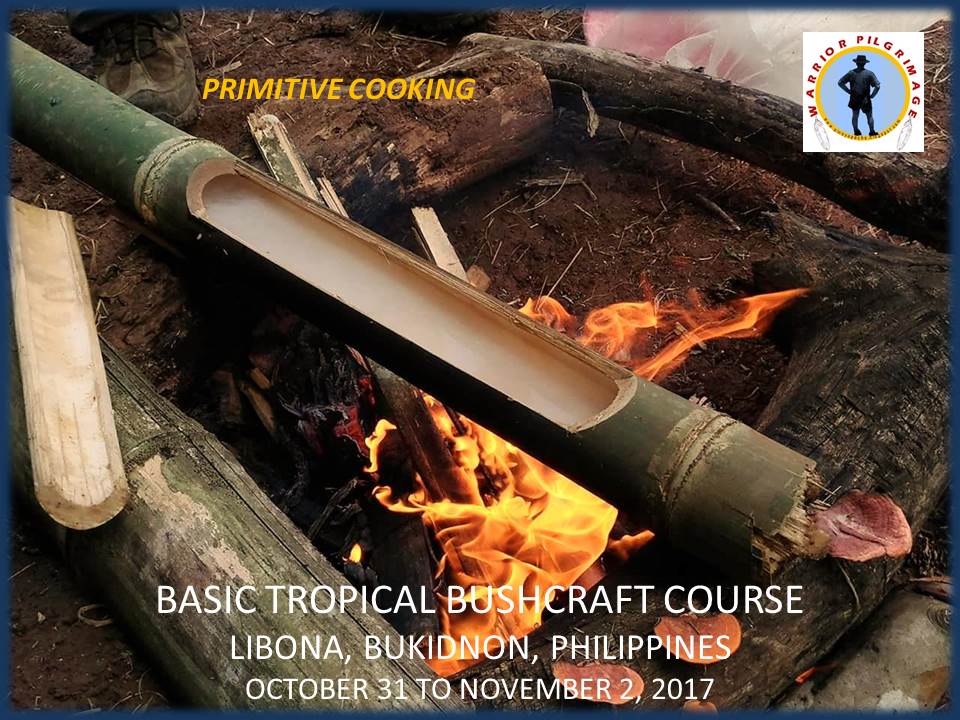
kinds of fireplaces. After the lectures, author shows how the Trailhawk
System of cooking rice in bamboo is done. The participants prepared their
meal for lunch and when all got cooked, to include the rice inside the bamboo,
we had our meal.
We packed up everything and hiked
the three kilometers back to Libona and then to the terminal. From Libona, we
rode on tricycles to Manolo Fortich and transferred to a van-for-hire.
Destination is Cagayan de Oro City, which we reached at 18:00. We stayed for a
while at a local restaurant for dinner and the post-event discussion and
socials. I was tired but I was not sleepy. I noticed there was no curfew here
but we have to end after midnight.
I found a vacant room at Rosario’s
Place for I have a speaking engagement tomorrow evening (November 3) at Viajero
Outdoor Centre. Coming here to Cagayan de Oro with a cargo of blades gave me
fears of travel restrictions brought about by Martial Law. It turned out well
but, going back to Cebu, a security guard made it a little hard for me with his
wrong presumptions. Or was he just interested with my properties? My spring-bound lecture handbook made all the explaining
for him.
The unpredictable weather of the
highlands of Bukidnon is something that I have to give an extra consideration
next time. I expected it to behave like all highlands do but I failed to give a
thought that Bukidnon is a plateau where rainwater would be collected on a wide
area instead of travelling fast and quick to the sea. Here, it accumulates slow
and long before going down the different drainage systems.
It was a productive moment not just
for me, but also for my newly-found friends of Mindanao. At last, I was able to
introduce bushcraft there and helped them become better outdoorsmen. My trip there would
not have been possible without the sudden sparks of creativity by Earl and
JP. For their efforts, I part my couple of Seseblades to them, courtesy of Dr.
Arvin Sese, whose quality but affordable blades I had endorsed everytime I have training sessions.
Document done in LibreOffice 5.3
Writer
Posted by
PinoyApache
at
09:00
2
comments
Labels: Bukidnon, bushcraft camp, Cagayan de Oro City, ethical bushcraft, firecraft, foraging, knife safety, Libona, notches, outdoors cooking, plant identification, survival tool-making, training, traps and snares
Wednesday, May 11, 2016
LILOAN (CEBU) RESPONDERS GOES BUSHCRAFT
A
WEEK AFTER THE first search and rescue summit of Cebu Province, I
began to receive requests from local government units to have their
emergency responders undergo training in bushcraft and survival.
This training is quite expensive if you look it at from an
international perspective since the skills acquired are highly-valued
by Europeans and Americans. We have one survival school in Subic but
it only showcases the primitive-living ways of the Aeta. What I
teach is entirely different.
Disasters
are now more intense and unpredictable, aggravated by climate change
and by man. More people now visit places, as in adventure tourism,
where, a decade ago, nobody would and vulnerability to accidents
increase as well. Against these conditions, LGUs need to be well
prepared, as defined and mandated by Republic Act 102020. The recent
SAR summit initiated by the Cebu Provincial Disaster Risk Reduction
Management Office provided the stimulus for LGUs to provide their
respective DRRMOs with great importance and provide them equipment,
funding and training.
The
Municipality of Lilo-an requested that I teach their emergency
responders in bushcraft and survival on August 28-30, 2015. I
recently had taught volunteer responders of the Capiz Archdiocese
Disaster Action Center last month at Ivisan, Capiz and, before that,
in June, to nineteen individuals during the Philippine Independence
Bushcraft Camp which was hosted by Lilo-an. The PIBC is an
alternative learning medium created solely to answer the needs for
more education of outdoorsmen and active individuals.
I
arrived at the Lilo-an Municipal Hall at 05:00 of August 28, 2015.
Joining me soon to assist me are five members from the Camp Red
Bushcraft and Survival Guild: Jhurds Neo, Ernie Salomon, Dominik
Sepe, Mark Lepon and Nelson Tan. I would be expecting the full force
of the Lilo-an Public Safety and Emergency Management Office lead by
its chief, Hammurabi Bugtai. Thirteen are available and a skeleton
crew remained to man the post in their absence.
From
the municipal hall we were whisked towards the village of Mulao by
the town's workhorse called the “Dukevan”. After touching base
with village officials, we proceed to the Mulao Elementary School
before proceeding down for Cotcot River. I am leading the party and
follow a trail, whose unfamiliarity will be lessened with Ernie's
knowledge of having taken this same trail during the PIBC. Ernie
failed to remember the exact route but we reach the Cotcot River on a
different campsite.
Nevertheless,
it is a good camping site which we used in our earlier dirt times.
It has a wide open ground good for eight tents and some trees to prop
hammocks. It is beside a stream and limitless firewood.
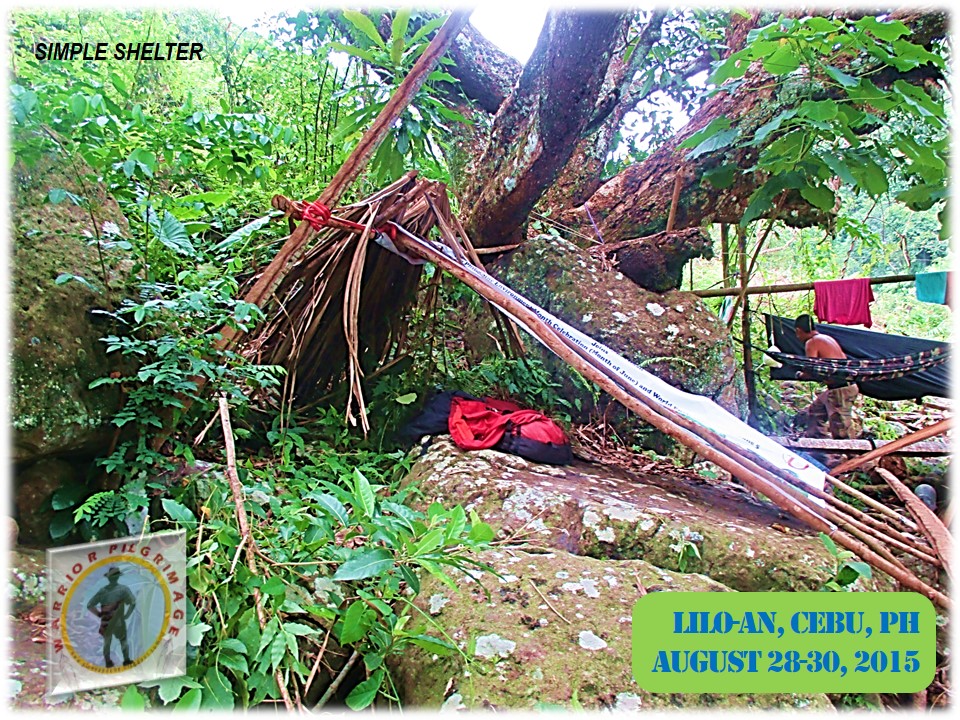
Immediately, improvised shelters are erected by the participants
using laminated nylon sheets, used advertisement tarp sheets, wooden
poles, bamboos, ropes, natural cordage and buri palm leaves.
When
all have settled down, I start the training at 13:00 tackling first
about Introduction to Bushcraft. Except for a few, the term
bushcraft is so alien to them but they could relate it better instead
with the use of the closest Cebuano equivalent available -
“panikaysikay”. It would also good to note that bushcraft
is not totally synonymous with the word survival, since the latter is
immediate while the former is the practice of skills in a day-to-day
basis or the preparation hereof in survival situations.
One
of the new topics that I have introduced lately is Ethical Bushcraft.
It is taken as an excerpt from my future e-book which bears the same
title. Considering that bushcraft is beginning to unfold as a
leisure weekend activity, thanks to survival TV, the unabated
enjoyment of it would take a toll on the forest resources like those
happening in Western countries where many private lands and parks are
now off-limits to bushcraft activities.
In
Ethical Bushcraft, the participants are taught to be part of the
landscape, judiciously use forest resources, even firewood, and to
increase safety, particularly the management of campfires. It is a
lengthy topic which takes most of the afternoon and, should be, for
educating individuals into responsible outdoorsmen is what this is
all about, especially when everybody are now interested in bushcraft
and survival.
The
last topic for the day is Knife Care and Safety. It aims to correct
the usual ways we carry and use the knife and to change the common
notion of the knife as a mere weapon into a very useful tool. In
bushcraft, the knife lay supreme for, without it, tasks would be
downright difficult to accomplish. As every tool, you have to spend
considerable attention that it functions well by maintaining its
sharpness and keep it from rust.
Bushcraft
is a lawful activity and it easily fits in that description under
Batas Pambansa Bilang Anim (BP 6), the only law in the
Philippines governing the carrying and possession of knives. This
topic increases your responsibility in the use of blades and its
carrying, including travelling. It also teaches you the different
shapes of blades, knowing the different parts of a knife and how to
sharpen these.
When
dusk begins to be felt, the participants disperse to prepare their
dinner. They cook their food and rice in large pots which they
brought along. Ernie prepared for the camp staff. Campfire Yarns
and Storytelling unfolds when supper had been taken and everyone take
their respective spots around a small campfire, just like the Boy
Scout days. The campfire is the social center of early camp life
since time immemorial. Taps at 22:00 is extended by two hours.
The
second day – August 29 – begins with a light breakfast for,
today, everyone would be fasting, including the camp staff. The
participants would feel being miserable in an environment where they
have almost no control of and then fighting off hunger and drowsiness
in the middle of the lectures. When responding to calamitous
situations, you are almost in this state and you have to stretch
yourself for a few more mileage to be effective.
First
topic for the day is Survival Tool-Making. When you lack gears or
what you have is inadequate, you have to improvise by making tools.
Tool-making is simply extending your existence during a survival
situation. You make different tools for different situations like
cordage, for foraging, for trapping and hunting, for dining and
cooking, and for other special uses. What they learned yesterday in
knife-handling safety would be applied on this topic.
Essentially,
knives and tool-making go together. Making a tool exercises your
dexterity with a knife. I demonstrate to them how to make a foraging
stick and then a bamboo cooking pot employing the Trailhawk System.
I designate them into three groups of four and require them to make a
spoon, a drinking jug and a cooking pot. Those that do not have
knives with them, choose the knives that me and my camp staff put on
display.
The
morning progresses into something positive for the participants and
the training staff when a strong rain came. It stayed for 30 minutes
and unleashes again another torrent after an hour but it stayed
longer. In the dry comforts of their shelters, the participants
persevered and continue on the making of their dining tools as well
as the pot that would be used later for cooking and all three groups
showed me their results thereafter.
Second
topic would have been Firecraft but we just had a downpour and so not
conducive to discuss about fire or heat. I jump to the next,
instead, which is about Shelters. Before setting up a shelter, you
should choose a good campsite. It should not be on the stream banks.
It should not be on flat terrain. It should not be along trails.
It should not be near a water source. It should not be under a
forest of pines, cedar, pulpwood, eucalyptus and rubber trees.
The
campsite should be away from all of these and do not alter the
aesthetic of the place just so it could suit your tastes. Keep it as
it is and then blend your man-made shelter with it. If you cannot
make one, use a small cave or a rock overhang and make yourself
comfortable by building a small fire. Use the rocks as reflector of
heat. Simple shelters can be made from natural materials or a
combination of man-made ones. Some shelters employ this setup in
this bushcraft camp which is not difficult to explain.
Then
I proceed to the topic about Foraging and Plant ID. Foraging works
better with good bushcraft ethics unless there is a need where your
existence would be at stake. I discourage the use of rifles when
hunting for food and resort instead to trapping. I demonstrate how a
simple trap looks like and how it is placed. Likewise, I show a
snare employed to catch monkeys and big lizards and another one that
closes a loop when moved. Not to be outdone, the participants made a
trap made to catch fowls and birds.
Part
of foraging is identifying plants. It could be edible, herbal or
harmful. Just as long you suspect each plant that you do not know,
it would never be a problem. To guide them how harmful plants look
like, I showed them pictures of these plants, starting from the
thorny ones to one that is so toxic that there is no antidote to cure
people affected by this.
The
last lecture for the day is about Outdoor Cooking. This topic also
includes how you preserve meat, fish, vegetables and fruits. The
processes are discussed thoroughly as possible given the light of day
beginning to go dim. Then there are ways how you cook your food:
open hearth, semi-closed and the closed style; and where you cook:
campsite, trailside and bushcraft.
The
open style is very popular as it is very simple. Semi-closed works
like you would with a clay hearth where there is a hole to feed the
fire with wood and another hole where the pot is placed or where the
food is cooked. A good example would be the Dakota fire hole. The
closed type is a different kind as it does not use direct fire in
cooking your food but would use that fire instead to heat the stones
to cook your food instead like a crude oven.
The
three groups are now ready with their bamboo cooking vessels. The
Trailhawk System of cooking is not complete without employing the
unusual way of how it cooks rice, which is quite different from a
standpoint of conventional cooking of rice. It is now almost dark
and the guys are hungry because of the whole day without food.
Whoever cooks his rice first, can start immediately their Nocturnal
Hunting.
One
by one, group after another group, leave in search of their own food.
For me, it is time to relax by taking a bath in the middle of Cotcot
River where the current is swift. The water is warm yet refreshing
to a warmed up body that have not had rest for two days and a bath
for a day. I never felt so better after that, given that the night
is warm and humid. I can see lights that walk up on one hill and
another group on a hill across it.
Ernie
starts his own cooking, ably helped by Jhurds while Nelson makes
another fire to smoke the mosquitoes away. The first group arrive
and they caught five edible tree snails (Local: taklong), just
enough for the four of them. A second group arrive to show a more
miserable result – a heart of a young coconut tree (ubod).
The last group whose lights glowed at the farthest hill returned with
a live chicken and some horse radish. Very well, so far so good.
All cook their food. Those with less, supplement it with canned
goods.
The
second night begets a second dinner found the hard way. When all had
their fill, another Campfire Yarns and Storytelling turned up. Since
I do not have enough time for tomorrow, I decide to talk about the
Everyday Carry around the campfire circle. The night went on after
that but I am tired and I hit the deck of my shelter early.
The
third day – August 30 – is reserved for Firecraft. It is a very
warm morning. After a good breakfast, I start the topic immediately.
Firecraft is not just about making fire by modern conveniences or by
primitive means, but it is understanding how a fire would work and
how it may be used. Elementary understanding of a fire should start
from the so-called fire triangle, which is now substituted with the
tetrahedron. (A tongue twister. Why not a diamond?)
Then
you have to identify good fire tinder. Tinder absorb heat which
makes fire possible and it could also absorb moisture quickly to test
your patience in making fire. Tinder are natural dry material which
are so light and, sometimes, so fluffy but you could manufacture your
own tinder like I did with cotton jeans which result to charred
clothe. Charclothe could catch the flimsiest of sparks and can be
used as medium to receive heat from concentrated light passing by
water inside a bottle.
There
are four ways to make fire. First is by the conventional manner
which could be done with a lighter, a box of matches or by a ferro
rod. Second is by solar magnification which can be created with a
magnifying lens or other material which could imitate the lens like
bottled water or even ice. The third is by pressure which is only
possible with an internal combustion engine and by the fire piston.
The
last is the most popular, which is by friction. The whole idea of
survival is anchored on this. Actually, it is not. Friction methods
are many and it is done with wood or by bamboo or the combination of
both. Most popular here is the bamboo-saw method because it is
considered our own and is extensively used in Boy Scout activities.
Beginning to get attention in local bushcraft is the bowdrill method.
Other methods like the hand drill, the fire plow and the fire thong
are as good as the others. It takes a good amount of practice and
the right conditions to make fire with these.
After
successfully making fire in some methods, I believed I have taught
all what is needed to be taught and decide that the training has ran
its course. Then it rained heavily. We pack our things back inside
our bags under this deluge and break camp. I fear that the river
would rise. As I had feared, a tributary has risen and we have to
cross it three times under a strong current. We take another route
back to Mulao and found refuge under their covered basketball court.
While
waiting for the rain to subside, Jhurds decide to raffle off the free
giveaways: ten pieces paracord of 10 meters length each, two
Seseblades NCO Straight knife and a modified Seseblades Sinalung.
All these courtesy of Jhurds, who have been very supportive of my
endeavours. A Hyundai Starex of the Municipality of Lilo-an arrive
to pick us all, down to the new seaside store of Titay's Rosquillos
and Native Delicacies.
Upon
arriving, I distribute the training certificates to the participants,
after which Aljew Frasco whisk us off to his farm and treated me,
Jhurds, Ernie, Mark, Doms and Nelson to a well-cooked mixed-vegetable
stew. Gone are the fatigue and the bone weariness that have hounded
me for as long as I can remember. The soup is just superb and would
have been perfect if paired with cold beer but we all need an early
rest. There would be a next time, I am sure.
The
Municipality of Lilo-an have taken extraordinary steps to
professionalize their emergency responders with the addition of this
training. They are the first municipality to extend their DRRM
operators to learn bushcraft and, likewise, it equipped them in their
work, especially when responding to places where they have no total
control of the environment. This training taught them how to adapt,
blend and improvise in any given situation where resources are
limited and pursue their goals without impediments.
As
for me, I have now come to the conclusion that I will focus my
attention on sharing what I know about bushcraft and wilderness
survival. I have been in private employment for sometime now and I
think I may have to choose the best master: the corporate owners or
my passion. I will arrive at that bridge and when I do I will cross
the river and burn the bridge behind.
Document
done in LibreOffice 4.3 Writer
Posted by
PinoyApache
at
08:30
0
comments
Labels: bushcraft camp, Cebu, ethical bushcraft, knife safety, Liloan, outdoor cooking, survival tool-making, survivalcraft, training, traps and snares
Subscribe to:
Posts (Atom)