Tuesday, December 8, 2015
NAPO TO BABAG TALES LCIII: Raise a Roof
THE
ROBLE FAMILY WILL get a real surprise today, April 19, 2015. Their
house, which had been battered by strong typhoons Yolanda and Ruby
and brought to a death kneel by Seniang, is now standing up again at
its old site. What it lacked are concrete foundations and the roof.
There was a wave of concern and sadness among local outdoorsmen that
a fund-raising campaign had made its way in different sites of
Facebook which resulted to the construction of a new house.
Wood
that had been sourced locally became the frame of the house. We saw
it stood at its former place when we had visited it last March 29,
2015. The wooden posts were still suspended over holes which were
prepared for the pouring of concrete as foundations, which cement
sacks had not yet arrived then. We had carried a few pieces of
coconut lumber, some used plyboard, a pair of light GI beams and some
sheets of plaited bamboo on February 15, 2015 at their place.
Jhurds
Neo, elected president of the Camp Red Bushcraft and Survival Guild,
is the workhorse behind this project. He facilitated and exerted
great effort that the Roble family will get a new home. His
persistence brought hope to the Roble family and made possible for
the procurement of badly-needed housing materials and getting it sent
to the place either on his own or with help from the bushmen of Camp
Red. That help came in droves though.
After
meeting at the Our Lady of Guadalupe Parish, we motor to Napo, where
eight sheets of corrugated GI roof are waiting, courtesy of Jhurds’
industry. We tied each sheet into a tight roll and carry it with one
hand to the Roble homestead. It is light and could be transferred
from one hand to the other easily. You have to watch and worry your
neck though because one edge is exposed. We carried it safely with
gloves to prevent injury.
We
reach Lower Kahugan Spring and I see locals installing a portable
water pump to suck water from two big PVC barrels whose water were
taken from the Sapangdaku Creek and mixed with chemical. These
chemical-laced water are sprayed on mango trees to induce more
flowers and to kill insects. I noticed that empty packs of chemicals
were irresponsibly thrown on the stream. I remind the pump tender
guy about the need to transfer the empty packs to dry ground so it
will not pollute the stream.
When
nothing happened, I take matters into my own hands, literally, and
personally transferred the empty packs to dry land from the creek. I
remind them also to take care of the natural spring near them as it
is the only water source around here that is relied by inhabitants as
it had been many times in the past. I am very particular about the
potability of water around here because people living here had not
yet been properly educated about hygiene.
Anyway,
we resume our journey. Determined to get there at the Roble family’s
abode are Jhurds, Ernie Salomon, Jerome Tibon, Eli Tambiga with
friend Abigail, Justin Abella, Faith Gomez, Dominik Sepe, Mayo Leo
Carrillo, Jingaling Campomanes, Bogs Belga, Mark and Mirasol Lepon,
Justin Apurado, Rommel Mesias, Nelson Tan and Richie Quijano. It is
very warm. The rolled roof sheets, at first very light, had weighed
like lead as the terrain becomes ascending.
Our
arrival surprised the Roble family as they do not have an inkling of
our coming. Fele and Tonia are all smiles. The cement had been
delivered a few days ago and it had been poured into the base of
posts and the rest made into hollow blocks. The roof sheets would
make possible the habitation of their new house, perhaps, but the
prospect of it is now a possibility. One by one, I removed the cords
that tied the sheets and lay it flat over the other on the floor of
the new house.
I
am happy to see that the female turkey I brought here is laying eight
eggs inside a makeshift shelter where it is now nesting. The male is
quite healthy standing guard outside, tail feathers spread out. It
had recovered well from its injury. Meanwhile, the bushmen fanned
out to forage firewood for soon we will get another taste of heaven.
The pots are readied and the food ingredients laid on a table.
Coffee
is the first commodity that is prized by everyone and, after the
water barely boiled, sachets of it are dropped into cups. As always,
coffee outdoors is perfect. The ladies begins to decimate the
vegetables and meat in neat lines with their Mora knives. Of course,
this is under the direction of Ernie who, I believe, will take
matters into his hand all the business of cooking.
Wood
smoke is sweet to my senses and I just love it. The guys have
learned to love it as well as it is an ever-present thing in
bushcraft. Firewood are split by big blades or by smaller ones with
a stick as baton. Manual labor is a challenge in tropic heat yet
mild enough under the shades of mango and Java plum trees. The guys
thrive on it, sweat dripping on their foreheads and arms and remedied
by a wipe from a sweat-soaked shirt.
When
not at the tasks at hand, they are busy comparing notes about blades
and gears. They are serious but, most often, a hearty laugh breaks
the dreariness. Three guys laid their Mora on the table and the rest
present their own, starting a for-Scandinavians-only knife porn,
which include a HΓΌntafors
and a Bahco. Jhurds gave me his surplus US military canvass duffel
bag which I appreciate so well.
Rommel
starts to kindle a fire using a water bottle and all eyes and taunts
are on him when the cloudy skies tease him. Mark did likewise with a
small magnifying lens of his small Swiss Army compass, eliciting the
same taunts. The Roble kids are busy with their hunt of green
coconuts which are abundant in their abode. Ernie gets the ladle and
gets busy with the cooking.
Finally,
lunch is served. Everyone circled around the table as Rommel lead
the prayer. Food on hand are a bowl full of mountain-cooked
chopsuey, grilled chicken wings and pork, and a side dish of raw
cucumber in vinegar. Rice completes the menu and, silently, the guys
picked their food with spoons, forks or chopsticks. Some made a
refill while a couple made a third run.
After
the meal, the guys relaxed a bit but there are announcements to be
made. Dominik updates the group of our project – the Who Put
the “N” in Nature IV – which will be divided into two
parts. The first would be the collection drive of school supplies
and the second would be the outreach proper. The Roble homestead is
the ideal place of this outreach as it had been for three previous
occasions starting 2012.
The
place where the collection would be will be decided by its
availability. Previously, we held it at a restobar in Lahug and,
hopefully, would still be but we have not reserved our event yet and
there is a chance that we will not be accommodated. Dom have other
places in mind and, the good thing is, three of the four musical
bands he approached have confirmed its participation. I believe
there would be many children this year than last year.
Then
it is my turn. This is about the overtures that a Singaporean TV
production company had proffered to Camp Red. They are interested to
come to Cebu to do a Photo Face-Off episode here with our own
bushmen providing the backdrop and subject. A reality show, it
demands that we do our stuff oblivious of their presence after taking
them to a very secluded place, which we have lots of.
Everyone
is excited at these prospects whichever it may be. Inspired and
emboldened by those, the full force of the blade porn is unleashed.
Fele helped us accomplish that by providing a log and a plank to set
the blades upright. These bushmen, even the women, carry multiple
blades for just a day activity. One by one, the blades are exposed
into the open where it is pierced into wood.
Hatchets,
machetes, woodlores, folders, Scandinavians, local and imported
brands, begins to decorate the wood. Some crazy guys even placed
their paracord bracelets to add to these lunacy which only bushmen
understood. The blade porn is the exclamation point of our day on
the mountains. The activity that places a seal to all our
activities. Slowly, we clear the logs of blades and bade goodbye to
the Roble family. The family are hopeful that they will, someday,
live again in a real house.
I
pass by the place where a man was seen mixing the chemicals in the
morning. I see that my sound counsel to dispose properly his wastes
had been ignored. Empty plastic bottles and empty plastic packaging
are left on the stream. I cannot stomach imagining an innocent child
who would use the same bottle as container for his drinking water.
The empty plastic packaging had been covered and hidden underneath
weeds. Downstream of me are river crabs turning red, cooked by the
strong chemicals. My anger begins to boil.
I
collected all the toxic materials and placed it inside two plastic
bags and I brought it to Napo. I advise all to proceed directly to
Guadalupe while I would have to settle this first at the village hall
of Sapangdaku. Jhurds accompany me to report this violation against
the environment. The auxiliary police heard my complaint and
recorded it in their log book. I want this incident be brought to
the attention of their village council.
I
do not care if small businesses might be affected by my intervention.
They had been doing that for a long time and it is time that they
know their practices are wrong. They had given a bad name to the
place and to the famous mangoes of Guadalupe that Guimaras had
overtaken us in quality. Customers are also now beginning to be more
concerned of where their money spent go and they prefer goods or
products that gives them a clean conscience.
I
have always been a staunch advocate for the environment and,
sometimes, taking it to the extreme. Facebook and other social
networking sites are helpful tools but people misused it and that
makes them, most often, very irritating and defeats their purpose. On
the other hand, actual confrontations are natural and, most likely,
you will be exposed to threat or harm and, in rare instances, losing
a job.
I
did my part today in protecting the environment by informing and
involving authorities. It is a small gesture but it creates real and
hard awareness on the part of the village council and for those who
may read this article. But it is harder on my part since I will be
creating future antagonists as much as you would have done by just
sitting and tinkering with a keyboard. But I am satisfied with this,
the same as you would have also by just reading this.
Document
done in LibreOffice 4.3 Writer
Posted by
PinoyApache
at
10:30
0
comments
Labels: advocacy, Cebu City, environment, humanitarian
Tuesday, December 1, 2015
COMPLEAT BUSHCRAFT XX: The Ideal Camp
FINDING
A GOOD CAMPSITE for the 2015 edition of the Philippine Independence
Bushcraft Camp is a priority for me. I remembered in 2012 where I
have done it solo in the Babag Mountain Range of Cebu City just a few
weeks before that year’s very impressive PIBC. It always brings
out the best in me. It takes skill to identify a good campsite,
especially for bushcraft use.
A
bushcraft camp is so different from a camp used mostly by mainstream
outdoor activities. A bushcraft camp does not grow on bald peaks nor
on exposed places and does not need a sea of clouds. It stays below
treeline where it blends with vegetation and does not desire to be so
colorful. An ideal bushcraft camp have to have access to a stream
and bamboos. A clean water source is only a bonus since bushcraft
could use any water it obtains.
The
PIBC is transferring to the hilly areas of the Municipality of
Lilo-an, Cebu and I had considered three different sites there. All
three places had been visited by me and it has the features and
criteria to host a bushcraft camp. However, the PIBC is a big event
and this year’s PIBC, I believe, would be participated by many
people, not to mention the different PIBC alumni who would volunteer
their time to support their new brethren.
It
is because of this that I am a bit challenged. These three different
places are not that big in terms of camp size, good enough to
accommodate more than 30 individual shelters, and the sustainability
of a water source to supply drinking water to a good number of people
that would swell to around 40. That is a lot and water is very vital
as well as security. I need to look and find that camp.
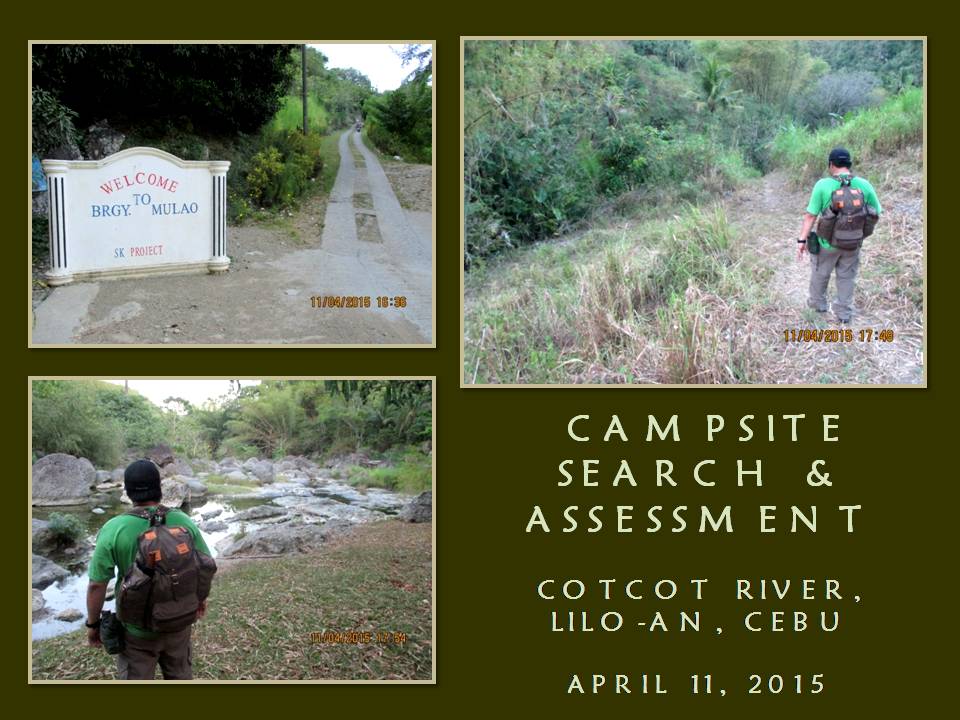
Today,
April 11, 2015, I am going to Lilo-an. Coming along is Jhurds Neo,
the President of Camp Red Bushcraft and Survival Guild.
Automatically, he will sit in the PIBC as the Camp Ramrod – that is
the camp administrator in layman’s term. We meet at Mandaue City
at 14:00 and commuted in a public utility midget AKA the Multicab.
Oh God, I hate that vehicle and I still patronize it. Oh dear!
Anyway,
we arrive at 15:15 in Lilo-an and proceed on the business of
procuring the food ingredients for our meals at the public market.
Both me and Jhurds intend to stay overnight so we will cook and eat
dinner tonight and breakfast for tomorrow. Once we have the items,
we hired two motorcycles to bring us to the trailhead. I intend to
start at the hanging bridge at the village of Mulao but my driver
dropped me at the wrong place. Jhurds followed suit.
Upon
inquiry with a local, we are a long ways off. We are at Cabadiangan
and we will have to walk to a spillway from whence Mulao will start.
If we walk fast, it would take us 90 minutes to reach the village
hall of Mulao. We start on the road which begins to ascend once we
got past the spillway. The road going to Mulao is adorned with
garbage bins colored brightly and ornamental plants lining the sides.
We
reach the village hall and register our names. We also get to pay a
visitor’s fee of ten pesos each since the village had identified
certain features of their place as tourist spots. The Cotcot River
runs along the village and this same river is the boundary between
Lilo-an and another town, Compostela. The river has huge granite
rocks and water-polished boulders choking the river and two of these
have names – Malingin and Arko’ng Bato.
We
go down a path to Cotcot River and reach our old camping site where a
lone acacia tree grow. I know there is no water source here but I
heard that there is one near Arko’ng Bato and we will have
to find it in the failing light. We reach the big boulder on a
difficult route and it is already 18:00. It is almost darkness and
shadows have claimed the banks where there are vegetation – the
likely places where a natural spring would occur.
We
are on a wide shelf of granite and we decide to set up camp there.
We have water for cooking and drinking and we will use the stream for
washing. Immediately, I forage dry driftwood which are plenty on the
other side of the bank and that means I have to jump and balance over
menacing rocks which would have been slippery and dangerous should it
were wet. Warm days made it more acceptable to rubber though.
Once
I got firewood, I return to the shelf and break the smaller ones by
hand, the bigger ones with my AJF Gahum knife. Jhurds collect four
stones of equal size and begins making a fire. I pull out my
consortium of black pots and begins to slice 250 grams pork meat,
peeled three potatoes, cut 20 green pepper, crush garlic and chop an
onion with my Mora Companion knife. I enjoyed coffee first before I
start to cook the pork adobao and boiled the potatoes. Jhurds,
meanwhile, prepared the cooking of rice.
On
an iron grille supported by the four stones, three pots are
simultaneously placed over a fire, each having its contents cooked.
We eat dinner at 20:00 under the clear starry sky with the frolic of
the stream water supplying us music of nature. It is dark but we
have small LED lights and a LuminAid solar-powered emergency
inflatable lantern to light the place. The granite below us is still
warm and this would help in our sleep later.
After
that good meal, Jhurds wash the pots downstream. I stand guard with
a light on him. It is so silent save for the swirling sounds of the
river, the hum of crickets and the calls of geckos. Once in a while,
a commercial plane would buzz overhead and pierce the harmony of the
night with its engine. I see the familiar geometry in the sky that
tell tales of mythical creatures and superhumans.
We
enjoy the ambiance of the place so much that we spent the evening
hours in conversations until it surprised us that it is already
23:00. We sleep on our respective hammocks which we use instead as
ground sheet and bedding. The shelf is so wide that it removes away
your fear of falling on the river while asleep. The smooth rock is
warm which would be very helpful when the temperature would dip low
during early dawn.
I
wake up from time to time to check on our positions in relation to
the river’s edge. We did not slide contrary to my fears. A last
quarter moon crosses overhead and paints a silvery light on the
riverscape. My brain react to the light with dread as if it is
daylight. Everything is silent except the usual natural sounds. My
fingertips are feeling the bite of the cold and I place hands on the
part of my body where it is most warm.
I
wake up when the first rays of light touched the highest mountains.
I take a leak on the other bank and came back with an armful of
firewood. My search for the natural spring is certainly not here and
could be upstream. I do not know but it is best if I prepare our
breakfast. I break two eggs and stir it briskly on a skillet after I
sprinkled salt. I slice three eggplants into thin strips and drop
all to the stirred eggs. I also peeled and sliced three potatoes.
Jhurds
start the fire where the separate pots for the potatoes and rice are
cooked. I place the skillet over the fire and begin frying the
eggplant chips with oil. We eat our breakfast at 07:00 and then we
start washing our pots. We notice a lot of dead river mudskippers
and fresh-water shrimps. The shrimps turned red and I begin to
suspect chemicals although I see traces of a poison plant pounded on
a rock. I am confused since poison plants do not turn shrimps into
red ones, a condition caused only by exposure to heat or strong
medicine.
Cotcot
River is sick and so polluted with chemicals and I see to it that my
pots are thoroughly washed with strong detergents once I got home.
The Municipality of Liloan should know about this so preventive
measures would not kill the river in the future. I believe people
fish for subsistence and wash their clothes here and exposure to
chemicals would surely cause health problems for them.
We
leave Arko’ng Bato at 08:30 going on a quest to find that
natural spring. We meet a local fisherman carrying a sack. We
inform him of the dead fishes and shrimps in the river and he showed
me a good-sized catfish and a foot-long fresh-water eel. He found
these already dead and would have brought these home as food when he
noticed our great concern. He left the catfish and eel on a rock and
I gave him our uncooked rice, eggplant and egg. Then we found the
natural spring that we had been looking since yesterday.
It
is surrounded by a spiny bamboo grove (Local name: kagingkingon),
a Malabar almond tree (magtalisay) and an elephant apple tree
(katmon). The spring gushed forth from the ground where a
bamboo trough is placed. Nearby are several natural springs which
were not used and the runoff caused a small marshy area. Across the
spring is a river pond where bathing is possible and downstream small
waterfalls and jacuzzi-like channels.
Satisfied
with our find, I taste the water and I notice it has its own distinct
taste. Could be from granite. Anyway, a good water source gives the
possibility of hosting more people for the PIBC, which I feared would
come. We walk on upstream and begin the next phase of finding a good
campsite which could accommodate many light shelters, tents or
hammocks. We found a good spot where there are several mango trees
and a few groves of spiny bamboos in the vicinity.
The
spot looks familiar. This is the same place where Aljew Frasco had
taught Notching on the rest of Camp Red last March 9, 2014 (CB 11:
A Notching class by the Riverside). Then the old hanging bridge
linking Mulao of Liloan to the Mulao of Compostela would not be far.
The same bridge that we were supposed to get dropped yesterday were
it not for my driver’s judgment error. I am bestowed with good
fortune today and I am happy that my expectations had turned out
right the way it should be.
I
know the route now to the hanging bridge but we take a shortcut
instead to farms and over a low hill to get there instead of
following the river. We reach the bridge at 10:20 and both of us
deserve rest and a bottle of cold soda drinks each. After that, we
begin another uphill walk on a road which has no trees to shade us.
It is concrete and it took us over an hour of walking to reach a road
corner where another road goes down to the same road where walked
yesterday.
Then
the “cavalry” arrived in the form of a red Toyota 2003 pickup
driven by Christopher Maru and we were “rescued”. Christopher is
Camp Red and had participated the PIBC in 2013 together with Aljew.
We reach the town center of Lilo-an before noon and take lunch at
open eateries near the municipal hall. Then I make it sure that we
will not commute by riding in a public utility midget AKA the
Multicab. Our mission is accomplished.
Document
done in LibreOffice 3.3 Writer
Posted by
PinoyApache
at
11:00
1 comments
Labels: campsite selection, Cebu, Cotcot River, exploration, Liloan, PIBC
Subscribe to:
Posts (Atom)