Showing posts with label PIBC. Show all posts
Sunday, May 6, 2018
PHILIPPINE INDEPENDENCE BUSHCRAFT CAMP 2017
AFTER THREE YEARS, the PIBC
returned to the place of its birth: Camp Damazo. It started there in 2011 until
it experimented in holding it at Sibonga in 2014. In 2015 and 2016, it was held
in Liloan. During that period of six years, it had hosted 97 participants who
learned basic tropical bushcraft skills. This year, another set of 26
registrants would flock to the jungles and enhance their knowledge about the
outdoors.
The PIBC had become an institution
in itself, exceeding its expectations when it was held for the very first time
in 2011. By 2012, it had accepted the first participants from outside Cebu and
by 2015, the first foreigner. The format used had changed and improved through
the years and used as basis for trainings that this writer conduct in other
places and for organizations like MCAP, CLIMBER, Archdiocese of Capiz, PECOJON,
Liloan DRRMO, 5th CMAG, Bukal Outdoor Club and Bluewater Resorts.
The PIBC officially starts every
June 10th and culminates on June 12th, which happen to be, you guessed it,
Philippine Independence Day. It follows the dates faithfully, whether it fall
on weekends or weekdays. PIBC is a patriotic activity which rekindle each
Filipino’s love of flag, country and freedom. It also is a venue for outdoors
learning and education, as well as a campsite for camaraderie, kindred and
friendship.
Warrior Pilgrimage and the Camp Red
Bushcraft and Survival Guild collaborated through hard work and dedication for
many years to bring again this seventh episode. Assembly area is the parking
lot of the Our Lady of Guadalupe Parish on the first day (June 10).
Participants, instruction presentors, camp staff and volunteers start to
arrive. Among them were four from Luzon, one from Leyte, one from Palawan, one
based in the USA, one from Switzerland and three minors.
The famous Duke Bus of the
Municipality of Liloan, our main transport for the last three episodes, came
again to ferry all to the trailhead in Baksan. From there, the participants are
engaged to walk in a Discovery Hike to introduce them and increase their
outdoors awareness. It follow Lensa Trail, crossing streams, following a ridge
on a combination of forest and jungle, and finally arriving at Camp Damazo at
10:00.
After a short briefing about camp
rules, locations of latrines and campfire and the camp staff, the participants
proceed to erect their shelters. Most have tents but some have hammocks. Jhurds
Neo (PIBC 2012), camp ramrod, assigned an area for participants and another one
for volunteers. Humidity is high and, as with previous experience, rain is
expected to fall. Meals for lunch are prepared and eaten as the minutes ticked
to officially start the activities. After forsaking siesta, all gathered under
a wide tarp canopy at 13:00, and all ears now for the lectures at hand.
This author, discusses the first
chapter: Introduction to Bushcraft. It tackles the meanings and the
jargons used in bushcraft, its environment, the psychology of an enthusiast,
its methodologies and its difference from survival and from mainstream
activities. Comes next is Ethical Bushcraft. The best practices of
leisure bushcraft, using its own principles of Blend, Adapt and Improvise. It
covers trail travel, campsite location and safety, fire management and camp
hygiene.
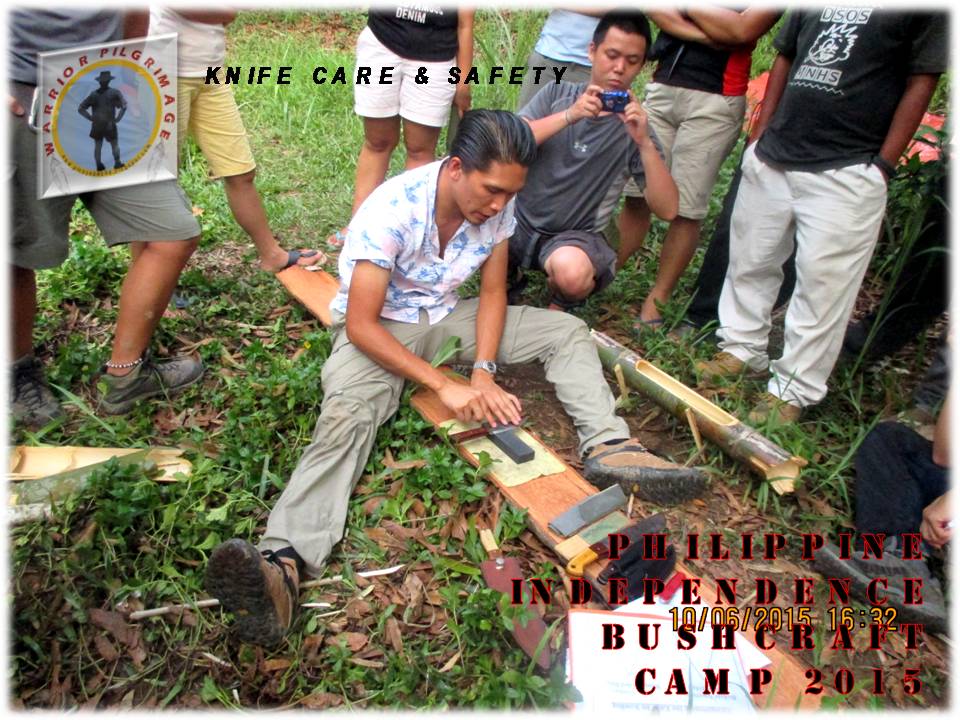
At 15:00, Knife Care and Safety
gets discussed by Aljew Frasco (PIBC 2013). This chapter changes back the
perspective of the knife into a useful tool. The Philippine law on the knife – Batas
Pambansa Bilang 6 – are explained thoroughly and clearly as well as ethics
and safety, care and sharpening, blade shapes, parts and grinds, and the
Nessmuk Trio. At 16:30, this author take over once more to demonstrate Survival
Tool-Making. This chapter is a practical exercise in knife dexterity and
safety. Dr. Guille Zialcita (PIBC 2016) discussed the part that touched on
fishing applications.
When dusk came, all activities
ceased and the participants focused on the preparation of their meals. By
19:30, the campfire is lit and the place begun to be populated by participants
and camp staff and volunteers. A social event, Campfire Yarns and Storytelling,
is an integral component in camp life. Tales and stories caught everyone’s
attention and their humor as the small company gets fueled by a moderate round
of alcoholic drinks. The social activity ended at 23:30 but a set of night
watch starts their task until such time they are relieved after one hour and so
on until daybreak.
The second day (June 11) starts
with breakfast but after that, all will deny food the rest of the day, not
until they have accomplished foraging their own food which comes later in the
night. The first chapter is Foraging and Plant Identification. This
author discusses about traps and snares, luring methods and trap lines, and
foraging food and non-food. It also identifies which plants are edible, harmful
and poisonous. The participants are then shown the different traps and snares
that are set up in camp.
Next at 10:00, is Common
Wilderness Treatments, discussed by Eli Bryn Tambiga (PIBC 2013). It
tackles common injuries in the woods like open wounds and bleeding, fractures,
hypothermia, heat strokes, hypoglycemia and the methods to contain it as well
as a practical in using a triangular clothe as bandage and sling. At 13:00,
Dominik Sepe (PIBC 2012) discusses about Notches and Lashings. After a
half hour of demonstration, the participants proceeded with the business of
working with knife and baton on a stick and produce five different notches.
When everybody is about to settle
down at 15:00, Outdoor Cooking and Food Preservation came next. This
author talked about the ways how meat, fish, vegetable and fruits are
preserved. Getting equal discussion are the different kinds of fireplaces.
After the lectures, author shows how the Trailhawk System of cooking
rice in bamboo is done. Five groups came to possess five different bamboo poles
to process into cooking vessels. A fire is prepared and rice are cooked inside
it.
After the first group have cooked
their rice, they commenced to Nocturnal Hunting. The jungle and streams of Camp
Damazo host small edible creatures and have sustained participants of the PIBC
during the early years and now, after an absence of three years, these
creatures are good enough in numbers for the taking. Ernie Salomon (PIBC 2011),
the camp fixer, would ensure that the foraged creatures become a gastronomic
treat for the participants and volunteers alike.
For one-and-a-half hours, the five
groups filled their respective catch bins and ensured their meal, ending a
day-long fast. Dinner is most sweet when you personally toiled and foraged your
own food, offering an empty stomach a way out of its hunger pains. All dined
together, the rice inside the bamboo pots exude a sweet aroma which made the
food more desired. Everyone were happy and exchanged jolly conversations in
between swallows.
The second Campfire Yarns and
Storytelling started at 20:30 and almost everyone felt relaxed that all had
already overcame their ordeals of drowsiness, hunger, thirst, humidity and
other stress-causing conditions and it becomes second nature for all to gift
self with toasts of success. A few took the pleasure of an early rest, easing
on the thought that tomorrow would be the last day and they had proven
themselves for the last two days. Alcoholic drinks, cached underneath the
ground for a week made its regular rounds again to stoke interesting
conversations until midnight.
Last day (June 12), the Blade Porn,
a traditional bushcraft camp activity wherein knives and hatchets are laid on a
blanket to elicit good conversations, began. The number of blades far outnumber
the owners three to one but this author believed most of the campers carried
more than six with them. Then came the Patriotic Time. Jingaling Campomanes
(PIBC 2015) led the singing of the Lupang Hinirang and the reciting of
the Panatang Makabayan.
After a late breakfast, we broke
camp and cleaned up Camp Damazo. To see to it that we do not leave trace, a
task group led by Jonathaniel Apurado (PIBC 2015), left behind to pick up
rubbish that may have been missed out, dismantle camp furnitures and snares,
and see to it that the campfire and firepit embers are completely extinguished.
Because of the unexpected late participation of additional volunteers, a lot of
ground had to be cleared. As per assessment, it is recommended that the PIBC
would have to be held somewhere other than here for the next two years.
The exit route is shorter than the
ones we took two days ago but it is steep on the last part. It goes out to the
Baksan-Pamutan Road. A trail across goes down to Lanipao Rainforest Natural
Spring Park and it is there where we would go. The fresh-water pools are
perfect for bathing and to cool our bodies down. Aside that, cool refreshments
would be provided; raffles and giveaways, blanket trading, and the distribution
of training certificates would also be done there.
The following participants finished
the 3-day Basic Tropical Bushcraft Course:
Ronilyn
Ambal Frederick Ygnacio
III
Eulalio
Conrado Salazar Raul Andre Jose Ben
Ronniel
Abellar Vladimir Lumbab
Mark
Brylle Moniva Aileen Estoquia
Katrina
Mie Javier Jayson Binamira
Buen
Josef Andrade Joan Binamira
Rodillo
Arnejo Sweet Honey Acenas
Martin
Ibañez II Bonabella Canga
Honey
Vina Alquizola April Joy
Delantar
Shelley
Kim Binghay Floramae Dellosa
Luzviminda
Viray Felipe Arturo Enriquez
Dave
Judson Sy Alvin John Osmeña
Frederick
Ygnacio Jr Markus Immer
The giveaways were provided by
Derek Manuel (PIBC 2016) of Derek’s Classic Blade Exchange; John Robert (PIBC
2016) of the KnifeMaker; Paracord Manila; Silangan Outdoor Equipment; Titay’s
Liloan Rosquillos and Native Delicacies; Tingguian Tribe Outdoors; Zue Fashion;
and the Camp Red Buscraft and Survival Guild. Transportation provided free by the Municipality of Liloan. Warrior Pilgrimage is the media
partner for PIBC MMXVII.
Document done in LibreOffice 5.3
Writer
Posted by
PinoyApache
at
21:40
0
comments
Labels: Camp Damazo, Cebu City, ethical bushcraft, first aid, knife safety, nocturnal hunting, notches, PIBC, plant identification, primitive cooking, tool making, training
Tuesday, May 1, 2018
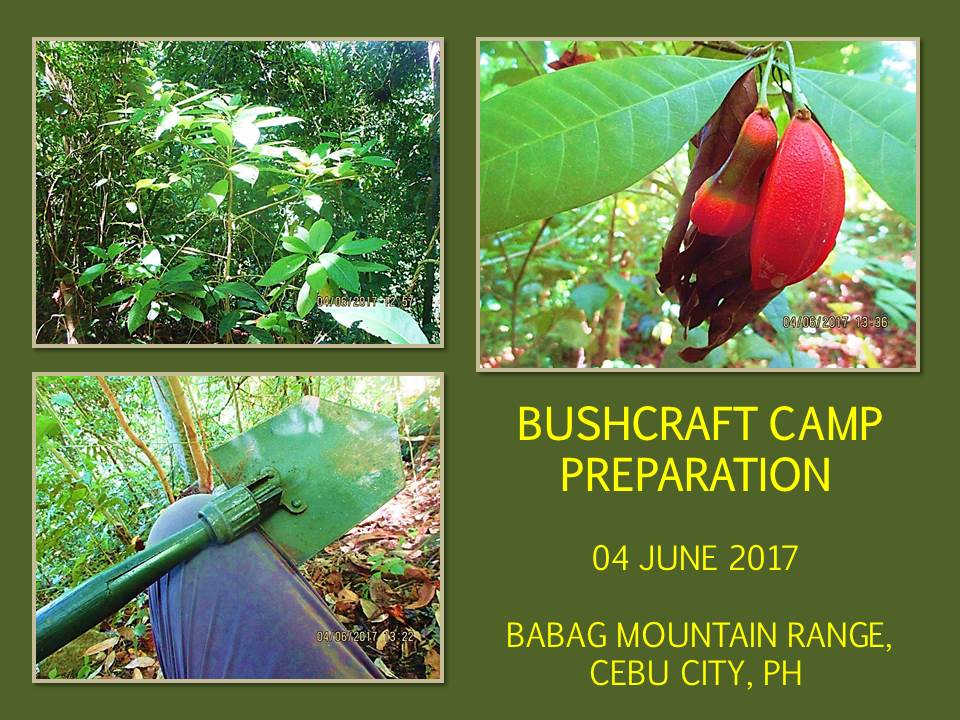
BUSHCRAFT BUHISAN XLIV: Return to Camp Damazo
THE PHILIPPINE INDEPENDENCE BUSHCRAFT CAMP is less
than a week away. Today, June 4, 2017, is a day reserved for preparing the
campsite. The last time I visited Camp Damazo was five months ago during my
psyching up for the Thruhike. It had been jungle when I discovered it many
years ago and still was jungle when I last saw it. I believed it would stay
that way for as long as you kept it a secret to the mainstream crowd.
I come today with the right people. My kind of people
and all belonged to the Camp Red Bushcraft and Survival Guild. Most of these
guys who are present today cut their teeth here like Ernie Salomon in PIBC
2011, Jhurds Neo in PIBC 2012 and Richie Quijano during the Bonifacio Day
Bushcraft Camp in 2015. The rest like Jingaling Campomanes, Mirasol Lepon,
Jonathaniel Apurado, Glyn Formentera and Jhops Burbe either took the PIBC 2015
or in 2016 at Liloan.
These guys can work on their own without so much
supervision. Before we left Guadalupe, each guy had been briefed of what we
will all do and all are prepared for the tasks at hand. We all have some of our
blades with us and the opportunity for another dirt time in a jungle is sheer
joy. Nobody could beat that anytime. I am doing the point and my outdoor
awareness level are again at its max. I expect reptiles lurking, especially
that it rained hard last night and in the early morning.
The ground is wet, leaves dripping with dew. We move
slowly among this man-made forest of Burma teak, its wide leaves that fell to
the ground do not make pop-corn sounds anymore like it used to during the warm
summer days. The trail follow a low ridge which is sandwiched between two small
streams. We follow the bigger one (Creek Alpha) downstream. The water is clear
and flowing, the stones among them glossy and shiny. Rubber works on most wet
rocks but it is much safer if you go it slow.
The vegetation changed from a single species into a
diverse chain of indigenous shrubs and vines that line the stream banks. Here,
the birds and insects are much alive. The cacophony of sounds are just amazing.
That is what rain can do to a parched land in so short a time. The stream is
tricky on some point but I know these parts very well. I caught sight of the
trail and we are walking on ground once more. This is a mixed forest of teak,
mahogany, gmelina and thick undergrowth dominated by rattan, rhododendron, wild
ginger and wild yams.
This is part of Lensa Trail which actually crisscross
each other through the vast Buhisan Watershed Area. We keep to the high ground
from then on until we cross another small stream (Creek Bravo) to proceed to
another trail across. The path led me to a ridge which transforms into a
beautiful forest of mixed indigenous and exotic species. For a moment, I seem
to be in another world but it ended as wild vegetation claimed ground what was
once theirs.
We are now at Camp Damazo, pure jungle environment
and, soon, home-to-be to the PIBC once more. As we were approaching it, I did
my usual trail maintenance work, clearing the path of obstacles and debris,
bringing dry twigs and branches with me. The rest of the guys carry dry bundles
of twigs collected along the way. We would need dry firewood for our cooking
later on and these are few after a downpour. There would be a lot of work but
the promise of a good meal would put more heart to our combined effort.
First things first, is to make fire and keep the smoke
thick to keep daytime mosquitoes, hornets, ants and creepy crawlies away. In
jungle environments, these insects are pesky and thick and they are attracted
to human presence. It could be your carbon dioxide exhausts from your breath
and perspiration or it could be your artificial odor on your clothes.
Sometimes, it is just the wrong kind of shirt and bag color but we keep that
annoyance to a minimum by using fabric with natural-toned colors.
Ernie will do the cooking and he is supplied with a
generous amount of dry firewood that we collected along the way. Jingaling and
Mirasol will assist him in his airy kitchen. Jhurds, Jon, Jhops and Glyn will
work on a firepit and the kitchen furniture and stock it with more firewood. Me
and Richie will dig a latrine for male and female. We just have to retrace our
route and look for those perfect spots to commune with nature. Richie has his
small pick-axe while I have with me a US-surplus folding shovel, given by Hawaii
resident Remy Ababa a few months ago.
The work on the latrines were easy due to modern tools
and we were able to finish it earlier than we expected it to be. We go back to
the camp and Ernie and girls are in the middle of preparing the food while a cooking
fire is doing its work on two blackened pots which, most likely, contain rice.
Jhurds and his crew are busy with their blades splitting firewood picked up
from the ground. Richie joined them while I go check the water source. It is
located 150 meters away. The bamboo trough is now missing and it needs
replacement with a new one. Time to look for bamboo poles.
In this jungle, only a few groves of bamboo grow. Most
of those that grew are the hardy type which are protected by a screen of
thorns. I saw one in a nearby stream (Creek Charlie) and I unleashed my big AJF
Gahum knife to forage one pole. I am able to clear the thorns away, work which
is quite painstaking and time-consuming, so I could have access to a pole. The
sound of chopping reverberated in the silence of the place, disturbing the bird
calls and the chirp of cicadas and other insects. All sorts of ants fell from
the foliage and dropped on my person and it made this work more difficult. I
should have smoked it before I commenced.
I cut the pole but it hanged forever above me, its
foliage and branches completely intertwined with its own kind. Forcing it with
all my strength only budged it just a few inches down. My footing is only
limited to two narrow boulders and there is not much I can do except pulling it
with a rope from the streambed which is eight feet below. The more I pulled,
the more ants falling over me. Some bit and some leave substance that stung. It
crawled over my hair to my face and it caused me eye irritations. The pole moved
just a foot. I tried to force the pole down by grabbing it and jumping down to
the stream like Tarzan which is very dangerous and it budged just a little.
Leaving it hanging, I go back to Camp Damazo. I would
just hire a local to bring it down to earth in time for the PIBC. I need two
green bamboo poles though for survival tool-making and for knife dexterity
exercises for the participants and another short piece of dry bamboo for
friction fire-making. Anyway, I got a piece of the green bamboo and go first to
the water source and insert this to replace the missing trough. The kitchen
fire pit is already done when I returned and two iron bars are placed over it.
These will hold the pots and pans when it is operational during the PIBC.
I sipped my cup of coffee and enjoyed the sight of the
kitchen furniture frame already standing. Soon a platform of round sticks will
be laid across the two wooden beams. Meantime, I have to help in collecting
firewood and identify more ground for tents and ground sheets. I brought two 4
feet x 10 feet laminated nylon sheets for the latrines but it would be best if
this is installed on the day of the event and so I have to cache it securely
where its unnatural color of blue and orange would be an obvious sight in a
jungle environment.
I looked around the hidden beauty of the jungle even
the sinister presence of stinging plants gave off its enchanting allure to
butterflies and bees. The “giraffe tree” is now threatened by man. Its
surroundings gets cleared as a hunter’s blind is erected near it. Hunting of
jungle fowls, ground pigeons, palm civets, leopard cats, monitor lizards and
pythons are frequent here and the government do not have the manpower nor the
resources to enforce laws in this protected area.
The camp preparation work and the walk in a humid
environment left me sweaty, thirsty and hungry and a shout from Ernie says that
food is now ready along with a rapping of spoon on metal cup. Food are fried
mixed vegetables, lo-me (local noodles), seaweeds in vinegar, grilled pork
and cupcakes baked in Dutch oven. Truly, this meal is a meal fit for kings
considering it is just a day activity. In the Camp Red Bushcraft and Survival
Guild, this is regular. Someday, I might entertain of elevating it into
bushcraft glamping.
Well fed and invigorated by coffee, camp prep work
continue to the rest of the day until we have what we need: firewood placed on
a platform above ground, latrines, fire pit for the kitchen, kitchen furniture
and trough for the natural spring. The bamboo poles could contracted to locals
which I would do when we get out of the jungle on the way to Lanipao. The
return of the PIBC to Camp Damazo is very well-considered as participation
increased from last time and so are volunteers. But I trust in my people to practice
Ethical Bushcraft when they are in pristine environment. I taught them how.
Posted by
PinoyApache
at
09:30
2
comments
Labels: Camp Damazo, camp management, camp preparation, Camp Red, Lensa Trail, PIBC
Tuesday, March 1, 2016
PHILIPPINE INDEPENDENCE BUSHCRAFT CAMP 2015
I
AM THRILLED OF this year's Philippine Independence Bushcraft Camp
which will happen in a few hours today, June 10, 2015, at Lilo-an,
Cebu. It would be the first time that it would be held there and I
had thoroughly prepared the campsite through several visits, the
latest of which was just three days ago. I made it sure that the
separate latrines for both men and women would be done as well as
liaisons with the municipal authorities.
My
Silangan Predator Z backpack is full and so is another smaller
Lifeguard USA rucksack. Not only that, a plastic bag is full of PIBC
t-shirts. I have with me 43 pieces for the participants and for the
camp staff. The guys from Camp Red Bushcraft and Survival Guild
would be giving me full support and they are excited that some
member-applicants would join their ranks.
Jhurds
Neo, concurrent club president and PIBC product of 2012, had worked
hard alongside me for this to be a success. Slowly, he had shown
leadership skills which Camp Red needed after I had passed the baton
many months ago. He is the designated Camp Ramrod and he will
administer and manage the campsite and he will designate people to do
the tasks of night watch, gathering of water and firewood, camp
safety and hygiene.
I
designate JCenter Mall in Mandaue City as the assembly area and we
all wait for the transport, provided free by the Municipality of
Lilo-an, which arrived at 08:30, due to heavy traffic. There are 19
participants who came, out of the original 25 who registered, and
they are accompanied by all the camp staff. We arrive at Lilo-an at
09:00 but the organizers sees it fit to procure food for the first
and second day.
The
PIBC is a three-day camp-out seminar which teaches people about
primitive-living techniques and wilderness survival skills. It also
is a venue for camaraderie and friendship as well as renewal of love
for country and flag. This is the fifth edition of the PIBC and it
is located beside the Cotcot River, which can be accessed from the
remote village of Mulao. I believe the day at the camp would be
humid and very warm.
We
arrive at Mulao at 10:30 and we proceed immediately to the campsite
after a short briefing. Four members of Camp Red composed of Fulbert
Navarro (2012), Marc Lim (2013), Justin Apurado (2014) and Nelson
Orozco (2014) had left earlier as advance party to install safety
ropes along a difficult part of the route and to finish the privacy
coverings for the two latrines. The ground showed that it had rained
last night and raised the stream by a few centimeters.
We
reach the campsite and everyone pitch tents and all sort of shelters
on the selected area. There are mango trees to rig hammocks but
majority prefer to sleep on the ground, which included me. A fire
immediately comes to life to start the preparation of the noontime
meal, as well as to savor warm coffee, which is very welcome for
those whose throats are parched.
The
camp staff are able to take their late lunch at 14:30 and it further
delayed the start of the PIBC. The original schedule was at 11:00
and there would be four topics. Nevertheless, the discussions would
have to start the soonest time possible, which is at 15:00, and I
begin the topic about Introduction to Tropical Bushcraft. I need to
make it short as possible so I could start on the next one.
This
chapter tackles more on the history and origin of bushcraft. What
are the likely places where this is done and what are the ideal
numbers of a bushcraft activity. Aside that, this discussion
disperses the notion that bushcraft is survival. Although bushcraft
is associated with survival yet the activity itself is really
separate from survival. While survival is immediate, bushcraft is
the preparation for survival.
Ethical
Bushcraft is one of the new chapters that I had included in this
year's PIBC, for the simple reason that many people are now beginning
to practice bushcraft. These people might adopt wrong practices
learned by watching too much survival TV and searching the Internet
and would not sit well with private land owners and park
administrators. Besides, that Western brand of bushcraft might not
please mainstream outdoorsmen and would create instead friction
between us and them.
Bushcraft
could be destructive if not done properly or if you have no deep
knowledge about it. Bushcraft could only be learned from a teacher,
if you are an urbanite, or by your long exposure in the woods.
Ethical Bushcraft teaches you everything in the proper perspective,
from choosing a trail to choosing your companions. In between, you
are taught the rules of Blend, Adapt and Improvise which would be
your guidelines in your conduct.
After
this chapter, Knife Care and Safety comes next. Aljew Frasco (2013),
knifemaking hobbyist and Camp Red's vice president, will do the
discussions. This topic gives you more knowledge about knives and
guides you in the proper care and handling of a knife. Another of
Camp Red, Fulbert Navarro, assists Aljew in discussing about the only
known knife in the land – Batas Pambansa Bilang 6.
The
last chapter of the first day is Survival Tool Making. By the time I
finished this, it is almost dusk. The long bamboo poles which I
prepared for this occasion remains untouched. It would have been
used to exercise each participant's dexterity with a knife as well as
applying the proper cutting techniques learned during the
discussions. Anyway, I promised them that they would have that
chance for tomorrow.
Day
One ended at 17:30 and all participants prepare their evening meals
individually or by group. For the camp staff, Nelson Orozco did the
cooking for us. Ernie Salomon (2011), the official Camp Fixer, had
not yet arrived and this task passed on to the shoulders of Nelson.
Large pots are in short supply and we have to improvise the cooking.
After the meals, the campfire is populated by staff and novices
alike. Laughter competed with the rush of the stream in the night
aided by strong liquid moderately taken in small amounts.
The
campfire is fed by an abundance of dry bamboo, split and broken in
small manageable sizes. The fire keeps on burning, long after taps
time; long after the rowdy tales told by rowdy individuals had sought
the comforts of their shelters. It is looked after and fed by a set
of Nightwatchers, who relieved each other each hour until 05:00. I
am part of this duty where I am the last to take the watch.
Day
Two will see the campfire revert into a fireplace. Water will be
boiled for coffee and, sooner, breakfast. After that, there will be
none. Not after the participants will be successful in their hunt
for food on the Cotcot River tonight. Meanwhile, the chapter on
Simple Knots, Lashes and Braids will be the focus of Dominik Sepe of
PIBC 2012. This would have been discussed yesterday but lack of time
forced me to postpone this today, June 11.
This
chapter is long and the novices would have to participate after the
demo by Doms so they could understand better this craft. This
chapter is a big improvement from the previous ones as it tackles
more on the simplest knots, with integration of lashes and braids.
This is more of a bushcraft ropework and shies away from the
technical ones done by mainstream activities.
Another
new topic included for PIBC 2015 is Practical Wilderness Treatments.
Eli Bryn Tambiga (2012) will do the discussions. He is a volunteer
for the Philippine National Red Cross and Camp Red's elected
secretary. Aside this, he is the designated Camp Hawkeye –
photographer in your layman's term. He comes in prepared and happily
hands out free triangular clothes with Camp Red logo.
This
chapter touches on open wounds where we are most vulnerable like
palms, upper and lower arms and upper and lower legs; closed-wound
fractures on knees and elbows; sprained ankles; and the ways to
immobilize these injured parts. Part of the discussion are the most
common medical emergencies where we are most likely to encounter on
individuals like hypothermia, heat strokes and hypoglycemia and the
ways on how to treat these patients.
After
a 10-minute break, the PIBC continues on with the topic about
Shelters. Finding a suitable place for a shelter, like a campsite,
is a skill and there are places where it is not rational to set up
shelters for the sake of security and safety. Shelters are either
man-made or natural. Man-made are either synthetic materials or
sourced from nature. Natural shelters are either caves, overhangs or
among debris. If you know where to catch warm air rising, you would
likely experience a comfortable night in a camp.
The
hours drag by to early afternoon and the chapter about Firecraft
comes. Everybody becomes attentive for this is the topic where most
can relate what bushcraft is. I give them the idea about the four
elements of a fire where, the absence of one element, would make it
impossible to start one. Then I discussed about tinder, kindling and
firewood and how to source it and from where. Tinder could be
manufactured like the charclothe.
Then
comes the three methods of making a fire which is by solar-intensity
magnification, by friction and by pressurized air. We concentrate on
the first and the second since these are very practical and very
easy, provided you have the right tinder to pair it with. The
wonders of the charclothe mesmerized the participants as the tiny
sparks from a steel on flint produces embers which became a flame
when transferred to a tinder bundle.
Aljew
demonstrates the bow-drill method and discusses it in step-by-step
method, whereby smoke, then ember, appear; then smoke thickens and
then a flame burst. Four participants were able to make fire using
this method. On the other hand, two participants helped each other
to rub bamboo on bamboo and, after a considerable struggle, are able
to produce flame.
Satisfied
with the results in fire-making, I proceed on to the next, which is
Foraging and Plant Identification. Foraging is required when you are
in search of food or of other things that would work in your
sustenance for survival. Plants make up some of it and an individual
should know which are edible or not and which are toxic. I
emphasized more on the dangerous plants through a compilation of
pictures.
Last
chapter is Outdoor Cooking but not limited to the different ways in
preserving meat, vegetables, fruits and fish. Situations where
cooking are done vary from campsite to trail to extreme circumstances
and fireplaces might be open, semi-closed or underground. I decide
to integrate the practical exercise in tool making from the two poles
of bamboo which were supposed to be cut up yesterday.
Six
groups of three participants each are tasked to each choose three
segments (or culms) from the bamboo poles for this workout to test
their dexterity in the use of a knife in carving out spoons, a
drinking jug and a cooking vessel. They would have to employ the
“Trailhawk System” of opening up a bamboo as a cooking pot which
I demonstrate. Afterward, they are instructed to cook rice by
“buyok” method, which is to boil water first.
When
a group had finished their cooking, they would start their Nocturnal
Hunting on the stream. They equipped themselves with LED lights,
catch bins and pointed sticks. One group was able to make a catch
net. For two hours of the night, Cotcot River becomes a hotbed of
busy people trying to catch fish, shrimps and crabs. Most returned
empty-handed but, nevertheless, they are entitled to a good meal,
with or without a catch.
Joining
us is Ernie Salomon and Mayo Leo Carrillo (2012) and they brought
more ammo – brandy and food – to augment our diminishing supply.
The second night then is as vicious as was the first with yarns and
laughter echoing in the night. I did not last midnight and I found
myself surrendering to the comforts of a crude but cool bedding. I
turned in and I miss the company of rowdy storytellers.
I
wake up the next day, June 12, to the smell of coffee. This is Day
Three. Time to distribute the PIBC t-shirts to the novices and the
camp staff. I also include small Camp Red stickers. Glad to see
smiles on everyone and this is not yet the surprise we prepared for
them. Ernie begins to make his presence felt on the fireplace and
brunch is called. In a little while, the Philippine flag will be
raised.
The
flag, originally came into my possession during Freedom Climb 2010,
had been used in PIBC during 2011, 2013 and 2014. Today, it bathed
again in the warm sunshine and danced with the breeze. I would not
want it done in any other way but raise it up in a camp like our
forefathers did during resistance against the Spanish, the Americans
and the Japanese. That way, patriotism is raised to a higher level.
Everyone
assembles on a clearing and begins to sing the Philippine National
Anthem – the Lupang Hinirang, to the gist of a novice's
hands. After that, everybody recites the Oath of Allegiance – the
Panatang Makabayan. Everybody shook hands and greeted each
other Happy Independence Day and photo socials erupt. Then the Blade
Porn gets its turn. Arrayed on two coconut planks, the blades gets
their “15 minutes of fame”.
We
break camp and leave at 10:00, going by way another route towards the
hanging bridge that linked the village of Mulao of Liloan to another
village of the same name belonging to the municipality of Compostela.
After an hour of walking we reach the place where the bus, used as
our transport of two days ago, would pick us up. It came at the
appointed time of 13:00 and we occupy all the open spaces inside.
We
reach Barroful's Seaside Resort to enjoy the cool breeze that was
wanting in our very humid camp. The guys stretched their aching
muscles or be just still on a proper chair. The bottles of half-full
Jagermeister and Jack Daniels are buttressed by four more full
bottles of Matador brandy and its mix of lime juice. It is going to
be a long day and there is excitement as the giveaways are displayed
on the table.
These
are 19 survival-paracord bracelets and two Zebra 12cm stainless-steel
pots provided by Mayo Leo Carrillo; three emergency disposable stoves
by Eli Bryn Tambiga; a Julio Herretz machete and a Seseblade sinalung
by Jhurds Neo; two LED lights and a Silangan dry-fit tshirt by Aaron
and Ann Jillian Binoya; another sinalung from me; and three
woodlore knives and three utility knives courtesy of The Knifemaker
of Mandaue City, Cebu.
The
nineteen participants are Christopher Ngosiok, Locel Navarro, Angel
Luz Villaganas, couple Mark and Mirasol Lepon, Nelson Tan, Fritz Jay
Hortelano, Leomel Pino, Fritz Bustamante, Niño Paul Beriales,
Anthony Yalong, Bim Sauco, Rommel Mesias, Jonathaniel Apurado, Rubi
Valdez, Carlo Magno Rejuso, Diocyl Hinay, Lord Benjamin Belga Jr. and
Richie Quijano. All are fortunate to bring home something aside from
the certificate of participation for the 3-day Basic Course on
Tropical Bushcraft and Survival.
Not
only that, the Blanket Trading, presided by Glenn Pestaño (2011),
would increase each participant's knowledge about this activity and,
likewise, would add or exchange what they had with one or several
ones that they wished to acquire through a healthy barter of goods
done the old way. I watch from the sidelines and I am glad that the
PIBC have now reached this level through the five years it existed
and is now an institution in itself.
I
greatly appreciate that my efforts to teach woodcraft had been
recognized by the present leadership of the Camp Red Bushcraft and
Survival Guild, led by Jhurds and Aljew Frasco, by giving me a
Certificate of Appreciation with a token of a wooden trophy with a
mother-of-pearl Native American and a miniature-but-working pipe
tomahawk. Ditto with Ernie Salomon, who received the same
certificate and a small O-Light LED light for providing
fit-for-a-king meals through the years to everyone.
A
special prize, provided for by Pardy Bugtai of PABU Knives, are a
genuine Cold Steel Pendelton bushcraft knife and another genuine Tom
Brown Tracker knife. The Pendleton would be up-for-grabs to the
participants and Anthony Yalong of Manila had snared it after a coin
toss. Jhurds, on the other hand, got the Tracker fair and square
after three down-the-wire tries with three other camp staff.
The
PIBC had equipped the participants, previous and present, skills
which improved their outdoor skills and, not only that, they now have
the edge when things go wrong. They would be natural leaders in a
community of survivors should disasters overwhelm places where they
reside or visit. Learning of bushcraft skills in a proper avenue are
rare here in the Philippines but the PIBC addressed that and the PIBC
ensures that you do not give an arm and a leg to participate in it.
It is available to all and is not exclusive. Since it is
non-commercial, it is done once a year and participation is limited.
I
have given the thought that I will relinquish the convening of the
PIBC to the guild of Camp Red. I believe they are now capable of
handling the PIBC for I have seen how their skills and their
capabilities improved over the years. I have nurtured skillful men
who can stand proudly on their own and the next year's PIBC – the
sixth edition – would be their “crossing of the Tiber”. I am
proud of my Camp Red.
I
believe also that it is time for me to expand my horizon and teach
bushcraft and survival in other places as a journeyman. I have
reached a threshold where these rare skills would now be used as a
source of income. I have come to the point of leaving the corporate
world and come out into the real world of pursuing livelihood this
way. I have made a mark on the local outdoors scene where none had
been before and I have more things to do.
Document
done in LibreOffice 4.3 Writer
Posted by
PinoyApache
at
08:30
0
comments
Labels: bushcraft camp, Camp Red, Cebu, firecraft, Liloan, outdoor cooking, PIBC, shelters, survivalcraft, tool-making, training
Tuesday, December 1, 2015
COMPLEAT BUSHCRAFT XX: The Ideal Camp
FINDING
A GOOD CAMPSITE for the 2015 edition of the Philippine Independence
Bushcraft Camp is a priority for me. I remembered in 2012 where I
have done it solo in the Babag Mountain Range of Cebu City just a few
weeks before that year’s very impressive PIBC. It always brings
out the best in me. It takes skill to identify a good campsite,
especially for bushcraft use.
A
bushcraft camp is so different from a camp used mostly by mainstream
outdoor activities. A bushcraft camp does not grow on bald peaks nor
on exposed places and does not need a sea of clouds. It stays below
treeline where it blends with vegetation and does not desire to be so
colorful. An ideal bushcraft camp have to have access to a stream
and bamboos. A clean water source is only a bonus since bushcraft
could use any water it obtains.
The
PIBC is transferring to the hilly areas of the Municipality of
Lilo-an, Cebu and I had considered three different sites there. All
three places had been visited by me and it has the features and
criteria to host a bushcraft camp. However, the PIBC is a big event
and this year’s PIBC, I believe, would be participated by many
people, not to mention the different PIBC alumni who would volunteer
their time to support their new brethren.
It
is because of this that I am a bit challenged. These three different
places are not that big in terms of camp size, good enough to
accommodate more than 30 individual shelters, and the sustainability
of a water source to supply drinking water to a good number of people
that would swell to around 40. That is a lot and water is very vital
as well as security. I need to look and find that camp.
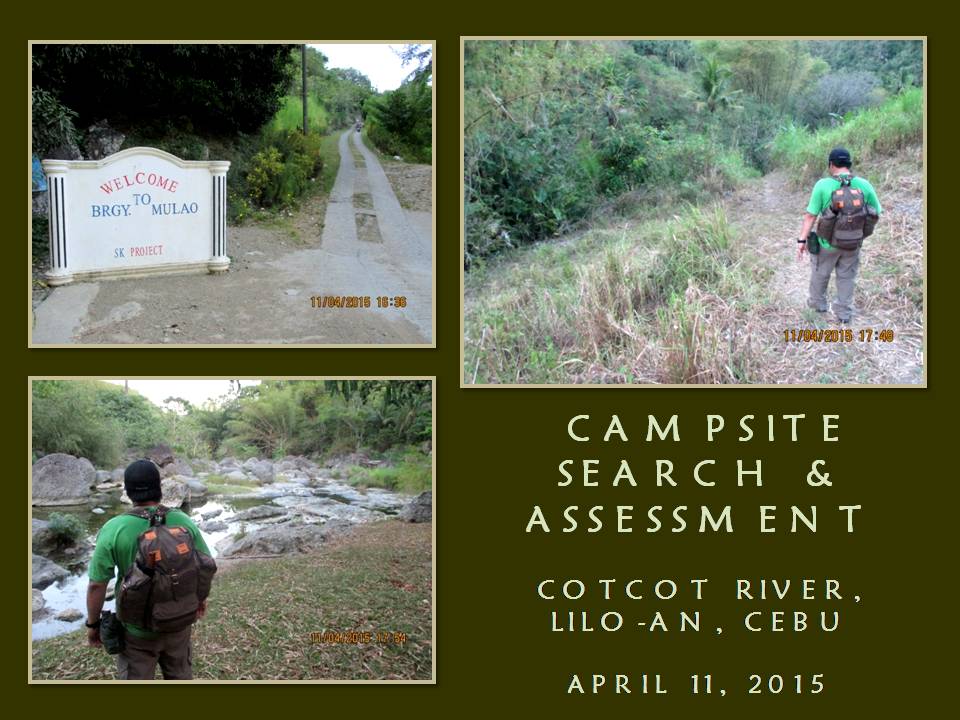
Today,
April 11, 2015, I am going to Lilo-an. Coming along is Jhurds Neo,
the President of Camp Red Bushcraft and Survival Guild.
Automatically, he will sit in the PIBC as the Camp Ramrod – that is
the camp administrator in layman’s term. We meet at Mandaue City
at 14:00 and commuted in a public utility midget AKA the Multicab.
Oh God, I hate that vehicle and I still patronize it. Oh dear!
Anyway,
we arrive at 15:15 in Lilo-an and proceed on the business of
procuring the food ingredients for our meals at the public market.
Both me and Jhurds intend to stay overnight so we will cook and eat
dinner tonight and breakfast for tomorrow. Once we have the items,
we hired two motorcycles to bring us to the trailhead. I intend to
start at the hanging bridge at the village of Mulao but my driver
dropped me at the wrong place. Jhurds followed suit.
Upon
inquiry with a local, we are a long ways off. We are at Cabadiangan
and we will have to walk to a spillway from whence Mulao will start.
If we walk fast, it would take us 90 minutes to reach the village
hall of Mulao. We start on the road which begins to ascend once we
got past the spillway. The road going to Mulao is adorned with
garbage bins colored brightly and ornamental plants lining the sides.
We
reach the village hall and register our names. We also get to pay a
visitor’s fee of ten pesos each since the village had identified
certain features of their place as tourist spots. The Cotcot River
runs along the village and this same river is the boundary between
Lilo-an and another town, Compostela. The river has huge granite
rocks and water-polished boulders choking the river and two of these
have names – Malingin and Arko’ng Bato.
We
go down a path to Cotcot River and reach our old camping site where a
lone acacia tree grow. I know there is no water source here but I
heard that there is one near Arko’ng Bato and we will have
to find it in the failing light. We reach the big boulder on a
difficult route and it is already 18:00. It is almost darkness and
shadows have claimed the banks where there are vegetation – the
likely places where a natural spring would occur.
We
are on a wide shelf of granite and we decide to set up camp there.
We have water for cooking and drinking and we will use the stream for
washing. Immediately, I forage dry driftwood which are plenty on the
other side of the bank and that means I have to jump and balance over
menacing rocks which would have been slippery and dangerous should it
were wet. Warm days made it more acceptable to rubber though.
Once
I got firewood, I return to the shelf and break the smaller ones by
hand, the bigger ones with my AJF Gahum knife. Jhurds collect four
stones of equal size and begins making a fire. I pull out my
consortium of black pots and begins to slice 250 grams pork meat,
peeled three potatoes, cut 20 green pepper, crush garlic and chop an
onion with my Mora Companion knife. I enjoyed coffee first before I
start to cook the pork adobao and boiled the potatoes. Jhurds,
meanwhile, prepared the cooking of rice.
On
an iron grille supported by the four stones, three pots are
simultaneously placed over a fire, each having its contents cooked.
We eat dinner at 20:00 under the clear starry sky with the frolic of
the stream water supplying us music of nature. It is dark but we
have small LED lights and a LuminAid solar-powered emergency
inflatable lantern to light the place. The granite below us is still
warm and this would help in our sleep later.
After
that good meal, Jhurds wash the pots downstream. I stand guard with
a light on him. It is so silent save for the swirling sounds of the
river, the hum of crickets and the calls of geckos. Once in a while,
a commercial plane would buzz overhead and pierce the harmony of the
night with its engine. I see the familiar geometry in the sky that
tell tales of mythical creatures and superhumans.
We
enjoy the ambiance of the place so much that we spent the evening
hours in conversations until it surprised us that it is already
23:00. We sleep on our respective hammocks which we use instead as
ground sheet and bedding. The shelf is so wide that it removes away
your fear of falling on the river while asleep. The smooth rock is
warm which would be very helpful when the temperature would dip low
during early dawn.
I
wake up from time to time to check on our positions in relation to
the river’s edge. We did not slide contrary to my fears. A last
quarter moon crosses overhead and paints a silvery light on the
riverscape. My brain react to the light with dread as if it is
daylight. Everything is silent except the usual natural sounds. My
fingertips are feeling the bite of the cold and I place hands on the
part of my body where it is most warm.
I
wake up when the first rays of light touched the highest mountains.
I take a leak on the other bank and came back with an armful of
firewood. My search for the natural spring is certainly not here and
could be upstream. I do not know but it is best if I prepare our
breakfast. I break two eggs and stir it briskly on a skillet after I
sprinkled salt. I slice three eggplants into thin strips and drop
all to the stirred eggs. I also peeled and sliced three potatoes.
Jhurds
start the fire where the separate pots for the potatoes and rice are
cooked. I place the skillet over the fire and begin frying the
eggplant chips with oil. We eat our breakfast at 07:00 and then we
start washing our pots. We notice a lot of dead river mudskippers
and fresh-water shrimps. The shrimps turned red and I begin to
suspect chemicals although I see traces of a poison plant pounded on
a rock. I am confused since poison plants do not turn shrimps into
red ones, a condition caused only by exposure to heat or strong
medicine.
Cotcot
River is sick and so polluted with chemicals and I see to it that my
pots are thoroughly washed with strong detergents once I got home.
The Municipality of Liloan should know about this so preventive
measures would not kill the river in the future. I believe people
fish for subsistence and wash their clothes here and exposure to
chemicals would surely cause health problems for them.
We
leave Arko’ng Bato at 08:30 going on a quest to find that
natural spring. We meet a local fisherman carrying a sack. We
inform him of the dead fishes and shrimps in the river and he showed
me a good-sized catfish and a foot-long fresh-water eel. He found
these already dead and would have brought these home as food when he
noticed our great concern. He left the catfish and eel on a rock and
I gave him our uncooked rice, eggplant and egg. Then we found the
natural spring that we had been looking since yesterday.
It
is surrounded by a spiny bamboo grove (Local name: kagingkingon),
a Malabar almond tree (magtalisay) and an elephant apple tree
(katmon). The spring gushed forth from the ground where a
bamboo trough is placed. Nearby are several natural springs which
were not used and the runoff caused a small marshy area. Across the
spring is a river pond where bathing is possible and downstream small
waterfalls and jacuzzi-like channels.
Satisfied
with our find, I taste the water and I notice it has its own distinct
taste. Could be from granite. Anyway, a good water source gives the
possibility of hosting more people for the PIBC, which I feared would
come. We walk on upstream and begin the next phase of finding a good
campsite which could accommodate many light shelters, tents or
hammocks. We found a good spot where there are several mango trees
and a few groves of spiny bamboos in the vicinity.
The
spot looks familiar. This is the same place where Aljew Frasco had
taught Notching on the rest of Camp Red last March 9, 2014 (CB 11:
A Notching class by the Riverside). Then the old hanging bridge
linking Mulao of Liloan to the Mulao of Compostela would not be far.
The same bridge that we were supposed to get dropped yesterday were
it not for my driver’s judgment error. I am bestowed with good
fortune today and I am happy that my expectations had turned out
right the way it should be.
I
know the route now to the hanging bridge but we take a shortcut
instead to farms and over a low hill to get there instead of
following the river. We reach the bridge at 10:20 and both of us
deserve rest and a bottle of cold soda drinks each. After that, we
begin another uphill walk on a road which has no trees to shade us.
It is concrete and it took us over an hour of walking to reach a road
corner where another road goes down to the same road where walked
yesterday.
Then
the “cavalry” arrived in the form of a red Toyota 2003 pickup
driven by Christopher Maru and we were “rescued”. Christopher is
Camp Red and had participated the PIBC in 2013 together with Aljew.
We reach the town center of Lilo-an before noon and take lunch at
open eateries near the municipal hall. Then I make it sure that we
will not commute by riding in a public utility midget AKA the
Multicab. Our mission is accomplished.
Document
done in LibreOffice 3.3 Writer
Posted by
PinoyApache
at
11:00
1 comments
Labels: campsite selection, Cebu, Cotcot River, exploration, Liloan, PIBC
Subscribe to:
Posts (Atom)