Showing posts with label tool-making. Show all posts

Tuesday, March 1, 2016

PHILIPPINE INDEPENDENCE BUSHCRAFT CAMP 2015

I AM THRILLED OF this year's Philippine Independence Bushcraft Camp which will happen in a few hours today, June 10, 2015, at Lilo-an, Cebu. It would be the first time that it would be held there and I had thoroughly prepared the campsite through several visits, the latest of which was just three days ago. I made it sure that the separate latrines for both men and women would be done as well as liaisons with the municipal authorities.

My Silangan Predator Z backpack is full and so is another smaller Lifeguard USA rucksack. Not only that, a plastic bag is full of PIBC t-shirts. I have with me 43 pieces for the participants and for the camp staff. The guys from Camp Red Bushcraft and Survival Guild would be giving me full support and they are excited that some member-applicants would join their ranks.

Jhurds Neo, concurrent club president and PIBC product of 2012, had worked hard alongside me for this to be a success. Slowly, he had shown leadership skills which Camp Red needed after I had passed the baton many months ago. He is the designated Camp Ramrod and he will administer and manage the campsite and he will designate people to do the tasks of night watch, gathering of water and firewood, camp safety and hygiene.


I designate JCenter Mall in Mandaue City as the assembly area and we all wait for the transport, provided free by the Municipality of Lilo-an, which arrived at 08:30, due to heavy traffic. There are 19 participants who came, out of the original 25 who registered, and they are accompanied by all the camp staff. We arrive at Lilo-an at 09:00 but the organizers sees it fit to procure food for the first and second day.

The PIBC is a three-day camp-out seminar which teaches people about primitive-living techniques and wilderness survival skills. It also is a venue for camaraderie and friendship as well as renewal of love for country and flag. This is the fifth edition of the PIBC and it is located beside the Cotcot River, which can be accessed from the remote village of Mulao. I believe the day at the camp would be humid and very warm.

We arrive at Mulao at 10:30 and we proceed immediately to the campsite after a short briefing. Four members of Camp Red composed of Fulbert Navarro (2012), Marc Lim (2013), Justin Apurado (2014) and Nelson Orozco (2014) had left earlier as advance party to install safety ropes along a difficult part of the route and to finish the privacy coverings for the two latrines. The ground showed that it had rained last night and raised the stream by a few centimeters.

We reach the campsite and everyone pitch tents and all sort of shelters on the selected area. There are mango trees to rig hammocks but majority prefer to sleep on the ground, which included me. A fire immediately comes to life to start the preparation of the noontime meal, as well as to savor warm coffee, which is very welcome for those whose throats are parched.


The camp staff are able to take their late lunch at 14:30 and it further delayed the start of the PIBC. The original schedule was at 11:00 and there would be four topics. Nevertheless, the discussions would have to start the soonest time possible, which is at 15:00, and I begin the topic about Introduction to Tropical Bushcraft. I need to make it short as possible so I could start on the next one.

This chapter tackles more on the history and origin of bushcraft. What are the likely places where this is done and what are the ideal numbers of a bushcraft activity. Aside that, this discussion disperses the notion that bushcraft is survival. Although bushcraft is associated with survival yet the activity itself is really separate from survival. While survival is immediate, bushcraft is the preparation for survival.

Ethical Bushcraft is one of the new chapters that I had included in this year's PIBC, for the simple reason that many people are now beginning to practice bushcraft. These people might adopt wrong practices learned by watching too much survival TV and searching the Internet and would not sit well with private land owners and park administrators. Besides, that Western brand of bushcraft might not please mainstream outdoorsmen and would create instead friction between us and them.

Bushcraft could be destructive if not done properly or if you have no deep knowledge about it. Bushcraft could only be learned from a teacher, if you are an urbanite, or by your long exposure in the woods. Ethical Bushcraft teaches you everything in the proper perspective, from choosing a trail to choosing your companions. In between, you are taught the rules of Blend, Adapt and Improvise which would be your guidelines in your conduct.

After this chapter, Knife Care and Safety comes next. Aljew Frasco (2013), knifemaking hobbyist and Camp Red's vice president, will do the discussions. This topic gives you more knowledge about knives and guides you in the proper care and handling of a knife. Another of Camp Red, Fulbert Navarro, assists Aljew in discussing about the only known knife in the land – Batas Pambansa Bilang 6.
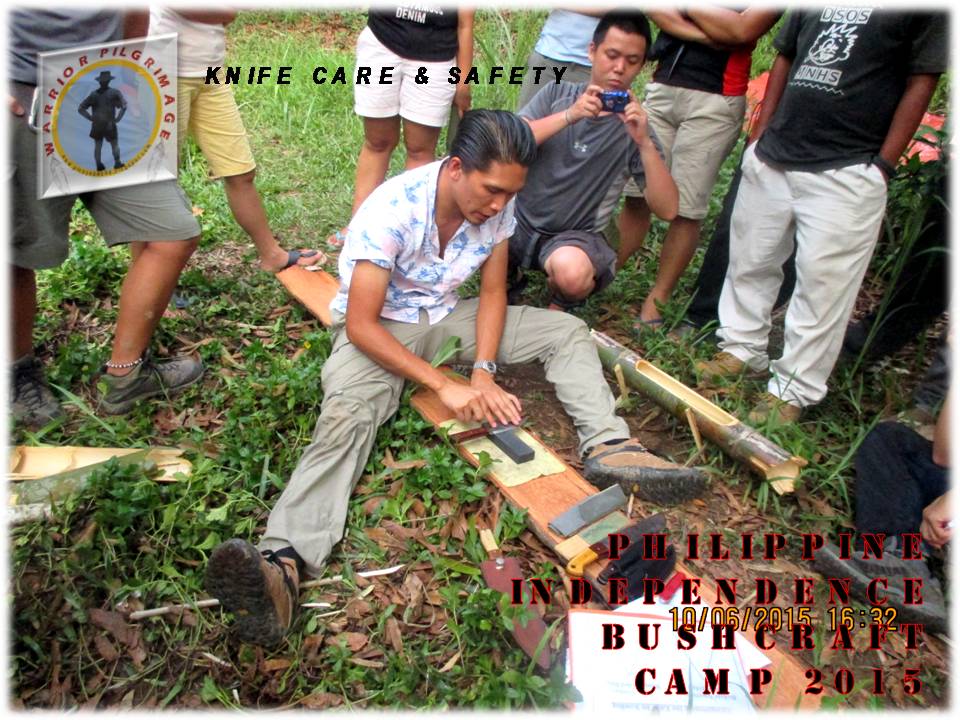

The last chapter of the first day is Survival Tool Making. By the time I finished this, it is almost dusk. The long bamboo poles which I prepared for this occasion remains untouched. It would have been used to exercise each participant's dexterity with a knife as well as applying the proper cutting techniques learned during the discussions. Anyway, I promised them that they would have that chance for tomorrow.

Day One ended at 17:30 and all participants prepare their evening meals individually or by group. For the camp staff, Nelson Orozco did the cooking for us. Ernie Salomon (2011), the official Camp Fixer, had not yet arrived and this task passed on to the shoulders of Nelson. Large pots are in short supply and we have to improvise the cooking. After the meals, the campfire is populated by staff and novices alike. Laughter competed with the rush of the stream in the night aided by strong liquid moderately taken in small amounts.

The campfire is fed by an abundance of dry bamboo, split and broken in small manageable sizes. The fire keeps on burning, long after taps time; long after the rowdy tales told by rowdy individuals had sought the comforts of their shelters. It is looked after and fed by a set of Nightwatchers, who relieved each other each hour until 05:00. I am part of this duty where I am the last to take the watch.

Day Two will see the campfire revert into a fireplace. Water will be boiled for coffee and, sooner, breakfast. After that, there will be none. Not after the participants will be successful in their hunt for food on the Cotcot River tonight. Meanwhile, the chapter on Simple Knots, Lashes and Braids will be the focus of Dominik Sepe of PIBC 2012. This would have been discussed yesterday but lack of time forced me to postpone this today, June 11.

This chapter is long and the novices would have to participate after the demo by Doms so they could understand better this craft. This chapter is a big improvement from the previous ones as it tackles more on the simplest knots, with integration of lashes and braids. This is more of a bushcraft ropework and shies away from the technical ones done by mainstream activities.


Another new topic included for PIBC 2015 is Practical Wilderness Treatments. Eli Bryn Tambiga (2012) will do the discussions. He is a volunteer for the Philippine National Red Cross and Camp Red's elected secretary. Aside this, he is the designated Camp Hawkeye – photographer in your layman's term. He comes in prepared and happily hands out free triangular clothes with Camp Red logo.

This chapter touches on open wounds where we are most vulnerable like palms, upper and lower arms and upper and lower legs; closed-wound fractures on knees and elbows; sprained ankles; and the ways to immobilize these injured parts. Part of the discussion are the most common medical emergencies where we are most likely to encounter on individuals like hypothermia, heat strokes and hypoglycemia and the ways on how to treat these patients.

After a 10-minute break, the PIBC continues on with the topic about Shelters. Finding a suitable place for a shelter, like a campsite, is a skill and there are places where it is not rational to set up shelters for the sake of security and safety. Shelters are either man-made or natural. Man-made are either synthetic materials or sourced from nature. Natural shelters are either caves, overhangs or among debris. If you know where to catch warm air rising, you would likely experience a comfortable night in a camp.

The hours drag by to early afternoon and the chapter about Firecraft comes. Everybody becomes attentive for this is the topic where most can relate what bushcraft is. I give them the idea about the four elements of a fire where, the absence of one element, would make it impossible to start one. Then I discussed about tinder, kindling and firewood and how to source it and from where. Tinder could be manufactured like the charclothe.

Then comes the three methods of making a fire which is by solar-intensity magnification, by friction and by pressurized air. We concentrate on the first and the second since these are very practical and very easy, provided you have the right tinder to pair it with. The wonders of the charclothe mesmerized the participants as the tiny sparks from a steel on flint produces embers which became a flame when transferred to a tinder bundle.

Aljew demonstrates the bow-drill method and discusses it in step-by-step method, whereby smoke, then ember, appear; then smoke thickens and then a flame burst. Four participants were able to make fire using this method. On the other hand, two participants helped each other to rub bamboo on bamboo and, after a considerable struggle, are able to produce flame.


Satisfied with the results in fire-making, I proceed on to the next, which is Foraging and Plant Identification. Foraging is required when you are in search of food or of other things that would work in your sustenance for survival. Plants make up some of it and an individual should know which are edible or not and which are toxic. I emphasized more on the dangerous plants through a compilation of pictures.

Last chapter is Outdoor Cooking but not limited to the different ways in preserving meat, vegetables, fruits and fish. Situations where cooking are done vary from campsite to trail to extreme circumstances and fireplaces might be open, semi-closed or underground. I decide to integrate the practical exercise in tool making from the two poles of bamboo which were supposed to be cut up yesterday.

Six groups of three participants each are tasked to each choose three segments (or culms) from the bamboo poles for this workout to test their dexterity in the use of a knife in carving out spoons, a drinking jug and a cooking vessel. They would have to employ the “Trailhawk System” of opening up a bamboo as a cooking pot which I demonstrate. Afterward, they are instructed to cook rice by “buyok” method, which is to boil water first.

When a group had finished their cooking, they would start their Nocturnal Hunting on the stream. They equipped themselves with LED lights, catch bins and pointed sticks. One group was able to make a catch net. For two hours of the night, Cotcot River becomes a hotbed of busy people trying to catch fish, shrimps and crabs. Most returned empty-handed but, nevertheless, they are entitled to a good meal, with or without a catch.

Joining us is Ernie Salomon and Mayo Leo Carrillo (2012) and they brought more ammo – brandy and food – to augment our diminishing supply. The second night then is as vicious as was the first with yarns and laughter echoing in the night. I did not last midnight and I found myself surrendering to the comforts of a crude but cool bedding. I turned in and I miss the company of rowdy storytellers.


I wake up the next day, June 12, to the smell of coffee. This is Day Three. Time to distribute the PIBC t-shirts to the novices and the camp staff. I also include small Camp Red stickers. Glad to see smiles on everyone and this is not yet the surprise we prepared for them. Ernie begins to make his presence felt on the fireplace and brunch is called. In a little while, the Philippine flag will be raised.

The flag, originally came into my possession during Freedom Climb 2010, had been used in PIBC during 2011, 2013 and 2014. Today, it bathed again in the warm sunshine and danced with the breeze. I would not want it done in any other way but raise it up in a camp like our forefathers did during resistance against the Spanish, the Americans and the Japanese. That way, patriotism is raised to a higher level.

Everyone assembles on a clearing and begins to sing the Philippine National Anthem – the Lupang Hinirang, to the gist of a novice's hands. After that, everybody recites the Oath of Allegiance – the Panatang Makabayan. Everybody shook hands and greeted each other Happy Independence Day and photo socials erupt. Then the Blade Porn gets its turn. Arrayed on two coconut planks, the blades gets their “15 minutes of fame”.

We break camp and leave at 10:00, going by way another route towards the hanging bridge that linked the village of Mulao of Liloan to another village of the same name belonging to the municipality of Compostela. After an hour of walking we reach the place where the bus, used as our transport of two days ago, would pick us up. It came at the appointed time of 13:00 and we occupy all the open spaces inside.


We reach Barroful's Seaside Resort to enjoy the cool breeze that was wanting in our very humid camp. The guys stretched their aching muscles or be just still on a proper chair. The bottles of half-full Jagermeister and Jack Daniels are buttressed by four more full bottles of Matador brandy and its mix of lime juice. It is going to be a long day and there is excitement as the giveaways are displayed on the table.

These are 19 survival-paracord bracelets and two Zebra 12cm stainless-steel pots provided by Mayo Leo Carrillo; three emergency disposable stoves by Eli Bryn Tambiga; a Julio Herretz machete and a Seseblade sinalung by Jhurds Neo; two LED lights and a Silangan dry-fit tshirt by Aaron and Ann Jillian Binoya; another sinalung from me; and three woodlore knives and three utility knives courtesy of The Knifemaker of Mandaue City, Cebu.

The nineteen participants are Christopher Ngosiok, Locel Navarro, Angel Luz Villaganas, couple Mark and Mirasol Lepon, Nelson Tan, Fritz Jay Hortelano, Leomel Pino, Fritz Bustamante, Niño Paul Beriales, Anthony Yalong, Bim Sauco, Rommel Mesias, Jonathaniel Apurado, Rubi Valdez, Carlo Magno Rejuso, Diocyl Hinay, Lord Benjamin Belga Jr. and Richie Quijano. All are fortunate to bring home something aside from the certificate of participation for the 3-day Basic Course on Tropical Bushcraft and Survival.

Not only that, the Blanket Trading, presided by Glenn Pestaño (2011), would increase each participant's knowledge about this activity and, likewise, would add or exchange what they had with one or several ones that they wished to acquire through a healthy barter of goods done the old way. I watch from the sidelines and I am glad that the PIBC have now reached this level through the five years it existed and is now an institution in itself.

I greatly appreciate that my efforts to teach woodcraft had been recognized by the present leadership of the Camp Red Bushcraft and Survival Guild, led by Jhurds and Aljew Frasco, by giving me a Certificate of Appreciation with a token of a wooden trophy with a mother-of-pearl Native American and a miniature-but-working pipe tomahawk. Ditto with Ernie Salomon, who received the same certificate and a small O-Light LED light for providing fit-for-a-king meals through the years to everyone.

A special prize, provided for by Pardy Bugtai of PABU Knives, are a genuine Cold Steel Pendelton bushcraft knife and another genuine Tom Brown Tracker knife. The Pendleton would be up-for-grabs to the participants and Anthony Yalong of Manila had snared it after a coin toss. Jhurds, on the other hand, got the Tracker fair and square after three down-the-wire tries with three other camp staff.


The PIBC had equipped the participants, previous and present, skills which improved their outdoor skills and, not only that, they now have the edge when things go wrong. They would be natural leaders in a community of survivors should disasters overwhelm places where they reside or visit. Learning of bushcraft skills in a proper avenue are rare here in the Philippines but the PIBC addressed that and the PIBC ensures that you do not give an arm and a leg to participate in it. It is available to all and is not exclusive. Since it is non-commercial, it is done once a year and participation is limited.

I have given the thought that I will relinquish the convening of the PIBC to the guild of Camp Red. I believe they are now capable of handling the PIBC for I have seen how their skills and their capabilities improved over the years. I have nurtured skillful men who can stand proudly on their own and the next year's PIBC – the sixth edition – would be their “crossing of the Tiber”. I am proud of my Camp Red.

I believe also that it is time for me to expand my horizon and teach bushcraft and survival in other places as a journeyman. I have reached a threshold where these rare skills would now be used as a source of income. I have come to the point of leaving the corporate world and come out into the real world of pursuing livelihood this way. I have made a mark on the local outdoors scene where none had been before and I have more things to do.


Document done in LibreOffice 4.3 Writer

Monday, January 18, 2016

NAPO TO BABAG TALES LCV: Unconventionals

I ALWAYS IGNORE THIS trail whenever I do a reverse of the No-Santol-Tree Trail. I find it unnecessary to go over a peak in order to go down and climb another one. Why make life difficult? Common sense always win over me. On the other hand, this particular trail was not here when I embarked on an exploration frenzy around the Babag Mountain Range in the years 2008 to 2011. I just noticed this in 2012.

Anyway, I promised my adherents at the Camp Red Bushcraft and Survival Guild today, May 10, 2015, that we would be doing some little explorations in the hills between Kalunasan and Sapangdaku. I have not even thought of this trail when we begin from the trailhead at the Kalunasan Road. We are fourteen people – all men – and it is a very warm day. It is already 08:30 and not a very good hour to start.


I stare at this trail and I begin to get interested. I would have to drag my feet though to make life comfortable for those who are not used to walking rugged terrain or the lack of it. Behind me are Camp Red regulars Jhurds Neo, Ernie Salomon, Jerome Tibon, Dominik Sepe, Eli Tambiga, Mayo Leo Carrillo, Nelson Orozco, Justin Apurado, Bogs Belga, Mark Lepon, Jonathan Apurado and Nelson Tan. A mix of the serious, the amusing and the outrageous.

Most are in their best earth-toned clothes and bags and we looked more like spec-ops guys instead of colorful gadflies. Gadflies? Well, we see them from time to time usually on the parking lot of Guadalupe church or in our favorite dirt-time place and you would not know if there are males among them. Well, today, I do not expect to meet any of them, much more so on this trail in the heat of the day.

I look up the trail and I barely see green. The trees and thickets have wilted and are opaque brown and in different shades of it. Worse, the hillsides are scorched by grass fires of a few days old! So on we walk with sparse shade on a ground that is loose and dusty. I forced myself to move like a snail. The strongest walkers are impatient behind me but we are not in a race. We are in a humanitarian hike. It is humanitarian to be kind to the slowest walkers, is it not?

We reach a point where there are two tamarind trees. It could barely give a shade. The NST Trail branch from here while this trail that I am planning to explore is on another branch. Right now it is beckoning me up. I clear the path of dry wood and other debris. I do not want an accident. People tend to overlook a lot of things when they are subject to fatigue and heat which they could have noticed when under good conditions.


I have not carried a big knife although I open carried a smaller knife but it is of no use against dry wood. You simply cannot hack and slash with it. With both hands, I drag the wood one by one, moving it on the side of the trail. It is difficult because these are dried branches that have tangled against each other and I have to use considerable strength which I am supposed to be conserving.

Being generous of your energy in a harsh condition like today would drain you faster than you could recoup it. The secret thing here is you do not overexert. The dust rise as I drag the dry wood to the side while maintaining good balance on a steep terrain made difficult with loose topsoil. Good thing I have covered my head with a “krama”, a checkered clothe popular in Cambodia which Jonathan had given me a week ago. I looked like a fierce follower of Pol Pot of the Khmer Rogue.

We pass by a couple of tamarind trees that had been cut down a few weeks ago. I still could not comprehend why some people cut down fruit trees that had given them an income for some time? I remembered the 51 sacks stacked higher than a standing man along the road that we passed by an hour ago. I let go a sigh of frustration and stare heavenward. Up ahead is a lone whitelead tree (Local name: biyateles) surviving a grass fire. One half of its foliage is green while the rest are scorched.

I reach the top and it is shady. It is 09:30 according to my Guess watch. Wow, I cannot believe it took me one hour to reach this place which is just about 300 meters in length! I am indeed humanitarian. The place is a ridge with another ridge going southeast. I notice an orange paint sprayed on a trunk of mango. So, this had been used as a race route. Anyway, this is a good route for runners but just be careful going downhill.


I waited for the rest and I am sure where I would go next. Up ahead is the steel hulk of a transmission tower looming above the trees like an alien machine and the trail goes there. The guys take a rest and begins their conversations. I ventured alone to that other ridge to have a look. It goes downward to a series of lower hills where, I believed, there is a community. I go back where the rest are and proceed to the tower.

The ridge is planted with mango trees and I see traces of chemical-spraying activities here: orange-colored rubber hoses, blue PVC water barrels, small water pumps hidden under tarpaulin, paper with Arabic literature, ropes, bamboo ladders and empty pouches for chemical compounds. Over the side are plots of roses, another plant that people shower with generous amounts of chemical. Ferns thrived under them mangoes while algae are growing fat on their branches and barks.

I go down a saddle where the steel tower is located and go up to the rest of the ridge. Immediately, I see the route where I had taken my team last January that led me to a cul-de-sac filled with a forest of roses. It was some mistake which I do not want to repeat. We go up where there is a farm shed and shady trees and then I heard water.

I begin to look around and I see water pouring out of a black PVC pipe into a big hole filled with clear water. It is clean. There are small fish (gurame) swimming in it and some golden Japanese snails (kuhol). I wonder where the water came from because it flows very briskly in this mild El Niño. I look again at my watch and it is now 09:45. I decide to make our “dirt-time” here. The place could accommodate us all and a different place would induce good conversations and plans.

So we find places for our backpacks and begins to disembowel it of our pots, knives, tools and the food ingredients which we will prepare and cook here. We gather dry firewood and tinder as we set up our fireplace. It was quick. Fire begins to appear. Water are plenty. We could use it generously in our cooking but there should be coffee first. Even on a very hot day, warm coffee is very welcome.


I see another hole where water flows from a green rubber hose. Water is cloudy and is not of good quality like the first. Jonathan and Justin set up hammocks near this hole. Bogs and Eli cut the meat, onions, potatoes, cucumbers, green pepper and a vegetable pear with a Mora and an antler-handled knife made from Sheffield. The second knife is a gift given by Alan Poole of the United Kingdom to me. This is the moment where it will be tested.

Ernie concentrates on the fireplace while Mayo, Mark, Nelson and another Nelson assisted him. Jhurds secretly pour cold Pepsi in a cup while Dom and Jerome secretly are in a middle of a personal discussion. When all these guys are not doing something, they swap places and strike conversations with anybody. It is a healthy atmosphere and I am amongst them taking photos or testing equipment like my new knife and a Suuntu MC-2 Mirror Compass given by the same donor.

I found this place a very great campsite for a “Survival Day” activity – if ever its water source is working all the time – and there are bamboo groves nearby. Although quite shady, it is not a good idea to make camp at the top of a hill because it is exposed to winds and you get easily skylined. Instead, you would have to set up shelter down a saddle where there are mango trees because bushcraft is about blending with the landscape.

By now, the food had been cooked. As always, another kingly banquet for hungry bushmen. After a prayer, the boodle-fight starts. Open for decimation are grilled pork sliced in bite sizes; “pancit” - a popular noodle meal; steamed potatoes; rice; and a side dish of raw cucumber dipped in spiced vinegar. Many trips to the food had found me full and the dining place a puzzle of blank spaces.

There were some food left and a kilo of uncooked rice which we left to the farmer's wife who unexpectedly came while in the last parts of our lunch. Then we begin to clean the dishes and pots and pack all the things into our respective bags. The journey continues. We go down the hill into copse of mangoes where the trail wind among it and crossing other trails. I post familiar places but my adventure juices prefer the unfamiliar ones.


I take a route going south and east and south and west, passing by a long narrow ridge, then standing below another steel pylon. I end up on a flower farm and a farmer shows me a way to the rest of the path. It curves into another ridge that goes down into a dry waterway and a small marshy area thick with birds of paradise. The route goes down once more into a stream, which I later understand as the Sapangdaku Creek. We cross the stream and come unto a small flat valley.

We all take a rest here since it still 14:00 and very shady. Jhurds introduce me to a woman living in a single-room house with a small child. She carries a surname Labrador and I remembered her at the Roble homestead last December where we had an outreach. His husband is away but I could not dismiss the good location of this place. It could host a good number of people as it is not a fragile environment and can be used as a bushcraft camp.

The place is called Kangsi. It is nearby a stream and a natural spring. A small rainforest is across it with groves of bamboo and is perfect for a plant ID lecture. The Napo Main Trail is just above us and this makes it friendly for bulky people and senior citizens. I walk to the water source and fill my bottle. When I got back Mayo is doing something with a discarded but still green bamboo pole while the rest are hitting a target with their catapults. I lend mine to make it five.

Jhurds is carving a bamboo to make sheath for a local boy who carried a knife with a flimsy cardboard one. He secured two pieces of bamboo with packaging tape and gave a piece of his paracord to tie the sheath with knife to the boy's waist, eliciting a thankful smile from the boy. Meanwhile, Mayo made bow limbs and another shorter piece to support the longer one. He is making a Penobscot bow. This type provides good power for an arrow if used with ordinary wood, in this case, bamboo.


For almost a good two hours we made the place into another playground but it would not be our last here. For sure, we will be coming back. I like the place and I would like to spend a night here sometime. We leave for Napo at 15:45, following a route that goes downstream. This is a difficult route because it passes by water and it causes rocks to be slippery. Besides, I never like to walk along streams.

Ultimately, we reach Napo and made a mad dash for Red Hours, our favorite water hole. It was a good day. Our little exploration snared us to two good places that make our patented dirt-time as good as those we spend most often. It was a good time also to prepare the rough cuts extra sharp for the Philippine Independence Bushcraft Camp this June.


Document done in LibreOffice 4.3 Writer

Thursday, January 23, 2014

COMPLEAT BUSHCRAFT VI: Digging Holes

THE OUTLAW BUSHCRAFT GATHERING is fast approaching and there are many things to do with so little time and, for that, I am quite worried because I am part of the organizing. This gathering is really a convention of a small group of unconventional outdoorsmen who will show and demonstrate their crafts with each other and before other individuals who are beginning to be fascinated with what really bushcraft and survival is all about?  

I am on an urgent mode and I will go to Sibonga today, August 18, 2013, to do these things in a blur and one of these is digging two latrine holes for the participants of The Gathering.  A hole is easy to make with pick and shovel or with an iron rod but I have to walk the talk and, that is, to do that task with a digging stick.  Yes, I will do that in the most traditional way possible using wood.  


As you can see, I have taught people how to make digging sticks during the three years that I convened the annual Philippine Independence Bushcraft Camp and I will prove why a wooden stick could do that task equally well as opposed to the conventional notion of using modern tools.  A stout stick will then have to be secured on the area and it will mean that I will have to chop a live tree.  What will make it harder is that one of my hands is hurting.   

I hurt it yesterday after a pistol jammed several times due to oversized brass shells on a number of ammunition and I have to extract it in the safest and most professional way possible.  This happened at a firing range somewhere in Metro Cebu while assisting in the Basic Gun Safety and Firearms Proficiency Training of ten security personnel from Sky Rise 1 and Sky Rise 2.

My hand is swelling between thumb and forefinger and I need something to remedy this quickly.  Of course, I drank lots of water that day to keep me hydrated and get the blood circulating.  My problem then that day is how to protect the part of the hand from getting disturbed when I carry on the work of digging holes today?  That answer had already been a part of the solution from the start: Cotton gloves.  

Yes, of course, I was already mulling the thought of buying a pair of hand gloves before I touched a gun that day.  It just clicked through right away and I immediately bought two pairs after I saw the swelling and while there was still light that day before hardware stores close shop.  That done, I made myself ready for the undertaking of today. 

I wake up early to the designated area at Guadalupe and I see Ernie Salomon already ahead of me.  Later, Ramon Corro arrive on his blue Ford Ranger.  Ramon will be using the truck to get us to the campsite of the scheduled Gathering, which would be held soon on the last week of August.  We leave at 6:45 AM for Natalio Bacalso Avenue then head south.

At Pardo, we pick up Wil Rhys-Davies, my business partner at Snakehawk Wilderness School and the other organizer of The Gathering.  After him, we pass by Glenn Pestaño who had been waiting at Bulacao with his equipment.  Glenn is also part of the organizing and he is instrumental in doing the negotiations with the owner of the property where The Gathering will be, the tourism department of the Municipality of Sibonga, the village of Sayaw and the local police.


When we reach Candaguit in Sibonga, we negotiate the road to Mangyan thence to Sayaw.  It is uphill and some short stretches of it are steep.  We pass by a small waterfall just beside a road and the source to it just after a bend of the road.  Amidst that, a small farm of terraced rice plots get irrigated by the natural spring.

We arrive at Lower Sayaw at 9:30 AM and we proceed on foot to the house of Rufino Ramos.  Rufino is the owner of the lot for The Gathering and I have met him a couple of times in April and last July.  Today, he is nowhere but his wife is there as well as the rest of his family.  I come bearing books for the children and how they are glad to have books to keep and read in their home!  I promised them I will bring some more.

We boil water for coffee and, after that, I tour Ramon and Ernie to the camp site.  It is on top of a low hill with mango, jackfruit and coconut trees on to one side where it is part of a meadow and a steep sloping brushland off the other.  In between are several rock cairns arranged for future use.  We go down the hill and survey the place below where there is a dry brook.

Wil and I survey this place for a possible place to erect our latrines.  I found a spot for the males where there are guava bushes of shoulder height and another spot across a dry watercourse behind a grove of spiny bamboo for the females.  That taken, I looked for a stout pole among a sparse forest of mixed vegetation.  

Well, there may be a lot of straight live poles good enough for the taking but I will choose wisely.  I need a healthy one and it better be an exotic kind.  No need to ruin the growth of young trees just because I need one or two poles.  Sometimes you had to have a certain level of common sense to distinguish what needs to use and what not and that is where plant identification becomes a factor.  Without that, you either are just another wood gatherer or an LNT lunatic.

By the way, I will be leading a discovery hike in and around The Gathering on the second day and I will be discussing Plant ID while on the move.  We return to the house and prepare our noon meal.  Glenn had been on an errand to find Rufino and to look for two free-rein chicken and had not yet returned.

When the promised chicken had not materialized as of 11:00 AM, Ernie and Ramon, together with Rufino’s wife, sourced canned meat and eggs from a small store in the locality.  In a while both returned and Ernie prepare the ingredients which we had bought from a roadside market a couple of hours ago in Ocaña, Carcar plus the canned meat and eggs.


When the food is about to be served, Glenn arrive with two gallons of fresh coconut wine still in its bubbly splendor!  Just about time and the wine is so sweet when I tasted it.  The food are mixed-vegetable soup, meatloaf in eggs, raw cucumber and milled corn.  The weather is great and cloudy and we eat to our heart’s delight.

When the last of the food were consumed, everyone gets to drink the native wine except Ernie.  He says he have had bad memories of it.  Wil enjoyed the strong liquid and gets high with his tales.  I suggest to all that we return to the site where the latrine holes will be dug.  I carry my locally-made Puffin Magnum knife in a belt sheath and my William Rodgers bushcraft knife, also inside its sheath, and stuck to the same belt.      

Without much further ado, I chop a thick pole from a white leadtree (Local name: ipil-ipil, biyatelis) using my Puffin Magnum knife.  Like it or not, this is an invasive species and it grows fast to the detriment of indigenous plants.  It had adapted well with our terrain and clime and it has its good uses as well.  For the locals, it is just another fodder for their cooking fire so no bleeding hearts there you LNT metrosexuals.

It is an erect pole whose straightness was caused by its proximity with tall trees. Likewise, its primary branch is straight as well.  With that I could make three poles and tie it all together at one end and it will stand erect to provide a stable tripod for those who would want to use the latrine after you have lashed a horizontal “seat” right across it.  But, first things first, I need the bottom part of a pole as my digging stick.

When the upper trunk fell, I drag it from the streambed into the upper bank.  It is heavy but my grip is good and my hands are well protected by my gloves.  I cut off the foliage and then proceed to divide the pole at three parts with the bottom part getting my approval as my crude tool.  I then chop off the bottom end slantingly along two faces making it look like a giant flathead screwdriver. 

The weight of the pole is heavy as it is 6 feet and 4 inches high and 2.5 to 3 inches thick.  With that, I have a digging stick that could do more work than a pointed iron rod or a combination of pick and shovel.  It pierces the earth deep and breaks it out with very good leverage, the flat chisel tip doing the work of a shovel.  

Ramon offered to test his made-in-China folding-shovel-and-spike combo to clean the hole of soil after digging it with the pole but it broke in two pieces instead.  Ernie did the cleaning of the hole and I provide him with a coconut shell after that and it did the job well that the iron shovel failed to do.  The hole is eight inches deep, six inches wide and three feet long.

After I finished the “men’s room”, I proceed to the other side and start the earth-breaking work for the “ladies' room”.  We discussed about the contrasting ergonomics that a lady would prefer should they use an outdoors latrine and it would be quite awkward and too “violent” to force them to try one that men can only adopt in our very shameful fashion.  


So it came to be that I found an abandoned millstone with a hole in the center.  The millstone would then become the “seat” provided that I enlarge the hole and gouge a trough on the surface from hole to outer rim with a pointed iron rod.  Quite perfect indeed and the latrine hole is of the same dimension as that of the previous one.  All it needs now are four poles as posts and a sheet of cheap tarpaulin to hide the ladies.

For all these efforts of cutting poles with a knife, dragging and carrying the poles over one shoulder on a steep trail and using one heavy pole to break up the ground, I begin to feel young again as all my bone joints, muscles and ligaments are put to good use.  It is better than exercising inside a gym doing the monotonous regimen, inhaling the same stale air over and over again, even inhaling the not-so-nice elements that comes with it.  

Here, at the outdoors, the air is always fresh with a good dose of sunshine and heat to make you sweat a lot.  Then you get to use a lot of logic and observation skills while working with your hands.  You will feel freedom as you have never felt before and a lot of self-gratification comes forth from the things you do which you thought you do not have the time, the strength and the skill.

Primitive-living skills, especially those practiced by the Camp Red Bushcraft and Survival Guild, are not for the faint-hearted.  It is labor intensive, making good use of the muscles and bones for strength and power as well as the brains for wit and cunning like the ones I  just did.  Adding to that, is the pride and confidence to use that skill and our tools, especially the blades, to everyone’s advantage after a good dose of improvisation and adaptation.

If you want to call yourself a man and a woman with a streak of strong independence, be at The Gathering, at the PIBC or with Camp Red and learn bushcraft and survival from the masters.  If you want to increase your chances of survival in a SHTF situation, you have come to the right place.  Be that and be all you can be.


Document done in LibreOffice 3.3 Writer