Friday, March 11, 2016

ALLIANCE MATTERS VI: BMC 2015

THE SUCCESS OF THE Philippine Independence Bushcraft Camp, which had just ended yesterday, had left me in a stupor and quite tired but, by all means, I have to honor a commitment. Today, June 13, 2015, the Cebu chapter of the Mountain Climbers Alliance of the Philippines, with support from the Visayan Trekkers Forum, would give another Basic Mountaineering Course for the new set of individuals who are lured to the wonders of the mountains.

This local version of the MCAP's BMC, is the brainchild of Barry Paracuelles, who saw it a need to educate people about outdoor ethics, the technical aspect of mountaineering and pure common sense. This would be the second time that Barry is organizing this. Last year it was held in Sibonga, Cebu and, this year, it will be located at the Boy Scout Camp in Kalunasan, Cebu City. Just like last year, I would be one of the resource persons.
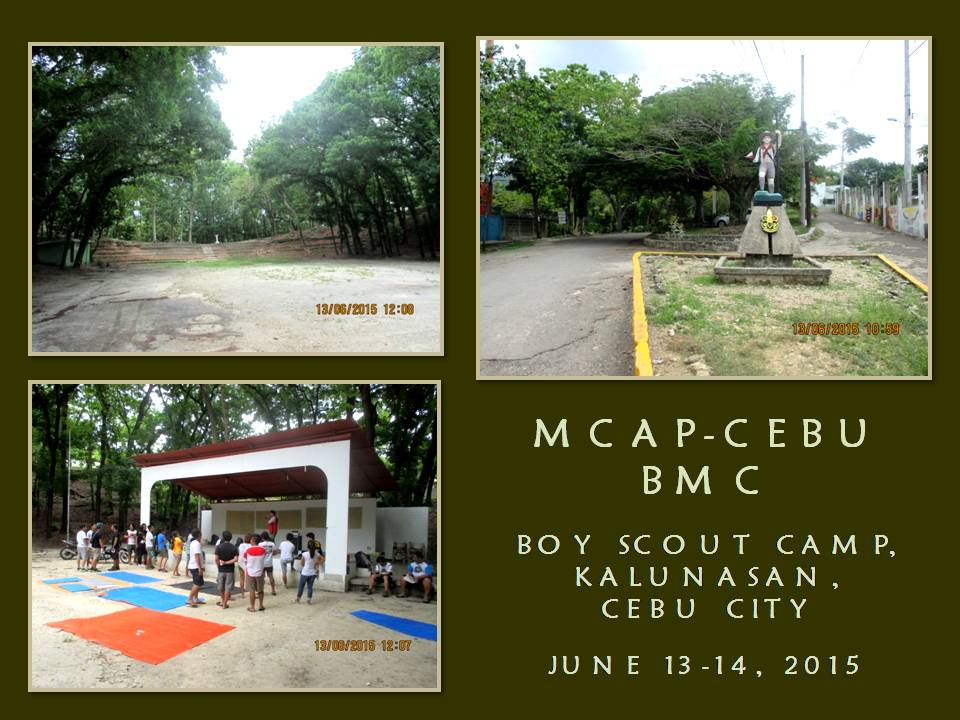

I shrug off my lethargy and commute to the site. I had not awaken earlier as I had planned but I willed myself to be there. It is almost 11:00 when I arrive and the participants are busy drawing up their test itinerary on pieces of Manila paper with black markers. Barry had chosen the amphitheater area for the seminar and there is a stage where each of the three groups are instructed to explain to everybody.

After lunch, Barry continued with his discussion. He provided a sound system for the microphone; and a laptop and a projector for visual learning. After about 30 minutes, I am next. My topic would be about the Survival Kit; Water; and Cold Weather Survival. These were the same topics that I had talked about last year and I am excited to impart my knowledge to this new batch of participants.

The Survival Kit is a very important piece of personal equipment that may be useful with its owner and to those who are with him/her. Although the absence of it is not life-threatening but its presence will somewhat give you some peace of mind. The kit does not necessarily be contained in a single container and, in fact, consists of several sub-kits like the First Aid Kit, Replenishment Pouch, the Repair Kit and the Survival Knife.

The kit is nothing but a replication of your regular equipment but quite small so it could fit inside a small container. There is the extra LED light and some extra batteries; an extra whistle; an extra lighter or an extra set of matchsticks; an extra paracord; an extra knife; an extra of everything. Remember this – redundancy is security; and it is not difficult to assemble this. Then you place in an emergency power bank to give life to your mobile phone, a camera, a GPS or gadgets.


The First Aid Kit is the most important component of your survival kit. It should contain medicine for ordinary ailments, betadine solution, isopropyl alcohol, cotton balls, gauze bandage and surgical tapes. I used my IFAK as a demonstration tool for it contains, aside from the mentioned items above, a host of other things which could be very useful during emergencies like a tourniquet, a triangular clothe, an emergency blanket, rubber gloves, trauma shears and a generous roll of surgical tape.

The Replenishment Pouch contains your extra cache of nourishment that you may need when you ran out of regular food which you had budgeted for a trip. It may be high-nutrition food or an MRE pack with a sprinkling of coffee, chocolate and powdered juice or milk. During emergencies, when your itinerary extends to a day or two, this particular sub-kit would come in very handy.

The Repair Kit may not be important but it is a good option if you have one. Its most important attribute is that you can do repairs on the field. A packaging tape with you could do almost all things like patching up a torn tent, saving a sole from separating from the shoe, covering a wound bandage and wrapping a splint. A needle-and-thread set, an epoxy tube and some safety pins would make you appreciate this sub-kit.

The Survival Knife, if you wish to incorporate it as one of your equipment, does not have to be expensive or with a complicated design. It does not have to be very heavy but it should be sturdy enough to handle rugged work. A locally-made knife of about five to six inches in blade length is enough since these kind of knives are very efficient in a tropical setting. Make sure that your knife is encased inside a sturdy sheath like hard plastic, PVC, wood or thick leather.

If you insist to buy imported brands, choose the Mora knives of Sweden. These are efficient and easier to maintain and I have seen it personally how it performed for I own one myself. Another imported knife that you should consider is the Swiss Army Knife, preferably the ones with new design because the blade is longer and choose also which has a folding saw. The saw design of the SAKs are superior in performance compared to other multi-tool brands.


After this, I proceed on to the topic of Water. Water, as we know it, are often taken for granted in the tropics yet it is a source of conflict in other places. We have an abundance of it even during drought. This topic teaches the participants the wisdom of constant rehydration and constant refill of water bottles when an opportunity presents. It also teaches them where to find the safest water and, when its potability is suspect, how to process these.

My last talk is Cold Weather Survival. These are the physical mechanisms that slowly wick away body heat and, without our knowing, would leave us colder than we were and would lead to hypothermia or shock. In highly-elevated areas, this is deadly. These are Respiration, Conduction, Convection, Evaporation and Radiation. Thankfully, there are methods to counter these like insulation, layering, covering up of vulnerable areas and constant awareness of physical exertions to keep respiration and perspiration under control.

Barry takes over from where I left and pursues his discussion about the types of backpacks and tents and loading techniques. Neil Mabini of VTF proceeds to discuss his which touches about Knots and Knot-tying. Later, he rigs a single rope on a high branch of a tree and demonstrates Single Rope Technique with the use of prussik knots. A few bold participants decides to go up and down a 7.5 mm rope.

I decide to pitch my Silangan hammock between two mahogany trunks when it begins to rain. Rain is a rare occurrence nowadays due to the onset of a mild El Niño weather. Rain are supposed to be felt at this time of year in great abundance. Nevertheless, I am able to rig my Apexus fly sheet over my hammock and tied its ends from wooden pegs which I sourced from a low branch of an arbor tree before the rain came.

Although the Boy Scout Camp is abundant of trees, you would not see a low-hanging branch because it is harvested by outsiders for firewood. The arbor tree's branch is not really that low and I have to jump high to reach its nearest part. It was done through quick thinking instigated by a backdrop of a few minutes of daylight left and by the possibility of oncoming rain.

After the day, dinner is prepared by all. Next comes the socials. Lively talks and jokes spurred on by Chad Bacolod made the company I am with very alive supplied by almost endless rounds of strong drinks which, altogether, raise the crescendo of laughter. It is near midnight when I burrow into my cocoon for the night. The night is cool and I feel nostalgia.

Some forty years ago, I came here for an overnight camp as part of a contingent of boy scouts from the Colegio de San Jose-Recoletos (now USJ-R). It was at these same grounds that I helped pitch a tent assigned to me and two others. The tent was made of Army canvass. We set it up in A-type fashion. Draft would pass thru between canvass edge and ground and I remember waking up with part of my head protruding from this gap. It is just pleasant to reminisce this.

I wake up the next day, June 14, at almost 09:00. Oh God, I am tired. I have been tired already by three days of teaching bushcraft to another set of people in Lilo-an, Cebu and now another two days for the BMC. One participant, Fritz Jay Hortelano, attended both outdoor seminars and, I can say, he is now a complete and responsible outdoorsman. His knowledge gained from both camps would sit him well among peers.

Neil, together with the other participants are on the other side of the camp for an abseil session. Those who stayed prepare the meals. When the rest arrived, brunch is served. I take two refills. Then the BMC certificates are distributed to the participants. In appreciation, they gift Barry, Neil and me a brand new Nalgene bottle each. After the photo sessions, the seminar concludes.

The BMC will be offered free for as long as there are dedicated people like Barry, Neil and Chad. Taking this seminar would make a big difference on the individual and on the environment where he/she will choose to visit. The more responsible people visiting the mountains, the more vibrant will the mountaineering community be.


Document done in LibreOffice 4.3 Writer


Tuesday, March 1, 2016

PHILIPPINE INDEPENDENCE BUSHCRAFT CAMP 2015

I AM THRILLED OF this year's Philippine Independence Bushcraft Camp which will happen in a few hours today, June 10, 2015, at Lilo-an, Cebu. It would be the first time that it would be held there and I had thoroughly prepared the campsite through several visits, the latest of which was just three days ago. I made it sure that the separate latrines for both men and women would be done as well as liaisons with the municipal authorities.

My Silangan Predator Z backpack is full and so is another smaller Lifeguard USA rucksack. Not only that, a plastic bag is full of PIBC t-shirts. I have with me 43 pieces for the participants and for the camp staff. The guys from Camp Red Bushcraft and Survival Guild would be giving me full support and they are excited that some member-applicants would join their ranks.

Jhurds Neo, concurrent club president and PIBC product of 2012, had worked hard alongside me for this to be a success. Slowly, he had shown leadership skills which Camp Red needed after I had passed the baton many months ago. He is the designated Camp Ramrod and he will administer and manage the campsite and he will designate people to do the tasks of night watch, gathering of water and firewood, camp safety and hygiene.


I designate JCenter Mall in Mandaue City as the assembly area and we all wait for the transport, provided free by the Municipality of Lilo-an, which arrived at 08:30, due to heavy traffic. There are 19 participants who came, out of the original 25 who registered, and they are accompanied by all the camp staff. We arrive at Lilo-an at 09:00 but the organizers sees it fit to procure food for the first and second day.

The PIBC is a three-day camp-out seminar which teaches people about primitive-living techniques and wilderness survival skills. It also is a venue for camaraderie and friendship as well as renewal of love for country and flag. This is the fifth edition of the PIBC and it is located beside the Cotcot River, which can be accessed from the remote village of Mulao. I believe the day at the camp would be humid and very warm.

We arrive at Mulao at 10:30 and we proceed immediately to the campsite after a short briefing. Four members of Camp Red composed of Fulbert Navarro (2012), Marc Lim (2013), Justin Apurado (2014) and Nelson Orozco (2014) had left earlier as advance party to install safety ropes along a difficult part of the route and to finish the privacy coverings for the two latrines. The ground showed that it had rained last night and raised the stream by a few centimeters.

We reach the campsite and everyone pitch tents and all sort of shelters on the selected area. There are mango trees to rig hammocks but majority prefer to sleep on the ground, which included me. A fire immediately comes to life to start the preparation of the noontime meal, as well as to savor warm coffee, which is very welcome for those whose throats are parched.


The camp staff are able to take their late lunch at 14:30 and it further delayed the start of the PIBC. The original schedule was at 11:00 and there would be four topics. Nevertheless, the discussions would have to start the soonest time possible, which is at 15:00, and I begin the topic about Introduction to Tropical Bushcraft. I need to make it short as possible so I could start on the next one.

This chapter tackles more on the history and origin of bushcraft. What are the likely places where this is done and what are the ideal numbers of a bushcraft activity. Aside that, this discussion disperses the notion that bushcraft is survival. Although bushcraft is associated with survival yet the activity itself is really separate from survival. While survival is immediate, bushcraft is the preparation for survival.

Ethical Bushcraft is one of the new chapters that I had included in this year's PIBC, for the simple reason that many people are now beginning to practice bushcraft. These people might adopt wrong practices learned by watching too much survival TV and searching the Internet and would not sit well with private land owners and park administrators. Besides, that Western brand of bushcraft might not please mainstream outdoorsmen and would create instead friction between us and them.

Bushcraft could be destructive if not done properly or if you have no deep knowledge about it. Bushcraft could only be learned from a teacher, if you are an urbanite, or by your long exposure in the woods. Ethical Bushcraft teaches you everything in the proper perspective, from choosing a trail to choosing your companions. In between, you are taught the rules of Blend, Adapt and Improvise which would be your guidelines in your conduct.

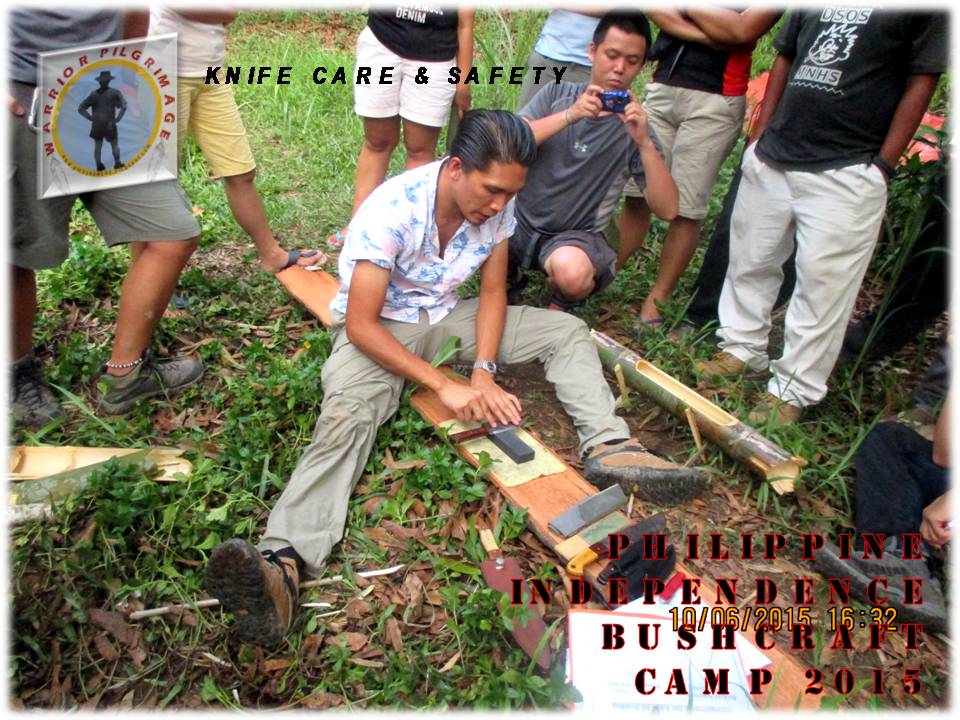
After this chapter, Knife Care and Safety comes next. Aljew Frasco (2013), knifemaking hobbyist and Camp Red's vice president, will do the discussions. This topic gives you more knowledge about knives and guides you in the proper care and handling of a knife. Another of Camp Red, Fulbert Navarro, assists Aljew in discussing about the only known knife in the land – Batas Pambansa Bilang 6.


The last chapter of the first day is Survival Tool Making. By the time I finished this, it is almost dusk. The long bamboo poles which I prepared for this occasion remains untouched. It would have been used to exercise each participant's dexterity with a knife as well as applying the proper cutting techniques learned during the discussions. Anyway, I promised them that they would have that chance for tomorrow.

Day One ended at 17:30 and all participants prepare their evening meals individually or by group. For the camp staff, Nelson Orozco did the cooking for us. Ernie Salomon (2011), the official Camp Fixer, had not yet arrived and this task passed on to the shoulders of Nelson. Large pots are in short supply and we have to improvise the cooking. After the meals, the campfire is populated by staff and novices alike. Laughter competed with the rush of the stream in the night aided by strong liquid moderately taken in small amounts.

The campfire is fed by an abundance of dry bamboo, split and broken in small manageable sizes. The fire keeps on burning, long after taps time; long after the rowdy tales told by rowdy individuals had sought the comforts of their shelters. It is looked after and fed by a set of Nightwatchers, who relieved each other each hour until 05:00. I am part of this duty where I am the last to take the watch.

Day Two will see the campfire revert into a fireplace. Water will be boiled for coffee and, sooner, breakfast. After that, there will be none. Not after the participants will be successful in their hunt for food on the Cotcot River tonight. Meanwhile, the chapter on Simple Knots, Lashes and Braids will be the focus of Dominik Sepe of PIBC 2012. This would have been discussed yesterday but lack of time forced me to postpone this today, June 11.

This chapter is long and the novices would have to participate after the demo by Doms so they could understand better this craft. This chapter is a big improvement from the previous ones as it tackles more on the simplest knots, with integration of lashes and braids. This is more of a bushcraft ropework and shies away from the technical ones done by mainstream activities.


Another new topic included for PIBC 2015 is Practical Wilderness Treatments. Eli Bryn Tambiga (2012) will do the discussions. He is a volunteer for the Philippine National Red Cross and Camp Red's elected secretary. Aside this, he is the designated Camp Hawkeye – photographer in your layman's term. He comes in prepared and happily hands out free triangular clothes with Camp Red logo.

This chapter touches on open wounds where we are most vulnerable like palms, upper and lower arms and upper and lower legs; closed-wound fractures on knees and elbows; sprained ankles; and the ways to immobilize these injured parts. Part of the discussion are the most common medical emergencies where we are most likely to encounter on individuals like hypothermia, heat strokes and hypoglycemia and the ways on how to treat these patients.

After a 10-minute break, the PIBC continues on with the topic about Shelters. Finding a suitable place for a shelter, like a campsite, is a skill and there are places where it is not rational to set up shelters for the sake of security and safety. Shelters are either man-made or natural. Man-made are either synthetic materials or sourced from nature. Natural shelters are either caves, overhangs or among debris. If you know where to catch warm air rising, you would likely experience a comfortable night in a camp.

The hours drag by to early afternoon and the chapter about Firecraft comes. Everybody becomes attentive for this is the topic where most can relate what bushcraft is. I give them the idea about the four elements of a fire where, the absence of one element, would make it impossible to start one. Then I discussed about tinder, kindling and firewood and how to source it and from where. Tinder could be manufactured like the charclothe.

Then comes the three methods of making a fire which is by solar-intensity magnification, by friction and by pressurized air. We concentrate on the first and the second since these are very practical and very easy, provided you have the right tinder to pair it with. The wonders of the charclothe mesmerized the participants as the tiny sparks from a steel on flint produces embers which became a flame when transferred to a tinder bundle.

Aljew demonstrates the bow-drill method and discusses it in step-by-step method, whereby smoke, then ember, appear; then smoke thickens and then a flame burst. Four participants were able to make fire using this method. On the other hand, two participants helped each other to rub bamboo on bamboo and, after a considerable struggle, are able to produce flame.


Satisfied with the results in fire-making, I proceed on to the next, which is Foraging and Plant Identification. Foraging is required when you are in search of food or of other things that would work in your sustenance for survival. Plants make up some of it and an individual should know which are edible or not and which are toxic. I emphasized more on the dangerous plants through a compilation of pictures.

Last chapter is Outdoor Cooking but not limited to the different ways in preserving meat, vegetables, fruits and fish. Situations where cooking are done vary from campsite to trail to extreme circumstances and fireplaces might be open, semi-closed or underground. I decide to integrate the practical exercise in tool making from the two poles of bamboo which were supposed to be cut up yesterday.

Six groups of three participants each are tasked to each choose three segments (or culms) from the bamboo poles for this workout to test their dexterity in the use of a knife in carving out spoons, a drinking jug and a cooking vessel. They would have to employ the “Trailhawk System” of opening up a bamboo as a cooking pot which I demonstrate. Afterward, they are instructed to cook rice by “buyok” method, which is to boil water first.

When a group had finished their cooking, they would start their Nocturnal Hunting on the stream. They equipped themselves with LED lights, catch bins and pointed sticks. One group was able to make a catch net. For two hours of the night, Cotcot River becomes a hotbed of busy people trying to catch fish, shrimps and crabs. Most returned empty-handed but, nevertheless, they are entitled to a good meal, with or without a catch.

Joining us is Ernie Salomon and Mayo Leo Carrillo (2012) and they brought more ammo – brandy and food – to augment our diminishing supply. The second night then is as vicious as was the first with yarns and laughter echoing in the night. I did not last midnight and I found myself surrendering to the comforts of a crude but cool bedding. I turned in and I miss the company of rowdy storytellers.


I wake up the next day, June 12, to the smell of coffee. This is Day Three. Time to distribute the PIBC t-shirts to the novices and the camp staff. I also include small Camp Red stickers. Glad to see smiles on everyone and this is not yet the surprise we prepared for them. Ernie begins to make his presence felt on the fireplace and brunch is called. In a little while, the Philippine flag will be raised.

The flag, originally came into my possession during Freedom Climb 2010, had been used in PIBC during 2011, 2013 and 2014. Today, it bathed again in the warm sunshine and danced with the breeze. I would not want it done in any other way but raise it up in a camp like our forefathers did during resistance against the Spanish, the Americans and the Japanese. That way, patriotism is raised to a higher level.

Everyone assembles on a clearing and begins to sing the Philippine National Anthem – the Lupang Hinirang, to the gist of a novice's hands. After that, everybody recites the Oath of Allegiance – the Panatang Makabayan. Everybody shook hands and greeted each other Happy Independence Day and photo socials erupt. Then the Blade Porn gets its turn. Arrayed on two coconut planks, the blades gets their “15 minutes of fame”.

We break camp and leave at 10:00, going by way another route towards the hanging bridge that linked the village of Mulao of Liloan to another village of the same name belonging to the municipality of Compostela. After an hour of walking we reach the place where the bus, used as our transport of two days ago, would pick us up. It came at the appointed time of 13:00 and we occupy all the open spaces inside.


We reach Barroful's Seaside Resort to enjoy the cool breeze that was wanting in our very humid camp. The guys stretched their aching muscles or be just still on a proper chair. The bottles of half-full Jagermeister and Jack Daniels are buttressed by four more full bottles of Matador brandy and its mix of lime juice. It is going to be a long day and there is excitement as the giveaways are displayed on the table.

These are 19 survival-paracord bracelets and two Zebra 12cm stainless-steel pots provided by Mayo Leo Carrillo; three emergency disposable stoves by Eli Bryn Tambiga; a Julio Herretz machete and a Seseblade sinalung by Jhurds Neo; two LED lights and a Silangan dry-fit tshirt by Aaron and Ann Jillian Binoya; another sinalung from me; and three woodlore knives and three utility knives courtesy of The Knifemaker of Mandaue City, Cebu.

The nineteen participants are Christopher Ngosiok, Locel Navarro, Angel Luz Villaganas, couple Mark and Mirasol Lepon, Nelson Tan, Fritz Jay Hortelano, Leomel Pino, Fritz Bustamante, Niño Paul Beriales, Anthony Yalong, Bim Sauco, Rommel Mesias, Jonathaniel Apurado, Rubi Valdez, Carlo Magno Rejuso, Diocyl Hinay, Lord Benjamin Belga Jr. and Richie Quijano. All are fortunate to bring home something aside from the certificate of participation for the 3-day Basic Course on Tropical Bushcraft and Survival.

Not only that, the Blanket Trading, presided by Glenn Pestaño (2011), would increase each participant's knowledge about this activity and, likewise, would add or exchange what they had with one or several ones that they wished to acquire through a healthy barter of goods done the old way. I watch from the sidelines and I am glad that the PIBC have now reached this level through the five years it existed and is now an institution in itself.

I greatly appreciate that my efforts to teach woodcraft had been recognized by the present leadership of the Camp Red Bushcraft and Survival Guild, led by Jhurds and Aljew Frasco, by giving me a Certificate of Appreciation with a token of a wooden trophy with a mother-of-pearl Native American and a miniature-but-working pipe tomahawk. Ditto with Ernie Salomon, who received the same certificate and a small O-Light LED light for providing fit-for-a-king meals through the years to everyone.

A special prize, provided for by Pardy Bugtai of PABU Knives, are a genuine Cold Steel Pendelton bushcraft knife and another genuine Tom Brown Tracker knife. The Pendleton would be up-for-grabs to the participants and Anthony Yalong of Manila had snared it after a coin toss. Jhurds, on the other hand, got the Tracker fair and square after three down-the-wire tries with three other camp staff.


The PIBC had equipped the participants, previous and present, skills which improved their outdoor skills and, not only that, they now have the edge when things go wrong. They would be natural leaders in a community of survivors should disasters overwhelm places where they reside or visit. Learning of bushcraft skills in a proper avenue are rare here in the Philippines but the PIBC addressed that and the PIBC ensures that you do not give an arm and a leg to participate in it. It is available to all and is not exclusive. Since it is non-commercial, it is done once a year and participation is limited.

I have given the thought that I will relinquish the convening of the PIBC to the guild of Camp Red. I believe they are now capable of handling the PIBC for I have seen how their skills and their capabilities improved over the years. I have nurtured skillful men who can stand proudly on their own and the next year's PIBC – the sixth edition – would be their “crossing of the Tiber”. I am proud of my Camp Red.

I believe also that it is time for me to expand my horizon and teach bushcraft and survival in other places as a journeyman. I have reached a threshold where these rare skills would now be used as a source of income. I have come to the point of leaving the corporate world and come out into the real world of pursuing livelihood this way. I have made a mark on the local outdoors scene where none had been before and I have more things to do.


Document done in LibreOffice 4.3 Writer