Showing posts with label gear test. Show all posts
Tuesday, May 9, 2017
THE THRUHIKE JOURNAL: Days 2 and 3 (Monteverde to Cerdeña)
DAY TWO ::::: THE STRONG WINDS HAVE
MELLOWED down while the monotonous tap-tap of the rain on my canopy have lulled
me to laziness. It should be a cold morning but I am surprisingly warm. The
Therm-a-Rest insulated foam pad which was provided by Michael Schwarz for the
Thruhike have given me strange comfort which I have had not experienced
before. Indeed, I had a good night’s
sleep free of worries but I have to rise from the comfortable capsule of my
hammock.
I was amazed at our coverage of Day
One. We were not supposed to be camping
here at Monteverde, Samboan yesterday but somewhere down short of here. The first day adrenaline spurt might have to
do with that. Or that I intend to change
the itinerary. It is the latter but
adrenaline and, perhaps, capsules of multivitamins and Guarana may have
helped. Here, we have a good water
source and a perfect ground to set up hammocks and shelters.
It is 06:15 and I need to boil
water for coffee. Suddenly, my hands are
afire. Ants, known locally as “hakot”,
have invaded the nooks and crannies of my backpack where I stashed my rice and
everywhere on the ground and then my feet got stung and it was all over me
quick. They were working all night while
I had that hangtime. They were also on
my Park N Go bread. I gyrated to a
tuneless dance and dragged my bag far, slapped it hard and shook off the tiny
army.
I did have that coffee while
watching over my Trangia alcohol burner doing its work on rice. Jonathaniel Apurado, my buddy of this
Thruhike, is cooking Knorr soup on his alcohol burner. You might wonder how much food we carried for
this journey? We carried food good for
five days only, intending to replenish our supply at Mantalongon, Dalaguete on
Day Five, which would be on January 21, 2017.
We each carried a half kilo of rice, repacked in five plastic tubes weighing 100 grams each, and three packs each of Knorr flavored soups and another three
for Korean spicy noodles. Actually, I
carried more for insurance if ever Murphy’s Law imposes its will on the
Thruhike.
The warm Knorr soup mixed with warm
rice on a cold morning is wonderful. My
food plan are soup for breakfasts, baked goods and energy bars for lunch and
spicy noodles for dinners. When we get a
chance to pass by markets, we will change our diets but, basing on my food
plan, this would be rare and few. By
now, you would get the idea of our eating habits for a month. You know, planning the Thruhike is not
easy. You will have to study your
itinerary long and hard before making it final, careful enough not to
overestimate nor underestimate the distances between places found in maps. When you have the itinerary, planning your
meals are next.
The good thing about my itinerary
is I could change it if I wished it. I
can enjoy this privilege because I have explored these places in segments. Days One, Two, Three and Four are part of
Segment VIII which I had passed by last September 2016 but we did that starting
from Upper Beceril, Boljoon going down to Liloan, Santander and this Thruhike
is going on a reverse, which is kind of tricky on your planned pace because it
is uphill. But Day One was spectacular
because I changed it.
We leave the campsite at 08:15 just
in time when curious locals visited us.
The wind began to pick up its strength and rain lashed at us but we
still retained good manners to accommodate their questions and it turned out
well and good. One of those who came is
Dominador Rodriguez, and we met him last time when we passed by here. We followed him as we continue on our journey
today, January 18. Before I reached the
boundary of Oslob, I informed their police station about our presence and our
activity. I might not get that chance
for I know cellular phone signals ahead are absent.
I do not feel tired nor I feel
muscle pains from the labors of a forced march yesterday. The amount of time walking among mountains
done every Sunday for eight years have done wonders for my body and I have
adapted well. If this is to be a gauge
then the Thruhike is good as done! I
have trained myself well even before this epiphany happened in 2011 but the
greatest transformation is my mindset. I
might be older but I am better than when I was an invincible adventurer of the
‘80s and the ‘90s.
The trail passed by a well but we
have already secured water. We reach a
paved road. This same road goes down to
Tumalog waterfall and to the coasts of Oslob but the one we are following is
the unfinished Trans-Axial Highway which goes uphill. The scenery begins to change when you are on
higher elevations. Valleys, farms,
verdant hills, rocky cliffs and solitary huts dot the countrysides. A Brahminy kite flew from behind me to the
right and I take it as a good omen. I
tried hard to capture it with my camera but another one caught my attention as
it called me with its shrill whistle.
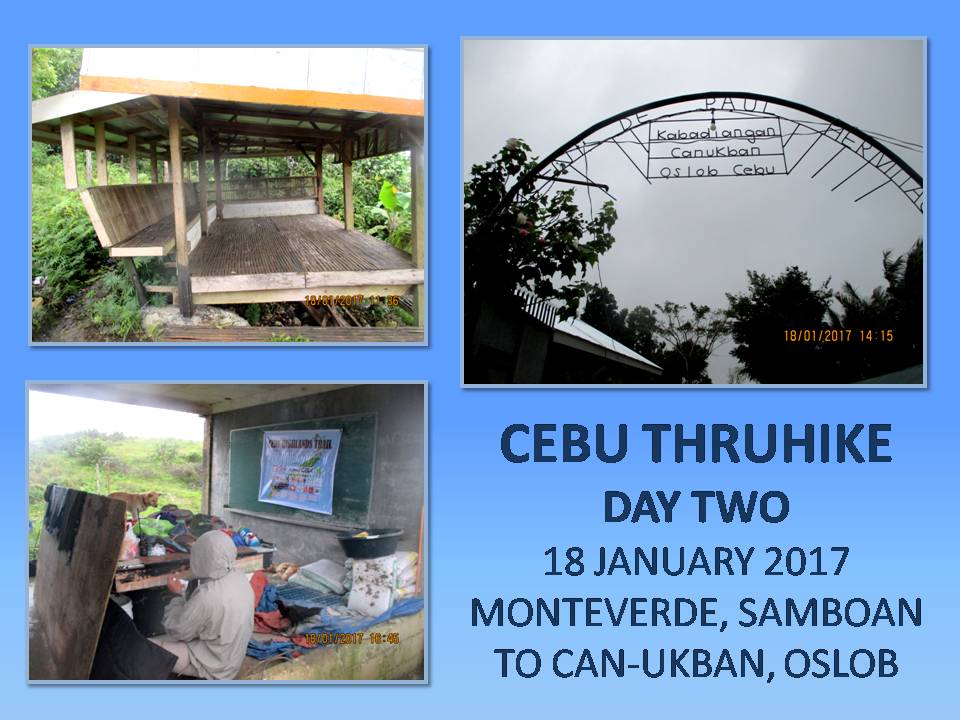
For the moment, there is no other
way to walk here but I see some shortcuts where it would bypass the pavements
and it goes through forest trails.
Actually, you would not know these until you see a long bend or a
hairpin turn and then you decide to explore a path which puts you on places
where you most wanted it to be. It goes
perfectly well on three of such places because I was certain it would. We reach Cañang, Oslob at 10:15 and rest at
its barangay hall to talk to a local.
Although the building gave us warmth and protection from the rain and
cold, we need to continue our walk and so have to leave this friendly
village.
The same road goes into more scenic
scenery of long deep valleys on either side, choked with trees and approached
by a series of low hills, farms and verdant meadows, landscapes which you would
not know existed in Cebu. The same
Brahminy kites that I saw a couple of hours ago appeared. By now, the weather turned mild with bit of
sunshine. We came upon a waiting shed at
11:25, at a place called Mohon, already part of Can-ukban, Oslob and we stopped
for noonbreak.
Since we were on higher ground, I
decide to test the Versa 2-Way VHF radio on selected frequencies for Cebu City,
Alcoy, Dalaguete and Argao. Both Jon and
I possessed amateur radio station licenses, being members of Ham Radio
Cebu. Cloudy weather, distance and
mountains forbid me to come in contact with these repeater stations. The rest is a good thing for it made me
appreciate this structure at closer range than the last time I passed by here.
Well rested, we leave Mohon at
13:00 in a cloud of light showers. The concrete road is in good condition as it
weave its way among hills and pocket forests which, to my mind, contain an
enormous number of avian species. From a
distance, you will see this same road climbing up through more elevations and
it would probably deter you when you walk it in another time. The wet weather brought by a Low Pressure
Area might have helped us in overcoming this obstacle but you will feel the
cold as you go higher.
We arrived too early at the place
where we are supposed to spend our second night, at 14:10, but it is pointless
to go on under this uncooperative weather to seek shelter on another
place. We will just have to take
advantage of the friendship we made with a couple who owned a concrete house
which is located just across the Vincent de Paul Hermitage. It is convenient for us to honor the
itinerary this time, just in time to see Miguel Aniñon grind ears of corn with
a millstone, which I caught in video.
We spend the rest of the day
unloading our things to dry it out, together with our bags. The hammocks were dry and that is the most
important thing. We do not have to worry
about the rain since we tied it on the concrete posts of an unfinished concrete
structure where there is a roof, although without walls, and owned by the
Aniñon Family. The location of their
house, together with the hermitage, are located on top of a peak and we are,
nevertheless, exposed to the spray of raindrops and cold wind. That night, strong gusts and heavy downpour
brought by the storm pelted our camp.
Distance Walked: 10.37 kilometers
Elevation Gained: 754 meters from a
low of 538 meters
DAY THREE ::::: THE COLD CREPT INTO
MY SIDES where the Therm-a-Rest had not clasped me as it gave way to weight of
body inside a hammock which had become soggy from the intermittent spray of
moisture. It was like that for the rest
of the night and, here, early in the morning of January 19, I begun to wiggle
out of my discomfort zone. Jon had
already started cooking the rice and boiled water for coffee on our alcohol
burners. The skies were still in a dour
mood and it was raining. The things that
we dried yesterday, remained moist.
Fr. Carlo Curacot of the Vincent de
Paul Hermitage came to pay us a visit after breakfast and asked of how are we
doing? After a while, he sent us warm
buttered pancakes and, finishing it, we set out on our journey to the
north. The ground was wet and slippery
but we decide to go against common sense by taking a steep shortcut downhill to
evade a long bend of concrete road. We realized it was difficult to stay erect
following this trail, more like a suicide mission, but we survived this
unscathed.
An unpaved road is nice but trails
are better. Only, the trails to our next
destination are in short supply. When
there is a shortcut, we took it and, most often, it is so muddy and
slippery. We stop by a small house with
so many family members at 09:50 on a boundary between Oslob and Ginatilan. A matriarch, Damiana Cariño, 72 years old and
bent to so much time working in the fields, talked about her predicament of
never receiving cash allocated to senior citizens from both towns. We advised her to focus on the town where she
is registered as a voter. That is where
most local funding is based on, of small towns where politics are so divisive.
Another shortcut brought us to
another stretch of unpaved road and a welcome sign says Manlum, Oslob and
another says Cansaloay, Oslob. Up ahead
would be a shallow well fed by a natural spring. It is a small marshy place and is one of the
headwaters of the Laguinsan River which wind its way to the coasts of
Oslob. A trail goes up to a bald hill
which goes up and up. The rains had not
abated, winds picked up strength as we gained elevation. Fogs obliterate the landscape, making
navigation a patchwork of guesses and tells.
Most of the time, I am caught
off-balance by the force of the wind.
The Therm-a-Rest is slung across my shoulder to the front of my body and
is the object of so much wind resistance so I have to clip it lee of the wind
with my left arm. Mt. Bandera would just
be around there beyond my vision obscured by fogs. As I go further, terrain which lay invisible
begun to show its earthly appearance, blurry humps at first then in great
details.
Now I am on the hump that is Mt.
Bandera and we stop for a while to send out another propagation test to a
repeater station of Ham Radio Cebu, found in the Babag Mountain Range of Cebu
City, a distance of about 118-120 kilometers.
I am testing a Versa Duo VHF Radio, with stock antenna and 5 watts
power. The first stream of
communications was received by station DY7EYN at 11:00 but was interrupted by
bad weather and cut short. The second
one at 11:30 went out seamlessly and acknowledged by station 4F7MHZ.
Satisfied by the results of the
worthiness of the Versa Duo in extreme weather conditions, we go down the trail
towards Tigib Spring, another source of the Laguinsan River. We arrive at 12:10 and enjoy our 50 minutes
of noonbreak under the onslaught of streaming winds and whipping rain. We munch on energy bar, biscuits, bread and
mixed trail food. I foraged ripe guavas
and sliced it in halves with my Buck Classic 112 knife.
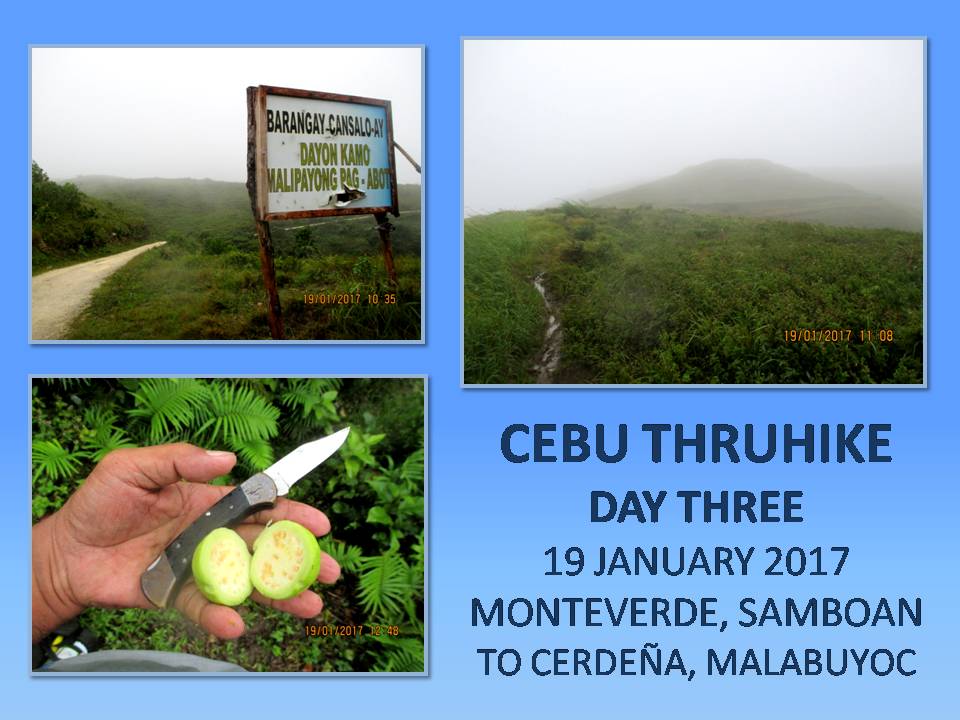
At exactly 13:00, we followed the
trail that would join with an unpaved road, which would become one with a paved
one, recently concreted. This road goes
on lazily uphill, twisting and bending forever towards the sky, passing by
either at Malabuyoc or at Boljoon, again and again. The good thing is the rain had abated for a while
and there are no fogs to block your view ahead although the wind still ruled
the higher elevations, especially at the most exposed areas. At this stage, I informed both the Malabuyoc
Police Station and the Boljoon Police Station of our presence in their area.
At a point where it is most
elevated, the road begins to twist and bend downward. Heavy rains have clogged up ditches with silt
and pebbles, on some points, carrying whole culverts down the mountainside. Landslides threaten a house below while
cracks on elevated ground above roads is something you would not want to happen
where people pass. I have not seen one
vehicle, not even the omnipresent motorcycles-for-hire. But there is life here. A boy rode the back of his carabao while a
noisy party of intoxicated locals just came out from a house where there is a
feast of some sort.
Schoolchildren walked their way
home from school and some of them run at the sight of us. Stories of child snatchers pervade everywhere
and we fit the description of big bags to stuff children inside. Cannot blame them for these places are indeed
lonely which a newly-opened road could not change immediately. In time, maybe they will get used to the
sight of a backpacker. I hope so. The Thruhike opens you to different local
cultures and different people who harbor different beliefs and, most of them,
are talkative enough to tickle you with their simplicity.
By now, the road is eerily empty
and silent. I found a copse of mahogany
trees which I have eyed before as a perfect camping site for hammocks. It is now 15:30 and I do not know if we would
get another opportunity to find a good place like this to camp up ahead. This is perfect, although it is just ten
meters away from the road. It is
slightly elevated, since we are at the shoulders of Mount Ablayan, and trees
are growing near each other that could hide several shelters. I got a light gray taffeta sheet and Jon has
a brown laminated nylon sheet. Both are
of neutral colors and we are good in stealth camping.
Immediately, I tied the
partly-moist hammock to separate trees to wick away moisture while I fixed over
it my wet taffeta shelter. Then I
removed all the things inside the bag to let it all dry, carefully storing the
food cache above the ground. I fixed the
drip lines at each end of the hammock in the event rain will come. Set up my Trangia alcohol burner at a spot
where I could comfortably sit, scratched the small ferro rod of an Advanced Pro
Fire Starter over the alcohol fumes and a fire erupted. So began my coffee moments.
I cooked the rice and then my first
supply of spicy Korean noodles. Jon
seems satisfied with his shelter but there is something different in him
today. He looks fatigued. Maybe the weight he carried. His bag is bigger than mine. We both expect an expedition type of activity
but I carried things that are necessary even though some have redundancy in
functions. I even left my metal cup,
preferring to savor coffee from the extra lid of my smallest pot. The only extra luggage I have is a selfie
stick.
But there is also something
different with my feet today. I felt a
soreness at each base of my big toes.
Walking with wet unbroken shoes and new socks since Day One might have rubbed
the skin of the big toes. The pair of
Jack Wolfskin fits just right but it would have been better if I broke it down
for a few days before engaging on the Thruhike.
Same with the Lorpen cotton socks which were provided by Viajero Outdoor
Centre at a special price. We are still
on the third day and I do not want some things putting a monkey wrench on the
Thruhike.
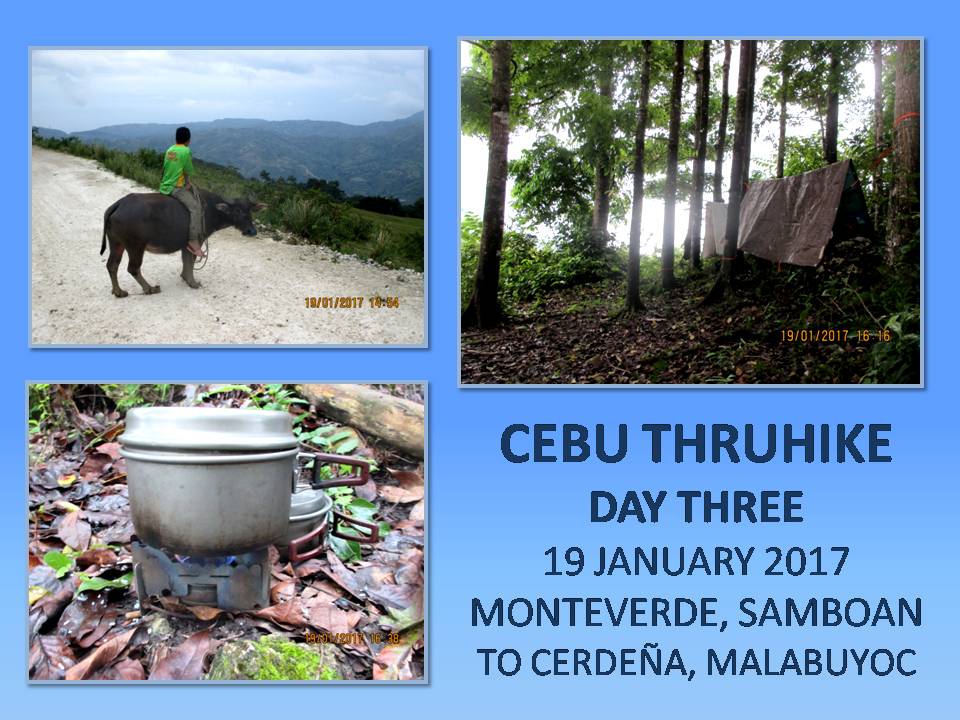
In my mind’s blueprint, I would use
the same socks and undershorts for four days and will change to new ones only
on the fifth day and the eighth day afterward for this southern leg. The Silangan Outdoor Equipment hiking pants
and shirt would be worn without spares for the whole of the Thruhike. I could only wash it, perhaps, in places
where there is an abundant supply of water but that is just about it. I cannot assure myself if I could take a bath
nor brush my teeth. I hanged my moist
jersey, hike pants and wet socks for drying.
Despite our efforts to camp
stealthily, I noticed schoolchildren running so fast on the road when they
passed by near our campsite and then sneak a glance at our direction. They have developed keen eyesight even at
hours where everything stood gray and they could distinguish something that is
not right. I may fool a mainstream hiker
but I cannot fool a mountain youth. I
toast my coffee lid, for want of a cup, to them. There is light rain yet we enjoyed supper at
18:00, while there is still light. Rain
and wind lashed back its fury during the middle of the night but I am warm even
half naked.
Distance Walked: 11.94 kilometers
Elevation Gained: 839 meters from a
low of 359 meters
Document done in LibreOffice
5.2 Writer
Monday, May 1, 2017
THE THRUHIKE JOURNAL: Day 1 (Liloan Point to Monteverde)
I WALK FROM MY HOME in downtown
Cebu City to the Cebu South Bus Terminal at 03:00 of January 17, 2017. Today is the start of the test Thruhike of
the Cebu Highlands Trail or the CHT. I
do not know what would come out of the Thruhike starting from this lonely hike
in the wee hours of an unfolding day. My
backpack is heavy but I am used with heavier loads before and I do not know how
I would fare in a Thruhike since this is a different thing than just climbing a
peak. This is an exercise of epic
proportions.
Yesterday morning, the Cebu
Provincial Government, thru Mr. Boboi Costas and the Cebu Provincial Tourism
Office, hosted a press conference and send-off for me and Jonathaniel Apurado
at the Museo Sugbu. Going there to
witness this were JR Servano of Silangan Outdoor Equipment, Randy Salazar of
Philippine Adventure Consultants, Gian Carlo Jubela and Sheila Mei Abellana of
Adrenaline Romance, Jhurds and Zette Neo with son Jacob, and Justin Apurado of
the Camp Red Bushcraft and Survival Guild.
That was a cheerful moment even if
it was raining hard compared to the grim outlook that my mind is harboring
right now on the empty streets. I
arrived at the terminal after 45 minutes and I waited for Jon, munching on
bread paired with instant coffee. Jon
came in time at 04:00 and we boarded a Ceres Bus bound for Liloan,
Santander. I forced myself to sleep
while in the bus but I could not. My
restive mind refused to be subdued and so I lost some precious hours of sleep
which I surrendered after waking up more than two hours ago.
It is 07:25 when we dropped off the
bus. I am on stable ground looking
across a beach and faraway Negros Oriental.
Above the far shoreline, the Cuernos de Negros Range is still shrouded
in mist. This is it. Liloan Point.
Kilometer Zero. Strewn on the
beach are pebbles, debris and dead seashells.
I picked a piece of a small clam and placed it inside what space left in
my bag. Jon did likewise with the other
half of another clam. The rituals of the
first moments of a long journey took us many minutes to observe. Haste I want but haste could wait. I would have that later to make amends to my
itinerary. Meanwhile, I sent a text
message to the Santander Police Station, informing them of our presence and our
hiking activity.
I focused my concentration on the
paved road and the hike machine begun the first of its thousand steps. From sea level to a grade of just three
meters, I felt the effort of my muscles carry the weight of me and bag as the
walking took us to a corner of the national highway. A small eatery beckoned me and Jon for a meal
and we took a light breakfast of fish soup and rice. The meal was sufficient but we supplemented
it with tablets of Enervon multivitamins and a natural Guarana extract from
Herbalife. I do not know how these would
affect on our performance but that remains to be seen.
I filled my two empty bottles half
full. If I filled it full, I would be
carrying another two kilos of weight. I
took a peep at my schedule. Noonbreak
at Talisay, Samboan. Campsite at
Camburoy, Samboan. Is this
real? I do not know but let me see if I
could better these places with first day adrenaline. The mild weather played well into my hike
though but there is a Low Pressure Area spotted off the coasts of Surigao del
Norte and it is approaching land.
Somewhere along the way rain had to be encountered.
Why did I choose January? Okay, the Thruhike is programmed for 27 days
and this journey would end in the middle of February. In Cebu, January and February are the coldest
months of the year when the amihan – the northeast monsoon – bring in
the coolness of winter from Japan, China and Siberia into the equator. It becomes colder still when spring starts to
thaw the ice. I am walking north and I
will be facing the wind and the sun slightly at my back because of winter
solstice. I am using nature for my
benefit. Now you know.
I heaved the backpack and it
creaked on the shoulder straps. I let go
a breath of air and cinched all the ladder locks tightly. Jon and I are wearing new pairs of Jack
Wolfskin trail shoes donated by Niño Paul Beriales and newly-minted CHT jerseys
designed and provided for by Silangan Outdoor Equipment. Darn it, we looked good! My outfitter, also provided me a new pair of
grey hiking pants which material is the same as that of my old pair. I am in 7th Heaven in my appearance and
nice-looking appearance translates into high morale and better performance. That said, I will grow wings on my
heels. Bring it on!
We were here last September and it
was easy to find the trail we used although the last time was downhill. The ground is wet but not muddy. It had rained for a week except yesterday and
the day before that. The traction is
good except when you step on something hard and unwieldy. We covered higher ground quickly as if we are
men possessed. We connect to a dirt road
and the boundary marker that is known as Talisay, Samboan would not be
far. Time is 10:20 and too early for a
noonbreak.
I am packing a GPS transmitter
provided by Galileo Satellite Control System-Philippines. It is about 300 grams and is powered by three
lithium AA batteries. It should be
placed without obstacles overhead and so I have it attached above my 40-liter
backpack with a piece of cord. I have to
untie two knots when I need something from inside my bag which were often and
retie it back. The GPS would track our
hike and would be automatically recorded digitally in a cloud environment. Aside that, we each were equipped by Versa
Cebu with their Versa Duo VHF 2-way radios along with extra batteries and
chargers.
We walked very fast on the first
few kilometers and we decide to rest at a community called Inadlayan else we
would experience a burn out. Local folks
were amazed at our quest to hike to the tip of Northern Cebu but I was more
amazed at the cooling effect of a cold Sparkle on my thirsty throat. We are now at Bunlan, Santander. There should be a trail up ahead which we had
taken last time only it was kind of tricky since we were washed out in thick
mist during a storm. We have to
remember.
We did remember but I slipped on my
toes and I found myself going down on my knees.
It was the action of a swaying backpack, filled to the full at its
expandable pouch, that caused me a slight mistake. A rock punctured the fabric of the pants and
caused a scratch on my right knee. I
peeked at the knee and it was bleeding slightly. No time to nurse a pain. I got up slowly and proceed upon the height
that refused me a minute ago and stared at another familiar ridge. This time we know where we are going and we
have to take a noonbreak.
It is exactly 12:00 when we reach
Cabutongan Elementary School. We are
still in Santander but midday is warm even though it is cloudy. My lunch are six pieces of Park N Go bread,
two pieces of Titay’s Liloan Rosquillos, three pieces of Tiger crackers, half
of the Fitbar and a handful of mixed nuts, chocolate, raisins and
marshmallows. A single tablet of Guarana
extract is added later. I have enough
supply of all and I would not worry for I have planned the Thruhike carefully
as if I am in a war campaign with a supply team tasked to replenish our food
and fuel at rendezvous points up ahead on the CHT.
I checked my knee. The blood had caked but Jon insists treating
it with betadine. No harm done except
for a microscopic breach on the fabric.
An hour of rest had given us enough time to replenish lost energy to the
3+ hours of hiking with loads. At 13:10,
we pursued the place dictated by the schedule as our campsite. We passed by Camburoy, Samboan and chatted
with a group of local folks. We took
advantage of this by refilling our water bottles. Upon the insistence of one, I plucked thirty
pieces of Indonesian pepper which I plan to plant in my garden when I reach
Cebu City on the eleventh day. Sent a
text message to the Samboan Police Station so they could explain to anyone
calling their attention of our presence
The winding dirt road is abandoned
save for a few passing motorcycles.
Everyone are indoors listening to a popular drama series on AM radio: Handumanan
sa Usa ka Awit. It is better we
passed by unnoticed than be beholden to stay still for a few precious minutes
trying to explain the unexplainable intricacies of hiking through Cebu as a
matter of respect for the locals even though they cannot comprehend very well
of the magnitude of what you are doing.
You got to be nice all the time.
Show your best smile and greet everyone.
Talk more and the more they talk.
I follow the rough road. It is long, going uphill all of the time,
winding and twisting and you would have to retrieve memory when it passes by on
junctions. It is eerily silent and there
are no more houses when we cross over to somewhere in Monteverde, Samboan. The place is one where we should have taken
our noonbreak for next day’s walk but, here we are, taking it by storm. I think we grew some kind of wings on our
feet. I guess, the first day jitters and
the capsules of multivitamins and Guarana ingested hours ago would have
something to do with that.
We each carried a bottle of Enervon
Multivitamins containing 30 capsules, courtesy of our Swiss benefactor, Markus
Immer, and another bottle of Herbalife Natural Raw Guarana, containing 60
capsules, courtesy of the couple Mark and Mirasol Lepon. Although I believed that supplements could
improve performance but I was not an eager fan of that because of cost but,
today, provided free, I began to notice a slight difference. Maybe it is too early for presumptions or
maybe it was just adrenaline, which is normal during first days. Maybe.
We walked by memory and came upon
the most wonderful sight which I expected to reach before the onset of dusk:
the concrete water tanks of Kalinawan.
We arrived at 16:30 with plenty of light to pitch our shelters and
hammocks and, the most important of all, plenty of water. The trail is on an exposed ridge which lacked
large trees. What it have are shrubs and
young trees down a slope. I found a
group of sturdy shrubs just perfect to host two hammocks and thick enough to
hold the weight of a man.
Just when we were about to start
claiming the spot for our shelters, strong winds coming from the east begun to
play on my taffeta sheet making my work on a shelter rather tricky. Jon took much longer righting his as he
struggled against the wind carrying his much lighter laminated nylon sheet off
its anchors. Maybe the LPA have hit
land. While Jon was in that predicament,
I started the cooking of rice for our supper.
I am carrying the very efficient Trangia burner which is fed with
denatured alcohol. For that matter, I
carried a liter of fuel. I relish the
moment with a drink from my supply of Energy Joss which lessened my body thirst
caused by extreme exertions.
When the rice got cooked, I boiled
water for coffee. Jon soon boiled water
for the first of his supply of three spicy Korean noodles. It began to rain and the wind stalled a bit. We ate in silence in dim light given off by
our headlamps. Outside of our range of
light it was silent and dark. Both of us
were tired and an early rest is most welcome.
The wind had increased its intensity and so were the rain. It was cold but I was dry and warm, thanks to
the Therm-a-Rest which fits perfectly inside my hammock. I do not know about Jon but I can see he was
really tired. He carried a heavy load
some of it superfluous like a folding seat and an umbrella. Beats my selfie stick.
Distance Walked: 16.67 kilometers
Elevation Gained: 548 meters from a
low of 0 meters
Posted by
PinoyApache
at
09:00
0
comments
Labels: Cebu, Cebu Highlands Trail, gear test, journal, Samboan, Santander, sleep pad, thruhike
Monday, April 17, 2017
BUSHCRAFT BUHISAN XLIII: Man on Fire
I AM AFIRE. LAST WEEKEND’S debacle in the mountains does not alter my mood and my mind today, December 18, 2016. I have something big to accomplish next month and I do not have that much time to prepare. A month could barely move mountains unless San Miguel Brewery or Lucio Tan would dip their fingers into my affair. I am prepared for rejections though when expectations turn into empty air.
I have declined many offers to earn an income since the start of December for my mind is focused only on one thing – The Thruhike. With or without those big names, I will have my Thruhike and I have a promise to deliver to my first set of sponsors, who expressed their profound support with funds and them nice things. I could not ask for less at the moment and while I am at it, I have to develop my stamina and my mindset to keep my end of the bargain.
It is so hard on me. I could feel the pressure weighing down on my resolve since I had already set a date of January 17, 2017 as the start of the Thruhike. I could not back down from it. And it is now about to be less than a month away. It would have been easier if I do not do the planning and just be a follower. But when you are the instigator of such things, the task is horrendous and of almost epic proportions since you would be treading on grounds that have not been tried before.
The Thruhike is not a walk to climb a peak which, by usual practice here in the Philippines, takes about two to seven days, usually starting at trailheads that has elevations of 200 meters and up. The whole island of Cebu, at its backside, is difficult terrain, starting from sea level extending to at least 400+ kilometers of mountain trails and roads and I have programmed to hike it at 27 to 32 days with extra three days safety margin. Besides that, it is not a guided hike. It is navigational savvy at its best.
Of course, my closest of friends knows what I am doing and my capability of accomplishing this Thruhike right from the start up to its endmost might be mind-boggling but all know I could achieve this. But there may have been skeptics among them. But that is alright. I know some people would open their purses right at the last minute and I am prepared to do the things in between like more time in the outdoors and before the altar of my faith.
I have even purchased a new pair of running shoes taken from donations for training. I do not use it for running but for personal errands where running is out of the equation. The walking is enough and I do not have to exaggerate it in speed so I could have that fastest best. I take care of my joints and tendons and I have my own discriminatory reasons not to behave in such reckless abandonment.
Today at Guadalupe, we are but few. It would just be a leisurely hike, just enough to sharpen the mind and to get the hang out of what nature could offer to the senses. Coming with me is Jonathaniel Apurado, Ernie Salomon, Richie Quijano and Glyn Formentera. This is my ideal size of crowd for a dayhike. I do not like boisterous company and I do not like people talking on the trail. They could have that in places of rest though.
We are going to Camp Damazo today to seek the pleasures of its existence. No it is not high and mighty stuff. It is drab and jungle and teeming with creeping devils. We will be walking straight to it with the church parking ground as the trailhead. We know how to go there and we kept it within our own circle which, in this case, is that ugly stalking tiger called the Camp Red Bushcraft and Survival Guild. Yeah, we are ugly to mainstream gadflies and we do not conform to their borrowed ideology.
It had been raining early in the morning and it is good to see the verdant grass growing thick and healthy on that totally bare backside of a hill that I am fond of calling as the “heartbreak ridge”, for the very reason that it had denied a good number of people to give up climbing it and almost claimed the same numbers that barely survived. It is just a low hill and I do not know why it is unkind to people?
If you are not likely be a victim of this heartbreaking episode, you are bound to see a different angle of the city and you begin to like it but we have to move on higher ground to the refuge of shades offered by a forest of fruit trees, hardwood and shrubs which you cannot see from anywhere down the curbs or even thought it existed this close to urban living. So save that exhilarating feeling on your SD card.
The ground is wet and, as expected, a myriad of different birds tries to choke your eardrums with their beautiful melodies. This part, that I named as Bebut’s Trail, is heaven for anyone who have been stressed out in drab office work. It is shady and, when the season is right, you could practically pluck star apples, Spanish plums or currants from fruit-heavy branches.
The trail goes horseshoe like, passing by a place called the Portal before ending at Baksan Road. You just walk a few meters up the road before engaging again another trail called the Lensa Trail. It is all downhill and goes through a man-made forest of Burma teak. It is eerie and silent in here as birds and flying insects do not make this exotic forest their habitat. Only a few people go here like local wood gatherers and us.
The playgrounds chosen by the Camp Red Bushcraft and Survival Guild are different from those chosen by the mainstream outdoors crowd. We prefer our camp under the protection of trees and we liked it anonymous. Of course, we have to chose earth colors for our canopies and our clothes to achieve that effect. Camping on peaks and on places where the crowds are, are taboo for us. Our minds do not simply work that way, child like.
A stream crosses my path. It is brisk and milky and birds seem to delight at that spot where native plants thrived. Yeah, it rained some hours ago and I have not seen Creek Alpha like this. We follow its course downhill where another trail welcomed us. We cross the same stream and hiked onto dry ground for the rest of the day. The path took on another half circle midway between mountain top and another stream.
I showed the guys of the honey oozing down a trunk of a Burma teak. Like I said before in another article, it is unusual for insects, much less a stingless bee colony, to roost in exotic trees. But here it is, defying instinct for survival. It is evolution at work. We cross Creek Bravo and the forest here seems more alive with busy insects zooming here and there while birds make their presence felt with their staccato of melodies.
Lensa Trail climb up a ridge over what seems to be a very beautiful forest that became a tangle of jungles when we reach Camp Damazo. This is our camp and everything comes to a standstill. We each brought firewood and tinder from the lower trails and, in a moment, we would have wood fire, a kind of fire disdained by the mainstream, whose beliefs follow that foreign ideology they hold so dear which, ironically, allows one.
First things first – coffee! I brought my Swiss Army emergency burner with me and coffee came in short time with fire coming from small branches. Not bad for a piece of can. This is a gift from my Swiss friend and we we here last November 26. Proof of that is that I saw and retrieved the dismountable pot holders of his Kelly Kettle. We simply overlooked it and thought we stowed it back to the burner set. Hahaha…there it is.
Ernie begins to ask of the food ingredients which we carried separately as Camp Damazo starts to transform into his kitchen without walls. Overhead is a dour sky but we do not want to be caught unprepared and so erected a cheap plaid nylon sheet above the hearth. Cords were in short supply but we have nature to provide us with something to stretch the canopy. Jon helped Ernie with the cooking while Richie and Glyn break the twigs into small pieces.
With the way the day behaved, it would be an enjoyable one as eyes are on the black pot. The same pot that had served me and my brethren well since the Philippine Independence Bushcraft Camp of 2012. It had survived the punishing interludes of Scotchbrites and sand and it is an icon in itself, a testament to the frugality and practicality of bushcraft. Everything we do and use are of the old world tradition and flashy gears used by the mainstream crowd does not find an instant fan from among us.
By popular demand, we are dining again a dish of pork liver estofado with a side dish of sliced cucumber and tomato in vinegar. Everyone ate in silence, savoring the warm food in warm humid jungle. The food is good and it even tastes better here. Ernie does it with a flair all the time. This is his specialty – cooking – as well as his tinkering and inventing gadgets from scratch. I watch him all the time and tease him until he polishes his cooking to perfection.
We stay for a while to recover from the shock of a full meal. Stories, yarns and jokes crawled out naturally caused by the effects of a fully-satisfied stomach. Washed pots and utensils are dried for a while as the owners claimed the eternal silence of the hills as theirs, for the moment, and felt free to do as they please with laughter and jolly voices echoing among this forested enclave.
At 14:30, we leave our beloved Camp Damazo. We halt for a while at Caramon Spring to drink then we continue to cross a couple of streams and climb up another peak whose one trail led us to Baksan Road. We cross this road into another trail that goes down a fertile valley and into Lanipao. The rest of the way, we walk on the road to Napo. Then a motorcycle is a good option to complete our day’s journey as it brought us back to Guadalupe.
It was an easy day yet worth more than the time when I raced with another on a high peak in another place and time faraway. There was no adrenaline rush and that feeling of invincibility you normally feel when on a high place becomes so alien and distant, replaced by a subtle appreciation of life and the natural world. I am on fire and the things I do in my present life would help and guide me in my quest to tame that wild spirit from within. The Thruhike will be my statement in my life should I succeed.
Document done in LibreOffice 5.2 Writer
Posted by
PinoyApache
at
10:30
0
comments
Labels: Camp Red, Cebu City, gear test, outdoor cooking, training
Saturday, April 1, 2017
BUSHCRAFT BUHISAN XLII: Sacred Ground
I
DO NOT OFTEN BRING people to Camp Damazo. It is sacred ground for
the Camp Red Bushcraft and Survival Guild and it had hosted the 2011,
2012 and 2013 editions of the Philippine Independence Bushcraft Camp
and the 2015 Bonifacio Day Bushcraft Camp. There are no seas of
clouds nor exhilarating views to gaze upon golden sunsets and
luxuriant valleys. It is dreary and humid and all jungle. You will
be disappointed. To us who find bushcraft a way of life, it is
paradise.
The
camp is named after the late Sergio Damazo Jr., my scoutmaster during
my high school years at the then Colegio de San Jose-Recoletos (now
USJ-R) when it was then housed in its old campus near Freedom Park
and Carbon Public Market. During his time, he was a legend among his
peers. He was a very good teacher and he was equally a very good
storyteller. His tales of his experiences and anecdotes placed all
ears to an unflinching attention.
It
was that time when a Boy Scout IS a Boy Scout and my school basked
under his giant shadow snaring accolade after accolade, recognized
and represented in every international jamboree. He was a natural
prepper and a master of all crafts that were taught in the Boy Scout.
His loss left a big vacuum in the local Boy Scout community which,
sadly, stagnated to glamour camping, cater service food and all that
is politically correct imposed by overprotective parents.
It
is my privilege as his former student to name this place in the
wilderness in his honor and memory. There never was like him and his
is a big shoe to fill in. Camp Damazo does not appear in Google Map
nor it is kind to cellular signals. It is a hidden nook in the Babag
Mountain Range yet, despite its remoteness, it can be walked direct
from Guadalupe, the route of which is also a mystery. It is a
privilege then if you are personally invited.
One
of those that I welcomed today – November 26, 2016 – is my Swiss
benefactor and friend. I cannot say no to him if ever he rings me
for a hike in the woods. He is a typical individual who has a heart
set for the outdoors. His is a rare breed in a Europe that is now
harboring a highly-urbanized generation which is perpetually wired to
the electrical outlet and the Wi-Fi. He is not that young anymore
and he is intent to shed off some weight off his frame.
We
have spent time together in other places testing equipment and gear
and I am more than willing to try anything new. I write my own
unsolicited reviews in this personal blog and in my Facebook wall and
I somehow liked it in so much that it have helped people in their
choices. My Swiss friend is carrying a bag that seem to have a bulky
cargo inside. Whatever it will be, I just want to steer him safely
along the trail to Camp Damazo.
We
walked at a slow pace at ten in the morning on wet ground past a
man-made forest of Burma teak. A strange red shark far way from home
greeted us. The path ends at Creek Alpha but we walked downstream to
get to another trail which would pass an old campsite and more of
teak forests with a mixture of non-native species. When I am here,
it seems that I am in my natural environment and every stress and
worry is forgotten. I am a freelance wilderness guide and this is my
office.
I
am not a mountain guide. I do not give you the cold shoulder and
that perpetual silence while you struggle to keep up with a pace. I
do not work that way. I talk to make you more alive and watchful in
a pace much to your liking. Along the way are harmful plants which
without your knowledge gets you snagged or stung. You begin to
wonder how such a living forest is dead? It is so silent.
I
was wrong. Here upon a tall teak tree, a stingless bee colony (Local
name: kiyot) made a honeycomb inside its trunk which is rare.
Honey overflowed and oozed down it. The viscous fluid is sticky and
sweet. It is a matter of choice for one native species trying to
adapt to a foreign host to keep away competition and ensure its
survival. These are small wonders that do not take attention from an
untrained eye and the matching wisdom to explain why? That is why I
am no mountain guide.
We
reach Creek Bravo and take a rest. The humidity of the tropics might
be too much for my friend. When I am on this spot, it gives me
happiness just to stare across me of the only place in the whole
Buhisan Watershed Area where a good concentration of water bamboos
(butong) grow. How it colonized that part left me wondering?
Whatever, it is a source of material and nourishment for a bushcraft
camp. I took special care of these bamboos leaving it untouched for
long periods of time.
We
resume our hike. We climb up a steep trail to reach a ridge and two
parallel trails. One goes down Lensa Creek while the other follow
the back of the ridge and then to Camp Damazo. The forest is now
alive of birds and insects. I still see Burma teaks, gmelinas and
mahoganies but, amidst them, are native species which attract these
living creatures. A few branches blocked the path and we have to
watch over our heads of unstable ones bound to fall at the rock of a
breeze.
Jungle
jumble becomes a beautiful forest, for a time, and becomes both as we
approach more elevation. Soon we will be at the fabled Camp Damazo.
At thirty before twelve noon, we reach the place. In the center is a
cairn, marking the fireplace. A bell pepper with a single fruit grow
beside it. Above us is a Moluccan ironwood tree (ipil), whose
foliage protect us from the eyes of sun and drone. Beside it is a
stinging tree (alingatong) which, for all of its ill repute,
is harmless. For now.
What
makes Camp Damazo special? First of all, I discovered this while
exploring Lensa Creek in 2010. It was when I saw a sickly bamboo
that I noticed a trail which led to three other trails, which one of
these brought me to here. I came back to explore the other trails
and found a natural spring and an exit in one and Creek Charlie on
another. The camp is on a low peak covered by trees and surrounded
by thick jungle where teaching plant ID is perfect. Ground is a
mixture of rock, sand and loam and absorbs rainwater quickly.
You
would likely see ground pigeons, palm civets, jungle fowls and hawks
here at closer distance than you would have expected these to be.
Creek Charlie is a source of food which is very vital in a nocturnal
hunting episode. Camp Damazo is a wild place but succeeding
bushcraft camps have tamed it briefly and I decide to leave this
place untouched for every couple of years so wild vegetation would
recover. But on some weekends, we come just to cook meals and be
gone.
Today,
we will just be testing gears and have a cup of coffee and some
bread. My Swiss friend retrieved a Kelly Kettle. That is why his
bag looked so bulky. It is my first time to personally see, touch
and hold a Kelly Kettle. It is a camp burner which you can use to
cook food and boil water simultaneously. It is made of high-grade
stainless steel and weighs 1000 grams. It consists of the fire oven,
a kettle looking like a doughnut with bail and a chain near the
bottom to tilt the liquid out, a standard pot and a collapsible pot
adapter to handle bigger pots.
We
tested it with a commercial alcohol-gel fuel but it never dished out
enough heat to boil water in the kettle and it took us the whole of
15 minutes to observe a steam, which did not came, so we decided to
add small bits of firewood in the oven to stir the water alive. It
did in a few minutes. The Kelly Kettle is more efficient if it uses
solid fuel like dry wood, twigs and other kindling. It is best in
expedition base camps and in boats where exposure to elements are
high like rain, snow and wind.
Buried
below the spotlight of the Kelly Kettle, is an Advanced Fire Starter
Pro donated by Paul Sidney Uy for my use during my Thruhike of the
Cebu Highlands Trail in January 2017. It looks like a tactical pen
where the parts can be unscrewed from each other. There is the one
holding the striker, another one holding the ferromagnesium rod and
another as container for tinder. At the end is a small button
compass while the other is a lanyard holder.
I
scratched the rod with the striker on the alcohol gel and it caught
the sparks and blue flame erupted which then was used for the Kelly
Kettle. This fire starter creates a good volume of sparks unheard of
for its small size. Actually I tested it on a tattered piece of
tissue at Frontgate Burger Restaurant the previous night and the
tissue caught fire. Sidney owns Frontgate, located in Baseline,
Juana Osmeña Street, Cebu City, which serves the finest burgers and
steaks in town. The demo was witnessed by other Frontgate patrons.
After
we had our coffee and fully satisfied of time spent well, we leave
Camp Damazo for Guadalupe. We walk on the exit trail where the
natural spring is located and more strange plants to understand and
learn. Streaking away to put more distance from us is a jungle fowl.
It is a rooster and it is the first time I saw one fleeing away on
the ground. Most often when surprised it flies in a trail of
dropping plumes. It may have freshened itself with water from the
spring and caught unaware of our coming until about a few meters.
After
crossing the upper part of both Creek Alpha and Creek Bravo, which
were slippery, we arrive at the Pamutan-Sapangdaku Road. We cross it
for another much tame trail going to Lanipao where we found cold
refreshment. From there, we walk towards Napo where we ride
motorcycles-for-hire to Guadalupe. From the church, we walk again to
my favorite watering hole and cap our outdoor workout with the
coldest beer.
Document
done in LibreOffice 5.2 Writer
Posted by
PinoyApache
at
09:00
0
comments
Labels: camp burner, Camp Damazo, camp stoves, Cebu City, cooking utensil, fire tool, gear test
Sunday, January 1, 2017
BEBUT’S TRAIL XV: The Little Boss
THE
GATE IS NOW OPEN FOR LITTLE JACOB to mountain adventures and into the
world of the Camp Red Bushcraft and Survival Guild. He is the
seven-year old son of Jhurds Neo, head shed of the Camp Red guild.
Jacob has a “cult following” of his own of boys his age and
above. His skill with the knife and with firecraft are “legendary”
and would finally be tested on playgrounds which were denied
skilfully by his father to him for sometime.
He
is appropriately dressed for the outdoors today (September 12, 2016)
and carries a sling bag which, I believe, contained his prized
possessions: a knife, a ferro rod set and his jellied cottons. I am
following him on the trail. He walked in swagger fashion at first
but when he noticed that the ground is a bit slippery for his
comfort, he walked cautiously and slowly this time. Hearing the word
“snake”, he stopped and signaled me to go first. Smart fellow.
Behind
him is his concerned dad, our Swiss friend and benefactor, Ernie the
Fixer, Boy O, Jonathan and Señor Nyor. The greens are all in bloom
and a good time to do a little Plant ID for the benefit of the Little
Boss and our Swiss guest. I start with the most basic and most
common of the lot like jackfruit, breadfruit, cottonfruit, star
apple, sour sop, sweet potato, spinach vine, horseradish, taro,
cassava, papaya and, of course, the bamboo.
Jhurds
wanted to introduce Jacob to the almost-forgotten art of making pop
guns from bamboo. Too much Internet for the kids today have eroded
many of the ideas and the skills of much of the boyhood games and
contraptions we learned long ago. We, the older generation, have
adapted with technology well and became knowledgeable of the best of
both worlds but the present generation do not. Jhurds has to open
the gate wide this time for Jacob to explore the ancient world of his
dad and that of his grandpop.
I
wished I have started my kids when they were young like my late
grandfather did for me. I was too engrossed with my government work
then, benefiting me nothing but a life devoid of a soul, serving an
ingrate master begetting me disappointments. Fortunately, I was able
to recover my respect and my reputation after realizing the futility
of remaining there and escaping at the right time to the folds of a
new-found spirituality and private employment. I am not employed now
and have too much time but, still, I wished I had time with my kids
then.
We
reach the homestead of Luceno Laborte in Sibalas, the navel of
Baksan. After rehydrating, we settled down and begun the process of
our dirt-time. My Swiss friend unpacked his toys: a Militec folding
saw, a Cold Steel Bushman and a strangely camouflaged Swiss
army-issue poncho. I instantly fell in love with the poncho but it
petered out when he presented to me a Swiss Army emergency stove for
testing. It consists of a hobo can, a bottle and a cup and it is all
aluminum, except for the steel bail and a cork cap.
Ernie
start his business of collecting the food ingredients into his airy
kitchen while Nyor has just placed a bird’s nest above dry firewood
to be given a baptism of meteor showers from his ferro rod. The
sparks came streaming down but the tinder barely caught it. Our
Swiss friend tried his own into the nest and, slowly, a tiny flame
sprouted from a cotton-silk tree down. Meanwhile, Jacob found new
friends and disappeared from view. Only his high-pitched voice could
be heard that he is somewhere near. Boys.
Luceno
arrived with a half liter of unadulterated coconut wine, still in its
white state and sweetness. This cannot be? The hell with coffee.
It is a great privilege to be offered coconut wine, of all places, in
Cebu City, at its purest form yet. How often do you know of native
wine produced in the city’s mountain communities being made
available to other people. This liquid is worth its weight in gold
if I were to analyze its rarity. Most of the coconut wine came from
the far towns north, west and south, already questionable, and from
Leyte, which is already aged.
Spurred
on by this good fortune, I begun to dissect the Swiss emergency stove
and document each part and the different possibilities of being
tweaked to serve current conditions. This contraption can be used
with solid fuel like twigs, dry organic material, sawdust, paper,
cardboard or even charcoal. I boiled water in its cup component
using heat from burned twigs. Or you could use it in combo with an
alcohol burner like I did later with water in its bottle component.
There is one problem though: How would you hold the bottle when it is
hot? Even so, I can tweak that.
Now,
where would Jacob be? I saw a glimpse of him trying to catch pace
with a local boy and he has a slender bamboo with him. I thought I
heard the unmistakable “pop” sound of an improvised bamboo pop
gun. There goes another “pop” and another. They are in the
midst of an ongoing battle, I think? Pop! Pop! Pop! A
small balled paper landed inches away from me. I am almost grazed by
their intense warfare, most likely, almost a casualty of friendly
fire.
This
Filipino childhood past time is made from a slender bamboo tube about
8 to 10 inches long. A bamboo stick, a half-inch shorter than the
tube and which fits snugly inside the tube’s bore, is used to push
projectiles out of the tube and is connected to another short tube,
about 4 to 5 inches long, which acts as a handle for the rod. The
projectile is wet paper balled to be force-fed into the tube by the
rod. The water acts as a sealant. When another balled paper is
pushed hard into the tube, air pressure increase and forces the paper
on the other end to “fire”.
Jhurds
seems ecstatic at the outcome of his experiment and relaxed slightly
his watch over Jacob. Now he is talking with our Swiss guest and Boy
O. Jonathan and Nyor are helping Ernie with the cooking and I bet it
would be another feast fit for princes and dukes. Just a half hour
from now we would indulge on that. Luceno brought marang
(English: Johey oak) and avocados from his orchards. Our Swiss
friend added some fruits he bought from the market like mangoes,
lanzones, rambutan and mangosteens.
Jacob,
probably tired of his little skirmishes, turned up with thirteen sets
of bamboo pop guns. Three local boys foraged these bamboos and made
all of these for him. I can imagine Jacob’s joy at owning that
many in his armory. He may well start an arms trading business in
the school where he is studying. Just in time for the meal that is
now being served. Everybody, to include Luceno and wife and Jacob’s
playmates partake of a local pasta called pancit, mixed
vegetable soup, sliced cucumber in vinegar and milled corn.
Getting
his energy back, Jacob goes back to play mode. This time he
witnessed two boys doing a rap duel, fast-faced sing-song-talk in
Tagalog which could easily twist and tangle my thick Visayan tongue
in spasmodic delirium if I were to try it. I would not dare but it
is a sight to behold to see these mountain-bred children performing
something which I thought popular only in highly-urbanized areas,
streets, TV shows and in the Internet. These children in the
highlands have the best of both worlds too and they are adept to
embrace pop culture and technology as if it is just a change of
clothes.
Then
I came to realize how Jacob would learn so much in the use of the
knife when he sees his playmates using bigger work blades with such
dexterity as if they were working with a small knife. On the other
end, the boys would be amazed to see Jacob’s Condor Bushlore as
they are not used to seeing smaller blades. Then their amazement
would go double when Jacob would show them how to make fire from
jellied cottons after a spark from the ferro rod. The masters of
firecraft being taught new tricks by a novice and so thirteen bamboo
pop guns were happily given.
It
was dream time for Jacob and for his playmates. Dream time also for
me for soon I will own that Swiss Army emergency stove. The kick
from the native wine made today’s activity very worthwhile and
unforgettable. When it is in the middle of the afternoon, we start
packing our things. Jacob is reluctant to part with his playmates
but he is tired and he has to go with his dad on the route we took in
the morning. Me and the rest would go down direct to Guadalupe by
way of Bebut’s Trail and the not-so-dreaded-anymore “Heartbreak
Ridge”.
Document
done LibreOffice 5.2 Writer
Posted by
PinoyApache
at
08:30
0
comments
Labels: Baksan Forest, Bebut’s Trail, bushcraft, Camp Red, camp stoves, Cebu City, gear test

Subscribe to:
Posts (Atom)