Showing posts with label Camp Red. Show all posts

Thursday, November 22, 2018

MAN-SIZED HIKE XXVIII: Lutopan to Guadalupe

THERE ARE SOME PEOPLE WHO just does not give up. Failure is not an option for them but an opportunity to better them next time. I led a Selection Hike last time in October from Lutopan, Toledo City to South Poblacion, San Fernando which was 41.64 kilometers. There were twenty-one people at the start yet only fifteen made it less than twelve hours. The rest would have to do a repeat which I am organizing today, December 30, 2017.

The route, this time, is the traditional route of the Camp Red Bushcaft and Survival Guild, which is from Lutopan to Guadalupe, Cebu City. It is 36 kilometers yet it has to climb up the Babag Mountain Range and be finished in under 12 hours. Many have cut their teeth here and I just hope that those who were denied the last time would finally be able to break the curse. The Selection Hike is one of the requirements for membership into the guild.

We meet at the Cebu South Bus Terminal at 05:00 and I forgot about the holiday weekend rush. There were many people going home to the towns to celebrate New Year and the line is very long. We were able to ride a Toledo-bound bus at 06:45 after almost an hour of standing along the queue. Once the bus made its way, it stopped to pick up more passengers. It arrived at Lutopan at 09:00 and so we begin this stark holiday-season walk.

The pace I pushed was moderate, intending to preserve strength at its most crucial moments, which is the last half. We would arrive in darkness, I am sure of that, because of our late start, which was beyond our control. The 6-man Liloan Triathlon Team, totally driven high by the result of their participation of the October selection hike, came again to better their time in a terrain almost the same as from last time.

Bonabella Canga and Glyn Formentera, who both were overcame with fatigue and the 12-hour time limit during the last test, made themselves available now, along with first-timers Aaron Binoya and Kim Binghay. Going along as overwatches are Jhurds Neo, Aljew Frasco, Christopher Ngosiok, Justin Apurado, Locel Navarro and Mark Moniva. We all sacrificed comfort for this, which most are doing now for the approach of New Year’s Eve.

From Lutopan, we followed the paved concrete road over Cantabaco and Camp 8, Toledo City; Camp 7, Minglanilla; and stopped at the road corner found in Manipis, Talisay City for rest and rehydration. From this road corner, we took another road, partly paved and partly bare, most of this downhill, passing by Cebu City’s remote mountain villages of Sinsin and Buot. When everybody arrives at Buot, we stop to rest and to rehydrate.

There would be a one-hour noonbreak but there would be no lunch of cooked meal. What we would eat could either be bread, sandwiches or pre-cooked food. The Selection Hike is designed not as a race, despite its time limitation, but as a physical test for people from Camp Red and those who would like to associate with us, as a sort of an evacuation drill, under a scenario of foreign invasion, war or increasing distance from a threat of biological and chemical gases or radioactive fallout.  

Across us is the hanging bridge which spans our side to the other bank 30 meters away over the Bonbon River branch of the mighty Mananga River. We cross this swaying span and the misery of the hikers begin. The trail goes up to Mount Samboryo, a hill held in awe by locals. It should be because it is steep and there are swamp buffaloes on the loose with their young. You give it a wide berth when it stares at you with the evil eye.
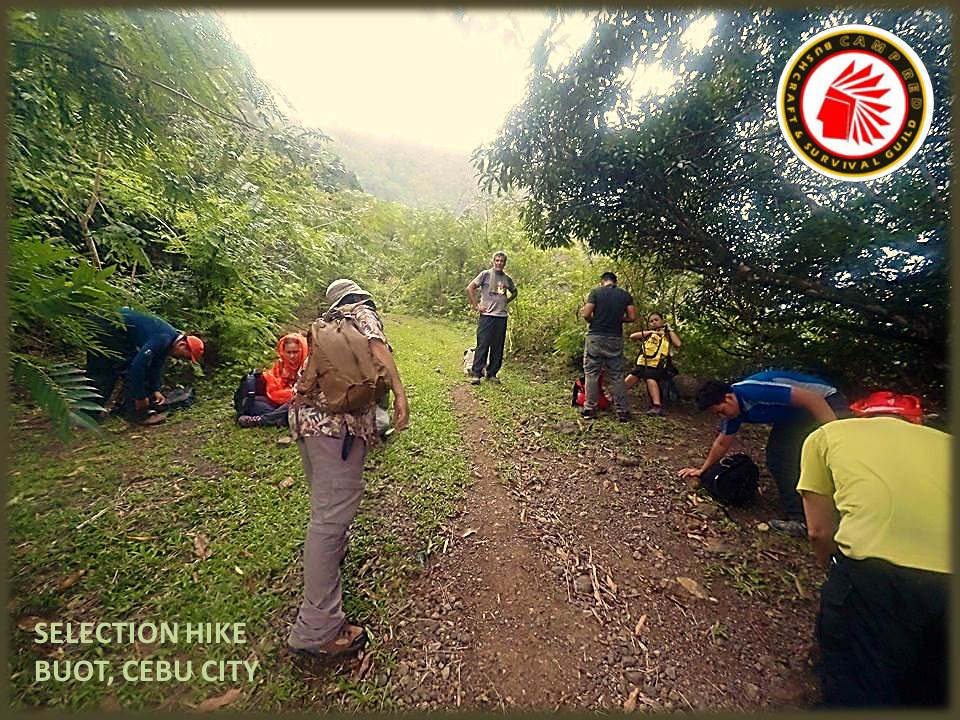
We stop for a moment halfway to gather water from a water source. We proceed on and pass by a farm then climbing up a ridge and rest again. Two trails faced us: the older one which led to Cabatbatan and another newer path that goes up over the divide of Samboryo, passing by a razor-edged ridge and grassy meadows among muffin (sic) peaks. I lead the party slowly up the mountain, containing adrenaline level to a minimum.

The ground is stable than was the last time I passed by here a month ago. Dirt motorcycles causes so much damage to the trails here to the consternation of locals who used these trails to carry their produce to the markets and back with their week’s subsistence and also where their children use in going to school. Some homesteads decide to fence off the trails going to their farms for good measure. Seems the best way to discourage mindless cockroaches astride these machines.

The trail goes on a rolling terrain of short grass and farms on one side and forest line on the other side. Across us is the Sudlon Mountain Range and the wide Bonbon River Valley. Our quest took us to a beaten trail that goes down gently until one section of our party encountered a farm animal tethered across a trail. I passed by this cow and it moved timidly to the side when I made noise.

I find cows and swamp buffaloes blocking a trail normal although it should not be there. Farmers are just totally irresponsible and they never give a thought that people use these trails but what could we do when they grew up with this wrong habit. The cow became spooked when Jhurds brandished a stick to move it away and fell on all fours. The owners noticed it and they became agitated. I go back to control the situation.

All is well when the cow stood up. But it is best not to add fuel to a spark and thaw it with apologies instead even though it is their fault in the first place. There was a rush of adrenaline on this episode and we took advantage of it with increased speed over many road rises which seemed to never end. We reach Pamutan Junction at 16:30 and stop to rehydrate. We were all stressed out and that is not good. Jhurds decides to pull out due to a household errand.

From hereon, it would all be downhill through paved roads that pass by Baksan. It is a long concrete road and not friendly to our now-tender soles. I would have loved to take a trail that goes direct to Guadalupe but it is now dusk and most of those who compose this party has no experience in night navigation. I would not dare compromise safety for pain. Pain can be tolerable at times if you know how to turn off nerve receptors.

Those who are most fit and who seemed to have a high tolerance for pain vanished from view. I would have loved to be at the forefront but I have other matters to attend. I need everyone to beat the 12-hour limit and I decide to be at the tail, to be where the last people are. I became a one-man cheering squad trying to raise the morale of the last people in my field of vision.

I am with the last group and we arrive at the parking lot of the Our Lady of Guadalupe Parish at 20:44 or 11 hours and 44 minutes. The Liloan Triathlon Team, six people, arrived first at 20:21 or 11 hours and 21 minutes. Bona and Glyn, finally made it, especially for Glyn who failed on two occasions. It cannot be denied that both arrived at 20:31 or 11 hours and 31 minutes. Bona has her iPhone application to show me, to include the number of steps and calories burned. All that, for a happy 36 kilometers of torture.

Happy New Year!

Document done in LibreOffice 5.3 Writer
Photos by Christopher Ngosiok

Saturday, October 6, 2018

BUSHCRAFT BUHISAN XLVI: Jungle Steam

IT IS A SPECIAL DAY today, November 26, 2017, for the Camp Red Bushcraft and Survival Guild. We have a special guest whose blades provided the tools for our dirt-times and became synonymous with Philippine bushcraft. Dr. Arvin Sese is in town. Taking timeout from his busy schedule, Doc Arvin happily joined the bunch in our hallowed playground at the old Camp Damazo, the site of the first Philippine Independence Bushcraft Camp in 2011.

While the weather was very depressing the days before, today promises a very warm day. The sun shone gloriously on the parking lot infront of the Our Lady of Guadalupe Parish, Guadalupe, Cebu City. When I arrived, Ernie Salomon, Richie Quijano, Vlad Lumbab, Glyn Formentera, Nelson Tan and Jenmar de Leon were already there. Then came Aljew Frasco, Eman Apuya and Boblyle Balverde. Arriving last in an Isuzu passenger van are Jhurds Neo and Doc Arvin.

After securing the food ingredients from the roadside market of Guadalupe, we leave as one on board the Isuzu at 08:15. We arrived twenty minutes later at Baksan and proceed to the trailhead. The path led to a man-made exotic forest of Burma teak. The ground is wet but not muddy. Going downhill, we follow the same serpentine path to the Banauan Creek. The stream is brisk but clear, its ripples sweet music to the ears.

I am leading the pack and I made it sure that the pace is favorable for Jhurds, Vlad and Doc Arvin, especially now that we are following the stream down to its intended union with the bigger Lensa Creek. We would not be going to the catchment basin of the Buhisan but we would be on higher ground instead where it is much safe. We reach the old site of Camp Damazo at 09:30 and staked our dirt time here.

 
The heat of the day made the jungle very humid as steam rose to the canopies. While the rains may have left a wet surrounding, we at the Camp Red Bushcraft and Survival Guild know where to source dry kindling, tinder and firewood. I taught these guys and I am mighty proud of them. If we do not find them, we have these in our fire kits. The guys automatically spread out to look for dry fuel.

An uneasy flame appeared underneath a wooden tripod standing high and a little gentle coaxing from Aljew, this flame begins to gain warmed up spaces around its small circle of half-moist tinder and kindling until it became confident to burn bigger fuel. Thick smoke rise and a crackle of fire announced to all that it is ready for the pyromaniacs. A pot hanged from the tripod and coffee is in the first order of things.

   
Doc Arvin, tired from his travel from Carcar City, 41 kilometers away, set up a hammock in between two trunks and, in an instant, a blissful snore sounded off. He says he stayed a full vigil the whole night at the Carcar District Hospital treating and caring patients. He is a government doctor who is on loan from a government hospital in Pangasinan. He would be going back to his home province after a few days.

Dr. Arvin Sese, together with his brothers, owned and sold knives under the SESEBLADE brand. I first saw a Seseblade, an NCO, during the 2012 PIBC. Since then I have used their blades in all my bushcraft and survival classes everywhere in the country and endorsed the Seseblade before participants. Aside from the NCO, Seseblade also has the Mountaineer, Sinalung, Nessmuk, Matavia, the JEST Bolo, Parang and the Tomahawk.

It is known that I just used a 9-inch Seseblade Straight NCO over another bigger blade to work my way through the forbidding wilderness of the Doce Cuartos Mountain Range in Tabogon during Day 22 of my Thruhike of the Cebu Highlands Trail. Even though small, the local blade performed well in a tropical jungle environment with just a flick of a wrist, a method that shies away from those cinema-type hacking which is tiring and less effective.

After drinking coffee, I found the rest of the gathered firewood partly moist so I decided to augment theirs with dry ones. I see a waist-high stump and started chopping on one side with my AJF Gahum. Although the outermost part is moist, the next layers were completely dry. Storms and downpours could not penetrate the grains and it shall remain dry although it looked wet on the outside. The wood from the dead trunk provided good fuel for the cooking.

The guys were busy with the cooking and they were deeply buried in their conversations. I need not disturb that equilibrium so I dragged a cheap laminated nylon sheet from my Lifeguard USA rucksack to a place where there is shade. Unmindful of the dear doctor’s snoring and the roars of laughter from the river bank, I tried to squeeze a few minutes of sleep, which I did, until my Yaesu FT270R picked up a wayward signal.

I do not know how many minutes did I sleep but I felt I was cheated. It felt that I enjoyed it in a few seconds only. I did not feel revived nor was I short of being tired. The struggles of the camp fixers of their food have not yet seen its finale but there is still brewed coffee in a billy can. I could try another cup. The snores are still there and I envy Doc Arvin. More jungle steam rising to the branches and humidity is high.

The last of the meat is almost done on open ember. The aroma is overpoweringly sweet, teasing my hunger to its ultimate borderline of instability. Doc Arvin could have felt it too as the snores have stopped and the hammock moved to reveal a couple of lower legs dangling and reaching for the ground. I see a smiling Doc Arvin, quite refreshed from his half-hour of sleep. Ernie removed the last one and Vlad sliced that with his scary-sharp blade.

Lunch begin at 12:30, fair enough to feed a mad and famished man. Aside from grilled pork, liver estofado and raw cucumber in vinegar got served with unlimited rice. The pot bottoms are scraped clean leaving less for the ants. Conversations regained its momentum with the clank and clink of metal competing for earspace as it gets a scrubbing from sand near a water hole.

By 13:30, it was time to move off. Doc Arvin has to leave Cebu City for Carcar City at 17:00. After cleaning up Camp Damazo, leaving as little traces of our time here, I led them to another trail. I would have loved to go the way we went in but it is longer. The trail I am following now is steep but we would be at the trailhead in shorter time possible even if we tarry a lot for rests which is natural.

We are climbing a peak which I jestingly call as “Boy T’s Hell” and it is steep. We overcome two false peaks before arriving there. This peak, I first climbed in 2010 with Boy Toledo and Ernie during an earlier exploration of the extremities of the Buhisan. It was here that Boy almost collapsed of dehydration, fatigue and disorientation. I gave him all my water and it revived him but the peak was hell for him.

We arrived at Boy T’s Hell at 14:30 and before us is a long ridge that connect to another ridge and, on that day, it was beautiful to gaze at, unlike the last time I was there. Across us is the pyramidal shape of Bokatol. We arrived at Baksan at 15:30, time good enough for Doc Arvin to be at the Cebu South Bus Terminal before 17:00. We immediately leave as one on board the Isuzu and reached Guadalupe.

We say goodbye and thanks to Doc Arvin as Jhurds drove the Isuzu to the bus terminal. It was my first time to see and talk to Doc Arvin in person yet it seemed we knew each other for a longer time. In this strange interest of bushcraft, I have encouraged my adherents and students to patronize local products, most particularly, local blades. Doc Arvin has been most generous to provide me his designs and prototypes and I was a willing ambassador.

Document done in LibreOffice 5.4 Writer

Monday, October 1, 2018

NAPO TO BABAG TALES CXXVI: Bukal Outdoor Goes Wilderness First Aid

BUKAL OUTDOOR CLUB is one of just a very few outdoors group that I know of who took very seriously their interest of visiting mountains, hiking and camping. They are striving to equip their members to stock knowledge from seminars, when available, and they are very cooperative with each other. To remember, they have taken wilderness survival training from this writer last May 13-15, 2017 and I want them to learn more.

Fortunately for them, the Camp Red Bushcraft and Survival Guild is hosting another Wilderness First Aid training on November 11, 2017 but it is not confined to their members only. I invited Bukal Outdoor Club to participate in this activity. Instructing again for the third time is Shio Cortes, formerly of Cebu PDRRMO but now has his own outfit – Strategic Options Safety Solutions. Assisting him are Val Cruz III and Christopher Ngosiok. All are registered nurses.

This is a rare opportunity for Bukal Outdoor Club to learn from people who know their business well since this is an open event. We start from Napo after a short motorcycle ride from Guadalupe. The day is perfect and warm. We will be on a short walk only to a place where I recently host several outdoor activities. It is a small open plain found beside the Sapangdaku Creek but it is totally safe and high enough from a flood.

We arrive there at 09:00 and choose a ground under the shade of star apple trees. Everybody formed a semi circle facing Shio, Val and Christopher. Shio starts the introduction about Wilderness First Aid. It touches on the whole context of WFA and then the overview of emergency response which are focused as Locate, Access, Stabilize and Transport or LAST. Then he distinguishes the difference between Search and Rescue as against Search and Recovery.

Christopher demonstrates how the Primary Assessment is performed by assessing first the scene of the incident and the manner by which the victim was found. When examining patient, if unconscious, is to feel the airway for signs of breathing and then check pulse. Where no breathing and pulse are felt, proceed to CPR or the cardio-pulmonary resuscitation. Again check airway. There may be obstruction of foreign objects else, if patient is healthy but only choking, proceed to effect the Heimlich maneuver.

If patient is injured, proceed to the management of bleeding by (a) direct pressure, (b) elevation and (c) applying pressure points. The fourth – by tourniquet – should be applied as a LAST OPTION only! The rule of thumb would be that the affected part where tourniquet is placed should be released from pressure every fifteen (15) minutes and it should be applied to not more than two (2) hours. Failing that, it causes suffocation and permanent damage of arteries of the appendage.

For this part, the participants are urged to join in and use triangular handkerchiefs, bandannas or any other type of thin clothing as cravat bandage to wrap imaginary wounds or to stabilize fancied dislocated joints among themselves. Then these same cravats are used to perform a tourniquet on each other. A more sophisticated tourniquet could be performed by even on himself. It is called the Combat Application Tourniquet.

Other injuries which cause patient difficulty in their mobility are the muscoskeletal injuries which are simple fractures and complex ones which can be remedied by providing splints to the affected part to prevent unnecessary movements. Immobilizing the affected part is very important also when patient is a victim of a venomous bite. The purpose really is to delay the suspected venom or poison to travel quickly to the brain through the veins and arteries. Treat each bite as venomous or, at the least, as carrying rabies.

A slight downpour interrupted our activity and everyone took a break preparing their noontime meal. Ernie Salomon, Jhurds Neo and Jonathan Apurado prepared food for the participants. Food served were grilled pork, mung bean soup, cucumber in vinegar and it is laid on banana leaves, along with rice, another grand mimic of the Philippine military's popular “boodle fight” fete. Lunch was dished out at 13:00, a trying hour of empty stomachs yet warm enough to promote good appetite.

After lunch, laminated-nylon sheets are then made available to the participants to try the patient assessment among themselves. By now, rain have stopped and “patients” are now more willing to be scrutinized like Atty. Rany San Juan of MEZ II and Atty. Bruce Ragas of POPCOM VII. From patient assessment, the participants practiced immobilizing injured parts and applying splints.

Last topic is patient transport and packaging. First to be discussed are the easiest and which are the most commonly practiced like the single and the two-man carries. Then the most complex carrying-and-packaging methods are demonstrated where you need ropes or cords, sturdy sheets and some common everyday items. Evident of these methods are the Daisy Chain Package and the Georgia Litter Rig.

One improvised litter setup is using the ball cap and the small backpack to prevent unnecessary head movement where the visor of the cap acts as an improvised neck brace and the backpack's waist strap are used to hold the forehead from swaying side to side aside that it acts as a cushion to the back of the head. Officially, the training ends at 15:30 as the skies begin to show signs of rain again.

For this life-saving activity, Camp Red is indebted to Shio Cortes and Val Cruz III and we presented to him our token of appreciation, courtesy of the club president, Jhurds Neo. Likewise Christopher Ngosiok will have his token soon on an unspecified date. We were fortunate that they have pushed on again with this event even when they have very busy schedules and the activity was threatened again by a downpour.

Bukal Outdoor Club and the rest of the participants have gained additional knowledge in wilderness emergency response where improvisation and adaptation would spell the difference on the survivability of a patient, granting that professional aid and hospitals would be several hours away. The training would be very useful to Bukal Outdoor Club as they will embark on a five-day 56-kilometer segment hike of the Cebu Highlands Trail from Mount Manunggal to Mount Babag to Lutopan on November 30.


Document done in LibreOffice 4.3 Writer

Thursday, September 6, 2018

MAN-SIZED HIKES XXVI: Lutopan-Tubod-South Poblacion

ONE OF THE BEST TRAINING route for stamina and endurance which I first tried in August 2012 for the Camp Red Bushcraft and Survival Guild. It follows Segment II of the Cebu Highlands Trail, coming from Lutopan, Toledo City but it veers down the coast once you reach Tubod, San Fernando. I miscalculated its length though, based on an estimate, and measured it at around 31 kilometers. Actually, I found out later that it is more than 41 kilometers.

The Camp Red Bushcraft and Survival Guild has a few requirements for membership and one of these is called the Selection Hike. It is a cross-country day hike that needs to be finished in under twelve hours. This present long day hike is the first time that I would implement strict time pressure. Although, this is a guild activity, I considered many non-applicants to join so local residents would get used to our presence and activity.

Thirty-six signified their intention online but only twenty-eight committed individuals arrived at the assembly place at 7Eleven, across the Cebu South Bus Terminal, at 05:00 of October 8, 2017. We board a bus bound for Toledo City and arrive at 07:00 at the outskirts of Lutopan, now known as Don Andres Soriano. Across the highway is the village of Bunga and there is a road which, many years ago were mere paths of residents.

At 07:10, the Selection Hike begun. The day is starting to go warm but it is nothing. Adrenaline is on our side. We passed by Bunga, some upland rice farms and Lake Poog. Due to an unusual number of participants, six Camp Red regulars accompanied me. They are Jhurds Neo, Aljew Frasco, Jonathaniel Apurado, Justin Apurado, Christopher Ngosiok and Jingaling Campomanes. Half of them have been here.

Six of the participants are members of the triathlon team of the Municipality of Liloan and I expect a torrid pace, which I do not want to happen. Although we are under time pressure, this is not a race, and I have to curtail the speed that would accommodate the slowest. Besides that, I am not that young anymore and I need reserves of energy during the last stretch, which would be to the coastal highway.

We go down the valley of Lamac, in Pinamungahan, and reach its market at 10:00. Here, participants and veterans take time to rest, rehydrate and take snacks. After 15 minutes, we continue and crossed a spillway to another village of Sibago. The valley is humid and it begins to take its toll on some of the participants. Rest spaces under any shade are most welcome as the pebbled road begins to create pressure to the soles. 

Going out of Sibago is climbing up a trail that is bare and rocky. Except for three of my wards, the rest do not know that there is a store selling cold softdrinks and I relied on that presence so I could have a modicum of control for the weaker hikers. The triathlon team is still strong, much more so with marathoner Eduardo Eduria, the most senior among us yet possesses the greatest stamina.

We overcome a hill and we are on to a road that is the boundary of Pinamungahan and San Fernando. Just a few meters is the store and how everyone loved to just sit and relax and eat bread, energy bar or good old raisins and peanuts paired with cold softdrinks. I did not allow a long break this time like we used to in the early selection hikes where we cook food with real fire. I, myself, has bread as my meal. 

 
We have an hour of break and that is part of the time needed to finish this test in under 12 hours. We arrive here at 11:30 and, by 12:30, we proceed on our quest. We will be treading this time on a dirt trail that was carved by sleds of many generations of swamp buffaloes, which I loved to call as the “Carabao Highway”. It is a scenic trail that passes on a single ridge of mountains that goes north and south and is found exactly in the middle of Cebu.

This is my sixth time to walk this beautiful trail and the last time was leading eight pilgrims during Cebu’s first Camino de Santiago last July 2017. It was raining then and the path was muddy, slippery and nasty. I thought I heard thunder from afar and I looked back to see dark clouds northeast of us. We are walking south and making distance from it. Suddenly, the afternoon air is cooling down. Breeze blow from our back and it is so soothing.

We arrive at a concrete marker. It is square with the names of the places at each face. This is where the most scenic spots can be seen. You would not see the sea on each side of the island from here but the valleys of Magsico and Anislag are a dramatic sight. We have passed the part where the trail is carved a meter deep by the sleds and the ground from hereon are hard sod. It is now 14:30 and there is a threat of thunderstorm behind us.

We reach the village of Tubod after 25 minutes. This is the midpoint of our Selection Hike and there is a good water source here which comes deep from the ground. We only halted for a while to top off water bottles and then we proceed down the road to the direction of the coastal highway. We stop by a store to rehydrate on cold softdrinks for about 10 minutes but we were off again, spurred on with beating the 12-hour limit.

The road goes down until we arrive at a bridge and this is now the difficult phase. It goes uphill and uphill. Road rises, which you thought was the end of it but, once over the top, you see more. Hiking from Lutopan to Tubod was hard already and you expect to claim the reward of your troubles by following the last half of the journey in splendor. This was not to be and two of the participants decide to end their journey. They thought this was picnic.

Those who persevered would discover that, right after the endless road rises, are another endless downhill stretches. Our foot soles are now tender to the constant pounding on hard surface like pavements of asphalt and concrete. I would prefer walking on the side of the roads where there are grasses but underneath it are hidden pebbles which would be painful when stepped upon, a concession you receive when you wear light hiking shoes.

I arrive at the village of Magsico after a series of horseshoe bends. There is a store that I knew from last time to enjoy cold softdrinks because we will have a long way to go and too few daylight hours left. It is now 16:30 and I am worried about the rest for they begin to feel pain. There will be more downhill stretches beyond here although not that steep anymore. The hard part here is that it is a broken road strewn with holes and pebbles.

When some of the participants arrived, I resumed towards our destination for the day. Twelve came with me while the other thirteen needed a breather. The line stretched long this time. Pain on the soles and knees, fatigue and humidity were the culprits. This time, pain on the weight of the backpacks came bearing on our shoulders. The contents inside the bag are just water, extra t-shirt, a knife and a first aid kit. Gravity multiplied the weight.

We passed by the village of Tabionan at dusk. Pebbles are all over the road while asphalt pavements stubborn enough to withstand rain and heavy vehicles remained, creating a patchwork of lunar-like landscape. You have to find the best spots to step on and you need light. I do not have to use one since all behind me started to light their way. Motorcycles passed by leaving trails of dust and annoying muffler roar.

You cannot always walk on the best places because these are marked by motorcycle drivers, locals who knows every inch of the road and they always travel at full speed. They cannot brake and wait for you to step aside. If they do, they would steer wildly sideways. Most of the time, they do not honk their horns and, sometimes, their motorcycle headlight is not functioning. You can see their narrow well-beaten paths on both sides.

You cannot walk at the outermost, on the shoulders, and you certainly cannot walk on the middle. You walk single file and warn each other of oncoming motorcycles and step aside together. You stay alert and keep conversations and jokes to a minimum. Silence, borne out of coping pain, step after step, becomes mandatory. You go slow or fast, pain is still there. Then you see light coming from a cement factory and your morale goes high.

There are two cement plants in San Fernando and the one operated by Taiheiyo Cement Corp. is the one where we are bound to. The visible light comes from its smoke stack but it is still three kilometers away. I see a light behind me in a long line bobbing left and right and I thought I saw a few walking lights some 300 meters away. That is a good sign. We will overcome pain and we will reach our destination safely. 
  
I arrive first at South Poblacion, San Fernando with Eduardo Eduria, Maria Theresa Lanit, Jenmar de Leon and the Liloan Triathlon Team and they all made it in 11 hours and 37 minutes. Next to come are Rany San Juan, Rodel Arnejo and Christopher Ngosiok at 11:38. Coming too at 11:39 are Locel Navarro and Justin Apurado. Then you have Mark Moniva, Joy Delantar and two guests at 11:44. Randy Salazar nipped the bud at 11:59 for that 41.64 kilometers of happy torture.

For those who did not make it, there is always a next time and it would not be here, thankfully. Honestly, I cannot do this all the time. I had a hard time up there. My age caught up with me. Besides, I was nursing a pinched nerve in my lower vertebrae and, although pain was tolerable, it was annoying. It limited my movement and I have to think about it all the time, keeping in mind not to over exert.  

Document done in LibreOffice 5.3 Writer
Some photos by Christopher Ngosiok

Wednesday, August 1, 2018

BEBUT’S TRAIL XIX: Taro Tendrils

WHEN YOU ARE KEEN on exposing people to creative cooking using unfamiliar ingredients in an outdoors setting, it is just second nature for you to rise up from your comfort zone and heft a bag for the woods. Today, August 20, 2017, I would walk with seven others on the same route I walked last week - “Heartbreak Ridge”. Our destination would still be that shed in Sibalas. It is now a spot well-loved by the Camp Red Bushcraft and Survival Guild.

One of those who would hike up the infamous hill is the not-so-little Titay anymore. She will be with his dad Aljew. Titay have grown into a beautiful dalaguita - an adolescent lady – and how time flies. Also braving the bare hill are Bonna, Jhurds, Theresa, Jingaling and Glyn. We left the Our Lady of Guadalupe Parish at 08:30 after acquiring the ingredients for our noontime meal from its side market.

It is now 09:00 and it is very warm here as was last week. I am worried about Titay so I gave her my elastic headwear to shield her head, face and nape from direct sunlight. She begins to tire when she reached the steel tower and her dad has to goad her gently so she would overcome the last hump. Beyond there are bush and woodland and a shaded trail where many birds found refuge.

 
I bought this time two bundles of jute leaves (Local name: saluyot) which I preserved upside down and covered in loose layers of parasol tree leaves (binunga). I also acquired several pieces of okra, a few green pepper, onions, garlic and two bundles of vine-like taro root tendrils (takway). The main ingredient would be the young taro sprouts which I plan to cook in two different dishes.

If you have 230 grams of taro sprouts, if boiled, it provides you 3.22 g protein, 165.6 mg calcium, 0.92 mg iron, 1534 µg vitamin A, 0.05 mg thiamin, 0.18 mg riboflavin, 1.45 mg niacin and 48.30 vitamin C. It provides you energy with 110.40 kcal. (Source: Cooking Smart by Blecenda Miranda-Varona and David Arsulo Varona, Philippine Publishing House, 2005.) We have about 1,200 grams of that.

It can reduce high blood pressure, controls blood sugar levels, protects the skin, prevents different types of cancer, enhances digestion, increase circulation, prevents heart diseases, improves vision, boosts immune system, strengthens muscle and nerves. It also contains dietary fiber, which plays a very important role in the digestive system. Consumption of this can increase our gastrointestinal health. It also prevents diarrhea, cramps, constipation, bloating, excess gas, and improves the overall health of the body.

We arrive at the shed in Sibalas at 10:15. This wooden structure is built at the instance of Jhurds, currently Camp Red’s head shed, and with the assent of Luceno Labrador, the lot owner. Camp Red helped in reforesting the place with fruit, hardwood and indigenous species. The shed would host outdoors seminar someday but, for the moment, it sufficed as a place where we do “dirt times”.

As on previous occasions, the shed becomes the center of a few hours of camp life. The split log seats are there to give spartan comfort and respite to the tired limbs while the wide center table gives convenience to those who would prepare the food prior to cooking. The table is now accommodating the food ingredients and the tools for cooking. The men among us proceed to forage dry twigs and firewood. The ladies stayed to process meat and slice the vegetables.

Fire begins to blaze by the time Aljew’s firebox and my Swiss Army wood burner were set up. A pot of water is boiled first for that beautiful thought of a coffee drink. I took care of another pot for rice. One of the ladies, Bonna, watched the cooking on my behalf while I busy myself with the taro sprouts. You have to peel the outer layers first as it would cause itchiness on your tongue, gums and throat. It has a substance that is common among taro species.

It would be painstaking work. You have to use the edge of a blade lightly so skin will be stripped away and there are around twenty of these long stalks, which measure around two feet each. As you work on these taro part, you would notice that the color of dark purple adhere to your thumbs and fingers caused by the natural dye that is found on the insides of the skin. When done skinning, you chop the stalks about 2 inches long each.

On the other front, an earthen hearth is prepared for cooking the marinated meat on glowing coals. Aljew and Jhurds help each other that there is sufficient firewood to make this possible. Titay watched all these and sometimes would sidle by her dad and asked a few questions. Aljew taught her how to safely use a knife, chop firewood and feed wood on fire. This is another aspect of Titay’s ongoing education into a better adult that his dad envisioned of her. He is training her in this unconventional setting.

Half of the processed taro stalks, I would cook as a soup. I would not use any meat ingredient (subak) to achieve taste. The taro is the main ingredient and it has its own special taste, which is enhanced by the addition of jute leaves, sliced onions, salt and black pepper. It is a traditional Cebuano fare called bas-oy (vegetable soup) minus the meat.

Sliced okra is mixed with the other half of the taro tendrils. Garlic, sliced onions and green pepper are sauteed first before the taro is dropped into the strong-smelling oil that is simmered a bit. Care is observed not to stir the tendrils while it is cooked for a few minutes so it would not release a substance that causes itchiness. When the texture becomes brown, the okra is mixed to the fare and stirred while soy sauce is added.

On the other hand, the marinated meat took time to cook. Everybody waited. At 13:30, we got our meal. For the rest, it is their first time to taste young taro tendrils. I am used to its slimy appearance but, once you get to like its taste, you forgot about it and you crave for more. The taro adobo is the easiest to cook but it can also be cooked with coconut-based soup, simply fried in a pan, or rolled in rice-paper wrappers.

Plant identification is very important in bushcraft and survival. Today’s session educated the people from Camp Red the appearance of jute leaves and young taro tendrils. They were also exposed to the methods of cooking these. Sharing what I know and showing them how. The pots, plates and spoons are washed in a nearby well. In an hour we would be moving out but, for the meantime, we engage in small talks.

Aljew foraged a green coconut from a short tree and opened it. Titay watched how his dad did it. She drank the natural water straight from the small hole. The coconut was split in half by his dad while Titay scraped the meat with an improvised spoon made from the green husk. It might be ordinary for you readers but bonding with a daughter or son and exposing them to the outdoors is something you would crave for if you have the time.

By 14:00, our things are slowly returned to our bag. We took another trail that led to Baksan. We reach a road and it is a long way back to Guadalupe. We will pass by the Sapangdaku Spillway and going there would all be downhill by a concrete road. We crossed a bridge and walked the rest of the way to the church. Titay felt the fatigue and the pain but her dad never left her side. She reached our destination and she got her fish balls.

Document done in LibreOffice 5.3 Writer

Friday, July 27, 2018

BEBUT’S TRAIL XVIII: Jute Leaves

IT IS ALWAYS A GOOD THING to go out of your comfort zone, hike outdoors and do dirt time. Yeah, dirt time. That is what we called our activity in the Camp Red Bushcraft and Survival Guild. We stay in one place and make wonders. Dirty your hands, do manly work, use a blade or cook something unfamiliar using indigenous material.

After meeting up with the guys at the parking lot of Our Lady Guadalupe Parish today, August 13, 2017, and buying the ingredients we need for our cooking session, we hiked towards that hill which I liked to call as “Heartbreak Ridge”. It is not heartbreaking when you are hiking down it in the afternoon. Just do not do that uphill starting 07:30 and upwards.

 
At 08:30, the hill was very warm. The rising sun is at its most intense here because it is bare. The secret to surviving “heartbreak” is to take it slow. Do not mind the heat and ignore it. It is at your back anyway. Just do not hurry. It would help you much if you travel light. Bring just a day pack. If you heft a big one, make sure you start early.  

The hike on a very warm day on a very bare hill, gave me the opportunity to test my theory on food preservation, especially of leafy vegetables. I bought a bundle of jute leaves (Local name: saluyot). For those who do not know about this plant, jute leaves has antibacterial property. It is also anti-convulsant, anti-oxidant, anti-inflammation, antipyretic, anti-obesity, anti-fungal and anti-microbial. (Source: StuartXchange)

A hundred grams of jute leaves yield 43-58 calories; 80.4-84.1 g H2O; 4.5-5.6 g protein; 0.3 g fat; 7.6-12.4 g total carbohydrate; 1.7-2.0 g fiber; 2.4 g ash; 266-366 mg calcium; 97-122 mg phosphorous; 7.2-7.7 mg iron; 12 mg sodium; 444 mg potassium; 6,410-7,850 µg beta-carotene; 0.13-0.15 mg thiamine; 0.26-0.53 mg riboflavin; 1.1-1.2 mg niacin; and 53-80 mg ascorbic acid. Leaves yield a significant amount of mucilaginous polysaccharide, therefore, a source of energy.

 
Forgive me for speaking Russian but jute leaves are my favorite and I will be cooking this later when we reach Sibalas. Meantime, I have to protect it from the wilting power of the sun on vegetation that is cut from its main stem. What I did was sprinkle water on the leaves and wrapped it with leaves from a parasol tree (binunga). Then I turn it upside down and place it inside a plastic bag that I hand-carried.

When we reached the safety of the woods, the pace of our walk began to slack a bit. We simply enjoyed the cooler ambiance that a shaded trail offered to superheated homo erectus. We do not have a timetable for this day hike. We just have a destination and that is it. We sit there, stay for two or three hours, prepare our food, cook it and eat it. In between will be the tales about the recent activities and of future projects.

The woods would also lessen exposure of the jute leaves against the heat. That also goes with the other vegetables, sold and already sliced in bite sizes, like red squash, string beans, okra, white squash and shreds of cabbage leaves, ingredients for a soon-to-be Cebuano culinary called sinagol-sagol (English: mixed vegetable soup). Once we get to Sibalas, I would personally supervise the cooking.

We arrive at 09:50. A shed welcomed us and we rest for a while on its split log seats. A center table accommodated the things from our bags that we unloaded. Blades are normal sight for us and they are handled with so much care, not for its sharp edge but because these are special properties which tell so much about the owners. These are extensions to our personality.

I set up my Swiss Army Wood Burner and went on the process of collecting as many dry twigs as I could for fuel. Boiling of water for coffee came first and is mandatory. Coffee, whatever its form be, and whatever weather, is always perfect outdoors. Then rice was next.

My companions prepared a hearth on the ground and started a roaring fire with firewood. Stones are placed along each side and an iron grill is laid across the fire. While waiting for the coals to glow hotter, the meat are immersed in a mix of soy sauce, vinegar, crushed garlic and sliced onions. Once the coals would be ready, marinated meat would be grilled over it.

The jute leaves remained fresh although the moisture I provided has already evaporated. Its being loosely encased in a layer of bigger leaves from the parasol tree helped its preservation. The same with placing it upside down as all the water it preserved went to the extremities of the leaf capillaries.     

I picked the leaves one by one from the stems and it should be about 75 grams in weight. When the rice got cooked, I replaced it with a small pot containing water and the raw vegetable mix, with a piece of ginger and slices of onions, green pepper and tomatoes. I let boil for eight minutes before I placed salt and black pepper.

When I got the taste right, I add the jute leaves and leave it simmered for just a minute before I remove it from the burner. The soup and the rice are now ready for the eating. The grilled meat is now almost at its last pieces and, probably, we would have our lunch at 13:00, which is just about fine. By now, everyone should be hungry.

After the meal, we washed our pots, spoons and plates from a nearby well. For the rest of the day we just talked and enjoyed the wonders of the outdoors. The shifting shadows under a forest are so strange to watch. Sometimes, you get small doses of filtered sunshine and it does not hurt you. The forest heals your body, mind and your spirit.

Sitting for most of the time, feeling and examining the edges of your blades, is a relaxing moment for me. Perhaps, for the others too as I see one of them finishing a chunk of wood into slender pieces and another one having a grand time shaving feathersticks. What would be your afternoon be like in the outdoors?

When 15:30 came, we packed our things and walked a different trail going to Baksan. We reach a road and followed it for 45 minutes until we arrive at the Sapangdaku Spillway. A small Suzuki Scrum is parked in the middle of stream while children are around it, splashing water into the tires, underchassis, hood and everywhere. An adult seemed nonchalant of the turbid color of the water.

Fortunately, there is a new pedestrian bridge constructed and we walked it instead of crossing the stream on the spillway which we did in the old days. In another 45 minutes we arrived at the Our Lady of Guadalupe Parish. We called it a day and that is the trademark by which I and the Camp Red Bushcraft and Survival Guild spent our weekends.    

Document done in LibreOffice 5.3 Writer