Showing posts with label foraging. Show all posts

Monday, December 7, 2020

2020-008 | FINDING DRY FIREWOOD

OUTDOOR COMMON SENSE TIPS: In the event of very wet conditions where finding dry firewood is difficult, a standing dead tree trunk can be a good source of firewood. Chop on one side and you will be surprised that it is dry. Just be careful because the knife on its downward stroke will tend to bounce off the surface if the edge cannot penetrate deep.

First seen in Facebook

November 28, 2017

=> => => o0o <= <= <=


GATHERING GOOD FIREWOOD is second-nature for people. That is fine when you are blessed with good weather or you lived in the tropics where sunshine is turned on 365 days a year. Wood, to include moist and half-moist, full branches and upturned roots, trunks and slender branches, can be converted into good firewood, through a drying process and are kept under the weather for future use.

When wood is drier and lighter, it is chopped or cut to the right length and stacked neatly and aerated for another drying process, this time in a sheltered place. Wood are bunched according to thickness and age, or the time when these were gathered. When it is ripe for use as a firewood, it is chopped lengthwise or split from each other, so to aerate the insides and allow moisture to evaporate.

These are neatly stacked in squares and are sometimes covered with canvass cloth, cheap laminated nylon sheet or just a piece of square plywood placed on the topmost. Those that are ready for the hearth are linearly-stacked separately where it is most accessible, as on either sides, or on the bottom if the makeshift hearth is propped on legs. This is the way homesteads process their firewood, even in suburban areas where it has access to the woodlands.

In camping, the conditions are different. You are forced to use wood where it is available and there is almost no drying and aging process. Most likely, a tenderfoot would pick up a dry-looking wood from the ground intending to use it as firewood with disastrous results. In the process, lighting off all the 48 matchsticks in the box or suffering third-degree burn on the thumb by holding the gas-lighter valve too long, and without success of producing even an ember.

In bushcraft, we developed firewood gathering into an art form. We understood the science behind that. Of why, almost the wood we found and see, are not the best firewood for immediate use? And understanding further the elements of the fire triangle, we can put a spark of fire to life. With that, we could enjoy coffee; finish a warm meal; with the light and the heat of the fire, it stokes up a good night of fireside conversations.

Camping in good weather, firewood are easy to find. These are not found on the ground. These are found up there or rising up from the ground. These are not thick but are very easy to break off with even a lady’s hand. Because it is small in width or diameter, introducing it to heat until it became a fledgling flame, is so easy. Once you attained a robust fire, add thumb-sized wood for insurance.

How do you know these dead branches are dry? You break it and you smell. Your nose would pick up the smell of moisture once the broken-up branch is exposed to air. You may still use these but wait when the fire had already reached the right temperature where it would consume almost anything. Or you could dry it first by propping it near the campfire using the heat radiated by the fire.


During bad weather conditions where there is heavy rain and you need to make a fire to warm yourself, finding good firewood material is very daunting. Your object is to find a dry one which is close to impossible since everything is wet. Your only recourse is to find standing dead trees and dead stumps which would not be rare I am sure of that; and those dead twigs that are not touching the ground.

Standing tree stumps which have been dead for some time may look wet in rain but, once you chopped off on one side, you will be surprised it is almost dry. Chop further and it becomes drier. Watch where the blade bounces because, sometimes, it skims the surface. When you have a substantial number of pieces, chop and split them into smaller pieces and leave three long slender ones and fashion it into feather sticks. The finer the curls, the better it accepts heat and flame.

Standing dead trees have wood completely dry because it is still protected by its dead barks. You could chop off on the sides like you do on the dead stump but, if it is a huge tree, chances are that it has a cavity on its trunk. That is where you chip off chunks of dry wood with your work blade. By the way, please make sure you have a good working blade with you when you are foraging and processing firewood. You simply could not do it with your bare hands.


Lastly, understand the science of things in how to introduce heat quickly to wood and turn it into a smoldering fire. The smaller, the lighter and the drier they are, the better the chances of catching a fire. That is why in bushcraft, we have another medium to facilitate the quick transfer of heat to fire to a hardy material like wood. These are called tinder and kindling. It would be a different topic, however, and this might be featured here in the future.

=> => => o0o <= <= <=


WARRIOR PILGRIMAGE BLOG, personified by this writer, is synonymous with the Outdoors, since Bushcraft and Survival is its niche. Safety and Security are its bedrock when it ventured into organizing outdoor events that involved people as in adventure/pilgrimage guideships and seminars; and explorations and expeditions.

Through tutorship, experience, folk knowledge and good old common sense, this writer was able to collect useful information which he is currently documenting in a book titled, ETHICAL BUSHCRAFT. He shares some of this information and knowledge in his training sessions; in his social-media account; and in this blog.


Friday, February 1, 2019

BEBUT’S TRAIL XX: Foraging in the Rain

I GOT KIDS TO TEACH spoon carving on Saturday, March 17, 2018. I need them to carve the softest bamboo that is still green and thin. Kids have little hands and do not have the strength to slice and whittle bigger and harder bamboos. They will be using blades, you know, and that makes it very dangerous. Self-inflicted injuries cannot be discounted.

Why am I teaching children to use knives when parents forbid it? In my generation, we were also forbidden but we were taught by the elders how to use blades safely and properly. Growing up with blades taught us responsibility and we earned our first blades when it was observed that we have grown to appreciate the value of a knife in our everyday lives.

In a society that is too politically-correct, old values which tend to aid children into better adults are discarded because of unfounded fear brought on by sensationalism and by reckless movies which depict glory in blood and gory. Too bad, nobody teaches blade safety and dexterity to kids anymore except from a lone voice in the wilderness.

This is now my advocacy. In my bushcraft camps, there are no shortcuts to handling a knife without sitting all ears first to the topic about knife care and safety. But those were mostly adults and, despite that, it is still strictly supervised. How much more for children? The best age to introduce the knife to children is 7 years old and above.

Because I place good premium on safety, I would forage these green and soft bamboo poles myself. Although I have requested the host of the event to produce green bamboo poles, it might not be the kind of bamboo I meant. I have to be sure because I also put good premium on quality of instruction. These kids should be taught only the best.

On an unusually cloudy morning of March 13th, I left the comforts of home for Guadalupe. It is a Wednesday. I would just be on a very short hike on the hills where I thought I found a lot of healthy groves of bamboo. There are many species of bamboo that I have come to know of but I am only after one kind that is known by its local name: “buho”. 

When I arrive in Guadalupe, I buy a sachet of instant coffee and five bread. This would be my breakfast which I intend to enjoy somewhere over that hump that I love to call as “heartbreak ridge”. It is actually called Guadalupe Hills and there is a trail that goes over its bare back which ultimately goes into a thick forest of Banika and Baksan.

I am carrying my canvass Lifeguard USA rucksack and inside it is an aluminum Swiss Army wood burner, water in a Nalgene bottle and a repurposed Gatorade bottle, a cup, cords, a cheap laminated plaid-nylon sheet, a Cold Steel Bushman, a William Rodgers Bushlore, a Victorinox Trailmaster, my fire kit, extra t-shirt, my “wildlife kit” and a folding “SOP”.

 
The SOP means “seat of power” and is nothing more than a folding seat. When you are now in your middle ages, seating is way comfortable than squatting on the ground. I found it very comfortable when I am working with a fire to cook food or boil water for coffee. I just bring this in short hikes because it is heavy but I have done it lately on extended hikes.

The wildlife kit is a new addition to my usual dayhike load. It is composed of a journal, a waterproof notebook, a ballpen, a pencil, magnifying glass, a ruler and a tape measure, all placed inside a handbag. This is my tool to find and document animal trails in Cebu, whether it is about farm animals, pets or wildlife. Another project in the making.

The weather is very mild today yet two days before I was complaining to myself that it was unusually warm. It was that time I was guiding people on the Babag Mountain Range which is visible from where I stand now on “heartbreak ridge”. The ground is partially wet since it rained lightly here hours before.

Arriving on the outskirts of the forest, precipitation materializes, dampening the mood of the day. Drops of rain fall on my clothes and shoes, totally getting me wet. I cannot stop just because it is raining. Until I found a good and healthy grove of bamboo. There are many visible from the trail but it is not what I desire.

I transfer to another path which I seldom take and found one in the innermost part of the forest. The rain does not bother too much now under thick foliage and so I set up camp near the bamboo. From my bag, I splay on the ground the cheap sheet and place all my things over it. The SOP is the last item I remove and I sit for a while to stare at the bamboos.

As an advocate of ethical bushcraft, you do not cut wantonly any member of a plant you desire. In this case, a bamboo. I study the poles. There are straight ones that reach to the top of the forest cover and there are a few who bow to the will of gravity. I do not need a thick pole, long and full of strength. What I need is a tender one that is thin and soft.

I found what I was looking for and marked it. Then I turn to the business of boiling water for coffee. Light breakfast first. Although it is raining, we in bushcraft (I taught a lot of people), could make fire under any circumstances. We could find dry firewood and tinder in wet conditions and light it up with a single matchstick or with a gas lighter.

With dry twigs and a sliver of paper, a fire came alive within the confines of the Swiss Army burner. I place the stainless-steel cup with water over the rim of the blazing burner and wait for the tell-tale bubbles on the bottom of the cup to appear. If you want it quick, do away the roiling bubbling moment and save time and fuel. In five minutes I have my coffee.

After finishing the five bread and coffee, I pick up a tool most suited for this kind of work: the saw. The bamboo pole I choose is not thick and it does not need brute force to remove it from the rest. The saw-teeth design of the Victorinox Trailmaster, or any Swiss Army Knife for that matter, is a very efficient cutting tool, better than other makes.

I cut an inch above the culm on the lowest part of the pole I choose and the rest of the pole come crashing down to earth. With the Cold Steel Bushmaster, I cut away the branches, the thick bottom and the topmost part where it is most narrow. Dividing the pole into five parts, I let the Trailmaster do its efficient and neat cutting work.

I now got my five poles at about 2 meters each and I believe it would be enough for my class four days from now. I secured all together with timber hitches on both ends for easy carrying. This bamboo variety is very light and hefting on one shoulder is no big deal, especially on a very slippery downhill trail.

I am much satisfied with my foraging work and, slowly, I stow all my things back to my bag. Thanking the place for accepting my intrusion, to include the disturbance. I keep it tidy as possible. I keep the cut branches mixed in with the foliage above while the rest of the unneeded parts, I place it inside a hollow trunk of a tree.

As expected, the path is slippery for it is smooth limestone. My Jack Wolfskin pair tried its best to grip the ground and it had succeeded because I deem to walk slow. It is still raining and a spray of water just slapped my face after I had taken a selfie. Nevertheless, this foraging work is not finished, not until I reach home.

I always give my best when I am teaching people. That means I make things happen that is beyond the scope of my work. That extra mile, that extra effort, is what people want although they do not know it and, likewise, do justice to the bread that they pay you for a glimpse of unconventional education that they yearn from you.

Document done in LibreOffice 5.3 Writer

Saturday, October 6, 2018

BUSHCRAFT BUHISAN XLVI: Jungle Steam

IT IS A SPECIAL DAY today, November 26, 2017, for the Camp Red Bushcraft and Survival Guild. We have a special guest whose blades provided the tools for our dirt-times and became synonymous with Philippine bushcraft. Dr. Arvin Sese is in town. Taking timeout from his busy schedule, Doc Arvin happily joined the bunch in our hallowed playground at the old Camp Damazo, the site of the first Philippine Independence Bushcraft Camp in 2011.

While the weather was very depressing the days before, today promises a very warm day. The sun shone gloriously on the parking lot infront of the Our Lady of Guadalupe Parish, Guadalupe, Cebu City. When I arrived, Ernie Salomon, Richie Quijano, Vlad Lumbab, Glyn Formentera, Nelson Tan and Jenmar de Leon were already there. Then came Aljew Frasco, Eman Apuya and Boblyle Balverde. Arriving last in an Isuzu passenger van are Jhurds Neo and Doc Arvin.

After securing the food ingredients from the roadside market of Guadalupe, we leave as one on board the Isuzu at 08:15. We arrived twenty minutes later at Baksan and proceed to the trailhead. The path led to a man-made exotic forest of Burma teak. The ground is wet but not muddy. Going downhill, we follow the same serpentine path to the Banauan Creek. The stream is brisk but clear, its ripples sweet music to the ears.

I am leading the pack and I made it sure that the pace is favorable for Jhurds, Vlad and Doc Arvin, especially now that we are following the stream down to its intended union with the bigger Lensa Creek. We would not be going to the catchment basin of the Buhisan but we would be on higher ground instead where it is much safe. We reach the old site of Camp Damazo at 09:30 and staked our dirt time here.

 
The heat of the day made the jungle very humid as steam rose to the canopies. While the rains may have left a wet surrounding, we at the Camp Red Bushcraft and Survival Guild know where to source dry kindling, tinder and firewood. I taught these guys and I am mighty proud of them. If we do not find them, we have these in our fire kits. The guys automatically spread out to look for dry fuel.

An uneasy flame appeared underneath a wooden tripod standing high and a little gentle coaxing from Aljew, this flame begins to gain warmed up spaces around its small circle of half-moist tinder and kindling until it became confident to burn bigger fuel. Thick smoke rise and a crackle of fire announced to all that it is ready for the pyromaniacs. A pot hanged from the tripod and coffee is in the first order of things.

   
Doc Arvin, tired from his travel from Carcar City, 41 kilometers away, set up a hammock in between two trunks and, in an instant, a blissful snore sounded off. He says he stayed a full vigil the whole night at the Carcar District Hospital treating and caring patients. He is a government doctor who is on loan from a government hospital in Pangasinan. He would be going back to his home province after a few days.

Dr. Arvin Sese, together with his brothers, owned and sold knives under the SESEBLADE brand. I first saw a Seseblade, an NCO, during the 2012 PIBC. Since then I have used their blades in all my bushcraft and survival classes everywhere in the country and endorsed the Seseblade before participants. Aside from the NCO, Seseblade also has the Mountaineer, Sinalung, Nessmuk, Matavia, the JEST Bolo, Parang and the Tomahawk.

It is known that I just used a 9-inch Seseblade Straight NCO over another bigger blade to work my way through the forbidding wilderness of the Doce Cuartos Mountain Range in Tabogon during Day 22 of my Thruhike of the Cebu Highlands Trail. Even though small, the local blade performed well in a tropical jungle environment with just a flick of a wrist, a method that shies away from those cinema-type hacking which is tiring and less effective.

After drinking coffee, I found the rest of the gathered firewood partly moist so I decided to augment theirs with dry ones. I see a waist-high stump and started chopping on one side with my AJF Gahum. Although the outermost part is moist, the next layers were completely dry. Storms and downpours could not penetrate the grains and it shall remain dry although it looked wet on the outside. The wood from the dead trunk provided good fuel for the cooking.

The guys were busy with the cooking and they were deeply buried in their conversations. I need not disturb that equilibrium so I dragged a cheap laminated nylon sheet from my Lifeguard USA rucksack to a place where there is shade. Unmindful of the dear doctor’s snoring and the roars of laughter from the river bank, I tried to squeeze a few minutes of sleep, which I did, until my Yaesu FT270R picked up a wayward signal.

I do not know how many minutes did I sleep but I felt I was cheated. It felt that I enjoyed it in a few seconds only. I did not feel revived nor was I short of being tired. The struggles of the camp fixers of their food have not yet seen its finale but there is still brewed coffee in a billy can. I could try another cup. The snores are still there and I envy Doc Arvin. More jungle steam rising to the branches and humidity is high.

The last of the meat is almost done on open ember. The aroma is overpoweringly sweet, teasing my hunger to its ultimate borderline of instability. Doc Arvin could have felt it too as the snores have stopped and the hammock moved to reveal a couple of lower legs dangling and reaching for the ground. I see a smiling Doc Arvin, quite refreshed from his half-hour of sleep. Ernie removed the last one and Vlad sliced that with his scary-sharp blade.

Lunch begin at 12:30, fair enough to feed a mad and famished man. Aside from grilled pork, liver estofado and raw cucumber in vinegar got served with unlimited rice. The pot bottoms are scraped clean leaving less for the ants. Conversations regained its momentum with the clank and clink of metal competing for earspace as it gets a scrubbing from sand near a water hole.

By 13:30, it was time to move off. Doc Arvin has to leave Cebu City for Carcar City at 17:00. After cleaning up Camp Damazo, leaving as little traces of our time here, I led them to another trail. I would have loved to go the way we went in but it is longer. The trail I am following now is steep but we would be at the trailhead in shorter time possible even if we tarry a lot for rests which is natural.

We are climbing a peak which I jestingly call as “Boy T’s Hell” and it is steep. We overcome two false peaks before arriving there. This peak, I first climbed in 2010 with Boy Toledo and Ernie during an earlier exploration of the extremities of the Buhisan. It was here that Boy almost collapsed of dehydration, fatigue and disorientation. I gave him all my water and it revived him but the peak was hell for him.

We arrived at Boy T’s Hell at 14:30 and before us is a long ridge that connect to another ridge and, on that day, it was beautiful to gaze at, unlike the last time I was there. Across us is the pyramidal shape of Bokatol. We arrived at Baksan at 15:30, time good enough for Doc Arvin to be at the Cebu South Bus Terminal before 17:00. We immediately leave as one on board the Isuzu and reached Guadalupe.

We say goodbye and thanks to Doc Arvin as Jhurds drove the Isuzu to the bus terminal. It was my first time to see and talk to Doc Arvin in person yet it seemed we knew each other for a longer time. In this strange interest of bushcraft, I have encouraged my adherents and students to patronize local products, most particularly, local blades. Doc Arvin has been most generous to provide me his designs and prototypes and I was a willing ambassador.

Document done in LibreOffice 5.4 Writer

Saturday, September 22, 2018

THE TRAILHAWK JOURNEYS: Bukidnon Bushcraft Training

MINDANAO IS UNDER MARTIAL LAW and I do not forget that. There was an urban war in Marawi City fought by the government forces against ISIS which had ended more than a month ago. I travelled a month earlier to Davao City to test the climate of uncertainty painted by media. There was indeed a military presence there, which is fair enough. Would it be okay to travel there again with bladed tools? I have to find that out myself.

You know, I have never taught bushcraft and wilderness survival in Mindanao and I waited for many years for that opportunity until Earl Ryan Janubas and JP Echavez, both of Cagayan de Oro City, organized one for me. Martial Law have curtailed travel of Mindanaoans to their most famous mountain destinations and they needed an alternative outlet for their thirst of adventure. That is when they contacted me.

Going by plane to Mindanao is out of the question for me, although travelling in it with blades is the most convenient. The transfer of the airport location of Cagayan de Oro, in Lumbia, to the Municipality of Laguindingan a few years ago is too far for my own comfort. The boat is my best option even if I have to unload my bladed tools to security for safekeeping while I am in the boat and it would travel with me anyway.

As an outdoors educator and survival instructor, blades play a very important role in all my classes and training instructions. Blades make easy work and these are educational aids and tools. Trusting to my good judgment, I carried some of my best blades with me like the AJF Gahum, Pandoy Pulido Pinahig, Condor Bushlore, Mora Companion, Knifemaker Camp, Seseblade Sinalung, Seseblade Matavia, a Browning and a Victorinox Trailmaster. Coming also is my veteran tomahawk.    

I travelled by boat in the evening of October 29, 2017 bound for Cagayan de Oro. Earl and JP would be expecting my arrival the following day. I arrived in the morning of October 30 and JP came to fetch me and whisked me to Focal Matters, a photography studio located at Capistrano and Yacapin streets where Earl is the resident photographer. After lunch, Earl and I travelled to Libona, Bukidnon on his Honda CG125, along with JP with his motorcycle.

We followed a newly-opened road that go through the backcountry of Indahag and Gango and arrive at Libona at around 15:00. We made a courtesy call to the village head of Poblacion and then to the community leader where we would make our camp for three days. It is in the property of Earl’s brother. We visit it for a brief inspection. It passes by a big pineapple farm and a trail lead to a stream.

Beside the stream is a narrow piece of ground good for eleven tents and some trees could host a few hammock pieces. It had been raining here for the most part of the week and the stream is deep with color associated with floods. I have my concerns but I am hoping that weather will get better. It is sunny and warm but the highlands has a weather of its own. I cannot rely on a weather forecast from a mere phone application.   

Earl and I returned to the town and made it to the house of his brother. We will both sleep there so we could be early to the campsite while JP need to go back to CDO. Bukidnon, by its location in the highlands of Mindanao, always has cold nights. It was colder still when there was a heavy downpour in the middle of the night which did not stop until the earliest hours of dawn. That got me worried about the stream and the campsite.

After breakfast of October 31, Earl and I went back to the campsite at 07:00. The stream have not risen that much. Only the color became more brown and the current more brisk than yesterday. I am assured of a very sunny morning and I hoped that the weather will turn out the better for the rest of the day. We choose this site because of its proximity to a natural spring located across.

I looked for a couple of trees, not far enough from each other and not near enough, and finding one such place, I left my bag. I choose the best location where I would be safe if the stream overflow but near enough to the rest. Open carrying my AJF Gahum, I go back up the slope and looked for a good place to make a latrine. Found one under a copse of cassia trees and dug a hole with a digging stick sharpened by my knife.

Then I foraged materials as educational aid for the outdoors seminar like dry and green bamboos, firewood and dry leaves. After an hour, JP and eleven participants arrived, including two high school students from Xavier University. One participant even brought his two dogs. All set up tents on the grassy ground while two of them found a place for a hammock.

Part of the morning was spent setting up shelters and diverting the flow of the natural spring by a bamboo viaduct, crossing over the stream into our campsite. Dry bamboos are abundant and I do not have to cut poles since there are many left rotting on the ground and a few are left hanging. I choose the clean ones for our improvised water span, propping it high enough from even an increase of a meter of flood.

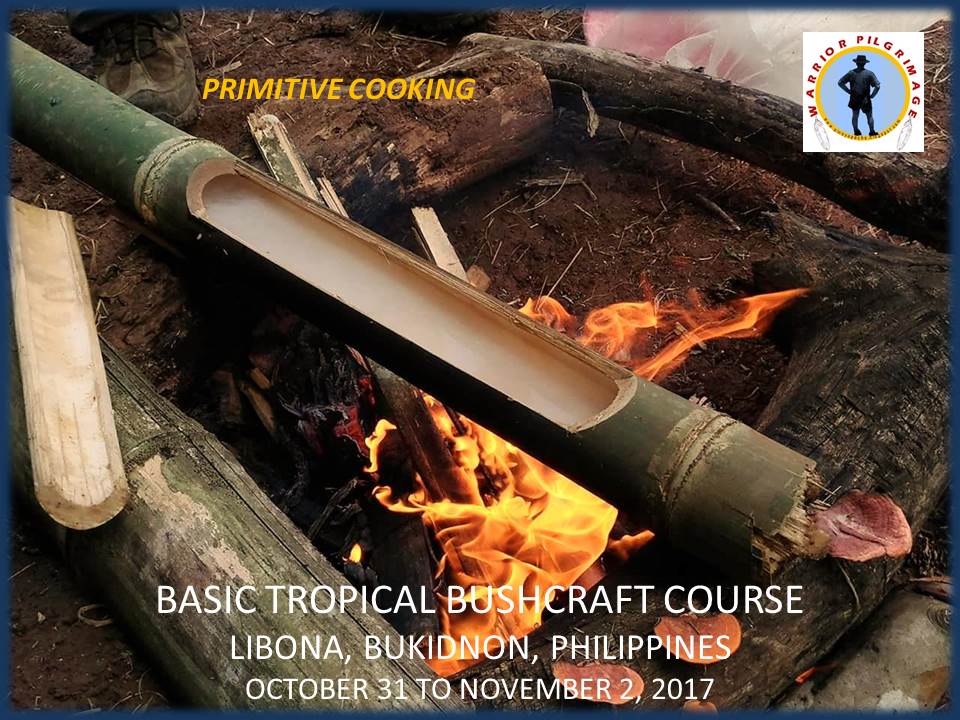
The BASIC TROPICAL BUSHCRAFT COURSE is almost the same as that of the ones I do and organize in the Philippine Independence Bushcraft Camp, held in Cebu annually. It always start with Introduction to Bushcraft. The participants learned the terminologies and jargon used in bushcraft; its preferred environment; its own psychology; its methodologies; and its difference from survival and from mainstream activities.

 
Then next is Ethical Bushcraft. The best practices of leisure bushcraft, using its own principles of Blend, Adapt and Improvise, to lower your obtrusive presence among forests and jungles and increases an individual’s safety and security. It covers trail travel, courtesy to locals, campsite location, fire management and camp hygiene. Ethical Bushcraft is taken from this author’s unfinished book of the same title.

After lunch and siesta, it is the turn for Knife Care and Safety to be discussed. This chapter changes the perspective of the knife into a useful tool instead. The Philippine law on the regulations of carrying a knife – Batas Pambansa Bilang 6 – are explained thoroughly and clearly as well as ethics and safety, care and sharpening, blade shapes, parts and grinds, and the Nessmuk Trio.

At 14:30, this author demonstrate Survival Tool-Making to the participants. This chapter is a practical exercise in knife dexterity and safety; taught them how to carve spoons, jugs and an improvised cooking vessel from a green bamboo pole; and create a digging stick from a thick straight branch. Aside that, this blogger gave them the idea how and where to source cords from nature. Next is Notches. Another knife dexterity session aided, this time, by a baton.

When dusk came, all activities ceased and the participants focused on the preparation of their meals under a slight shower. By 19:30, the campfire is lit and becomes the social center for the Campfire Yarns and Storytelling. This camp tradition does not need great company as long as the train of tales and laughter begins. Sometimes, a moderate round of alcoholic drinks move that into more tales and laughter. Rains came and ended abruptly the night socials.
  
The second day (November 1) starts with breakfast but after that, all will deny food the rest of the day, not until they have accomplished foraging their own food which comes later in the night. This is to simulate the hunger pangs associated when you are stressed in a survival situation. Everyone steeled themselves for this occasion. The day is warmer than yesterday but the ground is muddy.

The first chapter for this long day is Customizing the Survival Kit. It is better that survival kits are made from scratch than bought commercially because its size and components depend upon the type of the activity you are indulging in and the kind of environment you are going to visit. Your personal preference still matters although redundancy of some functions, like fire tools, luminosity, water collection and cutting devices increases security.

Then I proceed to Foraging and Plant Identification. This author discusses about traps and snares and what are the difference between the two; luring methods and trap lines; and foraging food and non-food. It also identifies which plants are edible, harmful and poisonous. The participants are then shown the different traps and snares that are set up in camp before touring the area around the camp for the common plants growing here.

Hearing distant thunder, I decide to proceed to Fire, Fuel and Campfire Safety. Understanding first how a fire is made is very important. You have to know the three elements of the fire triangle: fuel, heat and air. You cannot produce fire if lacking one element. Conversely, you can put out a fire by removing one. Lately, they added a fourth element – chemical reaction.

Making fire by friction is 80% common sense, 10% skill and 10% perspiration. Your fire can start if you can acquire and identify the right tinder, if you are in a dry place, and if you have the patience. In a very humid location, the presence of moisture in the atmosphere almost always hinder the production of ember needed to start a fire. Most of the time heat is stolen by the cooling effect of watery air.

Aside from friction, there is the conventional method which are matchsticks, lighters, ferro rods, and the flint and steel. Then there is solar magnification which can be done with magnifying lens in a cloudless day. Then you have pressurized air, exemplified by the fire piston. Since I do not have the luxury of time, I limit my demonstrations to the flint and steel, and the ferro rod. I also showed them how to make a tinder bundle. 

Demonstrated how the bow drill method is made and spun. Unfortunately, I could only make thick smoke as sawdust embers refused to light up my tinder due to humid conditions. Dark clouds are now overhead as the thunder gets nearer and nearer. I let others try the bowdrill, the ferro rod, and the flint and steel. The participants properly learned how to use the ferro rods. It ignites easily natural tinder.

By now, wisps of moisture started to drop. I demonstrated how the bamboo-saw method is made and scratched. As with the bow drill, I could only produce smoke. Moisture have penetrated the grains of bamboo. Racing against the rain, I tried again and failed. Four participants tried but in vain. I made another derivative of the bamboo-saw that could be done with two people. Smoke is thick and there is a promise of ember but it lived shortly. Then a strong downpour fell.

For the rest of the afternoon, we could do nothing but stay in our shelters. I could not discuss the rest of the topics and our Nocturnal Hunting is even jeopardized. Owing to circumstances beyond our control, I aborted it and gave a go signal to prepare their food for dinner. In wet conditions, I am able to make fire in my Swiss Army wood burner to boil water first for coffee and then for Japanese seaweed soup.

The heavy downpour caused the stream to overflow on the lowest places of the campsite but it necessitated the transfer of three tents nevertheless to better locations. The water current increased and became very noisy, alarming everybody. For a couple of hours we were awake, watching the stream, until the rains began to slow down. I relax with my watch and half-chased sleep.

In my comfortable hammock, rainwater found its way to my chest. I shifted my body so the drips would not fall on me but a cotton rope I used to tie the hammock with snapped and I fell hard with my hammock on the ground. I re-strung my hammock and my shelter setup hoping to stop the drips. I placed drip cords on the ridgeline of my shelter just like I did before on the ends of my hammock. After I have done so, the drips have stopped.

The last day (November 2), I was surprised to see that the bamboo viaduct have withstood the stream’s rising water last night and still supplied us with an uninterrupted clean water. The water is not cloudy. We prepared breakfast early for I have four more topics to discuss. Yesterday’s muddy ground are smoothed out by water but it is wise not step on the same surfaces.

After breakfast, we break camp and transferred uphill to be away from the din created by chainsaws used by locals who took advantage of a holiday to cut trees. The first one is Understanding Cold Weather. During mountain climbing, exposure to the elements is expected. There are five physical mechanisms that steal away body heat and the things that we should do to keep us constantly warm.

Next is Outdoors Common Sense. This is the subject matter that I based from my yet unpublished book, ETHICAL BUSHCRAFT. It is about trail courtesy and behavior while on the trail; choosing the best campsites; practicing stealth camping; increasing individual safety and security; wildlife encounters; and introduce people the idea of Blend, Adapt and Improvise.

Finally, the topic of Outdoor Cooking and Food Preservation gets its slot. Different ways of preserving meat, fish, vegetable and fruits. Getting equal discussion are the different kinds of fireplaces. After the lectures, author shows how the Trailhawk System of cooking rice in bamboo is done. The participants prepared their meal for lunch and when all got cooked, to include the rice inside the bamboo, we had our meal.

We packed up everything and hiked the three kilometers back to Libona and then to the terminal. From Libona, we rode on tricycles to Manolo Fortich and transferred to a van-for-hire. Destination is Cagayan de Oro City, which we reached at 18:00. We stayed for a while at a local restaurant for dinner and the post-event discussion and socials. I was tired but I was not sleepy. I noticed there was no curfew here but we have to end after midnight.

 
I found a vacant room at Rosario’s Place for I have a speaking engagement tomorrow evening (November 3) at Viajero Outdoor Centre. Coming here to Cagayan de Oro with a cargo of blades gave me fears of travel restrictions brought about by Martial Law. It turned out well but, going back to Cebu, a security guard made it a little hard for me with his wrong presumptions. Or was he just interested with my properties? My spring-bound lecture handbook made all the explaining for him.

The unpredictable weather of the highlands of Bukidnon is something that I have to give an extra consideration next time. I expected it to behave like all highlands do but I failed to give a thought that Bukidnon is a plateau where rainwater would be collected on a wide area instead of travelling fast and quick to the sea. Here, it accumulates slow and long before going down the different drainage systems.    

It was a productive moment not just for me, but also for my newly-found friends of Mindanao. At last, I was able to introduce bushcraft there and helped them become better outdoorsmen. My trip there would not have been possible without the sudden sparks of creativity by Earl and JP. For their efforts, I part my couple of Seseblades to them, courtesy of Dr. Arvin Sese, whose quality but affordable blades I had endorsed everytime I have training sessions.  

Document done in LibreOffice 5.3 Writer

Friday, March 13, 2015

BUSHCRAFT BUHISAN XXVI: Badassery

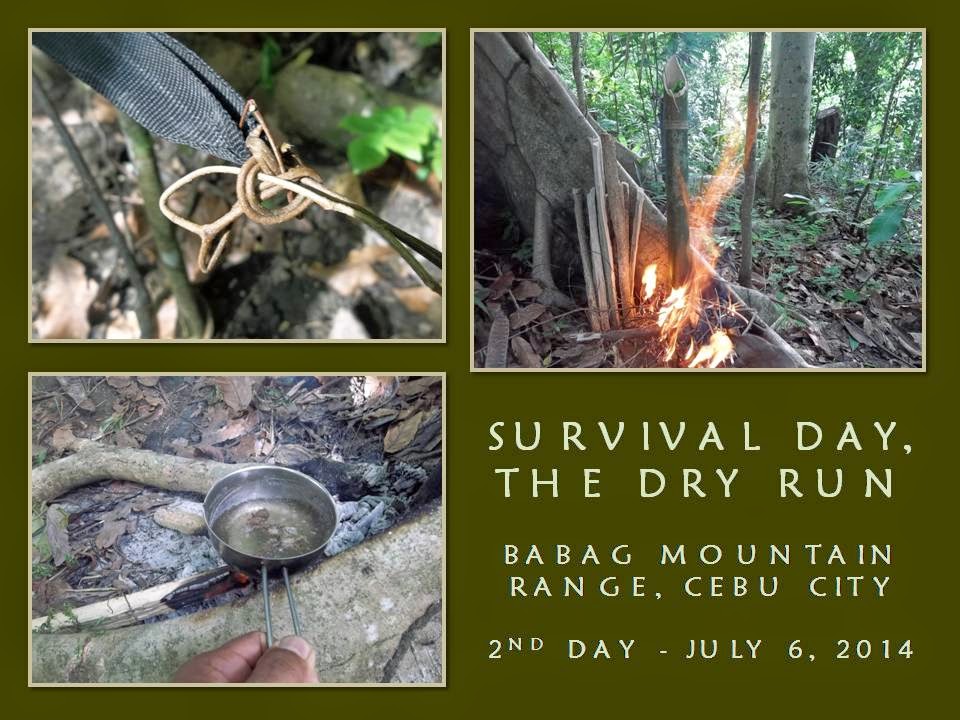
I REACHED HOME AT 12:30 and ate a hasty lunch ten minutes later. Then it began to rain. I am worried that I would be further delayed to embark on a solo journey today, July 5, 2014, because of this. When the rain stopped, I thanked all the saints and hurriedly left my residence at 13:10 and commute to Jones Avenue then to Guadalupe, then I hired a motorcycle to bring me to the trailhead at Baksan.

I carried an old-school desert-tan Lifeguard USA rucksack and, in it, is a camera tripod, an Apexus taffeta sheet, a box of safety matches and a stainless-steel cup. My tomahawk - my old adventure partner – is open carried, the haft slipped into my operator belt. To protect me from mosquitoes, I brought my Umbro long-sleeved shirt, a sniper mesh and my long-standing partner on a myriad of sleeping grounds – my bonnet. A Silangan side pouch housed my dilapidated Kodak camera and a cheap cellphone. That is all.


It is 13:50 when I started. I am almost two hours late. I should have released myself at exactly 12:00 for this novel activity called Survival Day. Survival Day answers to the requests of the Camp Red Bushcraft and Survival Guild to engage their members in an activity combining all the elements of bushcraft, survival, navigation and escape and evasion. A selected pair would engage on this overnight, preferably on a weekend, with a third man observing and documenting their activity. They would have to choose one place from among three sites.

When this was posted in Facebook, they were all taken by surprise. A daring few volunteered to enlist in a dry run but all bowed out at the last minute. Since I designed this activity, it is inherent in me to show all how it is done. To increase the ante, I will do this alone while doing the documentation myself. I choose the Buhisan Watershed Area, because that place is a perfect bushcrafter’s paradise. It is all jungle and home to some of the nastiest bugs.


From Baksan, I followed the path I had discovered to Creek Alpha. This route is already integrated into the old Lensa Trail which the locals had used for many years. The ground is wet but it is not slippery. Still, I opt to cut a green limb of a Mexican lilac tree (Local name: kakawate) as my walking stick. It is 7-and-a-half feet long and it is heavy. I pass by a teak forest and I look for dry leaves. Since it had rained all the time, I found just a few, crushed it, and placed it inside a plastic bag.

The grasses are waist high as I follow a low ridge then another adjoining ridge, this time climbing up to a hill which I loved to call as Boy T’s Hell. I pause for a while to study the somber sky, the verdant greenery and my back trail. I do not see a soul but I see traces of a rattan planting activity. They – the DENR1 or the MCWD2 – intend to discourage people from visiting the Buhisan by planting these like a hedge. It might be for a lot of reasons like wildlife poaching, illegal logging and, possibly, trail running, which the latter is downright hazardous if done here.

I go down the hill and follow another ridge where there is a tree with my trailsign. I found it and slowly trace the now-scant path. The walking stick is most helpful here as I get to pole vault over shallow ravines and save me the trouble of jumping without something to anchor on on slippery ground. Slowly, I reach the stream, after I had carefully maneuvered among spiny plants and those that I thought are toxic. You could never be too sure.


I am now on a very secluded trail, but very beautiful from whichever point of view you are in. The stream is full of water, clear and running. I carefully set my foot on stones when I walk on the river bed, intending to leave no trace of my presence even to the extent of climbing up on a path of loamy soil. I leave my presence at the top, but it is on a wrong trail. I do this all the time to fool anyone who might take advantage of my being alone. The Buhisan is still a dangerous place since it is a refuge of lawless elements.

I follow the path and pass by the old campsite of the first Philippine Independence Bushcraft Camp. Along the trail are very dry leaves of a dead Indian rhododendron shrub (yagumyum). I collected a lot which disintegrate itself into tiny bits when handled. I soon found my plastic bag of dry tinder getting bigger and bigger which my pants pocket could not accommodate anymore, so I decide that I have enough and place it inside my bag.

I walk on, scanning everything that might be edible, but the sky darkened and I hurry up. I reach Creek Bravo and I take a rest. This is the only place in the Buhisan where there are groves of water bamboos (butong, buho). The groves are located at a higher place and there are no paths there except through a small watercourse. I climbed up using my hands to gain footholds. Although I am bulky and heavy, that had never been a problem for me. I used to rock climb in the ‘90s and I still got a good eye-to-muscle coordination and a tight grip.


The groves have thinned as it had been harvested over several times and only a few healthy poles are left, most of it young. One grove is being burned down and I can not comprehend why? I do not want to cut the few remaining poles so I looked for poles that had already been cut and overlooked by the gatherer. I found one hanging on a tree with four segments and I am able to save two conjoined segments. I also found a smaller but pointed pole, about six feet long, on the ground. I bound the bamboos together with a vine so I could carry it easily.

The sky is getting somber and somber as the afternoon light is losing its intensity. I will carry my bamboos and wooden staff over an ascending ridge, on the lookout always for rattan tendrils. As I walk on higher elevations, the light improved, visibility clearer. I see wild mushrooms (kwakdok) on dead wood and I pluck these. I walk on and startle a brush cuckoo (sigigid) feeding on the ground. It had not noticed me coming until I am about five feet near. I see a lot of dry wood on the ground but I prefer those hanging in midair.

I am now approaching Camp Damazo and I notice one of a pair of huge wood pillars that had guarded its entrance had succumbed to decay. Ah, the place that had nurtured the finest products of the PIBC had recovered well, the fire ring of stones under the Moluccan ironwood tree (ipil) remained untouched. I am tempted to stay for there is an abundance of light here but I need to be at the water source first to study the possibility of camping near it and to placate my throat.


I found the natural spring and I drink two cups of the fine water. Fresh-water crabs inhabit here and it appears only during nighttime. It would be best if I could camp nearby so I do not have to walk far and burn up a makeshift torch. The torch is a problem though as I had not found a dry suitable material like palm leaves. Anyways, I cut the bigger bamboo in half so I could fashion a water container out of one while the other half as a catch bin should I push to catch crabs tonight. I carved a spout for the water container and punched a hole at this end, then I fill it full with water after washing it.

I look around and I see a promising place to camp but it is gloomy and a possible route of running water should it rain heavily. I backtrack to the spring and decide to spend the night near Camp Damazo instead. My lacking of a dependable lighting to illuminate my foraging in the night discouraged me but I leave the catch bin if ever I could find dry leaves as a torch, time willing. It is now almost 16:30 and I need to go back to Camp Damazo to take advantage of the light being plentiful there.

I size up the place and I see a good ground thirty meters away. I walk towards it and I found a perfect spot although I need to cut or break a young tree to achieve a good campsite. It is underneath three tall trees with a hardwood species of tree (tugas) growing underneath it. There are no rotting branches on the trees and should a piece of either tree fall, it would be caught by the branches of the shorter hardwood tree. Breeze comes from the valley below and would fill my shelter with smoke should I make a campfire in between.

I notice a swarm of small forest mosquitoes beginning to torment me and those big black ants appearing suddenly as all sensed me expending carbon dioxide. I need to keep moving to distract these insects. Immediately, I cut several stalks of a zingiber plant and lay it on the ground. I grab an armful of crawling ferns that had been choking a young tree and place it above the leaves laid on the ground so I could use it as a cushion for my body should I lie to sleep.


I draw out my taffeta sheet from my rucksack and tie the middle grommet holes to the tree trunks with laces from my Columbia hike shoes. I extend one part of the sheet as a low awning close to the ground, tying one end with a piece of black clothe that I had been using as a head band and the other end with a vine. The other half of the sheet I would use partly as a wall and partly to cover the leaves where I would be sleeping on. I retrieve a long pole lying on the trail so I could use this to retain the angle of the sheet wall firm.

I would not have carried the walking stick here without a purpose. I place it underneath the sheet that would be used as my sleeping area. It would be placed so it would keep me from rolling over and to restrict my body in one place so my body heat would not be wasted. I believe it would be cold tonight and I need to be warm. I will collect firewood, the ones hanging in midair. I found many and I break the twigs into three different kinds: pencil lead size, pencil wood size and thumb size.

I make a nest of tinder and kindling beside a jutting root of an arbor tree, which act as a shield, before I struck my first match. Humidity causes the dry leaves to absorb moisture quickly and, until I struck my fourteenth matchstick, I was able to make a roaring fire. I feed dry firewood and collect bigger wood which I cut and split with my tomahawk. I drag some more and keep it off the ground. The mosquitoes and ants begins to disappear as it senses wood smoke. I can now rest easy and feed the fire from time to time.


I drag some felled branches with dried leaves still attached to it and use it to camouflage my shelter. By 19:00, I take rest inside my open shelter, donning the long-sleeved shirt and the bonnet. The mesh, will cover my head, upper body, arms and hands. I listen to the sounds of the jungle. I can hear hundreds of geckos inhabiting this part of the Buhisan. You could distinguish each individual by the timbre and manner of their croaks. Also grabbing attention are jungle fowls, a myriad of birds, frogs and a cry of a palm civet.

The mosquitoes, they came, and how they loved to hover near the ears. I move to my side and pray when would this torment end. When the breeze shifted direction, the mosquitoes would be gone but when the breeze disappears, it would be back with a vengeance. Fed up with my failure to gain sleep, I feed another set of firewood to my small campfire at 20:30. My eyes had already adjusted to the darkness that I could walk my way around to take a leak. The whole place is now foggy.

The strong winds came and all creatures are silent. Rain will come soon. I hear branches breaking, a lot of it falling to the ground. A low pressure area near Luzon had been bringing all these rains and a very strong tropical typhoon (Glenda) is looming in the Pacific, approaching my island by the hour. It is raining lightly but it never affected my fire. A few drops fell on it and I thought it at first as a person walking on grass (as raindrops hiss on embers) but it is only my mind playing games on me.

The mosquitoes, well, they remained when the breeze shifted to another direction and would be gone again when the smoke filled my shelter. I begin to feel my stomach complaining without dinner. I rise again from bed at 22:00 and feed my fire with enough firewood. A strong downpour fell but the fire kept roaring and thick smoke would emerge when a few raindrops found its way there. My struggle with the pesky insects continue on until past midnight where I rise again and feed my fire.

I hear the beautiful melody of a black shama (siloy) and unbelief is written all over me that I had really slept. I look at my wristwatch and it is 05:30. The second day (July 6), at last, but I am not in a hurry. I peek at my fire and all the wood are burned out. I go back to sleep. I wake up again at 07:00 and rise to rekindle my campfire alive. I prepare another nest of tinder and light twigs and it took matchstick No. 21 before it roared to life.

I will heat up the water inside the bamboo that I had collected yesterday. After 45 minutes, steam begins to appear from the spout. I get my cup and poured me a good-quantity of the bamboo-flavored water. Then I place wild mushrooms that I had foraged yesterday on the liquid and set my cup above the embers to boil it into a soup. “Wild mushroom soup, that is the menu for breakfast sir.” It might be inadequate but, at least, it is nourishment.

Breakfast at 09:00 and I sit still on a rock listening to the melodic chants of two individual black shamas and the buzz of the cicadas. Suddenly, from out of nowhere, a reddish cuckoo dove (tubaon) perched on a dead wood three feet away from me. It eyed me curiously for about fifteen seconds and transfer to a young tree at my back. I could not resist the temptation of moving my head after 30 seconds to see its beauty and it flew away. Oh, such little pleasures give meaning to life.


I take advantage of the sparse sunlight on the open spaces of Camp Damazo and I drink two cups of the bamboo tea. Noontime is still far and I have to kill time by taking a little exploration of a ghost trail that I had noticed below my place. I go back and try my reflex on my tomahawk. The remaining wood pillar becomes my target board. I am quite rusty, my throws lacked consistency now as I have not had the time to practice it anymore, unlike in the old days when I was engaged in a warrior’s pilgrimage.

Two hours more to go. Boredom led me to my shelter. I feed the fire and lay down. Strong winds from the southwest arrive and everything becomes silent. It rained again. I wait out the rain under the dry safety of my shelter. It is a light rain or it might be the canopies filtered this into something more tolerable. I close my eyes and I awakened at 11:30, thirty minutes more and I will be on my way.

When 12:00 do arrive, I break camp, put out my fire and put everything in order. I carry the pointed bamboo as my staff. I pass by the natural spring and drink two cups of the refreshing water. The female bat that I had startled yesterday near the spring is surprised again by my presence and flew away. I cross two small streams, probably these are the upper parts of the streams I crossed yesterday. The route is uphill now and I take it slow, resting twice, each for 30 seconds.

I reach Baksan Road at 12:45 and I feel good. The struggle would be easy now as it is downhill all the way to Lanipao. When I arrive at the place, I just rest a minute before resuming to the designated rendezvous point – Napo, which I reach at 13:10. I could have gratified myself with cold refreshment and biscuits but I intend to do it at Guadalupe instead. I still have an extra 10 miles of resistance and I believe I could do that.

Guadalupe at 13:30 and I reward myself with a humble lunch in a small store. Then I proceed to the Red Hours Convenience Store to recoup my electrolytes with cold bottles of San Miguel Cerveza Negra. It was a worthy two days of solitude which would perfectly change the game of how the outdoors would be best enjoyed here in the Philippines. Being badass is not always bad and, sometimes, in my dreams, I liked to to toy with the idea of creating a new hobby called BADASSERY3.

Document done in LibreOffice 3.3 Writer

1Department of Environment and Natural Resources.
2Metropolitan Cebu Water District.

3It is coined by Conal Robbie when he commented on my June 24, 2014 article titled “Bushman Blogger Badass”. Conal is the owner of the blog www.crucifixio.wordpress.com.