Showing posts with label Bukidnon. Show all posts

Saturday, September 22, 2018

THE TRAILHAWK JOURNEYS: Bukidnon Bushcraft Training

MINDANAO IS UNDER MARTIAL LAW and I do not forget that. There was an urban war in Marawi City fought by the government forces against ISIS which had ended more than a month ago. I travelled a month earlier to Davao City to test the climate of uncertainty painted by media. There was indeed a military presence there, which is fair enough. Would it be okay to travel there again with bladed tools? I have to find that out myself.

You know, I have never taught bushcraft and wilderness survival in Mindanao and I waited for many years for that opportunity until Earl Ryan Janubas and JP Echavez, both of Cagayan de Oro City, organized one for me. Martial Law have curtailed travel of Mindanaoans to their most famous mountain destinations and they needed an alternative outlet for their thirst of adventure. That is when they contacted me.

Going by plane to Mindanao is out of the question for me, although travelling in it with blades is the most convenient. The transfer of the airport location of Cagayan de Oro, in Lumbia, to the Municipality of Laguindingan a few years ago is too far for my own comfort. The boat is my best option even if I have to unload my bladed tools to security for safekeeping while I am in the boat and it would travel with me anyway.

As an outdoors educator and survival instructor, blades play a very important role in all my classes and training instructions. Blades make easy work and these are educational aids and tools. Trusting to my good judgment, I carried some of my best blades with me like the AJF Gahum, Pandoy Pulido Pinahig, Condor Bushlore, Mora Companion, Knifemaker Camp, Seseblade Sinalung, Seseblade Matavia, a Browning and a Victorinox Trailmaster. Coming also is my veteran tomahawk.    

I travelled by boat in the evening of October 29, 2017 bound for Cagayan de Oro. Earl and JP would be expecting my arrival the following day. I arrived in the morning of October 30 and JP came to fetch me and whisked me to Focal Matters, a photography studio located at Capistrano and Yacapin streets where Earl is the resident photographer. After lunch, Earl and I travelled to Libona, Bukidnon on his Honda CG125, along with JP with his motorcycle.

We followed a newly-opened road that go through the backcountry of Indahag and Gango and arrive at Libona at around 15:00. We made a courtesy call to the village head of Poblacion and then to the community leader where we would make our camp for three days. It is in the property of Earl’s brother. We visit it for a brief inspection. It passes by a big pineapple farm and a trail lead to a stream.

Beside the stream is a narrow piece of ground good for eleven tents and some trees could host a few hammock pieces. It had been raining here for the most part of the week and the stream is deep with color associated with floods. I have my concerns but I am hoping that weather will get better. It is sunny and warm but the highlands has a weather of its own. I cannot rely on a weather forecast from a mere phone application.   

Earl and I returned to the town and made it to the house of his brother. We will both sleep there so we could be early to the campsite while JP need to go back to CDO. Bukidnon, by its location in the highlands of Mindanao, always has cold nights. It was colder still when there was a heavy downpour in the middle of the night which did not stop until the earliest hours of dawn. That got me worried about the stream and the campsite.

After breakfast of October 31, Earl and I went back to the campsite at 07:00. The stream have not risen that much. Only the color became more brown and the current more brisk than yesterday. I am assured of a very sunny morning and I hoped that the weather will turn out the better for the rest of the day. We choose this site because of its proximity to a natural spring located across.

I looked for a couple of trees, not far enough from each other and not near enough, and finding one such place, I left my bag. I choose the best location where I would be safe if the stream overflow but near enough to the rest. Open carrying my AJF Gahum, I go back up the slope and looked for a good place to make a latrine. Found one under a copse of cassia trees and dug a hole with a digging stick sharpened by my knife.

Then I foraged materials as educational aid for the outdoors seminar like dry and green bamboos, firewood and dry leaves. After an hour, JP and eleven participants arrived, including two high school students from Xavier University. One participant even brought his two dogs. All set up tents on the grassy ground while two of them found a place for a hammock.

Part of the morning was spent setting up shelters and diverting the flow of the natural spring by a bamboo viaduct, crossing over the stream into our campsite. Dry bamboos are abundant and I do not have to cut poles since there are many left rotting on the ground and a few are left hanging. I choose the clean ones for our improvised water span, propping it high enough from even an increase of a meter of flood.

The BASIC TROPICAL BUSHCRAFT COURSE is almost the same as that of the ones I do and organize in the Philippine Independence Bushcraft Camp, held in Cebu annually. It always start with Introduction to Bushcraft. The participants learned the terminologies and jargon used in bushcraft; its preferred environment; its own psychology; its methodologies; and its difference from survival and from mainstream activities.

 
Then next is Ethical Bushcraft. The best practices of leisure bushcraft, using its own principles of Blend, Adapt and Improvise, to lower your obtrusive presence among forests and jungles and increases an individual’s safety and security. It covers trail travel, courtesy to locals, campsite location, fire management and camp hygiene. Ethical Bushcraft is taken from this author’s unfinished book of the same title.

After lunch and siesta, it is the turn for Knife Care and Safety to be discussed. This chapter changes the perspective of the knife into a useful tool instead. The Philippine law on the regulations of carrying a knife – Batas Pambansa Bilang 6 – are explained thoroughly and clearly as well as ethics and safety, care and sharpening, blade shapes, parts and grinds, and the Nessmuk Trio.

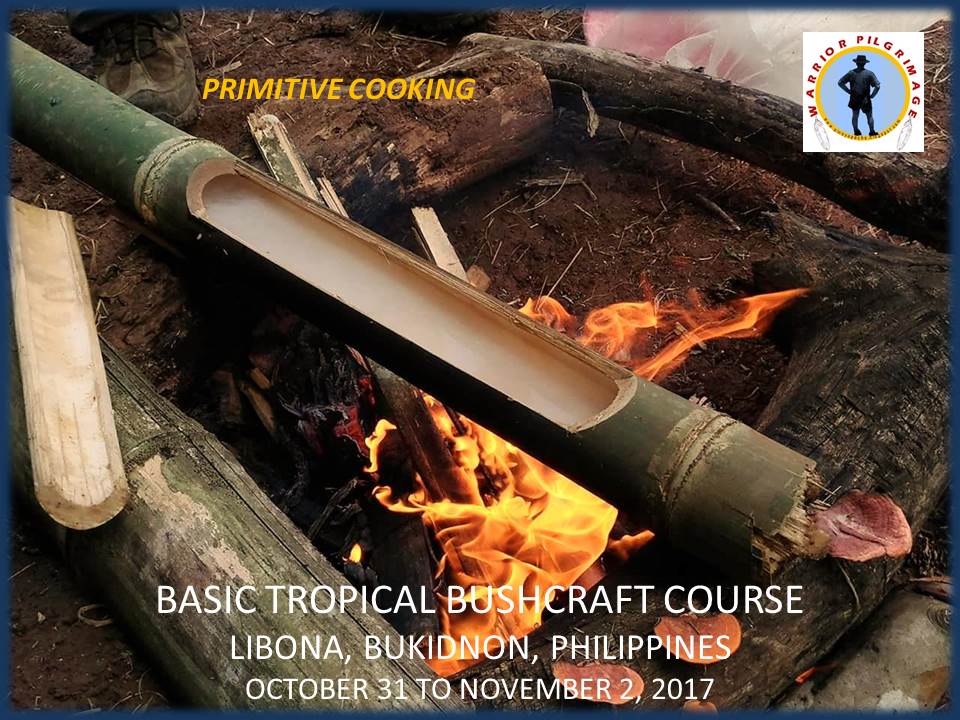
At 14:30, this author demonstrate Survival Tool-Making to the participants. This chapter is a practical exercise in knife dexterity and safety; taught them how to carve spoons, jugs and an improvised cooking vessel from a green bamboo pole; and create a digging stick from a thick straight branch. Aside that, this blogger gave them the idea how and where to source cords from nature. Next is Notches. Another knife dexterity session aided, this time, by a baton.

When dusk came, all activities ceased and the participants focused on the preparation of their meals under a slight shower. By 19:30, the campfire is lit and becomes the social center for the Campfire Yarns and Storytelling. This camp tradition does not need great company as long as the train of tales and laughter begins. Sometimes, a moderate round of alcoholic drinks move that into more tales and laughter. Rains came and ended abruptly the night socials.
  
The second day (November 1) starts with breakfast but after that, all will deny food the rest of the day, not until they have accomplished foraging their own food which comes later in the night. This is to simulate the hunger pangs associated when you are stressed in a survival situation. Everyone steeled themselves for this occasion. The day is warmer than yesterday but the ground is muddy.

The first chapter for this long day is Customizing the Survival Kit. It is better that survival kits are made from scratch than bought commercially because its size and components depend upon the type of the activity you are indulging in and the kind of environment you are going to visit. Your personal preference still matters although redundancy of some functions, like fire tools, luminosity, water collection and cutting devices increases security.

Then I proceed to Foraging and Plant Identification. This author discusses about traps and snares and what are the difference between the two; luring methods and trap lines; and foraging food and non-food. It also identifies which plants are edible, harmful and poisonous. The participants are then shown the different traps and snares that are set up in camp before touring the area around the camp for the common plants growing here.

Hearing distant thunder, I decide to proceed to Fire, Fuel and Campfire Safety. Understanding first how a fire is made is very important. You have to know the three elements of the fire triangle: fuel, heat and air. You cannot produce fire if lacking one element. Conversely, you can put out a fire by removing one. Lately, they added a fourth element – chemical reaction.

Making fire by friction is 80% common sense, 10% skill and 10% perspiration. Your fire can start if you can acquire and identify the right tinder, if you are in a dry place, and if you have the patience. In a very humid location, the presence of moisture in the atmosphere almost always hinder the production of ember needed to start a fire. Most of the time heat is stolen by the cooling effect of watery air.

Aside from friction, there is the conventional method which are matchsticks, lighters, ferro rods, and the flint and steel. Then there is solar magnification which can be done with magnifying lens in a cloudless day. Then you have pressurized air, exemplified by the fire piston. Since I do not have the luxury of time, I limit my demonstrations to the flint and steel, and the ferro rod. I also showed them how to make a tinder bundle. 

Demonstrated how the bow drill method is made and spun. Unfortunately, I could only make thick smoke as sawdust embers refused to light up my tinder due to humid conditions. Dark clouds are now overhead as the thunder gets nearer and nearer. I let others try the bowdrill, the ferro rod, and the flint and steel. The participants properly learned how to use the ferro rods. It ignites easily natural tinder.

By now, wisps of moisture started to drop. I demonstrated how the bamboo-saw method is made and scratched. As with the bow drill, I could only produce smoke. Moisture have penetrated the grains of bamboo. Racing against the rain, I tried again and failed. Four participants tried but in vain. I made another derivative of the bamboo-saw that could be done with two people. Smoke is thick and there is a promise of ember but it lived shortly. Then a strong downpour fell.

For the rest of the afternoon, we could do nothing but stay in our shelters. I could not discuss the rest of the topics and our Nocturnal Hunting is even jeopardized. Owing to circumstances beyond our control, I aborted it and gave a go signal to prepare their food for dinner. In wet conditions, I am able to make fire in my Swiss Army wood burner to boil water first for coffee and then for Japanese seaweed soup.

The heavy downpour caused the stream to overflow on the lowest places of the campsite but it necessitated the transfer of three tents nevertheless to better locations. The water current increased and became very noisy, alarming everybody. For a couple of hours we were awake, watching the stream, until the rains began to slow down. I relax with my watch and half-chased sleep.

In my comfortable hammock, rainwater found its way to my chest. I shifted my body so the drips would not fall on me but a cotton rope I used to tie the hammock with snapped and I fell hard with my hammock on the ground. I re-strung my hammock and my shelter setup hoping to stop the drips. I placed drip cords on the ridgeline of my shelter just like I did before on the ends of my hammock. After I have done so, the drips have stopped.

The last day (November 2), I was surprised to see that the bamboo viaduct have withstood the stream’s rising water last night and still supplied us with an uninterrupted clean water. The water is not cloudy. We prepared breakfast early for I have four more topics to discuss. Yesterday’s muddy ground are smoothed out by water but it is wise not step on the same surfaces.

After breakfast, we break camp and transferred uphill to be away from the din created by chainsaws used by locals who took advantage of a holiday to cut trees. The first one is Understanding Cold Weather. During mountain climbing, exposure to the elements is expected. There are five physical mechanisms that steal away body heat and the things that we should do to keep us constantly warm.

Next is Outdoors Common Sense. This is the subject matter that I based from my yet unpublished book, ETHICAL BUSHCRAFT. It is about trail courtesy and behavior while on the trail; choosing the best campsites; practicing stealth camping; increasing individual safety and security; wildlife encounters; and introduce people the idea of Blend, Adapt and Improvise.

Finally, the topic of Outdoor Cooking and Food Preservation gets its slot. Different ways of preserving meat, fish, vegetable and fruits. Getting equal discussion are the different kinds of fireplaces. After the lectures, author shows how the Trailhawk System of cooking rice in bamboo is done. The participants prepared their meal for lunch and when all got cooked, to include the rice inside the bamboo, we had our meal.

We packed up everything and hiked the three kilometers back to Libona and then to the terminal. From Libona, we rode on tricycles to Manolo Fortich and transferred to a van-for-hire. Destination is Cagayan de Oro City, which we reached at 18:00. We stayed for a while at a local restaurant for dinner and the post-event discussion and socials. I was tired but I was not sleepy. I noticed there was no curfew here but we have to end after midnight.
 
I found a vacant room at Rosario’s Place for I have a speaking engagement tomorrow evening (November 3) at Viajero Outdoor Centre. Coming here to Cagayan de Oro with a cargo of blades gave me fears of travel restrictions brought about by Martial Law. It turned out well but, going back to Cebu, a security guard made it a little hard for me with his wrong presumptions. Or was he just interested with my properties? My spring-bound lecture handbook made all the explaining for him.

The unpredictable weather of the highlands of Bukidnon is something that I have to give an extra consideration next time. I expected it to behave like all highlands do but I failed to give a thought that Bukidnon is a plateau where rainwater would be collected on a wide area instead of travelling fast and quick to the sea. Here, it accumulates slow and long before going down the different drainage systems.    

It was a productive moment not just for me, but also for my newly-found friends of Mindanao. At last, I was able to introduce bushcraft there and helped them become better outdoorsmen. My trip there would not have been possible without the sudden sparks of creativity by Earl and JP. For their efforts, I part my couple of Seseblades to them, courtesy of Dr. Arvin Sese, whose quality but affordable blades I had endorsed everytime I have training sessions.  

Document done in LibreOffice 5.3 Writer

Monday, June 1, 2009

THE BACON HUNTERS OF MOUNTS DULANGDULANG & KITANGLAD

...Bring home the bacon!”, Dr. Abe Manlawe seemed to scream through a text message in my cell phone screen on the morning of June 5, 2008 goading us to bring the Cebu Mountaineering Society (CeMS) banner to the crowns of Dulangdulang and Kitanglad in a span of three days, a feat unprecedented yet in CeMS history. Officially named The CeMS Memorial Climb and Trek; which is held every June of each year to honor the memories of Sir Joe Avellanosa, Roy Tabanao, Penpen Mitchell, Dodong Polancos and Tio Paeng Tura; the planned activity will traverse the second and fourth highest Philippine mountains and then camp on each of their peaks.

Despite the uncertainties and anxieties that hound our preparations since Day 1 of our training where, in what was originally a 14-climber team composition, it was decimated by injuries and other commitments that left only eight determined souls: Lilibeth Initan, Boy Olmedo, Jon Consunji, Julienne Rosales, Sam Lim, Loklok Caumeran, Aldrich Paypon and Jing de Egurrola.

And so, on the night of June 5, at exactly 8:00 PM, these eight “bacon hunters” in commemorative brown t-shirts left Cebu Harbor for the Port of Cagayan de Oro on board M/V Doña Rita to take on that challenging task. It was not an easy trip for one good reason: it coincided with the opening of classes. Most of us have children and Julienne is a teacher herself. We might be physically present to embark on this trek but our minds are wandering far away to our respective homes!

We arrived at Cagayan de Oro at 6:30 in the morning of June 6 under a sunny sky and proceeded right away to the Agora Bus Terminal and took a bus bound for Malaybalay City in Bukidnon Province and arrived thereat to take lunch and go shopping for other essentials like food. At 2:00 in the afternoon, we took a public utility jitney for the town of Lantapan and then for Barangay Bul-ogan, nestled in the foot of Mount Dulangdulang and within the ancestral domain of the Talaandig tribe.
Our guide, Michael John “Mijan” Pizarro, met us at Cagayan de Oro City to facilitate our meeting with the head of the Talaandig tribe – Datu Boronay – and later, our resting place for the night in the house of our gracious host – Edgar Ladera and family – who accommodated all of us in their humble abode.

Later, we were invited to the house of Datu Boronay to attend a Talaandig tribal ritual of asking for permission to enter the Kitanglad Mountain Range and a blessing from their god Magbabaya to give us a good journey where we provided three live fowls as sacrifice offering, a square meter each of red and white cloth, coins and a bottle of Green Perico Mallorca - a distilled alcoholic drink. After the ritual we were each given strips of white cloth to carry on to Mt. Dulangdulang and ate chicken and rice together with the datu and his tribesmen.

Datu Boronay related to us the special importance of Mounts Dulangdulang and Kitanglad in their folklore when, according to the oral tradition passed on to him thru many generations, there was a great flood where only a man and a woman were the only survivors. The man clung to the top of Kitanglad while the woman at Dulangdulang. When the flood receded the man and the woman, thru Magbabaya's will and design, met and produced offsprings that grew numerous through time, whereby, it became the ancestors of the four original tribes of Mindanao Island: the Talaandig, the Manobo, the Maranao and the Maguindanao. The word “dulangdulang”, according to them, meant “a place of ritual” where, in some instances, they would climb the mountain and ask favors from the gods and spirits that inhabit therein with indigenous rites and sacrifices.

We slept at the house of the Ladera family after consuming three 750 ml. bottles of Tanduay Rum 5 Years chased with powdered juice and tea to combat the night chill brought about by rains. It was very cold and I was having trouble sleeping despite my intoxication with alcohol as winds seeped in through the bamboo floorings!

Early morning of June 7 begun under a shroud of intermittent rains. We began our quest to climb Mt. Dulangdulang at 9:00 AM, following a vegetable road that got higher and higher. The road was boulder-filled and running water left deep and wide furrows along the road which we evaded or leapt over and it took us an hour and forty-five minutes to reach the junction where the trail to Dulangdulang led. We were in high spirits and we walked a good pace in the open terrain which normally would take two hours, at the least.

The trail to Dulangdulang changed abruptly as lush vegetation pervaded the area and the trail became slippery especially when stepping on boulders teeming with moss. Fallen trees blocked the trail on many points that we either stepped over or crawled under or sometimes the next stepping stone were so high that we have to grasp and grab at anything to gain a foothold. We climbed steadily for more than an hour until we went downhill for a short distance and crossed a small mountain stream that refreshed our thirsty throat. Just above the water source there was a small clearing and we took lunch there.

It was very clear that, despite the cold brought forth by the rain, we were sweating hard and we were gasping for breath. We pushed on following Mijan the guide and the trail led to more crawling under felled trees. It twisted and bended and twirled, up and down; then more ups and downs and more twisting and bending and twirling until we could not sweat anymore as the cold ruled the higher altitude. Here, I could hear the howling winds racing above in jetstreams hastening our decreasing resistance to the cold.
As we pushed on higher, moss as thick as a carpet clung to branches and trunks of young and old trees alike, logs, boulders, even on the soil. Tree branches and twigs hung low making navigation along the trail a nasty undertaking. This part of Dulangdulang is a trail full of backpack snatchers; a certified shoulder-strap buster!

Many times I would find myself crawling on all fours and never have I seen myself bowing before the will of nature except here in these trails of Dulangdulang! Once, I found myself slithering forward on my belly to evade a fallen log that blocked the way, my heavy Habagat Venado II scraping hard the undersides of the dead tree and fully documented by Julienne with clicks from her digicam.

I have been on a similar terrain and like difficulty before afforded by blocking tree trunks and snarling branches and twigs and bouncy hanging trails in the slopes of Mount Talinis in Negros Oriental, but it seemed, the number of times I struggled myself crawling and and evading overhead obstacles are ten times more in consistency here in Mt. Dulangdulang than in Talinis and the vegetation here are much wilder and the trail longer. Mount Apo was very cold but, here, I lose almost all resistance to it and I barely survived!

The rains never abated and I never saw nor seen signs of animal or bird life in this part of Dulangdulang except, perhaps, by one Mindanao robin which fluttered and suspended in the air inches away from my face for about eight seconds or more, who seemed unperturbed and unafraid by my uninvited presence.

Two in the afternoon here without naked sunlight made us thought it was almost sundown thus we sped up our pace and, without our knowing, drained us of strength as we found ourselves gasping for air and resting often. An hour later, I came into a rare clearing and here visibility was greater as more light could penetrate through the foliage. It was amazingly green here as moss grew thick and covered whatever bare spaces afforded by wood, stone or soil. This is my first time to see a great moss forest and it was partly shrouded in mist. This is where the Talaandigs make their rituals.

Along these trails were many old trees where their trunks and branches twisted in different grotesque forms and it was so eerie and strange. Here, I began to notice strange white things lurking nearby which got caught in my peripheral vision as I passed along. I ignored these. Also here, my Breitling wristwatch began to behave strangely as I registered dial readings of 3:20 PM, then 3:00 PM, and then 6:00 PM in a span of forty-five minutes! As I related these events later to all, Aldrich thought he noticed something on that place that made his hair stand while Mijan confirmed my observations that there indeed are spirits lurking there which bothered many climbing parties before us.

At 4:00 PM, a very big boulder seemed to block the trail but we overcame it by climbing over the obstacle and behind it where broken tree limbs and branches and other debris which we slowly negotiated fearing accidents. Then we climbed up a very steep trail before reaching our campsite for the night – Manny's Garden1.
Under the howling winds that are still racing above us and rains that seemed to fall without end, we set up our tents, six in all. I pitched mine, a borrowed Apexus Halcon, and shared space with Loklok, my neighbor. It was very very cold and windy making preparation of our food very difficult as the winds, time and again, would snuff the stove flames cold. I ate only a fourth of my normal load of dinner. Again, as at the Talaandig village, I was having trouble sleeping.

In the morning of June 8, the winds never stilled and so were the rains. Everybody were so timid and would rather stay inside the comforts of their tents away from the elements. I tried to rally everyone by clearing my tent at 7:45 AM, but to no avail. Everyone suffered from the cold; even I, who tried to hide the discomfort by going half-naked for thirty minutes for acclimatization, shook hard and my teeth chattered.

When, finally, the last tent had been stowed, we moved from Manny's Garden at 10:45 AM towards the peak of Mount Dulangdulang, still shrouded in fog despite near noon. We tied the strips of white cloth in the branches of stunted tinikaran trees that towered over makeshift little shrines like those we saw practiced in the Himalayas. Coins were offered to the mountain gods on the makeshift shrines covered with red and white cloths.

At 11:00 AM, we started downhill for the next objective – Mount Kitanglad. It was dangerously steep and very very slippery and then we came upon a rock face where a small brook ran below it and we negotiated down from there by sliding from a rope. It was slow painstaking work. We went down and down and would have been glad to be in a much lower altitude but, it seemed, the winds kept following us. The rains made slippery work on the trail and I found myself falling face flat on three separate occasions (which no one saw) grasping on roots and young limbs to prevent myself from falling from a sheer height – three close calls which drained me of strength!

Along the jagged trails I began to feel dizzy and tried to remedy it by eating trail snacks, but as I traveled some more it became apparent that I have to eat my pack lunch of omelet and half-cooked rice ASAP! At 1:30 PM, I ate my meal by my lonesome self beside the trail and took only four spoonfuls of the half-cooked rice with the aid of water while discarding the rest of the rice away, except the omelet. My hand shook as I ate and I have to stabilize the hand with the other in order to put the spoon in my chattering mouth!

I followed the trail that Mijan marked and it twisted and bended and twirled its way through the same mossy forest of low hanging branches and twigs, fallen logs, thorny thickets and vines and it was so dizzying and draining as I have to crawl, stoop and fought to wriggle my unwieldy backpack through these obstacles that are somewhat endless. God knows of how many branches and twigs I snapped to break myself free from their grasp and that struggle left me scratched and bleeding in my arms and legs! Not to mention, the volume of body heat that I surrendered on that stretch.

I finally caught up with Mijan, who was in a bind of what trail to follow as he surmised and shared to me that he lost the trail and was beginning to grew more worried when he learned that Sam was not with me and might be lost himself. He backtracked and I followed likewise.

It was already 4:30 PM and still a lot of dangerous ground to cover under a failing light to reach Mt. Kitanglad, so we decided to bivouac and pitched four tents on a small clearing while Mijan retraced his trail to look for the correct direction and for Sam.

Everybody were drenched wet and shaking from the cold, despite several layers of dry clothing beneath raincoats or jackets; fingers numb and cold in spite being covered by mittens and gloves; teeth chattering as wisps of cold air stabbed through protective layers. Nobody gave a damn to venture outside the tents once we settled in and, by good fortune, the ever industrious Aldrich (may the Lord increase his tribe) gave me a cup of hot chicken noodle soup as our dinner which Loklok and I sipped with gusto! It was the third straight night that I missed that elusive sleep as it was so very cold – the coldest I have ever experienced yet.

We decided to rise early and braved the cold, this time without the rain. There were no hot coffee servings and steaming meals and we all ate a cold and dry breakfast of a handful of cereals without milk. At 8:00 AM of June 10, we broke camp and proceeded to follow the faint trail marked by Mijan for us. Forty-five minutes later, we finally found Mijan's and Sam's campsite on a large clearing and it was a welcoming site. We celebrated our reunion with Sam by sharing more of these cereals which we have reserved on the trail. Sam, actually, was not lost, and was following the correct trail after all. It was only Mijan, then me, who got lost! After a short prayer from Jon invoking the Lord for guidance and protection we continued our journey for Mt. Kitanglad.

We walked in an improved speed and pace under a rainless sky and coupled by the blessing of the sun's heat, even though how slight, that broke through from small gaps of the thick clouds and mists on that high altitude and, despite the surge of wind speed in open and exposed areas, we were very determined to reach Mt. Kitanglad at noon and be off for Cagayan de Oro City to board a boat for Cebu at 8:00 PM.
But, it was not to be. We still struggled on the same terrain just like the ones we passed by before. There were still the pesky thorns and low hanging branches, as well as old trees that blocked the way, but it created less and less problems as we climbed on higher, until cane grass or bugang grew in abundance along the shoulders of Kitanglad. There were now lesser sturdy handholds like tree roots and branches and the trail became deceptively dangerous as it is now very precipitous and exposed to the racing winds with only the cane grass as your only option to grab as your anchors for your ascent.

At this juncture, the last obstacle towards Kitanglad stared down from us. It was an 87-degree slope with scant handholds save for those unreliable cane grass and it was 35 to 40 feet high! Mijan went first and rigged our 17-meter dynamic rope from above a ledge where a lone stunted tree provided as anchor. We decided to add and tied an 8-meter twilled nylon rope so it could reach the staging area. It was slow progress as eight of us took turns following the first man. An hour and a half later, I closed the gap and unrigged the ropes from the precipice.

At exactly 12:00 noon, we took our lunch at the peak of Mount Kitanglad amid the imposing relay and repeater towers of commercial telecommunication firms. A detachment from the Philippine Army were so kind enough to loan us their supply of rice, a big cooking pot and cooking fires that Mijan, Julienne and Aldrich prepared and cooked. We appreciatively repaid those with our own supply of rice that were stowed deep in the bowels of our backpacks of whose weight we were glad to part with.

Thirty minutes later, we descended downhill for the lowlands and warmer air. The trail were devoid of thick vegetation unlike those that were found on Dulangdulang but is deceptively dangerous as well for there were smooth boulders, some with moss on it that, failure to step squarely on those would result to grave consequences like bumps and sprains, or worse, a broken bone. All told there were twelve steel staircases installed all along the different points of the trail giving easy access to and fro.

It was a long downhill trek that ended at a farm-to-market road strewn with big boulders and great depressions on the soil caused by running water that left navigation by motorized vehicle a dangerous occupation. We walked on for several kilometers intending to reach Barangay Intavas of Impasud-ong Municipality by 4:00 PM, but sadly though, we could not muster enough energy to put up a torrid pace and so, the last man reached Intavas at 6:00 PM and too little time. Time was not on our side there and we accepted the fact that we cannot board the boat that would take us to Cebu that night.

We decided instead to celebrate our successful adventure with a hearty meal of three lechon manok in Malaybalay City. Later, we checked in at the Plaza View Tourist Inn near the city square and a stone's throw away from St. Ignatius Cathedral and finally slept soundly for the first time in four days! Wow...

We left Malaybalay City after lunch for Cagayan de Oro City on board an aircon bus and arrived at 3:00 in the afternoon at the Agora Bus Terminal and, later, we decided to while away our time window shopping at Limketkai Shopping Mall where Ferdie Sogoc, a former CeMS mountaineer now based there, invited us to a meal at KIS Restaurant. We hungrily splurged on everything that were placed on the dining table and they were a delightful array of broiled squid and boneless bangus, raw fish in seasoned vinegar mixed with chopped grilled pork and a soup of goat innards. My appetite returned to give me back the energy (and the weight) that I lost on the trails of Mounts Dulangdulang and Kitanglad.
By 7:50 PM, we raced to the wharf and boarded M/V Cagayan Princess for Cebu in the nick of time as the gangplank were about to be removed. That settled now our certain departure from Cagayan de Oro and we settled in our cots and celebrated again with sips from miniature Johnnie Walker Red Label bottles that Jon kept and carried around the trails which he reserved for this occasion.

Cheers to the “bacon hunters” for that safe and bountiful hunt!!!

Another cheer to CeMS for another impressive milestone in its history as it approached its 20th founding anniversary!!!

Observations and Recommendations:

THAT RECENT TRAVERSE climb to Mount Dulangdulang and Mount Kitanglad had exposed us to many shortcomings which we have not foreseen or have ignored during our careful preparations on the weeks before. We also were able to recognize some advantages which we have never considered during the many brainstorming meetings before this climb.

One of these that we gave emphasis and careful study is allotting only THREE days for the whole stretch of the trek from Bul-ogan, Lantapan to Intavas, Impasud-ong traversing Mounts Dulangdulang and Kitanglad thinking that our good physical preparations and conditioning would make things possible to our advantage. We discovered otherwise that 3 days is not enough for these traverse trek and have pressured us to speed up our pace the more thus exposing our party to grave consequences that almost negated the safety requirements that we painstakingly planned and prepared.

We ignored the change in weather conditions. Most of us summited Mt. Kitanglad before and have recognized and accepted her whims and mentally calculated that the extreme conditions experienced at Kitanglad is also acceptable at Mt. Dulangdulang at any given time. We were wrong there!

The above conditions have conspired together creating difficulties and near havoc upon our small party. Humble aside, we were composed of the best pacers and the strongest climbers of CeMS yet the small time frame demanded that we give more effort to achieve our goal. Goaded by the extreme cold we doubled our usual pace reaching our first campsite with plenty of time to spare!

That burst of speed in a lengthened stretch have unconsciously sapped away our energy reserves giving us little chance to resist the cold the following days ahead. Clearly, we were not using our heads when we generously gave our body heat away to speed.

Without a clear mind you miscalculate everything, even the capacity to think coherently! The extreme cold, fatigue, semi-starvation, anxiety and fear caused us to drain our strength and our body heat quickly even our mental functions were affected without our knowing!

A 30-minute miscalculation borne out of following a false trail would result to a two-and-a-half-hour time delay for a group of 4 to 9 individuals and longer still for a bunch of 10 to 15 hikers or more. Precious little time that would spell delayed schedules or worse, disaster! We have not foreseen this although two of us have experienced this kind of problem in Mount Pangasugan (Leyte) in 1992! We were fortunate enough to have only suffered a slight disruption of our ETD.

Only Sam stuck to the trail because he was thinking clearly. You know what? Among ourselves he was the only one who carried or wore an ordinary rain coat. A simple item that we ignored in our checklists! Sam preserved his body heat, his strength and his capacity to think all because of one ordinary rain coat. We could have preserved all what we have lost if we remembered that some of us have an extra big black garbage bag which we could easily fashion into an improvised rain coat!

Store only the essentials like several layers of protective clothings, enough food and trail snacks and drinking water. Group equipment like tents, cook sets, stoves and fuel whose load and weight are better shared and assigned among the group members. Travel and pack it light but never sacrifice the necessary items.

Bring a tarpaulin, if possible. It would be wise to protect your tent, even with a flysheet, from the elements. A stand alone tent could not preserve and will release your body heat eventually nor it could prevent the cold to seep into the insides of your tent. With a tarp above the tent, at least, what warm air trapped between will not escape right away and your body heat is preserved longer while denying the cold air the chance to breathe into the warm space of your tent quickly. This, we have not anticipated well.

A 30- to 40-liter backpack capacity would do well in tropical terrain and conditions, especially those found in the Kitanglad Mountain Range. A climber with a backpack of 50 liters and above of storage capacity would find great difficulty in inching his way among thorny shrubs, blocking tree trunks, felled logs, low-hanging branches and snarling tendrils. I used a 90-liter Habagat Venado II which caused me many encumbrances while Mijan the guide, who is familiar with this route, uses a 30-liter Habagat Carrera and breezed beyond my vision. A Conquer Tuko and a Habagat Sigbin would do well also here.

It is best that not more than 10 trekkers, including the guide, should negotiate the trails of Mt. Dulangdulang to Mt. Kitanglad. Although the DENR recommended at least 15 people, experience dictate that it should not be more than ten for the simple reason: that Dulangdulang is not an ordinary mountain to climb at. Few people would cause a lesser impact upon its lush vegetation and the lesser people to manage the better is the visual coordination between guide and sweeper. The fewer climbers the faster the pace be.

I recommend that you give four to five days for this trek, to exclude a day of paying respect to the Talaandig tribe. Three days is good enough for climbing either Mt. Kitanglad or Mt. Dulangdulang only.
Document done in OpenOffice 2.1 Writer, Trebuchet MS font, size 12.
1Named after an intrepid Mindanao mountaineer, the late Manny Soroño.