Showing posts with label travel. Show all posts

Saturday, March 16, 2019

BUSHCRAFT FOR ALL IN BLUEWATER PANGLAO

AFTER A STINT AT BLUEWATER Maribago Beach Resort, in Lapulapu City, Cebu, last March 17, 2018, I set sail for my next assignment, which would be done at the Bluewater Panglao Beach Resort in Panglao Island, Bohol. Today is April 14, 2018 and it is the start of the election campaign period for barangay officials.

Travelling in that period is critical for someone who carry blades in the course of his work. In my case, as a survival instructor, I carry a lot. All are shorter than nine inches except for a Cold Steel Bushmaster which I am still undergoing field tests. I have with me a total of seven work blades and I checked it in along with my Mil-Tec bag as baggage.

I am with my assistants Jonathaniel Apurado of the Camp Red Bushcraft and Survival Guild and the couple Jethro and Marianne Ocubillo of Bukal Outdoor Club; and they also have blades with them which would complement mine. They breeze in through security without a hitch and followed my course. We responsible blade owners always follow regulations.

After an hour of crossing Bohol Strait on a fastcraft, we arrive on the Port of Tagbilaran. A passenger van provided by Bluewater Resorts came to pick us up and whisk us away to Panglao Island. I have never been to Panglao, a very popular tourist destination of Bohol, where white-sand beaches and great resorts abound plus a bathable cave.

One of the best resorts in Panglao, an unmatched gem in itself, due to its being designated as a Green Resort by no less than the ASEAN Tourism Committee, is the Bluewater Panglao Beach Resort. It would be my very first time there and I am awed at the tidiness and orderliness of the resort and the design of the pool when I arrived.

Anyway, a two-level family loft is assigned to us as our accommodation for two days and two nights free. Tomorrow, April 15, is the day when we will demonstrate our skills showcase. We liked how the staff treated us and it is a nice feeling. We proceed to Aplaya Restaurant for our free breakfast and begin stuffing ourselves.

Stretching outside after the meal, we decide to inspect the place where the short bushcraft workshop would be held. The iconic seven dolphins that became a lore in Bluewater Maribago Beach Resort, is shining under the glare of the noonday sun. We follow the stone-tiled footpath amidst rows of sprightly bamboos on each side.

On an empty lot is a playground reserved for children and a hotel personnel confirmed my hunch. I would be back in late afternoon, when it is cool enough and start to search for the items that I would need like green bamboo poles and dry wood for a fire. Then we head for our rooms. It is much cooler there. 

I almost slept the whole afternoon and was about to forget my task. The cooler temperature inside the loft and the soft bed had left me lazy. By sheer will power, I bravely left my comfort zone and go outside. I got the bamboo poles and cut it at the desired size with a small saw. I found lots of dry wood, a discarded PVC pipe and a 2-ft x 2-ft plain roof sheet.

Then it is time to prepare for dinner once again. After a cool shower, I join the rest at Aplaya and enjoy a free dinner, courtesy of Bluewater Resorts. Evening in the resort is so soothing and relaxed. I am tempted to walk on the beachfront but I am not prepared for another bath. The salty breeze added to the ambiance of the place.

I decide to walk back to the loft and check the things that I need for tomorrow while the rest take a stroll on the beach. There is an electric kettle and there is coffee and sugar. I enjoyed the night alone in my room before it gets populated by Jon and the couple who would be sleeping on the lower part.

The second day (April 15) opens up with a short walk to Aplaya Restaurant for another free breakfast. During Saturdays, the restaurant serves Barrio Fiesta, a galore of Filipino food favorites. We stuff ourselves full knowing that we will have a long day ahead of us. The day is warm and humid but we are excited.

We go back to the loft and retrieve our tools and gear and proceed to the children’s playground. My bamboos are ready and the firewood and I secured long benches from the resort's maintenance department. We laid all our things on one of the bench and place my folding seat behind, facing the participants.

I begin setting up the two different snares which I located a distance away from the main area. Then, with much time on our hands, I tie a hammock between two trees. Its presence is for nursing mothers who might be present. Jon, Jethro and Marianne gathered the firewood and stacked it. For insurance, we ready our first aid kits.

At 09:00 the participants arrived. Facilitating this activity here is Ms. Ivy Mae Palonpon, one of the few Bluewater Resorts staff who took my 3-day Basic Island Survival Course last May 2017 at Bluewater Sumilon Island Resort, Oslob, Cebu. Attending this activity are off-duty resort staff and two of them brought their kids.

Although this little workshop was designed for children, I could easily tweak the lecture to my advantage to make it very flexible. I have the best assistants with me right now and their presence are most welcome. But it is easier this time because I speak a common dialect with them: Cebuano.

I talk to them first the meaning of the word bushcraft and its relation to survival so all could understand the very nature of the discussion. Then I proceed to the many reasons why they should count themselves fortunate to attend in this rarely-offered session. The knowledge gained from their participation is a big advantage when dealing with calamities and disasters with which example is the 7.2 earthquake that hit Bohol in 2013.

If you are a native of Bohol, you would know your way around making a fire and the cooking that follow. But what if a typhoon of a magnitude like Haiyan (Yolanda) hit your place and you found yourself unprepared and all your cooking utensils swept away? That also goes with your matchsticks and lighters and everything dear to you.

Preparation is the key here and I have to teach the Boholanos another way to make a fire. But first, they would have to stock vital tools and grab it the first chance before they escape to safety. I show them how a Go Bag would look like and what are its contents. Then I emphasize why redundancies of certain items are the best practice.

Making a fire with matchsticks and lighters is easy in under favorable conditions. When tinder and kindling are wet and you are stressed, hungry and thirsty, you would surely waste matchsticks and gas; the same commodities that would be hard to find in an environment where people feel the same as you.

Elementary Firecraft simply teaches you to identify, collect and process better tinder and kindling than the ones you are familiar with. It also teaches you how to pair these primary fuel with a ferrocerium rod. The ferro rod, for as long as your tinder are dry, provide sparks in your whole lifetime and are impervious to water.

The novelty of making a fire by ferro rod increased the interest of the participants. All are taught how to properly scratch it and how to place it in relation to the combustible material. Even the dependents, as young as 5 years old, are able to produce sparks and then flame and it fattens the heart when they ask for more.  
  
My next topic is Knife Safety. It is not taught in classrooms but it is learned through experience which takes many years or maybe half of your lifetime. In their case now, what they learned are supplemented by this topic. Even more. Situations which they did not expect to happen are discussed and they prided themselves of learning so many in less than an hour. Which I know they would remember well in their hearts thereafter.

Rightly so, for I would not let people touch a knife in any of my class or workshop without undergoing this. Rightly so, for they would be using a knife for Survival Tool Making, a practical exercise on knife dexterity. But, first things first, I show them how to make an improvised bamboo cooking vessel, in my Trailhawk System style. Part of that is cooking rice in a different way.

Using sparks from a ferro rod, I produce a flame on a tinder and transferred this flame to more tinder and then kindling and, finally, to bigger fuel like firewood. I am attempting of cooking rice on bamboo. While the flame makes its work, with the constant watch of Jethro and Jon, I proceed to carve a spoon from bamboo.

Getting the hint, they would be making their own spoons but, we need to take noonbreak first. The participants go on their way to take theirs in a place they know while we four return to Aplaya to eat another free Barrio Fiesta meal. With just a few minutes of rest we go back to the lecture area.

A mother and her little daughter slept in the hammock and that helped. We wait for the rest of the participants until they are all here. I ask them if they could still remember how I carved a spoon. When I had affirmative answers I let them choose any knife they wished. The blades I have are for educational aids and I do not use it for any other purpose.

I leave them to the comforts of their own world but with constant supervision. The small boy join the spoon carving session and I guide his every stroke until a spoon is formed. It is so nice to see the face of the boy light up with a big smile as he proudly showed his spoon to his father. The adults also did good and finished theirs in much faster time than what it thought they would.

We almost forgot the rice that was cooked in bamboo. I do not worry about it. The rice is now ready for serving. The two snares I set up are now ready for demonstration. One is a pressure-trigger snare while the other is a tube snare and both are very efficient. The former does not need bait and could catch a foot no bigger than goat. The latter is good for snakes, lizards and monkeys.   

We finish before 15:00 and that gave us a lot of time to tidy up the place, collect our gear and proceed back to our accommodation hoping to steal a nap. We celebrated the day with a few cold bottles of beer on the poolside cafe. Just sitting there and be away from the heat is a blessing.

The cool airconditioned room and the soft bed upstairs beckoned me. Immediately, I fell in the spell of Lady Dreamtime. The bathroom could wait and I forgot everything until Jon woke me up. By that time it was already 18:30 and they are preparing for another dinner back to Aplaya. The bed would not let me go.

When I woke up a few minutes later, everyone had gone away. I hurriedly took a bath and proceed to the restaurant. It was still open but they reserved food for me, just in case. They know how to pick my favorites. There were still guests and we stay longer on our table. Jethro and Marianne decide to take a stroll on the beach for a swim. Romantic moments for them and we leave them to their privacy.

I take advantage of free WiFi and begin updating my Facebook with photos from Bluewater Panglao Beach Resort. Jon opts to return to the loft to find entertainment on TV. I stayed long enough at Aplaya until such time that the place is almost deserted. I look over the beach and found the couple sitting on separate divans.

Tomorrow, we would check out early after our last free breakfast and proceed to Tagbilaran City. Our boat tickets back to Cebu are already taken cared of. Meanwhile, I need to prepare for our departure and I followed Jon’s footsteps to the loft. Need to remove the clutter into my Mil-Tec and fully enjoy the comforts of Bluewater Panglao Beach Resort.

Document done in LibreOffice 5.3 Writer
Some photos courtesy of Jonathaniel Apurado

Friday, March 1, 2019

PINOYAPACHE CELEBRATES SECRET BIRTHDAY IN PANAY

IN JUST A FEW MINUTES, it would be my birthday. The Mitsubishi Strada came in at 23:50 of April 5, 2018 at MJ Cuenco Avenue, Cebu City as agreed. Driving is Randy Salazar of Philippine Adventure Consultants and one of the driving force behind Filipino Traditional Blades. His passengers are Ernie Salomon and Jonathaniel Apurado and all of them are with the Camp Red Bushcraft and Survival Guild.

The Strada is loaded and my High Sierra Titan is added to the cargo at the back. We are travelling tonight, or to put in a better perspective, most of tomorrow, April 6, overland from Cebu City to Toledo City, cross Tañon Strait, drive from San Carlos City over the hump of the Negros Cordillera to Bacolod City, cross Guimaras Strait, and drive a few kilometers from Port Dumangas to Iloilo City. Impressive!

Tomorrow would be my birthday. I prefer that people not know about it but who keeps secret these days, especially if you are honest enough to add it in Facebook. At that early hour there were no birthday greetings from the three guys. I suspect they may have devious plans among themselves. I have been ambushed many times and I know the drill.

Everyone are in high adrenaline mode as we travel south to Toledo City. The Strada is very noisy inside. There is no traffic and we reach the Port of Toledo at 02:00 and we have a cup of coffee to kill the time as our ship steadily docked to the wharf. The crossing of Tañon Strait took just 90 minutes and we are now at the Port of San Carlos. My birthday starts today.

In semi-darkness, Randy steered the pickup to the highway of the skies. There was not much to see and it was eerily silent at the back of me and both Ernie and Jon pursued the last hours of sleep before daylight overtakes them. I tried my best to keep Randy in company but found myself struggling with my consciousness. The sudden changes of  engine sound would wake me up from time to time.

I felt a strange silence as the Strada screeched to a halt then a noise of the pickup door is slammed shut. Where are we? Time to take a nature leak. The first lights of dawn painted the Negros sky and dark shadowy mass begun to slowly show details. A waterfall! Where is this place? I know we are now in the highlands of Don Salvador Benedicto but I did not notice this scenery before.

By now, the day begins to expose everything along this highway of the Negros Cordillera. I am beginning to get oriented once I spot Canlaon Volcano on one side and the Mandalagan Mountain Range on the other side. The fertile valleys hosted the plains dedicated to sugar canes that made barons out of farmers in the heady days when sugar was gold.

It took us another hour of travel before Randy decides to stop at Murcia. It takes great concentration and control to drive over in darkness to here from Cebu City. Our company would have helped but we unashamedly gave in to drowsiness. He needs a break. Time to enjoy another cup of coffee. Where is that coffee please?

We stay for a moment as Randy’s favorite breakfast joint begins to muster the last phase of chicken soup. The coffee came at the most perfect time and the blade talks make us forget food for a while. I remembered the blades that were placed below the shift stick. Randy owns a lot of beautiful blades. He is a blade connoisseur in his own right.

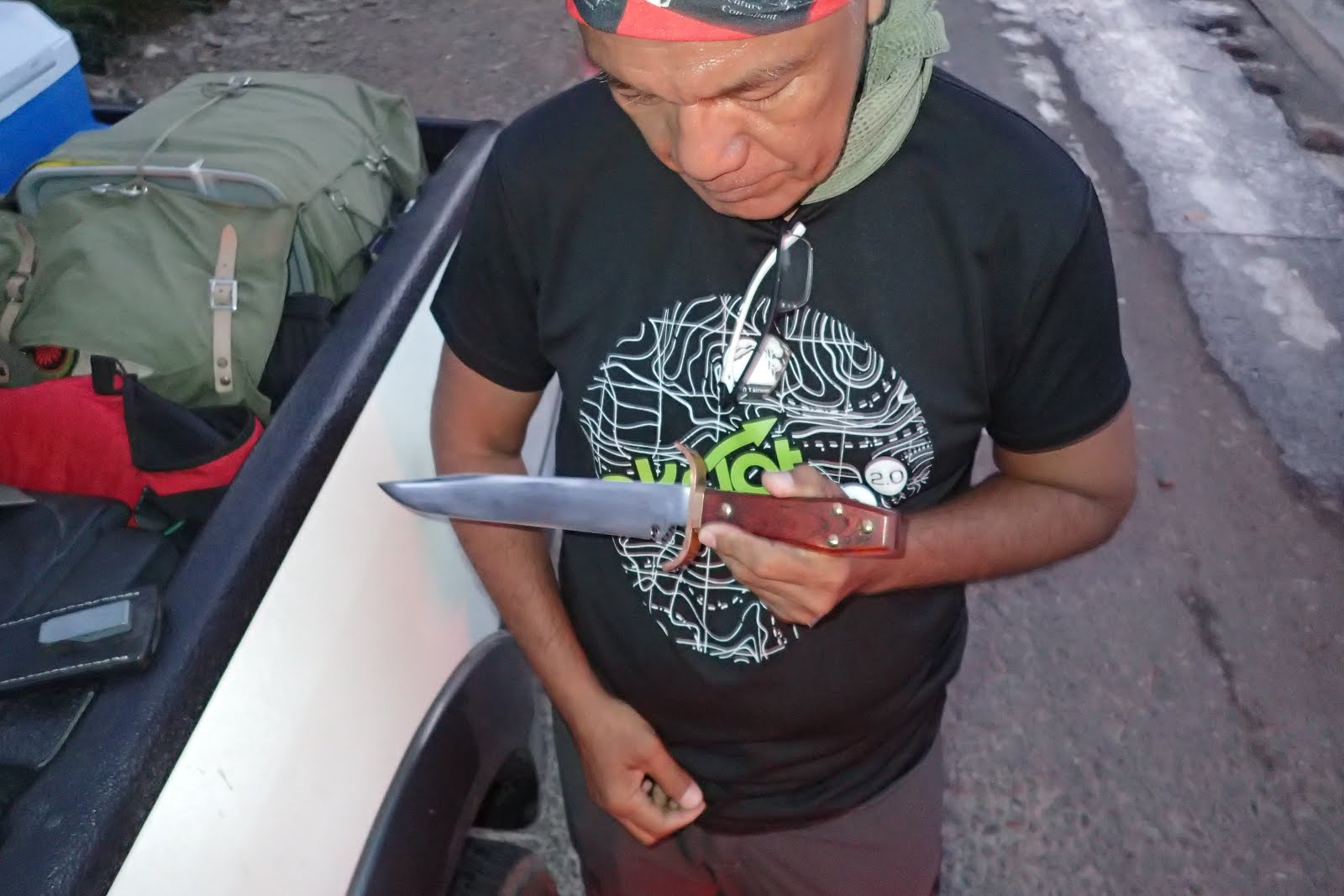
I was talking about a Bowie with a coffin-shaped handle and that sweet-looking Nessmuk. The Bowie is made by Freddie Angeles in 1987. He do not make blades anymore since he is now 80 years old and, for that matter, the Bowie becomes a collector’s item. The Nessmuk is made by Dondon Dimpas under the Ursulo line. It is stamped as 002 and, therefore, also another collector’s item since it is the most popular of his early make which elicit profound attention from blade enthusiasts.

I am flushed with envy and I am so happy it fell to the right hands. If it cannot be mine, at least, for the moment, I will have that privilege to hold and feel its balance and be photographed with it for posterity. Oh, real coffee, raw and strong, provoked an inner ecstasy within me as I held those blades in my hand. 

Come to think of it, I started all this thing about blades. I taught people the value of a blade in my bushcraft camps. I now have many converts and, I admit, I am but a pygmy when you talk about their dedication and passion about blades. They know so much and everything about it and are now on the verge of becoming bladesmiths themselves. 

After breakfast, we drive around the market and Randy surprised us with a kilo each of grounded Negros coffee, the same coffee that perked me up a half-hour ago. Then we proceed to the last stretch of road to Bacolod City to catch the first trip for Iloilo. Unfortunately, we did not make it and have to wait for the second trip.

For a full 45 minutes we waited until the time when the Nissan Strada got the go signal to crawl over the ramp into the ship’s deck. Jon, Ernie and I make it to the gangplank and up a series of stairs and find the best location. Crossing the Guimaras Strait took a longer time as tide and current clash midstream. The skipper has to make the necessary adjustments until we reach the Port of Dumangas.

It is 20 kilometers to Iloilo City and we have lots of time. Randy would have to make a stop on his old residence in the city. This was where he started before making Cebu as his base. We unload the things found on the back of the Strada and secured it inside the house. It seems Randy would like to make a little tour for us around the city.

 
The first stop is the old market where they sell the original versions of the different La Paz batchoy, an Ilonggo version of noodles which has very generous shredded meat, liver, egg and vegetable garnishments. You are provided condiments to suit your taste. I have never tried an original batchoy before and I would not let this pass.

Second stop is at Derek’s Classic Blade Exchange. I know the guy who runs this place: Derek Manuel. Setting up a knife store in Iloilo City and making it run for more than two years is an accomplishment in itself. You got to hand it to the man. Part of his business is online and people from faraway as Metro Manila and Metro Cebu source their blades here.

He sells good quality blades, knife accessories and other stuff relating to the outdoors sub-culture of bushcraft and survival. It is located across the La Paz Plaza. However, we could not resume our private tour since Derek wanted to treat us to a real Iloilo lunch, which is a good thing. We proceed to Breakthrough Restaurant, located in a beach of Molo district.

Arriving to join us is Derek’s wife, Ana. We ordered seafood and it is laid before us, rich savory and succulent. We finished almost at 15:00 and we were really full of that grand Iloilo lunch that Derek provided for our lot. Randy took a long drive back to our place. There, we returned the things to the back of the Strada.

We are going to Alimodian but we have to pass by first at Adventure Central, the home of Iloilo’s best sports climbing wall and it was here that the drawing board of the successful completion of the Panay Trilogy is headquartered. I get to meet the staff and it feels good to just sit, suckle a cold bottle of Red Horse and watch future rock jocks solve problems above.

We leave Adventure Central in a convoy of three pickups. It is now in the middle of the afternoon. We reach Alimodian with plenty of daylight to spare. I chose a spot for my hammock-and-shelter setup and I am home. A bottle of local brandy appears and my cup is empty. I am thirsty.

Randy gave me a hatchet. The axehead is acquired from the traditional blacksmiths of Sibalom, Antique, while the haft is carved by his own hands. Picked on one side are the words “Camp Red” painted in bold red while on the other side is the emblem of the Guild: a modern interpretation of a noble Native American warrior in bold red.


Could they have known my birthday and kept it hush-hush? I am not surprised there. I know that game. Okay, THEY do know. They just gave me a small lighted candle. They sang the birthday song. I blew the candle and clapping of hands and laughter echo in the evening. I open my Lenovo A7000 and a flood of greetings swamp my Facebook newsfeed.

Document done in LibreOffice 5.3 Writer
Photos by Jonathaniel Apurado

Thursday, November 1, 2018

OLD MANILA: A Gleaming Pearl After Dusk

AFTER MY ENGAGEMENT IN Rodriguez, Rizal on December 10, 2017, I went directly to Navotas City, into the home of Jay Z and Carla Jorge. That very evening, I am again treated to a sampling of the best of Navotas cuisine by the couple, right in their little restaurant – Pacing’s House of Barbeque. Tired as I was, the ambiance of the place and the food revived my soul to appreciate life better and to toast to the goodness of human character.

 
On the table was one of their specialties – spicy fish tofu served on a hot plate. Along with that was plain rice and their best-selling pork barbecue bathed in a glistening splendor of sauce, a well-kept family secret formulated by Jay Z’s late grandmother – Pacing. Grilled tomatoes on a stick completed the fare. Where I have taken off, a pint of Arce Dairy Ice Cream landed on spaces where these heavenly food used to be. A cold creamy ice cream mattered very much to a comfort-deprived heathen.

A book, just off the printing press, by the smell of the pages, passed on to my hands as a gift by the Jorge couple. Fine weather, cool ambiance, hearty reception, the best food in town, a special ice cream and a Guidebook on the Proper Use of Medicinal Plants. What else would a bushman want? These unexpected rewards somehow dampened my disappointment earlier before I came here. At least here, I am much closer to home. I got real friends.

The Jorge couple’s hospitality extended for a couple of days before I departed for Cebu. The most memorable of this was seeing the Manila that I have not seen before. That came on a late afternoon of December 11. The couple was celebrating their third wedding anniversary (I was their absent ninong) and Jay Z insisted that we dine at Barbara’s Heritage Restaurant where their wedding reception was held then. I went for a ride and found the establishment still closed.

It was at that moment when I was entering an old building of colonial proportions and beauty that I was transported back in time. Back to that time when Manila was a glistening pearl and a prized possession of Spain. The electric bulbs glowed majestically muffled, blending perfectly with the natural light of dusk. Shadows and lines and curves were at its exact places in the design of time and light and aura. It projects something unworldly yet understandably clear for the senses to enjoy.

Come to think of it. This was the same Manila that I totally disdained many years ago because of its uncontrolled development, overpopulation, high crime volume, grime accumulating on your nostrils and collars, high cost of living, floods under the slightest of rains and that ever constricting vehicular traffic. My idea of Manila expanded after EDSA '86 and became the National Capital Region. Manila, to most Visayas and Mindanao residents, is Luzon and where the conversations in Tagalog start.

Inside the courtyard of the quaint building is a beautiful fountain. Across it is a stone staircase leading to a veranda and above me are the finely-wrought windows and eaves that spoke of its Andalusian origins. I would be wrong if I have not seen this scene before in another time but in the comforts of a cushioned seat inside a cinema theater, back then when FPJ lorded it as an all-time box-office hit. 

Walking on the cobbled streets of Intramuros under twilight, devoid of vehicular traffic, was very soothing to the senses. A horse-driven carriage passes by, uprooting your mind from the present time to days when colonial life were centered around the protection of walled communities and watchtowers. Intramuros, the Old Manila, was the biggest of them all in the orient and it is here, at such hours, when the gran hombres and their doñas socialized as if they were in their home countries.

The approaching Angelus of the hour brought magic and charm all to its own reminiscent of the times. At such hours, the tropic heat does not bite anymore. The breeze from Manila Bay dislodged the warm air that radiate from the mortar walls and pavements. San Agustin Parish stood before me and, farther away, is the bulk of the Manila Cathedral. Into the great door of the San Agustin I entered for the very first time and I could smell the many years of nostalgia that had stayed up the high ceilings, which also host a mosaic of shades and tones of the different centuries.

In a cacophony of bells, a Eucharistic celebration started as I eased myself in one of the pews. I noticed older women of European descent, attending to worship, only suggests that at its height of liveability, Old Manila may have hosted a considerable population of Spanish and other nationalities, as well as Filipinos of respectable wealth and influence, doing business or serving for the Crown. I might have dreamed but in my dreamy state I locked out the tensions that separate the colonizers from the local populace.

The electric bulbs and street lights now dominated the darkened skies and the old walls looked surreal in their unnatural glow. People walked on the cobbled streets and there are too few people here, an unlikely sight of that usual densely-peopled Manila street that I came to know of. Most of those I saw are students, laughing on their way home. Then there are the office workers, still in their uniforms, walking singly to the same direction where the students went.

Jay Z and I went back to Barbara’s. Hungry acids pierced my insides as the waiters arranged the food on two long tables. They served buffet food. Toned down music of smooth melodies sprinkled the ancient room in a totally relaxed mood and, at a signal, the chairs dragged backwards and reverberated inside the dining room as the diners prepared the short walk to the buffet tables. The ladies went first, while the gentlemen among us sat and waited for our turn.

Food for the taking were Filipino and continental dishes. I went in and choose braised pork, pinakbet, kangkong adobo, fresh lumpia and pork inasal. Popular Filipino delicacies are many and I helped myself with biko and on as many pieces of fried banana. A five-piece string band regaled us with their select traditional Filipino favorites. This same banduria provided the music that were interpreted by sets of cultural dancers swaying to the tunes of Tagalog, Bicolano, Visayan and Maranao numbers.

It was a memorable night indeed in the Old Manila which I now began to appreciate as a legitimate daughter of a Spain that was then at its height of power in the Old World, a good 250 years before the coming of the Americans. This same city shone a hundred more times in the Far East under another colonizer and could have been a shining beacon in the Pacific, on the verge of surpassing of even the greatest cities of Asia, were it not for World War II.

Though her identity was usurped by many, she retained her own destiny within the confines of the playgrounds where she frolicked, danced and sang long ago. She is a free spirit and she enjoyed her past with much more vigor than people thought of her as a modern metropolis. I came to apologize on that thought and I was gifted with a rare charm that has no equal, even from my own beloved Cebu.

Sunday, October 21, 2018

THE TRAILHAWK JOURNEYS: Rodriguez Rizal Wilderness Survival Class

LAST FEBRUARY 2016, an independent event organizer contacted me for a survival training, far inland beyond the Wawa Dam, in Rodriguez, Rizal. This particular organizer became one of the participants along with twenty others. I could not forget the two days I spent with them and the hosting family who originally were from Aklan. That training, came days after I had also done one with 34 individuals organized by CLIMBER.

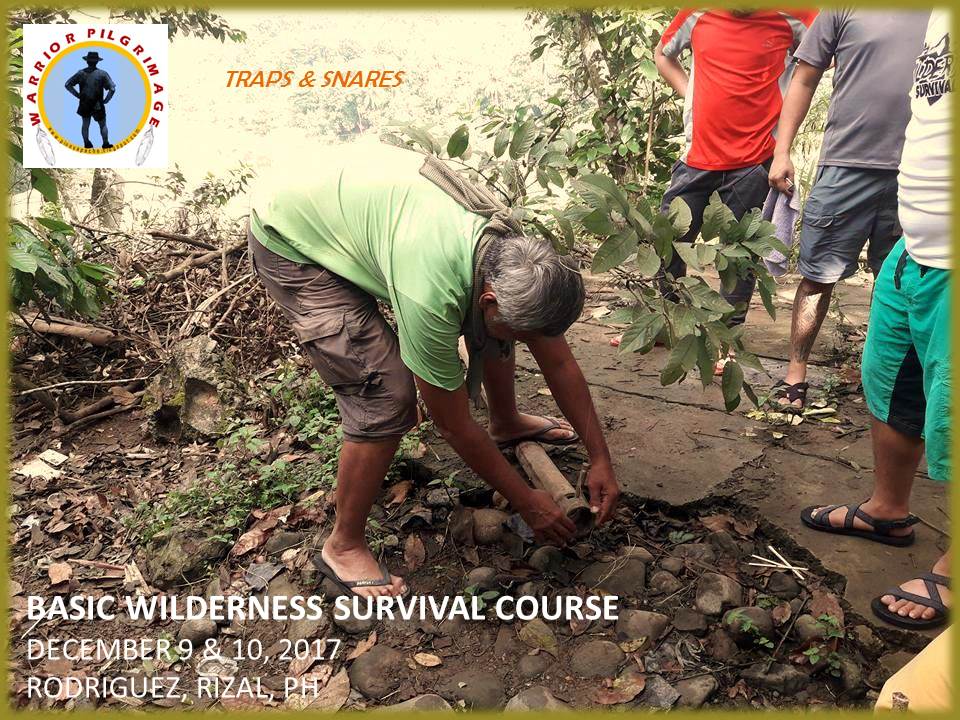
The organizer, now my former student, arranged again another training for another set of participants, this time on the approach to the Binicayan-Pamitinan Protected Landscape, in Rodriguez, Rizal, near the DENR office. I am again obliged to travel to Luzon with my tools, educational aids and instruction manual. It is another compressed training which would run for two days on December 9 and 10, 2017.

Although I do not mind doing a training for two days, as I receive the same compensation package that I do for three days, but three days is best for both the participants and me. I only give the best instructions and the extra day would have given justice to what you spend for. An extra day would have been relaxing on my part also and, in the process, participants would not be forced to receive an overload of information. 

This training is called the BASIC WILDERNESS SURVIVAL COURSE. It is designed for tropical wilderness settings of dense jungles and rugged highlands, which I first offered to the mountaineering community in October 2013. It is open to all individuals or groups of any interests and purpose. Attending now are fifteen people, to include two minors. The training is done inside a local resort.

The first chapter is Introduction to Survival. Survival situations demand that you stay tough after the initial impact. Mental stability and toughness are very important characteristics of a survivor. You must develop a survival mindset. Do not engage in prolonged mind games of fantasy and false hopes. You should rein in your mind so you would not release excess adrenaline and cause you more confusions in a very stringent moment.

The best thing to do is stay still and fill up your lungs with oxygene. Your brain needs it most to help you process thoughts. You are now in a high state of agitation and so does your brain. Your brain will be in hyper mode, collating and processing many thoughts all at the same time which is beyond human capacity. We can do so one thought at a time. Just stay still and breathe regularly, supplying your blood system with oxygene.

In the hierarchy of needs and of nutrition in a survival situation, water is always on the top of the scales of both. Rightly so, for we are in the tropics and humidity plays a big role. With that, we surrender perspiration by the acts of our exertions and by what the climatic conditions imposed on us. Along with the lost moisture, is our body heat which we let go without our knowing.

When you stay still in one place, you lessen wastage of moisture and body heat. Then you confine the latter by setting up a shelter (if you still have one) or make one from scratch. That is the second need. The third would be food then warmth. Although food, and even water, would give you warmth, but heat from a naked flame or from the rays of the sun or from a person’s body is solace. Last is security which would complement well with the rest.

Our body has four hypothetical storage tanks that needs to be replenished from time to time during survival. First is constant rehydration that would offset dehydration. Second is food that would give you nutrients, carbohydrates and proteins. Third is sugar which is converted by enzymes for your adrenaline rush. Fourth is fat, hardest to find in the tropics yet are wrapped as tissues in our body.

The topic for the next chapter is about Water Sanitation and Hydration. The first chapter had mentioned the importance of water during survival. Water could be sourced from natural springs, water seeps, man-made water holes, flowing streams, the atmosphere and from plants. It could be refined through boiling, by chemicals, exposure to heat, through filtration and by desalination. It is wise to cache water in your survival camp or just travel early and take advantage of shady places and breeze if you happen to have less.

We move fast to the third chapter which is about Knife Care and Safety. The knife is a tool and should not be used to what it was not designed for like digging holes and as pry bars. It is a vital piece of equipment that should be properly handled and cared for because it is your link to your surviving. In all my training, knife etiquette is learned first before you touch a knife, so as to lessen accidents.

Besides that, there is a knife law that forbids the display, even of concealed carrying, in public places unless you are in a lawful activity, which we are in right now. A knife should be in a sturdy sheath when travelling and should be unsheathed when at home to keep it from rust. There are many kinds of knives and it is important that you know the parts, blade shapes, grind styles and the tang designs. You must also learn how to field sharpen a knife.

I was able to finish three chapters in the morning and noonbreak is mandatory when the clock struck twelve. There is no cooking as food is prepared by the family-run resort. After lunch, the hammock is an inviting proposition and I sneaked into its comfortable grip for a quick nap. I needed the rest to keep my mind sharp since the participants would be handling knives later. Refreshed after 90 minutes of siesta, I continued with the activity.

After the much appreciated instructions about the knife in the morning, we moved on to Survival Tool Making. Using a tool is essential in survival or even when not in that situation. I showed them the most basic of tools like the digging stick, traps and snares from pieces bamboo that I prepared, and the batoning stick. I let each carve a spoon on bamboo to practice their dexterity with a knife while supervising the practical exercise.

Following this is the chapter on Notches. There are five basic notches that are used regularly in bushcraft. These are applicable in shelters, furniture and tools. Again, this is another exercise in knife dexterity but it can only be achieved with the use of another tool, the baton stick. On a single stick that served as an art canvas, each participant carved their five different notches, starting with the easiest up to the most complicated.

Next is Fire, Fuel and Campfire Safety. You cannot make a fire if one or all elements are not present, namely: fuel, heat and air. Lately, they added a fourth element – chemical reaction. Fire-making is 80% common sense, 10% skill and 10% perspiration. We are talking about the friction methods. Your fire can start if you can acquire and identify the right tinder, if you are in a dry place, and if you have the patience.

Aside from friction, there is the conventional method which are matchsticks, lighters, ferro rods and the flint and steel. Then there is solar magnification which can be done with any lens, reading glasses, water and even ice. Then you have pressurized air, exemplified by the fire piston. Since I do not have the luxury of time, I limit my demonstrations to the flint and steel, which I paired with charclothe, and the ferro rod. I showed them how to make a tinder bundle. 

Showed them how the bow drill method is made and spun. Unfortunately, I could only make thick smoke as sawdust embers refused to light up my tinder. Humidity is very high since we are beside a big river and there is a promise of a downpour. I let others try the bowdrill, the ferro rod, and the flint and steel. The teenagers among them were able to light the charclothe. Unfortunately, we cannot do with the bamboos because the dry ones have not been stored properly and are all wet.

A strong downpour came as expected and we have to end the first day. The activity on primitive cooking using bamboo could not proceed. The storage of firewood, along with dry bamboo had been left to neglect. I have to dry just a few after I have set my shelter in the morning and left the rest to the onslaught of rain when the rush for the safe shelter commenced.

Likewise, the activity on Nocturnal Hunting has to be shelved. The Marikina River has risen and very turbulent and is not safe for people. The good thing about catered food is you appreciate it in times of rain but I have seen a lot of cooking in the worst of times and today is no exception. Should have but the organizer designed this as it is and it is beyond my control.

When the rain stopped, the Campfire Yarns and Storytelling pushed through naturally. A small fire gave the participants a reason to gather around in a circle. I have to gather the drenched firewood nearer the fire to wick it away of moisture so it would be fed next as campfire fuel. A bottle of brandy appeared and the glass made its way among the adults animating more of the stories. The evening program ended at 23:00 and the hammock is most appreciated.
 
The second day (December 10) start with Customizing the Survival Kit. It is better that survival kits are made from scratch than bought commercially because a survival kit’s size and its components depends upon the type of the activity you are indulging in and the kind of environment you are going to visit. Your personal preference still matters. The components should include the medical kit, the replenishment pouch, the repair kit and a small knife. It could all be integrated in one container and should be waterproofed.

Next is Foraging and Plant Identification. Foraging food in the wilderness or on unfamiliar terrain can be very taxing to the mind. When you are stressed and hungry, you tend to remove all caution. Looks can be very deceiving in the tropics like fruits, leaves, nuts, roots, flowers and mushrooms. Likewise, you need to evade harmful plants while travelling your way in a jungle.

Short term food would be grub, tree snails, fresh-water shrimps and crabs and frogs. These can be picked by hand. Cook it if you must to remove parasites and bacteria. Long term food are meat from mammals, fish, birds and reptiles. For that, you must use a weapon or traps and snares. Traps could be anything designed to lure prey into a simple contraption of a hollow bamboo or a dam of rocks. It must work with the terrain, with gravity and the habits of creatures, including its anatomy design.

Snares are more complex. It has a spring mechanism and a trigger mechanism which would be initiated by the prey. Showed the students a very common snare employing a pressure-trigger mechanism. It could catch anything from birds to goats. Another is a tube snare popularized by the Aeta. You must use bait so prey would be lured to set it off. A single trap or a single snare would not yield you a catch but a trap line of 20 to 30 of these, after ascertaining where prey would most likely pass or visit.

 
Related to these is the chapter on Food Preservation and Cooking. If you can eat a deer all in one setting, well and good. You are very fortunate to still possess a healthy appetite. Meat rot in a short span of time. During survival, meat can be preserved and its edibility can be extended for a few more hours to several months. You can boil it. You can dry it. You can smoke it. Or you can cook it with its own oil from its fat.

Fish can be preserved by drying and by smoking. Fruits can be digested after a drying session and provide you natural sugar. Common rootcrops, has high starch value, and should be cooked, by all means possible, to remove toxins and poison. Famine crops need to be immersed in running water for five days before cooking. Salt and vinegar are good food preservatives. Vinegar can be sourced from any palm.

Next is Navigation and Understanding Trails. This is more on traditional navigation which use the natural terrain, shadows and the sky fixtures for travel; avoiding obstacles and exposed areas; and knowing how to identify signs on trails made by both animals and humans. Following that is Understanding Cold Weather. During survival, exposure to the elements is expected. There are five physical mechanisms that steal away body heat and the things that we should do to keep us constantly warm.

Dusk would soon come and we have to break camp, intending to finish the last chapter which is Outdoors Common Sense. This is based from my yet unpublished book, ETHICAL BUSHCRAFT. It is about trail courtesy and behavior while on the trail; choosing the best campsites; practicing stealth camping; increasing individual safety and security; wildlife encounters; and introduce people the idea of Blend, Adapt and Improvise.

We finished the training with a blade porn. It is a traditional bushcraft activity where all edged tools are laid together in one place to inject another round of useful conversations and to encourage closer camaraderie among the participants. What resulted was the presence a considerable number of high-quality imported blades and rare local blades. It is now almost evening and we took dinner.

The van-for-hire that took me here two days ago from Cubao, came back to bring me back there. The organizer made sure of that. From Cubao, I took a bus bound for Navotas where an invitation for a second dinner awaits me and, of course, a refuge to rest a few days before my departure back to Cebu. I am tired, not of the training compressed in two days, but from a trusted person who failed to keep his end of the bargain. It is one of the hazards of a journeyman and it is sad.

Document done in LibreOffice 5.3 Writer
Some photos by Vernie Tuason and Franz Tiu

Friday, August 17, 2018

PINOYAPACHE GOES TO SAMAL ISLAND

I PROMISED TWO YEARS ago that I would attend the 2nd Omega Pelta Kappa Fraternity and Sorority National Convention to be hosted by the Zeta Chapter of Davao City on September 9, 2017. This, I made in writing for everyone to read, after the conclusion of the 1st OPK National Convention held in Cebu City last September 2015. Later I faced a dilemma, when the date was fast approaching: that I simply do not have the funds to be there. 

It is not easy to just forget about it. No it is never in my character. I gazed at heaven for manna. I was about to give up to that idea when a fellow Peltan, now based abroad, promised to shoulder my airplane fares should I be interested to go to Davao and attend it. Then another of our sister promised to take care of the billeting before and during the national convention. I did not ask for all of that but it came my way. God is Great! Thank you! Thank you my gracious sponsors. You are heaven sent. Thank you.

I was scheduled to fly from Cebu on September 7 but, by the quirks of the regularly delayed flights with which this particular airline is famous for, my flight was rescheduled on the night of September 8, just in time to be with my brothers and sisters celebrating a pre-convention party in Matina Town Center, one of Davao City’s popular watering holes and we occupied the front tables. It was like we were college students again. Actually, this was the day that OPK was founded 52 years ago.

During that joyous affair, I witnessed the military conducting checkpoint on the entrance to the rock concert event. The whole of Mindanao was under Martial Law due to the war against terrorists in Marawi City which had just ended a few days ago. Threats by armed groups are still present which necessitated drastic measures. The military watched us from the sidelines and would always approach anybody who would take a smoke with stern warnings. The musical event ended at midnight and orders of beer stopped.

Tired from the travel and too much of beer, I joined with other Peltans to rest early – at 02:30 of the following day – at our billeting area in Green Windows Dormitel, so we could start early in the morning for the convention site, which would be at Samal Island. At 05:00, my pre-set alarm woke me up and I get the opportunity to use the common bathroom first. My mindset always worked on situations like this which I learned many years ago in training center barracks.

Yes I prepared for this travel under a Martial Law atmosphere that I came “naked”. I did not bring any blade, not even a small Swiss Army Knife, for I cannot fathom it being confiscated or of me getting investigated because of that. I preferred going “grey”, to go places unnoticed and without arousing attention. I compensate what I lacked by increasing my situational awareness. I know how Martial Law worked because I grew up with it in the years of the Marcos dictatorship (1972-86) and I hated it.


At 08:00, we were now prepared to Samal Island and one vehicle of our convoy got caught by radar speeding in a highway while approaching Sasa Wharf. In Davao City, you are not allowed to cruise over 40 KPH. I appreciate that and it should be applied nationwide. The driver, who is from the Gamma Chapter and unaware about this city ordinance, got a warning instead after one of our hosts interceded. We waited for our turn to board the ferry that would cross a narrow channel into the Island Garden City of Samal.

It is my first time to be in this island, which is known for its mother-of-pearl farms producing cultured pearls. Samal Island was also in the news some two years ago when the Abu Sayyaf went out of their way to kidnap three foreigners while they were in their yacht. After 30 minutes, we arrived at Samal and walked just a few meters to where the convention would be held: Camp Holiday Resorts. It is good to know that the sister who sponsored my billeting, took care also of my registration which is a thousand bucks. Again, thank you.

I got registered without a fuss, took a seat around on one of the tables and did a Peltan handshake to everyone. Familiar faces, from the convention of two years ago, arrived and everybody exchanged niceties, good conversations and hearty laughs of funny memories. Coffee and light meals got served. The convention is scheduled for 18:00, so I looked for my room, which I get to share with two other Peltans. It is a nice airconditioned room with a soft bed, a good view from its terrace and it is not cramped.

After freshening up, I went back to the convention hall wearing the event shirt. The room occupants doubled by this time but, thankfully, I reclaimed my seat. My envelope is still there and, in it, is the event programme. My Lenovo A7000 is still at its place near the electrical outlet, charging power. Too much of WiFi hours ago have drained it of life and now it is gaining battery volume. I need the Android phone for the documentations. I came here because of an obligation – a promise – and, second, as an adventure travel blogger.

Travelling under a Martial Law is adventure. It is another adventure if you do not agree – in principle – to this present government’s penchant for extra-judicial killings and ignoring rule of law. I am a dissenting voice and Davao City is the current president’s hometown. Figuratively, I am in “enemy” territory because I am different from you in thoughts. What would be sauce for you is poison for me and let us agree to disagree with that. I am no stranger to the president and Davao City. I climbed Mount Apo in 1994 and, in 1995, I chased and caught alive a serial killer here which got me an audience with the former mayor. We met twice!

As much as possible, I will try to keep to myself, despite the festive affair, and I will refuse any talks about politics. The program started and the chapters are mentioned. Delta Chapter, the one I belonged to, is now a dying entity, so were every other chapter except where OPK is still very active. It is so sad because we are not getting any younger and the law forbids us to do the usual rituals and processes which had shaped our view of fraternities and sororities, and of our own OPK. It does not work that way anymore and we have a dearth of new blood. I do not know if this convention would adapt to change.

It did not. By design, the idea about PISPI was never mentioned. Burying that to silence is the extension of the leadership council to two more years. They have not done their homework for two years and have nothing to show anything promising and I heard no mild reactions. We are still feeling – or reeling – our way in the dark. I was hoping the advocates for change were here because I was very receptive to that idea. There is a rift somewhere and what is there next in this same setup? PISPI would have given me hope instead of reminiscing about the glory days like school reunions always bring.

When the convention ended, I returned to my room and drank beer to toast to the demise of PISPI and what is left of my OPK. I do not see a good future. I kept to myself on the room’s terrace accompanied by a few Peltans celebrating our 52nd founding years from the rest. Personally, I do not like a crowd and I would rather do socials in anonymity, far from the rest. We all will stay here until tomorrow noon. The exclusivity of a room is much better and it works for me here.

 
The second day, September 10, is reserved for recreation and more socials. Early rising Peltans have already occupied two long rows of table on the general beach area. Breakfasts of native delicacies were provided by our hosts and buckets of cold Red Horse keeps you warmed up. You may have to choose the shoreline or an infinity pool to cool off or bathe on both. I do a short tour around Camp Holiday. There are many amenities and rooms but I would not do a detailed description or content without being asked to.

At 12:00, we moved from Samal Island back to the mainland. Many of us from Cebu has flights back but our hosts decided to treat us for lunch first in Flyover Ihaw-ihaw Restaurant at the Buhangin District. Then someone saw a durian and we proceed to McArthur Highway where it is popularly sold. I love durian and I could eat ten pieces in one setting, which I did in 1997. Today, I am just good for four. It is not that cheap anymore. My OPK sisters and brothers brought boxes of fruit and processed durian with them when they went to the airport.

I remained. My flight is scheduled for tomorrow. Brod Raymund Galot and Brod Ody Lee made it sure that I have a place to stay. I do not have a choice but go back to the Green Windows Dormitel. It is much cheaper and there are not too many guests. I do miss the company of my fellow Peltans. On the street to where it is located are many cheap restaurants which would be favorable for my limited budget. There is not much to do except read a book, Deep Survival by Laurence Gonzales. I always carry a book when traveling.

My last day in Davao fell on a very infamous date – September 11. Subconsciously, that tragic event which came to the US sixteen years ago, could happen anywhere but it has a good chance that it could also happen in Davao now to which a Martial Law preempt such ideas of harm. Brod Raymund came at 11:00 to fetch me. An extended courtesy of my host which I am most indebted to. My flight is at 20:40 yet. We visited first his office to log off from work. He is with the City Engineering Office.

Brod Raymund became my tour guide which I appreciate very much. He brought me to GAP Farming Resort. It is one of Davao’s oldest recreation resort. At its heart is a tunnel system built by the Japanese Army during World War II. After an hour of roaming around, we go down to Riverwalk Exotic Resto Grill. They serve crocodile dishes which meat are sourced from the Davao Crocodile Park. I need to try and I choose crocodile sisig to widen my taste experience. I eat the whole serving to myself.

It is well-spiced to cover something that is related to something fishy. Well it has its own characteristic but one thing that I noticed immediately is that my tooth became achy. It is not a toothache yet but the sensation on my gums indicate that it will. My knees, which once were arthritic, acted like one again, although I could walk without feeling pain. There is just a knot somewhere in there. This crocodile meat has a high uric content or it could be an ingredient which caused my nerve receptors acting crazy. 


Brod Raymund brought me at last to the Davao airport at 18:30. In two hours, I would be flying out. A slight delay came. 23:15. I was ready for another delay when an announcement advised us passengers to proceed the boarding gate. I enjoyed my time in Davao and Samal seeing again fellow Peltans and it would take another two years before we meet again with them in Kabankalan City, Negros Occidental – the next host. This time, I will not promise. To those I met, thank you all. I could not name all and you are in my heart. Thank you and may God bless all Peltans!

Document done in LibreOffice 5.3 Writer