Showing posts with label plant ID. Show all posts
Monday, February 18, 2019
NAPO TO BABAG TALES CXXX: A Different Kind of Wilderness Survival Camp
THIS IS A STRANGE CROWD that I am
facing today, March 23, 2018. Ricky Petiluna, the event organizer had assembled
one which looked like it came straight out of Bohemia. Ricky himself is a front
act of a local death metal band, the Kryptic Skulls. I assume the rest of the
band are here and the rest are its fan base.
This band has a different
philosophy. They are enchanted with nature and the outdoors. Everytime they
have out-of-town gigs, they make it sure that, after the klieg lights, after
the ear-splitting music, after the exhausting performance, after the shrieking
crowds, they go straight to the hills of their hosts and launch their own
nature appreciation therapy.
It has a different energy and it
travels through their soundbytes. This event and the participation is testament
to that. A couple of Boy Scouts took the opportunity when it was posted in
Facebook and hanged on to the call of the wild. The venue would be at a place I
designate as Camp Xi, easy to access but tricky to find.
All the participants are accounted
for at the parking lot of the Our Lady of Guadalupe Parish. We all proceed to
the trailhead of Napo, the gateway to the Babag Mountain Range, Cebu City,
Philippines. Going to assist me are Ernie Salomon, Jonathaniel Apurado and
Randy Salazar. Their mere presence already elicits awe among participants as
they have created names for themselves in our small outdoors sub-culture of
bushcraft.
After a hike of an hour through the
beautiful trails of Sapangdaku Valley, we cross a stream and ascend a ridge
leading to Camp Xi. The campsite is ready with a good water source 150 meters
away – spring, waterfall and stream; separate latrines for men and women; a
firepit with adequate firewood; and a grassy meadow to welcome individual
shelters.
The participants set up their tents
and simple shelters. Some opt to find places to hang a hammock. After claiming
their spots, I let them prepare their meals for lunch. Ernie and Jon cook the
food for the four of us camp staff. I would start the training after siesta and
that would be at 13:00. The weather is warm and humid assuring us sunshine all
the way.
Before proceeding to the first
topic, I talk about the purpose and the design of the BASIC WILDERNESS
SURVIVAL COURSE. You see, the mountains consist of harsh environments,
steep inclines, high elevations and unpredictable weather patterns. It is
remote yet people visit these places to chase passions and desires. Accidents
are most likely to happen there in a flash.
After that, I proceed to the Introduction
to Survival. Survival is different from bushcraft. It is immediate and
would bend rules and morality in the pursuit of life – of surviving. That is a
hard reality which all survivors must live with while in the course of their
dire consequences and the thereafter.
While nobody has that ultimate
technique to survive accidents and calamities, a prepared mind would, at least,
be blest by chance. Surviving the initial impact is one half of it while
ensuring your survival until help comes in is the other half of that. In
between, the mind controls everything from the way you think and even to the
release of adrenaline. Your brain is a supercomputer but, unfortunately, it
could only process one thought at a time.
Survival situations demand that you
stay tough after the initial impact. Mental stability and toughness are very
important characteristics of a survivor. You must develop a survival mindset.
Do not engage in prolonged mind games of fantasy and false hopes. You should
rein in your mind so you would not release excess adrenaline and cause you more
confusions in a very stringent moment.
The best thing to do is stay still
and fill up your lungs with oxygen. Your brain need it most to help you process
thoughts. You are now in a high state of agitation and so does your brain. Your
brain will be in hyper mode, collating and processing many thoughts all at the
same time which is beyond human capacity. We can do so one thought at a time
only. Just stay still and breathe regularly, supplying your blood system with oxygen.
In the hierarchy of needs and of
nutrition in a survival situation, water is always on the top of the scales of
both. Rightly so, for we are in the tropics and humidity plays a big role. With
that, we surrender perspiration by the acts of our exertions and by what the
climatic conditions imposed on us. Along with the lost moisture, is our body
heat which we let go without our knowing.
When you stay still in one place,
you lessen wastage of moisture and body heat. Then you confine the latter by
setting up a shelter (if you still have one) or make one from scratch. That is
the second need. The third would be food then warmth. Although food, and even
water, would give you warmth, but heat from a naked flame or from the rays of
the sun or from a person’s body is solace. Last is security which would
complement well with the rest.
Our body has four hypothetical
storage tanks that need to be replenished from time to time during survival.
First is constant rehydration that would offset dehydration. Second is food
that would give you nutrients, carbohydrates and proteins. Third is sugar which
is converted by enzymes for your adrenaline rush. Fourth is fat, hardest to
find in the tropics yet are wrapped as tissues in our body.
The next topic is about Water
Sanitation and Hydration. The first chapter had mentioned the importance of
water during survival. Water could be sourced from natural springs, water
seeps, water holes, flowing streams, the atmosphere and from plants. It could
be sanitized through boiling, through filtration and by desalination. It is
wise to cache water or travel early and
take advantage of shady places and breeze if you happen to have less.
We move fast to the third topic of
the day which is Knife Care and Safety. The knife is a tool and should
not be used to what it was not designed for like digging latrine holes and as
pry bars. It is a vital piece of equipment that should be properly handled and
cared for because it is your link to your surviving. In all training I
conducted, knife etiquette is learned first before you touch a knife.
Besides my rules, there is a knife
law that forbids the display, even of concealed carrying, in public places
unless you are in a lawful activity, which we are in right now. A knife should
be in a sturdy sheath when travelling and should be unsheathed when at home to
keep it from rust. There are many kinds of knives and it is important that you
know the parts, blade shapes, grind styles and the tang designs. You must also
learn how to field sharpen a knife.
After the much appreciated
instructions about the knife, we move on to Survival Tool Making. Making
a tool is essential in survival or even when not in that situation. I showed
them the most basic of tools like the digging stick, traps and snares from pieces
of bamboo that I was able to obtain, and the batoning stick.
I let the participants practice
their knife dexterity by making their own spoons, jugs and cooking pots from
poles of bamboo. They work in groups of five and closely supervised. Before
17:00, the groups managed to finish their tools. The first day lecture just end
and everyone goes to prepare their dinner.
The first evening of the day is
reserved for the Campfire Yarns and Storytelling. This had become
tradition after it had its first introduction in 2011 during the first
Philippine Independence Bushcraft Camp. With the campfire as the center of
social life, participants sit in a wide circle listening to funny tales and
anecdotes, usually fueled by a moderate dose of alcohol. This last activity for
the day ended at 23:00.
The second day, March 24, begin
with Notches. There are five basic notches that are used regularly in
bushcraft. These are commonly used in building shelters and creating tools.
Again this is another exercise of knife dexterity together with the baton
stick. Another stick is supplied each participant and they proceed to carve the
five notches there.
The next chapter is Foraging and
Plant Identification. Foraging food in the wilderness or on unfamiliar
terrain can be very taxing to the mind. When you are stressed and hungry, you
tend to remove all caution. Looks can be very deceiving in the tropics like
fruits, leaves, nuts, roots, flowers and mushrooms. Likewise, you need to evade
harmful plants while travelling your way in a jungle.
Short term food would be grub, tree
snails, fresh-water shrimps and crabs and frogs. These can be picked by hand.
Cook it if you must to remove parasites and bacteria. Long term food are meat
from mammals, fish, birds and reptiles. For that, you must use a weapon, traps
and snares. Traps could be anything designed to lure prey into a simple
contraption of a hollow bamboo or a dam of rocks. It must work with the
terrain, with gravity and the habits of creatures.
Snares are more complex. It has a
spring mechanism and a trigger mechanism which would be initiated by the prey.
Showed the students a very common snare employing a pressure-trigger mechanism.
It could catch anything from birds to goats. Then again, you must use bait so
prey would be lured to step on it. A single trap or a single snare would not
yield you a catch but a trap line of 20 to 30 snares or traps would after
ascertaining where would the prey would most likely pass or visit.
Related to these is the chapter on Food
Preservation and Cooking. If you can eat a deer all in one setting, well
and good. You are very fortunate to still possess a healthy appetite. Meat rot
in a short span of time. During survival, meat can be preserved and its
edibility can be extended for a few more hours to several months. You can boil
it. You can dry it. You can smoke it. Or you can cook it with its own oil from
its fat.
Fish can be preserved by drying and
by smoking. Fruits can be digested after a drying session and provide you
natural sugar. Common rootcrops, has high starch value, and should be cooked,
by all means possible, to remove toxins and poison. Famine rootcrops need to be
immersed in running water for five days before cooking. Salt and vinegar are
good food preservatives. Vinegar can be sourced from any palm.
Last chapter for the day is Fire,
Fuel and Campfire Safety. You cannot make a fire if one or all elements are
not present, namely: fuel, heat and air. Lately, they added a fourth element –
chemical reaction. Fire-making is 80% common sense, 10% skill and 10%
perspiration. We are talking about the friction methods. Your fire can start if
you can acquire and identify the right tinder, if you are in a dry place, and
if you have the patience.
Aside from friction, there is the
conventional method which are exemplified by the use of matchsticks, lighters,
ferro rods and the flint and steel. Then there is solar magnification which can
be done with magnifying glass. Then you have pressurized air, exemplified by
the fire piston. Showed them how to use the flint and steel, which I paired
with charclothe, and the ferro rod. I also showed them how to make a tinder
bundle.
Showed them how the bow drill
method is made and spun. Unfortunately, I could only make thick smoke as
sawdust embers refused to light up my tinder. Too humid. Likewise, for the
bamboo method. It is now late afternoon and dusk is just around the corner. I
let others try the bowdrill, the bamboo, the ferro rod, and the flint and
steel.
In this second day, all the
participants are exposed to a whole day of fasting. They have to experience the
pangs of hunger. The stomach would crave for food and would challenge their
concentration. It would increase drowsiness, decrease attention span as the
humidity, the uncomfortable situation, even the crawling insects place them in
an irritating mood.
After securing the fire, the four
groups consisting of 5-6 participants each, begin their quest for dinner. Rice
is cooked inside bamboo poles and when it is done, they go to the next phase, which
is Nocturnal Hunting. No food, no dinner. All looked for edible snails
on trees and fresh-water crabs on the stream. There was good foraging and Ernie
cooked it for them, gourmet style.
The second edition of the Campfire
Yarns and Storytelling starts and wonderful tales begun to unravel, much
more so when bottles of local brandy mysteriously appeared from out of nowhere,
courtesy of two very resourceful participants, who hunted something different
other than snails and crabs. The night extended well beyond midnight until the
last drops have been consumed.
The third and last day, March 25,
start with Customizing the Survival Kit. It is better that survival kits
are made from scratch than bought commercially because a survival kit’s size
and its components depends upon the type of the activity you are indulging in
and the kind of environment you are going to visit. Your personal preference
still matters.
Next comes Navigation and
Understanding Trails. It is more on traditional navigation which use the
natural terrain, shadows and the sky fixtures for travel; avoiding obstacles
and exposed areas; and knowing how to identify signs on trails made by both
animals and humans. Following that is Understanding Cold Weather. During
survival, exposure to the elements is expected. There are five physical
mechanisms that steal away body heat and the things that we should do to keep
us constantly warm.
The last chapter is Outdoors
Common Sense. This is the subject matter that I based from my yet
unpublished book, ETHICAL BUSHCRAFT. It is about trail courtesy and
behavior while on the trail; choosing the best campsites; practicing stealth
camping; increasing individual safety and security; wildlife encounters; and
introduce people the idea of Blend, Adapt and Improvise.
After I have closed the training
camp, I let them witness how the Blade Porn looks like. This is another
bushcraft tradition which is unique in itself and is not found in any outdoor
disciplines. This is a staple of good conversations and Randy explained to the
crowd the innate qualities of each blade. A few of the participants place their
blades to the collection and they begin to understand the purpose of this.
After an early lunch, we break camp
and walk down the ridge to another different ridge, crossing a bit into
Kalunasan. We finally reach the road at 14:00 and a transport begins to
transfer the participants back to Guadalupe. This was one of the best survival
training camp put together by an independent organizer. The participants are provided
an event t-shirt and a badge plus a giveaway. Congratulations Ricky, I see one
future bushmaster in you. Some day.
Document in LibreOffice 5.3 Writer
Posted by
PinoyApache
at
19:17
0
comments
Labels: bushcraft camp, Camp Xi, Cebu City, firecraft, knife safety, notches, plant ID, survivalcraft, tool making, water
Wednesday, February 6, 2019
BUSHCRAFT CAMP FOR KIDS IN BLUEWATER MARIBAGO (VER. 2)
THIS BLOGGER
RECENTLY SIGNED a Memorandum of Agreement with BLUEWATER RESORTS, represented
by its corporate marketing officer, Enrico Monsanto, as resource person for a
series of bushcraft events in 2018 designed for children in all its
recreational facilities located in Bluewater Maribago Beach Resort, Lapulapu
City; Bluewater Panglao Beach Resort, Bohol; and Bluewater Sumilon Island
Resort, Cebu.
The first of this
is at the Bluewater Maribago Beach Resort. Participating would be children from
the Dolpo Kids Club, from guests, walk-in registrants and from the staff of
Bluewater Resorts. I would be expecting the presence of the parents and
nursemaids too as was the last time I did this same activity last year (March
25, 2017). In fact, parents last year joined the kids carve their own bamboo
spoons.
But before this,
there was a teaser video released by Bluewater Resorts about the summer-long
activities offered by their facilities for children and Bushcraft Camp for Kids
is one of these. In fact, members of the Camp Red Bushcraft and Survival Guild
made themselves available for a video shoot right inside Bluewater Maribago
Beach Resort. Please watch the video:
Before 08:00 of
March 17, 2018, I was already at Allegro Restaurant with Mr. Monsanto. With me
are Jhurds, 8-year old Jacob, Jonathaniel and Jingaling. They will assist me
during the Introduction to Bushcraft for Kids. I have subdivided this day-long
activity to a Plant ID Tour, Primitive Cooking, Elementary Firecraft, Blade
Safety, Knife Dexterity Exercise, Animal Snares, and Simple Shelter Construction
A couple of
Japanese minors and a Korean joined a handful of Filipino kids as I talk about
the essence of bushcraft. Then I point to each and every tree that would help
them find water in case of survival and other helpful plants which harbor
useful parts. This was possible during the Plant ID Tour around the confines of
Bluewater Maribago Beach Resort.
Considering that a
bamboo is the most common plant in the tropics even in temperate parts of Asia,
the idea of cooking food using a bamboo as an improvised cooking vessel is
shown to the kids and parents alike in Primitive Cooking. A two-meter pole of
green bamboo is opened with a knife with the aid of a stick. That done, rice
and water are poured into and then a fire is started.
The kids are also
taught how to create a fire by a magnifying glass and by a ferrocerium rod
during the session on Elementary Firecraft. With a fine downy material, the
kids shrieked in delight as they create fire when they scratched the ferro rod
over it. Fire by solar magnification took time to evolve but with a charred
clothe, a smoky ember appear, blowing it to life when placed among a bundle of
dry tinder. Thick smoke erupted then fire.
The next topic is
Blade Safety and it is this part where it is most difficult to proceed since
the children would be exposed to harm. The edge and the tip of a knife are
parts where it is sharpest and, therefore, harmful. Extra care should be
undertaken when handling a knife, especially during the practical exercise.
Close supervision would be properly exercised by my staff.
The kids are
attentive during the lecture on the procedures of handling a knife, repeating
it over again as I see fit and proper. It is very important that the direction
of the strokes should be away from you and should be slightly downward. Then
you may have to choose your most comfortable position and engage work in the safest
location. Engaging in conversations while working is discouraged.
A knife at rest
should be returned inside its sheath and it is forbidden for anybody to walk
around with an unsheathed knife. Then there are rules how to pass a knife from
one person to another. All of those are the most important and the children are
now ready for the Knife Dexterity Exercise wherein they are made to carve a spoon
from a piece of bamboo. Parents joined their wards, as well as the Bluewater
staff.
After an hour of
close supervision, the children proudly showed off their bamboo spoons. They
have achieved this work on their own, mastering their fear and timidness and,
once they have gained confidence on this single moment, they would be
comfortable handling a knife with responsibility. Then a demonstration is shown
to kids how an animal snare work and how to construct a simple shelter. The day
is capped off by tasting the rice cooked in bamboo.
I consider it an
honor and a sort of redemption for my brand of outdoor activities, to be
accepted and trusted wholly by Bluewater Resorts, a certified green hotel and
resort, to propagate bushcraft on their recreational facilities that involve
children. Although bushcraft uses blades as tools, it is a child-friendly
activity which nurtures the creativity of the child and aids the child the
value of life skills, which is now beginning to wane due to easy access to WiFi
and the electrical outlet.
This writer, who
have toiled to create this blog from scratch and for which many original ideas
came forth which animated the local outdoors scene from its dull
one-dimensional existence. The Philippine Independence Bushcraft Camp, the Camp
Red Bushcraft and Survival Guild, the exploration and establishment of the Cebu
Highlands Trail, the Thruhike, and the formation of the Camino de Santiago of
Cebu, are all fruits of this blog which fired up the imagination of outdoorsmen
who wanted variety.
At the end of the
day I am more than satisfied that people – children most specially – are
getting interested again on the long-neglected skills of bushcraft. It is not
spectacular compared to most outdoor activities which has an abundance of supportive
corporate names. Most often it is maligned and misunderstood and I have to
fight it from within to remove those wrong misconceptions. I weeded out the
wrong practices which popular and social media are erroneously propagating.
That rare opportunity
and, forthwith, being associated with one of the best green hotel in Southeast
Asia, gives a prestige which I have had not expected before. It is something
that I would watch carefully when traversing over opinions and contents in
social media. What I digress would surely reflect to names that I am currently
associating myself with. It is an unfamiliar territory but I would not want it
in any other way. It is just right.
It was a long
journey for me, jagged and steep, running against the wind to corner an elusive
prey. I am now on to that special place where dreams become a reality. The
sheep is now snarling like a wolf but it is just a harmless shadow. I let it be
and so I claim my rightful place under the sun.
Document done in LibreOffice 5.3
Writer
Posted by
PinoyApache
at
09:00
0
comments
Labels: Bluewater Maribago, knife safety, Lapulapu City, plant ID, primitive cooking, tool making, training
Saturday, December 1, 2018
NAPO TO BABAG TALES CXXVII: Three Raptors
FOR OLD TIME’S SAKE, I accommodated
a request from my friends belonging to my former club, the Cebu Mountaineering
Society. Actually, I had done so for them in July on a climb to Mount Babag
from Napo and, again, just last December 28, on a hike through the Buhisan
Watershed Area to Napo. This time, I would do so again for them from Napo to
Bokawe to Guadalupe. Today is another brand-new year, January 2, 2018. Happy New
Year!
The opportunity to go out again to
the mountains instead of snoring through the party fats of the past few days
brought about by holiday goodwill is most cherished. Without any second
thoughts, I came first at the parking lot of the Our Lady of Guadalupe Parish
and waited for my friends. They came and they were Lilibeth Initan, Mon Corro,
Paul Morgia and two ladies who, I think, are new members, since it is the first
time I saw of them.
It was already 08:30 when we start
from Napo. I would surprise them today by bringing them to my playground. They
were indeed surprised when I brought them to a different trail right after
crossing the foot bridge. The Manggapares Trail, from its very trailhead, is
known by the locals only and my people from the Camp Red Bushcraft and Survival
Guild. It goes up upon the very moment you step on its path.
There are a few houses here and a
flower farm at the beginning but, once you get past it, it is a very lonely
trail. It is very shady. Mexican lilac (Local: kakawate), cassia (bistula),
alom, beach hibiscus (malibago), Java plum (lomboy),
mango, tamarind and bauhinia trees abound here. The ground is hard and rocky.
Shrubs, herbs and grass line the path and elevation is forever rising.
Tagaytay Ridge is just one of the
many ridges of the Babag Mountain Range that extend far to the east and it had
been used for many years by the older generations when travelling to Mount
Babag and beyond. Manggapares Trail is really an old trail that I once trod in
the early ‘90s and have been forgotten when I laid low from the outdoors scene
for years. I only rediscovered it in 2011 but, by that time, there was an
earth-moving activity on the ridge.
Yes, there was a crude road made so
that heavy equipment and trucks could be brought up. Big holes were dug from
the ground and a lot of cement were poured on it. These were the anchors for a
series of steel towers that would soon be erected. My heart ached at the sight
of these but, after many years, when the ground settled down and nature
reclaimed what was theirs, I accepted the presence of the steel behemoths.
We reach the first of these towers.
It now has high-tension cables over it, relaying electricity from a power plant
in Naga City over the mountains and down the line from here across to Mapawon
Peak in Kalunasan and beyond to the distribution facility in Cabancalan, Mandaue
City. The second tower is on a higher elevation and is 200 meters uphill. We
follow a path between a field of wild-growing sweet potatoes and yams, hoping
not to disturb any reptiles snoozing among it.
The third tower is a bit of
difficult to reach since a path to it is steep. Once you are below it, a row of
Mexican lilac trees provide you shade from the sun. However, at this time of
the year, there is no need for that. Northeast monsoon winds carrying the
winter cold of Siberia, Manchuria and Japan reach the tropics making the
weather very mild. The cooler wind is most welcome.
The path is now rolling terrain and
we stop to rest at an abandoned backhoe. Why it had been left there to rust
against the elements is a question which I have not had a credible answer as of
this time. According to my local friends, it had fell twice on the side of the
mountain but was salvaged each time. They were even more mystified than I am
when the workers left it even if it was not broke.
It became part of the landscape and
a landmark of sort. It is a natural magnet of conversations and people
naturally rest here like we are doing now. We have just overcome the hardest
part and it would be easy walk from hereon. Yonder is the fourth and fifth
tower and a sixth on top of a hill. As we were going to the next tower, I
happen to scan the sky and, above me, is the unmistakable silhouette of a rare
Philippine falconet.
Tried to take a photo of the small
raptor but the distance was just too great. My being close to nature all the
time, have developed my observation skills to a finer edge. I can see many
things that most people do not see, the finest details, and I am awed at such
spectacles. The spectacles I yearned are not the landscapes and scenery but the
ordinary ones which do not elicit a second look from a mainstream hiker.
Everything on my path is
interesting and each rock, plant, footprint, soil, stream, insect, bird, or
creature tells a story. It gives me joy to see all these in their proper order
of things and that joy increases if you could see something beyond the
ordinary. The outdoors is better appreciated if you would only relegate your
ego to the background and put yourself into your most humble form.
I am now approaching the fifth
tower and, in a few seconds, would walk past it to the next one. If I was with
my Camp Red Bushcraft and Survival Guild, we do not walk past the fifth tower.
There are trails here which we use just for ourselves. I do not often share
these secret places to the mainstream, although sharing now the Manggapares
Trail is already a favor. Must be their lucky day.
I walk to a high saddle where one
of the peak hosts the sixth tower. It is a cloudy day and the lower hills and
the metropolis are covered by fogs. The wind roared, bringing with it the cold
winters of the temperate zone. Mon and the rest are trudging up the trail
towards me. A familiar cry overhead changed my attention to the sky. Another
raptor. It is not a Brahminy kite. Then it must be a serpent hawk! It is!
I am quite elated to see two
different kinds of birds-of-prey today which are not so common in Cebu. Both
were wedge-tailed and flew effortlessly! I developed a keen sense of amity for
raptors after I had encountered a great Philippine eagle in the wilderness of Pangasugan
in ‘92. It glided in my direction then under the forest cover and dropped a
lone feather which fell on my opened palm. The ground around me dimmed when it
passed by.
A path lay before me as I studied
the landscape on the other side of the saddle. Bokawe. It is a big mountain
district yet it is not a village. In fact, one huge part belonged to Pamutan
and another smaller part to Sapangdaku. I could be wrong but the absence of
boundary markers could be the reason. A road that I dread lay in wait for me
below the mountain and I believe this path would lead me there.
We reach the road and, good thing,
we walked just a couple of kilometers of paved concrete to the junction in
Pamutan. Locals called this particular place as “bagsakan” - a term
which meant as a place where the farm produce are collected, before being
brought to the market. This is now a very popular place for hikers where they
take rest and eat meals. There were five when we arrived and we took a table to
feast on cold soda drinks.
More hikers arrived. A few
recognized me. The shorts-and-black-leggings crowd. That is how they look now.
Appropriate for a girl though, but… Only Paul and me are wearing long hiking
pants. Mine is made in Cebu by Silangan Outdoor Equipment. Thin, stretchy and
quick-drying, my pair of Silangan pants have proven its worth during my 27-day
Thruhike of Cebu last year and to so many dirt times with the Camp Red
Bushcraft and Survival Guild.
On this junction, four roads
crossed each other. From the north is the road that we just walked in from
Bocawe. From the south is the ones coming from Buhisan and To-ong. From the west – Pamutan; and from the northeast – Baksan, Sapangdaku and Guadalupe. We
will go to Guadalupe and so we will take the last road. It goes downhill
between a man-made forest of Burma teak.
The afternoon sun appeared faintly
but we are now in a shaded road and would soon disappear into jungle. We reach
Managobtob and transfer to a trail into the Buhisan Watershed Area. This is
another of my well-kept secret paths which I am sharing to this group. I do not
have to worry of their second coming, They cannot remember a thing nor any
landmark anyway. This is the famed Lensa Trail which passes Camp Damazo.
Camp Damazo is holy ground to the
Camp Red Bushcraft and Survival Guild and I have just committed sacrilege by
introducing non-guild people here. It is okay as long as you do not tell them
that. The path goes downhill and we take it very slow, warning them of the
slippery surfaces. We cross a small stream and another before I let them rest
near a water source to rehydrate.
Jungle travel is different from a
normal mountain hike underneath a forest. In jungles, the air is stuffy, the
heat so humid and your thirst doubled. Once we resumed our hike, I warned them
again of harmful plants. There are so many on Lensa Trail and there are also
many plants that they are not aware of but actually are growing here like the
stinging tree (alingatong), Moluccan ironwood (ipil) and the
Madras ginger (galangal).
The trail took us to a stream –
Creek Bravo, and follow another trail that goes around a mountain until we come
upon another stream – Banauan Creek. We take a rest here and showed them a
small cascade, never knowing that this was the first site of the first Philippine
Independence Bushcraft Camp held in 2011. I tell them tales to distract and to
refresh them since a jungle environment can be so demanding on your stamina.
Tales should be craftily woven to
suit to a certain mountain and a person’s experience and when that person is an
acquaintance, the moment, or should I say a forbidding peak, then becomes light
to surmount. The humour to the story is what goads a tired hiker to discover
for himself or herself the actual physical attribute that have almost waylaid
that certain individual. The interest offsets the fatigue. I am talking about
“Boy T’s Hell”.
This is a low peak but steep and
this is the best exit to take in the hours when the shadows are now longer.
Inside jungles, 2 o’clock looked like four. I follow a path where I can only
see and the rest followed me. The good thing about a high ground is that you
get all the light you need. The shadows disperse and you can see the skies
clearly, almost without obstacles. We reach the peak after two false ones and
take a deep breather.
We must follow a trail east of us
that has long grasses to reach another mountain. The trail follow a long ridge,
steep on one side, and goes up to link to another ridge. The northern branch
goes down to a phoney forest of Burma teak and then a road. We are now at
Baksan and we have to walk a paved road for a few meters before electing to
transfer yet into another trail.
Again, they do not know this trail
existed and it would take them all the way to Guadalupe. The path goes to a
mixed forest of native and fruit-bearing trees like mango, Johey oak (marang),
cottonfruit (santol), Java plum, breadfruit (kulo), currants (bugnay), star apple,
tamarind and coconuts. The forest becomes a stunted limestone forest. This
time, vegetation are cleared and fields of corn, cassava, lime grass and
horseradish tree are planted.
Then we come upon the bare slopes
of Guadalupe Hills – the one I loved to call as “Heartbreak Ridge”. Another
raptor appeared from out of nowhere and, this time, it is a Brahminy kite. This
would be the third one and it is the least kind of raptor that I would want
observed. This is also the most common and it does not instill a sense of awe
that I would have given to other kinds.
We pass by a hole in the ground. I
explained to them that this whole range we are on was a battlefield during
World War II and the hole was a vent from a tunnel made by the Japanese. The
dome of the Our Lady of Guadalupe Parish is clearly visible and anytime from
now we would be back to the parking area where we met in the morning. We did
reach that at 16:30 and everyone were very happy of the long walk. I am too.
The best thing is to reconnect with
them for we are not getting younger. The more time we have for times like this,
the better. Maybe in the next episode, I would tell them all the secrets I
kept. But, for now, it is best that we toast this New Year as a Good and Happy
Year.
Document done in LibreOffice 5.3
Writer
Posted by
PinoyApache
at
09:00
0
comments
Labels: Lensa Trail, Manggapares Trail, plant ID, Tagaytay Ridge, training
Saturday, September 15, 2018
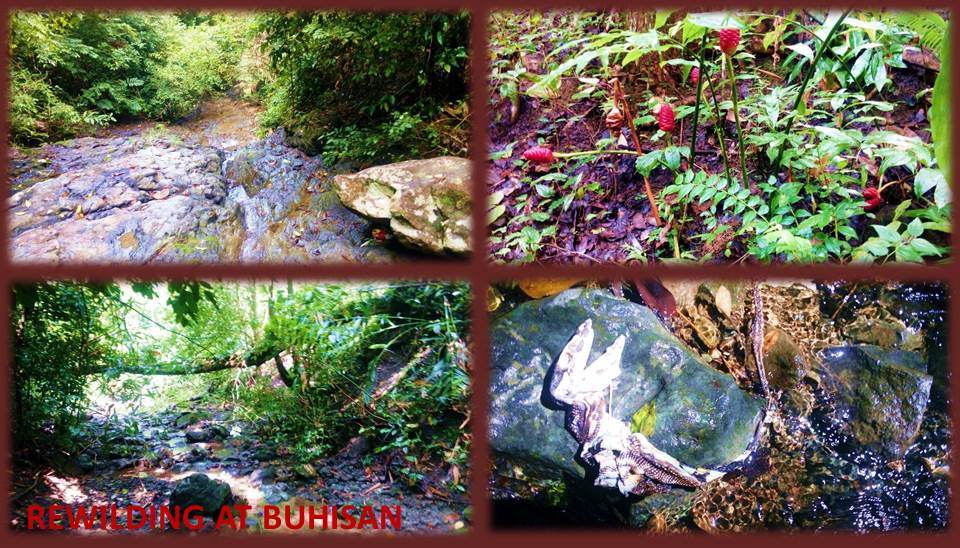
BUSHCRAFT BUHISAN XLV: Rewilding
REWILDING IS THE RETURN of habitats
to its original state, to include the re-introduction of wild animals that were
once native there before its disappearance. My version of rewilding is the
return of the wilderness into my system. Immersion in a jungle environment, on
a place or a camp all to myself, far away from any human company, is my idea of
rewilding and I have the perfect place for it – Creek Charlie.
I need to return to the wild alone
today, October 27, 2017, and there is no other day. In a few days, I will be
sailing to Mindanao so I could teach and share bushcraft skills for the very
first time there. Whenever I do that, I always retrieve the essence of the
forests, the jungles, the mountains, the streams and all that is in the
outdoors for connection, inner strength and a renewed knowledge in woodlore.
I cannot explain that to someone
who has a mindset that is so different from mine. I may dress and behave like
anyone else but I am not what you think. I am now carrying thoughts borne out
of my native origins which I have rediscovered and embraced long ago yet modern
enough to write something complex as this article. Yes, Virginia, my philosophy
of the world around me is in all my writings.
You know, I have been assimilated
unawares to conventional ways but I cannot undo it. I do not hate myself for
that nor feel uneasy of all these people around me whose mindsets are
mechanically trained since childhood to think and act in a manner and behavior
tailored-fit for Western culture. I could do nothing about it and I can live
with that but it does not carry an obligation to explain everything to someone
who is of not my kind.
However, you may understand me if
you follow the gist of this article. So, rewilding is a sort of ritual that I
have done countless times, before I proceed to do big tasks ahead. It had
helped me release stress while I was in a corporate prison, working my ass off
for my masters. Rewilding had enriched my spirit and my life, and lets me
retrieve wisdom that are not available in conventional channels.
Personally, I love solo walks into
the mountains. The silence is something that I would not trade for a lively
company or the spattering of friendly conversations. My kind of silence is the
whisper of wind among leaves, bird songs, the frolic of water in a stream, the
buzz of a fleeting bee, even the crackling of dry tinder before a robust flame.
I longed for these kind of sounds. Primeval and distant. In silence, these are
so sweet to the soul.
I followed a path that I know very
well and the chance to tread on bare ground immediately connects me to sacred
grounds. I became one with the forest. Unobtrusive in movement and clothes.
Silent like a cat. No hurried steps, no pressure of time. Not even the presence
of dark clouds overhead could alter my pace. I am that rare someone who found
enjoyment in what I do – alone – even walking on the same trails and places.
My Silangan Predator bag swayed as
I struggled for balance when a shoe failed to grip softer ground downhill,
exposing my presence to whoever may walk this path. But I doubt that. I have
still to meet someone who is brave enough to walk trails on a weekday. Alone. Too
bad, everyone is a slave to the system and their time is programmed on weekends
only. Cannot blame them. Better that way. I can have all the spaces without
them.
The sun warmed up the forest and
steam begins to rise. I am sweating even when I am under shady trees. Wild gingers
are flowering everywhere, even within the unwelcoming presence of a Burma teak
forest. Long ago, our forest managers eat anything fed to them, planting exotic
species, never knowing the troubles it brought to native species, insects,
birds and soil. This man-made forest is a failed experiment even if the trees
grew healthy.
Creek Alpha is before me and the
stream is full and merry. I followed it downstream, careful this time not to
leave any trace. Common sense tells me to evade streams but I find good sense
of forest people using part of the stream as a route. They know their own
places and I am learning from them. I see where they placed foot on rocks and
know what are they wearing for their feet. Because of them, Creek Alpha now has
a name: Banauan.
I am leaving Banauan Creek and the
phony forest and I am now on a trail in an environment that is much wilder. Presence
of spiny rattan competes for your special attention apart from the softened
trail. This path is one of the wonders of local knowledge. It simply followed a
certain contour instead of cutting across a mountain. It benefits well my walk,
rising gently to cross a saddle and going down gently to Creek Bravo.
Just like the first stream, Creek
Bravo is also energetic and loaded. On a rock is a carcass of a juvenile
monitor lizard which died several weeks ago. This particular stream is teeming
with rocks of all ages and sizes, broken up by the force of water. Across me
are the groves of water bamboos, fully recovering from wanton destruction five
years ago. I have planned of reintroducing fresh-water shrimps here but I just
could not source live specimen.
After that brief rest, I passed
through an alley where “skin snatchers” abound. This trail is thick with rattan
palms and their spiny tendrils, slender and barely noticeable, suddenly catches
skin or fabric and you have to respect that. You take a few steps back and
slowly remove the spiny whip. My copy of the Puffin Magnum knife becomes useful
as it cleared a safe path for me.
The trail climbs up towards a
ridge, leaving the marshy areas behind for stable ground. The ridge goes up
gently but it is blocked by more rattan palms and by the equally thorny vines
of the Asiatic bitter yam (kobong), which got cleared by my open-carried
knife. At this instance, I carved a digging stick to extract from the ground a
rootcrop from the wild yam which I intend to bring home. The thorny vines make
a good hedge against intruders.
The trail led to a very beautiful
forest. Both sides are steep but it is much vegetated. It goes up and up, but
gently. I arrive a small clearing which I know as my dear Camp Damazo. It
hosted recently the 7th edition of the Philippine Independence Bushcraft Camp
last June. Twenty-six participants came to learn basic bushcraft here which I
first organized in 2011. The PIBC returned here after three years in Sibonga
and Liloan.
Settling myself on a cheap
laminated nylon sheet, I prepared my Swiss Army wood burner. I intend to boil
water for coffee for it is 10:45 anyway. Found dry twigs which I break into
short lengths and started a fire by a gas lighter. Placed a cup of water over
the rim of the burner and feed more fuel into the burner. Water finally boiled
after five minutes and I poured instant coffee. Paired the coffee with bread
and enjoyed the moment of silence.
Camp Damazo has recovered in so
short a time, thanks to the rainy season. The campfire area marked by a cairn
has settled well and new growths of vegetation begin to reclaim around it. A
remnant of a bamboo pot with its lid lies nearby a Moluccan ironwood (ipil)
and the stinging tree (alingatong) where a mass of dirt are left by the
now missing army of ants after gnawing off clean the leftover rice many months
ago.
I looked around the camp area.
Madras ginger (galangal) bears little round fruits at the tips of its
stems, ripe and drooping to the ground. The yellowish-green fruit became a diet
of a passing palm civet (singalong) and left black round scats over a
tree root. Tall arbor trees provide second-tier shade and jungle fowls loved to
forage there when caterpillars infest the leaves. Much more so with raptors and
lesser avian.
I rest for more than an hour at
Camp Damazo. I would have loved to stay here but there is something wilder
somewhere over there. I pack my things back inside my bag and proceed to Creek
Charlie. It is now 13:00 and, to my estimates, too late to explore more places.
But there is a place that I once visited four years ago. I marked that trail
but I was wondering what happened of that?
I followed the trail going to Creek
Charlie, passing by where an unusually-shaped tree that looked like a
brontosaurus, complete with feet, a tail and a long neck. This tree I also
discovered four years ago but did not have the courage to approach and take a
photo of it. I respect the presence of something other than it. Through the
years, I was able to take photos from afar, then point-blank, when I think it
is now used to my presence.
I am not superstitious and do not
believe in those “third eye” tales, but I am convinced of the presence of these
rarely-seen elements. I have seen and encountered many of these kind, even at
closer range possible, yet I do not show fear and I let them be as they are.
When you are a renewed Roman Catholic you would understand and be aware of
their presence but it does not mean that you are impervious from harm.
Vegetation near it was being
cleared and a hunter’s shed is being built near the trail, already shriveled,
exposing horizontal wood beams that had once supported a roof of abaca leaves
and walls of galangal leaves. I looked around where the hunter might
have set his sights and I settled on thick debris that was supported by tree
branches of the brontosaur tree and its neighbors. It could host a nest, an
arboreal hiding place of wildlife.
I could only shake my head. Why
would I trouble myself waiting for a prey in an uncomfortable location so I
could get off a shot when I could do better with indigenous methods, with
myself comfortably waiting in the confines of my home? I would not have to
alter the surroundings. The only alteration I make is introducing a cord and
using a young sprout to bend to my whim.
Creek Charlie, I discovered, is
part of the right fork of the bigger Lensa Creek that supplied water to the
catchment basins, marshes, the man-made lake and, ultimately, to the MCWD
consumers. This is a stream of primeval proportions. The rocks are bigger,
water fall in cascades. You get caught in a flashflood here and you are dead.
It is never a good idea to use this as a route but I know of a trail across me.
It is steep and follow a very
narrow ridge, steep on both sides with one side on a deep ravine. The soil on
this ridge is soft and it is not good to bring a lot of people here, especially
people who do not carry the same mindset as mine. I crossed over another ridge,
which can be reached by a short leap. The trail suddenly dies out and I am
facing three possibilities, once upon a time paths before these were choked by
vegetation.
I choose the marked trail and
passed by a hole filled with very clear water coming from a spring. I did not
see this before. The jungle is unfolding and showing me things that were denied
to me last time. Must be because I am very patient or was it my awe and reverence
for this place? I passed by the first of two bamboo groves. Poles are left by a
forest dweller on the ground but I place it standing up beside a trunk. I might
use this someday.
I am going to my sacred place in a
jungle where it faced a distant lone mountain and the rising of the sun. I have
bamboos to make a shelter – a sweat lodge – where I can do meditations in the
future and be away from the complexities of urban living. It is there among
giant figs (tibig and talo-ot) with buttress roots as tall as a
man. Then I saw movement. Timid, confident and unafraid. Brown fur and a thick
tail. Squirrel?
The Philippine squirrel (kangsi)
is a very elusive rodent that is common in Palawan. But on my visit to Mount
Pangasugan in Leyte last March 2014, my guide showed me a live one staying
inert on a branch from a distance of about 50 meters. I could only see a brown
smudge among the greens but its shrill whistle pierced the early morning air.
You would think that the noise they made were done by birds.
I believed Cebu was part of its
habitat when it was still all forest and too few people claiming farm patches.
In case you do not know, there is a place in Sapangdaku Creek and everywhere in
Cebu that are called Kangsi or Kansi. Nobody remembers why it is called that
but I know why? The creature I saw disappeared among the roots and I found
holes underneath it, the entrances are well used, indicating a healthy family.
Yes the forest is unfolding and
showing me its hidden features. I am quite satisfied of my finds that I did not
tarry long. I found my sacred place and the second bamboo is still untouched by
humans. I go back to where I came from and crossed Creek Charlie once more. I
take another trail to drink from a natural spring called Karamon. I crossed the
headwaters of Creek Bravo and Banauan Creek towards a mountain road.
Across me is a trail that goes to
Lanipao. It goes lazily downhill to the Lanipao Rainforest Spring Resort,
Cabins Resort and a store that sells cold soft drinks. Walking on, I found another
recreation center – Motmot Spring Resort – that was not here last June. Not
only was the forest unfolding its secrets to me, it also include this road to
Napo. So much for mysteries. Ha!
Document done in LibreOffice 5.3
Writer
Posted by
PinoyApache
at
09:00
0
comments
Labels: Buhisan, Cebu City, commentary, exploration, plant ID, soloing
Wednesday, August 1, 2018
BEBUT’S TRAIL XIX: Taro Tendrils
WHEN YOU ARE KEEN
on exposing people to creative cooking using unfamiliar ingredients in an
outdoors setting, it is just second nature for you to rise up from your comfort
zone and heft a bag for the woods. Today, August 20, 2017, I would walk with
seven others on the same route I walked last week - “Heartbreak Ridge”. Our
destination would still be that shed in Sibalas. It is now a spot well-loved by
the Camp Red Bushcraft and Survival Guild.
One of those who
would hike up the infamous hill is the not-so-little Titay anymore. She will be
with his dad Aljew. Titay have grown into a beautiful dalaguita - an
adolescent lady – and how time flies. Also braving the bare hill are Bonna,
Jhurds, Theresa, Jingaling and Glyn. We left the Our Lady of Guadalupe Parish
at 08:30 after acquiring the ingredients for our noontime meal from its side
market.
It is now 09:00
and it is very warm here as was last week. I am worried about Titay so I gave
her my elastic headwear to shield her head, face and nape from direct sunlight.
She begins to tire when she reached the steel tower and her dad has to goad her
gently so she would overcome the last hump. Beyond there are bush and woodland
and a shaded trail where many birds found refuge.
I bought this time
two bundles of jute leaves (Local name: saluyot) which I preserved
upside down and covered in loose layers of parasol tree leaves (binunga).
I also acquired several pieces of okra, a few green pepper, onions, garlic and
two bundles of vine-like taro root tendrils (takway). The main
ingredient would be the young taro sprouts which I plan to cook in two
different dishes.
If you have 230
grams of taro sprouts, if boiled, it provides you 3.22 g protein, 165.6 mg
calcium, 0.92 mg iron, 1534 µg vitamin A, 0.05 mg thiamin, 0.18 mg riboflavin,
1.45 mg niacin and 48.30 vitamin C. It provides you energy with 110.40 kcal.
(Source: Cooking Smart by Blecenda Miranda-Varona and David Arsulo
Varona, Philippine Publishing House, 2005.) We have about 1,200 grams of that.
It
can reduce high blood pressure, controls blood sugar levels, protects the skin,
prevents different types of cancer, enhances digestion, increase circulation,
prevents heart diseases, improves vision, boosts immune system, strengthens
muscle and nerves. It also contains dietary fiber, which
plays a very important role in the digestive system. Consumption of this can
increase our gastrointestinal health. It also prevents diarrhea, cramps,
constipation, bloating, excess gas, and improves the overall health of the body.
We
arrive at the shed in Sibalas at 10:15. This wooden structure is built at the
instance of Jhurds, currently Camp Red’s head shed, and with the assent of Luceno
Labrador, the lot owner. Camp Red helped in reforesting the place with fruit,
hardwood and indigenous species. The shed would host outdoors seminar someday
but, for the moment, it sufficed as a place where we do “dirt times”.
As on previous
occasions, the shed becomes the center of a few hours of camp life. The split
log seats are there to give spartan comfort and respite to the tired limbs
while the wide center table gives convenience to those who would prepare the
food prior to cooking. The table is now accommodating the food ingredients and
the tools for cooking. The men among us proceed to forage dry twigs and
firewood. The ladies stayed to process meat and slice the vegetables.
Fire begins to
blaze by the time Aljew’s firebox and my Swiss Army wood burner were set up. A
pot of water is boiled first for that beautiful thought of a coffee drink. I
took care of another pot for rice. One of the ladies, Bonna, watched the
cooking on my behalf while I busy myself with the taro sprouts. You have to
peel the outer layers first as it would cause itchiness on your tongue, gums
and throat. It has a substance that is common among taro species.
It would be
painstaking work. You have to use the edge of a blade lightly so skin will be
stripped away and there are around twenty of these long stalks, which measure
around two feet each. As you work on these taro part, you would notice that the
color of dark purple adhere to your thumbs and fingers caused by the natural
dye that is found on the insides of the skin. When done skinning, you chop the
stalks about 2 inches long each.
On the other
front, an earthen hearth is prepared for cooking the marinated meat on glowing
coals. Aljew and Jhurds help each other that there is sufficient firewood to
make this possible. Titay watched all these and sometimes would sidle by her
dad and asked a few questions. Aljew taught her how to safely use a knife, chop
firewood and feed wood on fire. This is another aspect of Titay’s ongoing
education into a better adult that his dad envisioned of her. He is training
her in this unconventional setting.
Half of the
processed taro stalks, I would cook as a soup. I would not use any meat
ingredient (subak) to achieve taste. The taro is the main ingredient and
it has its own special taste, which is enhanced by the addition of jute leaves,
sliced onions, salt and black pepper. It is a traditional Cebuano fare called bas-oy
(vegetable soup) minus the meat.
Sliced okra is
mixed with the other half of the taro tendrils. Garlic, sliced onions and green
pepper are sauteed first before the taro is dropped into the strong-smelling
oil that is simmered a bit. Care is observed not to stir the tendrils while it
is cooked for a few minutes so it would not release a substance that causes
itchiness. When the texture becomes brown, the okra is mixed to the fare and
stirred while soy sauce is added.
On the other hand,
the marinated meat took time to cook. Everybody waited. At 13:30, we got our
meal. For the rest, it is their first time to taste young taro tendrils. I am
used to its slimy appearance but, once you get to like its taste, you forgot
about it and you crave for more. The taro adobo is the easiest to cook but it
can also be cooked with coconut-based soup, simply fried in a pan, or rolled in
rice-paper wrappers.
Plant
identification is very important in bushcraft and survival. Today’s session
educated the people from Camp Red the appearance of jute leaves and young taro
tendrils. They were also exposed to the methods of cooking these. Sharing what
I know and showing them how. The pots, plates and spoons are washed in a nearby
well. In an hour we would be moving out but, for the meantime, we engage in
small talks.
Aljew foraged a
green coconut from a short tree and opened it. Titay watched how his dad did
it. She drank the natural water straight from the small hole. The coconut was
split in half by his dad while Titay scraped the meat with an improvised spoon
made from the green husk. It might be ordinary for you readers but bonding with
a daughter or son and exposing them to the outdoors is something you would
crave for if you have the time.
By 14:00, our
things are slowly returned to our bag. We took another trail that led to
Baksan. We reach a road and it is a long way back to Guadalupe. We will pass by
the Sapangdaku Spillway and going there would all be downhill by a concrete
road. We crossed a bridge and walked the rest of the way to the church. Titay
felt the fatigue and the pain but her dad never left her side. She reached our
destination and she got her fish balls.
Document done in LibreOffice 5.3
Writer
Posted by
PinoyApache
at
11:00
1 comments
Labels: Baksan, Camp Red, outdoors culinary, plant ID
Subscribe to:
Posts (Atom)