Showing posts with label campfire. Show all posts
Friday, March 13, 2015
BUSHCRAFT BUHISAN XXVI: Badassery
I
REACHED HOME AT 12:30 and ate a hasty lunch ten minutes later. Then
it began to rain. I am worried that I would be further delayed to
embark on a solo journey today, July 5, 2014, because of this. When
the rain stopped, I thanked all the saints and hurriedly left my
residence at 13:10 and commute to Jones Avenue then to Guadalupe,
then I hired a motorcycle to bring me to the trailhead at Baksan.
I
carried an old-school desert-tan Lifeguard USA rucksack and,
in it, is a camera tripod, an Apexus taffeta sheet, a box of
safety matches and a stainless-steel cup. My tomahawk - my old
adventure partner – is open carried, the haft slipped into my
operator belt. To protect me from mosquitoes, I brought my Umbro
long-sleeved shirt, a sniper mesh and my long-standing partner on a
myriad of sleeping grounds – my bonnet. A Silangan side
pouch housed my dilapidated Kodak camera and a cheap
cellphone. That is all.
It
is 13:50 when I started. I am almost two hours late. I should have
released myself at exactly 12:00 for this novel activity called
Survival Day. Survival Day answers to the requests of the Camp Red
Bushcraft and Survival Guild to engage their members in an activity
combining all the elements of bushcraft, survival, navigation and
escape and evasion. A selected pair would engage on this overnight,
preferably on a weekend, with a third man observing and documenting
their activity. They would have to choose one place from among three
sites.
When
this was posted in Facebook, they were all taken by surprise. A
daring few volunteered to enlist in a dry run but all bowed out at
the last minute. Since I designed this activity, it is inherent in
me to show all how it is done. To increase the ante, I will do this
alone while doing the documentation myself. I choose the Buhisan
Watershed Area, because that place is a perfect bushcrafter’s
paradise. It is all jungle and home to some of the nastiest bugs.
From
Baksan, I followed the path I had discovered to Creek Alpha. This
route is already integrated into the old Lensa Trail which the locals
had used for many years. The ground is wet but it is not slippery.
Still, I opt to cut a green limb of a Mexican lilac tree (Local name:
kakawate) as my walking stick. It is 7-and-a-half feet long
and it is heavy. I pass by a teak forest and I look for dry leaves.
Since it had rained all the time, I found just a few, crushed it, and
placed it inside a plastic bag.
The
grasses are waist high as I follow a low ridge then another adjoining
ridge, this time climbing up to a hill which I loved to call as Boy
T’s Hell. I pause for a while to study the somber sky, the verdant
greenery and my back trail. I do not see a soul but I see traces of
a rattan planting activity. They – the DENR1
or the MCWD2
– intend to discourage people from visiting the Buhisan by planting
these like a hedge. It might be for a lot of reasons like wildlife
poaching, illegal logging and, possibly, trail running, which the
latter is downright hazardous if done here.
I
go down the hill and follow another ridge where there is a tree with
my trailsign. I found it and slowly trace the now-scant path. The
walking stick is most helpful here as I get to pole vault over
shallow ravines and save me the trouble of jumping without something
to anchor on on slippery ground. Slowly, I reach the stream, after I
had carefully maneuvered among spiny plants and those that I thought
are toxic. You could never be too sure.
I
am now on a very secluded trail, but very beautiful from whichever
point of view you are in. The stream is full of water, clear and
running. I carefully set my foot on stones when I walk on the river
bed, intending to leave no trace of my presence even to the extent of
climbing up on a path of loamy soil. I leave my presence at the top,
but it is on a wrong trail. I do this all the time to fool anyone
who might take advantage of my being alone. The Buhisan is still a
dangerous place since it is a refuge of lawless elements.
I
follow the path and pass by the old campsite of the first Philippine
Independence Bushcraft Camp. Along the trail are very dry leaves of
a dead Indian rhododendron shrub (yagumyum). I collected a
lot which disintegrate itself into tiny bits when handled. I soon
found my plastic bag of dry tinder getting bigger and bigger which my
pants pocket could not accommodate anymore, so I decide that I have
enough and place it inside my bag.
I
walk on, scanning everything that might be edible, but the sky
darkened and I hurry up. I reach Creek Bravo and I take a rest.
This is the only place in the Buhisan where there are groves of water
bamboos (butong, buho). The groves are located at a higher
place and there are no paths there except through a small
watercourse. I climbed up using my hands to gain footholds.
Although I am bulky and heavy, that had never been a problem for me.
I used to rock climb in the ‘90s and I still got a good
eye-to-muscle coordination and a tight grip.
The
groves have thinned as it had been harvested over several times and
only a few healthy poles are left, most of it young. One grove is
being burned down and I can not comprehend why? I do not want to cut
the few remaining poles so I looked for poles that had already been
cut and overlooked by the gatherer. I found one hanging on a tree
with four segments and I am able to save two conjoined segments. I
also found a smaller but pointed pole, about six feet long, on the
ground. I bound the bamboos together with a vine so I could carry it
easily.
The
sky is getting somber and somber as the afternoon light is losing its
intensity. I will carry my bamboos and wooden staff over an
ascending ridge, on the lookout always for rattan tendrils. As I
walk on higher elevations, the light improved, visibility clearer. I
see wild mushrooms (kwakdok) on dead wood and I pluck these.
I walk on and startle a brush cuckoo (sigigid) feeding on the
ground. It had not noticed me coming until I am about five feet
near. I see a lot of dry wood on the ground but I prefer those
hanging in midair.
I
am now approaching Camp Damazo and I notice one of a pair of huge
wood pillars that had guarded its entrance had succumbed to decay.
Ah, the place that had nurtured the finest products of the PIBC had
recovered well, the fire ring of stones under the Moluccan ironwood
tree (ipil) remained untouched. I am tempted to stay for
there is an abundance of light here but I need to be at the water
source first to study the possibility of camping near it and to
placate my throat.
I
found the natural spring and I drink two cups of the fine water.
Fresh-water crabs inhabit here and it appears only during nighttime.
It would be best if I could camp nearby so I do not have to walk far
and burn up a makeshift torch. The torch is a problem though as I
had not found a dry suitable material like palm leaves. Anyways, I
cut the bigger bamboo in half so I could fashion a water container
out of one while the other half as a catch bin should I push to catch
crabs tonight. I carved a spout for the water container and punched
a hole at this end, then I fill it full with water after washing it.
I
look around and I see a promising place to camp but it is gloomy and
a possible route of running water should it rain heavily. I
backtrack to the spring and decide to spend the night near Camp
Damazo instead. My lacking of a dependable lighting to illuminate my
foraging in the night discouraged me but I leave the catch bin if
ever I could find dry leaves as a torch, time willing. It is now
almost 16:30 and I need to go back to Camp Damazo to take advantage
of the light being plentiful there.
I
size up the place and I see a good ground thirty meters away. I walk
towards it and I found a perfect spot although I need to cut or break
a young tree to achieve a good campsite. It is underneath three tall
trees with a hardwood species of tree (tugas) growing
underneath it. There are no rotting branches on the trees and should
a piece of either tree fall, it would be caught by the branches of
the shorter hardwood tree. Breeze comes from the valley below and
would fill my shelter with smoke should I make a campfire in between.
I
notice a swarm of small forest mosquitoes beginning to torment me and
those big black ants appearing suddenly as all sensed me expending
carbon dioxide. I need to keep moving to distract these insects.
Immediately, I cut several stalks of a zingiber plant and lay it on
the ground. I grab an armful of crawling ferns that had been choking
a young tree and place it above the leaves laid on the ground so I
could use it as a cushion for my body should I lie to sleep.
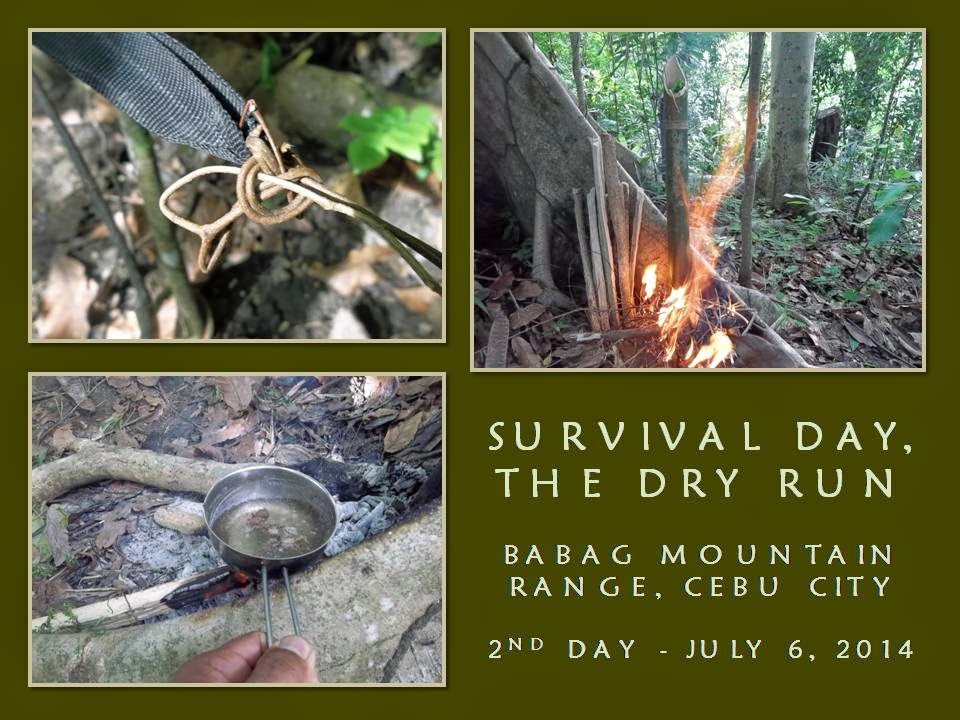
I
draw out my taffeta sheet from my rucksack and tie the middle grommet
holes to the tree trunks with laces from my Columbia hike
shoes. I extend one part of the sheet as a low awning close to the
ground, tying one end with a piece of black clothe that I had been
using as a head band and the other end with a vine. The other half
of the sheet I would use partly as a wall and partly to cover the
leaves where I would be sleeping on. I retrieve a long pole lying on
the trail so I could use this to retain the angle of the sheet wall
firm.
I
would not have carried the walking stick here without a purpose. I
place it underneath the sheet that would be used as my sleeping area.
It would be placed so it would keep me from rolling over and to
restrict my body in one place so my body heat would not be wasted. I
believe it would be cold tonight and I need to be warm. I will
collect firewood, the ones hanging in midair. I found many and I
break the twigs into three different kinds: pencil lead size, pencil
wood size and thumb size.
I
make a nest of tinder and kindling beside a jutting root of an arbor
tree, which act as a shield, before I struck my first match.
Humidity causes the dry leaves to absorb moisture quickly and, until
I struck my fourteenth matchstick, I was able to make a roaring fire.
I feed dry firewood and collect bigger wood which I cut and split
with my tomahawk. I drag some more and keep it off the ground. The
mosquitoes and ants begins to disappear as it senses wood smoke. I
can now rest easy and feed the fire from time to time.
I
drag some felled branches with dried leaves still attached to it and
use it to camouflage my shelter. By 19:00, I take rest inside my
open shelter, donning the long-sleeved shirt and the bonnet. The
mesh, will cover my head, upper body, arms and hands. I listen to
the sounds of the jungle. I can hear hundreds of geckos inhabiting
this part of the Buhisan. You could distinguish each individual by
the timbre and manner of their croaks. Also grabbing attention are
jungle fowls, a myriad of birds, frogs and a cry of a palm civet.
The
mosquitoes, they came, and how they loved to hover near the ears. I
move to my side and pray when would this torment end. When the
breeze shifted direction, the mosquitoes would be gone but when the
breeze disappears, it would be back with a vengeance. Fed up with my
failure to gain sleep, I feed another set of firewood to my small
campfire at 20:30. My eyes had already adjusted to the darkness that
I could walk my way around to take a leak. The whole place is now
foggy.
The
strong winds came and all creatures are silent. Rain will come soon.
I hear branches breaking, a lot of it falling to the ground. A low
pressure area near Luzon had been bringing all these rains and a very
strong tropical typhoon (Glenda) is looming in the Pacific,
approaching my island by the hour. It is raining lightly but it
never affected my fire. A few drops fell on it and I thought it at
first as a person walking on grass (as raindrops hiss on embers) but
it is only my mind playing games on me.
The
mosquitoes, well, they remained when the breeze shifted to another
direction and would be gone again when the smoke filled my shelter.
I begin to feel my stomach complaining without dinner. I rise again
from bed at 22:00 and feed my fire with enough firewood. A strong
downpour fell but the fire kept roaring and thick smoke would emerge
when a few raindrops found its way there. My struggle with the pesky
insects continue on until past midnight where I rise again and feed
my fire.
I
hear the beautiful melody of a black shama (siloy) and
unbelief is written all over me that I had really slept. I look at
my wristwatch and it is 05:30. The second day (July 6), at last, but
I am not in a hurry. I peek at my fire and all the wood are burned
out. I go back to sleep. I wake up again at 07:00 and rise to
rekindle my campfire alive. I prepare another nest of tinder and
light twigs and it took matchstick No. 21 before it roared to life.
I
will heat up the water inside the bamboo that I had collected
yesterday. After 45 minutes, steam begins to appear from the spout.
I get my cup and poured me a good-quantity of the bamboo-flavored
water. Then I place wild mushrooms that I had foraged yesterday on
the liquid and set my cup above the embers to boil it into a soup.
“Wild mushroom soup, that is the menu for
breakfast sir.” It might be inadequate but, at least, it is
nourishment.
Breakfast
at 09:00 and I sit still on a rock listening to the melodic chants of
two individual black shamas and the buzz of the cicadas. Suddenly,
from out of nowhere, a reddish cuckoo dove (tubaon) perched on
a dead wood three feet away from me. It eyed me curiously for about
fifteen seconds and transfer to a young tree at my back. I could not
resist the temptation of moving my head after 30 seconds to see its
beauty and it flew away. Oh, such little pleasures give meaning to
life.
I
take advantage of the sparse sunlight on the open spaces of Camp
Damazo and I drink two cups of the bamboo tea. Noontime is still far
and I have to kill time by taking a little exploration of a ghost
trail that I had noticed below my place. I go back and try my reflex
on my tomahawk. The remaining wood pillar becomes my target board.
I am quite rusty, my throws lacked consistency now as I have not had
the time to practice it anymore, unlike in the old days when I was
engaged in a warrior’s pilgrimage.
Two
hours more to go. Boredom led me to my shelter. I feed the fire and
lay down. Strong winds from the southwest arrive and everything
becomes silent. It rained again. I wait out the rain under the dry
safety of my shelter. It is a light rain or it might be the canopies
filtered this into something more tolerable. I close my eyes and I
awakened at 11:30, thirty minutes more and I will be on my way.
When
12:00 do arrive, I break camp, put out my fire and put everything in
order. I carry the pointed bamboo as my staff. I pass by the
natural spring and drink two cups of the refreshing water. The
female bat that I had startled yesterday near the spring is surprised
again by my presence and flew away. I cross two small streams,
probably these are the upper parts of the streams I crossed
yesterday. The route is uphill now and I take it slow, resting
twice, each for 30 seconds.
I
reach Baksan Road at 12:45 and I feel good. The struggle would be
easy now as it is downhill all the way to Lanipao. When I arrive at
the place, I just rest a minute before resuming to the designated
rendezvous point – Napo, which I reach at 13:10. I could have
gratified myself with cold refreshment and biscuits but I intend to
do it at Guadalupe instead. I still have an extra 10 miles of
resistance and I believe I could do that.
Guadalupe
at 13:30 and I reward myself with a humble lunch in a small store.
Then I proceed to the Red Hours Convenience Store to recoup my
electrolytes with cold bottles of San Miguel Cerveza Negra.
It was a worthy two days of solitude which would perfectly change the
game of how the outdoors would be best enjoyed here in the
Philippines. Being badass is not always bad and, sometimes, in my
dreams, I liked to to toy with the idea of creating a new hobby
called BADASSERY3.
Document
done in LibreOffice 3.3 Writer
1Department
of Environment and Natural Resources.
2Metropolitan
Cebu Water District.
3It
is coined by Conal Robbie when he commented on my June 24, 2014
article titled “Bushman Blogger Badass”. Conal is the owner of
the blog www.crucifixio.wordpress.com.
Posted by
PinoyApache
at
09:00
0
comments
Labels: Baksan Forest, Buhisan, bushcraft, campfire, Cebu City, foraging, Lensa Trail, plant ID, soloing, tool making
Thursday, February 12, 2015
PHILIPPINE INDEPENDENCE BUSHCRAFT CAMP 2014
FOR
THE FIRST TIME, the 2014 Philippine Independence Bushcraft Camp will
be done at Lower Sayao, Sibonga, Cebu. For the last three years, it
had been held at Camp Damazo, a very secluded nook of the Babag
Mountain Range, Cebu City. Camp Damazo had hosted forty-seven
individuals, on three occasions of the PIBC, to learn bushcraft and
survival from this blogger.
The
old camp had increased in size brought on by a yearly occupancy and
this blogger looked for other places which does not necessarily be a
jungle environment. The campsite would have to could accommodate a
good number of people and be able to absorb the impacts of campfire
cooking. So on June 10, 11 and 12, 2014, the PIBC migrated to a new
location.
Sibonga,
a town located 56 kilometers south of Cebu City will host the new
campsite on a hilly village which can be accessible from its village
in Candaguit or from Ocaña, Carcar. The good thing about the new
campsite is that it has a very reliable source of clean potable
water, a healthy relationship with the local community, a very secure
location and an ever-present cool breeze coming in from Bohol Strait.
We
all assemble at the 7Eleven Convenience Store, across the Cebu South
Bus Terminal, early morning of June 10. An aircon bus loaned from
the Municipality of Liloan left at 07:40 and ferried all to the base
of the campsite. All begin the short trek afterward to the top of a
hill where mango trees grow. It is a very warm day but the
possibility of rain is not discounted. The campsite is open terrain
but there are shady areas.
The
PIBC is a very limited affair and those who counted themselves in to
learn the basic training on tropical bushcraft and survival are
Jerome Tibon, Nelson Orozco, Maria Mahinay, Justin Ianne Abella,
Jillian Ann Yap-Binoya, Justin Apurado, Jon Daniel Apurado and Gerald
Ortiz. Some of them had been joining the activities of Camp Red
Bushcraft and Survival Guild and their participation would solidify
their entry as full members.
Coming
along are previous products of the PIBC like Jhurds Neo (2012),
Dominic Sepe (2012), JB Albano (2012), Eli Bryn Tambiga (2012),
Fulbert Navarro (2012), Conar Ortiz (2012), Aljew Frasco (2013),
Christopher Maru (2013), Johnas Obina (2013), Allan Aguipo (2013) and
Patrick Calzada (2013). Jhurds and Dominic will both administer the
campsite; Eli Bryn would document the whole event with his camera;
while Fulbert, Conar and Aljew would discuss different chapters. The
rest would function as handymen.
This
year’s theme is MAKING A DIFFERENCE. It is inspired by the
resolute spirit of the Filipino people in spite of the challenges and
difficulties it faced right after the 7.2 magnitude earthquake in
Bohol and the post-Typhoon Haiyan devastation in Leyte and North
Cebu. I am convinced that with the proper set of survival skills and
knowledge, any calamity can be overcome and the PIBC could provide
these.
On
the campsite, majority of the participants and staff preferred the
simple taffeta or a laminated-nylon sheet as shelters which they
either paired with a hammock or with a ground sheet. The rest of the
morning are dedicated to foraging firewood, inspecting the latrines
that the organizers had prepared last June 1 and fetching of water
for drinking and cooking. Additionally, I cut a single pole of
bamboo for training aid later.
After
lunch, this blogger opened the PIBC and proceed on to the first
chapter, which is about Introduction to Bushcraft and Survival. It
rained but it never interrupted the outdoor lessons. When I had
finished this section, Aljew proceed to talk about the chapter on
Knife Care and Safety. It is still raining but Aljew is very
persistent, nonetheless, and refused to be bothered by it. The rain
had slackened when I begin the lesson on Survival Tool-Making.
The
long bamboo pole gets dismembered as the participants practice their
dexterity with the knife by carving drinking jugs and spoons. They
were taught the proper way to cut and safe handling of the knife.
After dinner, a small fire becomes the center of the PIBC socials
where a bushcraft tradition of Campfire Yarns and Storytelling will
entertain all. Liquor is encouraged to provide animation to the
tales but it is drank in moderation. This caps the first day yet
there is a nightwatch alternately done by two camp staffs every two
hours.
The
second day – June 11 – starts with a breakfast. After this, the
participants and staff would spend the whole day without food to
simulate the hunger pangs associated with survival. Conar and
Fulbert jointly hold the lessons on Basic Knot Tying. This was
supposed to be discussed on the first day but delay caused it to be
rescheduled. It is another warm day but droplets of rain threaten
the training but we were not about to be bothered.
Firecraft
is the next chapter, which I discussed, with Aljew lending his time
to demonstrate how to make fire with a bow drill and Fulbert with the
bamboo saw. Glenn Pestaño (2011) and Ernie Salomon (2011) arrive to
provide support to the staff. Glenn will take charge of additional
logistics while Ernie will fix the meals for tonight and tomorrow. I
proceed on the next chapter, which is about Shelters. Then comes the
long chapter on Foraging and Plant Identification.
In
the middle of the afternoon, I lead all to a high hill where the
village chief reside for the Plant ID/Prepper Lab Tour. We pass by a
small community, secluded farms, a small lake and a cave before
entering a large compound. It has vegetable gardens, several water
sources, fruit-bearing trees, livestock, a fishpond, a private
chapel, a small blacksmith shop, a ham radio station and several
layers of defensible spots. It is the center of a self-sustaining
community.
When
we go down to our campsite, I discuss the new chapter on Prepping and
mentions the residence we visited a while ago as a perfect example of
a homestead where the owner’s mindset worked on the manner of a
prepper. Last chapter is Outdoor Cooking, which I finished at dusk.
Patrick and JB demonstrate how to cook rice and milled corn on
separate chambers of a single piece of bamboo. Ernie goes to work on
a beef stew by sheer creativeness.
After
dinner, we get ready for another highly-valued bushcraft activity,
Nocturnal Hunting. A small stream teeming with fresh-water crabs is
the training ground for the participants. It is raining but it does
not matter since all will be wet anyway walking on the stream. The

route starts from a rice paddy below camp and ends into another rice
paddy where there is a natural spring. In between is the stream
itself, a forest, a deep pond and a waterfall.
The
participants collected mature crabs only which Ernie saute in oil
before cooking it with coconut milk. Another session of the Campfire
Yarns and Storytelling follow where the jolly circle is aptly
supplied by local moonshine – fresh coconut wines. The rain had
stopped by then and the activity went on into the wee hours of the
night and that caps the second day. As usual, the nightwatch take
their posts.
The
last day – June 12 – is a day reserved for the Philippine colors
but our tradition of the Blade Porn is scheduled early. So, after a
light breakfast, the blades gets the spotlight first. Eighty-one
blades owned by twenty-two individuals are spread on two tarps! Then
the flag is raised full on a bamboo pole and everyone sang to the
beat of Maria’s hands the Philippine national anthem - Lupang
Hinirang. Then comes the oath of allegiance to flag and country
– the Panatang Makabayan - which everyone repeated line by
line thru the instance of Glenn.
We
break camp after a very delicious lunch of free-rein chicken soup,
which Ernie splendidly cooked, and dried fish. The meal is spread on
banana leaves akin to a “boodle-fight” which the military
popularized. We leave the campsite for the place where we got
dropped off by our transport. The bus arrived at at 13:30 and whisk
us off from Sibonga bound for Lilo-an. In a private beach, we
celebrate the conclusion of PIBC MMXIV with rounds of brandy to spur
on good conversations of past and present PIBCs.
Mayo
Leo Carillo (2012) join us and gave away whistle-paracord bracelets
to the participants. Free side pouches were also given to the
participants courtesy of Silangan Outdoor Equipment. Three woodlore
knives made by The Knifemaker were raffled off to the participants;
as well as lady paracord bracelets, small LED lights and a compass
donated by Glenn; three straw filters provided by Jerome; and
emergency coolers from Sea Olympus Marketing.
Certificates
are distributed to the participants recognizing their finishing of
the basic course on Tropical Bushcraft and Survival. Likewise, new
Camp Red stickers are distributed to everyone who attended the PIBC.
Before ending, Aljew treat everyone to a free dinner. This present
PIBC metamorphosed into the realm of prepping and homesteading
brought on by the special quality of the place in Sibonga which this
blogger took advantaged of and in consideration of the succeeding
disasters which have struck the country.
There
is a possibility, however, that the PIBC will not just be confined to
Cebu. A different province or city could host it, provided it falls
on June 10 to 12. The PIBC is a unique event since it focuses more
on the introduction of learning real-world survival skills to
anybody. These skills would gather dust if not used or practiced
regularly but can be retrieved anytime when the situation demands.
PIBC is just like this: You just knock only once and all things will
unravel before you.
Document
done in LibreOffice 3.3 Writer
Some
photos courtesy of Eli Bryn Tambiga
Posted by
PinoyApache
at
09:00
1 comments
Labels: bushcraft camp, Camp Red, campfire, Cebu, foraging, knives, PIBC, plant ID, Sibonga, survivalcraft, tool making, training
Friday, February 7, 2014
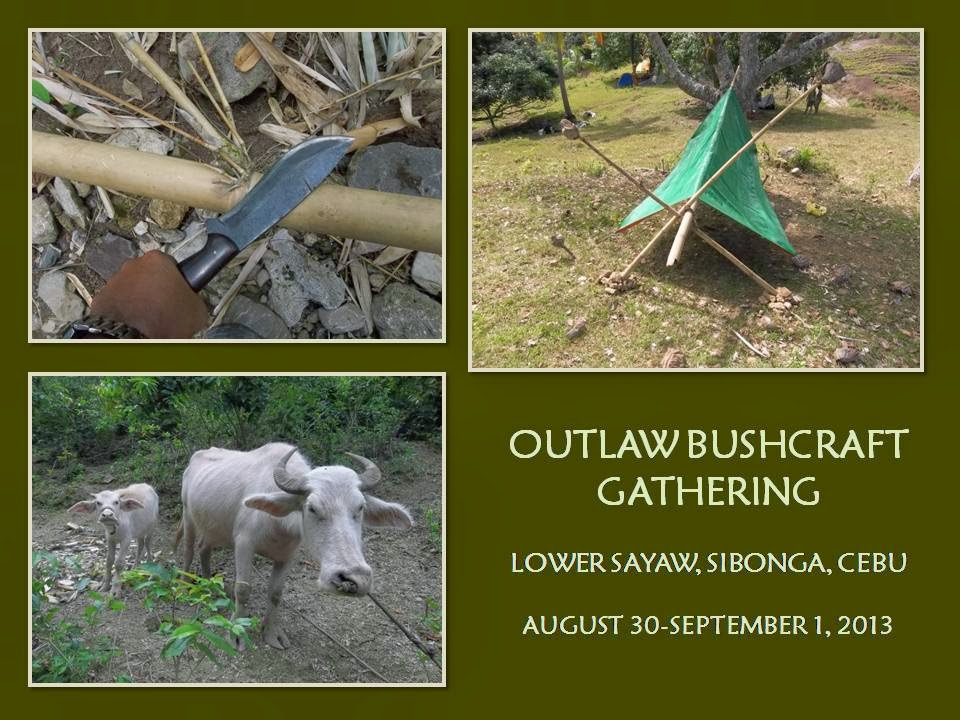
THE GATHERING
I HAVE A HEAVY backpack today, August 30, 2013, and I see the trail that leads to the campsite in Lower Sayaw, Sibonga, Cebu quite daunting. Although I am blessed with mild weather but it is humid caused by last night’s downpour. It is quarter to nine in the morning and not the best time to start a hike.
I am with Faith and Justine. Both have heavy backpacks as well and both are participants of the first-ever OUTLAW BUSHCRAFT GATHERING of which I, together with Wil Rhys-Davies, have organized under Snakehawk Wilderness School. This activity is the brainchild of Wil. It goes on for three days until September 1 and will be thoroughly different from the bushcraft camps that I myself convene every now and then.
I am sweating, breathing hard and my knees are uncannily so uncooperative today. I stop so often to adjust to the pace of Faith and Justine who both are as much in a difficult bind than me. It is a long way from Napo, Carcar from which we started our uphill walk and trees are a welcome refuge to shield us from the sun’s tormenting rays.
With my hand on an eco bag, I carry a big hard-bound children’s dictionary, vegetables and spices and a kilo of milled corn. As we reach the middle part of the route, I volunteer to carry the two kilos of milled corn that Justine had been lugging so he could free his other hand which had been holding a tent set. Wisps of moisture drop from the sky and cool me a bit but that’s all. It is warm again when it is gone.
After ninety minutes of walking and getting winded of the effort, we reach the shoulder of the hill where the others are now waiting. By now, the camp is only two hundred meters away but it is a far 200 since it is now 10:15 AM. Nevertheless, I push on at a crawling pace and stopping short of our objective to avail of a shade offered by a mango tree growing on a hillside.
Beyond the bend, I see another mango tree and then another and then a tent. Wil meet me and show me the rest of the campsite. The designated camp is empty as all the shelters are erected at a small valley down on the other side of the hill but I need to give the book to the Ramos family first. Then I go down and meet the rest of the guys like Glenn, Jhurds, Aljew, Christopher and Allan.
Wil gave a welcome speech to everyone and talk about campsite selection and safety and personal hygiene. As he was discussing, coffee is served and I drink a cup of it to pep me up after that tiring walk. It is good to just be sitting under a cool shade but there is no breeze here. Since it is almost noontime, everyone gets to work preparing to cook their meals.
I need to secure water first for drinking and washing. Coming with me to the water source are Jhurds, Justine and Faith. When we have returned, they are now in the middle of their lunch. We go back up the hill to prepare also our meals. When we have eaten, the rest are gratefully taking their siesta. It is cooler on the hill and I cannot understand why people camp at that small valley when I did not designate it as a campsite?
But I have an unfinished business and this will be the first activity: Making a tripod seat for the men’s latrine. I rally everyone to come up the hill with me where I stashed the wooden poles and retrieve it. I will need it as the latrine seat. Despite deprived of rest, I make an effort to do this task immediately.
When we had brought the poles to the site, Wil and I proceed to lash a tripod together with cheap paracord. When it was done, I chop a notch on two of the poles where a smaller pole will be lashed horizontally providing as the seat. The tripod seat is then placed above the latrine hole which I have dug twelve days ago (CB 06: Digging Holes).
Wil instructed the male participants to install a tarpaulin sheet all around the latrine in the same manner as that done earlier on the women’s latrine which was secured to six upright poles. When we have finished the latrines, I go back up the hill and begin to set up my own shelter. I need to set up my sleeping quarters before I could claim rest if ever there is one for daylight.
It is just a simple shelter with the longest bamboo pole of a tripod used as a ridge to connect to a jackfruit tree propping the tarpaulin whose four corners are secured by cords and wooden pegs. A used advertisement tarp make up my shelter footprint. The ultimate budget backpacker’s way. Breeze will flow freely to cool the insides.
As I was setting up my shelter, those that had set up tents at the small valley transfer residence nearby Wil’s. They opt to take advantage of shades under the mango trees and the uninterrupted breeze that their former campsite cannot provide. Although the former site is a good place, it is not a safe area since it is a natural drainage and, aside that, it is hot and humid there.
That is why I chose the upper ground as the designated campsite. I could recognize a good campsite when I see one and Wil also could, based upon his wide experience. Although there are coconut trees but these are planted in straight lines and you could set up your shelters in between and not underneath it. You just watch out where you walk though.
The rest of the afternoon are dedicated to conversations and socials. Wil, by his many years at the outdoors, talked about his experiences as a traveller whether it be on a desert, a mountain, on snowed places or even on a city. Conversations such as this are good staples in a campsite, especially in a bushcraft camp, although it is best beside a campfire with coffee or moonshine.
When it is late afternoon, everyone prepared dinner for the first night. Aljew, Allan and Christopher helped themselves to cook their own dinner while Jhurds and Glenn collaborated for their own. Same with Justine and Faith. Wil joined the group of Aljew while I make my own meal of mushrooms that I foraged.
The evening is allotted for Campfire Yarns and Storytelling. Aljew provide the fire while a local moonshine – a coconut wine – appeared to coax the participants into a fluid state of telling tales. Jhurds, Glenn and Wil took turns in doing that while the rest gets entertained. This goes on until the last drop of the “jungle juice” had ran out its course.
On the second day (August 31), the Gathering is dedicated for primitive-living skills. Bamboos – green and mature – are gathered from below the camp after breakfast and tools are made out of the green ones like drinking jugs, spoons, cooking vessels and weapons. Wil showed how the Aeta cook their rice while I showed my own system of cooking anything in it. Both are efficient though if you know how.
The dry bamboos are used as firewood, bows and arrows and a blowgun. Wil is the expert on bows and arrows and he made one for Faith to test on. I made a blowgun from a tube of a sand bamboo with a bamboo dart. Flight is made from the husk of a mature coconut and quite light. I try it against a trunk of jackfruit tree 30 meters away but a crosswind blow it off course else it would have hit target.
From a short pole of a green water bamboo (Local name: butong), I cook rice. From a green tube of a sand bamboo (Local name: bagakay), I experiment the cooking of rice in it. I failed to cook it properly on the latter but I am wiser now and know how to do it next time. We took our meal at 1:00 PM when the rice was cooked inside the bigger bamboo. Then all take time to enjoy siesta.
Next activity is a plant identification tour. It is my specialty but, unfortunately, I cannot be with them since I will rendezvous with Fulbert and Dominic and the owners of Silangan Outdoor Equipment - JR and Rev Cheryl Servano at Candaguit, Sibonga. Silangan Outdoors is one of the sponsors of the Gathering. Wil and I endorse their products when we do outdoor seminars together or separately.
That activity proceed on in my absence but without the plant ID session. When I do arrive back to camp, it is already 7:30 PM. The Serviano couple set up their prototype tent nearby and join the participants in the middle of another Campfire Yarns and Storytelling greased by two gallons of coconut wine. After my own dinner, I join the campfire crowd.
When the native wine is sucked dry, it was replaced by bottles of Tanduay Rum which made the conversations more animated and more amusing. It run from knives to urban legends to witchcraft to ghosts. Scary stories put a lid to the night activity and everyone silently crawled to their respective sleeping quarters including Dom whose legs became rubber that night.
On the third and final day (September 1), I woke up late to find the Servano couple already gone. I had a good night’s sleep. It was cool. After coffee time, I need to take a walk to the main village of Sayao, which is located uphill. A dirt road goes up there winding among farms set in long valleys and among hills. Coming along is Jhurds and Fulbert. I need to tour the house of the village chieftain.
I reach the top of the hill but a route goes down into a small water basin – Lake Sayao. All around it are vegetation and a small shore for people to take a swim or to catch fish. On the side is a waiting shed. Across the shed is a limestone cave. It is said to be deep but I have no appetite for caving right now as I do not have the proper tools.
Going further on, I see a big gate with an elephant fruit tree (Local name: catmon) and a rare black banana (Local name: malumbaga) on its approach. The village headman – Dionisio Navasca – owns the property where we are right now. He was born in Hawaii but returned here to manage his ancestral property. He practiced sustainable living and, without his knowing, prepping. He preserves the landscape and forbids the wanton cutting down of trees, slash-and-burn farming and hunting of wildlife and birds.
I toured the rest of his property and I see a small amphitheatre which is used as a cockfighting arena, stones broken from hills arranged as walls, a big Malay apple tree (Local name: macopa), a chapel that contains the remains of his ancestors and antique statues, a fishpond, farms of different vegetables, a blacksmith shop, fossils, a small hardwood forest, a ham radio station, a lookout deck, ancient millstones, a herd of goats, cows, swamp buffaloes and lots of free-range chicken.
I was surprised to see a huge Philippine ebony tree (Local name: kamagong) here. I instantly recognized it when I walk above a catwalk following the footsteps of Jhurds and Fulbert. Both are awed by it and it is their first time to see this tree, which both did not recognize when they pass beneath it. I smell the leaves as I bury my head amongst it. It is so nice to see one after a very very long time.
One of the things that is worth mentioning are the old stone grinders. One is made for grinding corn and constructed of Mactan stone. The other one is made of basalt rock, made in Negros, designed to grind rice. These were brought by Dionisio’s great grandparents when they left Cebu for Hawaii in 1905 to work on the sugar cane fields there. Dionisio brought it back home for good. I touched the basalt stone and I embrace it close to my heart, tears welling on my eyes.
When we returned to the campsite, I seek the items for giveaways given by our sponsors like the packs of Titay’s Lilo-an Rosquillos to the organizers and participants. Two gift certificates from Vienna Kaffeehaus and another one from St. Mark Hotel are raffled off to two lucky persons which Faith got for a free dinner for two and Allan for a free overnight accommodation and breakfast.
When it is done, I pick up my tomahawk and dagger to start the knife-throwing session. The target is a coconut tree trunk. Gosh, it is hard. My hawk just bounced off it even though the throw caught it true several times. Glenn join me and his hawk caught the trunk on its steely grip at last after several tries. I throw the knife on different distances and on different force but my timing was off, clearly a result of a rusty skill that have seen better days in the past.
When I have had enough of that, I place my tomahawk and all my blades to start the Blade Porn. Everyone followed the gist and laid down their blades. Branded ones are laid side-by-side with locally-made blades, with folders and multi-tool sets baring their teeth. The blade porn is a valued tradition in a bushcraft camp and I do that every now and then, especially during the Philippine Independence Bushcraft Camp every June 12th.
Afterwards, Glenn called everyone to gather around a sheet of laminated nylon to start the Blanket Trade. He explains to all how it is done. He placed a set of items which I matched with mine and it does not have to be that the items up for trading have the same value. The individual’s preference is taken into consideration but if the initiator of the trading do not “take the bait”, the other would match it up by “sweetening the pot”. In my case, Glenn took a liking to my offer and it is consummated. Then the trade goes on.
Before breaking camp, Glenn offered to have his Benjamin air-powered rifle for testing and firing. Impromptu targets are set infront of a cairn 30 meters away. Fulbert, Justine and Faith fired away at targets from as big as an empty sardine can to as small as bottled-water caps. Then we finally leave with all ten of us inside Aljew’s pickup for the big city.
Document done in LibreOffice 3.3 Writer
Posted by
PinoyApache
at
09:00
0
comments
Labels: bushcraft camp, campfire, Cebu, knives, primitive weapons, primitive-living, Sibonga, Snakehawk Wilderness
Sunday, August 15, 2010
OSMEÑA PEAK FROM A BUSHCRAFTER'S EYE
IT HAD BEEN A long time since I last climbed Osmeña Peak. When talking of Osmeña Peak, part of the package is taking a long trek direct to the Kawasan River in Badian or go on a stop point in Basak, also in Badian, and take a long ride to Matutinao where there is Kawasan Falls, if you follow upriver; and a good white-sand beach, if you prefer to stay on sea level.
Osmeña Peak is the highest point of the island province of Cebu rising at a height of 1,015+ meters above sea level. It is best accessed from Mantalongon, in Dalaguete, where it could be reached in less than an hour. I know of some who climb O-Peak by way of Basak and it offer a challenging route. I would take that route anytime if I have a chance.
Lately, on April 21, 2010, I got the chance to shake hands again with my Grandfather Mountain of the South. I am not alone this time but I am with Glen Lao and Rene Anduyan and, in between us, are thirty-four Boy Scouts from the Sacred Heart School which we baby-sit time and time again during the whole trip that start from Mantalungon at 1:00 PM.
Midway along the route to the peak, I chopped a lot of firewood to fuel the wok where our food for dinner and breakfast will be cooked in which a local was hired to do the task. We left all our food provisions with the cook after re-filling our water from a concrete spring box and followed the upward trail to the ridge that led us to the wide camping areas at around 3:30 PM.
It is now a different camping area. There are now barbed-wire fences, concrete shelters, a steel gate and, the one I don't like most, a high-altitude garbage dumping site! There are bottles and broken glass everywhere and an accident is bound to happen here anytime anyday. Some people conveniently throw their garbage down into the sinkholes and it is a mess. I collected whatever broken glass I could find and broke it into smaller pieces until they are crushed into powder - - almost.
Two campsites were designated but I opted to look for my own spot on an area where there are sharp rocks everywhere. I used my bushcraft sense to look for a good sleeping ground and my eyes found one rare sandy place good enough to fit my width and half my height. With that taken, I started to ascend Osmeña Peak at 5:00 PM with my camera and waited for sundown.
After supper, I decided to snake down the trail without a light and into my Korean-made sleeping bag, that I used for the first time and much better and lighter than my heavy wool-lined Chinese mummy sack. I am sleeping out without a tent and I protected the lower part of my sleeping bag by stuffing it inside a big garbage bag improving its insulation from the cold.
My camp is a hundred meters away from the higher of the two campsites and it guarded the northern approach of the camp. At 8:00 PM, the skies were very clear and I could see all my friends twinkling above me. The Milky Way is milky as ever and I am quite warm inside my sleep bag but not for long when, at midnight, I was awakened by the wind in high gear and I am enveloped in fog. The garbage bag covering the lower body helped a lot and, hey, I could move better with my new sleeping bag!
The wake-up call is now sounded and everyone in the two campsites start to rouse and move about and lights began to bob in and out of the fog in the dawn of April 22. Voices of these excited kids gave me warmth as I remembered my first foggy dawn in Camp Marina thirty-five years ago. It is still 4:00 AM and I am not about to go out of my cocoon yet. Not until breakfast time.
It was already 6:15 AM when I left Osmeña Peak for the nth time. God knows of how many times I've been here. The last time I was here was in March 2001 - the day I guided an Australian aboriginal-rights activist and his cousin and it was a long time ago. I remembered too that I did a solo climb here (twice) and camped at the peak itself and then hiked downhill into a long valley down to Badian.
I am doing rear-guard sweep to the boys ahead of me and I make most of the time shooting pictures of everything except the mayhem of the activity. Although this is supposed to be a mountaineering event but I see it with a bushcrafter's eye. I took note of the trees, the shrubs, the trail, the landmarks, the old and new tracks, traces of fire and cooking, even the angle of the shadows. My senses were alert in every change of the wind direction and of the natural sounds.
We reach Patong in 45 minutes and the boys were very enthusiastic about their new-found adventure. To remember, these boys grow up in a very sheltered world with a very protective set of affluent parents. The world they know is their home, their school and the malls. A very superficial world unlike the present environment where they are in right now where they get to witness hardship and poverty of people living in the mountains and that is good. They will be molded into better and responsible adults someday.
A half-hour later, we followed the long valley into one of the best trails of Cebu. It is a long route that follow along the contour of the valley into forests, patch farms, sentinel rocks and a good view of the sea. We rested at Malagaring at 9:00 AM and it is a time to rehydrate and hide from the probing rays of the sun. In another half-hour, we will be in the last stretch of our route to Basak.
We arrive at the school in Basak at ten and we waited for, maybe, an hour for our transportation to Poblacion. The boys were thankful of the gracious resting time after a long walk while I looked for something native like a glass bowl of a locally-fermented drink called “tuba”. I found one above a trail and it is so fresh! My thirst vanished and it's better than all those soda-cum-energy drinks. It gave back the strength to my ancient knees. Ho! Ho!
By noon we occupied the whole local eatery in the town center and prepared our gears for loading into public utility midgets a.k.a “multicabs” for the direction of Matutinao. Damn, I hate these multicabs! It is 1:30 PM when the boys witnessed their first real waterfalls in Kawasan River and they were awed at the sight of the first cataract and the second one where they do the swimming and frolicking.
I would have loved taking a bath in the lower levels of Kawasan but I would rather walk upriver over slippery trails and rickety bamboo footbridges just to take a dip at the source itself as I have done so since 1992! From a single burst of a huge volume of water, the natural spring scattered in a wide arc after an earthquake in 1998. Still it gives a good massage on my back and an “old friend” - a local version of the poison ivy known as the “alingatong” - still stand guard over the source.
The locals have befriended me up here and I am treated like a local hero after I saved the life of a local boy when a piece of broken glass thrown into the river severed the inner arteries of the right ankle. Instantly, I carried the boy in my arms running down the whole length of the trail from the source into the highway, then into a bus and, finally, the district hospital. The boy would have expired due to loss of blood and, thankfully, I was there at the right moment.
There's a lot of good memories for me in the Source and I will always go there whenever I could. I have camped there many times with my mountaineer-friends and have shared the small sandy area with my wife and my eldest son (then 5-years old) on another year. I could still see the notch of the tree scarred with the edges of my tomahawk and my Garand bayonet crossing each other during a throwing demo to the locals in 2001. Basing from the height of the tree where I saw it hit years ago, it grew to about 18 inches now.
I am saddened though that fresh-water shrimps that used to thrive here in the Source are now gone because of over-poaching. On the other hand, fresh-water crab population are not that healthy anymore. I used to catch one or two shrimps or crabs here for food and happily get rid of my canned goods to the locals. Those were the good old days and it was a rare privilege to eat what the locals also eat.
By 4:30 PM, we left the river for the beach at the back of the school in Matutinao. Dinner is eaten back at the town center and we left our backpacks at the beach but, once back, the boys have a sit-in with Scoutmaster Glenn giving last-minute instructions. After 2-3 hours of their scouting rituals, the boys set up their tents while I choose a good sleeping spot.
I found one under an old talisay tree whose foliage are thick enough to thwart a sudden onslaught of summer rain. Another talisay tree, of smaller trunk, leaned almost ground-level to the north giving me protection on my left side while I dragged a big driftwood to shield me on my right side. In between my feet and the trunk of the bigger tree, I will build my campfire.
I gathered wood debris and kindling and built the shape of my would-be campfire. Using my gathered tinder which I kept dry for the whole time, I put a small flame to life after I struck a lone matchstick. It is a natural feeling to have fire for company and mine is small but it gives off heat through radiation and convection. A lot of warmth bounced off the tree trunk and from the driftwood into me and a little of this is wasted.
I enjoyed the warmth and watched the surf hit the breakers as I sang to myself the songs that my grandfather used to sing. I feed the fire from time to time until I almost used up all my reserves and, by then, it is already 2:00 AM and I could feel the pebbles in my eyes begin to roll around and I tilt over and cover my face with a camouflaged mesh cloth and the wood smoke are all over me keeping off the mosquitoes away.
Document done in OpenOffice 3.1 Writer
Posted by
PinoyApache
at
16:46
2
comments
Labels: bushcraft, campfire, Cebu, Kawasan Falls, Osmeña Peak
Subscribe to:
Posts (Atom)